
Two police officers sued the federal government in June 2025 over Congress’s failure to install a memorial plaque honoring Jan. 6 heroes. That lawsuit is still active in March 2026, even after a plaque was secretly hung at 4 AM in a hallway no visitor can access.
The Capitol plaque lawsuit sits at the intersection of constitutional law, political pressure, and a three-year fight to honor more than 140 officers injured during the January 6, 2021, Capitol attack.
Here you’ll find the full timeline, every key player, the legal arguments on both sides, and what a court could realistically order next.
This is not a settlement case with a payout. It’s a civil rights and statutory compliance fight over whether Congress can simply ignore its own laws.
What Is the Capitol Plaque Lawsuit?
The Capitol plaque lawsuit is a federal civil case filed to force Congress to properly install a memorial plaque honoring law enforcement officers who defended the U.S. Capitol on January 6, 2021. Trump CPB Board Removals Lawsuit
Two officers filed the case in June 2025 in the U.S. District Court for the District of Columbia. They named Thomas Austin, the Architect of the Capitol, as the defendant.
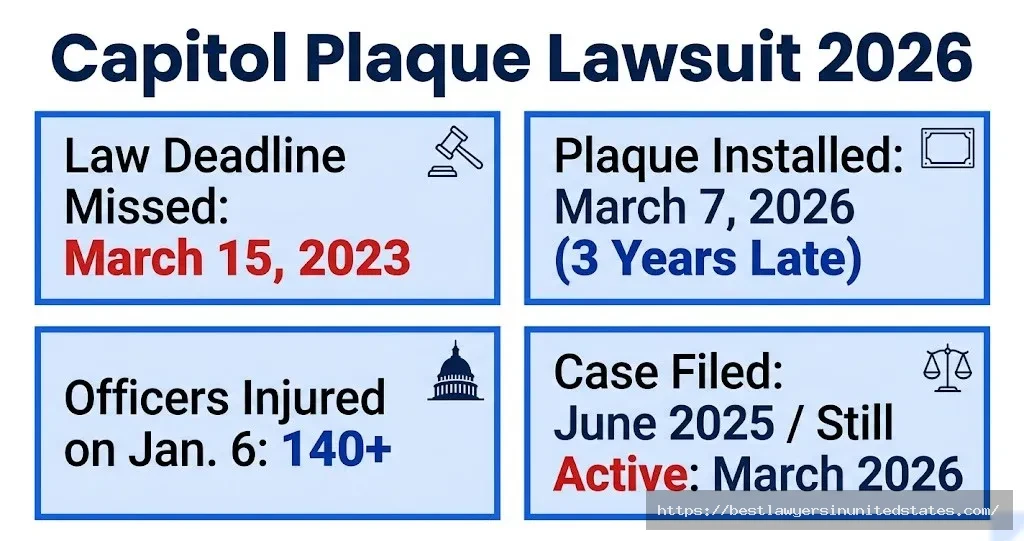
The core argument is simple: Congress passed a law in March 2022 requiring a plaque to be installed by March 15, 2023. That deadline came and went. The plaque sat in a basement for years.
| Key Case Detail | Information |
|---|---|
| Case Filed | June 2025 |
| Defendant | Thomas Austin, Architect of the Capitol |
| Court | U.S. District Court, D.C. |
| Statute at Issue | 2022 Consolidated Appropriations Act |
| Legal Deadline Missed | March 15, 2023 |
| Current Status | Active as of March 2026 |
The officers aren’t seeking money damages. They want a court order compelling proper installation of the plaque in a publicly accessible location on the western exterior of the Capitol building.
Capitol Plaque Lawsuit Update 2026: Where Things Stand Right Now
The most important recent development: the plaque was secretly installed at 4 AM on Saturday, March 7, 2026, in a restricted hallway off the Capitol’s west entrance.
The plaintiffs immediately pushed back. On March 11, 2026, their attorney filed court documents arguing the installation violated both the letter and the spirit of the 2022 law.
U.S. District Judge Dabney Friedrich then asked the plaintiffs whether their case should now be dismissed as moot. They said no, and the litigation continues.
| 2026 Timeline | Event |
|---|---|
| January 2026 | Senate unanimously passed resolution to display plaque |
| March 7, 2026 | Plaque installed at 4 AM in restricted hallway |
| March 11, 2026 | Officers filed court documents arguing placement violates the law |
| March 12, 2026 | Judge Friedrich asked if case is moot; officers said litigation must continue |
| March 2026 (ongoing) | Government ordered to respond; case active |
The judge gave the government a deadline to respond. As of late March 2026, no ruling has been issued on whether the case proceeds.
Key Takeaway: The Capitol plaque was installed in March 2026, but the lawsuit continues because officers argue the secretive, inaccessible location still violates federal law.
Harry Dunn and Daniel Hodges: Who Filed the Lawsuit?
Harry Dunn and Daniel Hodges are the two officers who filed the Capitol plaque lawsuit in June 2025.
Harry Dunn served with the U.S. Capitol Police for 15 years before leaving the force in 2023. He was among the officers who directly confronted the Jan. 6 mob. He has since become one of the most public faces of the Jan. 6 law enforcement community, including an unsuccessful Democratic primary run in Maryland’s 3rd Congressional District in 2024. He is now running for the seat in Maryland’s 5th District, vacated by retiring Rep. Steny H. Hoyer.
Daniel Hodges is a current officer with the Washington, D.C. Metropolitan Police Department. Footage of Hodges being crushed in a doorway by rioters circulated widely after the attack.
Both men have described ongoing struggles with the psychological aftermath of that day. Their lawsuit states that both officers live with lasting psychic injuries from January 6, made worse by what they call their government’s refusal to acknowledge their service.
They are represented by attorney Brendan Ballou of the Public Integrity Project. Ballou is a former federal prosecutor who previously handled Jan. 6 criminal cases at the Justice Department.
The Jan. 6 Memorial Plaque Legal Case: The Core Issue
The Jan. 6 memorial plaque legal case is about one question: does Congress have to follow laws it passes for itself?
Congress required the Architect of the Capitol to obtain and install a plaque by March 2023. That didn’t happen. The Architect told a House subcommittee in April 2025 that he had not received authorization from the House Speaker to proceed.
That admission became a key piece of the lawsuit. The officers argue that the Architect had a legal duty to act regardless of political pressure from the Speaker’s office.
The plaque itself exists and has been in storage since at least 2024. It reads: “On behalf of a grateful Congress, this plaque honors the extraordinary individuals who bravely protected and defended this symbol of democracy on January 6, 2021.”
The case also touches on a broader principle. As Dunn put it in court filings, the failure to display the plaque represents a “rewriting of history.” The legal question is whether courts can compel a legislative branch agency to comply with congressional mandates when Congress itself refuses to act.
What Does the 2022 Law Say About the Jan. 6 Plaque?
The 2022 law is the foundation of the entire Capitol plaque lawsuit. Congress included a plaque requirement in the March 2022 Consolidated Appropriations Act, a government funding package signed by President Biden.
The statutory language says the Architect of the Capitol “shall obtain an honorific plaque” and “shall place the plaque at a permanent location on the western front of the United States Capitol.”
It required the plaque to be completed by May 2023 and installed by March 2023. Congress did not fund the plaque separately; it directed the Architect to act within existing appropriations.
| Law Provision | Detail |
|---|---|
| Enacted | March 2022 |
| Signed by | President Joe Biden |
| Requirement | Obtain and permanently install a plaque at the western front |
| Installation Deadline | March 15, 2023 |
| Completion Deadline | May 2023 |
| Status at Filing (June 2025) | Plaque completed, sitting in storage; not installed |
Speaker Mike Johnson’s office argued the law was “not implementable” because the statute said the plaque should list officer names, while the plaque that was produced listed law enforcement agencies instead.
Officers and legal experts dispute that interpretation. They argue the text is clear and the agencies-vs-names dispute does not justify three-plus years of non-compliance.
Key Takeaway: A federal law with a clear March 2023 deadline was ignored for over three years, and that violation is the foundation of the entire Capitol plaque lawsuit.
Who Is the Architect of the Capitol and Why Are They Being Sued?
The Architect of the Capitol is a legislative branch agency responsible for maintaining and operating the Capitol building and its surrounding grounds. The current officeholder is Thomas Austin, who was appointed by Congress in June 2024.
The Architect was named as the defendant because the 2022 law specifically assigned installation responsibility to that office. The plaintiffs chose this strategic target because suing a House Speaker directly would raise significant separation of powers issues.
Austin told a House subcommittee in April 2025 that he had not received “final instructions to install the plaque” from the House Speaker. His statement became one of the most cited lines in the lawsuit.
The DOJ, under Trump, is defending Austin. That places the Trump administration’s Justice Department in the position of defending non-compliance with a law that Congress passed and Trump’s own predecessor signed.
How Did Mike Johnson Delay the Capitol Plaque?
House Speaker Mike Johnson, a Republican from Louisiana, is the central political figure in the Capitol plaque delay. He never directly ordered the plaque removed or blocked. He simply never authorized the Architect of the Capitol to install it.
Johnson’s office offered shifting explanations over time. The most formal position: the 2022 law was “not implementable” because the plaque listed agency names rather than individual officer names, as the statute specified.
Critics called that argument a technicality. Approximately 100 Democratic members of Congress responded by mounting poster board-style replicas of the plaque outside their office doors throughout the Capitol complex.
Trump began calling January 6 “a day of love” as his 2024 political fortunes improved. As the lawsuit notes, Republican leaders followed his lead. The political environment made any action on the plaque increasingly unlikely without a court order or Senate intervention.
Johnson’s pattern of delay tracks directly with the timeline of Trump’s resurgence. The plaque was sitting completed in storage for over a year before the lawsuit was filed.
What Does “Western Front” Mean in the Jan. 6 Plaque Lawsuit?
The term “western front” is at the heart of the dispute over whether the March 2026 plaque installation satisfies the law.
The 2022 statute requires the plaque to be placed “at a permanent location on the western front of the United States Capitol.” The officers argue that means the exterior of the building, on the west side, facing the National Mall.
That location matters for two reasons:
- It is where the most violent confrontations between officers and rioters took place on January 6, 2021.
- It is freely accessible to the general public, including Capitol tourists.
The current installation is inside a pair of doors along the west front’s interior. That hallway is not on the Capitol Visitor Center tour route. Members of the public cannot enter without escort. A sign at the top of the nearby stairs reads “Authorized Personnel Only.”
Attorney Brendan Ballou told the court that hiding the plaque from visitors is “no different than the basement the plaque was kept in for years.” The legal argument is that honor is inherently public, and that congressional intent was clearly for public recognition on the exterior of the building. Ozempic Lawsuit 2026
The Capitol Plaque 4 AM Installation: What Happened on March 7, 2026?
The Capitol plaque was installed at approximately 4 AM on Saturday, March 7, 2026, by workers from the Architect of the Capitol’s office.
There was no announcement. No ceremony. No notice to the officers who filed the lawsuit.
Workers bolted the plaque to a wall just inside an entrance on the west front of the Capitol. The location is inside the building, in a hallway that requires staff authorization to access.
New York Rep. Adriano Espaillat responded on social media: “Make no mistake: they did this at 4AM so no one would see, no ceremony, no real recognition.”
| March 7, 2026 Installation Details | Fact |
|---|---|
| Time of Installation | Approximately 4:00 AM |
| Location | Interior hallway, west front, Capitol building |
| Public Access | None: unescorted visitors cannot enter |
| Tour Route Inclusion | No |
| Advance Notice to Plaintiffs | None |
| Ceremony Held | None |
Dunn’s reaction was immediate. “This is a temporary home. It is still not in accordance with the law, so our lawsuit will continue,” he told reporters.
Key Takeaway: The secretive 4 AM installation without ceremony or public access was immediately challenged as legally insufficient, keeping the Capitol plaque lawsuit alive through March 2026.
Why Is the Capitol Plaque Still Hidden from the Public?
The Capitol plaque is still hidden from the public because its current location is inside a restricted entrance that regular visitors cannot reach.
According to Dunn’s court declaration filed March 11, 2026: “Unescorted visitors cannot access this part of the building, and would be removed from the Capitol if they were discovered.”
The Architect of the Capitol’s own spokesperson confirmed the current location is not on the public tour route offered through the U.S. Capitol Visitor Center.
The plaintiffs’ attorney, Brendan Ballou, used a pointed analogy in court filings. Think of it this way: hanging a medal of honor inside a locked filing cabinet and calling it a public display doesn’t actually honor anyone. The physical act of installation means nothing if no one can see it.
The officers argue that public recognition is the entire point. The law’s stated purpose is to “Honor Members of Law Enforcement Who Responded on January 6.” Real honor, they say, requires public visibility.
The Senate, which voted unanimously in January 2026 to display the plaque, wanted it in a location accessible to visitors. The House, under Johnson’s leadership, has not agreed to a joint placement on the exterior.
Who Is Judge Dabney Friedrich in the Capitol Plaque Case?
U.S. District Judge Dabney Friedrich is the federal judge overseeing the Capitol plaque lawsuit in the District Court for the District of Columbia.
Friedrich is a Trump appointee. She was elevated to the federal bench during Trump’s first term. That background is relevant context, though judges are expected to rule on law, not politics.
She has issued rulings in Trump-related matters before, including a prior case where she rejected the DOJ’s attempt to expand the reach of Trump’s Jan. 6 pardons. That ruling was seen as a setback for the administration.
In the Capitol plaque case, Friedrich’s most recent action came on March 12, 2026. She asked the parties whether the case should now be dismissed as moot, given that a plaque had been physically installed. The officers responded that the case must continue, and the judge ordered the government to file a response.
No ruling has been issued as of late March 2026. Friedrich’s decision on mootness will determine whether the lawsuit survives or is dismissed before the merits are addressed.
The DOJ Motion to Dismiss the Capitol Plaque Case Explained
The Department of Justice filed a motion to dismiss the Capitol plaque lawsuit in December 2025. The DOJ is defending Thomas Austin, the Architect of the Capitol, as a defendant.
The core DOJ argument: the plaintiffs lack legal standing to bring the lawsuit. Standing requires showing a concrete, personal injury that a court order could remedy.
The DOJ argued the officers’ claimed harms, including ongoing death threats and psychic injuries, could not be cured by hanging a plaque. The filing states it is “implausible” to suggest that installing the plaque would stop third-party death threats against the officers.
| DOJ Argument | Plaintiff Counterargument |
|---|---|
| Officers lack standing (no redressable injury) | Psychic injuries from government non-recognition are legally cognizable |
| Plaque installation would not stop death threats | Legal violation exists independent of threats; honor and recognition have independent value |
| Law is “not implementable” (names vs. agencies) | Text of 2022 law requires installation; agencies-vs.-names dispute does not excuse total non-compliance |
| Post-installation: case is now moot | Installation in restricted area violates the statute; case must continue |
The DOJ’s motion to dismiss was being litigated when the 4 AM installation occurred in March 2026. The installation shifted the battleground from “will it ever be hung” to “was it hung in the right place.”
The Equal Protection Argument in the Capitol Plaque Lawsuit
The Equal Protection argument in the Capitol plaque lawsuit claims that Congress is treating Jan. 6 officers differently from other law enforcement personnel without a constitutional justification.
The plaintiffs point to a specific contrast. Congress has installed a memorial to officers who died in a different tragedy. It has recognized law enforcement in other contexts. Yet it refuses to honor the Jan. 6 officers, the lawsuit argues, specifically because of political pressure from the Trump-aligned wing of the Republican Party.
That selective refusal, the officers argue, violates the Equal Protection Clause of the Fifth Amendment. The clause prohibits discriminatory government action without a rational, non-discriminatory basis.
It’s a novel argument. Most Equal Protection cases involve protected classes like race or sex. The officers’ theory applies the clause to government recognition, arguing that choosing which law enforcement acts to honor based on political considerations crosses a constitutional line.
Legal scholars have noted this is a harder argument to win than the statutory compliance claim. Courts give Congress wide latitude in discretionary decisions. But the statutory argument: that the law says “shall install” and Congress simply didn’t, is more straightforward.
What Are “Psychic Injuries” in the January 6 Officers’ Lawsuit?
“Psychic injuries” in the January 6 officers’ lawsuit refers to psychological and emotional harm that Dunn and Hodges say they have suffered as a result of the government’s refusal to acknowledge their service.
The term appears in their original June 2025 complaint. Both men describe lasting trauma from the events of January 6 itself. The lawsuit argues that Congress’s continued failure to install the plaque compounds that trauma.
The idea is that official government recognition, or the denial of it, has real psychological consequences for people who risked their lives in service. When your own government refuses to honor you while pardoning the people who attacked you, that refusal causes harm.
The DOJ challenged this in its motion to dismiss. It argued the connection between plaque installation and relief from psychic injury is speculative at best.
The officers’ response: the injury is the government’s refusal to comply with its own law. The harm isn’t just about the plaque itself. It’s about what that refusal communicates about how their service is valued. More than 140 officers were injured on January 6. At least four later died by suicide.
Key Takeaway: The “psychic injuries” claim transforms this from a dry statutory dispute into a human story about recognition, validation, and what governments owe to people who defend them. DOGE Transparency FOIA Lawsuit
The Senate Jan. 6 Plaque Resolution of 2026
The Senate passed a unanimous resolution in January 2026 to display the Jan. 6 plaque on the Senate side of the Capitol building.
The resolution was introduced by Sen. Jeff Merkley, a Democrat from Oregon, and Sen. Thom Tillis, a Republican from North Carolina. Their bipartisan sponsorship made unanimous passage possible.
The resolution directed the plaque to be displayed “until the plaque can be placed in its permanent location.” Tillis suggested two possible locations, including the first floor of a Senate entrance.
Former Speaker Nancy Pelosi used the Senate resolution vote to make a political point. Speaking to reporters on the fifth anniversary of the attack, she said: “Just wait 10 more months. Hakeem Jeffries will be speaker and we will place it in the place of honor.”
The Senate resolution was a significant political moment. It marked one of the rare times a Republican senator, Tillis, broke openly with House Republican leadership over Jan. 6 commemoration. But it did not resolve the lawsuit.
The resolution gave the Architect of the Capitol political cover to act. The March 7, 2026 installation followed weeks after the Senate vote. Whether that installation satisfies the law remains the live legal question.
Brendan Ballou: The Attorney Behind the Capitol Plaque Lawsuit
Brendan Ballou is the attorney representing Harry Dunn and Daniel Hodges in the Capitol plaque lawsuit.
Ballou is a former federal prosecutor who worked at the Department of Justice handling January 6 criminal cases. He left the DOJ earlier in 2025, reportedly after the Trump administration took over and shifted the department’s approach to Jan. 6 prosecutions.
He now works for the Public Integrity Project, a nonprofit legal organization. The organization provided his services to Dunn and Hodges.
Ballou’s dual background: prosecuting Jan. 6 rioters and now suing to honor the officers who stopped them, gives him an unusually close view of the entire legal landscape around the attack. He has been one of the most vocal voices in court filings about the public-recognition requirement.
His key argument, stated in the March 11 filing: “Honor is a social, that is, public, recognition.” That sentence frames why the lawsuit continues even after a plaque was hung. Technical compliance is not enough if the placement removes the entire public purpose of the memorial.
Frequently Asked Questions
What is the Capitol plaque lawsuit about?
The Capitol plaque lawsuit is a federal civil case filed to force proper installation of a memorial honoring Jan. 6 law enforcement officers. Congress passed a law in 2022 requiring installation by March 2023, but the plaque was not hung until March 2026, in a restricted location the public cannot access. Officers Harry Dunn and Daniel Hodges argue the current placement still violates the law and the case must continue.
Was the Jan. 6 Capitol plaque actually installed?
Yes, the plaque was installed at 4 AM on March 7, 2026, but in a restricted hallway off-limits to the public. The location is inside the Capitol’s west entrance and is not on the public visitor tour route. Officers and their attorney argue the hidden placement fails to meet the statute’s requirement for a publicly visible location on the western front.
Why are officers still suing if the plaque was hung?
Officers are still suing because they argue the current location violates the exact text of the 2022 law, which requires a permanent placement on the “western front” of the Capitol. The hallway location is accessible only to authorized Capitol staff, not the general public. Without continued litigation, they argue the plaque may never be moved to a legally compliant, publicly visible location.
Who is suing over the Capitol plaque?
Former U.S. Capitol Police Officer Harry Dunn and current D.C. Metropolitan Police Officer Daniel Hodges filed the lawsuit in June 2025. Both men defended the Capitol on January 6, 2021, and have continued to speak publicly about that day. They are represented by Brendan Ballou, a former DOJ prosecutor who now works with the Public Integrity Project.
What could a court order in the Capitol plaque case?
A court could issue a mandamus-style order directing the Architect of the Capitol to reinstall the plaque in a publicly accessible, exterior location on the Capitol’s western front. The court could also dismiss the case as moot if it finds the current installation satisfies the statute. If the case proceeds on the merits, the judge could also rule on the Equal Protection and statutory compliance arguments directly.
The Capitol plaque lawsuit is not over. A plaque exists, and it has been hung. But where it hangs, and who can see it, is now the central legal fight.
Check the U.S. District Court for the District of Columbia’s docket for case updates. The next key moment is Judge Friedrich’s ruling on whether the case can proceed despite the March 2026 installation.
More than 140 officers were injured defending the Capitol. Four later died by suicide. Whether they receive a publicly visible memorial on the building they defended is now a question being answered in federal court.
