Two separate General Motors V8 engine lawsuits are active right now, and millions of truck and SUV owners have a stake in at least one of them. The general motors v8 engine lawsuit covering the 6.2-liter L87 engine officially launched as a consolidated federal class action on March 1, 2026, while the older 5.3-liter LC9 case already secured a $175 million settlement paid out to qualifying owners.
Nearly 600,000 vehicles are caught up in the L87 litigation alone. Silverados, Yukons, Tahoes, Suburbans, Sierras, and Cadillac Escalades built between 2021 and 2024 are at the center of the case.
This article breaks down both lawsuits, who qualifies, what the payouts look like, and exactly what you should do today to protect your claim. The details matter, and the deadlines are closer than most people realize. Capitol Plaque Lawsuit
What Is the General Motors V8 Engine Lawsuit?
The General Motors V8 engine lawsuit is actually two separate legal battles targeting two different defective engines. Knowing which one applies to you is the first thing to figure out.
The first case, Siqueiros v. General Motors LLC, targeted the Generation IV 5.3L V8 LC9 engines and ended with a final court-approved settlement of $175 million, approved by Judge Edward M. Chen in October 2025.
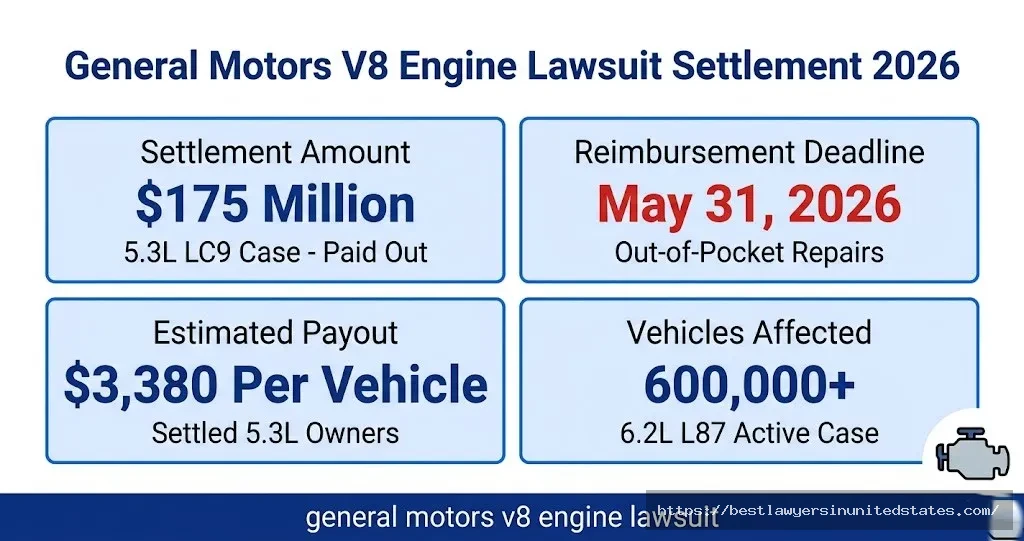
The second and ongoing case targets the 6.2-liter L87 V8 engine. On March 1, 2026, a major class action lawsuit against General Motors officially commenced in federal court after multiple lawsuits over engine failures were consolidated into one case. The lawsuit alleges a widespread defect in the GM 6.2-liter V8 EcoTec3 L87 engines that can cause sudden and catastrophic engine failure, even after recall repairs.
| Case | Engine | Status | Settlement |
|---|---|---|---|
| Siqueiros v. GM | 5.3L V8 LC9 (Vortec) | Settled October 2025 | $175 million |
| Powell et al. v. GM | 6.2L V8 L87 (EcoTec3) | Active, commenced March 2026 | Pending |
The two cases are distinct. If you own a 2011-2014 model with a 5.3L engine, your case is the settled one. If you own a 2021-2024 model with a 6.2L engine, the active litigation is yours.
The General Motors Class Action Lawsuit: How It Got Here
The general motors class action lawsuit did not start with one bold attorney. It started with tens of thousands of complaints that regulators could no longer ignore.
GM’s investigation identified 28,102 field complaints or incidents in the US potentially related to failure of the L87 engine due to crankshaft, connecting rod, or engine bearing failure, of which 14,332 involved allegations of loss of propulsion.
The first GM engine failure lawsuit wasn’t filed until after the National Highway Traffic Safety Administration opened a federal investigation in January 2025. Since then GM issued an L87 engine recall, which caused NHTSA to open another engine failure investigation in January 2026.
Individual lawsuits were filed beginning April 3, 2025, with Hernandez v. General Motors, followed by Hecht on May 9, McNamara on May 12, Houchin on May 16, and continuing through October 2025. A dozen nearly identical cases were then merged into one.
GM L87 Engine Lawsuit 2026: Where the Case Stands Now
The GM L87 engine lawsuit 2026 is in its early litigation phase, with key deadlines unfolding right now.
Judge Kumar has called on GM to file an answer to the complaint, or any defense motions or objections, by March 30, 2026, and plaintiffs would have until May 29, 2026, to answer. GM’s replies will be due by June 29.
On February 26, 2026, plaintiffs filed the consolidated class action complaint in the consolidated action, in which Hagens Berman was named interim co-lead counsel.
This is early in the legal process. No settlement has been announced for the L87 case. A resolution similar to the 5.3L case could take years, though public pressure and the sheer volume of complaints may accelerate negotiations.
Key Takeaway: The 5.3L lawsuit is settled and paying out. The 6.2L lawsuit is active and in early litigation as of March 2026. Both are separate cases with different vehicles, engines, and outcomes.
The GM Engine Defect: What Actually Breaks and Why
The GM engine defect lawsuit is rooted in a very specific mechanical failure, not general wear and tear. Understanding the defect helps owners recognize symptoms early.
Engine teardown analysis identified two primary root causes, both attributable to supplier manufacturing and quality issues: rod-bearing damage from sediment on connecting rods and crankshaft-oil galleries, and out-of-specification crankshaft dimensions and surface finish.
Think of it like a journal with a grain of sand stuck in the bearing surface. That tiny contamination tears through the soft bearing metal until the crankshaft has nowhere to rotate freely, and the engine seizes.
According to the complaints, that breakdown in lubrication can cause the engine to seize completely or even send a piston through the engine block. The failure can happen with no warning at highway speeds.
Warning signs owners report:
- Knocking, ticking, or growling from the bottom of the engine
- Check engine light with diagnostic code P0016
- Hesitation, rough shifting, or sudden loss of power
- High RPMs without corresponding acceleration
- Complete stall while driving
Who Qualifies for the GM V8 Engine Lawsuit?
Who qualifies for the GM V8 engine lawsuit depends on which engine your vehicle has and when it was built.
For the active L87 6.2L class action: Vehicles with the L87 engine include the 2021-2024 Cadillac Escalade and Escalade ESV, 2019-2024 Chevrolet Silverado 1500, 2021-2024 Chevrolet Tahoe, 2021-2024 Chevrolet Suburban, 2019-2024 GMC Sierra 1500, 2021-2024 GMC Yukon, and 2021-2024 GMC Yukon XL.
For the settled 5.3L LC9 case: The GM engine settlement includes vehicles in California, Idaho, and North Carolina manufactured on or after February 10, 2011, and equipped with Generation IV LC9 5.3-liter V8 Vortec 5300 engines. Vehicles that already received piston replacements under warranty are excluded.
| Lawsuit | Engine | Model Years | States |
|---|---|---|---|
| Powell v. GM (active) | 6.2L L87 V8 | 2019-2024 | All 50 states |
| Siqueiros v. GM (settled) | 5.3L LC9 Vortec | 2011-2014 | CA, ID, NC only |
Most class action settlements cover subsequent owners as long as the warranty is active. If your engine failed while under the factory powertrain warranty, you are usually eligible for compensation regardless of whether you were the first or second buyer.
GM Silverado Engine Lawsuit: Are Your Years Covered?
The GM Silverado engine lawsuit covers a wide range of model years, but the specific engine matters more than the model name.
The litigation took off in the wake of an April 2025 GM engine failure recall affecting 597,630 Chevy Silverado 1500, GMC Sierra, Chevy Tahoe, Chevy Suburban, GMC Yukon, and Cadillac Escalade vehicles that contain GM 6.2-liter L87 V8 engines.
There are 153,630 GMC Sierra 1500 vehicles affected by this recall, along with 82,832 GMC Yukon vehicles and 60,933 GMC Yukon XL vehicles. The Silverado 1500 accounts for the largest single group of affected vehicles.
The simplest check: If your Silverado is a 2019-2024 model and you opted for the 6.2L V8 engine upgrade, your truck is in the recall and litigation scope. If you have the 5.3L engine in a pre-2015 model, you fall under the settled Siqueiros case.
Key Takeaway: The GM Silverado and Sierra together represent the largest group of affected vehicles. Your engine code, not just the model year, determines which lawsuit applies to you. Trump CPB Board Removals Lawsuit
GM Escalade Engine Lawsuit: Luxury Price, Defective Engine
The GM Escalade engine lawsuit carries extra weight because buyers paid luxury vehicle prices, often $80,000 or more, for an SUV with a known defective engine.
Owners who have experienced the defect report no warning signs before sudden and total engine failure, and the defect has manifested in vehicles with as little as 1,200 miles on them. One Escalade owner reported their engine failed at just 1,600 miles on a brand new 2026 model.
The plaintiffs argue GM’s concealment was more egregious for luxury buyers. In addition to rendering affected vehicles unsafe to drive, the defect, even after the proposed recall remedy, significantly reduces vehicle value. If GM had disclosed the truth about the defect, consumers would not have purchased these vehicles or would have paid substantially less.
The Escalade-specific claims also allege diminished resale value as a separate category of damages, separate from repair costs. This matters for Escalade owners who have not yet experienced a failure but whose vehicles’ market value has dropped due to the defect’s public exposure.
GM Engine Recall 25V-274: What the Fix Was and Why It Failed
NHTSA recall 25V-274 was supposed to solve the problem. For many owners, it made things worse or did nothing at all.
The GM 6.2L L87 recall (25V-274) covers nearly 600,000 vehicles in the United States built between March 2021 and May 2024. GM filed the official recall report with NHTSA on April 24, 2025, after years of internal investigations it quietly closed.
The recall had two possible outcomes for each vehicle. Dealers either replaced the engine entirely if it showed critical defects, or switched the oil from 0W-20 to thicker 0W-40 synthetic and installed a new oil fill cap if the engine passed inspection.
Federal safety regulators have escalated their scrutiny of General Motors’ beleaguered 6.2L V8 L87 engine, now targeting vehicles that allegedly failed after receiving the manufacturer’s prescribed fix. The National Highway Traffic Safety Administration has opened Recall Query RQ26001, a direct investigation into the adequacy of the remedy for Recall 25V-274, which initially covered nearly 600,000 trucks and SUVs. This new action stems from 36 separate complaints in which engines catastrophically failed after a dealer inspection and service intended to prevent that exact outcome.
Additionally, customer requests for reimbursement of previously paid repairs to correct the L87 engine condition are to be submitted to the dealer prior to or by May 31, 2026. That deadline is critical for anyone who paid out of pocket before the recall was announced.
GM 5.3 Engine Lawsuit Settlement: The Case That Already Paid Out
The GM 5.3 engine lawsuit settlement is closed and distributing money. If you owned an affected vehicle in California, Idaho, or North Carolina, this is the case for you.
Multiple GM oil consumption class action lawsuits have been filed over the years, with most of them dismissed. The Siqueiros v. General Motors case was also dismissed in 2017, but the judge allowed the plaintiffs to modify and refile their claims.
The lawsuit survived, went to trial, and won. After achieving a $102.6 million jury verdict against General Motors, DiCello Levitt and co-counsel went on to secure a $175 million post-trial settlement for more than 40,000 vehicle owners across California, Idaho, and North Carolina. The agreement, approved in 2025, delivers average payments exceeding $3,300 per vehicle.
The three plaintiffs who originally filed the lawsuit will receive $30,000 each, while the lawyers representing the case will receive $57 million. Class members received significantly less per person, but the case still stands as a powerful precedent for the ongoing L87 litigation.
Key Takeaway: The 5.3L case proves GM can be beaten at trial and forced to pay real money. It sets a concrete roadmap for the 6.2L L87 plaintiffs currently in court.
Siqueiros v. General Motors: The $175 Million Verdict That Changed Everything
Siqueiros v. General Motors is not just a settlement. It is the legal blueprint every attorney in the L87 case is studying right now.
The core of the case centered on the design of the engine’s piston rings. According to internal GM documents uncovered during the trial, the company was aware as early as 2010 that the piston rings in the 5.3L V8 were prone to premature wear. This defect caused the engines to consume excessive amounts of oil, leading to carbon buildup on the spark plugs and, eventually, a total loss of compression.
DiCello Levitt used GM’s own internal documents and expert testimony from the company’s engineers to show that GM was aware of the defect as early as 2010 but continued to sell the affected vehicles. That strategy, using the company’s own documents against it, is precisely what plaintiffs in the L87 case are replicating.
The settlement was filed in the U.S. District Court for the Northern District of California under Siqueiros, et al. v. General Motors LLC (No. 3:16-cv-07244-EMC). Under the settlement agreement, eligible current owners or lessees of the affected vehicles receive payments of $3,380 each.
GM Engine Lawsuit Payout Per Person: What Can You Expect?
GM engine lawsuit payout per person varies sharply depending on which case you’re in and the severity of your damages.
For the settled 5.3L case: The settlement terms stipulate that eligible current owners or lessees of affected vehicles will receive $3,380 each, while the three named customers who originally filed the lawsuit will receive $30,000 each.
For the active 6.2L L87 case: No settlement amount has been set yet. The case is in early litigation. Based on prior GM settlements and the scale of damage, legal analysts expect any future settlement to be substantial.
| Scenario | Estimated Compensation |
|---|---|
| 5.3L LC9 settled claim (CA, ID, NC) | ~$3,380 per vehicle |
| 6.2L L87 engine replacement cost (if out of pocket) | $10,000+ |
| Lemon law repurchase (full vehicle buyback) | Purchase price minus mileage offset |
| Post-recall repair reimbursement deadline | May 31, 2026 |
The cost of repairing or replacing the engine can easily amount to well over $10,000 if not covered by warranty, and those covered by warranty may have a difficult time locating a replacement engine.
GM Engine Bearing Failure Lawsuit: The Heart of the Defect Claim
The GM engine bearing failure lawsuit is built around one core mechanical truth: the bearings that support the crankshaft are failing, and GM knew it.
The lawsuit says the defect involves the bearings in GM’s L87 engines, which are prone to failure, resulting in engine block breaches and/or engine seizure. The defect can lead to catastrophic engine failure at any moment, causing loss of power while driving at high speeds, increasing the risk of a crash.
The root cause is not age or owner negligence. Two primary root causes were identified, both attributable to supplier manufacturing and quality issues: rod-bearing damage from sediment on connecting rods and crankshaft oil galleries, and out-of-specification crankshaft dimensions and surface finish.
Real driver accounts from NHTSA filings tell the story plainly. One owner reported being at 65 mph on the freeway when the truck suddenly turned off and the dash told them to put it in neutral. Another was stranded on the side of Interstate 5 in the rain with very little space between the guardrail and slow lane where large trucks were mandated to drive.
Key Takeaway: The bearing failure is a manufacturing defect, not a maintenance issue. That distinction is central to every legal claim in the L87 lawsuit.
GM Recall Inadequate Fix Lawsuit: When the Repair Makes It Worse
The GM recall inadequate fix lawsuit is arguably the most alarming development in this entire legal saga. People who followed GM’s instructions and had the recall done are still experiencing complete engine failure.
The lawsuits claim that the new higher-viscosity oil led to increased wear on the engine components, negatively impacting vehicle performance and fuel consumption. In other words, the fix may be accelerating damage in some engines rather than preventing it.
Owners are unsure which technical service bulletin applies to their vehicle, whether their engine needs replacement, and whether GM’s so-called fix of switching to higher viscosity oil will actually prevent total engine failure if the engine is not replaced. Class members have started to receive mailed recall notices from GM, but upon contacting their dealerships about repairs, they’ve been informed that the parts are not available.
The situation parallels a recall on a faulty airbag where the replacement part also fails. The legal theory is straightforward: if the remedy doesn’t fix the defect, it wasn’t an adequate recall.
Powell v. General Motors LLC: The Lead Case in the Active Litigation
Powell v. General Motors LLC is the official name of the consolidated class action now moving through federal court.
The class action, filed in the U.S. District Court for the Eastern District of Michigan, includes claims on behalf of owners and lessees of vehicles equipped with the L87 engines. It was filed in the Eastern District because GM is headquartered in Detroit, Michigan.
The first complaint was filed by James S. Powell of Illinois in February 2025, before the recall was announced. Powell indicated that he bought a 2023 GMC Yukon Denali in October 2022, noting that there was clearly an engine defect affecting the vehicles.
The case now spans a 389-page consolidated complaint. Hagens Berman was named interim co-lead counsel. The firm has secured settlement benefits valued at more than $320 billion for class members, including multiple settlements for GM vehicle owners. Ozempic Lawsuit 2026
Key court deadlines in Powell v. GM:
| Deadline | Date |
|---|---|
| GM’s defense motions due | March 30, 2026 |
| Plaintiffs’ response due | May 29, 2026 |
| GM’s reply due | June 29, 2026 |
| Out-of-pocket repair reimbursement deadline | May 31, 2026 |
GM Lemon Law Claim for Engine Failure: A Faster Path to Compensation
A GM lemon law claim can run parallel to the class action and may get you money significantly faster. Lemon law claims are individual, not class-based, meaning you don’t wait for thousands of other claimants.
Available remedies under lemon law include a cash-and-keep settlement where you keep the vehicle and receive cash compensation, a replacement vehicle nearly identical to your current model, or a GM lemon law repurchase where the manufacturer repurchases your vehicle for an amount calculated according to what you paid, minus a mileage-based offset. Costs and expenses associated with your vehicle defects, such as out-of-pocket repair costs and rental or towing costs, are also compensated under the law.
Eligibility typically hinges on the number of repair attempts and time out of service. Generally, if the same problem persists after four or more repair attempts, or if the vehicle is out of service for more than 30 days cumulatively, it may qualify as a lemon.
Lemon law and class action participation are not mutually exclusive in most states. An owner can pursue a lemon law buyback independently while also being a class member in the Powell lawsuit.
How to File a GM Engine Lawsuit Claim
Filing a GM engine lawsuit claim does not require hiring an attorney on day one, but knowing your options and keeping records is critical from today forward.
Immediate steps every affected owner should take:
- Document everything. Keep every repair order, dealer communication, and mileage note. Courts and claims administrators require proof.
- Check your VIN. Visit NHTSA’s official recall lookup at nhtsa.gov/recalls to confirm your vehicle is covered under recall 25V-274.
- Request reimbursement before May 31, 2026. If you paid out of pocket for L87 engine repairs before the recall was issued, submit that reimbursement claim to a GM dealer immediately. That deadline is hard.
- Register your interest with lead counsel. Hagens Berman and co-lead counsel in Powell v. GM are accepting registrations from affected owners at hbsslaw.com.
- If your engine failed after the recall fix, document the post-repair failure separately. These cases are the subject of NHTSA’s new RQ26001 investigation and carry separate legal weight.
For the settled 5.3L case: Payments will be made after the Final Effective Date as defined in the Settlement Agreement. If you received a notification from the GM 5300 LC9 Class Action Administrator and have not provided a copy of an IRS Form W-9, submit it to avoid a 24% federal income tax backup withholding.
Frequently Asked Questions
Does the GM V8 engine lawsuit cover used vehicle owners?
Most class action settlements cover subsequent owners as long as the warranty is active. If your engine failed while under the factory powertrain warranty, you are usually eligible for compensation regardless of whether you were the first or second buyer. Being a second owner does not automatically disqualify you; warranty status is the key factor.
What is the NHTSA recall number for the GM 6.2L L87 engine?
The official NHTSA recall number for the GM 6.2L L87 engine defect is 25V-274, issued April 24, 2025. NHTSA has since opened Recall Query RQ26001, a direct investigation into whether the recall remedy is actually adequate, following 36 complaints of engine failure after the prescribed fix was performed.
How much money will GM engine lawsuit claimants receive?
Eligible owners in the settled 5.3L LC9 case receive $3,380 each under the Siqueiros v. GM settlement. For the active 6.2L L87 class action, no settlement amount has been set yet, as litigation commenced March 1, 2026, and is in early court proceedings.
My engine failed after the GM recall fix. What are my rights?
NHTSA’s Office of Defects Investigation is now focused on the adequacy of the remedy after receiving complaints of L87 engine failures following completion of the recall work. Document the post-repair failure in detail, save all repair orders, and contact co-lead counsel in Powell v. GM, as post-recall failures represent a distinct category of claims.
What is the deadline to file a GM engine lawsuit claim?
Customer requests for reimbursement of previously paid repairs to correct the L87 engine condition must be submitted to the dealer by May 31, 2026. There is no single universal deadline for joining the class action itself, but the sooner you register with counsel, the better your documentation record.
What to Do Before the Deadlines Pass
Two active GM V8 engine lawsuits. Two engines. Two very different timelines. If your vehicle has the 5.3L LC9 engine and you’re in California, Idaho, or North Carolina, your settlement check is already in process. If you have the 6.2L L87 engine in a 2019-2024 truck or SUV, the fight is just getting started.
The May 31, 2026 out-of-pocket reimbursement deadline is the most time-sensitive action item right now. Don’t miss it.
Document your engine history, check your VIN against the recall, and register your interest with the class action legal team. The owners who act early, and keep solid records, are the ones who get the best outcomes in class action cases like this one.