
Quick Answer Box
- The Colorado ICE subpoenas lawsuit is a federal civil action filed by Colorado Attorney General Phil Weiser challenging administrative subpoenas that ICE sent to multiple Colorado state agencies demanding records on individuals who may be undocumented immigrants.
- The lawsuit directly affects immigrants and mixed-status families in Colorado whose personal data is held by state agencies, as well as state employees and agencies ordered to comply with federal demands that Colorado argues violate the Tenth Amendment.
- No monetary settlement is at stake; the relief sought is a court order blocking enforcement of the subpoenas and establishing constitutional limits on ICE’s administrative subpoena authority over state government records.
Case Snapshot
| Detail | Information |
|---|---|
| Court | U.S. District Court for the District of Colorado |
| Case Number | Filed 2025; specific docket number pending full public docketing confirmation |
| Lead Plaintiff | State of Colorado, by and through Attorney General Phil Weiser |
| Defendant | U.S. Immigration and Customs Enforcement (ICE); Department of Homeland Security (DHS) |
| Filing Date | 2025 (precise date subject to confirmation via PACER docket) |
| Status | Active litigation; preliminary injunction proceedings as of 2026 |
| Relief Sought | Declaratory and injunctive relief blocking ICE subpoena enforcement against Colorado state agencies |
| Key Legal Doctrine | Anti-commandeering doctrine; Tenth Amendment; 8 U.S.C. § 1357(d) |
| Settlement Fund | Not applicable; equitable relief action |
The Colorado ICE subpoenas lawsuit represents one of the most significant state-versus-federal constitutional confrontations over immigration enforcement authority filed in 2025. Colorado Attorney General Phil Weiser initiated the action after ICE sent administrative subpoenas to multiple state agencies, demanding records that Colorado law protects from exactly this type of disclosure.
The legal stakes extend well beyond Colorado’s borders. More than a dozen states have enacted statutes limiting cooperation with federal immigration enforcement. A ruling against Colorado would effectively authorize ICE to circumvent those statutes through the administrative subpoena mechanism.
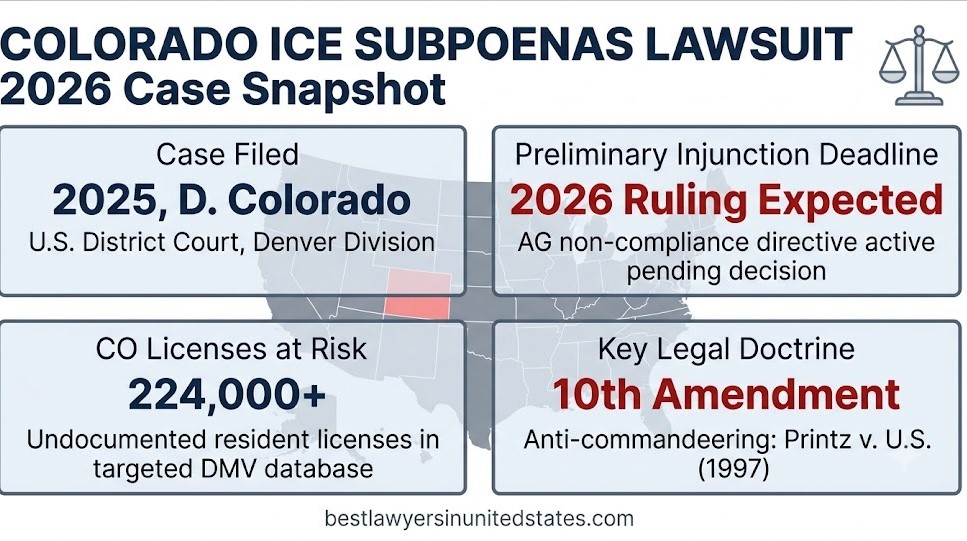
The case turns on whether ICE’s authority under 8 U.S.C. § 1357(d) can compel sovereign state agencies to produce records, or whether the Tenth Amendment’s anti-commandeering doctrine blocks that compulsion entirely. That is not a political question. It is a constitutional law question with a specific body of Supreme Court precedent controlling the answer.
What happens in this federal courtroom in Denver will determine the operational reach of federal immigration enforcement in every state with sanctuary-style statutes.
Colorado ICE Subpoenas Lawsuit: Case Overview
The Colorado ICE subpoenas lawsuit is a constitutional challenge filed by the State of Colorado against the U.S. Department of Homeland Security and U.S. Immigration and Customs Enforcement in the U.S. District Court for the District of Colorado.
The complaint was filed by Attorney General Phil Weiser in 2025, following ICE’s issuance of administrative subpoenas to at least three Colorado state agencies. Those subpoenas demanded records on individuals who ICE asserted were subject to immigration enforcement.
Colorado’s position is that the subpoenas violate both the Tenth Amendment’s anti-commandeering doctrine and Colorado’s own statutory protections for immigrant records, including Colorado Senate Bill 54 of 2019, which limits state and local law enforcement cooperation with federal immigration detainer requests.
Core legal claims in the complaint:
- ICE’s administrative subpoenas unconstitutionally commandeer state agencies as instruments of federal enforcement
- The subpoenas exceed the statutory scope of 8 U.S.C. § 1357(d), which governs ICE’s administrative subpoena authority
- The demands violate Colorado statutory protections for immigrant personal data held by state agencies
- Compliance would expose state agency employees to civil liability under Colorado law
Attorney Insight: Attorneys tracking this case note that Colorado’s decision to file for declaratory and injunctive relief rather than waiting for contempt proceedings gives the state a proactive litigation posture, forcing ICE to defend the subpoenas’ legal basis in court before any records are transferred.
Colorado Attorney General ICE Lawsuit 2025
Colorado Attorney General Phil Weiser formally initiated the 2025 legal challenge against ICE after state agencies received subpoenas with specific return dates demanding categories of records that Colorado law designates as protected.
Weiser’s office filed the complaint under the state’s parens patriae authority, meaning Colorado brought the action on behalf of its residents and its institutional interests as a sovereign state. That standing theory is well-established in state-versus-federal litigation and was successfully employed in states’ challenges to federal environmental and healthcare regulations.
The attorney general’s office simultaneously issued formal legal guidance to Colorado state agencies directing them not to comply with the subpoenas pending court resolution. That guidance created a direct compliance standoff between state agencies and federal enforcement.
Key dates in the Colorado AG’s legal action:
| Event | Date / Status |
|---|---|
| ICE subpoenas issued to Colorado state agencies | 2025 |
| AG Weiser files federal complaint | 2025 |
| AG issues non-compliance guidance to state agencies | Shortly after filing |
| Preliminary injunction motion filed | 2025 to 2026 |
| Federal government response due | Per court scheduling order |
| Expected hearing on preliminary injunction | 2026 |
Attorney Insight: Attorneys monitoring this litigation note that the AG’s pre-litigation guidance directing state agencies to withhold compliance was a calculated procedural move, because it preserved Colorado’s ability to claim ongoing irreparable harm if the injunction is denied, strengthening the case for emergency judicial relief.
Who Is Phil Weiser and Why Did He File This Lawsuit?
Phil Weiser is Colorado’s elected Attorney General, serving since January 2019. His office has jurisdiction to represent the state in federal constitutional litigation, and he has previously brought multistate actions on antitrust, environmental, and consumer protection grounds.
Weiser filed this lawsuit under the authority vested in the Attorney General by Colorado law to defend state sovereignty and protect Colorado residents from federal overreach that the state’s chief legal officer determines to be unconstitutional. The decision to litigate rather than negotiate was deliberate and reflects a legal assessment that ICE’s subpoena demands lacked statutory authorization and were constitutionally barred.
The lawsuit positions Weiser’s office alongside other state attorneys general who have challenged federal immigration enforcement directives since 2025. Washington, Illinois, and Massachusetts have filed related challenges in their respective federal districts.
Colorado AG office litigation profile in federal court:
- Filed multistate antitrust actions against Google (joined 2020 investigation)
- Led consumer protection actions against opioid distributors
- Filed federal constitutional challenges to federal agency rulemaking
- Joined multistate briefs in immigration enforcement cases before the Ninth and Tenth Circuits
Attorney Insight: Attorneys observing state AG litigation strategy note that Weiser’s office has a documented record of bringing federal constitutional challenges with multistate coordination, which suggests this ICE subpoena case may attract amicus support from other state attorneys general in the Tenth Circuit.
Litigation Watch: Colorado Attorney General Phil Weiser filed this action on parens patriae grounds, issuing simultaneous non-compliance guidance to state agencies, creating a deliberate legal standoff that forces ICE to justify its subpoena authority before any records are disclosed.
What Are ICE Administrative Subpoenas?
ICE administrative subpoenas are compulsory document demands issued by Immigration and Customs Enforcement under the authority of 8 U.S.C. § 1357(d), which is part of the Immigration and Nationality Act.
Unlike judicial subpoenas, administrative subpoenas do not require prior court approval. ICE issues them unilaterally to demand records from individuals, businesses, and, in the cases at issue in Colorado, from state government agencies. The recipient must comply or challenge the subpoena through formal legal proceedings.
The scope of what ICE can demand through this authority has never been definitively resolved by the U.S. Supreme Court in the context of state agency records. That gap is the central legal opening Colorado’s complaint exploits.
Key characteristics of ICE administrative subpoenas:
| Feature | Description |
|---|---|
| Issuing authority | ICE officer, without prior judicial approval |
| Statutory basis | 8 U.S.C. § 1357(d) |
| Recipient options | Comply, negotiate, or formally challenge in court |
| Records commonly sought | Driver license records, public benefit records, tax records, health records |
| Return date | Specified in the subpoena, typically 10 to 30 days |
| Enforcement mechanism | Contempt proceedings if recipient refuses and court sides with ICE |
Attorney Insight: Attorneys practicing federal immigration law note that the administrative subpoena mechanism has historically been used against private parties, not state government agencies, and that Colorado’s challenge represents one of the first sustained litigation tests of whether 8 U.S.C. § 1357(d) even reaches state sovereign records.
Can ICE Subpoena State Agencies?
Whether ICE can legally compel a state government agency to produce records through an administrative subpoena is the precise legal question this lawsuit asks the court to resolve. The answer is not settled law.
Federal law grants ICE broad authority to investigate immigration violations and to demand records from persons and entities subject to its investigative jurisdiction. The critical question is whether state government agencies are subject to that jurisdiction or whether state sovereignty provides a constitutional shield.
Two competing legal principles create the conflict. Federal supremacy under Article VI of the Constitution establishes that valid federal law overrides conflicting state law. But the Tenth Amendment’s anti-commandeering doctrine, as interpreted by the Supreme Court in Printz v. United States, 521 U.S. 898 (1997), prohibits the federal government from conscripting state officials to administer or enforce federal programs.
The central legal tension:
| Principle | Source | Federal Position | Colorado Position |
|---|---|---|---|
| Federal supremacy | Art. VI, U.S. Constitution | ICE subpoenas are valid federal law | Federal law does not override state sovereignty here |
| Anti-commandeering | Tenth Amendment; Printz v. U.S. (1997) | Does not apply to records demands | Applies; state agencies cannot be commanded to serve federal enforcement |
| Statutory scope | 8 U.S.C. § 1357(d) | Reaches any person with relevant records | Does not authorize demands against state agencies |
*Attorney Insight: Attorneys analyzing this case structure note that the anti-commandeering argument is the stronger of Colorado’s two legal theories, because *Printz* was a decisive 5-4 opinion by Justice Scalia that has not been narrowed or overruled, and its logic maps directly onto the command to produce state-agency records for federal enforcement purposes.*
ICE Administrative Subpoenas Sent to Colorado State Agencies
ICE sent administrative subpoenas to multiple Colorado state agencies in 2025, demanding records from agency databases that contain personal information on Colorado residents, including individuals with and without legal immigration status.
The agencies that reportedly received subpoenas include the Colorado Department of Motor Vehicles, which holds driver’s license and identification records, and the Colorado Department of Human Services, which administers public benefit programs. The Colorado Department of Public Health and Environment was also identified as a recipient of related federal records demands.
Each agency holds data on hundreds of thousands of Colorado residents. Driver’s license records alone in Colorado include information from the state’s 2013 law granting licenses to individuals regardless of immigration status, a policy that produced a database ICE would find particularly valuable for identification purposes.
State agencies reported as subpoena recipients:
- Colorado Department of Motor Vehicles (DMV): License and ID records including those issued under Colorado’s 2013 undocumented-resident license law
- Colorado Department of Human Services (CDHS): Public benefit program enrollment and eligibility records
- Colorado Department of Public Health and Environment (CDPHE): Health program participation and vital records
- Other state agencies: Additional agencies may have received related demands; full list subject to litigation disclosure
Attorney Insight: Attorneys familiar with Colorado’s 2013 driver’s license law note that ICE’s demand for DMV records is particularly consequential because that database was created under an explicit legislative promise that license information would not be shared with federal immigration authorities, making the subpoena an attempted circumvention of a specific state legislative policy.
What Is 8 U.S.C. § 1357 and ICE’s Subpoena Power?
Section 1357 of Title 8 of the U.S. Code is the primary statutory grant of authority for ICE’s immigration enforcement powers, including the administrative subpoena mechanism at the center of the Colorado lawsuit.
Subsection (d) specifically authorizes designated immigration officers to issue subpoenas requiring the production of records and testimony related to immigration investigations. Congress enacted this authority as part of the Immigration and Nationality Act, and it has been used primarily in the context of employer audits and private-party document demands.
The Colorado litigation forces the court to interpret the scope of “any person” in the statute. ICE argues that language is broad enough to include state agencies. Colorado argues that applying the statute to state sovereign entities requires clear congressional authorization that does not appear in the text or legislative history.
Statutory text analysis:
| Statutory Element | ICE Interpretation | Colorado Interpretation |
|---|---|---|
| “Any person” subject to subpoena | Includes state government agencies | Excludes state sovereign entities without clear congressional statement |
| “Records relevant to investigation” | Any state database with relevant data | Limited to records of private parties, not state-administered programs |
| Enforcement mechanism | Federal contempt authority | Cannot compel state officials without anti-commandeering violation |
| Congressional intent | Broad enforcement authority | No evidence Congress intended to reach state sovereign records |
Attorney Insight: Attorneys specializing in federal administrative law note that the “clear statement rule,” a canon of statutory construction, requires that Congress speak with unmistakable clarity before a federal statute is interpreted to displace state sovereign interests, and that the text of 8 U.S.C. § 1357(d) lacks that clarity.
Litigation Watch: The statutory interpretation of 8 U.S.C. § 1357(d) and the anti-commandeering doctrine operate as twin legal shields in Colorado’s complaint, and either one, if accepted by the court, is independently sufficient to block the subpoenas without the court reaching the other argument.
The Anti-Commandeering Doctrine and Immigration Enforcement
The anti-commandeering doctrine is a constitutional principle derived from the Tenth Amendment that prohibits the federal government from compelling state legislatures to enact laws or state executive officials to administer federal programs. It is the most powerful legal weapon in Colorado’s constitutional arsenal in this case.
The doctrine has two foundational Supreme Court precedents. New York v. United States, 505 U.S. 144 (1992), held that Congress cannot compel states to enact regulatory legislation on its behalf. Printz v. United States, 521 U.S. 898 (1997), extended the doctrine to executive branch commandeering, holding that the federal government cannot conscript state law enforcement officers to implement federal background check requirements.
The Printz holding is the closer analog to Colorado’s situation. Just as Congress could not require local sheriffs to run background checks for the federal Brady Act, ICE arguably cannot require state agency employees to search, compile, and produce state-maintained records for a federal enforcement program.
Anti-commandeering doctrine applied to Colorado’s case:
| Printz Precedent Element | Application to Colorado ICE Subpoenas |
|---|---|
| Federal government cannot conscript state executive officers | ICE subpoenas command state agency employees to act on federal behalf |
| State officials cannot be required to implement federal programs | Producing immigration enforcement records is implementation of ICE’s program |
| Remedy is to refuse compliance | Colorado AG directed state agencies not to comply |
| Federal government may enforce law through its own officers | ICE may collect records through its own agents, not through state employees |
*Attorney Insight: Attorneys analyzing Tenth Circuit precedent in this area note that the circuit has consistently applied *Printz* in favor of state sovereignty claims, and that Colorado’s case is factually stronger than several cases where the anti-commandeering doctrine was successfully invoked, because the subpoenas command affirmative state-agency action rather than merely requesting voluntary cooperation.*
The Tenth Amendment and Federal Immigration Enforcement
The Tenth Amendment provides that powers not delegated to the federal government by the Constitution, nor prohibited to the states, are reserved to the states or to the people. In immigration law, the federal government holds primary authority, but that authority does not eliminate all state sovereignty interests.
The Supreme Court addressed the intersection of federal immigration authority and state sovereignty most directly in Arizona v. United States, 567 U.S. 387 (2012). That decision struck down portions of Arizona’s state immigration enforcement law on preemption grounds. But it did not address the reverse question: whether the federal government can compel state agencies to assist in federal immigration enforcement.
Colorado’s complaint distinguishes Arizona carefully. Arizona was about a state trying to do more than federal law allowed. Colorado’s case is about the federal government trying to compel the state to do something state law forbids. Those are opposite constitutional postures, and the anti-commandeering doctrine governs the latter.
Constitutional authority map:
- Federal government: Exclusive authority to establish immigration law and policy
- State government: Authority to regulate state agencies and what information they collect and share
- Contested zone: Whether federal enforcement authority can compel state agency compliance through administrative subpoena
Attorney Insight: Attorneys litigating state-federal immigration disputes note that the Arizona v. United States decision, while often cited by federal enforcement advocates, actually supports states’ ability to decline to cooperate with federal enforcement so long as states are not independently enforcing immigration law themselves.
Colorado Suing Federal Government Over Immigration Records
Colorado’s lawsuit against the federal government over immigration records is one of several state legal actions filed in 2025 challenging the scope of ICE enforcement directives under the Trump administration’s second-term immigration agenda.
The Trump administration issued executive orders in early 2025 directing federal agencies, including DHS and ICE, to maximize immigration enforcement using all available legal tools. The administrative subpoena program targeting state agency databases was a direct product of those directives.
Colorado’s action is filed in its home federal circuit, the Tenth Circuit, which covers Colorado, Kansas, New Mexico, Oklahoma, Utah, and Wyoming. A ruling from the U.S. District Court for the District of Colorado would be binding on that court and persuasive elsewhere but would be subject to Tenth Circuit review on appeal.
States with related ICE enforcement legal challenges as of 2025 to 2026:
| State | Nature of Challenge | Court |
|---|---|---|
| Colorado | AG challenge to ICE subpoenas | D. Colo. |
| Illinois | Challenge to federal immigration enforcement directives | N.D. Ill. |
| Washington | Multiple immigration enforcement challenges | W.D. Wash. |
| Massachusetts | Challenge to federal cooperation demands | D. Mass. |
| California | Broad challenge to federal enforcement coordination demands | N.D. Cal. |
Attorney Insight: Attorneys monitoring multistate immigration litigation note that parallel challenges in multiple circuits create the conditions for a circuit split, which historically accelerates Supreme Court review, making the Colorado case potentially significant not just for the Tenth Circuit but for national constitutional doctrine.
Colorado Immigrant Records Subpoena Legal Challenge
The legal challenge to the immigrant records subpoenas rests on four distinct arguments, each capable of independently defeating ICE’s demands. Colorado’s litigation strategy layers them deliberately, so that winning on any one of them is sufficient to block compliance.
The four legal arguments in order of constitutional weight:
Argument 1: Anti-commandeering doctrine (Tenth Amendment)
ICE cannot compel state agencies to serve as instruments of federal enforcement. Printz v. United States, 521 U.S. 898 (1997), controls. This is Colorado’s strongest argument.
Argument 2: Statutory overreach (8 U.S.C. § 1357(d))
The administrative subpoena statute does not authorize demands against state sovereign agencies. The clear statement rule requires explicit congressional authorization to displace state sovereign immunity, which the statute does not provide.
Argument 3: State statutory protection
Colorado Senate Bill 54 (2019) and related statutes expressly prohibit state and local agencies from sharing immigrant records with federal immigration authorities without judicial process. ICE’s administrative subpoenas do not constitute judicial process.
Argument 4: Fourth Amendment and privacy
Compelled production of personal records held in state databases implicates the privacy rights of the individuals whose records are sought, independent of the state’s sovereign interests.
Attorney Insight: Attorneys litigating similar records protection cases in other circuits note that layering constitutional, statutory, and state law arguments in this sequence is the standard approach in state-versus-federal records disputes, because appellate courts often affirm on the narrowest available ground, and the narrowest ground here is statutory overreach, which requires no constitutional ruling.
Litigation Watch: Colorado’s four-layer legal strategy means the court can rule in the state’s favor without reaching the most sweeping constitutional questions, a feature that makes early injunctive relief more achievable because courts prefer narrow grounds for preliminary rulings.
Colorado Sanctuary Policy Lawsuit 2025
Colorado’s 2025 ICE subpoena litigation is the direct legal offspring of Colorado Senate Bill 54, enacted in 2019 and signed by Governor Jared Polis. SB 54 prohibits Colorado law enforcement agencies from honoring ICE detainer requests without judicial warrants and restricts the sharing of information about individuals’ immigration status.
That statute established Colorado as a functional sanctuary jurisdiction in the legal sense: it does not bar federal immigration enforcement but prohibits state and local officials from actively participating in it. SB 54 remains in effect and is central to the legal framework of the current subpoena challenge.
The subpoenas ICE issued in 2025 were designed, at least in part, to work around SB 54 by going directly to non-law-enforcement state agencies. That strategy is itself an argument against the subpoenas: if the federal government is deliberately structuring its demands to circumvent state legislation, that circumvention underscores the anti-commandeering problem rather than resolving it.
Colorado SB 54 key provisions relevant to this lawsuit:
- Prohibits law enforcement agencies from inquiring about immigration status without justification
- Bars honoring ICE detainers without a judicial warrant or court order
- Restricts sharing of immigration-related information with federal authorities
- Does not prevent voluntary cooperation in criminal investigations unrelated to immigration status
Attorney Insight: Attorneys tracking Colorado’s legislative history note that SB 54 was drafted specifically to survive federal preemption challenges, and that its provisions were modeled on successful constitutional defenses in California and Illinois, giving Colorado strong precedent support for the statute’s validity.
State vs. Federal Immigration Enforcement: The Legal Divide
The conflict between state and federal authority over immigration enforcement is structural, not incidental. The U.S. Constitution grants the federal government plenary power over immigration law, but it does not grant federal agencies unlimited access to state infrastructure, databases, or personnel to exercise that power.
That structural divide has produced a predictable pattern of litigation since 2017. Federal enforcement agencies push the boundaries of their authority. States with protective statutes resist. Courts arbitrate the constitutional line. The Colorado ICE subpoena case is the most recent and, in some respects, the most legally precise iteration of that recurring conflict.
The critical distinction is between preemption and commandeering. The federal government can preempt state law that conflicts with federal immigration policy. It cannot, under Printz, commandeer state officials to implement federal policy. Colorado’s lawsuit argues that ICE has crossed from preemption territory into commandeering territory by demanding that state agency employees search, compile, and produce state-maintained records on behalf of a federal enforcement program.
Preemption versus commandeering:
| Doctrine | What Federal Government Can Do | What It Cannot Do |
|---|---|---|
| Preemption | Override conflicting state immigration laws | Require states to enact laws furthering federal policy |
| Commandeering | Direct its own officers to enforce federal law | Conscript state officers or agencies to implement federal programs |
Attorney Insight: Attorneys specializing in Tenth Amendment litigation note that the preemption-versus-commandeering distinction is frequently misunderstood by non-specialists, and that media coverage of this case often conflates the two, obscuring the fact that Colorado is not trying to run its own immigration policy but simply declining to staff ICE’s.
Colorado Immigrant Data Privacy Lawsuit
The data privacy dimension of the Colorado ICE subpoena lawsuit involves the rights of individual immigrants, not just the state’s sovereign interests. Colorado maintains extensive databases containing personal information on residents regardless of immigration status, and those residents have a legitimate privacy interest in that information.
Colorado’s complaint raises the privacy interests of state residents whose records would be disclosed under the subpoenas. Colorado law, including the Colorado Privacy Act and statutory protections specific to agency records, provides privacy protections that the AG argues the federal subpoenas cannot override without judicial process.
The privacy argument complements the anti-commandeering argument. Even if a court were to find that ICE’s subpoena authority technically reaches state agencies, the individuals whose records are sought may have independent Fourth Amendment interests in those records under the third-party doctrine’s ongoing evolution following Carpenter v. United States, 585 U.S. 296 (2018).
Privacy protections implicated by the subpoenas:
- Colorado Privacy Act protections for state-collected personal data
- Driver’s license record confidentiality under Colorado DMV regulations
- Public benefit program confidentiality requirements under state and federal law
- Health record protections under CDPHE regulations
- Carpenter v. United States (2018) framework for digital records privacy
*Attorney Insight: Attorneys practicing civil rights litigation note that the *Carpenter* decision’s recognition that comprehensive digital records warrant Fourth Amendment protection, even when held by third parties, provides a developing constitutional hook for individual immigrants whose records were sought, separate from the state’s sovereign claims.*
Who Is Affected by the Colorado ICE Subpoenas?
The ICE subpoenas targeting Colorado state agencies affect a broad population of Colorado residents, not only undocumented immigrants. Any individual whose personal records are held in the targeted state databases is potentially affected.
Colorado’s DMV issued approximately 224,000 driver’s licenses to undocumented residents between 2013 and 2023 under the state’s license-for-all policy. All of those records are in the database ICE sought access to. That database also includes license and ID records for millions of other Colorado residents.
Public benefit program databases at CDHS contain records on individuals who may be citizens, lawful permanent residents, visa holders, DACA recipients, or undocumented immigrants. The subpoena as issued does not filter by immigration status before demanding access.
Who is potentially affected:
| Population | Why Affected |
|---|---|
| Undocumented immigrants with CO licenses | Direct enforcement target |
| DACA recipients | Hold state-issued licenses; program status in legal uncertainty |
| Mixed-status families | Family members’ data in shared records |
| U.S. citizens in shared household records | Incidentally included in benefit program records |
| State agency employees | Face legal exposure if they comply with AG’s non-compliance directive |
| Nonprofit organizations serving immigrants | Client records may be sought in broader enforcement |
Attorney Insight: Attorneys representing immigrant communities in Colorado note that the psychological harm to mixed-status communities from the mere existence of these subpoenas, regardless of legal outcome, has already produced measurable reductions in immigrants’ use of public benefit programs they are legally entitled to access.
Litigation Watch: The affected population extends well beyond undocumented immigrants, encompassing DACA recipients, mixed-status families, lawful permanent residents, and even U.S. citizens whose records appear in the targeted state databases, which substantially broadens the political and legal stakes of the outcome.
Colorado Federal Court Immigration Case 2026 Status
The Colorado ICE subpoenas case is proceeding in the U.S. District Court for the District of Colorado, Denver Division, before a federal district judge assigned under that court’s standard case assignment protocols.
As of the 2026 litigation calendar, the case is expected to be in the preliminary injunction phase or post-ruling on the preliminary injunction motion. Colorado filed for emergency injunctive relief shortly after the complaint was filed, seeking to block any agency compliance with the subpoenas while the constitutional questions are litigated on the merits.
The procedural path forward involves several milestones:
Expected case timeline:
| Phase | Estimated Timing |
|---|---|
| Complaint filed | 2025 |
| Motion for preliminary injunction filed | 2025 |
| Federal government opposition filed | 2025 to 2026 |
| Preliminary injunction hearing | 2026 |
| Court ruling on preliminary injunction | 2026 |
| Merits briefing (cross-motions for summary judgment) | 2026 to 2027 |
| Trial (if factual disputes require it) | 2027 |
| Tenth Circuit appeal (likely by losing party) | 2027 to 2028 |
| Possible Supreme Court petition | 2028 to 2029 |
Attorney Insight: Attorneys tracking Tenth Circuit immigration cases note that any preliminary injunction ruling in this case will be subject to immediate appeal to the Tenth Circuit under 28 U.S.C. § 1292(a)(1), making the appellate phase nearly certain regardless of which party wins at the district court level.
When to Consult an Immigration Attorney About ICE Subpoenas in Colorado
Consulting an immigration attorney is the appropriate step for any Colorado resident who believes their records may have been sought in the ICE subpoenas, who has been directly contacted by ICE in connection with a records request, or who works at a state agency that received a subpoena.
Immigration attorneys in Colorado who handle federal enforcement matters have direct knowledge of the ongoing litigation and can advise on whether a specific individual’s records fall within the scope of the contested subpoenas. They can assess ICE contact, evaluate options, and, where necessary, connect clients with the nonprofit legal organizations supporting the broader litigation.
When to consult an immigration attorney immediately:
- You received any communication from ICE directly related to records or immigration status
- You are an undocumented immigrant or DACA recipient who holds a Colorado driver’s license
- You are a state employee who received agency guidance about subpoena compliance and are uncertain about your personal legal exposure
- You are a member of a mixed-status family with records in Colorado state agency databases
- You have a pending immigration case and are concerned that state records were or may be disclosed to ICE
Types of attorneys who handle this area:
| Attorney Type | What They Handle |
|---|---|
| Immigration attorney (removal defense) | Individual enforcement exposure, deportation defense |
| Civil rights attorney | Fourth Amendment and privacy claims related to records disclosure |
| Constitutional law attorney | Anti-commandeering, Tenth Amendment litigation |
| State agency employee counsel | Employment and compliance liability for state workers |
Attorney Insight: Attorneys specializing in removal defense in Colorado note that the subpoena litigation has created a new category of intake consultation: individuals who do not have an active immigration case but who are seeking advice about their exposure as a result of the state-level legal battle over their records.
Frequently Asked Questions
What is the Colorado ICE subpoenas lawsuit about?
The Colorado ICE subpoenas lawsuit is a federal civil action filed by Colorado Attorney General Phil Weiser challenging administrative subpoenas that ICE sent to Colorado state agencies demanding records on individuals who may be subject to immigration enforcement.
The lawsuit argues that the subpoenas violate the Tenth Amendment’s anti-commandeering doctrine and exceed ICE’s statutory authority under 8 U.S.C. § 1357(d).
The case is pending in the U.S. District Court for the District of Colorado as of 2026.
What legal authority does ICE claim for sending subpoenas to Colorado state agencies?
ICE claims authority under 8 U.S.C. § 1357(d), the administrative subpoena provision of the Immigration and Nationality Act, which allows ICE officers to compel production of records relevant to immigration investigations.
The federal government’s position is that this statute reaches any entity holding relevant records, including state government agencies.
Colorado disputes that interpretation, arguing that sovereign state agencies are not subject to federal administrative subpoena authority without clear and explicit congressional authorization.
Can ICE legally force Colorado state agencies to hand over immigrant records?
That question is the exact issue the court must resolve, and the answer is not yet settled law.
The anti-commandeering doctrine established in Printz v. United States, 521 U.S. 898 (1997), provides strong support for Colorado’s position that state agencies cannot be conscripted to implement federal immigration enforcement.
If Colorado prevails, ICE cannot compel state agency compliance; if the federal government prevails, state agencies with relevant records could be required to produce them under threat of contempt.
Which Colorado state agencies received ICE subpoenas?
The Colorado Department of Motor Vehicles, Colorado Department of Human Services, and Colorado Department of Public Health and Environment are among the state agencies identified as recipients of ICE subpoenas or related federal records demands.
The DMV database is particularly significant because it contains records from Colorado’s 2013 law granting driver’s licenses to undocumented residents.
Additional state agencies may have received related demands; the full scope of the subpoena program is subject to discovery in the ongoing litigation.
What should Colorado immigrants do if their records were sought by ICE?
Individuals who believe their records may have been sought should consult an immigration attorney promptly, particularly if they are undocumented, hold a Colorado driver’s license, or receive any direct communication from ICE.
DACA recipients and mixed-status families should seek legal consultation even in the absence of direct ICE contact, because the subpoenas affect databases that contain their information.
Nonprofit legal organizations including the ACLU of Colorado and the Colorado Immigrant Rights Coalition are providing guidance to affected communities during the litigation.
What court is handling the Colorado ICE subpoenas lawsuit and what is the case number?
The lawsuit is pending in the U.S. District Court for the District of Colorado, Denver Division.
The specific docket number should be confirmed through PACER using the case name “State of Colorado v. U.S. Department of Homeland Security” or the names of the lead parties as listed in the official complaint.
The case was filed in 2025 and is expected to reach the preliminary injunction ruling phase during 2026.
Closing
The Colorado ICE subpoenas lawsuit is a foundational constitutional case, not a political skirmish. The court’s ruling on whether ICE can compel state agencies to produce records will establish controlling Tenth Circuit precedent that affects every state with protective immigration statutes.
Anyone in Colorado whose records fall within the scope of the contested subpoenas, whether an individual immigrant, a state employee, or a community organization, should not wait for the litigation to conclude before consulting legal counsel. The case is active, the legal landscape is shifting, and individual exposure may be time-sensitive.
Immigration attorneys, civil rights attorneys, and constitutional practitioners in Colorado are the appropriate legal professionals for anyone with direct exposure to this enforcement action.
