
Quick Answer
- What this is: A federal class action lawsuit against Krispy Kreme following a ransomware cyberattack first detected on November 29, 2024, that disrupted operations and exposed consumer and employee data.
- Who qualifies: U.S. customers, employees, or franchise workers whose personal information was stored in Krispy Kreme systems and was potentially accessed during the breach period.
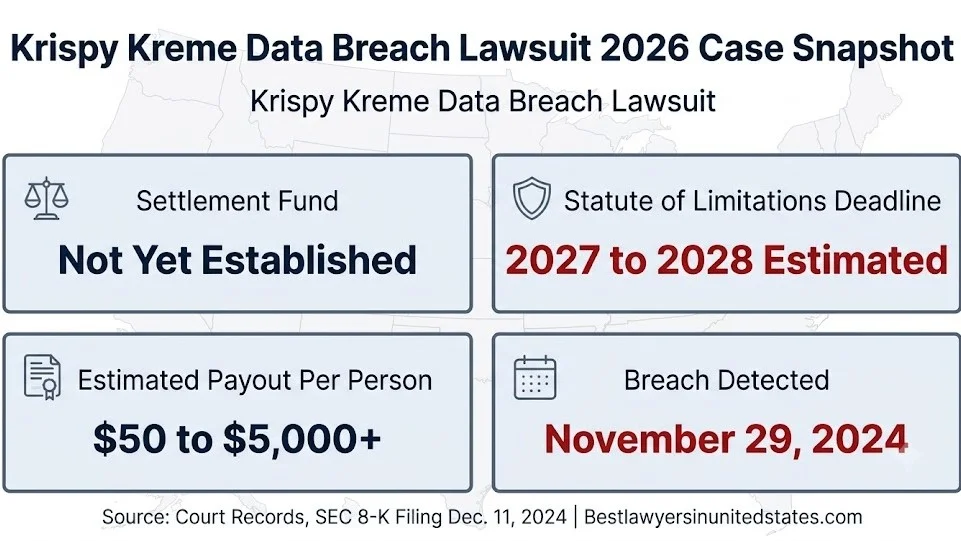
- What it may be worth: Early data breach class actions of comparable scale have produced per-claimant recoveries ranging from $50 to $500 for ordinary members, with higher amounts for documented out-of-pocket losses.
Case Snapshot
| Detail | Information |
|---|---|
| Court | U.S. District Court, Western District of North Carolina (Charlotte Division) |
| Case / MDL Number | Multiple initial complaints filed; consolidation status under review as of early 2026 |
| Cyberattack Detected | November 29, 2024 |
| SEC 8-K Disclosure | December 11, 2024 |
| Breach Notification to Consumers | Began rolling out December 2024 through early 2025 |
| Current Status | Active litigation; no global settlement finalized as of publication |
| Settlement Fund | Not yet established; negotiations ongoing |
| Defendant | Krispy Kreme Doughnut Corporation |
The Krispy Kreme data breach lawsuit represents one of the more closely watched consumer data cases to emerge from the 2024 wave of ransomware attacks targeting national food service brands. A cyberattack detected on November 29, 2024 forced the company to acknowledge in a formal SEC disclosure that unauthorized parties had accessed its systems, disrupting online ordering operations for weeks.
What distinguishes this litigation from the broader pile of post-breach class actions is scale. Krispy Kreme operates or franchises over 1,400 shops across the United States, with millions of registered online accounts carrying payment card data, addresses, and loyalty program records.
Several class action complaints were filed in federal court within weeks of the public disclosure. Those filings allege that Krispy Kreme failed to implement adequate data security protocols, failed to detect the intrusion promptly, and failed to notify affected individuals within legally required timeframes.
The litigation is active. For anyone whose data was stored in Krispy Kreme’s systems during or before November 2024, the question of whether to participate is time-sensitive.
What Is the Krispy Kreme Data Breach Lawsuit?
The Krispy Kreme data breach lawsuit is a class action proceeding filed in federal court against Krispy Kreme Doughnut Corporation. It alleges the company’s inadequate cybersecurity practices allowed a ransomware group to access and potentially exfiltrate the personal data of customers, employees, and franchise personnel.
The legal theories vary across the initial complaints but cluster around four core claims: negligence, negligence per se, breach of implied contract, and unjust enrichment. Each theory approaches the same core question from a different legal angle: did Krispy Kreme have an obligation to protect this data, did it fail, and what does that failure cost?
Under the negligence theory, plaintiffs argue the company owed a duty of care to safeguard personal information collected during online ordering, loyalty program enrollment, and employment onboarding.
Key legal theories alleged:
- Negligence (failure to implement reasonable security measures)
- Negligence per se (violation of FTC data security standards and applicable state statutes)
- Breach of implied contract (consumers provided data with a reasonable expectation of protection)
- Unjust enrichment (company profited from data collection while failing to protect it)
Attorney Insight: Attorneys handling these claims point to the gap between Krispy Kreme’s extensive digital ordering infrastructure and the security investment documented in its pre-breach filings as a core element of the negligence theory.
How Did the Krispy Kreme Data Breach Class Action Begin?
The Krispy Kreme data breach class action began in December 2024, within days of the company’s public SEC disclosure. Multiple plaintiff firms filed independent complaints in the Western District of North Carolina, where Krispy Kreme is headquartered in Charlotte.
This is standard litigation mechanics following a major corporate breach. Plaintiff firms monitor SEC disclosures and news wire alerts, then race to file first. The court receiving these filings typically consolidates them under one lead case and appoints interim class counsel through a competitive application process.
As of early 2026, the cases remain in active pre-trial proceedings. Consolidation motions and lead plaintiff designations are standard procedural steps at this stage.
| Phase | Status (as of 2026) |
|---|---|
| Initial complaints filed | December 2024 |
| Consolidation proceedings | Ongoing |
| Lead plaintiff appointed | Pending or recently resolved |
| Class certification motion | Expected mid-to-late 2026 |
| Discovery phase | Active |
| Settlement negotiations | Early stage |
Attorney Insight: Attorneys handling these claims point to the speed of initial filings as significant. Courts pay attention to which firms filed early and with the most complete factual allegations when evaluating competing motions for lead counsel designation.
What Happened in the Krispy Kreme Cyberattack of November 2024?
The Krispy Kreme cyberattack was first detected on November 29, 2024. The company stated it experienced unauthorized activity affecting portions of its IT systems, which immediately disrupted its U.S. digital ordering platform.
The breach was later attributed by cybersecurity researchers to the Play ransomware group, a threat actor responsible for attacks on dozens of U.S. corporations and government entities. Play ransomware operates by infiltrating networks, moving laterally through systems, exfiltrating data, and then encrypting files before demanding payment.
For Krispy Kreme, the operational fallout was immediate and visible to consumers. Online ordering through the company’s app and website went dark for an extended period. That disruption was itself a signal of the breach’s depth before any public disclosure.
Timeline of the Krispy Kreme cyberattack:
- November 29, 2024: Unauthorized access detected in Krispy Kreme systems
- December 11, 2024: Company files 8-K with SEC disclosing the cybersecurity incident
- December 2024: Online ordering remains disrupted; third-party cybersecurity experts engaged
- Late December 2024 through January 2025: Breach notification letters begin reaching affected individuals
- Early 2025: Class action complaints consolidated in federal court
Attorney Insight: Attorneys handling these claims point to the two-week gap between the detected intrusion and the SEC disclosure as a potential indicator that internal damage assessment delayed the legally required notification clock.
What Did Krispy Kreme Disclose in Its SEC Filing About the Cyberattack?
Krispy Kreme’s SEC disclosure came through a Form 8-K filed on December 11, 2024, twelve days after the breach was detected. That filing is a legally required disclosure for publicly traded companies when a material cybersecurity incident occurs.
The 8-K confirmed: the company detected unauthorized activity on November 29, 2024; it was working with cybersecurity experts to contain and remediate the incident; and the disruption to digital ordering channels was ongoing and expected to have a material impact on business operations.
What the 8-K did not fully specify was the exact volume of records affected, the precise categories of consumer data compromised, or the identity of the threat actor. That pattern is common in early 8-K disclosures and frequently becomes a focal point of litigation.
What the December 11, 2024 SEC 8-K disclosed:
- Unauthorized access to IT systems confirmed
- Disruption to U.S. digital ordering operations confirmed as material
- Third-party cybersecurity experts retained
- Law enforcement notified
- Ongoing investigation with full scope not yet determined
What it did not disclose at the time:
- Specific number of individuals affected
- Categories of personal data accessed
- Whether data was exfiltrated or only encrypted
Attorney Insight: Attorneys handling these claims point to the SEC 8-K as a key exhibit, noting that courts have used the “material impact” language in 8-K filings as evidence that the company’s own executives considered the breach significant.
Litigation Watch: The initial complaints, the cyberattack timeline, and the SEC 8-K collectively establish that Krispy Kreme knew about a serious security incident, disclosed it publicly in stages, and that affected individuals had no immediate way to protect themselves during that disclosure gap.
What Data Was Stolen in the Krispy Kreme Breach?
The categories of data compromised in the Krispy Kreme breach include payment card information, customer account credentials, names and addresses from online ordering profiles, and potentially employee records from company HR systems.
The Play ransomware group is known to exfiltrate data before encrypting systems, meaning the breach likely involved theft rather than mere encryption lockout. That distinction matters legally. Encrypted-but-not-stolen data creates a weaker harm theory. Exfiltrated data creates a stronger one.
As breach notification letters reached affected individuals in late 2024 and early 2025, they confirmed that personal identifying information was among the compromised records. Specific disclosures in individual notification letters varied.
Data categories at risk, based on Krispy Kreme’s systems:
| Data Category | Likely Source System | Legal Harm Theory |
|---|---|---|
| Payment card numbers | Online ordering platform | Financial loss, fraud risk |
| Full name and address | Customer account database | Identity theft risk |
| Email address and password | Loyalty / rewards accounts | Credential stuffing exposure |
| Employee names and SSNs | HR / payroll systems | Severe identity theft risk |
| Franchise worker records | Franchise management systems | Employment-related identity exposure |
Attorney Insight: Attorneys handling these claims point to the distinction between card data and Social Security numbers as affecting claim value. SSN exposure is treated more seriously by courts because the harm is longer-lasting and harder to remediate.
Who Qualifies for the Krispy Kreme Data Breach Lawsuit?
Anyone whose personal information was stored in Krispy Kreme’s digital systems and was potentially accessed during the November 2024 breach period may qualify for the class action. This includes online customers, loyalty program members, and employees.
You do not need to have suffered a confirmed instance of fraud or identity theft to qualify. Data breach class actions are structured to compensate for the risk of harm created by unauthorized data access, not just confirmed downstream fraud.
The class is likely defined nationally, though state-specific subclasses may be certified in jurisdictions with stronger private data breach statutes, including California, Illinois, and New York.
Who likely qualifies:
- Registered users of the Krispy Kreme online ordering platform or app as of November 29, 2024
- Krispy Kreme rewards program members whose accounts were active during the breach window
- Employees whose records were stored in Krispy Kreme’s HR or payroll systems
- Franchise location workers whose information passed through Krispy Kreme’s corporate systems
Who may not qualify:
- Individuals who only purchased in-store with cash and never created an online account
- Customers who created accounts after the breach was contained and remediated
Attorney Insight: Attorneys handling these claims point to account registration records as the primary documentation need. If you have a confirmation email from Krispy Kreme’s online system dated before November 2024, that is your baseline proof of membership in the potential class.
What Are the Eligibility Requirements for the Krispy Kreme Data Breach Claim?
Eligibility for the Krispy Kreme data breach class action is based on whether a person’s personal information was within Krispy Kreme’s data systems at the time of the breach. Receiving a breach notification letter is strong evidence of eligibility but is not the only path in.
Courts apply a numerosity, commonality, typicality, and adequacy standard at class certification. From a potential claimant’s standpoint, what matters most is whether their data was in the system and whether they can document it.
Eligibility checklist:
- [ ] Had an active Krispy Kreme online account or rewards profile before November 29, 2024
- [ ] Received a breach notification letter from Krispy Kreme or a third-party notification service
- [ ] Purchased online using a payment card stored in the Krispy Kreme platform
- [ ] Was employed by Krispy Kreme or a corporate-affiliated franchise operation
- [ ] Can produce email confirmation, account records, or payment receipts showing data was in the system
Attorney Insight: Attorneys handling these claims point to the notification letter as the single most valuable document a potential claimant can preserve. Store it. Do not discard it.
Litigation Watch: The scope of who qualifies and the strength of each eligibility theory will be tested at class certification, which is expected to be one of the most contested stages of this litigation given the mixed nature of the data categories involved.
Did Krispy Kreme Send Data Breach Notifications?
Krispy Kreme began sending breach notification letters to affected individuals in late December 2024 and continuing into early 2025. The notifications were sent directly to individuals identified as having data within the compromised systems.
Legally, data breach notifications are triggered by state law. All 50 states now have data breach notification statutes. The specific requirements, including timing, method of delivery, and content, vary by state. For Krispy Kreme, as a company operating nationally, it must comply with the notification law of each affected individual’s state of residence.
Several states impose deadlines as short as 30 days from discovery of the breach. The gap between November 29, 2024 (discovery) and the rolling notifications starting in mid-to-late December 2024 may have pushed the outer edge of compliance in some jurisdictions.
State notification law benchmarks relevant to this case:
| State | Notification Deadline | Private Right of Action |
|---|---|---|
| California | 45 days (reasonable expedience standard) | Yes (CCPA / Cal. Civ. Code 1798.82) |
| Illinois | 45 days | Yes (PIPA) |
| New York | Expedient, no fixed deadline | Limited |
| North Carolina | Without unreasonable delay | Yes (NCITPA) |
| Texas | 60 days | No private right; AG enforcement |
| Florida | 30 days | Limited private right |
Attorney Insight: Attorneys handling these claims point to late notification in high-protection states like California and Illinois as an independent basis for enhanced statutory damages claims, separate from the underlying negligence theory.
What Is the Current Krispy Kreme Data Breach Settlement Status?
As of publication in 2026, no global settlement has been finalized in the Krispy Kreme data breach litigation. The case is in active pre-trial proceedings in the Western District of North Carolina.
This is not unusual for a data breach class action at this stage. Most major breach cases take two to four years from initial filing to a final approved settlement. The Equifax breach lawsuit, to use a well-documented federal precedent, took from 2017 to 2019 to reach a preliminary settlement agreement and significantly longer for final fund distribution.
The current status as of early 2026 includes active discovery, ongoing consolidation proceedings, and preliminary discussions between counsel. A formal mediation has not been publicly reported.
Current litigation milestones:
| Milestone | Target or Estimated Date |
|---|---|
| Initial complaints filed | December 2024 |
| Consolidation and lead plaintiff | Q1 2025 |
| Discovery phase | 2025 through 2026 |
| Class certification motion | Mid-2026 (estimated) |
| Mediation / settlement talks | Late 2026 or 2027 (estimated) |
| Preliminary settlement approval | 2027 (estimated if settlement reached) |
| Claims filing period | Post-approval (2027 or later) |
Attorney Insight: Attorneys handling these claims point to the discovery phase as critical because it is during this period that internal Krispy Kreme communications, security audit reports, and vendor contracts are produced and may strengthen or complicate the plaintiffs’ negligence theory.
How Much Is the Krispy Kreme Data Breach Settlement Worth?
No settlement fund has been established as of this writing. When a settlement is reached, the fund size will be negotiated based on the number of affected individuals, the severity of the data categories compromised, and comparable precedents.
Data breach settlements in federal class actions have varied widely. The Equifax settlement reached $575 million total, covering approximately 147 million affected individuals. The Capital One settlement was $190 million for roughly 100 million individuals. Smaller-scale breach cases have settled in the $2 million to $20 million range.
Krispy Kreme’s scale, digital reach, and the apparent involvement of a sophisticated ransomware group suggest a settlement in the lower-to-middle range of precedent, though the confirmed volume of affected individuals remains a significant unknown.
Comparable data breach settlements for scale reference:
| Company | Settlement Amount | Individuals Affected | Year |
|---|---|---|---|
| Equifax | $575 million | ~147 million | 2019 |
| Capital One | $190 million | ~100 million | 2021 |
| T-Mobile (2021 breach) | $350 million | ~76 million | 2022 |
| Denny’s / restaurant-scale cases | $2M to $15M | Hundreds of thousands | Various |
Attorney Insight: Attorneys handling these claims point to the number of confirmed affected individuals as the most important variable. If breach disclosure eventually reveals millions of compromised accounts, the fund and per-person payouts scale accordingly.
What Is the Estimated Payout Per Person in the Krispy Kreme Class Action?
No per-person payout amount has been set because no settlement exists yet. Based on comparable federal class action data breach cases, individual class members typically receive between $50 and $500 for ordinary claims with no documented out-of-pocket losses.
Individuals who can document specific financial harm tied to the breach, such as unauthorized card charges, credit monitoring costs, or time spent on fraud remediation, are eligible to claim higher individual amounts, typically in the $500 to $5,000 range depending on the settlement structure.
A small subset of claimants who experienced severe identity theft traceable to the breach may qualify for enhanced payments above $5,000, subject to the specific claims process terms.
Estimated payout tiers by claim type:
| Claimant Type | Estimated Range | Documentation Needed |
|---|---|---|
| General class member | $50 to $150 | Proof of account / notification letter |
| Documented out-of-pocket losses | $200 to $1,500 | Receipts, bank statements, fraud reports |
| Significant fraud / ID theft | $1,500 to $5,000+ | Police reports, credit freeze records, documented losses |
| Employees with SSN exposure | Higher tier, varies | Employment records, identity theft documentation |
Attorney Insight: Attorneys handling these claims point to the importance of starting a contemporaneous log of any fraud-related activity now, before a claims process is established. Courts have held that documentation created close in time to the incident is more credible than records reconstructed later.
Litigation Watch: The per-person payout range, the total fund size, and the tier structure will all be negotiated and presented to the court for approval. Class members retain the right to object or opt out of any settlement and pursue individual claims if the terms are inadequate.
What Compensation Can Krispy Kreme Data Breach Victims Recover?
Krispy Kreme data breach victims may recover several categories of compensation, depending on whether a settlement is reached or the case proceeds to trial. The categories align with what plaintiffs have recovered in comparable federal data breach class actions.
Compensable harm categories in data breach class actions:
- Out-of-pocket financial losses directly tied to the breach (unauthorized charges, credit freeze fees, ID theft protection costs)
- Lost time spent addressing breach-related fraud, typically compensated at an hourly rate set by the settlement structure
- Credit monitoring and identity theft protection services for a defined period, often one to two years
- Statutory damages in states with per-violation statutes, such as California and Illinois
- Injunctive relief, requiring Krispy Kreme to implement specified security upgrades as a condition of settlement
What data breach settlements typically do not cover: general emotional distress without documented impact, speculative future harm without some present manifestation, and losses not traceable to this specific breach.
Attorney Insight: Attorneys handling these claims point to the injunctive relief component as undervalued by potential claimants. For a company with Krispy Kreme’s scale, a court-ordered security overhaul has real consumer protection value beyond the cash payment.
What Is the Filing Deadline for the Krispy Kreme Data Breach Lawsuit?
No formal claims filing deadline has been set because no settlement has been approved. A claims deadline only becomes operative once a court approves a settlement and a claims administrator opens the filing window.
What is time-sensitive right now is the statute of limitations for individual plaintiffs and the preservation of documentation. In most federal data breach cases, the limitations period runs two to four years from the date of discovery, depending on the state and theory of recovery.
For potential claimants in California, the applicable window under the CCPA begins at discovery of the breach, which for most consumers means the date they received notification. Illinois PIPA operates similarly.
State limitations periods relevant to this breach:
| State | Limitations Period (General) | Clock Starts |
|---|---|---|
| North Carolina | 3 years (NCITPA) | Date of discovery |
| California | 4 years (CCPA claims) | Date of discovery / notification |
| Illinois | 5 years (PIPA) | Date of discovery |
| New York | 3 years | Date of incident |
| Florida | 4 years | Date of discovery |
| Texas | 2 years (negligence) | Date of incident |
Attorney Insight: Attorneys handling these claims point to the statute of limitations as the most commonly misunderstood deadline. Many potential claimants assume they can wait until the claims process opens. But individual negligence claims may expire before that process exists.
How Do You Join the Krispy Kreme Data Breach Lawsuit?
Joining the Krispy Kreme data breach lawsuit does not require any action right now for most potential class members. If a class is certified and a settlement is approved, class members are automatically included unless they opt out.
The practical steps at this stage are preparation, not formal enrollment. Gathering documentation, preserving records, and consulting a data breach attorney to assess whether your individual circumstances warrant a more active role in the litigation are the right moves.
Steps to take now:
- Locate and preserve any breach notification letter received from Krispy Kreme
- Pull records of your Krispy Kreme online account history, purchases, and stored payment data
- Monitor your credit reports through all three major bureaus (Equifax, Experian, TransUnion)
- Document any fraudulent activity or suspicious account access with dates and details
- Contact a data breach attorney if you experienced documented financial harm from the breach
- Do not discard communications from Krispy Kreme, its attorneys, or any claims administrator
Attorney Insight: Attorneys handling these claims point to the pre-settlement period as the optimal time to consult counsel, not after the claims window opens, because individual claimants with significant documented losses may benefit from a different legal strategy than mass claim filing.
What Type of Attorney Handles the Krispy Kreme Data Breach Case?
Data breach class actions are handled by plaintiff-side class action attorneys who specialize in privacy litigation, consumer protection law, and cyber security negligence. These are not general personal injury attorneys.
The firms actively filing and managing data breach class actions operate nationally and typically take cases on a contingency fee basis, meaning the attorney collects no fee unless the case produces a recovery. For individual claimants with small losses, this structure makes legal representation economically viable.
In the Krispy Kreme litigation specifically, the lead counsel candidates are firms that filed complaints in the Western District of North Carolina in December 2024. Those filings are publicly accessible through PACER.
Attorney types relevant to this case:
| Attorney Type | Role in This Case |
|---|---|
| Plaintiff class action / privacy attorney | Files and manages class claims; represents plaintiff class |
| Data breach litigation specialist | Advises on technical evidence, harm theories, discovery |
| Consumer protection attorney | Pursues state-law statutory claims under CCPA, PIPA, etc. |
| Individual claims attorney | Represents high-loss claimants pursuing enhanced recoveries |
Attorney Insight: Attorneys handling these claims point to the distinction between joining a class and pursuing an individual claim. For claimants with documented losses above $5,000, a one-on-one consultation with a privacy attorney before the claims window opens may reveal whether individual representation produces a better outcome than automatic class membership.
Where Does the Krispy Kreme Data Breach Lawsuit Stand in 2026?
In 2026, the Krispy Kreme data breach lawsuit is in active pre-trial litigation in the Western District of North Carolina. The case has moved through initial consolidation proceedings and is in the discovery phase.
No settlement has been announced. No class has been certified. Both of those steps are expected to unfold over the next 12 to 24 months, based on the pace of comparable federal data breach cases in the same district.
The 2026 litigation environment is relevant context. Federal courts in data breach cases have been increasingly receptive to certifying broad consumer classes after the Supreme Court’s TransUnion LLC v. Ramirez decision clarified but did not close the door on data breach standing. Plaintiffs must show a concrete, particularized harm, not a bare procedural violation.
2026 litigation status summary:
| Factor | Current Status |
|---|---|
| Court | U.S. District Court, W.D.N.C. (Charlotte Division) |
| Phase | Pre-trial / discovery |
| Settlement | None finalized |
| Class certification | Pending |
| Estimated resolution | 2027 to 2028 based on comparable cases |
| Key legal question pending | Whether plaintiffs can demonstrate concrete harm for standing under TransUnion |
Attorney Insight: Attorneys handling these claims point to the TransUnion standing issue as the most significant legal hurdle the plaintiff class faces in 2026. Claimants who can show concrete harm, not just data exposure, are better positioned.
Litigation Watch: The 2026 discovery phase and the forthcoming class certification battle will determine whether this case produces a broad settlement accessible to millions of Krispy Kreme customers or narrows to a smaller class of demonstrably harmed individuals.
Frequently Asked Questions
Was Krispy Kreme required to notify customers about the data breach?
Yes, all 50 states have data breach notification laws that required Krispy Kreme to notify affected individuals.
The timing requirements vary by state, with some states requiring notification within 30 days and others using a “reasonable expedition” standard.
Krispy Kreme began rolling out notifications in late December 2024 following the November 29, 2024 breach detection.
What personal information did the Krispy Kreme breach expose?
The breach exposed categories including payment card data, customer account credentials, names, addresses, and potentially employee records including Social Security numbers.
The Play ransomware group, identified as the threat actor, is known to exfiltrate data before encrypting systems.
Specific data confirmed for each individual varies based on which Krispy Kreme systems they interacted with.
How much money could I receive from the Krispy Kreme data breach settlement?
No settlement has been finalized, so no payment amount has been set.
Based on comparable data breach class actions, ordinary class members have historically received $50 to $500, with documented-loss claimants receiving higher amounts.
Employees with Social Security number exposure and individuals with confirmed fraud may qualify for enhanced recovery above $1,500.
Is the Krispy Kreme data breach lawsuit still open in 2026?
Yes, the litigation is active and ongoing in the Western District of North Carolina as of 2026.
The case is in pre-trial proceedings with discovery underway and class certification expected mid-to-late 2026.
No claims window has opened because no settlement has been approved.
Do I need proof of harm to join the Krispy Kreme data breach class action?
Class members do not need to prove individual harm to be included in the class if it is certified.
However, claimants seeking enhanced compensation above the base tier will need documentation of specific out-of-pocket losses tied to the breach.
Preserving records, account history, notification letters, and any fraud documentation now will strengthen a future claim at any tier.
What kind of lawyer handles Krispy Kreme data breach claims?
Plaintiff-side class action attorneys who specialize in privacy litigation and consumer data protection handle these cases.
These attorneys typically work on a contingency fee basis, meaning no fee unless there is a recovery.
Individuals with significant documented losses should consult a data breach attorney before the claims window opens to evaluate whether individual representation serves them better than automatic class participation.
Closing
The Krispy Kreme data breach lawsuit is an active federal proceeding with a long road ahead. The breach occurred, the data was accessed, and the litigation is real. What remains unresolved is the scope of the class, the depth of recoverable damages, and when a claims process will open.
For anyone who had a Krispy Kreme online account, worked for the company, or received a breach notification letter, the single most productive action right now is documentation. Preserve every relevant record.
If you experienced documented financial harm, fraudulent charges, or identity theft you can connect to this breach, consulting a data breach attorney before the claims window opens gives you the clearest picture of your options. These attorneys handle intake on a no-fee, no-cost basis until a recovery is secured.
