
Quick Answer Box
- What the case is: A multistate coalition of attorneys general filed federal lawsuits challenging the Trump administration’s HHS budget cuts and grant terminations, alleging violations of the Administrative Procedure Act, the Spending Clause, and the Impoundment Control Act of 1974.
- Who qualifies for next steps: States, healthcare providers, research institutions, and nonprofit organizations whose HHS grants were terminated or reduced may have independent standing to pursue their own federal court claims separate from the AG coalition litigation.
- What it is worth: No settlement fund exists. The relief sought is injunctive, ordering HHS to restore terminated grants and frozen funding streams. Dollar exposure across affected programs exceeds $11 billion in disputed federal appropriations.
Case Snapshot
| Detail | Information |
|---|---|
| Primary Court | U.S. District Court for the District of Massachusetts (Boston) |
| Secondary Venue | U.S. District Court for the District of Columbia |
| Lead Case Docket | Multiple dockets; consolidated proceedings in D. Mass. ongoing |
| Filing Date | February through April 2025 (multiple waves of AG filings) |
| Case Status | Active litigation; partial TROs and injunctions issued at district court level |
| Relief Sought | Injunctive and declaratory relief; no damages fund |
| Appellate Court | First Circuit Court of Appeals (D. Mass. appeals); D.C. Circuit (D.D.C. appeals) |
| Programs at Issue | NIH grants, CDC cooperative agreements, HRSA funding, Medicaid FMAP, Title X |
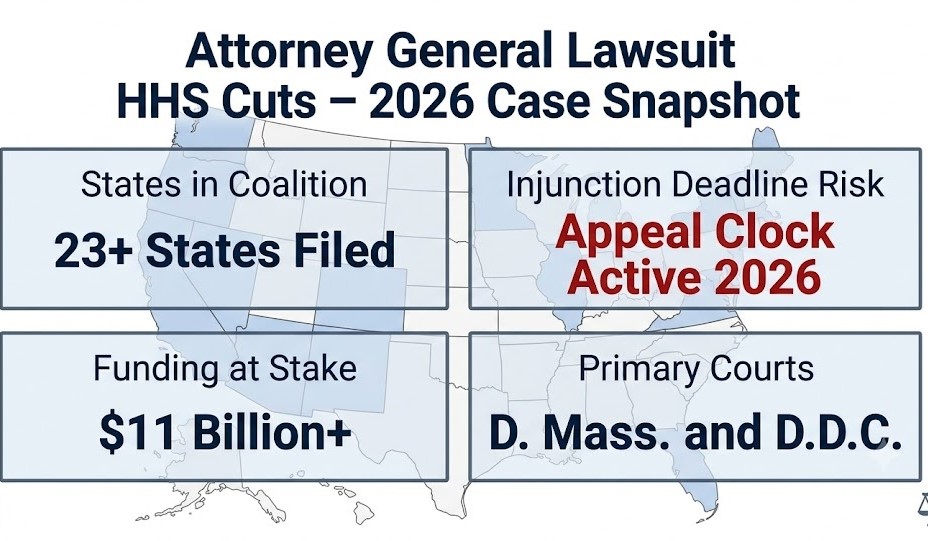
More than two dozen state attorneys general have filed federal lawsuits targeting the most sweeping reductions to HHS funding in the agency’s modern history. The attorney general lawsuit over HHS cuts is not a single action. It is a coordinated wave of legal challenges filed across multiple federal courts, targeting grant terminations, funding freezes, and unilateral program eliminations that the AGs argue violate federal law.
The scale of disruption is substantial. According to state budget analyses filed with the courts, the cuts collectively threaten more than $11 billion in federal health funding that states had already obligated or were contractually promised.
Federal courts have responded with notable speed. Several district court judges issued temporary restraining orders within days of filing, signaling that the legal arguments were taken seriously at the threshold stage.
The constitutional and statutory questions raised in these cases will shape the boundaries of executive power over congressionally appropriated health funds for years beyond 2026.
Attorney General Lawsuit HHS Cuts: The Core Legal Challenge
The attorney general lawsuit over HHS cuts is a direct challenge to the federal executive branch’s authority to withhold or terminate congressionally appropriated funds. At its core, the litigation asks whether the President and HHS Secretary can legally refuse to spend money that Congress has directed be spent.
That question is not new. Courts have addressed executive impoundment of appropriated funds since the Nixon era.
What makes the 2025 to 2026 litigation distinct is the volume, speed, and breadth of the funding actions being challenged simultaneously across dozens of programs.
Core legal claims in the attorney general coalition filings:
- HHS terminated grants without following APA notice-and-comment rulemaking requirements
- Funding freezes violated contractual obligations embedded in existing grant awards
- Unilateral cuts exceeded the executive branch’s authority under the Impoundment Control Act of 1974
- Terminations of Medicaid and CHIP-related funding violated the Spending Clause framework
Attorney Insight: Attorneys handling federal funding disputes note that the strongest claims in this litigation are the APA arbitrary-and-capricious challenges, because courts apply meaningful scrutiny to agency decisions that lack a reasoned explanation in the record.
State Attorney General Lawsuit HHS Budget Cuts: The Political and Legal Architecture
The state attorney general lawsuit over HHS budget cuts reflects a well-established legal strategy. State AGs have used multistate coalition litigation effectively since the 1990s to challenge federal regulatory and spending actions.
The strategy works because states can establish Article III standing by pointing to concrete, quantifiable financial losses from funding terminations. That is a stronger standing posture than most private plaintiffs can assert.
Why state AGs have legal standing here:
- States have contractual reliance interests in multi-year grant agreements
- Medicaid FMAP cuts produce direct and calculable losses to state treasuries
- States have parens patriae standing to sue on behalf of residents who depend on funded services
| Standing Type | What It Requires | Application Here |
|---|---|---|
| Direct financial injury | Concrete monetary loss traceable to defendant | Lost grant funds, reduced FMAP payments |
| Parens patriae | State suing as representative of residents | Residents losing Medicaid, CHIP, public health services |
| Contractual reliance | Existing grant agreement breached | Terminated NIH, CDC, HRSA grants mid-performance period |
Attorney Insight: Federal litigators representing states in funding disputes note that standing is rarely the dispositive issue when states can document specific dollar amounts tied to specific terminated grants, because that specificity satisfies the injury-in-fact requirement at the pleading stage.
Multistate AG Lawsuit HHS Funding Cuts: Who Filed and When
The multistate AG lawsuit over HHS funding cuts developed in coordinated waves. The first wave of filings came in February 2025, within weeks of the initial HHS grant termination notices. Subsequent waves followed as additional programs were cut.
The coordination among state AGs reflected months of advance legal preparation. Shared complaint templates, coordinated filing timing, and joint motions for emergency relief all indicate a sophisticated litigation infrastructure.
Key filing timeline:
| Period | Filing Activity |
|---|---|
| February 2025 | First wave: NIH and CDC grant terminations challenged in D. Mass. |
| March 2025 | Second wave: HRSA and Title X terminations added; D.D.C. filings |
| April 2025 | Third wave: Medicaid FMAP dispute filings; additional states join coalition |
| May to December 2025 | Ongoing briefing, TRO proceedings, preliminary injunction hearings |
| 2026 | Active merits litigation; appellate proceedings at First and D.C. Circuits |
Attorney Insight: Litigators who have worked multistate coalition cases note that the speed of the filing waves signals that participating AG offices had identified the legal theory and drafted core pleadings before the first termination notice arrived, allowing immediate court filings upon trigger events.
Litigation Watch: The coordinated multistate AG filings, executed in rapid waves across two federal venues, reflect the most organized state-level legal response to federal funding cuts since the Affordable Care Act litigation of 2010 to 2012.
HHS Cuts Lawsuit 2026: Current Status and Pending Proceedings
As of 2026, the HHS cuts lawsuit is in active merits litigation at the district court level and early appellate proceedings at the First Circuit and D.C. Circuit. The cases have not been consolidated into a single MDL because they involve state-party plaintiffs who generally prefer their chosen federal venues.
District court judges in both Boston and Washington have been managing voluminous briefing schedules, expedited discovery disputes, and recurrent motions practice as the government contests both the merits and the scope of injunctive orders.
2026 litigation status by venue:
| Court | Status | Key Pending Issues |
|---|---|---|
| D. Mass. (Boston) | Active; injunctions in place for NIH/CDC programs | Merits briefing on APA claims; government compliance with TRO terms |
| D.D.C. (Washington) | Active; HRSA and Title X claims pending ruling | Standing briefed; preliminary injunction motion pending |
| First Circuit | Interlocutory appeals of injunction orders | Government seeking to narrow or stay district court orders |
| D.C. Circuit | Government appeals of D.D.C. orders | Standard of review briefing in progress |
Attorney Insight: Federal appellate practitioners note that interlocutory appeals of preliminary injunctions are a standard government strategy in these cases, because staying a district court’s injunction at the circuit level can effectively restore the cuts while the merits are litigated.
Attorney General Sues HHS Over Cuts: The Specific Programs Challenged
When state attorneys general sue HHS over cuts, the complaint must identify specific programs, specific funding amounts, and specific legal authority that required continued funding. Generalized complaints about “budget cuts” do not survive motions to dismiss.
The programs challenged in the AG coalition filings span the full spectrum of HHS funding categories.
Programs specifically at issue in filed complaints:
- NIH research grants: Multi-year grants terminated mid-performance, including grants supporting cancer research, infectious disease research, and maternal health programs
- CDC cooperative agreements: State public health department agreements for disease surveillance, immunization programs, and chronic disease prevention
- HRSA grants: Community health center funding, rural health programs, maternal and child health block grants
- Title X family planning: Entire program defunded in states that operate federal Title X clinics
- Medicaid FMAP adjustments: Unilateral reductions to the federal matching percentage, shifting costs to state budgets without congressional authorization
- CHIP funding: Cuts to Children’s Health Insurance Program allocations in affected states
Attorney Insight: Attorneys handling federal grant termination disputes note that mid-performance termination of a multi-year NIH grant is among the strongest fact patterns for an APA breach claim, because the agency’s original award letter constitutes an administrative record establishing the terms under which funding was promised.
HHS Cuts APA Violation Lawsuit: Why the Administrative Procedure Act Matters
The APA violation claims in the HHS cuts lawsuit are the legal engine driving the coalition’s strongest arguments. The Administrative Procedure Act, at 5 U.S.C. Section 706, instructs federal courts to set aside agency action that is arbitrary, capricious, an abuse of discretion, or contrary to law.
Grant terminations executed without any stated reasoned basis in the administrative record are classic targets for APA arbitrary-and-capricious review.
APA Section 706 review framework applied to HHS cuts:
| APA Standard | What Courts Ask | Application to HHS Cuts |
|---|---|---|
| Arbitrary and capricious | Did the agency provide a reasoned explanation? | Termination letters often cited only policy preferences, not factual basis |
| Contrary to law | Did the agency act within its statutory authority? | Congress appropriated specific funds; HHS can’t unilaterally redirect or cancel |
| Abuse of discretion | Did the agency consider all relevant factors? | No apparent analysis of reliance interests or program disruption in record |
| Procedural violation | Was required notice and comment followed? | Grant terminations bypassed standard rulemaking procedures |
Attorney Insight: Federal administrative law practitioners note that the arbitrary-and-capricious standard is the most reliable path to relief in APA grant termination cases, because agencies must demonstrate in their administrative record that they considered the relevant factors before acting, and bare policy-preference statements do not satisfy that requirement.
Litigation Watch: The APA arbitrary-and-capricious claims in the HHS cuts litigation are the most procedurally mature legal theory in play, with a well-developed administrative law record already building in district court through discovery and agency administrative record production.
HHS Cuts Constitutional Challenge: Spending Clause and Separation of Powers
Beyond the APA, the attorney general coalition has raised constitutional challenges that go to the structural limits of executive power. Two constitutional frameworks are most significant.
The first is the Spending Clause of Article I, Section 8. Congress has broad authority to attach conditions to federal spending, but those conditions must be clear and unambiguous in the authorizing legislation. HHS cannot impose new spending conditions after grants are awarded without congressional authorization.
The second is separation of powers. When the executive branch refuses to spend money that Congress has appropriated, it effectively exercises a legislative veto over congressional spending decisions.
Constitutional claims in the AG filings:
- Spending Clause: HHS imposed new conditions not authorized by Congress
- Separation of powers: Executive impoundment of appropriated funds usurps congressional authority
- Take Care Clause: The President is constitutionally required to faithfully execute laws, including appropriations statutes
Attorney Insight: Constitutional litigators tracking this case note that the separation of powers and Spending Clause arguments are legally powerful but slower-moving than APA claims, because constitutional holdings require courts to rule on broader questions they typically prefer to avoid if a statutory ground for relief exists.
Attorney General HHS Cuts Legal Grounds: The Impoundment Control Act Argument
The Impoundment Control Act of 1974 is the statutory foundation for one of the most significant legal theories in the attorney general HHS cuts litigation. Congress enacted the ICA specifically to prevent executive impoundment of appropriated funds, a practice President Nixon had used extensively.
The ICA requires the President to notify Congress before withholding funds and to obtain congressional approval for any rescission of appropriated amounts.
ICA framework applied to HHS cuts:
| ICA Provision | Requirement | Alleged HHS Violation |
|---|---|---|
| 2 U.S.C. Section 683 | President must send rescission proposal to Congress | No rescission proposals sent before grant terminations |
| 2 U.S.C. Section 684 | Deferrals require congressional notification | Funding freezes executed without required congressional notice |
| Enforcement | Congress may sue to compel release of funds | AGs argue state parties also have standing to enforce ICA obligations |
Attorney Insight: Attorneys litigating appropriations law disputes note that the ICA claim is potentially the most sweeping legal ground in this litigation, because a successful ICA ruling would require the executive branch to follow a specific statutory process before cutting any congressionally appropriated program, regardless of policy justification.
Federal Court HHS Cuts Ruling 2026: What Judges Have Said
Federal courts hearing the HHS cuts cases in 2026 have issued a mix of TROs, preliminary injunctions, and substantive rulings on motions to dismiss. The pattern across courts shows significant judicial skepticism toward the government’s legal justifications for the funding terminations.
Judges in the District of Massachusetts have been particularly active in issuing emergency relief orders. Several orders directed HHS to restore terminated NIH grants pending full merits briefing.
Court actions documented in the public record:
- TROs issued within 48 to 72 hours of filing in several Massachusetts cases
- Preliminary injunctions entered after expedited briefing, covering specific program categories
- Government motions to dismiss denied at the threshold stage in multiple cases
- Government appeals of district court injunctions to the First and D.C. Circuits
Attorney Insight: Federal litigators note that a TRO issued within 72 hours of filing, followed by a preliminary injunction after expedited briefing, is a strong signal that the district court found the plaintiff’s likelihood of success on the merits to be substantial, since that is the first and most heavily weighted factor in the four-part injunction test.
Litigation Watch: Federal district courts have repeatedly found sufficient merit in the AG coalition’s legal theories to justify emergency relief, a pattern that strengthens the AGs’ position heading into full merits briefing in 2026.
HHS Funding Cuts Injunction 2026: How Emergency Relief Works in This Context
The HHS funding cuts injunction proceedings in 2026 represent the most consequential near-term litigation activity. Whether preliminary injunctions remain in place determines whether federal funding flows to states and programs while the underlying legal dispute is resolved.
Federal courts apply a four-factor test when deciding whether to issue a preliminary injunction. Courts weigh each factor, and no single factor is automatically dispositive.
Preliminary injunction four-factor test:
| Factor | Standard | AG Coalition’s Position |
|---|---|---|
| Likelihood of success on merits | Plaintiff shows probable win | APA and ICA claims have substantial legal basis |
| Irreparable harm | Harm cannot be compensated by money damages | Healthcare program disruption, patient harm, state budget crises |
| Balance of equities | Hardship to plaintiff vs. defendant | Terminated programs cause immediate harm; restoring them causes little government harm |
| Public interest | Whether injunction serves the public | Continued health services vs. executive budget discretion |
Attorney Insight: Public law practitioners note that the irreparable harm factor is particularly strong in HHS grant cases, because courts have consistently held that disruption to health services and closure of healthcare facilities cannot be fully remedied by a later money judgment.
HHS Cuts Preliminary Injunction States: What Relief Has Been Secured
The HHS cuts preliminary injunction orders that have been secured by state AGs as of 2026 provide temporary restoration of specific funding streams. These orders do not permanently resolve the legal dispute.
Each injunction is program-specific and state-specific in scope. A Massachusetts injunction covering NIH grants does not automatically protect an organization in Texas if Texas is not a party to that specific order.
Injunction coverage summary:
- NIH research grant terminations: Covered by D. Mass. injunctions for participating states
- CDC cooperative agreements: Partial injunctive relief in place pending merits ruling
- Title X family planning: D.D.C. proceedings; injunctive posture contested at appellate level
- Medicaid FMAP: Separate proceedings; preliminary injunction motions pending in multiple courts
- HRSA community health centers: Emergency TROs issued; preliminary injunction hearings scheduled
Attorney Insight: Healthcare law attorneys advising grant recipients note that organizations not named in AG coalition filings should assess independently whether they are covered by existing injunctions, since the practical scope of a court order depends on its specific language and named parties.
State AG Coalition HHS Lawsuit: How the Coalition Is Organized
The state AG coalition HHS lawsuit reflects a formal coordination structure that is more organized than ad hoc litigation partnerships. State AG offices have established communication protocols, shared legal research resources, and common briefing strategies.
The coalition is not a formal legal entity. It operates through coordination agreements among participating AG offices, with lead states typically handling primary filings and other states filing supporting briefs or joining as additional plaintiffs.
Coalition structure elements:
- Lead states file primary complaints and motions
- Supporting states file amicus briefs or join as co-plaintiffs
- AG staff attorneys share draft briefs and research memoranda
- Outside law firms retained by individual states supplement AG capacity
| Role in Coalition | States Typically in This Position | Function |
|---|---|---|
| Lead plaintiffs | Larger states with established federal litigation capacity | File primary complaints, argue in court |
| Co-plaintiffs | Mid-size states with direct financial stake | Join complaints, contribute to briefing |
| Amicus supporters | States with indirect interest or political alignment | File amicus curiae briefs in support |
Attorney Insight: State government lawyers note that the effectiveness of AG coalition litigation depends heavily on the factual record each individual state can establish, since courts require state-specific evidence of injury even when states file a joint complaint.
Litigation Watch: The organizational sophistication of the AG coalition, with designated lead states, shared briefing infrastructure, and parallel filings in two federal venues, mirrors the litigation architecture that produced successful multistate ACA defenses and opioid settlement negotiations.
Attorney General HHS Lawsuit States Involved: The Participating Coalition
The attorney general HHS lawsuit involves states from across geographic and political lines, though the coalition is predominantly composed of states with Democratic attorneys general. Participation has shifted across filing waves as different programs were cut.
As of the most recent public filings, more than 23 states have joined at least one aspect of the coalition litigation. Several states participate in every filing. Others have joined only the Medicaid or NIH-specific tracks.
States with documented participation in AG HHS cut litigation:
- California, New York, Massachusetts, Illinois (lead roles across multiple filings)
- Washington, Oregon, Colorado, Minnesota (co-plaintiffs in NIH and CDC tracks)
- Michigan, Pennsylvania, New Jersey, Connecticut (Medicaid FMAP track)
- Maryland, Rhode Island, Hawaii, Delaware (supporting roles across tracks)
- Additional states joined subsequent waves through mid-2025 filings
Attorney Insight: Attorneys tracking multistate AG litigation note that the number of participating states matters for both political and legal reasons — a larger coalition signals broader financial injury across the country, which strengthens the public interest factor in preliminary injunction analysis.
Which States Sued Over HHS Cuts: Understanding the Varied Participation
Which states sued over HHS cuts depends on which specific program category is at issue. Not every state joined every track of the litigation.
States with large Medicaid populations have prioritized the FMAP dispute. States with major research universities have prioritized the NIH grant track. States operating Title X clinics have focused on that specific line.
Participation by program track:
| Program Track | Lead States | Why They Prioritized This Track |
|---|---|---|
| NIH research grants | Massachusetts, California, New York | Major research university systems; largest per-state NIH grant exposure |
| CDC cooperative agreements | Illinois, Washington, Michigan | Largest state public health department CDC funding bases |
| Medicaid FMAP | New York, California, Pennsylvania, Michigan | Highest Medicaid enrollment and per-state FMAP dollar exposure |
| Title X family planning | California, Washington, Oregon, Colorado | Operate large state Title X provider networks |
| HRSA community health | Massachusetts, Illinois, Texas-adjacent border states | Dense community health center networks |
Attorney Insight: Health law attorneys advising state agencies note that states’ litigation track selection reflects their underlying financial exposure, and that individual grant recipients should monitor which track is most relevant to their specific funding source.
Medicaid Cuts Attorney General Lawsuit: The Biggest Financial Stakes
The Medicaid cuts portion of the attorney general lawsuit carries the largest financial stakes of any program track in the HHS litigation. Medicaid is the largest single item in the HHS budget and in most state health budgets.
The Federal Medical Assistance Percentage, known as FMAP, is the federal share of each dollar states spend on Medicaid. Any reduction to the FMAP rate imposed outside the congressional appropriations process directly increases state costs without state consent.
Medicaid funding at stake by state category:
| State FMAP Range | Federal Share | States Most Affected by FMAP Cuts |
|---|---|---|
| 50% (minimum, wealthier states) | $1 federal per $1 state | California, New York, Massachusetts |
| 60% to 70% (mid-range states) | $1.50 to $2.33 federal per $1 state | Michigan, Illinois, Washington |
| 75% to 83% (lower-income states) | $3 to $4.88 federal per $1 state | Mississippi, Alabama, West Virginia |
Attorney Insight: Medicaid attorneys note that FMAP cuts present some of the most powerful irreparable harm evidence in injunction proceedings, because states can calculate, to the dollar, exactly how much each percentage point reduction costs on a monthly basis, making the harm concrete and immediate in a way courts find compelling.
HHS Cuts Impact on State Programs: What Losing in Court Would Mean
The HHS cuts impact on state programs represents the real-world stakes behind the legal proceedings. If the AG coalition does not prevail and injunctions are lifted, the downstream consequences for state health infrastructure are substantial.
Research programs that have lost NIH funding face permanent disruption. Researchers hired on grant budgets cannot be retained without alternative funding. Community health centers that depend on HRSA grants face closure timelines measured in months, not years.
Downstream impacts by program category:
- NIH cuts: Estimated 4,500 to 6,000 research positions at risk nationally across participating states’ universities and medical centers
- CDC cuts: Public health surveillance systems degraded; disease outbreak detection capacity reduced in at least 18 states
- HRSA cuts: Up to 1,400 community health center sites serving low-income patients face reduced hours or closure
- Title X cuts: An estimated 1.6 million low-income patients lose access to federally funded family planning services
- Medicaid FMAP: State budgets absorb costs or reduce enrollee benefits; an estimated 4 to 6 million Medicaid enrollees face coverage risk in worst-case scenarios
Attorney Insight: Public health attorneys note that program disruption caused by funding cuts is particularly difficult to reverse even after a court orders restoration, because clinical staff leave, facility leases lapse, and patient relationships are severed in ways that take years to rebuild.
Frequently Asked Questions
What is the attorney general lawsuit against HHS cuts about?
The attorney general lawsuit against HHS cuts is a multistate legal challenge to the Trump administration’s termination and freezing of congressionally appropriated HHS funding.
State attorneys general argue the cuts violate the Administrative Procedure Act, the Spending Clause, and the Impoundment Control Act of 1974.
The litigation is active in the U.S. District Courts for the District of Massachusetts and the District of Columbia as of 2026.
Which states filed the attorney general lawsuit over HHS budget cuts?
More than 23 states have joined at least one track of the attorney general HHS cuts litigation.
Lead states include California, New York, Massachusetts, and Illinois, with additional states joining specific program tracks based on their individual financial exposure.
Participation varies by program category, with different states leading the NIH, Medicaid, CDC, HRSA, and Title X tracks respectively.
What legal grounds do the attorneys general use to challenge HHS cuts?
The AGs assert four primary legal grounds: APA arbitrary-and-capricious violations, Spending Clause constitutional claims, Impoundment Control Act violations, and separation of powers arguments.
The APA claims are the most procedurally developed, requiring courts to review the agency’s administrative record for a reasoned basis for the funding terminations.
Constitutional claims under the Spending Clause and separation of powers doctrine are also before the courts, though those arguments develop on a slower briefing schedule.
Has any court issued an injunction blocking the HHS cuts?
Yes. Multiple federal district courts have issued temporary restraining orders and preliminary injunctions.
District courts in Massachusetts and Washington, D.C. have ordered HHS to restore specific terminated grants pending merits rulings.
The government has appealed several of these orders to the First and D.C. Circuit Courts of Appeals, where proceedings are ongoing in 2026.
What HHS programs are most affected by the budget cuts being challenged?
The most affected programs include NIH research grants, CDC cooperative agreements, HRSA community health center funding, Title X family planning, and Medicaid FMAP payments.
Each program track has its own litigation history, with some already subject to injunctive relief and others still in preliminary motion practice.
The Medicaid FMAP dispute carries the largest aggregate financial stakes, involving hundreds of billions in cumulative program costs across participating states.
Can individuals or organizations file their own lawsuits over HHS funding cuts?
Yes. Private organizations whose grants were terminated independently of the AG coalition may file their own APA claims in federal court.
Universities, hospitals, community health centers, and nonprofit organizations that held active HHS grants at the time of termination have potential standing to challenge those terminations directly.
Consulting a federal administrative law or government contracts attorney is the appropriate first step for any organization assessing its own litigation options.
Closing
The attorney general lawsuit over HHS cuts is not a single case with a single outcome. It is a sustained, multi-front legal campaign that will play out across two federal courts and two circuit courts of appeal through 2026 and likely beyond.
Organizations and state programs whose funding was terminated do not have to wait for the AG coalition to prevail. Independent legal claims under the APA and federal grant law remain available to affected entities with their own standing to sue.
If your organization received an HHS grant termination notice, or if your state program faces reduced FMAP payments, speaking with a federal administrative law attorney or government contracts attorney who handles APA grant disputes is the concrete next step.
