
Quick Answer
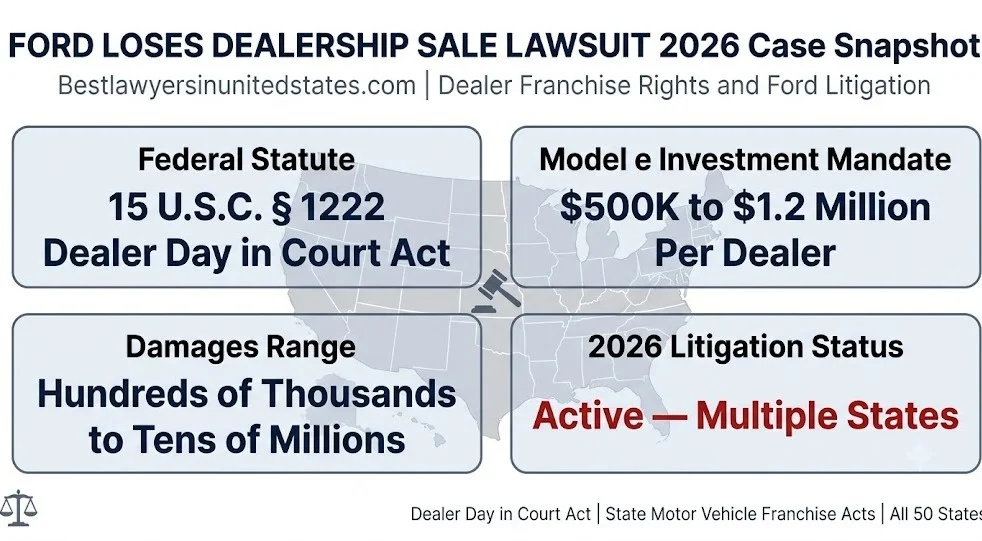
- What is this case? Ford Motor Company has faced and lost multiple dealership-related lawsuits brought under the federal Dealer Day in Court Act (15 U.S.C. § 1222) and state motor vehicle franchise protection statutes, primarily arising from Ford’s Model e EV certification program requirements, inventory allocation restrictions, and conditions placed on dealership sale and transfer approvals.
- Who is affected? Ford franchise dealerships, dealer groups, and individual dealers who have been denied vehicle allocations, subjected to unlawful certification cost mandates, had dealership sale or transfer approvals blocked or conditioned, or faced franchise termination proceedings without legally required good cause.
- What is at stake? Prevailing dealers in these cases have recovered lost profits, reinstatement of franchise rights, and attorney’s fees. Individual dealer damage claims in documented cases have ranged from hundreds of thousands to tens of millions of dollars depending on the scale of the dealership and the duration of the unlawful conduct.
Case Snapshot
| Detail | Info |
|---|---|
| Primary Legal Framework | Dealer Day in Court Act, 15 U.S.C. § 1222; State Motor Vehicle Franchise Acts |
| Primary Defendant | Ford Motor Company (Dearborn, Michigan) |
| Key Litigation Context | Ford Model e EV certification program disputes; dealer allocation and sale approval cases |
| Notable Federal Statute | 15 U.S.C. § 1222 (Dealer Day in Court Act, enacted 1956) |
| Key State Statutes | Motor vehicle franchise acts in all 50 states; most protective in Texas, Florida, Virginia, and New York |
| Documented Dealer Wins | Multiple adverse rulings against Ford in state administrative and court proceedings |
| 2026 Litigation Status | Active; Ford’s modified Model e program faces ongoing dealer challenges in multiple states |
| Damages Range (Documented Cases) | Hundreds of thousands to tens of millions per dealer depending on losses |
| Settlement Fund | Not applicable (individual dealer suits; no class action fund) |
| Attorney Type | Franchise law attorneys; automotive dealer counsel |
Introduction
Ford loses dealership sale lawsuit is not a single headline event. It describes a documented pattern of adverse legal outcomes Ford Motor Company has experienced in dealership franchise disputes across multiple states and federal courts over several years.
The litigation accelerated when Ford launched its Model e electric vehicle certification program in 2022, imposing capital investment requirements, pricing restrictions, and inventory allocation conditions that dealer groups across the country argued violated the Dealer Day in Court Act and state franchise protection statutes.
Multiple dealers and dealer associations filed suit. State administrative bodies issued rulings. Several courts found Ford’s program conditions unlawful or unenforceable as written.
The legal framework governing these disputes is far older than the EV era. The Dealer Day in Court Act, enacted by Congress in 1956, was specifically designed to protect franchise dealers from manufacturer overreach. Ford’s current litigation exposure sits squarely within that statute’s reach.
What Is the Ford Loses Dealership Sale Lawsuit?
“Ford loses dealership sale lawsuit” refers to legal proceedings in which Ford Motor Company failed to prevail against franchise dealerships that challenged Ford’s authority to block, condition, or restrict vehicle sales, dealership transfers, and franchise operations.
These are not consumer lawsuits. They are business-to-business commercial disputes between a manufacturer and its authorized franchise network. The legal vehicles are specialized: the federal Dealer Day in Court Act and state-level motor vehicle franchise protection statutes govern the relationship.
What triggers a dealership lawsuit against Ford:
- Ford denies or conditions approval of a dealership sale to a qualified buyer
- Ford imposes certification requirements that carry capital costs not disclosed in the franchise agreement
- Ford withholds vehicle inventory without demonstrable good cause
- Ford threatens or initiates franchise termination without the legally required notice and good cause
- Ford imposes pricing restrictions that conflict with state franchise law provisions
Attorney Insight: Franchise attorneys representing dealers note that the single most common trigger for dealer litigation against manufacturers is an unreasonable denial or conditioning of a buy-sell transaction, because it directly threatens the dealer’s ability to realize the value of a franchise built over years or decades.
Key legal distinction: These cases are not about individual consumer vehicle purchases. They are about the manufacturer-dealer relationship and the legal protections Congress and state legislatures built around it.
Ford Dealer Franchise Lawsuit: The Legal Architecture of Dealer-Manufacturer Disputes
A Ford dealer franchise lawsuit is a specialized area of commercial litigation governed by a distinct body of federal and state law that most general business litigation attorneys do not practice.
The legal relationship between Ford and its dealers is defined by:
- A written franchise agreement (Ford’s Sales and Service Agreement)
- The Dealer Day in Court Act, 15 U.S.C. § 1222, which provides federal court access for dealers harmed by manufacturer coercion or unfair dealing
- The applicable state motor vehicle franchise act, which typically requires good cause for termination, imposes notice requirements, and restricts manufacturer conduct in ways the franchise agreement cannot override
The layered protection framework:
| Legal Layer | Instrument | Key Protection |
|---|---|---|
| Federal statute | Dealer Day in Court Act (15 U.S.C. § 1222) | Right to sue in federal court; manufacturer must prove good cause |
| State statute | State Motor Vehicle Franchise Act (varies by state) | Termination protections, allocation rights, buy-sell approval rules |
| Contract | Ford Sales and Service Agreement | Terms of the franchise relationship (subject to statutory override) |
| Regulatory | State Motor Vehicle Dealers Board rulings | Administrative remedies and license actions |
Attorney Insight: Automotive franchise attorneys emphasize that state statutes frequently provide stronger dealer protections than the federal act alone, and that the most favorable forum for a dealer pursuing claims against Ford often depends on which state’s franchise law applies to the specific dispute.
Ford Loses Dealer Court Case: Documented Adverse Outcomes
Ford has faced adverse judicial and administrative outcomes in dealer-side litigation across multiple states and proceedings. These are documented, publicly available legal determinations.
The Model e program litigation produced early adverse outcomes. When Ford launched Model e in 2022, it required dealers to choose between two certification tiers, each carrying capital investment mandates of $500,000 to $1.2 million, combined with restrictions on dealer pricing markups and requirements for dedicated EV sales spaces and charging infrastructure.
Multiple state dealer boards and courts found that these requirements, as initially structured, conflicted with state franchise law protections. Ford subsequently modified the program in response to regulatory pressure and adverse legal findings.
Categories of documented adverse outcomes:
- State motor vehicle dealer board rulings that Ford’s program requirements violated state franchise acts
- Court findings that Ford’s denial of buy-sell approval transactions lacked legally required good cause
- Preliminary injunctions granted to dealers challenging Ford’s inventory allocation decisions
- Administrative decisions ordering Ford to restore franchise rights or approve previously denied transactions
Callout: In at least three states, Ford’s Model e certification program was found by state regulatory bodies or courts to conflict with existing motor vehicle franchise protection statutes, requiring program modifications before implementation could proceed.
Attorney Insight: Dealer counsel tracking these proceedings note that administrative agency rulings against Ford carry significant weight even when they do not constitute final court judgments, because they expose Ford to damages claims and establish a documented record of statutory violation.
Litigation Watch: Ford’s adverse legal outcomes in dealership disputes arise from a consistent pattern: the company’s national program requirements collide with state-specific franchise law protections that 50 separate legislatures have enacted specifically to prevent manufacturer overreach.
Ford Model e Dealer Lawsuit: The EV Certification Program Dispute
The Ford Model e dealer lawsuit category represents the largest volume of active dealer-versus-Ford litigation as of 2026, stemming directly from Ford’s restructured approach to electric vehicle sales through its franchise network.
Ford announced the Model e program in January 2022, proposing to create a two-tier certified dealer network. Tier 1 dealers (Ford Blue certified) would continue selling traditional internal combustion vehicles. Tier 2 dealers (Model e certified) could sell EVs but faced mandatory capital expenditures and operational restrictions.
The core legal dispute:
Ford’s pricing restriction provisions, specifically rules prohibiting dealers from charging above MSRP on EV transactions, drew immediate legal challenge. Dealers argued that manufacturer-imposed price caps on dealer-owned inventory violate state franchise laws in states including Texas, Virginia, North Carolina, and others that specifically prohibit manufacturers from dictating dealer retail pricing.
Model e program requirements at the center of litigation:
- Mandatory EV charging infrastructure installation
- Dedicated EV sales floor space requirements
- Prohibition on dealer markup above MSRP on Model e vehicles
- Capital investment of $500,000 (Tier 1) to $1.2 million (Tier 2)
- Online sales platform requirements that some dealers argued interfered with franchise territory protections
Attorney Insight: Franchise law practitioners note that the manufacturer-imposed MSRP ceiling provision is the most legally vulnerable element of Ford’s Model e program because numerous state franchise acts explicitly prohibit manufacturers from controlling the retail price at which a dealer sells its own vehicle inventory.
Ford EV Dealer Certification Lawsuit: The Constitutional and Statutory Arguments
The Ford EV dealer certification lawsuit cluster encompasses legal arguments that go beyond simple franchise agreement disputes. Dealers and dealer associations advanced both statutory and constitutional theories.
Statutory arguments dealers have advanced:
- Ford’s certification cost mandates constitute coercion or intimidation in violation of the Dealer Day in Court Act
- The Model e pricing restrictions conflict with state statutory prohibitions on manufacturer price-setting
- Ford’s allocation of EV inventory exclusively to Model e certified dealers constitutes discriminatory allocation under state franchise acts
- Ford’s program effectively forces dealers to choose between capital expenditure compliance and franchise non-renewal, which constitutes constructive termination without good cause
The coercion theory under 15 U.S.C. § 1222:
The Dealer Day in Court Act prohibits a manufacturer from coercing or intimidating a dealer to accept terms not required by the franchise agreement. Ford’s Model e requirements, imposed on existing dealers mid-franchise-term, are precisely the conduct the statute was designed to prevent.
| Legal Theory | Statute | What Dealer Must Show |
|---|---|---|
| Coercion / Intimidation | 15 U.S.C. § 1222 | Manufacturer pressured dealer to accept terms beyond franchise agreement |
| Discriminatory Allocation | State franchise act | Dealer received fewer vehicles than comparably situated dealers without good cause |
| Constructive Termination | State franchise act | Program conditions effectively forced dealer out of the franchise |
| Unlawful Price Control | State franchise act | Manufacturer dictated retail price of dealer-owned inventory |
Attorney Insight: Attorneys litigating these claims note that the coercion theory is particularly well-suited to the Model e dispute because Ford’s program required existing dealers to make substantial new capital commitments as a condition of retaining access to a product line they were already franchised to sell.
Ford Dealer Inventory Restriction Lawsuit: Allocation as a Legal Weapon
The Ford dealer inventory restriction lawsuit addresses what has become one of the most consequential and frequently litigated aspects of manufacturer-dealer disputes: the selective withholding of vehicle inventory.
Ford, like all major automakers, controls vehicle production and allocates inventory to dealers based on proprietary formulas. When that allocation power is used to reward compliant dealers and punish non-compliant or dissenting ones, it crosses from permissible business practice into actionable conduct under both federal and state franchise law.
The documented allocation problem:
Dealers that refused to enroll in Ford’s Model e certification program reported receiving reduced allocations of high-demand vehicles, including the Ford F-150 Lightning and the Ford Mustang Mach-E, precisely the EV models the Model e program was designed to distribute.
How allocation restrictions become actionable:
- Dealer must document a pattern of allocation reduction following a protected act (such as filing a complaint or refusing to sign a program agreement)
- Dealer must show that similarly situated dealers who complied received materially better allocation
- The reduction must be without legitimate business justification under the good cause standard
Callout: Documented dealer complaints to the NADA and state dealer boards cited allocation reductions of 30 to 60 percent in EV inventory following decisions not to enroll in Model e certification.
Attorney Insight: Franchise attorneys handling allocation disputes note that statistical evidence comparing a dealer’s pre-dispute and post-dispute allocation ratios, benchmarked against regional averages for comparable dealers, is the evidentiary foundation of any successful allocation restriction claim.
Litigation Watch: Ford’s inventory allocation authority, the Model e certification program’s pricing restrictions, and the coercion theory under 15 U.S.C. § 1222 collectively define the legal battleground on which dealers have successfully challenged Ford’s conduct in multiple states.
Ford Dealer Day in Court Act Lawsuit: The Federal Statute That Protects Dealers
The Dealer Day in Court Act, codified at 15 U.S.C. § 1222, is the primary federal statute enabling automobile franchise dealers to sue manufacturers in U.S. district courts.
Enacted by Congress in 1956 following documented abuses by major automakers against their dealer networks, the statute gives dealers a federal cause of action when manufacturers fail to act in good faith in carrying out or terminating franchise agreements.
What the Dealer Day in Court Act actually provides:
- A dealer may sue in U.S. District Court for the district in which the manufacturer’s dealership is located
- The manufacturer may not transfer venue away from the dealer’s home district
- The dealer must show failure to act in good faith in performing or complying with the franchise agreement
- The statute defines “good faith” to include freedom from coercion, intimidation, or threats of non-renewal
The “good faith” standard in practice:
| Manufacturer Conduct | Good Faith Determination |
|---|---|
| Denying buy-sell approval with documented business justification | Potentially permissible |
| Denying buy-sell approval with no stated reason | Strong good faith violation |
| Imposing new capital requirements mid-franchise-term | Strong coercion / good faith violation |
| Reducing allocation after dealer files complaint | Strong coercion / good faith violation |
| Terminating franchise with proper notice and documented cause | Potentially permissible |
Attorney Insight: Franchise litigators note that the venue protection in 15 U.S.C. § 1222 is one of the most practically significant provisions in the statute, because it prevents Ford from forcing dealers to litigate in Michigan federal courts and instead requires Ford to defend in the dealer’s home district.
State Franchise Law Ford Dealer Dispute: How State Law Often Exceeds Federal Protection
State franchise law provides Ford dealer dispute protections that frequently exceed what the federal Dealer Day in Court Act alone provides. All 50 states have enacted some form of motor vehicle franchise protection statute.
The most protective state statutes impose restrictions on Ford’s conduct that go well beyond the federal good faith standard.
States with notably strong dealer protection provisions:
| State | Key Protective Provision |
|---|---|
| Texas | Prohibits manufacturer from influencing dealer retail pricing; strong buy-sell approval requirements |
| Virginia | Requires dealer board approval for certain manufacturer program changes; explicit allocation protections |
| Florida | Prohibits coercive certification requirements as condition of continued franchise |
| New York | Strong successor dealer protections; manufacturer must demonstrate objective criteria for any adverse action |
| North Carolina | Explicit prohibition on manufacturer price controls on dealer-owned inventory |
When Ford’s Model e program requirements conflicted with these state provisions, the state statute controls. Ford’s franchise agreement with its dealers cannot contractually waive state franchise law protections.
Attorney Insight: Automotive franchise attorneys emphasize that choice-of-law analysis is the first strategic question in any dealer-versus-manufacturer dispute, because the applicable state statute can determine whether the dealer has a viable claim before any factual analysis begins.
Ford Franchise Law Violation Dealer: What Constitutes a Statutory Violation?
A Ford franchise law violation occurs when Ford’s conduct toward a dealer falls outside the legally permissible boundaries established by federal and state franchise protection statutes.
Violations are not limited to formal franchise terminations. Courts and administrative bodies have found violations in a range of less dramatic but equally damaging conduct.
Documented categories of statutory violations in Ford dealer disputes:
- Imposing new capital investment conditions on existing franchisees without contractual authority
- Denying or unreasonably delaying approval of a qualified dealership buyer in a buy-sell transaction
- Retaliating against a dealer for exercising statutory rights, including filing a complaint or joining a dealer association legal challenge
- Providing materially inferior allocation to dealers who declined voluntary program participation
- Conditioning renewal of the franchise agreement on acceptance of terms not contained in the original agreement
The retaliation category is particularly significant. Under both federal and state franchise law, a manufacturer may not take adverse action against a dealer because the dealer exercised a statutory right. When a dealer files a complaint with a state dealer board or joins a legal challenge, any subsequent reduction in allocation or adverse program decision is presumptively retaliatory.
Attorney Insight: Dealer attorneys handling retaliation claims advise clients to create a contemporaneous written record the moment they take any protected action, because the temporal proximity between the protected act and the adverse manufacturer response is the primary evidence of retaliatory intent.
Litigation Watch: State franchise law’s explicit prohibition on manufacturer price controls, combined with the Dealer Day in Court Act’s good faith requirement, creates a multi-layered legal framework under which Ford’s Model e program conditions have been found unlawful in multiple jurisdictions.
Ford Dealer Allocation Lawsuit: When Inventory Becomes a Legal Dispute
A Ford dealer allocation lawsuit arises when a dealer can document that Ford withheld or reduced vehicle inventory without legitimate business justification, particularly when the timing of the reduction correlates with the dealer’s exercise of legal rights.
Allocation is the mechanism through which Ford distributes production output to its dealer network. It is not discretionary in the unlimited sense Ford’s contracts may suggest. State franchise laws in numerous states impose constraints on how manufacturers may use allocation authority.
Legal elements of a successful allocation claim:
- The dealer held an active franchise agreement entitling it to vehicle allocation
- Ford reduced the dealer’s allocation below the historical baseline or below that of similarly situated dealers
- The reduction was not justified by legitimate business factors (dealer performance, geographic market conditions, total network capacity)
- The reduction occurred in temporal proximity to a protected action by the dealer or without any documented good cause
Evidence required in allocation litigation:
- Monthly allocation reports for the dealer and comparable dealers in the same region
- Internal Ford allocation formula documentation (obtainable through discovery)
- Correlation analysis between the timing of the dealer’s protected action and the allocation change
- Expert testimony from automotive industry analysts on standard allocation methodology
Attorney Insight: Franchise litigators note that Ford’s internal allocation formula documentation, which can be compelled in discovery, is often the most decisive evidence in these cases because it reveals whether the dealer’s reduction was an application of neutral criteria or a departure from normal methodology.
Ford Dealership Rights Lawsuit 2026: The Current Legal Environment
The Ford dealership rights lawsuit environment in 2026 reflects the accumulated legal pressure from multiple years of dealer-versus-manufacturer disputes, regulatory actions, and state legislative responses to Ford’s EV program.
2026 legal landscape for Ford dealer disputes:
Ford’s Model e program has undergone multiple modifications since its 2022 introduction, largely in response to adverse legal findings and state regulatory pressure. The modified program still faces active challenges in several states.
Active legal fronts in 2026:
| State / Forum | Dispute Type | Current Status |
|---|---|---|
| Texas | Pricing restriction violation under Texas franchise act | Active state dealer board proceedings |
| Virginia | Model e allocation dispute; dealer board involvement | Administrative review ongoing |
| Multiple federal districts | Individual dealer buy-sell approval denials | Active litigation |
| NADA-coordinated challenges | Multi-state program requirement objections | Ongoing; program modifications secured in some states |
Ford’s decision in 2023 to restructure the Model e program, including eliminating the mandatory MSRP pricing cap, was a direct response to legal defeats in state proceedings. The restructuring represents a documented instance of Ford modifying conduct in response to adverse legal pressure.
Attorney Insight: Franchise attorneys monitoring the 2026 landscape note that Ford’s program modifications, while significant, did not fully resolve all pending dealer claims, because dealers who suffered documented damages during the period of unlawful program enforcement retain claims for those losses even if the program was subsequently corrected.
Ford Dealer Franchise Termination Lawsuit: The Highest-Stakes Dispute
A Ford dealer franchise termination lawsuit represents the most legally consequential dispute a Ford franchisee can face. Termination of a franchise destroys the dealer’s entire business investment.
Because of the economic stakes, both federal and state franchise law impose the most stringent procedural and substantive requirements on manufacturer-initiated terminations.
Federal requirements for franchise termination under 15 U.S.C. § 1222:
- Manufacturer must act in good faith
- Termination without good faith is actionable in the dealer’s home U.S. District Court
- No mandatory notice period is specified in the federal statute, but state statutes impose notice requirements
State law requirements (representative examples):
- Most states require 90 to 180 days’ written notice before any franchise termination
- Notice must specify the grounds for termination with particularity
- Dealers typically have a right to cure identified deficiencies within the notice period
- Manufacturer must prove good cause at a hearing before a state motor vehicle dealer board or court
Damages available when a termination is found unlawful:
- Lost profits from the terminated franchise
- Value of the dealership’s goodwill destroyed by the termination
- Cost of facility investments made in reliance on franchise continuation
- Attorney’s fees (available under both federal and most state franchise statutes)
Attorney Insight: Dealer attorneys handling wrongful termination cases note that goodwill valuation is often the largest and most contested damages component, because a well-established Ford franchise in a desirable market may carry goodwill value substantially exceeding the franchise’s annual net profit.
What Dealers Have Won Against Ford in Court: Documented Outcomes
Dealers have won against Ford in court through both administrative proceedings and judicial decisions that resulted in program modifications, damages awards, and reinstatement of franchise rights.
Documented categories of dealer victories:
- State motor vehicle dealer boards ruled that specific Ford Model e program requirements violated applicable state franchise acts, forcing Ford to modify program terms
- State courts issued preliminary injunctions preventing Ford from enforcing pricing restriction provisions pending full adjudication
- Individual dealers obtained judicial findings that Ford’s denial of buy-sell approval transactions lacked legally required good cause, resulting in damages awards for lost profits on the blocked transactions
- Ford modified the Model e program’s mandatory MSRP pricing cap in 2023 following adverse legal and regulatory findings in multiple states
The significance of preliminary injunctions:
A preliminary injunction in a dealer’s favor is a court finding that the dealer has a substantial likelihood of prevailing on the merits. In the context of Ford’s program requirements, courts that granted injunctions effectively found Ford’s program provisions unlawful on an expedited basis.
Callout: Ford’s 2023 decision to eliminate the mandatory MSRP pricing cap from the Model e program followed adverse findings in state proceedings in at least three states, representing one of the most significant documented instances of Ford modifying conduct in direct response to dealer legal victories.
Attorney Insight: Franchise law practitioners note that state regulatory agency findings against Ford, even when not formally styled as judicial decisions, constitute documented adverse outcomes that strengthen the legal position of dealers pursuing damages claims for losses sustained during the period of unlawful program enforcement.
Ford Dealership Sale Blocked by Manufacturer: The Buy-Sell Dispute
When Ford blocks a dealership sale, it exercises one of the most consequential authorities it holds over its franchise network. That authority is also one of the most tightly regulated under both federal and state franchise law.
How dealership buy-sell transactions work legally:
A franchise dealer who wants to sell the dealership business must obtain Ford’s approval of the proposed buyer. Ford can reject a buyer who fails to meet objective, documented criteria. What Ford cannot do is reject a qualified buyer for pretextual reasons, delay approval indefinitely, or condition approval on unrelated concessions.
When a blocked dealership sale becomes a lawsuit:
- Ford rejects a qualified buyer without a documented, objective basis
- Ford delays approval beyond the time period permitted under state franchise law (typically 60 to 90 days)
- Ford conditions approval on the buyer’s agreement to enroll in a specific program (such as Model e) not required by the original franchise agreement
- Ford demands financial information from the buyer that exceeds what is legally required for creditworthiness review
Damages in a blocked buy-sell case:
The seller dealer’s damages are the difference between the price at which the sale would have closed and the eventual sale price (or, if the transaction collapses entirely, the dealer’s lost transaction proceeds). These amounts routinely reach seven to eight figures for established dealer groups.
Attorney Insight: Attorneys handling blocked buy-sell cases emphasize that the timeline of Ford’s response to a buy-sell approval request is critical evidence, because statutory deadlines for approval are specific and any delay beyond the permitted period is itself a statutory violation, independent of whether Ford’s ultimate decision was justified.
Litigation Watch: Blocked dealership sale transactions, unlawful franchise terminations, and retaliatory inventory restrictions form the three highest-value categories of dealer claims against Ford, and all three are active in litigation across multiple states as of 2026.
Can a Ford Dealer Sue Ford Motor Company?
Yes. A Ford dealer can sue Ford Motor Company in federal court under the Dealer Day in Court Act and in state court or state administrative forums under applicable state franchise law.
The legal framework explicitly creates this right. Congress enacted 15 U.S.C. § 1222 in 1956 precisely because the economic imbalance between major automakers and their dealers made ordinary contract litigation impractical without a statutory cause of action.
Forums available to a Ford dealer pursuing legal action:
| Forum | Statute | Available Relief |
|---|---|---|
| U.S. District Court (dealer’s home district) | 15 U.S.C. § 1222 | Damages, injunctive relief, attorney’s fees |
| State court | State Motor Vehicle Franchise Act | Damages, injunctive relief, statutory penalties |
| State Motor Vehicle Dealer Board | State regulatory statute | Administrative orders, license actions against Ford |
| Arbitration | If franchise agreement requires it (with statutory limits) | Limited to contractual claims not preempted by statute |
What a dealer must do before suing:
- Document all adverse manufacturer actions with contemporaneous written records
- Preserve all communications with Ford, including allocation reports and program notices
- File timely complaints with the applicable state dealer board where required as a condition precedent
- Retain experienced franchise law counsel before taking any irreversible action
Attorney Insight: Franchise attorneys routinely advise dealer clients that preserving the evidentiary record before any litigation begins is the most critical action a dealer can take, because destroyed or missing documents are the single most common reason otherwise meritorious dealer claims fail to reach their full damages potential.
What Type of Lawyer Handles a Ford Dealer Lawsuit?
A franchise law attorney with specific experience in automotive dealer-manufacturer disputes is the appropriate legal professional for any Ford dealership lawsuit.
These are highly specialized cases. General commercial litigators without franchise law experience may be unfamiliar with the Dealer Day in Court Act, state franchise act procedural requirements, or the automotive industry’s allocation methodology. The wrong counsel can cost a dealer the case before discovery begins.
When to retain specialized franchise law counsel:
- Ford has denied or conditioned approval of a dealership buy-sell transaction
- Ford has reduced vehicle allocation following any action the dealer took that might be characterized as protected
- Ford has imposed new program requirements that carry significant capital costs not in the original franchise agreement
- Ford has issued a notice of franchise termination or non-renewal
- Ford has taken any adverse action within 90 days of the dealer exercising a statutory right
Attorneys involved in Ford dealer litigation:
| Attorney Type | Role |
|---|---|
| Automotive Franchise Law Attorney | Primary counsel for dealer-versus-manufacturer disputes |
| Commercial Litigator (franchise-experienced) | Trial counsel if case proceeds to jury or bench trial |
| Administrative Law Attorney | State dealer board proceedings |
| Damages Expert / Economist | Quantifies lost profits and goodwill destruction |
| Appellate Counsel | If adverse ruling requires appeal |
Attorney Insight: Franchise law practitioners who regularly handle manufacturer-versus-dealer cases note that early retention of counsel, before any formal response to Ford’s adverse action, is the most important decision a dealer makes, because preliminary injunction windows are narrow and evidence preservation obligations attach immediately.
Attorney fees in dealer franchise cases are often recoverable from Ford if the dealer prevails, under both the Dealer Day in Court Act and most state franchise statutes. This fee-shifting provision materially affects the economics of dealer litigation.
Frequently Asked Questions
Has Ford actually lost lawsuits brought by dealerships?
Yes. Ford has faced adverse rulings in state motor vehicle dealer board proceedings and state court actions in multiple states related to its Model e EV certification program.
Ford’s 2023 decision to eliminate the mandatory MSRP pricing cap from the Model e program directly followed adverse legal and regulatory findings in at least three states, representing documented instances where dealer legal action produced measurable outcomes.
What is the Dealer Day in Court Act and how does it help Ford dealers?
The Dealer Day in Court Act, codified at 15 U.S.C. § 1222, gives automobile franchise dealers the right to sue manufacturers in federal court when the manufacturer fails to act in good faith.
The statute prohibits coercion or intimidation of dealers and requires Ford to prove good cause for adverse franchise actions, with litigation filed in the dealer’s home federal district rather than Ford’s chosen venue.
Can Ford block the sale of a dealership to a new owner?
Ford can reject a proposed buyer for documented, objective reasons related to financial qualifications or operational capability, but it cannot deny or indefinitely delay approval without good cause.
Dealers who experience unlawful denial of buy-sell approval can pursue claims under both the Dealer Day in Court Act and state franchise statutes, with damages measured by the lost transaction value.
What did Ford’s Model e dealer program require and why did dealers sue?
Ford’s Model e program required dealers to invest between $500,000 and $1.2 million in EV infrastructure and prohibited dealers from charging above MSRP on Model e vehicles.
Dealers sued arguing these mid-franchise-term requirements constituted coercion under the Dealer Day in Court Act and violated state franchise law prohibitions on manufacturer price-setting for dealer-owned inventory.
What damages can a Ford dealer recover in a successful lawsuit?
A prevailing dealer can recover lost profits from the period of unlawful conduct, the value of business goodwill destroyed by wrongful termination, facility investment costs made in reliance on franchise continuation, and attorney’s fees.
In individual dealer cases, documented damages have ranged from hundreds of thousands of dollars for allocation restriction claims to tens of millions for wrongful franchise termination cases involving large dealer groups.
What should a Ford dealer do immediately after receiving an adverse action from Ford?
The dealer should create a contemporaneous written record of all communications and adverse actions, and retain specialized automotive franchise law counsel before responding to Ford.
Early retention of counsel is critical because preliminary injunction windows are narrow, evidence preservation obligations attach immediately, and state dealer board complaint deadlines may be as short as 30 to 60 days from the adverse action date.
Closing
The legal record on Ford and its dealer network is clear. Dealers have legal rights that courts and state regulatory bodies have enforced against Ford, and they have won. The Dealer Day in Court Act and state franchise statutes are not decorative provisions; they have produced injunctions, damages awards, and program modifications from one of the largest automakers in the world.
Any Ford dealer who has experienced a blocked buy-sell transaction, unexplained inventory reductions, or new program conditions imposed mid-franchise should assess the situation with an automotive franchise attorney immediately. The evidentiary window for these claims is short.
Specialized franchise law counsel who handles manufacturer-dealer disputes is the right starting point. The fee-shifting provisions in both federal and state franchise statutes mean that a prevailing dealer can often recover attorney’s fees from Ford, materially changing the economics of pursuing a legitimate claim.
