
Quick Answer Box
- What this case is: Harvard University filed a federal lawsuit against the Department of Homeland Security in May 2025 after DHS moved to revoke Harvard’s Student and Exchange Visitor Program (SEVP) certification, which would have barred the university from enrolling any new international students.
- Who qualifies for concern: Current and prospective Harvard international students on F-1 and J-1 visas, students at peer institutions facing similar DHS pressure, and any university whose SEVP certification is under federal threat.
- What it’s worth legally: No monetary settlement is at issue. The case seeks injunctive relief to block DHS from terminating SEVP certification and to restore affected student visa records in the SEVIS database.
Case Snapshot
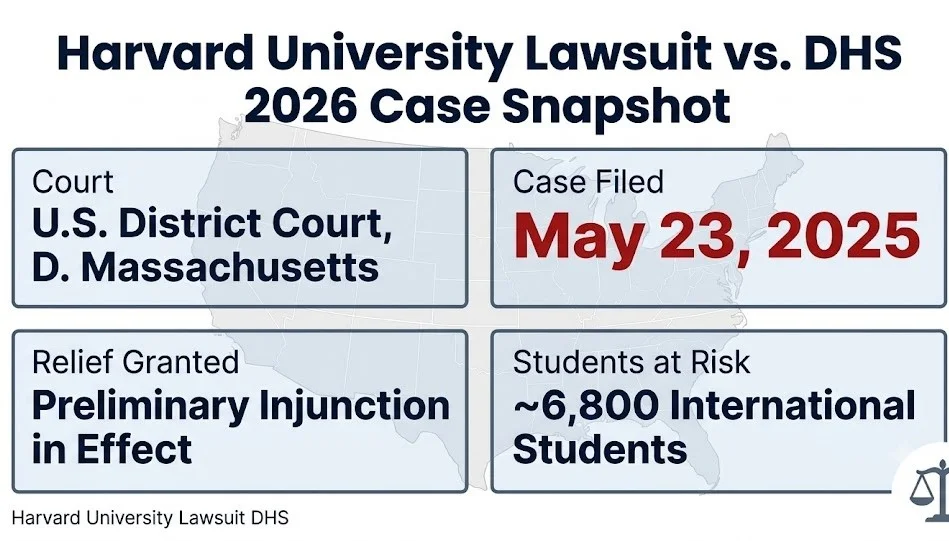
| Detail | Information |
|---|---|
| Court | U.S. District Court, District of Massachusetts |
| Case Number | 1:25-cv-11472-ADB |
| Presiding Judge | Judge Allison D. Burroughs |
| Filing Date | May 23, 2025 |
| Status (as of 2026) | Active litigation; preliminary injunction in effect |
| Relief Granted | Temporary restraining order issued May 23, 2025; converted to preliminary injunction |
| Settlement Fund | Not applicable; injunctive relief case |
| Law Firm for Harvard | WilmerHale |
Harvard University’s lawsuit against the Department of Homeland Security is one of the most consequential federal cases involving academic freedom and immigration enforcement in decades. Filed on May 23, 2025, in the U.S. District Court for the District of Massachusetts, the case directly challenges DHS’s authority to terminate Harvard’s SEVP certification without due process.
The government’s action, if upheld, would have stripped Harvard of its ability to enroll the roughly 6,800 international students who represent approximately 27 percent of its student body. A federal judge blocked the move within hours of the filing.
The legal stakes extend well beyond one university. The case is testing whether federal agencies can use immigration enforcement mechanisms as leverage against private institutions over political disputes.
This guide presents the full legal record: the docket, the claims, the court orders, and what the 2026 posture of the case means for students, institutions, and attorneys.
Harvard University Lawsuit DHS: The Core Legal Dispute
The Harvard university lawsuit against DHS centers on the government’s May 22, 2025, notice revoking Harvard’s SEVP certification. SEVP certification is the federal designation that authorizes a school to enroll students on F-1 and J-1 visas.
Without that certification, existing international students at Harvard would have had to transfer to another institution or face loss of legal immigration status. New international student enrollment would have been impossible.
Harvard filed suit the following day. The university argued the revocation was retaliatory, procedurally defective, and legally unauthorized under the statutes DHS cited.
Key claim: The complaint alleges DHS acted arbitrarily and capriciously, in violation of the Administrative Procedure Act, and in retaliation for Harvard’s refusal to comply with White House demands targeting academic governance.
Attorney Insight: Attorneys handling First Amendment institutional autonomy claims note that the combination of APA and constitutional theories gives Harvard two distinct tracks to win relief, even if one theory is rejected by the court.
| Core Legal Theory | Basis | Relief Sought |
|---|---|---|
| APA Arbitrary and Capricious | 5 U.S.C. § 706(2)(A) | Vacate revocation |
| First Amendment Retaliation | U.S. Const. Amend. I | Injunction against enforcement |
| Fifth Amendment Due Process | U.S. Const. Amend. V | Pre-deprivation notice and hearing |
| Ultra Vires Agency Action | Scope of DHS authority | Declaratory relief |
Harvard DHS Lawsuit 2026 Status: Where the Case Stands Now
As of 2026, the case remains in active litigation in the District of Massachusetts under Judge Allison D. Burroughs. The preliminary injunction blocking DHS from enforcing the SEVP revocation remains in effect.
The government appealed the preliminary injunction to the U.S. Court of Appeals for the First Circuit. Briefing on that appeal proceeded through late 2025 and into 2026.
No trial date has been set. The case is proceeding on cross-motions for summary judgment at the district court level while the appellate proceedings continue.
2026 Procedural Status:
- Preliminary injunction: In effect
- Government appeal: First Circuit, pending
- Summary judgment motions: Briefing stage
- SEVIS records: Restored under court order
- Projected merits ruling: Mid-to-late 2026
Attorney Insight: Attorneys tracking administrative law cases note that the First Circuit’s treatment of the APA arbitrary-and-capricious claim will carry significant precedential weight for agency-university disputes beyond this specific case.
Harvard Sues Department of Homeland Security: How the Legal Action Began
The sequence of events that produced this lawsuit began with a broader political confrontation. The Trump administration, in early 2025, sent Harvard a series of demands: changes to admissions practices, restrictions on certain faculty research, and cooperation with federal investigations into alleged antisemitism and viewpoint discrimination on campus.
Harvard refused to comply with several of the core demands in April 2025. DHS responded on May 22, 2025, with a notice terminating Harvard’s SEVP certification, effective immediately.
The practical effect was immediate disruption. DHS simultaneously moved to terminate SEVIS records for Harvard international students, placing thousands of students in legal limbo within hours.
Harvard retained WilmerHale and filed a complaint in Boston federal court within 24 hours of the revocation notice.
Attorney Insight: Immigration attorneys note that the speed of the DHS action, with no prior hearing or notice-and-comment period, became a central argument in Harvard’s procedural due process claim.
Timeline of the Precipitating Events:
| Date | Event |
|---|---|
| Early April 2025 | Trump administration demands sent to Harvard |
| April 14, 2025 | Harvard publicly rejects key demands |
| May 22, 2025 | DHS issues SEVP revocation notice |
| May 22, 2025 | SEVIS records begin termination process |
| May 23, 2025 | Harvard files complaint, Case No. 1:25-cv-11472 |
| May 23, 2025 | Judge Burroughs issues TRO within hours |
Litigation Watch: Harvard filed within 24 hours of the DHS revocation, invoked three distinct legal theories, and secured a TRO the same day, establishing an immediate legal barrier against student status terminations.
Harvard SEVP Certification Revocation Lawsuit: What SEVP Is and Why It Matters
SEVP certification is not optional for universities that enroll international students. It is the specific federal authorization issued by DHS/ICE under 8 C.F.R. Part 214 that permits a school to sponsor F-1 and J-1 nonimmigrant visas.
Without SEVP certification, a school cannot issue the Form I-20, which is the document that activates an F-1 visa holder’s lawful status. The student’s right to remain in the United States is directly tied to an active I-20 from a certified institution.
Revocation of certification is therefore not an administrative slap. It is an immediate threat to the legal presence of every currently enrolled international student.
Attorney Insight: Immigration attorneys who handle SEVIS compliance cases point out that SEVP revocations are normally reserved for schools that have committed fraud or failed compliance audits, not institutions with decades of spotless certification history.
What SEVP Revocation Would Have Done to Harvard Students:
- Terminated active SEVIS records for approximately 6,800 students
- Invalidated all pending Form I-20 issuances
- Forced students to transfer or depart the United States
- Barred Harvard from admitting any new international students
- Stripped Harvard’s ability to employ J-1 exchange visitors
Harvard DHS Case Court Docket and Judge: The Judicial Record
The case is officially captioned President and Fellows of Harvard College v. Department of Homeland Security et al., Case No. 1:25-cv-11472-ADB, filed in the U.S. District Court for the District of Massachusetts.
The presiding judge is Judge Allison D. Burroughs, an Obama appointee confirmed in 2014. Judge Burroughs is well-known in complex federal civil litigation, including prior high-profile immigration-adjacent matters in the District of Massachusetts.
The “ADB” suffix on the docket number identifies her as the assigned judge. She issued the TRO from the bench on the day the complaint was filed.
Attorney Insight: Federal litigation attorneys note that Judge Burroughs has a documented preference for thorough administrative records. That orientation benefits Harvard’s APA claim, which turns on what the administrative record reveals about DHS’s rationale.
Court Record Quick Facts:
| Field | Detail |
|---|---|
| Case Caption | President and Fellows of Harvard College v. DHS et al. |
| Docket | 1:25-cv-11472-ADB |
| Court | U.S. District Court, D. Mass. |
| Judge | Hon. Allison D. Burroughs |
| Clerk’s Office | Boston, Massachusetts |
| Appeal Docket | U.S. Court of Appeals, First Circuit |
Harvard Temporary Restraining Order DHS: The Emergency Court Win
Judge Burroughs issued the temporary restraining order (TRO) on May 23, 2025, the same day Harvard filed its complaint. The order was one of the fastest granted in recent federal civil rights and immigration enforcement disputes of this scale.
The TRO barred DHS from:
- Enforcing the SEVP certification revocation
- Terminating or altering any SEVIS records for enrolled Harvard students
- Taking any action to prevent Harvard students from maintaining lawful F-1 or J-1 status
The court applied the standard four-factor test from Winter v. Natural Resources Defense Council, 555 U.S. 7 (2008): likelihood of success on the merits, irreparable harm, balance of equities, and public interest.
Attorney Insight: Attorneys in federal injunctive practice note that a TRO issued the same day as filing, in a dispute of this magnitude, signals the court found the irreparable harm factor overwhelming, given that students would lose immigration status before any appeal could be heard.
TRO Factors Applied:
| Winter Factor | Court’s Finding |
|---|---|
| Likelihood of success on merits | Strong (APA and First Amendment claims) |
| Irreparable harm | Immediate (student visa status at risk) |
| Balance of equities | Favored Harvard |
| Public interest | Favored maintaining lawful immigration status |
Harvard DHS Lawsuit Ruling Update: Key Decisions Through 2026
Following the TRO, Judge Burroughs converted the order into a preliminary injunction after a full briefing cycle. The preliminary injunction issued in June 2025 and has remained in effect through 2026.
The government did not seek an emergency stay of the preliminary injunction from the First Circuit. That procedural choice left the injunction operative while the appeal on the merits proceeded.
Judge Burroughs rejected the government’s argument that Harvard lacked standing. The court held that Harvard suffered direct institutional injury, and that its students faced concrete immigration harm, satisfying Article III standing requirements.
Attorney Insight: Attorneys following administrative law litigation note that the standing ruling is as important as the merits ruling, because it keeps the courthouse door open for other universities facing similar agency pressure.
Key Rulings Chronology:
| Date | Ruling |
|---|---|
| May 23, 2025 | TRO issued |
| June 2025 | Preliminary injunction issued |
| Summer 2025 | Government files First Circuit appeal |
| Fall 2025 | First Circuit briefing begins |
| 2026 | Summary judgment briefing at district court level; First Circuit oral argument anticipated |
Litigation Watch: Every major ruling through early 2026 has gone against DHS at the district court level, and the government’s decision not to seek an emergency stay left the preliminary injunction untouched while the appeal proceeds.
Harvard Lawsuit First Amendment DHS: The Academic Freedom Claim
Harvard’s First Amendment claim is the most expansive theory in the complaint. The university argues that DHS’s SEVP revocation was a direct response to Harvard’s refusal to change its academic governance, admissions decisions, and faculty research priorities.
That makes the revocation, Harvard contends, a form of government retaliation against protected speech and institutional autonomy. The First Amendment protects not just individual speech but institutional academic freedom.
Courts have long recognized, under Keyishian v. Board of Regents, 385 U.S. 589 (1967) and its progeny, that academic freedom is a special constitutional concern. Harvard’s legal team argues that using immigration certification as a lever to compel academic compliance is unconstitutional on its face.
Attorney Insight: Civil rights attorneys note that the First Amendment retaliation theory requires Harvard to show a causal connection between its protected conduct, the refusal to comply with White House demands, and the adverse government action, which the timing of events makes straightforward to plead.
First Amendment Legal Framework:
- Protected conduct: Harvard’s academic and governance decisions
- Adverse action: SEVP revocation
- Causal link: Revocation followed refusal to comply within weeks
- Governing precedent: Keyishian; Garcetti v. Ceballos (distinguished); Bantam Books v. Sullivan
Harvard APA Violation Lawsuit DHS: The Administrative Law Claims
The Administrative Procedure Act claim is Harvard’s most technically precise legal argument. Under 5 U.S.C. § 706(2)(A), a reviewing court must set aside agency action that is “arbitrary, capricious, an abuse of discretion, or otherwise not in accordance with law.”
Harvard argues the DHS revocation fails on multiple APA grounds. The agency provided no prior notice. It held no hearing. It cited no regulatory violation by Harvard. It offered no reasoned explanation tied to the actual SEVP compliance standards.
That pattern, Harvard contends, is the textbook definition of arbitrary and capricious action under Motor Vehicle Manufacturers Ass’n v. State Farm Mutual Auto Ins. Co., 463 U.S. 29 (1983), the Supreme Court’s controlling standard.
Attorney Insight: Administrative law attorneys note that the State Farm standard is well-suited to this case because the DHS administrative record, once produced, must show the agency considered the relevant factors, and the record reportedly shows no SEVP compliance violations at Harvard.
APA Claim Elements:
| Element | Harvard’s Position |
|---|---|
| Notice requirement | No pre-revocation notice given |
| Hearing | No opportunity to respond before revocation |
| Regulatory basis | No cited SEVP compliance failure |
| Reasoned explanation | Revocation notice contained no factual findings |
| Record review | Administrative record expected to show pretextual rationale |
Harvard DHS Lawsuit Due Process Fifth Amendment: The Constitutional Floor
The Fifth Amendment claim addresses procedural due process. Harvard and its affected students argue they have a protected property or liberty interest in continued SEVP certification and valid immigration status.
A government benefit or authorization creates a protected interest when there is a legitimate expectation of continued receipt. SEVP-certified schools operate under a regulatory framework that allows revocation only for specific, defined violations following notice and an opportunity to respond.
The government’s immediate revocation, without any pre-deprivation process, Harvard argues, violated that constitutional floor. This claim runs parallel to the APA claim but at a higher legal plane.
Attorney Insight: Constitutional litigation attorneys note that Fifth Amendment due process claims, when combined with APA claims, create layered protection for plaintiffs because even if Congress had authorized the agency action, the Constitution imposes an independent procedural floor.
Due Process Framework Applied:
- Protected interest: SEVP certification as a licensed government authorization
- Deprivation: Immediate, without notice or hearing
- Process due: Pre-deprivation notice; opportunity to contest
- Government defense: National security; executive discretion
- Harvard’s counter: No national security finding was made or articulated
Litigation Watch: Harvard’s legal team filed three overlapping constitutional and statutory claims, ensuring that if the court rejects one theory, two others remain viable for the First Circuit and potentially the Supreme Court.
Harvard WilmerHale Lawsuit: The Legal Team and Strategy
Harvard retained WilmerHale, one of the country’s leading appellate and government litigation firms, to handle the case. The firm has a track record in high-stakes government-versus-institution disputes and maintains a significant federal courts practice in Boston and Washington, D.C.
WilmerHale’s strategic approach is visible in the complaint structure. The filing leads with emergency injunctive relief, preserves the administrative record issue immediately, and front-loads the First Amendment claim to frame the case as a constitutional confrontation rather than a routine regulatory dispute.
The firm also secured rapid amicus support. The Massachusetts Attorney General filed an amicus brief supporting Harvard’s position, as did coalitions of universities and civil liberties organizations.
Attorney Insight: Federal appellate attorneys note that WilmerHale’s decision to file all three legal theories simultaneously, rather than leading with the easiest statutory claim, signals a strategy aimed at the Supreme Court if the First Circuit rules for the government.
Legal Team Composition:
| Role | Party/Entity |
|---|---|
| Lead counsel for Harvard | WilmerHale |
| Defendant | DHS, ICE, Secretary Kristi Noem |
| Amicus: State government | Massachusetts Attorney General |
| Amicus: Higher education | Coalition of universities |
| Amicus: Civil liberties | ACLU and related organizations |
Harvard International Student Visa Revocation Lawsuit: The Human Impact
The most immediate human consequence of the DHS action was the threatened termination of SEVIS records for Harvard’s approximately 6,800 international students. SEVIS is the federal database that tracks the legal status of F-1 and J-1 visa holders.
A terminated SEVIS record effectively ends a student’s lawful presence in the United States. The student has no grace period. The termination triggers a technical overstay. The student faces potential removal proceedings.
The TRO stopped that process within hours. But the case has already produced concrete harm. Students reported disrupted travel plans, delayed visa renewals, and difficulty securing on-campus employment authorization while the legal status of their institution was uncertain.
Attorney Insight: Immigration attorneys handling individual F-1 cases note that even a brief SEVIS disruption can trigger downstream problems with work authorization, Optional Practical Training approvals, and re-entry after international travel.
Categories of Student Impact:
- Current enrolled F-1 students (degree-seeking)
- J-1 exchange students and visiting scholars
- Students on Optional Practical Training (OPT)
- Incoming admitted students awaiting I-20 issuance
- Faculty and researchers on J-1 exchange visitor status
Which Students Are Affected by the Harvard DHS Lawsuit?
The students most directly affected by this lawsuit are those enrolled at Harvard on F-1 and J-1 nonimmigrant visas. These students depend on Harvard’s active SEVP certification to maintain lawful status.
Beyond Harvard’s own students, the case affects any international student at a U.S. university whose institution is now facing similar DHS pressure. The government’s approach to Harvard has put hundreds of SEVP-certified institutions on notice that their certification is not insulated from political disputes.
Students at peer institutions who are watching this case have a legitimate legal interest in its outcome. A First Circuit ruling against Harvard would embolden DHS to use SEVP revocation against other schools.
Attorney Insight: Immigration attorneys advising international students at non-Harvard institutions recommend that students and their families consult with an F-1 visa attorney now, not after a revocation notice, to understand contingency options including transfer and status preservation.
Who Is Most Directly Affected:
| Student Category | Impact Level |
|---|---|
| Harvard F-1 degree students | Direct; SEVIS records at risk |
| Harvard J-1 exchange visitors | Direct; program status at risk |
| Harvard OPT participants | Direct; work authorization at risk |
| Students at peer institutions | Indirect but significant risk |
| Admitted students not yet enrolled | Moderate; I-20 issuance uncertain |
Litigation Watch: The affected population extends far beyond Harvard’s 6,800 international students. The precedent this case sets will govern how DHS can treat SEVP certifications at any of the roughly 11,000 SEVP-certified institutions across the United States.
Harvard Foreign Student Enrollment Lawsuit: The Institutional Enrollment Stakes
Harvard’s international student population generates substantial tuition revenue and anchors major research programs. The university enrolled students from over 130 countries as of the 2024-2025 academic year.
Beyond revenue, SEVP certification affects the university’s ability to recruit faculty, employ postdoctoral researchers, and sustain federally funded research programs that depend on international talent. The research impact alone runs into the hundreds of millions of dollars annually.
The lawsuit therefore is not only a legal defense of student visa status. It is a defense of Harvard’s core institutional capacity as a research university.
Attorney Insight: Higher education attorneys note that a university’s SEVP certification is effectively a federal license to operate as a world-class research institution, and that treating it as revocable for political reasons would fundamentally alter the relationship between federal agencies and private universities.
Harvard International Enrollment Facts:
| Metric | Figure |
|---|---|
| International students enrolled | Approximately 6,800 |
| Percentage of total enrollment | ~27% |
| Countries represented | 130+ |
| International graduate students | Majority of total international figure |
| Annual tuition and fee revenue at risk | Hundreds of millions of dollars |
Harvard Lawsuit Student Visa Ban: What the Government’s Action Actually Was
The government’s action was not a student visa ban in the technical immigration law sense. DHS did not revoke individual student visas. It revoked the institutional certification that authorizes Harvard to sponsor those visas.
That distinction matters legally. Individual visa revocations require consular or USCIS action. SEVP revocation is an ICE administrative action against the institution. The government used an institutional mechanism to achieve what amounts to a de facto visa ban for all Harvard-enrolled international students.
Harvard’s legal team argued that using the SEVP mechanism this way is not authorized by the relevant statutes and regulations, and that even if it were authorized, the lack of process makes it unlawful.
Attorney Insight: Immigration attorneys emphasize this structural distinction to clients because it means the legal remedy runs through the institution, not through individual visa holders, which is why Harvard, not individual students, is the named plaintiff.
Visa Ban vs. SEVP Revocation: Key Distinctions:
| Action Type | Who Acts | Direct Target | Legal Authority |
|---|---|---|---|
| Individual visa revocation | Consular officer / USCIS | Individual student | INA § 221(i) |
| SEVP certification revocation | ICE / DHS | Institution | 8 C.F.R. Part 214 |
| Effect of SEVP revocation | N/A | All enrolled F-1/J-1 students | Derivative |
| Harvard’s case challenges | N/A | SEVP revocation | APA, Const. Amends. I & V |
Harvard DHS Settlement or Outcome: What Resolution Could Look Like
This case is not structured for a monetary settlement. Harvard is not seeking damages. The relief sought is injunctive: a court order blocking DHS from enforcing the SEVP revocation and a declaration that the revocation was unlawful.
Resolution could take several forms. If the First Circuit affirms the preliminary injunction on the merits, DHS may choose not to pursue the case to the Supreme Court, effectively allowing Harvard’s certification to remain undisturbed. Alternatively, a change in administration policy could lead the government to withdraw its appeal.
If the government prevails at the First Circuit, Harvard would almost certainly seek Supreme Court review. The First Amendment and APA theories raise questions of national importance.
Attorney Insight: Federal appellate attorneys note that cases of this profile, involving institutional First Amendment rights and the scope of DHS enforcement authority, present the type of circuit-level conflict the Supreme Court frequently agrees to resolve.
Possible Resolution Paths:
| Outcome | Likelihood | Effect |
|---|---|---|
| First Circuit affirms injunction | Moderate-high | Harvard’s SEVP certification remains; DHS authority limited |
| Government withdraws appeal | Possible with policy change | Case ends, injunction becomes permanent |
| First Circuit reverses | Lower based on current record | Case proceeds to Supreme Court |
| Supreme Court review | Contingent | National precedent on agency authority vs. universities |
| Negotiated resolution | Possible | Policy concessions without judicial ruling |
Harvard Lawsuit Impact on Other Universities: The Broader Precedent
The Harvard university lawsuit against DHS is being watched by every major SEVP-certified institution in the United States. The American Council on Education, the Association of American Universities, and dozens of individual university presidents filed or supported amicus briefs in the district court proceedings.
Their concern is direct. If DHS can revoke SEVP certification from Harvard with no notice and no compliance violation, it can do the same to any university. The certification becomes a hostage in every political dispute between federal agencies and academic institutions.
Several universities facing separate but related federal pressure have cited the Harvard case in their own legal correspondence with government agencies. The litigation is functioning as a shield for the broader higher education sector.
Attorney Insight: Attorneys representing universities in federal regulatory matters note that the Harvard case outcome will determine whether SEVP certification is a stable regulatory status governed by notice-and-comment rulemaking or a discretionary executive tool, a distinction with enormous consequences for institutional planning.
Universities Citing or Supporting the Harvard Legal Position:
- Massachusetts Institute of Technology
- Stanford University
- Columbia University
- University of California system
- American Council on Education (representing 1,700+ institutions)
- Association of American Universities
Harvard DHS Lawsuit 2026: What Happens Next
The most important near-term development in 2026 is oral argument at the First Circuit. Briefing on the government’s appeal of the preliminary injunction was substantially complete by early 2026. Oral argument is anticipated in the spring or summer of 2026.
Simultaneously, Judge Burroughs is managing cross-motions for summary judgment at the district court level. A district court ruling on the merits could issue before or after the First Circuit decides the preliminary injunction appeal.
If the First Circuit rules in Harvard’s favor on the preliminary injunction, the government’s path to reversing the district court ruling narrows considerably. If the First Circuit reverses, the case heads toward emergency Supreme Court proceedings.
Attorney Insight: Federal court practitioners note that the parallel track of district court summary judgment and First Circuit appeal is unusual but tactically sound for Harvard, because a favorable district court ruling on the merits while the appeal is pending strengthens the case for the appellate panel to affirm.
2026 Anticipated Proceedings:
| Proceeding | Venue | Anticipated Timing |
|---|---|---|
| First Circuit oral argument | U.S. Court of Appeals, First Cir. | Spring/Summer 2026 |
| First Circuit ruling | U.S. Court of Appeals, First Cir. | Summer/Fall 2026 |
| District court summary judgment | D. Mass. | Mid-2026 |
| Potential Supreme Court petition | U.S. Supreme Court | Late 2026 if First Circuit reverses |
| Case final resolution | TBD | 2026-2027 |
Litigation Watch: The convergence of First Circuit oral argument and district court summary judgment briefing in 2026 makes this the most consequential year in the Harvard v. DHS litigation, with rulings from both courts potentially arriving within months of each other.
Frequently Asked Questions
What is the Harvard university lawsuit against DHS about?
Harvard filed a federal lawsuit against the Department of Homeland Security on May 23, 2025, challenging DHS’s revocation of Harvard’s SEVP certification.
The revocation would have barred Harvard from enrolling international students and threatened the legal immigration status of approximately 6,800 currently enrolled foreign national students.
Harvard argues the revocation violated the Administrative Procedure Act, the First Amendment, and the Fifth Amendment’s due process protections.
What court is handling the Harvard DHS lawsuit?
The case is pending in the U.S. District Court for the District of Massachusetts, Case No. 1:25-cv-11472-ADB.
Judge Allison D. Burroughs is presiding.
The government’s appeal of the preliminary injunction is before the U.S. Court of Appeals for the First Circuit.
Has Harvard won any rulings against DHS so far?
Yes. Judge Burroughs issued a temporary restraining order on the day the complaint was filed, May 23, 2025.
That TRO was subsequently converted into a preliminary injunction, which has remained in effect through 2026.
The government’s motion to lift the injunction was rejected at the district court level.
Who represents Harvard in the DHS lawsuit?
Harvard is represented by WilmerHale, a national appellate and government litigation firm with offices in Boston and Washington, D.C.
The government is represented by the U.S. Department of Justice on behalf of DHS, ICE, and Secretary Kristi Noem.
Amicus support for Harvard’s position has come from the Massachusetts Attorney General, the American Council on Education, and civil liberties organizations.
Can international students at other universities be affected by this lawsuit?
Students at other institutions are not direct parties to the Harvard case, but the legal outcome will govern DHS’s authority to revoke SEVP certification nationwide.
A ruling against Harvard at the First Circuit would establish precedent empowering DHS to use SEVP revocation against any SEVP-certified institution with no prior compliance violation.
International students at universities facing similar federal pressure should consult an F-1 or J-1 immigration attorney to understand contingency options.
Is there a settlement or monetary payout in the Harvard DHS lawsuit?
No monetary settlement is at issue in this case. Harvard is not seeking damages.
The case seeks injunctive relief: a permanent court order blocking DHS from enforcing the SEVP revocation and a declaratory judgment that the government’s action was unlawful.
If Harvard prevails fully, the practical outcome is the restoration and permanent protection of its SEVP certification, not a financial award.
Closing
The Harvard v. DHS case is active, consequential, and far from resolved. The preliminary injunction has held. The First Circuit will have its say in 2026. The outcome will define the limits of federal agency authority over American universities for years to come.
If you are an international student at any SEVP-certified institution, or if you represent a university navigating federal pressure, the time to consult with qualified legal counsel is before any adverse action arrives. An immigration attorney with federal court experience, or an administrative law attorney who handles APA litigation, is the right type of counsel for the questions this case raises.
