
Quick Answer
- The Activision lawsuit is a set of overlapping legal actions against Activision Blizzard covering workplace discrimination, pay inequity, retaliation, and securities fraud, with settlement funds totaling over $88 million across federal and state proceedings.
- Current and former employees who experienced gender-based discrimination, sexual harassment, or retaliation at Activision Blizzard locations may qualify; investors who held stock during the relevant period may have separate securities claims.
- Individual payouts vary by claim type and documented harm, with the EEOC fund distributing from a $35 million pool and the DFEH-negotiated fund addressing approximately $18 million in California state claims.
Case Snapshot
| Detail | Info |
|---|---|
| Primary Court (EEOC) | U.S. District Court, Central District of California |
| EEOC Case Number | 2:21-cv-07682-DSF-JEM |
| DFEH State Case Number | Los Angeles Superior Court, Case No. 21STCV26571 |
| SEC Proceeding | In the Matter of Activision Blizzard, Inc., File No. 3-21739 |
| EEOC Consent Decree Filed | September 27, 2021 |
| DFEH Complaint Filed | July 20, 2021 |
| SEC Order Date | February 3, 2023 |
| Presiding Judge (EEOC) | Hon. Dale S. Fischer, C.D. Cal. |
| EEOC Settlement Fund | $35 million |
| DFEH Settlement Fund | $18 million (negotiated) |
| SEC Civil Penalty | $35 million |
| Current Status (2026) | EEOC consent decree active; DFEH fund in distribution; SEC penalty paid; shareholder litigation ongoing |
| Defendant | Activision Blizzard, Inc. (now subsidiary of Microsoft Corporation) |
Activision Blizzard faces one of the most consequential employment and securities litigation packages in the modern gaming industry’s history. The activision lawsuit is not a single case. It is a coordinated constellation of federal, state, and investor actions that have collectively extracted more than $88 million in settlement value and imposed ongoing compliance obligations.
What made this litigation unusual was its speed. Within months of the California DFEH complaint going public in July 2021, the EEOC had filed its own parallel federal action, the SEC had opened an investigation, and shareholder derivative suits had landed in multiple courts.
The company’s sale to Microsoft in 2023 did not end the litigation. It transferred certain obligations and raised new successor liability questions that remain relevant to claimants in 2026.
Understanding which proceeding applies to your situation, and which type of attorney handles each, determines whether you have a viable claim worth pursuing.
What Is the Activision Lawsuit?
The Activision lawsuit refers to a series of legal proceedings initiated between 2021 and 2023 alleging systematic workplace discrimination, sexual harassment, retaliation, and related securities disclosure failures at Activision Blizzard, Inc.
The cases are separate in docket and jurisdiction. They are connected by overlapping facts, common witnesses, and shared documentary evidence.
At its core, the litigation alleges that Activision Blizzard maintained a pervasive “frat boy” workplace culture that harmed women and other protected employees over an extended period, while executives failed to disclose known legal exposure to investors.
Key proceedings at a glance:
- EEOC federal civil action (C.D. Cal., Case No. 2:21-cv-07682)
- DFEH California state action (L.A. Superior Court, Case No. 21STCV26571)
- SEC administrative enforcement (File No. 3-21739)
- Shareholder derivative suits (Delaware and California)
- Private plaintiffs’ class action claims (ongoing)
Attorney Insight: Attorneys handling these claims consistently point to the EEOC consent decree as the most structurally significant outcome, because it imposed third-party monitoring and mandated pay equity audits that create a documented compliance record relevant to future private claims.
The Full Scope of the Activision Blizzard Lawsuit
The Activision Blizzard lawsuit encompasses more legal theories than most employment discrimination cases filed in the past decade.
The EEOC’s complaint under Title VII of the Civil Rights Act alleged sex discrimination, sexual harassment, and retaliation across multiple Activision Blizzard business units including Blizzard Entertainment, King, and the core Activision publishing division.
The DFEH’s state action under the California Fair Employment and Housing Act (FEHA) added pay equity claims and alleged systemic wage disparities affecting female employees.
Breakdown of legal theories by proceeding:
| Proceeding | Legal Theory | Governing Law |
|---|---|---|
| EEOC (federal) | Sex discrimination, harassment, retaliation | Title VII, Civil Rights Act of 1964 |
| DFEH/CRD (state) | Discrimination, pay equity, FEHA violations | California FEHA |
| SEC (federal) | Disclosure failures, securities rule violations | Exchange Act Rule 21F-17 |
| Shareholder derivative | Breach of fiduciary duty | Delaware corporate law |
| Private class action | Employment discrimination damages | Title VII / FEHA / state analogs |
Attorney Insight: Attorneys reviewing multi-proceeding cases like this one typically advise claimants to identify which specific proceeding covers their employment dates, location, and harm category before filing, since overlapping funds do not necessarily mean duplicate recovery.
Inside the Activision Workplace Discrimination Lawsuit
The workplace discrimination lawsuit against Activision Blizzard centers on allegations that the company tolerated and perpetuated gender-based discrimination across years of documented internal complaints.
California’s DFEH filed its complaint on July 20, 2021, following a two-year state investigation. The complaint described a workplace where female employees faced barriers to promotion, unequal pay for comparable roles, and retaliation when they reported misconduct.
The EEOC’s parallel federal complaint, filed September 27, 2021, named the same underlying factual pattern but framed it under federal Title VII standards, which set a different threshold for systemic liability than California’s FEHA.
Documented allegations included:
- Systemic pay disparities between male and female employees at equivalent levels
- Denial of promotion opportunities based on gender
- Supervisory retaliation against employees who filed internal complaints
- Failure to investigate or act on repeated HR complaints
- A documented pattern of “stray remarks” and hostile conduct attributed to named supervisors
Bold callout: According to the EEOC complaint, the agency identified affected employees across Activision Blizzard’s Irvine, Santa Monica, and Los Angeles area offices as primary complaint sources.
Attorney Insight: Employment attorneys handling these claims have noted that the DFEH’s two-year pre-filing investigation produced a documentary record that strengthened private claimants’ ability to show a “pattern or practice” rather than isolated incidents, a distinction that affects damages calculations.
Litigation Watch: The Activision litigation began as a California state action, escalated to simultaneous federal enforcement within 60 days, and expanded to securities regulators within 18 months, making it one of the broadest employer enforcement actions in the gaming industry’s history.
What Made the Activision Hostile Work Environment Lawsuit Different
The hostile work environment claims in the Activision lawsuit stand apart from routine workplace harassment litigation in one significant way. They involved documented evidence of known misconduct at the executive level that was not acted upon.
Unlike cases where management is unaware of low-level harassment, the DFEH and EEOC complaints both alleged that supervisory personnel and human resources leadership were informed of specific incidents and failed to respond adequately or at all.
Under both Title VII and California’s FEHA, employer liability for hostile work environment claims depends significantly on whether management knew or should have known about the conduct. That element, according to the filed complaints, was not in serious dispute.
What the filings alleged regarding management awareness:
- Internal HR complaints were filed and documented
- Supervisors were identified by name in internal reports
- No disciplinary action was taken in multiple documented cases
- Female employees who complained faced adverse employment actions afterward
Bold callout: The EEOC consent decree signed in September 2021 required Activision Blizzard to retain an independent, court-approved monitor to oversee anti-harassment policy compliance for a minimum of three years.
Attorney Insight: Attorneys in employment class actions have observed that the presence of a court-appointed compliance monitor, as ordered here, often generates additional discoverable documentation useful in private litigation that runs parallel to or follows the government enforcement action.
The DFEH v. Activision Blizzard California Case Explained
The California Department of Fair Employment and Housing, now operating as the Civil Rights Department (CRD), filed its state action against Activision Blizzard in Los Angeles Superior Court on July 20, 2021, assigned Case No. 21STCV26571.
California’s FEHA is broader than federal Title VII in several ways. It covers smaller employers, imposes stricter obligations around investigation and response, and provides for individual supervisory liability in some circumstances.
The DFEH/CRD negotiated an $18 million settlement fund for direct claimant compensation. A portion of that fund was designated for programmatic relief, including pay audits, policy reforms, and training programs.
California-specific elements of the DFEH action:
| Element | Detail |
|---|---|
| Court | Los Angeles Superior Court |
| Case No. | 21STCV26571 |
| Filing Date | July 20, 2021 |
| Governing Law | California FEHA |
| Settlement Fund | $18 million |
| Compliance Relief | Pay audits, training mandates, policy reform |
| Fund Administrator | Court-supervised claims process |
Bold callout: The DFEH action initially faced a procedural dispute when the EEOC sought to intervene and coordinate settlement terms, creating a temporary conflict between federal and state enforcement priorities that was resolved by separate consent agreements.
Attorney Insight: California employment attorneys have noted that the DFEH/CRD settlement fund processes claims separately from the EEOC federal fund, meaning claimants who worked in California may have access to both pools depending on their claim category and opt-in election.
The EEOC Consent Decree: Federal Enforcement Action
The EEOC filed its federal civil action against Activision Blizzard in the U.S. District Court for the Central District of California on September 27, 2021, docketed as Case No. 2:21-cv-07682-DSF-JEM, before the Honorable Dale S. Fischer.
The consent decree, entered the same day as the complaint, resolved the EEOC’s claims without a trial. Activision Blizzard agreed to a $35 million settlement fund and a set of prospective injunctive relief obligations.
The $35 million fund was designated for distribution to current and former employees identified by the EEOC as having experienced sex discrimination, harassment, or retaliation during the covered employment period.
EEOC Consent Decree Key Terms:
- Settlement fund: $35 million
- Monitoring period: 3 years, with court-appointed monitor
- Required actions: Pay equity analysis, anti-harassment training, revised complaint procedures, HR reporting reforms
- Claimant eligibility period: Employees employed during the covered period as defined in the decree
- Court: C.D. Cal., Hon. Dale S. Fischer presiding
- Decree filed: September 27, 2021
Bold callout: The consent decree required Activision Blizzard to submit annual compliance reports to the EEOC and the court-appointed monitor throughout the monitoring period, creating a public accountability record that extends into 2026.
Attorney Insight: Employment attorneys have observed that the EEOC’s decision to file and resolve simultaneously, rather than litigate, accelerated fund availability for claimants but also limited the public evidentiary record that might otherwise emerge from full discovery.
Litigation Watch: The EEOC’s $35 million consent decree and the DFEH’s $18 million state fund operate as parallel but legally distinct compensation mechanisms, and qualifying employees may need to navigate both processes with different eligibility windows and claim requirements.
The Activision SEC Settlement and What It Means
The Securities and Exchange Commission entered a separate enforcement action against Activision Blizzard on February 3, 2023, designated In the Matter of Activision Blizzard, Inc., File No. 3-21739.
The SEC’s theory was distinct from the employment claims. Regulators alleged that Activision Blizzard violated Exchange Act Rule 21F-17 by impeding employees from reporting potential securities law violations to the SEC directly through its internal reporting policies.
Activision Blizzard agreed to pay a $35 million civil penalty to the SEC without admitting or denying the findings. No criminal referral accompanied the settlement.
SEC proceeding at a glance:
| Detail | Info |
|---|---|
| Proceeding | In the Matter of Activision Blizzard, Inc. |
| File Number | 3-21739 |
| Order Date | February 3, 2023 |
| Legal Theory | Violation of Exchange Act Rule 21F-17 |
| Penalty | $35 million |
| Admission | None required |
| Distribution | Civil penalty to U.S. Treasury, not claimants |
Bold callout: The $35 million SEC penalty went to the U.S. Treasury, not to employee claimants. It does not supplement the EEOC or DFEH funds and is not accessible to individual settlement participants.
Attorney Insight: Securities attorneys reviewing the SEC action have noted that the Rule 21F-17 theory, which targets employer interference with whistleblower communications, is increasingly used by the SEC as a standalone enforcement tool separate from underlying securities fraud allegations.
The Activision Shareholder Lawsuit: Investor Claims
Shareholder derivative suits against Activision Blizzard were filed in both Delaware and California following the public disclosure of the DFEH complaint in July 2021.
These suits alleged that Activision Blizzard’s board of directors breached fiduciary duties by failing to oversee the workplace culture issues, allowing legal exposure to grow, and failing to disclose that exposure to investors through proper channels.
Derivative suits name the company as the nominal defendant. The real targets are the directors and officers whose conduct allegedly harmed the company and, by extension, its shareholders.
Structure of the shareholder claims:
- Delaware Chancery Court: Derivative suits challenging board oversight failures
- California Superior Court: Parallel derivative claims under state corporate law
- Securities class action: Separate from derivative suits, alleging material misrepresentations to investors who bought or held stock during the relevant period
Bold callout: Former CEO Bobby Kotick was named in multiple shareholder filings. Plaintiffs alleged he was aware of complaints and failed to act, representing a breach of the duty of care owed to shareholders.
Attorney Insight: Securities litigation attorneys have noted that derivative suits in Delaware typically face a high threshold at the demand-futility stage, and plaintiffs here relied heavily on the documented failure of board-level oversight as established in the DFEH complaint record.
Litigation Watch: The shareholder derivative suits against Activision Blizzard’s board are legally distinct from employee compensation claims and require a securities or corporate litigation attorney, not an employment attorney, to evaluate investor standing.
The Activision Pay Equity Lawsuit and Wage Gap Claims
Pay equity claims formed a central component of the DFEH’s California action and appeared as a secondary theory in the EEOC’s federal consent decree.
The allegations were specific. Female employees at equivalent job levels and tenure received lower compensation than male counterparts. The DFEH’s two-year investigation produced internal pay data that the complaint cited as evidence of systemic disparity.
California’s Equal Pay Act, codified at Labor Code Section 1197.5, provides one of the country’s strictest pay equity standards. It requires equal pay for “substantially similar work” viewed as a composite of skill, effort, and responsibility, not just identical job titles.
Pay equity claim categories under California law:
| Claim Type | Standard | Governing Statute |
|---|---|---|
| Equal pay for equal work | Same establishment, same job | Labor Code Section 1197.5 (pre-2016) |
| Equal pay for substantially similar work | Comparable skill, effort, responsibility | Labor Code Section 1197.5 (post-2016 amendment) |
| FEHA pay discrimination | Protected class basis for pay gap | Gov. Code Section 12940 |
| Title VII pay equity | Federal standard, same employer | 42 U.S.C. Section 2000e-2 |
Bold callout: The DFEH complaint cited documented evidence that female employees at Activision Blizzard were paid less than male peers across multiple job classification levels, not isolated to a single department.
Attorney Insight: Employment attorneys handling pay equity claims in California have noted that the post-2016 amendment to Labor Code Section 1197.5 significantly lowered the burden of proof for plaintiffs by shifting the analysis from job title to job function, which benefits claimants whose roles were reclassified or relabeled.
Who Qualifies for the Activision Settlement?
Eligibility for Activision settlement funds depends on which proceeding a claimant falls under, since the EEOC federal fund and the DFEH state fund have different qualification criteria.
For the EEOC fund, the consent decree covers current and former employees who were employed by Activision Blizzard during the defined class period and who experienced sex discrimination, sexual harassment, or retaliation in violation of Title VII.
For the DFEH/CRD fund, California law and FEHA coverage means the pool extends to employees who worked at California locations and experienced pay disparities or FEHA violations, even if their claim does not meet the Title VII threshold.
Eligibility summary by claim type:
| Claim Category | Qualifying Criteria | Applicable Fund |
|---|---|---|
| Sexual harassment | Experienced harassment, reported or not | EEOC, private claims |
| Sex discrimination | Denied promotion, adverse action based on gender | EEOC, DFEH |
| Pay inequity | Lower pay than male peers, same or similar role | DFEH, private claims |
| Retaliation | Adverse action after complaint or reporting | EEOC, DFEH, private |
| Securities investor | Held stock, suffered loss during disclosure failures | Shareholder class action |
| Whistleblower retaliation | Impeded from SEC reporting | Potentially SEC-related private claim |
Attorney Insight: Attorneys reviewing these claims have emphasized that claimants do not need to have filed an internal HR complaint to qualify. The EEOC consent decree explicitly covers employees who experienced qualifying conduct but did not report it formally due to fear of retaliation.
Activision Settlement Amount: How Much Is in the Fund?
The total identifiable settlement value across all Activision Blizzard proceedings reaches at least $88 million, distributed across three distinct funds with different allocation mechanisms.
The EEOC’s $35 million fund is the largest employment compensation pool. It is administered under the court’s supervision and distributed to eligible claimants based on their individual harm profile as assessed by the claims administrator.
The DFEH/CRD’s $18 million fund addresses California-specific employment claims. A portion funds programmatic relief such as pay audits and policy changes, with the remainder available for direct claimant distribution.
Settlement fund overview:
| Fund | Amount | Source | Recipient |
|---|---|---|---|
| EEOC Consent Decree | $35 million | Activision Blizzard | Eligible employees |
| DFEH/CRD State Action | $18 million | Activision Blizzard | California claimants |
| SEC Civil Penalty | $35 million | Activision Blizzard | U.S. Treasury (not claimants) |
| Shareholder settlements | Amount varies by case | D&O insurance / company | Investor class members |
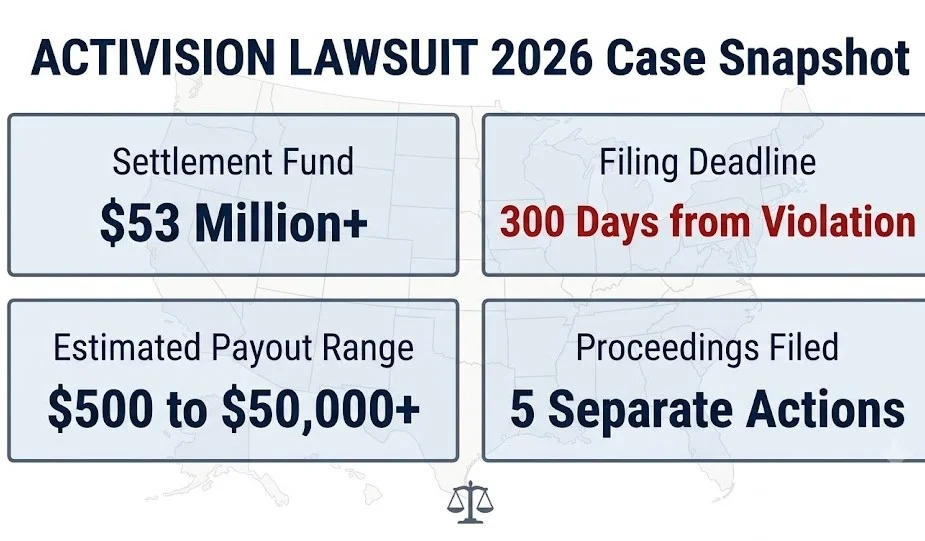
| Total (employment funds) | $53 million+ | — | Employee claimants |
Bold callout: The $53 million combined employment fund does not include amounts recovered through private attorney-negotiated settlements for individual claimants, which are not publicly disclosed.
Attorney Insight: Attorneys familiar with the claims administration process have noted that claimants who retained private counsel before the EEOC claims process closed often secured individual resolution figures that exceeded the pro-rata fund share, making early legal consultation particularly consequential here.
Litigation Watch: The combined employment settlement funds total more than $53 million, but the SEC’s $35 million penalty flows to the Treasury and is unavailable to individual claimants, a distinction that is frequently misunderstood and that can affect how a claimant evaluates their options.
Activision Settlement Payout Per Person: What Claimants Actually Receive
Individual payout amounts from the Activision settlement funds are not fixed. They are calculated based on each claimant’s documented harm, employment period, and position within the claims administration scoring process.
The EEOC consent decree did not establish a per-person minimum or maximum. The $35 million pool is divided among all validated claimants, weighted by the severity and duration of documented harm.
Based on the size of the fund and the estimated number of affected employees identified in the EEOC’s complaint, individual amounts are expected to range from several hundred dollars for claimants with limited documented harm to potentially tens of thousands of dollars for those with documented pay disparity, promotion denial, and retaliation claims.
Factors that affect individual payout:
- Length of employment during the covered period
- Documented nature and severity of the discriminatory conduct
- Whether the claimant filed an internal HR complaint or EEOC charge
- Whether the claimant suffered identifiable economic harm (pay gap, lost promotion)
- Whether the claimant experienced retaliation after reporting
- Whether the claimant had private counsel at the time of claim submission
Bold callout: Claims with documented economic damages such as pay disparities and lost promotions generally score higher in claims administration than claims based on work environment harm alone, meaning documented financial impact matters significantly to final payout.
Attorney Insight: Attorneys representing individual claimants have advised their clients to compile all available records of pay, performance reviews, internal complaints, and any subsequent adverse employment actions before submitting to the claims administrator, since the documentation submitted directly affects the scoring outcome.
Activision Lawsuit Filing Deadline 2026: Key Dates
The relevant deadlines for Activision Blizzard claims in 2026 depend on which proceeding applies and whether a claimant is pursuing a government-fund claim, a private claim, or a shareholder action.
The EEOC consent decree’s initial claims submission period has closed, but the court-supervised monitoring period remains active through 2026, and new compliance violations during that period can generate fresh claims.
Private employment claims under Title VII and California’s FEHA are subject to separate statutes of limitations that may still be running for employees who have not yet filed with the appropriate agency.
Key dates and deadlines:
| Proceeding | Status in 2026 | Applicable Deadline |
|---|---|---|
| EEOC fund claims | Initial period closed; monitoring active | Monitor period extends through 2024-2026 |
| DFEH/CRD fund claims | Distribution phase; check with administrator | Contact CRD for current status |
| Private Title VII claim | Must file EEOC charge within 180/300 days of violation | Statute runs from discriminatory act |
| California FEHA claim | Must file DFEH/CRD complaint within 3 years of violation | Expanded to 3 years as of Jan. 1, 2020 |
| Shareholder class action | Check specific case dockets for opt-out deadlines | Varies by case |
Bold callout: California expanded the FEHA statute of limitations from 1 year to 3 years effective January 1, 2020. Employees whose harm occurred in 2021 or later may still have viable state claims to file in 2026.
Attorney Insight: Attorneys reviewing late-filed claims have noted that the 300-day federal window for EEOC charges in California (a dual-filing state) is calculated from the date of the last discriminatory act, not the date of discovery, making accurate documentation of incident dates critical.
How to File an Activision Class Action Claim
Filing a claim in the Activision settlement requires identifying the correct proceeding, meeting the documentation requirements for that fund, and, where applicable, submitting through the court-appointed claims administrator.
For the EEOC consent decree fund, the claims process was administered by a court-supervised third party. The initial submission window is closed, but employees who believe they were improperly excluded can seek review through the court’s oversight process.
For ongoing private claims under Title VII or California’s FEHA, the process begins with filing an administrative charge with the EEOC or CRD, receiving a right-to-sue letter, and then filing a civil complaint in federal or state court within the statutory window.
Step-by-step process for new private claims:
- Document all relevant employment records, complaints, and adverse actions
- File a charge with the EEOC (federal) or CRD (California state)
- Receive a notice of right to sue from the agency
- File a civil complaint in the appropriate court within the statutory deadline
- Determine whether the claim is best pursued individually or through a class action
- Work with plaintiff-side employment counsel on discovery and damages calculation
Bold callout: Filing with the EEOC and California’s CRD simultaneously through the dual-filing arrangement preserves both federal and state claims with a single administrative submission, a procedural step that matters significantly for California-based claimants.
Attorney Insight: Employment attorneys consistently advise that the right-to-sue letter from the EEOC triggers a strict 90-day window to file in federal court, and missing that window forfeits the federal Title VII claim regardless of the merits.
Litigation Watch: The claims filing process differs materially depending on whether a claimant is pursuing the existing government consent decree fund or initiating a new private action, and the procedural deadlines for each are unforgiving once missed.
Which States Are Affected by the Activision Lawsuit?
The Activision Blizzard employment litigation is most concentrated in California, where the DFEH filed its state action and where Activision Blizzard’s primary offices are located.
Federal coverage through the EEOC consent decree extends to employees across all states where Activision Blizzard operated, since Title VII is a federal statute with nationwide application.
Employees in states outside California who experienced discrimination, harassment, or retaliation at Activision Blizzard facilities may pursue claims through the federal EEOC process or through their state’s equivalent fair employment agency.
State-by-state eligibility overview:
| State | Coverage | Agency to Contact |
|---|---|---|
| California | EEOC federal + DFEH/CRD state | EEOC + California CRD |
| Texas | EEOC federal + state TWCCRD | EEOC + Texas Workforce Commission |
| New York | EEOC federal + NYSDHR | EEOC + NY Division of Human Rights |
| Illinois | EEOC federal + IDHR | EEOC + Illinois Department of Human Rights |
| All other states | EEOC federal coverage applies | EEOC + applicable state agency |
Bold callout: California claimants have the strongest dual-remedy position because California’s FEHA exceeds federal Title VII protections in several respects, including the 3-year statute of limitations (versus 300 days for federal charges) and the potential for individual supervisor liability.
Attorney Insight: Employment attorneys outside California have noted that the EEOC consent decree’s coverage of multi-state Activision employees means that workers in Austin, Seattle, and other locations where Activision had operations should assess their federal claim eligibility independently of the California-specific DFEH process.
Activision Blizzard Settlement 2026: Current Status
As of 2026, the Activision Blizzard litigation landscape sits in a mixed state of concluded fund distributions, active court supervision, and ongoing private litigation.
The EEOC consent decree’s three-year monitoring period covers the span from 2021 through approximately 2024, with compliance reports filed with Judge Fischer’s court. The monitoring obligations and any compliance disputes arising from those reports remain within the court’s jurisdiction through the close of the monitoring term.
The DFEH/CRD fund has moved into distribution. The Microsoft acquisition of Activision Blizzard, completed in October 2023, has not extinguished existing settlement obligations. Microsoft, as corporate successor, assumed responsibility for ongoing consent decree compliance.
2026 status by proceeding:
| Proceeding | 2026 Status |
|---|---|
| EEOC consent decree | Monitoring period active; compliance reports on file |
| DFEH/CRD fund | Distribution phase; administrator processing claims |
| SEC penalty | Paid; proceeding closed |
| Shareholder derivative suits | Active in Delaware and California; status varies by case |
| Private individual claims | New filings possible under applicable statutes of limitations |
Bold callout: Microsoft’s October 2023 acquisition of Activision Blizzard for $68.7 billion transferred corporate successor liability for outstanding settlement obligations to Microsoft, a factor that strengthens the financial security of existing and potential future claimant recoveries.
Attorney Insight: Corporate transaction attorneys reviewing the Microsoft-Activision acquisition have noted that consent decree obligations survived the merger because they were court-imposed, not contractually negotiated, meaning Microsoft’s assumption of compliance responsibility was legally compelled, not discretionary.
Activision Claim Status 2026: How to Check Where Things Stand
Claimants who submitted to the EEOC consent decree fund can check the status of their claim through the court-appointed claims administrator, whose contact information was provided in the formal notice sent to potential class members.
For claimants who filed with the DFEH/CRD, the California Civil Rights Department maintains a case inquiry process. Claimants who retained private counsel should coordinate directly with their attorney, who has standing to query the administrator on their behalf.
For those pursuing private claims that have not yet been filed, the relevant status question is whether the applicable statute of limitations is still running, which requires calculating from the date of the discriminatory act, not the date of awareness.
How to track your status by claim type:
- EEOC consent decree claimants: Contact the court-appointed claims administrator using the reference number from your notice letter
- DFEH/CRD claimants: Contact the California Civil Rights Department inquiry line or check through retained counsel
- Private EEOC charge claimants: Monitor charge status through the EEOC’s online charge status portal using your charge number
- Shareholder class action members: Check the specific case docket on PACER or through class counsel’s published case website
- Unrepresented potential claimants: Consult with an employment attorney to assess whether a timely charge or complaint can still be filed
Bold callout: The PACER federal case management system allows public access to filings in the EEOC case (2:21-cv-07682-DSF-JEM), including consent decree compliance reports, which contain useful information about the monitoring period’s progress.
Attorney Insight: Attorneys representing late-arriving claimants have noted that the court-supervised monitoring record in this case is unusually detailed, and compliance reports filed with Judge Fischer’s court have, in some instances, identified new claimant categories that were not part of the original fund distribution.
Litigation Watch: Multiple Activision Blizzard claims processes are running simultaneously in 2026, and claimants who do not track the specific proceeding applicable to their situation risk missing a distribution window or a filing deadline without realizing it.
How to Find an Attorney for the Activision Lawsuit
The type of attorney a claimant needs depends on what kind of Activision claim they are pursuing.
Employment discrimination and harassment claims, including the EEOC and DFEH matters, are handled by plaintiff-side employment attorneys who specialize in workplace discrimination, harassment, and retaliation cases. These attorneys typically work on contingency, meaning no upfront fee.
Securities and shareholder claims require a securities litigation attorney or class action firm with experience in derivative suits and investor class actions. The legal theory, damages model, and court practice are entirely different from employment law.
Attorney type by claim category:
| Claim Type | Attorney Specialty | Fee Structure |
|---|---|---|
| Sex discrimination / harassment | Plaintiff-side employment attorney | Contingency (typically 33-40%) |
| Pay equity | Employment attorney (wage and hour) | Contingency |
| Retaliation | Employment attorney | Contingency |
| Shareholder derivative | Securities litigation attorney | Contingency or hybrid |
| Investor class action | Securities class action attorney | Court-approved fee from fund |
| Whistleblower / SEC reporting | Whistleblower attorney | Contingency; potential award |
Bold callout: Plaintiff-side employment attorneys typically offer free initial consultations and do not collect fees unless the case results in a recovery, which reduces financial risk for claimants who are uncertain whether their claim has value.
Attorney Insight: Attorneys who review potential new Activision-related claims in 2026 typically begin by assessing whether the statute of limitations is still open, whether the claimant has preserved documentary evidence, and whether the facts support an individual claim, a group claim, or referral to the existing class proceedings.
Frequently Asked Questions
What is the Activision Blizzard lawsuit about?
The Activision Blizzard lawsuit involves multiple legal proceedings alleging workplace sex discrimination, sexual harassment, pay inequity, retaliation, and related securities disclosure failures.
The EEOC filed a federal civil action in the Central District of California (Case No. 2:21-cv-07682), while California’s DFEH filed a parallel state action in Los Angeles Superior Court (Case No. 21STCV26571).
The SEC separately penalized the company $35 million for impeding employee access to federal whistleblower protections.
Who is eligible to receive money from the Activision settlement?
Current and former Activision Blizzard employees who experienced sex discrimination, sexual harassment, or retaliation during the covered employment period may qualify for the EEOC’s $35 million fund.
California-based employees with pay equity and FEHA claims may access the separate $18 million DFEH/CRD fund.
Investors who held Activision Blizzard stock and suffered losses tied to disclosure failures may have separate securities claims through the shareholder litigation track.
How much will each person receive from the Activision settlement?
Individual payouts from the EEOC’s $35 million fund are not fixed amounts and depend on each claimant’s documented harm, employment period, and claim scoring by the administrator.
Claims with documented economic harm such as wage disparities and lost promotions typically receive higher allocations than claims based on work environment harm alone.
Private settlements negotiated by individual attorneys may exceed the pro-rata fund share and are not publicly disclosed.
What is the deadline to file an Activision lawsuit claim in 2026?
The initial EEOC consent decree claims window is closed, but California employees may still file FEHA complaints with the CRD within three years of the last discriminatory act.
Federal Title VII claims require an EEOC charge within 300 days of the discriminatory act in California, a dual-filing state.
Employees who experienced qualifying conduct in 2023 or later may still have open windows in 2026 and should consult an employment attorney promptly.
Is the Activision settlement separate from the EEOC consent decree?
The EEOC consent decree and the DFEH/CRD state settlement are separate agreements with distinct funds, eligibility criteria, and administration processes.
The EEOC’s $35 million fund covers federal Title VII claims; the DFEH’s $18 million fund covers California FEHA claims.
Some claimants may qualify for both funds depending on their employment history, work location, and claim category.
Does the Microsoft acquisition of Activision affect settlement claims?
Microsoft’s October 2023 acquisition of Activision Blizzard transferred corporate successor liability for all existing court-imposed settlement obligations to Microsoft.
The EEOC consent decree and DFEH settlement terms survived the acquisition because they are court-ordered obligations, not contractual arrangements that could be renegotiated or assigned away.
Claimants with active or potential claims against Activision Blizzard are effectively pursuing recovery from a subsidiary of one of the world’s largest corporations, which improves the financial security of those recovery prospects.
Where This Case Stands and What to Do Next
The Activision Blizzard litigation represents a significant moment in how employment discrimination cases in the technology and gaming industries are prosecuted, monitored, and resolved across both state and federal systems.
For current and former employees with qualifying claims, the most consequential step in 2026 is determining whether the applicable statute of limitations is still running and whether documentary evidence has been preserved. Waiting reduces options.
An employment attorney with experience in workplace discrimination cases, or a securities attorney for investor claims, can assess the specific facts, identify the right proceeding, and advise on the realistic value of a claim before any commitment is made.
