
Quick Answer Box
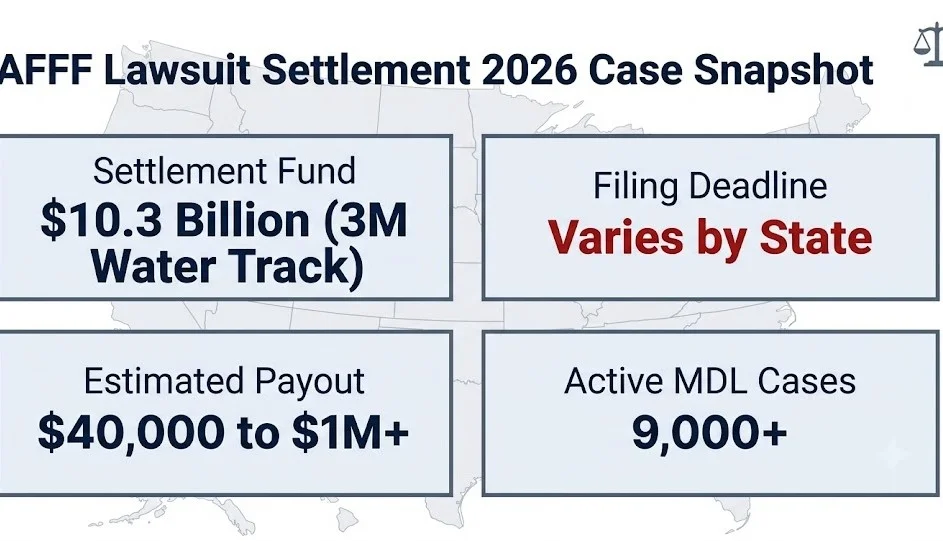
- The AFFF mass tort is not fully settled. 3M reached a global PFAS water settlement, but personal injury cancer claims against DuPont, Chemours, and Corteva remain in active litigation inside MDL-2873 as of 2026.
- Eligible claimants are individuals with documented PFAS exposure through firefighting foam and a qualifying cancer diagnosis, including kidney cancer, testicular cancer, bladder cancer, and several others.
- Estimated individual payouts range widely, from under $100,000 for lower-tier claims to over $1 million for severe diagnoses with strong exposure documentation, depending on which defendant the claim targets.
Case Snapshot
| Detail | Information |
|---|---|
| Case Name / MDL | In re: Aqueous Film-Forming Foams Products Liability Litigation, MDL-2873 |
| Court | U.S. District Court, District of South Carolina, Charleston Division |
| Presiding Judge | Senior U.S. District Judge Richard Gergel |
| MDL Transfer Order | December 2018 |
| 3M Global Settlement | Approximately $10.3 billion, announced June 2023, funding through 2036 |
| DuPont/Chemours/Corteva Settlement | Approximately $1.185 billion, announced July 2023, water systems only |
| Personal Injury Track Status | Active litigation; trial schedule ongoing into 2026 |
| Total Cases in MDL | Over 9,000 personal injury cases as of early 2026 |
The AFFF lawsuit will not be fully settled on a single date. That is the first thing a claimant in 2026 needs to understand. The litigation operates on parallel tracks, and depending on which defendant your claim targets, you are on a different timeline entirely.
3M reached a landmark settlement in 2023. But 3M’s deal covered public water systems, not individual cancer claimants. Personal injury claims, the ones filed by firefighters, veterans, and workers with PFAS-related cancers, remain inside MDL-2873 and are subject to a separate resolution process.
Over 9,000 personal injury cases are active in the MDL as of early 2026. The pace of those resolutions depends on bellwether trial outcomes, defendant-specific negotiations, and the pressure created by approaching trial dates. Understanding that structure is the difference between waiting indefinitely and knowing what to watch for.
When Will the AFFF Lawsuit Be Settled?
No single settlement date exists for the AFFF litigation. The case operates in two distinct tracks: a water system contamination track and a personal injury track.
The water system track saw major resolution in 2023. The personal injury track, involving cancer claimants, is in active litigation inside MDL-2873 as of 2026.
Individual case resolutions depend on which defendant the claim targets, what the bellwether trial record shows, and whether defendants choose global deals or case-by-case resolution.
Attorney Insight: Attorneys handling these claims point to the distinction between water utility settlements and personal injury claims as the single most misunderstood aspect of this litigation. The two tracks have separate funding, separate timelines, and separate eligibility criteria.
| Track | Status | Timeline |
|---|---|---|
| Public Water System Claims (3M) | Settled, $10.3B fund | Payments ongoing through 2036 |
| Public Water System Claims (DuPont group) | Settled, $1.185B | Payments ongoing |
| Personal Injury Cancer Claims (3M) | Separate negotiation | Not globally resolved as of 2026 |
| Personal Injury Claims (DuPont/Chemours) | Active trial track | Resolution expected 2026 to 2027 |
| Personal Injury Claims (Other Defendants) | Active MDL | Case-by-case timeline |
The short answer to “when will AFFF be settled” is: it depends on your specific claim, your diagnosed condition, and which defendant is responsible for your exposure.
Has the AFFF Lawsuit Been Settled?
The AFFF lawsuit has been partially settled. No global resolution covering all claimants and all defendants has been reached as of early 2026.
3M’s $10.3 billion deal, announced in June 2023, resolved claims from public water systems alleging PFAS contamination. It did not resolve cancer claims from individual plaintiffs.
DuPont, Chemours, and Corteva reached a separate $1.185 billion water system settlement in July 2023. Their personal injury liability exposure remains unresolved.
Bold Callout: As of early 2026, more than 9,000 personal injury cases remain active inside MDL-2873. The case is not over.
Attorney Insight: Attorneys handling these claims point to media coverage of 3M’s settlement as a source of significant confusion, with many potential claimants incorrectly assuming the entire AFFF litigation concluded in 2023.
The question “has the AFFF lawsuit been settled” has a specific answer: partially, for water utilities, not for individual cancer victims. Those claims are still being litigated.
AFFF Lawsuit Settlement Timeline 2026
The settlement timeline for AFFF personal injury claims in 2026 is driven by three factors: trial scheduling by Judge Gergel, ongoing bellwether results, and defendant negotiating posture.
Judge Gergel has managed MDL-2873 with active case management, scheduling bellwether trials to pressure defendants toward resolution. The trial record created by those cases sets the financial reference point for global settlement negotiations.
Timeline of Key Events
| Date | Event | Significance |
|---|---|---|
| December 2018 | MDL-2873 established | Federal consolidation of all AFFF cases |
| 2021 to 2022 | Discovery phase; bellwether selection | Case-specific facts established |
| June 2023 | 3M announces $10.3B water settlement | Water utilities resolved; personal injury separate |
| July 2023 | DuPont group announces $1.185B water settlement | Same distinction applies |
| 2024 | Bellwether personal injury trials proceed | Trial record builds settlement pressure |
| 2025 | DuPont/Chemours personal injury negotiations intensify | Trial verdicts drive financial pressure |
| 2026 | Active personal injury resolution expected | Settlement or trial outcomes for personal injury track |
Attorney Insight: Attorneys handling these claims point to the 2024 and 2025 bellwether trial record as the single most important factor in determining whether defendants settle personal injury claims globally in 2026 or allow additional trials to proceed.
Litigation Watch: The water utility settlements are largely complete, but the personal injury track inside MDL-2873 is in its most consequential phase as of 2026, with trial outcomes driving settlement pressure on remaining defendants.
AFFF Lawsuit 2026 Update and Current Status
As of early 2026, MDL-2873 remains one of the most active mass tort dockets in federal court. Personal injury cases against major AFFF manufacturers are in various stages of pre-trial, negotiation, and trial preparation.
3M faces ongoing personal injury negotiations separate from its water utility settlement. The structure of those discussions has not been publicly confirmed, but the scale of claims makes a global resolution financially preferable to trying thousands of individual cases.
DuPont, Chemours, and Corteva face their own personal injury exposure. These three entities share historical liability through the corporate spinoff structure that separated DuPont’s legacy chemical operations. That structure complicates settlement allocation across defendants.
Quick Facts: 2026 AFFF Personal Injury Status
- Active cases in MDL-2873: Over 9,000
- Primary personal injury defendants: 3M, DuPont, Chemours, Corteva, Tyco Fire Products, National Foam, Kidde-Fenwal
- Presiding judge: Senior U.S. District Judge Richard Gergel
- Court: U.S. District Court, District of South Carolina, Charleston Division
- Next expected milestones: Additional bellwether trials and potential global personal injury settlement announcements
Attorney Insight: Attorneys handling these claims note that the sheer volume of filed cases creates strong economic incentive for defendants to negotiate group resolutions rather than face individual trials at scale.
How Much Is the AFFF Lawsuit Worth Per Claimant?
Individual AFFF personal injury claims range from approximately $40,000 for lower-tier cases to over $1 million for high-severity diagnoses with strong exposure documentation.
The range reflects a tiered compensation structure that weights cancer type, severity, treatment required, duration of exposure, and strength of medical causation evidence.
No single announced per-claimant figure applies to all cases. Values in mass tort litigation vary by defendant, cancer type, and individual case facts.
Estimated AFFF Personal Injury Payout Tiers
| Tier | Cancer Type or Severity | Estimated Range |
|---|---|---|
| Tier 1 (Highest) | Kidney cancer, bladder cancer, progressive disease | $500,000 to $1M+ |
| Tier 2 | Testicular cancer, thyroid cancer, NHL | $150,000 to $500,000 |
| Tier 3 | Lower-stage diagnoses, partial documentation | $40,000 to $150,000 |
| Water Utility Claims | Municipal systems (separate track) | Allocated from $10.3B or $1.185B funds |
These figures are derived from reported bellwether trial outcomes and settlement patterns observed in comparable PFAS mass torts. Actual recovery depends on individual case strength.
Attorney Insight: Attorneys handling these claims point to exposure documentation as the single most variable factor affecting tier placement. Claimants with military records, occupational health records, or PFAS blood test results showing elevated levels typically qualify for higher tiers.
What Cancers Qualify for the AFFF Lawsuit?
Qualifying cancers for the AFFF personal injury lawsuit are those with established scientific or emerging epidemiological links to PFAS exposure, specifically PFOA and PFOS.
MDL-2873 plaintiffs have filed claims alleging a range of malignancies. Not all cancers carry equal evidentiary support, which affects both eligibility screening and claim tier placement.
Cancers Associated with AFFF/PFAS Claims in MDL-2873
| Cancer Type | Evidentiary Basis | Typical Tier Placement |
|---|---|---|
| Kidney / Renal Cell Carcinoma | Strong epidemiological evidence | Tier 1 |
| Bladder Cancer | Established PFAS association | Tier 1 |
| Testicular Cancer | Strong association with PFOS | Tier 2 |
| Thyroid Cancer | Documented PFAS endocrine disruption link | Tier 2 |
| Non-Hodgkin Lymphoma | Emerging evidence, accepted in MDL | Tier 2 |
| Prostate Cancer | Under review; weaker causal evidence | Tier 3 or screening |
| Pancreatic Cancer | Limited evidence; case-by-case basis | Case-by-case |
| Ovarian Cancer | Emerging research; developing claims | Under review |
Attorney Insight: Attorneys handling these claims note that the science on PFAS-linked cancers continues to evolve, and cancers not currently accepted in settlement matrices may gain evidentiary support through ongoing epidemiological research.
Litigation Watch: Cancer type is a primary driver of claim value. Kidney and bladder cancer claimants with strong PFAS exposure records occupy the highest settlement tier in reported AFFF negotiations as of 2026.
Who Qualifies for the AFFF Lawsuit?
Qualifying for the AFFF personal injury lawsuit requires two core elements: documented exposure to AFFF containing PFAS chemicals, and a diagnosis of a cancer type linked to that exposure.
The exposure requirement is not satisfied by general PFAS contact. Claimants must show they worked with, trained with, or lived near AFFF foam use sites for a meaningful period.
AFFF Lawsuit Eligibility Requirements
| Eligibility Factor | Qualifying Condition | Does Not Qualify |
|---|---|---|
| Exposure Type | Military, firefighter, airport worker, industrial use | General water contamination (separate track) |
| Duration | Regular or extended occupational exposure | Single incidental exposure |
| Diagnosis | Qualifying cancer with documented PFAS link | No cancer diagnosis |
| Timing | Diagnosis after documented exposure period | Pre-exposure diagnosis |
| Geography | U.S. military base, airport, industrial facility | Unknown exposure source |
Attorney Insight: Attorneys handling these claims point to military service records and occupational health documentation as the strongest exposure evidence. Veterans who served at bases where AFFF was used in training exercises have well-documented exposure records.
The statute of limitations varies by state. Most states allow two to three years from diagnosis or discovery of the PFAS-cancer link. Acting within that window is a threshold requirement.
3M AFFF Settlement: What It Covers and What It Doesn’t
3M’s $10.3 billion settlement, announced in June 2023, resolves claims from public water systems that detected PFAS contamination attributable to AFFF products. Payments are structured to flow through 2036.
This settlement does not cover individual cancer claimants. It does not resolve personal injury claims. Those remain in separate litigation within MDL-2873.
The distinction matters enormously for cancer victims. A municipal water utility receiving funds from the 3M settlement is a different legal entity with different claims than a firefighter with kidney cancer. Those are separate lawsuits with separate defendants and separate outcomes.
3M Settlement Scope
| Element | Covered | Not Covered |
|---|---|---|
| Public water utilities | Yes, PFAS remediation costs | Not applicable |
| Individual cancer victims | No | Separate litigation required |
| Private wells | Case-by-case, utility dependent | Not directly covered |
| Property damage | Limited, through utility claim | Not covered individually |
| Future exposure monitoring | Partially, through utility programs | Individual claimants separate |
Attorney Insight: Attorneys handling these claims note that 3M’s water system settlement was widely misreported as “ending the AFFF lawsuit,” which led many personal injury claimants to incorrectly assume their claims were resolved or precluded.
DuPont, Chemours, and Corteva AFFF Litigation Status
DuPont, Chemours, and Corteva reached a $1.185 billion water system settlement in July 2023. Like 3M’s deal, this covered public water utilities, not cancer claimants.
The corporate structure of these three entities complicates personal injury litigation. DuPont spun off Chemours in 2015. It later merged with Dow and then separated into three entities. Historical PFAS liability flows through those corporate lineages in ways that require court-supervised allocation.
Litigation Watch: DuPont, Chemours, and Corteva remain the primary defendants for personal injury claimants who cannot link their exposure directly to 3M products. Their liability exposure for cancer claims is unresolved as of 2026.
Attorney Insight: Attorneys handling these claims point to the DuPont/Chemours/Corteva corporate spinoff history as a genuine legal complexity. Plaintiffs’ counsel must trace which entity sold or distributed the specific AFFF product causing exposure.
Corporate Liability Allocation
| Entity | Historical Role | Current Litigation Status |
|---|---|---|
| DuPont de Nemours | Original PFAS manufacturer | Personal injury claims active |
| Chemours Company | Spun off from DuPont in 2015 | Shares legacy PFAS liability |
| Corteva Agriscience | DowDuPont agricultural spinoff | AFFF liability allocation pending |
| 3M Company | Largest AFFF producer | Water settled; PI claims ongoing |
How Bellwether Trials Are Shaping AFFF Settlements in 2026
Bellwether trials are representative cases selected from the MDL docket to be tried before a jury. The verdicts create a financial reference point that both sides use to calculate the value of the broader inventory of claims.
In MDL-2873, Judge Gergel managed a bellwether selection process through 2022 and 2023. Trial outcomes from that period established real-world verdict ranges that defendants and plaintiffs now use to estimate global settlement exposure.
A large plaintiff verdict in a bellwether trial increases settlement pressure on defendants immediately. A defense verdict reduces that pressure. The 2024 and 2025 trial record inside MDL-2873 is therefore directly responsible for shaping how quickly defendants move toward resolution in 2026.
How Bellwether Mechanics Work
| Phase | What Happens | Effect on Settlement |
|---|---|---|
| Case selection | Representative plaintiffs chosen | Establishes test cases |
| Trial | Jury hears individual case | Verdict creates reference point |
| Plaintiff verdict | High damages awarded | Increases defendant settlement urgency |
| Defense verdict | Claims dismissed or reduced | Reduces settlement pressure |
| Settlement matrix built | Tiers formed from verdict data | Claimants ranked by case similarity |
Attorney Insight: Attorneys handling these claims describe bellwether trials as “the engine of mass tort resolution,” because no defendant settles thousands of cases without first knowing what a jury will pay on a representative sample.
AFFF Lawsuit MDL-2873 and the Federal Court Overseeing the Case
MDL-2873 is formally titled In re: Aqueous Film-Forming Foams Products Liability Litigation. It was established by the Judicial Panel on Multidistrict Litigation in December 2018.
The MDL is assigned to the U.S. District Court for the District of South Carolina, Charleston Division. Senior U.S. District Judge Richard Gergel has presided over the litigation since its inception.
The MDL consolidates pretrial proceedings for federal AFFF cases filed nationwide. It does not prevent state court filings, and some claimants have cases in state courts running parallel to the federal MDL.
MDL-2873 Key Facts
| Detail | Information |
|---|---|
| MDL Number | 2873 |
| Full Case Title | In re: AFFF Products Liability Litigation |
| Court | U.S. District Court, D.S.C., Charleston Division |
| Presiding Judge | Senior Judge Richard Gergel |
| Established | December 2018 |
| Number of Cases (early 2026) | Over 9,000 personal injury filings |
| Case Management Orders | Multiple CMOs governing discovery and trial scheduling |
Attorney Insight: Attorneys handling these claims note that Judge Gergel has actively used case management orders to compress timelines and push defendants toward resolution, a judicial posture that is consistent with how large MDLs are managed when settlement pressure is intentional.
Litigation Watch: MDL-2873 in Charleston, South Carolina, under Judge Gergel’s active management, is the legal center of gravity for all AFFF personal injury claims in 2026. Every negotiation, trial, and settlement track flows through that docket.
AFFF Lawsuit Payout Tiers and Compensation Ranges
The compensation structure for AFFF personal injury claims is not announced publicly in the same way a class action settlement fund is. Instead, payouts are negotiated within a matrix that weights cancer severity, exposure evidence, and defendant-specific liability.
The tiered structure emerging from MDL-2873 settlement discussions follows a model common in pharmaceutical mass torts. Higher-tier cancers with strong medical and exposure records command the largest recoveries. Tier 3 cases with limited documentation receive the smallest shares.
AFFF Compensation Tier Matrix
| Tier | Qualifying Criteria | Estimated Recovery Range |
|---|---|---|
| Tier 1 | Kidney or bladder cancer, documented military or occupational exposure, strong PFAS blood test | $500,000 to $1M+ |
| Tier 2 | Testicular, thyroid, or NHL diagnosis, moderate exposure documentation | $150,000 to $500,000 |
| Tier 3 | Lower-stage diagnosis, limited exposure records, partial documentation | $40,000 to $150,000 |
| Excluded | No qualifying cancer, speculative exposure only | No recovery |
Attorney fees in mass tort cases are typically contingency-based, ranging from 33% to 40% of gross recovery. That percentage is deducted from the claimant’s gross award before the net check is issued.
Attorney Insight: Attorneys handling these claims point to PFAS blood testing as a meaningful way to strengthen tier placement. Documented blood serum levels above EPA reference ranges, combined with a qualifying cancer diagnosis, significantly improve claim positioning.
AFFF Lawsuit Filing Deadline and Statute of Limitations
The statute of limitations for AFFF personal injury claims varies by state. Most states apply a two-year or three-year window running from the date of diagnosis or the date the claimant discovered, or reasonably should have discovered, the PFAS connection to their illness.
No single nationwide deadline exists. The applicable state is typically where the claimant was diagnosed or resides.
State Statute of Limitations Examples
| State | Limitations Period | Discovery Rule Applies |
|---|---|---|
| California | 2 years from discovery | Yes |
| Texas | 2 years from injury discovery | Yes |
| New York | 3 years | Yes |
| Florida | 4 years | Yes |
| North Carolina | 3 years | Yes |
| South Carolina | 3 years | Yes |
| Pennsylvania | 2 years | Yes |
Bold Callout: Waiting is the most common reason qualifying claimants lose their right to file. The discovery rule delays the clock but does not stop it indefinitely.
Attorney Insight: Attorneys handling these claims note that the discovery rule, which starts the clock from when a claimant knew or should have known about the PFAS-cancer link, is litigated differently across states. Early consultation with a mass tort attorney is the only reliable way to confirm the applicable deadline.
How to File an AFFF Lawsuit or Join the Existing Claim
Filing an AFFF personal injury claim begins with retaining a mass tort attorney who handles PFAS or environmental exposure cases. Cases filed in federal court are transferred to MDL-2873 in South Carolina for coordinated pretrial proceedings.
Claimants do not file directly into the MDL themselves. The attorney files on their behalf and the case is automatically tagged for MDL transfer under the Judicial Panel on Multidistrict Litigation’s standing transfer orders.
Steps to File an AFFF Claim
| Step | Action Required | Estimated Timeframe |
|---|---|---|
| 1 | Retain a mass tort attorney with PFAS experience | Immediately |
| 2 | Gather exposure documentation (military records, employment records) | Within first 30 days |
| 3 | Obtain PFAS blood serum test if not previously done | Before or during intake |
| 4 | Compile cancer diagnosis and treatment records | During attorney intake |
| 5 | Attorney files complaint in appropriate federal district | Within weeks of retention |
| 6 | Case transferred to MDL-2873 for coordinated proceedings | Automatic upon transfer order |
| 7 | Case enrolled in settlement track or trial scheduling | Per MDL case management order |
Attorney Insight: Attorneys handling these claims note that claimants with military exposure records from base housing or training should request service records through the National Personnel Records Center before consulting an attorney, as that documentation significantly accelerates the intake process.
Military Veterans and AFFF Exposure Claims
Veterans represent a substantial portion of AFFF personal injury claimants. U.S. military installations used AFFF extensively in aircraft firefighting training from the 1970s through the late 2010s. The Department of Defense identified PFAS contamination at hundreds of bases.
Veterans who trained at PFAS-contaminated installations, lived in base housing near contaminated groundwater, or worked in military aviation can document exposure through service records and base-specific contamination histories published by the DoD and EPA.
Key Military AFFF Exposure Sites (DoD Identified)
| Installation Type | Example Exposure Sources | Documentation Available |
|---|---|---|
| Air Force bases | Aircraft crash training areas | DoD site assessment reports |
| Naval air stations | Flight deck foam use | Military service records |
| Marine Corps airfields | Firefighting training | Unit deployment records |
| National Guard airfields | AFFF storage and use | State environmental records |
| Coast Guard stations | Search and rescue training | Agency service records |
Attorney Insight: Attorneys handling these claims note that the Camp Lejeune Justice Act of 2022, while covering a distinct set of water contamination claims, established a legislative precedent for veteran PFAS exposure recovery that has influenced how AFFF claims from military claimants are evaluated in MDL-2873.
Litigation Watch: Veterans with qualifying cancer diagnoses and documented service at PFAS-contaminated installations represent some of the strongest cases in MDL-2873, combining clear exposure evidence with institutional documentation.
AFFF Lawsuit Municipal Water Settlements Versus Personal Injury Claims
The distinction between municipal water settlements and personal injury cancer claims is the most consequential structural feature of the AFFF litigation. These are not interchangeable.
Municipal water system claims are filed by cities, counties, and water utilities seeking compensation for PFAS remediation costs, infrastructure upgrades, and monitoring programs. The 3M $10.3 billion settlement and the DuPont group’s $1.185 billion settlement resolve those claims.
Individual cancer claimants are a separate plaintiff class. They allege personal physical harm, not property or infrastructure damage. Their claims require proof of individual exposure, individual diagnosis, and individual causation.
Water Utility vs. Personal Injury Comparison
| Element | Water Utility Claims | Personal Injury Claims |
|---|---|---|
| Plaintiff | City, county, or water system | Individual cancer patient |
| Harm alleged | Infrastructure contamination costs | Physical illness and damages |
| Settlement status | Largely resolved (3M, DuPont group) | Active litigation in MDL-2873 |
| Compensation basis | Remediation and monitoring costs | Medical bills, pain, lost wages |
| How to file | Through utility’s legal counsel | Through mass tort attorney |
Attorney Insight: Attorneys handling these claims point to news coverage conflating these two tracks as a direct cause of inaction by cancer victims who incorrectly believe the AFFF case is closed. The personal injury track is fully active.
What Happens If AFFF Defendants Don’t Settle in 2026?
If defendants do not reach a global personal injury settlement in 2026, the MDL continues into trial. Judge Gergel has the authority to set trial dates for individual bellwether cases and can accelerate the trial calendar to increase pressure on defendants.
A mass tort without settlement resolution does not simply go away. Cases proceed individually or in trial groups, with verdicts creating ongoing financial and reputational pressure on defendants.
For claimants, a delayed resolution means longer waits and continued litigation costs, though contingency-fee arrangements mean most plaintiffs pay no out-of-pocket fees regardless of timeline.
Potential 2026 to 2027 Scenarios
| Scenario | Likelihood | Effect on Claimants |
|---|---|---|
| Global personal injury settlement reached | Moderate to high | Claim form issued, payment timeline set |
| Defendant-specific partial settlements | High | Some claimants paid, others continue |
| Continued bellwether trials | Certain if no global deal | Verdicts build pressure; timeline extends |
| Appeals of trial verdicts | Possible | Further delay for affected claimants |
| MDL remand to home districts | Possible for aged cases | Individual state court proceedings |
Attorney Insight: Attorneys handling these claims note that mass tort defendants rarely allow litigation to continue indefinitely. The economic calculus of thousands of pending trials typically compels negotiation, particularly after adverse bellwether verdicts.
Frequently Asked Questions About the AFFF Lawsuit Settlement
Has the AFFF lawsuit been settled completely?
No, the AFFF lawsuit has not been fully settled as of 2026.
3M’s $10.3 billion deal and the DuPont group’s $1.185 billion deal resolved water utility claims only.
Personal injury cancer claims remain in active litigation inside MDL-2873.
When will AFFF personal injury claimants receive payment?
No confirmed payment date exists for the personal injury track as of early 2026.
Settlement negotiations are ongoing, and resolution could come in 2026 or extend into 2027 depending on trial outcomes and defendant negotiations.
Once a settlement is announced, claims processing and payment typically take six months to two years.
What cancers are covered by the AFFF lawsuit?
Kidney cancer, bladder cancer, testicular cancer, thyroid cancer, and non-Hodgkin lymphoma are the primary qualifying cancers in MDL-2873.
Other diagnoses are evaluated on a case-by-case basis depending on available PFAS exposure evidence and scientific literature.
The list of accepted cancers may expand as epidemiological research matures.
Do military veterans qualify for AFFF lawsuit claims?
Yes, veterans with documented service at PFAS-contaminated military installations and a qualifying cancer diagnosis are eligible to file.
Military service records, deployment histories, and DoD site assessments provide strong exposure documentation.
Veterans should consult a mass tort attorney promptly given varying state statutes of limitations.
How much can an AFFF claimant expect to receive?
Individual recoveries range from approximately $40,000 for lower-tier cases to over $1 million for high-severity diagnoses with strong exposure records.
Tier placement depends on cancer type, exposure documentation quality, and the specific defendant liable for the claimant’s exposure.
Attorney fees, typically 33% to 40% on contingency, are deducted from the gross recovery.
Is there still time to file an AFFF lawsuit in 2026?
Many claimants still have time to file in 2026, depending on their state’s statute of limitations and when they were diagnosed.
Most states apply a two-to-three year window from the date of diagnosis or discovery of the PFAS-cancer connection.
Claimants should consult a mass tort attorney immediately to confirm their specific filing window, as the deadline calculation varies by state.
Closing
The AFFF litigation in 2026 is not a closed case. It is one of the most active mass tort dockets in federal court, with over 9,000 personal injury claims pending and major defendants still negotiating under the pressure of trial scheduling by Judge Gergel in Charleston.
Claimants with qualifying cancer diagnoses and documented exposure should act on their own timeline, not wait for a headline announcing a global settlement. The statute of limitations runs independently of MDL progress.
Retaining a mass tort attorney with specific PFAS and MDL experience is the concrete next step. The most consequential AFFF developments of 2026 will be bellwether trial outcomes and any global personal injury settlement announcements from the remaining defendants.
