“Lawsuit” translates most commonly to demanda, pleito, or juicio in Spanish — but picking the wrong word in the wrong context can make you sound unprepared or even change your meaning entirely. Each translation carries different weight, and using the correct term in a legal setting, a courtroom, or even a casual conversation matters more than most people realize.
Quick Answer: The primary Spanish translations of “lawsuit” are la demanda (the formal legal claim), el pleito (the dispute or legal fight), and el juicio (the trial or court proceeding). The right word depends on the stage of the legal process and the Spanish-speaking country you’re in.
This guide breaks down every translation, shows you exactly when to use each one, gives you real example sentences, and walks you through the most essential related legal vocabulary — whether you’re a student, legal professional, interpreter, or simply trying to understand a legal situation in a Spanish-speaking environment. Chris Brown Lawsuit 2026
What Is “Lawsuit” in Spanish? The Core Translations
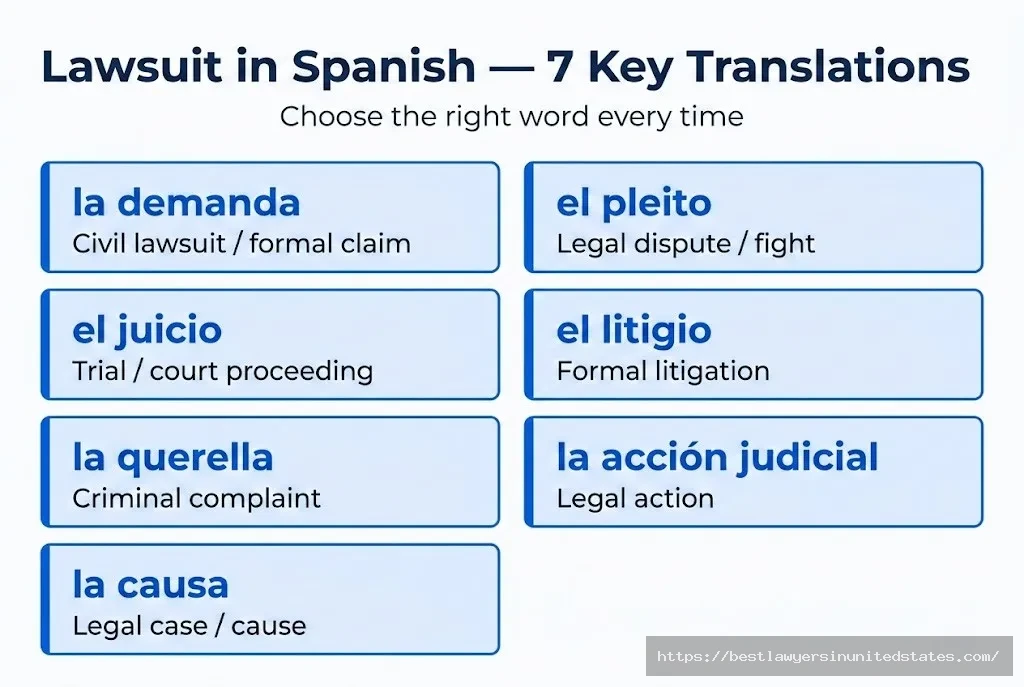
Before getting into nuance, here’s a fast-reference table showing all major Spanish translations of “lawsuit”:
| Spanish Term | Gender | Literal Meaning | Best Used When… |
|---|---|---|---|
| la demanda | Feminine | The claim / petition | Filing a formal legal complaint |
| el pleito | Masculine | The dispute / legal fight | Referring to the broader legal conflict |
| el juicio | Masculine | The trial / judgment | Describing the court proceedings themselves |
| el litigio | Masculine | The litigation | Formal, technical, or written legal contexts |
| la querella | Feminine | The criminal complaint | Criminal charges or formal accusations |
| la acción judicial | Feminine | The legal action | Describing the legal process in general |
| la causa | Feminine | The cause / case | Formal court documents and legal writing |
No single word perfectly covers every use of “lawsuit” in English. That’s not a quirk — it’s actually how Spanish-speaking legal systems are structured, where different stages and types of legal action have distinct names.
Breaking Down Each Translation
La Demanda — The Most Common Translation
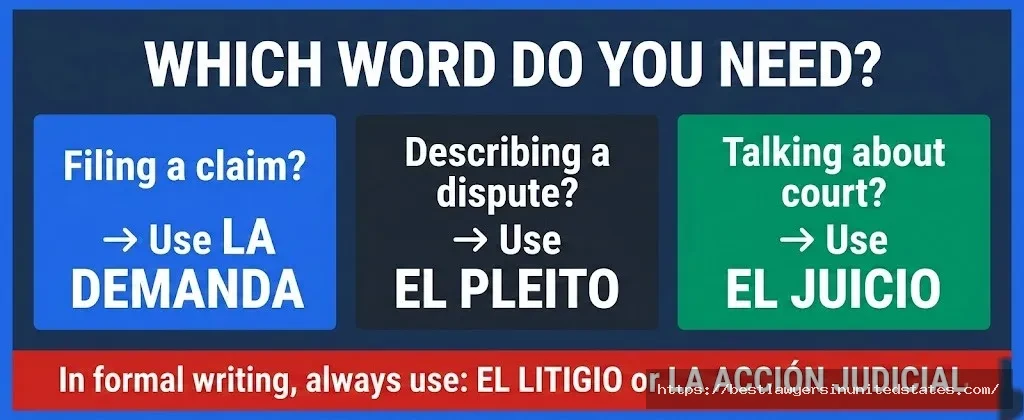
La demanda is the go-to word for “lawsuit” in everyday Spanish. It refers specifically to the formal written claim that a plaintiff submits to the court when initiating legal action. Think of it as the document you file — or, by extension, the legal action that document starts.
Example sentences:
- Ella presentó una demanda contra la empresa por daños y perjuicios. — She filed a lawsuit against the company for damages.
- La demanda fue desestimada por falta de pruebas. — The lawsuit was dismissed for lack of evidence.
- El juez admitió la demanda a trámite. — The judge accepted the lawsuit for processing.
You’ll also hear the phrase entablar una demanda, which means “to bring a lawsuit” or “to file a lawsuit.” This is the verb phrase most equivalent to the English “to file a lawsuit.”
El Pleito — The Legal Dispute
El pleito carries a slightly broader, more informal energy. While it can mean “lawsuit,” it more precisely refers to the legal fight or dispute itself — the ongoing conflict between two parties. It’s also used colloquially to mean any argument or quarrel.
In a legal context, pleito often describes the adversarial nature of the proceeding.
Example sentences:
- El hombre estaba seguro de que su pleito era fuerte. — The man was confident that his lawsuit was strong.
- La empresa entabló un pleito contra la competencia. — The company filed a lawsuit against its competitor.
- Decidir a proceder con un pleito es de hecho una decisión grande. — Deciding to proceed with a lawsuit is indeed a large decision.
El Juicio — The Trial
El juicio most accurately translates to “trial” rather than “lawsuit,” but in casual speech, Spanish speakers frequently use it to mean the entire legal process, including the lawsuit itself. Context matters a lot here.
If someone says “voy a juicio”, they typically mean they’re going to court or facing a trial — not that they’re filing a new claim.
Example sentences:
- Está involucrado en un juicio para impugnar el testamento de su padre. — He is involved in a lawsuit contesting his father’s will.
- El juicio fue suspendido por falta de evidencia. — The trial was suspended for lack of evidence.
- Meter un juicio a alguien — To bring a lawsuit against someone (colloquial, used in some regions)
El Litigio — Formal Litigation
El litigio is the most formal and technical translation. You’ll find it in legal documents, academic texts, and formal written communications more than in conversation. It maps most closely to the English word “litigation.”
Example sentences:
- El número de litigios internacionales en esta materia es muy limitado. — The number of international lawsuits in this area is very limited.
- El litigio entre las dos corporaciones duró cinco años. — The litigation between the two corporations lasted five years.
- Acción de litigio — Litigious action / civil suit
La Querella — Criminal Complaints
La querella is specifically for criminal complaints or formal accusations — situations where someone accuses another person of a crime. It’s not used for civil lawsuits. You’ll hear this word in criminal law contexts across Spain and Latin America.
Example: El acusado enfrenta una querella por fraude fiscal. — The accused faces a criminal complaint for tax fraud.
Translation Table: “Lawsuit” by Context
Here’s how to pick the right word depending on your situation:
| Situation | Best Spanish Word | Example |
|---|---|---|
| Filing a civil claim | la demanda | presentar una demanda |
| Describing a legal dispute | el pleito | ganar/perder un pleito |
| Referring to court proceedings | el juicio | ir a juicio |
| Formal legal writing | el litigio | resolver el litigio |
| Criminal accusation | la querella | interponer una querella |
| Class action lawsuit | la demanda colectiva | una demanda colectiva contra… |
| Bringing a lawsuit | entablar una demanda | entabló pleito contra… |
| Settling a lawsuit | llegar a un acuerdo | poner fin a un litigio |
Regional Differences: Spain vs. Latin America
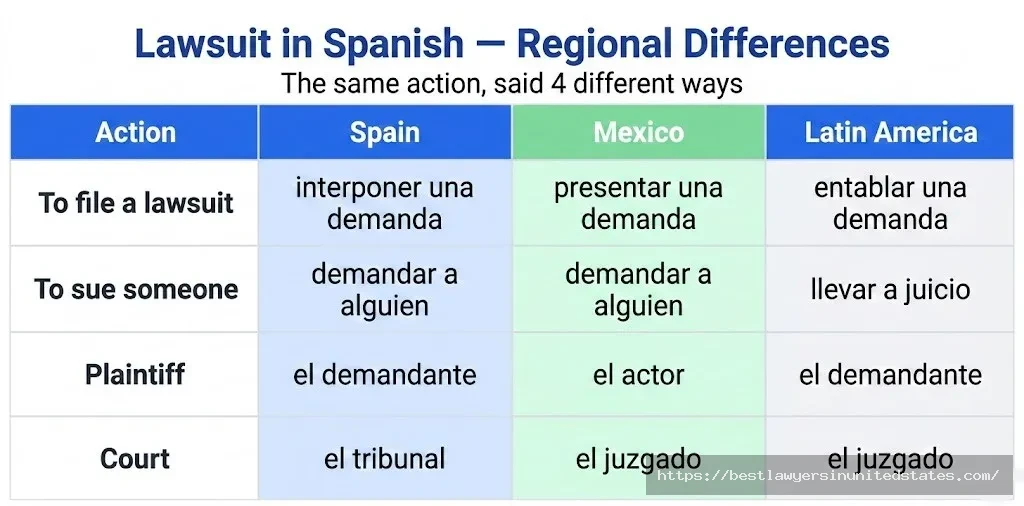
Spanish is spoken in over 20 countries, and legal vocabulary doesn’t always travel cleanly across borders. Here’s what you need to know:
| Term / Phrase | Spain | Mexico | Argentina | General Latin America |
|---|---|---|---|---|
| “To file a lawsuit” | interponer una demanda | presentar una demanda | iniciar un juicio | entablar una demanda |
| “To sue someone” | demandar a alguien | demandar a alguien | iniciar acciones legales | llevar a alguien a juicio |
| “Plaintiff” | el demandante | el actor | el actor | el demandante |
| “Defendant” | el demandado | el demandado | el demandado | el demandado |
| “Court” | el tribunal | el juzgado | el juzgado | varies |
| “Judge” | el juez | el juez | el juez | el juez |
| “Attorney / Lawyer” | el abogado | el abogado / el licenciado | el abogado / el letrado | el abogado |
The core vocabulary stays fairly consistent, but procedural phrases and formal titles vary. If you’re working in a specific country’s legal system, it’s worth confirming regional usage with a local attorney or certified interpreter.
Essential Legal Vocabulary: 60 Key Terms
If you’re navigating a legal situation in Spanish, you’ll need more than just the word for “lawsuit.” Here’s a comprehensive reference covering the most important terms:
People in the Courtroom
| English | Spanish | Notes |
|---|---|---|
| Plaintiff / Claimant | el demandante / el actor | Person filing the claim |
| Defendant | el demandado / el acusado | Person being sued/accused |
| Judge | el juez / la jueza | Presides over the case |
| Attorney / Lawyer | el abogado / la abogada | Represents a party |
| Prosecutor | el fiscal | Government’s attorney in criminal cases |
| Public Defender | el defensor público | Court-appointed defense lawyer |
| Witness | el testigo | Person giving testimony |
| Jury | el jurado | Group deciding the verdict |
| Bailiff | el alguacil | Court officer |
| Court Interpreter | el intérprete judicial | Translates proceedings |
| Expert Witness | el perito / el testigo experto | Specialist witness |
| Notary Public | el notario | Certifies legal documents |
The Legal Process: Step by Step
| English | Spanish | Notes |
|---|---|---|
| To file a lawsuit | presentar / entablar una demanda | Starting the legal action |
| Complaint | la demanda / la queja | The initial filing |
| Summons | la citación / el emplazamiento | Official notice to appear |
| Subpoena | la citación judicial | Compulsory court order |
| Hearing | la audiencia | Court session |
| Trial | el juicio | Full court proceeding |
| Deposition | la declaración / el testimonio | Pre-trial sworn statement |
| Discovery | el descubrimiento de pruebas | Pre-trial evidence exchange |
| Motion | la moción | Formal request to the court |
| Appeal | la apelación | Challenge to a court decision |
| Settlement | el acuerdo extrajudicial | Out-of-court resolution |
| Verdict | el veredicto / el fallo | Final decision |
| Judgment | la sentencia | Court’s formal ruling |
| Dismissal | el sobreseimiento | Case thrown out |
| Injunction | la medida cautelar | Court order to do or stop something |
Evidence and Documents
| English | Spanish | Notes |
|---|---|---|
| Evidence | la prueba / las pruebas | Anything supporting a claim |
| Exhibit | el anexo / la prueba documental | Evidence shown in court |
| Testimony | el testimonio | Spoken or written statement |
| Affidavit | la declaración jurada | Written sworn statement |
| Contract | el contrato | Written agreement |
| Deed | la escritura | Property document |
| Power of Attorney | el poder notarial | Authorization to act legally |
| Subpoena duces tecum | citación para presentar documentos | Order to produce documents |
| Transcript | la transcripción | Written record of proceedings |
Types of Lawsuits
| English | Spanish |
|---|---|
| Civil lawsuit | la demanda civil |
| Criminal case | el caso penal / el proceso penal |
| Class action lawsuit | la demanda colectiva |
| Personal injury lawsuit | la demanda por lesiones personales |
| Medical malpractice suit | la demanda por negligencia médica |
| Product liability suit | la demanda por responsabilidad del producto |
| Wrongful death suit | la demanda por muerte culposa |
| Breach of contract suit | la demanda por incumplimiento de contrato |
| Defamation lawsuit | la demanda por difamación |
| Libel suit | la demanda por calumnia |
| Employment lawsuit | la demanda laboral |
| Divorce proceeding | el proceso de divorcio |
Common Lawsuit-Related Phrases in Spanish
Knowing vocabulary is one thing — using phrases naturally in context is another. Here are the most common expressions you’ll hear and need:
| English Phrase | Spanish Translation |
|---|---|
| To file a lawsuit | presentar / entablar una demanda |
| To sue someone | demandar a alguien |
| To bring someone to court | llevar a alguien a juicio |
| To settle out of court | llegar a un acuerdo extrajudicial |
| To win a lawsuit | ganar un pleito / una demanda |
| To lose a lawsuit | perder un pleito / una demanda |
| To drop a lawsuit | retirar la demanda |
| To dismiss a case | desestimar / sobreseer el caso |
| To appeal a verdict | apelar el fallo |
| To be a party to a lawsuit | ser parte en un juicio |
| A lawsuit is pending | hay una demanda pendiente |
| To reach a verdict | dictar un veredicto |
| The lawsuit was settled | el pleito se resolvió |
| To be held liable | ser considerado responsable |
| Burden of proof | la carga de la prueba |
| Statute of limitations | el plazo de prescripción |
| Out-of-court settlement | acuerdo extrajudicial |
| Class action | demanda colectiva / acción de clase |
Real-World Example Sentences
Here’s “lawsuit” used in a variety of contexts with natural Spanish translations:
Civil context:
- Dos de los directores presentaron una demanda contra su antiguo empleador. — Two of the directors filed a lawsuit against their former employer.
- La constructora de la represa fue objeto de una demanda por parte de un grupo ecologista. — Construction of the dam was delayed because of a lawsuit brought by an environmental group.
- La celebridad presentó una demanda alegando difamación por parte de la revista. — The celebrity filed a lawsuit alleging defamation by the magazine. Crown Asset Management Lawsuit
Criminal context:
- La familia de la víctima entabló una acción ante la justicia contra los soldados implicados. — The victim’s family filed a lawsuit against the soldiers involved.
- El ejecutivo fue arrestado por evasión de impuestos y podría enfrentar una larga sentencia. — The executive was arrested for tax evasion and could face a long prison sentence.
Class action context:
- Una demanda colectiva puede amplificar las voces de los ciudadanos que buscan justicia. — A class action lawsuit can amplify the voices of citizens seeking justice.
Settlement context:
- Las dos partes acordaron poner fin al litigio sin llegar a juicio. — The two parties agreed to settle the lawsuit without going to trial.
How to Say “I’m Filing a Lawsuit” — A Practical Phrasebook
If you find yourself in a situation where you need to communicate about a legal action in Spanish, these phrases will help:
| English | Spanish |
|---|---|
| I need to speak with a lawyer. | Necesito hablar con un abogado. |
| I want to file a lawsuit. | Quiero presentar una demanda. |
| I have been wrongfully sued. | Me han demandado injustamente. |
| I need a court interpreter. | Necesito un intérprete judicial. |
| What are my legal rights? | ¿Cuáles son mis derechos legales? |
| What is the deadline to file? | ¿Cuál es el plazo para presentar la demanda? |
| The case has been dismissed. | El caso fue sobreseído. |
| We reached a settlement. | Llegamos a un acuerdo. |
| He was found not guilty. | Fue declarado inocente. |
| The verdict was in my favor. | El fallo fue a mi favor. |
| I want to appeal. | Quiero apelar. |
| Please explain my rights. | Por favor, explíqueme mis derechos. |
The Structure of a Spanish-Language Lawsuit: Key Stages
Understanding the word “lawsuit” in Spanish also means understanding the process it describes. Here’s how a typical civil lawsuit progresses, with the Spanish name for each stage:
| Stage | Spanish Name | What Happens |
|---|---|---|
| 1. Filing | La presentación de la demanda | Plaintiff submits the formal complaint to the court |
| 2. Service of Process | El emplazamiento / La notificación | Defendant is officially notified of the lawsuit |
| 3. Response | La contestación a la demanda | Defendant submits their formal reply |
| 4. Pre-Trial Motions | Las mociones previas al juicio | Lawyers argue procedural matters before trial |
| 5. Discovery | El descubrimiento de pruebas | Both sides exchange evidence and take depositions |
| 6. Trial | El juicio oral | Full court proceeding with testimony and arguments |
| 7. Verdict | El veredicto / El fallo | Decision is announced |
| 8. Judgment | La sentencia | Court’s formal written ruling |
| 9. Appeal | La apelación | Either party may challenge the decision |
| 10. Enforcement | La ejecución de la sentencia | Winner collects what was awarded |
Differences Between Civil and Criminal Cases in Spanish
One of the most important distinctions in Spanish legal vocabulary is between civil (civil) and criminal (penal) matters — because they use different terminology and different court systems.
| Concept | Civil / Civil | Criminal / Penal |
|---|---|---|
| Type of case | demanda civil | proceso penal |
| Who initiates | Private party (el demandante) | The state (el fiscal / prosecutor) |
| Goal | Compensation, injunction | Punishment, conviction |
| Standard of proof | Preponderancia de la prueba (preponderance) | Más allá de toda duda razonable (beyond reasonable doubt) |
| Outcome if you “win” as plaintiff | Sentencia favorable / indemnización | Condena (conviction) |
| Outcome if you “win” as defendant | Absolución / desestimación | Absolución (acquittal) |
| Term for the guilty verdict | responsabilidad (civil liability) | culpabilidad (guilt) |
Working with Spanish-Speaking Clients or Courts: Tips for Legal Professionals
If you’re an attorney, paralegal, or court interpreter working across language lines, here are some practical notes:
Always use formal register. In Spanish-speaking courtrooms, formal usted is used universally — not the informal tú. Switching to tú by accident signals disrespect or inexperience.
“Demandante” vs. “Actor.” In Spain, the standard term for plaintiff is el demandante. In Mexico and much of Latin America, el actor (from acción — legal action) is more common. Both are correct; context and country matter.
“Juzgado” vs. “Tribunal.” A juzgado is a lower court or single-judge court (common in Mexico and Latin America). A tribunal typically refers to multi-judge courts or higher courts. In Spain, tribunal is the broader term.
Class actions work differently in civil law countries. The U.S.-style class action (demanda colectiva) doesn’t exist in the same form in many Spanish-speaking countries that use civil law systems. Spain and most of Latin America have their own collective action mechanisms, but they vary significantly. Always verify local procedural rules.
Certified interpreters matter. If legal proceedings require Spanish interpretation in U.S. courts, only a court-certified interpreter (intérprete certificado) should be used. Using uncertified interpreters — even fluent ones — can jeopardize the legal record. Byte Aligners Lawsuit
Frequently Asked Questions
What is the most accurate Spanish translation of “lawsuit”?
Quick Answer: La demanda is the most widely understood and commonly used translation, especially in civil legal contexts across all Spanish-speaking countries.
For civil proceedings, la demanda covers the meaning of “lawsuit” most accurately — it refers to the formal legal claim a person submits to a court. If you need a single word that works everywhere, this is it.
When should I use “pleito” instead of “demanda”?
Quick Answer: Use pleito when describing the overall legal dispute or conflict — especially in conversation. Use demanda when referring specifically to the court filing.
Pleito has a broader, more colloquial feel. It can refer to the lawsuit, the legal battle, or even just a heated dispute. Demanda is more precise and formal, pointing specifically to the legal document or claim.
What does “juicio” mean — trial or lawsuit?
Quick Answer: Juicio most accurately means “trial,” but in everyday speech it’s often used to mean “the legal case” or “going to court.”
When someone says they’re “yendo a juicio”, they mean they’re heading into legal proceedings — which could mean a trial, a hearing, or the entire lawsuit. Context clarifies the exact meaning.
How do I say “class action lawsuit” in Spanish?
Quick Answer: La demanda colectiva is the standard translation. Some legal texts also use acción de clase (a more direct calque from English).
Demanda colectiva is widely understood across Latin America and Spain. When writing for a specific legal jurisdiction, confirm the preferred local term with a licensed attorney.
What’s the difference between “litigio” and “pleito”?
Quick Answer: Both mean litigation or lawsuit, but litigio is more formal and technical, while pleito is more conversational.
You’ll see litigio in written contracts, legal documents, and formal correspondence. Pleito turns up more in spoken language and general discussion of legal disputes. In formal writing, litigio is almost always the safer choice.
How do you say “to file a lawsuit” in Spanish?
Quick Answer: The most common phrase is presentar una demanda or entablar una demanda — both mean “to file a lawsuit.”
You might also encounter interponer una demanda (common in Spain), iniciar un juicio (Argentina), or incoar un juicio (formal, archaic). All refer to starting the legal process by submitting a claim to the court.
What is “settlement” in Spanish?
Quick Answer: An out-of-court settlement is un acuerdo extrajudicial. A legal settlement (formal resolution) is un acuerdo de conciliación or simply un acuerdo.
Llegar a un acuerdo means “to reach a settlement.” Poner fin a un litigio means “to end a lawsuit.” If the settlement happens before trial, you’ll often hear acuerdo extrajudicial (out-of-court agreement).
What does “demandante” mean?
Quick Answer: El demandante is the plaintiff — the person who files the lawsuit.
The word comes directly from demandar (to sue or demand). The defendant is el demandado. In criminal law, the accused is el acusado and the prosecutor is el fiscal.
How do you say “I want to sue someone” in Spanish?
Quick Answer: Quiero demandar a alguien — literally, “I want to sue someone.”
You could also say quiero llevar a alguien a juicio (“I want to take someone to court”) or quiero interponer una demanda contra… (“I want to file a lawsuit against…”). The verb demandar is the clearest and most direct choice.
What is a “demanda colectiva” and how is it different from individual lawsuits?
Quick Answer: A demanda colectiva is a class action — a single lawsuit filed on behalf of a large group of affected people, rather than one individual.
Class actions allow many people with similar claims (against the same company or product, for example) to combine their cases. They’re common in U.S. courts and increasingly used in Latin American jurisdictions too, though procedural rules vary by country.
How do you say “lawsuit” in formal legal Spanish writing?
Quick Answer: In formal documents, prefer litigio, acción judicial, or demanda depending on context.
For contracts and legal agreements, phrases like en caso de litigio (“in the event of a dispute/lawsuit”) and resolución extrajudicial de conflictos (“out-of-court dispute resolution”) are standard. Avoid pleito in formal writing — it sounds too casual for legal documents.
What does “acción judicial” mean?
Quick Answer: La acción judicial means “legal action” or “lawsuit” — it refers to the formal process of taking a matter to court.
It’s often used in broader or more procedural statements: “se tomarán acciones judiciales” — “legal action will be taken.” It’s a catch-all phrase when you want to reference the legal process without specifying the stage.
Is “lawsuit” masculine or feminine in Spanish?
Quick Answer: It depends on the word you choose. La demanda is feminine. El pleito, el juicio, and el litigio are masculine.
This matters for adjective agreement and article use. Una demanda larga (a long lawsuit) uses feminine agreement, while un pleito largo uses masculine.
Can I represent myself in a Spanish-speaking court?
Quick Answer: Yes, in many Spanish-speaking jurisdictions you can represent yourself (actuar en nombre propio or ir en pro se), but it’s rarely advisable in complex cases.
Most Spanish-speaking legal systems allow self-representation in some civil matters, but procedural rules, language requirements, and local practice vary significantly. Getting a qualified attorney (abogado) who speaks both English and Spanish is strongly recommended for anything involving formal litigation. TechLawNews 2026
Quick Reference: “Lawsuit” in Spanish at a Glance
| What you want to say | Spanish |
|---|---|
| Lawsuit (general) | la demanda |
| Legal dispute | el pleito |
| Trial / court case | el juicio |
| Formal litigation | el litigio |
| To file a lawsuit | presentar / entablar una demanda |
| To sue someone | demandar a alguien |
| Class action lawsuit | la demanda colectiva |
| Settlement | el acuerdo extrajudicial |
| Plaintiff | el demandante |
| Defendant | el demandado |
| Judge | el juez |
| Attorney | el abogado |
| Court | el tribunal / el juzgado |
| Verdict | el veredicto / el fallo |
| Judgment | la sentencia |
This article is provided for informational and educational purposes. It is not legal advice. If you’re involved in a legal matter — in English or Spanish — consult a licensed attorney in the relevant jurisdiction. For attorney referrals, contact [email protected].