
Quick Answer Box
- What it is: A federal class action arising from a 2022 data breach at Nelnet Servicing, LLC that exposed the personal information of approximately 2.5 million student loan borrowers. The case was filed in the U.S. District Court for the District of Nebraska. Separate litigation tracks address student loan servicing errors and PSLF mishandling.
- Who qualifies: Any borrower whose personally identifiable information was compromised in the June to July 2022 Nelnet breach and who received a data breach notification letter. Borrowers affected by servicing errors may have independent claims.
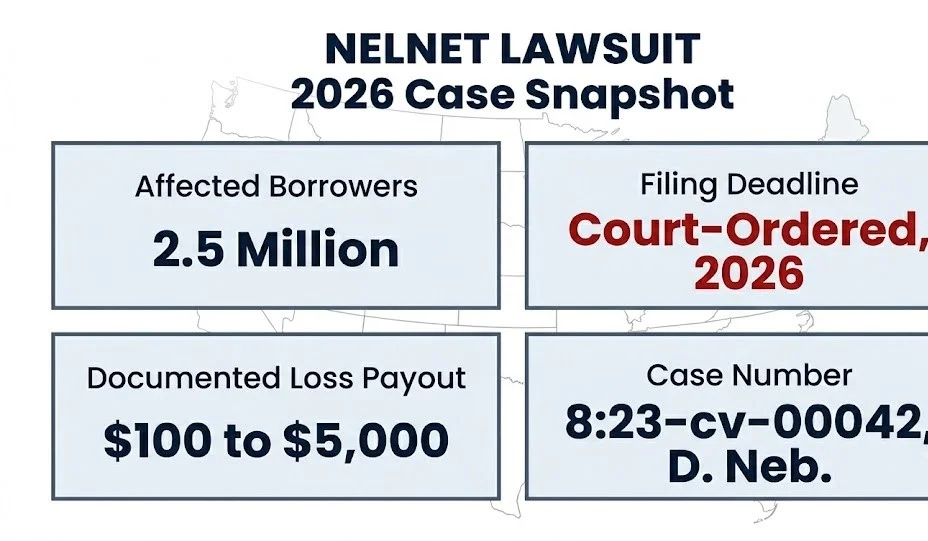
- What it’s worth: Settlement fund details are subject to court approval. Basic-tier claims for credit monitoring and identity theft protection are standard. Documented out-of-pocket loss claims can reach $5,000 or more depending on proof of actual harm.
Case Snapshot
| Detail | Info |
|---|---|
| Court | U.S. District Court, District of Nebraska |
| Case Number | 8:23-cv-00042 |
| Presiding Judge | Judge Robert F. Rossiter Jr. |
| Original Filing Date | January 2023 |
| Defendant | Nelnet Servicing, LLC |
| Breach Period | June 2022 to July 2022 |
| Affected Individuals | Approximately 2.5 million borrowers |
| Status as of 2026 | Settlement proceedings; final approval stage |
| Settlement Fund | Subject to court approval; specific dollar amount under seal pending final hearing |
The Nelnet lawsuit 2026 enters what may be its decisive phase. After more than three years of litigation in the District of Nebraska, the class action stemming from the 2022 data breach is moving through final settlement proceedings under Judge Robert F. Rossiter Jr.
Approximately 2.5 million student loan borrowers had their personal data exposed during a breach window that lasted from June through July 2022. That figure makes this one of the largest student loan servicer data breach cases in U.S. history.
The litigation is not limited to the breach itself. Separate claims against Nelnet involving payment misapplication, PSLF certification errors, and account servicing failures have generated their own legal track. Those claims affect a different subset of borrowers.
This analysis covers the full scope of Nelnet-related litigation active in 2026, including settlement structure, payout tiers, filing deadlines, eligibility standards, and the procedural details that determine whether a borrower can still recover.
Nelnet Lawsuit 2026: Where the Case Stands Now
The Nelnet lawsuit is in its final approval phase in the District of Nebraska as of 2026. Case No. 8:23-cv-00042 has progressed through class certification, discovery, and settlement negotiations. Judge Rossiter is overseeing the fairness hearing process that precedes distribution.
The timeline has moved slower than initial projections suggested. That is typical for data breach class actions of this scale. Discovery disputes over the scope of the breach, the adequacy of Nelnet’s cybersecurity measures, and the exact number of affected borrowers each contributed to the extended litigation calendar.
Key procedural milestones reached:
- Class certification granted under Rule 23(b)(3)
- Settlement agreement filed with the court
- Preliminary approval entered by Judge Rossiter
- Class notice distributed to identified class members via mail and email
- Opt-out and objection period opened
Attorney Insight: Attorneys handling these claims note that the transition from preliminary to final approval is the stage where objections from class members and competing counsel most frequently cause delays or modifications to settlement terms.
Bold Callout: Case No. 8:23-cv-00042 is the controlling docket number for all filings in the Nelnet data breach class action.
Nelnet Class Action Lawsuit 2026: Full Case Background
The Nelnet class action lawsuit 2026 originates from a cybersecurity breach that Nelnet disclosed in August 2022. Unauthorized actors accessed Nelnet’s systems between June 2022 and July 2022. During that window, personally identifiable information for roughly 2.5 million borrowers was exposed.
Nelnet Servicing, LLC operates as a federal student loan servicer under contract with the U.S. Department of Education. The company services loans for borrowers assigned to it through the federal student aid system. Its Lincoln, Nebraska headquarters established the venue for litigation in the District of Nebraska.
| Case Element | Detail |
|---|---|
| Breach Disclosure Date | August 2022 |
| Unauthorized Access Period | June 2022 to July 2022 |
| Data Exposed | Names, addresses, Social Security numbers, phone numbers |
| Loan Types Affected | Federal student loans serviced by Nelnet |
| Named Plaintiffs | Multiple; identified in amended complaint |
| Class Counsel | Firms appointed by court (listed on docket) |
| Theories of Liability | Negligence, breach of implied contract, unjust enrichment, state consumer protection violations |
The amended complaint alleged that Nelnet failed to implement adequate data security protocols despite being entrusted with sensitive borrower information by the federal government.
Attorney Insight: Attorneys handling these claims point to the government contractor relationship as a factor that increases both public interest scrutiny and the legal standard applied to Nelnet’s data protection obligations.
Nelnet Lawsuit Update: Key Developments This Year
The most significant Nelnet lawsuit update in 2026 is the progression to the final approval hearing for the settlement agreement. Class notice has been distributed. The objection period has opened.
Several developments mark this year’s activity:
- Settlement terms finalized between class counsel and Nelnet’s defense team
- Claims administrator appointed and claim portal activated
- Opt-out deadline set by court order
- Objection deadline established within the same order
- State attorney general notifications completed under CAFA requirements
The CAFA notification is a procedural requirement. Under 28 U.S.C. § 1715, defendants must notify the attorneys general of each state where class members reside at least 90 days before final settlement approval. Nelnet completed this step, clearing a procedural barrier that sometimes triggers state-level intervention.
No state attorney general has filed a formal objection to the settlement terms as of early 2026. That absence is a signal, though not a guarantee, that state-level enforcement authorities consider the terms within an acceptable range.
Attorney Insight: Attorneys handling these claims note that the absence of AG objections reduces the probability of settlement modification at the final hearing but does not eliminate the possibility of individual class member objections altering specific terms.
Bold Callout: CAFA requires notification of state attorneys general at least 90 days before final settlement approval. That window has passed without state-level objection.
Litigation Watch: The Nelnet class action has cleared its major procedural hurdles in the District of Nebraska, with class certification, preliminary settlement approval, and CAFA state notification all completed. The final approval hearing is the remaining gatekeeper before distribution begins.
Nelnet Data Breach Class Action: How the Case Was Built
The Nelnet data breach class action was built on negligence and consumer protection theories. Plaintiffs alleged that Nelnet maintained deficient cybersecurity despite handling highly sensitive federal student loan data. The breach exposed information that borrowers had no choice but to provide when their loans were assigned to Nelnet.
The “no choice” element is legally significant. Unlike a retail data breach where consumers voluntarily provided information to a business, Nelnet borrowers were assigned to the servicer by the Department of Education. That assignment removed the element of consumer choice from the data-sharing relationship.
Plaintiffs’ counsel constructed the case around four pillars:
- Negligence: Nelnet owed a duty of care to protect borrower PII and breached it through inadequate security protocols
- Breach of implied contract: The servicer-borrower relationship created an implied obligation to safeguard data
- Unjust enrichment: Nelnet profited from servicing contracts while failing to invest adequately in data protection
- State consumer protection statutes: Violations of applicable state laws governing data security and breach notification
Attorney Insight: Attorneys handling these claims emphasize that the involuntary nature of the data-sharing relationship strengthens plaintiffs’ position on duty of care, distinguishing this case from typical retail or social media breach litigation.
| Legal Theory | Key Argument |
|---|---|
| Negligence | Inadequate security for government-entrusted data |
| Implied contract | Servicing relationship created data protection obligation |
| Unjust enrichment | Nelnet profited while underinvesting in security |
| State consumer protection | Violation of breach notification and data security statutes |
Who Qualifies for the Nelnet Lawsuit
Eligibility for the Nelnet lawsuit is defined by the court-approved class definition. You qualify if your personally identifiable information was compromised during the June to July 2022 breach of Nelnet’s systems and you received a data breach notification.
The class definition, as certified by Judge Rossiter, covers:
- All U.S. residents whose PII was accessed during the breach window
- Borrowers whose loans were serviced by Nelnet at the time of the breach
- Individuals who received the August 2022 breach notification from Nelnet or its agents
Exclusions apply to Nelnet officers, directors, and employees. The presiding judge and court staff are excluded. Class counsel and their immediate family members are excluded.
The breach notification letter is the strongest indicator of class membership. If you received a letter or email from Nelnet in August or September 2022 informing you of a data security incident, you are presumptively within the class definition.
Borrowers who did not receive a notification but believe their data was compromised can contact the claims administrator. The administrator cross-references names against the breach database maintained by Nelnet.
Attorney Insight: Attorneys handling these claims note that the notification letter itself serves as de facto proof of class membership, making this a functionally no-proof settlement for most eligible claimants.
Bold Callout: Approximately 2.5 million borrowers received breach notification letters in 2022, forming the core of the settlement class.
Nelnet Data Breach: What Information Was Exposed
The Nelnet data breach exposed personally identifiable information including Social Security numbers, names, physical addresses, email addresses, and phone numbers. The breach did not, according to Nelnet’s filings, expose financial account numbers or loan payment data.
That distinction matters for claim valuation. Social Security number exposure carries the highest identity theft risk and typically justifies higher settlement tiers. The absence of financial account data exposure reduces, but does not eliminate, the risk of fraudulent transactions.
| Data Type | Exposed? | Risk Level |
|---|---|---|
| Social Security numbers | Yes | High |
| Full legal names | Yes | Moderate |
| Physical addresses | Yes | Moderate |
| Email addresses | Yes | Moderate |
| Phone numbers | Yes | Low to moderate |
| Financial account numbers | No (per Nelnet filings) | N/A |
| Loan payment history | No (per Nelnet filings) | N/A |
The breach window of June to July 2022 lasted approximately five to six weeks. Security forensics conducted after the breach identified unauthorized access but did not conclusively determine whether the accessed data was copied, sold, or distributed on dark web marketplaces.
Attorney Insight: Attorneys handling these claims point to the Social Security number exposure as the central harm driver, since SSN compromise creates lifelong identity theft risk that cannot be fully remediated by credit monitoring alone.
Bold Callout: Social Security number exposure creates lifelong identity theft vulnerability that persists well beyond any credit monitoring period offered in a settlement.
Litigation Watch: The involuntary nature of the borrower-servicer data relationship, combined with Social Security number exposure, positions this case in a stronger posture than typical retail data breach litigation where consumers voluntarily shared their information.
Nelnet Data Breach Settlement 2026: Terms and Structure
The Nelnet data breach settlement 2026 is structured as a claims-made settlement with tiered compensation categories. Borrowers file through an online claim portal or paper form. The settlement fund pays out based on the type and severity of harm each claimant demonstrates.
The settlement includes three primary benefit categories:
- Credit monitoring and identity protection services (typically 2 to 3 years, provided to all class members)
- Out-of-pocket expense reimbursement for documented costs related to the breach (capped per claimant)
- Lost time compensation for hours spent addressing breach-related issues (hourly rate applied to documented time)
The specific dollar amount of the aggregate settlement fund remains subject to final court approval. Court filings indicate the fund is structured to cover all valid claims, administrative costs, class counsel fees, and named plaintiff incentive awards.
| Settlement Component | Description |
|---|---|
| Credit monitoring | Multi-year identity protection service for all class members |
| Out-of-pocket reimbursement | Documented expenses from identity theft or fraud (capped) |
| Lost time compensation | Hourly reimbursement for time spent responding to breach |
| Class counsel fees | Subject to court approval, typically 25% to 33% of fund |
| Incentive awards | Named plaintiff awards, typically $2,500 to $7,500 each |
Attorney Insight: Attorneys handling these claims note that the tiered structure rewards claimants who documented their harm at the time it occurred, making contemporaneous record-keeping the single most important factor in claim valuation.
Nelnet Settlement Payout Amount: Tier Breakdown
The Nelnet settlement payout amount varies by claim tier. Basic-tier claimants receiving credit monitoring only do not receive a cash payment. Higher-tier claimants with documented losses can claim reimbursement up to per-claimant caps set in the settlement agreement.
Expected payout structure based on comparable data breach settlements and case filings:
| Claim Tier | What It Covers | Estimated Payout Range |
|---|---|---|
| Tier 1: Basic | Credit monitoring enrollment only | No cash payout (service value ~$300/year) |
| Tier 2: Out-of-pocket costs | Documented fraud losses, credit freeze fees, replacement ID costs | Up to $5,000 |
| Tier 3: Lost time | Hours spent on breach response (capped hourly rate) | $25/hour, capped at 5 to 10 hours |
| Tier 4: Documented identity theft | Confirmed identity theft with police report or FTC report | Higher cap, subject to court approval |
The pro-rata mechanism applies to each tier. If valid claims in a given tier exceed the allocated sub-fund, individual payments decrease proportionally. If claims fall below the sub-fund allocation, each claimant’s payment increases.
In comparable data breach settlements involving Social Security number exposure and similar class sizes, total out-of-pocket reimbursements have ranged from $100 to $5,000 per claimant depending on documentation.
Attorney Insight: Attorneys handling these claims emphasize that the difference between a $0 cash recovery and a $5,000 recovery often comes down to whether the borrower kept records of fraudulent charges, credit freeze costs, and time spent on phone calls with banks and credit bureaus.
Bold Callout: Documented out-of-pocket losses are the primary determinant of payout size. Credit monitoring alone produces no cash payment.
Nelnet Settlement: How Much Will I Get
The amount you receive from the Nelnet settlement depends on which tier you file under and how many total claims are submitted in your tier. A basic claim for credit monitoring produces no cash. A documented loss claim could produce $100 to $5,000 or more.
Think of it as a fee dispute in a courtroom: the judge allocates a fixed pool among all creditors. The more creditors file, the smaller each share. The fewer who file, the larger the per-person payment.
Variables that determine your actual check:
- Total settlement fund size (court-approved aggregate amount)
- Your claim tier (basic, out-of-pocket, lost time, documented identity theft)
- Total valid claims filed in your tier
- Whether you provided documentation of actual financial harm
- Court-approved deductions for attorney fees and administration
Most data breach class actions with 2 to 3 million class members see claims rates below 10 percent. That means fewer than 250,000 people typically file. If the claims rate in the Nelnet case follows that pattern, per-claimant distributions in higher tiers could be meaningfully above minimums.
Attorney Insight: Attorneys handling these claims consistently point to claims rate as the hidden variable that most affects individual payout. Lower participation means more money per claimant, a dynamic that plays out in every claims-made settlement.
Bold Callout: Data breach class actions with similar class sizes historically see claims rates below 10%, which inflates per-claimant payouts above initial estimates.
Litigation Watch: Settlement payout calculations in the Nelnet case are driven by claim tier selection, documentation quality, and total claims volume. Borrowers who documented fraud losses and credit costs at the time they occurred are positioned for the highest individual recoveries.
Nelnet Settlement Deadline 2026: Filing Cutoff Dates
The Nelnet settlement deadline is set by the court in the preliminary approval order. Missing it forfeits your right to a payment. There is no automatic extension.
Key deadlines in the Nelnet settlement timeline:
| Deadline | Approximate Timing |
|---|---|
| Class notice distribution | Completed (mail and email) |
| Opt-out deadline | Set in preliminary approval order; typically 60 to 90 days after notice |
| Objection deadline | Same timeframe as opt-out |
| Claim filing deadline | Typically 90 to 180 days after preliminary approval |
| Final fairness hearing | Scheduled by Judge Rossiter; 2026 |
| Distribution begins | 30 to 90 days after final approval |
The exact calendar dates are specified in the court order and on the settlement administrator’s website. Borrowers who received the class notice by mail or email should check the notice itself for the specific deadline applicable to their claim.
Courts rarely grant extensions to claim deadlines. When extensions occur, they require a noticed motion, a showing of good cause, and judicial approval. Administrative convenience is not good cause.
Attorney Insight: Attorneys handling these claims advise filing immediately upon confirming eligibility rather than waiting for the deadline. Last-day submission surges routinely crash administrator portals and create processing issues that the court may not cure retroactively.
Bold Callout: The claim filing deadline is a court order. It cannot be extended by the administrator and is not subject to grace periods.
Is the Nelnet Settlement Still Open in 2026
Whether the Nelnet settlement is still open for new claims in 2026 depends on the specific deadline set in the preliminary approval order. As of the settlement’s progression through the final approval stage, the claims window may be narrowing or closed.
Borrowers who have not yet filed should check two sources:
- The class notice they received (mail or email) for the specific claim deadline
- The settlement administrator’s claim portal for real-time status
If the claims window has closed, the only remaining options are:
- Filing a motion with the court for late claim acceptance (requires good cause)
- Pursuing an individual claim outside the class action (requires opting out, which has its own deadline)
- Monitoring for any second distribution if unclaimed funds remain after initial payments
Second distributions occur when valid claims consume less than the total fund. The remaining money is either redistributed to original claimants on a pro-rata basis or directed to cy pres recipients approved by the court.
Attorney Insight: Attorneys handling these claims note that most late-claim motions in data breach settlements are denied absent extraordinary circumstances such as military deployment, documented medical incapacity, or failure of the administrator to deliver notice.
| Scenario | Option Available |
|---|---|
| Claims window still open | File claim immediately |
| Claims window recently closed | Motion for late acceptance (difficult) |
| Opted out before deadline | Pursue individual lawsuit |
| Did not opt out, window closed | Wait for possible second distribution |
How to File a Nelnet Data Breach Claim
Filing a Nelnet data breach claim requires completing the settlement claim form through the administrator’s online portal or by submitting a paper form by mail. The process is administrative. No attorney is required for a standard claim.
Step-by-step filing process:
- Confirm your eligibility. Check whether you received the 2022 breach notification from Nelnet. If uncertain, contact the claims administrator with your name and prior address.
- Access the claim form. Use the URL provided in your class notice or locate the settlement administrator’s portal through the court docket on PACER.
- Select your claim tier. Basic credit monitoring enrollment requires minimal information. Out-of-pocket and lost time tiers require documentation uploads.
- Provide supporting documentation (if applicable). Bank statements showing fraudulent charges. Credit freeze fee receipts. FTC Identity Theft Report. Time logs for hours spent addressing breach consequences.
- Certify and submit. The claim form requires a certification under penalty of perjury that all submitted information is truthful and accurate.
| Required Information | Basic Tier | Documented Loss Tier |
|---|---|---|
| Name and address | Yes | Yes |
| Breach notification confirmation | Yes | Yes |
| Description of harm | No | Yes |
| Receipts or bank statements | No | Yes |
| Time log for lost time claim | No | Yes (if claiming lost time) |
| Perjury certification | Yes | Yes |
Attorney Insight: Attorneys handling these claims recommend that borrowers filing documented loss claims organize all receipts, statements, and correspondence chronologically before starting the claim form, since most portals do not allow partial saves.
Bold Callout: Every claim form includes a perjury certification. Submitting false information exposes the claimant to civil and criminal liability.
Litigation Watch: The claim filing process is designed for self-service, but borrowers with documented losses exceeding $1,000 should consider whether individual legal review of their claim materials could increase their recovery tier classification before submission.
Nelnet Lawsuit Denied Claim: What to Do Next
If your Nelnet claim is denied, the claims administrator must provide a reason for the denial. The most common reasons are failure to meet the class definition, missing documentation, or submission after the filing deadline.
Common denial reasons and remedies:
| Denial Reason | Possible Remedy |
|---|---|
| Not in breach database | Contact administrator with alternative records (prior addresses, maiden name) |
| Missing documentation | Resubmit with complete records if within cure period |
| Late filing | File motion with court for late acceptance (rarely granted) |
| Duplicate claim detected | Clarify with administrator; provide identification if name match issue |
| Perjury concern flagged | Respond promptly with accurate documentation |
Most settlement agreements include a cure period. If your claim is denied for incomplete documentation, the administrator may allow a window of 15 to 30 days to submit corrected or supplemental materials. That window is specified in the settlement agreement and the denial notice.
If the administrator’s denial is based on a determination that you are not within the class definition, you may request reconsideration. If reconsideration fails, the next step is filing a motion with Judge Rossiter’s court directly. That motion should be prepared by an attorney familiar with class action settlement procedure.
Attorney Insight: Attorneys handling these claims note that denied claims based on missing documentation are routinely cured during the supplemental window, while denials based on class membership are harder to reverse and often require court intervention.
Nelnet Student Loan Servicing Lawsuit: Beyond the Breach
The Nelnet student loan servicing lawsuit is a separate track of litigation from the data breach class action. Servicing claims involve allegations that Nelnet misapplied borrower payments, failed to process income-driven repayment recertifications, provided inaccurate payoff amounts, or improperly placed accounts in forbearance.
These claims are individual or smaller class actions. They do not arise from the data breach. A borrower can have both a valid data breach claim and a separate servicing claim.
Common Nelnet servicing allegations:
- Misapplied monthly payments to wrong loan accounts
- Failed to process IDR plan recertifications on time
- Incorrectly reported delinquency to credit bureaus
- Imposed unauthorized forbearance without borrower consent
- Provided inaccurate or misleading payoff balances
The Consumer Financial Protection Bureau and state attorneys general have examined student loan servicing practices across the industry. Nelnet, along with other major servicers, has faced regulatory scrutiny separate from private litigation.
Borrowers whose servicing issues caused financial harm independent of the data breach may have individual claims worth pursuing outside the class action. Those claims typically fall under state consumer protection statutes, the Fair Credit Reporting Act, and the Fair Debt Collection Practices Act.
Attorney Insight: Attorneys handling these claims distinguish sharply between data breach harm (identity exposure) and servicing harm (financial mismanagement). A borrower with both should evaluate each claim on its own merits.
Bold Callout: Servicing error claims against Nelnet are legally independent of the data breach class action and may carry separate, potentially larger, individual damages.
Nelnet PSLF Lawsuit and Borrower Claims
Nelnet PSLF claims arise from the company’s role in certifying qualifying payments under the Public Service Loan Forgiveness program. Borrowers allege that Nelnet miscounted qualifying payments, provided incorrect employment certification guidance, or failed to properly track progress toward the 120-payment threshold.
PSLF miscounting has affected thousands of borrowers nationally. The Department of Education’s 2021 Limited PSLF Waiver and 2024 PSLF Buyback program were direct responses to systemic servicer failures. Nelnet was among the servicers implicated in these failures.
PSLF-related claims against Nelnet include:
- Failing to credit qualifying payments under ICR, IBR, or PAYE plans
- Misapplying payments so they did not count toward the 120-payment requirement
- Providing incorrect information about employer eligibility
- Failing to notify borrowers when payment counts were adjusted
| PSLF Issue | Legal Basis for Claim |
|---|---|
| Payment miscounting | Breach of servicing contract, state consumer protection |
| Incorrect guidance | Negligent misrepresentation |
| Payment misapplication | Breach of contract, negligence |
| Failure to notify | State consumer protection, UDAP statutes |
These claims are distinct from the data breach. A borrower who was denied PSLF forgiveness because of Nelnet servicing errors has a separate cause of action that would not be released by participating in the data breach settlement.
Attorney Insight: Attorneys handling PSLF claims against loan servicers point to the DOE’s own corrective programs as evidence that the agency itself recognized systemic servicer failures, strengthening the factual basis for individual borrower lawsuits.
Bold Callout: Participating in the data breach settlement does not release PSLF-related claims. These are legally separate causes of action.
Litigation Watch: Borrowers who experienced both a data breach and PSLF servicing errors have two independent legal tracks available: the class action settlement for data exposure and an individual or separate class claim for servicing mismanagement. Neither claim releases the other.
Nelnet Lawsuit Nebraska Federal Court: Jurisdiction and Venue
The Nelnet lawsuit is venued in the U.S. District Court for the District of Nebraska because Nelnet, Inc. and Nelnet Servicing, LLC are headquartered in Lincoln, Nebraska. Federal jurisdiction is established under CAFA, 28 U.S.C. § 1332(d), which grants federal courts jurisdiction over class actions where the aggregate amount in controversy exceeds $5 million and minimal diversity of citizenship exists.
Case No. 8:23-cv-00042 is assigned to Judge Robert F. Rossiter Jr. Judge Rossiter has presided over the matter since its filing in January 2023. All substantive motions, settlement proceedings, and approval hearings take place in his courtroom in Omaha.
| Jurisdictional Element | Detail |
|---|---|
| Court | U.S. District Court, District of Nebraska |
| Division | Omaha |
| Case Number | 8:23-cv-00042 |
| Presiding Judge | Robert F. Rossiter Jr. |
| Jurisdictional Basis | CAFA, 28 U.S.C. § 1332(d) |
| Defendant Headquarters | Lincoln, Nebraska |
Borrowers located in any U.S. state are within the court’s jurisdiction for settlement purposes. There is no requirement that a class member reside in Nebraska. CAFA’s minimal diversity requirement is satisfied because the class includes borrowers from all 50 states.
Docket filings are publicly accessible through PACER. Borrowers or their attorneys can review the settlement agreement, class notice, preliminary approval order, and all substantive motions by searching the case number.
Attorney Insight: Attorneys handling these claims note that the District of Nebraska has handled several large data breach class actions, giving Judge Rossiter’s chambers familiarity with the procedural and substantive issues common to this type of litigation.
Bold Callout: All 50 states’ borrowers fall within the court’s CAFA jurisdiction. Nebraska residency is not required for class membership.
Frequently Asked Questions
What is the Nelnet lawsuit about and what happened?
The Nelnet lawsuit is a federal class action arising from a 2022 data breach that exposed the personal information of approximately 2.5 million student loan borrowers.
Unauthorized actors accessed Nelnet’s systems between June and July 2022, compromising Social Security numbers, names, addresses, and contact information.
The case was filed in January 2023 in the U.S. District Court for the District of Nebraska under Case No. 8:23-cv-00042.
Who qualifies for the Nelnet data breach settlement in 2026?
You qualify if your personally identifiable information was compromised in the June to July 2022 Nelnet breach.
The primary indicator of eligibility is whether you received a data breach notification letter from Nelnet in August or September 2022.
If you did not receive a letter but believe your data was exposed, you can contact the claims administrator for verification against the breach database.
How much money will I get from the Nelnet class action settlement?
The amount depends on your claim tier and the total number of valid claims filed.
Basic credit monitoring enrollment carries no cash payout, while documented out-of-pocket losses can produce reimbursement of up to $5,000 per claimant.
Lost time claims compensate at approximately $25 per hour for hours spent addressing breach consequences, subject to a cap.
What is the deadline to file a Nelnet data breach claim in 2026?
The specific deadline is stated in the preliminary approval order and the class notice distributed to class members.
Deadlines in data breach settlements typically fall 90 to 180 days after preliminary approval.
Check your class notice letter or the settlement administrator’s portal for the exact date applicable to your claim.
Can I still file a Nelnet claim if I did not receive a breach notification?
You may be eligible even without a notification letter.
Contact the claims administrator and provide your name and prior addresses so they can cross-reference you against the Nelnet breach database.
If your information is in the database, you can proceed with a claim.
Do I need a lawyer to file a claim in the Nelnet class action?
For a standard basic-tier claim, you do not need an attorney.
If you have documented losses exceeding the basic tier, plan to object to the settlement, want to opt out and pursue an individual lawsuit, or had your claim denied, consulting a class action attorney is advisable.
Class counsel represents the entire class, not individual claimants whose interests may differ from the group.
Closing
The Nelnet litigation entering 2026 operates on multiple tracks. The data breach class action is in its final approval stage. Separate servicing and PSLF claims remain independently viable for affected borrowers.
The time-sensitive action is confirming your eligibility and filing before the court-ordered claim deadline. If your losses from the breach are documented and substantial, or if you experienced PSLF or servicing errors, that is the point where consulting a class action attorney or consumer rights attorney becomes necessary.
