Quick Answer Box
- What it is: A no-proof class action is a lawsuit where eligible claimants can receive a settlement payment without submitting receipts, purchase records, or injury documentation. Courts approve these structures when individual proof collection would be administratively impractical.
- Who qualifies: Anyone within the defined class period who purchased a product, used a service, or had data exposed — depending on the specific case. Residency and timing are the primary eligibility tests.
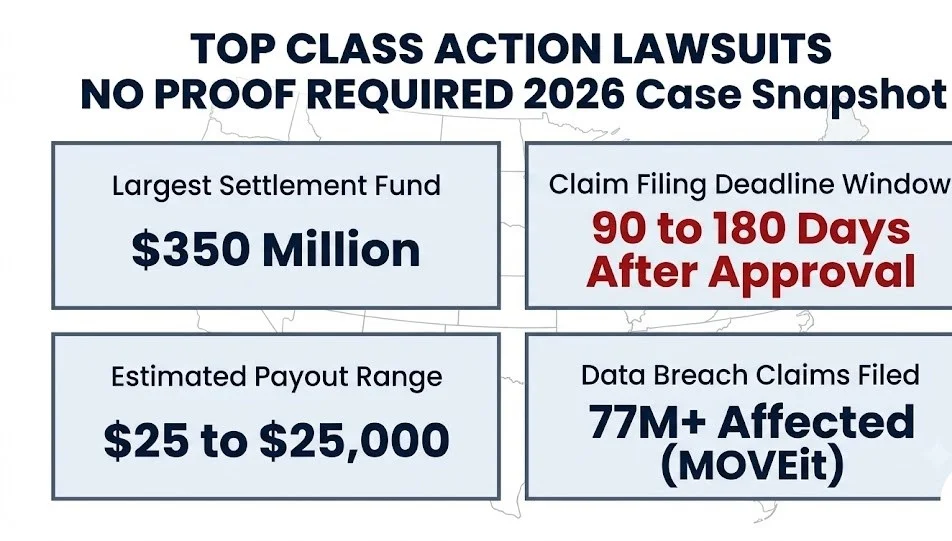
- What it’s worth: Payouts range from $25 in consumer product fraud cases to $25,000 or more in data breach litigation, depending on settlement fund size, claims volume, and whether losses can be self-certified.
Case Snapshot
| Detail | Info |
|---|---|
| Legal Framework | Federal Rule of Civil Procedure 23 |
| Governing Statute | Class Action Fairness Act, 28 U.S.C. § 1332(d) |
| Primary Court Type | U.S. District Courts; Multidistrict Litigation (MDL) panels |
| Case Status (2026) | Multiple active settlements across data breach, consumer fraud, antitrust, pharmaceutical categories |
| Settlement Fund Range | $2.5 million (small consumer cases) to $650 million (large data breach MDLs) |
| Typical Claim Deadline Window | 60 to 180 days after settlement preliminary approval |
| Administering Body | Court-appointed third-party claims administrators |
No-proof class actions represent one of the most widely misunderstood mechanisms in American civil litigation. Every year, hundreds of millions of dollars sit in settlement funds that go partially or entirely unclaimed because potential class members do not understand what “no proof required” means in legal terms — or whether they qualify.
The category spans four major litigation types in 2026: data breach settlements, consumer fraud and false advertising cases, pharmaceutical pricing actions, and antitrust class actions against corporate price-fixers. Each operates under Rule 23 of the Federal Rules of Civil Procedure. Each has a distinct payout structure.
Understanding how courts approve these settlements, who falls within the class definition, and what a realistic payout looks like is the foundation for making an informed decision about filing a claim.
This analysis covers the most significant active cases, the legal architecture behind no-proof claim structures, and the specific situations where retaining class action counsel shifts from optional to strategically necessary.
Top Class Action Lawsuit No Proof: What This Category Actually Covers
The term “top class action lawsuit no proof” refers to certified class actions where the settlement agreement does not require individual claimants to produce documentary evidence to receive payment. This is not a loophole. It is an approved legal structure used when courts determine that proof collection is impractical, prohibitively expensive, or would consume the settlement fund before any claimant received a dollar.
The legal basis sits in Rule 23(b)(3), which requires that common questions of law and fact predominate over individual ones. When they do, courts may certify classes where self-identification via a sworn affidavit or online claim form substitutes for documentary proof.
These cases fall into four primary categories in 2026:
- Data breach litigation (largest average individual payouts)
- Consumer product fraud (highest claim volumes, lowest per-person payouts)
- Antitrust price-fixing (business and individual plaintiffs)
- Pharmaceutical overcharging and false labeling (medical purchasers, insurers, patients)
Attorney Insight: Attorneys handling these claims consistently note that the “no proof” structure does not mean no scrutiny. Claims administrators verify eligibility through purchase databases, breach notification records, and cross-referencing with class definitions before distributing funds.
| Category | Typical Proof Substitute | Average Payout Range |
|---|---|---|
| Data breach | Self-certification of account ownership | $75 to $25,000 |
| Consumer fraud | Self-certification of purchase | $25 to $250 |
| Antitrust | Business purchase records optional | $100 to $5,000 |
| Pharmaceutical | Prescription record or self-certification | $50 to $500 |
How Do No-Proof Class Action Settlements Work Legally
No-proof class action settlements work through a court-supervised framework that replaces individual evidence with aggregate statistical harm analysis. The defendant agrees to fund a settlement pool. Class members submit a simplified claim. A court-appointed administrator distributes payments pro rata based on confirmed class membership.
The legal trigger is Rule 23(e), which governs the approval of class action settlements. A federal judge must find the settlement “fair, reasonable, and adequate” before any funds move.
Courts evaluate four factors when approving a no-proof structure:
- Whether the class is sufficiently ascertainable without individual records
- Whether the cost of proof collection would consume a disproportionate share of the fund
- Whether a self-certification mechanism creates adequate deterrence against fraud
- Whether the perjury exposure on a claim form provides sufficient legal accountability
The final fairness hearing is the procedural checkpoint where objectors can challenge the adequacy of the no-proof structure. If no meritorious objections survive, the court enters a final approval order and the administrator begins distributions.
Attorney Insight: Attorneys handling these claims point to the structure as an efficiency mechanism, not a generosity mechanism. Courts approve it because litigating individual damages for millions of claimants would make the class unmanageable.
Bold Callout: Courts have approved no-proof structures in settlements ranging from $2.5 million to $650 million in the past five years.
What Is a Claims-Made Settlement and Why Courts Approve It
A claims-made settlement is a structure where the defendant funds a pool and pays only the claimants who actually file valid claim forms within the deadline. Unclaimed amounts either revert to the defendant (reversionary) or go to approved charities under the cy pres doctrine (non-reversionary).
This structure is the dominant model in consumer class actions precisely because it aligns with no-proof eligibility. Class members self-identify. The administrator validates. The fund pays out only to confirmed claimants.
Courts approve claims-made settlements because they:
- Avoid the administrative impossibility of tracking down every class member individually
- Preserve judicial economy by resolving mass harm without thousands of individual trials
- Provide defendants with defined financial exposure
- Give class members a concrete opportunity to recover without hiring individual counsel
The cy pres doctrine matters here. Under cy pres, funds not claimed by class members go to organizations whose work approximates the interests at stake in the litigation. In a data privacy case, for example, residual funds might go to a digital rights nonprofit. The Ninth Circuit and Second Circuit have both published guidance on cy pres recipient selection.
Attorney Insight: Attorneys handling these claims note that reversionary structures are routinely challenged by objectors who argue they create a conflict of interest for class counsel, since a low claims rate benefits the defendant.
Quick-Facts Box:
- Claims-made settlement: Pays only those who file a claim form
- Reversionary: Unclaimed funds return to defendant
- Non-reversionary / cy pres: Unclaimed funds go to court-approved charities
- Pro-rata distribution: Each claimant’s share adjusts based on total valid claims filed
Litigation Watch: The legal architecture behind no-proof settlements, claims-made structures, and pro-rata distribution is set entirely at the court level under Rule 23 — understanding these three mechanisms explains why payout amounts vary so dramatically between settlement announcements and actual checks.
Who Qualifies for a No-Proof Class Action Lawsuit
Eligibility for a no-proof class action is defined in the court-approved class definition, not by the claimant’s subjective belief that they were harmed. The class definition appears in the settlement agreement filed with the court and in the notice mailed or emailed to potential class members.
Common eligibility criteria across major 2026 cases:
- Geographic requirement: U.S. residents, sometimes limited to specific states
- Temporal requirement: Purchased the product, used the service, or had data exposed within a specific date range (the “class period”)
- Product or account requirement: Purchased a specific product SKU, held an account with a specific institution, or received a specific notice
- Exclusion clause: Named defendants, their employees, and their family members are always excluded
Self-identification is the mechanism. The claimant swears under penalty of perjury that they meet the class definition. The administrator cross-checks against available records.
Attorney Insight: Attorneys handling these claims emphasize that “no proof required” does not mean anyone can file. The class definition is a legal boundary, and submitting a claim outside it constitutes a false statement on a legal document.
| Eligibility Factor | How It Is Verified Without Documents |
|---|---|
| Class period purchase | Self-certification; cross-check against retailer data if available |
| Account ownership | Email match against breach notification database |
| Geographic location | Zip code or state on claim form |
| Product exposure | Self-certification of use or purchase |
| Exclusion check | Name and employer cross-reference |
How to Join a Class Action Lawsuit Without Documentation
Joining a no-proof class action in 2026 typically requires four steps. The process is administrative, not adversarial. You are not filing a lawsuit. You are submitting a claim against an approved settlement fund.
Step 1: Identify the settlement. Class members typically receive direct notice via email, text, or mail. If you did not receive notice, the settlement website (run by the administrator) is searchable by name, email address, or account number.
Step 2: Confirm class period eligibility. The settlement site or court-filed notice lists exact dates. If your purchase, account, or data exposure falls within those dates, you are presumptively eligible.
Step 3: Complete the online or paper claim form. Most 2026 settlements use an online portal. You enter your name, address, and the information required to confirm class membership. You certify under penalty of perjury that the information is accurate.
Step 4: Submit before the deadline. Deadlines are court-ordered. Late claims are typically rejected, with rare exceptions for documented hardship reviewed at the court’s discretion.
Attorney Insight: Attorneys handling these claims note that selecting a higher-tier claim category in a tiered settlement (for example, “documented loss” vs. “basic claim”) without actual supporting documentation is where claimants most often create legal exposure for themselves.
Bold Callout: The claim deadline is a hard court order. Missing it forfeits your right to recovery, even if the court finds the settlement fair and adequate.
Class Action Lawsuits Without Receipts: Why the Rules Allow It
Courts allow no-receipt class actions because the Supreme Court and federal appellate courts have consistently held that the impossibility of individual proof does not defeat class certification when common questions predominate. The foundational cases are Comcast Corp. v. Behrend (2013) and Amchem Products, Inc. v. Windsor (1997), both of which shaped the standards that govern 2026 settlements.
The practical reason receipts are not required is simpler: most consumers discard receipts within days. Requiring them would eliminate millions of legitimate claimants from recovery, defeating the deterrence purpose of class action law.
Courts have identified three scenarios where receipt-free certification is appropriate:
- When the defendant’s own records confirm the class (account holders, data breach victims)
- When the product was so widely distributed that statistical probability confirms class membership
- When the cost of proof collection exceeds the value of the settlement fund itself
Rule 23(a)’s numerosity requirement also plays a role. When a class contains hundreds of thousands or millions of members, individual proof collection is structurally impossible.
Attorney Insight: Attorneys handling these claims point to the CAFA minimum of $5 million in aggregate controversy as the practical floor for federal no-proof class certification. Cases below that threshold often proceed in state court under different rules.
Quick-Facts Box:
- Rule 23(a): Numerosity, commonality, typicality, adequacy
- Rule 23(b)(3): Common questions predominate, class action is superior
- CAFA: Minimum $5 million aggregate amount in controversy for federal jurisdiction
- Receipt substitute: Sworn claim form, often supplemented by defendant’s own records
Data Breach Class Action No Proof Needed: The Biggest 2026 Cases
Data breach class actions represent the highest average individual payouts in the no-proof category. They are also the fastest-growing litigation category in 2026, driven by continued high-profile breaches at financial institutions, healthcare systems, and retail platforms.
In data breach settlements, no proof is needed because the defendant’s own breach notification records establish class membership. If a company notified you that your data was exposed, that notification is itself the proof.
Active and recently resolved data breach settlements relevant to 2026:
| Case | MDL / Court | Settlement Fund | Claim Deadline Status |
|---|---|---|---|
| In re: T-Mobile Data Security Breach Litigation | MDL 3073, W.D. Mo. | $350 million | Deadline passed; monitoring for residual distribution |
| In re: Capital One Consumer Data Security Breach Litigation | MDL 2915, E.D. Va. | $190 million | Closed; cy pres ongoing |
| In re: MOVEit Customer Data Security Breach Litigation | MDL 3083, D. Mass. | Active 2026 | Filing window expected mid-2026 |
| AT&T Data Breach Settlement | N.D. Tex. (consolidated) | Active 2026 | Filing window expected 2026 |
The MOVEit breach litigation and AT&T breach litigation are the two highest-profile active data breach class actions entering 2026 settlement discussions. Both involve tens of millions of exposed individuals. Neither requires documentary proof beyond account confirmation.
Attorney Insight: Attorneys handling these claims note that data breach cases with documented financial loss tiers consistently pay multiples of the basic claim amount. Claimants who can show fraudulent charges or credit monitoring costs receive substantially more than those filing under the basic self-certification tier.
Bold Callout: The T-Mobile $350 million settlement remains one of the largest data breach class action funds in U.S. history, with basic claims paying up to $25 and documented loss claims reaching $25,000.
Litigation Watch: Data breach settlements consistently offer tiered payouts where self-certified “no-proof” claimants receive baseline amounts while claimants with documentation of actual financial harm receive multiples of that figure — understanding the tier structure before filing determines the size of your actual recovery.
Consumer Fraud Class Action No Documentation: Key Cases in 2026
Consumer fraud class actions cover false advertising, deceptive labeling, and unfair business practices. These cases typically involve products sold at retail — food, beverages, supplements, personal care items, electronics — where the defendant made a material misrepresentation that affected the purchase decision.
No documentation is required because class membership tracks product purchase during the class period. The defendant’s sales data and the breadth of the alleged misrepresentation make individual documentation unnecessary.
Key consumer fraud categories active in 2026:
- Food and beverage labeling (natural, organic, whole grain claims)
- Supplement efficacy fraud (weight loss, joint health, immune support claims)
- Electronics and appliance performance (battery life, speed, capacity misrepresentations)
- Financial services fees (undisclosed or deceptive fee structures)
Settlement payouts in consumer fraud cases are typically low per claimant but high in aggregate. Individual recoveries of $25 to $250 are standard when no documentation is submitted. Claimants who retain receipts or purchase records and file under a documentation tier can often recover $50 to $500.
Attorney Insight: Attorneys handling these claims point to consumer fraud cases as the entry-level class action category, where the primary value is accountability and deterrence rather than individual financial recovery.
| Consumer Fraud Case Type | Avg. No-Proof Payout | Avg. Documented Payout |
|---|---|---|
| Food labeling | $25 to $75 | $75 to $150 |
| Supplement fraud | $30 to $100 | $100 to $250 |
| Electronics misrepresentation | $50 to $150 | $150 to $350 |
| Financial service fees | $75 to $250 | $250 to $500 |
Pharmaceutical Class Action No Proof Required: What’s Active in 2026
Pharmaceutical class actions without documentation requirements fall into two categories: drug pricing cases where the alleged harm is financial (overcharging), and drug safety cases where harm is defined by period of use rather than a specific diagnosed injury.
In pricing cases, patients and insurers who paid for a drug during a price-fixing conspiracy period qualify based solely on purchase timing. No prescription records are required if the defendant’s own distribution records confirm supply during the class period.
Active pharmaceutical class actions relevant to 2026:
| Case | MDL / Court | Class Period | No-Proof Basis |
|---|---|---|---|
| In re: Generic Pharmaceuticals Pricing Antitrust Litigation | MDL 2724, E.D. Pa. (Judge Rufe) | 2009 to present | Purchase during period; no receipt required |
| In re: Juul Labs Marketing Sales Practices Litigation | MDL 2913, N.D. Cal. | 2015 to 2022 | Product use self-certification |
| Zantac (Ranitidine) Settlement | Various state and federal courts | 1983 to 2020 | Use during period |
The Generic Pharmaceuticals MDL (MDL 2724) before Judge Cynthia Rufe in the Eastern District of Pennsylvania is among the most expansive antitrust class actions in U.S. history. It covers more than 1,000 generic drug SKUs and involves scores of defendant companies.
Attorney Insight: Attorneys handling pharmaceutical pricing class actions note that insurers and pharmacy benefit managers often file as institutional claimants with documented claims, while individual patients file self-certified claims — the pro-rata distribution therefore significantly favors institutional claimants in aggregate payout.
Bold Callout: MDL 2724 in the Eastern District of Pennsylvania covers drug pricing conduct going back to 2009 and remains actively generating settlements with individual generic drug manufacturers through 2026.
Antitrust Class Action Settlement No Documentation: How These Work
Antitrust class actions arise when companies agree to fix prices, allocate markets, or restrict competition in violation of the Sherman Act. The class typically includes anyone who purchased the affected product or service at artificially inflated prices during the conspiracy period.
No documentation is required in antitrust settlements because the harm is structural. The overcharge is embedded in every transaction during the conspiracy period. The defendant’s own pricing records establish when the conspiracy operated and at what price levels.
Courts calculate the class-wide overcharge using economic expert testimony. That aggregate figure forms the settlement fund. Individual claimants receive a pro-rata share based on estimated purchase volume, often self-certified.
Active antitrust class actions with no-proof claim structures in 2026:
- In re: Broiler Chicken Antitrust Litigation (N.D. Ill., Judge Thomas Durkin): Multiple settlements with chicken producers; consumer and commercial purchaser classes; self-certification available for consumer tier.
- In re: Pork Antitrust Litigation (D. Minn.): Settlements with several defendant pork processors; no receipt required for direct purchaser consumer claims.
- In re: Cattle and Beef Antitrust Litigation (D. Minn.): Active in 2026; no-proof consumer tier expected.
- In re: Generic Pharmaceuticals Pricing Antitrust Litigation (MDL 2724, E.D. Pa.): Crosses the pharmaceutical and antitrust categories; no-proof structure approved by court.
Attorney Insight: Attorneys handling antitrust class actions note that the treble damages available under the Clayton Act mean aggregate settlement funds are often significantly larger than in fraud cases, translating to higher per-claimant recoveries even at the pro-rata level.
| Antitrust Case | Court | Self-Cert Available | Est. Consumer Payout |
|---|---|---|---|
| Broiler Chicken | N.D. Ill. | Yes | $25 to $100 |
| Pork Antitrust | D. Minn. | Yes | $20 to $75 |
| Beef Antitrust | D. Minn. | Anticipated | TBD 2026 |
| Generic Drug Pricing | E.D. Pa. | Yes | $50 to $500 |
Litigation Watch: Antitrust class actions in the food sector — poultry, pork, beef — have generated hundreds of millions in aggregate settlements over the past five years, with consumer-tier no-proof claims representing the most accessible recovery channel for individual claimants.
How Much Can You Get From a No-Proof Class Action
Payout amounts in no-proof class actions are determined by three variables: the total settlement fund size, the number of valid claims filed, and whether the settlement uses a tiered structure.
The single most important factor most claimants overlook is claim volume. In a claims-made settlement, each valid claim reduces every other claimant’s share proportionally. A $50 million fund with 500,000 valid claims produces $100 per claimant. The same fund with 5 million claims produces $10 per claimant.
Payout ranges by category and claim tier in 2026:
| Case Type | Basic No-Proof Claim | Mid-Tier (Partial Documentation) | High-Tier (Full Documentation) |
|---|---|---|---|
| Data breach | $25 to $100 | $250 to $2,500 | Up to $25,000 |
| Consumer fraud | $25 to $75 | $75 to $200 | $200 to $500 |
| Antitrust (consumer) | $20 to $150 | $150 to $500 | $500 to $5,000 |
| Pharmaceutical pricing | $30 to $200 | $200 to $750 | $750 to $5,000 |
Pro-rata calculation means these figures are estimates until the claims period closes. The administrator tallies all valid claims, calculates the per-unit share, and then issues payments.
Attorney Insight: Attorneys handling these claims consistently advise clients to review the tier structure before filing. Filing a basic claim when you are eligible for a higher tier is leaving money on the table, and the decision cannot typically be reversed after the deadline.
Bold Callout: A data breach claimant with documented financial harm can receive up to 100 times more than a basic self-certified claimant in the same settlement.
Class Action Settlement Payout Without Proof: How Distributions Are Calculated
Distribution calculations in no-proof settlements follow a specific sequence controlled by the settlement agreement and supervised by the court. Understanding the sequence clarifies why published payout estimates often differ significantly from actual checks.
The distribution sequence:
- Settlement fund is funded by the defendant (lump sum or installments)
- Court approves attorney’s fees (typically 25 to 33 percent of the fund)
- Court approves class representative incentive awards (typically $2,500 to $25,000 per named plaintiff)
- Settlement administration costs are deducted (typically 3 to 8 percent of the fund)
- Residual amount is divided by total valid claims
- Each claimant receives a pro-rata share, subject to tier multipliers
The practical effect is that a publicized $50 million settlement may have a net distribution fund of $30 to $35 million after fees and costs. That figure, divided by total valid claims, determines individual payments.
Attorney Insight: Attorneys handling these claims point to the fee and cost deductions as one reason class members sometimes express surprise at the size of their actual payment. The published settlement amount is always the gross figure, not the net distribution pool.
| Deduction Category | Typical Percentage |
|---|---|
| Attorney’s fees | 25% to 33% of fund |
| Administration costs | 3% to 8% of fund |
| Incentive awards | Variable (small relative to fund) |
| Net distribution pool | 59% to 72% of headline fund |
Unclaimed Class Action Settlement Funds: What Happens to the Money
Unclaimed class action settlement funds are a significant policy issue in 2026. Claims rates in consumer class actions routinely fall below 5 percent, meaning more than 95 percent of eligible class members never file. That leaves tens of millions in unrecovered funds annually.
Three legal mechanisms govern what happens to unclaimed amounts:
1. Reversion to defendant. In reversionary settlement structures, unclaimed funds return to the company that funded the settlement. Critics argue this creates a perverse incentive to suppress claim awareness.
2. Cy pres distribution. In non-reversionary structures, the court directs unclaimed funds to a designated charity or nonprofit. The organization must have a connection to the subject matter of the litigation. The Supreme Court considered cy pres standards in Frank v. Gaos (2019) without resolving them definitively, leaving the question to circuit courts.
3. Second distribution to claimants. Some settlement agreements provide that if unclaimed funds exceed a threshold, a second pro-rata distribution goes to original claimants. This is increasingly common in large data breach settlements.
Attorney Insight: Attorneys handling these claims note that the unclaimed funds issue is one reason class action reform advocates have pushed for automatic payment models in cases where defendant records identify class members with certainty.
Bold Callout: In consumer class actions, claims rates below 5 percent mean the overwhelming majority of eligible class members forfeit their recovery by simply not filing.
Litigation Watch: The cy pres and reversion debate is shaping settlement negotiations in 2026, with courts increasingly pushing defendants to accept non-reversionary structures that direct unclaimed funds to related charitable organizations rather than back to the company that caused the harm.
Class Action No Receipt Required Settlement Deadline 2026
Settlement deadlines in no-receipt class actions are court orders. They are not suggestions or soft cutoffs subject to extension by the administrator. Missing a filing deadline forfeits your claim.
In 2026, several major settlement deadlines are either approaching or have been announced. Courts set these deadlines in the preliminary approval order, and any change requires a noticed motion and judicial approval.
How to track deadlines:
- Settlement administrator websites (searchable by case name or company)
- PACER (federal court docket system, public access, nominal per-page fee)
- State court docket systems (vary by jurisdiction)
- Class action settlement aggregator services (no affiliation with this site)
General timeline from settlement announcement to deadline:
| Stage | Typical Timeframe |
|---|---|
| Preliminary approval order | Day 0 |
| Class notice mailed / emailed | 30 to 45 days after preliminary approval |
| Opt-out and objection deadline | 60 to 90 days after notice |
| Claim filing deadline | 90 to 180 days after preliminary approval |
| Final fairness hearing | 120 to 180 days after preliminary approval |
| Distribution begins | 30 to 90 days after final approval |
Attorney Insight: Attorneys handling these claims advise claimants to file well before the deadline, as administrator websites frequently experience submission volume spikes in the final 48 hours before a deadline closes.
Bold Callout: Courts have discretion to reject late claims entirely. There is no mandatory grace period. The deadline in the preliminary approval order governs.
Best Class Action Lawsuits to Join in 2026
The “best” class action lawsuits to join in 2026 are those where the fund size is large, claim volumes are projected to be low (increasing individual shares), and no-proof eligibility is broadly defined. These three factors determine the practical value of filing.
Based on publicly filed settlement agreements and court records, the following represent high-value opportunities for claimants who qualify:
High-value active or anticipated 2026 no-proof settlements:
| Case | Why It Ranks High | Estimated Basic Payout | Status |
|---|---|---|---|
| MOVEit Data Breach MDL (MDL 3083, D. Mass.) | Large fund expected; 77M+ people affected | TBD | Active litigation, 2026 settlement anticipated |
| AT&T Data Breach Consolidated Action (N.D. Tex.) | 73M+ accounts; broad class definition | TBD | Settlement negotiations reported |
| Generic Drug Pricing MDL (MDL 2724, E.D. Pa.) | Ongoing individual drug settlements | $50 to $500 | Multiple settlements active |
| Broiler Chicken Antitrust (N.D. Ill.) | Multiple settlement tranches | $25 to $100 | Active; consumer claims period ongoing |
| Pork Antitrust (D. Minn.) | Resolved against several defendants | $20 to $75 | Claims ongoing through 2026 |
Attorney Insight: Attorneys handling these claims note that early filing — as soon as a claims window opens — does not increase your payout but does reduce administrative processing risk and eliminates the deadline pressure that causes many claimants to miss the window entirely.
Bold Callout: The MOVEit breach, which affected an estimated 77 million individuals across hundreds of downstream organizations, is projected to generate one of the largest data breach class action settlements in U.S. history upon resolution.
Class Action Lawsuit Filing Without Evidence: Legal Risks and Limits
Filing a class action claim without evidence is legally permissible within the class definition. Filing a claim outside the class definition — while certifying that you qualify — is a different matter. The distinction has legal consequences.
The claim form in every no-proof settlement includes a perjury certification. When you sign or electronically submit the form, you attest under penalty of perjury that the information is accurate and that you are a class member. That is a legally operative statement.
Where claimants most often exceed the legal limit:
- Filing for a product they never purchased
- Inflating purchase quantities beyond actual volume
- Selecting a documented-loss tier without actual documentation
- Filing multiple claims using different contact information
Courts and administrators have fraud detection mechanisms. Large settlements routinely employ statistical sampling, IP address deduplication, and cross-referencing against defendant records to identify fraudulent filings.
Attorney Insight: Attorneys handling these claims point to a 2019 Southern District of New York case where a claimant who filed 45 fraudulent claims in a consumer fraud settlement was referred to the U.S. Attorney’s office. The individual faced criminal exposure for wire fraud, not just civil liability.
| Risk Category | Legal Exposure |
|---|---|
| Filing outside class definition | Claim rejection; potential civil liability |
| Inflating quantities | Civil fraud; potential criminal referral |
| Multiple duplicate filings | Claim rejection; potential criminal fraud |
| False documentation tier selection | Civil fraud; perjury exposure |
Litigation Watch: The perjury certification on every no-proof claim form is the legal backstop that courts rely upon to approve settlement structures that do not require documentary evidence — ignoring it creates criminal exposure that far exceeds any settlement payout.
What Happens If You File a False Class Action Claim
Filing a false class action claim can result in criminal prosecution under federal wire fraud statutes, civil liability to the settlement fund, and permanent disqualification from the settlement. These are not theoretical risks.
Under 18 U.S.C. § 1343 (wire fraud), submitting a fraudulent claim electronically carries penalties of up to 20 years in federal prison. Most fraudulent claimants face civil remedies rather than criminal prosecution, but the threshold for a criminal referral is lower than many assume.
The settlement administrator’s fraud detection process typically works as follows:
- Statistical analysis flags outlier claims (unusual quantities, duplicate addresses, velocity patterns)
- Flagged claims are held and reviewed manually or algorithmically
- Claims identified as fraudulent are rejected and the claimant is notified
- In cases of systematic fraud, the administrator may refer to the court and DOJ
Practical consequences of filing a false claim:
- Claim is rejected and payment is withheld
- Claimant’s information is retained for potential referral
- In documented fraud cases: civil disgorgement demand or criminal referral
- Permanent disqualification from participating in the same settlement
Attorney Insight: Attorneys handling these claims note that the risk-reward calculation on fraudulent filing is fundamentally irrational. A basic consumer fraud claim pays $25 to $75. Federal wire fraud carries a 20-year maximum sentence. No legitimate class action attorney advises anything other than strict accuracy on claim forms.
Bold Callout: 18 U.S.C. § 1343 covers electronic fraud. Every online claim form submission falls within the scope of this statute.
Do You Need a Lawyer to Join a No-Proof Class Action
For a standard no-proof class action claim, most claimants do not need individual counsel. The process is administrative. The claim form is accessible without legal training. The settlement was already negotiated by class counsel appointed by the court.
The situations where retaining individual counsel becomes strategically important are specific and defined:
When individual counsel is advisable:
- You have documented financial harm exceeding the basic claim tier (data breach with fraud losses, pharmaceutical injury with medical records)
- You want to object to the settlement terms before final approval
- You want to opt out of the class to preserve an individual lawsuit
- You believe your losses significantly exceed what the class recovery would provide
- You received a letter from the administrator alleging you filed a fraudulent claim
For opt-outs in particular, the stakes are high. Opting out of a class action preserves your right to file an individual suit but forfeits your settlement payment. That decision requires analysis of the strength of your individual claim against the certainty of the class recovery.
Attorney Insight: Attorneys handling these claims note that the decision to opt out is typically meaningful only when a claimant has documented losses significantly above what the average settlement award produces — in most consumer fraud cases, that bar is rarely met.
| Situation | Do You Need Individual Counsel? |
|---|---|
| Filing a basic self-certified claim | No |
| Filing a documented-loss tier claim | Advisable |
| Objecting to settlement terms | Yes |
| Opting out of the class | Yes |
| Responding to a fraud allegation | Yes |
| Evaluating individual suit vs. class recovery | Yes |
Bold Callout: Class action attorneys appointed by the court represent the class as a whole. They do not represent you individually. If your interests diverge from the class, you need independent counsel.
Frequently Asked Questions
What is a no-proof class action lawsuit and how does it work?
A no-proof class action is a certified class action where claimants receive settlement payments without submitting receipts, medical records, or other documentary evidence.
Courts approve this structure under Rule 23 when common questions of law and fact predominate and proof collection would be administratively impractical or would consume the settlement fund.
Claimants self-certify eligibility on a claim form under penalty of perjury, and the administrator validates membership using available records.
Which class action lawsuits in 2026 require no documentation to file a claim?
Active 2026 no-documentation class actions include the MOVEit Data Breach MDL (MDL 3083, D. Mass.), the AT&T Data Breach consolidated action in the Northern District of Texas, the Generic Pharmaceuticals Pricing MDL (MDL 2724, E.D. Pa.), and the Broiler Chicken Antitrust Litigation (N.D. Ill.).
Each allows self-certified claims for basic recovery tiers.
Higher payout tiers in each case may require documentation of actual losses.
How much money can I receive from a no-proof class action settlement?
Payout ranges depend on the settlement fund size, total valid claims filed, and which tier a claimant qualifies for.
Basic no-proof consumer fraud claims typically pay $25 to $250; data breach basic claims pay $25 to $100; documented loss tiers in data breach cases can reach $25,000.
The final amount per claimant is not confirmed until after the claim deadline closes and the administrator completes pro-rata calculation.
What is the deadline to file a claim in a no-proof class action in 2026?
Every settlement has a court-ordered filing deadline that appears in the preliminary approval order and the class notice.
Deadlines typically fall 90 to 180 days after preliminary approval.
Missing the deadline forfeits your claim permanently, and there is no mandatory grace period.
Can I be penalized for filing a false or exaggerated class action claim?
Yes. Every claim form includes a perjury certification. Filing a false electronic claim also exposes you to federal wire fraud liability under 18 U.S.C. § 1343, which carries a maximum 20-year federal prison sentence.
Fraudulent claims are also rejected without payment, and systematic fraud can result in a criminal referral.
The risk of criminal exposure vastly exceeds any financial benefit from a fraudulent filing.
Do I need to hire an attorney to file a no-proof class action claim?
For a standard basic-tier no-proof claim, individual counsel is not required.
You do need an attorney if you plan to opt out of the class, object to settlement terms, respond to a fraud allegation from the administrator, or if your documented losses significantly exceed the class recovery.
Class counsel appointed by the court represents the class as a whole, not individual claimants whose interests may differ.
Closing
No-proof class action settlements provide one of the most direct channels for individual recovery in American civil litigation. The mechanics are standardized, the eligibility thresholds are defined in public court records, and the filing process is accessible without a law degree.
The critical actions are time-sensitive. Identify the cases where you fall within the class definition. Review the tier structure before filing. Submit your claim well before the court-ordered deadline.
If your documented losses exceed what a basic or mid-tier claim would produce, or if you are weighing an opt-out against an individual lawsuit, that is the point where speaking with a class action attorney shifts from optional to necessary. Most class action attorneys offer free consultations and work on contingency in individual opt-out matters.