Quick Answer: North Dakota DUI laws under NDCC § 39-08-01 set a 0.08% BAC limit for drivers 21+, with mandatory minimum penalties starting at $500 fine and addiction evaluation for first offense. The state’s unique 24/7 Sobriety Program requires twice-daily breath testing for repeat offenders—a program few other states mandate.
Driving under the influence in North Dakota carries consequences that extend far beyond a simple ticket. The state employs one of the nation’s most aggressive monitoring systems for DUI offenders, combining traditional penalties with mandatory sobriety testing that follows you for up to a year.
Understanding North Dakota’s DUI statutes matters whether you’re facing charges, planning your defense, or simply want to know your legal limits. This guide breaks down everything from BAC thresholds to the mechanics of the 24/7 Sobriety Program.
Check Your BAC Level
Not sure if you’re over North Dakota’s 0.08% legal limit? Our BAC calculator accounts for weight, drinks consumed, and time elapsed to estimate your blood alcohol concentration.
BAC Calculator
Estimate your Blood Alcohol Content
• Commercial Driver (CDL): 0.04% BAC
• Drivers Under 21: 0.00-0.02% BAC (Zero Tolerance)
• Enhanced Penalties: 0.15% BAC or higher in most states
Learn more about BAC calculations and testing accuracy
What is Considered DUI in North Dakota?
North Dakota Century Code § 39-08-01 defines DUI through five distinct violations. You commit DUI if you drive or maintain actual physical control of a vehicle with:
The five ways to violate North Dakota’s DUI law:
- 0.08% BAC or higher within two hours of driving
- Impairment from alcohol affecting safe driving ability
- Impairment from drugs or substances affecting safe driving ability
- Combined alcohol and drug impairment affecting safe driving ability
- Refusing chemical testing after lawful arrest
What “Actual Physical Control” Means
You don’t need to actively drive to face DUI charges in North Dakota. Sitting in a parked car with the keys in the ignition counts as “actual physical control.” Courts examine factors like key location, engine status, and driver position to determine control.
Key difference from other states: North Dakota prosecutes DUI for both driving and being in control of a vehicle. Similar to Minnesota’s approach to DUI laws, this broader definition catches more situations than states requiring actual vehicle movement.
North Dakota BAC Limits By Driver Type
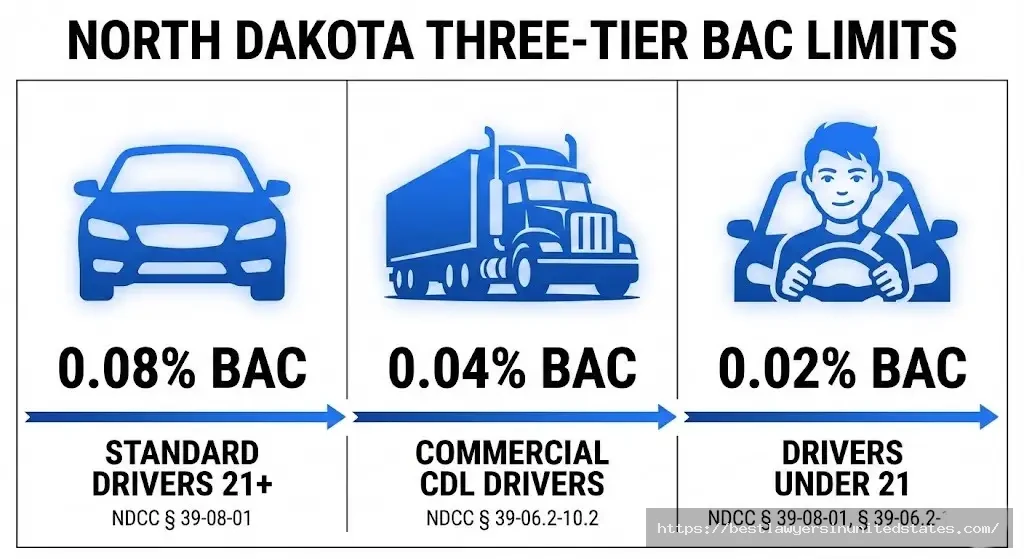
The legal limit varies based on driver age and license type. North Dakota enforces three separate BAC thresholds.
| Driver Category | BAC Limit | Statute |
|---|---|---|
| Standard drivers (21+) | 0.08% | NDCC § 39-08-01 |
| Commercial drivers (CDL) | 0.04% | NDCC § 39-06.2-10.2 |
| Drivers under 21 | 0.02% | Zero tolerance law |
Commercial Driver Penalties
CDL holders face stricter limits under a separate statute. North Dakota Century Code § 39-06.2-10.2 sets the 0.04% threshold—half the standard limit.
A CDL DUI triggers automatic disqualification from commercial driving. First offense brings one-year CDL suspension. Transporting hazardous materials when arrested extends suspension to three years.
Zero Tolerance for Minors
Drivers under 21 face North Dakota’s zero tolerance law. Any detectable alcohol—0.02% BAC or higher—violates this statute. That’s roughly one drink for most people.
Important note: The 0.02% threshold accounts for measurement variations and trace amounts from mouthwash or medications. Even these minor sources can trigger violations for underage drivers.
North Dakota DUI Penalties: First Through Fourth Offense
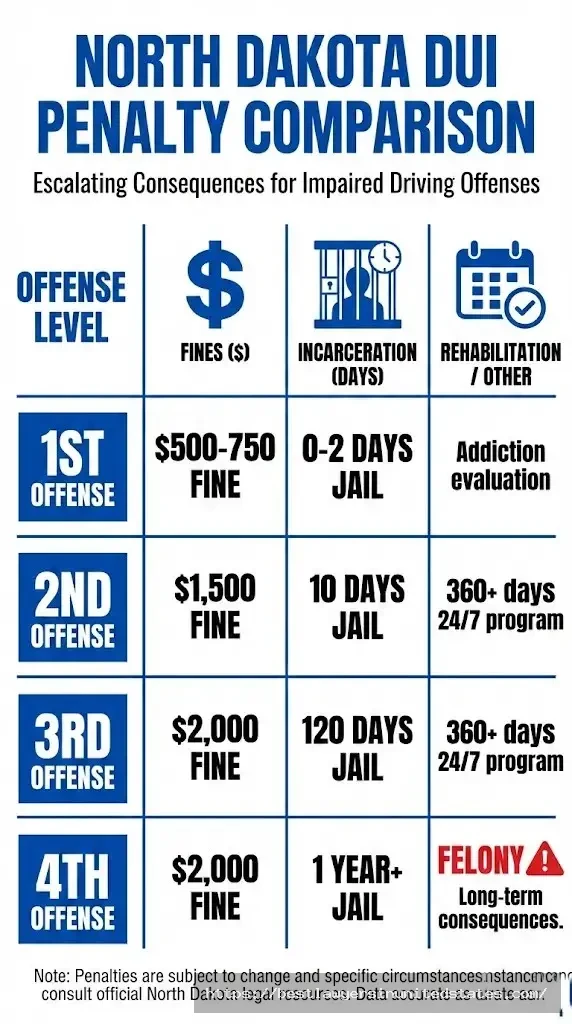
Penalties escalate sharply with each conviction. North Dakota uses a seven-year lookback period for first through third offenses, then switches to a fifteen-year window for fourth and subsequent violations.
First Offense DUI Penalties
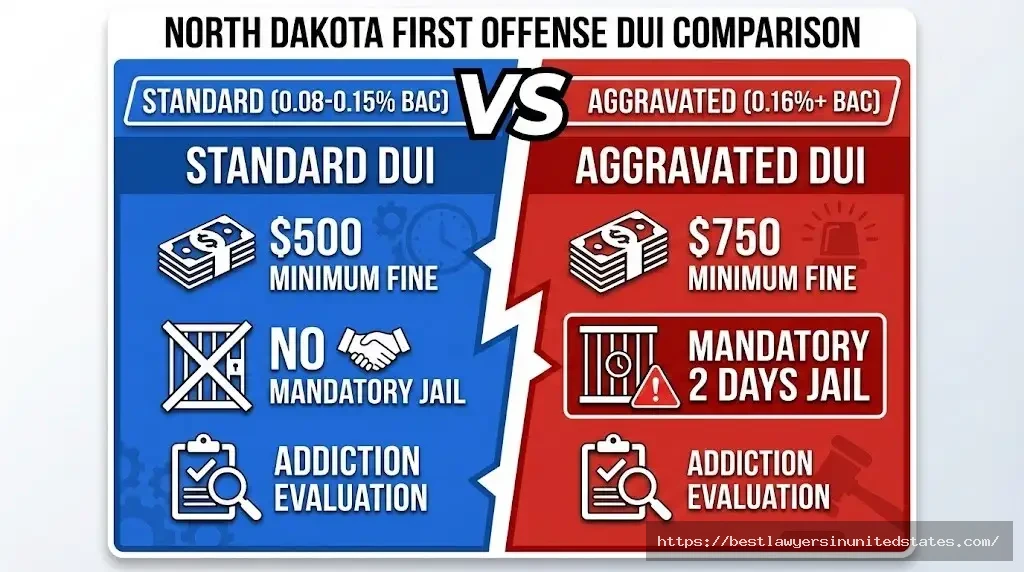
A first DUI in North Dakota is a Class B misdemeanor carrying mandatory minimum penalties.
| Penalty Type | Standard First Offense | Aggravated First Offense (0.16%+ BAC) |
|---|---|---|
| Fine | Minimum $500 | Minimum $750 |
| Jail Time | None mandatory | Minimum 2 days |
| License Suspension | Varies by circumstance | Varies by circumstance |
| Other Requirements | Addiction evaluation | Addiction evaluation + 2 days jail |
Critical distinction: North Dakota separates standard and aggravated first offenses. If your BAC reaches 0.16%—double the legal limit—you face the aggravated category with mandatory jail time even as a first-time offender.
The addiction evaluation requirement applies to all first offenses. Courts order assessment by a licensed treatment program. This evaluation determines whether you need treatment as part of sentencing.
Second Offense DUI Penalties (Within 7 Years)
Second DUI convictions remain Class B misdemeanors but carry harsher mandatory minimums.
Required penalties for second offense:
- Minimum 10 days imprisonment (48 hours must be consecutive)
- $1,500 fine
- Addiction evaluation by licensed program
- 360+ days in 24/7 Sobriety Program (mandatory probation condition)
Key change: The 24/7 Sobriety Program becomes mandatory at second offense. You cannot avoid this requirement. Courts cannot waive the associated fees. This program requires twice-daily breath testing or electronic alcohol monitoring for at least one year.
License plate confiscation also begins at second offense. Courts can order destruction of your vehicle’s plates. You must surrender them without delay at a court-specified time.
Third Offense DUI Penalties (Within 7 Years)
Third convictions within seven years elevate to Class A misdemeanors with substantial mandatory jail time.
| Penalty Component | Requirement |
|---|---|
| Jail Time | Minimum 120 days |
| Fine | Minimum $2,000 |
| Probation | Minimum 360 days supervised |
| 24/7 Program | Minimum 360 days mandatory |
| Evaluation | Addiction assessment required |
Important: Third offense jail sentences can be partially suspended if you complete treatment court. Only 10 days of the 120-day minimum must be served if you successfully finish an approved treatment program.
Fourth and Subsequent Offenses (Within 15 Years)
Fourth DUI violations become Class C felonies—the most serious DUI classification in North Dakota. The lookback period expands to fifteen years for these offenses.
Fourth offense mandatory penalties:
- Minimum 1 year and 1 day imprisonment
- Minimum $2,000 fine
- Minimum 2 years supervised probation
- 24/7 Sobriety Program participation (entire probation period)
- Addiction evaluation
The “1 year and 1 day” minimum ensures state prison time rather than county jail. North Dakota structures this sentence to require Department of Corrections custody for serious repeat offenders.
Understanding North Dakota’s Lookback Periods
North Dakota uses two different timeframes for counting prior DUI convictions. This dual system confuses many defendants.
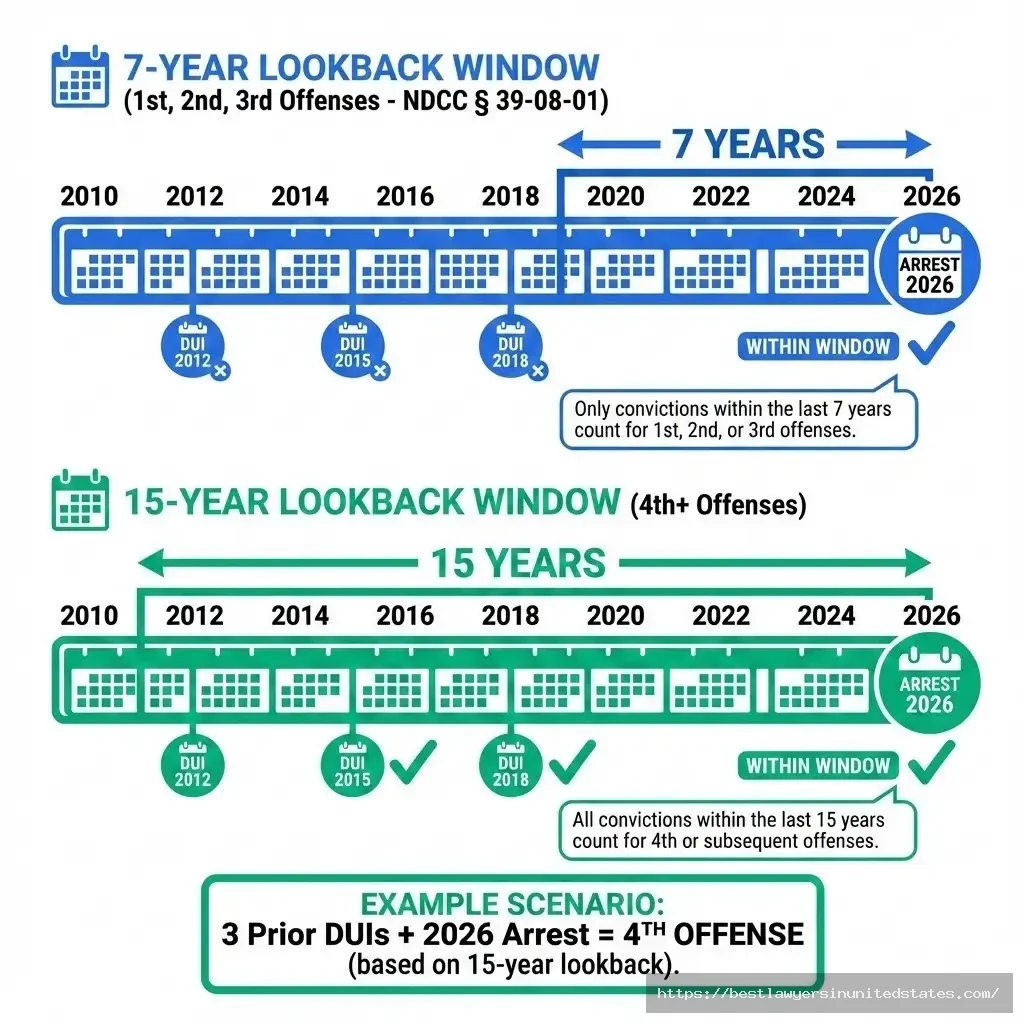
The two lookback periods:
| Offense Level | Lookback Period | Legal Reference |
|---|---|---|
| 1st, 2nd, 3rd offense | 7 years | NDCC § 39-08-01(3) |
| 4th and subsequent | 15 years | NDCC § 39-08-01(3) |
How the Seven-Year Window Works
First, second, and third offenses count only convictions from the past seven years. If your prior DUI occurred more than seven years ago, it doesn’t enhance penalties for a new first, second, or third offense.
Example: You got a DUI in 2016. A new arrest in 2026 (10 years later) counts as a first offense for penalty purposes. The 2016 conviction falls outside the seven-year window.
When the Fifteen-Year Window Applies
Fourth and subsequent offenses look back fifteen years. This extended window means very old convictions can still elevate new charges to felony level.
Example: DUI convictions in 2012, 2015, and 2018. A new arrest in 2026 counts as a fourth offense because all three priors fall within the fifteen-year lookback period.
The fifteen-year calculation starts from your most recent conviction date, not arrest date. Similar lookback structures exist in neighboring states like Montana, though Montana uses a ten-year window rather than North Dakota’s seven/fifteen split.
North Dakota’s 24/7 Sobriety Program Explained
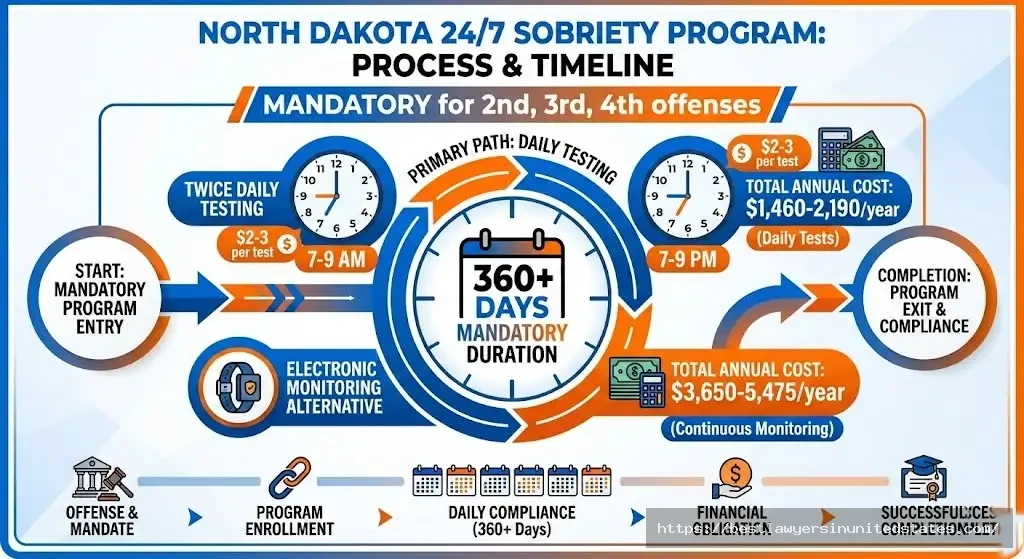
Chapter 54-12 of North Dakota Century Code establishes the 24/7 Sobriety Program—one of the state’s most distinctive DUI enforcement tools. This mandatory program requires twice-daily breath testing or continuous electronic monitoring.
Who Must Participate
The program becomes mandatory for:
- All second DUI offenses (360+ days required)
- All third DUI offenses (360+ days required)
- All fourth and subsequent offenses (duration of probation)
- First offenses with minor passengers (360+ days)
Courts cannot waive this requirement. Even if you complete treatment successfully, the 24/7 program remains mandatory for the full period.
How Twice-Daily Testing Works
Participants report to a testing location twice per day—typically morning and evening. Testing stations operate seven days per week, including holidays.
Standard testing schedule:
- Morning test: 7:00 AM – 9:00 AM
- Evening test: 7:00 PM – 9:00 PM
You must blow into a breathalyzer at each session. Any detected alcohol triggers immediate consequences. The program uses PBT (portable breath test) devices that provide instant results.
Electronic Monitoring Alternative
Some participants qualify for electronic alcohol monitoring instead of twice-daily testing. This option uses ankle bracelets that detect alcohol through skin perspiration.
Monitoring alternatives include:
- Continuous transdermal alcohol monitoring (SCRAM)
- Random urine testing
- Drug patch testing
Courts determine which monitoring method applies based on your circumstances and location. Remote areas without nearby testing stations often receive electronic monitoring approval.
Program Costs and Fees
Participants pay all 24/7 Sobriety Program fees. Courts cannot waive these costs under NDCC § 39-08-01(7).
Typical program costs:
- Daily testing fee: $2-3 per test
- Electronic monitoring: $10-15 per day
- Initial setup fees: $50-100
- Monthly total: $120-270 depending on method
Critical point: One year of twice-daily testing costs approximately $1,460-2,190. Electronic monitoring runs $3,650-5,475 annually. These costs come on top of fines, attorney fees, and other DUI expenses.
Non-Resident Participants
North Dakota residents who move out of state must still complete the 24/7 program. Section 39-08-01(7) requires non-residents to enroll in equivalent programs in their home states.
If your state lacks a 24/7 program, you must find an “alcohol compliance program” that provides similar monitoring. You must file proof of enrollment with North Dakota authorities.
Consequences of non-compliance: Missing tests or failing to enroll triggers probation violations. Judges can revoke probation and order you to serve your suspended jail sentence.
Calculate Your Total DUI Costs in North Dakota
North Dakota DUI convictions carry substantial financial consequences beyond court fines. Our cost calculator estimates your complete financial impact based on offense level and circumstances.
DUI Cost Calculator
Estimate total DUI expenses by state and offense
Detailed Cost Breakdown
Payment Timeline
Bail bond, towing fees, car impound, attorney retainer
Initial court fines, DMV fees, DUI school enrollment, ignition interlock installation
Monthly probation fees, ignition interlock fees, DUI school payments, attorney balance
Insurance premium increases, license reinstatement, SR-22 filing fees
- Lost wages from missed work (court dates, jail time, DUI school) – $2,000-$10,000
- Job loss or difficulty finding employment – Varies
- Professional license suspension (doctors, lawyers, nurses, pilots) – Career ending
- Rideshare and transportation costs during suspension – $1,500-$5,000
- Travel restrictions and visa denials – Varies
- Security clearance loss – Career impact
- Child custody implications – Legal costs
- Rental car restrictions – Varies
- Personal relationships and mental health costs – Priceless
Get your personalized cost estimate for North Dakota DUI charges
Complete Cost Breakdown By Offense
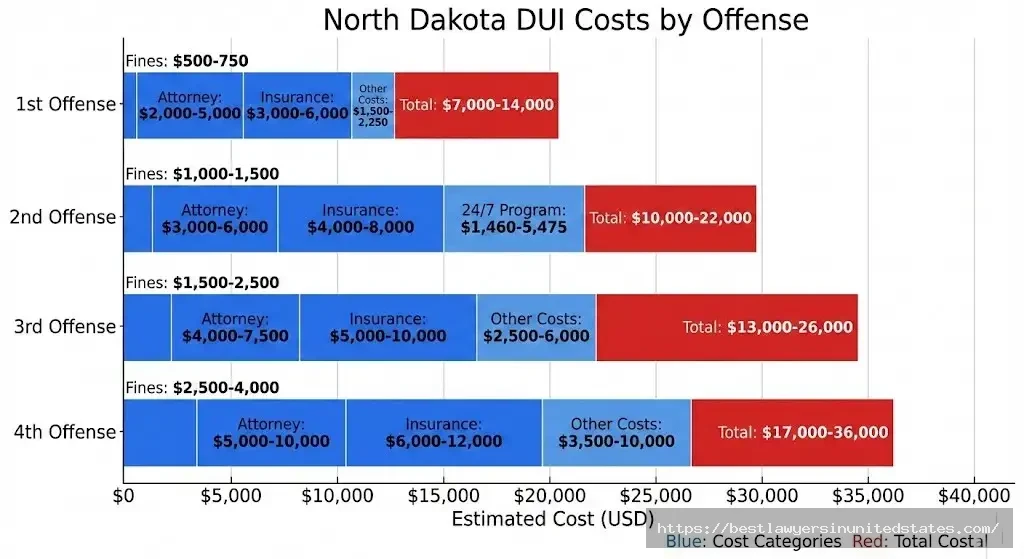
The true cost of a North Dakota DUI extends far beyond the initial fine. Factor in all mandatory and likely expenses.
| Cost Category | First Offense | Second Offense | Third Offense | Fourth Offense |
|---|---|---|---|---|
| Court Fines | $500-750 | $1,500 | $2,000 | $2,000 |
| Court Costs | $100-200 | $100-200 | $100-200 | $100-200 |
| Attorney Fees | $2,000-5,000 | $3,000-7,500 | $5,000-10,000 | $7,500-15,000 |
| 24/7 Program | $0 | $1,460-5,475 | $1,460-5,475 | $2,920-10,950 |
| Evaluation | $150-300 | $150-300 | $150-300 | $150-300 |
| DUI Education | $300-500 | $300-500 | $300-500 | $300-500 |
| License Reinstatement | $50 | $50 | $50 | $50 |
| Ignition Interlock | $900-1,200 | $900-1,200 | $900-1,200 | $900-1,200 |
| Insurance Increase (3 years) | $3,000-6,000 | $3,000-6,000 | $3,000-6,000 | $3,000-6,000 |
| Estimated Total | $7,000-14,000 | $10,000-22,000 | $13,000-26,000 | $17,000-36,000 |
Important: These estimates assume standard circumstances. Aggravated charges, accidents, or injuries increase costs significantly. Costs similar to those in South Dakota DUI cases, though South Dakota’s specific fee structures differ.
License Plate Confiscation: What Happens to Your Plates
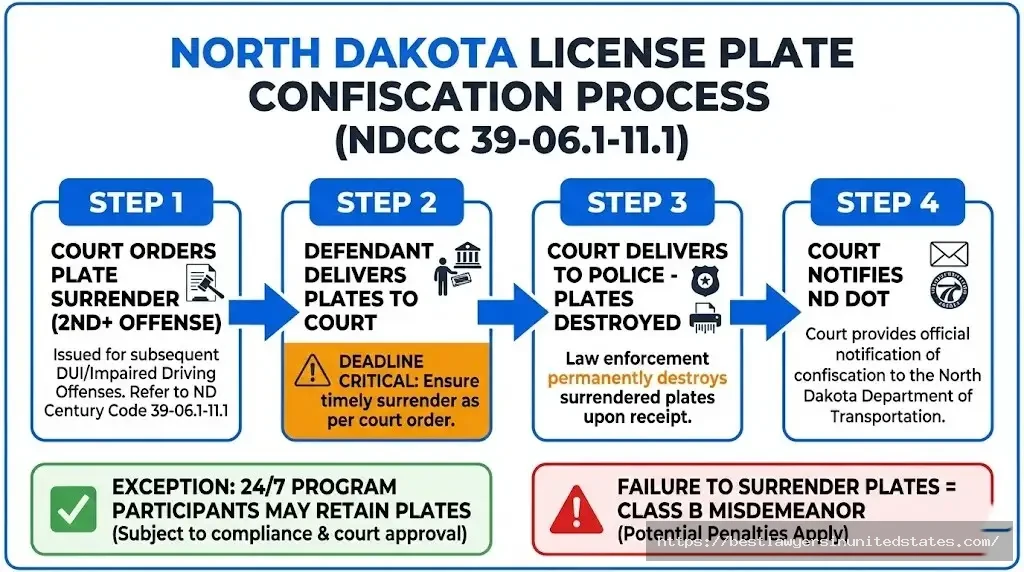
North Dakota Century Code § 39-08-01(4) authorizes courts to order license plate destruction for second and subsequent DUI convictions within seven years. This penalty surprises many defendants who don’t expect to lose their plates.
When Plates Get Confiscated
Courts may—but don’t always—order plate confiscation for:
- Second DUI within seven years
- Third DUI within seven years
- Fourth and subsequent DUI offenses
Judges have discretion to skip this penalty. However, many North Dakota courts routinely order confiscation for repeat offenders.
The Confiscation Process
After conviction, the court orders you to surrender plates within a specific deadline. You must deliver them to the court at the ordered time.
What happens to confiscated plates:
- You surrender plates to the court
- Court delivers plates to the arresting officer’s department
- Law enforcement destroys the plates
- Court notifies North Dakota DOT of the order
Critical deadline: Failure to surrender plates at the court-specified time is a Class B misdemeanor. Judges can revoke probation for non-compliance.
Hardship Exceptions
Courts can grant exceptions to avoid “undue hardship.” The statute allows exceptions when:
- Family members depend completely on the vehicle for life necessities
- A co-owner needs the vehicle and wasn’t involved in the DUI
- The offender participates in the 24/7 Sobriety Program
Important note: 24/7 program participants often receive automatic exceptions. Courts recognize that twice-daily testing requires reliable transportation to testing sites.
North Dakota Implied Consent Law
North Dakota Century Code § 39-20-01 establishes the state’s implied consent statute. This law deems that you consent to chemical testing the moment you drive on North Dakota roads.
What Implied Consent Means
Accepting a North Dakota driver’s license creates automatic consent to BAC testing during DUI investigations. Officers don’t need additional permission to request breath, blood, or urine samples after lawful DUI arrest.
The law requires officers to read you a warning before requesting tests. This warning explains:
- Your obligation to submit to testing
- Consequences of refusal
- Your right to additional independent testing
Refusing Chemical Tests
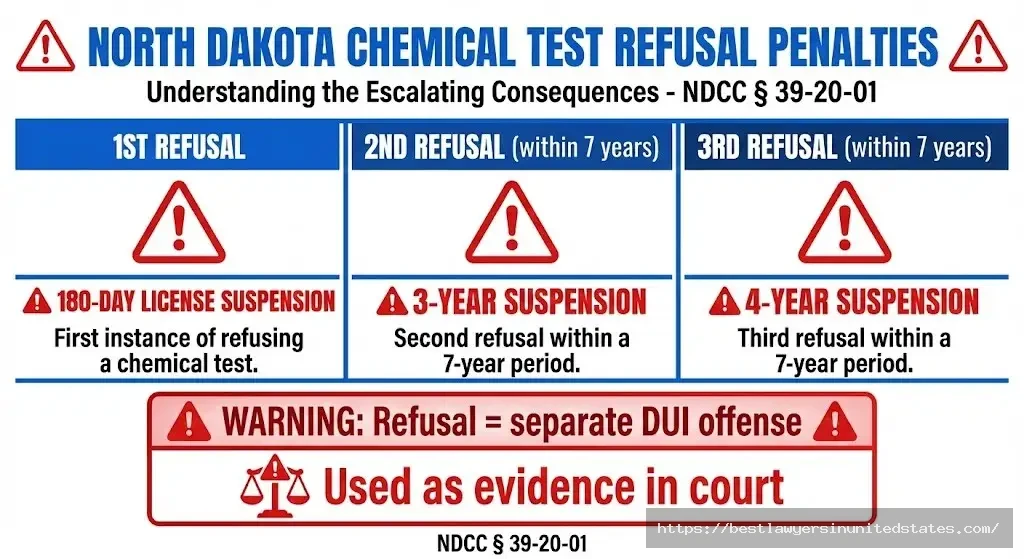
You can refuse testing despite implied consent. However, refusal triggers immediate administrative penalties separate from criminal DUI charges.
| Refusal Number | License Suspension |
|---|---|
| First refusal | 180 days |
| Second refusal (within 7 years) | 3 years |
| Third refusal (within 7 years) | 4 years |
Critical point: Refusal counts as a separate DUI offense under NDCC § 39-08-01(1)(a)(5). You face both refusal penalties AND DUI prosecution even without BAC evidence.
Test Refusal in Court
Prosecutors use refusal as evidence of “consciousness of guilt.” Juries hear that you refused testing. Defense attorneys argue innocent explanations, but refusal generally hurts your case.
Refusal doesn’t prevent conviction: North Dakota allows DUI convictions based on officer observations, field sobriety tests, and driving patterns alone. Refusing testing doesn’t eliminate prosecution—it just removes one piece of evidence.
Criminal Vehicular Homicide and Injury Charges
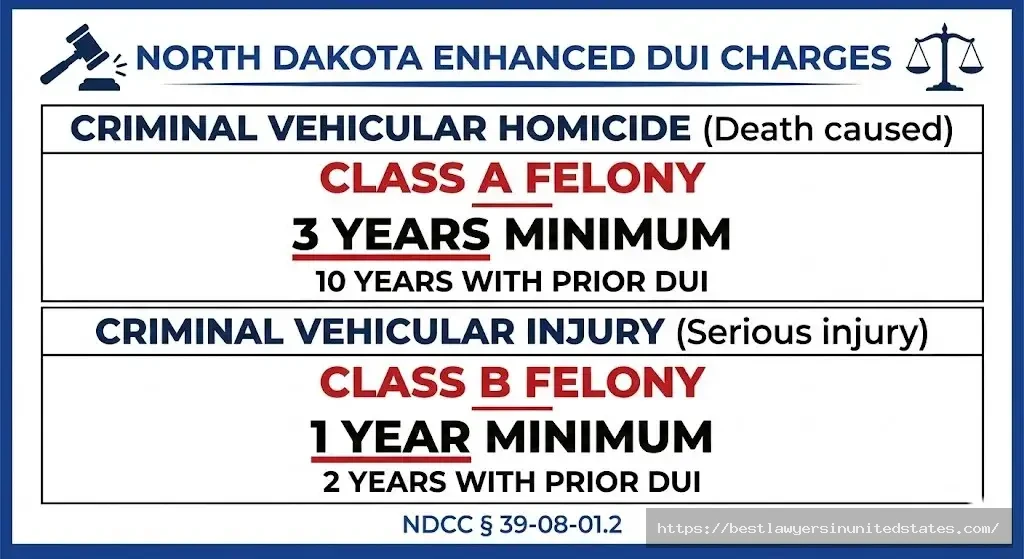
North Dakota Century Code § 39-08-01.2 creates enhanced felony charges when DUI causes death or serious injury. These provisions carry much longer prison sentences than standard DUI.
Criminal Vehicular Homicide
Causing death while committing DUI elevates charges to Class A felony criminal vehicular homicide. This includes deaths of unborn children (except when caused by the mother).
Criminal vehicular homicide penalties:
- Classification: Class A felony
- Mandatory minimum: 3 years imprisonment
- Enhanced minimum (prior DUI): 10 years imprisonment
The ten-year mandatory minimum applies if you have any prior DUI conviction—even a first offense from years ago. North Dakota imposes this enhanced sentence regardless of how much time passed since the prior conviction.
Criminal Vehicular Injury
Causing “substantial bodily injury” or “serious bodily injury” while committing DUI creates Class B felony charges.
Criminal vehicular injury penalties:
- Classification: Class B felony
- Mandatory minimum: 1 year and 1 day imprisonment
- Enhanced minimum (prior DUI): 2 years imprisonment
Important: These charges apply in addition to standard DUI. However, North Dakota prohibits prosecuting someone for both criminal vehicular homicide and the general homicide statute (Chapter 12.1-16) for the same incident.
Sentences under this statute cannot be suspended unless the court finds “manifest injustice.” This high standard means judges rarely reduce these mandatory minimums. The charges carry consequences similar in severity to neighboring Montana’s aggravated DUI statutes, though Montana structures its enhancements differently.
DUI With a Minor Passenger
North Dakota Century Code § 39-08-01.4 creates enhanced penalties when adults drive under the influence with children in the vehicle. This statute targets drivers 21+ who endanger minors.
Automatic Enhancement to Class A Misdemeanor
Standard first DUI = Class B misdemeanor. DUI with minor passenger = Class A misdemeanor automatically.
First offense with minor passenger penalties:
- Classification: Class A misdemeanor
- Fine: Minimum $750
- Jail: Minimum 2 days
- Probation: Minimum 360 days unsupervised
- 24/7 Program: Minimum 360 days mandatory
- Evaluation: Substance abuse assessment
Key difference: Even first-time offenders face the 24/7 Sobriety Program when a minor was in the vehicle. This jumps the typical progression that starts mandatory testing at second offense.
Second or Subsequent Offense With Minor
If you have any prior DUI conviction and commit DUI with a minor passenger, charges elevate to Class C felony.
Enhanced penalties (prior + minor):
- Classification: Class C felony
- Jail: Minimum 1 year and 1 day
- Fine: Minimum $2,000
- Probation: Minimum 2 years supervised
- 24/7 Program: Minimum 360 days
- Evaluation: Substance abuse assessment
This felony classification applies even if your prior conviction occurred many years ago. The statute contains no time limit for the enhancement—any prior DUI conviction in your lifetime triggers felony charges when combined with a minor passenger.
Treatment Court: Turn Your Felony Into a Misdemeanor
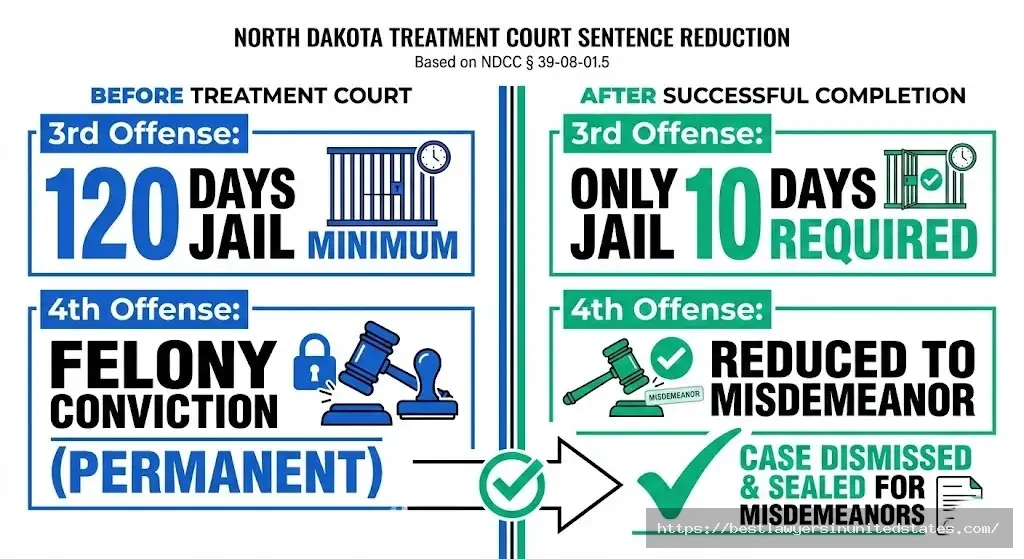
North Dakota offers treatment court programs that can dramatically reduce DUI consequences. Section 39-08-01.5 allows substantial sentence reductions and even conviction downgrades for successful completion.
What Treatment Court Involves
Treatment court combines intensive supervision, frequent court appearances, random testing, and mandatory treatment sessions. Programs typically last 12-24 months.
Treatment court requirements:
- Weekly or bi-weekly court check-ins
- Random drug and alcohol testing
- Individual and group therapy sessions
- Case manager meetings
- Community service hours
- 24/7 Sobriety Program participation
The process demands significant time and effort. However, successful completion brings benefits unavailable through regular sentencing.
Sentence Reduction for Third Offense
Standard third offense carries 120 days minimum jail. Treatment court reduces this to just 10 days if you complete the program successfully.
Sentence modification:
- Standard minimum: 120 days
- Treatment court minimum: 10 days
- Reduction: 110 days suspended
The court can also suspend your electronic monitoring and sobriety testing requirements for the final six months of the program if you demonstrate “substantial compliance.”
Felony Reduced to Misdemeanor
Successfully completing treatment court after a fourth or subsequent DUI (felony) downgrades your conviction to a misdemeanor under NDCC § 39-08-01.5(2).
Critical benefit: Felony convictions create lifetime consequences for employment, housing, and civil rights. Downgrading to misdemeanor removes these collateral penalties.
Case Dismissal for Misdemeanor Treatment Court
Misdemeanor DUI defendants who complete treatment court receive case dismissals and sealed records under NDCC § 12.1-32-07.2.
Post-completion benefits:
- Court dismisses the DUI case
- Court seals the criminal file
- DOT removes conviction from driving record (if federal law permits)
Important limitation: DOT removal isn’t guaranteed. Federal regulations at 49 CFR § 383.51 may prohibit removing CDL-related violations even after treatment court completion.
How to Get Your DUI Record Sealed in North Dakota
North Dakota Century Code §§ 39-08-01.6, 12.1-32-07.1, and 12.1-32-07.2 allow DUI record sealing under specific circumstances. Sealing removes public access to your criminal record.
Seven-Year Clean Record Requirement
Courts seal DUI records if you:
- Pled guilty/no contest OR were found guilty of DUI
- Have NOT been convicted of any subsequent DUI within 7 years
- Have NOT been convicted of ANY other crime within 7 years
Critical point: The seven-year period starts from your DUI conviction date. Any criminal conviction during those seven years—even minor offenses—resets the clock.
Automatic Sealing Process
Unlike some states requiring formal petitions, North Dakota courts seal qualifying records automatically. You don’t file a motion—the court processes sealing once you meet the seven-year requirement.
What gets sealed:
- Criminal court records
- Conviction documents
- Case files and proceedings
- Public access to the case
CDL Exception
Section 39-08-01.6(2) excludes CDL holders from automatic sealing. Commercial drivers cannot seal DUI records even after seven clean years.
This exception protects public safety by maintaining commercial driver violation histories. Federal motor carrier regulations require lifetime tracking of CDL violations.
Prosecutor Access Exception
Sealed records remain accessible to prosecutors for enhancement purposes. If you face new DUI charges, prosecutors can access sealed prior convictions to determine penalty levels.
A sealed 2016 DUI still counts as a prior conviction if you’re arrested in 2026. Sealing hides the record from public view but doesn’t eliminate it for criminal justice purposes.
Similar sealing provisions exist in nearby states, though Minnesota’s DUI record expungement process requires formal petitions rather than North Dakota’s automatic approach.
House Arrest Alternative: Electronic Monitoring in North Dakota
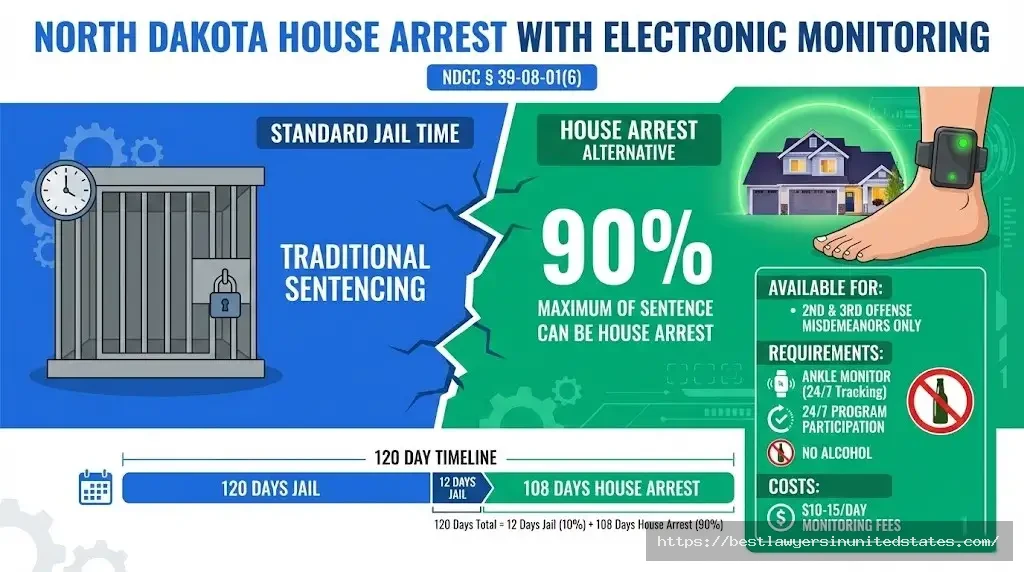
North Dakota Century Code § 39-08-01(6) allows house arrest with electronic monitoring as a partial jail alternative for second and third DUI offenses. This option lets you serve sentence at home while maintaining employment.
Who Qualifies for House Arrest
House arrest is available for:
- Second DUI offenses (Class B misdemeanor)
- Third DUI offenses (Class A misdemeanor)
Fourth offense felonies don’t qualify. The statute limits house arrest to misdemeanor DUI convictions only.
The 90% Limit
No more than 90% of your sentence can be served as house arrest. You must serve at least 10% in actual custody.
Example calculations:
| Offense | Minimum Sentence | Actual Jail Required | Maximum House Arrest |
|---|---|---|---|
| 2nd DUI | 10 days | 1 day | 9 days |
| 3rd DUI | 120 days | 12 days | 108 days |
Critical requirement: You must complete actual jail time first. Courts don’t allow house arrest until you serve the mandatory minimum custody portion.
House Arrest Requirements
Electronic monitoring comes with strict conditions beyond just staying home.
Mandatory house arrest conditions:
- Electronic home detention device (ankle monitor)
- Absolute prohibition on alcohol consumption
- Participation in 24/7 Sobriety Program
- Payment of all monitoring costs
You pay electronic monitoring fees—typically $10-15 daily. A 108-day house arrest alternative for third offense costs $1,080-1,620 in monitoring fees alone.
Alcohol Prohibition During House Arrest
Section 39-08-01(6) explicitly bans alcohol consumption during house arrest. Any drinking violates your sentence conditions.
Random testing through the 24/7 program ensures compliance. Failed tests or detected alcohol triggers immediate revocation. You then serve the remaining sentence in jail without house arrest credit.
What Happens After a DUI Arrest in North Dakota
The DUI process begins the moment law enforcement stops your vehicle. Understanding each step helps you protect your rights and meet critical deadlines.
Initial Traffic Stop
Officers need reasonable suspicion to stop your vehicle. Common DUI stop reasons include:
- Weaving between lanes
- Speeding or erratic speed changes
- Driving without headlights
- Traffic violations (running stop signs, illegal turns)
- DUI checkpoint encounters
North Dakota Highway Patrol and local police departments conduct regular DUI enforcement. Major cities like Fargo, Bismarck, Grand Forks, and Minot see frequent DUI patrols, especially on weekends and holidays.
Field Sobriety Tests
Officers typically request field sobriety tests (FSTs) during DUI investigations. North Dakota law enforcement uses standardized tests developed by the National Highway Traffic Safety Administration (NHTSA).
Common field sobriety tests:
- Horizontal Gaze Nystagmus (HGN) – following a pen or light with your eyes
- Walk-and-Turn – walking heel-to-toe along a straight line
- One-Leg Stand – balancing on one foot while counting
Important: You can refuse field sobriety tests in North Dakota without automatic penalties. Only chemical test refusal triggers the implied consent consequences. However, officers may arrest you based on other observations if you refuse FSTs.
Chemical Testing
After arrest, officers transport you to a testing location—typically the police station or detention center. They request breath, blood, or urine testing under the implied consent law.
Breath testing using devices like the Intoxilyzer 8000 is most common. Blood testing occurs when breath testing isn’t available or in cases involving suspected drug impairment.
Booking and Arraignment
Following arrest and testing, you go through booking at the county jail. This process includes:
- Fingerprinting and photographing
- Recording personal information
- Inventory of possessions
- Placement in holding cell
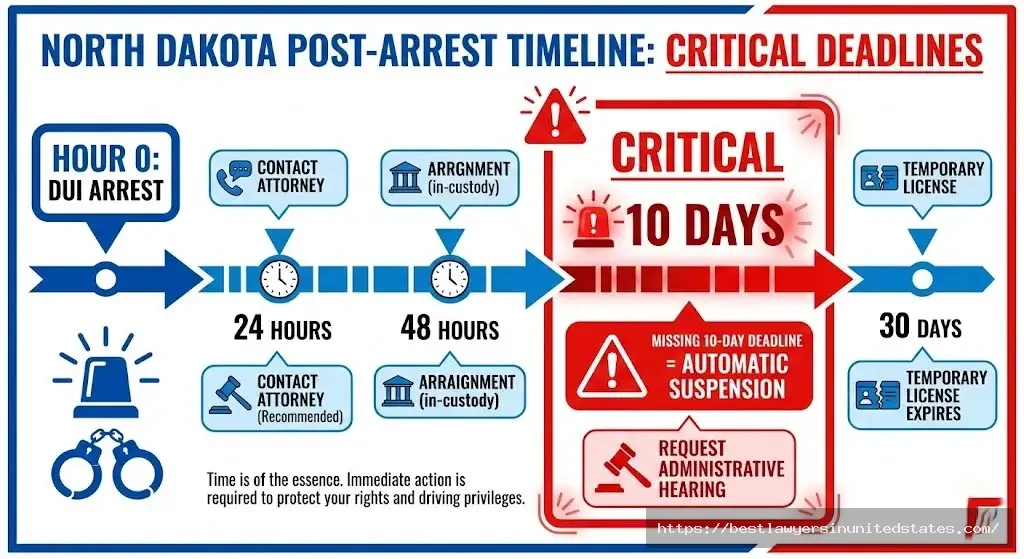
Most DUI defendants post bail within 24 hours. Arraignment—your first court appearance—occurs within 48 hours of arrest for in-custody defendants.
Critical First Deadlines
Actions to take immediately after arrest:
| Action | Deadline | Consequence of Missing |
|---|---|---|
| Request administrative hearing | 10 days | License suspension proceeds automatically |
| Contact DUI attorney | Within 24-48 hours | Evidence preservation, rights protection |
| Obtain incident report | ASAP | Case preparation, strategy development |
The 10-day administrative hearing deadline is absolute. Missing this window means automatic license suspension without opportunity to challenge it.
Finding a DUI Lawyer in North Dakota
DUI cases in North Dakota require attorneys familiar with state-specific statutes, the 24/7 Sobriety Program, and local court procedures. Generic DUI knowledge isn’t enough—you need North Dakota expertise.
What to Look for in a North Dakota DUI Attorney
Essential qualifications:
- Licensed to practice in North Dakota courts
- Specific DUI/criminal defense experience
- Familiarity with local prosecutors and judges
- Understanding of 24/7 Sobriety Program mechanics
- Track record in your county’s courts
Major North Dakota court locations:
- Cass County District Court (Fargo)
- Burleigh County District Court (Bismarck)
- Grand Forks County District Court (Grand Forks)
- Ward County District Court (Minot)
Attorneys who regularly practice in your county’s courts understand local tendencies and relationships that impact case outcomes.
Initial Consultation Questions
Ask potential attorneys:
- How many North Dakota DUI cases have you handled?
- What’s your success rate with administrative hearings?
- Do you have experience with treatment court applications?
- What are your fees for DUI representation?
- Will you handle both criminal and administrative proceedings?
Most North Dakota DUI attorneys offer free initial consultations. Use this meeting to evaluate whether the attorney understands your specific situation.
Attorney Fee Structures
North Dakota DUI attorneys typically charge flat fees rather than hourly rates. Fee amounts depend on charge severity and case complexity.
Typical attorney fee ranges:
- First offense (no complications): $2,000-3,500
- Second offense: $3,000-5,000
- Third offense (misdemeanor): $4,000-7,500
- Fourth offense (felony): $7,500-15,000+
Additional costs like expert witnesses, investigation, and trial preparation may increase total fees.
Find experienced DUI lawyers in North Dakota – Free consultation
Frequently Asked Questions About North Dakota DUI Laws
How long does a DUI stay on your record in North Dakota?
Quick Answer: DUI convictions remain on your North Dakota driving record permanently unless sealed under NDCC § 39-08-01.6 after seven years with no subsequent criminal convictions.
The seven-year sealing process applies only to criminal records, not DOT driving records. Your driving abstract may show DUI convictions indefinitely unless federal regulations prohibit retention.
Can you get a DUI expunged in North Dakota?
Quick Answer: North Dakota uses “sealing” rather than expungement. Records seal automatically after seven years if you have no subsequent criminal convictions during that period.
Treatment court completion provides the only path to earlier dismissal and sealing. Misdemeanor defendants who finish treatment court receive case dismissals under NDCC § 12.1-32-07.2.
Is a DUI a felony in North Dakota?
Quick Answer: Fourth and subsequent DUI offenses within fifteen years are Class C felonies in North Dakota. First, second, and third offenses are misdemeanors.
DUI causing death becomes Class A felony criminal vehicular homicide. DUI causing serious injury becomes Class B felony criminal vehicular injury.
What is the penalty for first DUI in North Dakota?
Quick Answer: First DUI penalties include minimum $500 fine ($750 for aggravated), mandatory addiction evaluation, and possible jail time. Aggravated first offense (0.16%+ BAC) requires minimum 2 days jail.
License suspension periods vary. Courts also may order ignition interlock devices and DUI education programs depending on circumstances.
How much does a DUI cost in North Dakota?
Quick Answer: Total first DUI costs range from $7,000-14,000 including fines, attorney fees, insurance increases, and program costs. Second offense costs reach $10,000-22,000. Third offense costs range $13,000-26,000.
Fourth offense felonies cost $17,000-36,000 or more when including mandatory 24/7 Sobriety Program participation, legal fees, and long-term insurance impacts.
Can you refuse a breathalyzer in North Dakota?
Quick Answer: Yes, but refusal triggers automatic 180-day license suspension for first refusal, 3-year suspension for second refusal within seven years. Refusal also counts as a separate DUI offense under NDCC § 39-08-01.
Prosecutors use refusal as evidence of guilt at trial. You face both refusal penalties and DUI prosecution even without BAC evidence.
What is North Dakota’s 24/7 Sobriety Program?
Quick Answer: The 24/7 Sobriety Program under Chapter 54-12 requires twice-daily breath testing or electronic alcohol monitoring for minimum 360 days. It’s mandatory for all second, third, and fourth DUI offenses in North Dakota.
Participants pay $2-3 per test or $10-15 daily for electronic monitoring. Courts cannot waive these fees. The program costs approximately $1,460-5,475 annually depending on monitoring method.
Does North Dakota have DUI checkpoints?
Quick Answer: Yes. North Dakota law enforcement conducts sobriety checkpoints on highways and major roads, particularly during holidays and special events. Checkpoints must meet constitutional requirements for random stops.
Common checkpoint locations include I-94, I-29, Highway 2, and downtown areas in Fargo, Bismarck, Grand Forks, and Minot. Checkpoint schedules aren’t published in advance.
Can you get a restricted license after DUI in North Dakota?
Quick Answer: Yes. North Dakota allows temporary restricted licenses during suspension periods. Restrictions typically limit driving to work, school, medical appointments, and DUI program participation.
Application processes and eligibility vary by offense level. Second and subsequent offenses may require ignition interlock devices for restricted license approval.
What happens if you get a DUI with a CDL in North Dakota?
Quick Answer: CDL holders face 0.04% BAC limit under NDCC § 39-06.2-10.2. First CDL DUI brings one-year commercial driving disqualification, three years if transporting hazardous materials. Second CDL DUI means lifetime commercial driving ban.
CDL suspensions apply even if you were driving a personal vehicle when arrested. North Dakota reports all CDL violations to the Commercial Driver’s License Information System (CDLIS).