
Two separate groups may qualify, and they are not interchangeable. Developers and consumers sit in different classes with different lawyers.
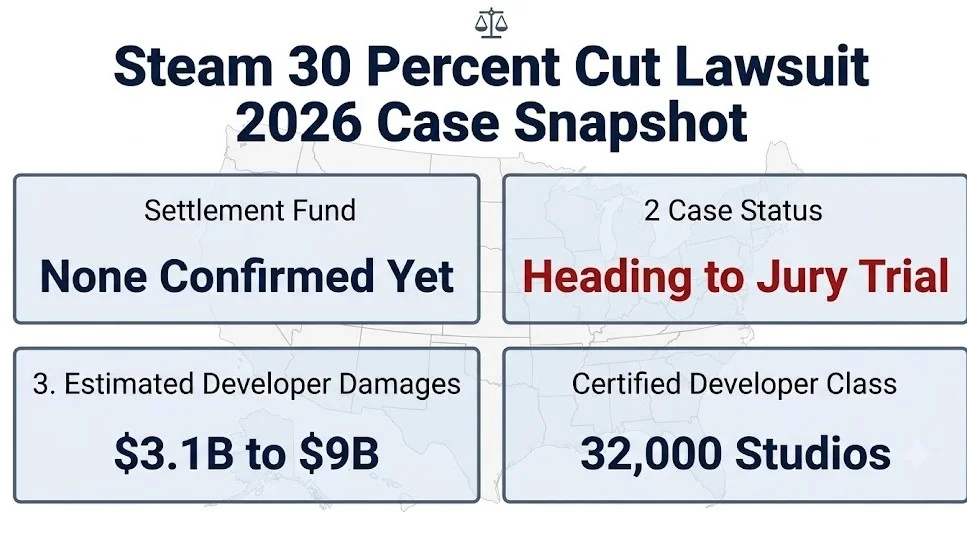
The certified developer class covers roughly 32,000 publishers and studios who paid Steam commissions since 2017. That class already exists and has court-appointed counsel.
The consumer track is separate. Cohen Milstein represents consumers who purchased PC video games from third-party publishers through Steam, alleging Valve abused its dominant market position to force higher prices. On May 2, 2025, Judge Whitehead appointed Cohen Milstein as sole Interim Lead Class Counsel for that consumer class.
Who is likely covered:
- Game studios and publishers that sold titles on Steam and paid its commission since 2017
- PC gamers who bought titles from third-party publishers through Steam during the class period
- Not yet covered: anyone waiting on a formal claims process, since none has opened
Attorney Insight: Attorneys note that developer eligibility is already defined by the certification order, while consumer eligibility could still shift before trial.
Steam 30 Percent Cut Lawsuit Timeline
The case timeline stretches back to 2021 and runs through active pretrial motions today. It has survived two major legal challenges already.
Judge Coughenour dismissed the initial complaint in November 2021, finding Wolfire hadn’t adequately alleged the relevant market or antitrust injury. Wolfire refiled an amended complaint in 2022 that was significantly more detailed, and the court let the case move forward.
In July 2022, Wolfire’s suit was combined with a similar antitrust lawsuit filed by Dark Catt, broadening the action. By December 2024, four related cases, including consumer suits Elliott, Hepler, and Drake, were consolidated for all purposes under the Valve caption.
| Date | Event |
|---|---|
| April 27, 2021 | Wolfire Games files original complaint |
| November 2021 | Original complaint dismissed, leave to amend granted |
| December 2021 | Amended complaint filed with jury demand |
| July 2022 | Wolfire and Dark Catt actions consolidated |
| May 2, 2025 | Cohen Milstein appointed lead consumer counsel |
| March 2026 | Summary judgment denied; case cleared for trial |
Attorney Insight: Attorneys watching this docket describe the 2021 dismissal as a normal opening skirmish, not a sign the case lacked merit.
Litigation Watch: The case began as a small developer complaint in 2021 and has grown into a consolidated multi-track antitrust fight now heading toward a jury.
How Much Is the Steam 30 Percent Cut Lawsuit Worth
There is no confirmed payout figure yet, because no settlement or verdict exists. Estimates come from plaintiffs’ experts, not the court.
Plaintiffs’ economists estimate the developer overcharge at more than $3.1 billion, which could triple to roughly $9 billion under antitrust treble damages rules. Widely shared figures near $6 billion are unconfirmed by any court filing.
The consumer class does not yet have a public damages figure in the U.S. case. The parallel UK claim does: a Competition Appeal Tribunal claim seeks £656 million, or about $897.9 million, for roughly 14 million UK consumers.
Bottom-line stat: No U.S. settlement fund exists as of mid-2026. Any dollar figure attached to a personal payout right now is speculative.
Attorney Insight: Attorneys caution clients against trusting flat dollar estimates circulating online, since none has been entered by the court.
Developer Class vs Consumer Class in the Valve Antitrust Case
These are two distinct legal tracks inside one consolidated docket. Confusing them leads to wrong expectations about eligibility and payout.
The developer class, led by Wolfire Games and Dark Catt Studios, seeks damages tied to commissions paid directly to Valve. The consumer class argues gamers paid inflated prices because of the price parity rule, and a federal jury will eventually decide whether either theory holds up.
The primary objective for the consumer class is reportedly a permanent court injunction against the parity rules, not merely a damages check, since an injunction is what would actually change how Steam operates.
| Track | Lead Plaintiffs | Goal |
|---|---|---|
| Developer/Publisher | Wolfire Games, Dark Catt Studios | Damages tied to commissions |
| Consumer | Multiple named plaintiffs, Cohen Milstein counsel | Injunction against price parity rule |
Attorney Insight: Attorneys representing developers and attorneys representing consumers are pursuing different remedies, which is why they operate under separate lead counsel.
Valve’s Defense Against the 30 Percent Commission Claims
Valve denies any wrongdoing and defends its commission as fair value for services rendered. The company has not conceded liability at any stage.
Valve argues its commission reflects the value of services it provides, including hosting, bandwidth, community features, and marketing tools. Valve denies wrongdoing, and no court has ruled that the company broke the law.
The company’s legal team includes Quinn Emanuel Urquhart & Sullivan, a firm with a long antitrust defense track record against large platform cases.
Valve’s core defense points:
- The 30 percent rate is standard industry pricing, not monopoly pricing
- Steam’s services justify the commission structure
- Plaintiffs have not proven a properly defined relevant market
Attorney Insight: Attorneys defending platform companies typically argue that a commission rate alone does not prove monopoly power, and Valve has leaned on that argument since 2021.
Law Firms and Attorneys Handling the Steam Lawsuit
Several major antitrust firms are actively litigating this case on both sides. Court filings name specific counsel for each plaintiff track.
Cohen Milstein leads the consumer class, Hagens Berman, a firm with a long antitrust track record against tech platforms, prosecutes alongside it, and attorney David Rosen is among the names attached to the developer litigation. David Rosen, co-founder of Wolfire Games, accused Valve of using Steam’s market power to suppress competition.
Valve’s defense includes Alicia Cobb and Steig Olson of Quinn Emanuel Urquhart & Sullivan, with Constantine Cannon LLP and Vorys Sater Seymour and Pease also appearing on the docket.
Named counsel by side:
- Plaintiffs: Cohen Milstein Sellers & Toll, Hagens Berman
- Defense: Quinn Emanuel Urquhart & Sullivan
Attorney Insight: Attorneys outside the case note that having Hagens Berman and Cohen Milstein both involved signals the plaintiffs’ side is treating this as a top-tier antitrust fight, not a niche gaming dispute.
Litigation Watch: Both sides have brought in firms with real platform antitrust experience, which is one reason this case has moved past dismissal twice already.
Steam 30 Percent Cut Lawsuit Settlement Status
There is no settlement in this case as of mid-2026. Both sides remain in active litigation with a trial track now open.
No settlement has been reached in the Steam lawsuit as of 2026, and neither side has publicly indicated willingness to settle at this time. Settlement remains on the table, and Google’s March 2026 settlement with Epic shows even platform holders will eventually negotiate rather than face open-ended remedy proceedings.
Valve, by contrast, hasn’t lost anything yet, so its incentive to settle depends heavily on how jury instructions get written and how damaging pretrial discovery turns out to be.
What this means for claimants:
- No claim form exists right now
- No payout deadline exists right now
- Deadlines will only be announced once a settlement or verdict lands
Attorney Insight: Attorneys tracking similar platform antitrust cases say settlements often surface weeks before trial, not months.
Steam 30 Percent Cut Lawsuit UK Claim
A separate but related consumer claim is proceeding in the United Kingdom. It targets the same commission and pricing conduct under UK competition law.
The claim, known publicly as Steam You Owe Us, is formally Vicki Shotbolt Class Representative Limited v Valve Corporation, Case 1640/7/7/24, before the Competition Appeal Tribunal. The Tribunal granted a collective proceedings order on an opt-out basis, with judgment published January 26, 2026, and the order formally made March 11, 2026.
The claim seeks £656 million, about $897.9 million, on behalf of roughly 14 million UK consumers over Steam’s 30 percent commission and its platform parity obligations.
| Detail | UK Claim |
|---|---|
| Tribunal | Competition Appeal Tribunal |
| Case Number | 1640/7/7/24 |
| Class Size | Approximately 14 million UK consumers |
| Amount Sought | £656 million ($897.9 million) |
Attorney Insight: Attorneys following both cases stress the UK claim runs on its own track and will not distribute money to U.S. class members.
Steam Arbitration Dispute Tied to the 30 Percent Cut Lawsuit
A side dispute over arbitration fees has become part of this litigation’s story. It involves consumers who were initially routed away from court entirely.
Valve has been accused of blocking consumers from arbitrating antitrust claims by refusing to pay $20 million in arbitration fees, a move plaintiffs’ counsel called bad faith. Consumers were only recently able to pursue their suit in court after Valve amended the arbitration clause in its user agreement.
Why this matters:
- Valve’s original user agreement pushed consumer disputes into individual arbitration
- Mass arbitration filings created a fee standoff between Valve and claimant firms
- The clause change is part of why the consumer class action exists at all
Attorney Insight: Attorneys handling mass arbitration disputes describe fee standoffs like this as a known pressure tactic used by large platform companies.
Litigation Watch: The arbitration fee fight is not a footnote. It is the reason the consumer class action reached federal court instead of staying buried in private arbitration.
What Happens Next in the Valve Antitrust Trial
The next major step is a jury trial, though no date has been set publicly. Both plaintiff tracks are now cleared to proceed.
In late March 2026, the court denied Valve’s motion for summary judgment, clearing the path for a jury trial over the 30 percent commission and price-parity rules. With summary judgment denied, both the developer and consumer tracks are cleared for trial, but no firm trial date had been publicly set as of mid-2026.
Legal observers tracking the docket expect scheduling to land within the 2026 to 2027 window, consistent with how long similar multi-year antitrust cases have taken to reach a jury in this court.
What comes before a verdict:
- Continued discovery and expert reports
- Pretrial motions on damages theory
- Possible late settlement talks before jury selection
Attorney Insight: Attorneys compare this stage to a company deciding whether to keep fighting a lawsuit or cut a deal before its own internal documents reach a jury.
Steam 30 Percent Cut Lawsuit by State
This is not a state-by-state case. It is a single consolidated federal action, not a formal multidistrict litigation panel case.
The developer class and the consumer class both proceed under one docket in the Western District of Washington. There is no separate case in any other state court, and no state-specific claim form exists.
What state residency actually affects:
- Which state bar an antitrust or consumer protection attorney is licensed in
- Whether a local firm can appear pro hac vice in the Seattle federal court
- Nothing about your eligibility as a developer or consumer, which depends on the class definition, not your state
Attorney Insight: Attorneys note that plenty of firms outside Washington represent clients in this case, since federal antitrust litigation regularly draws counsel from across the country.
How to File a Claim in the Steam Lawsuit
There is currently no claim form to file. No settlement or final judgment has triggered a claims process yet.
Developers who fall inside the certified 2017-forward class do not need to file anything today; the class already exists. Consumers should watch for official notice once the consumer track resolves.
What to do right now:
- Save Steam purchase or sales records if you believe you qualify
- Avoid third-party sites asking for money to “register” your claim early
- Watch official court notices tied to case number 2:21-cv-00563
Attorney Insight: Attorneys warn that any site charging an upfront fee to “file” a claim before a settlement exists is not connected to this litigation.
Litigation Watch: No claims process exists yet, and anyone asking for payment to file one on your behalf should be treated with suspicion.
What This Lawsuit Means for PC Game Prices
The lawsuit’s core theory is that Steam’s pricing rule kept PC game prices artificially high everywhere, not just on Steam. That claim is central to the consumer track.
Plaintiffs argue the price parity clause discouraged rival stores from underpricing Steam, since publishers were barred from selling cheaper elsewhere. That, they argue, removed the usual downward pressure competition creates.
Think of it like a shipping contract that bars a vendor from ever quoting a lower rate to a competing carrier. The rate stays high everywhere, because no carrier can undercut it.
If plaintiffs win an injunction:
- Publishers could legally offer lower prices on rival storefronts
- Steam’s price parity requirement could be struck down entirely
- Competing stores could compete more directly on price
Attorney Insight: Attorneys point to the requested injunction, not damages, as the change most likely to actually affect future game prices.
When to Talk to an Antitrust Attorney About the Steam Lawsuit
Developers and studios with significant Steam revenue since 2017 have the strongest reason to consult counsel now. Consumers generally do not need individual representation yet.
If your studio paid substantial commissions to Valve during the class period, an antitrust attorney can review your standing inside the certified class and flag any opt-out considerations before deadlines close.
Good reasons to consult an attorney now:
- Your studio has significant, documented Steam sales history since 2017
- You are weighing whether to opt out of the developer class
- You are a publisher considering separate individual claims against Valve
Reasons to wait:
- You are an individual consumer with no unusual damages
- You are only trying to track case news, not assert a claim
Attorney Insight: Attorneys generally advise developers with large, well-documented Steam revenue to get a case review sooner rather than later, since opt-out windows can close quickly once notice goes out.
Steam 30 Percent Cut Lawsuit Case Number and Court
The case is formally In re Valve Antitrust Litigation, Case No. 2:21-cv-00563, in the U.S. District Court for the Western District of Washington. It is assigned to Judge Jamal N. Whitehead.
The consolidated docket lists Wolfire Games, Dark Catt Studios, and numerous individual consumer plaintiffs, with interested parties including Electronic Arts, Nintendo, Microsoft, Humble Bundle, Epic Games, and Best Buy. Sony Interactive Entertainment also appears as an interested party on the case docket.
Quick reference:
- Court: U.S. District Court, Western District of Washington, Seattle
- Case number: 2:21-cv-00563
- Judge: Jamal N. Whitehead
- Filed: April 27, 2021
Attorney Insight: Attorneys advise anyone researching this case to search the exact case number rather than “Valve lawsuit,” since several unrelated Valve cases exist in the same court.
Frequently Asked Questions
What is the Steam 30 percent cut lawsuit?
It is a federal antitrust case, In re Valve Antitrust Litigation, alleging Valve monopolized PC game distribution through its commission and pricing rules.
The case is pending in the U.S. District Court for the Western District of Washington under case number 2:21-cv-00563.
Who qualifies for the Steam 30 percent cut lawsuit?
Developers and publishers who paid Steam commissions since 2017 fall inside the certified class of roughly 32,000 studios.
A separate consumer class covers PC gamers who bought titles through third-party publishers on Steam, with eligibility still being defined.
How much money could I get from the Steam 30 percent cut lawsuit?
No confirmed payout exists yet, since there is no settlement or verdict.
Plaintiffs’ experts have estimated developer damages above $3.1 billion, a figure that could rise under treble damages rules if a jury finds liability.
Is there a settlement in the Steam 30 percent cut lawsuit yet?
No, there is no settlement as of mid-2026.
The case survived summary judgment in March 2026 and is now proceeding toward a jury trial instead.
What court is hearing the Steam 30 percent cut lawsuit?
The U.S. District Court for the Western District of Washington in Seattle is hearing the case.
It is assigned to Judge Jamal N. Whitehead under case number 2:21-cv-00563.
When will the Steam 30 percent cut lawsuit go to trial?
No public trial date has been set as of mid-2026.
Legal observers following the docket expect scheduling to land sometime in the 2026 to 2027 window.
Closing
The Steam 30 percent cut lawsuit has cleared summary judgment and is now bound for a jury. No settlement exists, and no claim form exists.
Developers with significant Steam revenue since 2017 should have counsel review their standing now. Everyone else should watch the docket, not third-party payout calculators.
