
California gives renters some of the strongest legal protections in the United States. Under state law, you have rights around security deposits, evictions, rent increases, and habitability that many other states don’t offer. Whether you’re dealing with a security deposit dispute, facing eviction, or just want to understand your lease, this guide covers everything California tenants need to know in 2026.
California’s landlord-tenant laws are primarily codified in the California Civil Code §§ 1940-1954.1. The state also enacted AB 1482 (the California Tenant Protection Act of 2019), which caps rent increases and requires just cause for most evictions. These protections apply statewide, though cities like San Francisco, Los Angeles, and Oakland have even stricter local ordinances.
This guide includes three free interactive calculators to help you understand your specific rights. Whether you need to calculate your security deposit return deadline, estimate your eviction timeline, or determine required notice periods, these tools provide instant answers based on California law. Understanding tenant rights in California helps you protect yourself from illegal evictions, unlawful deposit retention, and landlord harassment.
What Are Your Rights as a Renter in California?
Overview of California Tenant Rights
California tenant rights come from both state statutes and local city ordinances. The California Civil Code establishes minimum protections for all renters. Cities with rent control can add stronger protections on top of state law.
Key state-level protections include:
- Security deposit limits and return timelines
- Just cause eviction requirements (AB 1482)
- Habitability standards and repair rights
- Anti-retaliation protections
- Privacy and entry rules
- Rent increase limitations
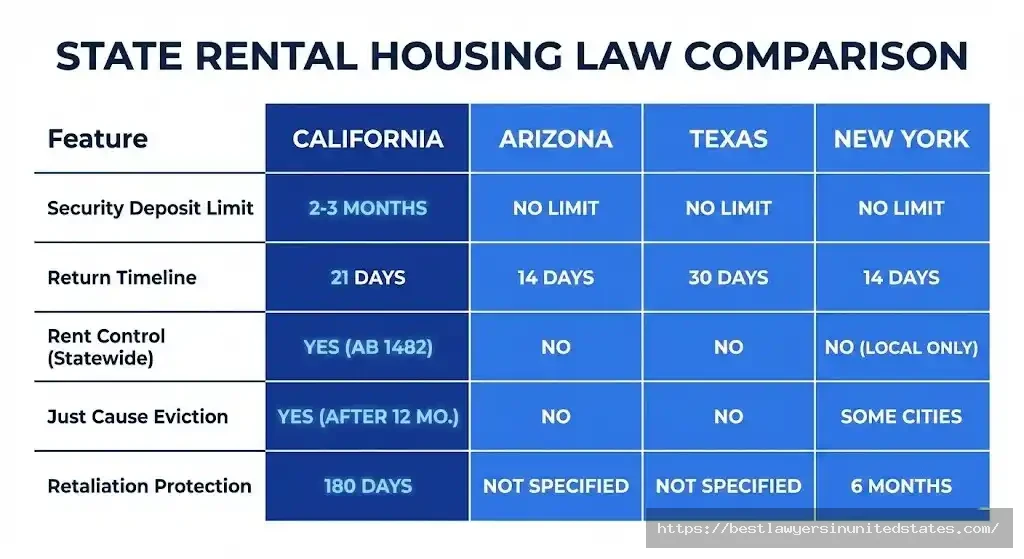
Unlike Arizona’s tenant rights laws which lack statewide rent control, California’s AB 1482 caps annual rent increases at 10%. California also provides stronger anti-retaliation protections than states like Arkansas, where retaliation protection periods are shorter or less clearly defined.
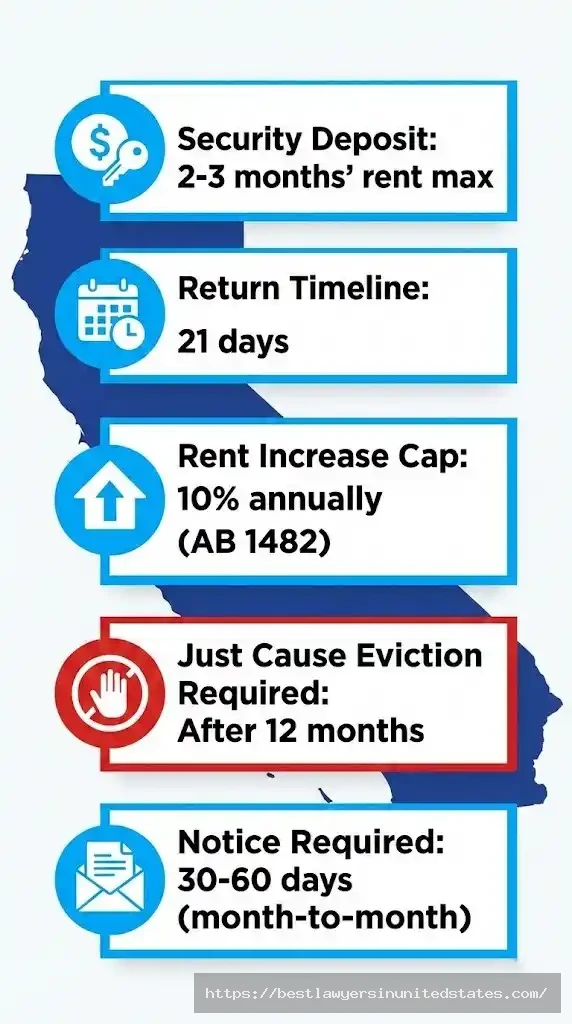
| Protection Type | California Law | Key Benefit |
|---|---|---|
| Security Deposit Limit | 2-3 months’ rent | Prevents excessive deposits |
| Deposit Return Timeline | 21 days | Fast refund requirement |
| Rent Increase Cap | 5% + CPI (max 10%) | Limits annual increases |
| Just Cause Eviction | Required after 12 months | Prevents arbitrary evictions |
| Retaliation Protection | 180-day presumption | Longest in the U.S. |
The California Tenant Protection Act (AB 1482)
AB 1482 took effect January 1, 2020, and provides two major protections: rent control and just cause eviction requirements.
Rent control under AB 1482:
- Annual increases capped at 5% plus local Consumer Price Index (CPI)
- Maximum increase: 10% per year
- Applies to most residential properties over 15 years old
- Exemptions: Single-family homes (unless corporate-owned), condos, properties built after 2005
Just cause eviction requirements:
- Applies to tenancies 12+ months
- Landlords must have valid reason to evict
- At-fault reasons: nonpayment, lease violations, illegal activity, nuisance
- No-fault reasons: owner move-in, substantial remodel, withdrawal from rental market
Understanding when your landlord can legally evict you is critical, and the eviction timeline calculator shows you how long the unlawful detainer process typically takes in California courts.
Month-to-Month vs. Fixed-Term Leases in California
The type of lease you have determines your notice requirements and eviction protections. California treats these lease types differently.
Month-to-month tenancies:
- Either party can end tenancy with proper notice
- Tenant notice: 30 days (regardless of tenancy length)
- Landlord notice: 30 days (tenancy under 1 year) or 60 days (tenancy 1+ years)
- Just cause still required for landlord-initiated termination after 12 months
Fixed-term leases:
- Lease continues until end date
- Early termination requires landlord agreement or legal justification
- Landlord cannot terminate early without cause (unless lease allows)
- Lease automatically converts to month-to-month if you stay after end date
California requires landlords to give 60-day notice for tenancies lasting one year or longer, though the notice period calculator can confirm your exact requirement based on your move-in date.
California Security Deposit Laws
What Is the Security Deposit Limit in California?
California law limits security deposits to protect tenants from excessive upfront costs. Under California Civil Code § 1950.5, landlords can charge a maximum deposit amount based on whether the unit is furnished.
Maximum security deposit amounts:
| Unit Type | Maximum Deposit | Example (Monthly Rent: $2,000) |
|---|---|---|
| Unfurnished | 2 months’ rent | $4,000 |
| Furnished | 3 months’ rent | $6,000 |
Landlords can charge additional amounts for pets, but the total cannot exceed these limits. California law limits security deposits to two months’ rent for unfurnished units, and you can use the security deposit calculator to verify your landlord isn’t overcharging.
Key rules:
- Deposit cannot exceed statutory limits
- No additional “nonrefundable” fees (except specific allowed fees)
- Pet deposits count toward total deposit limit
- Military tenants may have additional protections
How Long Does My Landlord Have to Return My Deposit?
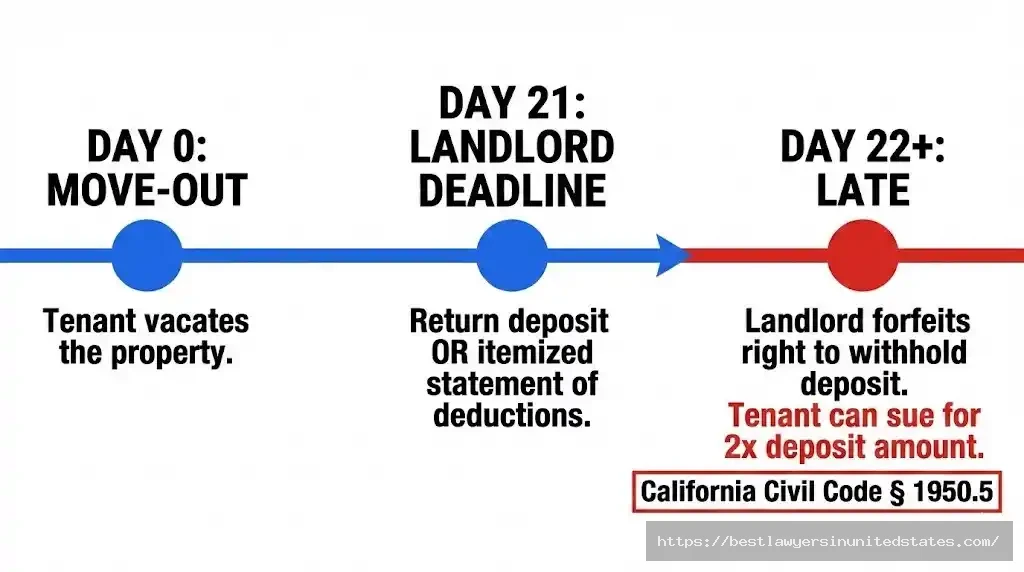
Quick answer: 21 days from move-out.
Within 21 days of move-out, landlords must return your deposit with an itemized statement—the security deposit calculator helps you track this deadline.
California Civil Code § 1950.5 requires:
- Full deposit return OR itemized deduction statement within 21 days
- Itemized statement showing specific deductions with dollar amounts
- Copies of receipts or invoices for repairs over $126
- Mailed to tenant’s forwarding address
Timeline example:
- Move-out date: January 1, 2026
- Landlord deadline: January 22, 2026
- Late penalty: Forfeit right to withhold any deposit amount
If the landlord fails to meet this deadline without valid reason, they forfeit the right to withhold any portion of the deposit. Courts may also award the tenant up to twice the deposit amount in statutory penalties.
Bad Faith Retention Penalties
California law imposes harsh penalties on landlords who act in bad faith when withholding security deposits.
What is “bad faith”?
- Intentionally withholding deposit without valid reason
- Claiming false damages
- Failing to provide itemized statement
- Missing the 21-day deadline without justification
Tenant remedies:
- Sue for full deposit amount
- Recover up to 2x the deposit in statutory damages
- Recover attorney fees and court costs
- File in small claims court (limit: $12,500 in 2026)
Example: You paid a $3,000 deposit. Your landlord keeps the entire amount claiming “general cleaning” without itemization. You sue in small claims court and win. You can recover the original $3,000 plus up to $6,000 in penalties ($9,000 total), plus filing fees.
What Can Landlords Deduct From My Deposit?
Allowed deductions:
- ✅ Unpaid rent
- ✅ Cleaning costs beyond normal wear and tear
- ✅ Repair costs for tenant-caused damage
- ✅ Unpaid utilities (if lease requires tenant payment)
- ✅ Replacement of damaged items (beyond normal wear)
NOT allowed:
- ❌ Normal wear and tear (faded paint, worn carpet, loose door handles)
- ❌ Routine cleaning (vacuuming, dusting, window washing)
- ❌ Repainting after years of tenancy
- ❌ Carpet replacement due to normal aging
- ❌ Minor scuffs, nail holes, or minor marks
Normal wear and tear definition: Deterioration that occurs naturally over time without negligence, carelessness, or abuse. This includes fading paint, worn carpet from foot traffic, and minor scuffs on walls.
Calculate Your Security Deposit Rights in California
Moving out soon? Use the free calculator to determine if your landlord owes you a security deposit refund and by what deadline. This calculator uses California’s specific security deposit laws including return timelines, allowable deductions, and penalty calculations.
🏠 Security Deposit Calculator
All 50 States + DC
Calculate max legal deposits, return deadlines, and penalties for violations.
📋 Enter Your Information
Special Conditions (if applicable)
✓ Results for
Based on current state law. Always verify with local regulations.
Link: https://bestlawyersinunitedstates.com/tenant-rights/security-deposit-calculator/
Calculator features:
- California-specific deposit limits and timelines
- Deduction legality checker
- Penalty calculation for late returns
- Itemized deduction analyzer
- Next steps if your rights are violated
Need help recovering your deposit? Contact California tenant rights attorneys for free consultation.
Questions about your tenant rights or need legal help?
Email: [email protected]
California Eviction Process & Timeline
Just Cause Eviction Requirements (AB 1482)
Under AB 1482, landlords must have “just cause” to evict tenants who have lived in the unit for 12 months or longer. California recognizes two categories of just cause: at-fault and no-fault.
At-fault reasons (tenant did something wrong):
- Nonpayment of rent
- Breach of lease agreement
- Nuisance behavior
- Illegal activity on premises
- Refusal to give landlord access per Civil Code
- Using unit for illegal purpose
No-fault reasons (tenant did nothing wrong):
- Owner or owner’s family moving into unit
- Withdrawal from rental market
- Demolition or substantial remodeling requiring permits
- Compliance with government order to vacate
- Converting to condos or other use
Key difference: No-fault evictions require landlord to pay relocation assistance in many California cities. At-fault evictions typically don’t trigger this requirement.
Under AB 1482, evictions require just cause after 12 months, and the eviction timeline calculator shows you how long the unlawful detainer process typically takes in California courts.
Eviction Notice Types in California
California uses different notice types based on eviction reason. The notice period determines how long you have before the landlord can file an unlawful detainer lawsuit.
3-Day Notice to Pay Rent or Quit:
- Used for nonpayment of rent
- Must specify exact amount owed
- Tenant has 3 days to pay or move out
- Weekends and court holidays don’t count
3-Day Notice to Cure or Quit:
- Used for lease violations (other than rent)
- Must specify the violation
- Tenant has 3 days to fix the problem
- Example: unauthorized pet, excessive noise
3-Day Unconditional Quit Notice:
- Rarely used in California
- No chance to fix problem
- Only for serious violations (illegal activity, repeated violations after prior cure notices)
- Most restricted notice type
30-Day or 60-Day Notice:
- 30 days: tenancy under 1 year
- 60 days: tenancy 1 year or longer
- Used for no-fault evictions
- Must state just cause reason (if AB 1482 applies)
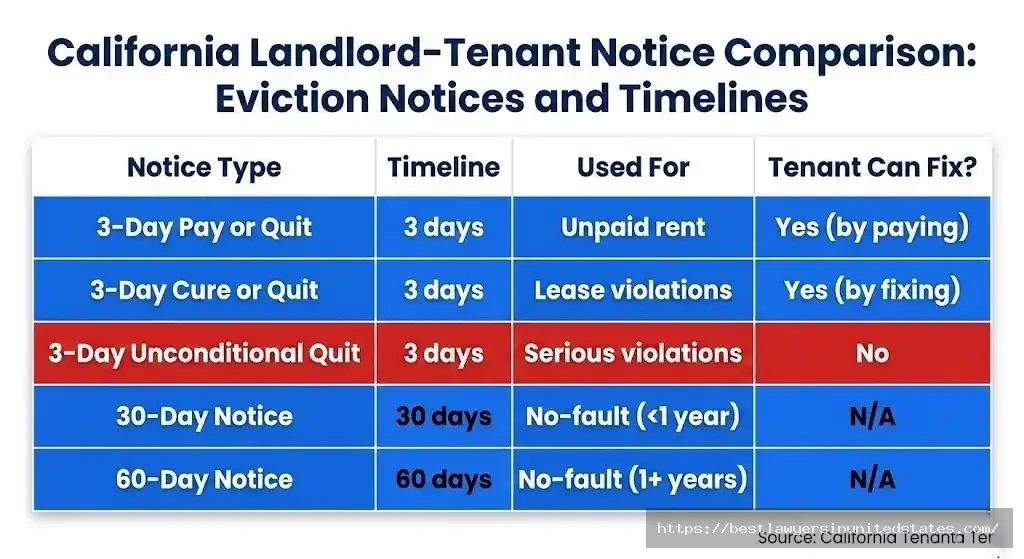
| Notice Type | Timeline | Used For | Tenant Can Fix? |
|---|---|---|---|
| 3-Day Pay or Quit | 3 days | Unpaid rent | Yes (by paying) |
| 3-Day Cure or Quit | 3 days | Lease violations | Yes (by fixing) |
| 3-Day Unconditional Quit | 3 days | Serious violations | No |
| 30-Day Notice | 30 days | No-fault (< 1 year) | N/A |
| 60-Day Notice | 60 days | No-fault (1+ years) | N/A |
Unlawful Detainer Process Timeline
After the notice period expires, the landlord can file an unlawful detainer lawsuit if you haven’t moved out or fixed the violation.
Step-by-step timeline:
- Notice served (Day 0)
- Landlord delivers proper notice
- Clock starts for notice period
- Notice period expires (Day 3, 30, or 60)
- Tenant must pay, fix violation, or move out
- If tenant doesn’t comply, landlord can file lawsuit
- Summons and complaint filed (Day 4-10 after notice expires)
- Landlord files unlawful detainer in court
- Court issues summons
- Tenant must respond within 5 days
- Tenant files answer (Day 9-15)
- Tenant has 5 days to respond to summons
- Failure to respond = automatic judgment for landlord
- Answer states defenses and denies allegations
- Trial scheduled (Day 20-40)
- Court sets trial date
- Usually 20 days after answer filed
- Can request continuance for hardship
- Trial held (Day 20-40)
- Both sides present evidence
- Judge issues ruling same day or within days
- Tenant can present defenses
- Judgment and writ (Day 25-45)
- If landlord wins, court issues judgment
- Landlord requests writ of possession
- Sheriff enforces eviction
- Sheriff lockout (Day 30-50)
- Sheriff posts 5-day notice
- Physical eviction occurs
- Landlord changes locks
Total timeline: 30-60 days from initial notice to sheriff lockout, depending on tenant response and court backlog. From 3-day notice to sheriff lockout, the eviction timeline calculator estimates your complete eviction timeline based on your county.
Relocation Assistance for No-Fault Evictions
Many California cities require landlords to pay relocation assistance when evicting tenants through no fault of their own. This is separate from state law and varies by city.
Cities with relocation requirements:
| City | Typical Amount | Triggers |
|---|---|---|
| San Francisco | $7,200-$21,500+ | Owner move-in, Ellis Act, substantial remodel |
| Los Angeles | $8,200-$21,500+ | Owner move-in, demolition, permanent removal |
| Oakland | $6,000-$9,200+ | No-fault evictions, substantial remodel |
| Berkeley | $7,500-$15,000+ | Owner move-in, substantial remodel |
| Santa Monica | $8,000-$18,500+ | Owner move-in, demolition |
How to claim relocation assistance:
- Landlord must inform you of relocation rights in eviction notice
- Payment usually due before you move out
- Can be paid in installments in some cities
- Failure to pay is a defense to eviction
State law (AB 1482): For covered properties, landlords must pay one month’s rent for no-fault evictions, though local ordinances often require more.
What Landlords Cannot Do During Eviction
California law prohibits “self-help” evictions. Landlords must use the court process and cannot take shortcuts.
Illegal landlord actions:
- ❌ Changing locks without court order
- ❌ Removing tenant belongings
- ❌ Shutting off utilities (water, gas, electricity)
- ❌ Removing doors or windows
- ❌ Threatening or harassing tenant
- ❌ Entering unit without notice (except emergency)
Consequences for landlords:
- Tenant can sue for damages
- Court may award 2-3x actual damages as penalties
- Tenant can recover attorney fees
- Criminal penalties possible for utility shutoffs
- Tenant may have defense to eviction
If you’re facing an unlawful eviction or your landlord violated AB 1482, understanding eviction lawyer costs can help you budget for legal representation that protects your rights.
Calculate Your Eviction Timeline in California
Facing eviction? Know exactly how long the process takes and your rights at each stage. The calculator provides a detailed timeline based on California’s eviction laws, including notice periods, court timelines, and appeal windows.
⏱️ Eviction Timeline Calculator
All 50 States + DC
Get step-by-step breakdown of eviction process, notice requirements, and your legal rights.
📋 Enter Your Situation
Enter the date you received the eviction notice to see projected dates
📅 Eviction Timeline for
Estimated timeline for
📍 Step-by-Step Timeline
Link: https://bestlawyersinunitedstates.com/tenant-rights/eviction-timeline-calculator/
Calculator features:
- Stage-by-stage eviction timeline
- California-specific notice requirements
- Court filing to sheriff lockout dates
- Tenant defense deadlines
- Appeal window calculations
Facing illegal eviction? Get immediate legal help from California tenant rights lawyers.
Questions about your tenant rights or need legal help?
Email: [email protected]
Notice Requirements & Lease Termination
Notice to Vacate Rules in California
Notice requirements in California depend on who ends the tenancy and how long you’ve lived there.
Tenant-initiated (you’re moving out):
- Month-to-month: 30 days’ notice required
- Fixed-term lease: Notice not required (lease ends automatically)
- Week-to-week: 7 days’ notice
- Notice period: Always same regardless of tenancy length
Landlord-initiated (landlord ends tenancy):
- Month-to-month under 1 year: 30 days’ notice
- Month-to-month 1+ years: 60 days’ notice
- Fixed-term lease: Cannot terminate early without cause
- Must state just cause reason (if AB 1482 applies)
California requires landlords to give 60-day notice for tenancies lasting one year or longer, though the notice period calculator can confirm your exact requirement based on your move-in date.
How notice is calculated:
- Start date: Day notice is delivered
- End date: Midnight on final day of notice period
- Example: 30-day notice delivered January 1 ends January 31
| Lease Type | Tenant Notice | Landlord Notice (<1 year) | Landlord Notice (1+ years) |
|---|---|---|---|
| Month-to-Month | 30 days | 30 days | 60 days |
| Fixed-Term | Not required* | Cannot end early** | Cannot end early** |
| Week-to-Week | 7 days | 7 days | 7 days |
*Unless breaking lease early
**Except with just cause
Early Lease Termination Rights
Breaking a lease early is legal in California under specific circumstances. Understanding when you can leave without penalty protects you from owing remaining rent.
Legal reasons to break lease:
- Active military deployment (Servicemembers Civil Relief Act)
- Domestic violence, sexual assault, stalking, human trafficking victim
- Uninhabitable conditions landlord won’t fix
- Landlord harassment or privacy violations
- Landlord failure to provide essential services
Landlord’s duty to mitigate damages:
- Landlord must make reasonable effort to re-rent unit
- Cannot charge you rent after new tenant moves in
- Must advertise unit and show to prospective tenants
- You’re only liable for actual vacancy period
Financial consequences if breaking without legal reason:
- May owe rent until unit is re-rented
- May owe landlord’s advertising and showing costs
- Not liable for full remaining lease term
- Security deposit can be used for unpaid rent
Tenant Rights When Landlord Sells House
Your lease survives the sale of the property. A new owner steps into the previous landlord’s shoes and must honor your existing lease.
Key protections:
- Lease remains valid after sale
- New owner cannot evict you without cause
- Security deposit transfers to new owner
- All lease terms remain unchanged
- Fixed-term leases run until end date
If new owner wants you out:
- Must wait until lease ends (fixed-term)
- Must give 30/60-day notice (month-to-month)
- Must have just cause if AB 1482 applies
- May owe relocation assistance (no-fault eviction)
During showing and inspection:
- Current landlord must give 24-hour notice
- You cannot unreasonably deny access
- Showings must be at reasonable times
- You can negotiate showing schedule
Calculate Notice Periods in California
Need to move out or wondering how much notice your landlord must give? The calculator determines the exact notice period required based on your lease type and California law, including notice to vacate, lease termination, and landlord entry notice requirements.
📬 Notice Period Calculator
All 50 States + DC
Find required notice periods for lease termination, rent increases, and landlord entry.
📋 Select Your Situation
What type of notice do you need? *
Select your role first
To calculate when notice must be given
Some states require longer notice for longer tenancies
✓ Notice Requirements for
📊 All Notice Periods for
| Notice Type | Tenant | Landlord |
|---|
Link: https://bestlawyersinunitedstates.com/tenant-rights/notice-period-calculator/
Calculator features:
- Notice requirements by lease type
- Move-out notice deadlines
- Landlord entry notice rules
- Rent increase notice periods
- Lease termination timelines
Questions about your lease? Speak with California housing attorneys today.
Questions about your tenant rights or need legal help?
Email: [email protected]
Landlord Obligations & Tenant Rights
Habitability Standards in California
California law requires landlords to maintain rental units in habitable condition. This “implied warranty of habitability” (California Civil Code §§ 1941-1942) means landlords must provide safe and livable housing.
Required habitability features:
- Waterproofing and weather protection
- Plumbing and gas facilities in good working order
- Hot and cold running water
- Heating facilities
- Electrical lighting and wiring
- Clean and sanitary buildings/grounds
- Adequate trash receptacles
- Floors, stairways, and railings in good repair
- Working deadbolt locks on doors
- Working windows with screens
What happens if conditions aren’t met:
- Landlord must repair within 30 days of notice
- Tenant can withhold rent for serious violations
- Tenant can repair and deduct cost from rent
- Tenant can move out (constructive eviction)
Repair-and-Deduct Rights
California allows tenants to make repairs themselves and deduct the cost from rent under specific conditions (California Civil Code § 1942).
Requirements to use repair-and-deduct:
- Problem substantially affects habitability
- Tenant notified landlord in writing
- Landlord didn’t fix within 30 days (or 60 days for government agency notice)
- Repair cost doesn’t exceed one month’s rent
- Cannot use more than twice in 12-month period
- Tenant keeps all receipts and invoices
Repair-and-deduct limits:
- Maximum: Lesser of one month’s rent or actual repair cost
- Frequency: Twice per 12-month period
- Scope: Only for habitability issues (not cosmetic)
Example: Your monthly rent is $2,000. The heater breaks in winter (habitability issue). You notify landlord in writing. After 30 days, landlord hasn’t fixed it. You hire a repair company for $800. You deduct $800 from next month’s rent and pay $1,200. This is legal under California law.
California Mold Tenant Rights
Mold is a serious health hazard. California law requires landlords to disclose mold and remediate problems (Health & Safety Code § 17920.3).
Landlord mold disclosure requirements:
- Must provide “Residential Mold Disclosure” booklet before lease signing
- Must disclose known mold problems
- Must inform about moisture and mold prevention
- Failure to disclose can void lease or reduce rent
Landlord remediation duties:
- Fix water leaks and moisture sources
- Remove existing mold growth
- Replace damaged materials (drywall, carpet)
- Prevent future mold growth
- Cannot retaliate against tenant for mold complaints
Tenant rights:
- Request mold inspection
- Withhold rent for serious mold affecting habitability
- Break lease if mold makes unit uninhabitable
- Sue for health damages caused by mold
- Report to local health department
When to call health department:
- Landlord refuses to fix mold
- Mold covers large areas
- Mold returns after remediation
- Mold causes health symptoms
Landlord Entry Rules
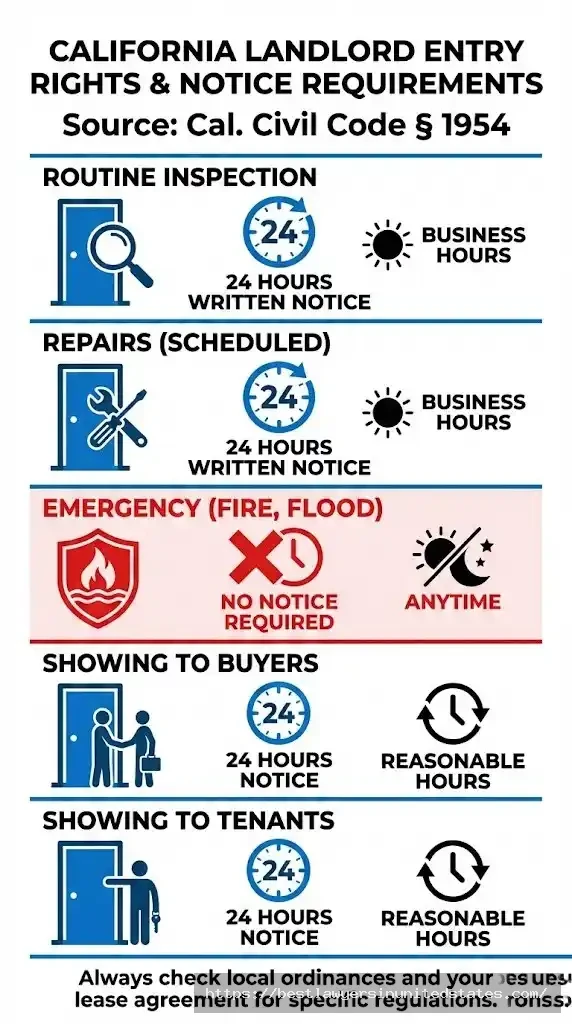
California Civil Code § 1954 strictly limits when landlords can enter your rental unit. Landlords must respect your privacy and follow notice requirements.
24-hour advance notice required for:
- Routine inspections
- Non-emergency repairs
- Showing unit to prospective tenants or buyers
- Showing unit to contractors for estimates
No notice required for:
- True emergencies (fire, flood, gas leak)
- Tenant abandonment
- Court order
- Tenant consent at time of entry
Entry must be:
- During normal business hours (8 AM – 5 PM typical)
- For legitimate purposes only
- With reasonable advance notice
- Not used to harass tenant
| Entry Reason | Notice Required | Time Restrictions |
|---|---|---|
| Routine inspection | 24 hours written | Business hours |
| Repairs (scheduled) | 24 hours written | Business hours |
| Emergency | None | Anytime |
| Showing to buyers | 24 hours written or oral | Reasonable hours |
| Showing to tenants | 24 hours written or oral | Reasonable hours |
Violation consequences:
- Tenant can sue for invasion of privacy
- Evidence of harassment or retaliation
- Tenant may have defense to eviction
- Damages and attorney fees
Anti-Retaliation Protections
California’s 180-day retaliation protection period is significantly longer than states like Alabama’s tenant rights framework, which doesn’t specify a presumption period. California Civil Code § 1942.5 prohibits landlords from retaliating against tenants who exercise their rights.
Protected tenant actions:
- Complaining to landlord about habitability
- Complaining to government agency
- Exercising repair-and-deduct rights
- Organizing tenant union
- Testifying in court against landlord
- Requesting repairs in writing
Prohibited retaliatory actions:
- Raising rent
- Decreasing services
- Threatening eviction
- Evicting tenant
- Refusing to renew lease
- Harassing tenant
180-day presumption rule:
- If landlord takes action within 180 days of protected activity, law presumes retaliation
- Landlord must prove action was NOT retaliatory
- Longest presumption period in the U.S.
- Strong protection for tenants
Example: You complain to the health department about mold on January 1, 2026. Landlord raises your rent on March 1, 2026 (60 days later). Law presumes this is retaliation. Landlord must prove rent increase was planned before complaint and not retaliatory.
Rent Increases & Rent Control in California
AB 1482 Rent Increase Limits
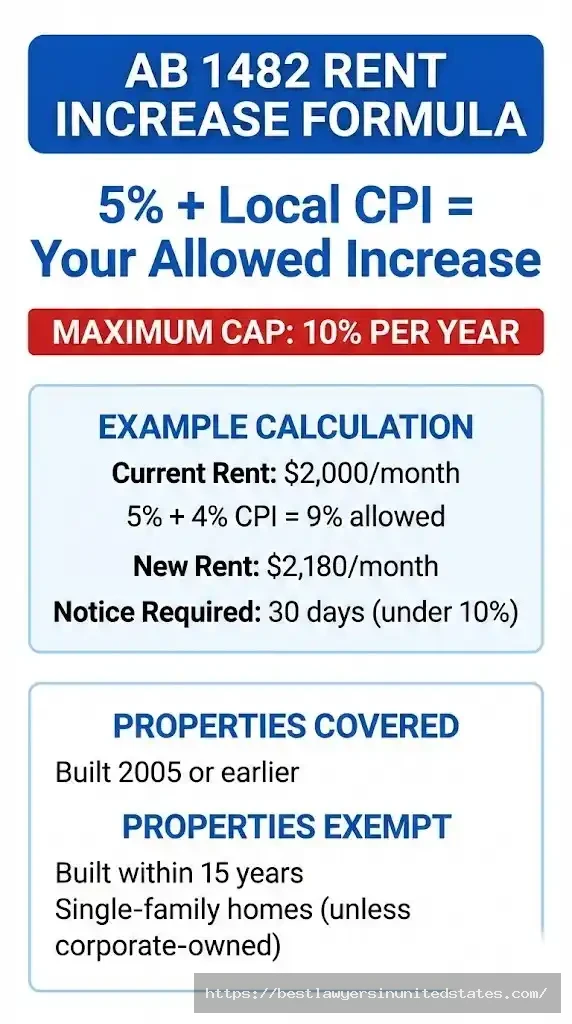
AB 1482 caps annual rent increases for most California residential properties built before 2005.
Rent increase formula:
- 5% plus local Consumer Price Index (CPI)
- Maximum: 10% per year
- Applies to 12-month period, not calendar year
2026 rent increase limits:
- Base: 5%
- CPI varies by region (typically 2-5%)
- Total cap: 10% maximum
Notice requirements:
- Increase under 10%: 30 days’ written notice
- Increase of 10% or more: 90 days’ written notice
- Cannot increase more than once per 12 months
Example calculation:
- Current rent: $2,000/month
- Local CPI: 4%
- Legal increase: 5% + 4% = 9%
- New rent: $2,180/month
- Notice required: 30 days (under 10%)
Properties exempt from AB 1482 rent caps:
- Built within last 15 years
- Single-family homes (unless owned by corporation or REIT)
- Condos (unless owned by corporation or REIT)
- Duplexes where owner occupies one unit
Local Rent Control Ordinances
San Francisco, Los Angeles, Oakland, Berkeley, Santa Monica, and other cities have rent control stricter than AB 1482.
Key differences in rent-controlled cities:
| City | Max Annual Increase | Additional Requirements |
|---|---|---|
| San Francisco | 60% of CPI | Rent board oversight, just cause eviction |
| Los Angeles | 3-4% typical | Rent registry, habitability inspections |
| Oakland | CPI (typically 2-4%) | Rent board, relocation assistance |
| Berkeley | 65% of CPI | Rent board, eviction protections |
| Santa Monica | 75% of CPI | Strict eviction controls |
Local protections often include:
- Lower annual increase caps than state law
- Rent board oversight and dispute resolution
- Additional just cause requirements
- Higher relocation assistance
- Rent registry requirements
How to know if you’re covered:
- Check city housing website
- Call local rent board
- Review lease for rent control disclosures
- Ask landlord directly
Fair Housing & Discrimination
Protected Classes in California
California prohibits housing discrimination beyond federal Fair Housing Act protections.
Federal protected classes:
- Race
- Color
- National origin
- Religion
- Sex
- Disability
- Familial status (families with children)
California additional protections:
- Sexual orientation
- Gender identity
- Gender expression
- Marital status
- Source of income (including Section 8)
- Age
- Ancestry
- Genetic information
- Military or veteran status
Illegal discrimination includes:
- Refusing to rent based on protected class
- Different terms or conditions
- Steering to certain units or buildings
- False claim of unavailability
- Harassment based on protected status
- Refusing reasonable disability accommodations
Source of Income Discrimination
California law prohibits landlords from discriminating based on source of income, including government assistance programs.
Source of income includes:
- Section 8 housing vouchers
- Social Security
- SSI (Supplemental Security Income)
- Veterans benefits
- Child support
- Alimony
Landlord obligations:
- Must accept Section 8 vouchers
- Cannot advertise “no Section 8”
- Must follow same screening criteria
- Cannot delay or discourage applications
Exceptions:
- Owner-occupied buildings with one rental unit
- Properties with 4 or fewer units where owner lives on-site
- Religious organizations renting to members
Tenant Privacy Rights in California
Privacy Rights Beyond Landlord Entry
California protects tenant privacy beyond just entry rules. Landlords have limited rights to access tenant information and property.
Mailbox access:
- Only tenant can access mailbox
- Landlord cannot open or read tenant mail
- Violation is federal crime (mail tampering)
Surveillance and monitoring:
- Landlord can install cameras in common areas
- Cannot install cameras inside rental units
- Cannot monitor tenant activities unreasonably
- Audio recording inside units may violate wiretap laws
Landlord gossip and confidentiality:
- Landlord should keep tenant information private
- Cannot share financial or personal details without reason
- References to future landlords should be factual only
Tenant Screening & Background Checks
California limits what landlords can ask and charge during the application process.
Application fee limits 2026:
- Maximum: $58.45 (adjusted annually for inflation)
- Must provide copy of actual credit report
- Must refund if no report obtained
- Can only charge actual costs
Criminal history restrictions (AB 2219):
- Landlords cannot ask about criminal history on initial application
- Can only ask after conditional approval
- Cannot consider arrests without conviction
- Cannot consider certain old convictions
- Exceptions for registered sex offenders near schools
What landlords can check:
- Credit history and score
- Rental history and references
- Income verification
- Criminal convictions (with limitations)
- Eviction history
Resources & Next Steps
Free Interactive Calculators
California Security Deposit Calculator: https://bestlawyersinunitedstates.com/tenant-rights/security-deposit-calculator/ Estimate your max deposit, calculate return deadlines, and check deduction legality.
California Eviction Timeline Calculator: https://bestlawyersinunitedstates.com/tenant-rights/eviction-timeline-calculator/ Get detailed timeline from notice through sheriff enforcement based on your situation.
California Notice Period Calculator: https://bestlawyersinunitedstates.com/tenant-rights/notice-period-calculator/ Determine exact notice requirements for your lease type and tenancy length.
California Tenant Hotlines & Legal Aid
Statewide Resources:
- California Department of Consumer Affairs: (800) 952-5210
- Housing Rights Center: (800) 477-5977
- Tenants Together (statewide advocacy): www.tenantstogether.org
Local tenant unions and legal aid:
- San Francisco Tenants Union: (415) 282-6622
- Los Angeles Tenants Union: www.latenantsunion.org
- Oakland Tenants Union: www.oaklandtenantsunion.org
- Legal Aid Society (locations statewide): www.lawhelpca.org
When to Contact a Tenant Rights Attorney
Consider consulting an attorney if you’re facing:
- Illegal eviction or lockout
- Security deposit wrongfully withheld
- Habitability issues landlord won’t fix
- Discrimination or harassment
- Retaliation after complaint
- Complex lease disputes
Many tenant rights attorneys offer free consultations. California law allows you to recover attorney fees if you win your case.
Frequently Asked Questions
What are my rights as a renter in California?
Quick Answer: California tenants have rights to habitable housing, security deposit limits (2-3 months’ rent), 21-day deposit return, just cause eviction protections after 12 months, rent increase caps (10% max annually), 180-day retaliation protection, and 24-hour entry notice requirements.
What can a landlord not do in California?
Quick Answer: Landlords cannot evict without just cause (after 12 months), conduct self-help evictions (lockouts, utility shutoffs), retaliate within 180 days of tenant complaints, enter without 24-hour notice (except emergencies), raise rent more than 10% annually, or discriminate based on protected classes including source of income.
How much can a landlord raise rent in California?
Quick Answer: Under AB 1482, landlords can raise rent up to 5% plus local CPI (Consumer Price Index) with a maximum cap of 10% per year for most properties over 15 years old.
Rent-controlled cities like San Francisco and Los Angeles often have stricter limits. Landlords must provide 30 days’ notice for increases under 10% and 90 days’ notice for increases of 10%.
How long does a landlord have to return my security deposit in California?
Quick Answer: California landlords must return security deposits within 21 days of move-out, along with an itemized statement of any deductions.
If the landlord fails to meet this deadline without valid reason, they forfeit the right to withhold any portion and may owe you up to twice the deposit amount in penalties.
Can my landlord evict me without cause in California?
Quick Answer: No, not after 12 months of tenancy. AB 1482 requires landlords to have just cause for evictions after you’ve lived in the unit for 12 months or more.
Just cause includes at-fault reasons (nonpayment, lease violations) and no-fault reasons (owner move-in, major remodel). No-fault evictions often require relocation assistance.
Do I have to give 60 days notice to move out in California?
Quick Answer: No. Tenants always give 30 days’ notice to terminate a month-to-month lease, regardless of how long they’ve lived there.
The 60-day requirement only applies to landlords ending month-to-month tenancies lasting one year or longer. Fixed-term leases typically don’t require tenant notice unless breaking the lease early.
What is AB 1482 and how does it protect me?
Quick Answer: AB 1482 (California Tenant Protection Act of 2019) provides two major protections: rent control (max 10% annual increases) and just cause eviction requirements after 12 months of tenancy.
It covers most residential properties over 15 years old. Exemptions include single-family homes (unless corporate-owned), condos, and newly built properties.
Can I withhold rent if my landlord won’t make repairs in California?
Quick Answer: Yes, for serious habitability violations. California allows tenants to withhold rent or use the “repair-and-deduct” remedy (up to one month’s rent) for habitability issues.
You must notify the landlord in writing and give them 30 days to repair (or 60 days if a government agency issued the notice). Keep documentation of all communications.
What are my rights if my landlord is selling the house in California?
Quick Answer: Your lease survives the sale. The new owner must honor your existing lease terms, including fixed-term end dates and month-to-month agreements.
The new owner cannot evict you without just cause and must follow all AB 1482 requirements. Current landlord must give 24-hour notice for showings to prospective buyers.
How do I know if my rental is covered by rent control in California?
Quick Answer: Check if your property is over 15 years old for AB 1482 coverage. For stricter local rent control, verify if you’re in San Francisco, Los Angeles, Oakland, Berkeley, Santa Monica, or other rent-controlled cities.
Contact your city’s rent board or housing department. Properties exempt include single-family homes (unless corporate-owned), condos, and buildings built after 2005.
How do I calculate if my landlord owes me my security deposit?
Quick Answer: Use the California security deposit calculator at the link above. Input your deposit amount, move-out date, and any claimed deductions.
The calculator checks if deductions are legal, calculates your return deadline (21 days), and determines penalties if your landlord violated the law.
How long does the eviction process take in California?
Quick Answer: From initial notice to sheriff lockout typically takes 30-60 days total in California. The timeline includes 3-60 day notice period (depending on reason), 5 days to respond to summons, 20-30 days to trial, and 5 days for sheriff enforcement.
Use the eviction timeline calculator at the link above to estimate your specific timeline based on notice type and county court backlog.
How much notice does my landlord need to give me in California?
Quick Answer: For month-to-month tenancies, landlords must give 30 days’ notice if you’ve lived there under 1 year, or 60 days’ notice if you’ve lived there 1 year or longer.
For fixed-term leases, landlords cannot terminate before the lease ends without just cause. Use the notice period calculator at the link above to determine your exact requirement.
Can my landlord enter my apartment without notice in California?
Quick Answer: No, except for true emergencies (fire, flood, gas leak). California law requires landlords to give 24-hour advance written notice for routine inspections, repairs, or showing to prospective tenants.
Entry must be during reasonable hours (typically 8 AM – 5 PM). Violation of entry rules can be evidence of harassment or retaliation.
What should I do if I find mold in my California rental?
Quick Answer: Notify your landlord immediately in writing with photos. California requires landlords to fix mold issues that affect habitability.
If the landlord doesn’t respond within 30 days, you can contact your local health department, use repair-and-deduct rights, or potentially break your lease if the unit is uninhabitable. Keep all documentation.
Conclusion
California provides renters with strong legal protections that exceed most other states. AB 1482’s rent control and just cause eviction requirements protect long-term tenants from arbitrary displacement. The state’s 21-day security deposit return deadline, 180-day retaliation protection, and strict habitability standards give you powerful tools to enforce your rights.
Understanding these protections helps you spot illegal landlord actions and respond appropriately. The three free calculators on this page help you calculate exact timelines and amounts specific to your situation.
Always document everything in writing. Save emails, texts, notices, photos, and receipts. If your landlord violates your rights, you may be able to recover damages, attorney fees, and statutory penalties. For complex disputes or legal questions beyond this guide, consult a California tenant rights attorney who can evaluate your specific situation.
Know your rights, stand up for yourself, and don’t hesitate to seek help when needed. California law is on your side.