
Quick Answer Box
- The Trader Joe’s Uncrustables lawsuit is a trademark dispute filed by J.M. Smucker Company, not a consumer class action.
- There is no consumer settlement fund or claim form because this case involves two companies, not shoppers.
- The case’s value lies in potential damages, lost profits, and an injunction Smucker is seeking against Trader Joe’s, not individual consumer payouts.
Case Snapshot
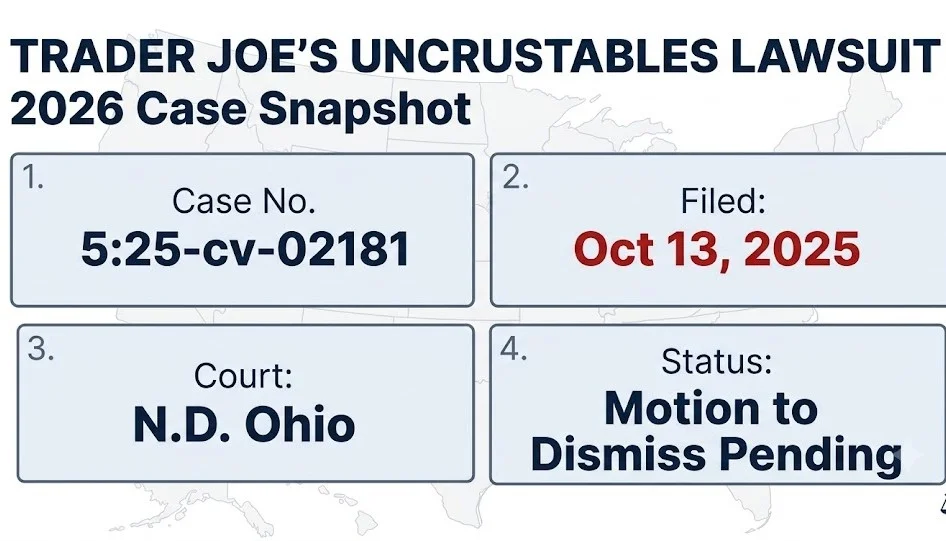
| Detail | Info |
|---|---|
| Court | U.S. District Court, Northern District of Ohio |
| Case / MDL Number | 5:25-cv-02181 |
| Filing Date | October 13, 2025 |
| Status | Active, pending motion to dismiss and venue transfer |
| Settlement Fund | Not applicable, no consumer settlement exists in this case |
The Trader Joe’s Uncrustables lawsuit is not the kind of case where consumers file a claim form and wait for a check. This is a trademark fight between two food companies, and understanding that distinction matters before reading further.
J.M. Smucker Company filed the case in October 2025, accusing Trader Joe’s of copying its Uncrustables design. The dispute now sits before a federal judge in Ohio, with a motion to dismiss still pending.
Smucker says Uncrustables generate roughly $920 million a year in sales. This article breaks down the legal claims, the court record, and what happens next, without pretending consumers have a stake in the outcome.
What Is the Trader Joe’s Uncrustables Lawsuit
The Trader Joe’s Uncrustables lawsuit is a federal trademark case filed by J.M. Smucker Company against Trader Joe’s Company. Smucker alleges Trader Joe’s crustless peanut butter and jelly sandwiches copy the design and packaging of its Uncrustables brand.
The case does not involve consumer plaintiffs or a proposed class. It is a direct dispute between two corporations over intellectual property rights.
- Plaintiff: J.M. Smucker Company
- Defendant: Trader Joe’s Company
- Core allegation: trademark and trade dress infringement
Attorney Insight: Attorneys handling these claims note that trademark disputes between competitors, unlike consumer class actions, focus on market harm rather than individual damages to shoppers.
Smucker Trader Joe’s Lawsuit Explained
Smucker’s lawsuit argues that Trader Joe’s launched an “obvious copycat” of its Uncrustables sandwich design. The complaint points to the round shape, crimped edges, and blue packaging as protected trademarks Trader Joe’s allegedly copied.
Smucker claims it has invested more than $1 billion over two decades building the Uncrustables brand, which now sells approximately 1.5 billion units annually.
Bold callout: Smucker’s complaint calls Trader Joe’s product “an obvious attempt to trade off” the recognition built around Uncrustables.
Attorney Insight: Attorneys handling these claims point out that brand investment figures like these often become central evidence in proving trademark value at trial.
Is There a Trader Joe’s Uncrustables Settlement for Consumers
No, there is no consumer settlement or claim process tied to this lawsuit. This case involves only Smucker and Trader Joe’s as parties, with no consumer class ever proposed or certified.
Any financial recovery in this case, if it occurs, would go to Smucker as the plaintiff company, not to individual shoppers.
| Question | Answer |
|---|---|
| Can consumers file a claim | No |
| Is there a settlement fund | No |
| Who benefits from a win | Smucker, not consumers |
Attorney Insight: Attorneys handling these claims stress that confusing a trademark dispute with a consumer class action can lead people to waste time searching for a claim form that does not exist.
Litigation Watch: This case’s entire financial and legal stakes run between two companies, with no consumer payout mechanism built into the litigation.
Trader Joe’s Uncrustables Lawsuit Case Number and Court
The case is formally numbered 5:25-cv-02181 in the U.S. District Court for the Northern District of Ohio. Judge John R. Adams is presiding over the litigation.
Smucker filed the complaint on October 13, 2025, paying a federal filing fee to initiate the case.
| Detail | Info |
|---|---|
| Case Name | J.M. Smucker Company v. Trader Joe’s Company |
| Docket Number | 5:25-cv-02181 |
| Court | N.D. Ohio |
| Presiding Judge | John R. Adams |
Attorney Insight: Attorneys handling these claims stress that verifying the exact docket number helps distinguish real case updates from recycled news summaries.
Trademark Infringement Claims Explained
Trademark infringement means using a design or mark so similar to another company’s protected mark that it risks confusing consumers. Smucker’s complaint asserts this theory as its central legal claim.
The company holds federal trademark registrations covering the sandwich’s specific shape and the “bitten sandwich” imagery used on its packaging.
- Registered elements: round pie-like shape with peripheral crimping
- Registered imagery: sandwich shown with a bite taken out, revealing filling
- Legal standard: likelihood of consumer confusion between the two products
Attorney Insight: Attorneys handling these claims note that federally registered trademarks carry a legal presumption of validity, which shifts significant weight toward the trademark holder early in litigation.
Trade Dress and Packaging Allegations Explained
Trade dress refers to the overall visual appearance of a product or its packaging that identifies its source to consumers. Smucker argues Trader Joe’s packaging uses a confusingly similar blue color scheme and bite-mark imagery.
The complaint claims these visual choices were not accidental but designed to associate Trader Joe’s product with Uncrustables in shoppers’ minds.
- Packaging color: blue tones allegedly matching Smucker’s trademarked branding
- Imagery: bitten sandwich graphic revealing filling, similar to Uncrustables packaging
- Product shape: round, crimped-edge design at the center of the dispute
Attorney Insight: Attorneys handling these claims say trade dress cases often turn on side-by-side visual comparison evidence presented directly to the court.
Litigation Watch: The strength of Smucker’s case rests heavily on whether a judge or jury finds the visual similarities substantial enough to cause real consumer confusion.
Trader Joe’s Motion to Dismiss Explained
Trader Joe’s filed a motion to dismiss and, alternatively, to transfer venue on January 9, 2026. The motion challenges whether Smucker’s complaint states a valid legal claim and whether Ohio is the correct venue for the case.
Smucker filed its opposition to that motion shortly after, keeping the case active in the Northern District of Ohio for now.
- Motion filed: January 9, 2026, by Trader Joe’s Company
- Motion type: failure to state a claim and/or transfer of venue
- Current status: opposition filed, ruling pending
Attorney Insight: Attorneys handling these claims note that venue transfer motions are common defense tactics in cases where the defendant is headquartered far from the filing court.
Trader Joe’s Uncrustables Lawsuit Timeline
The case has moved through several procedural stages since its filing in late 2025. Each step has shaped how the dispute is likely to unfold in 2026.
October 13, 2025: J.M. Smucker Company files suit in the Northern District of Ohio.
December 10, 2025: Judge John R. Adams addresses procedural matters in the case.
January 9, 2026: Trader Joe’s files a motion to dismiss and to transfer venue.
February 23, 2026: Most recent known filing activity on the public docket.
Attorney Insight: Attorneys handling these claims note that a pending motion to dismiss typically pauses discovery until the court resolves the threshold legal questions.
What Remedies Is Smucker Seeking
Smucker is seeking several forms of relief beyond simple monetary damages. The company wants Trader Joe’s to stop selling the disputed product entirely.
Its requested remedies also include destruction of existing inventory and packaging tied to the alleged infringement.
- Injunctive relief: court order barring further sales of the disputed product
- Destruction order: existing inventory, labels, and marketing materials
- Financial relief: damages, costs, and disgorgement of Trader Joe’s profits
Attorney Insight: Attorneys handling these claims note that seeking product destruction, not just damages, signals how seriously Smucker views the brand protection stakes here.
Trader Joe’s Uncrustables Lawsuit by State
This case is federal and centralized in a single court, unlike many consumer class actions that vary by state. Its outcome will apply nationally to Trader Joe’s sales of the disputed product.
State law does factor in through one specific claim tied to Ohio’s own consumer protection statute.
| Scope | Detail |
|---|---|
| Court venue | Northern District of Ohio, federal |
| Applicable state claim | Ohio Deceptive Trade Practices Act |
| Geographic effect | Nationwide, given federal trademark claims |
Attorney Insight: Attorneys handling these claims note that combining federal trademark claims with a state deceptive trade practices claim is a common strategy to broaden available remedies.
What Type of Lawyer Handles a Case Like This
An intellectual property attorney specializing in trademark and trade dress litigation typically handles cases like this one. These lawyers focus on brand protection, consumer confusion analysis, and federal trademark law.
Both companies in this case retained major law firms with significant trademark litigation experience.
- Smucker’s counsel: Jones Day
- Trader Joe’s counsel: firms including Frost Brown Todd and Latham and Watkins
- Specialty required: federal trademark and trade dress litigation
Attorney Insight: Attorneys handling these claims say the caliber of law firms involved often signals how aggressively both sides intend to litigate rather than settle quickly.
How This Case Compares to Other Private Label Lawsuits
This case fits a broader pattern of manufacturers suing retailers over private label products resembling name brands. Mondelez International filed a similar case against Aldi in 2025 over cookie and cracker packaging.
Both disputes reflect growing manufacturer concern as store brand products gain market share against established national brands.
- Similar case: Mondelez International v. Aldi, filed May 2025
- Shared theory: private label packaging allegedly copies national brand trade dress
- Broader trend: manufacturers increasingly litigating against retailers’ store brands
Attorney Insight: Attorneys handling these claims note that a ruling in this case could influence how aggressively other manufacturers pursue similar private label disputes.
What Happens Next in the Trader Joe’s Uncrustables Lawsuit
What happens next depends on how Judge Adams rules on Trader Joe’s pending motion to dismiss. That ruling will determine whether the case proceeds to discovery or gets transferred to a different court.
If the case survives the motion, both sides will move into evidence gathering, including consumer confusion studies and internal design documents.
- Near-term: ruling on the motion to dismiss and venue transfer
- Mid-term: discovery phase, if the case survives dismissal
- Long-term: possible settlement, trial, or summary judgment motions
Attorney Insight: Attorneys handling these claims expect the venue and dismissal ruling to significantly shape the case’s pace through the rest of 2026.
Litigation Watch: The entire trajectory of this case currently hinges on a single pending ruling, not on any settlement talks or consumer-facing claims process.
What a Smucker Win or Loss Would Mean
A Smucker win would likely force Trader Joe’s to redesign or pull its crustless sandwich product entirely. It could also strengthen trademark protections for product shapes across the food industry.
A Trader Joe’s win would signal broader room for retailers to develop private label products resembling established national brands.
- If Smucker wins: potential injunction, product redesign, or removal from shelves
- If Trader Joe’s wins: precedent favoring private label design flexibility
- Industry impact: either outcome likely influences future private label litigation
Attorney Insight: Attorneys handling these claims say the ruling’s influence will likely extend well beyond peanut butter and jelly sandwiches into broader private label strategy.
Frequently Asked Questions
Is there a Trader Joe’s Uncrustables lawsuit consumers can join?
No, this case does not include a consumer class or claim process.
It is a trademark dispute between J.M. Smucker Company and Trader Joe’s Company.
Consumers have no legal stake or payout opportunity in this specific litigation.
What is the case number for the Trader Joe’s Uncrustables lawsuit?
The case is numbered 5:25-cv-02181 in the U.S. District Court for the Northern District of Ohio.
It was filed on October 13, 2025, and is presided over by Judge John R. Adams.
The case is formally styled J.M. Smucker Company v. Trader Joe’s Company.
What is Smucker asking the court to do?
Smucker is asking the court to stop Trader Joe’s from selling the disputed sandwiches.
It also wants destruction of existing inventory and packaging, plus monetary damages and disgorgement of profits.
These remedies reflect a broader trademark protection strategy, not simple compensation.
Has Trader Joe’s responded to the lawsuit?
Yes, Trader Joe’s filed a motion to dismiss and to transfer venue on January 9, 2026.
Smucker has since filed an opposition to that motion.
A ruling on this motion remains pending as of this writing.
What happens if Smucker wins the case?
A win for Smucker would likely force changes to Trader Joe’s product design or packaging.
The court could order an injunction, product destruction, and financial damages.
It could also strengthen trademark protections for similar product shapes industry-wide.
Who qualifies for a payout in this case?
No individual consumers qualify for a payout in this lawsuit.
Only Smucker, as the plaintiff company, stands to receive any financial recovery if the case succeeds.
This distinguishes the case sharply from consumer class action settlements covered elsewhere on this site.
The Trader Joe’s Uncrustables lawsuit remains an active corporate trademark dispute, not a consumer claims case. Anyone following it for news purposes should watch the pending motion to dismiss ruling for the next real development.
Food and beverage companies concerned about similar private label exposure should consult an intellectual property attorney experienced in trademark and trade dress litigation.
