
If you’ve been arrested for DUI in Alabama, you’re facing penalties that start at $8,000 and can include jail time, license suspension, and a permanent criminal record. Alabama Code Section 32-5A-191 makes it illegal to drive with a blood alcohol content of 0.08% or higher, or while impaired by any substance. You have only 10 days to request an administrative hearing to fight your license suspension.
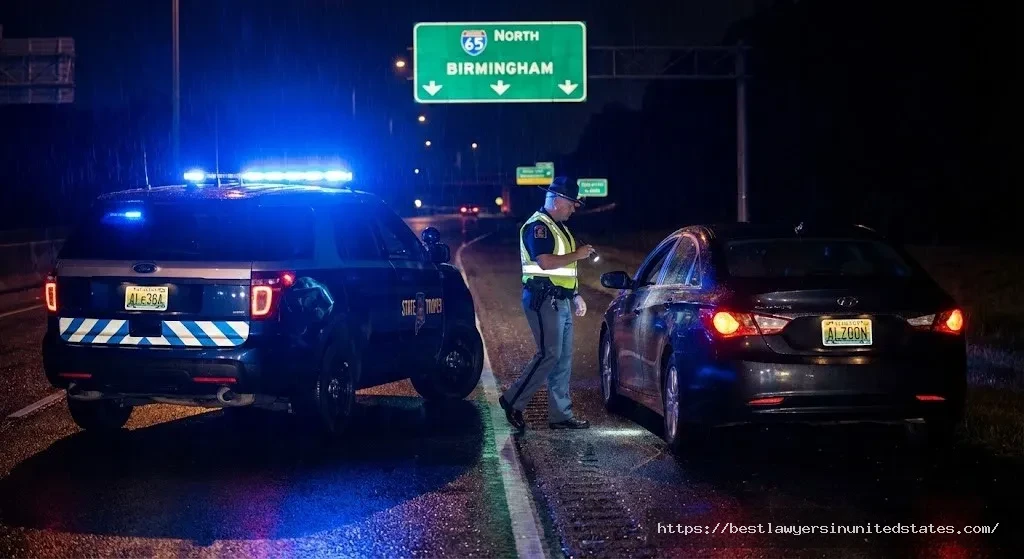
This guide explains Alabama DUI laws, penalties for each offense level, the arrest process, defense strategies, and actual costs. We’ll show you what happens at each stage and how to protect your rights.
What Constitutes DUI in Alabama?
Alabama law defines DUI in three ways under Code Section 32-5A-191. You can be arrested for driving while impaired by alcohol, drugs, or controlled substances. The state doesn’t require proof you were actually driving in some cases.
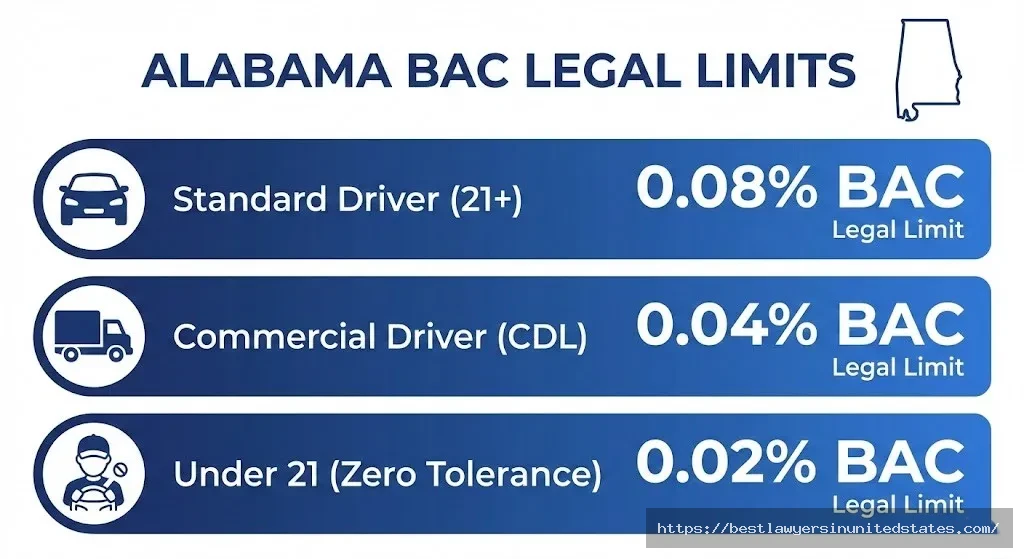
Per Se DUI means you’re legally impaired at specific BAC levels:
- 0.08% or higher for regular drivers
- 0.04% or higher for commercial drivers
- 0.02% or higher for drivers under 21
Impairment DUI applies when your ability to drive safely is affected at any BAC level. Officers look for signs like erratic driving, slurred speech, or failed field sobriety tests. Your BAC doesn’t have to reach 0.08% for an arrest.
Actual Physical Control extends DUI charges beyond active driving. You can be arrested while sitting in a parked car with the keys in the ignition. Alabama courts have convicted people sleeping in the back seat if keys were accessible. This provision aims to prevent impaired people from driving but creates legal gray areas.
Check Your BAC Level
Not sure if you’re over the legal limit? Use our BAC calculator to estimate your blood alcohol content based on your weight, drinks consumed, and time elapsed.
BAC Calculator
Estimate your Blood Alcohol Content
• Commercial Driver (CDL): 0.04% BAC
• Drivers Under 21: 0.00-0.02% BAC (Zero Tolerance)
• Enhanced Penalties: 0.15% BAC or higher in most states
Understanding your BAC helps you make safer decisions. Remember that impairment begins before you reach the legal limit.
DUI for Controlled Substances in Alabama
Drug-related DUI charges work differently than alcohol cases. Alabama law prohibits driving while impaired by any controlled substance, including prescription medications. No specific threshold exists like the 0.08% BAC for alcohol.
Police use Drug Recognition Experts (DREs) to evaluate suspected drug impairment. These trained officers conduct 12-step evaluations including pulse checks, eye examinations, and divided attention tests. Blood tests confirm the presence of drugs in your system.
Marijuana DUI cases are increasing in Alabama. Medical marijuana became legal in 2021, but driving while impaired remains illegal. Officers can arrest you even with a valid medical marijuana card if they believe you’re impaired.
Prescription Medication DUI charges apply to legal drugs like opioids, benzodiazepines, and muscle relaxers. Having a valid prescription is not a defense. The state must only prove the medication impaired your driving ability.
Police typically request blood tests for drug DUI cases. Unlike breath tests for alcohol, blood tests detect drugs for days or weeks after use. This creates defense opportunities since presence doesn’t equal impairment at the time of driving.
First 72 Hours After DUI Arrest: Critical Action Steps
The hours immediately following your arrest determine your case outcome. Missing deadlines or making mistakes now can cost you your license and increase penalties.
Hour 1-24: Protect Your Rights
Do not discuss your case with anyone except an attorney. Police may ask questions designed to build their case. You have the right to remain silent. Use it. Officer statements like “it’ll be easier if you cooperate” are tactics to gather evidence against you.
Document everything you remember about the arrest. Write down the time, location, what you ate and drank, when you stopped drinking, officer statements, and any medical conditions affecting your behavior. Memory fades quickly. These details become crucial for your defense.
Preserve all evidence. Keep receipts from bars or restaurants showing when you made purchases. Save credit card statements. Note witness names and contact information. Take photos of the arrest location and your vehicle position.
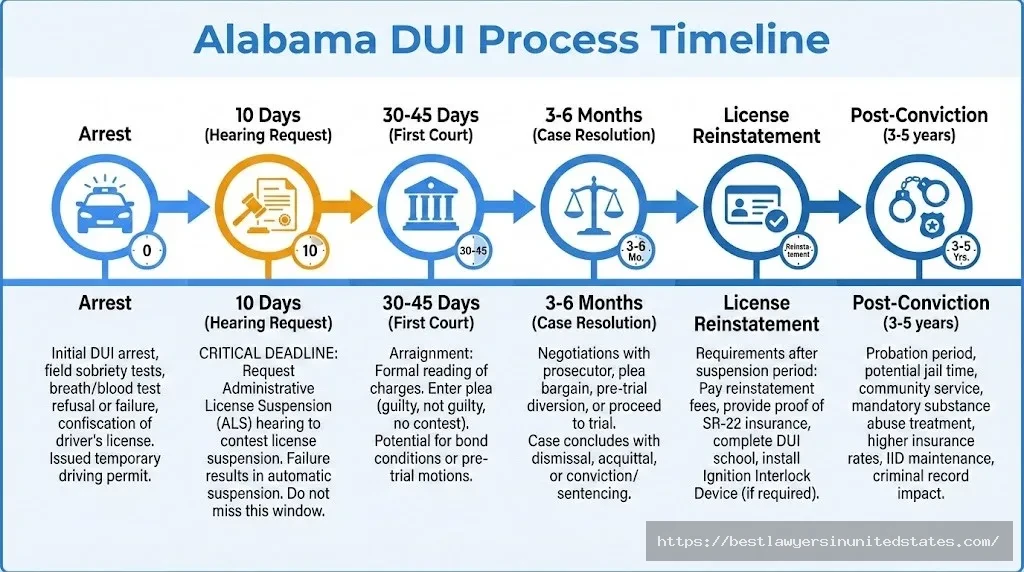
Days 1-10: Request Administrative Hearing (CRITICAL DEADLINE)
Alabama’s Department of Public Safety will suspend your license automatically if you failed or refused a chemical test. You have exactly 10 calendar days from your arrest date to request an administrative hearing. Miss this deadline and your suspension becomes automatic with no opportunity to contest it.
File your hearing request with the Alabama Law Enforcement Agency Administrative License Suspension Division. You can submit the form online, by mail, or in person at any ALEA Driver License Office. Locations include Birmingham (2100 E South Blvd), Mobile (1301 Azalea Rd), and Montgomery (2701 Gunter Park Dr W).
The administrative hearing is separate from your criminal case. You can win the administrative hearing and still face criminal charges. However, winning the hearing preserves your driving privileges while your criminal case proceeds.
Week 1: Find a DUI Attorney Before First Court Date
Contact experienced DUI attorneys immediately. Most offer free consultations. Your first court appearance typically occurs 30-45 days after arrest. Waiting until then to hire an attorney wastes valuable investigation time.
Ask attorneys these specific questions:
- How many DUI cases have you handled in [your county]?
- What’s your trial versus plea bargain rate?
- Will you personally handle my case or pass it to another attorney?
- What are realistic outcomes for my specific charges?
Avoid attorneys who guarantee specific results. No honest attorney can promise case dismissal or specific sentences. Look for attorneys familiar with your local court system who have relationships with prosecutors and judges.
Alabama DUI Penalties by Offense Level
Alabama DUI penalties increase dramatically with each offense. The lookback period is five years, meaning prior convictions within five years count as repeat offenses.
First Offense DUI in Alabama
First-time DUI charges qualify as Class A misdemeanors under Alabama law. Prosecutors sometimes offer reduced penalties for first offenders, but nothing is guaranteed.
Criminal Penalties:
Jail time ranges from zero to one year. Most first offenders serve no jail time or 24-48 hours in county lockup. Judges consider factors like your BAC level, cooperation with police, and whether anyone was injured. You’ll report to facilities like the Jefferson County Jail (317 Richard Arrington Jr Blvd N, Birmingham) or Madison County Detention Center (100 Courthouse Square NW, Huntsville).
Fines range from $600 to $2,100. The court sets the exact amount based on your circumstances. This doesn’t include court costs, typically $200-$500 additional.
License suspension lasts 90 days minimum. After 30 days, you can apply for a hardship license allowing driving to work, school, or medical appointments. The hardship license requires ignition interlock installation.
DUI school is mandatory. You must complete an Alabama DUI education program approved by the Alabama Department of Mental Health. The program costs $300-$500 and takes multiple sessions over several weeks.
Substance abuse evaluation determines if you need treatment. A licensed evaluator interviews you and reviews your case details. The evaluation costs $100-$300. If treatment is recommended, you must complete it before license reinstatement.
Probation may last 1-2 years. Conditions typically include no alcohol consumption, random drug testing, community service, and regular meetings with a probation officer. Violations can result in jail time.
Administrative Penalties:
Your license suspension begins immediately upon arrest if you failed or refused the chemical test. This administrative suspension runs separately from criminal penalties. If you request a hearing within 10 days, you can drive until the hearing occurs.
For a failed chemical test, the suspension lasts 90 days. For refusing the test, suspension extends to one year. Many people mistakenly believe refusing the test helps their case. It doesn’t. Refusal can be used as evidence against you and results in longer suspension.
Ignition Interlock Requirements:
Alabama requires ignition interlock devices for six months after a first offense. The device connects to your vehicle’s ignition system and requires a breath sample before starting. Random rolling retests occur while driving to prevent someone else from providing the initial sample.
Installation costs $75-$100. Monthly monitoring fees run $60-$90. You pay all costs. Remove the device early or tamper with it and you face criminal charges plus extended suspension.
Second DUI Offense in Alabama (Within 5 Years)
Second offense DUI within five years carries mandatory minimums. Judges have less discretion to reduce penalties.
Jail time is mandatory: minimum 48 hours, maximum one year. Most second offenders serve 5-10 days in county jail. Some counties allow jail alternatives like weekend sentencing or electronic monitoring for nonviolent offenders.
Fines increase to $1,100-$5,100. Expect the higher end if your BAC was elevated or other aggravating factors exist.
License revocation (not just suspension) lasts one year minimum. No hardship license is available for the first 60 days. After 60 days, you can petition for hardship license with ignition interlock.
Ignition interlock is required for two years. This term begins after your revocation period ends, adding substantial time to restricted driving.
Community service of 30 days or more is mandatory. Some courts allow converting this to additional jail time. Most require actual community service through approved organizations.
DUI court programs may be available. These intensive supervision programs combine treatment, frequent court appearances, and strict monitoring. Successful completion can reduce some penalties. Jefferson County and Mobile County operate DUI court programs.
Third DUI Offense in Alabama
Third offense DUI moves into felony territory in some circumstances. Even as a misdemeanor, penalties become severe.
Jail time is mandatory: minimum 60 days, maximum one year. Expect to serve the minimum at minimum. Judges rarely grant alternative sentencing for third offenses.
Fines range from $2,100 to $10,100. The court also assesses costs, probation fees, and restitution if property damage or injuries occurred.
License revocation lasts three years. After one year, you can petition for hardship license with ignition interlock. Approval is not automatic. The hearing officer reviews your compliance with treatment, employment needs, and driving record.
Vehicle forfeiture becomes possible. Alabama law allows seizing vehicles used in third or subsequent DUI offenses. Prosecutors don’t pursue this in every case, but the threat exists. If the vehicle is financed, the lender’s interest is protected, but you still lose the vehicle.
Ignition interlock is required for three years after the revocation period ends.
Substance abuse treatment is mandatory. The court orders inpatient or intensive outpatient treatment based on your evaluation. Treatment duration varies from 30 days to several months. You pay all costs.
Fourth DUI Offense in Alabama (FELONY)
Fourth offense DUI within five years becomes a Class C felony under Alabama law. This conviction creates a permanent felony record affecting employment, housing, gun ownership, and voting rights.
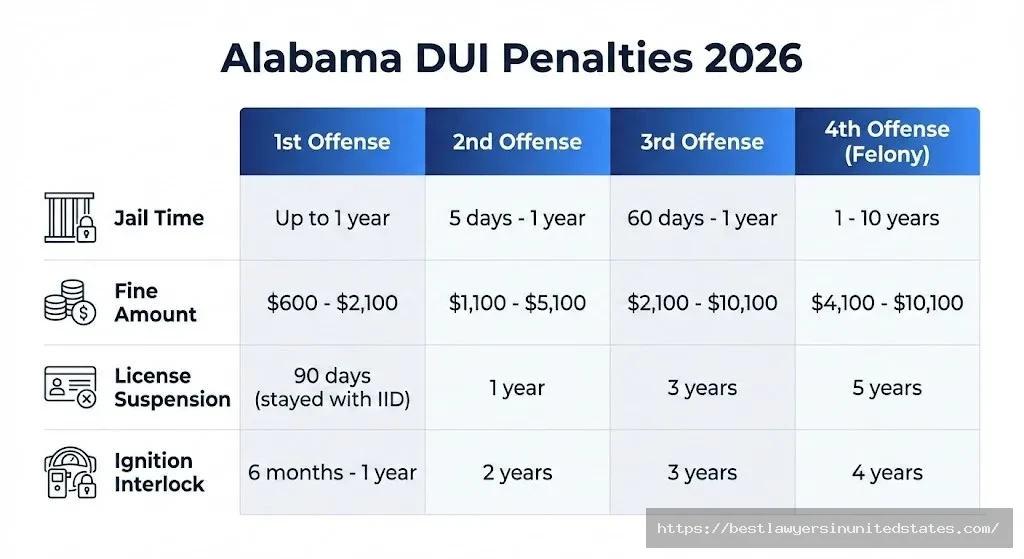
Prison time ranges from one to 10 years. Most fourth offenders serve 1-3 years in Alabama Department of Corrections facilities. Early release through good behavior may reduce actual time served.
Fines range from $4,100 to $10,100 plus court costs. Financial penalties become the least of your concerns with prison time.
License revocation lasts five years. No hardship license is available for the first year. After one year, you can petition for hardship license, but approval is rare for felony DUI offenders.
Ignition interlock is required for five years after the revocation period. This means up to six years of interlock requirements total.
Voting rights are suspended during incarceration and while on parole. Alabama automatically restores voting rights for most Class C felonies after completing your sentence. However, you must apply for restoration.
Gun ownership rights are lost permanently. Federal law prohibits felons from possessing firearms. Alabama law contains similar restrictions. Some rights may be restored through a pardon, but the process takes years and succeeds rarely.
Calculate Your Total DUI Costs
Use our DUI cost calculator to estimate the full financial impact of a DUI in Alabama based on your offense level and circumstances.
The calculator includes court fines, attorney fees, insurance increases, license reinstatement fees, DUI school, ignition interlock costs, and lost wages.
DUI Cost Calculator
Estimate total DUI expenses by state and offense
Detailed Cost Breakdown
Payment Timeline
Bail bond, towing fees, car impound, attorney retainer
Initial court fines, DMV fees, DUI school enrollment, ignition interlock installation
Monthly probation fees, ignition interlock fees, DUI school payments, attorney balance
Insurance premium increases, license reinstatement, SR-22 filing fees
- Lost wages from missed work (court dates, jail time, DUI school) – $2,000-$10,000
- Job loss or difficulty finding employment – Varies
- Professional license suspension (doctors, lawyers, nurses, pilots) – Career ending
- Rideshare and transportation costs during suspension – $1,500-$5,000
- Travel restrictions and visa denials – Varies
- Security clearance loss – Career impact
- Child custody implications – Legal costs
- Rental car restrictions – Varies
- Personal relationships and mental health costs – Priceless
True Cost of a DUI in Alabama: Complete Financial Breakdown
DUI costs extend far beyond court fines. The total financial impact for a first offense ranges from $8,025 to $22,225. Here’s where your money goes.
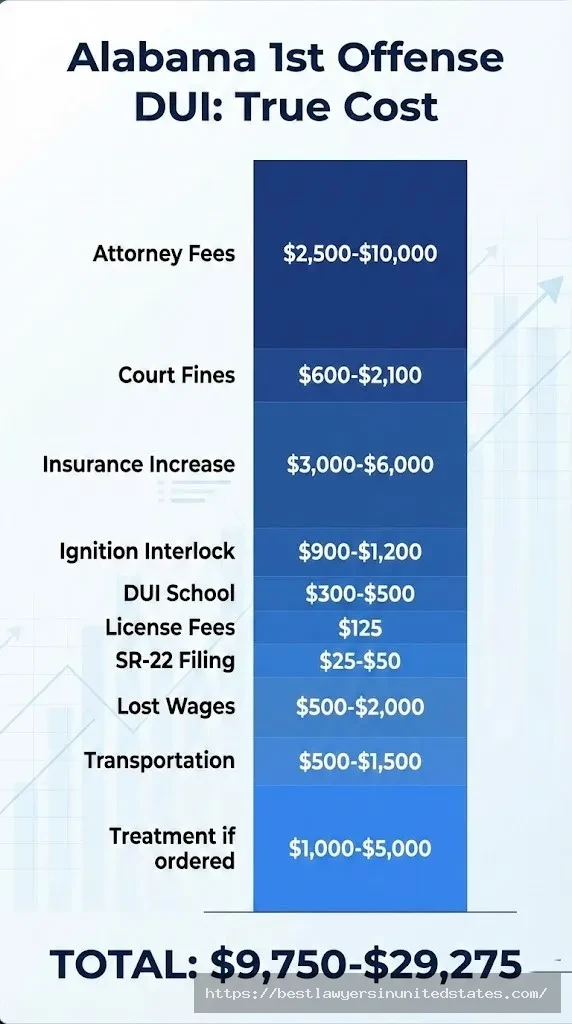
First Offense Cost Breakdown
| Expense | Cost Range |
|---|---|
| Court fines | $600-$2,100 |
| Court costs | $200-$500 |
| Attorney fees | $2,500-$10,000 |
| DUI school | $300-$500 |
| Substance abuse evaluation | $100-$300 |
| Treatment (if ordered) | $1,000-$5,000 |
| Ignition interlock (6 months) | $900-$1,200 |
| License reinstatement | $125 |
| SR-22 insurance filing | $25-$50 |
| Increased insurance premiums (3 years) | $3,000-$6,000 |
| Lost wages (court/jail) | $500-$2,000 |
| Alternative transportation | $500-$1,500 |
| TOTAL | $9,750-$29,275 |
Attorney fees vary based on case complexity and attorney experience. Simple first offense cases with no accident or injury cost $2,500-$5,000. Cases requiring trial preparation range from $5,000-$10,000. Complex cases with serious injuries or prior offenses exceed $10,000.
DUI school and treatment costs add up quickly. The mandatory DUI education program costs $300-$500. If your substance abuse evaluation recommends treatment, expect $1,000-$5,000 for outpatient programs. Inpatient treatment reaches $10,000-$30,000.
Ignition interlock costs $75-$100 for installation plus $60-$90 monthly monitoring. For a six-month requirement, total costs run $900-$1,200. Longer requirements for repeat offenses multiply these costs. Violations require device recalibration at $50-$100 each time.
Insurance rate increases hurt for years. Your insurer will reclassify you as high-risk. Rates typically increase 50-100% for three to five years. A driver paying $1,000 annually will pay $1,500-$2,000 after DUI. Over three years, that’s $3,000-$6,000 in additional premiums. Some insurers drop DUI offenders entirely, forcing you to high-risk insurers with even higher rates.
SR-22 insurance filing proves you carry required coverage. Alabama requires SR-22 for three years after DUI. The filing fee costs $25-$50, but the real cost comes from higher premiums attached to SR-22 policies.
Lost wages compound during court appearances and jail time. Each court date means missing work. Jail time, even 48 hours, costs wages plus potential job loss. Some employers fire employees who can’t report to work during incarceration. Professional license holders face additional consequences.
Transportation costs add up when your license is suspended. Uber, Lyft, and taxis become your only options. A 10-mile commute to work costs $15-$25 each way. Over 90 days, that’s $2,700-$4,500 in transportation costs alone. Public transportation helps but adds time to every trip.
Hidden Costs Not in the Table
Employment consequences can be devastating. Some employers fire employees with DUI convictions, especially if the job involves driving. Professional licenses for nurses, teachers, real estate agents, and others face board review. Some boards suspend or revoke licenses.
Background checks reveal DUI convictions permanently unless expunged. This affects housing applications, college admissions, and security clearances. You’ll explain your conviction for years in applications and interviews.
Vehicle impoundment costs apply if your car was towed after arrest. Towing runs $150-$300. Storage fees accumulate at $25-$50 daily. A vehicle stored for five days before release costs $300-$550 total.
Bail bonds cost 10-15% of bail amount. A $1,000 bail requires $100-$150 to a bondsman. You never recover this fee. If you post bail directly, the court refunds it after case resolution, but most people lack funds to post full bail.
Second and Third Offense Costs
Second offense costs start at $15,000 and easily exceed $35,000. Third offense costs exceed $25,000 and can reach $50,000 or more when including treatment and lost employment.
Mandatory jail time creates more lost wages. Treatment becomes longer and more expensive. Attorney fees increase due to case complexity. Ignition interlock requirements extend to two or three years. Insurance companies may refuse coverage entirely.
Fourth Offense (Felony) Costs
Felony DUI costs become incalculable. Prison time means job loss. Felony records make future employment difficult. Professional licenses are often permanently lost. Housing options shrink. The financial impact lasts a lifetime.
Alabama’s Taylor’s Law: When DUI Penalties Double
Taylor’s Law, named after 6-year-old Taylor Bray who was killed by a drunk driver, increases DUI penalties in specific circumstances. The law took effect in 2019 and applies statewide.
What is Taylor’s Law?
Taylor’s Law doubles fines and adds mandatory minimum jail time when certain aggravating factors exist. It aims to punish DUI offenders who create elevated risks. The law applies to all offense levels, first through fourth.
Aggravating Factors That Trigger Enhanced Penalties
Child Passenger (Under 14): Having a child under 14 in your vehicle during DUI doubles all fines and requires mandatory minimum jail time. First offense minimum becomes 30 days. Second offense minimum becomes 90 days. These minimums apply even if the judge wants to be lenient.
High BAC (0.15% or Higher): Your BAC at time of testing matters. A 0.15% BAC is nearly twice the legal limit. This threshold triggers enhanced penalties. Your BAC level depends on weight, drinks consumed, and time elapsed since drinking.
Accident Causing Injury: DUI with serious injury upgrades charges significantly. Serious injury means broken bones, hospital admission, or permanent impairment. These cases often become felonies regardless of prior offenses.
Accident Causing Death: DUI causing death results in vehicular manslaughter charges (Class B felony). Prison time ranges from 2-20 years. No suspended sentences are allowed.
Driving in School Zone: DUI in an active school zone during school hours doubles fines. School zones cover the area within 1,000 feet of school property during arrival and dismissal times.
Suspended or Revoked License: Driving DUI while your license is already suspended or revoked for a prior DUI adds mandatory jail time. You’ll also face separate charges for driving on suspended license.
Third or Subsequent Offense: Third and fourth offenses automatically qualify as aggravated DUI. Penalties escalate even without other factors.
How Enhanced Penalties Apply
Fines double for aggravating factors. A $600-$2,100 first offense fine becomes $1,200-$4,200 with a child passenger. These doubled fines stack on top of all other costs.
Mandatory minimum jail time removes judicial discretion. Judges who might otherwise grant alternative sentencing must impose jail time. Good behavior during court proceedings doesn’t reduce the mandatory minimum.
Treatment requirements increase. Courts order longer treatment programs when aggravating factors exist. This means more time away from work and family plus higher treatment costs.
DUI Arrest Process and Your Rights in Alabama
Understanding the arrest process helps you protect your rights. Each stage offers opportunities for defense attorneys to challenge evidence.
Traffic Stop and Investigation
Police need reasonable suspicion to stop your vehicle. Common reasons include weaving between lanes, speeding, running red lights, or equipment violations like broken taillights. Random stops without cause are illegal.
Officers look for signs of impairment during the initial conversation. Slurred speech, alcohol odor, bloodshot eyes, and fumbling with documents create suspicion. Officers note these observations in arrest reports.
Field sobriety tests are optional in Alabama. You can refuse them without penalty. The Standardized Field Sobriety Tests include:
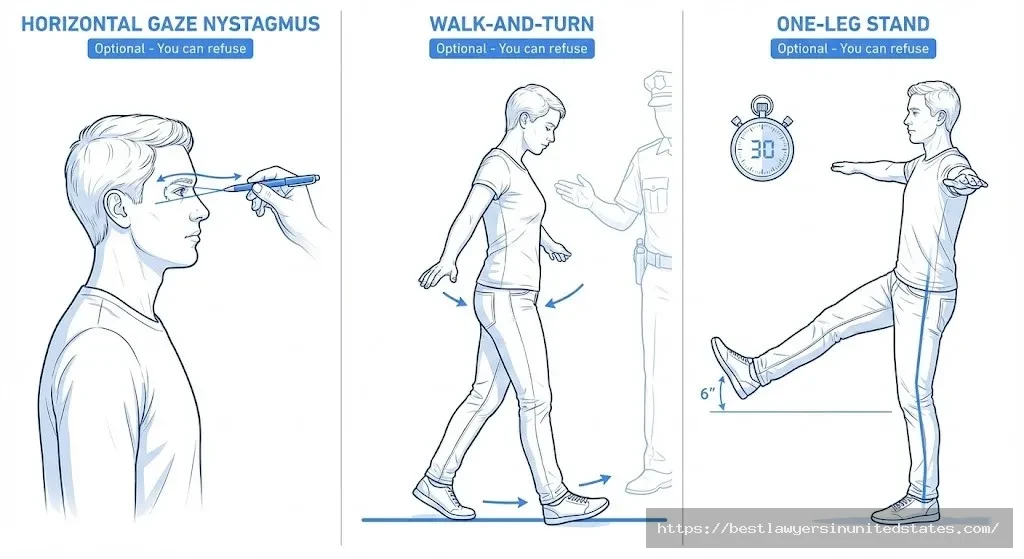
- Horizontal Gaze Nystagmus (following a pen with your eyes)
- Walk-and-Turn (nine steps heel-to-toe, turn, nine steps back)
- One-Leg Stand (stand on one leg for 30 seconds)
These tests are subjective. Officers interpret results based on training. Failure doesn’t prove intoxication. Medical conditions, nervousness, and poor coordination affect performance. Many sober people fail these tests.
Portable breathalyzers given at roadside are preliminary tests. Results are not admissible in court. These devices are less accurate than station breathalyzers. You can refuse the portable test. However, refusal gives officers additional evidence of guilt.
Arrest and Implied Consent
Once arrested, Alabama’s implied consent law applies. By driving on Alabama roads, you’ve legally agreed to chemical testing if arrested for DUI. This consent is implied by the act of driving.
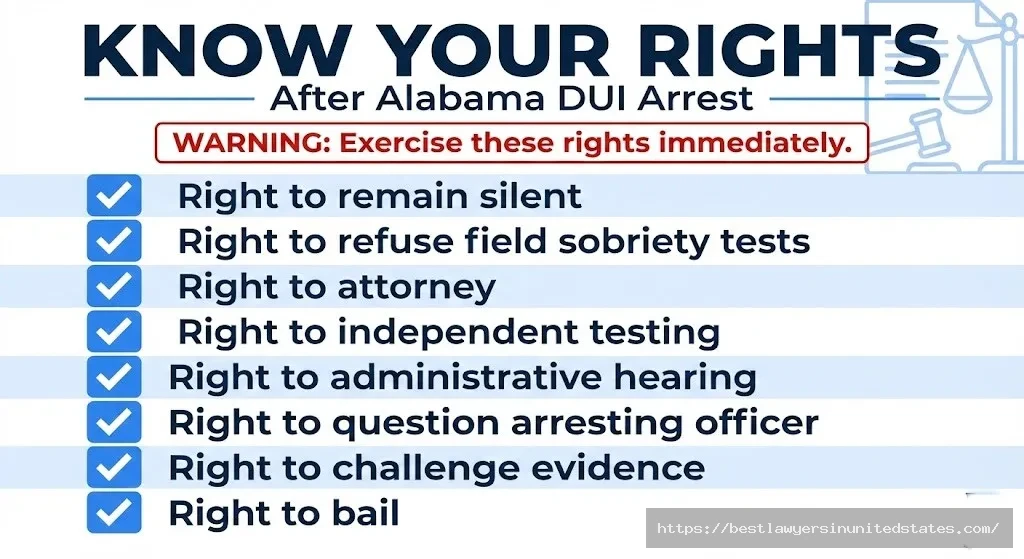
Officers must read you the implied consent warning before requesting chemical testing. The warning explains refusal consequences: immediate license suspension. Officers must give this warning at the jail or testing facility, not at roadside.
You can still refuse chemical testing after arrest. However, refusal results in automatic license suspension: 90 days for first refusal, one year for second refusal within five years. Refusal can also be used as evidence of guilt at trial.
Chemical test options include breath, blood, or urine. You don’t choose which test. Officers decide based on suspected substance. Breath tests measure alcohol only. Blood tests detect alcohol and drugs. Urine tests are rarely used due to reliability issues.
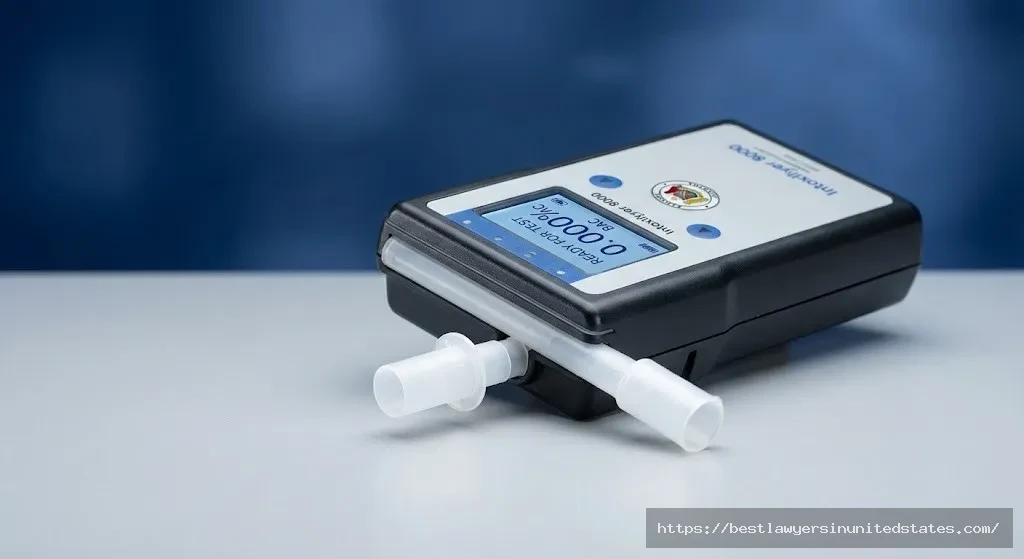
The Intoxilyzer 8000 is Alabama’s approved breath testing device. Operators must be certified and follow strict protocols. The device must be calibrated regularly. Defense attorneys often challenge calibration records and operator qualifications.
Blood tests require qualified medical personnel. A nurse, doctor, or trained phlebotomist must draw blood. Testing occurs at hospitals or specialized facilities. Chain of custody must be maintained for results to be admissible.
You have the right to independent testing. Alabama law allows you to request testing by a provider of your choice at your expense. Police must allow reasonable opportunity for this testing. Most people don’t know this right exists and never request it. An independent test showing lower BAC strengthens your defense.
Booking and Release
Booking occurs at the county jail. You’ll be fingerprinted, photographed, and searched. Officers confiscate personal property. The jail holds you until bail is set or you’re released on recognizance.
Bail amounts for first offense DUI typically range from $500 to $2,000. Second and third offenses see higher bail. Factors include your ties to the community, prior criminal history, and whether you’re considered a flight risk.
Release on recognizance means you’re released without posting bail. First offenders with clean records and local ties often qualify. You sign paperwork promising to appear at court dates.
Bonding out requires payment. You can pay the full bail amount in cash, which is refunded after case resolution. Or you can use a bail bondsman who charges 10-15% nonrefundable fee. A bondsman posts the full bail, but you never recover the fee.
Your first court appearance is typically scheduled 30-45 days after arrest. The paperwork given at release includes this date. Missing it results in a warrant for your arrest and forfeiture of any bail posted.
License Suspension: Two Separate Battles You’re Fighting
Most people arrested for DUI don’t realize they face two separate cases: administrative (civil) and criminal. You can lose your license through the administrative process even if your criminal case is dismissed.
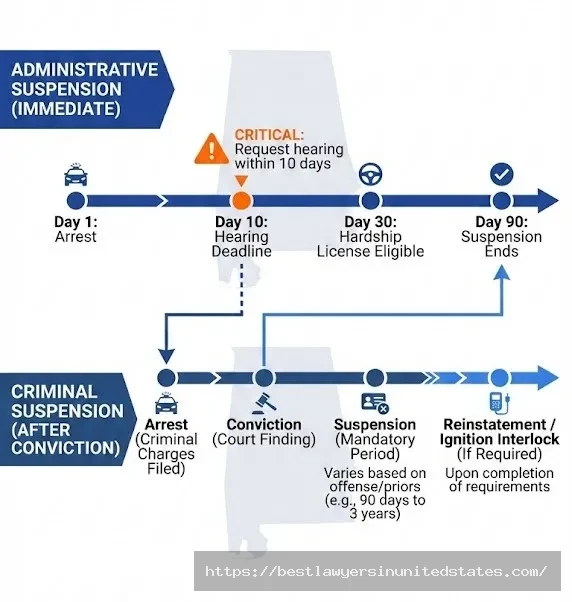
Administrative License Suspension (Immediate)
The administrative case begins at arrest. If you failed or refused the chemical test, your license suspension starts immediately. The officer confiscates your physical license and issues a temporary permit valid for 10 days.
You must request a hearing within 10 days to challenge the suspension. File the request with the Alabama Law Enforcement Agency Administrative License Suspension Division. Forms are available online at www.alea.gov or at any ALEA Driver License office.
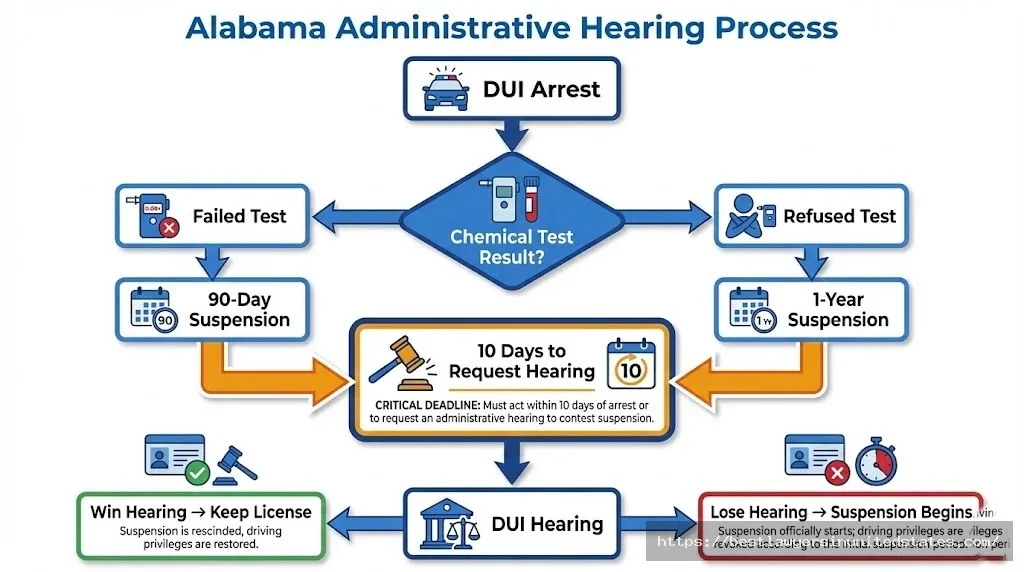
The administrative hearing focuses on limited issues:
- Did the officer have probable cause to arrest you?
- Did the officer properly administer the chemical test?
- Did your BAC exceed the legal limit or did you refuse testing?
The hearing officer is not a judge. These officials work for ALEA and have limited discretion. The burden of proof is lower than in criminal court. The state must show by a preponderance of evidence (more likely than not) that you violated the law.
Your attorney can subpoena the arresting officer, maintenance records for testing equipment, and calibration logs. Many officers don’t appear at administrative hearings. If the officer doesn’t appear and no other evidence supports suspension, you may win by default.
Winning the administrative hearing preserves your license until your criminal case resolves. Losing means your suspension begins immediately. However, you can often apply for a hardship license.
Suspension lengths for administrative cases:
- Failed test, first offense: 90 days
- Failed test, second offense within 5 years: 1 year
- Refused test, first offense: 1 year
- Refused test, second offense within 5 years: 3 years
Criminal License Suspension (After Conviction)
Your criminal DUI case proceeds separately in criminal court. A conviction here results in additional license suspension or revocation. This penalty is imposed by the judge as part of sentencing.
The criminal suspension runs concurrent with (at the same time as) any administrative suspension if you lost that hearing. However, criminal penalties often extend longer than administrative penalties.
Criminal conviction suspension periods:
- First offense: 90 days minimum
- Second offense within 5 years: 1 year minimum
- Third offense: 3 years minimum
- Fourth offense: 5 years minimum
These minimums can be extended based on aggravating factors. The judge sets the exact term within statutory limits.
If you win your administrative hearing but lose your criminal case, the criminal suspension begins after conviction. If you lost both, the longer suspension controls, and both don’t stack on top of each other.
Hardship License Eligibility
A hardship license (restricted license) allows limited driving during suspension. You can drive to work, school, medical appointments, and substance abuse treatment. No recreational driving is allowed.
Eligibility timing varies by offense:
- First offense: Available after 30 days
- Second offense: Available after 60 days
- Third offense: Available after 1 year
- Fourth offense: Available after 1 year (rarely granted)
You must petition the court or administrative hearing officer for a hardship license. Approval requires proving you need to drive for livelihood, education, or necessary medical treatment. Public transportation availability affects approval.
Hardship license requirements:
- Proof of SR-22 insurance
- Ignition interlock device installed in your vehicle
- Completion of DUI school (sometimes required first)
- Payment of reinstatement fees
The hardship license restricts you to specific routes at specific times. For example, you might be allowed to drive between 7-9 AM to work and 5-7 PM home. Violating these restrictions results in immediate revocation.
Ignition Interlock Device Requirements
Alabama requires ignition interlock devices for all DUI offenses. The device connects to your vehicle’s starter and requires a breath sample before starting. Random rolling retests occur while driving.
Installation must be done by an approved provider. Alabama maintains a list of certified installers statewide. You choose the installer but must select from the approved list. Installation costs $75-$100.
Monthly monitoring fees run $60-$90. The device records all tests, violations, and driving patterns. You must bring your vehicle to the installer monthly for data download and calibration check. Miss an appointment and the device locks your vehicle until serviced.
Required ignition interlock periods:
- First offense: 6 months
- Second offense: 2 years
- Third offense: 3 years
- Fourth offense: 5 years
These periods begin after your suspension/revocation ends. For a first offense with 90-day suspension, you need ignition interlock for 6 additional months after the 90 days expire. Total restricted driving time: 9 months.
Violations and tampering result in extended interlock requirements and possible criminal charges. Violations include:
- Failed test (BAC above 0.02%)
- Missed rolling retest
- Attempting to bypass the device
- Having someone else blow into the device
Each violation adds 30-90 days to your required interlock period. Multiple violations can extend your requirement by years.
How to Beat a DUI in Alabama: Defense Strategies
DUI cases are winnable. Successful defenses attack the evidence, procedures, and testimony. Here are the most effective strategies Alabama DUI attorneys use.
Illegal Traffic Stop
Police need reasonable suspicion to stop your vehicle. Random stops and stops based on hunches are unconstitutional. Your attorney examines why the officer stopped you.
Common illegal stop scenarios:
- Officer stopped you in a high-crime area without specific wrongdoing
- Officer followed you from a bar but you committed no traffic violation
- Officer conducted random stop without checkpoint authorization
- Stop based solely on anonymous tip without corroboration
If the stop was illegal, all evidence gathered afterward gets suppressed. This includes breath tests, blood tests, and officer observations. Suppression often forces prosecutors to dismiss charges.
Checkpoint stops face special scrutiny. Alabama law allows DUI checkpoints, but strict requirements apply. Police must follow written policies for checkpoint location, timing, and vehicle selection. They can’t arbitrarily choose which vehicles to stop.
Faulty Breathalyzer Results
Breath test results seem scientific and objective. They’re not. Multiple factors affect accuracy.
Calibration Issues: The Intoxilyzer 8000 requires calibration every 30 days. Your attorney subpoenas maintenance logs. Missing calibrations or failed calibration tests invalidate results.
Operator Error: The officer must be certified to operate the device. Certification requires training and periodic renewal. Your attorney verifies the officer’s credentials. Expired certification means inadmissible results.
Mouth Alcohol Contamination: The officer must observe you for 20 minutes before testing. This observation period ensures mouth alcohol from recent drinking, burping, or vomiting doesn’t inflate results. If the officer didn’t wait the full 20 minutes, results may be suppressed.
Medical Conditions: GERD (acid reflux), diabetes, and certain diets produce mouth alcohol that affects results. GERD causes stomach acid and alcohol to rise into your mouth. Diabetes and ketogenic diets create acetone, which breathalyzers sometimes mistake for alcohol.
Rising BAC Defense: Your BAC continues rising for 30-90 minutes after your last drink. If you were stopped soon after leaving a bar, your BAC at the time of testing may have been higher than while actually driving. Alabama law requires impairment while driving, not just at test time.
Your attorney can hire an expert witness to testify about these factors. Expert testimony explaining technical flaws in testing often creates reasonable doubt.
Improper Testing Procedures
Blood tests follow strict procedures. Violations invalidate results.
Chain of Custody: Every person who handled your blood sample must be documented. Nurses who drew blood, officers who transported it, and lab technicians who tested it all appear in chain of custody records. Breaks in the chain allow challenges to whether the tested blood was actually yours.
Qualified Personnel: Only qualified medical personnel can draw blood. In some rural areas, officers draw blood themselves. This violates Alabama law. Your attorney verifies who drew your blood and their qualifications.
Sterile Procedure: Blood draws require sterile equipment and proper technique. Alcohol-based cleansers contaminate samples. The medical professional should use non-alcoholic cleansers like benzalkonium chloride or iodine.
Preservation: Blood samples require specific preservatives and refrigeration. Improper storage allows fermentation, which increases measured alcohol content. Testing must occur within specific timeframes.
Lack of Actual Physical Control
To convict you of DUI, prosecutors must prove you were in actual physical control of the vehicle. This becomes an issue in cases where you weren’t actively driving.
Common scenarios:
- Sleeping in parked car with engine off
- Sitting in passenger seat with keys in console
- Outside the vehicle but keys in your pocket
- Someone else was driving
Alabama courts look at multiple factors: key location, engine status, your position in the vehicle, and whether the vehicle was operable. No single factor determines control. The totality of circumstances matters.
Defense strategy emphasizes you had no intent to drive. If you’re sleeping in the back seat with keys in the trunk, you’ve taken steps to avoid driving. This shows responsibility, not criminal intent.
Violation of Constitutional Rights
Police must follow your constitutional rights during arrest and investigation.
Miranda Rights: Officers must read your Miranda rights before custodial interrogation. If they questioned you after arrest without reading rights, those statements get suppressed. However, Miranda only applies to questioning after arrest, not during the initial traffic stop.
Illegal Search: Police need probable cause or your consent to search your vehicle. If they searched without either, evidence found may be suppressed. This includes open containers, drugs, or other contraband discovered during the search.
Coerced Confession: Your statements must be voluntary. If officers threatened you, made false promises, or used other coercive tactics, your statements get suppressed. Examples include officers saying “cooperate or we’ll charge your passenger too” or “it’ll be easier if you admit you were drinking.”
Challenging Field Sobriety Tests
Field sobriety tests are highly subjective. Officers interpret your performance based on their training. Many factors unrelated to intoxication affect performance.
Medical Conditions: Inner ear problems affect balance. Knee or back injuries prevent proper completion. Vision problems make following a pen difficult. Neurological conditions cause nystagmus (involuntary eye movement) that mimics intoxication.
Physical Factors: Age over 65, obesity, and leg length discrepancy all affect performance. Footwear matters too. High heels or boots make heel-to-toe walking nearly impossible. Officers should account for these factors but often don’t.
Environmental Conditions: Tests conducted on uneven pavement, in bad weather, or with heavy traffic create unreliable results. The one-leg stand test on gravel is unfair. Walk-and-turn on sloped surfaces is unreliable.
Nervousness: Being stopped by police creates anxiety in sober people. Nervousness causes shaking, sweating, and poor coordination that officers mistake for intoxication.
Your attorney cross-examines the officer about test administration. Did they demonstrate each test? Did they give clear instructions? Did they account for your medical conditions or environmental factors? Inconsistencies undermine the officer’s testimony.
Realistic Expectations About Dismissal
Not every DUI case gets dismissed. Strong evidence makes winning difficult. However, several scenarios increase dismissal chances:
- Illegal stop with no other evidence
- Breath test under 0.10% with good driving and no other impairment signs
- Blood test issues with chain of custody
- Video evidence contradicting officer testimony
- Medical conditions explaining your behavior
Your attorney evaluates your specific case and advises on realistic outcomes. Sometimes negotiating reduced charges (reckless driving) produces better results than trial. Sometimes trial is worth the risk.
Finding the Right Alabama DUI Attorney
Your attorney choice significantly impacts your case outcome. Hire an experienced DUI attorney, not a general criminal defense lawyer. DUI law is specialized. Specific knowledge of breath testing, blood testing, and administrative license procedures matters.
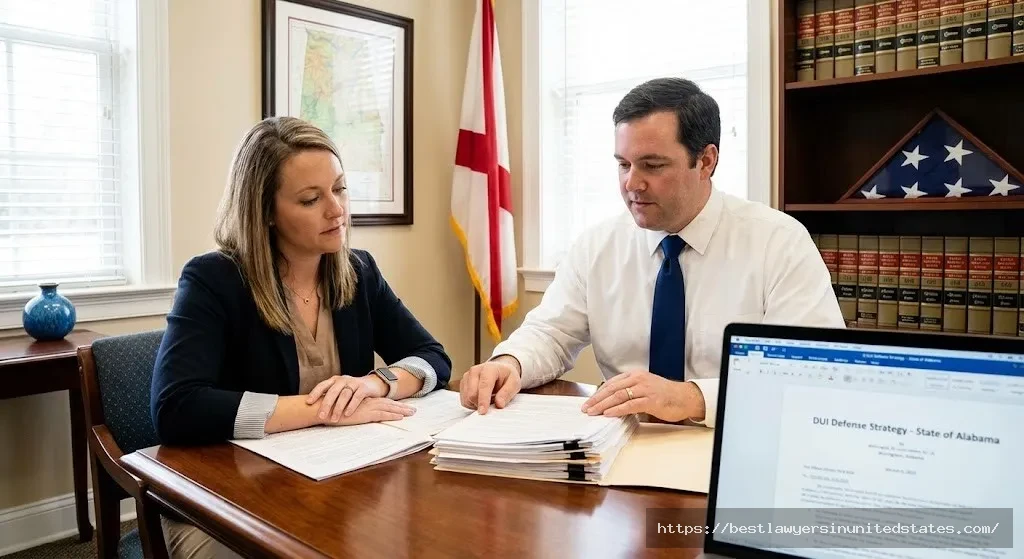
What to Look For
Alabama Bar Certification: Verify the attorney is licensed to practice in Alabama. Check the Alabama State Bar website for disciplinary history. Some attorneys licensed in other states try to practice in Alabama. Only Alabama-licensed attorneys can represent you.
DUI-Specific Experience: Ask how many DUI cases the attorney has handled in the past year. Dozens is good. Hundreds is better. An attorney who handles one or two DUI cases monthly doesn’t have enough experience.
Trial Experience: Many attorneys only negotiate pleas. While plea bargains resolve most cases, you want an attorney willing to take your case to trial if necessary. Ask about their trial versus plea ratio. Some trial experience is essential.
Local Court Familiarity: Attorneys who regularly practice in your county know the prosecutors, judges, and local procedures. This familiarity helps negotiate better outcomes. An attorney from another county may not understand local practices.
Scientific Training: Top DUI attorneys complete training in breath testing technology and field sobriety test administration. The National Highway Traffic Safety Administration (NHTSA) offers courses to law enforcement. Attorneys who complete the same training can challenge officer testimony more effectively.
Free Consultation: Most DUI attorneys offer free initial consultations. Meet with several attorneys before choosing. Compare their experience, approach, and fees. A free consultation lets you evaluate whether you’re comfortable with the attorney.
Questions to Ask During Consultation
- How many DUI cases have you handled in [your county]?
- What percentage of your cases go to trial versus plea bargaining?
- Will you personally handle my case or delegate to another attorney?
- What are realistic outcomes for my specific charges and facts?
- Have you completed NHTSA standardized field sobriety test training?
- Do you have experience challenging Intoxilyzer 8000 results?
- What is your fee structure and payment plan options?
- How will we communicate during the case?
Take notes during consultations. Compare attorney responses. Trust your instincts about who will fight hardest for you.
Red Flags to Avoid
Guaranteed Outcomes: No ethical attorney guarantees case dismissal or specific sentences. Too many variables exist. Attorneys who promise results are being dishonest.
Extremely Low Fees: DUI defense requires substantial work. Attorneys charging $500-$1,000 can’t possibly provide adequate representation. They handle volume cases with minimal effort. Expect to pay $2,500-$10,000 for quality representation.
Immediate Pressure: Attorneys who demand you sign a retainer agreement immediately are more interested in getting paid than evaluating your case. Take time to decide. Most courts allow 30-60 days before requiring attorney appearance.
Poor Communication: If the attorney doesn’t return calls during the hiring process, communication won’t improve after hiring. Responsiveness matters. Your case is important to you. It should be important to your attorney too.
No Local Experience: Attorneys who practice statewide may lack specific county knowledge. Jefferson County procedures differ from Mobile County. Baldwin County judges handle cases differently than Madison County judges. Local knowledge matters.
Payment Plans and Costs
DUI attorney fees vary based on case complexity:
- First offense, no accident: $2,500-$5,000
- First offense with accident or injury: $5,000-$7,500
- Second or third offense: $5,000-$10,000
- Fourth offense (felony): $10,000-$25,000
- Trial preparation and trial: Add $3,000-$10,000
Most attorneys require a retainer (upfront payment) covering initial work. This ranges from $1,000-$3,000. The remainder can often be paid in installments over 3-6 months.
Some attorneys accept credit cards. Others offer in-house payment plans. A few work with legal financing companies. Discuss payment options during your consultation.
Public defenders are available if you can’t afford an attorney. However, public defenders handle hundreds of cases simultaneously. They provide basic representation but lack time for intensive case preparation. Hiring private counsel produces better outcomes if you can afford it.
County-Specific DUI Information in Alabama
DUI enforcement and court procedures vary by county. Here’s what you need to know about Alabama’s largest counties.
Jefferson County (Birmingham)
Jefferson County processes more DUI cases than any Alabama county. Cases are heard at multiple locations:

Bessemer Division: 1801 3rd Avenue North, Bessemer, AL 35020. Handles cases from western Jefferson County including Bessemer, Hueytown, and Midfield.
Birmingham Division: Jefferson County Courthouse, 716 Richard Arrington Jr Blvd N, Birmingham, AL 35203. Handles cases from Birmingham, Homewood, Mountain Brook, and Vestavia Hills.
DUI Court Program: Jefferson County operates a specialized DUI court for repeat offenders. The program combines intensive supervision, treatment, and regular court appearances. Successful completion can reduce some penalties. Eligibility requires second or third offense DUI with substance abuse issues.
Administrative Hearings: Held at ALEA Driver License Office, 2100 East South Boulevard, Montgomery, AL 36116. However, Jefferson County residents can often attend hearings at Birmingham office upon request.
Mobile County
Mobile County sees high DUI enforcement due to coastal tourism. Holidays and summer weekends see increased checkpoints.
Mobile County Courthouse: Government Plaza, 205 Government Street, Mobile, AL 36602. All DUI cases are heard here regardless of where in the county you were arrested.
Enforcement Patterns: Highway 98 (Beach Boulevard) and Highway 193 (Battleship Parkway) see frequent DUI stops during summer. Alabama State Troopers and Mobile Police Department both patrol these routes heavily.
Tourist Impact: Out-of-state defendants face unique challenges. Missing court dates results in warrants. Consider hiring local counsel to appear on your behalf if travel is difficult.
Baldwin County
Baldwin County includes Gulf Shores, Orange Beach, and Fairhope. Tourism drives aggressive DUI enforcement.
Bay Minette Courthouse: 251 C Hand Avenue, Bay Minette, AL 36507. All DUI cases are heard here. The drive from the beach takes 45 minutes.
High Enforcement Areas: Highway 59 from Gulf Shores to I-10 is heavily patrolled. Alabama 180 and 182 (beach roads) see frequent stops. Memorial Day through Labor Day enforcement is intense.
Out-of-State Defendants: Many Baldwin County DUI defendants are tourists. Hiring local counsel is essential. They can appear at most hearings without you being present.
Madison County (Huntsville)
Madison County serves North Alabama including Huntsville, Alabama’s largest city by population.
Madison County Courthouse: 100 Courthouse Square NW, Huntsville, AL 35801. All DUI cases are heard here.
Employment Impact: Huntsville’s economy centers on aerospace, defense, and technology. Many jobs require security clearances. DUI convictions can result in clearance loss. This makes fighting charges especially important for Huntsville residents.
Scientific Community: Many Madison County defendants work in technical fields. Prosecutors face educated jurors who understand statistical analysis and scientific method. This sometimes helps defendants when technical defenses are raised.
Montgomery County
Alabama’s capital sees DUI enforcement focused on downtown entertainment district and Interstate 85 corridor.
Montgomery County Courthouse: 251 South Lawrence Street, Montgomery, AL 36104. Criminal cases are heard here.
Administrative Hearings: ALEA Administrative License Suspension Division is headquartered in Montgomery at 2701 Gunter Park Drive West, Montgomery, AL 36109. Montgomery County residents have the easiest access to in-person administrative hearings.
Smaller Counties
Rural counties handle DUI cases differently. Some points to know:
Limited Public Defenders: Small counties may have only one or two public defenders handling all cases. Private attorneys may travel from larger cities.
Local Counsel: Hiring an attorney who practices regularly in that county helps. Judges and prosecutors in small counties know local attorneys well.
Longer Case Timelines: Rural courts meet less frequently. Your case may take longer to resolve than in urban counties.
Long-Term Consequences of Alabama DUI Conviction
DUI consequences extend years beyond your case resolution. Understanding these impacts helps you make informed decisions about your defense.
Criminal Record Impact
DUI convictions appear on Alabama criminal records permanently unless expunged. Alabama allows expungement of some first offense misdemeanors, but the process requires completing your sentence, waiting several years, and petitioning the court. Most people never pursue expungement.
Your criminal record appears in background checks for employment, housing, loans, and education. You’ll check “yes” when applications ask about criminal convictions. You’ll explain your DUI in job interviews for years.
Employment Background Checks: Most employers conduct criminal background checks. DUI shows up. Some employers have zero-tolerance policies for criminal convictions. Others consider the nature of the offense and how long ago it occurred. Jobs involving driving almost always reject applicants with DUI convictions.
Professional Licensing: State licensing boards review criminal convictions. Nurses, teachers, real estate agents, lawyers, accountants, and others face board discipline for DUI. Some boards suspend licenses. Others impose probation. A few revoke licenses permanently.
The Alabama Board of Nursing is particularly strict. A DUI conviction often results in license suspension for 6-12 months. During suspension, you can’t work as a nurse. Some nursing employers fire nurses who lose their license even temporarily.
Teachers face review by the Alabama State Department of Education. First offense DUI typically results in probation. Multiple DUI convictions can lead to permanent certificate revocation.
Security Clearances: Federal security clearances require disclosure of all criminal convictions. DUI alone doesn’t automatically disqualify you. However, the security clearance investigator reviews circumstances. Recent DUI or multiple offenses raise concerns about judgment and reliability. Some clearances get denied. Others face delays.
Gun Ownership: Misdemeanor DUI doesn’t affect gun ownership rights in Alabama. However, felony DUI (fourth offense) prohibits gun possession under federal and Alabama law. Convicted felons cannot own, purchase, or possess firearms.
Employment Consequences
Beyond background checks, DUI convictions directly impact employment.
Job Loss: Some employers fire employees convicted of DUI, especially if the job involves driving. Company vehicle operators, commercial drivers, and delivery workers often lose their jobs. Even if driving isn’t required, some employers have zero-tolerance policies for criminal convictions.
Commercial Driver’s License (CDL): DUI in a personal vehicle affects your CDL. First offense DUI results in CDL disqualification for one year. You lose your CDL even though you weren’t driving commercially. This is career-ending for most truck drivers. Second offense DUI means lifetime CDL disqualification.
Jobs Requiring Driving: Many jobs require driving even without a CDL. Sales representatives, healthcare workers making home visits, and service technicians all drive as part of their job. License suspension means you can’t perform essential job functions. Some employers allow leave of absence during suspension. Others terminate employment.
Professional Reputation: Some fields care more about reputation than others. Lawyers with DUI face bar discipline and client perception problems. Doctors and executives face similar reputation damage. Public-facing positions make DUI more damaging.
Insurance Ramifications
Insurance companies treat DUI convictions seriously. Rate increases and coverage denials create long-term financial burden.
SR-22 Insurance Requirement: Alabama requires SR-22 certificate filing for three years after DUI. SR-22 is not insurance itself. It’s a certificate your insurance company files with the state proving you carry required coverage. Most insurers charge extra to file SR-22.
Premium Increases: Expect insurance rates to increase 50-100% after DUI. A driver paying $1,200 annually will pay $1,800-$2,400. These increased rates last 3-5 years. You can’t shop your way out of increases. All insurers see your DUI conviction.
Coverage Denial: Some insurance companies drop DUI offenders entirely. You’ll receive a non-renewal notice. You must find new coverage, usually with high-risk insurers. High-risk insurers charge even more than standard insurers’ DUI rates.
Long-Term Rate Impact: Even after 3-5 years, your insurance history includes DUI. Some insurers consider convictions for 10 years when calculating rates. You’ll pay somewhat higher premiums for a decade.
How Long Does DUI Affect You?
Different consequences last different lengths of time:
Criminal Record: Permanent unless expunged. Background checks reveal it forever.
License Suspension/Revocation: 90 days to 5 years depending on offense. Restrictions end after completing the term and paying reinstatement fees.
Ignition Interlock: 6 months to 5 years depending on offense. Required period begins after suspension ends.
SR-22 Filing: 3 years from conviction date. You must maintain continuous coverage. Let your insurance lapse and the 3-year clock restarts.
Insurance Rate Increases: 3-5 years of significant increases. 5-10 years of smaller increases. 10+ years until completely erased from insurance history.
Employment Impact: Varies by employer and position. Some employers only consider convictions from past 7 years. Others consider all convictions. Professional licenses face lifetime review.
Security Clearance: Recent convictions (within 7-10 years) carry more weight. Older convictions matter less unless multiple offenses exist.
The practical answer: DUI affects you for at least 5 years, significantly for 3 years, and permanently on your criminal record.
Special Circumstances and Unique DUI Cases
Certain DUI situations face unique legal issues. Understanding these scenarios helps if you fall into one of these categories.
DUI on Private Property in Alabama
You can be charged with DUI on private property if the public has access. The key issue is whether the location is accessible to the public.
Parking Lots: Shopping center, apartment complex, and business parking lots qualify as publicly accessible. You can be arrested for DUI in a Walmart parking lot. The fact that the property owner could restrict access doesn’t matter if the public generally has access.
Private Driveways: Your own driveway on private property is not publicly accessible. Police need a warrant to enter your property and make an arrest. However, if they see you driving on the driveway from the public road, they may establish probable cause for a warrant.
Gated Communities: These are tricky. If the gate is open or the community allows general public entry for legitimate purposes, it may be considered publicly accessible. If the community is truly private with restricted access, DUI charges face challenges.
Private Roads: Roads on private property open to public use qualify. Private roads on hunting clubs or farms without public access may not qualify. Case law in this area is limited.
If arrested for DUI on private property, your attorney challenges whether the location was publicly accessible. Photos showing gates, signs, and access restrictions help your defense.
Out-of-State DUI Consequences
Alabama participates in the Interstate Driver’s License Compact. This agreement shares DUI conviction information between states.
License Impact in Your Home State: If you’re arrested for DUI in Alabama but hold a license from another state, Alabama reports your conviction to your home state. Your home state then treats the conviction as if it occurred locally. You face license suspension in your home state.
Interstate Consequences: Some states impose harsher penalties than Alabama. A first offense DUI in Alabama might trigger more severe consequences when reported to your home state.
Failure to Appear: If you’re from out of state and miss your Alabama court date, Alabama issues a warrant. Your home state may suspend your license for failing to resolve the Alabama charge. The Driver’s License Compact tracks failure to appear in traffic cases.
Hiring Local Counsel: Out-of-state defendants should hire Alabama attorneys. Local attorneys can appear at most hearings without you being present. This saves travel costs and time off work.
Underage DUI (Under 21)
Alabama’s zero-tolerance law applies stricter rules to drivers under 21.
0.02% BAC Threshold: Adults face DUI charges at 0.08% BAC. Drivers under 21 face DUI charges at 0.02% BAC. One beer can exceed this threshold. The law accounts for measurement error in breath testing while maintaining near-zero tolerance.
Enhanced Penalties: Underage DUI carries all standard penalties plus additional consequences. Parents or guardians must be notified. The court may order substance abuse evaluation and treatment.
Juvenile Court: Drivers under 18 face juvenile court proceedings. Juvenile DUI cases are technically civil, not criminal. However, the court can impose detention, probation, community service, and license suspension.
College Impact: DUI convictions affect college admissions and financial aid. Some colleges rescind admission offers for incoming freshmen with DUI convictions. Current students may face disciplinary action from the college in addition to criminal penalties.
Parent Involvement: Parents of underage DUI offenders often face questions about supervision. While parents face no legal liability for the DUI itself, courts may order parent participation in treatment or education programs.
CDL Holders Special Rules
Commercial driver’s license holders face stricter standards and harsher consequences.
0.04% BAC Threshold: CDL holders are held to half the standard BAC limit. This applies whether you’re driving commercially or in your personal vehicle. Off-duty DUI in your personal car at 0.05% BAC results in CDL disqualification.
Disqualification Periods:
- First offense DUI: 1 year CDL disqualification
- Second offense DUI: Lifetime CDL disqualification
- Refusal of chemical test: 1 year CDL disqualification
These disqualifications apply even if you receive reduced criminal charges. The administrative disqualification is separate from criminal penalties.
No Hardship License for Commercial Driving: You cannot get a hardship CDL. If your personal license is suspended, you cannot drive commercially at all. This means complete loss of income for professional drivers.
Employer Notification: CDL holders must notify their employer within 30 days of DUI arrest. Failure to notify can result in federal violations and additional penalties.
Career Impact: Most trucking companies and logistics companies fire drivers after first offense DUI. The one-year disqualification makes employment impossible anyway. After disqualification ends, finding employment with a DUI on your record is extremely difficult. Many drivers never return to the profession.
Alabama DUI Court Program
Alabama offers DUI court as an alternative to traditional prosecution for some offenders. This intensive supervision program combines treatment, frequent court appearances, and strict monitoring.
What is DUI Court?
DUI court is a specialized docket for repeat DUI offenders with substance abuse issues. The program lasts 12-18 months and requires:
- Intensive outpatient treatment (3-5 days weekly initially)
- Frequent court appearances (weekly at first, then bi-weekly)
- Random drug and alcohol testing (2-4 times weekly)
- Support group attendance (AA or similar)
- Sober living environment (sometimes)
- Community service
- Compliance with all court orders
The same judge oversees your entire case. This allows the judge to track your progress and address issues immediately. The judge, attorneys, treatment providers, and probation officers meet regularly to review participant progress.
Eligibility Requirements
Not everyone qualifies for DUI court. Typical eligibility criteria:
- Second or third offense DUI
- Diagnosed substance abuse disorder
- Resident of the county where court operates
- Willingness to complete treatment
- No violent criminal history
- No pending charges in other jurisdictions
First offenders rarely qualify. Fourth offense felony DUI is typically excluded due to mandatory prison time. Some counties restrict eligibility to specific offense levels.
Benefits Versus Traditional Sentencing
Reduced Jail Time: Successful DUI court completion can reduce or eliminate jail time. Second offense DUI normally requires mandatory 48 hours jail minimum. DUI court may suspend this if you complete the program.
Treatment Focus: Traditional sentencing may order treatment, but it’s often minimal. DUI court provides intensive treatment addressing underlying addiction.
Support Network: Participants form relationships with other recovering individuals. This peer support helps maintain sobriety.
Frequent Accountability: Weekly court appearances create accountability. You can’t hide relapse for long. Immediate consequences help participants stay on track.
Reduced Recidivism: Studies show DUI court participants have lower repeat offense rates than traditional prosecution. The intensive supervision and treatment combination addresses the root cause.
Program Structure
Phase 1 (Months 1-3): Intensive supervision with weekly court appearances, daily or near-daily testing, and frequent treatment sessions. You’ll likely attend outpatient treatment 3-5 days weekly. Random testing occurs 3-4 times weekly.
Phase 2 (Months 4-6): Reduced supervision with bi-weekly court appearances and testing 2-3 times weekly. Treatment continues but may reduce to 2-3 days weekly.
Phase 3 (Months 7-12): Minimal supervision with monthly court appearances and weekly testing. Treatment focuses on relapse prevention and life skills.
Phase 4 (Months 13-18): Aftercare with bi-monthly appearances and random testing. Many participants have completed treatment by this phase.
Consequences of Violations
DUI court requires strict compliance. Violations result in immediate consequences:
- Missed court appearance: Warrant and possible detention
- Positive alcohol/drug test: Jail sanction (1-7 days typical)
- Missed treatment session: Additional community service or jail
- New criminal charge: Termination from program
Most participants experience violations. The program expects some setbacks. However, repeated violations or serious violations like new DUI result in termination. Termination means returning to traditional prosecution and facing original sentencing recommendations.
Counties Operating DUI Courts
Jefferson County: Operating since 2008, one of Alabama’s oldest DUI courts. Located at Bessemer Division of Jefferson County District Court.
Mobile County: Started 2015, handles cases from throughout Mobile County.
Other Counties: Some smaller counties operate DUI courts intermittently based on funding. Check with your attorney about availability in your county.
If your county doesn’t operate DUI court, ask your attorney about similar intensive probation programs. Some counties offer enhanced supervision as an alternative.
Frequently Asked Questions About Alabama DUI
Is your license suspended immediately after a DUI in Alabama?
Your physical license is confiscated at arrest if you failed or refused chemical testing. The officer issues a temporary permit valid for 10 days. Your actual suspension begins after 10 days unless you request an administrative hearing within that timeframe. If you request a hearing, you can drive until the hearing occurs and a decision is made. Win the hearing and your license isn’t suspended administratively. Lose and suspension begins immediately.
Can a DUI be dismissed in Alabama?
Yes. DUI cases get dismissed when evidence is weak or procedures were violated. Common dismissal scenarios include illegal traffic stops, faulty breathalyzer results, breaks in blood test chain of custody, and lack of probable cause for arrest. However, dismissal rates are relatively low. Most DUI cases result in conviction or reduced charges through plea bargaining. Strong cases with high BAC and video evidence rarely get dismissed.
How long does a DUI stay on your record in Alabama?
DUI convictions remain on your criminal record permanently unless expunged. Expungement requires completing your sentence, waiting several years, and petitioning the court. Most people never complete the process. For driving record purposes, DUI affects you for 10 years. For insurance purposes, the biggest rate increases last 3-5 years, but impact continues up to 10 years. For employment background checks, DUI appears permanently.
What is the most common penalty for first time DUI in Alabama?
First-time DUI typically results in probation, fines, license suspension, DUI school, and substance abuse evaluation. Most first offenders serve no jail time or just 48 hours in county jail. Total costs range from $8,000 to $22,000 including fines, attorney fees, insurance increases, and other expenses. License suspension lasts 90 days but hardship license is available after 30 days. Ignition interlock is required for 6 months. Probation lasts 1-2 years with conditions like no alcohol consumption and random testing.
What happens after the 3rd DUI in Alabama?
Third DUI in Alabama becomes a serious misdemeanor or felony depending on circumstances. Mandatory minimum jail time is 60 days. Fines range from $2,100 to $10,100. License revocation lasts 3 years with no hardship license available for the first year. Vehicle forfeiture becomes possible. Mandatory substance abuse treatment is required. Ignition interlock is required for 3 years after revocation ends. Third offense often triggers more aggressive prosecution seeking maximum penalties. Some cases qualify for DUI court as an alternative to traditional sentencing.
Do cops show up to court for DUI in Alabama?
Yes, officers typically appear at DUI trials. Unlike minor traffic violations where officers may not appear, DUI is a serious criminal charge. Prosecutors need officer testimony to prove their case. The officer describes observations, test results, and your behavior. However, officers sometimes don’t appear at administrative license suspension hearings. If the officer fails to appear and no other evidence supports suspension, you may win by default. Your attorney can subpoena the officer for both proceedings.
What is Taylor’s Law in Alabama?
Taylor’s Law enhances DUI penalties when aggravating factors exist. Named after 6-year-old Taylor Bray killed by a drunk driver, the law doubles fines and adds mandatory jail time when a child under 14 was in the vehicle, BAC was 0.15% or higher, accident caused injury or death, or other specific circumstances existed. For first offense with child passenger, mandatory minimum jail time becomes 30 days. Fines double automatically. The law applies statewide to all offense levels.
How do police prove DUI in Alabama?
Police prove DUI through multiple forms of evidence. Officer testimony describes driving behavior, appearance, odor of alcohol, slurred speech, bloodshot eyes, and performance on field sobriety tests. Chemical test results showing BAC over 0.08% provide strong evidence. Dash camera and body camera videos document the stop and testing. The state must prove beyond reasonable doubt that you were impaired or over the legal limit while driving. Even without chemical test results, officers can prove DUI through observation testimony and field sobriety test performance.
Take Action: Next Steps After Alabama DUI Arrest
Time matters in DUI cases. Missing deadlines costs you your license and reduces defense options. Follow these steps immediately.
Within 24 Hours:
- Write down everything about your arrest: time, location, what you ate and drank, officer statements, witnesses
- Preserve all evidence: receipts, credit card statements, witness contact information
- Do not discuss your case on social media or with friends
- Contact family or friends for support but don’t discuss case details
Within 10 Days (CRITICAL):
- Request administrative license suspension hearing with Alabama Law Enforcement Agency
- Forms available at www.alea.gov or any ALEA Driver License office
- This preserves your driving privileges while fighting the suspension
- Miss this deadline and suspension becomes automatic
Within 2 Weeks:
- Consult with experienced DUI attorneys (most offer free consultations)
- Meet with 2-3 attorneys to compare experience and fees
- Ask specific questions about your case and realistic outcomes
- Hire an attorney before your first court date
Ongoing:
- Attend all court dates (missing dates results in warrant and additional charges)
- Follow all conditions of release (no new arrests, stay in state if required)
- Begin substance abuse evaluation if recommended by attorney
- Consider attending AA or similar programs (shows court you take the charge seriously)
- Document everything: keep all receipts, emails, appointment records
If Facing Second or Third DUI:
- Consequences escalate dramatically with repeat offenses
- Consider residential treatment programs before sentencing
- Ask attorney about DUI court program eligibility
- Understand that jail time becomes more likely with each offense
Prevention for Next Time:
- Plan alternative transportation before drinking (Uber, Lyft, designated driver)
- Understand that one DUI costs more than years of ride-share services
- Calculate your BAC to understand how alcohol affects you
- Remember impairment begins before reaching 0.08% legal limit
Find Experienced Alabama DUI Attorneys
Facing DUI charges alone puts you at significant disadvantage. Prosecutors and judges see unrepresented defendants as easy convictions. An experienced attorney protects your rights, challenges evidence, and negotiates better outcomes.
Need a DUI attorney in Alabama? Contact qualified criminal defense lawyers in your area. Most offer free initial consultations to evaluate your case.
For legal assistance, reach out to [email protected] for referrals to experienced Alabama DUI attorneys in your county.
