
Georgia DUI laws impose harsh penalties under O.C.G.A. § 40-6-391. A first offense brings $300-$1,000 in fines, up to 12 months in jail, and license suspension for up to one year. You have only 10 business days to request an administrative hearing with the Georgia Department of Driver Services (DDS) or lose your license automatically.
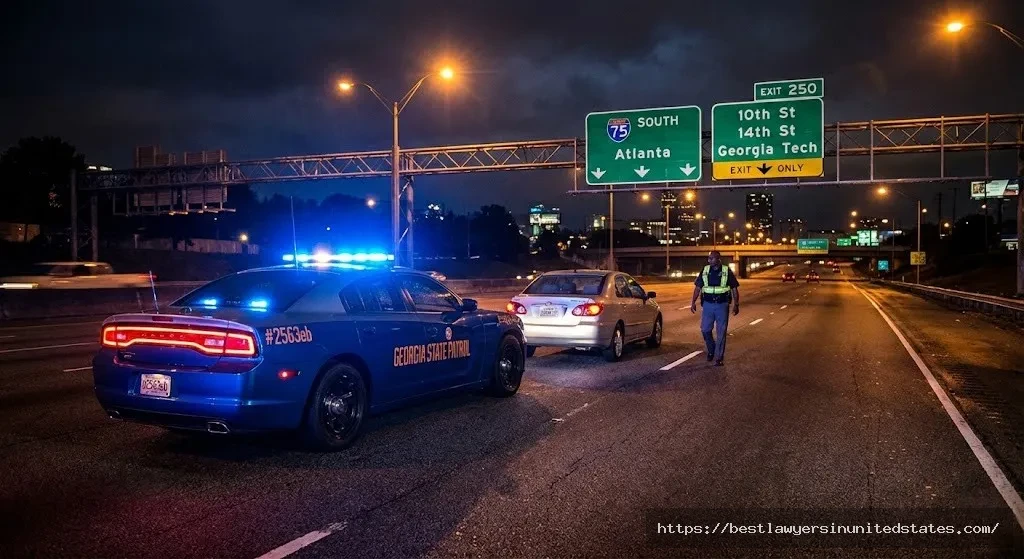
Georgia uses a unique dual standard for DUI charges. You can be convicted through DUI per se (BAC of .08% or higher) or DUI less safe (impaired driving regardless of BAC). This means prosecutors can charge you even without breath or blood test results.
Understanding Georgia DUI Laws (O.C.G.A. § 40-6-391)
Georgia’s DUI statute makes it illegal to operate a vehicle while under the influence of alcohol, drugs, or other intoxicating substances. The law applies to all public roads, highways, and parking lots throughout the state.

Police officers in Georgia must have reasonable suspicion to stop your vehicle. Common reasons include weaving between lanes, speeding, or broken taillights. Once stopped, officers look for signs of impairment like slurred speech, bloodshot eyes, or alcohol odor.
What Constitutes DUI in Georgia?
Georgia law defines DUI in several ways under O.C.G.A. § 40-6-391. You violate the law if you drive or are in actual physical control of a moving vehicle while:
- Your BAC is .08% or higher within three hours of driving (DUI per se)
- You are less safe to drive due to alcohol consumption (DUI less safe)
- You are under the influence of any drug to the extent it makes you less safe to drive
- You have any amount of marijuana or controlled substances in your blood or urine
The “actual physical control” language means you can get charged even if the vehicle isn’t moving. Sitting in the driver’s seat with keys in the ignition counts as control in Georgia courts.
DUI Per Se vs. DUI Less Safe (Georgia’s Unique Dual Standard)
Georgia stands apart from most states with its DUI less safe provision. This creates two separate paths for prosecutors to prove you were driving under the influence.
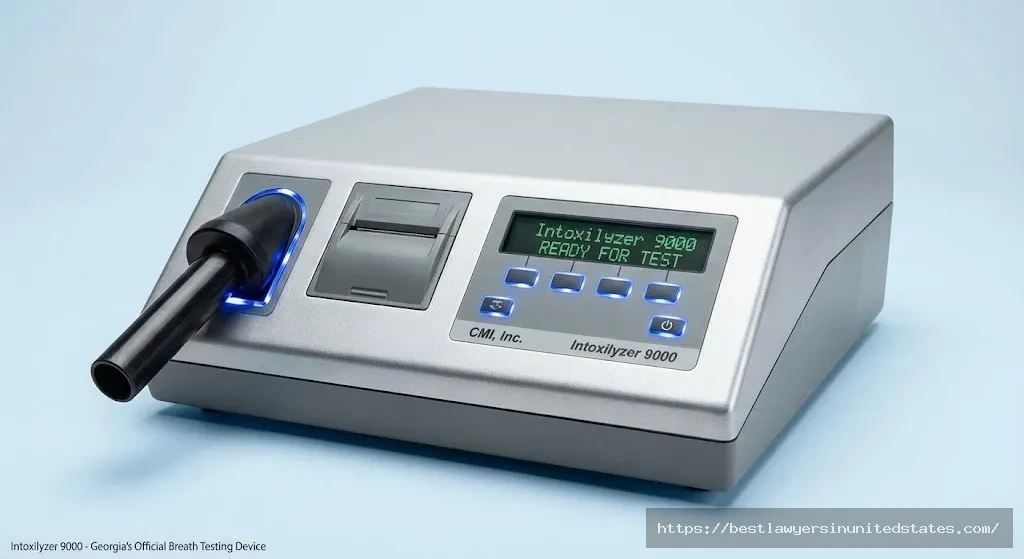
DUI Per Se requires chemical test results showing your BAC at .08% or higher. The prosecution must prove you drove within three hours of having this BAC level. Georgia uses the Intoxilyzer 9000 breathalyzer machine for most roadside testing.
DUI Less Safe focuses on your driving ability rather than a specific BAC number. Prosecutors can convict you based solely on officer observations, field sobriety test performance, and driving behavior. This means you face conviction even with a BAC under .08% or no test at all.
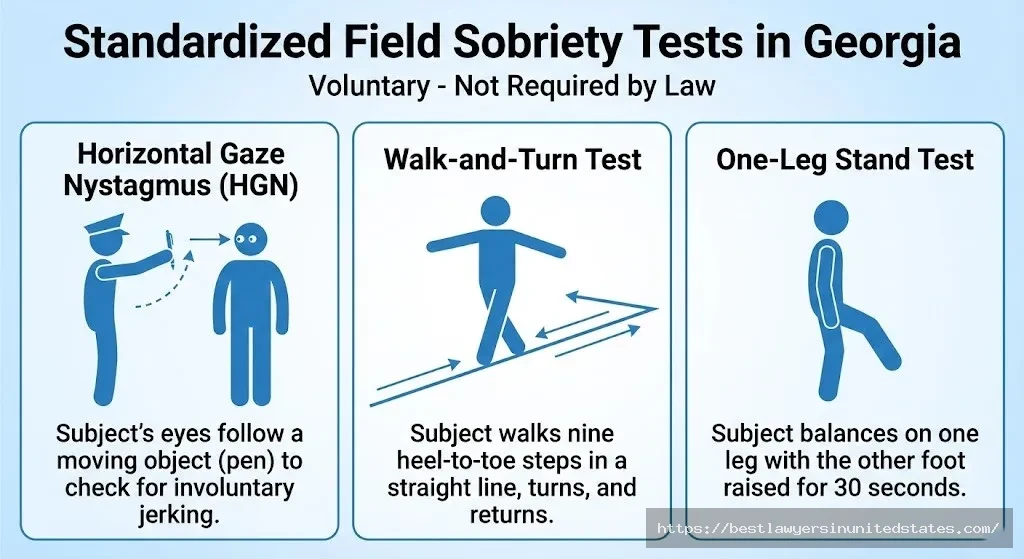
Officers testify about your performance on standardized field sobriety tests. These include the horizontal gaze nystagmus (HGN) test, walk-and-turn test, and one-leg stand test. Poor performance on these tests provides evidence for DUI less safe charges.
Many Georgia DUI arrests result in both charges. Prosecutors often proceed with DUI less safe when breath test results are excluded or unavailable. Check your BAC level using our BAC calculator to understand how alcohol affects your body.
BAC Calculator
Estimate your Blood Alcohol Content
• Commercial Driver (CDL): 0.04% BAC
• Drivers Under 21: 0.00-0.02% BAC (Zero Tolerance)
• Enhanced Penalties: 0.15% BAC or higher in most states
Georgia BAC Limits by Driver Type
| Driver Type | BAC Limit |
|---|---|
| Standard Driver (21+) | 0.08% |
| Commercial Driver (CDL) | 0.04% |
| Under 21 | 0.02% |
Georgia’s zero tolerance law for drivers under 21 sets the BAC limit at just .02%. This essentially means any measurable alcohol results in DUI charges for underage drivers. One beer or glass of wine typically exceeds this limit.
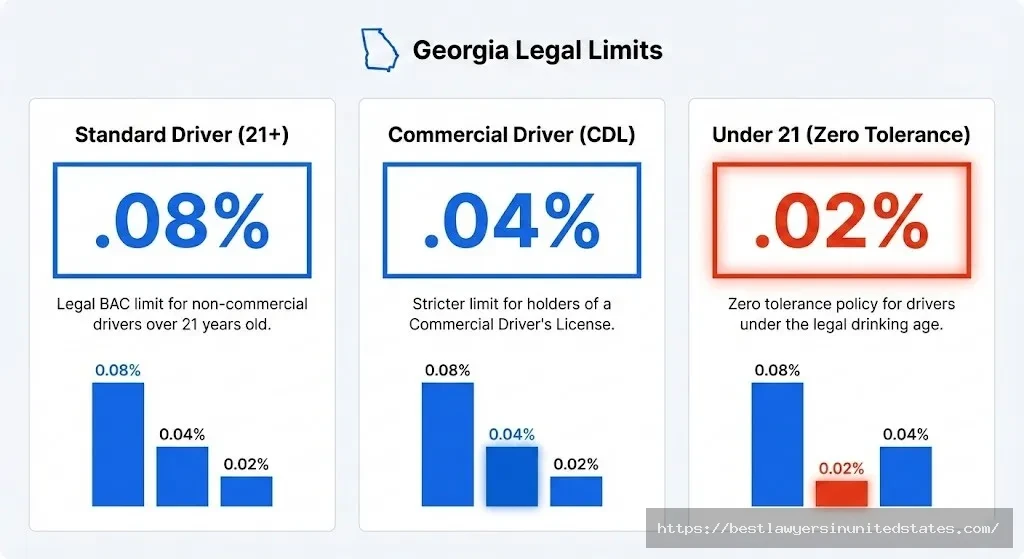
Commercial drivers face stricter standards under both Georgia and federal law. A .04% BAC while operating a commercial vehicle triggers DUI charges. The Georgia Department of Public Safety enforces these limits aggressively on interstates like I-75, I-85, and I-20.
Georgia Zero Tolerance Law for Drivers Under 21
Drivers under 21 face Georgia’s zero tolerance law under O.C.G.A. § 40-6-391(k). Any measurable alcohol in your system (.02% BAC or higher) results in criminal charges. This applies even if you’re not visibly impaired.
The .02% threshold accounts for potential false readings from mouthwash, cough syrup, or certain foods. But Georgia courts rarely accept these explanations without expert testimony. College students at University of Georgia, Georgia Tech, and other schools face serious academic consequences beyond legal penalties.
Underage DUI conviction means automatic license suspension until age 21. No hardship permit exists for these cases. You also face 40 hours of community service and completion of the Georgia Risk Reduction Program.
Athens-Clarke County Police and Georgia State Patrol target areas near college campuses during football season and holidays. Downtown Atlanta entertainment districts also see increased enforcement for underage drinking and driving.
Georgia DUI Penalties: What Happens If You Get a DUI?
Georgia DUI penalties escalate rapidly with each offense within a 10-year lookback period. The state calculates this period from arrest date to arrest date, not conviction dates. Both criminal and administrative penalties apply simultaneously.
First DUI Offense in Georgia
A first DUI offense in Georgia carries serious consequences under O.C.G.A. § 40-6-391(c)(1). Courts treat these as misdemeanors, but the penalties still affect your life for years.
Criminal Penalties:
- Fines: $300-$1,000 (mandatory minimum $300)
- Jail time: Up to 12 months (minimum 24 hours required)
- Probation: 12 months supervised probation
- Community service: 40 hours minimum
- DUI school: Georgia Risk Reduction Program (20 hours, costs $355)
- Clinical evaluation: Substance abuse assessment required
- Victim impact panel attendance
License Consequences: The Georgia Department of Driver Services suspends your license through two separate processes. The administrative license suspension (ALS) happens within 30 days of arrest. The criminal suspension begins after conviction.
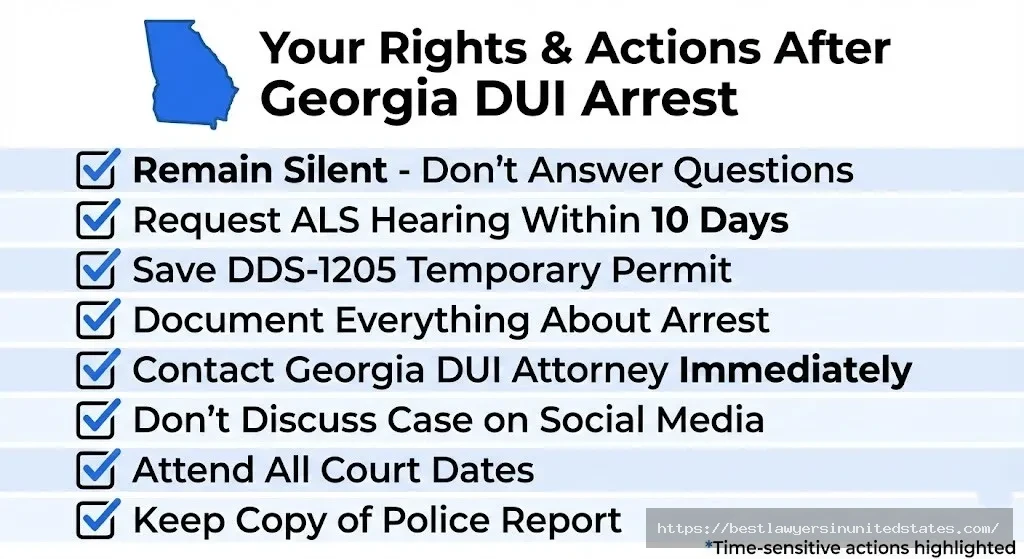
You receive a DDS-1205 form (30-day temporary permit) at arrest. This permit expires exactly 30 days later. You must request an ALS hearing within 10 business days or face automatic 12-month suspension.
First offenders can apply for a limited driving permit after 30 days. This permit allows driving for work, school, medical appointments, and DUI school. You must install an ignition interlock device at your expense.
Special Circumstances: BAC of .08% to .159% typically results in standard first offense penalties. BAC of .16% or higher triggers enhanced penalties including mandatory ignition interlock device installation.
Refusing the state-administered breath or blood test adds a separate 12-month hard suspension. This suspension runs concurrently with other license suspensions but carries no permit eligibility for the first year.
Cases in Fulton County State Court or DeKalb County State Court often take 6-9 months to resolve. Rural Georgia counties like Bartow County or Cherokee County may resolve cases faster but impose stricter penalties.
Calculate the full financial impact using our DUI cost calculator to understand total expenses beyond court fines.
DUI Cost Calculator
Estimate total DUI expenses by state and offense
Detailed Cost Breakdown
Payment Timeline
Bail bond, towing fees, car impound, attorney retainer
Initial court fines, DMV fees, DUI school enrollment, ignition interlock installation
Monthly probation fees, ignition interlock fees, DUI school payments, attorney balance
Insurance premium increases, license reinstatement, SR-22 filing fees
- Lost wages from missed work (court dates, jail time, DUI school) – $2,000-$10,000
- Job loss or difficulty finding employment – Varies
- Professional license suspension (doctors, lawyers, nurses, pilots) – Career ending
- Rideshare and transportation costs during suspension – $1,500-$5,000
- Travel restrictions and visa denials – Varies
- Security clearance loss – Career impact
- Child custody implications – Legal costs
- Rental car restrictions – Varies
- Personal relationships and mental health costs – Priceless
Second DUI Offense in Georgia (Within 10 Years)
A second DUI within 10 years brings mandatory jail time under O.C.G.A. § 40-6-391(c)(2). Georgia judges have limited discretion on these cases. The penalties increase substantially from first offense consequences.
Criminal Penalties:
- Fines: $600-$1,000 (mandatory minimum $600)
- Jail time: 90 days to 12 months (minimum 72 hours required, 30 days must be served)
- Probation: 12 months to 5 years supervised probation
- Community service: 240 hours minimum (30 days)
- License plate surrender required
- Vehicle registration suspended
- Publication of conviction in local newspaper (court’s discretion)
License Suspension: Second offense triggers automatic 18-month license suspension through Georgia DDS. The administrative suspension process still applies, giving you 10 business days to request a hearing.
After 18 months, you must complete Georgia Risk Reduction Program, pay reinstatement fees of $310, and maintain SR-22 insurance for three years. SR-22 insurance typically costs $500-$2,000 more annually than standard coverage.
Ignition Interlock Requirement: Courts must order ignition interlock device installation for minimum 12 months. You pay installation costs ($150-$300) plus monthly monitoring fees ($75-$150). The device connects to your vehicle’s electrical system and requires breath samples before starting.
Gwinnett County State Court and Cobb County State Court handle thousands of second offense DUI cases annually. These courts strictly enforce mandatory minimum sentences.
Third DUI Offense in Georgia
Third DUI conviction within 10 years remains a misdemeanor but carries severe high and aggravated misdemeanor penalties under O.C.G.A. § 40-6-391(c)(3). This conviction has lifelong consequences beyond the immediate punishment.
Criminal Penalties:
- Fines: $1,000-$5,000 (mandatory minimum $1,000)
- Jail time: 120 days to 12 months (minimum 15 days required)
- Probation: Up to 5 years supervised probation
- Community service: 30 days (240 hours)
- Clinical evaluation and treatment program completion
- Habitual violator declaration by Georgia DDS
License Revocation: Third offense triggers mandatory 5-year license revocation. Georgia declares you a habitual violator under O.C.G.A. § 40-5-58. This status carries additional penalties if caught driving during the revocation period.
You become eligible for reinstatement after 5 years, but must complete extensive requirements. These include alcohol/drug treatment program, Risk Reduction Program, payment of all fines and fees, and SR-22 insurance proof.
Vehicle Forfeiture: Georgia law allows vehicle forfeiture proceedings on third offense cases. The state can seize your vehicle permanently, even if the car belongs to someone else. This applies to both owned and financed vehicles.
Fourth DUI & Habitual Violator Status (Felony)
A fourth DUI within 10 years becomes a felony under O.C.G.A. § 40-6-391(c)(4). Georgia Superior Courts handle these cases instead of State Courts. This conviction means a permanent felony record affecting employment, housing, and civil rights.
Felony Penalties:
- Prison time: 1 to 5 years (mandatory minimum 90 days)
- Fines: $1,000-$5,000
- Probation: Up to 5 years after release
- Permanent license revocation
- Permanent habitual violator status
- Vehicle seizure and forfeiture
The Georgia Department of Corrections houses felony DUI offenders in state prisons. Unlike county jail for misdemeanors, felony prison time means serving in facilities across Georgia.
Fourth offense eliminates any possibility of limited driving permits. You cannot legally drive in Georgia for a minimum of 5 years. After 5 years, reinstatement requires extensive proof of rehabilitation and DDS director approval.
Felony DUI conviction removes your right to vote until sentence completion. You also lose the right to possess firearms under federal law. Many professional licenses become unavailable with felony convictions.
Aggravating Factors That Increase Penalties
Certain circumstances trigger enhanced penalties even on first offense cases. Georgia law treats these situations more seriously due to increased danger to the public.
Child Endangerment: Driving under the influence with a child under 14 in the vehicle adds separate charges under O.C.G.A. § 40-6-391(l). This brings an additional $1,000-$5,000 fine and 12 months jail time. The offense also triggers Department of Family and Children Services investigation.
Serious Injury by Vehicle: Causing serious injury while DUI becomes a felony under O.C.G.A. § 40-6-394. This carries 1 to 15 years in prison regardless of prior DUI history. Serious injury means injury creating substantial risk of death or causing serious disfigurement.
Homicide by Vehicle: DUI causing death results in vehicular homicide charges under O.C.G.A. § 40-6-393. First degree vehicular homicide (DUI plus another traffic offense) brings 3 to 15 years in prison. Second degree (DUI alone causing death) means 1 to 15 years.
High BAC: Blood alcohol content of .16% or higher triggers mandatory ignition interlock requirements even on first offense. Some counties impose additional community service hours and treatment requirements.
Accident Cases: DUI arrests involving accidents face additional charges like failure to maintain lane, following too closely, or reckless driving. Multiple charges increase total fines and create separate probation violations.
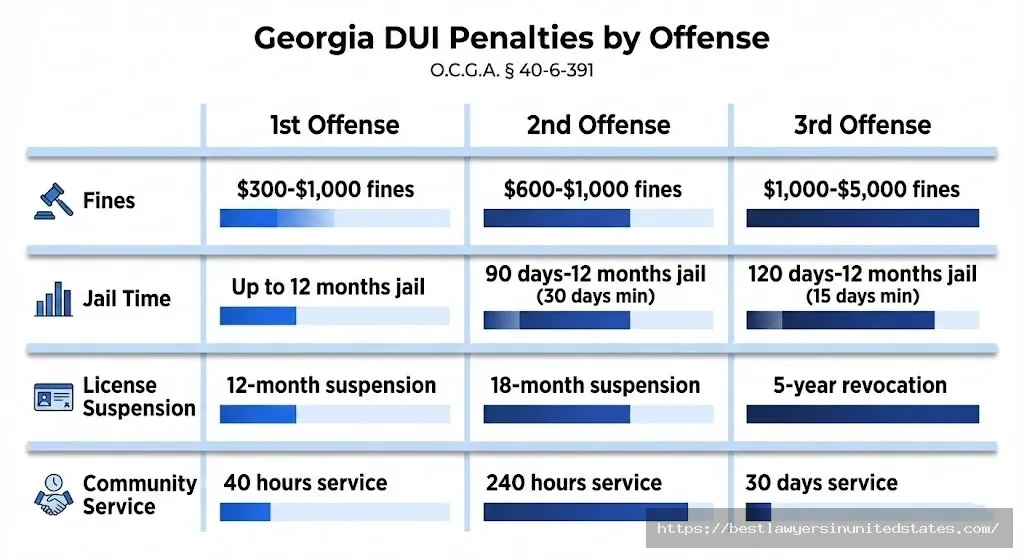
Georgia DUI Penalties by Offense
| Offense | Fines | Jail Time | License Suspension | Other Penalties |
|---|---|---|---|---|
| 1st Offense | $300-$1,000 | Up to 12 months (24 hrs min) | 12 months | 40 hrs community service, Risk Reduction Program, clinical evaluation |
| 2nd Offense | $600-$1,000 | 90 days-12 months (30 days min) | 18 months | 240 hrs community service, ignition interlock 12+ months, license plate surrender |
| 3rd Offense | $1,000-$5,000 | 120 days-12 months (15 days min) | 5 years (revocation) | 30 days community service, habitual violator status, possible vehicle forfeiture |
| 4th+ Offense (Felony) | $1,000-$5,000 | 1-5 years prison | Permanent revocation | Habitual violator status, vehicle forfeiture, loss of civil rights |
Is a DUI a Misdemeanor or Felony in Georgia?
First, second, and third DUI offenses within 10 years are misdemeanors in Georgia. The charges classify as high and aggravated misdemeanors, which carry potential 12-month jail sentences. State Courts and Municipal Courts handle these cases.
Fourth offense DUI within 10 years becomes a felony under O.C.G.A. § 40-6-391(c)(4). Superior Courts have jurisdiction over felony DUI cases. The conviction remains on your criminal record permanently with no expungement available.
Georgia also classifies certain first-time DUI cases as felonies based on circumstances. Serious injury by vehicle (DUI causing serious bodily harm) is a felony. Homicide by vehicle (DUI causing death) is a felony carrying 3 to 15 years in prison.
The distinction matters significantly for long-term consequences. Misdemeanors allow you to honestly answer “no” when job applications ask about felony convictions. Felonies trigger federal restrictions on firearm ownership and voting rights.
Georgia courts cannot reduce felony DUI charges to misdemeanors through plea bargaining. The statute prohibits this practice. Your only option for felony avoidance is fighting the case at trial or getting charges dismissed.
Georgia’s 10-Day Rule: Critical Deadline After DUI Arrest
Georgia’s 10-day rule represents the most important deadline following DUI arrest. You have exactly 10 business days (not calendar days) from arrest to request an Administrative License Suspension hearing with Georgia DDS.
Officers give you a DDS-1205 form at arrest. This form serves as your temporary driving permit for 30 days. The form also explains your right to request an ALS hearing within 10 business days.

How to Request an ALS Hearing: Submit your request in writing to the Georgia Department of Driver Services within 10 business days. Mail, fax, or hand-deliver your request to the appropriate DDS office. Include your full name, date of birth, driver’s license number, and arrest date.
Atlanta drivers submit requests to the DDS Headquarters at 2206 East View Parkway in Conyers. Other regions use their local DDS field offices. The DDS website lists all office locations and contact information.
Your request must include a $150 filing fee (first offense) or $200 fee (second offense within five years). The fee is non-refundable even if you win the hearing. However, this hearing offers your only chance to avoid automatic license suspension.
What Happens at the ALS Hearing: Georgia DDS typically schedules hearings within 30-60 days of your request. Hearings take place at DDS offices throughout the state. Fulton County DDS and DeKalb County DDS handle the highest volume of hearings.
The hearing officer (not a judge) determines whether police had probable cause for arrest and whether you refused testing or had BAC over the legal limit. You can present witnesses, cross-examine the arresting officer, and submit evidence.
Winning the ALS hearing means keeping your license despite pending criminal charges. Losing means suspension begins immediately after the hearing. Most people hire Georgia DUI attorneys for these hearings because the technical requirements are complex.
Consequences of Missing the 10-Day Deadline: Missing this deadline results in automatic license suspension with no hearing. Your 30-day temporary permit expires and suspension begins immediately. No exceptions exist for late requests, even with good reasons.
The automatic suspension lasts 12 months for first offense, 18 months for second offense, and 5 years for third offense. You forfeit the opportunity to challenge the suspension or obtain an early work permit.
Georgia DUI Less Safe: When BAC Doesn’t Matter
Georgia’s DUI less safe charge under O.C.G.A. § 40-6-391(a)(1) allows conviction without any specific BAC level. Prosecutors only must prove you were “less safe to drive” due to alcohol or drugs. This standard applies throughout Georgia, from Atlanta to rural counties.
How Prosecutors Prove “Less Safe to Drive”
Police officers document observations from the moment they activate their lights. They note your driving behavior, speech patterns, physical appearance, and responses to questions. These observations become crucial evidence at trial.
Common Evidence Used:
- Erratic driving (weaving, speeding, improper lane changes)
- Bloodshot or watery eyes
- Slurred or thick-tongued speech
- Strong odor of alcoholic beverage
- Difficulty with coordination or balance
- Admission of alcohol consumption
- Performance on field sobriety tests
- Demeanor and attitude
Officers administer three standardized field sobriety tests. The horizontal gaze nystagmus test checks for involuntary eye jerking. The walk-and-turn test assesses your ability to follow instructions and maintain balance. The one-leg stand test evaluates coordination.
Video evidence from patrol car dash cameras or body cameras shows your actual performance. Gwinnett County Police and Cobb County Police officers typically wear body cameras that record the entire encounter.
Defense Strategies for DUI Less Safe
Officers often misinterpret normal behavior as signs of impairment. Medical conditions, fatigue, anxiety, and physical disabilities affect field sobriety test performance. These factors provide legitimate defenses to less safe charges.
Common Defense Arguments:
- Medical conditions affecting balance or eye movement
- Improper administration of field sobriety tests
- Poor weather or road conditions during testing
- Officer bias or assumption of guilt
- Lack of actual driving impairment despite alcohol odor
- Alternative explanations for driving behavior
Many Georgia DUI attorneys challenge less safe charges because they rely heavily on subjective officer opinions rather than scientific test results. Juries must decide whether you were actually “less safe” to drive, creating reasonable doubt opportunities.
The Georgia DUI Arrest Process: Step-by-Step Timeline
Understanding what happens after DUI arrest helps you protect your rights and meet critical deadlines. The process involves both Georgia Department of Driver Services (administrative) and criminal court systems.
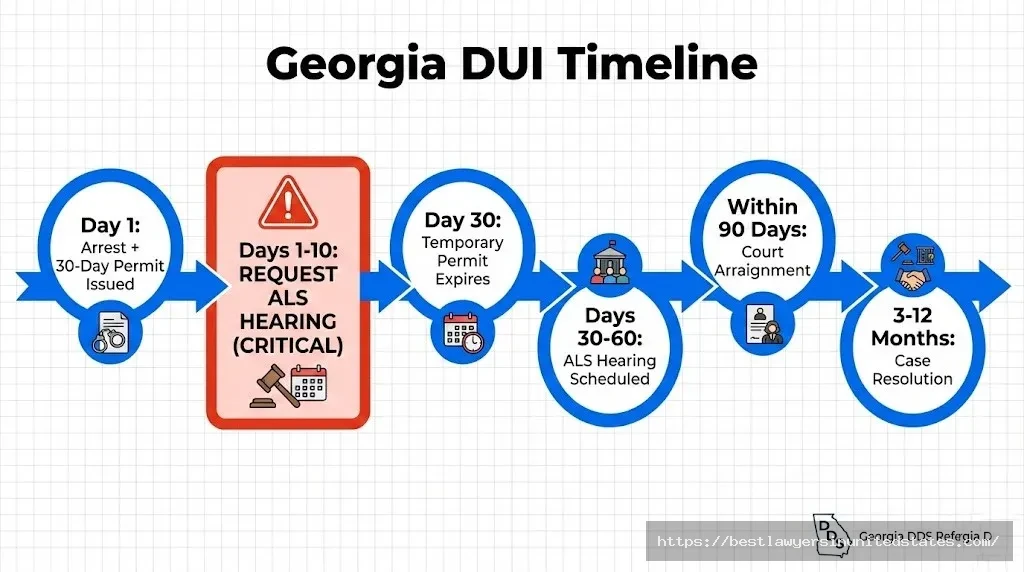
Day 1 – Arrest: Police stop your vehicle for suspected traffic violation or erratic driving. The officer requests your license and asks questions about alcohol consumption. You must provide your license but are not required to answer questions about drinking.
Officers conduct field sobriety tests if they suspect impairment. You can refuse these tests, but refusal often leads to arrest anyway. Officers then transport you to jail or police station for breath testing.
Georgia’s implied consent law requires breath or blood testing. Refusing the state-administered test triggers automatic 12-month license suspension. The officer reads an implied consent notice explaining consequences of refusal.
After breath test results, officers issue the DDS-1205 form (30-day temporary permit) and release you on bond or recognizance. Bail typically ranges from $1,500-$5,000 for first offense in metro Atlanta courts.
Days 1-10 – Critical ALS Hearing Request Window: You have exactly 10 business days to request an administrative license suspension hearing. Mail your written request with filing fee to Georgia DDS. This deadline is non-negotiable.
Most people hire a Georgia DUI lawyer immediately to handle the ALS hearing request and begin building a defense. Attorneys familiar with local courts in Fulton County, Cobb County, or DeKalb County understand specific prosecutor and judge tendencies.
Day 30 – Temporary Permit Expires: Your 30-day temporary driving permit expires exactly 30 days after arrest. If you requested an ALS hearing, you can continue driving until the hearing date. If you missed the 10-day deadline, your license suspends automatically.
Days 30-60 – ALS Hearing Scheduled: Georgia DDS schedules your administrative hearing, usually 30-60 days after your request. The hearing takes place at a DDS office near your arrest location. You or your attorney must appear at the scheduled time.
Within 90 Days – Criminal Court Process Begins: The court issues a citation or accusation formally charging you with DUI. First court appearance (arraignment) typically occurs 30-60 days after arrest. You enter a plea of guilty, not guilty, or nolo contendere.
Most people plead not guilty at arraignment to preserve all defense options. The court sets a pre-trial conference date, typically 30-60 days later. Pre-trial conferences allow negotiation with prosecutors about plea deals or case dismissal.
3-12 Months – Case Resolution: Cases resolve through plea agreement (most common), trial, or dismissal. Simple first offense cases often resolve within 3-6 months. Complex cases or second/third offenses may take 9-12 months or longer.
State Court of Fulton County and State Court of DeKalb County have the longest backlogs in Georgia. Cherokee County State Court and Forsyth County State Court typically move cases faster.
How Much Does a DUI Cost in Georgia?
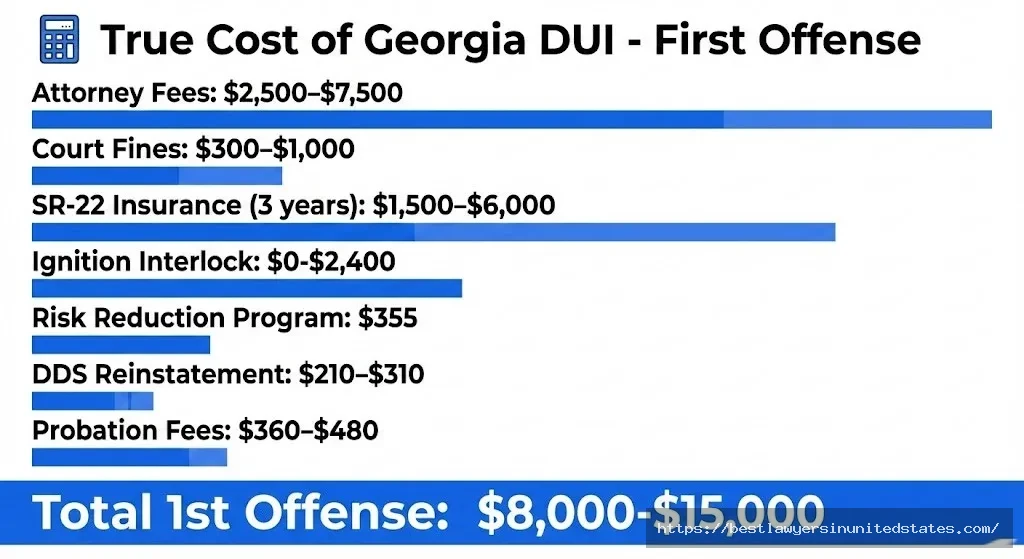
The true cost of a Georgia DUI extends far beyond the court fine. Most first-time offenders pay $8,000-$15,000 in total expenses. Second and third offenses cost substantially more due to increased penalties and requirements.
Georgia DUI Cost Breakdown
| Cost Category | First Offense | Second Offense | Third Offense |
|---|---|---|---|
| Bail Bond (10% of bail) | $150-$500 | $300-$750 | $500-$1,500 |
| Attorney Fees | $2,500-$7,500 | $4,000-$10,000 | $5,000-$15,000 |
| Court Fines | $300-$1,000 | $600-$1,000 | $1,000-$5,000 |
| Court Costs | $200-$500 | $300-$700 | $500-$1,000 |
| DDS Reinstatement Fee | $210-$310 | $210-$310 | $210-$310 |
| Risk Reduction Program | $355 | $355 | $355 |
| Substance Abuse Evaluation | $75-$200 | $100-$250 | $150-$300 |
| Probation Supervision Fees | $360-$480 (12 months) | $480-$1,200 | $600-$1,800 |
| Ignition Interlock Device | $0-$2,400 | $1,800-$3,600 | $2,400-$4,800 |
| SR-22 Insurance (3 years) | $1,500-$6,000 | $2,000-$8,000 | $3,000-$10,000 |
| Towing and Impound | $200-$400 | $200-$400 | $200-$400 |
| Total Estimated Cost | $8,000-$15,000 | $12,000-$22,000 | $15,000-$35,000 |
Breaking Down Major Expenses
Attorney Fees: Georgia DUI attorneys typically charge flat fees ranging from $2,500 for simple first offense cases to $15,000+ for felony cases or jury trials. Payment plans are common. Some attorneys require full payment upfront.
Atlanta DUI lawyers generally charge more than attorneys in smaller Georgia cities. However, experienced attorneys often save you money by reducing charges or avoiding conviction. Calculate potential costs using our DUI cost calculator.
Insurance Impact: DUI conviction makes you a high-risk driver in Georgia. Insurance companies raise your rates by 50-200% on average. This increase lasts three years minimum. SR-22 insurance certification adds additional fees of $25-$50 per year.
State Farm, Allstate, and Geico typically drop DUI offenders or non-renew policies. You may need to find coverage through high-risk insurance providers. Shop multiple companies to find the best rates.
Ignition Interlock Costs: Georgia-approved ignition interlock providers charge $150-$300 for installation plus $75-$150 monthly monitoring fees. Second offense requires minimum 12 months, totaling $1,800-$3,600. Third offense requires longer periods.
Smart Start and Intoxalock operate throughout Georgia including Atlanta, Savannah, Columbus, and Augusta. Monthly costs include device rental, calibration, and data reporting to Georgia DDS.
Hidden Costs: Lost wages from jail time, court appearances, and DUI school attendance add thousands more. Most people miss 3-5 days of work for a first offense. Professional license holders face separate licensing board proceedings.
Uber or Lyft costs during license suspension add $200-$500 monthly for most people. Public transportation in Atlanta via MARTA provides alternatives but isn’t available in most Georgia counties.
Common DUI Defenses in Georgia
Georgia DUI cases can be won at trial or dismissed before trial. Experienced defense attorneys identify constitutional violations, procedural errors, and factual weaknesses in the prosecution’s case. Success depends on specific facts and circumstances.
Challenging the Traffic Stop
Police must have reasonable suspicion of criminal activity or traffic violation to stop your vehicle. This is a Fourth Amendment requirement. Stops based on hunches, anonymous tips, or racial profiling violate your constitutional rights.
Officers cite minor traffic violations like “failure to maintain lane” to justify DUI stops. However, Georgia law allows momentary lane touching if it doesn’t create danger. Brief tire contact with lane lines doesn’t prove impaired driving.
Defense attorneys obtain dash camera video showing your actual driving pattern. Often the video contradicts the officer’s report. Video showing steady, controlled driving undermines reasonable suspicion for the stop.
Attacking Breathalyzer Test Results
Georgia uses the Intoxilyzer 9000 breathalyzer machine for most DUI arrests. These machines require regular maintenance, calibration, and proper operation. Errors in any of these areas provide defense opportunities.
Common Breathalyzer Challenges:
- Improper calibration or maintenance records
- Failure to observe you for required 20 minutes before testing
- Mouth alcohol contamination from burping or regurgitation
- Medical conditions affecting breath test accuracy
- Officer certification and training deficiencies
- Machine malfunction or error codes
Georgia DDS maintains calibration records for all Intoxilyzer 9000 machines. Your attorney can subpoena these records to identify maintenance problems. Machines in Fulton County and DeKalb County State Courts process thousands of tests annually, increasing malfunction risk.
Certain medical conditions like acid reflux disease (GERD) and diabetes cause false high readings. Mouth alcohol from dental work, breath mints, or tobacco products also affects results. Expert witnesses testify about these scientific issues at trial.
Blood Test Chain of Custody Issues
DUI cases involving blood tests require strict chain of custody procedures. Blood samples must be properly collected, labeled, stored, and tested. Errors at any stage compromise test reliability.
Georgia law requires specific procedures for blood draw and analysis. The person drawing blood must be qualified. Samples require preservative and anticoagulant. Storage must maintain proper temperature. Testing must follow Georgia Crime Lab protocols.
Defense attorneys request complete chain of custody documentation. Missing signatures, improper storage temperatures, or delayed testing create reasonable doubt. Blood vials in poorly maintained evidence rooms may ferment, creating false alcohol readings.
Field Sobriety Test Challenges
Standardized field sobriety tests have specific administration requirements. Officers must follow National Highway Traffic Safety Administration (NHTSA) guidelines exactly. Deviations from proper procedures make test results unreliable.
Common FST Defense Arguments:
- Improper test instructions or demonstration
- Unsuitable testing location (gravel, slope, poor lighting)
- Officer scoring errors or subjectivity
- Weather conditions (wind, rain, cold)
- Medical conditions or physical disabilities
- Improper footwear (heels, boots)
- Age-related balance issues
Video evidence often shows officers didn’t follow proper procedures. Sometimes officers conduct tests in dangerous locations like highway shoulders. Poor lighting conditions make accurate observation impossible.
Rising Blood Alcohol Defense
Your BAC rises for 30-90 minutes after you stop drinking. This means your BAC at the time of arrest may be higher than when you were actually driving. Georgia law requires proof of BAC level “within three hours” of driving.
If you consumed alcohol shortly before driving, your BAC may have been under .08% while driving but over .08% during the later breath test. Expert witnesses calculate absorption and elimination rates to show this possibility.
This defense works best when significant time passes between driving and testing. Processing time at jail, booking procedures, and waiting for breath test administration all allow BAC to rise.
Constitutional Violations
Police must respect your constitutional rights during DUI investigation and arrest. Violations of Fourth Amendment (illegal search), Fifth Amendment (self-incrimination), or Sixth Amendment (right to counsel) rights can result in case dismissal.
Examples of Constitutional Violations:
- Illegal traffic stop without reasonable suspicion
- Arrest without probable cause
- Failure to read Miranda rights before questioning
- Denial of access to attorney
- Illegal search of vehicle without consent or warrant
- Coerced confession or statements
Video from police body cameras and dash cameras often reveals constitutional violations. Cases involving illegal stops or arrests get dismissed through motions to suppress evidence. Evidence obtained from illegal stops cannot be used against you at trial.
Georgia Implied Consent Law: What Happens If You Refuse?
Georgia’s implied consent law under O.C.G.A. § 40-5-55 requires drivers to submit to state-administered chemical tests. When you drive in Georgia, you automatically consent to breath, blood, or urine testing if arrested for DUI.
Officers must read the implied consent notice before requesting a test. This notice explains that refusing the test results in automatic license suspension. First refusal brings 12-month hard suspension with no permit allowed.
Consequences of Test Refusal
Refusing the state-administered test triggers separate administrative penalties beyond any criminal DUI conviction. These penalties apply even if you’re found not guilty of DUI in criminal court.
First Refusal:
- 12-month hard license suspension (no permit available)
- Suspension begins on 46th day after arrest if you don’t request hearing
- Must complete Georgia Risk Reduction Program
- Pay $210 reinstatement fee plus $25 administrative fee
- Install ignition interlock device for 12 months after reinstatement
Second Refusal (Within 5 Years):
- 3-year hard license suspension
- No permit eligibility during suspension
- Complete DUI Alcohol or Drug Use Risk Reduction Program
- Clinical evaluation required
- Pay $210 reinstatement fee
- Ignition interlock device for 12 months after reinstatement
The “refusal suspension” is separate from any criminal DUI suspension. If convicted of DUI after refusing the test, you face both suspensions. These run concurrently but you serve the longer suspension period.
Can Refusal Help Your Case?
Refusing breath testing eliminates the strongest evidence against you (BAC results). Prosecutors must rely on officer observations, field sobriety tests, and circumstantial evidence. This makes cases harder to prove beyond reasonable doubt.
However, prosecutors tell juries you refused because you knew you were guilty. Georgia law allows refusal evidence at trial. Judges instruct juries they may infer consciousness of guilt from refusal to test.
Most Georgia DUI attorneys advise against refusal unless you’re certain your BAC exceeds .08% by a large margin. The administrative penalties for refusal often outweigh the benefit of denying prosecutors test results.
Chemical Test After Refusal
Police can obtain search warrants for blood testing even after you refuse. Georgia judges issue electronic warrants quickly, often within 30 minutes. Officers take you to a hospital where medical staff draws blood under warrant authority.
The blood test results become admissible evidence despite your refusal. You still face the refusal suspension penalties because you refused the initial state-administered test. The warrant-authorized test is a separate procedure.
Getting Your License Back After a Georgia DUI
License reinstatement after Georgia DUI conviction requires completing multiple steps and paying various fees. The process differs based on offense number and specific circumstances of your case. For more information about related legal matters, visit our guide on divorce costs in Georgia.
Georgia License Suspension Timeline
| Offense | Administrative Suspension | Criminal Suspension | Hardship Permit Eligibility |
|---|---|---|---|
| 1st Offense | 12 months (30 days hard) | 12 months | After 30 days |
| 2nd Offense | 18 months (120 days hard) | 18 months | After 120 days |
| 3rd Offense | 5 years (2 years hard) | 5 years | After 2 years |
| 4th+ Offense | 5 years (no permit) | Permanent | No permit allowed |
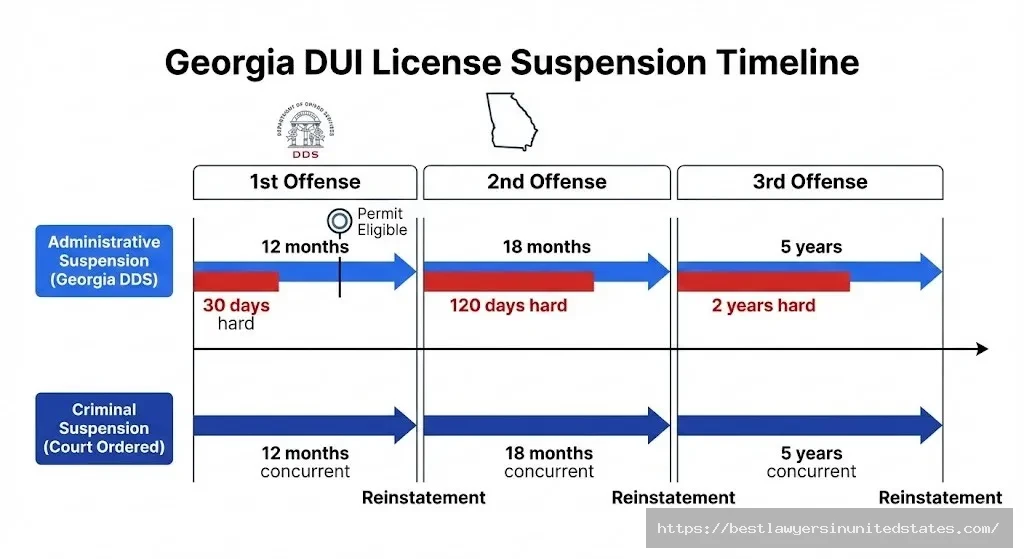
Reinstatement Requirements
Complete all requirements before Georgia DDS reinstates your license. Missing any requirement delays reinstatement indefinitely. The process typically takes 2-4 weeks after submitting all documentation.
Required Steps:
- Serve entire suspension period
- Pay all court fines, fees, and restitution
- Complete Georgia Risk Reduction Program ($355)
- Obtain substance abuse clinical evaluation (if required)
- Complete any court-ordered treatment programs
- Install ignition interlock device (if required)
- Pay $210 DDS reinstatement fee
- Pay $25 administrative fee
- Obtain SR-22 insurance certificate
- Pass vision test and written test (if license expired)
Submit reinstatement documents to any Georgia DDS Customer Service Center. Locations exist throughout metro Atlanta, including Conyers, Norcross, Riverdale, and Decatur. Bring all completion certificates, payment receipts, and proof of insurance.
Hardship or Limited Driving Permits
Georgia law allows limited driving permits for specific purposes during license suspension. These permits restrict you to driving for work, school, medical treatment, and required alcohol treatment programs.
First Offense Hardship Permit: Apply after serving 30 days hard suspension. Submit application to DDS with $25 fee. Include employer letter verifying work schedule and address. Proof of enrollment if driving to school.
The permit restricts driving to specific routes and times. You cannot make stops except at authorized destinations. Violations result in permit revocation and possible criminal charges for driving on suspended license.
Ignition Interlock Device Requirement: Hardship permits require ignition interlock installation at your expense. The device prevents vehicle operation if breath sample shows alcohol. Monthly reports go to Georgia DDS.
Smart Start, Intoxalock, and LifeSafer provide approved devices throughout Georgia. Installation takes 1-2 hours at authorized service centers. You pay installation ($150-$300) plus monthly monitoring ($75-$150).
Second and Third Offense Reinstatement
Multiple offenses require longer hard suspension periods before permit eligibility. Second offense requires 120 days hard suspension. Third offense requires 2 years hard suspension before applying for limited permit.
Habitual violator status (third offense) remains on your record permanently. Future traffic violations carry enhanced penalties. Any DUI within 10 years of habitual violator declaration triggers felony charges.
Georgia DUI Laws for Commercial Drivers (CDL)
Commercial drivers face stricter DUI standards under both federal and Georgia law. A DUI conviction ends many trucking and commercial driving careers permanently. The consequences apply whether driving a commercial vehicle or personal vehicle at arrest.
Lower BAC Limits for CDL Holders
Federal Motor Carrier Safety Administration regulations require states to enforce .04% BAC limit for commercial drivers operating commercial vehicles. Georgia law adopts this federal standard under O.C.G.A. § 40-6-391.
Georgia CDL BAC Limits:
- .04% BAC while operating commercial vehicle = DUI
- .08% BAC in personal vehicle = DUI (same as non-CDL)
- .02% BAC if under 21 in any vehicle = DUI
- Any measurable controlled substance = disqualification
CDL holders arrested with .04% BAC or higher face immediate out-of-service orders. You cannot drive commercial vehicles for 24 hours minimum. The arrest triggers administrative disqualification proceedings separate from criminal charges.
CDL Disqualification Periods
Georgia DDS disqualifies your CDL for specific periods based on offense type and number. These disqualifications are separate from your regular license suspension. You lose commercial driving privileges even if you keep your regular license.
First Offense DUI:
- 1-year CDL disqualification
- Lifetime disqualification if carrying hazardous materials
- No hardship CDL available during disqualification
- Must retake CDL skills and knowledge tests for reinstatement
Second Offense DUI (Lifetime):
- Lifetime CDL disqualification
- No reduction or appeal available
- Cannot obtain CDL in any state
- Applies regardless of time between offenses
Other Disqualifying Offenses: Refusing chemical test in commercial vehicle brings same disqualification as DUI conviction. Leaving accident scene, using commercial vehicle to commit felony, or causing fatality also trigger disqualification.
Impact on Professional Drivers
Most trucking companies have zero-tolerance policies for DUI arrests. Even a first offense DUI in your personal vehicle results in immediate termination. Background checks reveal DUI arrests and convictions permanently.
Insurance companies refuse to cover drivers with DUI records. This makes you unhireable for most commercial driving positions. Owner-operators face insurance costs of $10,000+ annually after DUI conviction.
Georgia employment in logistics, trucking, and transportation ranks among the top industries. DUI conviction eliminates access to these jobs. Atlanta’s position as a major transportation hub means thousands of commercial driving jobs become unavailable.
Georgia DUI Checkpoint Laws: Know Your Rights
Georgia law enforcement agencies conduct DUI checkpoints legally throughout the state. The Georgia Supreme Court and U.S. Supreme Court upheld checkpoint constitutionality despite Fourth Amendment concerns. However, checkpoints must follow specific procedures to be legal.
Legal Requirements for Georgia Checkpoints
Georgia courts require checkpoints to follow established guidelines protecting constitutional rights. Random or discriminatory stops violate the Fourth Amendment. Checkpoints must use neutral selection criteria.
Required Checkpoint Procedures:
- Advance public notice of checkpoint location
- Clearly visible warning signs and lights
- Neutral mathematical formula for stopping vehicles (every vehicle, every 3rd vehicle, etc.)
- Supervisory oversight and written guidelines
- Safety considerations for officers and motorists
- Reasonable duration and minimally intrusive procedures
Georgia Governor’s Office of Highway Safety coordinates DUI checkpoints statewide. Metro Atlanta sees increased checkpoints during holidays like New Year’s Eve, July 4th, Labor Day, and St. Patrick’s Day weekend.
Your Rights at a Checkpoint
You must stop at a properly marked DUI checkpoint. Avoiding a checkpoint by turning around before reaching it is legal but may give officers reasonable suspicion to stop you for investigation.
What You Must Do:
- Stop when directed by officers
- Provide driver’s license and vehicle registration
- Remain polite and cooperative
What You Can Refuse:
- Answering questions about drinking or destination
- Field sobriety tests
- Preliminary breath test (PBT)
- Vehicle search without probable cause or warrant
Officers can only detain you briefly at checkpoints without reasonable suspicion. If they smell alcohol, observe open containers, or notice impairment signs, they can extend the detention for DUI investigation.
Common Checkpoint Locations
Georgia State Patrol and local police departments run checkpoints on major corridors throughout the state. I-75, I-85, I-20, and I-285 see regular checkpoint operations, especially Friday and Saturday nights.
Atlanta Police Department, Cobb County Police, and Gwinnett County Police conduct frequent checkpoints in entertainment districts. Buckhead, Midtown Atlanta, and Marietta Square areas have high checkpoint activity during weekend nights.
College towns like Athens (University of Georgia) and Statesboro (Georgia Southern University) increase checkpoints during football season and graduation weekends. Savannah runs checkpoints along River Street during St. Patrick’s Day celebrations.
Frequently Asked Questions About Georgia DUI Laws
What is the legal BAC limit in Georgia?
The legal BAC limit is .08% for drivers 21 and older, .04% for commercial drivers, and .02% for drivers under 21. Georgia also prosecutes DUI less safe charges regardless of BAC level. Learn more about BAC calculations on our BAC calculator page.
How long does a DUI stay on your record in Georgia?
DUI convictions remain on your Georgia criminal record permanently. They cannot be expunged or sealed. The conviction also stays on your driving record for 10 years for purposes of calculating repeat offense penalties.
Can you get a DUI expunged in Georgia?
No. Georgia law does not allow DUI conviction expungement. The only exception is if charges are dismissed or you’re found not guilty. Arrest records can sometimes be restricted under Georgia’s record restriction laws.
Do you lose your license for first DUI in Georgia?
Yes. First DUI conviction results in 12-month license suspension through Georgia DDS. You can apply for a limited driving permit after 30 days hard suspension. The permit requires ignition interlock device installation.
How likely is jail time for first DUI in Georgia?
Very likely. Georgia law requires minimum 24 hours jail time for first DUI conviction. Judges typically sentence 1-10 days jail time. Some judges allow jail alternatives like community service or house arrest for first offenders with no aggravating factors.
What is the 10-day rule for DUI in Georgia?
You have 10 business days from arrest to request an administrative license suspension hearing with Georgia DDS. Missing this deadline results in automatic license suspension with no opportunity for hearing.
Can a DUI be reduced to reckless driving in Georgia?
Yes, but it’s uncommon. Georgia prohibits reducing DUI charges in exchange for guilty pleas under O.C.G.A. § 40-6-391(f). Prosecutors only reduce charges when significant case weaknesses exist. Most first offenses resolve through DUI plea agreements.
What happens if you refuse a breathalyzer in Georgia?
Refusing the state-administered breath test results in automatic 12-month hard license suspension. You cannot obtain a permit during this suspension. Prosecutors can use your refusal as evidence of guilt at trial.
How much does a DUI cost in Georgia?
Total costs range from $8,000-$15,000 for first offense including attorney fees, fines, DUI school, increased insurance, and other expenses. Use our DUI cost calculator for detailed estimates.
Is Georgia a zero tolerance state for DUI?
Yes, for drivers under 21. Georgia enforces zero tolerance under O.C.G.A. § 40-6-391(k), making it illegal to drive with .02% BAC or higher if under age 21. Any measurable alcohol results in DUI charges for underage drivers.
What is DUI less safe in Georgia?
DUI less safe under O.C.G.A. § 40-6-391(a)(1) means you were less safe to drive due to alcohol or drugs, regardless of BAC level. Prosecutors can convict you based solely on driving behavior, field sobriety tests, and officer observations without breath test results.
Can you get a work permit after DUI in Georgia?
Yes, after serving required hard suspension periods. First offense allows limited permit after 30 days. The permit restricts driving to work, school, medical appointments, and DUI program. You must install an ignition interlock device.
What is the penalty for second DUI in Georgia?
Second DUI within 10 years brings $600-$1,000 fine, 90 days to 12 months jail (30 days mandatory), 18-month license suspension, and required ignition interlock for 12+ months. You must complete 240 hours community service.
Does a DUI affect car insurance in Georgia?
Yes, significantly. Insurance rates increase 50-200% on average after DUI conviction. Increases last minimum 3 years. Many insurers drop DUI offenders entirely, requiring high-risk insurance policies costing substantially more.
How long is probation for DUI in Georgia?
First DUI brings 12 months probation. Second offense brings 12 months to 5 years probation. Third offense brings up to 5 years probation. Probation requires monthly supervision meetings, drug/alcohol testing, and compliance with all conditions.
What happens at a DUI arraignment in Georgia?
Arraignment is your first court appearance where you enter a plea to DUI charges. Most people plead not guilty to preserve defense options. The judge explains charges, potential penalties, and sets future court dates.
Can you beat a DUI in Georgia?
Yes, through various defense strategies. Common defenses include illegal traffic stops, improper breathalyzer procedures, field sobriety test challenges, and rising BAC arguments. Many cases resolve through charge reduction or dismissal based on case weaknesses.
What is Georgia’s habitual violator law?
Third DUI conviction within 10 years triggers habitual violator status under O.C.G.A. § 40-5-58. This brings 5-year license revocation. Fourth offense becomes a felony with 1-5 years prison time.
Do I need a lawyer for first DUI in Georgia?
Yes. Georgia DUI laws are complex with the dual administrative and criminal processes. The 10-day ALS hearing deadline requires immediate action. Attorneys identify defense opportunities, negotiate with prosecutors, and represent you at hearings and trial.
What is the Georgia Risk Reduction Program?
State-approved 20-hour DUI education program required for license reinstatement after conviction. The program costs $355 and covers alcohol/drug effects, consequences of impaired driving, and risk assessment. All Georgia DUI offenders must complete it.
Why You Need a Georgia DUI Lawyer
Georgia’s dual DUI prosecution system makes cases significantly more complex than in many states. You face both criminal charges in State or Municipal Court and administrative license suspension through Georgia DDS. These proceedings happen simultaneously with different judges, different rules, and different deadlines.

The 10-day deadline for requesting an ALS hearing requires immediate action. Most people arrested over weekends miss this deadline entirely without legal guidance. Once the deadline passes, no hearing occurs and automatic suspension begins.
What Georgia DUI Attorneys Do
Experienced DUI lawyers handle both the administrative DDS process and criminal court case. They request your ALS hearing within the 10-day window while you recover from arrest. This preserves your ability to drive pending hearing resolution.
Attorneys investigate every aspect of your arrest. They subpoena police videos, breathalyzer maintenance records, and officer training files. They identify constitutional violations, procedural errors, and technical defenses specific to your case.
Common Attorney Services:
- Request ALS hearing within 10-day deadline
- Obtain and review police video evidence
- Challenge legality of traffic stop
- Cross-examine officers at ALS hearing
- Negotiate with prosecutors for charge reduction
- File motions to suppress illegal evidence
- Hire expert witnesses for breathalyzer challenges
- Represent you at trial if case doesn’t settle
Cost vs. Benefit Analysis
Georgia DUI attorneys charge $2,500-$7,500+ for first offense cases. This seems expensive until you consider the alternatives. Total DUI costs exceed $8,000-$15,000 including fines, insurance increases, and lost wages.
Attorneys often reduce first offense DUI charges to reckless driving when case weaknesses exist. Reckless driving means lower fines, no license suspension, and no DUI on your record. The savings in insurance costs alone justify attorney fees.
Even when conviction is likely, attorneys negotiate better plea deals. Judges often accept shorter jail time, fewer community service hours, or delayed reporting dates when defendants have legal representation. Many attorneys have relationships with prosecutors in local courts like Fulton County or Gwinnett County.
Finding the Right Attorney
Choose an attorney who focuses primarily on DUI defense in Georgia courts. General criminal defense lawyers lack the specific knowledge of breathalyzer science, field sobriety testing, and DDS administrative procedures.
Look for attorneys who regularly practice in the court handling your case. Local experience matters because judges and prosecutors have different approaches. What works in Cherokee County State Court may not work in DeKalb County State Court.
Check the attorney’s trial experience. Many DUI lawyers never go to trial. While most cases settle, you want an attorney willing and able to try your case if negotiations fail. This willingness strengthens negotiating position with prosecutors.
Contact our office at [email protected] to connect with experienced Georgia DUI attorneys offering free consultations. Local attorneys throughout Atlanta, Savannah, Augusta, Columbus, and Macon are available to review your case.
For DUI laws in other states, see our guides on Alabama DUI Laws, Florida DUI Laws, California DUI Laws, and Arizona DUI Laws.
