Montana DUI laws set a 0.08% BAC limit for drivers over 21, with penalties ranging from $600 fines and 24-hour jail minimums for first offenses to mandatory prison time for fourth offenses. Your fourth DUI becomes a felony under Montana Code Annotated § 61-8-731, carrying 13 months to 5 years in prison.
Montana uses a lifetime lookback period. Every prior DUI conviction counts forever, no matter how long ago it occurred.
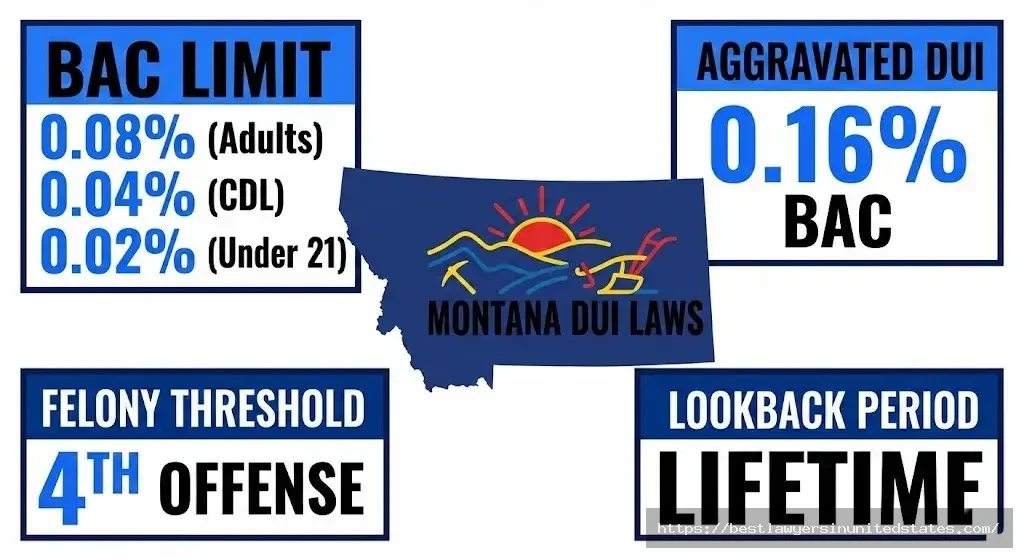
This guide covers Montana’s unique DUI system, including the state’s dual offense structure, 24/7 sobriety testing, and restricted probationary license requirements.
Understanding Montana’s DUI System
Montana operates under two separate DUI laws that prosecutors can charge simultaneously. You can face both DUI and DUI Per Se charges from a single incident.
What Qualifies as DUI in Montana?
Montana Code Annotated § 61-8-401 defines DUI as operating a vehicle while “under the influence” of alcohol or drugs. Officers determine impairment through field sobriety tests, driving behavior, and physical observations like slurred speech or bloodshot eyes.
You don’t need to be driving to face charges. Montana law applies to anyone in “actual physical control” of a vehicle. Sitting in the driver’s seat with keys in the ignition counts, even with the engine off.
DUI vs DUI Per Se: Montana’s Dual System
Montana’s DUI Per Se law under MCA § 61-8-406 makes it illegal to drive with a BAC of 0.08% or higher, regardless of actual impairment.
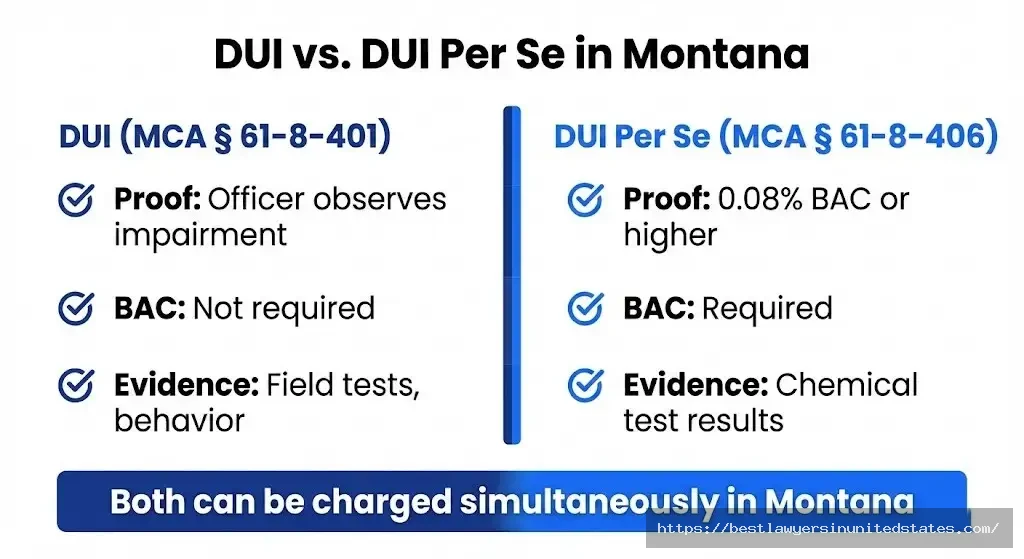
Key differences:
| Charge Type | Proof Required | BAC Level Matters? |
|---|---|---|
| DUI | Officer observes impairment | No |
| DUI Per Se | Chemical test shows 0.08%+ | Yes |
| Both charges | Either/both conditions met | Varies |
Prosecutors often charge both offenses. You might beat the DUI charge by proving you weren’t impaired, but still get convicted of DUI Per Se based on your BAC test results.
Strategic impact: Defense attorneys handle these charges differently. Fighting DUI focuses on challenging the officer’s impairment observations. Fighting DUI Per Se attacks the chemical test’s accuracy and administration.
Montana BAC Limits by Driver Type
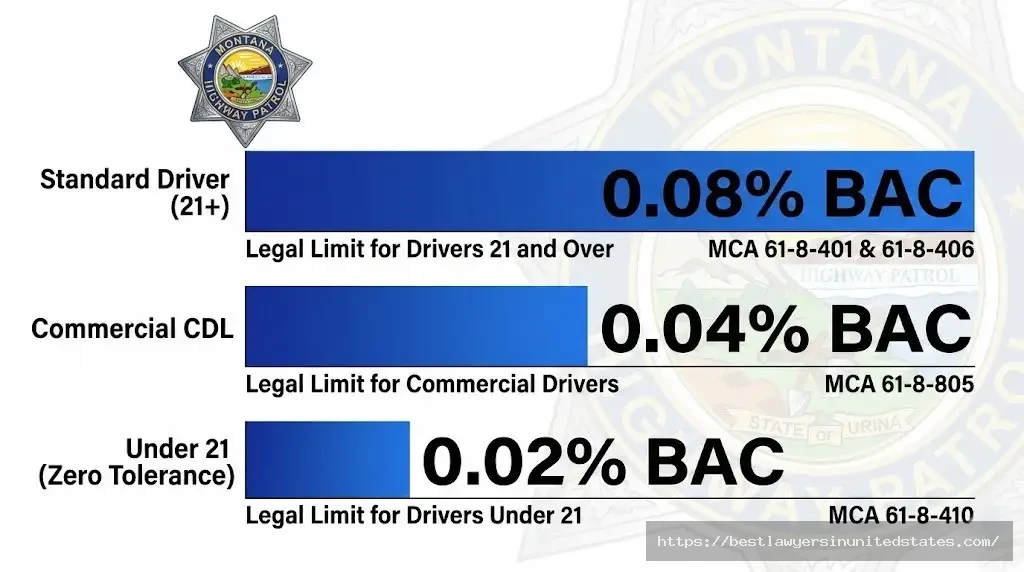
Montana enforces different BAC thresholds based on driver category:
| Driver Type | Legal BAC Limit | Law Citation |
|---|---|---|
| Standard (21+) | 0.08% | MCA § 61-8-406 |
| Commercial (CDL) | 0.04% | MCA § 61-8-411 |
| Under 21 | 0.02% | MCA § 61-8-410 |
Critical detail: CDL holders face a 0.04% limit even when driving personal vehicles. A 0.08% BAC in your personal car still triggers CDL disqualification.
Want to estimate your BAC? Use our BAC calculator to see how drinks affect your blood alcohol level.
BAC Calculator
Estimate your Blood Alcohol Content
• Commercial Driver (CDL): 0.04% BAC
• Drivers Under 21: 0.00-0.02% BAC (Zero Tolerance)
• Enhanced Penalties: 0.15% BAC or higher in most states
Montana DUI Penalties 2026
Montana structures penalties by offense number within your lifetime. The state counts all prior DUI convictions forever.
First Offense DUI Penalties

Standard first offense under MCA § 61-8-714:
| Penalty Type | Requirement |
|---|---|
| Jail time | 24 hours to 6 months |
| Fines | $600 to $1,200 |
| License suspension | 6 months |
| Chemical assessment | Mandatory |
| Treatment program | Varies by assessment |
| Victim impact panel | Required |
Most first-time offenders serve the minimum 24 hours. Judges rarely impose maximum sentences unless aggravating factors exist.
First offense aggravated DUI (0.16% BAC or higher):
| Enhanced Penalty | Requirement |
|---|---|
| Jail time | 48 hours to 1 year (48 hours consecutive minimum) |
| Fines | $1,200 to $2,000 |
| Treatment | Enhanced requirements |
The 48-hour minimum must be served consecutively. No work release or weekends allowed.
Second Offense DUI Penalties
Second offense within your lifetime triggers harsher mandatory minimums:
| Penalty Category | Standard DUI | Aggravated DUI |
|---|---|---|
| Jail time | 5 days to 1 year | 10 days to 1 year |
| Fines | $1,200 to $2,000 | $2,500 to $5,000 |
| License suspension | 1 year | 1 year |
| IID requirement | 1 year minimum | 1 year minimum |
| Treatment hours | 40 minimum | 40+ hours |
Critical requirement: The 5-day minimum jail sentence must be served consecutively. Courts cannot grant work release for these days.
All second-offense convictions require ignition interlock device installation. You pay installation costs ($100-$150) plus monthly fees ($70-$100).
Third Offense DUI Penalties
Third convictions carry severe consequences under MCA § 61-8-714(3):
Mandatory penalties:
- Jail: 30 days to 1 year (30 days consecutive)
- Fines: $2,500 to $5,000
- License suspension: 1 year
- IID requirement: 2 years minimum
- Vehicle forfeiture: Possible (court’s discretion)
Montana allows vehicle forfeiture starting with third offenses. The state can seize your car even if family members own it.
Fourth Offense: Felony DUI
Your fourth DUI conviction becomes a felony under MCA § 61-8-731, regardless of time between offenses.

Felony DUI penalties:
| Consequence | Details |
|---|---|
| Classification | Felony offense |
| Prison time | 13 months to 5 years (Montana State Prison) |
| Fines | Up to $10,000 |
| License revocation | 1 year minimum |
| Vehicle forfeiture | Mandatory |
| Felony record | Permanent |
Lifetime impacts of felony DUI:
- Voting rights suspended during incarceration
- Federal student loan ineligibility
- Professional license restrictions
- Firearm ownership prohibition
- Employment barriers in most fields
Fifth and sixth offenses: Enhanced prison sentences apply. Courts can order permanent driving privilege revocation.
Calculate your total financial impact using our DUI cost calculator.
DUI Cost Calculator
Estimate total DUI expenses by state and offense
Detailed Cost Breakdown
Payment Timeline
Bail bond, towing fees, car impound, attorney retainer
Initial court fines, DMV fees, DUI school enrollment, ignition interlock installation
Monthly probation fees, ignition interlock fees, DUI school payments, attorney balance
Insurance premium increases, license reinstatement, SR-22 filing fees
- Lost wages from missed work (court dates, jail time, DUI school) – $2,000-$10,000
- Job loss or difficulty finding employment – Varies
- Professional license suspension (doctors, lawyers, nurses, pilots) – Career ending
- Rideshare and transportation costs during suspension – $1,500-$5,000
- Travel restrictions and visa denials – Varies
- Security clearance loss – Career impact
- Child custody implications – Legal costs
- Rental car restrictions – Varies
- Personal relationships and mental health costs – Priceless
Aggravated DUI in Montana
Montana law creates an enhanced “aggravated DUI” category under MCA § 61-8-465 with stricter penalties than standard DUI.
What Triggers Aggravated DUI Charges?
Four circumstances elevate a DUI to aggravated status:

Aggravated DUI triggers:
- BAC 0.16% or higher (double the legal limit)
- Chemical test refusal (breath, blood, or urine)
- Child passenger under 16 in the vehicle
- DUI causing bodily injury to another person
Critical point: You can face aggravated DUI charges even on a first offense if any trigger applies.
Is Aggravated DUI a Felony in Montana?
Aggravated DUI remains a misdemeanor for your first three offenses. The enhanced classification affects penalty severity, not felony status.
Felony thresholds:
- First three aggravated DUIs: Still misdemeanors (with enhanced penalties)
- Fourth aggravated DUI: Felony (same as standard fourth DUI)
- Exception: Aggravated DUI causing serious bodily injury becomes a felony on first offense
Aggravated DUI Penalty Comparison
| Offense | Standard DUI Jail | Aggravated DUI Jail | Standard Fines | Aggravated Fines |
|---|---|---|---|---|
| 1st | 24 hours-6 months | 48 hours-1 year | $600-$1,200 | $1,200-$2,000 |
| 2nd | 5 days-1 year | 10 days-1 year | $1,200-$2,000 | $2,500-$5,000 |
| 3rd | 30 days-1 year | 60 days-1 year | $2,500-$5,000 | $5,000-$10,000 |
Key penalty difference: Aggravated DUI doubles minimum jail time and increases minimum fines by $600 to $2,800 depending on offense number.
High BAC Aggravated DUI (0.16%+)
Montana’s 0.16% threshold represents extreme intoxication. For a 180-pound man, reaching 0.16% BAC typically requires 8-9 drinks within 2 hours.
Consequences of 0.16%+ BAC:
- Minimum 48-hour consecutive jail sentence (first offense)
- Enhanced chemical dependency treatment requirements
- Longer probation periods (typically 2 years vs. 1 year)
- Higher insurance rate increases
Judges view high BAC cases seriously. Expect prosecutors to oppose reduced charges in 0.16%+ cases.
Montana’s Implied Consent Law
Montana operates under an implied consent law. Accepting your driver’s license means you automatically agree to chemical testing if arrested for DUI.
How Implied Consent Works in Montana
Montana Code Annotated § 61-8-442 requires chemical testing cooperation. When an officer arrests you for DUI, you must submit to breath, blood, or urine testing.
What triggers implied consent:
- Officer arrests you for DUI (not just stops you)
- Officer reads the implied consent warning
- Officer requests a chemical test
- You must choose: submit or refuse
Your testing options:
- Breath test (most common)
- Blood test (officer’s choice or by warrant)
- Urine test (rare, used for drug DUI)
Officers must read the implied consent advisory before requesting testing. This warning explains refusal consequences.
Chemical Test Refusal Consequences
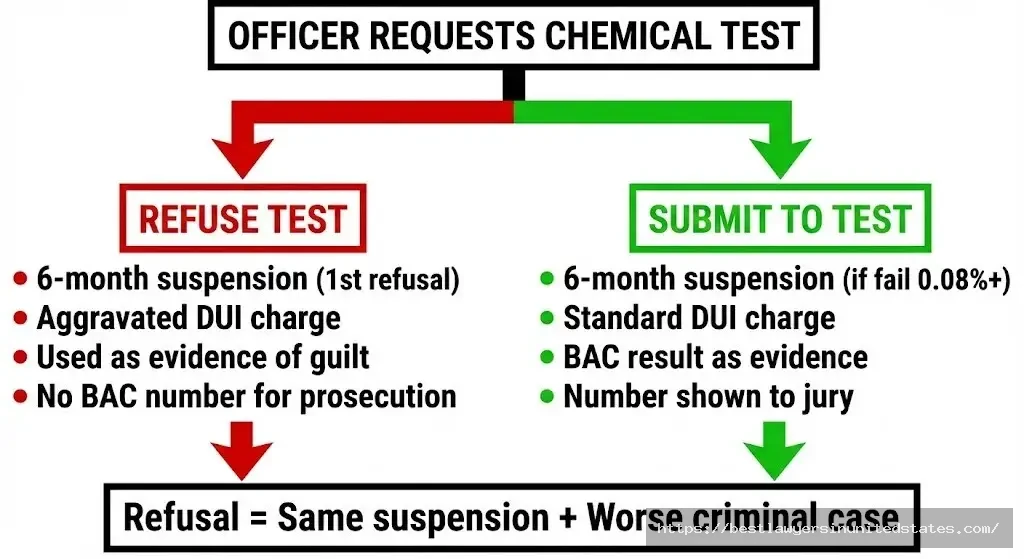
Refusing a chemical test triggers automatic administrative penalties separate from any criminal charges:
| Refusal Number | Suspension Length | Restoration Fee |
|---|---|---|
| First refusal | 6 months | $200 |
| Second refusal (within 5 years) | 1 year | $200 |
| Third refusal | 1 year | $200 |
Critical differences between refusal and test failure:
| Factor | Test Refusal | Failed Test (0.08%+) |
|---|---|---|
| License suspension | 6 months | 6 months |
| Criminal evidence | Refusal itself used against you | BAC results used |
| Aggravated DUI trigger | YES | NO |
| Restoration requirements | Same | Same |
Why refusal matters criminally: Prosecutors use test refusal as evidence of “consciousness of guilt.” Juries often interpret refusal as admission you knew you were intoxicated.
Can You Refuse Field Sobriety Tests?
Montana law distinguishes between field sobriety tests and chemical tests. You can refuse field tests without automatic penalties.
Field sobriety test refusal:
- No automatic license suspension
- No violation of implied consent law
- Officer may still arrest based on other evidence
- Refusal itself cannot be used against you in court
Roadside preliminary breath test (PBT):
- Also refusable without penalty
- Results not admissible in criminal trial
- Used only for probable cause determination
- Different from evidentiary breath test at station
Evidentiary chemical test refusal:
- Triggers 6-month suspension
- Violates implied consent law
- Can be used as criminal evidence
- May trigger aggravated DUI charges
Independent Testing Rights
Montana law allows you to arrange additional independent testing at your own expense after completing the official test. MCA § 61-8-442(2) protects this right.
How independent testing works:
- Complete the officer’s chemical test first
- Request independent testing
- Officer must provide reasonable opportunity
- You pay all costs
- Results admissible in your defense
Officers cannot deny reasonable independent testing requests. Denials may provide grounds for case dismissal.
Montana’s Restricted Probationary License (RPL)
Montana offers a restricted probationary license program allowing limited driving during your suspension period. The RPL requires completing Montana’s unique A-C-T program phases.
RPL Eligibility Requirements
Not everyone qualifies for restricted licenses in Montana:
Who can apply:
- First, second, or third DUI offenders
- Montana residents only
- Valid Montana license holders
- SR-22 insurance obtained
Who cannot apply:
- Felony DUI convicts (fourth offense+)
- Out-of-state license holders
- Those with suspended SR-22 insurance
- Drivers who missed chemical assessments
The A-C-T Program Phases
Montana’s RPL system uses three sequential phases: Assessment, Chemical dependency treatment, and Testing.
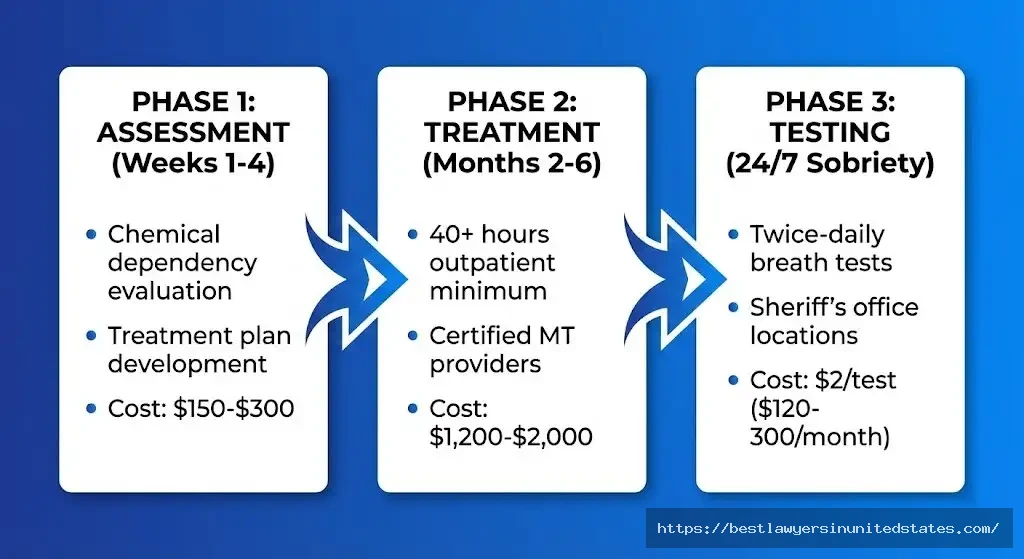
Phase 1: Assessment (Weeks 1-4)
The assessment phase requires professional chemical dependency evaluation:
- Licensed counselor conducts evaluation
- Creates individualized treatment plan
- Determines treatment intensity needed
- Assesses relapse risk factors
Cost: $150-$300 depending on provider
Phase 2: Chemical Dependency Treatment (Months 2-6)
Treatment requirements vary by assessment results:
| Assessment Level | Treatment Hours | Duration | Typical Cost |
|---|---|---|---|
| Level I | 16 hours outpatient | 4-8 weeks | $500-$800 |
| Level II | 40 hours outpatient | 10-16 weeks | $1,200-$2,000 |
| Level III | 90+ hours intensive | 20-26 weeks | $3,000-$5,000 |
Second and third offenses require minimum 40-hour programs regardless of assessment.
Phase 3: Testing – Montana’s 24/7 Sobriety Program
The final phase requires either:
- Twice-daily breath testing at sheriff’s office, OR
- Continuous Alcohol Monitoring (CAM) bracelet
Duration: Remainder of suspension period after treatment completion
How to Apply for Montana RPL
Application timeline and steps:
- Day 1-30 after suspension: Wait 30 days minimum before applying
- Complete assessment: Schedule with approved Montana provider
- Gather documents needed:
- SR-22 insurance certificate
- Assessment completion certificate
- RPL application form (MVD-101)
- $200 application fee
- Submit to Montana Motor Vehicle Division:
- Mail: PO Box 201430, Helena, MT 59620-1430
- In person: 302 N Roberts St, Helena, MT 59620
- Install ignition interlock device (if required for 2nd+ offense)
Processing time: 10-15 business days for approval decision
RPL Driving Restrictions
Montana’s restricted license allows limited driving only:
Permitted driving:
- Work commute (direct route only)
- Chemical dependency treatment appointments
- 24/7 testing appointments
- Medical emergencies
- Court-ordered appointments
Prohibited driving:
- Recreational purposes
- Shopping or errands
- Social visits
- Alternative routes to work
Violation consequences: Officers who catch you violating RPL restrictions will revoke the license immediately. You’ll serve the remaining suspension without driving privileges.
Montana’s 24/7 Sobriety Program
Montana’s 24/7 program requires twice-daily alcohol testing for DUI offenders during their RPL phase. The program aims to maintain complete sobriety rather than just preventing drunk driving.
How Twice-Daily Testing Works
Testing schedule requirements:
- Morning test: 7:00 AM – 9:00 AM
- Evening test: 7:00 PM – 9:00 PM
- Tests must be 12 hours apart
- Seven days per week (including holidays)
- No exceptions for weekends or vacations
You report to your assigned testing location during the testing window. A law enforcement officer or designated monitor administers a breath test.
Test result thresholds:
- 0.00% BAC: Pass
- 0.01% or higher: Violation (immediate consequences)
- Missed test: Same as failed test
24/7 Testing Locations in Montana
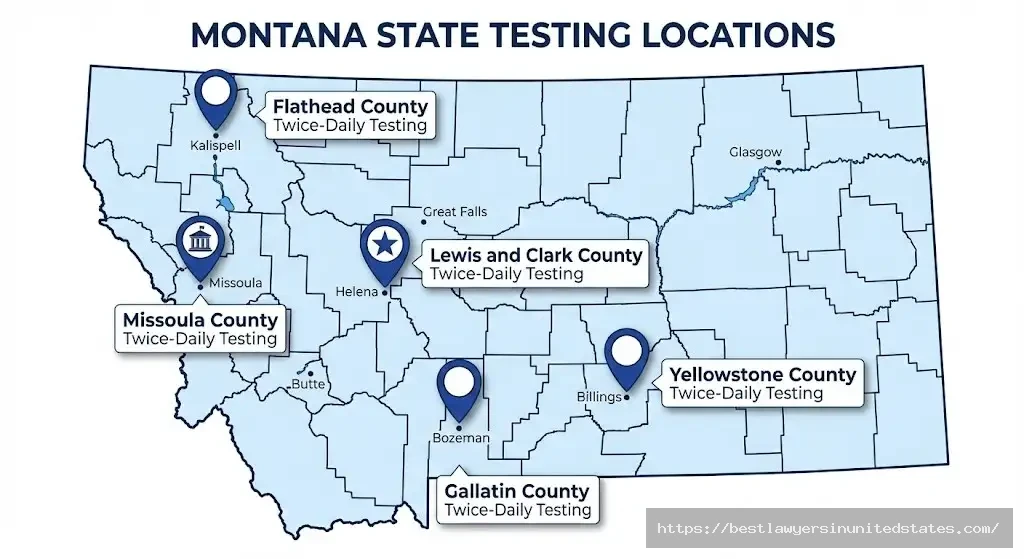
Major county testing sites:
| County | Testing Location | Address |
|---|---|---|
| Missoula | Missoula County Detention Facility | 2340 Mullan Rd, Missoula, MT 59808 |
| Yellowstone | Yellowstone County Detention Facility | 2060 S 56th St W, Billings, MT 59106 |
| Gallatin | Gallatin County Sheriff’s Office | 615 S 16th Ave, Bozeman, MT 59715 |
| Lewis and Clark | Lewis and Clark County Detention Center | 3021 N Roberts St, Helena, MT 59602 |
| Flathead | Flathead County Detention Center | 920 S Main St, Kalispell, MT 59901 |
Rural counties: Smaller counties use sheriff’s offices or designated testing facilities. Contact your county sheriff for specific locations.
24/7 Program Costs
Testing fees accumulate quickly over months of participation:
| Cost Component | Amount |
|---|---|
| Per-test fee | $2-$5 per test |
| Monthly cost | $120-$300 (60 tests) |
| 6-month program | $720-$1,800 |
| 1-year program | $1,440-$3,600 |
Payment responsibility: You pay all testing costs. No financial assistance programs exist.
Alternative: CAM bracelet option – Some counties allow Continuous Alcohol Monitoring ankle bracelets instead of twice-daily testing:
- Installation fee: $100-$200
- Monthly monitoring: $300-$400
- Eliminates daily testing site visits
- Detects alcohol consumption 24/7
What Happens If You Miss a Test?
Missing even one scheduled test triggers immediate consequences:
Same-day actions:
- Sheriff issues arrest warrant
- RPL suspended immediately
- Bond required for release
- Court hearing scheduled
Criminal consequences:
- Charged with program violation
- Up to 2 days jail time per missed test
- Fines up to $200 per violation
- Extended probation period
Administrative consequences:
- RPL revocation (serve remaining suspension without driving)
- Restart A-C-T program from beginning
- Additional suspension time added
Common missed test excuses that don’t work:
- Work schedule conflicts
- Car breakdown
- Family emergency
- Illness
- Forgot the appointment
Judges rarely excuse missed tests. Plan your life around the testing schedule or risk losing all driving privileges.
Montana DUI License Suspension Timeline
Montana enforces two separate suspension systems: administrative (through Montana Motor Vehicle Division) and criminal (through courts). Both can run simultaneously.
Immediate Suspension After Arrest
At the DUI stop:
- Officer confiscates your physical license
- Issues temporary driving permit (pink form)
- Permit valid for 5 business days only
Day 6 after arrest:
- Temporary permit expires
- License officially suspended (unless you requested hearing)
- Cannot drive legally without RPL or successful hearing
Administrative Hearing Process
You have limited time to request an administrative hearing to fight the suspension:
Critical deadlines:
| Action | Deadline | Consequence of Missing |
|---|---|---|
| Request hearing | 30 days from arrest | Automatic suspension |
| Hearing scheduled | 30-60 days after request | Varies by county |
| Suspension stays | Until hearing decision | License valid meanwhile |
How to request a hearing:
- Complete “Request for Hearing” form (MVD-100)
- Submit to Montana MVD within 30 days of arrest
- Pay $100 hearing fee (non-refundable)
- MVD schedules hearing in county of arrest
What you can challenge at hearing:
- Did officer have probable cause for stop?
- Was arrest lawful?
- Did you refuse testing or test over 0.08%?
- Were testing procedures proper?
- Was implied consent warning given?
Hearing outcomes:
- Win: License suspension canceled
- Lose: Suspension begins immediately
- No appeals to administrative decisions
Criminal Court Suspension
Separate from administrative suspension, criminal DUI convictions trigger additional license suspensions:
| Conviction | Criminal Suspension | Can Run Concurrent? |
|---|---|---|
| 1st DUI | 6 months | Yes |
| 2nd DUI | 1 year | Yes |
| 3rd DUI | 1 year | Yes |
| 4th DUI (felony) | 1 year minimum | Yes |
How concurrent suspensions work: If you lose your administrative hearing and get convicted, the suspensions can overlap rather than stack. You don’t serve 6 months plus 6 months, just 6 months total.
If you win administrative hearing but get convicted: Criminal suspension still applies. Winning the MVD hearing doesn’t protect against court-ordered suspension.
License Reinstatement Requirements
Getting your license back after suspension requires several steps:
Reinstatement checklist:
- Complete full suspension period (or RPL program)
- Pay $200 reinstatement fee to Montana MVD
- Provide SR-22 insurance certificate
- Pay all outstanding court fines and fees
- Complete all ordered treatment programs
- Pass written and driving tests (if required)
- Install IID (if ordered for 2nd+ offense)
SR-22 insurance requirement: Montana requires SR-22 for 3 years after DUI reinstatement. Expect insurance rates to increase $1,000-$3,000 annually.
The True Cost of a Montana DUI
Montana DUI costs extend far beyond court fines. Total expenses often reach $10,000-$25,000 for first offenses and increase substantially for repeat convictions.
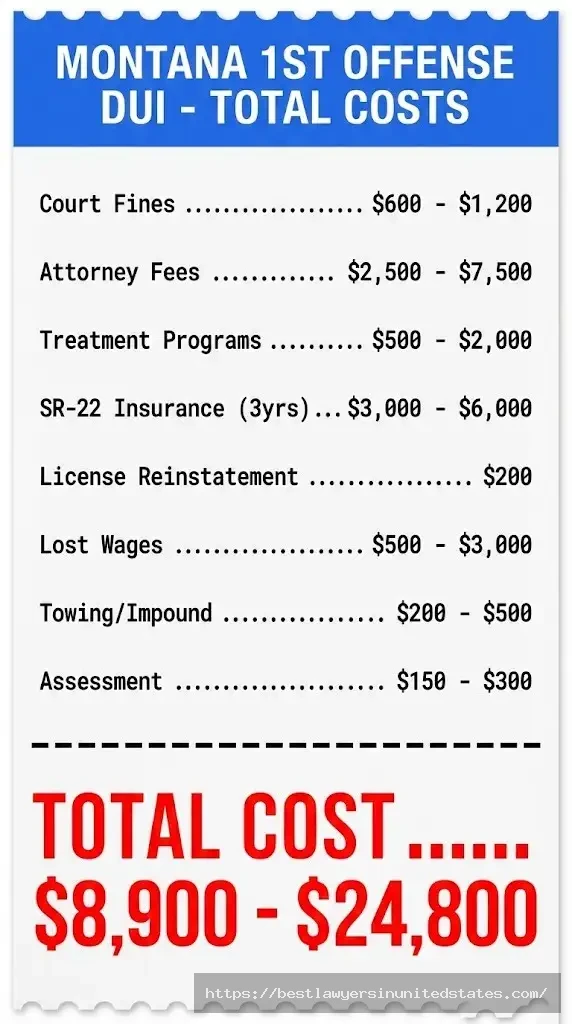
First Offense DUI Cost Breakdown
| Expense Category | Low End | High End | Notes |
|---|---|---|---|
| Court fines | $600 | $1,200 | Statutory minimum/maximum |
| Court costs | $200 | $500 | Filing, processing fees |
| Public defender | $0 | $500 | If appointed |
| Private attorney | $2,500 | $7,500 | Varies by county, complexity |
| Bail/bond | $500 | $2,000 | Refunded if you appear |
| Chemical assessment | $150 | $300 | Required evaluation |
| Treatment program | $500 | $2,000 | Based on assessment level |
| Victim impact panel | $50 | $100 | One-time attendance fee |
| License reinstatement | $200 | $200 | Montana MVD fee |
| SR-22 insurance (3 years) | $3,000 | $6,000 | Annual rate increase |
| Towing/impound | $200 | $500 | Vehicle recovery costs |
| Lost wages | $500 | $3,000 | Court dates, jail time |
| TOTAL FIRST OFFENSE | $8,900 | $24,800 |
Hidden costs not included above:
- Increased car insurance rates (lasts 3-5 years)
- Uber/taxi costs during suspension ($200-$1,000)
- Lost job opportunities requiring clean record
- Professional license complications
- Travel restrictions (some countries deny entry)
Use our DUI cost calculator to estimate your specific situation.
Second Offense DUI Costs
| Expense Category | Low End | High End |
|---|---|---|
| Court fines | $1,200 | $2,000 |
| Attorney fees | $5,000 | $12,000 |
| Bail/bond | $1,000 | $3,000 |
| Treatment (40+ hours) | $1,200 | $3,000 |
| Ignition interlock (1 year) | $900 | $1,500 |
| SR-22 insurance (3 years) | $4,000 | $8,000 |
| All other costs | $2,000 | $4,000 |
| TOTAL SECOND OFFENSE | $15,300 | $33,500 |
Third Offense DUI Costs
Third offenses add vehicle forfeiture risks and longer IID requirements:
| Major Cost Additions | Amount |
|---|---|
| Extended attorney fees | $8,000-$15,000 |
| 30-day jail lost wages | $4,000-$8,000 |
| IID (2 years) | $1,800-$3,000 |
| Vehicle forfeiture | $5,000-$30,000 (if ordered) |
| TOTAL THIRD OFFENSE | $25,000-$50,000+ |
Felony DUI Costs (Fourth Offense)
Felony convictions create long-term financial devastation:
Immediate costs:
- Criminal defense attorney: $15,000-$30,000
- Court fines: Up to $10,000
- Prison lost income: $20,000-$60,000 (13 months-5 years)
- Vehicle forfeiture: Mandatory (value lost)
Long-term financial impacts:
- Lifetime reduced earning potential: $100,000-$500,000
- Felony record employment barriers
- Professional license revocations
- Federal student loan ineligibility
- Difficulty renting housing
Estimated lifetime cost of felony DUI: $150,000-$500,000+
Montana DUI Attorney Costs
Legal representation costs vary significantly by case complexity and county:
| Case Type | Typical Fee Structure | Price Range |
|---|---|---|
| First offense (no aggravating factors) | Flat fee | $2,500-$5,000 |
| First offense (accident/injury) | Hourly + retainer | $5,000-$12,000 |
| Second offense | Flat fee or hourly | $5,000-$10,000 |
| Third offense | Hourly + retainer | $8,000-$15,000 |
| Felony DUI (fourth offense) | Hourly + retainer | $15,000-$30,000 |
County cost variations:
- Missoula County: Higher average fees ($3,500-$8,000 for first offense)
- Yellowstone County (Billings): Mid-range ($3,000-$6,000)
- Rural counties: Often lower ($2,000-$4,000)
Payment options: Many Montana DUI attorneys offer payment plans. Typical terms require $1,000-$2,000 down payment with monthly installments.
Special DUI Circumstances in Montana
Certain driver categories face unique DUI consequences beyond standard penalties.
CDL Holders: Commercial Driver DUI Rules
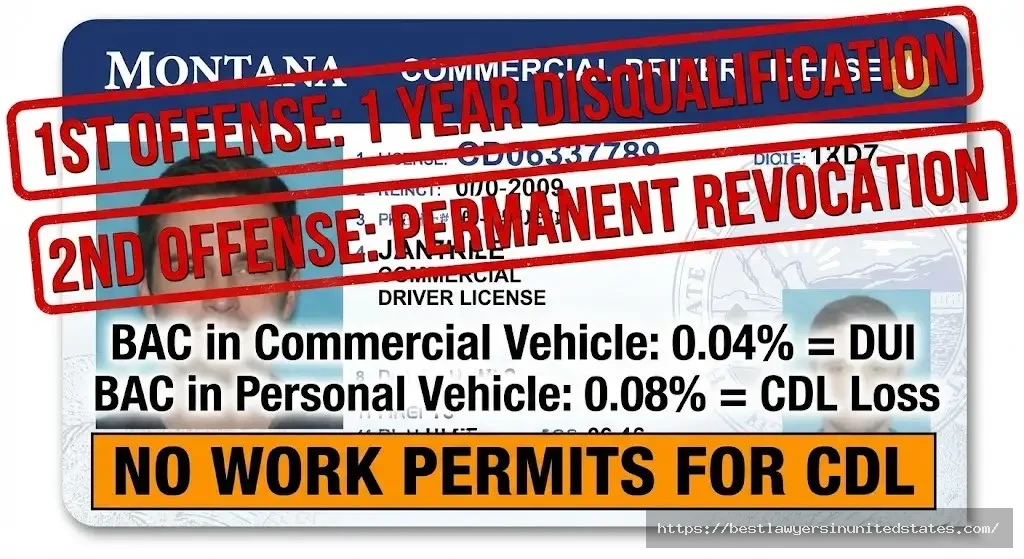
Montana imposes strict DUI standards on commercial driver license holders. A single DUI can end your trucking career.
CDL BAC limits:
| Vehicle Type | BAC Limit | Violation |
|---|---|---|
| Commercial vehicle | 0.04% | CDL DUI |
| Personal vehicle | 0.08% | Still triggers CDL disqualification |
| Any vehicle (under 21) | 0.02% | Zero tolerance + CDL loss |
Critical rule: You face CDL disqualification even for DUI in your personal car. The 0.08% BAC limit applies to criminal charges, but your CDL gets suspended regardless.
CDL disqualification periods:
| Offense | Disqualification Length | Can You Get It Back? |
|---|---|---|
| First DUI | 1 year | Yes, after 1 year |
| First DUI (hazmat CDL) | 3 years | Yes, after 3 years |
| Second DUI (lifetime) | Permanent | No |
| DUI causing fatality | Permanent | No |
No work permits for commercial driving: Montana does not offer restricted CDL privileges. You cannot drive commercial vehicles during your disqualification period, even for work.
Interstate impact: The Federal Motor Carrier Safety Administration reports your Montana DUI to all states. You cannot get a CDL in another state to avoid Montana’s disqualification.
Employer notification: Montana reports CDL DUI convictions to your employer within 30 days. Most trucking companies terminate employment immediately.
Underage DUI (Under 21) in Montana
Montana enforces zero tolerance for drivers under 21 through MCA § 61-8-410, setting a 0.02% BAC limit.
How 0.02% BAC works:
- Approximately one drink creates 0.02% BAC
- Mouthwash or cold medicine can register 0.02%
- No impairment required for violation
Zero tolerance penalties:
| Violation | First Offense | Second Offense |
|---|---|---|
| License suspension | 90 days | 1 year |
| Fines | $100-$500 | $300-$1,000 |
| Treatment | May be required | Usually required |
Adult DUI charges for minors: If your BAC reaches 0.08% or higher, you face adult DUI charges in addition to zero tolerance violation.
Dual charging:
- Zero tolerance (0.02%-0.079% BAC)
- Adult DUI (0.08%+ BAC)
- Both penalties apply simultaneously
Parent/guardian notification: Montana law requires police to notify parents or guardians of minors arrested for any alcohol offense.
DUI Causing Injury or Death
DUI crashes causing injuries or fatalities trigger severe charges beyond standard DUI:
Vehicular homicide while intoxicated (MCA § 45-5-106):
- Classification: Felony
- Prison: 2-30 years
- Fines: Up to $50,000
- License: Lifetime revocation possible
- Victim restitution: Mandatory (medical, funeral, lost income)
Aggravated DUI with serious bodily injury:
- Felony on first offense (bypasses misdemeanor levels)
- Prison: 2-10 years
- Permanent felony record
- Civil lawsuits likely (insurance won’t cover)
Civil liability: Criminal penalties are just the beginning. Victims can sue for:
- Medical expenses (past and future)
- Lost wages and earning capacity
- Pain and suffering
- Wrongful death damages
Montana allows punitive damages in DUI injury cases. Judgments often exceed $1 million in serious injury cases.
Out-of-State Drivers Arrested in Montana
Montana DUI arrests affect your home state license through the Interstate Driver License Compact.
What Montana reports to your home state:
- DUI arrest and conviction
- BAC test results
- License suspension in Montana
- All court outcomes
Your home state’s response:
- Typically suspends your license
- Treats Montana DUI as if it occurred at home
- Counts toward habitual offender status
- May require SR-22 insurance
Court appearance requirements:
- You must appear in Montana for arraignment (usually)
- Attorney may appear for you in some hearings
- Judge can issue arrest warrant if you don’t appear
- Cannot transfer case to your home state
Common states with Montana tourists:
- California, Washington, Oregon (ski visitors)
- North Dakota, South Dakota, Wyoming (border states)
- All states participate in Interstate Compact
Travel restrictions: You cannot leave Montana if you’re out on bail without court permission. Request travel authorization from the judge.
DUI on Indian Reservations in Montana
Montana has seven tribal reservations where jurisdiction becomes complex in DUI cases.
Montana’s tribal lands:
- Blackfeet Nation
- Crow Nation
- Fort Peck Assiniboine & Sioux
- Fort Belknap Indian Reservation
- Northern Cheyenne Indian Reservation
- Rocky Boy’s Indian Reservation
- Flathead Reservation (Confederated Salish & Kootenai)
Who has jurisdiction:
| Defendant | Location | Arresting Agency | Which Law Applies? |
|---|---|---|---|
| Tribal member | Reservation | Tribal police | Tribal code |
| Non-tribal member | Reservation | Tribal/FBI | Federal law (18 USC 1152) |
| Any driver | State highway through reservation | Montana HP | Montana state law |
Federal DUI charges: Non-tribal members arrested on reservation land face federal prosecution, which carries different penalties than Montana state DUI:
- Federal: Up to 1 year jail, $5,000 fine (first offense)
- Federal courts have no plea bargaining
- Federal conviction affects federal employment/benefits
Practical complications:
- Tribal police may turn you over to FBI
- Federal court in Billings or Great Falls (far from arrest location)
- No Montana DUI diversion programs in federal system
- Defense attorneys need federal court admission
Highway exception: DUIs on federal highways passing through reservations (like Highway 2 through Fort Belknap) typically stay in Montana state courts.
Montana License Suspension FAQs
Is Your License Suspended Immediately After a DUI in Montana?
Not immediately at the stop, but within days. Officers confiscate your physical license and issue a temporary permit valid for 5 business days. Your license suspends on the sixth day unless you requested an administrative hearing within 30 days.
Critical timeline:
- Day 0: Arrested, receive temporary permit
- Days 1-5: Temporary permit remains valid
- Day 6: License suspended (if no hearing requested)
- Day 30: Deadline to request hearing
Requesting a hearing stays the suspension until the hearing officer decides your case.
Can You Refuse a Breathalyzer in Montana?
Yes, you can refuse, but Montana’s implied consent law imposes automatic penalties. First refusal triggers a 6-month license suspension, and refusal becomes aggravated DUI evidence against you.
Refusal consequences comparison:
| Factor | Refuse Test | Take Test (0.08%+) |
|---|---|---|
| Suspension length | 6 months | 6 months |
| Used as evidence | Refusal shown to jury | BAC number shown |
| Aggravated DUI charge | YES (refusal = aggravating factor) | Only if 0.16%+ |
Refusal strategy rarely helps: Prosecutors argue refusal shows “consciousness of guilt.” Juries typically view refusal negatively. You lose your license for the same period but make your criminal case harder to defend.
How Long Does a DUI Stay on Your Record in Montana?
Permanently, unless expunged. Montana uses a lifetime lookback period for DUI offenses. A DUI from 30 years ago still counts as your first offense when calculating penalties for a new DUI.
Record permanence:
- Criminal record: Permanent (unless expunged after 5 years)
- Driving record: Permanent (lifetime lookback)
- Background checks: Shows indefinitely
- Employment screening: Visible permanently
Expungement option: Misdemeanor DUI offenders can petition for expungement 5 years after completing their sentence. See details in the expungement section below.
Can You Expunge a DUI in Montana?
Montana allows expungement for misdemeanor DUI convictions under specific conditions. Expungement removes the conviction from public court records but doesn’t erase it completely.
Montana DUI Expungement Eligibility
Misdemeanor DUI requirements:
- 5 years passed since sentence completion
- All fines and restitution paid in full
- All probation completed successfully
- No new arrests during 5-year waiting period
- No pending charges anywhere
What “sentence completion” means:
- Final day of jail time or probation (whichever is later)
- All treatment programs finished
- All license suspension served
- All court costs paid
Second calculation method: Count from “date of sentencing” plus probation length (typically results in same 5-year period).
Who cannot get expungement:
- Felony DUI offenders (fourth offense+)
- Those with pending charges
- Multiple DUI convictions (one expungement allowed per person)
- Those who violated probation
Montana Expungement Process
Step-by-step filing procedure:
- Obtain complete court records:
- Request from court where convicted
- Need full case file and disposition
- Cost: $0-$50 depending on county
- Complete expungement petition:
- Form title: “Petition for Expungement”
- Available from district court clerk
- Must include case number, conviction details
- File petition with Montana District Court:
- File in county of conviction
- Filing fee: $200
- Attach proof of completion (jail release, probation end date)
- Serve notice to county attorney:
- Must notify prosecutor’s office
- Prosecutor can object to expungement
- Service must be completed within 30 days
- Court hearing (if prosecutor objects):
- Judge weighs public interest vs. your rehabilitation
- You may need to testify
- Hearing typically 30-60 days after filing
- Judge’s decision:
- Ruling within 30 days of hearing
- If granted, conviction sealed from public view
- Court sends notice to Montana DOJ
Processing timeline: 3-6 months from filing to final order.
What Expungement Does (and Doesn’t Do)
After successful expungement:
✅ What gets removed:
- Public court records (public cannot see conviction)
- Most background checks (employers won’t see it)
- Can legally say “not convicted” on most applications
❌ What remains:
- Counts as prior offense for future DUI charges
- FBI background checks may still show it
- Professional licensing boards can still access
- Law enforcement can see sealed record
- Immigration authorities retain access
Employment answer: For most private employers, you can answer “no” when asked about criminal convictions. Exceptions exist for:
- Government jobs requiring security clearance
- Law enforcement positions
- Jobs requiring fingerprinting
- Professional licenses (lawyers, doctors, nurses)
Critical limitation: Even with expungement, Montana counts the DUI for repeat offender penalties. Your second DUI still becomes a second offense with enhanced penalties.
Your Rights at Montana DUI Stops
Montana law provides specific protections during traffic stops and DUI investigations. Understanding these rights helps you avoid self-incrimination.
Montana DUI Checkpoint Laws
DUI checkpoints are legal in Montana if properly conducted. Montana courts upheld sobriety checkpoints in State v. Henderson and subsequent cases.
Legal checkpoint requirements:
- Public announcement before checkpoint (newspaper, social media, news)
- Supervisory approval and written plan
- Neutral vehicle selection (every car, or every third car)
- Safety precautions (lights, signs, officer visibility)
- Brief detention only (1-3 minutes per vehicle)
Your checkpoint rights:
| What You Must Do | What You Can Refuse |
|---|---|
| Stop your vehicle | Field sobriety tests |
| Provide license, registration, insurance | Answer questions beyond identification |
| Exit vehicle if ordered | Vehicle searches without warrant/consent |
| Submit to arrest if officer has probable cause | Preliminary breath tests (roadside PBT) |
Can you turn around to avoid a checkpoint?
Yes, legally, if you can do so safely and without traffic violations. However:
- Officer can follow you for separate traffic violation
- Illegal U-turn gives officer probable cause to stop you
- Turning around may create officer suspicion
- Must obey all traffic laws during avoidance
What to say at checkpoints:
- “I’m invoking my right to remain silent.”
- “I do not consent to searches.”
- “Am I free to go?”
Polite but firm refusal protects your rights without appearing confrontational.
Field Sobriety Tests: Your Rights
Montana law does not require you to perform field sobriety tests. You can refuse without automatic penalties.
Standardized field sobriety tests (SFSTs):
- Horizontal Gaze Nystagmus (HGN) – follow pen/light with eyes
- Walk-and-Turn – nine steps heel-to-toe, turn, return
- One-Leg Stand – balance on one foot for 30 seconds
Why officers use SFSTs:
- Build probable cause for arrest
- Obtain evidence of impairment
- Document your physical condition on video
Accuracy concerns:
- 68-77% accurate under ideal conditions (NHTSA studies)
- Medical conditions create false positives:
- Ear infections (balance issues)
- Knee/ankle injuries
- 50+ age (natural balance decline)
- Neurological conditions
- Eye conditions (HGN test)
- Officer administration errors common
Non-standardized tests to refuse:
- Alphabet recitation
- Counting backwards
- Finger-to-nose
- Romberg balance test (head tilt back, eyes closed)
These lack scientific validation and judges often exclude them.
Should you refuse field tests?
Arguments for refusal:
- No automatic penalty (unlike chemical test refusal)
- Tests subjectively graded by officer
- Results almost always support arrest
- Medical conditions cause failure regardless of sobriety
Arguments for taking tests:
- Refusal gives officer more suspicion for arrest
- Your confident performance might convince officer to release you
- Video evidence of good performance helps defense
Most DUI attorneys recommend polite refusal unless you’re completely sober and confident in your physical abilities.
Breathalyzer Rights and Refusal
Montana law distinguishes between preliminary breath tests (roadside) and evidentiary breath tests (at station).
Preliminary Breath Test (PBT) – Roadside:
- Portable device at traffic stop
- Results not admissible in criminal trial
- Used only for probable cause determination
- You can refuse without penalty
Evidentiary Breath Test – At Station:
- Larger, calibrated machine at jail/station
- Results admissible as primary evidence
- Refusal triggers implied consent violations
- Refusal = 6-month suspension + aggravated DUI
How to tell the difference:
- Roadside = preliminary test (refusable)
- At police station/jail = evidentiary test (implied consent applies)
- Officer must read implied consent warning before evidentiary test
What happens if you refuse evidentiary test:
| Consequence | Timeline |
|---|---|
| Automatic suspension | Begins 6 days after refusal |
| Aggravated DUI charge | Immediately added to charges |
| Prosecution evidence | “Consciousness of guilt” argument |
| Administrative penalties | Same as failing test |
Can officers force you to submit?
Not without a warrant. Montana law prohibits physical force for blood draws unless:
- Officer obtains search warrant from judge
- Exigent circumstances exist (serious injury crash)
- Defendant unconscious (medical blood draw)
Officers increasingly obtain telephonic warrants (call judge for approval). Warrant overrides your refusal rights.
What to Do at a Montana DUI Stop
Best practices during DUI stops:
- Pull over safely:
- Use turn signal
- Move to safe location
- Turn off engine
- Keep hands visible on steering wheel
- Provide required documents:
- Driver’s license
- Registration
- Insurance card
- Do this without fumbling (officers note coordination)
- Invoke your rights politely:
- “Officer, I’m choosing to remain silent.”
- “I do not consent to any searches.”
- Don’t argue or explain
- Refuse field sobriety tests (politely):
- “I respectfully decline to perform field tests.”
- Offer no explanation
- Decide on chemical test carefully:
- If offered roadside PBT: Can refuse
- If at station for evidentiary test: Refusal has serious consequences
- Consider your actual impairment level
- Contact attorney immediately after arrest:
- Montana provides phone call right
- Don’t discuss case with police first
- Wait for legal advice before making statements
What not to do:
- Don’t volunteer information (“I only had two beers”)
- Don’t take field sobriety tests if you have balance issues
- Don’t argue with officer or refuse lawful orders
- Don’t lie (worse than silence)
- Don’t refuse documents (license, registration, insurance)
Finding a Montana DUI Attorney
Choosing the right attorney significantly affects your case outcome. Montana DUI law requires specialized knowledge of state statutes, local court procedures, and defense strategies.
What to Look for in Montana DUI Lawyers
Essential qualifications:
- Active Montana State Bar membership
- 3+ years DUI-specific experience
- Trial experience (many attorneys never go to trial)
- Familiarity with your county’s courts and prosecutors
- Knowledge of Montana-specific laws (Bobby’s Law, RPL, 24/7 program)
Verify attorney credentials:
- Check Montana State Bar website for license status
- Review disciplinary history
- Confirm they handle DUI cases regularly (not general practice)
County-specific experience matters:
- Missoula prosecutors handle cases differently than Yellowstone County
- Each county’s judges have different sentencing tendencies
- Local attorneys know which defenses work in their jurisdiction
Questions to Ask DUI Attorneys

During initial consultation, ask:
- “How many DUI cases have you handled in [your county] County?”
- Look for: 50+ cases in your specific county
- “What’s your DUI trial success rate?”
- Look for: Specific numbers, not vague “very successful”
- Realistic answer: 10-30% trial wins (DUI cases are hard to win)
- “Will you personally handle my case or delegate to junior attorneys?”
- Look for: Lead attorney commitment, not paralegal delegation
- “What’s your fee structure – flat fee or hourly?”
- Flat fee: Better for budgeting ($2,500-$7,500 first offense)
- Hourly: Can exceed estimates quickly ($200-$400/hour)
- “What defenses do you see in my case?”
- Look for: Specific strategies based on your facts
- Red flag: Generic “we’ll fight it” without details
- “How often do you get DUI charges reduced or dismissed?”
- Look for: Honest assessment based on Montana statistics
- Red flag: Guarantees or promises (unethical)
- “Can you handle both administrative hearing and criminal case?”
- Look for: Experience with Montana MVD hearings
- “What are my realistic case outcomes?”
- Look for: Range of possibilities, not false hope
Montana DUI Attorney Fee Structures
Typical fee arrangements:
| Fee Type | Best For | Typical Cost | Advantages | Disadvantages |
|---|---|---|---|---|
| Flat fee | First offense, standard facts | $2,500-$5,000 | Predictable cost, covers most work | May not include trial |
| Hourly + retainer | Complex cases, trials likely | $200-$400/hour + $3,000-$5,000 retainer | Pays for actual time | Can exceed budget |
| Hybrid | Uncertain case complexity | Flat fee for pre-trial, hourly for trial | Balanced approach | Complex billing |
What’s typically included in flat fees:
- Initial consultation
- Arraignment appearance
- Administrative hearing
- Pre-trial motions
- Plea negotiations
- One sentencing hearing
What often costs extra:
- Jury trial (add $5,000-$15,000)
- Expert witnesses ($1,500-$5,000 each)
- Toxicology expert
- Appeals
Payment plan availability:
- Most Montana DUI attorneys offer payment plans
- Typical terms: $1,000-$2,000 down, 6-12 monthly payments
- Must be paid before trial usually
Montana County-Specific Attorney Considerations
Missoula County:
- Higher attorney fees ($3,500-$8,000 average)
- More DUI specialists available
- University of Montana law grads practice here
- Treatment court program available
Yellowstone County (Billings):
- Mid-range fees ($3,000-$6,000)
- Largest city, more attorney options
- Prosecutors less likely to reduce charges
- Strict 24/7 program enforcement
Gallatin County (Bozeman):
- Growing DUI caseload (ski tourism)
- Fees similar to Missoula ($3,500-$7,000)
- Younger attorney pool
- Treatment court available
Rural counties (Ravalli, Flathead, Lewis and Clark):
- Fewer attorneys (limited choices)
- Lower fees ($2,000-$4,000)
- Attorneys may handle multiple practice areas
- More flexible prosecutors (sometimes)
Need a Montana DUI attorney? Contact us for referrals: [email protected]
Montana DUI Laws: Frequently Asked Questions
Is a DUI a felony in Montana?
Quick Answer: Not for your first three DUI convictions. Montana DUI becomes a felony on your fourth offense under MCA § 61-8-731.
Montana treats the first three DUI convictions as misdemeanors, even aggravated DUIs with high BAC. Your fourth DUI conviction triggers automatic felony charges carrying 13 months to 5 years in prison.
Exception: Aggravated DUI causing serious bodily injury becomes a felony on first offense.
How many DUIs is a felony in Montana?
Quick Answer: Four DUIs equals a felony in Montana. Your fourth conviction anywhere in your lifetime results in felony charges.
Montana uses a lifetime lookback period with no washout. A DUI from 30 years ago counts as your first offense when calculating penalties for a new DUI arrest.
What is the penalty for a first DUI in Montana?
Quick Answer: First offense Montana DUI carries 24 hours to 6 months jail, $600-$1,200 fines, 6-month license suspension, and mandatory alcohol treatment.
Judges typically impose minimum penalties for first offenders with no aggravating factors. Expect 24-48 hours jail time, $600-$800 fines, and 6-month suspension with RPL eligibility.
First offense aggravated DUI (0.16%+ BAC) doubles minimum jail to 48 hours consecutive and increases fines to $1,200-$2,000.
How long does a DUI stay on your record in Montana?
Quick Answer: Permanently, unless you successfully petition for expungement after 5 years.
Montana DUI convictions remain on your criminal and driving record indefinitely. The state uses lifetime lookback, meaning a 40-year-old DUI still counts toward repeat offender penalties.
Expungement option: Misdemeanor DUI offenders can petition to expunge the conviction 5 years after completing their sentence, but it still counts as a prior offense for future DUI charges.
Can you refuse a breathalyzer in Montana?
Quick Answer: Yes, but refusal triggers automatic 6-month license suspension and creates aggravated DUI charges against you.
Montana’s implied consent law imposes penalties for chemical test refusal equal to or worse than test failure. Refusal also provides prosecutors with “consciousness of guilt” evidence at trial.
Strategic consideration: Refusing rarely helps your case. You lose your license for the same period as failing the test, but make your criminal defense harder.
What happens when you get your first DUI in Montana?
Quick Answer: Expect arrest, 24-hour minimum jail, $600-$1,200 fines, 6-month license suspension, chemical assessment, alcohol treatment, and 3 years of increased insurance rates.
Immediate consequences:
- Arrest and jail booking
- License confiscated (5-day temporary permit issued)
- Vehicle impounded (retrieval costs $200-$500)
- Bond set ($500-$2,000 typical)
Court process timeline:
- Arraignment: 2-4 weeks after arrest
- Pre-trial hearings: 2-4 months
- Trial or plea: 3-6 months from arrest
- Sentencing: Typically same day as guilty plea
Total costs range from $9,000-$25,000 including attorney fees, fines, treatment, and insurance increases.
What makes a DUI aggravated in Montana?
Quick Answer: Montana aggravated DUI requires BAC of 0.16% or higher, chemical test refusal, child passenger under 16, or DUI causing bodily injury.
Any one of these four triggers elevates standard DUI to aggravated status:
- BAC 0.16%+ (double legal limit)
- Refusing breath or blood test
- Child under 16 in vehicle
- Causing injury to another person
Aggravated DUI doubles minimum jail time and increases fines by $600-$2,800 depending on offense number.
Is Montana a zero tolerance state for DUI?
Quick Answer: Montana is zero tolerance for drivers under 21 (0.02% BAC limit) but not for adults over 21 (0.08% BAC limit).
“Zero tolerance” terminology confuses many people. Montana uses 0.08% BAC for adults, which is standard nationwide. The state enforces true zero tolerance only for underage drivers under MCA § 61-8-410.
Can you get a DUI expunged in Montana?
Quick Answer: Yes, but only for misdemeanor DUI convictions, and only after waiting 5 years from sentence completion with no new arrests.
Montana allows one-time expungement petitions for misdemeanor DUIs. The process requires filing with district court, serving notice to county attorney, and potentially attending a hearing.
What expungement doesn’t do: Even after expungement, the DUI still counts as a prior offense for future DUI charges under Montana’s lifetime lookback rule.
How much does a Montana DUI cost?
Quick Answer: First offense Montana DUI costs $9,000-$25,000 total when including attorney fees, fines, treatment, license reinstatement, and insurance increases.
Use our DUI cost calculator for a detailed breakdown based on your specific circumstances.
Major cost categories:
- Attorney fees: $2,500-$7,500
- Court fines and costs: $800-$1,700
- SR-22 insurance (3 years): $3,000-$6,000
- Treatment programs: $500-$2,000
- License reinstatement: $200
- Lost wages: $500-$3,000
Second and third offenses cost $15,000-$50,000+, while felony DUI exceeds $100,000 in lifetime financial impact.
Need legal help? Contact us for Montana DUI attorney referrals: [email protected]