
Getting arrested for DUI in Nebraska triggers two separate legal battles. You face criminal charges under Nebraska Revised Statute § 60-6,196 and an automatic administrative license suspension through the Nebraska DMV. Both processes start the moment police arrest you.
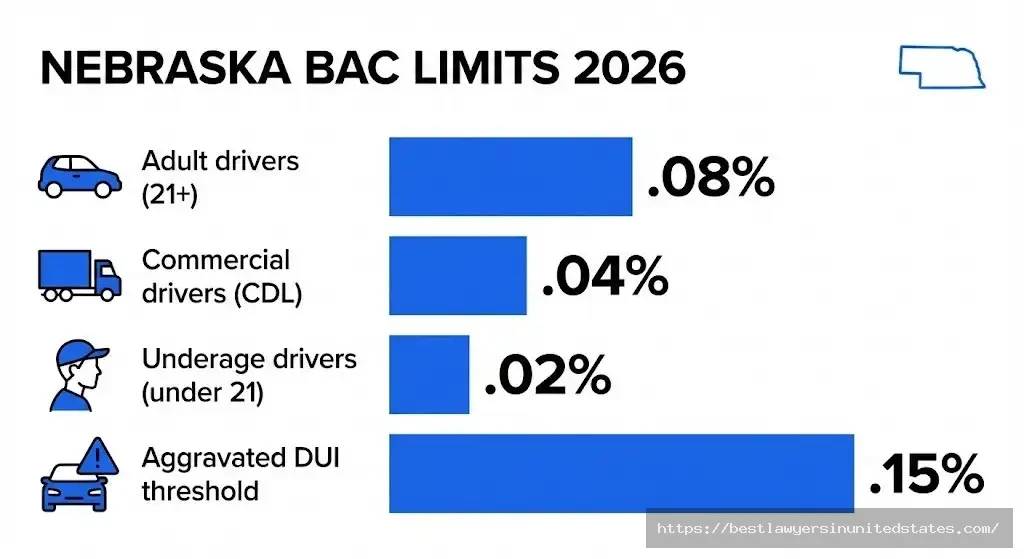
Nebraska operates a dual penalty system based on your blood alcohol concentration. Standard DUI applies when your BAC measures .08% to .149%, while aggravated DUI kicks in at .15% or higher. The aggravated classification brings steeper fines, longer jail time, and extended license revocations.
What Qualifies as DUI in Nebraska?
Quick Answer: You can get arrested for DUI in Nebraska with a BAC of .08% or higher, or if drugs impair your driving ability regardless of BAC level.
Nebraska law defines DUI as operating a vehicle while impaired by alcohol, drugs, or both. Under § 60-6,196, prosecutors can charge you based on:
- BAC of .08% or higher (per se violation)
- Actual impairment by alcohol or drugs
- Combined influence of alcohol and drugs
Driver-Specific BAC Limits
Different BAC thresholds apply based on your driver classification:
| Driver Type | Legal BAC Limit | Statute |
|---|---|---|
| Adult drivers (21+) | .08% | § 60-6,196 |
| Commercial drivers (CDL) | .04% | § 60-4,168 |
| Underage drivers (under 21) | .02% | § 60-6,196.01 |
The state can charge you with DUI even if your BAC falls below .08% if evidence shows impairment. Nebraska State Patrol officers use field sobriety tests, driving patterns, and physical symptoms to establish impairment.
DUI Drugs in Nebraska
Prescription medications, marijuana, and illegal drugs all qualify for DUI charges. Nebraska does not set specific THC limits like it does for alcohol. Officers rely on drug recognition experts and blood tests to prove impairment.
Important: Medical marijuana patients face the same DUI penalties as recreational users. Nebraska law makes no exceptions for prescribed or legally obtained substances.
Check Your BAC Level
Not sure if you’re over Nebraska’s .08% legal limit? Use our interactive tool to estimate your blood alcohol concentration based on drinks consumed, body weight, and time elapsed.
BAC Calculator
Estimate your Blood Alcohol Content
• Commercial Driver (CDL): 0.04% BAC
• Drivers Under 21: 0.00-0.02% BAC (Zero Tolerance)
• Enhanced Penalties: 0.15% BAC or higher in most states
Remember: This calculator provides estimates only. Actual BAC depends on metabolism, food intake, and other factors.
Nebraska DUI Penalty Chart 2026
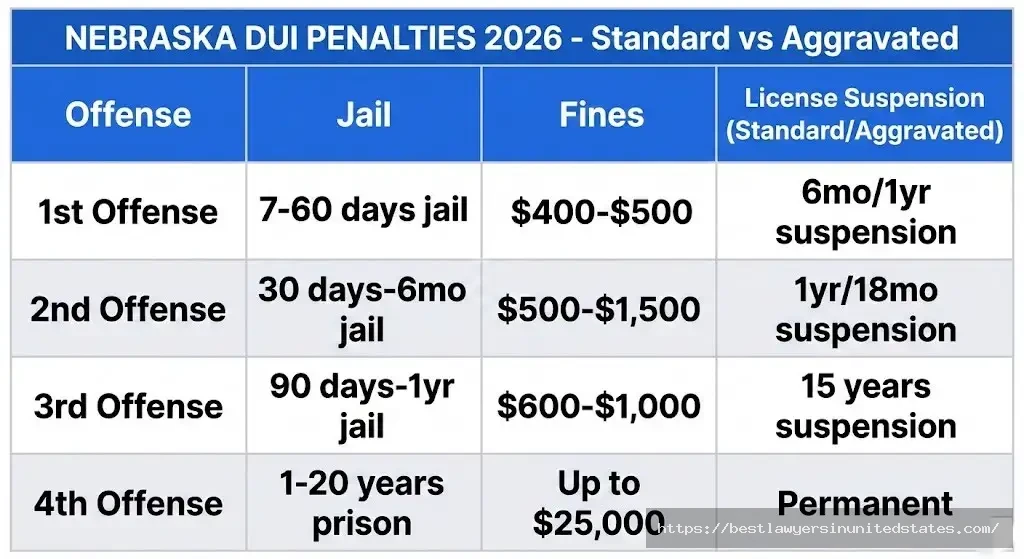
Penalties escalate dramatically with each offense. Nebraska separates standard and aggravated DUI charges at every level, plus offers probation alternatives that can reduce jail time.
Standard DUI Penalties (.08 – .149% BAC)
| Offense | Jail Time | Fines | License Revocation | Additional Penalties |
|---|---|---|---|---|
| 1st | 7-60 days | $400-$500 | 6 months | Possible probation |
| 2nd | 30 days-6 months | $500-$1,500 | 1 year | Vehicle immobilization, IID required |
| 3rd | 90 days-1 year | $600-$1,000 | 15 years | Class IIIA misdemeanor, IID required |
| 4th+ | 1-20 years prison | Up to $25,000 | Permanent | Class III felony |
Aggravated DUI Penalties (.15%+ BAC)
| Offense | Jail Time | Fines | License Revocation | Additional Penalties |
|---|---|---|---|---|
| 1st | 7-60 days | $400-$500 | 1 year | Possible probation |
| 2nd | 30 days-6 months | $500-$1,500 | 18 months | Vehicle immobilization, IID required |
| 3rd | 90 days-1 year | $600-$1,000 | 15 years | Class IIIA misdemeanor, IID required |
| 4th+ | 1-20 years prison | Up to $25,000 | Permanent | Class III felony |
Critical difference: The .15% threshold extends license revocations by 6-12 months compared to standard DUI at the same offense level.
Probation vs. Non-Probation Sentencing
Nebraska courts can offer probation instead of full jail sentences for first through third offenses. Probation typically requires:
- House arrest with electronic monitoring
- Weekly check-ins with probation officer
- Random alcohol testing
- Completion of substance abuse treatment
- Payment of all fines and fees
Judges rarely grant probation for aggravated DUI charges or repeat offenders.
1st Offense DUI Nebraska
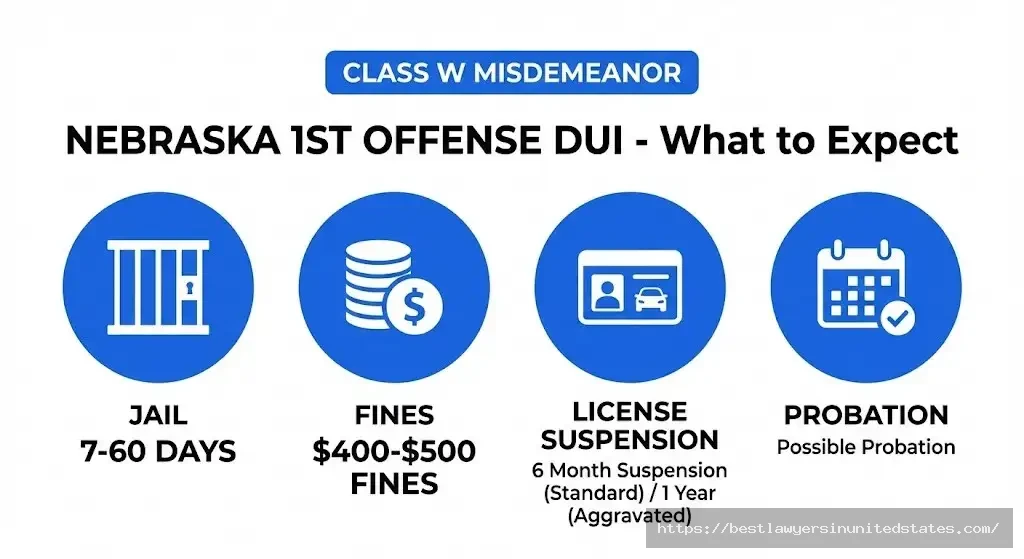
Quick Answer: First-time DUI in Nebraska is a misdemeanor carrying 7-60 days jail, $400-$500 fines, and 6-month license revocation for standard DUI.
Your first DUI arrest triggers both criminal prosecution and administrative penalties through the Nebraska DMV. These two processes run independently.
Criminal Penalties
Courts classify first DUI as a Class W misdemeanor under § 60-6,196(3)(a). Conviction brings:
Standard DUI (.08-.149%):
- Jail: 7-60 days
- Fines: $400-$500
- Probation: Available with court approval
- IID: Possible but not mandatory
Aggravated DUI (.15%+):
- Jail: 7-60 days (same as standard)
- Fines: $400-$500 (same as standard)
- License revocation: 1 year (6 months longer)
- IID: More likely to be required
Administrative License Action
The Nebraska DMV automatically revokes your license when police arrest you for DUI. This happens before any court conviction.
Timeline of events:
- Day 1: Police confiscate your physical license at arrest
- Days 1-10: You can request an administrative hearing to challenge the revocation
- Day 10: Deadline to request hearing (if missed, revocation stands automatically)
- Day 30: Temporary driving permit expires
- Day 31+: Cannot drive legally until revocation period ends
Probation Options
Many first-time offenders receive probation instead of jail time. Douglas County Court and Lancaster County Court frequently approve probation for:
- First-time offenders with no prior record
- BAC below .15%
- No accident or injuries involved
- Cooperation with police during arrest
Probation periods run 12-24 months and require completion of DUI education programs approved by the Nebraska DMV.
2nd Offense DUI Nebraska
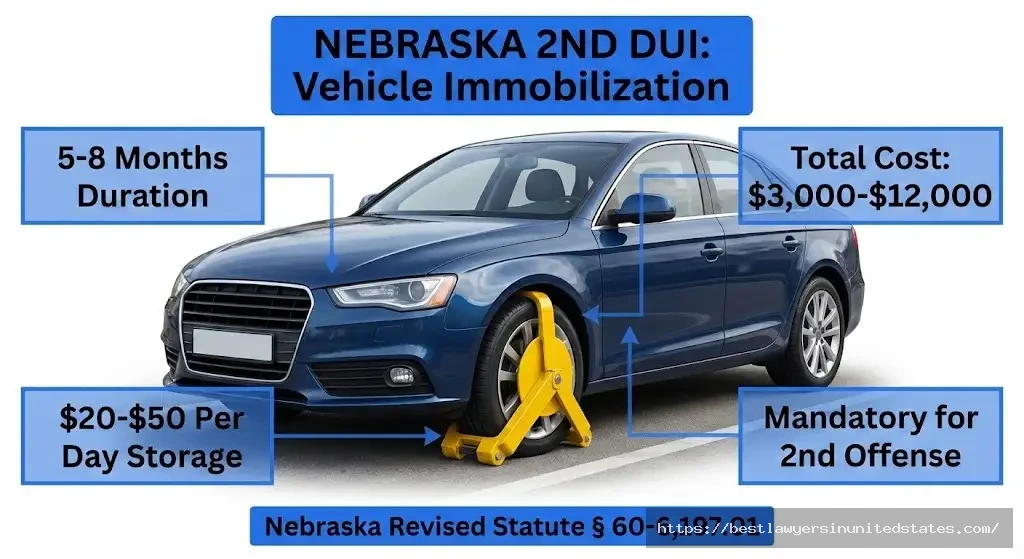
Quick Answer: Second DUI in Nebraska requires 30 days to 6 months jail, $500-$1,500 fines, and mandatory vehicle immobilization for 5-8 months.
Nebraska treats second DUI as an enhanced misdemeanor with mandatory minimum jail time. Courts rarely grant full probation for second offenses.
Vehicle Immobilization Requirement
Nebraska law uniquely requires immobilization of any vehicle you owned or operated during a second DUI arrest. Under § 60-6,197.01:
Immobilization details:
- Duration: 5-8 months
- Who pays: Vehicle owner (even if not the driver)
- Storage costs: $20-$50 per day at impound lot
- Release requirements: Proof of SR-22 insurance, reinstatement fees paid
- Exceptions: Hardship waiver for family’s only vehicle (rarely granted)
Total immobilization costs typically run $3,000-$12,000 when including towing, storage, and administrative fees.
Enhanced Penalties
| Category | Standard (.08-.149%) | Aggravated (.15%+) |
|---|---|---|
| Jail | 30 days-6 months | 30 days-6 months |
| Fines | $500-$1,500 | $500-$1,500 |
| License revocation | 1 year | 18 months |
| IID requirement | Mandatory 1 year | Mandatory 1 year |
| Vehicle immobilization | 5-8 months | 5-8 months |
Mandatory IID Installation
Second offense triggers automatic ignition interlock device requirements. You must install IID in every vehicle you own or operate.
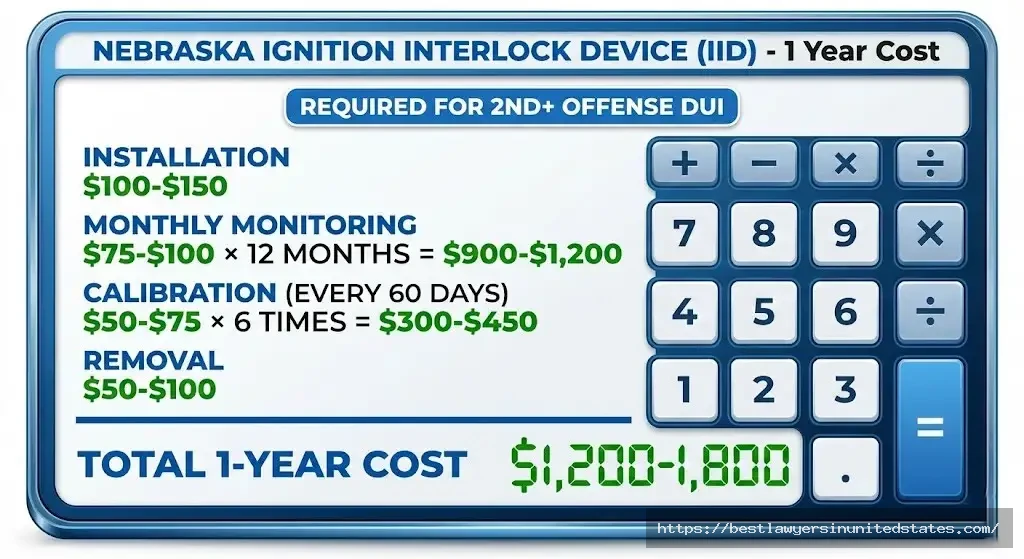
IID costs in Nebraska:
- Installation: $100-$150
- Monthly monitoring: $75-$100
- Calibration (every 60 days): $50-$75
- Removal fee: $50-$100
Total one-year IID costs: $1,200-$1,800
Approved IID providers in Nebraska include Smart Start, Intoxalock, and LifeSafer. The Nebraska DMV maintains a current list at dmv.nebraska.gov.
3rd Offense DUI Nebraska
Quick Answer: Third DUI in Nebraska is a Class IIIA misdemeanor with 90 days to 1 year jail, $600-$1,000 fines, and 15-year license revocation.
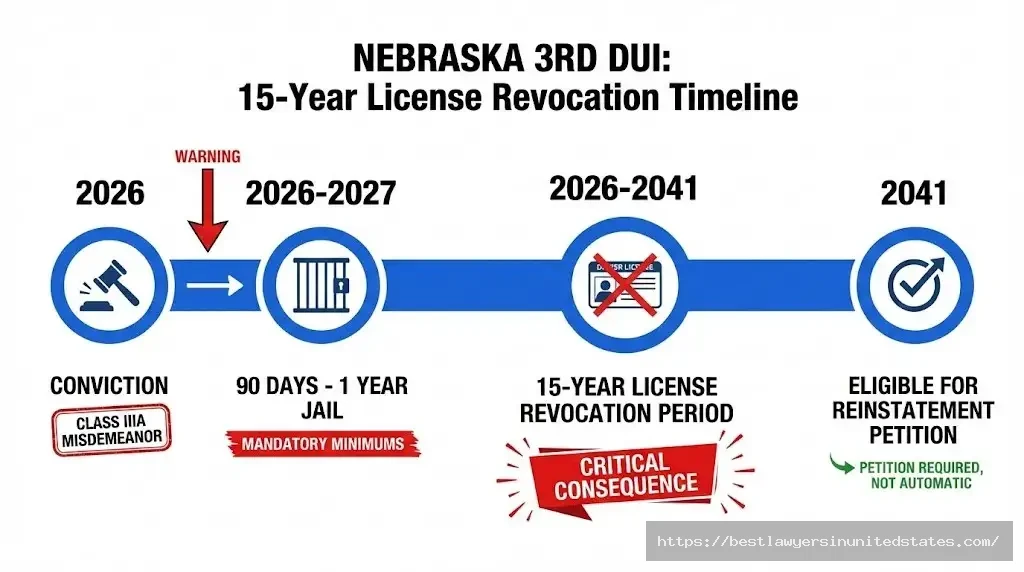
Your third DUI conviction permanently changes your driving record. The 15-year license revocation means you cannot legally drive in Nebraska until 2041 if convicted in 2026.
Felony Conversion Possibility
While third DUI remains a misdemeanor, prosecutors can seek felony charges if:
- Less than 12 years passed since second conviction
- Accident caused serious bodily injury
- Child under 16 was in the vehicle
- BAC exceeded .20%
Douglas County and Lancaster County attorneys frequently pursue felony enhancements under these circumstances.
Long-Term License Consequences
The 15-year revocation under § 60-6,197.03 is not automatic permanent revocation. After 15 years, you can petition for license reinstatement if you:
Reinstatement requirements:
- Complete substance abuse treatment program
- Install IID in all vehicles
- Maintain SR-22 insurance for 5 years
- Pay $125 reinstatement fee
- Pass written and driving tests
- Show proof of sobriety (random testing for 1 year)
Enhanced Criminal Classification
Third DUI elevates to Class IIIA misdemeanor, carrying:
| Penalty Type | Standard (.08-.149%) | Aggravated (.15%+) |
|---|---|---|
| Jail minimum | 90 days | 90 days |
| Jail maximum | 1 year | 1 year |
| Fines | $600-$1,000 | $600-$1,000 |
| IID requirement | 4-5 years | 4-5 years |
| Probation | Rarely granted | Almost never granted |
Most third-time offenders serve full jail sentences. Lancaster County Court reports only 12% of third DUI cases received probation in 2025.
4th Offense DUI Nebraska: Felony Classification
Quick Answer: Fourth DUI in Nebraska becomes a Class III felony with 1-20 years prison, up to $25,000 fines, and permanent license revocation.
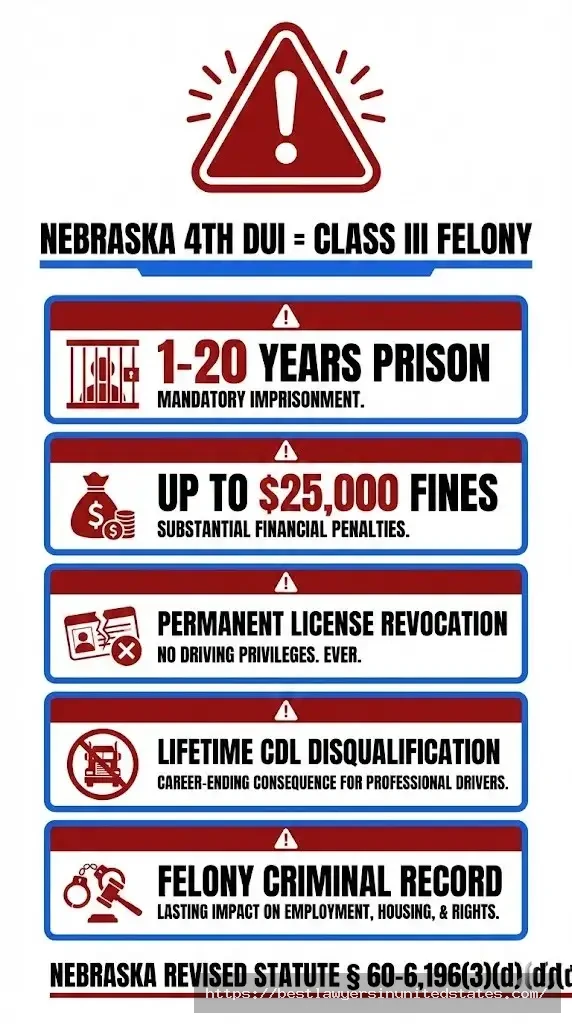
Nebraska law automatically classifies fourth and subsequent DUI convictions as felonies under § 60-6,196(3)(d). This permanent criminal record affects employment, housing, voting rights, and gun ownership.
Felony Sentencing
Class III felony DUI carries severe mandatory minimums:
Prison time:
- Minimum: 1 year
- Maximum: 20 years
- Typical sentence: 2-5 years for fourth offense
- Parole eligibility: After serving 50% of sentence
Financial penalties:
- Court fines: Up to $25,000
- Restitution: If accident involved victims
- Court costs: $500-$2,000
- Public defender fees: $400-$1,200 (if appointed)
Permanent License Revocation
Fourth DUI triggers lifetime license revocation in Nebraska. Unlike the 15-year revocation for third offense, permanent revocation means:
- No legal driving in Nebraska ever
- No hardship permits available
- No reinstatement after time served
- IID cannot restore driving privileges
The only exception requires full pardon from the Nebraska Board of Pardons, granted in fewer than 2% of applications.
Interstate Consequences
Nebraska reports felony DUI convictions to all states through the Driver License Compact. If you move to another state:
- Most states honor Nebraska’s permanent revocation
- You cannot obtain a license in 45 of 50 states
- Some states require 10-year waiting period before considering new license
- Federal CDL disqualification is permanent nationwide
What is Aggravated DUI in Nebraska?
Quick Answer: Aggravated DUI in Nebraska means your BAC measured .15% or higher, triggering enhanced penalties including longer license revocations.
The .15% threshold doubles the legal limit of .08%. Nebraska law treats high BAC as evidence of severe impairment requiring stricter consequences.
Why .15% Matters
BAC above .15% significantly increases penalty severity:
| Offense | Standard Revocation | Aggravated Revocation | Difference |
|---|---|---|---|
| 1st | 6 months | 1 year | +6 months |
| 2nd | 1 year | 18 months | +6 months |
| 3rd | 15 years | 15 years | No change |
| 4th+ | Permanent | Permanent | No change |
Enhanced IID Requirements
Aggravated DUI cases face stricter ignition interlock device mandates:
- Standard DUI: IID optional for first offense
- Aggravated DUI: IID strongly recommended by courts for first offense, mandatory for all subsequent offenses
Courts also extend IID monitoring periods. Lancaster County Court typically requires:
- 1st aggravated: 12-18 months IID
- 2nd aggravated: 3-4 years IID
- 3rd aggravated: 4-5 years IID
Reduced Probation Eligibility
Judges grant probation in only 15% of aggravated DUI cases compared to 45% for standard DUI. Douglas County Court data shows:
Probation approval rates (2025):
- Standard 1st DUI: 47%
- Aggravated 1st DUI: 18%
- Standard 2nd DUI: 8%
- Aggravated 2nd DUI: 2%
Nebraska Implied Consent Law
Every Nebraska driver automatically consents to chemical testing when they receive their license. This implied consent under § 60-6,197.03 activates when police arrest you for suspected DUI.
What Happens When You Refuse Testing?
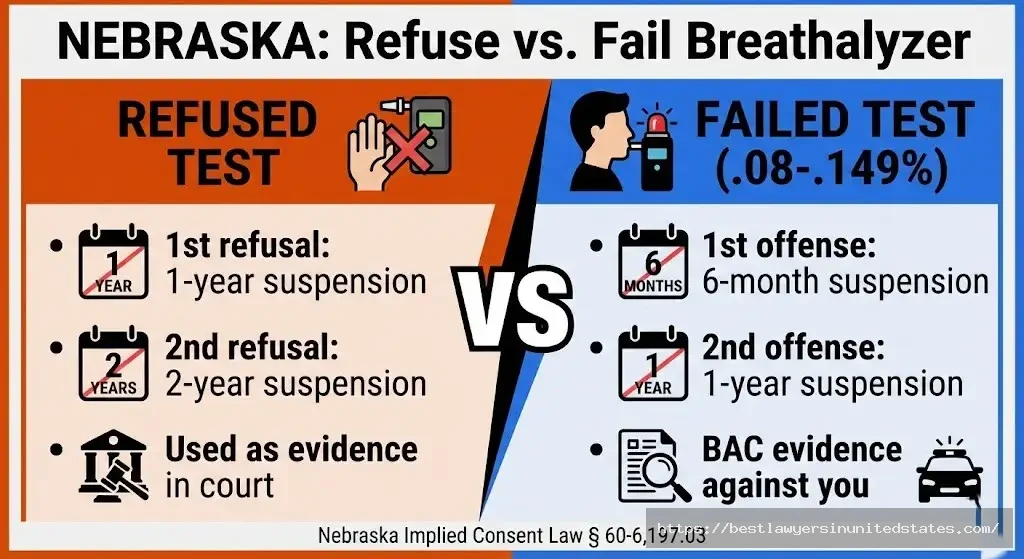
Quick Answer: Refusing a breathalyzer in Nebraska triggers automatic license revocation of 1 year for first refusal, 2 years for second refusal.
Refusal carries harsher immediate consequences than failing the test:
| Scenario | 1st Offense Penalty | 2nd Offense Penalty |
|---|---|---|
| Refuse test | 1-year revocation | 2-year revocation |
| Fail test (.08-.149%) | 6-month revocation | 1-year revocation |
| Fail test (.15%+) | 1-year revocation | 18-month revocation |
Critical point: Refusal revocation runs separately from any criminal DUI conviction penalties. You can face both simultaneously.
Can Police Force You to Take a Test?
Officers cannot physically force breath samples without a warrant. However, Nebraska State Patrol increasingly obtains warrants for blood draws in cases involving:
- Serious accidents with injuries
- Fatalities
- Multiple prior DUI convictions
- Suspected drug impairment (breath tests don’t detect drugs)
Judges in Douglas and Lancaster Counties typically approve warrant requests within 30-60 minutes of submission.
The Implied Consent Warning
Before requesting a chemical test, officers must read the implied consent advisory explaining:
- Refusal triggers automatic license revocation
- You have no right to attorney before testing
- Test results can be used as evidence
- You can request independent testing after
Failure to read the full warning can invalidate the test results. However, courts reject challenges based on minor wording variations.
Two Separate Proceedings
Refusal creates dual legal problems:
Administrative (DMV):
- Automatic revocation hearing
- 10-day deadline to request hearing
- DMV must prove: lawful arrest, implied consent warning given, you refused
- Lower burden of proof than criminal court
Criminal (Court):
- Refusal admissible as evidence
- Prosecutors argue “consciousness of guilt”
- Juries often view refusal negatively
- Can still be convicted without BAC test
Do You Lose Your License Immediately After a DUI in Nebraska?
Quick Answer: Yes. Police confiscate your physical license at arrest and issue a 30-day temporary permit.
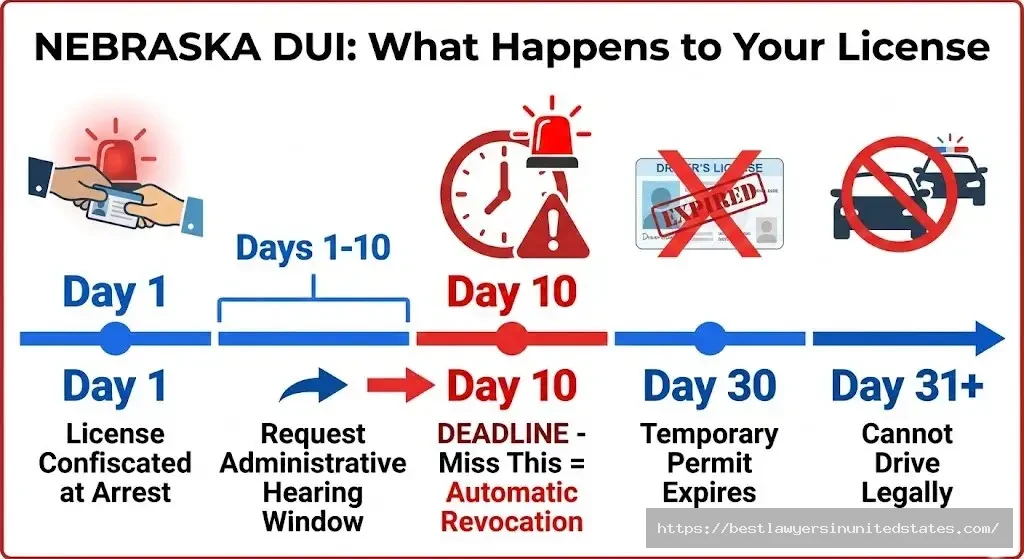
License seizure happens at the arrest scene before any court appearance or conviction.
Timeline of License Actions
| Day | What Happens | Action Required |
|---|---|---|
| 1 | License physically confiscated | None yet |
| 1-10 | Can request administrative hearing | Must request within 10 days |
| 10 | Hearing request deadline passes | If missed, revocation automatic |
| 30 | Temporary permit expires | Cannot drive after this date |
| 31+ | Driving = new criminal charge | Wait for hearing or revocation end |
Requesting an Administrative Hearing
You have 10 calendar days from arrest to request a hearing challenging the license revocation. Send requests to:
Nebraska DMV Driver Services 301 Centennial Mall South Lincoln, NE 68509 Phone: (402) 471-3861
Required information:
- Full legal name
- Driver’s license number
- Date and location of arrest
- Copy of temporary permit
- $50 hearing fee (waived if you win)
What Happens at the Hearing
Administrative hearings occur 20-45 days after your request. The Nebraska DMV hearing officer determines whether:
- Police had reasonable grounds for the arrest
- You were driving or in physical control of vehicle
- Officer properly advised you of implied consent
- You refused testing or tested above legal limit
Burden of proof: DMV must show evidence by preponderance (51% certainty), not beyond reasonable doubt like criminal court.
Winning Your Hearing
Only 15% of administrative hearings result in license reinstatement. Common winning arguments include:
- Officer lacked probable cause for initial traffic stop
- Breathalyzer machine malfunctioned or was improperly calibrated
- Officer failed to read complete implied consent warning
- Blood test violated proper collection procedures
- You were not actually driving the vehicle
Ignition Interlock Device Requirements in Nebraska
Ignition interlock devices measure your BAC before allowing your vehicle to start. Nebraska courts order IID installation for most DUI convictions.
When IID Becomes Mandatory
| Offense Level | IID Required? | Duration |
|---|---|---|
| 1st DUI (standard) | Optional | 6-12 months if ordered |
| 1st DUI (aggravated) | Strongly recommended | 12-18 months if ordered |
| 2nd DUI | Mandatory | 12-18 months minimum |
| 3rd DUI | Mandatory | 4-5 years |
| 4th+ DUI | Mandatory | Permanent (if license restored) |
How IID Works
The device connects to your vehicle’s ignition system and electrical wiring. Before starting the car:
- Blow into the handheld unit
- Device analyzes your BAC
- If BAC exceeds .025%, vehicle won’t start
- If BAC is below .025%, you can drive
- Device requires random rolling tests while driving (pull over safely to test)
- All tests are recorded and reported to Nebraska DMV
Failure consequences:
- Vehicle horn honks continuously until turned off
- Headlights flash
- Incident reported to DMV
- Possible probation violation
- Extended IID requirement
Installation and Costs
Only Nebraska DMV-approved providers can install IID:
Approved providers in 2026:
- Smart Start (locations in Omaha, Lincoln, Grand Island)
- Intoxalock (locations in Omaha, Lincoln)
- LifeSafer (locations in Omaha, Lincoln, Kearney)
Cost breakdown:
| Service | Cost |
|---|---|
| Installation | $100-$150 |
| Monthly monitoring | $75-$100 |
| Calibration (every 60 days) | $50-$75 |
| Removal | $50-$100 |
| Total (1 year) | $1,200-$1,800 |
Violations and Extensions
IID violations extend your monitoring period:
- Missing calibration appointment: +30 days
- Failed breath test (BAC over .025%): +60 days per incident
- Tampering with device: +6 months
- Having someone else blow: +6 months, possible new criminal charge
Lancaster County Court reports the average IID user serves 4 months beyond their original requirement due to violations.
SR-22 Insurance in Nebraska
SR-22 is not insurance itself but a certificate proving you carry minimum liability coverage. Nebraska requires SR-22 filing after DUI conviction.
SR-22 Duration Requirements
| Offense | SR-22 Period | When Required |
|---|---|---|
| 1st DUI | 3 years | From conviction date |
| 2nd DUI | 5 years | From conviction date |
| 3rd+ DUI | 5 years | From conviction date |
| Refusal | 3 years | From refusal date |
Critical deadline: You must file SR-22 before the Nebraska DMV will reinstate your license after suspension/revocation ends.
Cost Impact
SR-22 filing adds $15-$50 filing fee, but insurance premium increases cause the real financial damage:
Average Nebraska auto insurance rates (2026):
- Clean record: $1,100/year
- After 1st DUI: $2,800/year (+155% increase)
- After 2nd DUI: $3,500/year (+218% increase)
Total 3-year cost increase: $5,100-$7,200 for first DUI conviction.
How to File
Contact your insurance company to request SR-22 filing. If your current insurer drops you (common after DUI), high-risk insurers in Nebraska include:
- Progressive
- The General
- Direct Auto
- Bristol West
Your insurance company electronically files SR-22 with Nebraska DMV. You receive a paper copy for your records.
Maintaining SR-22:
- Never let coverage lapse (even one day restarts 3-year period)
- Insurance company notifies DMV of cancellation
- DMV immediately suspends license upon cancellation notice
- Must refile SR-22 and pay reinstatement fees
CDL Holders: Special Nebraska DUI Rules
Commercial driver licenses face stricter standards under federal and Nebraska law. A single DUI typically ends professional driving careers.
Lower BAC Threshold for CDL Drivers
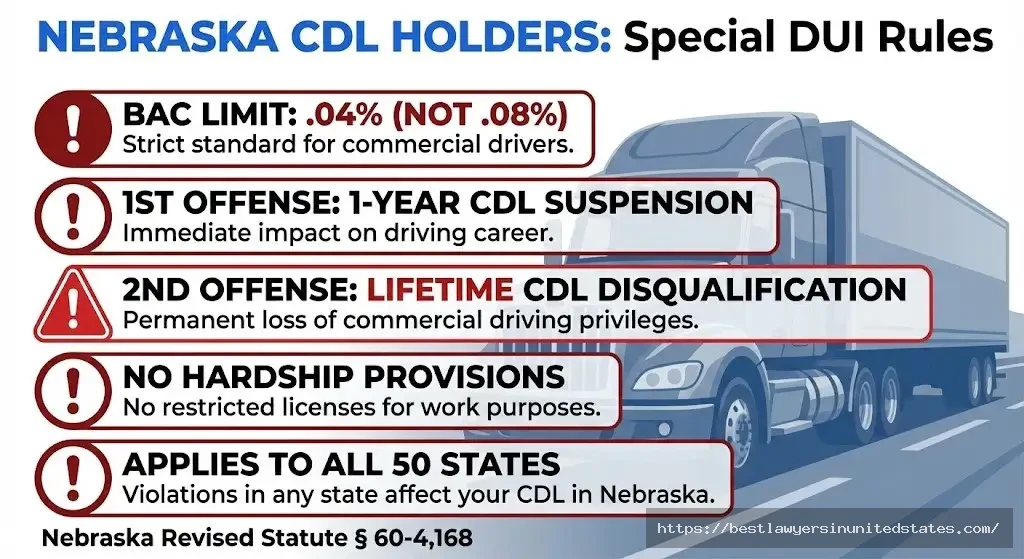
Quick Answer: Nebraska CDL holders face DUI charges at .04% BAC, half the standard .08% limit.
Under § 60-4,168 and federal motor carrier regulations:
| License Type | Legal BAC Limit | DUI Threshold |
|---|---|---|
| Regular license | .08% | .08% |
| CDL (commercial vehicle) | .04% | .04% |
| CDL (personal vehicle) | .08% | .08% |
Important: The .04% limit applies only when operating commercial vehicles. CDL holders driving personal vehicles face standard .08% limits.
Automatic CDL Disqualification
DUI conviction triggers automatic CDL suspension regardless of which vehicle you were driving:
1st offense CDL penalties:
- 1 year CDL suspension (minimum)
- 3 years if transporting hazardous materials
- Cannot drive commercially even with IID
- Regular license suspension runs concurrently
2nd offense CDL penalties:
- Lifetime CDL disqualification
- No hardship provisions
- Cannot be reduced or waived
- Applies to all 50 states
Career Impact
Nebraska trucking companies terminate drivers immediately upon DUI arrest, before conviction. Major carriers including Werner Enterprises, Crete Carrier, and TMCS report zero-tolerance policies.
Employment restrictions:
- Cannot drive for common carriers
- Cannot operate vehicles over 26,000 lbs
- Cannot transport 16+ passengers
- Cannot transport hazardous materials
Some local delivery companies hire drivers with single DUI convictions after 5-7 years, but opportunities remain severely limited.
Out-of-State CDL Holders
Nebraska reports all DUI arrests involving CDL holders to the Commercial Driver License Information System (CDLIS). Your home state receives notification within 72 hours, triggering:
- Immediate suspension in your home state
- Employer notification (for most major carriers)
- Violation added to your CDL record permanently
- Background check failures for new driving jobs
Zero Tolerance: Underage DUI in Nebraska
Nebraska’s zero tolerance law under § 60-6,196.01 sets the BAC limit at .02% for drivers under age 21.
What Triggers Zero Tolerance Violations?
Quick Answer: Any driver under 21 with BAC between .02% and .08% faces zero tolerance charges, while BAC .08%+ triggers standard adult DUI charges.
The .02% threshold accounts for:
- Mouthwash alcohol content
- Trace amounts from medications
- Fermentation in breathalyzer machines
- Environmental alcohol exposure
Anything above .02% results in automatic penalties.
Underage DUI Penalties
| BAC Level | Charge Type | License Penalty | Fines | Other Penalties |
|---|---|---|---|---|
| .02-.079% | Zero tolerance violation | 1-month suspension | $100-$500 | Possible diversion program |
| .08%+ | Adult DUI (full penalties) | 6 months (1st offense) | $400-$500 | Same as adults 21+ |
Impact on College and Financial Aid
Underage DUI creates problems beyond legal penalties:
Education consequences:
- Suspension from school athletic teams
- Removal from campus housing
- Loss of academic scholarships
- Ineligibility for federal student loans
- Mandatory reporting to colleges (UNL, Creighton require disclosure)
The University of Nebraska-Lincoln suspends students from campus housing for minimum one semester after DUI conviction.
Diversion Programs
First-time underage offenders may qualify for diversion programs in Douglas and Lancaster Counties. Requirements include:
- No prior criminal record
- BAC below .12%
- No accident involved
- Guilty plea with deferred judgment
Diversion requirements:
- 6-12 months supervision
- Substance abuse evaluation
- Alcohol education classes (16 hours minimum)
- Community service (20-40 hours)
- Random testing
- $500-$800 program fees
Successfully completing diversion prevents DUI conviction on your permanent record.
DUI Drugs and Marijuana in Nebraska
Nebraska DUI law under § 60-6,196 applies equally to alcohol, prescription drugs, illegal drugs, and marijuana.
Prescription Drug DUI
Quick Answer: You can get DUI charges for prescription medications if they impair your driving, even with valid prescriptions.
Common prescription drugs that trigger DUI arrests:
- Opioid painkillers (OxyContin, Vicodin, Percocet)
- Benzodiazepines (Xanax, Valium, Ativan)
- Sleep medications (Ambien, Lunesta)
- Muscle relaxants (Soma, Flexeril)
- Some antidepressants
Legal defense: Having a valid prescription does not excuse impaired driving. The warning labels stating “do not operate machinery” create legal liability.
Marijuana DUI in Nebraska
Nebraska has not legalized marijuana for any purpose. Possession and use remain criminal offenses, with additional DUI charges if you drive impaired.
THC testing methods:
- Blood test (most common)
- Urine test (less reliable for impairment timing)
- No breathalyzer equivalent exists for marijuana
Critical difference: THC remains detectable in blood for days or weeks after use, but only active THC indicates current impairment. Defense attorneys frequently challenge whether detected THC proves impairment at arrest time.
Drug Recognition Experts
Nebraska State Patrol employs Drug Recognition Experts (DRE) who conduct 12-step evaluations to identify drug impairment:
- Breath alcohol test
- Interview with arresting officer
- Eye examination
- Divided attention tests
- Vital signs check
- Dark room pupil examination
- Muscle tone evaluation
- Injection site inspection
- Suspect’s statements
- DRE’s opinion
- Toxicology examination
- DRE’s conclusions
Lancaster County has 8 certified DREs, while Douglas County maintains 12. Their evaluations serve as evidence in court.
Penalties Same as Alcohol DUI
Drug DUI carries identical penalties to alcohol DUI:
- Same jail time
- Same fines
- Same license suspension
- Same IID requirements
- No separate drug DUI category
Courts may add mandatory substance abuse treatment focused on drug use rather than alcohol.
The Nebraska DUI Arrest Process
Understanding each step helps you protect your rights and build potential defenses.
Traffic Stop or DUI Checkpoint
Police need reasonable suspicion to stop your vehicle. Common triggers include:
- Weaving between lanes
- Driving too slowly
- Nearly hitting objects
- Stopping inappropriately
- Running red lights or stop signs
- Driving without headlights at night
DUI checkpoints: Nebraska State Patrol operates sobriety checkpoints on major holidays. They must announce checkpoint locations publicly in advance and stop vehicles using neutral formulas (every 3rd car, every car, etc.).
Field Sobriety Tests
Officers typically request three standardized field sobriety tests:
Horizontal Gaze Nystagmus (HGN):
- Follow pen or finger with eyes
- Officer looks for involuntary eye jerking
- Alcohol causes distinct nystagmus patterns
Walk and Turn:
- Walk 9 steps heel-to-toe on straight line
- Turn on one foot
- Return 9 steps
- Tests divided attention and balance
One Leg Stand:
- Stand on one foot
- Raise other foot 6 inches
- Count aloud for 30 seconds
- Tests balance and divided attention
Can you refuse field sobriety tests? Yes, with no legal penalties. Nebraska law does not require participation. However, refusal gives officers additional probable cause for arrest.
Breathalyzer Testing
Two types of breath tests occur during DUI arrests:
| Test Type | Location | Legal Status | Accuracy |
|---|---|---|---|
| Preliminary Breath Test (PBT) | Roadside | Can refuse | Less accurate |
| Evidentiary Breath Test | Police station | Implied consent applies | Court-admissible |
PBT results: Not admissible in court but establish probable cause for arrest. Officers use PBT to determine whether to arrest.
Evidentiary test: Conducted on calibrated Intoxilyzer machines at police stations. Results admissible as primary evidence of BAC.
Arrest and Booking
If arrested, police:
- Place you under arrest
- Read Miranda rights
- Transport to police station or county jail
- Conduct booking (fingerprints, photos, personal property inventory)
- Request evidentiary breath or blood test
- Issue temporary driving permit
- Set bond or release on recognizance
Miranda Rights
Quick Answer: Police must read Miranda rights before questioning you about DUI. If they don’t, your statements may be inadmissible in court.
Critical point: Miranda only applies to questioning. Police can legally use:
- Your driving behavior before arrest
- Field sobriety test performance
- Physical symptoms (bloodshot eyes, alcohol smell)
- Breath or blood test results
These observations don’t require Miranda warnings because they’re not the result of interrogation.
Bond and Release
Most first-time DUI arrests result in release on personal recognizance or bond within 12-24 hours. Bond amounts in Nebraska typically range:
- 1st offense DUI: $1,000-$2,500
- 2nd offense DUI: $2,500-$5,000
- 3rd+ offense DUI: $5,000-$10,000
- DUI with serious accident: $10,000-$50,000
Douglas County and Lancaster County Courts set bond at initial appearance, usually the day after arrest or next business day.
Nebraska DUI Court Process
Criminal DUI cases move through several stages from arrest to resolution.
Arraignment
Quick Answer: Arraignment happens within 48-72 hours of arrest where you enter your plea and receive formal charges.
At arraignment before Douglas County Court or Lancaster County Court:
What happens:
- Judge reads formal DUI charges
- You enter plea (guilty, not guilty, no contest)
- Judge sets conditions of release
- Court schedules pre-trial conference
- Public defender appointed if qualified
Plea options:
- Guilty: Admits all facts, proceeds to sentencing
- Not guilty: Denies charges, proceeds to trial
- No contest: Doesn’t admit guilt but accepts punishment (treated as guilty for sentencing)
Recommendation: Almost always plead not guilty at arraignment. You can change your plea later after reviewing evidence with attorney.
Pre-Trial Conference
Scheduled 30-60 days after arraignment. Your attorney and prosecutor discuss:
- Discovery exchange (police reports, videos, breath test results)
- Potential plea bargains
- Suppression of evidence issues
- Trial scheduling
Common plea bargains in Nebraska:
- Reduced to reckless driving
- Standard DUI instead of aggravated
- Probation instead of jail time
- Deferred judgment for first offenders
Lancaster County accepts plea bargains in about 65% of DUI cases, while Douglas County settles approximately 58%.
Trial or Plea Agreement
Only 5-8% of Nebraska DUI cases go to trial. Most resolve through plea agreements.
Trial process if you proceed:
| Step | Timeline | Purpose |
|---|---|---|
| Jury selection | Day 1 | Choose 6-person jury |
| Opening statements | Day 1 | Each side previews case |
| Prosecution evidence | Day 1-2 | State presents witnesses, tests |
| Defense evidence | Day 2 | You present defenses |
| Closing arguments | Day 2 | Final persuasion to jury |
| Jury deliberation | Day 2 | Jury discusses verdict |
| Verdict | Day 2 | Guilty or not guilty |
Burden of proof: State must prove DUI beyond reasonable doubt (95%+ certainty). If reasonable doubt exists, jury must acquit.
Sentencing
If convicted by trial or guilty plea, sentencing occurs 30-90 days later. Judge considers:
- Criminal history
- BAC level
- Cooperation with police
- Accident or injuries
- Prior DUI convictions
- Substance abuse issues
Factors that increase sentences:
- BAC above .15%
- Refusal to test
- Accident with injuries
- Child passenger under 16
- Excessive speed
- Prior criminal record
Factors that decrease sentences:
- First offense
- Low BAC (.08-.10%)
- Cooperation with police
- Completion of treatment before sentencing
- Strong employment history
- Family responsibilities
Nebraska DUI Courts and Problem-Solving Courts
Nebraska operates specialized DUI courts in Lancaster and Douglas Counties as alternatives to traditional prosecution.
Lancaster County DUI Court
Located in Lincoln, this program targets repeat DUI offenders (2nd or 3rd convictions).
Eligibility requirements:
- 2nd or 3rd DUI conviction
- Documented substance abuse problem
- No violent criminal history
- Resident of Lancaster County
- Willing to accept strict supervision
Program structure:
- 18-24 month intensive supervision
- Weekly court appearances before dedicated judge
- Random alcohol testing (3-5 times per week)
- Substance abuse treatment (individual and group)
- Case manager coordination
- Graduation ceremony upon completion
Benefits over traditional sentencing:
- Reduced jail time (often probation instead)
- Treatment focus rather than punishment
- Peer support from other participants
- Job protection (evening court sessions)
- Expungement possibility after completion
Success rates: Lancaster County DUI Court reports 73% completion rate and only 18% of graduates re-offend within 5 years (compared to 45% general recidivism).
Douglas County Problem-Solving Court
Omaha’s program operates similarly with some key differences:
- Accepts 1st offense DUI if BAC exceeded .20%
- 12-month minimum program length
- Weekly meetings at Douglas County Court
- Partnership with University of Nebraska Medical Center addiction specialists
- Costs $50/month program fee
How to Qualify
Prosecutors must approve your entry into DUI court. Not everyone qualifies:
Automatic disqualifications:
- 4th or higher DUI
- Pending felony charges
- Sex offender registration
- Violent crime history
- Active protection orders
Request evaluation for DUI court at arraignment or first pre-trial conference. Your attorney submits application to prosecution for review.
Calculate Your Total DUI Costs in Nebraska
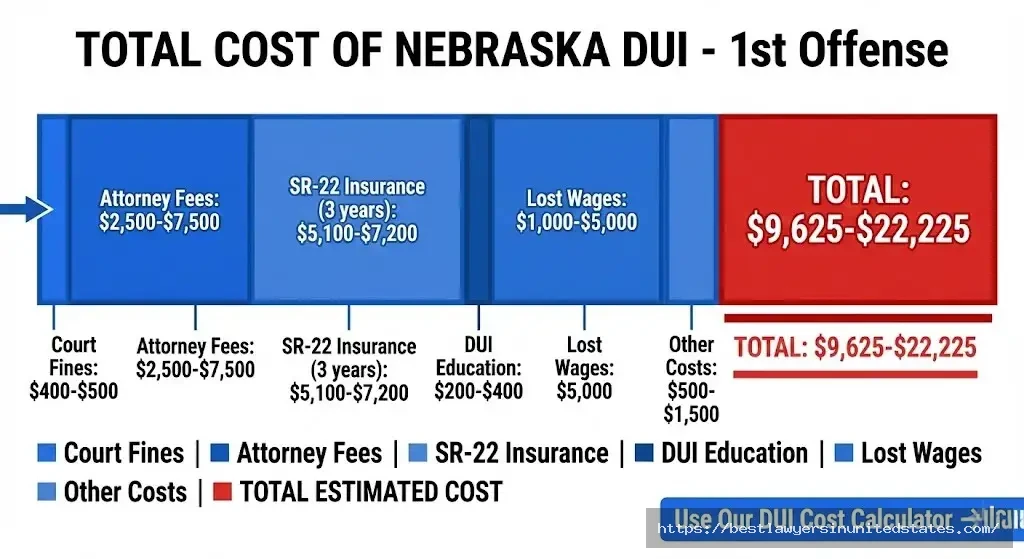
DUI financial consequences extend far beyond court fines. Estimate your complete costs including attorney fees, insurance increases, and lost wages.
Get your personalized cost estimate
DUI Cost Calculator
Estimate total DUI expenses by state and offense
Detailed Cost Breakdown
Payment Timeline
Bail bond, towing fees, car impound, attorney retainer
Initial court fines, DMV fees, DUI school enrollment, ignition interlock installation
Monthly probation fees, ignition interlock fees, DUI school payments, attorney balance
Insurance premium increases, license reinstatement, SR-22 filing fees
- Lost wages from missed work (court dates, jail time, DUI school) – $2,000-$10,000
- Job loss or difficulty finding employment – Varies
- Professional license suspension (doctors, lawyers, nurses, pilots) – Career ending
- Rideshare and transportation costs during suspension – $1,500-$5,000
- Travel restrictions and visa denials – Varies
- Security clearance loss – Career impact
- Child custody implications – Legal costs
- Rental car restrictions – Varies
- Personal relationships and mental health costs – Priceless
Nebraska DUI Cost Breakdown
| Cost Category | 1st Offense | 2nd Offense | 3rd Offense |
|---|---|---|---|
| Court fines | $400-$500 | $500-$1,500 | $600-$1,000 |
| Court costs | $200-$400 | $300-$500 | $400-$600 |
| Attorney fees | $2,500-$7,500 | $5,000-$12,000 | $7,500-$15,000 |
| License reinstatement | $125 | $125 | $125 |
| DUI education | $200-$400 | $300-$500 | $400-$600 |
| Substance abuse evaluation | $100-$300 | $150-$350 | $200-$400 |
| Ignition interlock (if ordered) | $0-$1,800 | $1,200-$1,800 | $4,000-$6,000 |
| SR-22 insurance (3 years) | $5,100-$7,200 | $7,200-$9,600 | $9,000-$12,000 |
| Lost wages (jail/court) | $1,000-$5,000 | $2,000-$10,000 | $5,000-$20,000 |
| Total estimated cost | $9,625-$22,225 | $16,775-$36,375 | $27,225-$55,725 |
Hidden costs not included:
- Increased health/life insurance premiums
- Professional license suspension (lawyers, doctors, nurses)
- Security clearance revocation
- Employment termination
- Rental application denials
- Loan application denials
Nebraska DUI Defense Strategies
Several defenses can result in reduced charges or case dismissal.
Challenging the Traffic Stop
Police need reasonable suspicion of traffic violation or criminal activity to stop your vehicle. Common challenges:
Illegal stop grounds:
- Anonymous tip without corroboration
- Hunch or profiling
- Following you from bar without observed violation
- Checkpoint that doesn’t follow established procedures
If the stop was illegal, all evidence collected after gets suppressed under the exclusionary rule.
Breathalyzer Machine Defenses
Intoxilyzer machines require strict maintenance and calibration:
Required documentation:
- Calibration every 30 days
- Maintenance logs
- Officer training certification
- Quality control tests
Nebraska courts exclude breath test results when:
- Machine wasn’t calibrated within 30 days
- Officer lacked proper certification
- Quality control tests failed
- 20-minute observation period not followed
- Mouth alcohol contamination possible (recent vomiting, GERD)
Field Sobriety Test Issues
Several factors beyond intoxication affect field sobriety test performance:
- Medical conditions: Inner ear problems, back injuries, knee problems
- Environmental factors: Uneven pavement, gravel, poor lighting
- Weather: Rain, snow, ice, strong wind
- Footwear: High heels, boots, sandals
- Age: Balance naturally decreases after age 50
- Weight: Over 50 pounds overweight affects balance tests
Rising BAC Defense
Alcohol takes 30-90 minutes to fully absorb into bloodstream. Your BAC continues rising after you stop drinking.
Defense argument: You were below .08% while driving but above .08% when tested 60-90 minutes later at the police station.
Example: You stop drinking at 11:00 PM. Police stop you at 11:15 PM (BAC .06%). Breath test at station occurs at 12:15 AM (BAC .09%). You weren’t over the limit while driving.
Courts accept rising BAC defenses when supported by expert testimony calculating absorption rates.
Medical Conditions Affecting BAC
Some conditions create false high BAC readings:
- Diabetes: Ketones from diabetic ketoacidosis mimic alcohol on breath tests
- GERD: Acid reflux brings alcohol from stomach to mouth, creating artificially high readings
- Dental work: Trapped alcohol in crowns or bridges
- Low-carb diets: Produce ketones similar to diabetes
What’s New in 2026: Recent Nebraska DUI Law Changes
Nebraska DUI laws continue evolving. Recent changes affect penalties and procedures.
Electronic Monitoring Expansion
Legislature passed LB 478 in 2025 expanding electronic monitoring for DUI offenders. Starting January 1, 2026:
New provisions:
- All 2nd offense DUI probationers must wear alcohol monitoring anklets
- 24/7 SCRAM devices detect alcohol through perspiration
- Violations trigger immediate arrest and probation revocation
- Costs ($10-$15 per day) paid by defendant
Impact: Gives judges alternative to jail time while ensuring compliance.
IID Subsidy Program
Nebraska DMV launched income-based IID subsidy program in late 2025:
Eligibility:
- Household income below 200% federal poverty level
- 1st or 2nd offense DUI only
- Employed or actively seeking employment
Benefits:
- Covers 50% of installation costs
- Reduces monthly fees by $35-$50
- Funded through DUI fine surcharges
Apply through Nebraska DMV Driver Services at dmv.nebraska.gov/iid-assistance.
Mandatory BAC Retesting
New protocol requires confirmatory breath tests starting March 2026:
- All breath tests over .08% require second test within 10 minutes
- Both tests must exceed .08% for DUI charge
- Reduces false positive risk
- Adds procedural step officers must follow
Failure to conduct second test may invalidate results.
What to Do Immediately After a Nebraska DUI Arrest
Your actions in the first 72 hours significantly impact your case outcome.
Within 24 Hours of Arrest
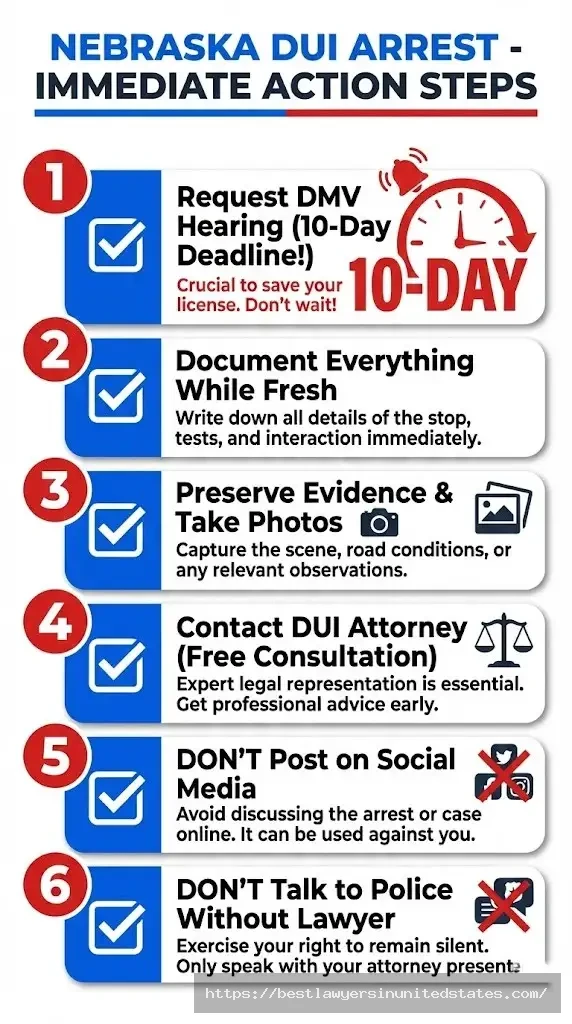
Step 1: Request administrative hearing
You have only 10 days to challenge license revocation. Don’t wait.
Contact: Nebraska DMV Driver Services 301 Centennial Mall South Lincoln, NE 68509 Phone: (402) 471-3861
Step 2: Document everything while fresh
Write down:
- Exact time of stop
- Location (street, mile marker)
- Officer’s statements
- Field sobriety tests requested
- Weather and road conditions
- What you ate/drank and when
- Witnesses present
Step 3: Preserve evidence
- Take photos of arrest location
- Keep receipts from establishments visited
- Get contact information from passengers
- Don’t wash clothing (may show lack of alcohol spillage)
Step 4: Contact DUI attorney
Initial consultations are usually free. Attorneys can:
- Request police reports and videos immediately
- Begin challenging license suspension
- Identify defense strategies
- Negotiate with prosecutors early
What NOT to Do
Don’t discuss case on social media:
- Prosecutors monitor Facebook, Instagram, Twitter
- Any posts can be used as evidence
- “I wasn’t even drunk” = admission you were drinking
- Photos from same night show your condition
Don’t talk to police without attorney:
- Anything you say can hurt your case
- Police may contact you for “clarification” (really gathering evidence)
- Politely decline and provide attorney’s contact
Don’t miss the 10-day DMV deadline:
- Missing this deadline means automatic license revocation
- No second chances
- Cannot drive legally during suspension
Don’t plead guilty at arraignment:
- Wait until attorney reviews all evidence
- Plea bargains often available later
- Once guilty plea entered, cannot withdraw
Resources: Nebraska DUI Treatment and Support
Substance Abuse Treatment Programs
CenterPointe (Lincoln) 2633 P Street Lincoln, NE 68503 (402) 475-6695 Services: Outpatient treatment, DUI education, assessments
Bridge Behavioral Health (Omaha) 3515 Dodge Street Omaha, NE 68131 (402) 444-6444 Services: Intensive outpatient, individual therapy, group sessions
Region II Human Services (Omaha) 3810 Central Street Omaha, NE 68105 (402) 444-6100 Services: DUI classes, substance abuse evaluations
Nebraska DMV Offices
Omaha DMV 7212 W Center Road Omaha, NE 68106 Phone: (402) 471-3918 Hours: Monday-Friday 8:00 AM – 5:00 PM
Lincoln DMV 301 Centennial Mall South Lincoln, NE 68509 Phone: (402) 471-3861 Hours: Monday-Friday 8:00 AM – 5:00 PM
Grand Island DMV 211 N Wheeler Street Grand Island, NE 68801 Phone: (402) 471-3303 Hours: Monday-Friday 8:00 AM – 5:00 PM
Nebraska Courts
Lancaster County Court 575 S 10th Street Lincoln, NE 68508 Phone: (402) 441-7481
Douglas County Court 1701 Farnam Street Omaha, NE 68183 Phone: (402) 444-7176
Support Groups
Alcoholics Anonymous Nebraska Website: alcoholicsanonymous.com Lincoln hotline: (402) 476-1906 Omaha hotline: (402) 345-7799
SMART Recovery Nebraska Science-based alternative to 12-step programs Website: smartrecovery.org Meetings in Omaha and Lincoln
Frequently Asked Questions
Is jail time mandatory for 1st DUI in Nebraska?
Quick Answer: No, but judges can sentence up to 60 days. Many first offenders receive probation instead of jail.
Nebraska law sets jail ranges of 7-60 days for first DUI but doesn’t mandate minimum jail time. Probation allows you to serve sentence through house arrest, community service, and treatment programs. Douglas County grants probation in 58% of first DUI cases, while Lancaster County approves probation for 63% of first offenders.
Do you lose your license immediately after a DUI in Nebraska?
Quick Answer: Yes. Police confiscate your license at arrest and issue a 30-day temporary permit.
The Nebraska DMV automatically processes administrative license revocation when police report your arrest. Your physical license is taken at the roadside. You receive a paper temporary permit valid 30 days, allowing you to drive while requesting an administrative hearing. If you don’t request a hearing within 10 days, your revocation becomes final when the temporary permit expires.
How long does a DUI stay on your record in Nebraska?
Quick Answer: DUI convictions remain on your criminal record permanently in Nebraska unless expunged through the Clean Slate program.
Nebraska maintains DUI convictions on your driving record for 12 years for insurance and court purposes. After 12 years, prior DUI convictions cannot be used to enhance future DUI charges. However, the conviction stays on your criminal background check indefinitely unless you petition for expungement under § 29-3523.
Can you refuse a breathalyzer in Nebraska?
Quick Answer: Yes, but refusal triggers automatic 1-year license revocation for first refusal, longer than the 6-month revocation for failing the test.
Nebraska’s implied consent law under § 60-6,197.03 lets you refuse chemical testing. However, consequences include immediate license revocation, test refusal used as evidence at trial, and prosecutors arguing “consciousness of guilt.” Police cannot physically force you to blow into the breathalyzer without a warrant, but judges increasingly authorize blood draw warrants within 30-60 minutes.
Is a DUI a felony in Nebraska?
Quick Answer: Fourth and subsequent DUI convictions are Class III felonies. First through third DUI convictions are misdemeanors.
Nebraska treats first three DUI offenses as misdemeanors under § 60-6,196(3)(a-c). Fourth DUI automatically becomes a Class III felony under § 60-6,196(3)(d), carrying 1-20 years prison and permanent license revocation. Some third DUI cases elevate to felonies when aggravating factors exist, such as causing serious injury or having BAC above .20%.
How much does a DUI cost in Nebraska?
Quick Answer: Total first-time DUI costs range from $9,625 to $22,225 including fines, attorney fees, insurance increases, and lost wages.
Court fines ($400-$500) represent only a fraction of total costs. Add attorney fees ($2,500-$7,500), insurance increases ($5,100-$7,200 over 3 years), DUI education ($200-$400), license reinstatement ($125), and lost wages ($1,000-$5,000). Second offense costs climb to $16,775-$36,375, while third offense reaches $27,225-$55,725. Calculate your personalized estimate.
Can you get a DUI expunged in Nebraska?
Quick Answer: Yes, but only misdemeanor DUI convictions qualify, and only after completing a 5-10 year waiting period depending on the offense level.
Nebraska’s Clean Slate program under § 29-3523 allows petition for record sealing. Requirements include:
- At least 5 years since sentence completion (misdemeanor)
- No subsequent criminal convictions
- All fines and restitution paid
- Completion of probation/treatment programs
- Court approval required
Felony DUI (4th+ offense) cannot be expunged. The Nebraska Delete Act protects expunged records from appearing in background checks conducted by employers and landlords.
What is aggravated DUI in Nebraska?
Quick Answer: Aggravated DUI means your BAC measured .15% or higher, triggering enhanced penalties including longer license revocations.
The .15% threshold nearly doubles the .08% legal limit. Aggravated DUI extends license revocations by 6 months for first and second offenses (from 6 months to 1 year for first offense, 1 year to 18 months for second). Courts grant probation less frequently for aggravated cases and require longer IID monitoring periods. The aggravated designation applies at every offense level.
What happens for first DUI in Nebraska?
Quick Answer: First DUI brings 7-60 days jail, $400-$500 fines, 6-month license revocation for standard or 1 year for aggravated, plus possible probation.
After arrest, you face arraignment within 48-72 hours where charges are read and bail is set. The Nebraska DMV separately revokes your license for 6 months (standard BAC) or 1 year (aggravated BAC .15%+). Most first offenders negotiate probation instead of jail time through plea agreements. Total costs including attorney fees, insurance increases, and treatment programs range $9,625-$22,225.
Can you drive after a DUI before court date in Nebraska?
Quick Answer: No, not after your 30-day temporary permit expires unless you win an administrative hearing or obtain a work permit.
Police issue a 30-day temporary permit at arrest. If you request an administrative hearing within 10 days, you can drive until the hearing decision (usually 30-45 days). If you win the hearing, your regular license is restored. If you lose or don’t request a hearing, you cannot legally drive once the temporary permit expires. Nebraska offers limited work permits in some counties for essential employment, but these are rarely granted for first offenses.
What is the DUI limit in Nebraska?
Quick Answer: .08% BAC for adults 21+, .04% for commercial drivers, and .02% for drivers under 21.
Nebraska sets the standard legal limit at .08% blood alcohol concentration under § 60-6,196. Commercial vehicle operators face .04% limit under § 60-4,168 (even when driving personal vehicles). Zero tolerance law § 60-6,196.01 sets .02% for anyone under age 21. BAC of .15% or higher triggers aggravated DUI classification with enhanced penalties. Police can charge DUI below .08% if impairment is evident.
How long will I lose my license after a DUI in Nebraska?
Quick Answer: 6 months for first standard DUI, 1 year for first aggravated DUI, 1 year for second standard DUI, 18 months for second aggravated DUI, and 15 years for third DUI.
License revocation periods under § 60-6,197:
| Offense | Standard (.08-.149%) | Aggravated (.15%+) |
|---|---|---|
| 1st DUI | 6 months | 1 year |
| 2nd DUI | 1 year | 18 months |
| 3rd DUI | 15 years | 15 years |
| 4th+ DUI | Permanent | Permanent |
| 1st refusal | 1 year | N/A |
| 2nd refusal | 2 years | N/A |
Is there jail time on a first offense DUI in Nebraska?
Quick Answer: Possible but not mandatory. Judges can sentence 7-60 days, but many first offenders receive probation instead.
Nebraska Revised Statute § 60-6,196(3)(a) authorizes 7-60 days jail for first DUI but doesn’t require minimum jail time. Lancaster County grants probation to 63% of first-time offenders, while Douglas County approves probation for 58%. Factors increasing jail likelihood include BAC above .15%, accidents, injuries, prior criminal history, and refusal to cooperate with testing.
Can I still drive to work if I lose my license?
Quick Answer: Nebraska offers limited work permits in some counties, but availability depends on the county and offense level. Most first offenders cannot obtain work permits.
Work permits (also called employment permits) let you drive only to and from work, school, or medical appointments. Douglas County rarely grants these for DUI offenses. Lancaster County considers work permits for hardship cases involving sole family income earners, but approval rates remain below 10%. IID installation often becomes a requirement for any restricted driving privileges.
Will I have to go to court?
Quick Answer: Yes. You must appear at arraignment, all pre-trial hearings, and either trial or sentencing.
Nebraska law requires your physical presence at arraignment (within 48-72 hours of arrest), pre-trial conferences (1-3 hearings over 60-90 days), and sentencing. Missing any court appearance results in a warrant for your arrest and bond forfeiture. Only the trial can potentially be waived if you accept a plea agreement. Some counties allow attorneys to appear on your behalf for routine pre-trial matters, but you must attend arraignment and sentencing.
Protecting Your Rights After a Nebraska DUI
A DUI arrest doesn’t guarantee conviction. Many defenses exist, from challenging the traffic stop to questioning breath test accuracy. The 10-day deadline to request your DMV hearing represents your first critical decision.
Understanding Nebraska’s dual BAC penalty system helps you evaluate your situation. Aggravated DUI at .15% brings significantly longer license revocations than standard DUI. Second offense triggers unique vehicle immobilization requirements not found in most states. Fourth offense converts to permanent felony classification affecting employment, housing, and civil rights.
Nebraska-specific programs offer alternatives to standard prosecution. Lancaster County DUI Court and Douglas County Problem-Solving Court provide treatment-focused approaches for qualifying defendants. The Clean Slate program creates expungement possibilities after 5-10 years for misdemeanor convictions.
Act immediately after arrest. Request your administrative hearing within 10 days, consult with a DUI attorney, and document everything while events remain fresh. These steps protect your driving privileges and build your defense.
For questions about how Nebraska divorce costs compare to DUI expenses, or to connect with experienced legal representation, contact us for guidance.
Find DUI Lawyers in Nebraska Email: [email protected]
