Getting arrested for DUI in Nevada triggers two separate legal battles: criminal court and Nevada DMV administrative proceedings. Nevada law under NRS 484C.110 defines DUI three ways—driving impaired, operating a vehicle with .08% BAC or higher, or having .08% BAC within two hours after driving. First-time offenders face 2 days to 6 months jail, $400-$1,000 fines, and 185-day license revocation.
Nevada enforces some of the nation’s strictest DUI penalties. The state’s unique 2-hour rule and 12-hour jail hold catch many drivers off guard. Senate Bill 309 increased penalties starting October 2025, making legal representation more critical than ever.
This guide covers Nevada-specific DUI laws, penalties for each offense level, and defense strategies that actually work in Clark County and Washoe County courts.
What Qualifies as DUI in Nevada?
Nevada law creates three separate paths to a DUI conviction under NRS 484C.110. You don’t need to be stumbling drunk—prosecutors can convict you through impairment evidence, BAC test results, or Nevada’s unique 2-hour rule.
Three Ways Nevada Convicts Drivers
Impairment-based DUI happens when alcohol or drugs render you incapable of safely operating a vehicle. Officers document erratic driving, failed field sobriety tests, and physical symptoms like slurred speech. No specific BAC level required—prosecutors just need to prove you couldn’t drive safely.
Illegal per se DUI occurs when chemical tests show .08% BAC or higher. Nevada’s “illegal per se” law makes the BAC reading itself proof of guilt. Officers don’t need additional impairment evidence if your test shows .08% or above.
Nevada’s 2-hour rule DUI applies when breath or blood samples taken within two hours after driving show .08% BAC. This catches drivers who weren’t over the limit while driving but reached .08% later as alcohol absorbed into their bloodstream. You can defend against this by proving you consumed alcohol after driving stopped.
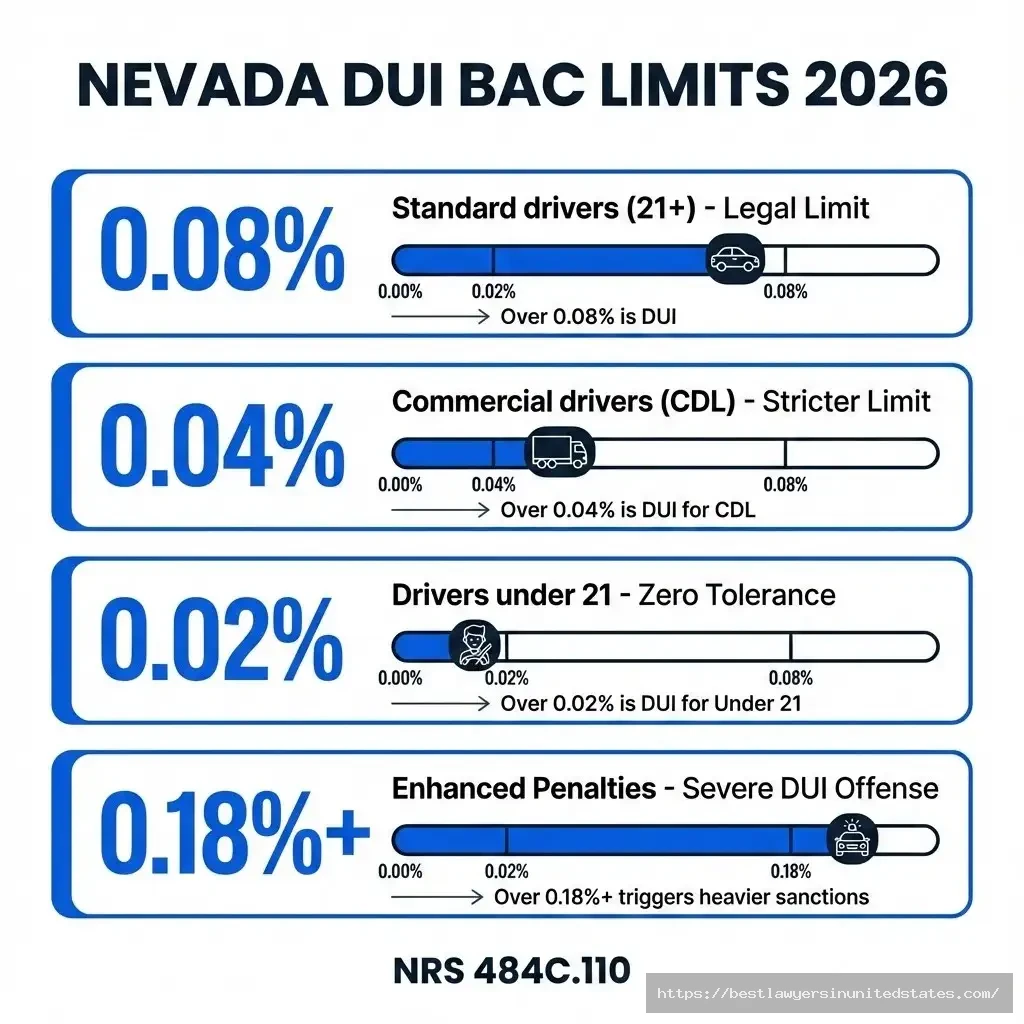
BAC Limits by Driver Type
Nevada sets different BAC thresholds based on driver category and age:
| Driver Type | Legal BAC Limit | Violation Type |
|---|---|---|
| Standard (21+) | .08% | Illegal per se DUI |
| Commercial (CDL) | .04% | Federal/state violation |
| Under 21 | .02% | Zero tolerance law (NRS 483.461) |
| Any driver | .18%+ | Enhanced penalties triggered |
Commercial drivers lose their CDL for one year on a first offense, even if driving their personal vehicle. Drivers under 21 face 90-day suspension for .02%-.079% BAC under Nevada’s zero tolerance law.
Check your estimated BAC level using our BAC calculator to understand how drinks affect your blood alcohol content over time.
BAC Calculator
Estimate your Blood Alcohol Content
• Commercial Driver (CDL): 0.04% BAC
• Drivers Under 21: 0.00-0.02% BAC (Zero Tolerance)
• Enhanced Penalties: 0.15% BAC or higher in most states
Actual Physical Control (The “Sleeping DUI”)
Nevada law punishes “actual physical control” of a vehicle while impaired—you don’t need to be driving. Pulling over to sleep it off in your car can still result in DUI charges carrying identical penalties to driving drunk.
Courts examine these factors to determine actual physical control:
- Location of keys (in ignition, on person, or in vehicle)
- Engine running or off
- Driver’s position (behind wheel or passenger area)
- Vehicle operability
- Whether driver drove to the location while intoxicated
- Headlights, heat, or radio operating
Critical point: Sitting in the driver’s seat with keys in the ignition—even with the engine off—often proves actual physical control. Move to the back seat, keep keys in your pocket, and park in a legal spot if you must wait in your vehicle.
Nevada DUI Penalties by Offense Level
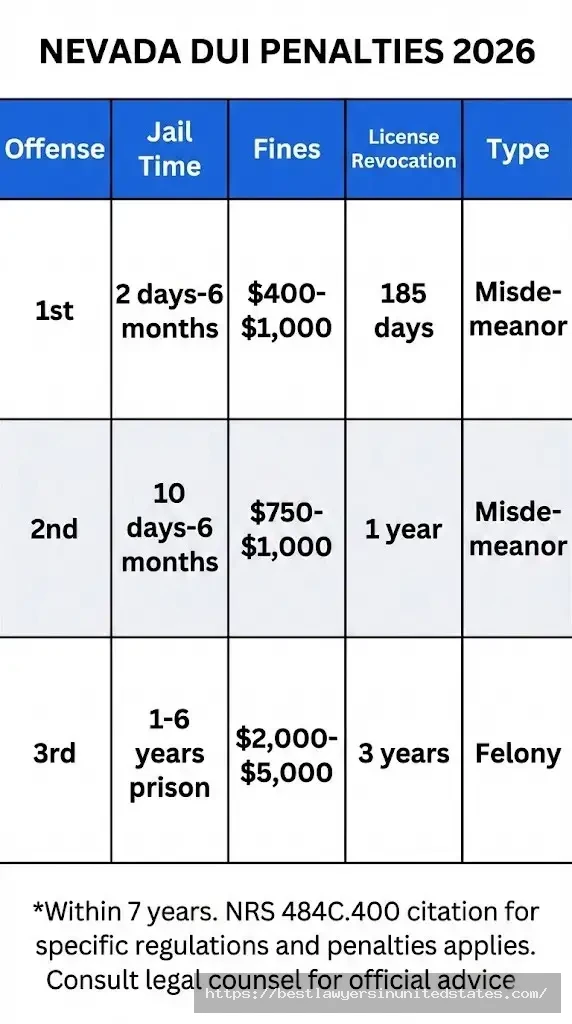
Nevada calculates DUI offenses within a seven-year “lookback period.” Your second DUI only counts as such if it occurs within seven years of the first conviction. After seven years, the next offense resets to first-offense penalties.
First Offense DUI (Misdemeanor)
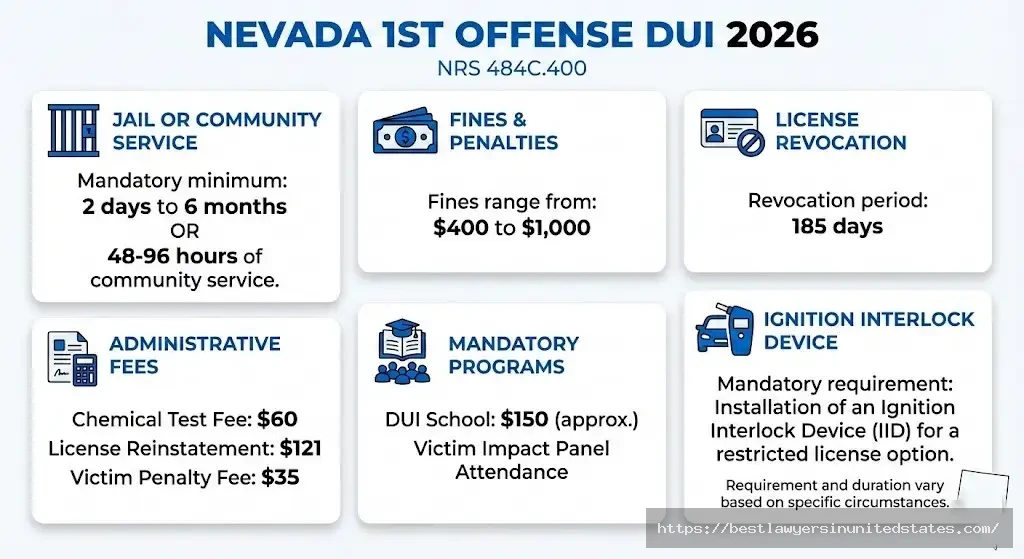
Nevada treats first-time DUI as a misdemeanor under NRS 484C.400. Penalties combine jail time, fines, license revocation, and mandatory programs.
Criminal Penalties
Jail time: 2 days minimum to 6 months maximum OR 48-96 hours community service wearing distinctive DUI clothing. Most judges offer the community service option for first offenders with no aggravating factors.
Fines and fees breakdown:
| Fee Type | Amount | Purpose |
|---|---|---|
| Base fine | $400-$1,000 | Criminal penalty |
| Chemical test fee | $60 | Lab analysis (NRS 484C.510) |
| Court assessments | Varies by court | Administrative costs |
| DUI school | ~$150 | Educational program |
| Victim impact panel | $50-$100 | Victim awareness |
Mandatory requirements:
- DUI education program completion
- Victim impact panel attendance (shares stories from DUI crash victims)
- Alcohol evaluation if BAC was .18% or higher
- Treatment program if evaluation recommends it
License Consequences
Nevada DMV revokes your license for 185 days on a first offense. This happens separately from criminal court under NRS 484C.220—even if a judge dismisses your criminal charges, the DMV revocation stands.
Reinstatement costs:
- $121 DMV reinstatement fee
- $35 victims of crime civil penalty
- $42.25 driver license fee
- $26 written/skills test fees
- DMV vision, knowledge, and possibly driving tests required
SR-22 insurance requirement: Nevada mandates SR-22 high-risk insurance for three years after reinstatement. This certificate proves you carry minimum liability coverage. Expect insurance rates to double or triple during this period.
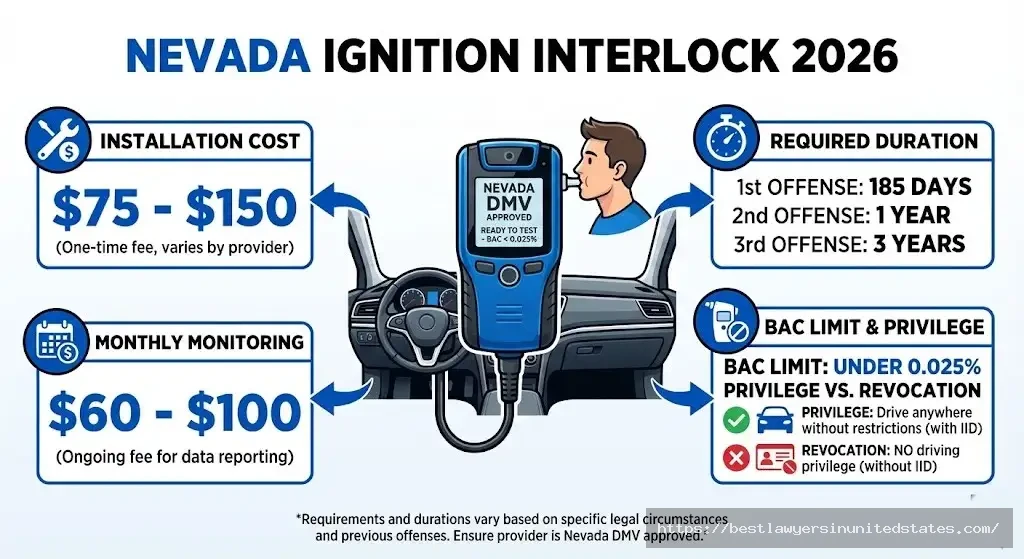
Ignition interlock privilege: You can apply for an ignition interlock device instead of full revocation. This lets you drive anywhere without restrictions—to work, school, groceries, anywhere—if you install an approved IID in your vehicle. The device tests your breath before the engine starts and randomly while driving.
Special Conditions for .18%+ BAC
Nevada law requires additional penalties when breath or blood tests show .18% BAC or higher:
- Mandatory alcohol/drug evaluation at your expense
- Treatment program if evaluator recommends it (court orders participation)
- Longer DUI school program in some courts
- Judges may add jail time beyond the 2-day minimum
Second Offense DUI (Within 7 Years)
Nevada increases penalties substantially for second DUI within seven years. This remains a misdemeanor but carries mandatory minimum jail time.
Criminal Penalties
Jail time: 10 days minimum to 6 months maximum in county jail. No exceptions—judges cannot suspend this mandatory minimum. Some courts allow work release for a portion of the sentence.
Fines: $750-$1,000 OR equivalent hours of community service in distinctive garb. Courts calculate community service at minimum wage rates.
Treatment program: Mandatory enrollment in court-approved substance abuse treatment at your expense. Programs last 3-12 months depending on your evaluation. You pay for weekly counseling, drug testing, and program fees.
License Consequences
| Consequence | Duration/Details |
|---|---|
| License revocation | 1 year (no restricted license available) |
| Ignition interlock required | 1 year minimum after reinstatement |
| Vehicle registration | May be suspended |
| Clinical supervision | Up to 1 year if ordered |
Critical difference: Second offense revocation prohibits restricted licenses. You cannot drive legally for the full revocation period unless you qualify for ignition interlock privilege.
Calculate your total second-offense costs using our DUI cost calculator to understand the complete financial impact.
DUI Cost Calculator
Estimate total DUI expenses by state and offense
Detailed Cost Breakdown
Payment Timeline
Bail bond, towing fees, car impound, attorney retainer
Initial court fines, DMV fees, DUI school enrollment, ignition interlock installation
Monthly probation fees, ignition interlock fees, DUI school payments, attorney balance
Insurance premium increases, license reinstatement, SR-22 filing fees
- Lost wages from missed work (court dates, jail time, DUI school) – $2,000-$10,000
- Job loss or difficulty finding employment – Varies
- Professional license suspension (doctors, lawyers, nurses, pilots) – Career ending
- Rideshare and transportation costs during suspension – $1,500-$5,000
- Travel restrictions and visa denials – Varies
- Security clearance loss – Career impact
- Child custody implications – Legal costs
- Rental car restrictions – Varies
- Personal relationships and mental health costs – Priceless
2025 Changes (Senate Bill 309)
Senate Bill 309 took effect October 2025, increasing second-offense penalties:
- Jail time increase: Mandatory minimum raised from 10 to 15 days for some jurisdictions
- Treatment threshold lowered: Automatic treatment now required at .10% BAC (down from .18%)
- Treatment participation: Completing treatment counts as a prior offense for future DUIs
- Enhanced drugged driving enforcement: More DRE officers and mandatory blood testing
Cases pending when SB 309 took effect may face the harsher penalties. Consult a Nevada DUI attorney immediately if your case dates from October 2025 or later.
Third Offense DUI (Felony)
Nevada classifies third DUI within seven years as a Category B felony under NRS 484C.400. This conviction creates a permanent felony record and carries mandatory prison time.
Criminal Penalties
Prison sentence: 1-6 years in Nevada State Prison. This offense is “nonprobationable”—judges cannot grant probation instead of prison. You serve actual prison time, not county jail.
Fines: $2,000-$5,000 plus court assessments. These fines come on top of prison costs, treatment programs, and license reinstatement fees.
Treatment program: Minimum 3 years in court-approved treatment program. You remain under clinical supervision even after prison release.
License Consequences
3-year license revocation begins after prison release. You can apply for restricted license after serving part of the revocation period. Ignition interlock device required for 3 years minimum.
Registration suspension: Nevada may suspend registration on all vehicles you own, preventing family members from driving them.
Serious Offender Program Alternative
Nevada offers the Serious Offender Program as a prison alternative for third-offense DUI. This pre-conviction treatment program requires:
- Application before trial/plea
- Acceptance by program administrators
- Completion of intensive 18+ month treatment
- Regular court reviews and drug testing
- Full compliance with all program rules
Major benefit: Successful completion reduces your felony to a second-offense misdemeanor. You avoid prison entirely and reduce your conviction level. The program has strict requirements—violations send you back to face the original felony charges.
DUI Causing Injury or Death (Felony)
Nevada DUI causing substantial bodily harm or death carries the state’s harshest penalties. Substantial bodily harm means injuries creating substantial pain, disfigurement, or impairment of bodily function.
Criminal Penalties
| Charge Type | Prison Term | Fine | Additional |
|---|---|---|---|
| DUI causing substantial bodily harm | 2-20 years | $2,000-$5,000 | Victim restitution |
| DUI causing death | 2-20 years | $2,000-$5,000 | Wrongful death liability |
Consecutive sentences: Multiple victims result in consecutive prison terms. Injure three people and you could face 60 years maximum.
Treatment requirement: Mandatory substance abuse treatment during and after incarceration.
License Consequences
- 3-year revocation minimum
- Possible lifetime revocation for DUI causing death
- Ignition interlock required 3 years after any reinstatement
- Civil liability for victim medical bills, lost wages, and damages
Nevada prosecutors aggressively pursue felony DUI charges. These cases often involve accident reconstruction experts, toxicology reports, and victim testimony.
Nevada’s Unique DUI Laws
Nevada enforces several DUI rules found nowhere else in the country. Understanding these state-specific laws makes the difference between conviction and dismissal.
The 2-Hour Rule (NRS 484C.110)
Nevada’s 2-hour rule makes it illegal to have .08% BAC within two hours after driving—even if you weren’t over the limit while actually driving. This catches people who stop driving, go home, and continue drinking.
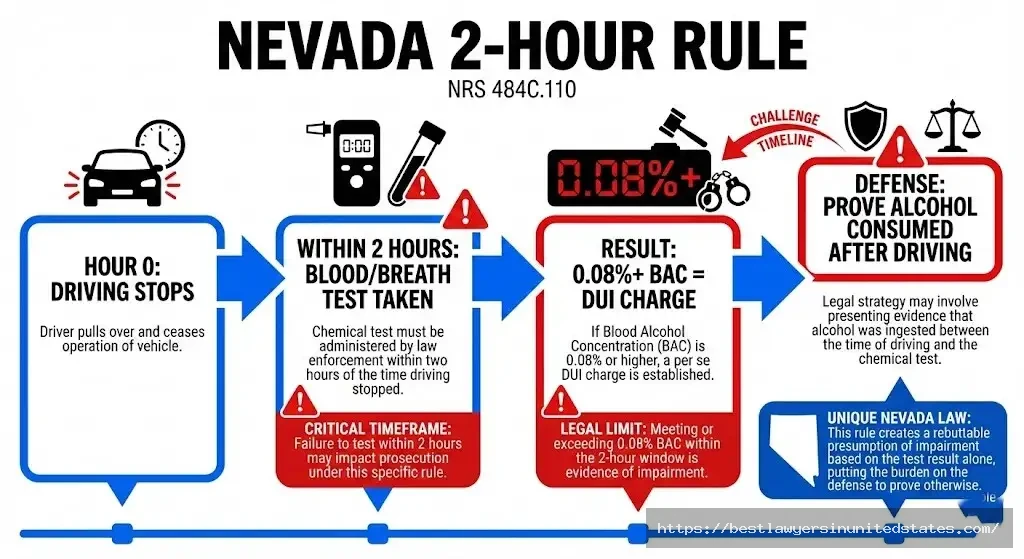
How prosecutors use it: Police often arrive 30-90 minutes after someone stops driving. The breath or blood test shows .08% at that time. Prosecutors charge you with DUI even though you may have been under .08% while driving.
The “post-driving consumption” defense: Nevada law allows you to defend against 2-hour rule charges by proving you consumed “a substantial amount of alcohol” after driving stopped. You must show:
- Exact timeline of when driving ended
- What alcohol you consumed after parking
- Amount consumed and proof of consumption
- Witnesses or receipts supporting your timeline
Critical deadline: Blood or breath samples must be taken within two hours after driving. Tests taken 121 minutes after you stopped driving cannot support 2-hour rule charges. Time calculations matter—your attorney will examine officer reports and testing logs to verify timing.
Courts require strong evidence to accept the post-driving consumption defense. “I had a drink when I got home” isn’t enough—you need witnesses, receipts, and credible testimony about quantities consumed.
The 12-Hour Jail Hold
Nevada law requires arrested DUI suspects to spend at least 12 hours in jail before release, even if you post bail immediately. You also must provide a breath sample under .04% before officers release you (NRS 484C.430).
What this means practically:
- Arrested at 10 PM? Earliest release is 10 AM next day
- Bail posted at midnight? You still wait until 12 hours pass
- BAC still above .04 at 12 hours? You wait longer until it drops
- No exceptions for work, childcare, or other obligations
Work and family impact: Most people lose at least one workday. The 12-hour hold affects evening arrests worst—you miss work the next day and possibly lose your job if your employer has strict attendance policies.
Officers confiscate your vehicle at arrest. Expect $200-$400 in towing and impound fees. Retrieve it within 30 days or the tow company auctions it.
Involuntary Blood Draws
Nevada officers can draw your blood by force if they obtain a warrant, even for misdemeanor first-offense DUI. NRS 484C.160 allows magistrates to authorize:
- Up to three blood draws within five hours after arrest
- Reasonable force to obtain samples
- Medical personnel to draw blood against your will
When officers seek warrants:
- You refuse breath testing
- Accidents involving injuries
- Child passengers in the vehicle
- Prior DUI convictions on your record
- Suspected drug impairment (drugs don’t show on breath tests)
The warrant process: Officers now use electronic warrant systems. A judge reviews the probable cause affidavit remotely and approves warrants within 30-60 minutes. This happens faster than most DUI suspects expect.
Medical professional requirement: Only nurses, phlebotomists, or doctors can draw blood. Police officers cannot stick the needle themselves. Hospitals and mobile DUI units provide medical staff for blood draws.
Some defendants challenge blood draws based on warrant defects, improper force, or contaminated samples. Your attorney examines the warrant application, blood draw procedures, and chain of custody documentation.
Marijuana DUI in Nevada
Nevada legalized recreational marijuana in 2017, but driving under marijuana influence remains illegal. The law sets specific THC thresholds that only apply to felony DUI cases.
Marijuana DUI thresholds:
- 2 nanograms (ng) of marijuana (delta-9-THC) per milliliter of blood
- 5 ng of marijuana metabolite (11-OH-THC) per milliliter of blood
Critical limitation: These thresholds only apply to third-offense felony DUI or DUI causing injury/death. First and second offenses require prosecutors to prove actual impairment—the nanogram levels don’t create automatic guilt for misdemeanors.
Why daily users face risk: THC metabolites remain in blood for days or weeks after use. Daily marijuana users often test above 5 ng even when not currently impaired. You can smoke marijuana Friday night and still fail a blood test Monday morning.
Proving impairment: Officers use Drug Recognition Experts (DREs) for marijuana DUI cases. These specially trained officers conduct 12-step evaluations including pupil measurements, balance tests, and vital signs. DRE testimony often determines whether prosecutors can prove impairment.
Nevada law treats marijuana identically to alcohol for DUI purposes. Medical marijuana cards provide no defense—legal use doesn’t equal legal driving.
Chemical Testing & Implied Consent
Nevada’s implied consent law (NRS 484C.150-250) requires drivers to submit to chemical testing when arrested for DUI. Refusal triggers automatic license revocation separate from any criminal penalties.
Nevada’s Implied Consent Law
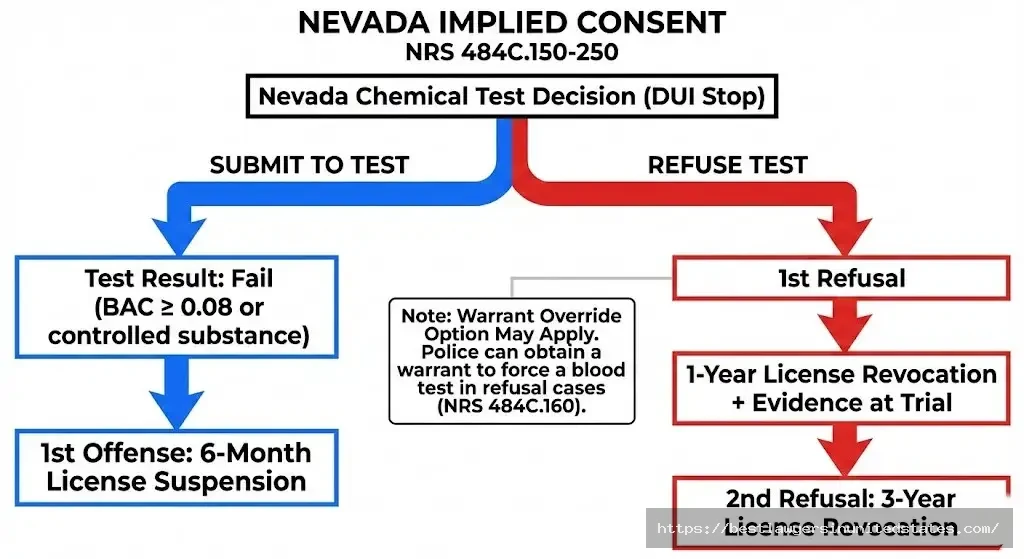
Every Nevada driver automatically consents to breath, blood, or urine testing by accepting a driver’s license. This “consent” activates when officers arrest you for suspected DUI.
Testing choice: Officers let you choose between breath or blood testing for alcohol. Both measure BAC, but blood tests also detect drugs. Officers must read you the implied consent warning explaining refusal consequences before requesting the test.
Urine testing: Officers can require urine tests in addition to breath tests when they suspect drug impairment. Marijuana, methamphetamine, cocaine, and prescription drugs show up in urine but not breath samples.
Independent testing right: Nevada law allows you to request additional testing at your own expense after completing the official test. Some defendants hire independent labs to retest blood samples or conduct their own blood draws. Results sometimes differ from police lab findings.
Refusing the Test
Nevada allows you to refuse chemical testing, but refusal triggers harsher administrative penalties than failing the test.
| Refusal Number | License Revocation | Notes |
|---|---|---|
| 1st refusal | 1 year | No restricted license |
| 2nd refusal (within 7 years) | 3 years | Possible reinstatement after 1 year |
| Refusal after prior DUI | 3 years | Enhanced penalties |
Refusal consequences:
- Officers document your refusal in arrest reports
- Prosecutors use refusal as “consciousness of guilt” evidence at trial
- Juries often view refusal negatively
- You still face DUI charges based on officer observations and field sobriety tests
- Refusal doesn’t prevent conviction—just eliminates one piece of evidence
Warrant override: Refusing doesn’t guarantee no testing. Officers increasingly obtain warrants for blood draws within 30-60 minutes. Magistrates approve warrants electronically based on probable cause affidavits.
Critical point: Refusal revocation runs separately from criminal conviction revocation. Even if you beat the DUI charge in court, Nevada DMV enforces the one-year refusal revocation.
Refusing makes sense in limited situations—when BAC is obviously over .08%, when drugs are involved, or when prior DUIs create felony exposure. Most DUI attorneys recommend testing over refusal for first offenders with borderline BAC levels.
Field Sobriety Tests
Nevada law doesn’t require you to perform field sobriety tests. These roadside physical tests help officers build probable cause for arrest but aren’t mandatory like chemical tests.
Common Nevada field sobriety tests:
- Horizontal Gaze Nystagmus (HGN): Officer moves pen or finger while watching your eye movements. Involuntary eye jerking indicates impairment.
- Walk-and-Turn: Walk nine steps heel-to-toe on a straight line, turn, and return. Officers watch for balance, following directions, and proper steps.
- One-Leg Stand: Stand on one foot for 30 seconds while counting. Swaying, hopping, or putting your foot down shows impairment.
Why these tests are used: Field sobriety tests create evidence for trial. Officers testify about your performance, often claiming failures you don’t remember. Dashboard and body camera footage preserves the tests for juries.
Medical conditions affecting tests: Inner ear problems, injuries, obesity, age over 65, and neurological conditions all impact balance and coordination. Officers rarely account for these factors during roadside testing.
Refusal strategy: Politely declining field sobriety tests eliminates video evidence of you stumbling around. Officers still arrest you based on driving, odor, and other observations—but prosecutors can’t show juries video of you failing tests.
Nevada law treats field sobriety test refusal differently than chemical test refusal. No automatic penalties apply for declining roadside physical tests.
License Suspension vs Revocation
Nevada drivers face two separate license actions after DUI arrest: immediate administrative revocation and later criminal court revocation. These happen on different timelines through different agencies.
Administrative Action (DMV)
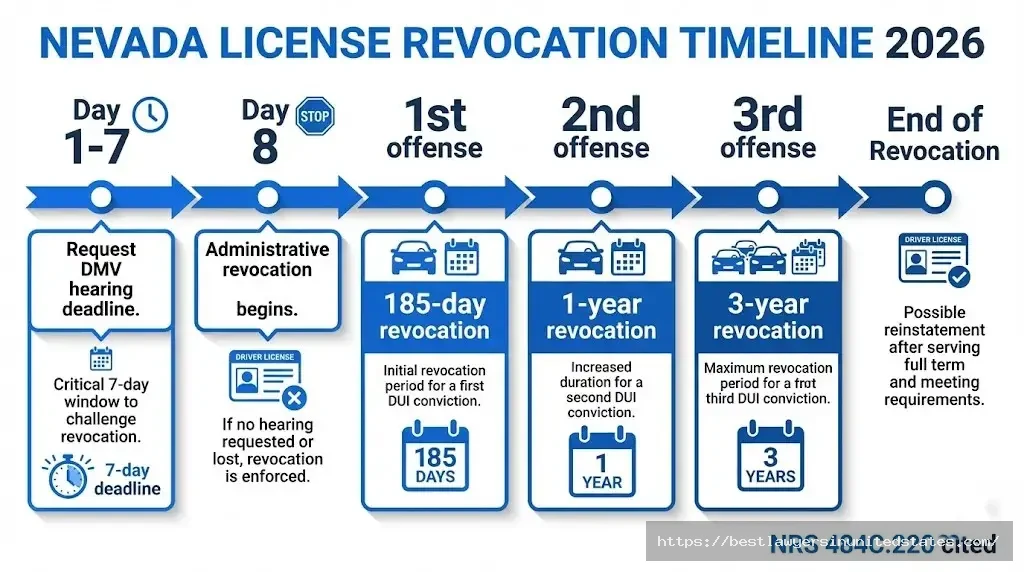
Nevada DMV revokes licenses administratively when breath or blood tests show illegal BAC levels (NRS 484C.220). This happens within days of arrest, long before criminal court resolves your case.
Administrative revocation timeline:
- At arrest: Officer confiscates your license
- Temporary license issued: Paper permit good for 7 days
- Day 8: Administrative revocation begins automatically
- Within 7 days of arrest: Request DMV hearing or revocation proceeds
Hearing request: You must request an administrative hearing within seven days of arrest. Miss this deadline and your license revokes automatically with no chance to contest it. File your hearing request at Nevada DMV’s Office of Administrative Hearings.
What you can challenge at DMV hearings:
- Whether officer had reasonable grounds to believe you were DUI
- Whether arrest was lawful
- Whether you were driving or in actual physical control
- Whether test results show prohibited BAC level
- Whether testing procedures followed regulations
DMV hearings focus on narrow procedural issues, not whether you’re actually guilty. Administrative Law Judges work for DMV, not the courts. Winning here prevents license revocation even if criminal court later convicts you.
Criminal Conviction Revocation
Criminal court imposes separate license revocation when judges convict you of DUI under NRS 484C.400. This revocation runs independently from administrative penalties.
Conviction revocation periods:
| Conviction | Revocation Length | Restricted License? |
|---|---|---|
| 1st offense | 185 days | Yes, after 90 days |
| 2nd offense | 1 year | No |
| 3rd offense (felony) | 3 years | Yes, after serving part |
Critical difference: Beating your criminal DUI charge doesn’t automatically reinstate your license. Administrative revocation stands even with criminal dismissal. You must meet all DMV reinstatement requirements separately.
Hardship restricted licenses: First-offense convictions allow restricted licenses after serving 90 days of revocation. Restrictions limit driving to work, school, medical appointments, and DUI program attendance. You must show proof of:
- Ignition interlock device installation
- SR-22 high-risk insurance
- Employment or school enrollment
- DUI school enrollment
Nevada DMV Administrative Hearings
Nevada DMV holds administrative hearings through the Office of Administrative Hearings in Carson City, Las Vegas, and Reno. These hearings determine whether administrative license revocation proceeds.
Filing process:
- Request hearing within 7 days of arrest
- Pay $50 filing fee
- DMV schedules hearing within 30-45 days
- Receive temporary license extension until hearing date
- Attend hearing with attorney
Hearing procedures:
- Administrative Law Judge presides
- Officer who arrested you testifies (often by phone)
- Your attorney cross-examines officer
- You can testify and present witnesses
- Judge issues written decision within 30 days
Winning outcomes: Judges dismiss administrative revocation if officers violated procedures, tests weren’t properly administered, or probable cause didn’t exist. Your license stays valid and DMV removes the administrative action from your record.
Losing outcomes: Judges uphold revocation if evidence supports it. Your temporary license expires immediately and full revocation begins. You can appeal to District Court but must file within 30 days.
Ignition Interlock Privilege
Nevada offers ignition interlock privilege as an alternative to full license revocation for all offense levels. This lets you drive anywhere without restrictions—work, errands, personal travel—if you install an approved IID.
How ignition interlock works:
- Device installed in your vehicle before you start
- Blow into device before engine starts
- BAC must show under .025% (lower than legal limit)
- Random rolling retests while driving
- Failed tests lock the vehicle until successful retest
- All test results download to monitoring company
- Violations reported to DMV and courts
Nevada IID requirements:
| Installation | Monthly Cost | Monitoring | Violations |
|---|---|---|---|
| $75-$150 | $60-$100 | Required | Can extend duration |
Approval process:
- Apply for IID privilege at Nevada DMV
- Choose DMV-approved installation company
- Install device and get certificate
- Submit certificate to DMV
- Pay privilege fees
- Receive IID privilege license
Critical rules: You cannot drive any vehicle without an installed IID. Getting caught driving a non-equipped car revokes your privilege immediately and adds new criminal charges. Family members can still drive your vehicle if they take the initial breath test.
Ignition interlock privilege costs more monthly than suspension but preserves your ability to work and maintain normal life. Most Nevada DUI defendants choose IID over full revocation.
DUI Arrest Process in Nevada
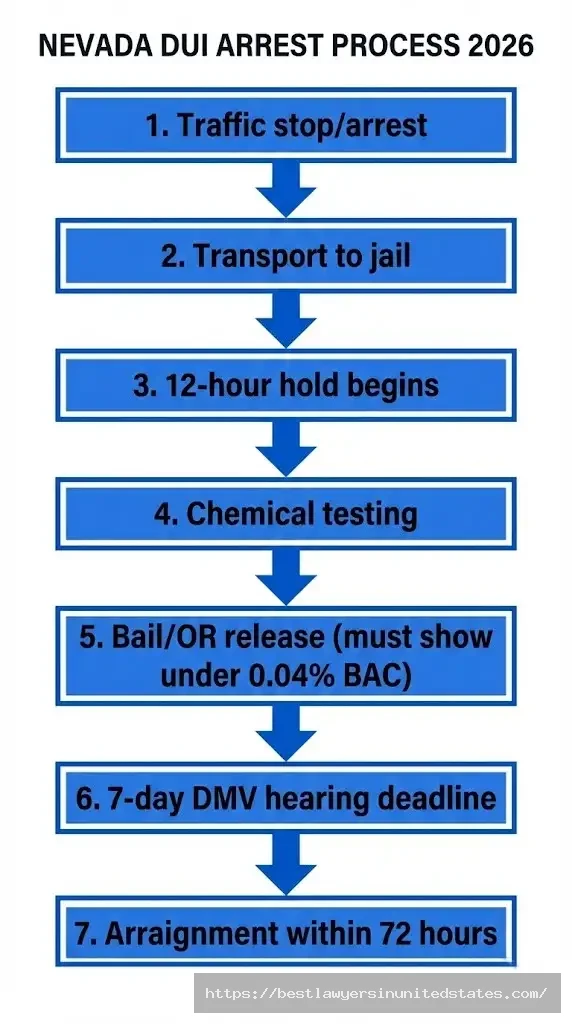
Nevada’s DUI arrest process follows predictable steps from traffic stop through court resolution. Understanding this timeline helps you protect your rights and meet critical deadlines.
What Happens During Arrest
Traffic stop: Officers stop you for traffic violations, erratic driving, or DUI checkpoints. They observe driving patterns and document violations in reports. Checkpoint stops must follow constitutional guidelines—random stops at predetermined locations.
Officer investigation:
- Officer asks where you’re coming from and whether you’ve been drinking
- You provide license, registration, and insurance
- Officer notes alcohol odor, bloodshot eyes, slurred speech
- Officer asks you to step out for field sobriety tests
- Preliminary breath test on portable device (not admissible at trial)
Formal arrest: Officers arrest you if they develop probable cause. They handcuff you, read Miranda rights, and transport you to jail for booking and chemical testing.
Vehicle impoundment: Police tow your car from the arrest scene. Towing companies charge $200-$400 for towing plus $30-$50 daily storage. Pick it up within 30 days or they auction it.
Jail booking and testing:
- Fingerprints and photos
- Chemical test (breath or blood)
- 12-hour minimum hold begins
- Breathalyzer before release (must show under .04%)
- Bail set or OR (own recognizance) release granted
License confiscation: Officers confiscate your license and issue a temporary paper license good for 7 days. Administrative revocation starts on day 8 unless you request a DMV hearing.
Court Process
Nevada DUI cases move through criminal court on a structured timeline. Missing court dates results in bench warrants for your arrest.
Arraignment (first court date):
- Occurs within 72 hours of arrest for in-custody defendants
- Judge reads charges and explains maximum penalties
- You enter plea (guilty, not guilty, no contest)
- Bail review if you weren’t released earlier
- Public defender appointed if you can’t afford attorney
Pre-trial motions and discovery:
- Your attorney files motions to suppress evidence
- Prosecutor provides police reports, videos, test results
- Motions hearing challenges illegal stops, improper testing, rights violations
- Plea negotiations begin
Trial or plea:
Nevada law permits plea bargaining in DUI cases, unlike some states. Common plea options include:
- Reckless driving (no DUI conviction, shorter suspension)
- First offense DUI with agreed sentence
- Charge reduction if evidence is weak
Trial by jury or judge: You can choose jury trial (6 jurors in misdemeanor cases) or bench trial before a judge alone. Trials last 1-3 days depending on evidence and witnesses.
Sentencing hearing:
- Occurs immediately after guilty verdict or plea
- Judge imposes jail, fines, programs, license revocation
- Sentencing guidelines vary by Clark County vs Washoe County courts
- You can request custody alternatives (work release, weekend jail)
Timeline Expectations
DUI cases resolve at different speeds depending on county and case complexity.
Clark County (Las Vegas) timeline:
- Arraignment: 3-7 days after arrest
- Pre-trial conferences: Every 30 days
- Trial setting: 3-6 months after arraignment
- Total resolution: 4-8 months average
Washoe County (Reno) timeline:
- Arraignment: Within 72 hours
- Discovery and motions: 60-90 days
- Trial: 4-6 months from arrest
- Total resolution: 5-7 months average
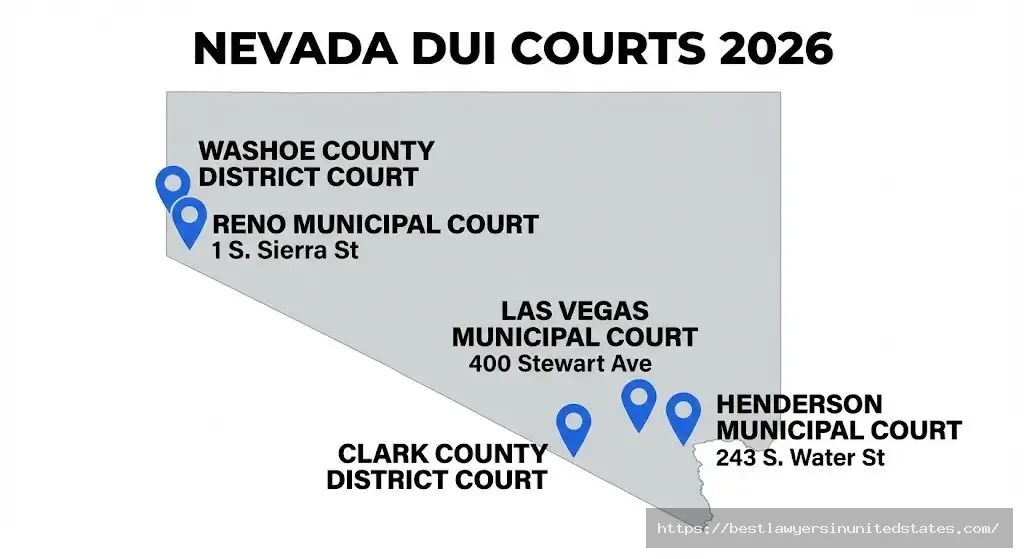
Las Vegas Municipal Court: Handles misdemeanor DUI arrests within city limits. These cases often resolve faster than justice court cases—3-5 months average. Municipal court operates at 400 Stewart Avenue in downtown Las Vegas.
Henderson Municipal Court: Processes Henderson city arrests at 243 S. Water Street. Similar timeline to Las Vegas Municipal Court.
Reno Municipal Court: Located at 1 S. Sierra Street, handles Reno city misdemeanor DUI. Coordinates with Washoe County courts for felony cases.
Felony DUI cases take longer—8-15 months for third offense or injury cases. These start in justice court and transfer to district court after preliminary hearing.
Special DUI Situations
Nevada law creates distinct rules for specific driver categories and circumstances. These situations carry unique penalties beyond standard DUI consequences.
Underage DUI (Under 21)
Nevada enforces zero tolerance for drivers under 21 under NRS 483.461. Any detectable alcohol—even .02%—violates the law for underage drivers.
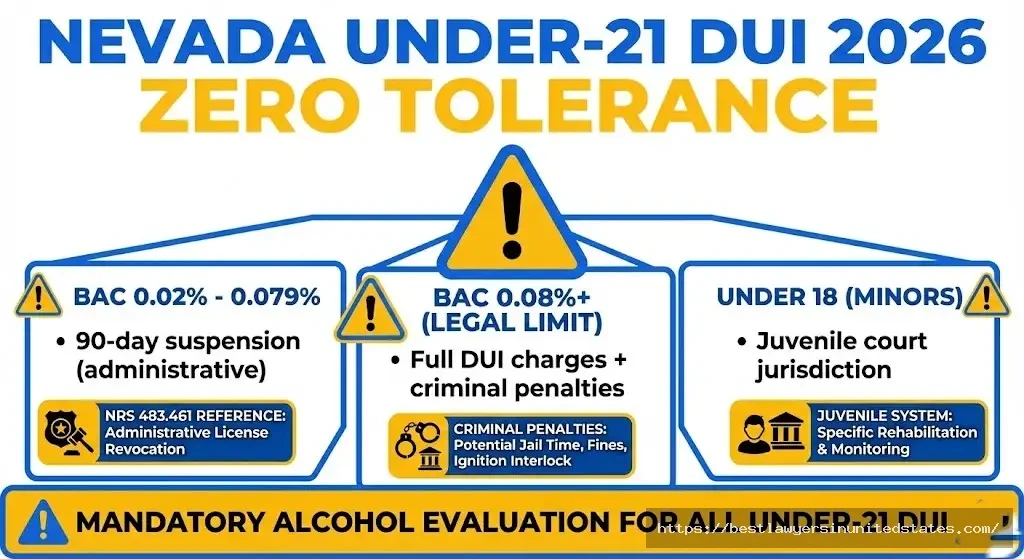
Under 21 BAC consequences:
| BAC Level | Age | Penalty | Court |
|---|---|---|---|
| .02%-.079% | Under 21 | 90-day suspension | Administrative only |
| .08%+ | Under 21 | Full DUI charges | Criminal court |
| .08%+ | Under 18 | Juvenile court | May transfer to adult |
Mandatory evaluation: Nevada requires alcohol/drug evaluation for all drivers under 21 convicted of DUI. The court orders treatment if evaluators recommend it, regardless of BAC level.
Juvenile court (under 18): Drivers under 18 face juvenile court proceedings under NRS 62E.630-640. Juvenile judges can order:
- 90-day license suspension
- 185-day suspension for .08%+ BAC
- Alcohol/drug treatment programs
- Juvenile detention for repeat offenses
- Community service
License consequences: Underage DUI convictions prevent license issuance until age 21 in some cases. Nevada DMV can suspend license application privileges for serious violations.
Parents receive notification of all underage DUI arrests and court proceedings. Juvenile court records may seal upon turning 18, but DUI convictions remain on driving records.
Commercial Drivers
Commercial driver’s license (CDL) holders face federal regulations in addition to Nevada state law. CDL suspension happens even when driving personal vehicles.
.04% CDL threshold: Federal law sets .04% BAC as the limit for CDL holders operating commercial vehicles. Nevada enforces this federal standard under NRS 484C.110.
CDL disqualification periods:
| Offense | Disqualification | Notes |
|---|---|---|
| 1st DUI | 1 year | 3 years if hauling hazmat |
| 2nd DUI | Lifetime | May petition after 10 years |
| DUI in CMV | Same as above | Commercial motor vehicle |
Critical rule: You lose your CDL for one year even if arrested in your personal car at .08% BAC. The DUI doesn’t need to occur in a commercial vehicle—your CDL suspension happens regardless.
Career impact: Most trucking companies and bus operators fire drivers after any DUI. CDL reinstatement takes months or years. You’ll need specialized high-risk CDL insurance costing $3,000-$7,000 annually.
Nevada doesn’t offer restricted CDL privileges. Your commercial driving career essentially ends during the disqualification period.
DUI with Passengers Under 15
Nevada law treats child passengers as an aggravating factor under NRS 484C.400. Judges consider this when determining sentences within statutory ranges.
Enhanced considerations:
- Judges may impose maximum jail time instead of minimum
- Fines often hit the high end of ranges
- Child Protective Services investigation triggered
- Possible child endangerment charges (separate crime)
- Court may order supervised visitation changes
Child endangerment charges: Prosecutors can file separate child endangerment under NRS 200.508 when passengers under 18 are in the vehicle. This gross misdemeanor carries additional penalties:
- Up to 364 days in jail
- $2,000 fine
- Runs consecutively with DUI sentence
Custody implications: Family court judges view DUI with children in the car as evidence of poor judgment. Expect temporary custody or visitation changes during criminal case resolution. The other parent can petition for emergency custody orders based on the arrest.
Clark County courts take child passenger DUI extremely seriously. Las Vegas Municipal Court judges routinely impose maximum sentences when children were endangered.
Open Container Laws
Nevada prohibits open alcohol containers in vehicles under NRS 484B.150. This misdemeanor often accompanies DUI charges but stands as a separate violation.
What violates open container law:
- Alcoholic beverage containers with broken seals
- Containers in passenger compartment (not trunk)
- Accessible bottles, cans, or cups
- Applies to driver and passengers
Exceptions: Open containers are legal in passenger areas of:
- Motor homes/RVs in living quarters
- Hired limousines and party buses
- Taxi cabs (passengers only)
- Commercial buses
Penalties for open container:
- $1,000 fine maximum
- No jail time
- Citation, not arrest
- Often added to DUI charges
Impact on DUI cases: Officers document open containers in DUI arrest reports. Prosecutors use this as evidence of drinking while driving. Juries view open containers as strong guilt evidence—much stronger than sealed bottles in the trunk.
Las Vegas Strip visitors often carry “go cups” between casinos. These violate open container laws once you enter a vehicle. Pour drinks out or finish them before getting in cars.
Costs of a Nevada DUI
Nevada DUI convictions create substantial direct and indirect costs over multiple years. Hidden expenses often exceed obvious fines and fees.
Average Total Costs
Calculate your complete financial exposure using our DUI cost calculator for Nevada-specific estimates.
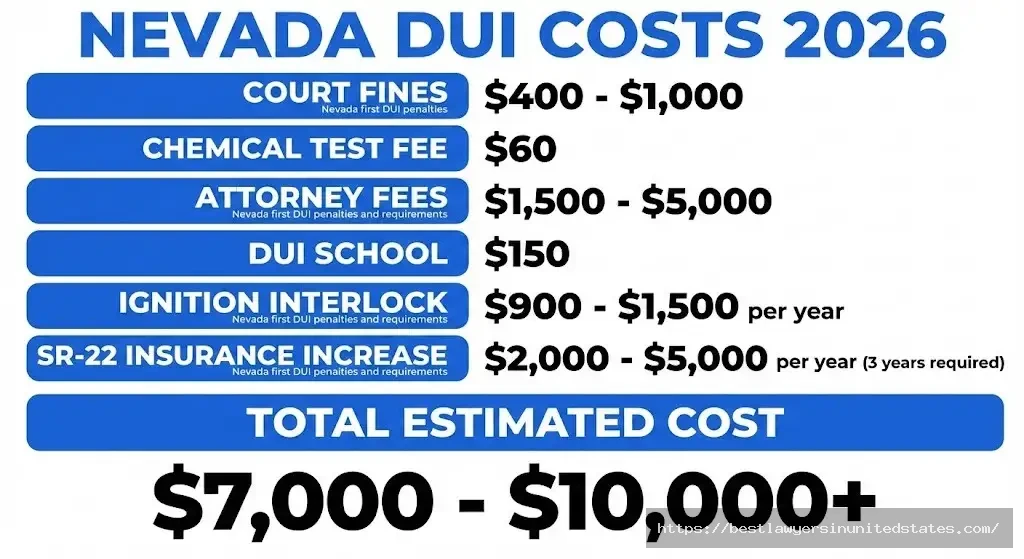
Total first-offense costs: $7,000-$10,000+ Total second-offense costs: $10,000-$15,000+ Total third-offense costs: $15,000-$30,000+ (plus lost income during prison)
Cost Breakdown
Nevada DUI expenses fall into immediate costs and long-term financial impacts.
Immediate court costs:
| Expense Category | First Offense | Second Offense | Third Offense |
|---|---|---|---|
| Criminal fine | $400-$1,000 | $750-$1,000 | $2,000-$5,000 |
| Chemical test fee | $60 | $60 | $60 |
| Court assessments | $200-$400 | $250-$500 | $500-$1,000 |
| DUI school | $150-$200 | $150-$200 | $150-$200 |
| Victim impact panel | $50-$100 | $50-$100 | $50-$100 |
| Treatment program | $0-$1,500 | $1,500-$3,000 | $3,000-$8,000 |
DMV and license costs:
- $121 license reinstatement fee
- $35 victims of crime penalty
- $42.25 new license fee
- $26 written/road test fees
- $75-$150 ignition interlock installation
- $60-$100 monthly IID monitoring fees
- $2,000-$5,000 SR-22 insurance annual increase (3 years)
Attorney fees: Nevada DUI attorneys charge $1,500-$5,000 for first offense misdemeanors, $3,000-$10,000 for second offense, and $7,500-$25,000 for felony third offense. Prices vary by attorney experience and county location.
Arrest and vehicle costs:
- $200-$400 vehicle towing
- $30-$50 daily impound storage
- $500-$2,500 bail bond (10% of bail amount)
- $100-$300 bail bond company fees
Lost income:
- 2-6 days missed work (arrest, court, jail)
- Possible job loss if employer has zero tolerance
- Reduced earning capacity with criminal record
- Lost wages during jail or prison time
Long-term expenses:
- SR-22 insurance increase: $2,000-$5,000 annually for 3 years = $6,000-$15,000 total
- Higher insurance even after SR-22 period ends
- Background check employment barriers
- Professional license suspensions (medical, legal, real estate)
- CDL loss preventing commercial driving jobs
Second and third offenses multiply these costs. Treatment programs for second offense run $1,500-$3,000. Felony third-offense treatment programs cost $3,000-$8,000 over three years.
DUI Defense Strategies
Nevada DUI cases aren’t automatic convictions. Experienced attorneys challenge evidence, procedures, and testing to achieve dismissals or reduced charges.
Common Defenses in Nevada
Challenging 2-hour rule timing: Your attorney examines arrest reports, dispatch logs, and testing records to verify exactly when driving ended and testing occurred. If more than two hours passed, 2-hour rule charges fail. If you consumed alcohol after driving, you can defend by proving post-driving consumption.
Attacking chemical test accuracy: Breath and blood tests require strict procedures. Defense challenges include:
- Breathalyzer calibration and maintenance records
- 15-minute observation period before testing
- Mouth alcohol contamination
- GERD or acid reflux affecting results
- Blood sample chain of custody
- Lab technician qualifications
- Fermentation in blood vials
Field sobriety test administration errors: Officers must follow standardized NHTSA procedures. Your attorney reviews dashboard and body camera footage to identify:
- Improper instructions
- Unsafe testing surfaces (gravel, sloped pavement)
- Poor lighting conditions
- Lack of proper demonstrations
- Medical conditions not accounted for
Rising BAC defense: Alcohol absorption takes 30-120 minutes. Your BAC rises after drinking stops. This defense argues your BAC was under .08% while driving but rose above .08% by testing time 30-90 minutes later.
Mouth alcohol contamination: Burping, regurgitation, or dental work can trap alcohol in your mouth. This creates falsely high breath test readings. Officers must observe you for 15 minutes before testing to ensure no mouth alcohol—violations invalidate test results.
Medical conditions affecting tests: These conditions create false positives or test failures:
- Diabetes and ketosis (mimics alcohol on breath)
- GERD and acid reflux (causes mouth alcohol)
- Inner ear problems (affects balance tests)
- Neurological conditions (affects coordination)
- Leg or hip injuries (impacts one-leg stand)
When Cases Get Dismissed
Nevada judges dismiss DUI charges when prosecutors can’t prove guilt beyond reasonable doubt or police violated constitutional rights.
Weak evidence dismissals:
- No chemical test results (refusal case with weak field evidence)
- Test results below .08% with no impairment proof
- Insufficient officer observations of impairment
- Unreliable witness testimony
Procedural violation dismissals:
- Illegal traffic stop (no reasonable suspicion)
- Arrest without probable cause
- Failure to read Miranda warnings before questioning
- Coerced confession statements
- Lost or destroyed evidence
- Violation of 72-hour arraignment rule
Constitutional violations:
- Unlawful search and seizure
- Denial of attorney during questioning
- Discriminatory checkpoint stops
- Blood draw without valid warrant
- Forced testing without legal authority
Successful motion to suppress: Your attorney files motions to exclude evidence obtained through illegal procedures. If judges grant these motions and suppress test results or statements, prosecutors often dismiss—they can’t prove their case without key evidence.
Plea Bargaining Options
Nevada law permits plea bargaining in DUI cases under NRS 484C.400. Prosecutors may offer reduced charges when evidence is weak or procedural problems exist.
Reckless driving reduction: The most common plea bargain reduces DUI to reckless driving under NRS 484B.653. Benefits include:
- No DUI conviction on record
- Shorter license suspension (90 days vs 185 days)
- Reduced insurance impact
- Lesser employment consequences
- No ignition interlock requirement
Wet reckless: Some prosecutors agree to “reckless driving involving alcohol.” This creates a DUI-related record but avoids full DUI conviction. Courts still order some DUI programs and consequences.
Charge dismissal with plea to lesser offense: Strong defense cases sometimes result in full DUI dismissal with pleas to:
- Exhibition of speed
- Failure to maintain lane
- Careless driving
- Traffic infractions (no criminal record)
Your attorney negotiates these outcomes based on case weaknesses, testing problems, or first-time offender status. Prosecutors in Clark County and Washoe County evaluate each case individually.
Nevada’s plea bargaining contrasts with states like Arizona that prohibit DUI charge reductions. This creates opportunities for favorable resolutions when your attorney identifies case weaknesses.
DUI Records & Expungement
Nevada maintains permanent DUI records through multiple agencies. Understanding record types and sealing options protects your future.
Criminal Records
DUI convictions create permanent criminal history records accessible to employers, landlords, and licensing boards.
FBI and Nevada records: Fingerprints and conviction data go to:
- Nevada Central Repository for Criminal History
- FBI National Crime Information Center (NCIC)
- Interstate criminal databases
Felony DUI impact: Third-offense felony DUI remains on your record for life. Any subsequent DUI arrest—even 20 years later—charges as felony due to the prior felony conviction. You never return to misdemeanor status.
Background check results: DUI convictions appear on:
- Employment background checks
- Professional license applications
- Housing rental applications
- Firearm purchase checks (felony DUI prohibits ownership)
- Immigration and citizenship reviews
DMV Records
Nevada DMV maintains two types of driving records with different retention periods.
Full DMV record (lifetime): Contains complete driving history including:
- All DUI convictions
- License revocations and suspensions
- Administrative actions
- Reinstatement dates
- Ignition interlock requirements
Driver history (10 years): Public driving records show DUI convictions for 10 years after conviction date. Insurance companies and employers requesting driving records see convictions during this period.
License revocation records: Revocations remain on full DMV records until you complete reinstatement. Unreinstated revocations show forever—you cannot get a license in any state until Nevada reinstatement completes.
Nevada DUI Expungement
Nevada allows sealing (expunging) some DUI convictions from public criminal records under NRS 179.245. Eligibility depends on offense level and time passed.
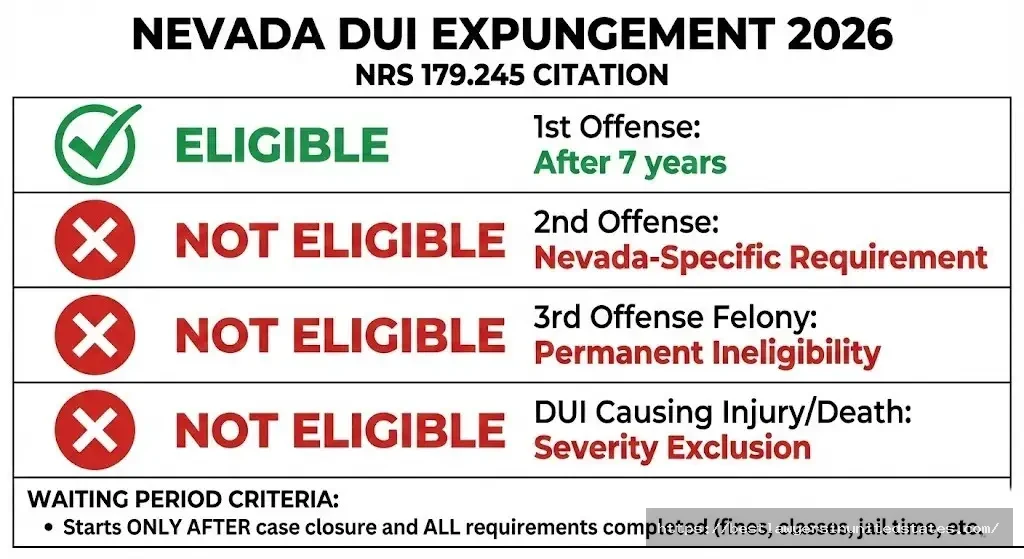
Sealing eligibility periods:
| Offense Level | Waiting Period | Eligibility |
|---|---|---|
| 1st offense misdemeanor | 7 years after case closure | Yes |
| 2nd offense misdemeanor | Never | Not eligible |
| 3rd offense felony | Never | Not eligible |
| DUI causing injury/death | Never | Not eligible |
Case closure date: The 7-year period starts when you complete all sentencing requirements—not conviction date. If you’re ordered to complete 3 years of treatment, the waiting period doesn’t begin until treatment ends.
Sealing process:
- Wait 7 years after completing all sentence requirements
- Obtain certified disposition from court
- File petition to seal records
- Pay $150-$200 court filing fees
- Serve petition on prosecutor’s office
- Attend hearing (prosecutor can object)
- Judge reviews compliance and criminal history
- Order granted if eligible
What sealing accomplishes: Sealed records don’t appear on public background checks. You can legally state you weren’t convicted for most purposes. However, sealing doesn’t erase:
- DMV records (remain permanently)
- Records for future DUI prosecutions (prior still counts)
- Federal immigration records
- Law enforcement access
Sealing denied if: You have any convictions in the 7-year waiting period, failed to complete sentencing requirements, or face pending criminal charges.
Nevada sealing provides substantial benefits for first offenders. Consult an attorney to determine eligibility and navigate the petition process properly.
Finding a Nevada DUI Attorney
Nevada DUI law complexity increases with 2025 changes under Senate Bill 309. Early attorney consultation significantly improves case outcomes.
Why You Need Legal Representation
Dual proceedings: You fight two separate battles—criminal court for penalties and Nevada DMV for license retention. Your attorney handles both simultaneously. Most people lose administrative hearings without legal help, resulting in license revocation even with criminal dismissals.
7-day DMV deadline: You must request administrative hearing within 7 days of arrest. Miss this deadline and your license revokes automatically with no appeal. Attorneys file these requests immediately to preserve your driving privileges.
Senate Bill 309 impact: October 2025 law changes increased penalties and created new legal issues. Attorneys experienced with post-SB 309 cases understand new requirements and defend accordingly.
Evidence preservation: Attorneys immediately request dashboard camera footage, body camera videos, and police reports. Law enforcement agencies delete videos after 30-90 days—waiting too long loses critical evidence.
What to Look For
Nevada-specific experience: DUI laws vary dramatically between states. California DUI experience doesn’t translate to Nevada’s 2-hour rule or 12-hour hold requirements. Choose attorneys practicing exclusively in Nevada.
Clark/Washoe County familiarity: Court procedures differ between counties. Las Vegas Municipal Court operates differently than Henderson Municipal Court. Reno cases follow different timelines than Clark County Justice Court. Local experience matters.
Track record with dismissals/reductions: Ask attorneys about their dismissal rate and successful plea bargains. Request specific examples of reckless driving reductions or suppressed evidence cases.
Trial experience: Most DUI cases settle through pleas, but trial-ready attorneys negotiate better deals. Prosecutors know which attorneys actually try cases and offer better pleas to avoid trial.
DMV hearing experience: Some criminal defense attorneys don’t handle administrative DMV hearings. Your attorney should represent you in both criminal court and DMV proceedings.
Free Consultations
Most Nevada DUI attorneys offer free initial consultations. Use these meetings to evaluate attorneys and understand your case.
Questions to ask:
- How many Nevada DUI cases have you handled?
- What’s your experience with [Clark/Washoe] County courts?
- Have you handled cases under the new Senate Bill 309 changes?
- What defense strategies apply to my case?
- What’s your fee structure and payment plans?
- Will you handle both criminal court and DMV hearing?
- What’s the likely outcome and timeline?
Case evaluation process: Bring arrest paperwork, citation, and temporary license to consultations. Attorneys review police reports (if available) and testing information to identify defense opportunities.
Email Contact: [email protected]
Nevada DUI consequences last years and cost thousands. Professional legal representation substantially improves outcomes compared to self-representation or public defenders handling heavy caseloads.
Frequently Asked Questions
What is the 2-hour rule for DUI in Nevada?
Quick Answer: Nevada law makes it illegal to have .08% BAC within two hours after driving, even if you weren’t over the limit while actually driving.
Officers can test your blood or breath up to two hours after you stop driving under NRS 484C.110. If the test shows .08% or higher within that window, you face DUI charges. You can defend by proving you consumed substantial alcohol after driving stopped.
How much is bail for a DUI in Nevada?
Quick Answer: Nevada DUI bail typically ranges from $1,000-$3,000 for first offense, $2,500-$5,000 for second offense.
Judges set bail based on criminal history, flight risk, and aggravating factors. First offenders without prior record often receive OR (own recognizance) release with no bail required. Bail bond companies charge 10%-15% non-refundable fees to post bail bonds.
Can you keep your license after DUI in Nevada?
Quick Answer: No, Nevada automatically revokes licenses for 185 days on first DUI, but you can apply for ignition interlock privilege to keep driving.
Administrative revocation starts 8 days after arrest unless you request a DMV hearing. Ignition interlock privilege lets you drive anywhere without restrictions if you install an approved device. This costs $75-$150 installation plus $60-$100 monthly monitoring.
How long does DUI stay on Nevada record?
Quick Answer: DUI convictions remain on Nevada criminal records for life and DMV records for 10 years publicly, lifetime for full records.
Nevada counts prior DUI convictions within a 7-year “lookback period” for penalty enhancement. First-offense misdemeanors can be sealed after 7 years. Second offenses and felonies cannot be sealed.
What is the 30-30 rule in Nevada?
Quick Answer: The “30-30 rule” appears to reference a 30-day deadline for certain DUI administrative actions, though this isn’t official legal terminology.
Nevada law doesn’t officially define a “30-30 rule” in DUI statutes. This may refer to the 30-day period to request restricted licenses or appeal administrative actions. Consult an attorney about specific deadlines in your case.
Is Nevada strict on DUI?
Quick Answer: Yes, Nevada enforces some of America’s strictest DUI laws with mandatory minimum sentences, no probation for third offenses, and the unique 2-hour rule.
Nevada’s 12-hour jail hold, forced blood draws, and nonprobationable felonies make penalties harsher than most states. Senate Bill 309 increased penalties further starting October 2025. First-time offenders serve actual jail time or community service in distinctive garb.
Can a DUI be dismissed in Nevada?
Quick Answer: Yes, Nevada judges dismiss DUI cases when police violated procedures, test results are unreliable, or prosecutors can’t prove guilt beyond reasonable doubt.
Common dismissal grounds include illegal traffic stops, improper testing procedures, broken chain of custody for blood samples, and rising BAC defenses. Your attorney files motions to suppress evidence and challenges procedural violations.
What happens to first-time DUI offenders in Nevada?
Quick Answer: First-time Nevada DUI results in 2 days jail or 48-96 hours community service, $400-$1,000 fine, 185-day license revocation, DUI school, victim impact panel, and SR-22 insurance.
Most first offenders choose community service over jail time. You must complete DUI education, attend victim impact panel, and install ignition interlock device for license reinstatement. Total costs reach $7,000-$10,000 including fines, fees, and insurance increases.
Is DUI a felony in Nevada?
Quick Answer: DUI becomes a felony in Nevada for third offense within 7 years or when causing substantial bodily harm or death.
First and second DUI offenses are misdemeanors. Third conviction within seven years elevates to Category B felony with 1-6 years prison. DUI causing injury or death charges as felony regardless of prior record with 2-20 years prison.
What are Nevada’s BAC limits for different drivers?
Quick Answer: Nevada sets .08% BAC for drivers 21+, .04% for commercial drivers, and .02% for drivers under 21.
These limits trigger automatic “illegal per se” DUI charges. Officers can still arrest drivers below these limits if impaired. Drivers showing .18% or higher face enhanced penalties including mandatory treatment evaluation.
Nevada’s DUI laws continue evolving with regular legislative updates. Staying informed about current penalties and defense options protects your rights and future after arrest.
Email: [email protected]