Quick Answer: Missouri officially uses “DWI” (Driving While Intoxicated), not “DUI.” First offense penalties include up to 6 months jail, $500+ fines, and 30-90 day license suspension. Missouri uses a unique four-tier offender system under Missouri Revised Statutes § 577.010.
Missouri takes drunk driving seriously. The state enforces strict penalties through both criminal courts and the Missouri Department of Revenue. Understanding Missouri’s DWI laws helps you avoid costly mistakes.
This guide covers everything from BAC limits to court procedures. You’ll learn about SATOP requirements, license suspensions, and total costs. We’ll explain Missouri’s unique legal terms and penalty structures.
Understanding Missouri’s DWI Terminology
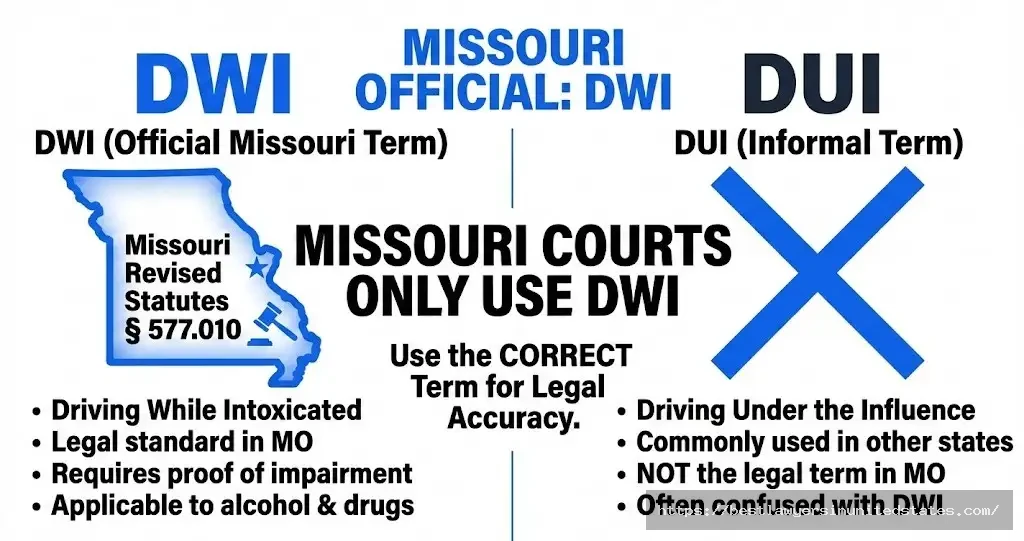
Quick Answer: Missouri law officially uses “DWI” (Driving While Intoxicated), not “DUI” (Driving Under the Influence).
Missouri Revised Statutes § 577.010 establishes “DWI” as the official charge. This differs from many states that use “DUI.” The terms mean essentially the same thing, but Missouri courts and police use DWI in all official documents.
Why the Terminology Matters
You might see “DUI” in older Missouri cases from before the 1980s. Some lawyers use the terms interchangeably when talking casually. However, your actual charges will always say “DWI” on Missouri court documents.
Key point: If someone searches for “DUI lawyer Missouri,” they’re looking for a DWI attorney. The services are identical regardless of terminology.
What Constitutes a DWI in Missouri?
You can face DWI charges in Missouri two ways. First, driving with a BAC at or above the legal limit. Second, driving while impaired by alcohol or drugs, regardless of BAC.
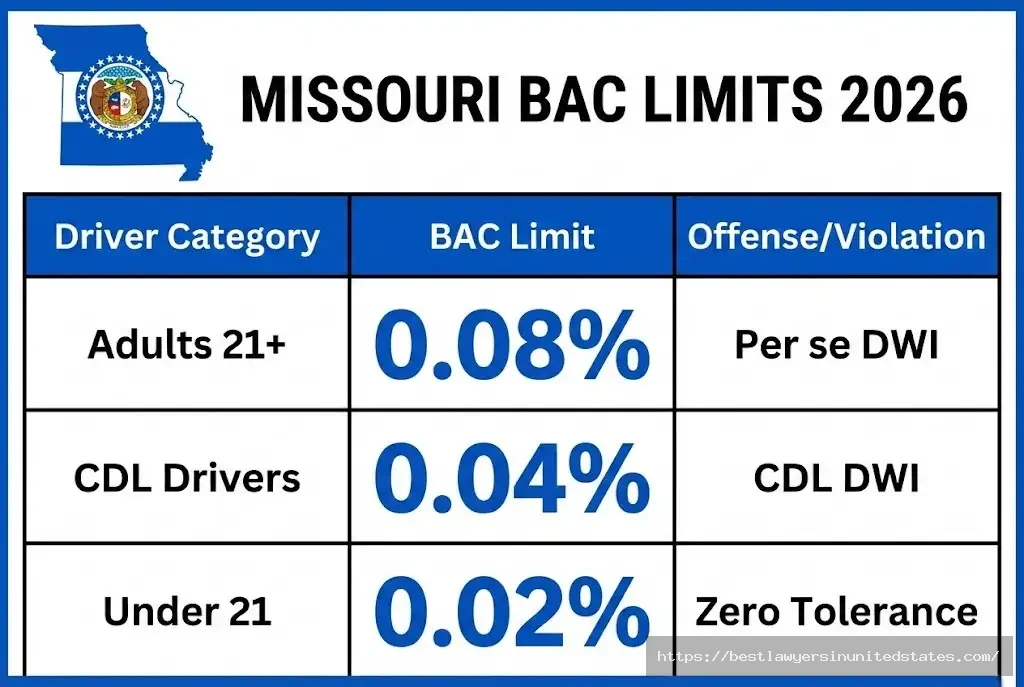
Missouri BAC Limits
| Driver Type | BAC Limit | Violation |
|---|---|---|
| Adults (21+) | 0.08% | Per se DWI |
| CDL Drivers | 0.04% | CDL DWI |
| Under 21 | 0.02% | Zero tolerance |
Missouri’s “per se” law means 0.08% BAC automatically violates the law. Police don’t need to prove actual impairment. Your BAC number alone supports a conviction.
Want to check if you’re over the limit? Use our BAC Calculator to estimate your blood alcohol level based on drinks consumed, weight, and time.
BAC Calculator
Estimate your Blood Alcohol Content
• Commercial Driver (CDL): 0.04% BAC
• Drivers Under 21: 0.00-0.02% BAC (Zero Tolerance)
• Enhanced Penalties: 0.15% BAC or higher in most states
Drugged Driving Under Missouri Law
Missouri Revised Statutes § 577.010 also covers drug impairment. This includes:
- Illegal drugs (marijuana, cocaine, methamphetamine)
- Prescription medications (opioids, benzodiazepines, sleep aids)
- Over-the-counter drugs (antihistamines, cold medicine)
Critical point: You can get a DWI even with legally prescribed medications if they impair your driving ability.
How Missouri Defines “Operating” a Vehicle
You don’t have to be driving to face DWI charges. Missouri courts consider you “operating” a vehicle if you’re in actual physical control. This means sitting in the driver’s seat with keys in the ignition, even if the car isn’t moving.
Missouri’s Four-Tier DWI Offender System
Quick Answer: Missouri classifies repeat offenders into four categories: Prior Offender, Persistent Offender, Aggravated Offender, and Chronic Offender. Each tier carries increasingly severe penalties.
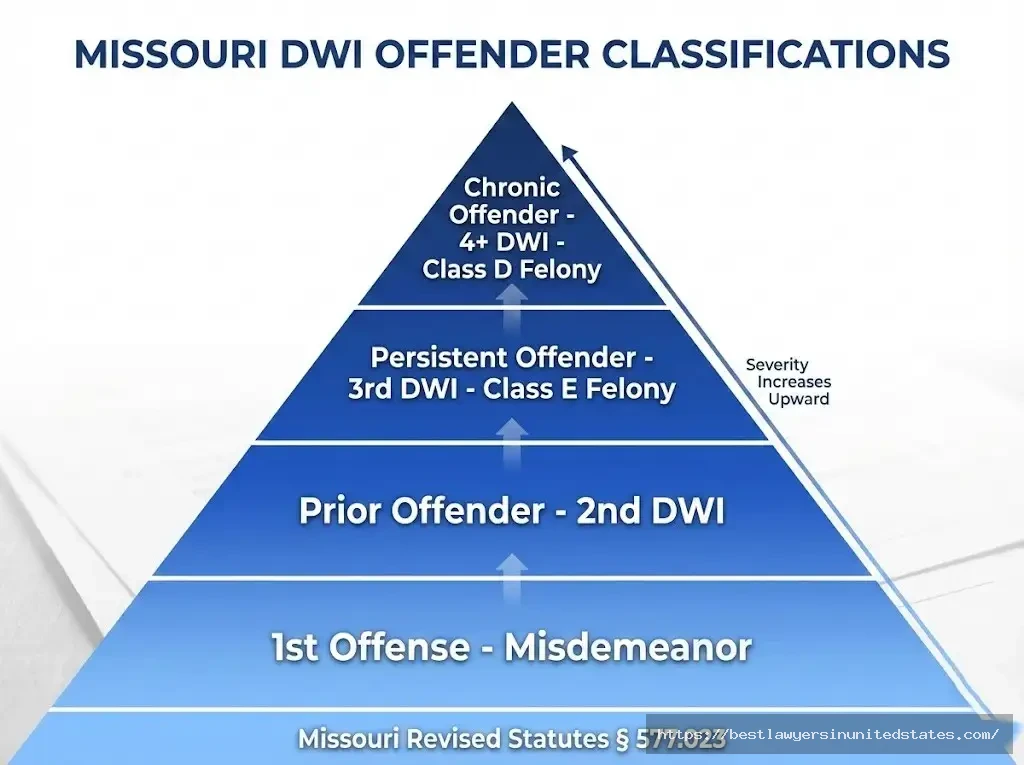
Missouri uses a unique classification system found in Missouri Revised Statutes § 577.023. This system increases penalties based on your DWI history. The system looks back at all prior DWI convictions, with no time limit for felony enhancements.
Prior Offender Classification
You become a Prior Offender with a second DWI conviction. Missouri law considers any DWI conviction from any state when determining your status.
What triggers Prior Offender status:
- Second DWI conviction
- Any timeframe between first and second offense
- Includes out-of-state DWI convictions
Penalties increase significantly:
- Up to 1 year in jail (vs. 6 months for first offense)
- $1,000+ in fines (vs. $500 minimum)
- 5-year license revocation (vs. 30-90 day suspension)
Persistent Offender Status
Persistent Offender status applies to third DWI convictions. This classification makes your charge a Class E felony, not a misdemeanor.
| Status | Offense Count | Charge Level | Maximum Sentence |
|---|---|---|---|
| First DWI | 1st | Misdemeanor | 6 months |
| Prior Offender | 2nd | Misdemeanor | 1 year |
| Persistent Offender | 3rd | Class E Felony | 4 years prison |
Key difference: Felony convictions appear on background checks permanently. This affects employment, housing, and professional licenses.
Aggravated Offender Category
Missouri law creates Aggravated Offender status for DWIs involving specific circumstances. These aggravating factors include:
- Driving 0.15% BAC or higher (nearly double the legal limit)
- Refusing chemical testing
- Speeding 20+ mph over the limit while intoxicated
- Driving with a child under 17 in the vehicle
Penalty enhancement: Aggravated offenses carry minimum jail time, even for first offenders. Judges have less discretion to suspend sentences.
Chronic Offender Classification
Four or more DWI convictions make you a Chronic Offender under Missouri law. This triggers the harshest penalties.
Chronic Offender consequences:
- Class D felony charges
- Up to 7 years in prison
- Permanent license revocation (no eligibility for reinstatement)
- Mandatory ignition interlock for life if license restored
Important note: Missouri counts all DWI convictions from your entire life. A DWI from 30 years ago still counts toward Chronic Offender status.
First Offense DWI in Missouri
Quick Answer: First DWI in Missouri carries up to 6 months jail, $500-$1,000 fines, and 30-90 day license suspension. Total costs typically range from $5,000-$10,000.
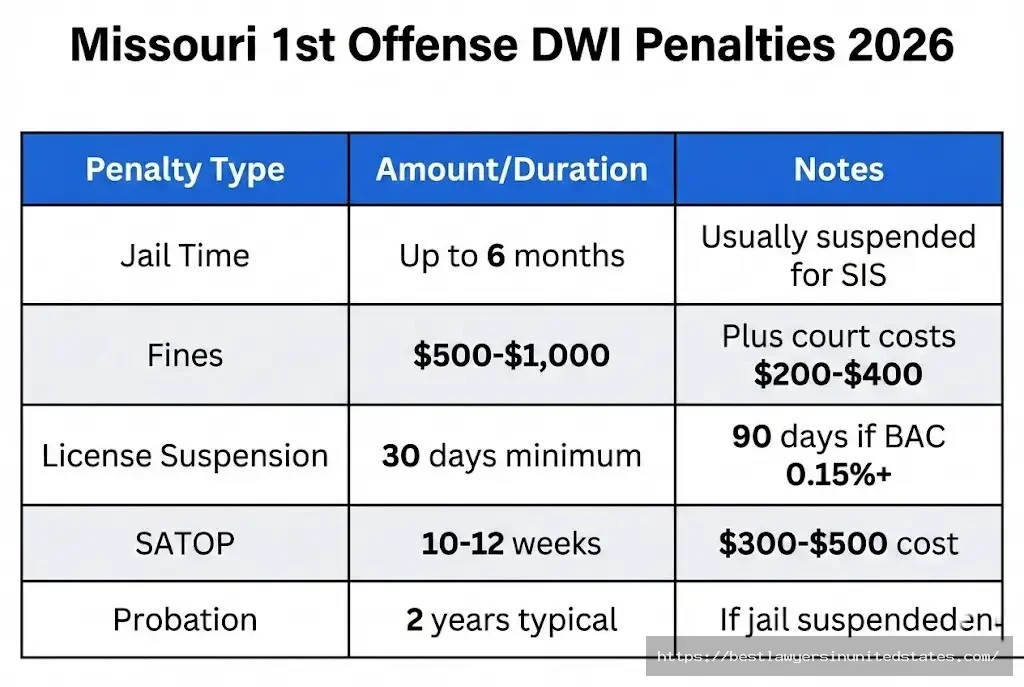
Missouri Revised Statutes § 577.010 treats first-offense DWI as a Class B misdemeanor. Most first-time offenders don’t serve jail time if they complete SATOP and meet other requirements.
First Offense Penalties Breakdown
| Penalty Type | Amount/Duration | Notes |
|---|---|---|
| Jail Time | Up to 6 months | Usually suspended for SIS |
| Fines | $500-$1,000 | Plus court costs ($200-$400) |
| License Suspension | 30 days minimum | 90 days if BAC 0.15%+ |
| SATOP | 10-12 weeks | $300-$500 cost |
| Probation | 2 years typical | If jail suspended |
Suspended Imposition of Sentence (SIS)
First-time offenders often qualify for SIS under Missouri law. This program lets you avoid a conviction on your record if you complete probation successfully.
SIS requirements:
- Complete SATOP program
- Pay all fines and court costs
- Complete probation (typically 2 years)
- Attend victim impact panel
- No new criminal charges
Critical benefit: SIS means no DWI conviction appears on your record after successful completion. However, Missouri still counts it as a prior DWI for future offenses.
What Happens at Your First Court Appearance
Your arraignment occurs within 10-15 days of arrest at the municipal or circuit court. You’ll appear before a judge who reads the charges and asks for your plea.
What to expect:
- Judge reads formal charges
- You enter guilty, not guilty, or no contest plea
- Bond conditions set (if not already released)
- Next court date scheduled
- Opportunity to request public defender
Smart move: Most DWI attorneys recommend pleading not guilty at arraignment. This preserves your right to negotiate or fight the charges later.
License Suspension Timeline
Missouri implements immediate license suspension separate from criminal court. The Missouri Department of Revenue handles this administrative process.
Timeline after arrest:
- Day 1: Police confiscate your license, issue 15-day temporary permit
- Within 15 days: Request administrative hearing or suspension begins automatically
- Day 31: Suspension takes effect if no hearing requested
- 30-90 days: Suspension period for first offense
Want to estimate your total DWI costs? Use our DUI Cost Calculator to see the complete financial impact including fines, attorney fees, and insurance increases.
DUI Cost Calculator
Estimate total DUI expenses by state and offense
Detailed Cost Breakdown
Payment Timeline
Bail bond, towing fees, car impound, attorney retainer
Initial court fines, DMV fees, DUI school enrollment, ignition interlock installation
Monthly probation fees, ignition interlock fees, DUI school payments, attorney balance
Insurance premium increases, license reinstatement, SR-22 filing fees
- Lost wages from missed work (court dates, jail time, DUI school) – $2,000-$10,000
- Job loss or difficulty finding employment – Varies
- Professional license suspension (doctors, lawyers, nurses, pilots) – Career ending
- Rideshare and transportation costs during suspension – $1,500-$5,000
- Travel restrictions and visa denials – Varies
- Security clearance loss – Career impact
- Child custody implications – Legal costs
- Rental car restrictions – Varies
- Personal relationships and mental health costs – Priceless
Second Offense DWI in Missouri (Prior Offender)
Quick Answer: Second DWI means up to 1 year jail, $1,000+ fines, 5-year license revocation, and mandatory ignition interlock. You’re classified as a Prior Offender. Total costs range from $10,000-$20,000.
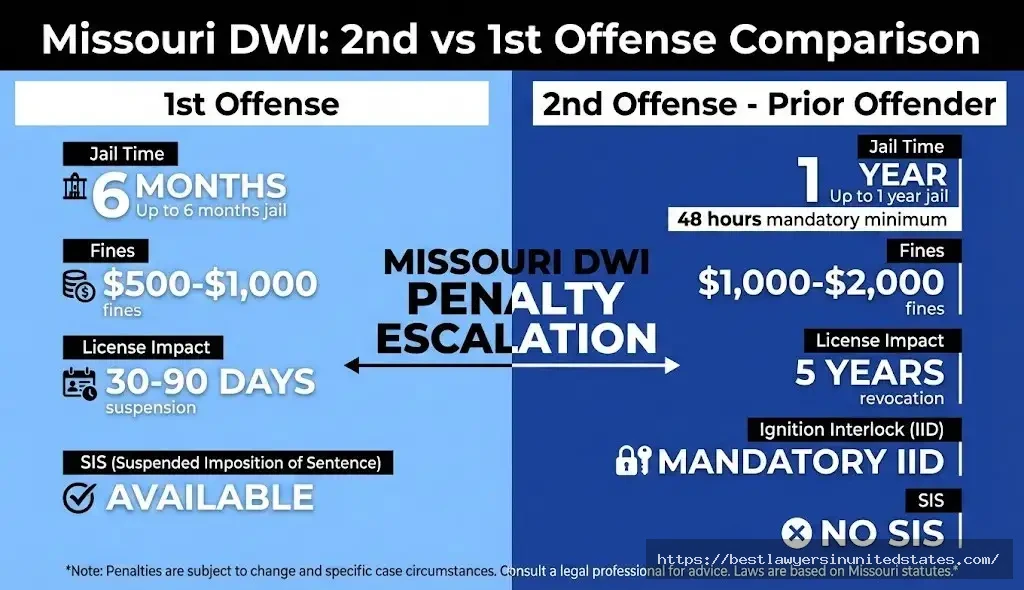
Prior Offender status under Missouri Revised Statutes § 577.023 significantly increases penalties. You lose eligibility for SIS and face mandatory minimum punishments.
Prior Offender Penalties
| Penalty Category | Second Offense | First Offense (Comparison) |
|---|---|---|
| Jail Time | Up to 1 year | Up to 6 months |
| Minimum Jail | 48 hours mandatory | None (SIS available) |
| Fines | $1,000-$2,000 | $500-$1,000 |
| License Revocation | 5 years | 30-90 days suspension |
| Ignition Interlock | Mandatory | Not required |
No More SIS Eligibility
Prior Offenders cannot receive Suspended Imposition of Sentence. This means your conviction goes on your permanent record immediately. The conviction appears on:
- Background checks for employment
- Professional license applications
- Housing rental applications
- Firearm purchase attempts
Long-term impact: A DWI conviction stays on your Missouri driving record for life. Insurance companies see it and raise your rates for at least 5 years.
Mandatory Ignition Interlock Device
Missouri law requires ignition interlock installation for all Prior Offenders seeking license reinstatement. The device prevents your car from starting if it detects alcohol on your breath.
IID requirements:
- Install in all vehicles you own or operate
- Pay installation fee ($100-$200)
- Pay monthly monitoring fee ($70-$100)
- Keep device for entire reinstatement period
- Pass random retest while driving
Cost over 5 years: Installing and maintaining an ignition interlock costs $4,200-$6,000 total.
How Missouri Courts Handle Second Offenses
Second DWI arrests trigger stricter bond conditions. Judges often require:
- Higher bond amounts ($1,000-$5,000)
- Alcohol monitoring bracelets (SCRAM devices)
- Weekly reporting to probation
- No-alcohol conditions
Critical deadline: You still have 15 days to request an administrative hearing with the Missouri Department of Revenue. Missing this deadline means automatic 5-year revocation.
Third Offense DWI in Missouri (Class E Felony)
Quick Answer: Third DWI is a Class E felony in Missouri. Penalties include up to 4 years prison, $10,000 fines, and 10-year license denial. You’re classified as a Persistent Offender. Total costs reach $15,000-$30,000+.
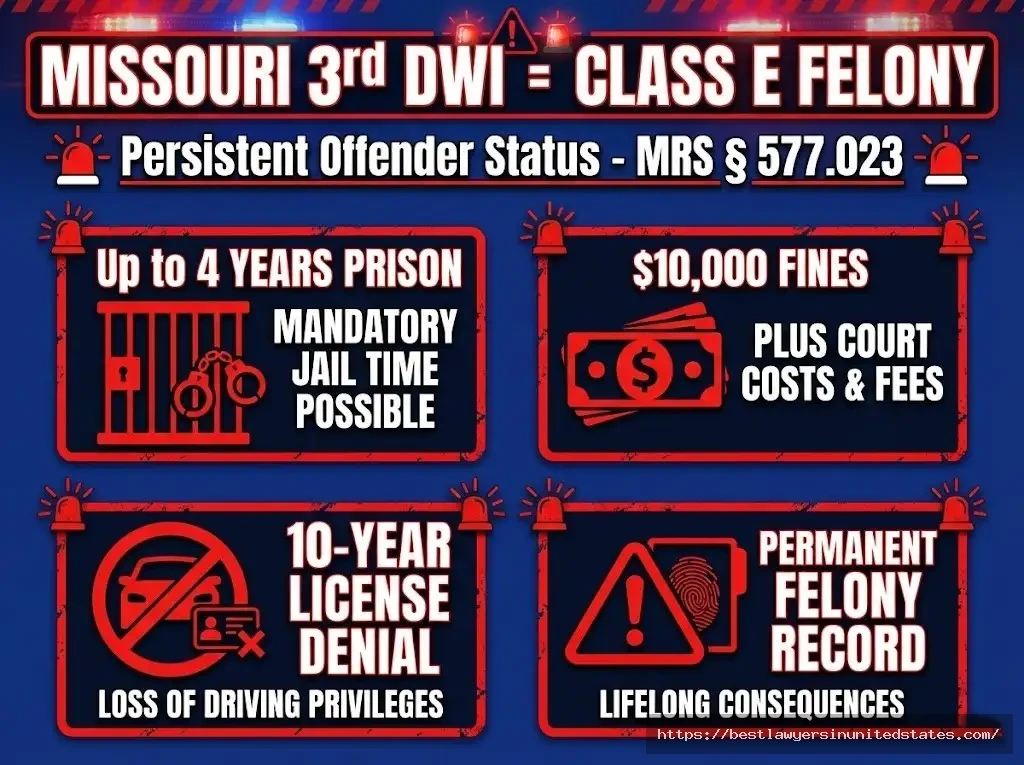
Missouri Revised Statutes § 577.023 makes your third DWI a felony offense. This triggers prison time instead of county jail. Persistent Offender status brings lifetime consequences.
Persistent Offender Felony Penalties
| Penalty Type | Third Offense DWI | Second Offense (Comparison) |
|---|---|---|
| Charge Level | Class E Felony | Class A Misdemeanor |
| Prison Time | Up to 4 years | Up to 1 year jail |
| Minimum Sentence | 120 days prison | 48 hours jail |
| Fines | Up to $10,000 | $1,000-$2,000 |
| License Denial | 10 years | 5 years revocation |
What Class E Felony Means for Your Future
Felony convictions create barriers that misdemeanors don’t. A Class E felony DWI affects:
Employment:
- Professional licenses (nurses, teachers, lawyers) often revoked
- Many employers have blanket “no felons” policies
- Federal jobs typically unavailable
- Security clearances denied
Rights you lose:
- Right to own or possess firearms (federal law)
- Right to vote while incarcerated (restored after release in Missouri)
- Right to serve on juries
- Eligibility for federal student loans
Housing challenges:
- Public housing applications denied
- Private landlords can refuse felons
- Background checks show felony permanently
Prison vs. Probation for Third DWI
Missouri judges have discretion on prison time for Class E felonies. Some offenders receive probation instead of prison if they meet conditions:
- Complete long-term inpatient treatment (30-90 days)
- Install ignition interlock immediately
- Submit to random drug/alcohol testing
- Pay all fines and restitution
- No criminal history beyond DWIs
Reality check: Most third-time offenders serve at least 120 days in Missouri Department of Corrections facilities. Judges face public pressure to impose prison time on repeat offenders.
License Denial vs. Revocation
Third DWI triggers 10-year license denial, not just revocation. This distinction matters.
Denial means:
- You cannot apply for any Missouri license for 10 full years
- No hardship license available
- No ignition interlock limited driving privilege
- After 10 years, you start the licensing process from scratch
Important exception: You might qualify for limited driving privilege after 45 days if you enter an approved long-term treatment program.
Missouri’s Implied Consent Law
Quick Answer: By driving in Missouri, you automatically consent to chemical testing if arrested for DWI. Refusing the test triggers automatic 1-year license revocation, separate from any criminal penalties.
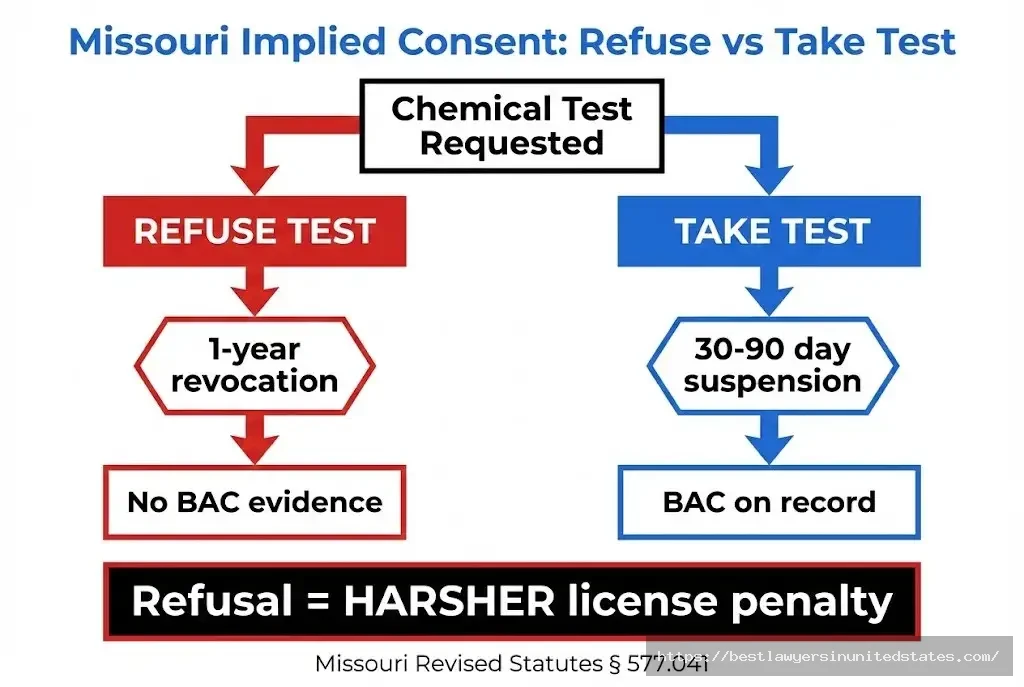
Missouri Revised Statutes § 577.041 establishes the implied consent law. Every licensed driver agrees to testing when they get their Missouri license. This agreement cannot be withdrawn.
What Happens When You Refuse Testing
Officers must read you the implied consent warning before requesting a test. The warning explains refusal consequences clearly.
| Offense | Test Refusal Penalty | Test Failure Penalty |
|---|---|---|
| First refusal | 1-year revocation | 30-day suspension |
| Second refusal | 1-year revocation | 5-year revocation |
| Third refusal | 1-year revocation | 10-year denial |
Critical point: Refusal penalties run separately from criminal DWI penalties. Even if you’re found not guilty of DWI, the refusal revocation stands.
Can Police Force You to Take a Test?
Missouri law allows forced blood draws only with a warrant. The Missouri State Highway Patrol increasingly seeks telephonic warrants for blood tests in these situations:
- Serious injury accidents
- Fatal crashes
- Repeat offenders
- Child endangerment cases
How it works: Officers call a judge at any hour. The judge issues a verbal warrant over the phone. Medical personnel then draw your blood, whether you consent or not.
Chemical Test Options in Missouri
Missouri offers three types of chemical tests. You don’t choose which test, the arresting officer decides.
Test types:
- Breath test (most common): Uses Intoxilyzer 8000 machine at police station
- Blood test: Hospital or trained technician draws sample
- Urine test (rare): Only when drugs suspected and breath test impractical
Test timing matters: Missouri law requires testing within 2 hours of driving. BAC results after 2 hours may be excluded as evidence.
Your Right to Additional Testing
You can request an independent blood test at your own expense after completing the official test. Missouri law protects this right under § 577.041.
How to exercise this right:
- Tell officers immediately you want independent testing
- Arrange transportation to hospital or clinic
- Pay all costs yourself ($150-$400)
- Preserve blood sample for defense expert analysis
Strategic value: Independent tests sometimes show lower BAC than police tests, especially if significant time passed.
How Refusal Affects Your Criminal Case
Prosecutors use test refusal as evidence of “consciousness of guilt.” They argue to juries that innocent people don’t refuse testing.
What prosecutors tell juries:
- “If he knew he was sober, why not prove it with a test?”
- “Refusal shows he knew he would fail”
- “Guilty people refuse, innocent people cooperate”
Defense response: Good DWI attorneys explain legitimate reasons for refusal, like distrust of police procedures or fear of inaccurate results.
License Consequences and Administrative Process
Quick Answer: Missouri runs two separate DWI cases: criminal court and Department of Revenue administrative. You have 15 days to request an administrative hearing or face automatic suspension. Both cases proceed independently.
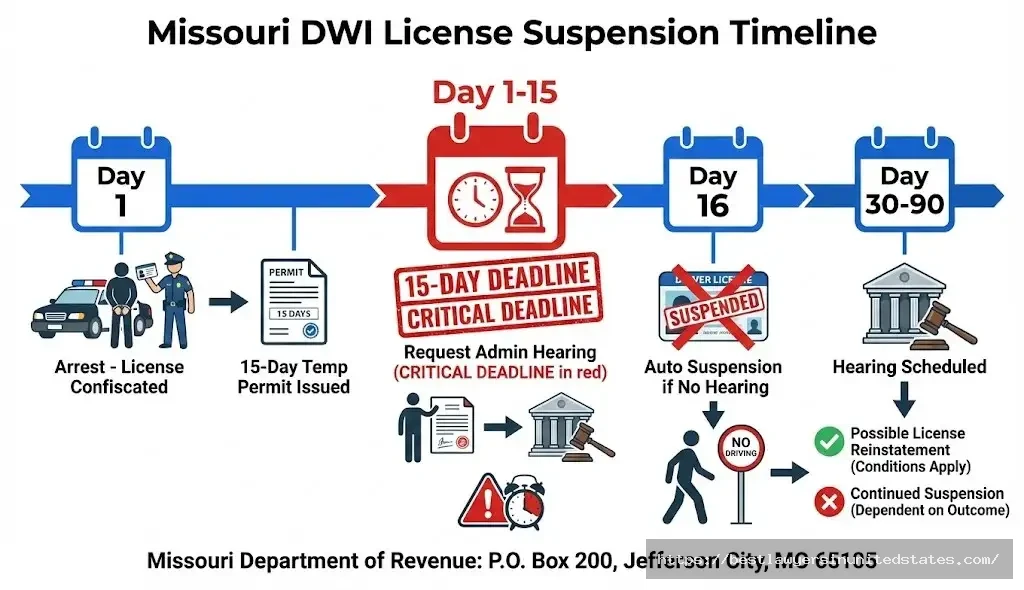
The Missouri Department of Revenue handles license suspensions separately from criminal courts. This dual-track system confuses many drivers. You can lose your license administratively even if criminal charges are dismissed.
The 15-Day Administrative Hearing Deadline
Police confiscate your license at arrest and issue a 15-day temporary permit. This permit expires in exactly 15 days.
Critical timeline:
- Day 1: Arrested, license taken, temporary permit issued
- Day 1-15: You must request administrative hearing in writing
- Day 16: Automatic suspension begins if no hearing requested
- Day 30-90: Hearing scheduled (if requested on time)
How to request hearing:
- Mail written request to Missouri Department of Revenue
- Address: P.O. Box 200, Jefferson City, MO 65105
- Include your driver’s license number and arrest date
- Send certified mail for proof of timely filing
Miss this deadline? Your suspension starts automatically with no chance to contest it.
What Happens at Administrative Hearings
Administrative hearings occur at Missouri Department of Revenue offices, not courthouses. A hearing officer (not a judge) decides whether to sustain the suspension.
Hearing officer considers only:
- Did officer have reasonable grounds for arrest?
- Was driver operating a vehicle?
- Did driver refuse testing or fail with BAC 0.08%+?
- Was implied consent warning properly given?
Important limitation: The hearing officer doesn’t decide if you’re guilty of DWI. They only decide if the suspension is legally justified.
Restricted Driving Privileges (RDP)
Missouri offers Restricted Driving Privileges after suspension begins. RDP lets you drive for specific purposes with an ignition interlock device.
| Allowed Driving | Not Allowed |
|---|---|
| Work/employment | Recreational trips |
| Medical appointments | Shopping (non-essential) |
| Alcohol treatment | Visiting friends |
| School/education | Dining out |
| Religious services | Entertainment |
| Childcare | General errands |
RDP requirements:
- File petition with circuit court ($100-$200 filing fee)
- Provide proof of SR-22 insurance
- Install ignition interlock in all vehicles
- Pay reinstatement fee ($45-$60)
- Attend all court-ordered programs
Ignition Interlock Device Requirements
Missouri requires ignition interlock for most suspended drivers seeking any driving privileges. The device costs add up quickly.
IID costs breakdown:
- Installation: $100-$200 (one-time)
- Monthly monitoring: $70-$100
- Calibration visits: $10-$20 (monthly)
- Removal fee: $50-$100
- Total annual cost: $940-$1,400
How IID works:
- Blow into device before starting car
- Device analyzes breath for alcohol
- Car starts only if BAC below 0.025%
- Random “rolling retests” required while driving
- All test results reported to monitoring company
Violation consequences: Any failed test or missed calibration gets reported to Missouri Department of Revenue. This can extend your IID requirement or revoke your driving privileges entirely.
License Reinstatement Process
Getting your full license back requires completing several steps. Missouri makes reinstatement complex and expensive.
Reinstatement checklist:
- ✓ Complete full suspension or revocation period
- ✓ Complete all court-ordered programs (SATOP, etc.)
- ✓ Pay reinstatement fee ($45-$200 depending on offense)
- ✓ File SR-22 insurance certificate
- ✓ Pass vision test
- ✓ Pass written knowledge test (for some revocations)
- ✓ Pay any outstanding fines or court costs
Processing time: Allow 2-4 weeks after submitting all documents before Missouri Department of Revenue issues a new license.
The Complete Cost of a Missouri DWI
Quick Answer: Total DWI costs range from $5,000-$10,000 for first offense, $10,000-$20,000 for second offense, and $15,000-$30,000+ for third offense in Missouri. These amounts include fines, legal fees, programs, and insurance increases.
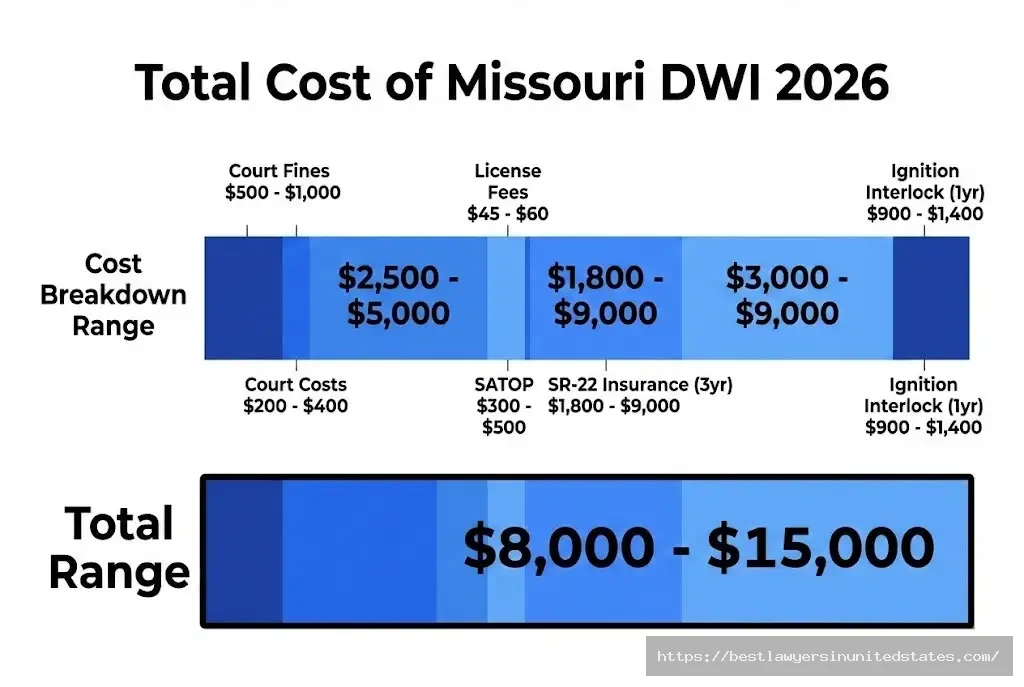
Most people drastically underestimate DWI costs. Court fines represent only a fraction of total expenses. Hidden costs add up over several years.
First Offense DWI Cost Breakdown
| Cost Category | Amount | Notes |
|---|---|---|
| Court Fines | $500-$1,000 | Varies by county |
| Court Costs | $200-$400 | Filing fees, processing |
| Attorney Fees | $2,500-$5,000 | Flat fee typical |
| SATOP Program | $300-$500 | 10-12 week course |
| License Reinstatement | $45-$60 | Missouri DOR fee |
| SR-22 Insurance | $300-$600/year | 3-year requirement |
| Insurance Rate Increase | $1,000-$3,000/year | Lasts 5+ years |
| Ignition Interlock | $900-$1,400/year | If required |
| Lost Wages | $500-$5,000 | Court appearances, jail |
| TOTAL (3 years) | $8,000-$15,000 | Conservative estimate |
Second Offense Cost Escalation
Prior Offender status doubles or triples first-offense costs. Mandatory requirements eliminate cheaper options.
Additional costs beyond first offense:
- Higher attorney fees ($5,000-$10,000) due to complexity
- Mandatory ignition interlock (5 years = $4,500-$7,000)
- Longer SR-22 requirement (5 years minimum)
- Greater insurance premium increases (often 200-300%)
- Alcohol monitoring bracelet ($300-$500/month if ordered)
- Inpatient treatment programs ($3,000-$15,000)
Second offense total: $15,000-$25,000 over 5 years is common.
Third Offense Felony Costs
Persistent Offender felonies bring costs that dwarf earlier offenses. Prison time means lost income and employment.
Felony-specific costs:
- Criminal defense attorney: $10,000-$25,000
- Bail bond: $1,000-$5,000 (10% of bond amount)
- Lost wages during incarceration: $10,000-$50,000+
- Long-term treatment program: $5,000-$20,000
- Lifetime ignition interlock: $900-$1,400 annually forever
- Professional license restoration: $1,000-$5,000
Critical financial impact: Many third-time offenders file bankruptcy. Felony convictions reduce lifetime earning potential by $200,000-$400,000 according to employment studies.
Calculate your specific Missouri DWI costs using our DUI Cost Calculator. Enter your offense level, county, and circumstances for a personalized estimate.
Hidden Long-Term Costs
Some DWI costs don’t show up immediately but impact finances for years.
Hidden costs include:
- Rideshare/taxi expenses during suspension ($2,000-$10,000)
- Employment termination (especially CDL, professional drivers)
- Professional license suspension (nurses, teachers, lawyers)
- College financial aid loss (drug/alcohol felonies)
- Travel restrictions (Canada denies entry for 10 years post-DWI)
- Rental car denials (many companies refuse DWI convictions)
SR-22 Insurance in Missouri
Missouri requires SR-22 certificates for most DWI offenders. This filing proves you carry minimum liability insurance.
SR-22 requirements:
- Minimum liability: 25/50/25 ($25k injury per person, $50k per accident, $25k property)
- Insurance company files certificate with Missouri Department of Revenue
- Must maintain continuous coverage (any lapse restarts suspension)
- Required for 3-5 years depending on offense
Cost impact: SR-22 filing costs $25-$50, but insurance premiums increase 100-300%. A policy costing $1,200/year pre-DWI jumps to $2,400-$4,800/year with SR-22.
How to Reduce DWI Costs
Some costs are fixed, but you can minimize expenses through smart decisions.
Cost-saving strategies:
- Shop multiple attorneys (many offer free consultations)
- Complete SATOP quickly (delays extend probation, increasing monitoring costs)
- Install ignition interlock promptly (faster reinstatement)
- Shop SR-22 insurance aggressively (rates vary 200%+ between companies)
- Request payment plans (courts and attorneys often agree)
- Consider public defender if you qualify financially
Don’t skip: Hiring an experienced DWI attorney often saves money long-term through reduced charges, lower fines, or avoided jail time.
SATOP: Missouri’s DWI Education Program
Quick Answer: SATOP (Substance Awareness Traffic Offender Program) is Missouri’s mandatory DWI education course. The 10-12 week program costs $300-$500. Completion is required for license reinstatement and avoiding jail time.
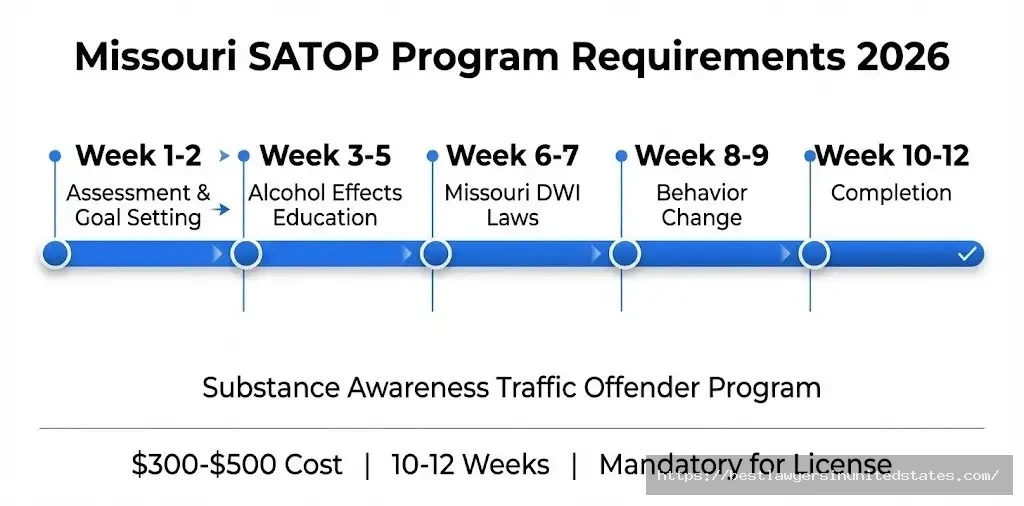
Missouri Revised Statutes § 577.001 establishes SATOP as the required education program for all DWI offenders. You cannot complete probation or regain your license without finishing SATOP.
What SATOP Involves
SATOP runs 10-12 weeks with weekly group sessions. Each session lasts 2-3 hours. The program includes education, assessment, and counseling.
Weekly topics:
- Week 1-2: Assessment and goal setting
- Week 3-5: Effects of alcohol on body and judgment
- Week 6-7: Missouri DWI laws and consequences
- Week 8-9: Decision-making and behavior change
- Week 10-12: Relapse prevention and completion
Attendance requirement: Miss more than one session and you start over from the beginning. The program director reports all absences to the court immediately.
SATOP Costs and Payment
Missouri licenses SATOP providers who set their own fees within state guidelines. Costs vary by provider and county.
| Program Type | Cost Range | Duration |
|---|---|---|
| Standard SATOP | $300-$500 | 10-12 weeks |
| Weekend SATOP | $400-$600 | 10-12 weeks |
| Enhanced SATOP | $500-$800 | 16-20 weeks |
| Online SATOP | Not allowed | N/A |
Payment plans: Most SATOP providers accept payment plans. You typically pay 25-50% upfront, then weekly or bi-weekly installments.
Financial hardship: Some providers offer sliding-scale fees for low-income participants. You must provide proof of income and expenses.
Where to Complete SATOP in Missouri
Missouri licenses SATOP providers statewide. Major cities have multiple locations. Rural counties may have only one provider.
Major metro area providers:
- Kansas City: 15+ providers in Jackson County
- St. Louis: 20+ providers in St. Louis City and County
- Springfield: 8+ providers in Greene County
- Columbia: 5+ providers in Boone County
Find providers: Missouri Department of Mental Health maintains the official SATOP provider directory at dmh.mo.gov/satop.
Consequences of Not Completing SATOP
Failing to complete SATOP triggers multiple penalties. Courts and the Missouri Department of Revenue both enforce compliance.
What happens if you don’t complete:
- ❌ Probation violation filed (possible jail time)
- ❌ License remains suspended indefinitely
- ❌ Judge can impose original jail sentence
- ❌ Warrant issued for your arrest
- ❌ SIS revoked if applicable
Critical timeline: Most courts require SATOP completion within 90 days of sentencing. Extensions are possible but require court approval before the deadline.
SATOP vs. Enhanced Programs
Some offenders need more intensive treatment than standard SATOP. Enhanced programs run 16-20 weeks and cost more.
Enhanced SATOP requirements:
- Second or subsequent DWI
- High BAC (0.15%+)
- Assessment indicates substance abuse problem
- Court order for enhanced treatment
- Refusal to complete standard SATOP
Long-term treatment: Chronic offenders often need inpatient treatment (30-90 days) costing $3,000-$15,000 beyond SATOP.
Zero Tolerance Law for Underage Drivers
Quick Answer: Missouri’s zero tolerance law prohibits drivers under 21 from operating vehicles with any detectable alcohol (0.02% BAC or higher). Penalties include 90-day license suspension, $500+ fines, and potential “delayed license” consequences.
Missouri treats underage drinking and driving more strictly than adult DWI. Missouri Revised Statutes § 302.525 creates separate penalties specifically for drivers under 21.
Underage BAC Limit: 0.02%
Drivers under 21 face DWI charges at just 0.02% BAC. This represents roughly one drink for most people.
Why 0.02% instead of 0.00%:
- Allows for trace amounts from mouthwash or medication
- Prevents false positives from non-alcoholic sources
- Provides legal buffer while maintaining strict enforcement
Comparison to adult limit:
| Age Group | BAC Limit | Tolerance |
|---|---|---|
| Under 21 | 0.02% | Zero tolerance |
| 21+ | 0.08% | Standard limit |
| CDL drivers | 0.04% | Enhanced restriction |
Underage DWI Penalties
Missouri imposes two sets of penalties on underage offenders: zero tolerance administrative penalties and criminal DWI charges if BAC exceeds 0.08%.
Administrative penalties (0.02%-0.079% BAC):
- 90-day license suspension
- $500 reinstatement fee
- Mandatory alcohol education
- 30 hours community service
- Parent/guardian notification
Criminal DWI charges (0.08%+ BAC):
- All adult DWI penalties apply
- Plus additional underage enhancement penalties
- Possible delayed license consequence
Delayed Driver’s License
Missouri’s unique “delayed license” penalty affects young offenders who commit alcohol violations before age 21. This rarely-discussed consequence extends for years.
How delayed license works:
- If you’re under 18 and convicted of alcohol offense, license eligibility delayed until age 18
- If you’re 18-20 and convicted, eligibility delayed 90 days to 1 year
- Delay applies even if you already have a license
- Cannot apply for any driving privileges during delay
Example: A 17-year-old convicted of underage DWI cannot get a license until age 18, even if they turn 18 before court proceedings finish.
Impact on College and Future Employment
Underage DWI convictions create barriers young people don’t anticipate. Missouri requires disclosure on many applications.
College consequences:
- Federal financial aid suspension (drug/alcohol felonies)
- College applications ask about criminal history
- Campus housing denials
- Fraternity/sorority membership issues
- Athletic scholarships revoked
Employment barriers:
- Background checks show conviction
- Internship rejections
- Professional schools (law, medicine) scrutinize alcohol offenses
- Government jobs often unavailable
- Military service difficult or impossible
Parent/Guardian Notification
Missouri law requires police to notify parents or guardians of underage DWI arrests immediately. This happens regardless of the minor’s preferences.
What parents receive:
- Written arrest notice within 24 hours
- Court date information
- Explanation of charges
- Contact information for prosecuting attorney
Privacy exception: If the minor is 18+ and emancipated, notification may not be required.
The DWI Legal Process in Missouri
Quick Answer: Missouri DWI cases involve two separate proceedings: administrative (license suspension) and criminal (jail/fines). The process takes 4-12 months from arrest to final resolution. You face multiple court appearances, deadlines, and decision points.
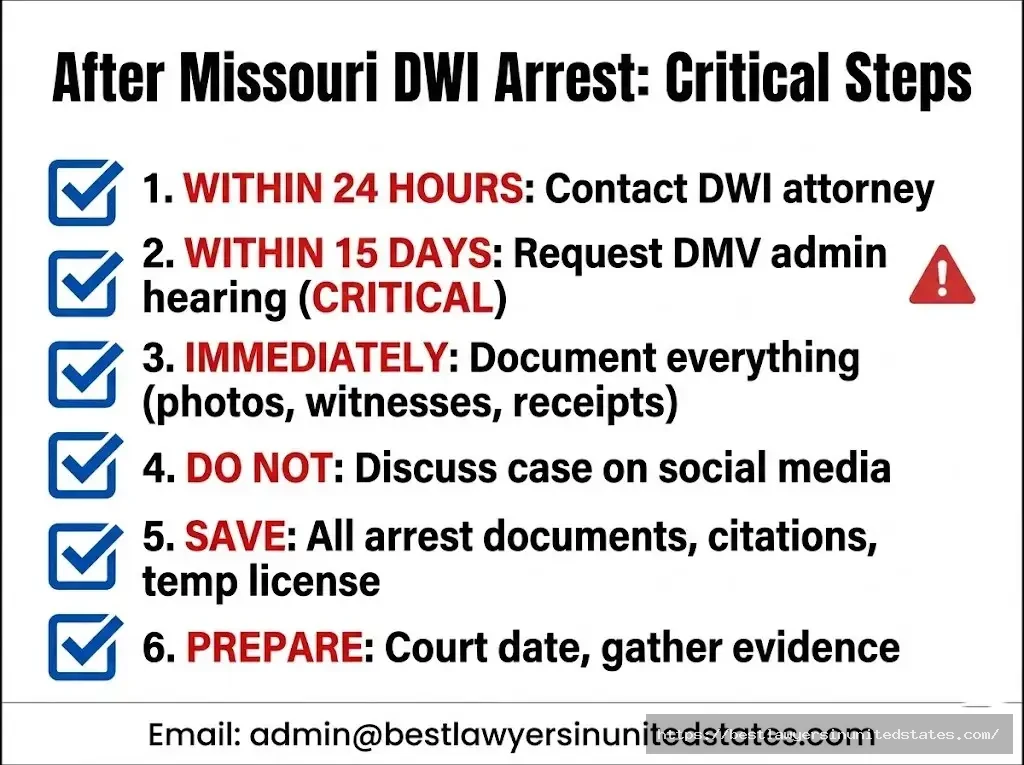
Understanding the legal process helps you protect your rights. Missouri’s dual-track system means you’re fighting two cases simultaneously, each with different rules and deadlines.
Arrest and Booking
DWI arrests follow a standard procedure across Missouri. The Missouri State Highway Patrol and local police departments use identical protocols.
What happens during arrest:
- Field sobriety tests: Officer asks you to perform 3 standardized tests
- Preliminary breath test: Roadside screening device (results not admissible in court)
- Arrest: Officer places you in custody if probable cause exists
- Transport: Taken to police station or jail
- Booking: Fingerprints, photos, paperwork
Timeline: Most DWI arrests take 3-6 hours from initial stop to release.
Two Separate Cases: Administrative and Criminal
Missouri runs parallel cases after your arrest. Many defendants don’t understand these are completely separate proceedings.
| Aspect | Administrative Case | Criminal Case |
|---|---|---|
| Agency | Missouri Department of Revenue | County/City Prosecutor |
| Focus | License suspension | Jail time, fines, probation |
| Deadline | 15 days to request hearing | Varies (60-90 days typical) |
| Burden | Officer shows reasonable grounds | State proves guilt beyond reasonable doubt |
| Result | Suspension/revocation | Guilty/not guilty verdict |
Key point: Winning your criminal case doesn’t automatically restore your license. Losing your administrative hearing doesn’t mean you’ll be convicted criminally. The cases proceed independently.
Arraignment Process
Your first court appearance happens within 10-20 days of arrest. This arraignment is brief but important.
What happens at arraignment:
- Judge reads formal charges
- You receive written copy of charges
- Judge asks for your plea (guilty, not guilty, no contest)
- Bond conditions reviewed
- Next court date set
- Attorney appointment if you qualify
Smart strategy: Plead not guilty at arraignment. You can change your plea later, but pleading guilty immediately gives up all negotiation power.
Pre-Trial Motions and Hearings
Your attorney files pre-trial motions challenging evidence or procedures. Common motions in Missouri DWI cases include:
Motion to suppress stop:
- Argues officer lacked reasonable suspicion to stop you
- If granted, all evidence excluded
- Case typically dismissed
Motion to suppress breath test:
- Challenges testing procedures
- Questions machine calibration
- Disputes operator certification
Motion to suppress statements:
- Argues police violated Miranda rights
- Challenges coerced statements
- Excludes harmful admissions
Discovery motions:
- Requests police reports
- Demands dash cam/body cam video
- Obtains officer training records
- Seeks breath machine maintenance logs
Trial vs. Plea Bargaining
Most Missouri DWI cases resolve through plea bargaining, not trial. Understanding your options helps you make informed decisions.
Plea bargain advantages:
- Reduced charges (DWI to reckless driving)
- Lower fines
- Less jail time
- Quicker resolution
- Certainty of outcome
Trial advantages:
- Chance of acquittal
- State must prove guilt beyond reasonable doubt
- Can challenge evidence
- Jury decides (if requested)
- No admission of guilt if acquitted
Missouri statistics: Approximately 85-90% of DWI charges resolve through plea agreements. Only 10-15% go to trial.
Sentencing Options in Missouri Courts
Judges have several sentencing options for DWI convictions. The sentence depends on offense level, criminal history, and circumstances.
Available sentences:
- SIS (Suspended Imposition of Sentence): First offenders only, no conviction if probation completed
- SES (Suspended Execution of Sentence): Conviction recorded, jail time suspended with probation
- Straight time: Immediate jail/prison sentence
- Shock time: Brief jail (30-60 days) then probation
- Treatment court: DWI court program instead of traditional sentencing
Probation conditions typically include:
- Regular meetings with probation officer
- Random drug/alcohol testing
- SATOP completion
- Community service
- Ignition interlock installation
- No alcohol consumption
- No criminal law violations
DWI Checkpoints and Saturation Patrols in Missouri
Quick Answer: DWI checkpoints are legal in Missouri. Law enforcement must follow specific procedures including advance public notice, neutral vehicle selection, and minimal detention. You have limited rights to refuse cooperation, but refusal may raise suspicion.
Missouri State Highway Patrol and local police conduct sobriety checkpoints during holidays and high-DWI weekends. Understanding checkpoint procedures protects your rights.
Legality Under Missouri Law
Missouri courts upheld DWI checkpoint legality in State v. Brooks (1986). The Missouri Supreme Court ruled checkpoints constitutional if conducted properly.
Legal requirements for checkpoints:
- Advance public notice (media announcements)
- Supervisory decision on checkpoint location (not individual officers)
- Neutral vehicle selection (every car, every third car, etc.)
- Minimal detention time
- Safety precautions (lights, signs, cones)
- Written operational plan
What makes checkpoints illegal:
- ❌ No advance notice given
- ❌ Random vehicle selection by officers
- ❌ Excessive detention without probable cause
- ❌ Unsafe location or setup
- ❌ No supervising officer present
What to Expect at a Checkpoint
Checkpoints follow predictable patterns. Knowing what’s coming reduces stress and helps you respond appropriately.
Checkpoint procedure:
- Initial stop: Officer waves your car into checkpoint
- Brief questioning: License, registration, insurance check
- Observation: Officer looks for alcohol odor, slurred speech, red eyes
- Release or further investigation: Most cars released in 1-2 minutes
If officer suspects impairment:
- Directed to secondary screening area
- Asked to exit vehicle
- Field sobriety tests offered
- Breath test requested
- Arrested if probable cause established
Your Rights at Missouri Checkpoints
You have constitutional rights at checkpoints, but they’re limited compared to normal traffic stops.
You must provide:
- Driver’s license
- Vehicle registration
- Proof of insurance
- Basic identity information
You can decline:
- Answering questions about drinking
- Performing field sobriety tests
- Taking preliminary breath test (PBT)
- Searching your vehicle (without warrant or probable cause)
What to say at checkpoints:
- “I prefer not to answer questions”
- “I don’t consent to searches”
- “Am I being detained or am I free to leave?”
Important: You cannot turn around or avoid a checkpoint once in the queue. Doing so gives officers probable cause to stop you.
Saturation Patrols in Missouri
Saturation patrols differ from checkpoints. Multiple officers flood high-DWI areas looking for impaired drivers.
How saturation patrols work:
- 10-20 officers assigned to specific area
- Focus on bars, entertainment districts, known DWI corridors
- Officers make regular traffic stops for any violation
- Enhanced DWI training and detection
Common saturation patrol locations:
- Westport entertainment district (Kansas City)
- Laclede’s Landing (St. Louis)
- Power & Light District (Kansas City)
- Downtown Springfield bar district
- Lake of the Ozarks (summer weekends)
Key difference from checkpoints: Officers need reasonable suspicion to stop you during saturation patrols. They can’t stop you randomly. However, any minor traffic violation (speeding 1 mph over, touching lane line, broken taillight) justifies a stop.
Finding Checkpoint Locations
Missouri law requires advance notice of checkpoint locations. Smart drivers check before going out.
Where to find checkpoint announcements:
- Missouri State Highway Patrol Twitter (@MSHPTrooperGHQ)
- Local police department Facebook pages
- Kansas City Star “Traffic Alerts”
- St. Louis Post-Dispatch “Road Report”
- TV station traffic reports
Timing: Announcements usually come 24-48 hours before checkpoints. Information includes general area but not exact location.
Field Sobriety Tests in Missouri
Quick Answer: Missouri police use three Standardized Field Sobriety Tests (SFSTs): Horizontal Gaze Nystagmus, Walk-and-Turn, and One-Leg Stand. You can refuse these tests without legal penalty, but refusal may lead to arrest. Tests are designed for failure, with officers trained to look for specific “clues.”
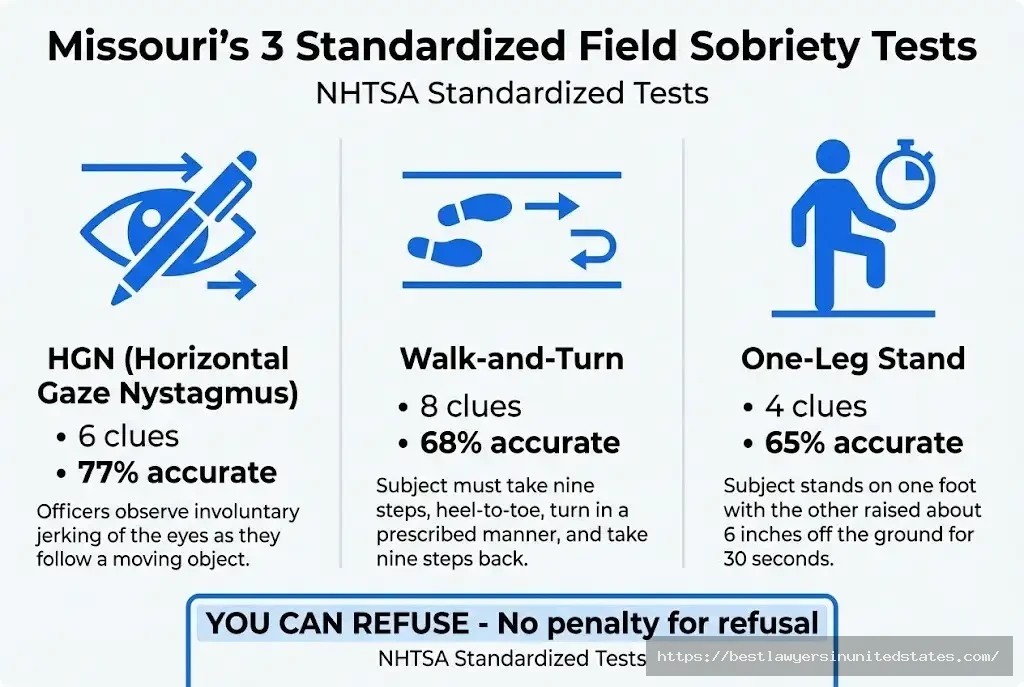
Field sobriety tests help officers build probable cause for arrest. The National Highway Traffic Safety Administration (NHTSA) standardized these tests nationwide, including Missouri.
The Three Standardized Tests
Missouri law enforcement uses only NHTSA-approved tests. Other tests (alphabet, counting, finger-to-nose) are non-standard and carry less weight in court.
Horizontal Gaze Nystagmus (HGN)
Officers hold a pen or flashlight 12-15 inches from your face and move it horizontally. They look for involuntary eye jerking.
What officers observe:
- Inability to smoothly follow moving object
- Distinct jerking at maximum deviation
- Angle of onset of jerking before 45 degrees
Clues officers record:
- 6 total clues possible (3 per eye)
- 4+ clues indicates 0.08% BAC
- Most reliable SFST (77% accurate per NHTSA)
Problems with HGN:
- Medical conditions cause nystagmus (inner ear problems, neurological issues)
- Certain medications cause eye jerking
- Head injuries affect results
- Test requires specific lighting and positioning
Walk-and-Turn Test
You walk heel-to-toe along a straight line for nine steps, turn in a specific manner, and return nine steps.
Instructions officers give:
- Place left foot on line, right foot ahead touching heel-to-toe
- Keep arms at sides
- Count steps out loud
- Watch feet at all times
- Don’t stop until test complete
What counts as failure:
| Clue | Description |
|---|---|
| Loses balance during instructions | Stepping or using arms before test starts |
| Starts too soon | Beginning before officer says “start” |
| Stops while walking | Pausing during test |
| Doesn’t touch heel-to-toe | Gaps between heel and toe |
| Steps off line | Foot completely off line |
| Uses arms for balance | Raising arms 6+ inches from sides |
| Improper turn | Not pivoting as instructed |
| Wrong number of steps | More or less than nine |
Key problem: Officers record 2+ clues as failure indicating impairment. However, studies show 30-40% of sober people fail this test.
One-Leg Stand Test
You stand on one leg while counting aloud for 30 seconds. Officers watch for specific indicators of impairment.
Test procedure:
- Stand straight with feet together, arms at sides
- Raise one foot 6 inches off ground
- Point toe
- Count out loud “one thousand-one, one thousand-two” to 30
- Watch raised foot, don’t look away
Four failure clues:
- Swaying while balancing
- Using arms for balance (6+ inches from sides)
- Hopping to maintain balance
- Putting foot down before 30 seconds
Why people fail sober:
- Poor balance naturally (age, weight, injuries)
- Uneven road surface
- Bad footwear (heels, boots, sandals)
- Weather conditions (wind, cold, rain)
- Officer’s instructions confusing or incomplete
Your Right to Refuse Field Sobriety Tests
Missouri law does not require you to perform field sobriety tests. Unlike breath tests after arrest, FSTs have no statutory penalty for refusal.
Refusing field sobriety tests:
- ✓ Legal and within your rights
- ✓ No license suspension for refusal
- ✓ Cannot be used to enhance charges
- ✗ Officer will likely arrest you anyway
- ✗ Prosecutor may mention refusal at trial
What to say when refusing:
- “I respectfully decline to perform field sobriety tests”
- “I do not consent to any tests”
- “I prefer to speak with an attorney first”
Officer response: Officers almost always arrest after refusal. They base arrest on other observations: odor of alcohol, slurred speech, red eyes, erratic driving.
Why Field Sobriety Tests Are Designed for Failure
Defense attorneys argue FSTs create false evidence of impairment. Multiple factors beyond alcohol affect performance.
Non-alcohol factors affecting tests:
- Age (balance worsens after 65)
- Weight (obesity affects balance)
- Injuries (knee, hip, back, ankle problems)
- Footwear (heels, flip-flops, work boots)
- Road surface (gravel, uneven pavement, slopes)
- Weather (rain, cold, wind, darkness)
- Nervousness (anyone would be nervous with police)
- Medical conditions (diabetes, inner ear disorders)
Critical fact: NHTSA’s own studies show field sobriety tests are only 65-77% accurate under ideal conditions. Real-world conditions are never ideal.
Defenses to DWI Charges in Missouri
Quick Answer: Common Missouri DWI defenses include challenging the traffic stop, questioning breath test accuracy, proving “rising BAC,” demonstrating improper procedures, and showing medical conditions affected testing. An experienced attorney identifies which defenses apply to your case.
Every DWI case has potential defenses. Missouri law requires strict procedures at each step. Police and prosecutors must prove their case beyond reasonable doubt.
Challenging the Traffic Stop
Missouri law requires reasonable suspicion for traffic stops. Officers need articulable facts justifying the stop.
Invalid stop reasons:
- ❌ “Gut feeling” or hunches
- ❌ Racial profiling
- ❌ Anonymous tips without corroboration
- ❌ Following too closely to police car
- ❌ Driving late at night in bar district
Valid stop reasons:
- ✓ Speeding (any amount over limit)
- ✓ Weaving within lane
- ✓ Touching lane markers
- ✓ Broken taillight or headlight
- ✓ Failing to signal
- ✓ Any traffic violation
Defense strategy: If your attorney suppresses the stop, all evidence afterward gets excluded. The case usually gets dismissed.
Questioning Breath Test Accuracy
Missouri uses Intoxilyzer 8000 breath testing machines. These machines have known issues and strict maintenance requirements.
Ways to challenge breath results:
- Machine not calibrated properly (Missouri requires monthly calibration)
- Operator not properly certified
- 15-minute observation period not followed
- Mouth alcohol contamination (burping, GERD, dental work)
- Radio frequency interference
- Medical conditions (diabetes produces acetone)
Missouri’s 15-minute observation rule: Officers must continuously observe you for 15 minutes before testing. They must ensure you don’t eat, drink, smoke, burp, or vomit. Violations invalidate the test.
Rising BAC Defense
Your BAC continues rising for 30-90 minutes after your last drink. This creates a defense if significant time passed between driving and testing.
How rising BAC works:
- You stop drinking at 10:00 PM (BAC 0.06%)
- Police stop you at 10:15 PM (BAC 0.07%, legal to drive)
- You’re tested at 11:00 PM (BAC 0.09%, over limit)
- You weren’t over 0.08% while actually driving
Defense requirement: Your attorney needs expert testimony calculating BAC at time of driving versus time of testing. This requires detailed information about:
- What you drank and when
- Your weight and gender
- Food consumption
- Time of last drink
- Exact testing time
Improper Arrest Procedures
Missouri law requires specific procedures during DWI arrests. Violations can invalidate evidence or even the entire arrest.
Required procedures:
- Reading Miranda rights before custodial questioning
- Proper implied consent warning before testing
- Continuous observation before breath test
- Certified operator administering test
- Documented chain of custody for blood samples
Common police mistakes:
- Questioning without Miranda warnings
- Not explaining implied consent properly
- Breaking 15-minute observation period
- Using uncertified operator
- Failing to video record (when equipment available)
Medical Conditions Affecting Tests
Certain medical conditions mimic intoxication or interfere with testing. These conditions provide legitimate defenses.
Conditions affecting field sobriety tests:
- Inner ear disorders (balance problems)
- Diabetes (disorientation, confusion)
- Neurological conditions (Parkinson’s, MS)
- Knee/hip/back injuries (difficulty with balance tests)
- Acid reflux/GERD (mouth alcohol issues)
Conditions affecting breath tests:
- Diabetes (acetone breath registers as alcohol)
- GERD (stomach acid creates mouth alcohol)
- Dental work (traps alcohol in mouth)
- Respiratory conditions (affect breathing patterns)
Evidence needed: Medical records documenting pre-existing conditions. Recent doctor visits strengthen this defense.
Frequently Asked Questions About Missouri DWI Laws
Can a DWI be reduced in Missouri?
Quick Answer: Yes, Missouri prosecutors sometimes reduce DWI charges to lesser offenses like careless driving or reckless driving through plea bargaining. Reductions depend on case facts, criminal history, and BAC level.
Prosecutors consider several factors when deciding whether to reduce charges. First offenders with low BAC (0.08-0.10%) and no accident have better chances. Common reduced charges include:
- Careless and imprudent driving (no points, no DWI on record)
- Reckless driving (4 points, misdemeanor but not DWI)
- Improper lane use (2 points, minor traffic violation)
What helps get reductions: Clean driving record, low BAC, cooperative at arrest, no accident, retained attorney, willingness to complete treatment voluntarily.
What is the 1st, 2nd, 3rd offense penalties for a DWI in Missouri?
Quick Answer: 1st offense: Up to 6 months jail, $500-$1,000 fines, 30-90 day suspension. 2nd offense: Up to 1 year jail, $1,000+ fines, 5-year revocation. 3rd offense: Up to 4 years prison (felony), $10,000 fines, 10-year denial.
| Offense | Jail/Prison | Fines | License | Classification |
|---|---|---|---|---|
| 1st | Up to 6 months | $500-$1,000 | 30-90 days | Misdemeanor |
| 2nd | Up to 1 year | $1,000-$2,000 | 5 years | Misdemeanor (Prior) |
| 3rd | Up to 4 years | Up to $10,000 | 10 years | Class E Felony |
Missouri also requires SATOP completion, SR-22 insurance, and ignition interlock for most offenses. Third offenses bring permanent consequences including felony records.
How long do you lose your license for a DUI in Missouri?
Quick Answer: First offense: 30-90 days suspension. Second offense: 5-year revocation. Third offense: 10-year denial. Refusal to test: 1-year revocation. These run separately from criminal penalties.
License suspension periods vary based on several factors:
First offense factors:
- Standard first DWI: 30 days
- BAC 0.15% or higher: 90 days
- Refusal to test: 1 year
- Under 21: 90 days
Repeat offenses:
- Second DWI: 5-year revocation
- Third DWI: 10-year denial
- Fourth+ DWI: Permanent denial possible
You can apply for restricted driving privileges after 45 days for second offense or immediately for first offense with ignition interlock installation. See our complete guide on other state laws like Illinois DUI laws for comparison.
What is a Class E felony DWI in Missouri?
Quick Answer: Class E felony DWI is Missouri’s third DWI offense (Persistent Offender status). Penalties include up to 4 years prison, $10,000 fines, and 10-year license denial. The felony conviction remains on your record permanently.
Class E represents Missouri’s lowest felony level, but still carries severe consequences. Unlike misdemeanors, felonies trigger:
- Prison time (Missouri Department of Corrections facilities)
- Permanent criminal record
- Loss of firearm rights
- Loss of voting rights while incarcerated
- Professional license suspensions
- Employment barriers
- Housing difficulties
Aggravating factors can enhance Class E to Class D felony: serious injury to others, excessive speed, extremely high BAC (0.20%+), child endangerment.
How much does a DWI cost in Missouri?
Quick Answer: First DWI costs $5,000-$10,000 total. Second DWI costs $10,000-$20,000. Third DWI costs $15,000-$30,000+. These include fines, attorney fees, programs, insurance increases, and lost wages.
Use our DUI Cost Calculator for personalized estimates based on your specific situation. Major cost categories include:
- Court fines and costs: $700-$1,400
- Attorney fees: $2,500-$25,000 (depending on offense)
- SATOP program: $300-$500
- Ignition interlock: $900-$1,400 annually
- SR-22 insurance increases: $1,000-$3,000 yearly for 3-5 years
- License reinstatement: $45-$200
- Lost wages: $500-$50,000+
Is a DWI a felony in Missouri?
Quick Answer: Third DWI and subsequent offenses are Class E felonies in Missouri (Persistent Offender status). First and second DWIs are misdemeanors. DWI causing serious injury or death is always a felony regardless of prior record.
Missouri’s offense classifications:
- First DWI: Class B misdemeanor
- Second DWI: Class A misdemeanor (Prior Offender)
- Third DWI: Class E felony (Persistent Offender)
- Fourth+ DWI: Class D felony (Chronic Offender)
Special felony circumstances:
- DWI causing serious physical injury: Class D felony
- DWI causing death: Class C or B felony
- DWI with child under 17 in car: Enhanced penalties
What happens if you get 3 DWI in Missouri?
Quick Answer: Three DWIs make you a Persistent Offender facing Class E felony charges. You face up to 4 years prison, $10,000 fines, 10-year license denial, and permanent criminal record. Most third-time offenders serve at least 120 days in Missouri Department of Corrections.
Third DWI eliminates most alternatives to prison. Missouri judges must impose minimum sentences:
Mandatory minimums:
- 120 days Missouri Department of Corrections (prison)
- $10,000 maximum fine
- 10-year license denial
- Lifetime ignition interlock if license ever restored
- SR-22 insurance for remainder of driving life
Long-term consequences:
- Felony background checks (employment, housing)
- Professional license suspensions
- Federal financial aid loss
- Firearm rights lost
- Difficulty traveling internationally
Compare Missouri’s harsh third-offense penalties with neighboring states like Kansas DUI laws and Iowa OWI laws.
Can you refuse a breathalyzer in Missouri?
Quick Answer: Yes, you can refuse breath testing in Missouri, but refusal triggers automatic 1-year license revocation for first refusal. Refusal carries harsher license penalties than failing the test (30-90 days suspension).
Missouri’s implied consent law gives you the right to refuse, but with consequences:
| Scenario | License Penalty |
|---|---|
| First refusal | 1-year revocation |
| Test failure (first offense) | 30-90 day suspension |
| Second refusal | 1-year revocation |
| Third refusal | 1-year revocation |
Strategic considerations:
- Refusal eliminates strongest evidence (BAC number)
- Prosecutors still pursue charges based on other evidence
- Judges and juries view refusal negatively
- License penalty much worse for refusal
Your attorney can better advise whether refusal helps or hurts your specific case. Check your BAC level beforehand using our BAC Calculator to make informed decisions.
DUI vs DWI Missouri: What’s the difference?
Quick Answer: Missouri law uses “DWI” (Driving While Intoxicated) as the official charge. “DUI” (Driving Under the Influence) means the same thing but isn’t Missouri’s legal term. Both refer to operating vehicles while impaired by alcohol or drugs.
The terms are interchangeable when talking generally, but Missouri statutes only use “DWI.” You’ll never be charged with “DUI” in Missouri courts. The charge will always read “Driving While Intoxicated” under Missouri Revised Statutes § 577.010.
Why people say both:
- Other states use “DUI” (California, Florida, etc.)
- Media uses terms interchangeably
- People relocating from other states bring terminology
- Older Missouri cases (pre-1980s) sometimes used “DUI”
Bottom line: If someone advertises “Missouri DUI lawyer,” they handle DWI cases. The services are identical regardless of terminology used.
How long does a DWI stay on your record in Missouri?
Quick Answer: DWI convictions stay on your Missouri driving record forever. They remain on your criminal record permanently unless expunged (rare for DWI). Missouri counts all prior DWIs regardless of age when determining penalties for new offenses.
Missouri never removes DWI convictions from your driving record maintained by the Department of Revenue. Insurance companies see DWI history indefinitely.
Record retention:
- Driving record: Permanent (lifetime)
- Criminal record: Permanent (unless expunged)
- Insurance impact: 5-10 years of higher premiums
- Background checks: Shows up permanently
- Enhanced penalties: Counts toward repeat offender status forever
Limited expungement: Missouri allows DWI expungement only for first offenses after 10+ years with specific requirements. Second and subsequent offenses cannot be expunged.
What is Jake’s Law in Missouri?
Quick Answer: Jake’s Law refers to Missouri legislation that enhanced penalties for repeat DWI offenders and required ignition interlock devices. The law was named after a child killed by a drunk driver.
Jake’s Law strengthened Missouri’s DWI penalties in the early 2000s. Key provisions include:
- Mandatory ignition interlock for repeat offenders
- Enhanced penalties for high BAC (0.15%+)
- Longer license revocation periods
- Stricter probation conditions
- Increased funding for DWI enforcement
Impact on current law: Jake’s Law provisions are now incorporated into Missouri Revised Statutes § 577.023. The name is rarely used in current legal proceedings, but the enhanced penalties remain in effect.
Can a DWI be dismissed in Missouri?
Quick Answer: Yes, Missouri DWI charges can be dismissed if police violated procedures, evidence is insufficient, or your rights were violated. Common dismissal grounds include illegal stops, improper testing, and procedural errors.
Dismissals are uncommon but possible. Your attorney must identify specific legal problems with the prosecution’s case:
Reasons for dismissal:
- Illegal traffic stop (no reasonable suspicion)
- Breath test machine not properly calibrated
- Officer not certified to operate testing equipment
- 15-minute observation period violated
- Miranda rights not given before questioning
- Evidence lost or destroyed
Motion to dismiss strategy: Your attorney files pre-trial motions challenging evidence. If the judge grants suppression of key evidence (like BAC results), prosecutors often dismiss rather than proceed with a weak case.
Find DWI Lawyers in Missouri
Facing DWI charges in Missouri requires experienced legal representation. The consequences are too severe to handle alone.
What a DWI attorney does for you:
- Challenges evidence and procedures
- Negotiates with prosecutors for reduced charges
- Represents you at administrative hearings
- Fights to keep your license
- Minimizes fines and jail time
- Protects your rights throughout the process
Questions to ask attorneys:
- How many DWI cases have you handled?
- What percentage go to trial vs. plea bargain?
- Do you handle both criminal and administrative cases?
- What are your fees and payment plans?
- Can you get my charges reduced or dismissed?
Most Missouri DWI attorneys offer free initial consultations. Take advantage of these to find the right lawyer for your case.
Contact us for DWI attorney referrals: Email: [email protected]
We connect you with experienced Missouri DWI lawyers who understand local courts and prosecutors. Many offer payment plans and free consultations.
For information on DWI laws in other states, see our guides on Kentucky DUI laws, Indiana DUI laws, and Arkansas DUI laws.