
Arrested for DUI in Vermont? Here’s what you need to know right now.
Vermont DUI laws carry serious penalties including fines up to $5,000, jail time up to 10 years for repeat offenders, and mandatory completion of the Impaired Driver Rehabilitation Program (IDRP). First-time offenders face up to $750 in fines, 90-day license suspension, and required ignition interlock installation.
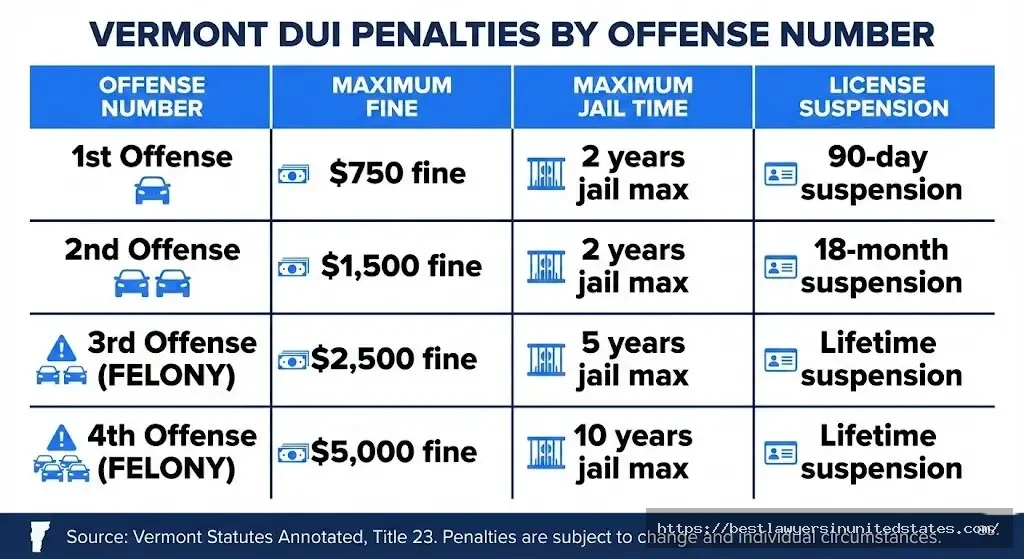
This guide covers Vermont’s DUI laws for 2026, including penalties by offense, the IDRP enrollment process, license suspension timelines, refusal consequences, and total costs. Understanding your BAC level is critical—Vermont’s legal limit is 0.08% for adults and 0.02% for drivers under 21. Calculate your BAC here to understand where you stand.
BAC Calculator
Estimate your Blood Alcohol Content
• Commercial Driver (CDL): 0.04% BAC
• Drivers Under 21: 0.00-0.02% BAC (Zero Tolerance)
• Enhanced Penalties: 0.15% BAC or higher in most states
Understanding Vermont DUI Laws Under 23 V.S.A. § 1201
Vermont defines DUI under statute 23 V.S.A. § 1201. You violate this law when you operate a vehicle with a blood alcohol content of 0.08% or higher, or while impaired by drugs or alcohol.
What Counts as “Operation” in Vermont?
Vermont courts define “operation” broadly. You don’t need to be actively driving. Simply sitting in the driver’s seat with the keys in the ignition can count as operation, even if the engine is off.
Key point: Officers can arrest you for DUI even if the vehicle is parked.
Vermont’s BAC Limits by Driver Type
| Driver Type | Legal BAC Limit |
|---|---|
| Adult drivers (21+) | 0.08% |
| Commercial drivers | 0.04% |
| Drivers under 21 | 0.02% (zero tolerance) |
DUI vs. DWI in Vermont
Vermont uses the term “DUI” (Driving Under the Influence). The state does not distinguish between DUI and DWI. All impaired driving offenses fall under the same statute.
DUID refers to Drug-Impaired Driving. This covers marijuana, prescription medications, and illegal drugs. The penalties match alcohol-related DUI offenses.
Is DUI a Misdemeanor or Felony in Vermont?
Quick Answer: First and second DUI offenses are misdemeanors. Third and subsequent offenses are felonies.
| Offense | Classification | Maximum Jail Time |
|---|---|---|
| 1st DUI | Misdemeanor | 2 years |
| 2nd DUI | Misdemeanor | 2 years |
| 3rd DUI | Felony | 5 years |
| 4th+ DUI | Felony | 10 years |
Vermont DUI Penalties by Offense Number
Vermont’s DUI penalties increase dramatically with each offense. The “lookback period” in Vermont is lifetime—all prior DUI convictions count regardless of how long ago they occurred.
First Offense DUI in Vermont
Maximum penalties for first offense:
- Fines: Up to $750
- Jail time: Up to 2 years (rarely imposed for first offense)
- License suspension: 90 days (administrative)
- IDRP: Required for license reinstatement
- Ignition interlock: Required for reinstatement
Typical sentence: Most first-time offenders receive probation, fines, mandatory IDRP completion, and ignition interlock installation. Jail time is uncommon unless aggravating factors exist (high BAC, accident, injuries).
Second Offense DUI in Vermont
Maximum penalties:
- Fines: Up to $1,500
- Jail time: Up to 2 years
- License suspension: 18 months (administrative)
- IDRP: Required
- Ignition interlock: Required (longer period than first offense)
Additional consequences:
- Vehicle immobilization possible
- Higher insurance premiums
- Longer probation periods
Third Offense DUI in Vermont (Felony)
Maximum penalties:
- Fines: Up to $2,500
- Jail time: Up to 5 years
- License suspension: Lifetime (reinstatement possible after 5 years)
- IDRP: Required for any reinstatement attempt
- Ignition interlock: Required for extended period
Vehicle forfeiture: Vermont courts can order forfeiture of your vehicle for third and subsequent offenses.
Fourth Offense DUI in Vermont (Felony)
Maximum penalties:
- Fines: Up to $5,000
- Jail time: Up to 10 years
- License suspension: Lifetime
- Vehicle forfeiture: Highly likely
Criminal record: Fourth offense DUI is a serious felony. This conviction appears on all background checks and significantly impacts employment, housing, and professional licensing.
Enhanced Penalties for Aggravating Factors
Vermont imposes enhanced penalties in specific circumstances:
High BAC (0.16% or higher):
- Mandatory minimum jail time
- Longer license suspension
- Extended ignition interlock requirement
Aggravated DUI (death or serious bodily injury):
- Up to 15 years imprisonment
- Permanent felony record
- Separate criminal charges possible (vehicular manslaughter)
DUI with minor passenger:
- Enhanced fines
- Longer jail sentences
- Child endangerment charges possible
The total financial burden of a Vermont DUI extends far beyond court fines. Calculate your total DUI costs here to understand the complete financial impact.
DUI Cost Calculator
Estimate total DUI expenses by state and offense
Detailed Cost Breakdown
Payment Timeline
Bail bond, towing fees, car impound, attorney retainer
Initial court fines, DMV fees, DUI school enrollment, ignition interlock installation
Monthly probation fees, ignition interlock fees, DUI school payments, attorney balance
Insurance premium increases, license reinstatement, SR-22 filing fees
- Lost wages from missed work (court dates, jail time, DUI school) – $2,000-$10,000
- Job loss or difficulty finding employment – Varies
- Professional license suspension (doctors, lawyers, nurses, pilots) – Career ending
- Rideshare and transportation costs during suspension – $1,500-$5,000
- Travel restrictions and visa denials – Varies
- Security clearance loss – Career impact
- Child custody implications – Legal costs
- Rental car restrictions – Varies
- Personal relationships and mental health costs – Priceless
What Happens When You’re Pulled Over for DUI in Vermont
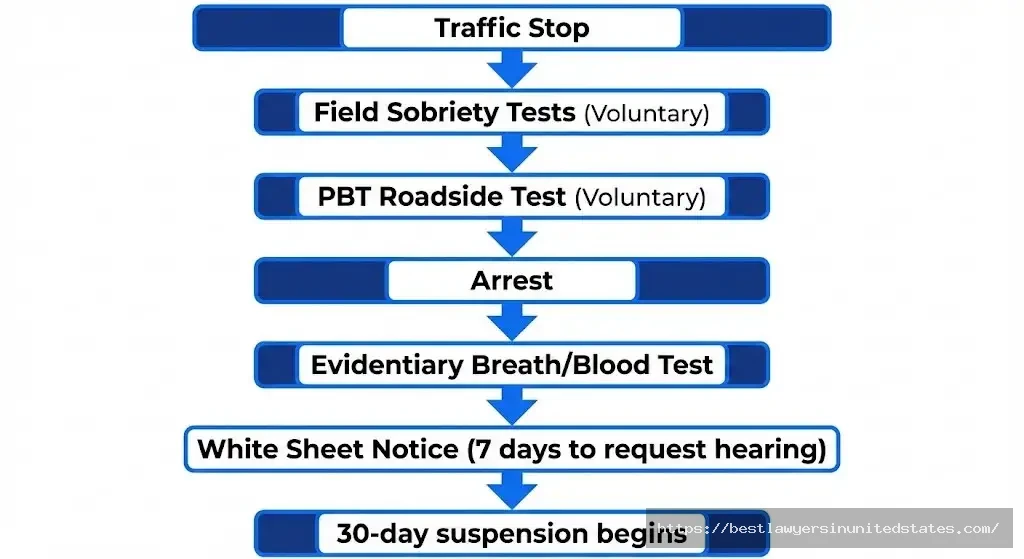
Vermont DUI arrests follow a standard procedure. Understanding this process helps you know your rights and what to expect.
Initial Traffic Stop
Vermont State Police or local law enforcement must have reasonable suspicion to stop your vehicle. Common reasons include:
- Weaving between lanes
- Speeding or erratic driving
- Equipment violations (broken taillight, expired registration)
- DUI checkpoints (legal in Vermont)
Officers observe your behavior during the stop. They look for slurred speech, bloodshot eyes, alcohol odor, and fumbling with documents.
Field Sobriety Tests in Vermont
Quick Answer: Field sobriety tests are voluntary in Vermont. You can refuse them without automatic penalties.
Officers typically request three Standard Field Sobriety Tests (SFSTs):
The three tests:
- Horizontal Gaze Nystagmus (HGN): Officer tracks your eye movements
- Walk-and-Turn: Nine steps heel-to-toe, turn, nine steps back
- One-Leg Stand: Balance on one foot for 30 seconds
Should you refuse FSTs? This is a complex decision:
- ✅ Pros: No test results for prosecution to use
- ❌ Cons: Officers may arrest based on other observations alone
Preliminary Breath Test (PBT) at Roadside
Vermont law does not require you to take the roadside PBT. This handheld device provides a preliminary BAC reading.
Critical difference: The roadside PBT differs from the evidentiary breath test at the police station. PBT results are generally not admissible in court except to establish probable cause for arrest.
Arrest and Transport
Officers arrest you if they establish probable cause that you’re driving under the influence. They read you Miranda rights and transport you to the police station or processing facility.
At the station, officers request an evidentiary breath or blood test. This is where Vermont’s implied consent law becomes critical.
The “White Sheet” Notice
Officers hand you a white sheet of paper called the “Notice of Intention to Suspend or Disqualify.” This document explains:
- Your license will be administratively suspended
- You have 7 days to request a hearing to contest the suspension
- The suspension takes effect 30 days from the arrest date
Critical deadline: You must request your administrative hearing within 7 days or lose your right to challenge the automatic suspension.
Vermont Implied Consent and Chemical Testing
Every Vermont driver automatically consents to chemical testing when they accept their license. This “implied consent” under 23 V.S.A. § 1201 applies the moment officers arrest you for DUI.
Evidentiary Breath and Blood Testing
Officers must read you the implied consent warning before requesting a chemical test. The warning explains that refusing triggers automatic license suspension.
Vermont’s evidentiary testing:
- Breath test: Datamaster or similar approved device
- Blood test: Required in accidents, unconscious drivers, or when breath test unavailable
- Urine test: Rarely used (only for drug testing when other methods unavailable)
Your Rights During Testing
You have the right to:
- Request an independent test at your own expense after the official test
- ❌ You do NOT have the right to: Contact an attorney before deciding whether to submit to testing
Observation period: Officers must observe you for 15 minutes before administering a breath test to ensure you don’t consume anything that could affect results.
Understanding Your BAC Results
Vermont uses the 0.08% BAC limit for adult drivers. Understanding how alcohol affects your BAC helps you make informed decisions. Use our BAC calculator to estimate how many drinks put you over the legal limit.
| Number of Drinks (Standard) | Approximate BAC (150 lb person) |
|---|---|
| 1 drink | 0.02% – 0.03% |
| 2 drinks | 0.05% – 0.06% |
| 3 drinks | 0.08% – 0.09% |
| 4 drinks | 0.10% – 0.12% |
Note: BAC varies significantly based on weight, gender, food consumption, and metabolism. These are estimates only.
Vermont DUI Refusal Laws: What Happens If You Say No
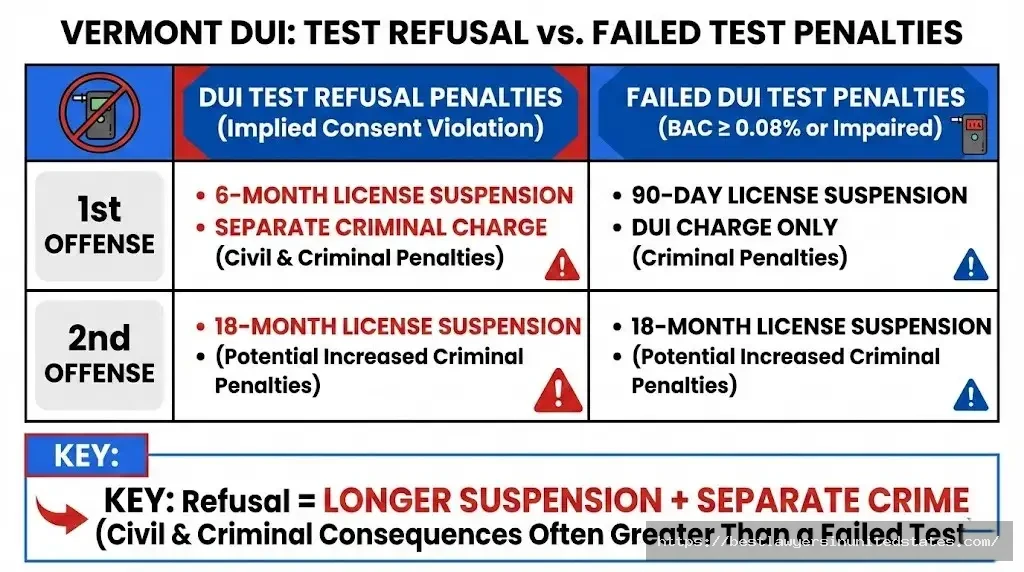
Refusing chemical testing in Vermont triggers both criminal and civil penalties. Vermont is one of the few states that makes refusal a separate criminal offense.
Criminal Penalties for Refusal
Quick Answer: Refusing a chemical test is a separate misdemeanor crime in Vermont, punishable by the same penalties as a first offense DUI.
Refusal carries:
- Up to $750 fine
- Up to 2 years jail time (rarely imposed)
- Separate criminal charge on your record
Prosecutors charge refusal as a standalone crime even if they later dismiss the DUI charge.
Civil License Suspension for Refusal
The Vermont DMV imposes administrative license suspension for test refusal. These suspensions run longer than suspensions for failing a test.
| Offense | Refusal Suspension | Failed Test Suspension |
|---|---|---|
| 1st refusal | 6 months | 90 days |
| 2nd refusal | 18 months | 18 months |
| 3rd+ refusal | Lifetime (reinstatement possible after 5 years) | Lifetime (reinstatement possible after 5 years) |
Critical point: The refusal suspension applies even if you’re never convicted of DUI. The criminal case and administrative suspension proceed on separate tracks.
How Refusal Affects Your Criminal Case
Refusing the test doesn’t make the DUI charge disappear. Prosecutors can still proceed based on:
- Officer observations (slurred speech, bloodshot eyes, alcohol odor)
- Field sobriety test results
- Driving behavior
- Your refusal itself (juries often view refusal as “consciousness of guilt”)
Can You Beat a Refusal Charge?
Possible defenses to refusal charges include:
- ✅ Officers didn’t read the implied consent warning
- ✅ Medical condition prevented you from providing a sample
- ✅ Officers didn’t have probable cause to arrest
- ✅ Language barrier prevented you from understanding the warning
Should You Refuse Testing in Vermont?
This is a strategic decision with serious consequences either way.
Reasons to submit to testing:
- Avoiding the separate refusal criminal charge
- Shorter license suspension
- Easier license reinstatement process
- Less ammunition for prosecutors at trial
Reasons some people refuse:
- No BAC evidence for prosecution
- Possible defense if you believe you’re over the limit
- Forces state to prove case through circumstantial evidence
Legal disclaimer: This information is educational. Consult a Vermont DUI attorney immediately after arrest for advice specific to your situation.
Vermont License Suspension and Reinstatement Process
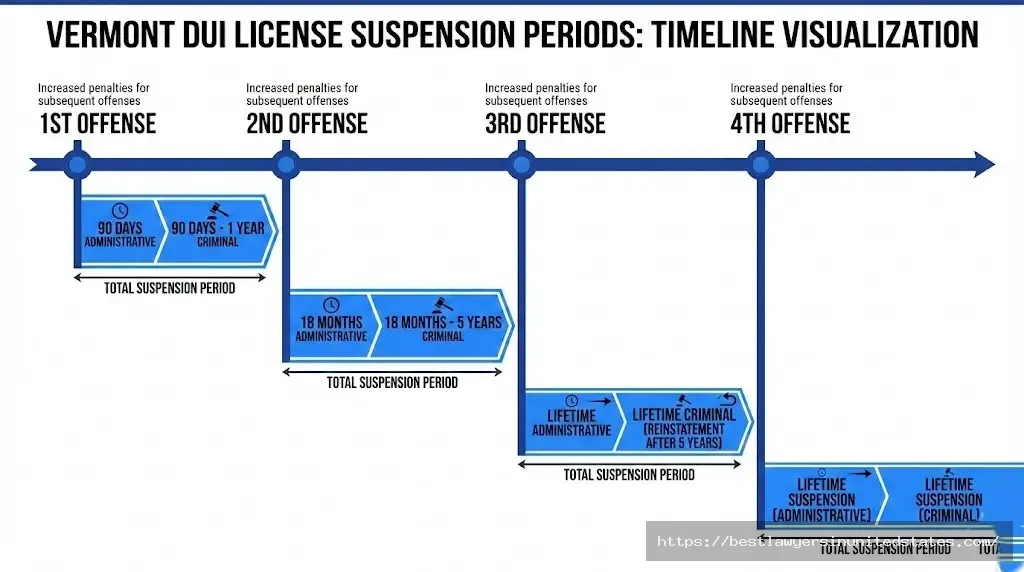
Vermont imposes two separate license suspensions for DUI: administrative (civil) and criminal. Understanding both is critical.
Administrative License Suspension
The Vermont DMV suspends your license automatically upon DUI arrest. This “civil” suspension proceeds independently of your criminal case.
Timeline:
- Day of arrest: Officers hand you the “white sheet” notice
- 7 days: Deadline to request administrative hearing
- 30 days: Suspension takes effect if you don’t request hearing or lose hearing
Administrative suspension periods:
| Offense | Suspension Length |
|---|---|
| 1st offense (failed test) | 90 days |
| 1st offense (refusal) | 6 months |
| 2nd offense (failed test) | 18 months |
| 2nd offense (refusal) | 18 months |
| 3rd+ offense | Lifetime (reinstatement possible after 5 years) |
Requesting an Administrative Hearing
You have 7 days from arrest to request a hearing with the Vermont DMV. Missing this deadline means automatic suspension with no opportunity to contest.
What happens at the hearing:
- DMV hearing officer (not a judge) presides
- State must prove: (1) officer had probable cause to arrest, (2) you were operating the vehicle, (3) BAC was 0.08% or higher (or you refused)
- You can present evidence and testimony
- Burden of proof: preponderance of evidence (lower than criminal court)
Success rates: Administrative hearings are difficult to win. Most drivers lose unless clear procedural errors occurred.
Criminal License Suspension After Conviction
If convicted of DUI in criminal court, the judge imposes additional license suspension on top of the administrative suspension.
Criminal suspension periods:
| Offense | Additional Criminal Suspension |
|---|---|
| 1st conviction | 90 days – 1 year |
| 2nd conviction | 18 months – 5 years |
| 3rd conviction | Lifetime (reinstatement possible after 5 years) |
Important: The administrative and criminal suspensions do not always run concurrently. Sometimes they stack, creating longer total suspension periods.
Vermont Ignition Interlock License
Quick Answer: Vermont does not offer traditional “hardship” or “work permit” licenses. Your only driving option during suspension is an ignition interlock license.
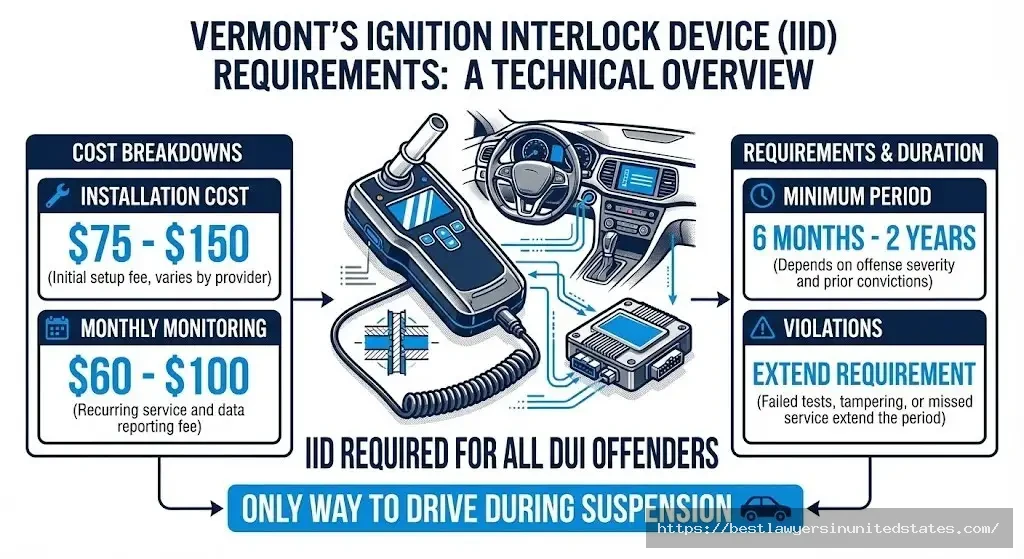
An ignition interlock device (IID) prevents your vehicle from starting unless you provide a breath sample below 0.02% BAC.
IID requirements in Vermont:
- Mandatory for all DUI offenders seeking license reinstatement
- Minimum installation period varies by offense (6 months to 2 years)
- Device costs $75-$150 installation plus $60-$100 monthly monitoring
- Violations (failed tests, tampering) extend your IID requirement
Getting an IID license:
- Complete required suspension period
- Enroll in IDRP (see next section)
- Pay DMV reinstatement fee ($100-$200)
- Install certified IID in your vehicle
- Maintain SR-22 insurance
Full License Reinstatement Requirements
To reinstate your full Vermont driver’s license after DUI, you must:
Mandatory requirements:
- ✅ Complete all suspension periods (administrative and criminal)
- ✅ Complete IDRP (Impaired Driver Rehabilitation Program)
- ✅ Install ignition interlock device
- ✅ Pay DMV reinstatement fees ($100-$200)
- ✅ Obtain SR-22 insurance certificate
- ✅ Pay all court fines and fees
Timeline: The entire process typically takes 6 months to 2 years for first offenders. Repeat offenders face much longer timelines.
IDRP: Vermont’s Impaired Driver Rehabilitation Program
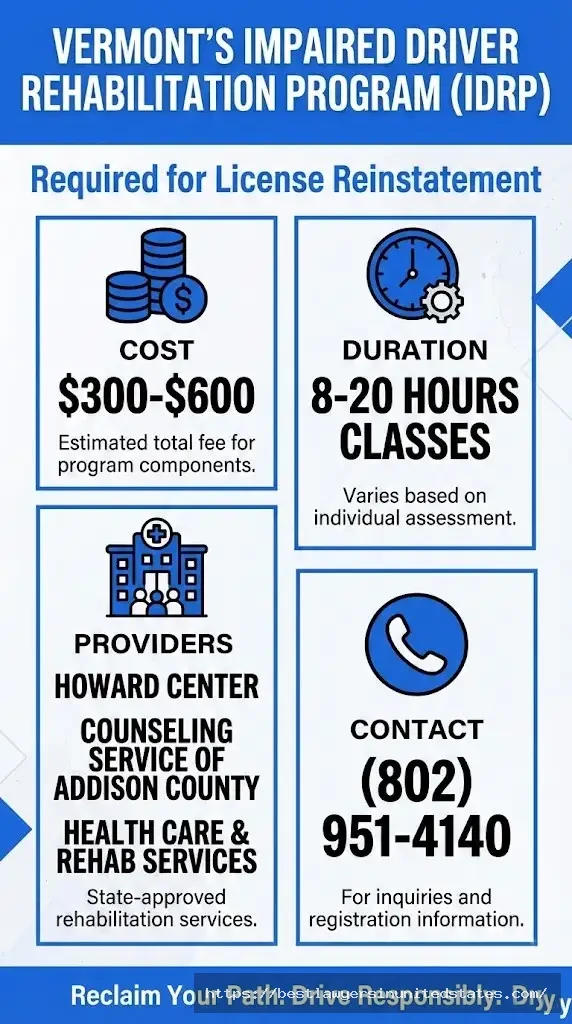
The Impaired Driver Rehabilitation Program (IDRP) is Vermont’s mandatory DUI education and counseling program. You cannot reinstate your license without completing IDRP.
What Is IDRP?
IDRP is a state-run program administered by the Vermont Department of Health. The program combines education about alcohol/drug effects with screening for substance abuse problems.
Program components:
- Initial assessment and screening
- 8-20 hours of group education sessions
- Individual counseling if assessment identifies substance abuse issues
- Completion certificate required for DMV
Who must complete IDRP:
- All first-time DUI offenders
- All repeat DUI offenders
- Test refusal offenders
- Out-of-state drivers arrested in Vermont (in some cases)
IDRP Providers in Vermont
Vermont contracts with approved providers to deliver IDRP services statewide:
Major IDRP providers:
- Howard Center (Burlington, Chittenden County area)
- Counseling Service of Addison County (Middlebury area)
- Health Care & Rehabilitation Services (Springfield area)
- Northeastern Family Institute (St. Johnsbury area)
- United Counseling Service (Bennington area)
Finding a provider: Visit the Vermont Department of Health website or call (802) 951-4140 for a complete list of approved IDRP providers near you.
IDRP Enrollment Process Step-by-Step
How to enroll in IDRP:
- Contact an approved provider – Call within 2-3 weeks of your arrest
- Schedule intake assessment – Provider evaluates your substance use history
- Attend required classes – Typically 8-20 hours over 2-4 weeks
- Complete any required counseling – If assessment identifies substance abuse issues
- Receive completion certificate – Provider issues certificate to you and reports to DMV
- Submit certificate to DMV – Include with your license reinstatement application
Critical point: Start IDRP as soon as possible. Waiting until your suspension ends delays your ability to get your license back.
IDRP Costs in Vermont
Quick Answer: IDRP costs $300-$600 depending on the provider and your assessment results.
| Fee Type | Typical Cost |
|---|---|
| Initial assessment | $75-$150 |
| Group education classes | $200-$400 |
| Individual counseling (if required) | $50-$100 per session |
| Total typical cost | $300-$600 |
Payment plans: Most providers offer payment plans. Ask about options when you enroll.
IDRP for Out-of-State Drivers
If you hold an out-of-state license but were arrested for DUI in Vermont:
- Vermont may require IDRP completion before removing administrative sanctions
- Your home state may accept Vermont IDRP completion (check with your state DMV)
- Some states require their own DUI programs instead
Interstate Driver’s License Compact: Vermont participates in this agreement. Your home state DMV receives notification of your Vermont DUI arrest and conviction.
What Happens If You Fail IDRP?
Failing to complete IDRP prevents license reinstatement indefinitely. You must:
- Re-enroll and complete the program
- Pay all fees again
- Restart the clock on your reinstatement timeline
Reasons for IDRP failure:
- Missing classes
- Failing to complete recommended counseling
- Positive alcohol/drug tests during the program
- Non-payment of fees
Vermont BAC Limits and Chemical Testing
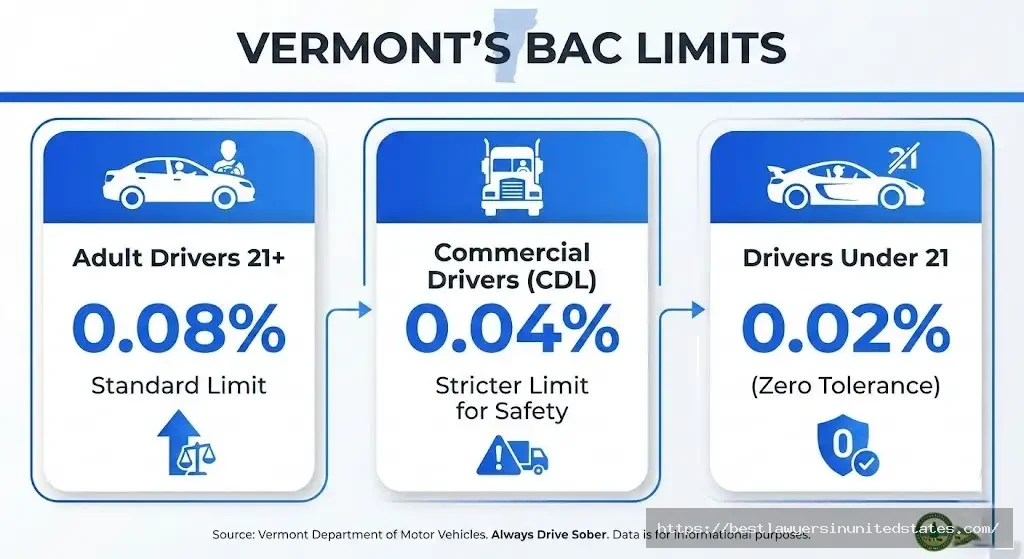
Vermont enforces different BAC limits for different driver types. Understanding these limits helps you know when you’re breaking the law.
Vermont’s Per Se BAC Limits
| Driver Category | BAC Limit | Violation Type |
|---|---|---|
| Standard drivers (21+) | 0.08% | DUI |
| Commercial drivers (CDL) | 0.04% | DUI |
| Drivers under 21 | 0.02% | Zero tolerance violation |
Per se law: A BAC at or above the legal limit automatically violates Vermont law. Prosecutors don’t need to prove you were actually impaired.
Types of Chemical Tests in Vermont
Vermont law enforcement uses three types of chemical tests:
Breath testing:
- Most common test type
- Uses Datamaster DMT or similar approved devices
- Results available immediately
- Measures deep lung air (alveolar breath)
Blood testing:
- Required when breath testing unavailable
- Used in accidents with injuries
- More accurate than breath testing
- Requires medical professional to draw blood
Urine testing:
- Rarely used
- Primarily for drug testing
- Less reliable than breath or blood
Challenging BAC Test Results
Your attorney can challenge BAC evidence through several defenses:
Common challenges:
- Calibration errors: Breathalyzer devices require regular calibration and maintenance
- Operator error: Officer must be trained and follow proper procedures
- Mouth alcohol: Recent use of mouthwash or breath spray can inflate results
- Rising BAC defense: Your BAC may have been below 0.08% while driving but rose by testing time
- Medical conditions: GERD, diabetes, or ketosis can produce false positives
Discovery requests: Your attorney can request:
- Breathalyzer maintenance and calibration records
- Officer training certifications
- Video footage of testing procedure
- Blood sample for independent testing
Vermont Zero Tolerance Law for Underage Drivers
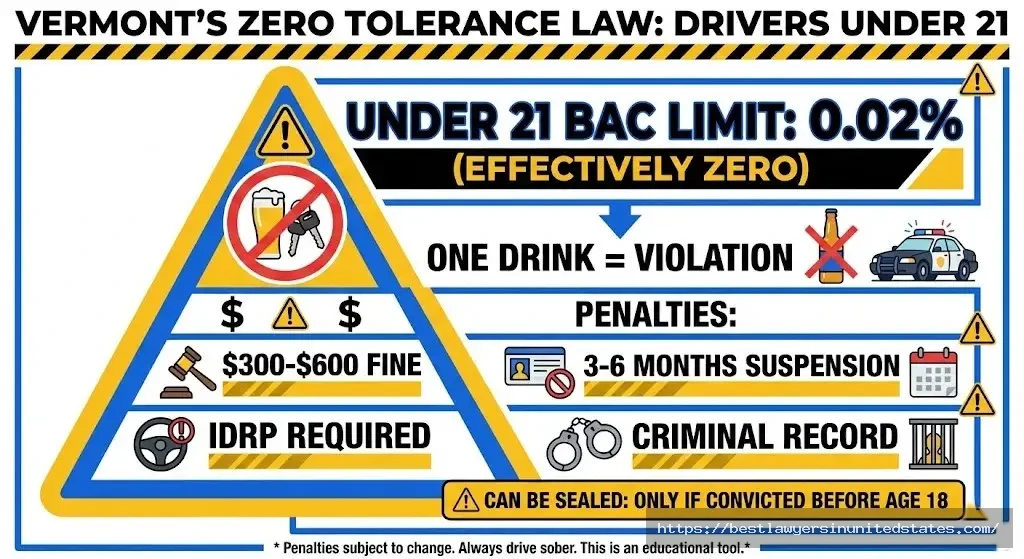
Vermont enforces strict “zero tolerance” laws for drivers under 21. The legal BAC limit drops to 0.02% for underage drivers.
What Is Vermont’s Zero Tolerance Law?
Quick Answer: Vermont prohibits drivers under 21 from operating a vehicle with any measurable alcohol in their system. The legal limit is 0.02% BAC—effectively zero tolerance.
How 0.02% affects you:
- One standard drink typically produces 0.02%-0.03% BAC
- Even a sip of alcohol can exceed the limit
- Mouthwash or breath spray containing alcohol can trigger violations
Penalties for Underage DUI in Vermont
| Penalty Type | First Offense | Second Offense |
|---|---|---|
| Fine | $300-$600 | $600-$1,200 |
| License suspension | 3-6 months | 6-12 months |
| IDRP | Required | Required |
| Criminal record | Yes | Yes |
Additional consequences:
- Parental notification
- Impact on college applications
- Loss of scholarships
- Higher insurance rates
- Employment difficulties
Can Underage DUI Be Sealed in Vermont?
Yes—but only for juvenile offenses.
Vermont allows sealing of juvenile criminal records (offenses committed before age 18). To seal an underage DUI:
- You must petition the Vermont Criminal Division Court
- Wait period varies (typically 2-5 years after completion of sentence)
- Court considers: rehabilitation, subsequent criminal history, public interest
Important: Convictions after age 18 cannot be sealed or expunged in Vermont, even if you were under 21.
Impact on College and Scholarships
Most college applications ask about criminal convictions. An underage DUI:
- Must be disclosed on applications (lying risks expulsion)
- May affect admissions decisions at selective schools
- Can result in scholarship revocation (especially athletic scholarships)
- Impacts federal financial aid eligibility if drug-related
Critical deadline: If you’re applying to college, consult a Vermont DUI attorney immediately. Early case resolution may minimize application impacts.
How Long Does a DUI Stay on Your Record in Vermont?
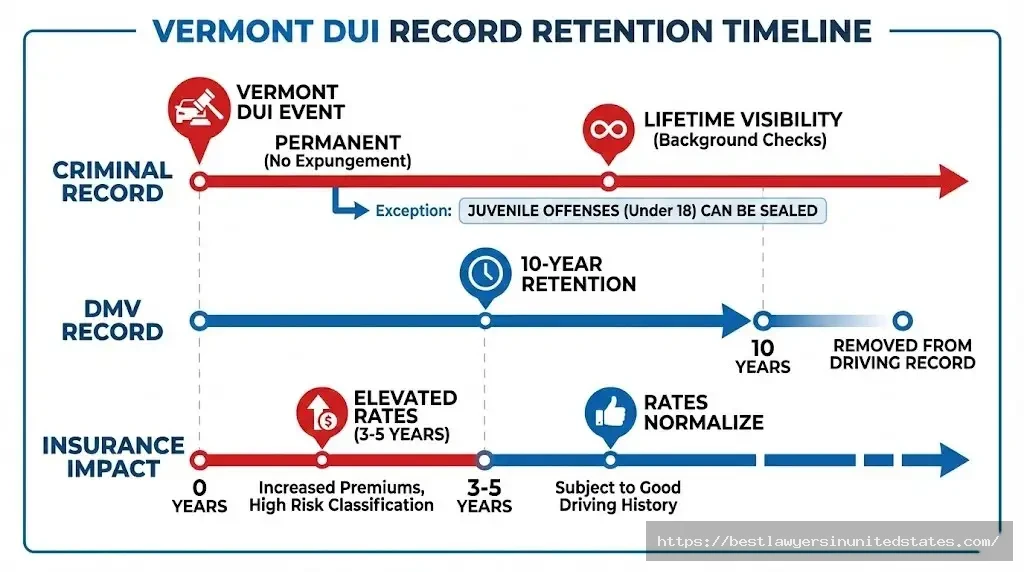
Vermont DUI convictions create permanent criminal records. Understanding the difference between criminal records and DMV records is critical.
DUI on Your Criminal Record
Quick Answer: DUI convictions remain on your Vermont criminal record permanently. Vermont does not allow expungement of adult DUI convictions.
What “permanent” means:
- ✅ Background checks show the conviction indefinitely
- ✅ Employment applications reveal the DUI
- ✅ Professional licensing boards see the conviction
- ✅ Future DUI arrests count as repeat offenses (no lookback period limit)
DUI on Your DMV Record
Vermont DMV maintains separate driving records. DUI convictions remain on your DMV record for 10 years.
DMV record impacts:
- Insurance companies see DUI for 10 years (rates stay elevated)
- Out-of-state license applications reveal the conviction
- Commercial driver licensing (CDL) becomes difficult or impossible
Can You Expunge a DUI in Vermont?
No—Vermont does not permit expungement of adult DUI convictions.
Vermont expungement law: Only certain non-violent misdemeanors and juvenile offenses qualify for sealing. DUI specifically does not qualify.
One exception: Juvenile offenders (under 18 at time of offense) can petition to seal records after completing all sentence requirements and waiting periods.
Pardons in Vermont
Vermont’s Governor can grant pardons, but pardons do not erase your criminal record. A pardon:
- Restores certain civil rights (voting, firearm ownership)
- Does NOT remove the conviction from background checks
- Does NOT prevent disclosure on applications
- Requires years of demonstrated rehabilitation
Reality: Pardons for DUI are extremely rare in Vermont.
Background Checks and Employment
Vermont employers can ask about criminal convictions on job applications. A DUI conviction:
- Appears on standard background checks
- Must be disclosed when asked
- May disqualify you from certain positions (commercial driving, jobs requiring company vehicles, security clearances)
- Can be explained with evidence of rehabilitation
Occupational licensing: Certain professions scrutinize DUI convictions:
- Commercial drivers (CDL)—lifetime bar for some violations
- Nursing and healthcare—license suspension possible
- Teaching—disclosure required, may affect hiring
- Legal profession—character and fitness review
Similar to Vermont, neighboring states like New Hampshire and Massachusetts also maintain permanent DUI records with limited expungement options.
Total Cost of a Vermont DUI
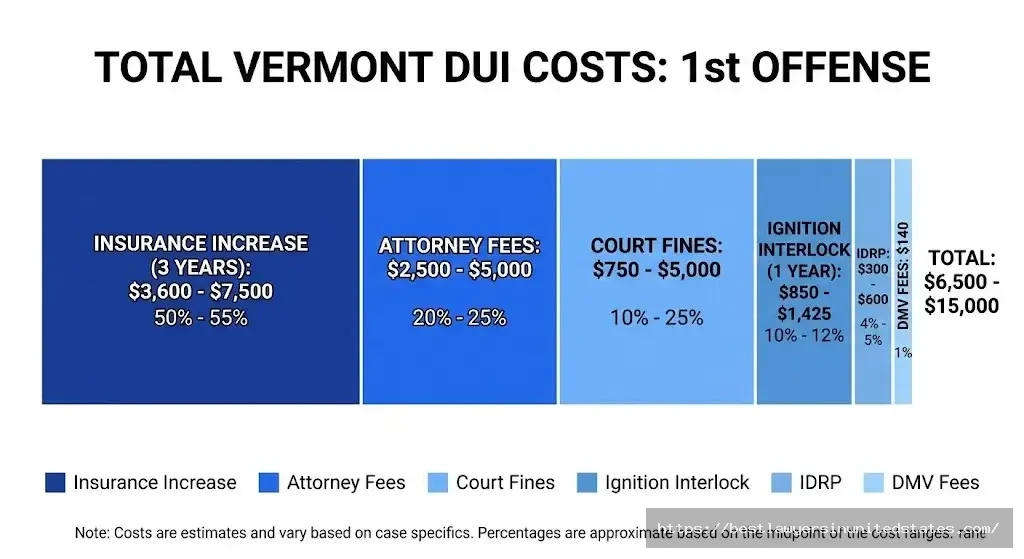
A DUI in Vermont costs far more than just the court fine. Understanding the complete financial impact helps you prepare.
Court Fines and Fees
| Offense | Fine Range | Court Costs |
|---|---|---|
| 1st DUI | $300-$750 | $150-$300 |
| 2nd DUI | $600-$1,500 | $150-$300 |
| 3rd DUI | $1,000-$2,500 | $150-$300 |
| 4th+ DUI | $2,000-$5,000 | $150-$300 |
Additional court fees:
- Victim assessment fee: $50-$100
- Crime lab fee (if blood test): $100
- Restitution (if property damage or injuries): Varies
IDRP Program Costs
IDRP fees: $300-$600 (see IDRP section above for breakdown)
Ignition Interlock Device Costs
| Cost Type | Amount |
|---|---|
| Installation | $75-$150 |
| Monthly monitoring | $60-$100/month |
| Removal | $50-$75 |
| Typical total (1 year) | $850-$1,425 |
Longer IID periods: Repeat offenders may require IID for 2-5 years, multiplying these costs.
License Reinstatement Fees
- Vermont DMV reinstatement fee: $115
- Duplicate license fee: $25
- Total: $140
Insurance Cost Increases
Vermont requires SR-22 insurance for DUI offenders. This high-risk insurance certificate causes dramatic rate increases.
Average insurance increases:
- First-year increase: +80% to +120% over prior premiums
- Typical annual increase: $1,200-$2,500
- Duration: 3-5 years minimum
- Total 3-year insurance increase: $3,600-$7,500
Attorney Fees in Vermont
Private attorney costs:
- First offense DUI: $2,500-$5,000
- Second offense DUI: $4,000-$7,500
- Third offense (felony): $7,500-$15,000+
Public defender: Free if you qualify (income-based eligibility). Vermont courts appoint public defenders for indigent defendants.
Other Hidden Costs
Additional expenses:
- Bail (if applicable): $200-$2,000
- Towing and impound: $150-$400
- Alternative transportation during suspension: $500-$2,000
- Lost wages (court appearances, jail time): Varies
- Increased employment difficulty: Impossible to quantify
Total DUI Cost Estimate for Vermont
| Offense | Low End | High End |
|---|---|---|
| 1st offense | $6,500 | $15,000 |
| 2nd offense | $10,000 | $22,000 |
| 3rd offense | $15,000 | $35,000+ |
These estimates include: Fines, court costs, IDRP, ignition interlock (1 year), license fees, attorney fees, and insurance increases (3 years).
Calculate your specific costs: Every case is different. Use our Vermont DUI cost calculator to estimate costs based on your specific circumstances.
Common DUI Defenses in Vermont
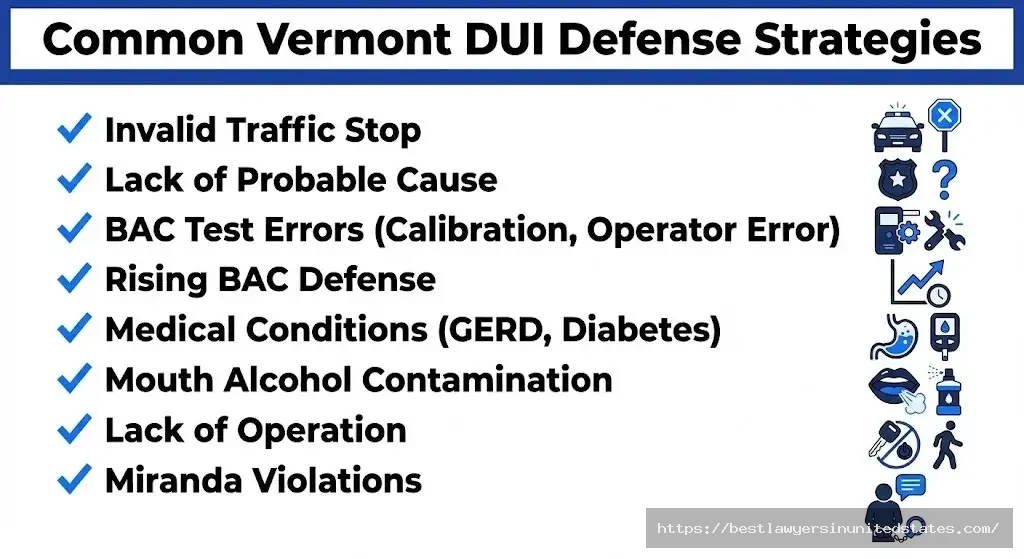
Vermont DUI charges can be challenged through several legal defenses. An experienced attorney evaluates which defenses apply to your case.
Challenging the Traffic Stop
Invalid stop defense: Officers need reasonable suspicion to stop your vehicle. If the stop lacked legal justification, all evidence gathered afterward may be suppressed.
Common invalid stops:
- No observed traffic violations or erratic driving
- Pretextual stops (stopping you for one reason while investigating another)
- Anonymous tips without corroboration
- DUI checkpoint violations (checkpoints must follow strict procedures)
Challenging Probable Cause for Arrest
Officers need probable cause to arrest you for DUI. Weak probable cause can lead to case dismissal.
Probable cause challenges:
- Failed field sobriety tests (not reliable evidence)
- Odor of alcohol alone (not proof of impairment)
- Bloodshot eyes or slurred speech (explainable by other causes)
- Officer training or certification issues
Challenging BAC Test Results
Breathalyzer and blood test results can be challenged through several methods:
Technical defenses:
- Device calibration and maintenance records show errors
- Officer certification expired or improper training
- 15-minute observation period not followed
- Mouth alcohol from recent use of products containing alcohol
Medical defenses:
- GERD or acid reflux (causes mouth alcohol)
- Diabetes or ketosis (produces acetone, misread as alcohol)
- Recent dental work
- Breath spray or mouthwash use
Rising BAC Defense
Your BAC continues rising for 30-90 minutes after your last drink. The rising BAC defense argues:
- Your BAC was below 0.08% while driving
- BAC rose above 0.08% by the time of testing
- Testing occurred 60-90 minutes after your stop
Example: You were pulled over at 11:00 PM (BAC 0.07%) but tested at 11:45 PM (BAC 0.09%). Your BAC was legal while driving.
Lack of “Operation”
Vermont requires proof you operated the vehicle. Your attorney can argue:
- You were sleeping in a parked car
- Keys were not in the ignition
- You were sitting in the passenger seat
- Someone else was driving
Critical evidence: Witness testimony or video footage showing you weren’t driving strengthens this defense.
Hiring a Vermont DUI Attorney
Vermont DUI cases involve complex legal and administrative procedures. Most people benefit from hiring an experienced DUI attorney.
When to Hire a DUI Lawyer
Quick Answer: Contact a Vermont DUI attorney within 24-48 hours of arrest. You have only 7 days to request an administrative hearing.
Critical early actions:
- Request administrative hearing (7-day deadline)
- Preserve evidence (video footage, witness information)
- Begin building your defense
- Protect your constitutional rights
What Can a DUI Attorney Do for You?
Attorney services:
- Request and attend administrative DMV hearing
- Challenge the legality of the traffic stop
- Suppress improperly obtained evidence
- Negotiate plea agreements with prosecutors
- Represent you at trial
- Minimize penalties and protect your record
- Guide you through IDRP and license reinstatement
How to Choose a Vermont DUI Attorney
Look for:
- ✅ Significant Vermont DUI case experience
- ✅ Trial experience (not just plea deals)
- ✅ Familiarity with local courts and prosecutors
- ✅ Membership in National College for DUI Defense
- ✅ Client reviews and case results
- ✅ Clear fee structure
Questions to ask:
- How many DUI cases have you handled in Vermont?
- What percentage of your practice focuses on DUI?
- What are your typical results for cases like mine?
- Will you personally handle my case or pass it to an associate?
Public Defender vs. Private Attorney
| Factor | Public Defender | Private Attorney |
|---|---|---|
| Cost | Free (if income-eligible) | $2,500-$15,000+ |
| Case load | Very high (100+ cases) | Lower (focused attention) |
| Experience | Varies widely | Choose based on experience |
| Availability | Limited client contact | More accessible |
Eligibility for public defender: Vermont courts use income guidelines. You must demonstrate financial hardship.
Vermont DUI Attorney Costs
Typical fees:
- First offense representation: $2,500-$5,000
- Second offense representation: $4,000-$7,500
- Third offense (felony) representation: $7,500-$15,000+
Fee structures:
- Flat fee: One price for representation through trial
- Hourly: $200-$400/hour (less common for DUI)
- Hybrid: Flat fee for pre-trial, hourly if case goes to trial
Payment plans: Many Vermont DUI attorneys offer payment plans. Ask about options during your consultation.
Find Vermont DUI lawyers: Contact experienced DUI attorneys in Vermont for free case evaluation.
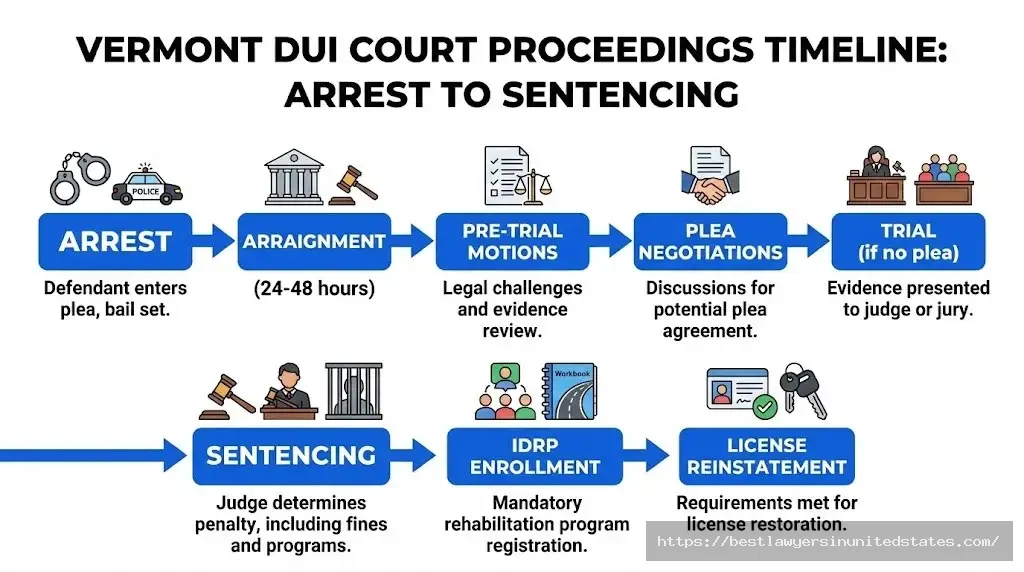
Vermont DUI Court Process
Vermont DUI cases proceed through several court stages. Understanding this process helps you know what to expect.
Arraignment
Your first court appearance typically occurs within 24-48 hours of arrest (if you’re held on bail) or within 2-4 weeks (if released).
What happens at arraignment:
- Judge reads the charges
- You enter a plea (guilty, not guilty, or no contest)
- Judge sets bail or release conditions
- Next court date scheduled
Most defendants plead: “Not guilty” at arraignment. This preserves all defense options.
Pre-Trial Motions and Discovery
Your attorney files motions to challenge evidence and requests discovery from the prosecutor.
Common motions:
- Motion to suppress evidence (illegal stop, improper testing)
- Motion to dismiss (lack of probable cause)
- Discovery motion (requesting police reports, video, calibration records)
Plea Negotiations
Most Vermont DUI cases resolve through plea agreements rather than trial. Prosecutors may offer:
Possible plea deals:
- Reduced charge (reckless driving instead of DUI)
- Reduced penalties (lower fines, shorter suspension)
- Deferred sentencing (charges dismissed if you complete probation)
Factors affecting plea offers:
- Your BAC level
- Prior criminal record
- Aggravating factors (accident, injuries, minors in vehicle)
- Strength of evidence
- Court congestion
Trial
If no plea agreement is reached, your case proceeds to trial.
Vermont trial options:
- Jury trial: Six-person jury decides guilt or innocence
- Bench trial: Judge alone decides the case
Burden of proof: Prosecution must prove guilt beyond a reasonable doubt.
Typical trial length: 1-3 days for DUI cases
Sentencing
If convicted (by plea or trial), the judge imposes sentence.
Factors judges consider:
- Vermont sentencing guidelines
- Your criminal history
- BAC level
- Presence of aggravating factors
- Acceptance of responsibility
- Employment and family situation
Alternatives to jail:
- Probation
- Home detention
- Weekend jail
- Community service
- Inpatient treatment programs
Out-of-State DUI Issues
Vermont DUI arrests create complications for out-of-state drivers. Understanding interstate implications is critical.
Vermont DUI with Out-of-State License
If you hold a license from another state but get arrested for DUI in Vermont:
What happens:
- Vermont notifies your home state DMV
- Your home state imposes its own suspension or penalties
- You must resolve the Vermont criminal case
- Vermont may require IDRP completion
- Your home state may require its own DUI program
Interstate Driver’s License Compact: Vermont participates in this agreement. Member states share DUI conviction information.
Out-of-State Residents Arrested in Vermont
If you’re visiting Vermont and get arrested for DUI:
- You must return to Vermont for all court appearances
- Vermont penalties apply regardless of where you live
- Failure to appear results in warrant for your arrest
- Some attorneys can appear on your behalf (check with attorney)
IDRP for out-of-state residents: Vermont may allow you to complete an equivalent program in your home state. Contact the Vermont IDRP office for approval.
Canada Entry After Vermont DUI
DUI is a serious crime in Canada. A Vermont DUI conviction makes you inadmissible to Canada.
Options for entering Canada:
- Temporary Resident Permit (TRP): Allows entry for specific purpose and duration
- Criminal Rehabilitation: Permanent solution (eligible 5 years after completion of sentence)
- Deemed Rehabilitation: Automatic eligibility 10 years after completion (first offense only)
Timeline: Most people cannot enter Canada for at least 5-10 years after a Vermont DUI.
Neighboring states have similar cross-border implications. Maine DUI laws also affect Canada entry, while New York DUI penalties create comparable interstate complications.
Frequently Asked Questions About Vermont DUI Laws
Is a DUI a felony in Vermont?
Quick Answer: First and second DUI offenses are misdemeanors. Third and subsequent offenses are felonies in Vermont.
Third offense DUI carries up to 5 years imprisonment. Fourth offense DUI carries up to 10 years imprisonment. Both create permanent felony records visible on all background checks.
How long does a DUI stay on your record in Vermont?
Quick Answer: DUI convictions remain on your criminal record permanently in Vermont. Vermont does not allow expungement of adult DUI convictions.
Your DMV record shows the DUI for 10 years. Insurance companies see the conviction for 3-5 years minimum. Background checks reveal the conviction indefinitely.
Can you get a work permit after DUI in Vermont?
Quick Answer: No. Vermont does not offer traditional “hardship” or “work permits” during DUI suspension.
Your only driving option is an ignition interlock license after completing mandatory suspension periods and enrolling in IDRP. The IID allows you to drive for work, but the device must be installed in your vehicle.
What is IDRP in Vermont?
Quick Answer: IDRP (Impaired Driver Rehabilitation Program) is Vermont’s mandatory DUI education and counseling program required for license reinstatement.
The program costs $300-$600 and includes assessment, group education classes (8-20 hours), and possible individual counseling. You cannot get your license back without completing IDRP.
Can you refuse a breathalyzer in Vermont?
Quick Answer: Yes, you can refuse a breathalyzer in Vermont, but refusal is a separate crime with harsher penalties than failing the test.
Refusal triggers 6-month license suspension (vs. 90 days for failed test), plus a separate criminal charge punishable by up to $750 fine and 2 years jail time.
How much does a DUI cost in Vermont?
Quick Answer: A first offense DUI in Vermont costs $6,500-$15,000 total, including fines, IDRP, ignition interlock, attorney fees, and insurance increases.
Second offenses cost $10,000-$22,000. Third offense felony DUI costs $15,000-$35,000 or more. Calculate your specific costs here.
Do I need a lawyer for a first DUI in Vermont?
Quick Answer: While not legally required, hiring a Vermont DUI attorney is highly recommended even for first offenses.
An attorney can challenge evidence, negotiate reduced charges, represent you at the DMV hearing (7-day deadline), and potentially save you thousands in penalties and insurance costs.
Can a DUI be expunged in Vermont?
Quick Answer: No. Vermont does not allow expungement of adult DUI convictions.
Only juvenile offenders (convicted before age 18) can petition to seal DUI records. Adult convictions remain permanent and visible on all background checks.
What is the BAC limit in Vermont?
Quick Answer: The BAC limit in Vermont is 0.08% for adult drivers, 0.04% for commercial drivers, and 0.02% for drivers under 21.
Vermont’s “per se” law means any BAC at or above these limits automatically violates the law regardless of actual impairment. Check your BAC level here.
How long is license suspended for DUI in Vermont?
Quick Answer: First offense DUI triggers 90-day administrative suspension plus additional criminal court suspension (90 days to 1 year).
Second offenses result in 18-month suspension. Third and subsequent offenses result in lifetime suspension, though reinstatement becomes possible after 5 years.
Vermont DUI Resources and Next Steps
Vermont Government Resources
Vermont DMV:
- Main office: 120 State Street, Montpelier, VT 05603-0001
- Phone: (802) 828-2000
- Website: dmv.vermont.gov
Vermont IDRP:
- Vermont Department of Health, Alcohol and Drug Abuse Programs
- Phone: (802) 951-4140
- Website: healthvermont.gov
Vermont Courts:
- Vermont Judiciary website: vermontjudiciary.org
- Superior Court locations throughout Vermont
- Criminal Division handles all DUI cases
Vermont Statutes:
- Vermont Statutes Online
- Title 23 (Motor Vehicles)
- Chapter 13, Subchapter 14 (Drunken Driving)
- Statute 23 V.S.A. § 1201 (DUI law)
Legal Assistance
Vermont Bar Association Lawyer Referral:
- Phone: (802) 223-2020
- Website: vtbar.org
- Free initial consultations available
Vermont Legal Aid:
- Phone: (800) 889-2047
- Serves low-income Vermonters
- Limited DUI representation (primarily civil matters)
Support and Treatment Resources
MADD Vermont (Mothers Against Drunk Driving):
- Victim support services
- Court accompaniment
- Educational programs
AA Meetings Vermont:
- Statewide meetings available
- Website: aavt.org
- Phone: (802) 295-7611
Vermont Substance Abuse Treatment:
- Vermont ADAP (Alcohol and Drug Abuse Programs)
- Phone: (802) 651-1550
- Confidential assessment and referral
Take Action Now: What to Do After a Vermont DUI Arrest
Vermont DUI laws impose strict penalties and complex requirements. The decisions you make in the days immediately following your arrest significantly impact your case outcome.
Critical first steps:
- Within 24 hours: Contact a Vermont DUI attorney for case evaluation
- Within 7 days: Request administrative DMV hearing (don’t miss this deadline)
- Within 2 weeks: Enroll in IDRP to demonstrate responsibility
- Gather evidence: Photos, witness information, receipts showing recent purchases
Understanding your costs: Vermont DUI penalties extend far beyond court fines. IDRP fees, ignition interlock costs, insurance increases, and attorney fees add up quickly. Calculate your total Vermont DUI costs to understand the complete financial impact and plan accordingly.
Know your BAC: Understanding how alcohol affects your blood alcohol content helps you make informed decisions. Use our BAC calculator to learn how many drinks put you over Vermont’s 0.08% legal limit.
Vermont’s IDRP requirement and lifetime lookback period for repeat offenses make professional legal representation especially valuable. Don’t face these charges alone.
Ready to fight your Vermont DUI charge? Contact experienced Vermont DUI attorneys for a free case evaluation and protect your future today.
