
What Are Texas DWI Laws in 2026?
Texas charges adults with Driving While Intoxicated (DWI) under Penal Code § 49.04 when they operate a motor vehicle in a public place while intoxicated. You’re legally intoxicated if your blood alcohol concentration (BAC) reaches 0.08% or higher, or if alcohol, drugs, or other substances impair your normal mental or physical abilities.
First-time DWI in Texas is a Class B misdemeanor with mandatory 72-hour jail time, fines up to $2,000, and license suspension up to 180 days. New 2026 laws make DWI in school zones an automatic state jail felony under Senate Bill 826, which took effect September 1, 2025.
Texas uses “DUI” only for drivers under 21 with any detectable alcohol. This guide covers penalties, costs, new 2026 laws, and your legal rights after a Texas DWI arrest.
DWI vs DUI in Texas: What’s the Difference?
Texas law creates two separate drunk driving offenses based on age. Understanding which charge applies to you determines your penalties and legal options.
Adult Drivers: DWI Charges
DWI (Driving While Intoxicated) applies to drivers 21 and older under Texas Penal Code § 49.04. You face DWI charges if:
- Your BAC measures 0.08% or higher
- Alcohol, drugs, or other substances impair your normal faculties
DWI is a criminal offense prosecuted in county or district courts. Penalties include jail time, substantial fines, and license suspension through both criminal courts and administrative proceedings.
Minor Drivers: DUI Charges
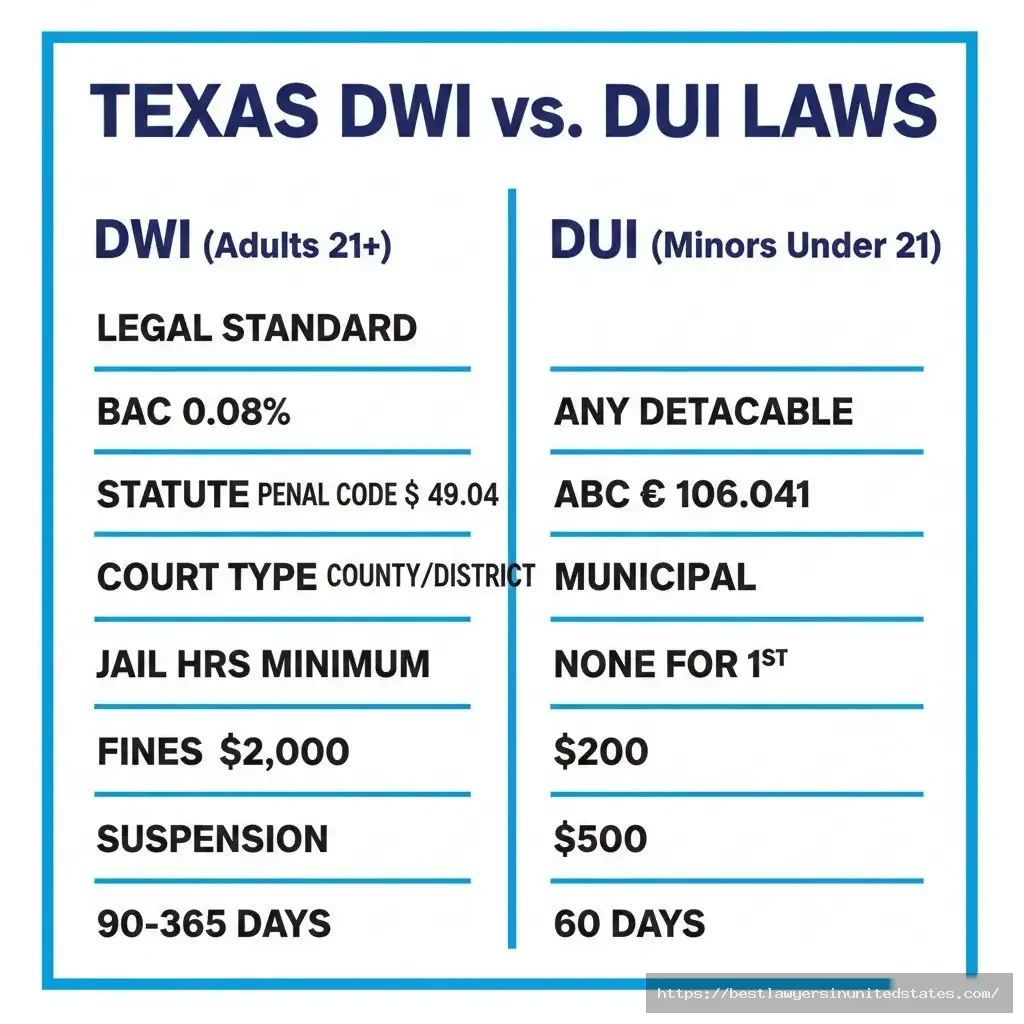
DUI (Driving Under the Influence) applies exclusively to drivers under 21 under Texas Alcoholic Beverage Code § 106.041. Texas enforces zero tolerance—any detectable alcohol in a minor’s system triggers DUI charges.
| Category | DWI (Adults 21+) | DUI (Minors Under 21) |
|---|---|---|
| Legal Standard | BAC 0.08% or impaired | Any detectable alcohol |
| Statute | Penal Code § 49.04 | Alcoholic Beverage Code § 106.041 |
| Court Type | County/District Court | Municipal/Justice Court |
| Classification | Criminal (Class B misdemeanor minimum) | Class C misdemeanor |
| Jail Time | 72 hours minimum (1st offense) | None for 1st offense |
| Fines | Up to $2,000 (1st) | Up to $500 |
| License Suspension | 90-365 days | 60 days (1st), 120 days (2nd) |
Critical point: A minor with BAC 0.08% or higher faces both DUI and DWI charges simultaneously. The DWI (adult) charge carries much harsher penalties.
Which Is Worse in Texas?
DWI is significantly worse than DUI. DWI requires mandatory jail time, creates a permanent criminal record, and costs $5,000-$15,000 total. DUI for minors carries no jail time for first offense and costs $500-$2,000.
However, minors caught with BAC 0.08% or higher get charged with both offenses and face the full DWI penalties plus additional DUI consequences.
Texas BAC Limits: Know the Legal Threshold
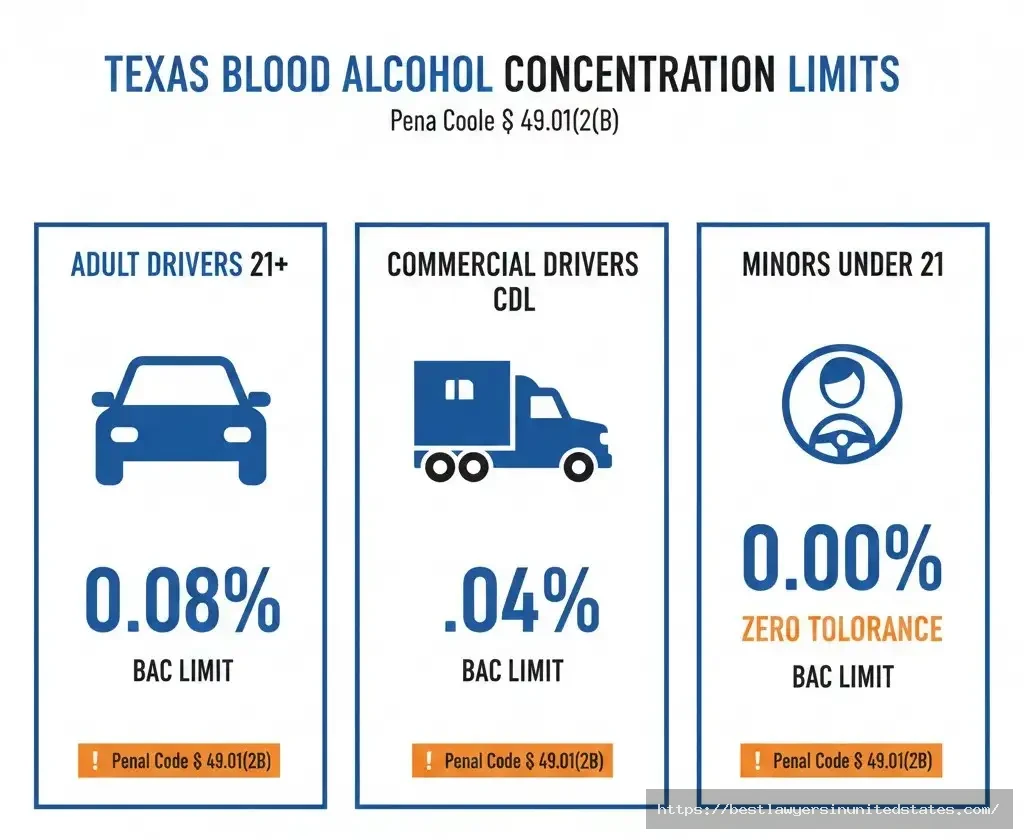
Texas sets different blood alcohol concentration limits based on driver age and license type. Knowing your specific limit helps you understand when you’re legally intoxicated.
Standard BAC Limits by Driver Type
| Driver Category | Legal BAC Limit | Texas Statute |
|---|---|---|
| Adult Drivers (21+) | 0.08% | Penal Code § 49.01(2)(B) |
| Commercial Drivers (CDL) | 0.04% | Federal regulations |
| Minors (Under 21) | 0.00% (zero tolerance) | Alcoholic Beverage Code § 106.041 |
| School Bus Drivers | 0.04% | Transportation Code |
How Many Drinks Equal 0.08% BAC?
Most adults reach 0.08% BAC after 2-3 standard drinks consumed within one hour. However, BAC varies significantly based on:
Factors affecting BAC:
- Body weight (lighter people reach 0.08% faster)
- Gender (women typically reach higher BAC than men at same weight)
- Food consumption (empty stomach increases BAC)
- Drinking speed (rapid consumption spikes BAC)
- Metabolism rate (varies by individual)
Estimate your BAC: Use our BAC calculator to estimate your blood alcohol level based on drinks consumed, body weight, and time elapsed. Remember—this tool provides estimates only. The only way to know your exact BAC is through official testing.
BAC Calculator
Estimate your Blood Alcohol Content
• Commercial Driver (CDL): 0.04% BAC
• Drivers Under 21: 0.00-0.02% BAC (Zero Tolerance)
• Enhanced Penalties: 0.15% BAC or higher in most states
Enhanced Penalties at 0.15% BAC
Texas law escalates DWI from Class B to Class A misdemeanor when your BAC reaches 0.15% or higher under Penal Code § 49.04(d). This doubles your maximum jail time from 180 days to one year and increases fines to $4,000.
Quick comparison:
- BAC 0.08%-0.149%: Class B misdemeanor (up to 180 days jail)
- BAC 0.15% or higher: Class A misdemeanor (up to 1 year jail)
Texas DWI Penalties: First, Second, and Third Offense
Texas DWI penalties escalate sharply with each conviction. Understanding the specific consequences helps you prepare for what’s ahead.
First DWI Offense in Texas
Classification: Class B misdemeanor (Penal Code § 49.04(b))
| Penalty Type | First Offense |
|---|---|
| Jail Time | 72 hours to 180 days (mandatory 72-hour minimum) |
| Fines | Up to $2,000 |
| License Suspension | 90 days to 1 year |
| Annual Surcharge | N/A (Driver Responsibility Program repealed 2019) |
| DWI Education | 12-hour course required |
| Community Service | 24-100 hours |
Enhanced first offense penalties:
- Open container present: 6-day minimum jail (not 72 hours)
- BAC 0.15% or higher: Class A misdemeanor, up to 1 year jail, $4,000 fine
- Child passenger under 15: State jail felony under § 49.045 (see dedicated section)
Is jail time mandatory for first DWI in Texas? Yes. Texas law requires a minimum 72-hour jail sentence for first-time DWI convictions. Judges cannot waive this requirement, though some allow credit for time served during arrest.
Second DWI Offense in Texas
Classification: Class A misdemeanor (Penal Code § 49.09(a))
| Penalty Type | Second Offense |
|---|---|
| Jail Time | 30 days to 1 year (mandatory 30-day minimum) |
| Fines | Up to $4,000 |
| License Suspension | 180 days to 2 years |
| Ignition Interlock | Mandatory for 1 year after reinstatement |
| DWI Education | Required if not completed for first offense |
| Community Service | 80-200 hours |
Critical deadline: Courts must order ignition interlock device installation on all vehicles you own or operate. The device must remain installed for one year after your suspension ends.
Third DWI Offense in Texas
Classification: Third-degree felony (Penal Code § 49.09(b)(2))
| Penalty Type | Third Offense |
|---|---|
| Prison Time | 2 to 10 years Texas Department of Criminal Justice |
| Fines | Up to $10,000 |
| License Suspension | 180 days to 2 years |
| Ignition Interlock | Mandatory (duration varies) |
| Felony Record | Permanent—affects employment, housing, voting, gun rights |
No lookback period: Texas counts all prior DWI convictions regardless of how long ago they occurred. A DWI from 30 years ago still counts toward your third felony charge under § 49.09(g).
DWI Penalty Comparison Table
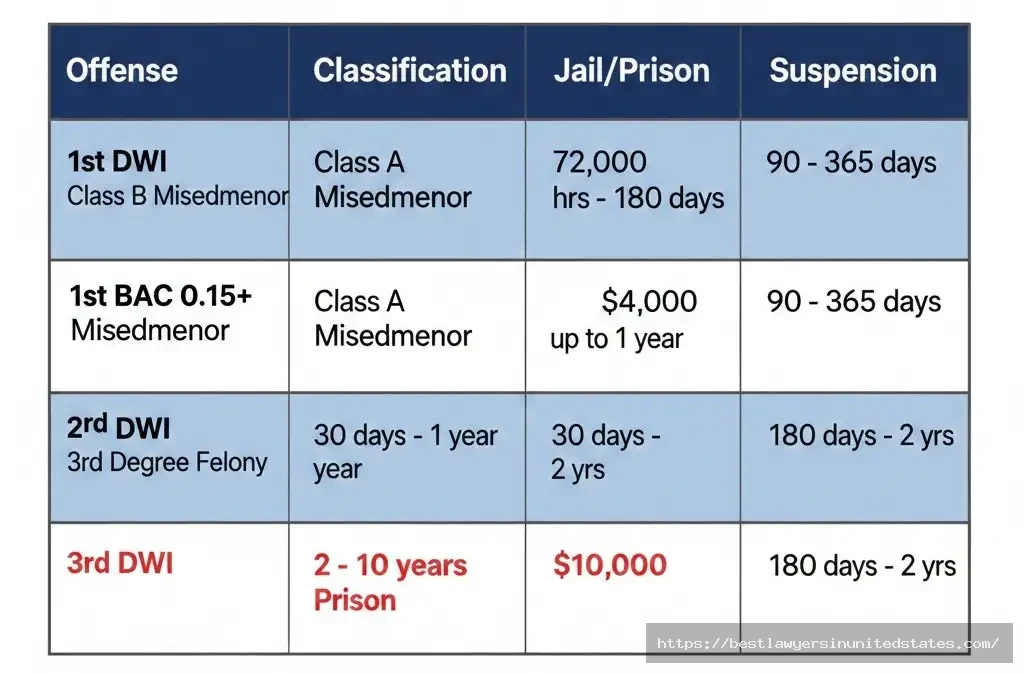
| Offense | Classification | Jail/Prison | Fines | Suspension | Felony Record |
|---|---|---|---|---|---|
| 1st DWI | Class B misdemeanor | 72 hrs – 180 days | $2,000 | 90-365 days | No |
| 1st (BAC 0.15+) | Class A misdemeanor | Up to 1 year | $4,000 | 90-365 days | No |
| 2nd DWI | Class A misdemeanor | 30 days – 1 year | $4,000 | 180 days – 2 yrs | No |
| 3rd DWI | 3rd degree felony | 2-10 years prison | $10,000 | 180 days – 2 yrs | Yes |
| Child passenger | State jail felony | 180 days – 2 yrs | $10,000 | 90-365 days | Yes |
Calculate your total costs: Texas DWI convictions cost far more than court fines alone. Use our DUI cost calculator to estimate your complete financial impact including attorney fees, insurance increases, ignition interlock, and lost wages.
DUI Cost Calculator
Estimate total DUI expenses by state and offense
Detailed Cost Breakdown
Payment Timeline
Bail bond, towing fees, car impound, attorney retainer
Initial court fines, DMV fees, DUI school enrollment, ignition interlock installation
Monthly probation fees, ignition interlock fees, DUI school payments, attorney balance
Insurance premium increases, license reinstatement, SR-22 filing fees
- Lost wages from missed work (court dates, jail time, DUI school) – $2,000-$10,000
- Job loss or difficulty finding employment – Varies
- Professional license suspension (doctors, lawyers, nurses, pilots) – Career ending
- Rideshare and transportation costs during suspension – $1,500-$5,000
- Travel restrictions and visa denials – Varies
- Security clearance loss – Career impact
- Child custody implications – Legal costs
- Rental car restrictions – Varies
- Personal relationships and mental health costs – Priceless
What Are the New Texas DWI Laws for 2026?
Texas legislators passed three major DWI bills during the 89th Legislative Session in 2025. These laws took effect September 1, 2025, and significantly change DWI penalties for specific circumstances.
Senate Bill 826: School Crossing Zone DWI
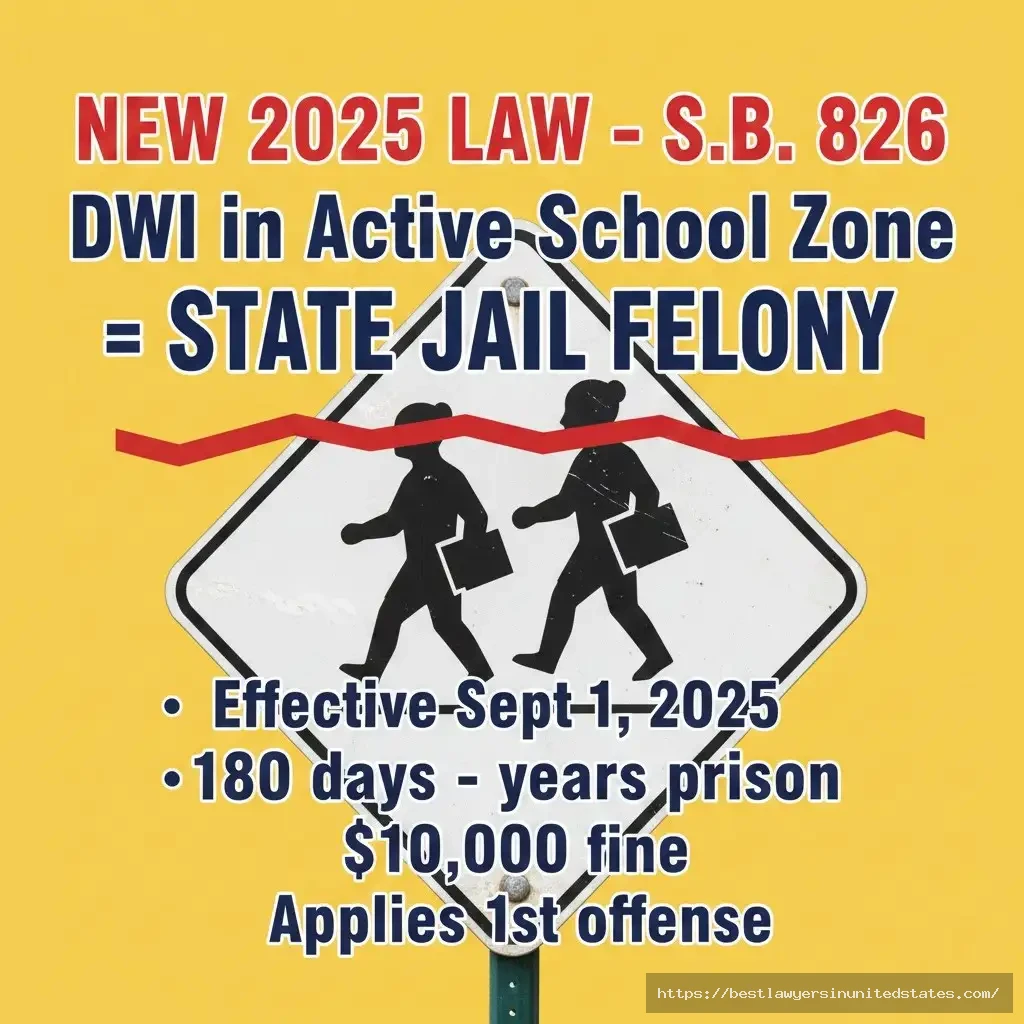
New felony offense: DWI committed in an active school crossing zone automatically becomes a state jail felony under amended Penal Code § 49.04(e).
Key provisions:
- Applies when you operate a vehicle while intoxicated in a designated school crossing zone
- Zone must have reduced speed limit in effect at time of offense
- Penalties: 180 days to 2 years state jail, up to $10,000 fine
- Applies to first-time offenders (no prior DWI required)
What qualifies as a school crossing zone? Texas Transportation Code § 541.302 defines school crossing zones as areas where reduced speed limits apply during school arrival/dismissal times. These zones typically operate 7:00-9:00 AM and 2:00-4:00 PM on school days.
Practical impact: This law turns what would normally be a Class B misdemeanor first DWI into an automatic felony if you’re driving through a school zone during active hours. The felony record follows you permanently.
Senate Bill 745: Multiple Fatality Enhancement
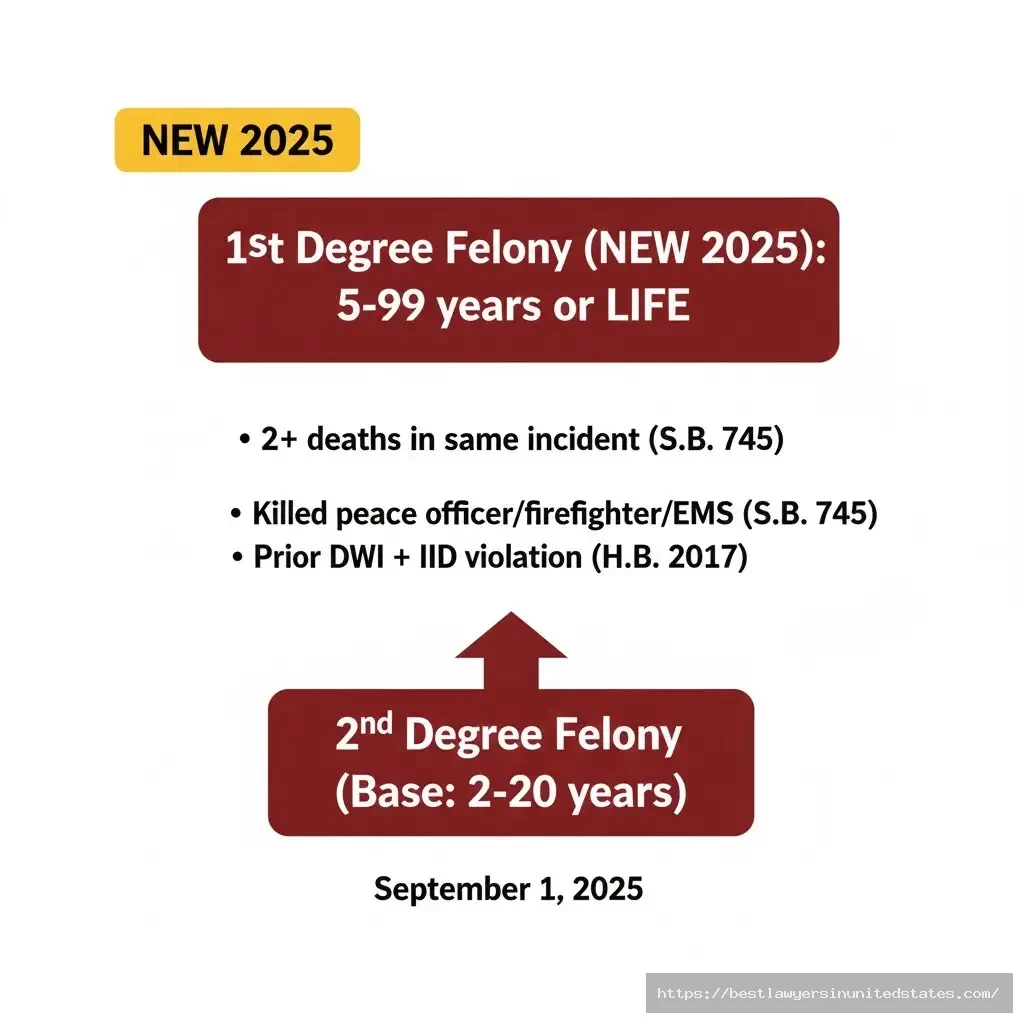
Enhanced intoxication manslaughter: Killing multiple people in a single DWI incident now triggers first-degree felony charges under amended § 49.09(b-2).
Previous law: Intoxication manslaughter was a second-degree felony (2-20 years) regardless of number of victims
New law (effective Sept 1, 2025):
- Killing 2+ people in same incident = first-degree felony
- Penalties: 5-99 years or life in prison
- Applies if victims die in same criminal transaction
This law also enhances penalties when DWI kills peace officers, firefighters, or emergency medical personnel to first-degree felony.
House Bill 2017: Prior Conviction Enhancement
Stricter repeat offender penalties: H.B. 2017 added § 49.09(b-2) language making intoxication manslaughter a first-degree felony if you have any prior intoxication offense and violated ignition interlock requirements during the fatal incident.
Combined effect: These 2025 laws create new felony “trap doors” that turn DWI into serious felonies under specific circumstances. Even first-time offenders face felony charges if caught in school zones.
Can You Refuse a Breathalyzer in Texas?
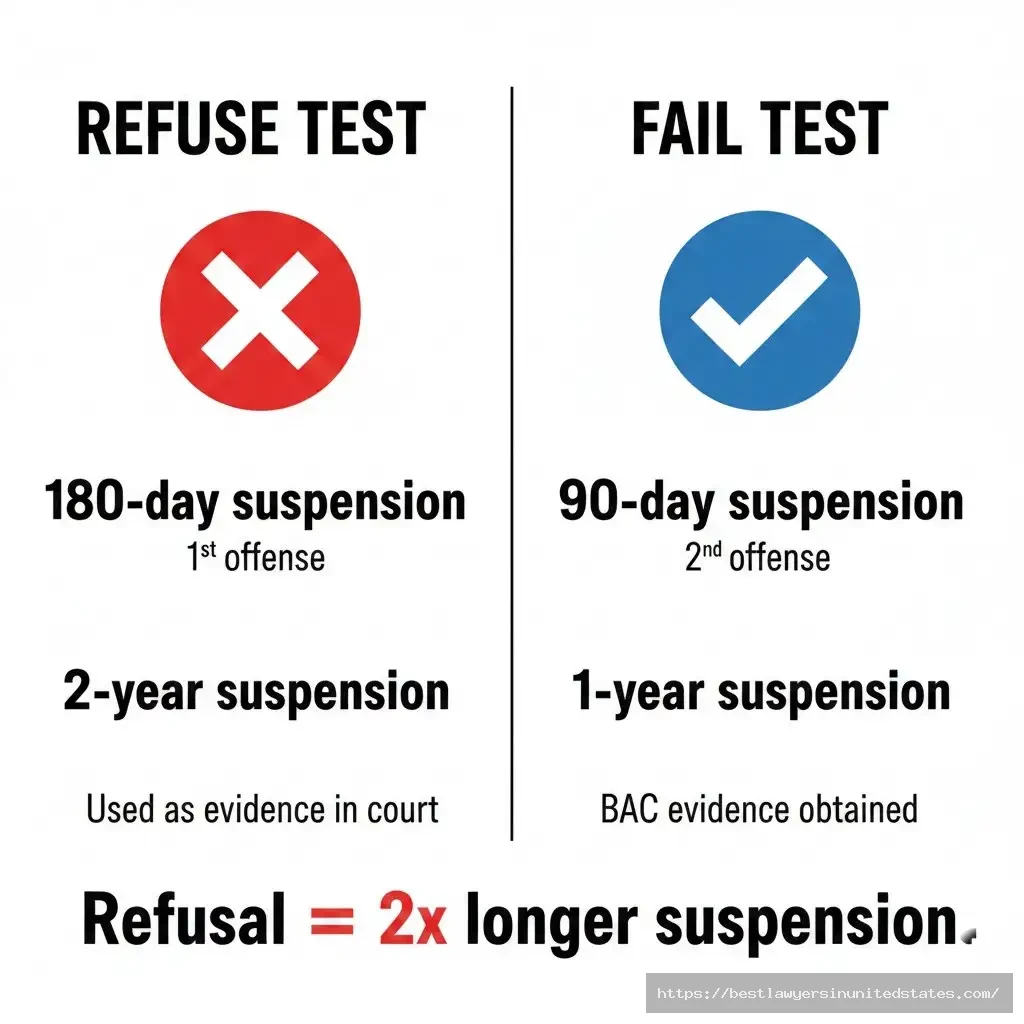
Yes, you can refuse breath, blood, and urine tests in Texas. However, refusal triggers automatic administrative penalties that often exceed the penalties for failing the test.
Texas Implied Consent Law
Texas Transportation Code § 724.011 establishes “implied consent”—by accepting your driver’s license, you automatically consent to chemical testing when arrested for DWI. Officers must read you the statutory warning before requesting a test.
The warning explains:
- Refusing the test suspends your license
- Refusal can be used as evidence against you in court
- You have the right to request additional independent testing
Penalties for Refusing vs. Failing
| Scenario | First Offense | Second Offense |
|---|---|---|
| Refuse breath/blood test | 180-day suspension | 2-year suspension |
| Fail breath/blood test (BAC 0.08+) | 90-day suspension | 1-year suspension |
| Difference | 90 days longer suspension | 1 year longer suspension |
Critical point: Refusing doubles your administrative suspension length compared to failing the test. First refusal = 180 days vs. 90 days for failure.
Can Police Force You to Take a Test?
Officers cannot physically force you to provide breath or blood samples without a warrant. However, Texas law enforcement increasingly obtains warrants for mandatory blood draws in these situations:
When police seek warrants:
- Accidents involving serious injury or death
- Child passengers in the vehicle
- Third or subsequent DWI arrest
- “No Refusal” enforcement periods (holidays, major events)
No Refusal weekends: Major Texas cities including Houston, Dallas, Austin, and San Antonio operate “No Refusal” initiatives during high-risk periods. Officers have magistrates on standby to issue immediate blood draw warrants if you refuse testing.
How Refusal Affects Your Criminal Case
While refusal protects you from providing BAC evidence, prosecutors use the refusal itself against you:
Ways refusal hurts your case:
- Police document refusal in their arrest report
- Prosecutors argue refusal shows “consciousness of guilt”
- Juries often view refusal as admission you knew you were intoxicated
- You lose opportunity to show BAC below 0.08%
One exception: You can request additional independent testing at your own expense after completing the official test. Some defendants use private lab results to challenge the state’s evidence.
Should You Refuse?
This depends on your specific situation. Refusing makes sense if:
- You’re certain your BAC exceeds 0.08% significantly
- You’ve had multiple prior DWI convictions (test results would enhance penalties)
- You can afford the longer suspension period
Refusing makes less sense if:
- You’ve consumed 1-2 drinks and may be under 0.08%
- You have no prior DWI history
- You need your license for work
Consult an attorney: Contact a Texas DWI lawyer immediately after arrest. Many offer free consultations to discuss whether you should submit to testing if given a second opportunity. Find experienced attorneys at [email protected].
Administrative License Revocation (ALR) Hearings in Texas
Texas runs two separate DWI proceedings simultaneously—criminal court handles your DWI charge while the Texas Department of Public Safety (DPS) administers license suspension through the ALR program under Transportation Code Chapter 524.
What Is an ALR Hearing?
Administrative License Revocation (ALR) hearings determine whether DPS can suspend your license based on:
- Refusing a chemical test, OR
- Failing a chemical test (BAC 0.08% or higher)
ALR proceedings are civil, not criminal. You face suspension even if criminal charges are dropped or you’re acquitted at trial.
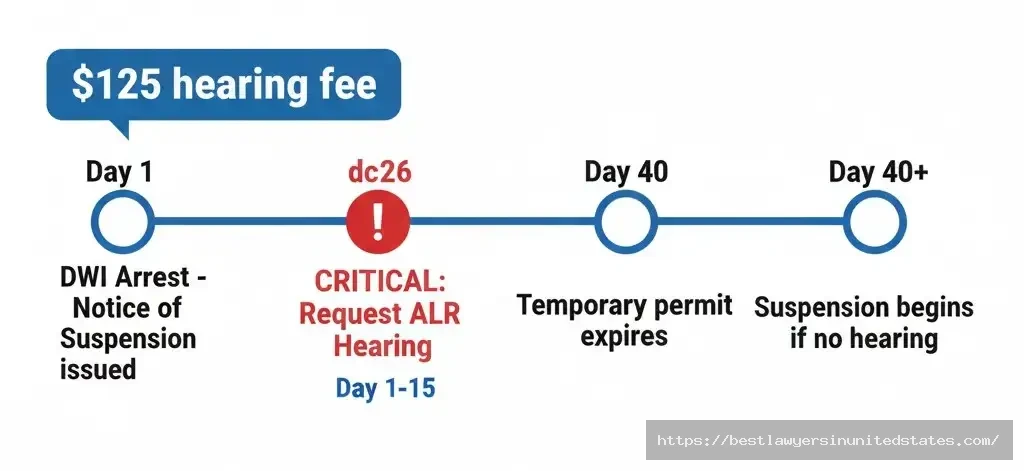
Critical 15-Day Deadline
You have exactly 15 days from arrest to request an ALR hearing. Miss this deadline and your license suspends automatically with no opportunity to contest.
Timeline after DWI arrest:
- Day 1: Officer arrests you and issues Notice of Suspension
- Day 1-15: You must request ALR hearing in writing or online
- Day 40: Temporary driving permit expires if you didn’t request hearing
- Day 40+: Suspension begins if no hearing requested
How to request: Submit online at Texas DPS website or mail request to address on your Notice of Suspension. Include $125 hearing fee.
What Happens at ALR Hearings
ALR hearings typically occur by phone with an Administrative Law Judge (ALJ). Your attorney can represent you without you being present.
The judge decides four issues:
- Probable cause: Did the officer have reasonable suspicion to stop you?
- Lawful arrest: Did the officer have probable cause to arrest you for DWI?
- Proper warning: Did the officer read the implied consent warning?
- Test refusal or failure: Did you refuse testing OR test above 0.08%?
If you win: DPS cannot suspend your license administratively (though criminal suspension may still apply if convicted)
If you lose: Suspension takes effect 30 days after the ALJ decision
ALR Suspension Periods
| Offense | Refusal Suspension | Test Failure Suspension |
|---|---|---|
| First | 180 days | 90 days |
| Second | 2 years | 1 year |
| Under 21 (any BAC) | 60 days (1st), 120 days (2nd) | 60 days (1st), 120 days (2nd) |
| CDL holders | 1 year | 1 year |
Why Request an ALR Hearing Even If You Think You’ll Lose
Three strategic reasons:
- License stays valid longer: Requesting a hearing extends your temporary permit until the hearing occurs (typically 30-120 days)
- Preview the state’s case: Your attorney can cross-examine the arresting officer and discover weaknesses in the DWI case
- Negotiation leverage: Winning the ALR hearing gives you bargaining power in criminal court
Two separate battles: Remember—you fight DWI charges in criminal court AND license suspension through ALR hearings. You can win one and lose the other. Hire an attorney who handles both proceedings simultaneously.
Total Cost of a Texas DWI: Beyond Court Fines
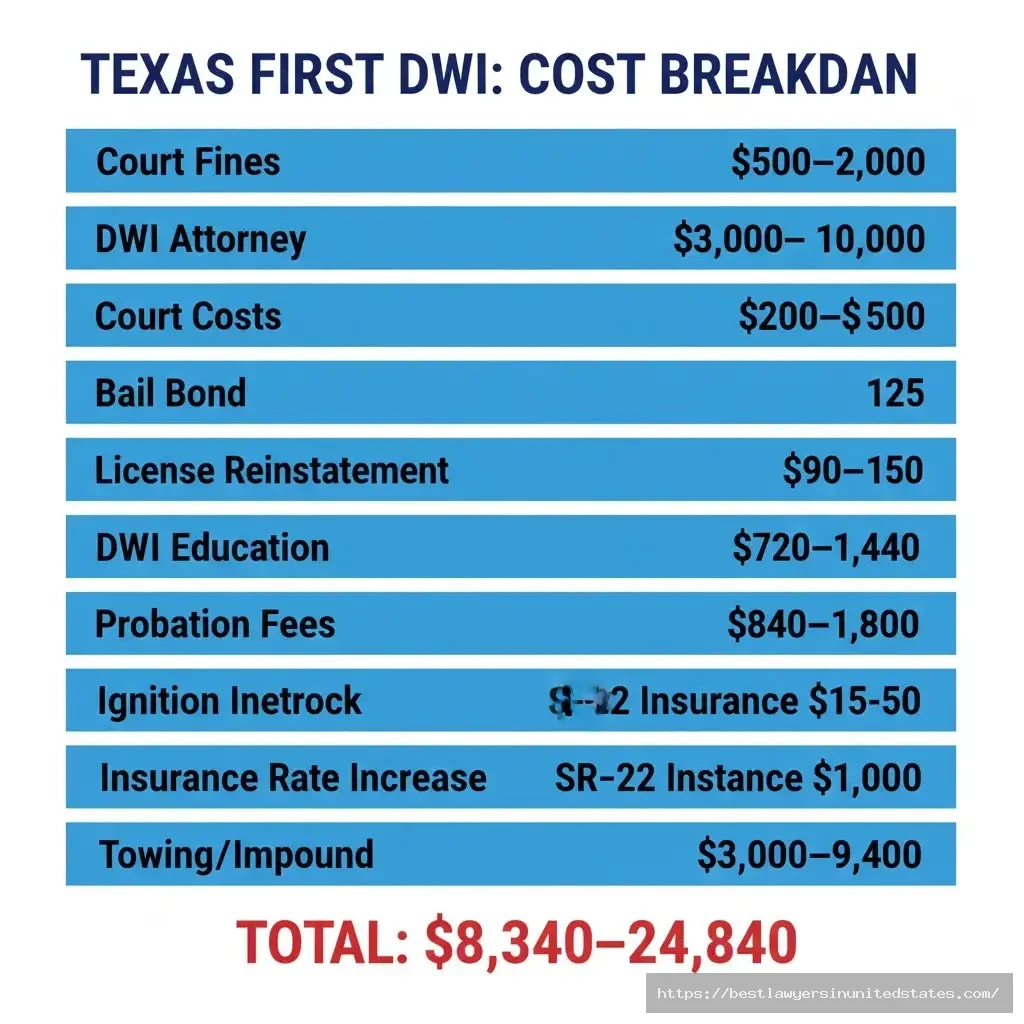
Texas DWI convictions cost $8,000-$24,000+ when you account for all expenses beyond the court fine. Understanding the complete financial impact helps you prepare.
Complete DWI Cost Breakdown (First Offense)
| Expense Category | Cost Range | Details |
|---|---|---|
| Court Fines | $500-$2,000 | Actual fine imposed by judge |
| Court Costs | $200-$500 | Administrative fees, processing |
| DWI Attorney | $3,000-$10,000 | Varies by case complexity, trial |
| Bail Bond | $100-$500 | 10% of bail amount (typically $1,000-$5,000) |
| License Reinstatement | $125 | DPS reinstatement fee |
| DWI Education Course | $90-$150 | 12-hour required course |
| Probation Fees | $60/month × 12-24 months | $720-$1,440 total if on probation |
| Ignition Interlock Device | $70-$150/month × 12 months | $840-$1,800 installation + monitoring |
| SR-22 Insurance Filing | $15-$50/year | 3 years required |
| Insurance Rate Increase | $1,000-$3,000/year × 3 years | $3,000-$9,000 total |
| Towing/Impound | $200-$400 | Vehicle towing and storage |
| Lost Wages | Varies | Court appearances, jail time, job loss |
| TOTAL (First Offense) | $8,340-$24,840 | Not including lost wages |
Second and Third Offense Costs
Second DWI: $12,000-$35,000
- Higher attorney fees ($5,000-$15,000)
- Longer ignition interlock period (1+ years)
- Increased insurance rates (often double first offense)
- Potential job loss from longer jail sentence
Third DWI (Felony): $20,000-$50,000+
- Criminal defense attorney ($10,000-$25,000)
- Lost income during prison sentence (2-10 years)
- Permanent employment limitations from felony record
- Difficulty obtaining housing, professional licenses
Hidden Costs People Forget
Job-related expenses:
- Lost wages during court appearances
- Job termination (especially CDL holders)
- Difficulty finding employment with criminal record
- Professional license suspension (lawyers, nurses, teachers)
Transportation costs:
- Uber/Lyft during suspension ($20-$50/day)
- Occupational license fees and restrictions
- Higher long-term insurance rates (3-5 years)
Calculate your specific costs: Use our DUI cost calculator to estimate your total financial impact based on offense number, BAC level, and whether you hire an attorney.
Cost comparison to other states: Texas DWI costs fall in the middle range nationally. California DUI laws impose higher fines but shorter suspensions, while Arizona DUI laws require mandatory jail time for all offenses including first-time.
DWI with a Child Passenger in Texas
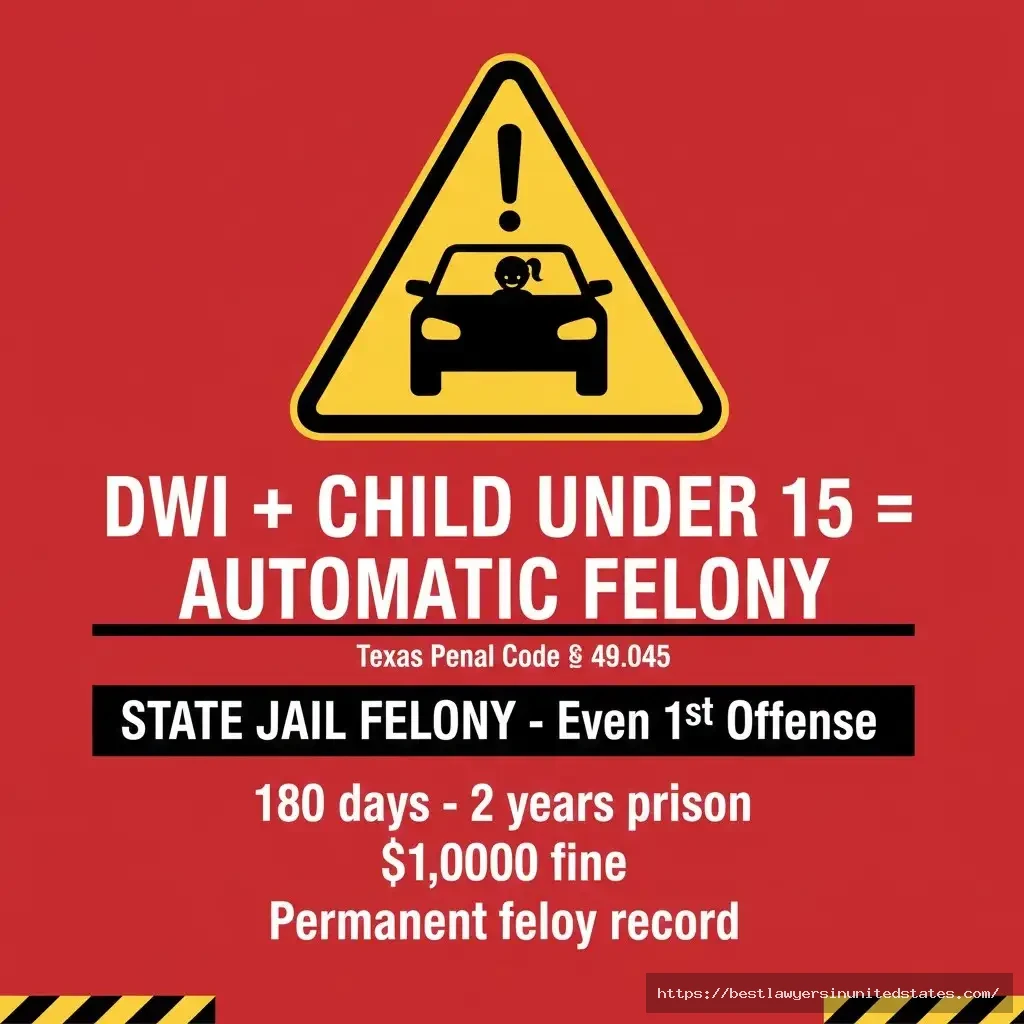
Operating a vehicle while intoxicated with a child passenger under 15 years old triggers automatic felony charges under Penal Code § 49.045—even for first-time offenders with no prior record.
Child Passenger Enhancement Law
Statute: Texas Penal Code § 49.045 (enacted 2003)
Elements required:
- You operated a motor vehicle while intoxicated
- Vehicle contained passenger under 15 years old
- No prior DWI convictions necessary
Classification: State jail felony (not misdemeanor)
Penalties for DWI with Child Passenger
| Penalty Type | State Jail Felony (§ 49.045) |
|---|---|
| Prison Time | 180 days to 2 years Texas state jail |
| Fines | Up to $10,000 |
| License Suspension | 90 days to 1 year |
| Felony Record | Permanent |
| Child Protective Services | Possible CPS investigation |
Applies even if: The child is your own son or daughter. Texas law makes no exception for parents.
Why Texas Created This Law
Texas legislators passed § 49.045 after several high-profile cases where intoxicated drivers killed child passengers. The law aims to protect children who cannot make decisions about entering vehicles with impaired drivers.
Critical difference from standard DWI:
- First DWI (no child): Class B misdemeanor, 72 hours jail minimum
- First DWI (child under 15 present): State jail felony, 180 days minimum
Defenses to Child Passenger Charges
Your attorney may challenge § 49.045 charges by proving:
- Child was 15 or older (prosecution must prove age)
- You were not actually intoxicated
- Child was not a “passenger” (legal definition disputes)
- Illegal stop or arrest violated your rights
Contact an attorney immediately: Child passenger DWI cases carry severe consequences. Find experienced Texas DWI lawyers who handle felony cases at [email protected] for a free consultation.
Texas Ignition Interlock Device (IID) Requirements
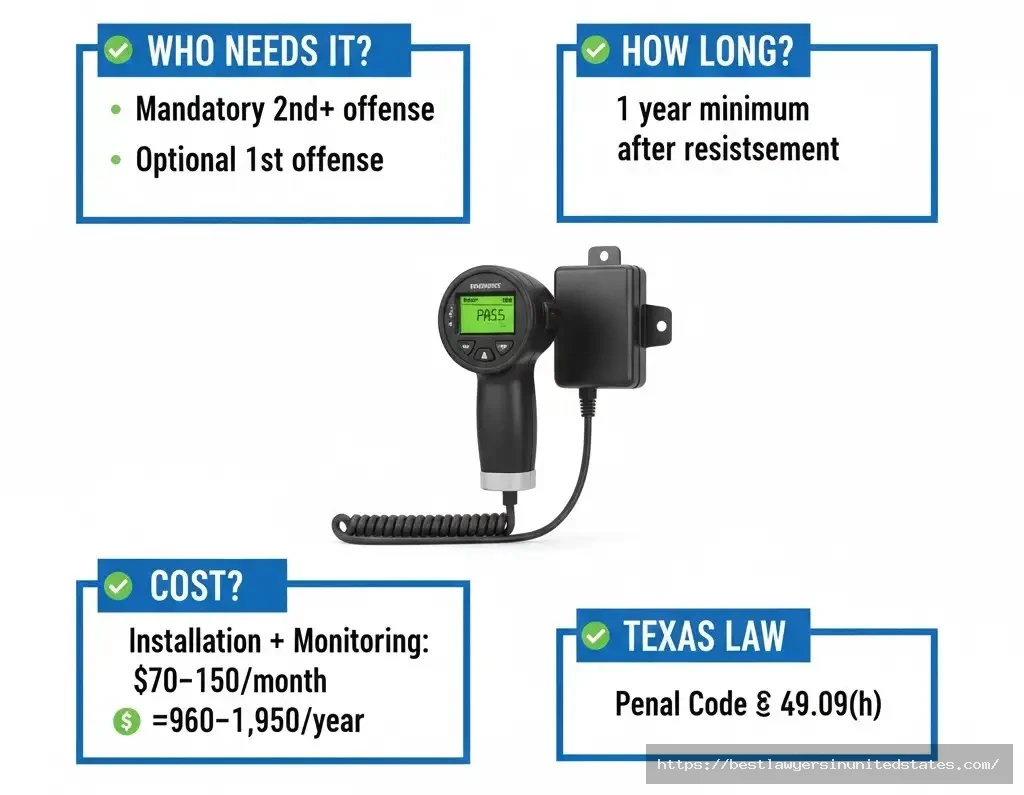
Texas courts can order ignition interlock device installation as a condition of probation for first offense DWI, and must order it for second and subsequent offenses under Penal Code § 49.09(h).
What Is an Ignition Interlock Device?
An ignition interlock device (IID)—officially called a “deep-lung breath analysis device” in Texas law—connects to your vehicle’s ignition system. You must blow into the device before starting the engine. The device prevents the engine from starting if it detects alcohol on your breath.
How it works:
- Blow into device before starting vehicle
- Device analyzes breath for alcohol
- Engine starts only if BAC is below programmed limit (typically 0.025%)
- Random “rolling retests” required while driving
- Device logs all attempts (including fails) and reports to probation officer
Who Must Install an IID in Texas?
Mandatory installation:
- Second or subsequent DWI conviction (§ 49.09(h))
- First offense DWI with deferred adjudication (judge’s discretion)
- Occupational license holders (required to drive during suspension)
Optional installation:
- First offense DWI (judge may order as probation condition)
IID Installation and Monitoring Costs
| Cost Type | Amount | Payment Schedule |
|---|---|---|
| Installation | $70-$150 | One-time |
| Monthly Monitoring | $70-$150 | Every month IID required |
| Calibration | $0-$25 | Every 60 days |
| Removal | $50-$100 | One-time |
| Total (1 year) | $960-$1,950 | Installation + 12 months monitoring |
Low-income assistance: Texas law requires IID providers to offer reduced rates if you qualify based on income under Transportation Code § 521.2476.
How Long Must You Keep the IID?
Minimum periods by offense:
- First offense (if ordered): 6-12 months
- Second offense: 1 year after license reinstatement
- Third offense: Varies (often 2+ years)
Critical point: The one-year requirement for second offense begins AFTER your suspension ends, not during. If you have a one-year suspension plus one-year IID requirement, you cannot drive unrestricted for two full years total.
Violating IID Requirements
Violations include:
- Starting vehicle without blowing into device
- Failing a test (alcohol detected)
- Attempting to tamper with or remove device
- Missing scheduled calibration appointments
Consequences:
- Extended IID requirement period
- Probation violation (possible jail time)
- Additional criminal charges (tampering)
Texas DPS-Approved IID Vendors
Texas Department of Public Safety maintains a list of approved ignition interlock device vendors at DPS IID Vendor List. Only install devices from approved vendors or the court may not accept it.
Major cities with IID vendors:
- Houston: Multiple vendors throughout Harris County
- Dallas: Vendors in Dallas and Tarrant Counties
- San Antonio: Bexar County providers
- Austin: Travis and Williamson County locations
Occupational Driver’s License in Texas
Texas allows drivers with suspended licenses to obtain occupational licenses for essential driving needs under Transportation Code § 521.242. This lets you drive to work, school, and necessary appointments during your suspension period.
What Is an Occupational License?
An occupational license (also called “essential need license”) permits you to drive for specific purposes during your suspension. You must petition the court and prove you need to drive for essential needs.
Eligible essential needs:
- Driving to and from work
- Driving for your job (if required)
- Attending school or educational programs
- Transporting yourself or family to medical appointments
- Attending court-ordered programs (DWI education, AA meetings)
Who Qualifies for an Occupational License?
You can petition for an occupational license if:
- Your license is currently suspended (not revoked)
- You have not been convicted of certain disqualifying offenses
- You can prove essential need to drive
- You maintain SR-22 insurance
Disqualifying factors:
- Multiple DWI convictions within short period
- DWI causing serious injury or death
- Leaving scene of accident involving injury
- Outstanding warrants or unpaid fines
How to Get an Occupational License in Texas
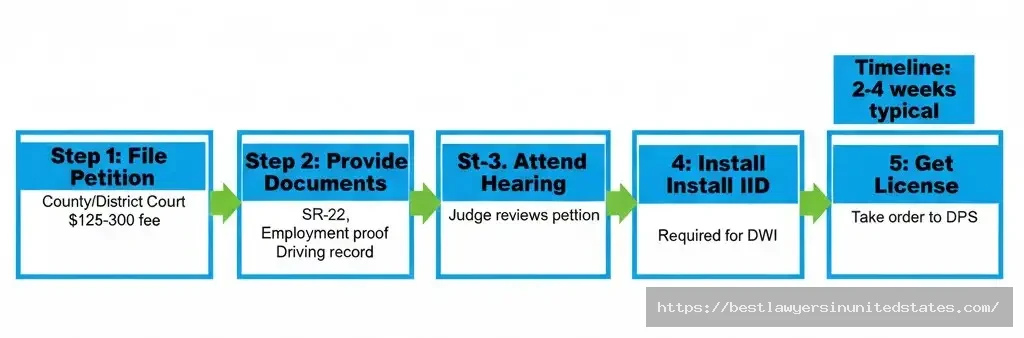
Step-by-step process:
- File petition: Submit “Petition for Occupational License” to county court or district court where you live
- Pay filing fee: $125-$300 (varies by county)
- Provide documentation:
- Proof of employment or school enrollment
- SR-22 insurance certificate
- Driving record abstract from DPS
- Written verification from employer
- Attend hearing: Judge reviews your petition (often granted same day in many counties)
- Order ignition interlock: Install IID on all vehicles you will drive (required for DWI-related suspensions)
- Obtain license: Take court order to Texas DPS office to get restricted license
Timeline: Most petitions are processed within 2-4 weeks if you have all documents ready.
Restrictions on Occupational Licenses
Your court order specifies:
- Days of week you can drive (e.g., Monday-Friday)
- Hours you can drive (e.g., 6:00 AM – 8:00 PM)
- Specific routes or locations permitted
- Zero tolerance for alcohol (IID required)
Violating restrictions: Driving outside your permitted times or locations can result in:
- Occupational license revocation
- Additional criminal charges
- Extended suspension period
Occupational License Costs
| Expense | Amount |
|---|---|
| Court filing fee | $125-$300 |
| Attorney fee (optional) | $500-$1,500 |
| SR-22 insurance | $15-$50/year filing fee + increased premiums |
| Ignition interlock | $70-$150/month (DWI-related suspensions) |
| DPS license issuance | $10 |
| Total (first year) | $1,500-$3,000+ |
Do you need an attorney? While not required, attorneys familiar with your local court can expedite the process and ensure your petition meets all requirements. Many Texas DWI attorneys include occupational license petitions as part of their representation.
DWI for Minors (Under 21) in Texas
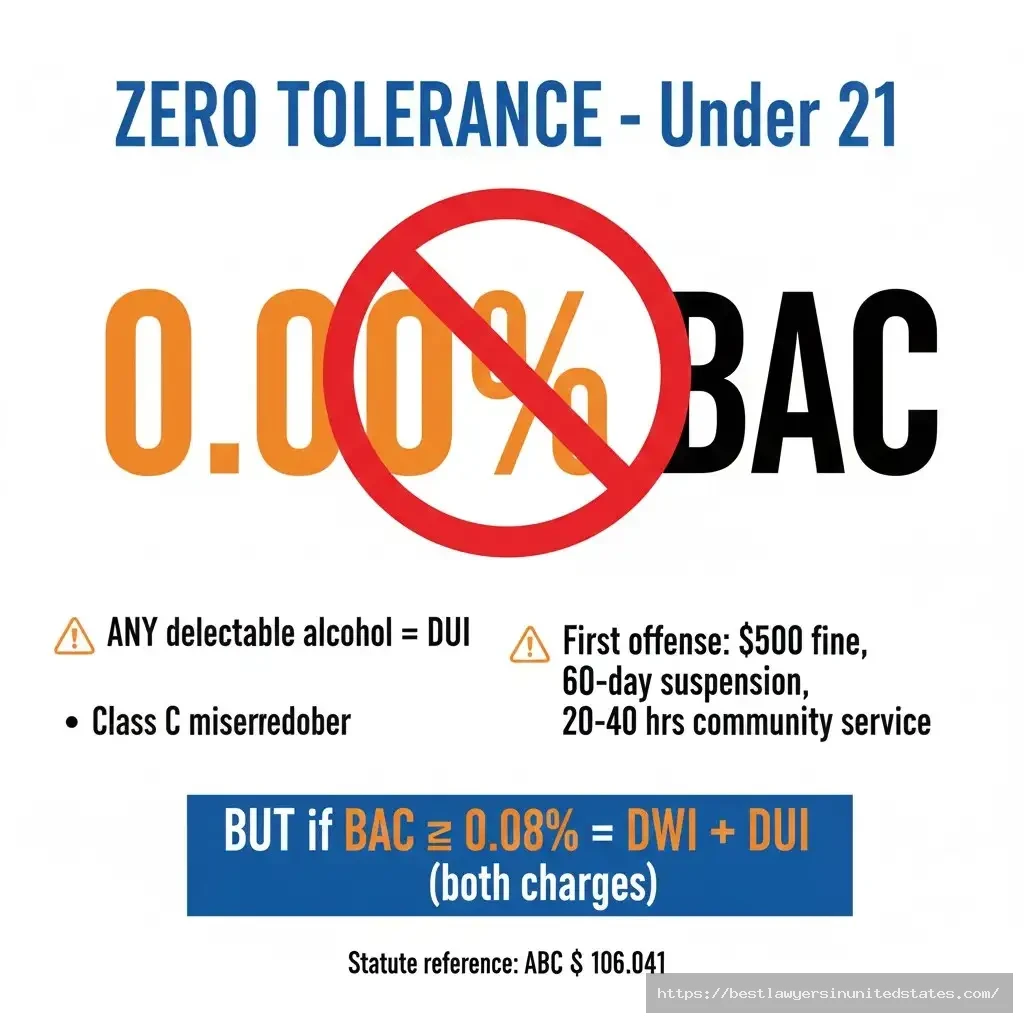
Texas enforces zero tolerance for drivers under 21 through the Texas Alcoholic Beverage Code § 106.041. Any detectable amount of alcohol in a minor’s system triggers DUI charges.
Zero Tolerance Law Explained
Under Texas law, you commit DUI as a minor if:
- You are under 21 years old
- You operate a motor vehicle in a public place
- You have ANY detectable amount of alcohol in your system
No 0.08% threshold for minors: Unlike adult DWI (which requires 0.08% BAC), minor DUI applies if your BAC registers 0.01% or higher—the equivalent of less than one drink.
Minor DUI Penalties (First Offense)
Classification: Class C misdemeanor
| Penalty Type | First DUI (Under 21) |
|---|---|
| Jail Time | None for first offense |
| Fine | Up to $500 |
| License Suspension | 60 days (automatic) |
| Community Service | 20-40 hours |
| Alcohol Awareness Course | Required |
| Criminal Record | Yes (misdemeanor) |
Minor DUI Penalties (Second and Third Offense)
Second offense:
- Fine: Up to $500
- License suspension: 120 days
- Community service: 40-60 hours
- Alcohol awareness course (if not completed)
Third offense (or more):
- Fine: $500-$2,000
- License suspension: 180 days
- Alcohol awareness class requirement
- Possible additional penalties
When Minors Face Adult DWI Charges
Minors with BAC 0.08% or higher get charged with both:
- DUI (Class C misdemeanor under Alcoholic Beverage Code)
- DWI (Class B misdemeanor under Penal Code)
This triggers full adult DWI penalties:
- 72-hour mandatory jail time
- Up to $2,000 fine
- Up to 180-day suspension
- Permanent criminal record
Critical point: A 20-year-old with BAC 0.10% faces both Class C DUI AND Class B DWI simultaneously. The penalties stack—you face both sets of consequences.
Impact on College and Future Opportunities
Minor DUI convictions create lasting consequences beyond legal penalties:
College implications:
- Required disclosure on college applications
- Loss of scholarships and financial aid
- Suspension from athletic teams
- Housing restrictions in dormitories
Employment barriers:
- Background checks reveal misdemeanor conviction
- Professional licenses may be denied (nursing, teaching)
- Military enlistment complications
- Some employers have zero-tolerance policies
Getting a Minor DUI Expunged
Texas allows expungement of minor DUI convictions under certain conditions after you turn 21. To qualify:
- You must be at least 21 years old
- You completed all court requirements
- You have no other convictions
- Waiting period has passed
Consult an attorney: Expungement removes the conviction from your public record. Speak with a Texas criminal defense lawyer about whether you qualify.
Intoxication Assault and Intoxication Manslaughter
Texas treats DWI crashes that cause injury or death as separate, more serious felonies under Penal Code §§ 49.07 and 49.08.
Intoxication Assault (§ 49.07)
You commit intoxication assault when you operate a vehicle while intoxicated and, by reason of that intoxication, cause serious bodily injury to another person.
“Serious bodily injury” means:
- Substantial risk of death
- Serious permanent disfigurement
- Protracted loss or impairment of any bodily organ or member
Classification: Third-degree felony
Penalties:
- Prison: 2-10 years
- Fine: Up to $10,000
- License suspension: 90 days to 1 year
- Restitution to victim
Enhanced penalties: Second-degree felony (2-20 years) if victim is peace officer, firefighter, or emergency medical personnel injured in line of duty.
Intoxication Manslaughter (§ 49.08)
You commit intoxication manslaughter when you operate a vehicle while intoxicated and, by reason of that intoxication, cause the death of another person by accident or mistake.
Classification: Second-degree felony (base offense)
Base penalties:
- Prison: 2-20 years
- Fine: Up to $10,000
- License suspension: 180 days to 2 years
- Restitution to victim’s family
2025 Enhanced Intoxication Manslaughter Penalties
First-degree felony enhancements (added by S.B. 745 and H.B. 2017):
Intoxication manslaughter becomes a first-degree felony (5-99 years or life) if:
- You killed 2 or more people in the same incident, OR
- You killed a peace officer, firefighter, or EMS personnel in line of duty, OR
- You had prior intoxication convictions AND violated ignition interlock requirements during the fatal crash
Example scenario: If you cause a crash while intoxicated that kills a family of three, you face first-degree felony charges with potential life sentence under the new 2025 laws.
How These Cases Are Prosecuted
Prosecutors must prove:
- You operated a motor vehicle
- You were intoxicated (BAC 0.08+ or impaired faculties)
- Your intoxication caused the injury or death
- The injury meets “serious bodily injury” definition OR death occurred
“By reason of that intoxication”: Prosecutors must show your intoxication was a cause of the crash, not just that you were intoxicated when it happened. This creates defense opportunities if other factors contributed (weather, other driver’s negligence, mechanical failure).
Defending Intoxication Assault/Manslaughter Charges
Common defenses:
- Challenge causation (something other than intoxication caused crash)
- Contest BAC test results
- Argue injury doesn’t meet “serious bodily injury” standard (assault only)
- Challenge probable cause for stop or arrest
These are serious felonies: If you face intoxication assault or manslaughter charges, hire an experienced Texas criminal defense attorney immediately. These cases often go to trial and require expert witnesses. Contact [email protected] for attorney referrals.
Can a First-Time DWI Be Dismissed in Texas?
Texas prosecutors dismiss approximately 5-10% of DWI cases based on legal or evidentiary problems. While dismissal is possible, you need valid legal grounds—not just being a first-time offender.
Common Grounds for DWI Dismissal
1. No probable cause for traffic stop
Officers must have reasonable suspicion of illegal activity to stop your vehicle. Invalid reasons include:
- “Routine” stops without specific violation
- Stops based solely on leaving a bar parking lot
- Anonymous tips without corroboration
If the stop was illegal: All evidence gathered afterward (including BAC test results) gets suppressed under the exclusionary rule.
2. No probable cause for DWI arrest
Officers need probable cause to arrest you for DWI—mere suspicion isn’t enough. Weak probable cause includes:
- Only one failed field sobriety test
- No driving behavior observed (parked car)
- Conflicting officer statements
- Medical conditions mimicking intoxication
3. Faulty breathalyzer results
Breathalyzer machines require strict maintenance and calibration. Your attorney may challenge results based on:
- Improper calibration (Texas requires 90-day checks)
- Operator certification expired
- 15-minute observation period not followed
- Medical conditions affecting results (GERD, diabetes)
- Residual mouth alcohol from recent drinking
4. Unreliable field sobriety tests
Standardized field sobriety tests (HGN, walk-and-turn, one-leg stand) have accuracy rates of only 65-77% according to NHTSA studies. Tests may be unreliable due to:
- Medical conditions (knee problems, inner ear issues)
- Age (people over 65 struggle with balance tests)
- Improper test administration by officer
- Unsafe testing conditions (uneven surface, poor lighting)
5. Blood draw violations
Texas law requires proper procedures for blood draws. Violations include:
- No warrant and no valid exception
- Unqualified person drew blood
- Chain of custody problems
- Lab testing errors or contamination
Realistic Chances of Dismissal
When dismissal is most likely:
- Clear constitutional violations (illegal stop/arrest)
- Prosecutor cannot prove you drove the vehicle
- BAC test results are unreliable or suppressed
- Key witnesses unavailable (officer left department)
When dismissal is unlikely:
- High BAC (0.15%+) with no testing problems
- You admitted drinking to officer
- Multiple failed field sobriety tests
- Accident with injuries
Alternative Outcomes Besides Dismissal
If dismissal isn’t possible, your attorney may negotiate:
Deferred adjudication: Complete probation and the case dismisses (but counts as conviction for DWI enhancement purposes per § 49.09(g))
Reduced charges: Prosecutors may reduce DWI to obstruction of highway if case has serious weaknesses
Pretrial diversion: Some counties offer first-offender programs (Harris County, Dallas County)
Do You Need an Attorney for First DWI?
Yes. Texas DWI cases involve complex legal and scientific issues. An experienced attorney can:
- Identify constitutional violations you wouldn’t spot
- Challenge BAC test results with expert witnesses
- Negotiate better plea deals
- Keep your record clean or minimize penalties
Attorney costs for first DWI: $3,000-$10,000 depending on whether case goes to trial. Compare this to total DWI costs of $8,000-$24,000—good representation often saves money by reducing penalties.
Find experienced Texas DWI defense attorneys at [email protected] for free case evaluations.
Boating While Intoxicated (BWI) in Texas
Texas Penal Code § 49.06 makes it illegal to operate a watercraft while intoxicated—the same standard as DWI but on water instead of roads.
What Is BWI in Texas?
You commit Boating While Intoxicated when you operate a watercraft while:
- Having BAC of 0.08% or higher, OR
- Not having normal use of mental or physical faculties due to alcohol, drugs, or other substances
“Watercraft” includes:
- Motorized boats and jet skis
- Sailboats
- Kayaks and canoes (when under influence)
- Water skis and aquaplanes
- Any device used to transport people on water
BWI Penalties Match DWI
| Offense | Classification | Jail | Fine | Consequences |
|---|---|---|---|---|
| 1st BWI | Class B misdemeanor | 72 hrs – 180 days | $2,000 | Boating safety course |
| 2nd BWI | Class A misdemeanor | 30 days – 1 year | $4,000 | Enhanced penalties |
| 3rd BWI | 3rd degree felony | 2-10 years | $10,000 | Felony record |
| BWI with child under 15 | State jail felony | 180 days – 2 years | $10,000 | Automatic felony |
Critical point: BWI penalties exactly mirror DWI penalties under § 49.09. A third BWI is a felony just like a third DWI.
Does BWI Affect Your Driver’s License?
No automatic suspension: BWI convictions don’t trigger automatic driver’s license suspension like DWI does—Texas Parks and Wildlife Department, not DPS, handles boating licenses.
However: BWI counts as a prior intoxication offense if you later get charged with DWI under § 49.09(c)(3). A BWI followed by a DWI means your second intoxication offense, triggering Class A misdemeanor penalties.
Where Texas Enforces BWI
Major enforcement areas:
- Lake Travis (Austin area)
- Lake Texoma (Texas/Oklahoma border)
- Lake Conroe (Houston area)
- Canyon Lake (San Antonio area)
- Galveston Bay and Gulf Coast
- Padre Island National Seashore
Peak enforcement periods: Memorial Day, July 4th, Labor Day weekends when Texas Parks and Wildlife wardens conduct “DWI on the Water” patrols.
BWI Testing and Refusal
Texas implied consent law (§ 724.011) applies to watercraft operators. If arrested for BWI, you face the same testing requirements and refusal penalties as DWI:
- Refusing test = 180-day driver’s license suspension (yes, even for boating)
- Officers can obtain warrants for blood draws
- Portable breath tests used on boats
Defending BWI Charges
BWI defenses mirror DWI defenses:
- Challenge probable cause for stop
- Contest field sobriety tests (harder to perform on moving boat)
- Question BAC test accuracy
- Prove you weren’t “operating” the vessel
Unique BWI defense: “Operation” requires you to be in control of the watercraft. Passengers drinking on a boat don’t commit BWI unless they’re at the controls.
Hiring a Texas DWI Lawyer: When You Need One
Texas DWI cases involve complex criminal law, administrative proceedings, and scientific evidence. Experienced legal representation significantly improves your outcome.
When You Should Hire a DWI Attorney
Hire an attorney immediately if:
- Your BAC tested 0.15% or higher (Class A misdemeanor)
- You have prior DWI convictions (felony risk)
- The case involves an accident, injury, or death
- Child passenger was in vehicle (automatic felony)
- You’re a CDL holder (career at stake)
- You refused chemical testing
- You were arrested in a school zone
You may handle it yourself if:
- First offense with BAC barely over 0.08%
- No aggravating factors
- You’re prepared to accept standard plea deal
Reality check: Even “simple” first DWI cases cost $8,000-$24,000 in total expenses. Attorneys often reduce this through dismissals, reduced charges, or avoiding convictions entirely.
What Texas DWI Lawyers Do
Criminal defense:
- Challenge illegal stops and arrests
- Suppress improperly obtained evidence
- Contest BAC test results with expert witnesses
- Negotiate reduced charges or dismissals
- Represent you at trial if needed
ALR hearings:
- Request hearing within 15-day deadline
- Cross-examine arresting officer
- Fight to keep your license
- Use hearing to preview state’s evidence
Occupational license:
- Prepare petition for essential need license
- Represent you at hearing
- Ensure you can drive during suspension
How Much Do Texas DWI Lawyers Cost?
| Service Level | Cost Range | What’s Included |
|---|---|---|
| Basic representation | $3,000-$5,000 | Plea negotiation, ALR hearing, occupational license |
| Full representation | $5,000-$10,000 | Above plus motion practice, pretrial hearings |
| Trial representation | $10,000-$25,000 | Everything plus jury trial, expert witnesses |
| Felony DWI | $10,000-$50,000 | Complex cases, intoxication assault/manslaughter |
Payment plans: Most Texas DWI attorneys offer payment plans. Expect to pay $1,500-$3,000 down and monthly installments.
Questions to Ask DWI Attorneys
Before hiring, ask:
- “How many DWI cases have you handled in [your county]?”
- Want: 100+ cases, familiar with local prosecutors and judges
- “What percentage of your practice is DWI defense?”
- Want: 50%+ focus on DWI/criminal defense
- “Will you handle both my criminal case and ALR hearing?”
- Want: Yes (some attorneys only do one or the other)
- “Have you handled cases with [your specific circumstances]?”
- Examples: High BAC, refusal, child passenger, accident
- “What are the possible outcomes in my case?”
- Want: Realistic assessment, not guarantees
Free Consultations
Most Texas DWI attorneys offer free initial consultations. Use these to:
- Get honest assessment of your case
- Understand possible outcomes
- Compare attorney fees and experience
- Decide if you need representation
Find experienced Texas DWI lawyers: Contact [email protected] for referrals to qualified attorneys in your county who offer free consultations.
Compare to other states: Florida DUI laws and Georgia DUI laws have different penalty structures and may be more or less harsh than Texas depending on circumstances.
Frequently Asked Questions About Texas DWI Laws
Is jail time mandatory for first DWI in Texas?
Yes. Texas Penal Code § 49.04(b) requires a minimum 72-hour jail sentence for first-time DWI convictions. Judges cannot waive this requirement. The minimum increases to 6 days if you had an open container in the vehicle.
Some counties allow credit for time served during arrest, meaning if you spent 72 hours in jail after arrest, you may not serve additional time after conviction. However, probation terms often include jail time as condition of probation.
What’s worse: DUI or DWI in Texas?
DWI is significantly worse. DWI is a criminal misdemeanor (or felony) with mandatory jail time, fines up to $2,000-$10,000, and permanent criminal record. DUI applies only to minors under 21 and is a Class C misdemeanor with no jail time for first offense and maximum $500 fine.
However, minors with BAC 0.08% or higher face both DUI AND DWI charges simultaneously, triggering full adult DWI penalties.
How many drinks equal 0.08% BAC?
Most adults reach 0.08% BAC after 2-3 standard drinks within one hour. However, this varies significantly based on:
- Body weight (lighter people reach 0.08% faster)
- Gender (women typically reach higher BAC than men at same weight)
- Food consumption (drinking on empty stomach increases BAC)
- Metabolism rate
Use our BAC calculator for personalized estimates based on your weight, gender, and drinks consumed. Remember—this is an estimate only, not a guarantee you’re under the legal limit.
Can I refuse a breathalyzer in Texas?
Yes, but refusal triggers 180-day license suspension (first offense) compared to 90 days if you take and fail the test. Your refusal can also be used as evidence against you in court, and prosecutors argue it shows “consciousness of guilt.”
Additionally, Texas officers increasingly obtain warrants for mandatory blood draws during “No Refusal” enforcement periods, especially on holidays and weekends.
What happens if I fail an ALR hearing?
Your license suspends 30 days after the Administrative Law Judge’s decision. Suspension lengths are:
- First offense (failed test): 90 days
- First offense (refusal): 180 days
- Second offense (failed test): 1 year
- Second offense (refusal): 2 years
You can petition for an occupational license to drive for essential needs (work, school, medical) during your suspension.
Is a first DWI a felony in Texas?
No, unless aggravating factors apply. Standard first DWI is a Class B misdemeanor. First DWI becomes a felony if:
- Child passenger under 15 was in vehicle (state jail felony under § 49.045)
- DWI occurred in active school crossing zone (state jail felony under § 49.04(e))
- You caused serious bodily injury (intoxication assault, third-degree felony)
How much does a Texas DWI lawyer cost?
$3,000-$10,000 for first offense depending on case complexity. Costs increase to $10,000-$25,000 if the case goes to trial. Felony DWI cases (intoxication assault, manslaughter) cost $10,000-$50,000+.
Most attorneys offer payment plans. Calculate whether attorney fees are worth it by comparing to total DWI costs of $8,000-$24,000—attorneys often reduce costs through dismissals or reduced charges.
Can I get a DWI expunged in Texas?
Only if your case was dismissed or you were acquitted. Texas does not allow expungement of DWI convictions. However, you may be eligible for:
Expungement (complete removal):
- Case dismissed
- You were acquitted at trial
- Charges never filed after arrest
Non-disclosure (sealed from public):
- First offense DWI with deferred adjudication
- Successfully completed probation
- No other convictions
- Waiting period passed (2-5 years)
What is the lookback period for DWI in Texas?
Texas has no lookback period. All prior DWI convictions count toward enhancement penalties regardless of how long ago they occurred under Penal Code § 49.09(g). A DWI from 30 years ago still counts as your first conviction if you get arrested today, making the new charge a second DWI (Class A misdemeanor).
This differs from many states that only count convictions within 5-10 years.
Do I need SR-22 insurance after a DWI?
Yes. Texas requires you to file SR-22 (certificate of financial responsibility) for 2 years after DWI conviction before you can reinstate your license. Your insurance company files the SR-22 with Texas DPS.
SR-22 filing costs $15-$50/year, but your insurance rates increase $1,000-$3,000/year for 3-5 years after DWI—the real cost of SR-22 is the higher premiums, not the filing fee.
Can I get a DWI while parked?
Yes. Texas law requires only that you “operate” a motor vehicle while intoxicated—not that you’re actively driving. Courts define “operation” as exercising control over the vehicle.
You can be convicted of DWI while:
- Sitting in driver’s seat with keys in ignition (even if engine off)
- Sleeping in driver’s seat with keys in pocket
- Attempting to start the vehicle
Exception: Sitting in back seat with keys out of reach typically doesn’t qualify as “operation.”
What happens if I get a DWI with a CDL?
Commercial driver’s license (CDL) holders face harsher consequences:
- 1-year CDL disqualification (first offense)
- Lifetime CDL disqualification (second offense)
- BAC limit is 0.04% (not 0.08%) when operating commercial vehicle
- DWI in personal vehicle still triggers CDL suspension
Most CDL holders lose their jobs after first DWI even if they eventually get standard driver’s license back—employers rarely keep drivers with DWI history.
How long does a DWI stay on my record in Texas?
Forever—Texas DWI convictions are permanent. They cannot be expunged or removed from your criminal record. The conviction appears on background checks for employment, housing, professional licenses, and more.
Non-disclosure (sealing from public but not law enforcement) may be available for first-time deferred adjudication cases after a waiting period.
Take Action After a Texas DWI Arrest
Texas DWI charges carry serious consequences—mandatory jail time, thousands in costs, license suspension, and permanent criminal records. Understanding your rights and legal options protects your future.
Critical deadlines to remember:
- 15 days: Request ALR hearing or lose license automatically
- 48 hours: Arraignment (first court appearance)
- 72 hours: Minimum jail time if convicted (first offense)
What to do now:
- Contact a Texas DWI attorney immediately—most offer free consultations and can start protecting your rights within 24 hours
- Request ALR hearing within 15 days—this keeps your license valid longer and gives your attorney time to prepare
- Don’t discuss your case—anything you say to police, friends, or family can be used against you
- Gather evidence—write down everything you remember about the stop, arrest, and testing
- Calculate your costs—use our DUI cost calculator to understand the full financial impact
Get legal help: Find experienced Texas DWI defense attorneys who understand local courts and prosecutors. Email [email protected] for referrals to qualified lawyers in your county offering free case evaluations.
Texas DWI laws changed significantly in 2025 with new school zone felonies and enhanced manslaughter penalties. Don’t face these charges alone—protect your rights, your license, and your future with experienced legal representation.
