
Getting charged with a DUI in Tennessee triggers serious consequences that start immediately. Tennessee’s 2024 law changes made penalties stricter—the aggravated DUI threshold dropped from .15% to .12% BAC, mandatory jail time now applies to all first offenses, and automatic work release was eliminated. This guide covers everything you need to know about Tennessee’s DUI laws, from arrest to court to getting your license back.
Tennessee law defines DUI broadly under Tennessee Code Annotated (TCA) § 55-10-401. You can face DUI charges even with a BAC under .08% if officers prove impairment.
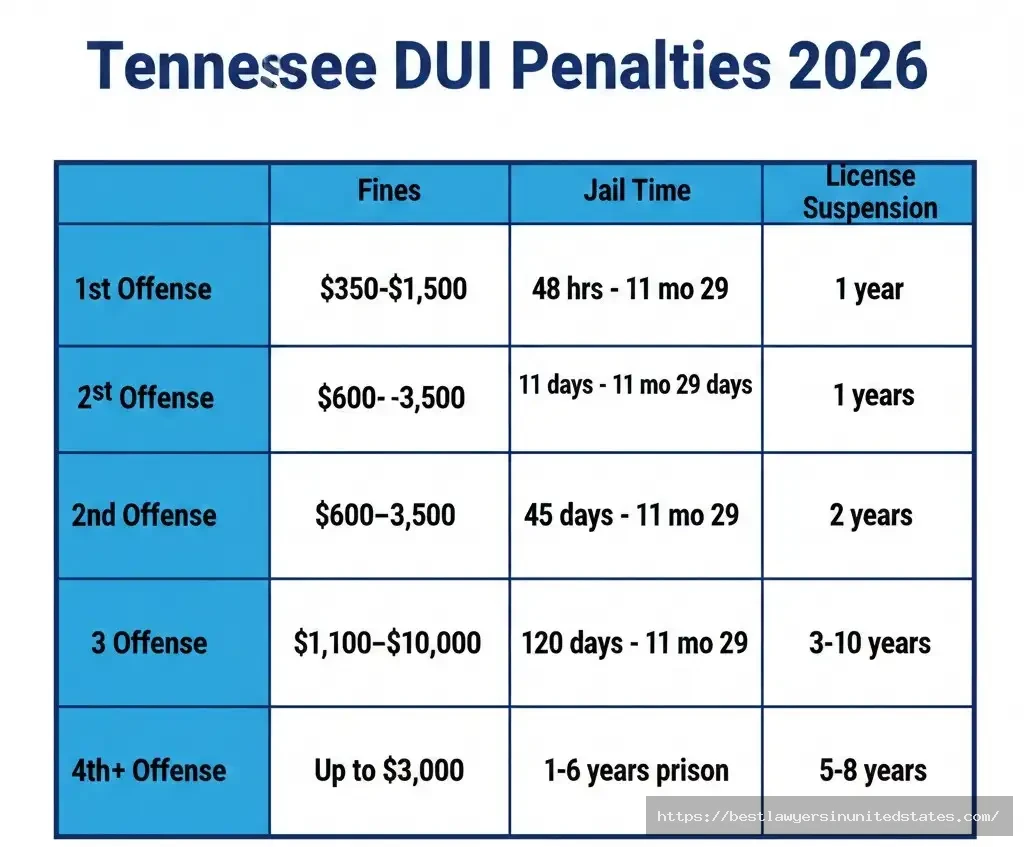
Quick Answer: First-offense DUI in Tennessee carries 48 hours to 11 months jail time, $350-$1,500 in fines, one-year license suspension, and mandatory ignition interlock. Second and third offenses bring harsher mandatory minimums, and a fourth DUI becomes a Class E felony.
What Constitutes a DUI in Tennessee?
Tennessee Code Annotated § 55-10-401 makes it illegal to drive while under the influence of alcohol, drugs, or any substance that impairs your ability to safely operate a vehicle. The state prosecutes DUI cases in two ways: per se violations (BAC at or above legal limit) and impairment-based violations (any observable impairment regardless of BAC).
You can face DUI charges with a BAC under .08% if an officer documents signs of impairment. Tennessee courts have upheld convictions based on field sobriety test failures, erratic driving, slurred speech, and other behavioral evidence—even when breath tests show BAC levels below the legal limit.
Tennessee’s “Sober DUI” Law Explained
Tennessee’s unique approach lets prosecutors charge you with DUI based solely on impairment evidence. This “sober DUI” provision means drivers can face conviction without any BAC test results. Officers rely on field sobriety tests, dashcam footage, and their observations of your behavior.
Critical point: Refusing a breathalyzer doesn’t prevent DUI charges in Tennessee. Prosecutors can still prove impairment through officer testimony and other evidence.
Types of Impairment Under Tennessee Law
Tennessee DUI laws cover multiple types of impairment:
- Alcohol impairment: Any BAC level with visible impairment, or .08% and above
- Drug impairment: Illegal drugs, prescription medications, over-the-counter drugs
- Combined impairment: Alcohol mixed with any drugs, even legal medications
- Marijuana impairment: THC in any detectable amount with signs of impairment
Important: Tennessee has no safe harbor for prescription medications. Taking prescribed painkillers, anxiety medications, or sleep aids doesn’t protect you from DUI charges if they impair your driving. Similar strict DUI laws apply in neighboring states like North Carolina and Georgia.
Tennessee BAC Limits & Zero-Tolerance Laws
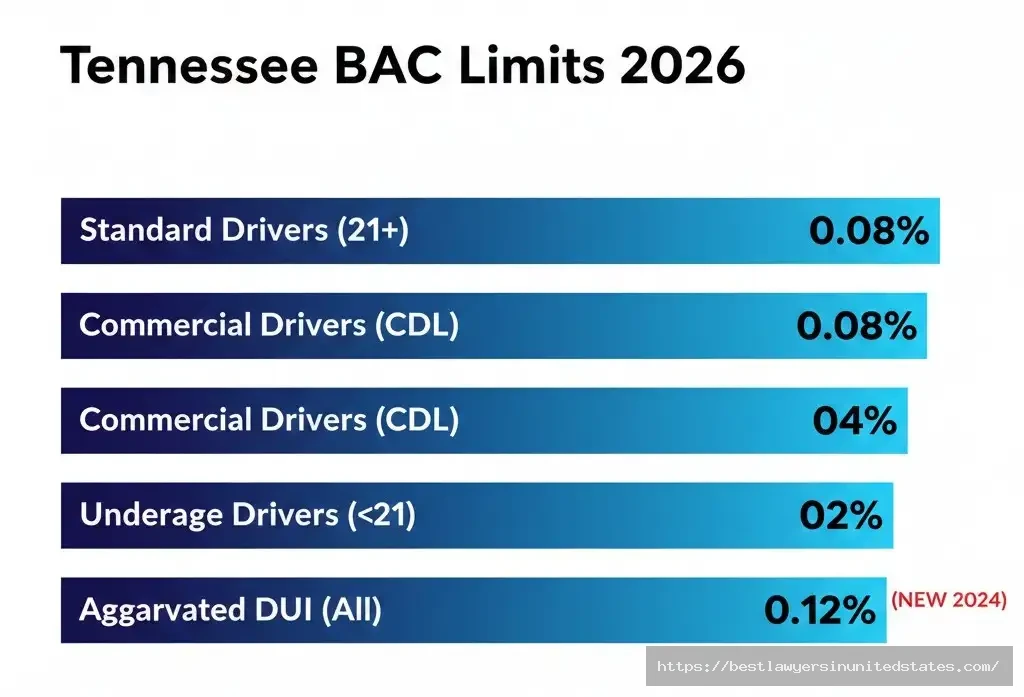
Tennessee sets different BAC limits based on driver age and license type. These limits determine when per se DUI charges apply automatically.
| Driver Category | Legal BAC Limit | Violation Type |
|---|---|---|
| Standard drivers (21+) | .08% | Per se DUI |
| Commercial drivers (CDL) | .04% | Per se DUI |
| Underage drivers (under 21) | .02% | Zero-tolerance violation |
| Aggravated DUI (all drivers) | .12% | Enhanced penalties |
Tennessee’s New .12% Aggravated DUI Threshold
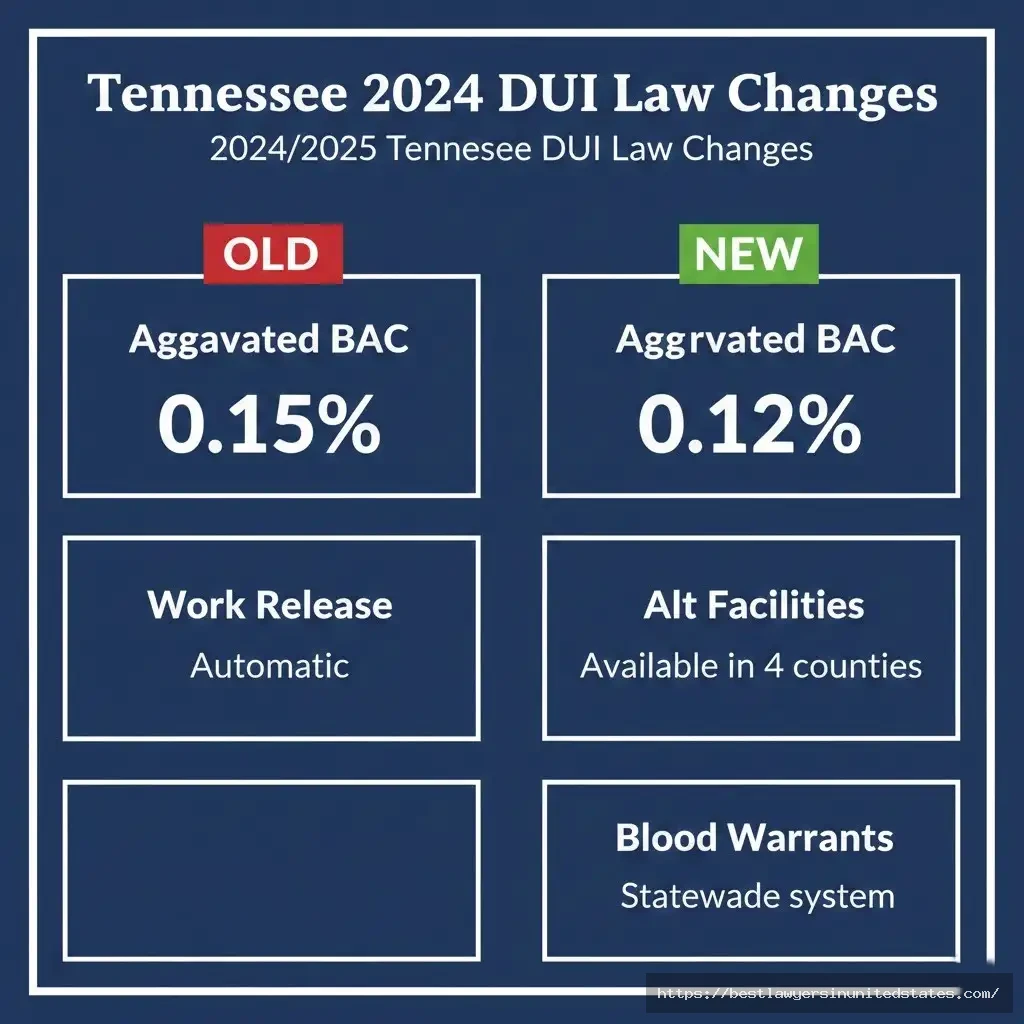
Starting in 2024, Tennessee lowered the aggravated DUI threshold from .15% to .12% BAC. This change means more DUI arrests now trigger enhanced penalties, longer jail sentences, and higher fines.
Testing your current BAC level helps you understand Tennessee’s limits. Use our BAC Calculator to estimate your blood alcohol concentration based on drinks consumed, body weight, and time elapsed.
BAC Calculator
Estimate your Blood Alcohol Content
• Commercial Driver (CDL): 0.04% BAC
• Drivers Under 21: 0.00-0.02% BAC (Zero Tolerance)
• Enhanced Penalties: 0.15% BAC or higher in most states
Key numbers to remember:
- Standard limit: .08% BAC triggers automatic DUI charges
- Aggravated threshold: .12% BAC adds enhanced penalties
- Commercial drivers: .04% BAC ends your CDL career temporarily
- Underage drivers: .02% BAC violates zero-tolerance law
Zero-Tolerance Law for Underage Drivers
Tennessee enforces strict zero-tolerance rules for drivers under 21. Any detectable alcohol (.02% BAC or higher) triggers automatic penalties, even if you show no signs of impairment.
Underage DUI consequences:
- License suspension until age 21 or one year, whichever is longer
- Mandatory alcohol safety school
- Community service requirements
- Delayed full license eligibility
Tennessee Implied Consent Law
Tennessee’s implied consent law (TCA § 55-10-406) means you automatically agree to chemical testing when you operate a vehicle. This consent applies the moment you accept your Tennessee driver’s license. Officers can request breath, blood, or urine tests after a lawful DUI arrest.
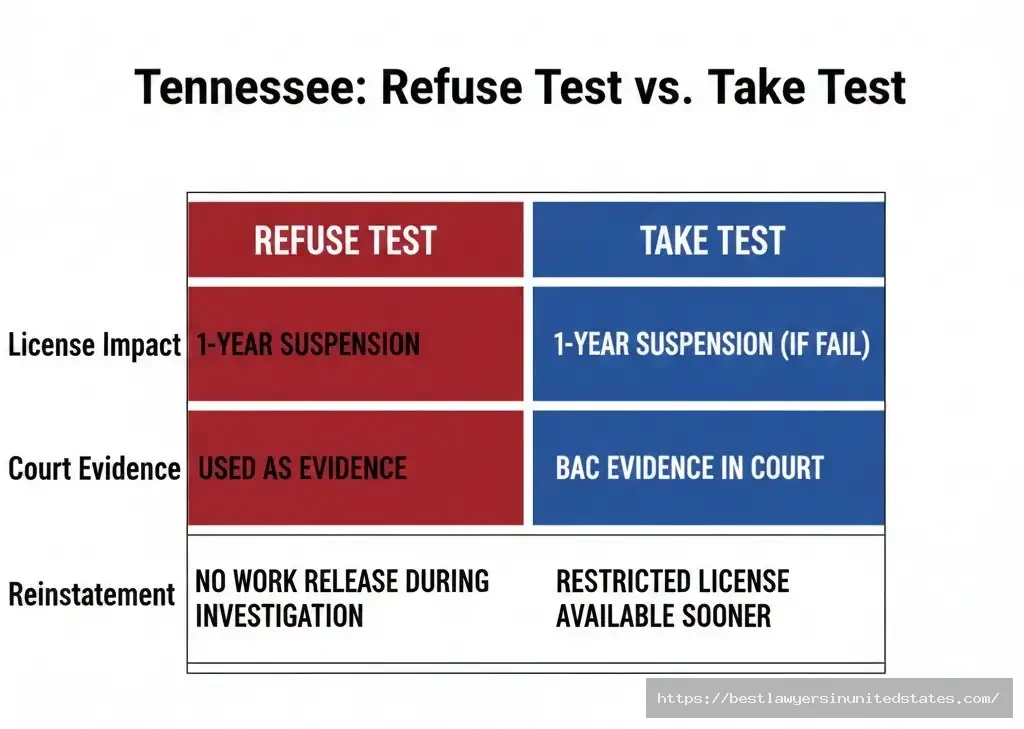
What Happens When You Refuse Testing?
Refusing a chemical test triggers immediate administrative penalties separate from any criminal DUI charges. The Tennessee Department of Safety and Homeland Security imposes these suspensions automatically.
| Offense | Refusal Penalty | Test Failure Penalty |
|---|---|---|
| 1st refusal | 1-year suspension | 1-year suspension |
| 2nd refusal | 2-year suspension | 2-year suspension |
| 3rd+ refusal | 3-year suspension | Varies by conviction |
Critical difference: Refusal penalties and test failure penalties are identical in Tennessee, unlike states such as Kentucky where refusal brings harsher consequences.
Can Police Force You to Take a Test?
Tennessee officers cannot physically force you to provide a breath sample. However, they can obtain a warrant for a blood draw in cases involving:
- Serious injury or death
- Child passengers in the vehicle
- Prior DUI convictions
- Aggravated DUI circumstances
2024 update: Tennessee’s new statewide blood draw warrant system lets officers obtain electronic warrants within minutes during no-refusal enforcement periods.
Independent Testing Rights
Tennessee law (TCA § 55-10-408) gives you the right to additional chemical testing at your own expense after police complete their testing. Many defendants use independent lab results to challenge the accuracy of police breathalyzer or blood test results.
You must request independent testing immediately. Delays of several hours can make results unreliable for comparison purposes.
2024/2025 Tennessee DUI Law Changes
Tennessee enacted major DUI law reforms in 2024 through the Tennessee Prevention of Drunk Driving Act. These changes affect every DUI arrest moving forward.
Lower Aggravated DUI Threshold (.15% → .12%)
The most significant change drops the aggravated DUI BAC threshold from .15% to .12%. This means thousands more drivers each year now face enhanced penalties for what Tennessee considers “high BAC” offenses.
Impact: A driver who previously avoided aggravated charges with a .14% BAC now faces:
- Longer mandatory minimum jail time
- Higher fines
- Extended license suspension
- Mandatory alcohol treatment programs
Elimination of Automatic Work Release
Tennessee’s 2024 reforms eliminated automatic work release eligibility for first-time DUI offenders. Previously, judges routinely granted work release, letting defendants serve their 48-hour minimum sentence while maintaining employment.
What this means: First-time offenders now serve their minimum 48 hours in custody without automatic work release. Judges retain discretion to grant work release, but it’s no longer guaranteed.
Alternative Incarceration Facilities
The new law creates alternative incarceration facility options in select Tennessee counties. These facilities offer structured environments with alcohol education and treatment programs as an alternative to county jail.
Available in: Davidson, Shelby, Knox, and Hamilton counties (expanding to additional counties in 2026)
Eligibility requirements:
- First or second offense only
- No accident with injury
- BAC under .20%
- Judge approval required
Statewide Blood Draw Search Warrants
Tennessee implemented an electronic warrant system for DUI blood draws. Officers can now obtain search warrants for blood tests through a centralized system within 15-30 minutes during no-refusal enforcement periods.
No-refusal periods in Tennessee:
- New Year’s Eve/Day
- Super Bowl Sunday
- St. Patrick’s Day
- Memorial Day weekend
- Fourth of July weekend
- Labor Day weekend
- Thanksgiving weekend
- December holiday period
Enhanced Treatment Program Requirements
First-time offenders now face mandatory alcohol and drug assessment before sentencing. Judges must consider assessment results when determining appropriate treatment programs and monitoring requirements.
Tennessee’s Recovery Court system expanded to 45 additional counties in 2024, offering intensive supervision and treatment as an alternative to traditional sentencing.
Tennessee DUI Penalties by Offense
Tennessee DUI penalties escalate rapidly with each conviction. Courts look at your DUI history over the past 10 years when determining which penalties apply.
First Offense DUI
Tennessee mandates harsh minimum penalties even for first-time offenders. Judges have discretion to impose penalties up to the maximum ranges shown.
Jail time: 48 hours minimum to 11 months, 29 days maximum Fines: $350-$1,500 License suspension: 1 year Ignition interlock: Mandatory for restricted license DUI school: 10-hour minimum alcohol safety program Probation: Typically 11 months, 29 days
2024 update: First offenders no longer receive automatic work release during the mandatory 48-hour minimum sentence.
The total financial impact of a first offense typically ranges from $4,000 to $15,000 when you include all costs. Calculate your specific costs using our DUI Cost Calculator to estimate fines, fees, insurance increases, and other expenses.
DUI Cost Calculator
Estimate total DUI expenses by state and offense
Detailed Cost Breakdown
Payment Timeline
Bail bond, towing fees, car impound, attorney retainer
Initial court fines, DMV fees, DUI school enrollment, ignition interlock installation
Monthly probation fees, ignition interlock fees, DUI school payments, attorney balance
Insurance premium increases, license reinstatement, SR-22 filing fees
- Lost wages from missed work (court dates, jail time, DUI school) – $2,000-$10,000
- Job loss or difficulty finding employment – Varies
- Professional license suspension (doctors, lawyers, nurses, pilots) – Career ending
- Rideshare and transportation costs during suspension – $1,500-$5,000
- Travel restrictions and visa denials – Varies
- Security clearance loss – Career impact
- Child custody implications – Legal costs
- Rental car restrictions – Varies
- Personal relationships and mental health costs – Priceless
Second Offense DUI (Within 10 Years)
Second DUI convictions carry substantially harsher mandatory minimums than first offenses. Tennessee courts show little leniency for repeat offenders.
Jail time: 45 days minimum to 11 months, 29 days maximum (minimum 45 consecutive days) Fines: $600-$3,500 License suspension: 2 years Ignition interlock: Mandatory for restricted license and 6 months after reinstatement DUI school: Required Vehicle seizure: Possible for repeat offenders
Critical deadline: Tennessee requires at least 45 consecutive days in jail for second DUI. Judges cannot suspend this minimum sentence.
Third Offense DUI (Within 10 Years)
Third DUI convictions bring significantly longer jail sentences and may be charged as felonies depending on circumstances.
Jail time: 120 days minimum to 11 months, 29 days maximum (minimum 120 consecutive days) Fines: $1,100-$10,000
License suspension: 3-10 years Ignition interlock: Mandatory Vehicle forfeiture: Court may order vehicle seizure Felony consideration: Prosecutors may charge as Class A misdemeanor or felony
Financial impact: Third offense DUI costs typically exceed $20,000 when including legal fees, fines, license reinstatement, and insurance increases.
Fourth and Subsequent DUI Offenses
Tennessee automatically charges fourth and subsequent DUI offenses as Class E felonies. Felony DUI convictions carry state prison sentences and permanent criminal records.
| Penalty Category | Fourth+ Offense |
|---|---|
| Classification | Class E Felony |
| Prison time | 1-6 years |
| Fines | Up to $3,000 |
| License revocation | 5-8 years |
| Vehicle forfeiture | Mandatory |
| Felony record | Permanent |
Important: Felony DUI convictions create permanent consequences beyond the immediate sentence. You lose voting rights while incarcerated, face employment barriers, and cannot possess firearms.
Aggravated DUI Enhancements
Tennessee law adds enhanced penalties when aggravating factors exist. The 2024 BAC threshold change means more drivers now face these enhancements.
Aggravating factors:
- BAC .12% or higher (changed from .15% in 2024)
- Child passenger under 18 in vehicle
- Accident causing serious injury
- Accident causing death
- Driving on revoked/suspended license
Enhanced penalties:
- Double the minimum jail time
- Increased fine ranges
- Longer license suspension periods
- Mandatory alcohol treatment
- Possible vehicular assault or homicide charges
Tennessee DUI Arrest Process
Tennessee DUI arrests follow a structured process from initial traffic stop through booking and bail. Understanding each step helps you protect your legal rights.
Traffic Stops and DUI Checkpoints
Officers must have reasonable suspicion to pull you over for suspected DUI. Common reasons include:
- Weaving between lanes
- Speeding or driving too slowly
- Failure to maintain lane
- Traffic violations (broken tail light, expired tags)
- Erratic braking or acceleration
DUI checkpoints: Tennessee allows sobriety checkpoints, but police must follow strict constitutional guidelines. Common checkpoint locations include I-40, I-24, I-65, and Highway 231 during holiday weekends.
Field Sobriety Tests
Tennessee officers typically request three standardized field sobriety tests (SFSTs):
- Horizontal Gaze Nystagmus (HGN): Officer tracks eye movement
- Walk-and-Turn: Nine heel-to-toe steps on a straight line
- One-Leg Stand: Balance on one foot for 30 seconds
Critical point: You can legally refuse field sobriety tests in Tennessee without automatic penalties. These tests are voluntary, unlike chemical breath or blood tests covered by implied consent.
Chemical Testing Procedure
After arrest, officers take you to a testing facility for breath, blood, or urine testing. Tennessee primarily uses Intoxilyzer breath testing machines at county jails and Tennessee Highway Patrol stations.
Testing timeline:
- Breath test: Within 2 hours of driving
- Blood test: Within 2 hours (warrant required if refused)
- Results: Typically available within 30 days
Booking and Bail
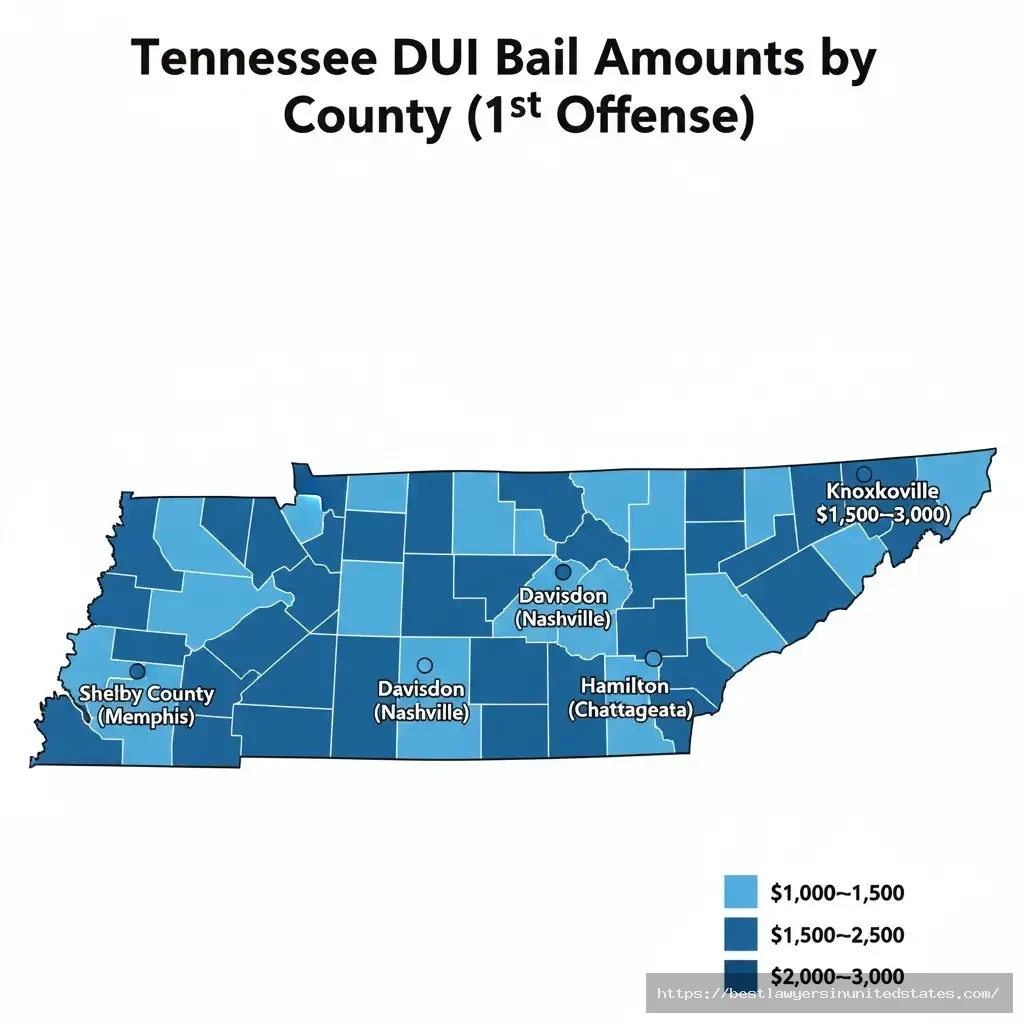
County jails process DUI arrests through standard booking procedures. Bond amounts vary by county and circumstances.
| County | Typical First-Offense Bond | Typical Second-Offense Bond |
|---|---|---|
| Davidson (Nashville) | $1,500-$2,500 | $5,000-$7,500 |
| Shelby (Memphis) | $1,000-$2,000 | $3,000-$5,000 |
| Knox (Knoxville) | $1,500-$3,000 | $5,000-$7,500 |
| Hamilton (Chattanooga) | $1,000-$2,500 | $4,000-$6,000 |
Bond payment options:
- Cash bond (full amount)
- Bail bondsman (10% fee)
- Property bond (real estate equity)
- Release on recognizance (no payment required)
Administrative License Suspension
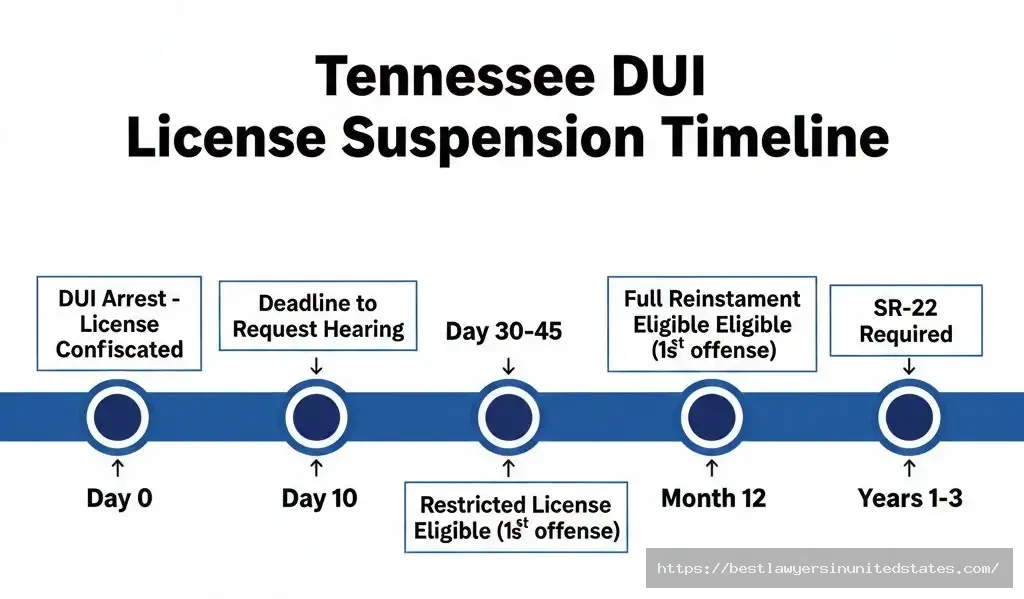
Tennessee automatically suspends your license at arrest for DUI or test refusal. This administrative suspension begins immediately, separate from any criminal court case.
Critical deadline: You have 10 days from arrest to request an administrative hearing with the Tennessee Department of Safety. Missing this deadline means automatic suspension with no hearing.
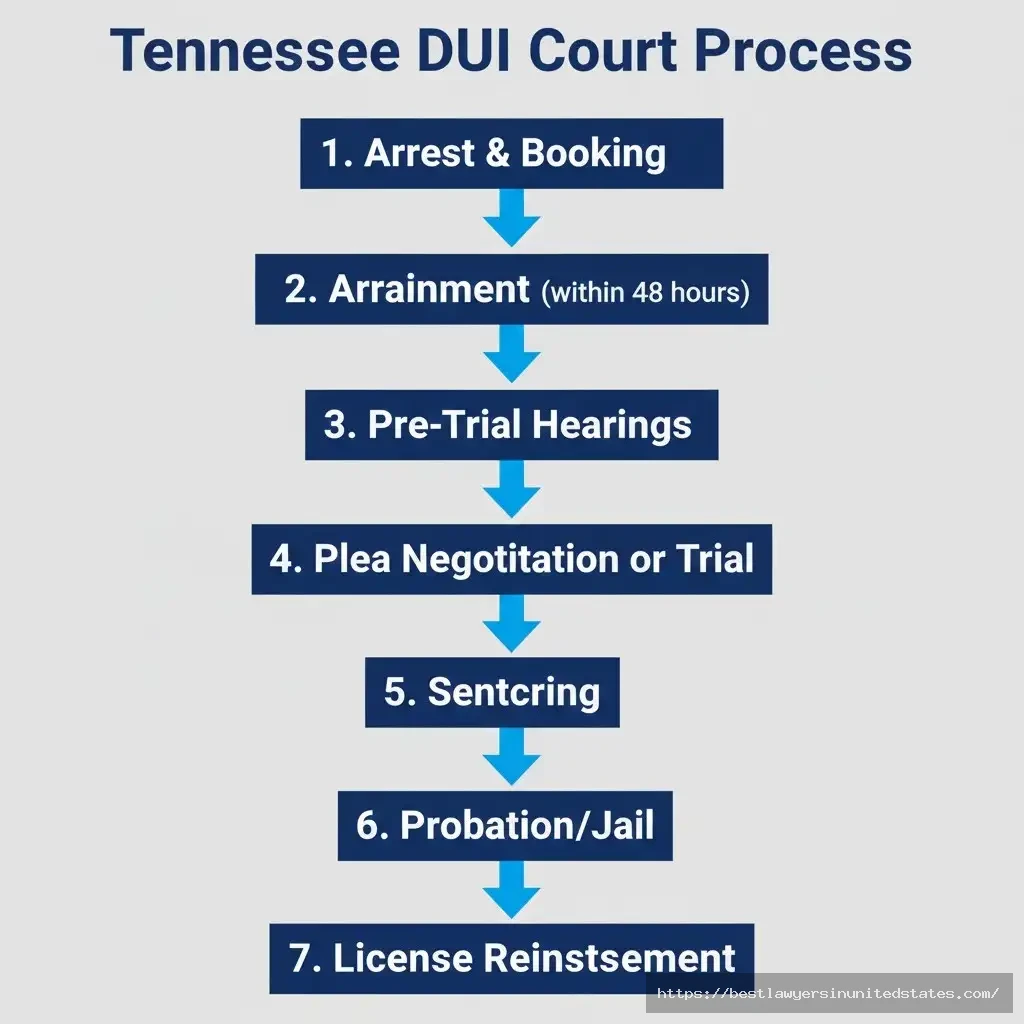
Tennessee DUI Court Process
Tennessee DUI cases move through either General Sessions Court (misdemeanors) or Circuit Criminal Court (felonies). Understanding the process helps you prepare for each stage.
General Sessions Court (Misdemeanor DUI)
Most first, second, and third offense DUI cases begin in General Sessions Court. Each Tennessee county operates its own General Sessions Court with different judges and procedures.
Major court locations:
- Davidson County: 408 2nd Avenue North, Nashville
- Shelby County: 201 Poplar Avenue, Memphis
- Knox County: 400 Main Street, Knoxville
- Hamilton County: 625 Georgia Avenue, Chattanooga
Circuit Criminal Court (Felony DUI)
Fourth and subsequent DUI offenses proceed through Circuit Criminal Court. These courts handle all felony cases in Tennessee.
Arraignment
Your first court appearance typically occurs within 48 hours of arrest. The judge informs you of charges, sets bail conditions, and schedules future hearings.
What happens at arraignment:
- Judge reads charges
- You enter initial plea (guilty, not guilty, no contest)
- Bond conditions set or modified
- Public defender appointed if eligible
- Next court date scheduled
Typical plea: Most DUI attorneys advise entering “not guilty” at arraignment to preserve all defense options.
Pre-Trial Hearings
Tennessee DUI cases involve multiple pre-trial hearings before reaching trial or plea agreement. These hearings address:
- Discovery: Exchange of evidence between prosecution and defense
- Motions to suppress: Challenges to stop legality or test results
- Plea negotiations: Discussion of reduced charges or sentencing
- Expert witnesses: Qualification of blood test or field sobriety experts
Plea Bargaining Restrictions
Tennessee law restricts plea bargaining in DUI cases. Prosecutors cannot reduce DUI charges to reckless driving or other lesser offenses in most circumstances.
Limited exceptions:
- Significant problems with evidence
- Constitutional violations during arrest
- Breath test machine malfunctions
- Blood test contamination issues
Trial Process
Tennessee DUI trials typically last 1-2 days before either a judge (bench trial) or jury (jury trial). The state must prove guilt beyond a reasonable doubt.
Trial sequence:
- Jury selection (if jury trial)
- Opening statements
- State’s case (officer testimony, test results)
- Defense case (witnesses, expert testimony)
- Closing arguments
- Jury deliberation and verdict
Jury composition: Tennessee DUI juries consist of 12 members in Circuit Court or 6 members in General Sessions Court (if jury trial requested).
Sentencing
Judges impose sentences immediately after guilty verdicts or plea agreements. Tennessee sentencing follows mandatory minimum guidelines with judicial discretion up to maximum penalties.
Alternative Incarceration Facilities (2024 Update)
Select Tennessee counties now offer alternative incarceration facilities as sentencing options. These facilities provide structured environments with alcohol education instead of county jail.
Current locations:
- Davidson County: Tennessee Alternative Sentencing Facility
- Shelby County: Shelby County Work Release Center
- Knox County: Helen Ross McNabb Center
- Hamilton County: Alternative Programs Division
Eligibility: First or second offense, no injury accident, BAC under .20%, judge approval
Statute of Limitations for Tennessee DUI
Tennessee sets different statute of limitations periods for DUI charges depending on offense severity. Understanding these deadlines affects when charges must be filed.
Misdemeanor DUI Statute of Limitations
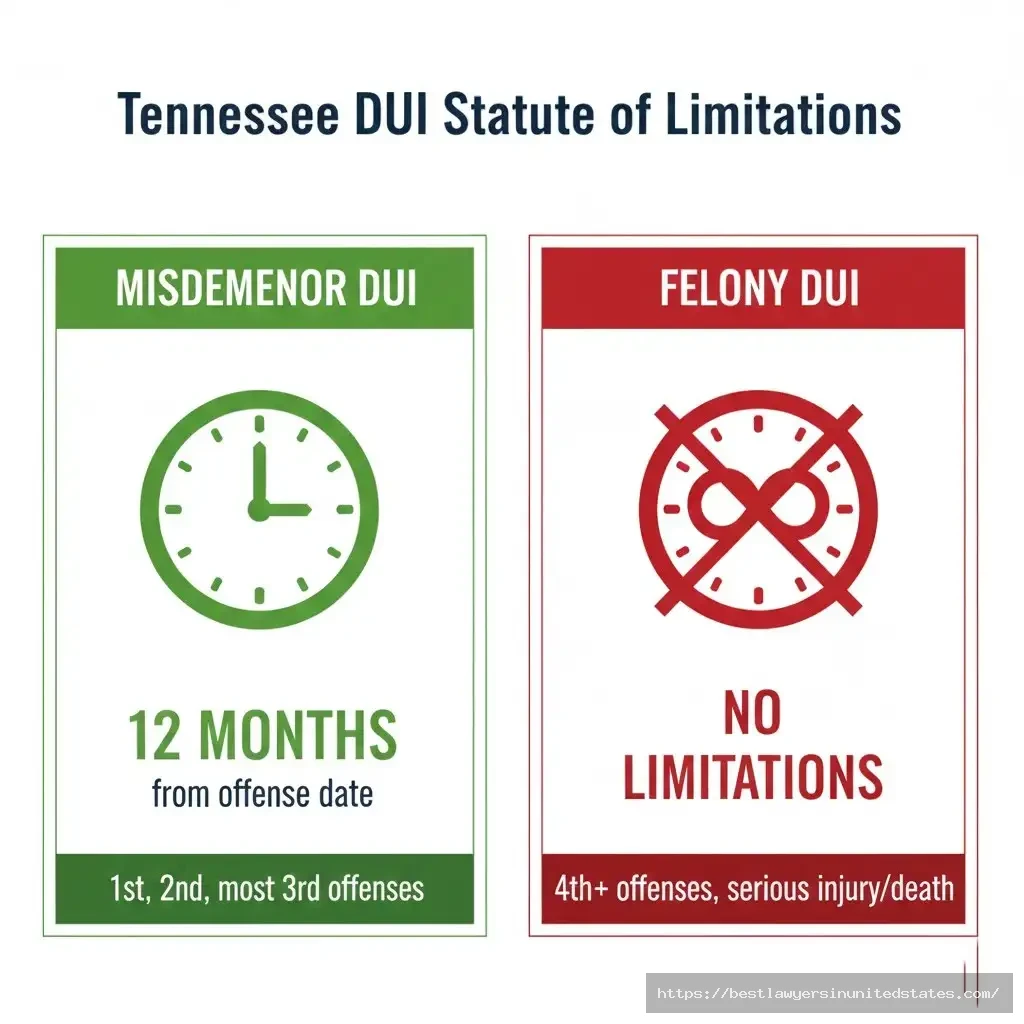
Tennessee law gives prosecutors 12 months from the offense date to file misdemeanor DUI charges. This applies to first, second, and most third offense cases.
Critical deadline: If police arrest you on January 1, 2026, prosecutors must file formal charges by January 1, 2027.
Important exception: The 12-month clock starts on the offense date, not the arrest date. If police arrest you months after the incident, prosecutors still only have 12 months from the original offense date.
Felony DUI Statute of Limitations
Tennessee imposes no statute of limitations on felony DUI charges. Prosecutors can file fourth-offense DUI charges at any time, even decades after the incident.
Practical reality: Most felony DUI cases get filed within weeks of arrest. Prosecutors rarely delay filing felony charges.
Administrative vs. Criminal Deadlines
Tennessee separates administrative license suspension deadlines from criminal prosecution deadlines. You must request an administrative hearing within 10 days of arrest, regardless of when criminal charges get filed.
Two separate timelines:
- Administrative hearing request: 10 days from arrest
- Criminal charge filing: 12 months from offense (misdemeanors only)
Critical point: Missing the 10-day administrative hearing deadline means automatic license suspension even if prosecutors later dismiss criminal charges.
License Consequences & Reinstatement
Tennessee’s license suspension system operates independently from criminal court proceedings. You face two separate suspensions: administrative (immediate) and court-ordered (after conviction).
Immediate Administrative Suspension
Tennessee suspends your license at arrest for DUI or test refusal. This suspension begins immediately and continues unless you successfully challenge it at an administrative hearing.
Administrative suspension timeline:
| Situation | Suspension Length |
|---|---|
| First DUI arrest | Until court case resolves |
| Second DUI arrest | Until court case resolves |
| First test refusal | 1 year |
| Second test refusal | 2 years |
Requesting an Administrative Hearing
You have 10 days from arrest to request an administrative hearing with the Tennessee Department of Safety and Homeland Security. File your request at:
Tennessee Department of Safety
Driver Services Division
P.O. Box 945
Nashville, TN 37202
Hearing locations: Administrative hearings occur by phone or at regional Department of Safety offices statewide.
Restricted License Eligibility
Tennessee allows restricted licenses (called “limited driving permits”) after serving a portion of your suspension. Eligibility depends on offense number and circumstances.
Restricted license timeline:
| Offense | Waiting Period | Requirements |
|---|---|---|
| 1st offense | Immediate | Ignition interlock, SR-22, fees |
| 2nd offense | 45 days served | Ignition interlock, SR-22, fees |
| 3rd offense | 120 days served | Ignition interlock, SR-22, assessment |
Allowed driving: Restricted licenses permit driving to/from:
- Work or business
- School or educational programs
- Medical appointments
- Court-ordered programs
- Alcohol treatment programs
Ignition Interlock Device Requirements
Tennessee mandates ignition interlock devices (IIDs) for all DUI offenders seeking restricted licenses. The device prevents vehicle starting unless you provide an alcohol-free breath sample.
IID duration by offense:
- First offense: Full suspension period (1 year minimum)
- Second offense: 2 years minimum
- Third offense: 3 years minimum
- Fourth+ offense: 5 years minimum
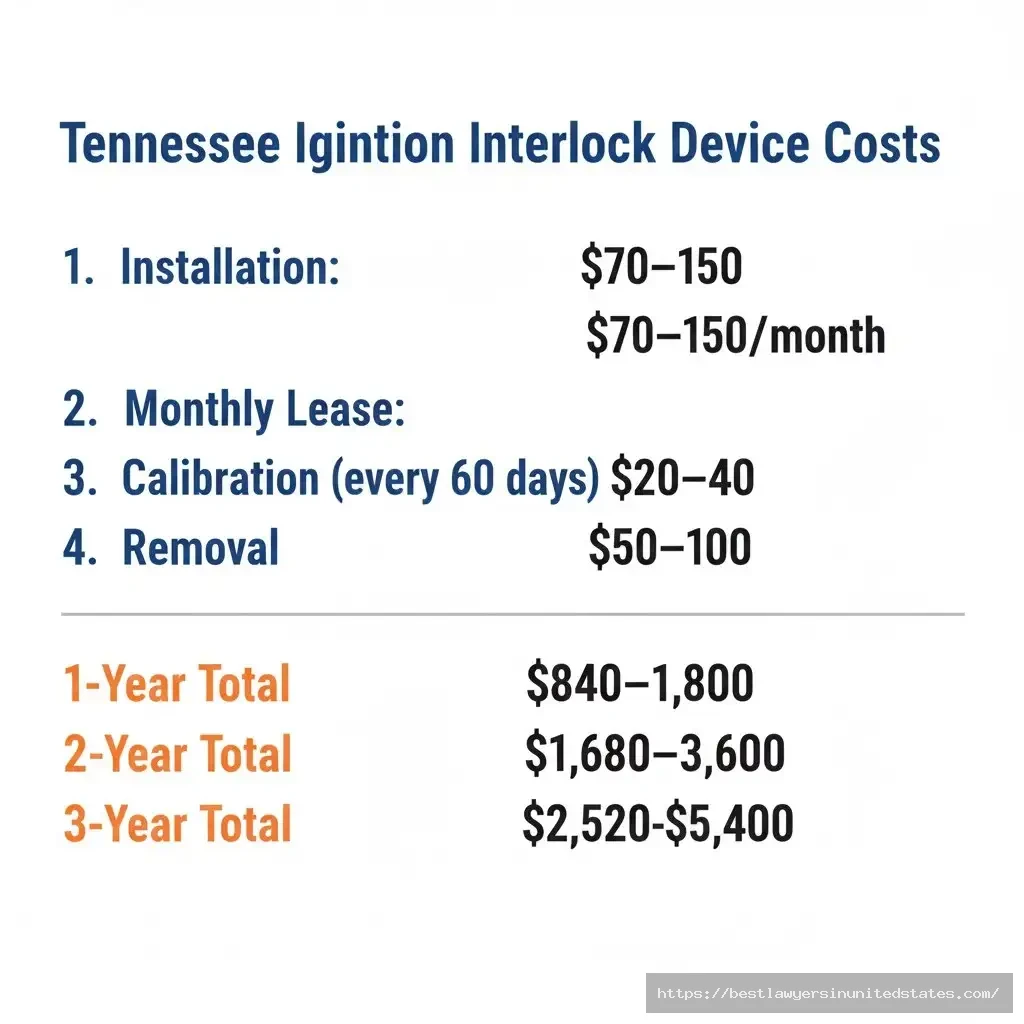
Monthly costs: $70-$150 for device lease, calibration, and monitoring
Approved providers: Tennessee certifies specific IID vendors. The Department of Safety maintains the current approved vendor list.
License Reinstatement Process
Getting your full license back requires completing all suspension terms and paying reinstatement fees. Tennessee’s reinstatement process involves multiple steps.
Step-by-step reinstatement:
- Complete suspension period: Serve full suspension or complete restricted license term
- Complete DUI school: Provide certificate of completion
- Complete treatment: Finish court-ordered alcohol programs
- Pay reinstatement fees: Submit required payments
- File SR-22: Maintain insurance for 3 years
- Pass tests: Retake written and driving tests (if required)
Tennessee reinstatement fees:
| Fee Type | Amount |
|---|---|
| Basic reinstatement | $100 |
| DUI reinstatement surcharge | $250 |
| SR-22 filing | $50 |
| License application | $28.50 |
| Total | $428.50 |
SR-22 Insurance Requirement
Tennessee requires SR-22 certificates of financial responsibility for all DUI convictions. Your insurance company files SR-22 forms directly with the Department of Safety.
SR-22 duration: 3 years from reinstatement date
Insurance impact: DUI convictions typically increase insurance premiums by 50-100% in Tennessee. The SR-22 filing requirement adds additional costs.
Important: Your SR-22 must remain active continuously for 3 years. Any lapse in coverage resets the 3-year requirement and triggers license suspension.
States like Ohio and Pennsylvania have similar SR-22 requirements that last 3 years.
Tennessee DUI Schools & Treatment Programs
Tennessee mandates alcohol safety education and treatment programs for all DUI convictions. These programs serve both punishment and rehabilitation purposes.
State-Licensed DUI School Requirement
First-time offenders must complete a 10-hour DUI school program certified by the Tennessee Department of Mental Health and Substance Abuse Services. Second and third offenders face longer program requirements.
DUI school duration by offense:
- First offense: 10 hours minimum
- Second offense: 20 hours minimum
- Third+ offense: 40 hours minimum plus treatment
Cost range: $150-$300 for first-offense programs
Finding Approved DUI Schools
Tennessee licenses DUI schools in every county. The Department of Mental Health maintains a searchable database of approved providers.
Major city locations:
- Nashville: Multiple providers in Davidson County
- Memphis: Shelby County providers
- Knoxville: Knox County options
- Chattanooga: Hamilton County programs
Alcohol and Drug Treatment Programs
Courts order comprehensive treatment assessments for repeat offenders and first offenders with BAC above .20%. Tennessee-certified counselors conduct assessments and recommend treatment levels.
Treatment levels:
- Level I: Outpatient counseling (1-2 sessions weekly)
- Level II: Intensive outpatient (3-5 sessions weekly)
- Level III: Residential treatment (30-90 days)
Treatment costs: $500-$5,000 depending on program intensity and duration
Tennessee Recovery Court Programs
Tennessee Recovery Courts offer intensive supervision and treatment as an alternative to traditional sentencing. These specialized DUI courts operate in 45 counties statewide.
Recovery Court benefits:
- Reduced jail time with successful completion
- Comprehensive treatment services
- Regular court monitoring
- Peer support groups
- Graduated sanctions and incentives
Eligibility requirements:
- No prior violent felonies
- No DUI involving serious injury
- Willingness to participate in treatment
- Able to appear for frequent court hearings
Program duration: 12-18 months minimum
Successful completion: Participants who complete all requirements may receive reduced sentences or early probation termination.
Financial Impact of a Tennessee DUI
DUI convictions create immediate and long-term financial consequences beyond court fines. Understanding the full cost helps you prepare for the financial impact.
Complete Tennessee DUI Cost Breakdown
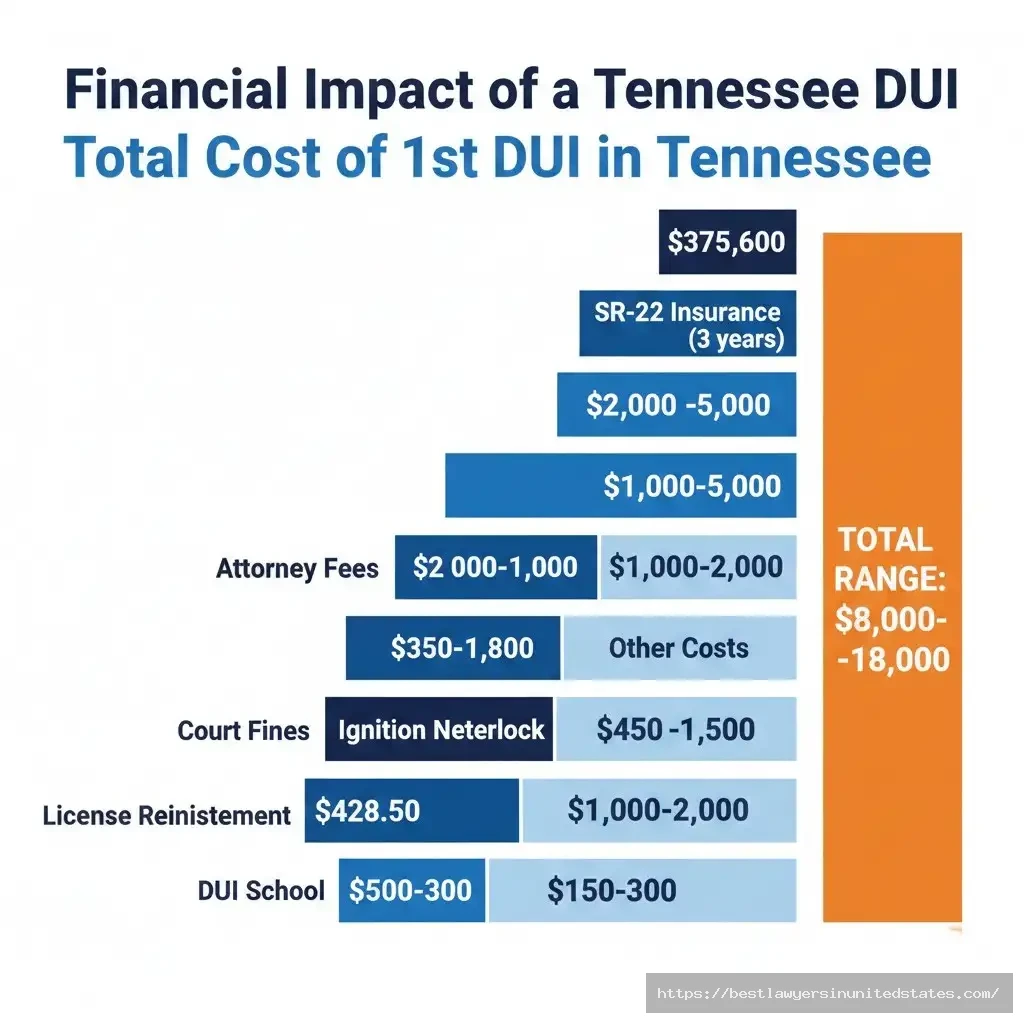
The total cost of a first-offense DUI in Tennessee typically ranges from $4,000 to $15,000. Repeat offenses cost substantially more.
| Cost Category | First Offense | Second Offense | Third Offense |
|---|---|---|---|
| Court fines | $350-$1,500 | $600-$3,500 | $1,100-$10,000 |
| Court costs | $200-$500 | $200-$500 | $200-$500 |
| Attorney fees | $2,000-$5,000 | $3,000-$7,500 | $5,000-$15,000 |
| Bail bond | $150-$250 | $300-$750 | $500-$1,000 |
| License reinstatement | $428.50 | $428.50 | $428.50 |
| DUI school | $150-$300 | $250-$500 | $400-$800 |
| Ignition interlock (annual) | $840-$1,800 | $1,680-$3,600 | $2,520-$5,400 |
| SR-22 insurance increase (3 years) | $3,000-$6,000 | $4,500-$9,000 | $6,000-$12,000 |
| Vehicle towing/impound | $200-$500 | $200-$500 | $200-$500 |
| Lost wages | $500-$2,000 | $1,000-$5,000 | $2,000-$10,000 |
| TOTAL ESTIMATED COST | $8,000-$18,000 | $12,000-$31,000 | $18,000-$56,000 |
Calculate your specific DUI costs using our Tennessee DUI Cost Calculator for personalized estimates based on your circumstances.
DUI Attorney Costs in Tennessee
Hiring experienced DUI defense counsel significantly impacts case outcomes. Tennessee DUI attorney fees vary based on case complexity and attorney experience.
Fee structures:
- Flat fee: $2,000-$5,000 for first offense
- Hourly rate: $200-$400 per hour
- Trial fee: Additional $3,000-$10,000 if case goes to trial
What affects attorney costs:
- Prior DUI convictions
- Accident involvement
- Injury or property damage
- BAC level (.12%+ aggravated)
- Commercial driver’s license
- Refusal to submit to testing
Insurance Premium Increases
Tennessee DUI convictions trigger massive insurance rate increases that last for years. Insurance companies view DUI as a high-risk behavior indicator.
Average insurance increases:
- First DUI: 50-100% premium increase
- Second DUI: 100-150% premium increase
- Third DUI: 150-200% premium increase
Duration: Insurance rate increases typically last 3-5 years in Tennessee. The SR-22 requirement adds additional costs.
Example: A driver paying $1,500 annually before DUI now pays $2,250-$3,000 annually for 3-5 years, costing $2,250-$7,500 extra total.
Hidden DUI Costs
Beyond obvious expenses, Tennessee DUI convictions create additional financial burdens:
Employment impact:
- Job loss from jail time or license suspension
- Inability to drive company vehicles
- Professional license suspension (nurses, teachers, lawyers)
- Reduced earning potential
Transportation costs:
- Rideshare or taxi expenses during suspension
- Public transportation passes
- Relying on friends/family for rides
Vehicle-related costs:
- Increased registration fees
- Vehicle impoundment and storage
- Potential vehicle forfeiture (repeat offenses)
Employment & Background Check Impact
Tennessee DUI convictions create permanent criminal records that affect employment, professional licensing, and background checks for years.
Criminal Record Consequences
DUI convictions remain on your Tennessee criminal record permanently unless expunged. This record appears on background checks run by employers, landlords, and licensing boards.
What shows on background checks:
- Arrest date and arresting agency
- Charges filed
- Court case number
- Conviction or dismissal
- Sentence imposed
- Current status (completed, probation, etc.)
Professional License Implications
Tennessee licensing boards require disclosure of criminal convictions, including DUI. Many professions face disciplinary action or license suspension after DUI convictions.
High-risk professions:
- Healthcare: Nurses, doctors, pharmacists face board review
- Education: Teachers may lose certification
- Legal: Attorneys must report to Board of Professional Responsibility
- Finance: Securities licenses may be suspended
- Commercial drivers: CDL suspended for one year (first offense)
CDL Holder Specific Rules
Tennessee commercial driver’s license holders face harsher DUI consequences than standard drivers. Federal regulations govern CDL DUI penalties.
CDL DUI penalties:
| Offense | In CMV | In Personal Vehicle |
|---|---|---|
| First DUI | 1-year CDL suspension | 1-year CDL suspension |
| Second DUI | Lifetime CDL revocation | Lifetime CDL revocation |
| Hazmat endorsement | 3-year CDL suspension | 3-year CDL suspension |
Critical point: You lose your CDL for one year even if the DUI occurred in your personal vehicle on your day off. The suspension applies to your commercial driving privileges regardless of where the DUI happened.
BAC limit for CDL holders: .04% in any vehicle, compared to .08% for standard drivers
Background Check Duration
Tennessee DUI convictions appear on background checks indefinitely unless expunged. The conviction never disappears automatically, unlike some states that limit reporting periods.
Common background check scenarios:
- Pre-employment screening: Shows forever unless expunged
- Housing applications: Landlords can see indefinitely
- Loan applications: May affect approval for 7 years
- Security clearances: Permanent record consideration
Employment Disclosure Requirements
Tennessee does not require automatic disclosure of DUI convictions to employers. However, many employment applications ask about criminal history.
Disclosure best practices:
- Answer application questions honestly
- Be prepared to explain circumstances
- Emphasize steps taken (treatment completed, etc.)
- Know your rights under “ban the box” laws
How to Beat a DUI in Tennessee
Tennessee DUI cases can be challenged through multiple legal strategies. Successful defenses require immediate action and experienced legal representation.
Challenge Traffic Stop Legality
Officers must have reasonable suspicion to pull you over. If police lacked valid justification for the initial stop, all evidence collected afterward becomes inadmissible.
Common invalid stop reasons:
- Anonymous tips without corroboration
- Hunches or “profiles” without observed violations
- Stops based solely on leaving bar parking lots
- Pretextual stops for minor equipment violations
Successful challenge: Courts suppress all evidence and dismiss charges when stops violate Fourth Amendment protections.
Question Field Sobriety Test Administration
Tennessee officers must follow standardized protocols when administering field sobriety tests. Deviation from National Highway Traffic Safety Administration (NHTSA) guidelines undermines test reliability.
Common FST administration errors:
- Inadequate instructions to suspect
- Poor testing conditions (uneven surface, bad weather)
- Failure to account for medical conditions
- Tests administered on roadway with traffic passing
- Officer lacks proper training certification
Challenge Breathalyzer Accuracy
Tennessee uses Intoxilyzer breath testing machines that require strict calibration and maintenance protocols. Attacking breath test accuracy succeeds when police fail to follow proper procedures.
Breathalyzer defense strategies:
- Calibration records show machine malfunction
- Officer lacked proper training certification
- 20-minute observation period not maintained
- Mouth alcohol contamination (recent vomiting, GERD)
- Radio frequency interference near testing location
Challenge Blood Test Collection and Handling
Tennessee blood test results must meet strict chain of custody and collection requirements. Contamination, improper storage, or collection errors invalidate test results.
Blood test vulnerabilities:
- Collection by uncertified phlebotomist
- Broken chain of custody
- Improper refrigeration or storage
- Testing delays exceeding 7 days
- Laboratory errors or contamination
Medical Conditions Affecting Test Results
Certain medical conditions create false positive breath test results or mimic impairment signs. Courts recognize these conditions as valid defenses when properly documented.
Conditions affecting BAC readings:
- Diabetes: Ketones produce false breath test readings
- GERD: Stomach acid creates mouth alcohol
- Hypoglycemia: Low blood sugar mimics intoxication
- Neurological disorders: Affect balance and coordination
- Respiratory conditions: Impact breath sample validity
Rising BAC Defense
Blood alcohol concentration continues rising for 30-90 minutes after drinking stops. This “rising BAC” defense argues your BAC was below .08% while driving but rose above the limit by testing time.
Requirements for rising BAC defense:
- Recent drinking (within 1 hour of driving)
- Time gap between driving and testing
- Expert testimony on alcohol absorption rates
- Strong case timeline documentation
Constitutional Violations
Tennessee DUI cases get dismissed when officers violate constitutional rights during investigation or arrest.
Common violations:
- Illegal search of vehicle
- Arrest without probable cause
- Failure to read implied consent warnings
- Coerced confessions
- Denial of right to attorney
Similar defense strategies work in neighboring states like Missouri and Mississippi.
Can a DUI Be Dismissed in Tennessee?
Quick Answer: Yes, Tennessee DUI charges can be dismissed when prosecutors lack sufficient evidence, constitutional violations occurred, or procedural errors undermine the case. However, dismissals require strong legal defenses and experienced representation.
Grounds for Dismissal
Tennessee courts dismiss DUI charges under specific circumstances:
Common dismissal reasons:
- Illegal traffic stop: No reasonable suspicion
- Suppressed evidence: Constitutional violations
- Breath test malfunctions: Machine calibration problems
- Blood test contamination: Chain of custody breaks
- Procedural errors: Missing deadlines or improper filings
- Witness unavailability: Officer leaves department
Suppression of Evidence
Motions to suppress exclude illegally obtained evidence from trial. When courts grant suppression motions for key evidence like breath test results, prosecutors often cannot prove their case and must dismiss charges.
Evidence subject to suppression:
- Illegal search results
- Statements without Miranda warnings
- Test results from illegal stops
- Evidence from warrantless blood draws
- Field sobriety tests without proper warnings
Procedural Defects
Tennessee DUI prosecutions must follow strict procedural requirements. Failures in these procedures create grounds for dismissal.
Critical procedures:
- Implied consent warning properly given
- 20-minute observation period before breath test
- Blood test warrant obtained (if required)
- Timely filing of charges within statute of limitations
- Proper notice of administrative hearings
Prosecutorial Discretion
Tennessee prosecutors sometimes dismiss DUI charges based on case weaknesses or defendant circumstances. Factors influencing dismissal decisions include:
- First-time offense with clean record
- BAC barely over legal limit
- No accident or property damage
- Strong constitutional or evidentiary defenses
- Successful completion of treatment programs
- Cooperation with prosecution
Success Rates and Realistic Expectations
Tennessee DUI dismissal rates vary by county and circumstances. Statewide, approximately 10-15% of DUI cases get dismissed before trial.
Factors affecting dismissal likelihood:
- Highest dismissal rates: BAC close to .08%, procedural errors, weak evidence
- Lowest dismissal rates: High BAC (.15%+), accidents, refusals, repeat offenses
Realistic expectations: Most Tennessee DUI cases end in plea agreements rather than dismissals or trials. Complete dismissals typically require significant legal defects or constitutional violations.
DUI Expungement in Tennessee
Quick Answer: Tennessee allows DUI expungement after 5 years for first-time offenders who complete all sentence requirements and maintain a clean record. The process costs approximately $500-$1,000 and takes 6-12 months.
Eligibility Requirements
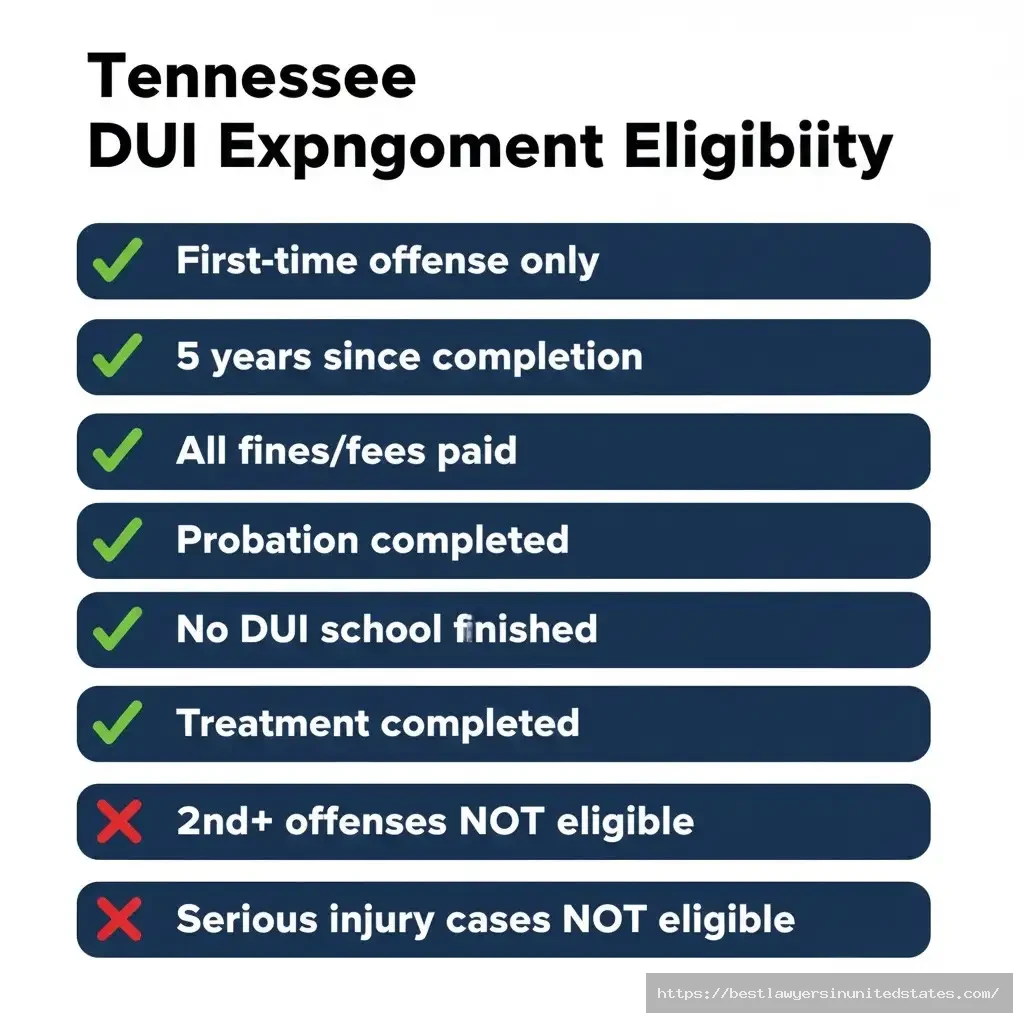
Tennessee law (TCA § 40-32-101) sets strict eligibility criteria for DUI expungement.
Basic requirements:
- First-time DUI offense only
- Minimum 5 years since conviction completion
- All fines, fees, and costs paid in full
- Probation successfully completed
- No subsequent criminal convictions
- No pending criminal charges
Ineligible offenses:
- Second or subsequent DUI convictions
- DUI causing serious injury or death
- Commercial driver DUI
- DUI with child endangerment
Five-Year Waiting Period
The 5-year waiting period begins when you complete all sentence requirements, not from conviction date.
Completion means:
- Jail time served
- Fines and fees paid
- Probation finished
- DUI school completed
- Treatment programs finished
- License fully reinstated
Example: If you were convicted on January 1, 2021, but completed probation on December 31, 2022, your 5-year waiting period begins December 31, 2022, making you eligible December 31, 2027.
Expungement Process
Tennessee DUI expungement requires filing a petition with the convicting court and following specific procedural steps.
Step-by-step process:
- Obtain criminal record: Request from Tennessee Bureau of Investigation
- Gather documents: Conviction records, completion certificates, payment receipts
- File petition: Submit to clerk of court that handled original case
- Serve prosecution: Provide notice to District Attorney General
- Court hearing: Attend hearing if required
- Court order: Obtain signed expungement order
- Serve agencies: Deliver order to TBI, Department of Safety, arresting agency
Costs and Timeline
Tennessee DUI expungement involves court filing fees and potential attorney costs.
Expungement costs:
- Court filing fee: $200-$300 (varies by county)
- TBI background check: $50
- Attorney fees: $500-$2,000 (optional but recommended)
- Service costs: $50-$100
- Total estimated cost: $500-$1,000+ depending on attorney use
Timeline: 6-12 months from petition filing to final order
What Gets Expunged
Successful Tennessee DUI expungement removes the conviction from public records but doesn’t erase all traces.
What expungement removes:
- Public court records
- TBI criminal history reports
- Department of Safety records
- Background check results (for most employers)
What remains:
- Federal databases (FBI records)
- Commercial driver history
- Private background check companies (until updated)
- Some professional licensing board records
Important limitation: Expunged DUI convictions still count as prior offenses if you get arrested for DUI again within 10 years of the original offense.
Frequently Asked Questions
Is Jail Time Mandatory for First DUI in Tennessee?
Quick Answer: Yes, Tennessee requires a mandatory minimum 48 hours in jail for first-offense DUI. Judges cannot suspend this minimum sentence, and the 2024 law changes eliminated automatic work release.
First-time DUI offenders in Tennessee must serve at least 48 hours in custody. Judges have discretion to impose up to 11 months and 29 days, but cannot reduce the sentence below the 48-hour minimum. Some counties offer alternative incarceration facilities as substitutes for county jail.
How Much Is Bail for DUI in Tennessee?
Quick Answer: Tennessee DUI bail typically ranges from $1,000 to $3,000 for first offenses, depending on the county and circumstances. Davidson County (Nashville) averages $1,500-$2,500, while Shelby County (Memphis) averages $1,000-$2,000.
Bail amounts increase for repeat offenses, high BAC levels, accidents, or aggravating circumstances. Counties set bail schedules that judges follow for standard DUI arrests. You can post bail through cash payment, bail bondsman (10% fee), or property bond.
Do You Lose Your License Immediately After DUI in Tennessee?
Quick Answer: Yes, Tennessee suspends your license immediately at DUI arrest through administrative action. Officers confiscate your physical license and issue a temporary permit valid for 10 days.
You have 10 days from arrest to request an administrative hearing to challenge the suspension. Missing this deadline results in automatic license suspension. The administrative suspension continues until your court case resolves unless you win the administrative hearing.
Can You Refuse a Breathalyzer in Tennessee?
Quick Answer: You can legally refuse a breathalyzer in Tennessee, but refusal triggers a 1-year license suspension identical to the suspension for failing the test. Unlike some states, Tennessee’s refusal penalty equals the test failure penalty.
Tennessee’s implied consent law means you automatically agreed to chemical testing when you accepted your driver’s license. Refusing doesn’t prevent DUI charges—prosecutors can still prove impairment through officer observations, field sobriety tests, and dashcam footage.
Is a DUI a Felony or Misdemeanor in Tennessee?
Quick Answer: First, second, and most third DUI offenses are Class A misdemeanors in Tennessee. Fourth and subsequent DUI convictions are Class E felonies carrying 1-6 years in state prison.
Some third offenses may be charged as felonies depending on circumstances like high BAC, accidents, or child endangerment. Judges have discretion to enhance third offenses to felony level in aggravated cases.
How Long Does a DUI Stay on Your Record in Tennessee?
Quick Answer: DUI convictions remain on your Tennessee criminal record permanently unless expunged. There is no automatic removal period. First-time offenders become eligible for expungement after 5 years.
Tennessee does not automatically remove DUI convictions after any time period. The conviction appears on background checks indefinitely unless you successfully petition for expungement. Only first offenses qualify for expungement, and only after completing all sentence requirements and waiting 5 years.
What Is the New Tennessee DUI Law for 2024?
Quick Answer: Tennessee’s 2024 DUI law changes lowered the aggravated DUI threshold from .15% to .12% BAC, eliminated automatic work release for first offenders, and created alternative incarceration facility options in select counties.
The Tennessee Prevention of Drunk Driving Act also implemented statewide blood draw search warrants and enhanced treatment program requirements. These changes make Tennessee’s DUI laws some of the strictest in the region, even compared to states like Arkansas and Alabama.
How Likely Is Jail Time for First DUI in Tennessee?
Quick Answer: Jail time is mandatory for first DUI in Tennessee. You will serve at least 48 hours in custody. The question isn’t whether you’ll serve jail time, but whether you’ll serve the minimum 48 hours or face the maximum 11 months, 29 days.
Tennessee judges routinely impose the mandatory minimum for first offenders without aggravating factors. High BAC (.12%+), accidents, or child passengers increase the likelihood of sentences beyond the 48-hour minimum.
Can You Get a DUI Dismissed in Tennessee?
Quick Answer: Tennessee DUI charges can be dismissed when legal defenses succeed, but dismissals are relatively uncommon. Approximately 10-15% of Tennessee DUI cases get dismissed before trial, typically due to constitutional violations, procedural errors, or insufficient evidence.
Dismissals require strong legal representation and significant case weaknesses. Most Tennessee DUI cases resolve through plea agreements rather than dismissals or trials. The best defense strategies challenge the legality of the traffic stop, attack breath test accuracy, or expose procedural violations.
How to Beat a DUI Charge in Tennessee?
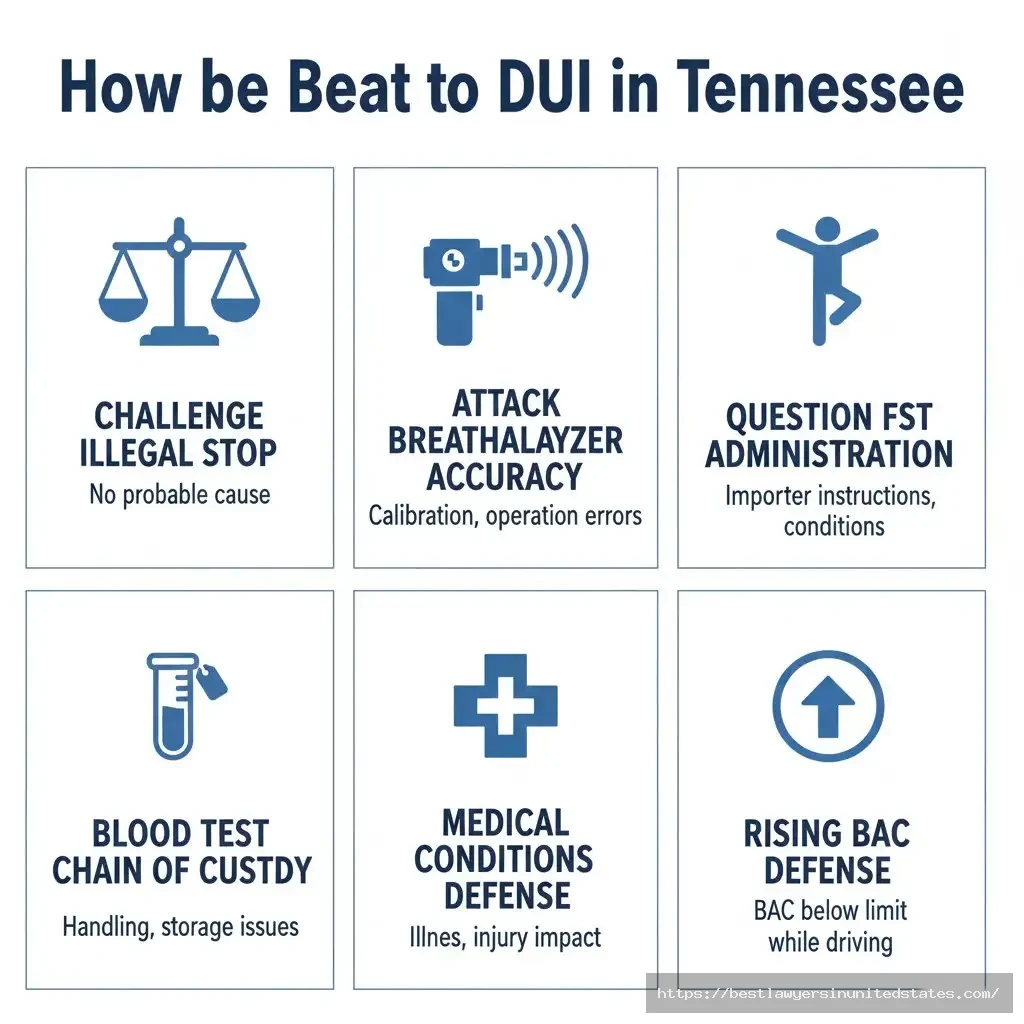
Quick Answer: Beating Tennessee DUI charges requires challenging the traffic stop legality, attacking test result accuracy, proving constitutional violations, or demonstrating procedural errors. Success rates increase with immediate attorney consultation and thorough case investigation.
Common successful defenses include illegal traffic stops without reasonable suspicion, breathalyzer calibration problems, blood test chain of custody breaks, and field sobriety test administration errors. Medical conditions like diabetes or GERD can also explain false positive test results or impairment symptoms.
Conclusion
Tennessee’s 2024 DUI law changes created stricter penalties and reduced judicial discretion in DUI cases. The lower aggravated threshold (.12% BAC), elimination of automatic work release, and enhanced treatment requirements make Tennessee one of the toughest states for DUI enforcement. First-time offenders now face mandatory 48-hour jail minimums without automatic work release, while repeat offenders face rapidly escalating penalties including felony charges for fourth offenses.
Understanding your legal rights and options starts with immediate action. Contact an experienced Tennessee DUI attorney within 24 hours of arrest to protect your rights and preserve all defense strategies. Request your administrative hearing within 10 days to challenge license suspension.
Next steps after Tennessee DUI arrest:
- Contact DUI attorney immediately (within 24 hours)
- Request administrative hearing (within 10 days)
- Estimate total costs using our DUI Cost Calculator
- Document everything (witnesses, conditions, medical issues)
- Attend all court dates (missing court creates additional charges)
Need Legal Help?
Connect with experienced Tennessee DUI attorneys who understand the state’s complex laws and court procedures.
Email: [email protected]
