
Utah enforces the strictest DUI laws in America with a 0.05% BAC limit for drivers 21 and older. A first offense brings mandatory jail time, $1,000+ in fines, 120-day license suspension, and 18 months with an ignition interlock device. The total cost averages $8,000-$15,000 for first-time offenders.
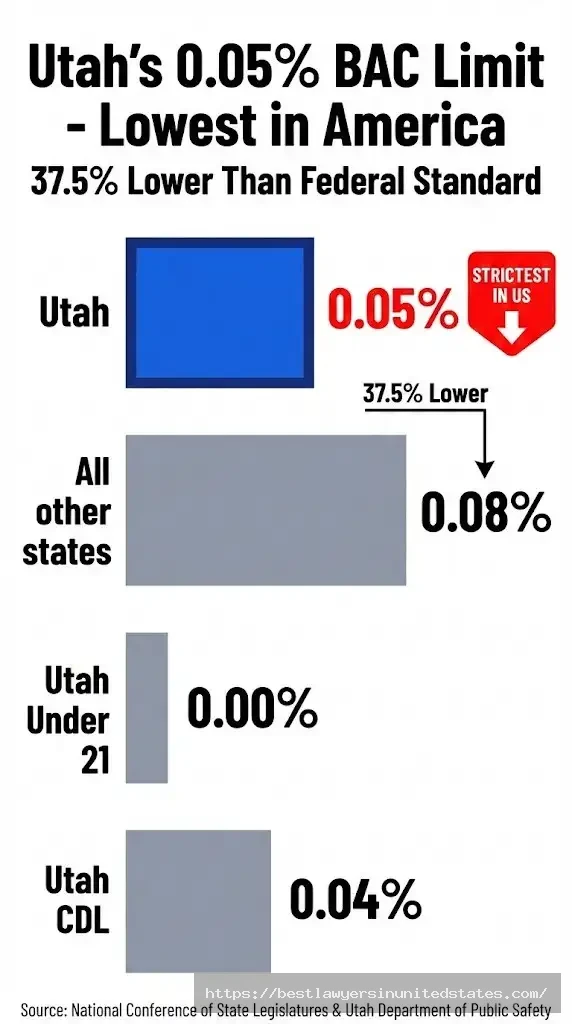
Utah became the first and only state to lower its legal limit from 0.08% to 0.05% on December 30, 2018. This groundbreaking law means you can face DUI charges after consuming just 1-2 drinks in many cases.
What Are Utah’s BAC Limits?
Quick Answer: Utah’s BAC limit is 0.05% for adults 21+, 0.04% for commercial drivers, and 0.00% for minors under 21.
Standard BAC Limits by Driver Type
| Driver Category | Legal BAC Limit | Utah Code Reference |
|---|---|---|
| Adults (21+) | 0.05% | Utah Code § 41-6a-502 |
| Commercial Drivers | 0.04% | Federal regulation |
| Drivers Under 21 | 0.00% | Utah Code § 41-6a-530 |
Critical point: Utah’s 0.05% limit is lower than the 0.08% federal standard used in all other states.
How Many Drinks Equal 0.05% BAC?
Most people reach 0.05% BAC after consuming:
- Women (120-140 lbs): 1-2 drinks in one hour
- Men (160-180 lbs): 2-3 drinks in one hour
Important: Body weight, food intake, metabolism, and drink strength all affect your BAC. A “drink” means 12 oz beer, 5 oz wine, or 1.5 oz liquor.
Want to check your estimated BAC before driving? Use our BAC calculator to see how different drinks affect your blood alcohol level.
BAC Calculator
Estimate your Blood Alcohol Content
• Commercial Driver (CDL): 0.04% BAC
• Drivers Under 21: 0.00-0.02% BAC (Zero Tolerance)
• Enhanced Penalties: 0.15% BAC or higher in most states
Zero Tolerance for Underage Drivers
Utah enforces a strict “not-a-drop” policy for drivers under 21. Any detectable alcohol in your system triggers penalties, even 0.01% BAC.
Underage DUI consequences:
- Immediate license suspension
- Mandatory alcohol education classes
- Potential criminal charges
- College scholarship impact
- Professional licensing barriers
Utah DUI Penalties: What You Face
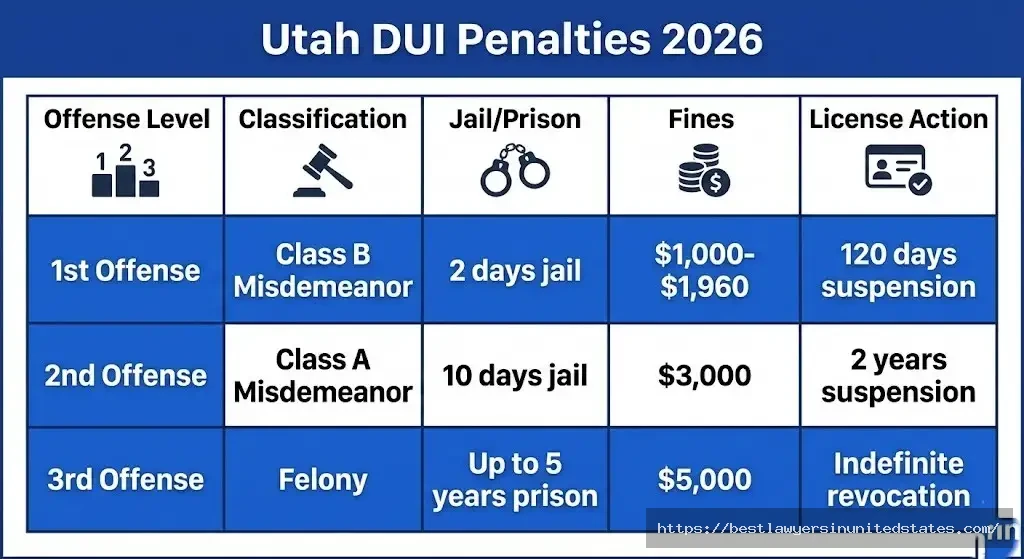
First DUI Offense (Class B Misdemeanor)
Quick Answer: First-time DUI in Utah brings 2 days minimum jail time, $1,000+ fines, 120-day license suspension, and 18 months with an ignition interlock device.
| Penalty Category | First Offense Details |
|---|---|
| Criminal Classification | Class B Misdemeanor |
| Jail Time | 2 days mandatory (up to 6 months possible) |
| Fines | Minimum $1,000 (up to $1,960 max) |
| License Suspension | 120 days (4 months) |
| Ignition Interlock | 18 months required |
| DUI Screening | Mandatory substance abuse evaluation |
| Education Programs | Prime for Life course or equivalent |
Critical deadline: You have 10 days from arrest to request an administrative hearing with the Utah Driver License Division to challenge your suspension.
Second DUI Offense (Class A Misdemeanor)
A second DUI within 10 years escalates to a Class A misdemeanor with harsher consequences.
Second offense penalties:
- Jail time: 10 days mandatory (up to 1 year maximum)
- Fines: Up to $3,000 plus court costs
- License suspension: 2 years
- Ignition interlock: Required for entire suspension period
- Substance abuse treatment: Mandatory counseling program
- 24/7 sobriety monitoring: Possible enrollment requirement
Third DUI Offense (Third-Degree Felony)
Quick Answer: A third DUI in Utah becomes a third-degree felony carrying up to 5 years in prison and permanent criminal record.
| Penalty Type | Third Offense (Felony) |
|---|---|
| Criminal Classification | Third-Degree Felony |
| Prison Time | Up to 5 years Utah State Prison |
| Fines | Up to $5,000 |
| License Revocation | Indefinite (minimum 2 years) |
| Ignition Interlock | Lifetime requirement possible |
| Felony Consequences | Loss of voting rights, firearm restrictions, employment barriers |
Aggravated DUI Circumstances
Utah law enhances DUI charges to felonies under specific circumstances:
Automatic aggravated DUI triggers:
- ⚠️ Causing bodily injury to another person (Utah Code § 41-6a-502)
- ⚠️ Passenger under age 16 in vehicle
- ⚠️ BAC of 0.16% or higher (extreme DUI)
- ⚠️ Third offense within 10 years
- ⚠️ Prior felony DUI conviction
Penalties for aggravated DUI:
- Third-degree felony charges
- 0-5 years prison time
- $0-$5,000 fines
- Permanent criminal record
- Enhanced restitution for victims
How Much Does a DUI Cost in Utah?
Quick Answer: A first-time DUI in Utah costs $8,000-$15,000 total when you factor in fines, attorney fees, license reinstatement, insurance increases, and ignition interlock devices.
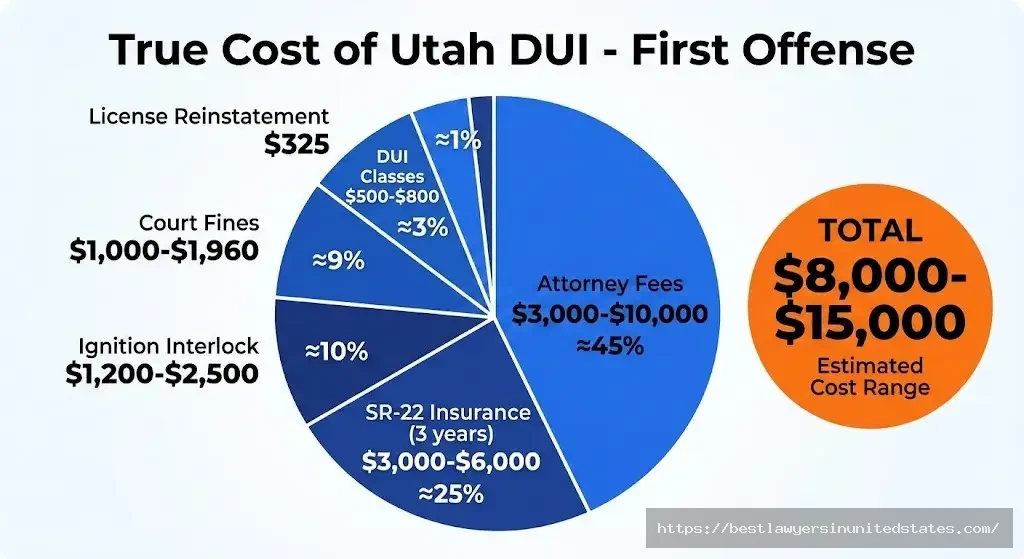
Complete DUI Cost Breakdown
| Cost Category | First Offense | Second Offense | Third Offense |
|---|---|---|---|
| Court Fines | $1,000-$1,960 | $1,500-$3,000 | $3,000-$5,000 |
| Court Costs | $500-$800 | $600-$1,000 | $800-$1,500 |
| Attorney Fees | $3,000-$10,000 | $5,000-$15,000 | $10,000-$25,000 |
| License Reinstatement | $325 | $325 | $325 |
| DUI Screening | $150-$300 | $200-$400 | $300-$500 |
| Education Programs | $500-$800 | $800-$1,200 | $1,000-$2,000 |
| Ignition Interlock (18 months) | $1,200-$2,500 | $2,000-$4,000 | $2,500-$5,000 |
| SR-22 Insurance (3 years) | $3,000-$6,000 | $5,000-$10,000 | $8,000-$15,000 |
| Bail Bond | $500-$2,000 | $1,000-$3,000 | $2,000-$5,000 |
| TOTAL ESTIMATED | $10,175-$24,685 | $16,425-$37,925 | $28,925-$59,325 |
Critical point: These costs don’t include lost wages from jail time, increased insurance premiums beyond three years, or long-term employment impacts.
Calculate your specific DUI costs using our DUI cost calculator based on your offense level and circumstances.
DUI Cost Calculator
Estimate total DUI expenses by state and offense
Detailed Cost Breakdown
Payment Timeline
Bail bond, towing fees, car impound, attorney retainer
Initial court fines, DMV fees, DUI school enrollment, ignition interlock installation
Monthly probation fees, ignition interlock fees, DUI school payments, attorney balance
Insurance premium increases, license reinstatement, SR-22 filing fees
- Lost wages from missed work (court dates, jail time, DUI school) – $2,000-$10,000
- Job loss or difficulty finding employment – Varies
- Professional license suspension (doctors, lawyers, nurses, pilots) – Career ending
- Rideshare and transportation costs during suspension – $1,500-$5,000
- Travel restrictions and visa denials – Varies
- Security clearance loss – Career impact
- Child custody implications – Legal costs
- Rental car restrictions – Varies
- Personal relationships and mental health costs – Priceless
Hidden DUI Costs Most People Miss
Additional financial impacts:
- Towing and impound fees: $200-$500
- Alcohol monitoring bracelet: $10-$15 per day
- Travel restrictions affecting work
- Professional license suspension
- Security clearance loss
- College scholarship revocation
How Utah DUI Costs Compare to Other States
Utah’s total DUI costs fall in the middle range compared to neighboring states. Nevada DUI laws impose slightly higher fines but shorter license suspensions. Colorado DUI laws require similar ignition interlock periods but allow more plea bargaining options.
Utah License Suspension and Administrative Process
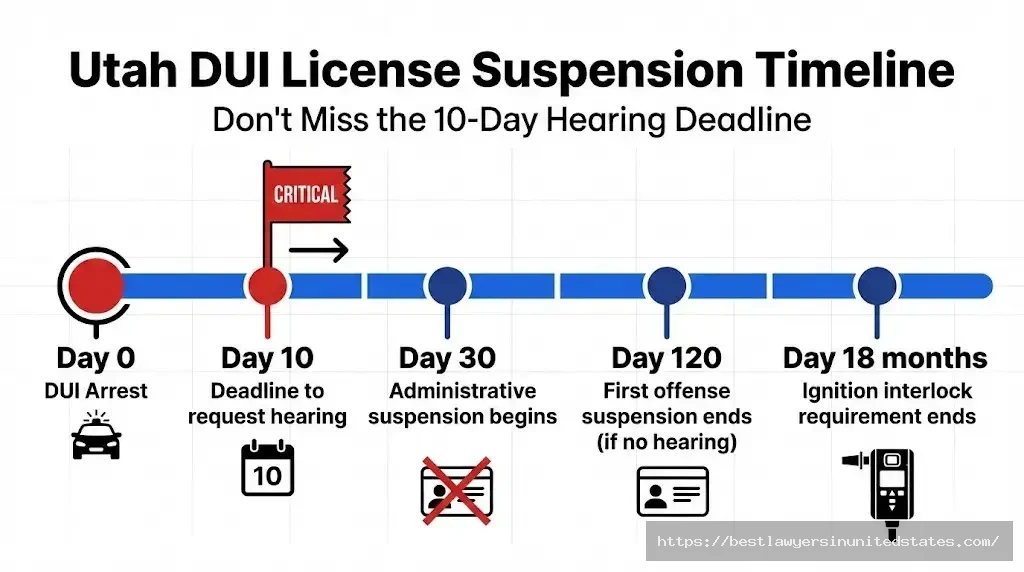
Administrative License Suspension Timeline
Quick Answer: Utah’s Driver License Division suspends your license immediately upon DUI arrest, separate from criminal court proceedings.
| Offense Level | Administrative Suspension | Criminal Court Suspension | Total Possible |
|---|---|---|---|
| First DUI | 120 days | 90 days | 120-210 days |
| Second DUI | 2 years | 2 years | 2 years |
| Third DUI | 2 years | Indefinite | Indefinite |
Critical deadline: Request your administrative hearing within 10 calendar days of arrest or your right to challenge the suspension expires.
How to Request an Administrative Hearing
You must contact the Utah Driver License Division within 10 days:
Contact methods:
- Phone: 801-965-4437 (Salt Lake area) or 800-662-3633 (outside Salt Lake)
- In person: Driver License Division offices statewide
- Mail: Utah Driver License Division, PO Box 144501, Salt Lake City, UT 84114-4501
What happens at the hearing:
- Officer must prove they had probable cause for arrest
- You can challenge breathalyzer accuracy
- Administrative Law Judge reviews evidence
- Decision affects only license suspension, not criminal case
Alcohol Restricted Driver Status
Utah offers a unique “Alcohol Restricted Driver” designation under Utah Code § 41-6a-517 that lets you drive with restrictions during suspension.
Requirements for restricted driving:
- Install ignition interlock device in your vehicle
- Pay $325 reinstatement fee
- Complete DUI screening
- Maintain SR-22 insurance
- No driving without ignition interlock
Benefits:
- Drive to work, school, medical appointments
- Maintain employment during suspension
- Earlier reinstatement than full suspension
Restrictions:
- Zero tolerance for any alcohol
- Device required in all vehicles you operate
- Monthly monitoring fees ($75-$150)
- Breath tests required before each drive
SR-22 Insurance Certificate
Utah requires SR-22 insurance filing for all DUI convictions under Utah Code § 41-12a-802.
SR-22 requirements:
- Minimum liability coverage: $25,000/$65,000/$15,000
- Continuous coverage for 3 years minimum
- Insurance company files directly with Driver License Division
- Lapse in coverage triggers new suspension
Average SR-22 cost increases:
- First DUI: 80-150% premium increase
- Second DUI: 150-300% premium increase
- Annual extra cost: $1,000-$2,000 for three years
Utah’s Unique DUI Laws You Need to Know
Metabolite DUI: Any Measurable Drug = DUI
Quick Answer: Utah prosecutes DUI for ANY detectable amount of controlled substances in your system, even prescription medications.
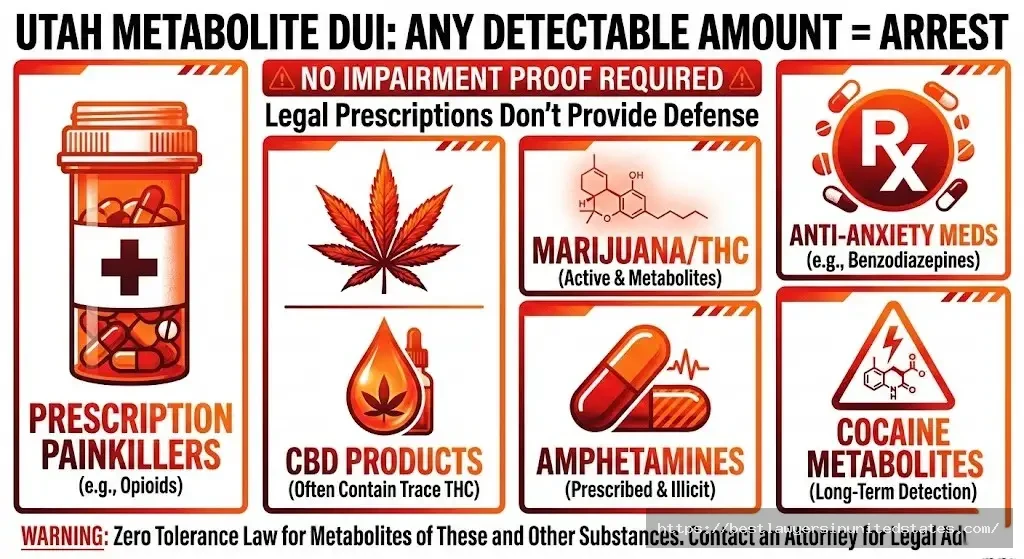
Utah Code § 41-6a-502(2)(b) creates a “metabolite DUI” that doesn’t require proof of impairment. Prosecutors only need to prove a measurable controlled substance was in your body while driving.
Substances that trigger metabolite DUI:
- Prescription painkillers (oxycodone, hydrocodone)
- Anti-anxiety medications (Xanax, Valium)
- Marijuana and THC metabolites
- CBD products containing trace THC
- Amphetamines (even with prescription)
- Cocaine or methamphetamine metabolites
Critical difference from alcohol DUI:
- Alcohol DUI: Requires 0.05% BAC threshold
- Metabolite DUI: ANY detectable amount triggers charges
- No impairment proof needed
- Legal prescriptions don’t provide defense
Case example: Utah courts convicted a driver with valid oxycodone prescription who showed no impairment signs. The presence of metabolites alone satisfied the statute.
Actual Physical Control: DUI Without Driving
Utah defines DUI broadly to include “actual physical control” of a vehicle under Utah Code § 41-6a-502(1).
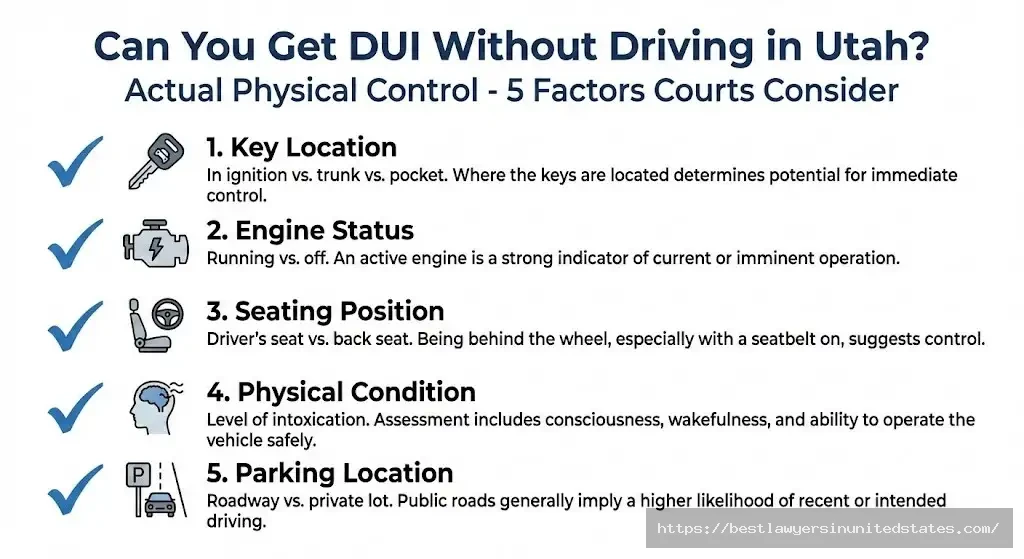
You can face DUI charges while:
- Sleeping in parked car with keys in ignition
- Sitting in driver’s seat with engine off
- Warming up vehicle in driveway
- Parked on private property
Five Factors Courts Consider
Utah courts use this test to determine actual physical control:
Factor analysis:
- Key location: Keys in ignition strongly suggests control
- Engine status: Running engine indicates immediate capability to drive
- Seating position: Driver’s seat vs. back seat matters significantly
- Physical condition: Level of intoxication affects ability assessment
- Parking location: Roadway vs. private parking lot
Protective measures if sleeping in car:
- ✅ Sit in back seat, not driver’s seat
- ✅ Put keys in trunk or outside vehicle
- ✅ Park in legal parking spot, not roadway
- ✅ Turn engine completely off
- ✅ Have sober designated driver’s contact info visible
Real scenario: Salt Lake City police arrested a driver sleeping in a parking lot with engine running for heat. Courts upheld the conviction based on engine operation and key location despite no driving.
Utah’s 24/7 Sobriety Program
Utah operates a mandatory sobriety monitoring program for repeat offenders under Utah Code § 41-6a-515.5.
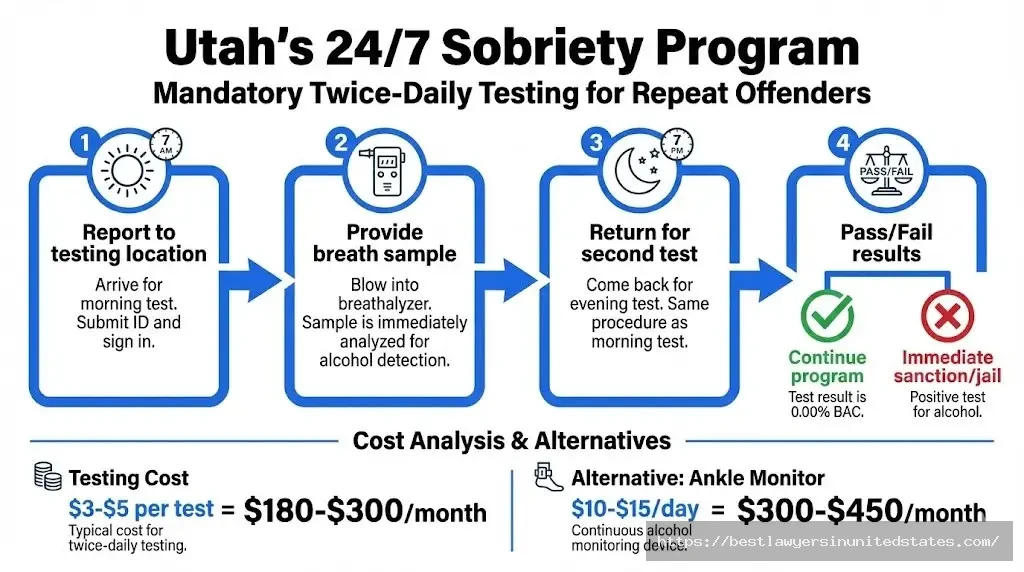
How the program works:
- Report to testing location twice daily (12 hours apart)
- Provide breath sample or wear continuous alcohol monitoring bracelet
- Testing times: Usually 7 AM and 7 PM
- Missed test = immediate sanction
- Failed test = jail time
Enrollment requirements:
- Second or subsequent DUI offense
- Court order or probation condition
- Alternative to jail time in some cases
Program costs:
- Daily testing: $3-$5 per test ($180-$300/month)
- Alcohol monitoring bracelet: $10-$15 per day ($300-$450/month)
- Installation fee: $50-$100
- Monitoring service: $75-$150/month
Testing locations:
- Salt Lake County: Multiple Sheriff’s Office locations
- Utah County: Provo Police Department, Orem facilities
- Davis County: Farmington testing center
- Rural areas: Local law enforcement offices
DUI Arrest Process in Utah
What Happens During a Traffic Stop
Immediate sequence of events:
- Initial stop: Officer observes traffic violation or erratic driving
- Document check: Officer requests license, registration, insurance
- Observation period: Officer watches for impairment signs
- Initial questioning: “Have you been drinking tonight?”
- Field sobriety tests: Officer requests roadside tests (optional)
- Preliminary breath test: Portable breathalyzer (optional)
- Arrest decision: Officer makes arrest if probable cause exists
- Chemical test: Breath or blood test at station (implied consent applies)
Common impairment indicators officers watch for:
- Bloodshot, watery eyes
- Slurred speech
- Alcohol odor
- Fumbling with documents
- Inability to follow instructions
- Admission of drinking
Field Sobriety Tests in Utah
Utah police typically administer three standardized field sobriety tests developed by the National Highway Traffic Safety Administration (NHTSA).
Standard tests:
- Horizontal Gaze Nystagmus (HGN): Officer moves object side to side, watches for involuntary eye jerking
- Walk-and-Turn: Nine steps heel-to-toe on straight line, turn, return
- One-Leg Stand: Balance on one foot while counting for 30 seconds
Critical points about field sobriety tests:
- Tests are voluntary in Utah (you can refuse)
- Refusal cannot be used against you in court
- Tests are subjective and officer-interpreted
- Medical conditions affect performance
- Weather and road conditions impact results
Should you take field sobriety tests? Most DUI defense attorneys advise politely declining these voluntary tests, as they primarily provide evidence against you.
Utah’s Implied Consent Law
Utah Code § 41-6a-520 requires all drivers to submit to chemical testing when arrested for DUI.
What implied consent means:
- Accepting a Utah driver’s license = automatic consent to testing
- Applies to breath, blood, or urine tests
- Officer must read you the implied consent advisory
- Refusal triggers automatic license suspension
Implied consent advisory language: “I now call upon you to submit to a chemical test to determine the alcohol or drug content of your blood. If you refuse this test, your driver license or privilege to drive will be suspended for 18 months for a first refusal, or 36 months for a second or subsequent refusal.”
Consequences of Refusing Chemical Tests
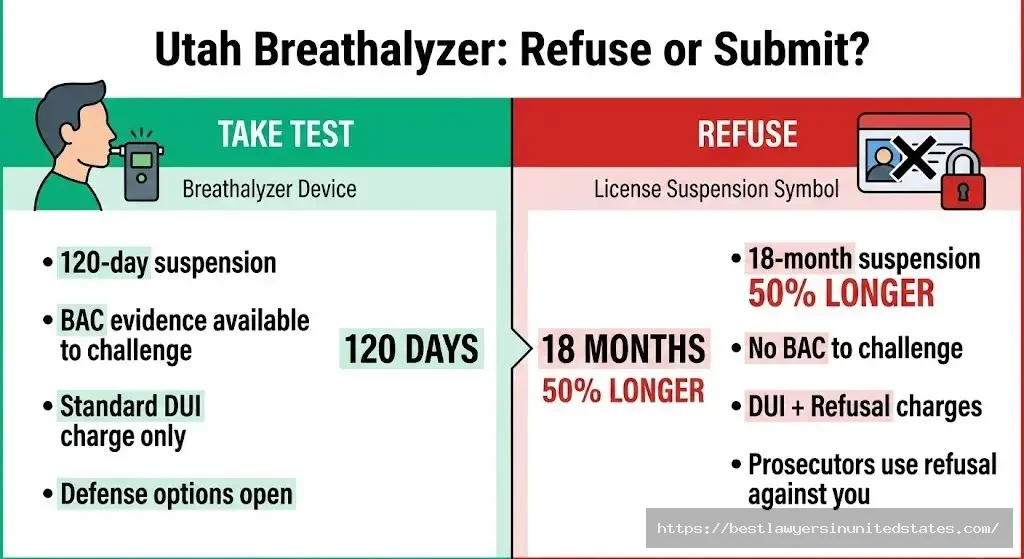
| Refusal Number | License Suspension | Criminal Penalty | Court Impact |
|---|---|---|---|
| First Refusal | 18 months | Additional Class B Misdemeanor charge | Refusal admissible as evidence |
| Second Refusal | 36 months | Enhanced criminal penalties | Prosecutors emphasize “consciousness of guilt” |
Critical point: Refusing the chemical test results in LONGER suspension than failing the test (18 months vs. 120 days for first offense).
Can police force you to take a test? Officers may obtain a search warrant for forced blood draw in cases involving:
- Serious bodily injury
- Death
- Repeat DUI offenders
- Suspected drug impairment
Booking and Bail Process
What happens at jail:
- Booking: Fingerprints, photographs, personal property inventory
- Chemical test: Breath test on Intoxilyzer 8000 or blood draw
- Cell holding: Wait in holding cell until sober or bail posted
- Bail determination: Judge sets bail amount at initial appearance
- Release: Post bail or remain jailed until arraignment
Typical bail amounts:
- First DUI: $500-$2,000
- Second DUI: $1,000-$3,000
- Aggravated DUI: $5,000-$10,000
Contact information after arrest: Salt Lake County Metro Jail: 801-743-7000 Utah County Jail: 801-851-4010 Davis County Jail: 801-451-4150
Utah DUI Court Process and Timeline
Arraignment: Your First Court Appearance
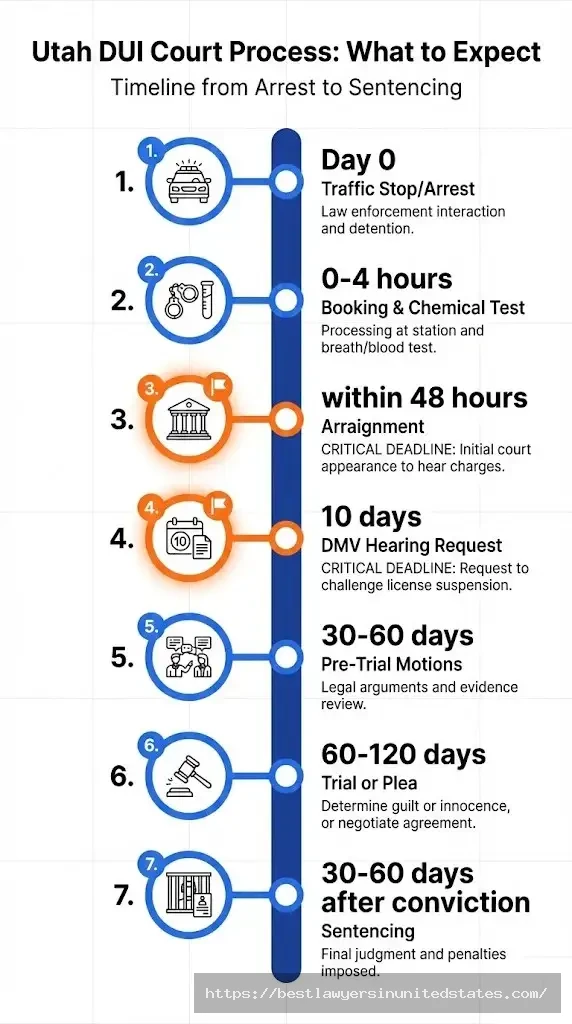
Quick Answer: Arraignment happens within 48 hours of arrest where you enter your plea and receive formal charges.
What happens at arraignment:
- Judge reads formal charges
- You enter plea (guilty, not guilty, no contest)
- Judge sets bail conditions
- Court schedules pre-trial conference
- Public defender appointed if you qualify
Critical decision: Most DUI attorneys advise entering a “not guilty” plea at arraignment to preserve all defense options.
Arraignment locations:
- Salt Lake City: Third District Court, 450 South State Street
- Provo: Fourth District Court, 125 North 100 West
- Ogden: Second District Court, 2525 Grant Avenue
- St. George: Fifth District Court, 220 North 200 East
Pre-Trial Hearings and Motions
Your attorney files motions challenging evidence between arraignment and trial.
Common defense motions:
- Motion to suppress stop (illegal traffic stop)
- Motion to suppress breath test (improper calibration)
- Motion to suppress field sobriety tests (improper administration)
- Motion to dismiss (insufficient probable cause)
Timeline: Pre-trial motions typically occur 30-60 days after arraignment.
Utah’s DUI Plea Bargain Restrictions
Critical limitation: Utah Code § 41-6a-501(3) strictly limits DUI plea bargaining.
What prosecutors CANNOT do:
- ❌ Reduce DUI to reckless driving without good cause
- ❌ Dismiss DUI if evidence supports conviction
- ❌ Offer deferred judgment on second or subsequent DUI
What’s still negotiable:
- ✅ Reduction from aggravated to standard DUI
- ✅ Reduced charges if evidence is weak
- ✅ Sentencing recommendations
- ✅ Alternative sentencing programs
Impact on defendants: Utah’s restrictions mean more DUI cases go to trial compared to states with flexible plea bargaining. This makes attorney representation critical for building a strong defense.
DUI Trial Process
If your case goes to trial, expect this timeline:
Trial phases:
- Jury selection: Both sides question potential jurors
- Opening statements: Attorneys outline their cases
- Prosecution case: State presents officer testimony, test results, video evidence
- Defense case: Your attorney challenges evidence, presents alternative explanations
- Closing arguments: Final persuasion to jury
- Jury deliberation: Jury decides guilty or not guilty
- Verdict: Jury announces decision
Trial length: Most DUI trials last 1-3 days.
Conviction consequences: If convicted at trial, sentencing follows within 30-60 days.
Sentencing and Court Requirements
Sentencing hearing elements:
- Victim impact statements (if injury involved)
- Defendant statement
- Attorney sentencing arguments
- Presentence investigation report review
- Judge announces sentence
Common sentencing conditions:
- Jail time (suspended or served)
- Probation period (typically 12-36 months)
- Alcohol restricted driver status
- Substance abuse treatment
- 24/7 sobriety monitoring
- Community service
- DUI education classes
- Restitution to victims
Underage DUI in Utah: Zero Tolerance Policy
Quick Answer: Utah enforces a 0.00% BAC limit for drivers under 21, meaning any detectable alcohol triggers penalties.
Not-a-Drop Law Penalties
Utah Code § 41-6a-530 creates separate underage DUI provisions:
| Violation | BAC Level | License Suspension | Criminal Charge |
|---|---|---|---|
| Underage “Not-a-Drop” | 0.01%-0.04% | 90 days (first), 1 year (second) | Class B Misdemeanor |
| Underage DUI | 0.05% or higher | 120+ days | Standard DUI charge (adult penalties) |
Critical difference: BAC between 0.01%-0.04% is underage-specific violation. BAC 0.05%+ triggers full adult DUI penalties even for minors.
Administrative vs. Criminal Process for Minors
Underage DUI creates two separate proceedings:
Administrative (Driver License Division):
- Automatic suspension upon arrest
- 10-day hearing request deadline
- Parent/guardian notification required
- Restricted driving for school/work possible
Criminal (Juvenile or District Court):
- Court appearance required
- Juvenile court if under 18
- Adult court if 18-20 years old
- Criminal record affects college, jobs, scholarships
Long-Term Impact on Minors
Educational consequences:
- Scholarship revocation or ineligibility
- College admission questions about criminal record
- Student housing restrictions
- Study abroad program exclusion
- Greek life membership issues
Professional licensing barriers:
- Medical, dental, nursing license applications
- Teacher certification challenges
- Law enforcement career elimination
- CDL commercial license prohibition
- Professional certifications requiring background checks
Military service impact:
- Enlistment eligibility questions
- Security clearance denial
- ROTC scholarship loss
- Military academy admission barriers
DUI Defense Strategies in Utah
Challenging the Traffic Stop
Quick Answer: Your attorney can suppress all evidence if police lacked probable cause for the initial traffic stop.
Valid stop reasons:
- ✅ Traffic violation observed (speeding, running red light)
- ✅ Equipment violation (broken taillight, expired registration)
- ✅ Erratic driving pattern (weaving, drifting)
- ✅ DUI checkpoint (if properly established)
Invalid stop reasons:
- ❌ Anonymous tip without corroboration
- ❌ Racial profiling
- ❌ “Hunch” without specific observations
- ❌ Following car from bar without traffic violation
Defense strategy: If the stop gets suppressed, all evidence collected after (field sobriety tests, breath test) becomes inadmissible, usually resulting in case dismissal.
Attacking Breathalyzer Accuracy
Utah DUI convictions heavily rely on Intoxilyzer 8000 breath test results. Multiple attack angles exist:
Calibration challenges:
- Machines require calibration every 30 days
- Certification records subpoenaed by defense
- Improper calibration invalidates results
- Maintenance logs reveal accuracy issues
Administration errors:
- 15-minute observation period requirement
- Mouth alcohol contamination
- GERD/acid reflux causing falsely high readings
- Radio frequency interference
Biological factors affecting results:
- Body temperature (fever adds +0.01% BAC per degree)
- Breathing patterns (hyperventilation reduces reading)
- Medical conditions (diabetes, hypoglycemia)
- Diet (ketogenic diet produces acetone)
Utah-specific challenge: Attack the 0.05% limit itself by showing margin of error. Most breathalyzers have ±0.01% accuracy, meaning a 0.05% reading could actually be 0.04%.
Blood Test Chain of Custody
Defense examination points:
- ✅ Proper collection procedures followed?
- ✅ Sterile collection kit used?
- ✅ Preservative added to vial?
- ✅ Proper refrigeration maintained?
- ✅ Lab certification current?
- ✅ Analyst qualifications verified?
- ✅ Documented transfer of possession?
Common chain of custody breaks:
- Multiple people handling sample without documentation
- Storage temperature violations
- Testing delays allowing fermentation
- Lab contamination issues
- Analyst training deficiencies
Metabolite DUI Defense Strategies
Fighting Utah’s unique metabolite DUI law requires specialized approaches:
Prescription medication defense:
- Prove valid prescription existed
- Show no impairment despite presence
- Challenge detection methods
- Question lab procedures
CBD/hemp product defense:
- Demonstrate legal CBD use
- Show product mislabeling
- Prove no marijuana consumption
- Challenge THC metabolite levels
Timing challenges:
- Marijuana metabolites remain detectable for weeks
- Prove last use was days/weeks before driving
- Show no active THC present
- Question impairment correlation
Critical point: Utah law makes this defense difficult because impairment proof isn’t required. Focus shifts to challenging test reliability and procedures.
Rising BAC Defense
Theory: Your BAC was below legal limit while driving but rose above 0.05% by time of testing.
How it works:
- Alcohol takes 30-90 minutes to fully absorb
- Peak BAC occurs 30-120 minutes after last drink
- Testing happens 30-120 minutes after stop
- You may have been legal while driving
Evidence needed:
- Timeline of drinking
- Type and number of drinks consumed
- Food intake affecting absorption
- Time of arrest vs. time of test
- Expert witness testimony
When to Hire a DUI Attorney
Critical situations requiring immediate attorney:
- ⚠️ Second or subsequent DUI charge
- ⚠️ Accident with injuries
- ⚠️ Child passenger under 16
- ⚠️ Commercial driver’s license at risk
- ⚠️ Professional license jeopardy
- ⚠️ Prior criminal record
Attorney benefits:
- Navigate Utah’s complex plea bargain restrictions
- Challenge breathalyzer calibration
- Negotiate reduced charges when possible
- File suppression motions
- Cross-examine prosecution witnesses
- Present expert testimony
Cost vs. benefit: While attorney fees range $3,000-$10,000, successful defense can save $5,000-$15,000 in fines, insurance increases, and lost income.
Find experienced DUI defense attorneys in Utah: Email: [email protected]
Long-Term Consequences of Utah DUI
Criminal Record Impact
Quick Answer: Utah DUI misdemeanors stay on your criminal record permanently unless expunged after waiting periods.
Record retention:
- First DUI: Eligible for expungement after 5 years (Class B)
- Second DUI: Eligible for expungement after 6 years (Class A)
- Felony DUI: Eligible after 7 years (with restrictions)
Background check visibility:
- Employment background checks
- Housing rental applications
- Professional licensing boards
- Security clearance investigations
- College admissions
- Loan applications
Employment and Professional Licensing
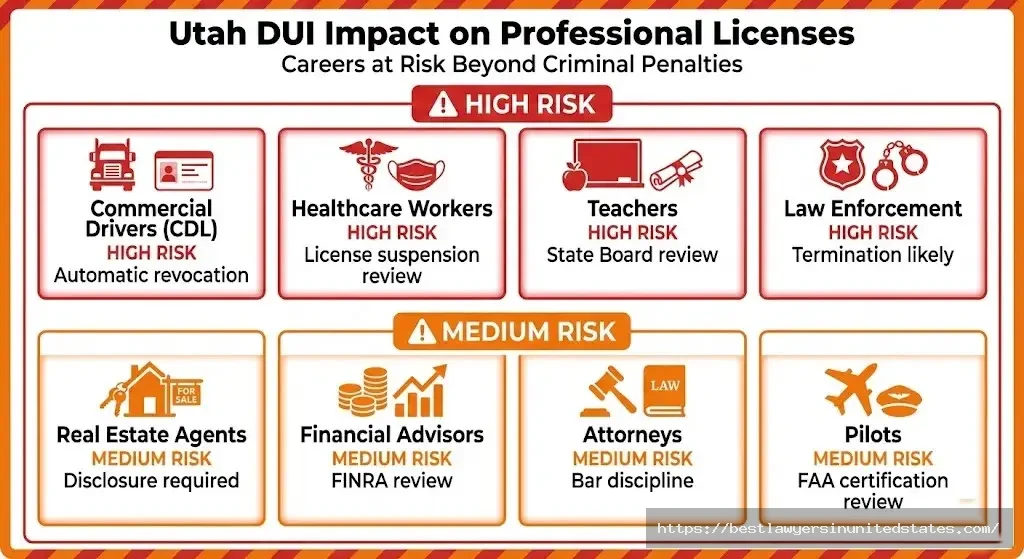
Career impacts:
Immediate job loss risks:
- Commercial drivers (CDL revoked)
- Professional drivers (Uber, Lyft, delivery)
- Healthcare workers
- Teachers and educators
- Law enforcement officers
- Government security positions
Professional license suspensions:
- Utah Medical Board (doctors, nurses)
- Utah State Board of Education (teachers)
- Utah Bar (attorneys)
- Real estate licenses
- Financial advisor certifications
- Cosmetology licenses
Case example: A registered nurse with first DUI faces mandatory Utah Division of Occupational and Professional Licensing review, potential license suspension, and monitoring requirements even after criminal case resolves.
Insurance Rate Increases
SR-22 insurance requirements continue for minimum 3 years after DUI conviction in Utah.
Average premium increases:
| Violation History | Annual Premium Before | Annual Premium After | Percentage Increase |
|---|---|---|---|
| Clean Record | $1,200 | $2,400-$3,000 | 100-150% |
| One Speeding Ticket | $1,500 | $3,000-$4,500 | 100-200% |
| Second DUI | $2,500 | $5,000-$7,500 | 100-200% |
Total 3-year cost: First DUI adds $3,600-$7,200 in insurance costs alone.
When rates return to normal: Most insurers reduce rates to normal levels 3-5 years after DUI if you maintain clean driving record.
Similar insurance impacts occur in neighboring states—compare how Arizona DUI laws and Nevada DUI laws affect insurance rates.
Travel Restrictions
Canadian entry denial:
- DUI is “serious criminality” under Canadian law
- Automatic inadmissibility for 10 years
- Temporary resident permit required ($200 CAD)
- Criminal rehabilitation application after 5 years
Other countries with DUI restrictions:
- Mexico (discretionary denial)
- United Arab Emirates (visa denial)
- Japan (potential denial)
- Australia (visa complications)
Expungement Eligibility in Utah
Utah Code § 77-40a allows DUI expungement under strict conditions:
Eligibility requirements:
- Complete all sentencing terms
- Wait 5 years (Class B), 6 years (Class A), 7 years (felony)
- No subsequent convictions
- Pay all fines and restitution
- Complete probation successfully
- Demonstrate rehabilitation
Expungement benefits:
- Removed from public criminal records
- No disclosure required on job applications
- Professional licensing relief
- Housing application advantages
Limitations:
- Still appears on FBI background checks
- Driving record remains (Driver License Division separate)
- Not eligible if subsequent offenses occur
Expungement process:
- Obtain certificate of eligibility from Utah Bureau of Criminal Identification
- File petition in district court
- Serve prosecuting attorney
- Attend hearing if contested
- Judge grants or denies expungement
Costs: $65 BCI application fee + $360 court filing fee = $425 total
How Utah DUI Laws Compare to Other States
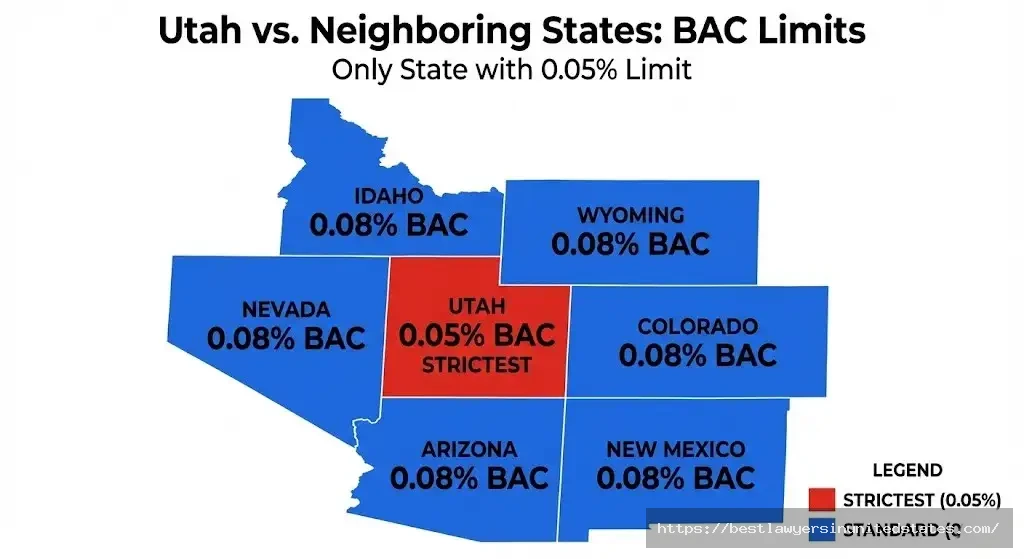
Utah vs. Neighboring States
Quick Answer: Utah enforces the strictest DUI laws in the nation with its 0.05% BAC limit compared to 0.08% in all surrounding states.
| State | Legal BAC | First Offense Jail | License Suspension | Ignition Interlock |
|---|---|---|---|---|
| Utah | 0.05% | 2 days mandatory | 120 days | 18 months required |
| Nevada | 0.08% | 2 days-6 months | 185 days | 6-12 months |
| Arizona | 0.08% | 1 day minimum | 90 days | 6-12 months |
| Colorado | 0.08% | 5 days-1 year | 9 months | Varies by county |
| Idaho | 0.08% | Up to 6 months | 90-210 days | 1 year minimum |
| Wyoming | 0.08% | Up to 6 months | 90 days | Not required first offense |
Key differences:
- Utah’s 0.05% BAC is 37.5% lower than other states
- Mandatory ignition interlock in Utah (optional in some states)
- Stricter plea bargain restrictions in Utah
- Metabolite DUI unique to Utah
Learn more about neighboring state requirements:
- Colorado DUI laws allow more flexible plea negotiations
- Nevada DUI laws impose longer initial suspensions
- Arizona DUI laws include extreme DUI at 0.15% BAC
Why Utah Has the Strictest Laws
Legislative history:
- December 30, 2018: Utah became first state to lower BAC to 0.05%
- Goal: Reduce alcohol-related traffic deaths by 18.3%
- Modeling after European standards (most EU countries use 0.05%)
- Opposition from restaurant and hospitality industries
- Supported by Utah Highway Safety Office data
Enforcement statistics:
- 2019-2023: DUI arrests decreased 12% after law change
- Fatal alcohol crashes reduced 18% in first two years
- Average BAC at arrest dropped from 0.14% to 0.12%
Cultural factors:
- Utah’s predominantly Mormon population (60%+)
- Religious teachings against alcohol consumption
- Strong lobbying from religious organizations
- Public health emphasis over tourism concerns
National DUI Statistics Context
United States DUI data:
- 10,142 alcohol-impaired driving deaths in 2023 (NHTSA)
- Average BAC in fatal crashes: 0.16% (twice legal limit)
- 28% of all traffic deaths involve alcohol
- DUI arrests: 1 million+ annually
Utah-specific statistics:
- 54 alcohol-related traffic deaths in 2023
- 2,847 DUI arrests in 2023
- Average BAC at arrest: 0.12%
- Repeat offender rate: 32%
Frequently Asked Questions About Utah DUI
How many drinks equal 0.05% BAC in Utah?
Quick Answer: Most people reach 0.05% BAC after 1-2 drinks for women and 2-3 drinks for men within one hour.
Factors affecting your BAC:
- Body weight and composition
- Biological sex (women metabolize alcohol slower)
- Food in stomach
- Drinking speed
- Alcohol content in drinks
- Medications affecting metabolism
Use our BAC calculator to estimate your blood alcohol level based on drinks consumed, body weight, and time elapsed.
Safe alternative: If you’ve consumed any alcohol, use rideshare, taxi, or designated driver rather than risking Utah’s strict 0.05% limit.
Will I go to jail for a first DUI in Utah?
Quick Answer: Yes, Utah law mandates minimum 2 days jail time for first DUI conviction, though judges may allow alternatives.
Jail alternatives:
- Electronic home monitoring
- Work release program
- Weekend jail sentences
- Community service substitution (in some cases)
- Treatment program residential time
When jail is unavoidable:
- Aggravated DUI circumstances
- Accident with injuries
- Very high BAC (0.16%+)
- Child passenger in vehicle
Typical first offense sentence: Judge suspends remaining jail time beyond 2-day minimum and orders probation with conditions.
How long does a DUI stay on my record in Utah?
Quick Answer: DUI convictions remain on your Utah criminal record permanently unless you file for expungement after waiting periods.
Permanent record implications:
- Appears on all background checks until expunged
- Counts as prior offense for 10 years
- Professional licensing boards see conviction indefinitely
- DMV driving record shows 10 years
Expungement waiting periods:
- Class B misdemeanor (first DUI): 5 years
- Class A misdemeanor (second DUI): 6 years
- Third-degree felony (third DUI): 7 years
After expungement: Criminal record sealed from public view but remains visible to law enforcement and federal agencies.
Can I refuse a breathalyzer test in Utah?
Quick Answer: You can refuse, but Utah’s implied consent law triggers automatic 18-month license suspension for first refusal—longer than the 120-day suspension for failing the test.
| Action | License Suspension | Criminal Charge | Evidence Impact |
|---|---|---|---|
| Take test, fail | 120 days | DUI charge | BAC evidence used |
| Refuse test | 18 months | DUI charge + refusal charge | Refusal used as evidence of guilt |
Strategic considerations:
- Refusal doesn’t prevent DUI charge
- Prosecutors present refusal as “consciousness of guilt”
- Police may obtain warrant for forced blood draw
- Refusal makes defense more difficult without BAC evidence
Most attorneys advise: Taking the test provides BAC number to challenge, while refusal offers fewer defense options despite no numeric evidence.
What is an Alcohol Restricted Driver in Utah?
Quick Answer: Alcohol Restricted Driver is a unique Utah designation under Utah Code § 41-6a-517 that allows you to drive with an ignition interlock device during your suspension period.
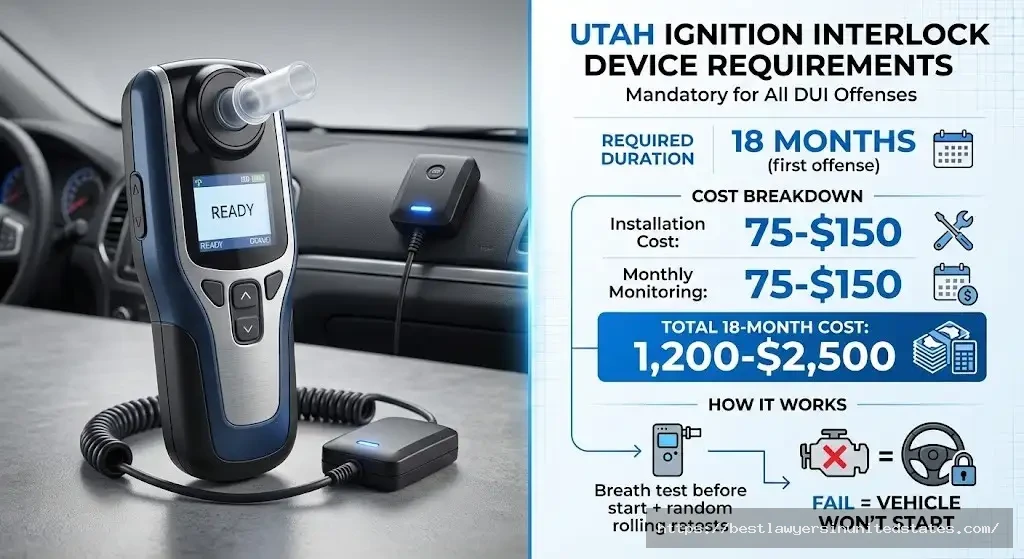
How it works:
- Install ignition interlock in your vehicle
- Device requires breath sample before car starts
- Random rolling retests while driving
- Any alcohol detection prevents vehicle start
- Violations reported to court
Benefits over full suspension:
- Maintain employment requiring driving
- Drive to school and medical appointments
- Earlier license reinstatement
- Meet family obligations
Requirements:
- Pay $325 reinstatement fee
- Complete DUI screening
- Maintain SR-22 insurance
- Monthly device monitoring ($75-$150)
- Zero tolerance for any alcohol
Application process:
- Complete mandatory suspension period (if any)
- Install certified ignition interlock device
- Submit proof to Driver License Division
- Pay reinstatement fee
- Receive restricted license
How much does a DUI attorney cost in Utah?
Quick Answer: Utah DUI attorneys charge $3,000-$10,000 for first offense representation, with higher fees for complex cases.
Fee structures:
- Flat fee (most common): $3,000-$7,500 first offense
- Hourly rate: $200-$400/hour (less common)
- Trial preparation: Additional $2,000-$5,000
- Expert witnesses: $1,500-$3,000 each
Factors affecting cost:
- First vs. repeat offense
- Misdemeanor vs. felony charges
- Trial vs. plea negotiation
- Accident involvement
- Attorney experience level
- Geographic location (Salt Lake City higher than rural areas)
Payment options:
- Upfront retainer (typical)
- Payment plans available
- Credit card acceptance
- Court-appointed defender if indigent
Cost-benefit analysis: Attorney fees of $5,000-$7,000 often save $10,000-$20,000 in reduced fines, shorter suspension, avoided jail time, and lower insurance increases.
For a detailed breakdown of potential costs, use our DUI cost calculator to estimate total expenses including attorney fees.
Can a DUI be reduced to reckless driving in Utah?
Quick Answer: Utah Code § 41-6a-501(3) prohibits reducing DUI to reckless driving without “good cause,” making plea bargains difficult.
Utah’s plea bargain restrictions:
- Prosecutors must show “good cause” for any reduction
- Court must approve plea agreement
- Standard practice prohibits routine reductions
- Second or subsequent DUI cannot be reduced
“Good cause” examples:
- Weak breathalyzer evidence
- Illegal traffic stop
- Rising BAC defense
- Improper test administration
- Witness credibility issues
Comparison to other states: Colorado DUI laws and Arizona DUI laws allow more flexible plea negotiations, making Utah particularly strict.
What’s still negotiable:
- Sentencing recommendations
- Jail time alternatives
- Treatment program selection
- Probation conditions
- Aggravated to standard DUI reduction
Do I need SR-22 insurance after a Utah DUI?
Quick Answer: Yes, Utah requires SR-22 insurance filing for minimum 3 years after any DUI conviction.
SR-22 requirements:
- Certificate of Financial Responsibility
- Insurance company files directly with Driver License Division
- Must maintain continuously for 3 years minimum
- Any lapse triggers immediate suspension
- Required before license reinstatement
Minimum coverage amounts:
- $25,000 bodily injury per person
- $65,000 bodily injury per accident
- $15,000 property damage
Costs:
- Filing fee: $15-$50 one-time
- Premium increase: 80-150% higher rates
- Annual extra cost: $1,000-$2,000
- Total 3-year impact: $3,000-$6,000+
When requirement ends:
- After 3 years of continuous coverage
- Driver License Division sends termination notice
- Contact insurer to remove SR-22 status
- Rates gradually decrease over following 2-3 years
Finding a DUI Attorney in Utah
When to Hire Legal Representation
Situations requiring immediate attorney:
- Second or subsequent DUI offense
- Felony DUI charges
- Accident causing injury or death
- Metabolite DUI involving prescription drugs
- Commercial driver’s license at risk
- Professional license jeopardy
- High BAC (0.15%+)
- Minor passenger in vehicle
Benefits of early representation:
- Attorney guidance during police questioning
- DMV hearing representation (10-day deadline)
- Evidence preservation
- Witness interviews
- Suppression motion preparation
- Plea negotiation (within Utah’s restrictions)
What to Look for in a Utah DUI Lawyer
Essential qualifications:
- ✅ Utah State Bar member in good standing
- ✅ DUI-focused practice (50%+ DUI cases)
- ✅ Trial experience in Utah courts
- ✅ Knowledge of local judges and prosecutors
- ✅ Field sobriety test training
- ✅ Breathalyzer certification understanding
- ✅ Metabolite DUI defense experience
Questions to ask during consultation:
- How many DUI cases have you handled in Utah?
- What’s your success rate with cases like mine?
- Do you recommend going to trial or negotiating?
- What are the likely outcomes in my specific case?
- Who will actually handle my case (attorney or associate)?
- What’s your total fee structure?
Utah DUI Attorney Cost Expectations
Geographic cost variations:
| Location | First Offense | Second Offense | Felony DUI |
|---|---|---|---|
| Salt Lake City | $5,000-$10,000 | $7,500-$15,000 | $15,000-$25,000 |
| Provo/Orem | $4,000-$8,000 | $6,000-$12,000 | $12,000-$20,000 |
| Ogden | $3,500-$7,000 | $5,500-$11,000 | $11,000-$18,000 |
| St. George | $3,000-$6,000 | $5,000-$10,000 | $10,000-$17,000 |
| Rural Utah | $2,500-$5,000 | $4,000-$8,000 | $8,000-$15,000 |
What’s included in attorney fees:
- Initial consultation
- Case investigation
- DMV hearing representation
- Court appearances
- Motion preparation and filing
- Plea negotiation
- Trial preparation (if needed)
Additional costs:
- Expert witnesses: $1,500-$3,000 each
- Breathalyzer expert: $2,000-$4,000
- Toxicology expert: $2,500-$5,000
- Accident reconstruction: $3,000-$10,000
- Court filing fees: $200-$500
Salt Lake City vs. Rural Utah Representation
Salt Lake County advantages:
- More DUI specialists available
- Judges experienced with complex defenses
- Better access to expert witnesses
- Multiple court locations
Rural county considerations:
- Fewer attorneys handle DUI exclusively
- Judges may have less DUI case volume
- Limited expert witness availability
- Often lower attorney fees
- More personal attorney-client relationships
Court locations by county:
- Salt Lake: Third District Court, 450 South State Street
- Utah County: Fourth District Court, 125 North 100 West, Provo
- Davis: Second District Court, 800 West State Street, Farmington
- Weber: Second District Court, 2525 Grant Avenue, Ogden
- Washington: Fifth District Court, 220 North 200 East, St. George
Finding qualified representation: Email: [email protected]
Key Takeaways: Utah DUI Laws 2026
Utah maintains the nation’s strictest DUI laws with a 0.05% BAC limit, mandatory jail time even for first offenses, and unique metabolite DUI provisions that prosecute any detectable drug presence. First-time offenders face minimum 2 days jail, $1,000+ fines, 120-day license suspension, 18-month ignition interlock requirement, and $8,000-$15,000 total costs.
The state’s 10-day deadline for requesting administrative hearings is critical—missing this window costs you the chance to challenge your license suspension. Utah’s alcohol restricted driver status offers the only path to limited driving privileges during suspension, requiring ignition interlock installation and SR-22 insurance.
Metabolite DUI laws create unique risks for prescription medication users and CBD consumers, as any measurable controlled substance triggers charges without impairment proof. Utah’s actual physical control doctrine means you can face DUI charges while sleeping in a parked vehicle if keys are accessible.
Critical deadlines:
- 10 days: Request DMV administrative hearing
- 48 hours: Arraignment after arrest
- 18 months: Ignition interlock requirement (first offense)
- 5 years: Expungement eligibility (Class B misdemeanor)
Consider consulting a Utah DUI attorney immediately after arrest, especially for second offenses, accidents with injuries, or cases involving professional licenses. The state’s strict plea bargain restrictions mean skilled legal representation becomes essential for challenging evidence and protecting your rights.
