Getting charged with DUI in Virginia carries serious consequences that go beyond what most states impose. Virginia law treats DUI and DWI as the same offense under §18.2-266, with mandatory jail time kicking in at surprisingly low BAC levels and a unique 3-hour testing window that affects how prosecutors build their cases.
First-time offenders face fines up to $2,500, potential jail time, and a one-year license suspension, but enhanced penalties apply if your BAC exceeds .15%. Understanding Virginia’s specific requirements—including mandatory VASAP enrollment, FR44 insurance, and ignition interlock devices for restricted licenses—can help you navigate the legal process and minimize long-term damage to your record.
What Counts as DUI in Virginia?
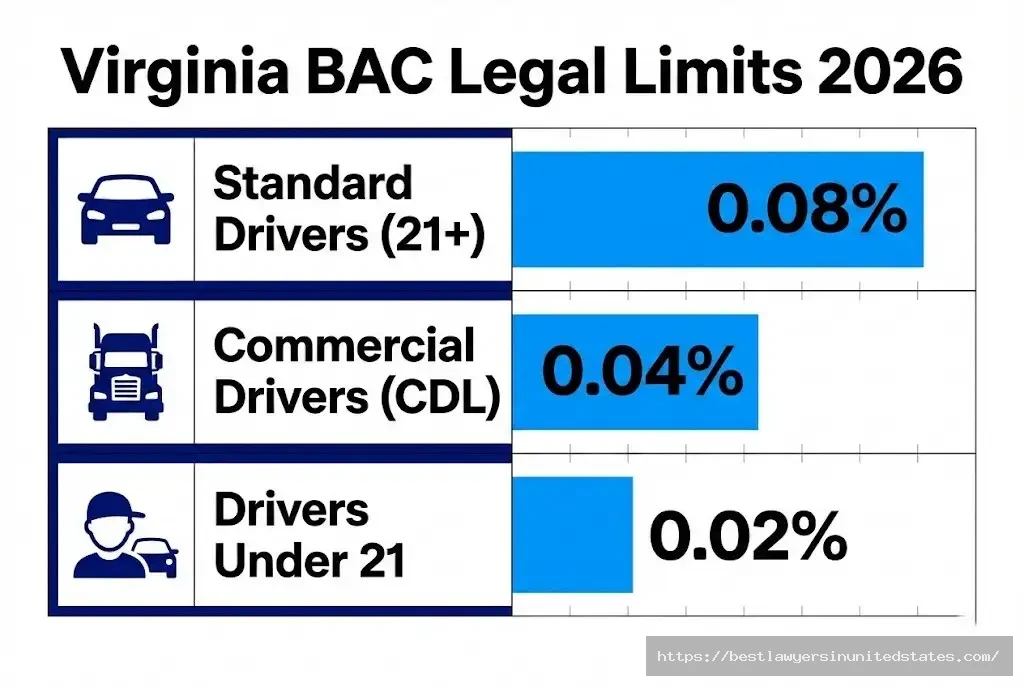
Virginia prosecutes DUI cases under two different legal theories. You can be convicted either by having a BAC of .08% or higher (per se violation) or by showing impairment regardless of your BAC level.
The Per Se Standard
Under §18.2-266, driving with a BAC of .08% or higher automatically violates Virginia law. Officers don’t need to prove you drove poorly or appeared intoxicated. The chemical test result alone provides sufficient evidence for conviction.
Virginia’s BAC limits:
| Driver Type | Legal BAC Limit |
|---|---|
| Standard drivers (21+) | 0.08% |
| Commercial drivers (CDL) | 0.04% |
| Drivers under 21 | 0.02% |
Virginia’s Unique 3-Hour Rule
Chemical test results only count as per se evidence if collected within three hours of driving. This requirement under §18.2-266 creates a critical window for prosecutors.
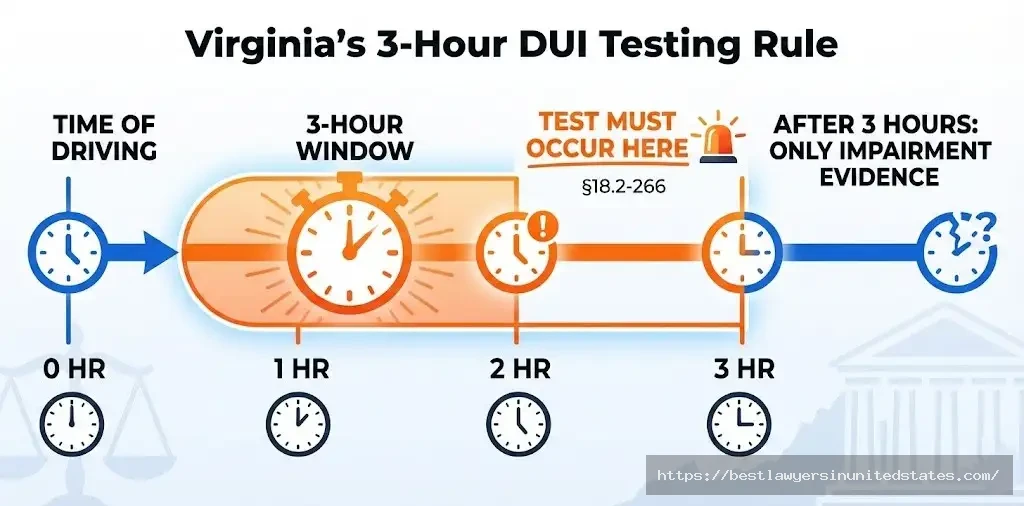
How the 3-hour rule affects cases:
- Police must act quickly to collect breath or blood samples
- Defense attorneys challenge test timing in many cases
- Tests taken after 3 hours can still be used as impairment evidence, not per se proof
- The clock starts when you last drove, not when police stopped you
If you’re unsure whether your BAC might have exceeded Virginia’s legal limits, you can check typical BAC levels using our calculator to understand how alcohol affects blood alcohol concentration.
BAC Calculator
Estimate your Blood Alcohol Content
• Commercial Driver (CDL): 0.04% BAC
• Drivers Under 21: 0.00-0.02% BAC (Zero Tolerance)
• Enhanced Penalties: 0.15% BAC or higher in most states
DUI vs. DWI: Same Offense in Virginia
Virginia uses both terms interchangeably in court documents and statutes. Unlike states like North Carolina that distinguish between the two, Virginia treats DUI and DWI as identical violations under the same statute.
What substances trigger DUI charges:
- Alcohol (most common)
- Marijuana and illegal drugs
- Prescription medications that impair driving
- Over-the-counter drugs causing impairment
- Any combination of substances affecting your ability to drive safely
Virginia Implied Consent Law Explained
Every driver in Virginia automatically agrees to chemical testing when they receive a license. This implied consent under §18.2-268.3 activates the moment an officer arrests you for suspected DUI.
What Officers Must Tell You
Police must read the implied consent warning before requesting a breath, blood, or urine test. The warning explains that refusing triggers an automatic civil penalty separate from any criminal DUI charge.
Your options after arrest:
- Submit to testing – Results can be used as evidence against you
- Refuse testing – Face automatic license suspension and other penalties
- Request additional independent testing – You can pay for your own test after the official one
Refusal Consequences in Virginia
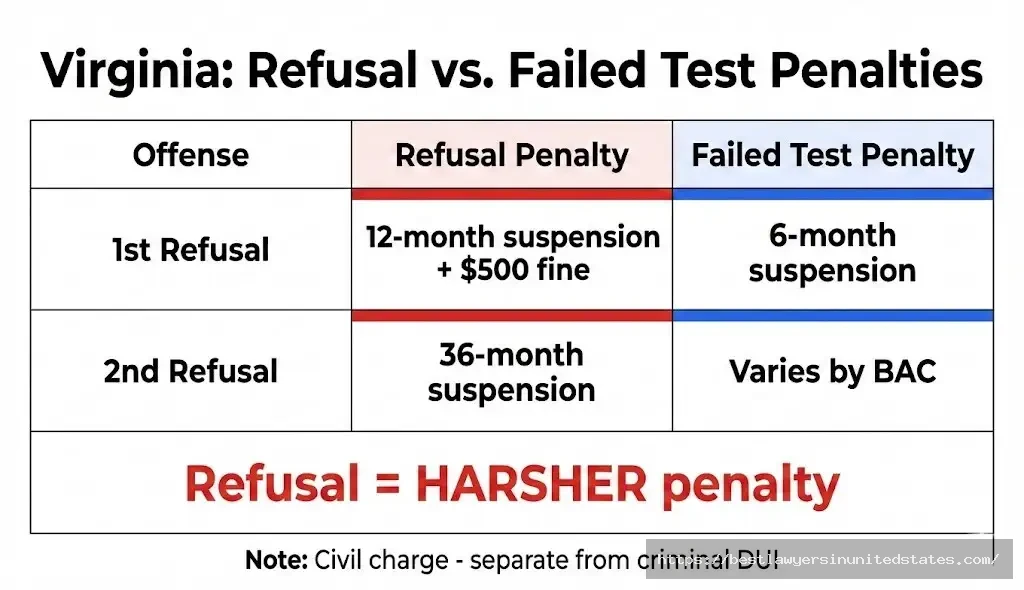
Refusing a chemical test triggers a civil charge under §18.2-268.3, completely separate from your criminal DUI case.
| Refusal Number | License Suspension | Additional Penalties |
|---|---|---|
| First refusal | 12 months | Civil fine up to $500 |
| Second refusal (within 10 years) | 36 months | Possible jail time |
| Third refusal (within 10 years) | 36 months | Class 1 misdemeanor |
Critical point: These suspensions apply even if you’re never convicted of DUI. You’ll fight two separate battles—the refusal case and the criminal DUI case.
Can Police Force You to Take a Test?
Officers cannot physically force you to provide a breath sample without a warrant. However, Virginia law allows police to obtain search warrants for blood draws in cases involving:
- Serious accidents with injuries
- Property damage
- Multiple prior DUI convictions
- Suspected drugged driving cases
Courts typically grant these warrants within 30-60 minutes of the request.
Virginia DUI Penalties by Offense
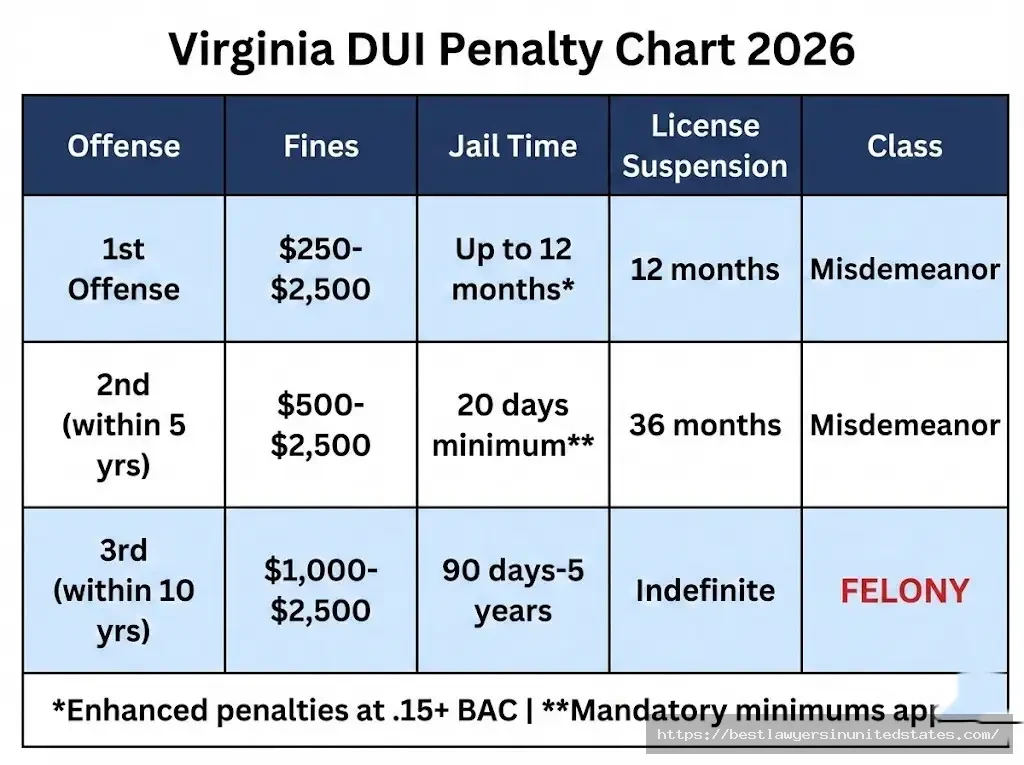
Virginia imposes some of the strictest DUI penalties in the nation, with mandatory minimum sentences that judges cannot reduce. The consequences escalate dramatically for repeat offenders and high BAC levels.
First Offense DUI Penalties
A first-time DUI in Virginia is a Class 1 misdemeanor carrying these base penalties:
| Penalty Type | Amount/Duration |
|---|---|
| Fines | $250-$2,500 |
| Jail time | Up to 12 months (usually none) |
| License suspension | 12 months |
| VASAP enrollment | Mandatory |
| Court costs | Approximately $300-$500 |
Enhanced penalties for elevated BAC:
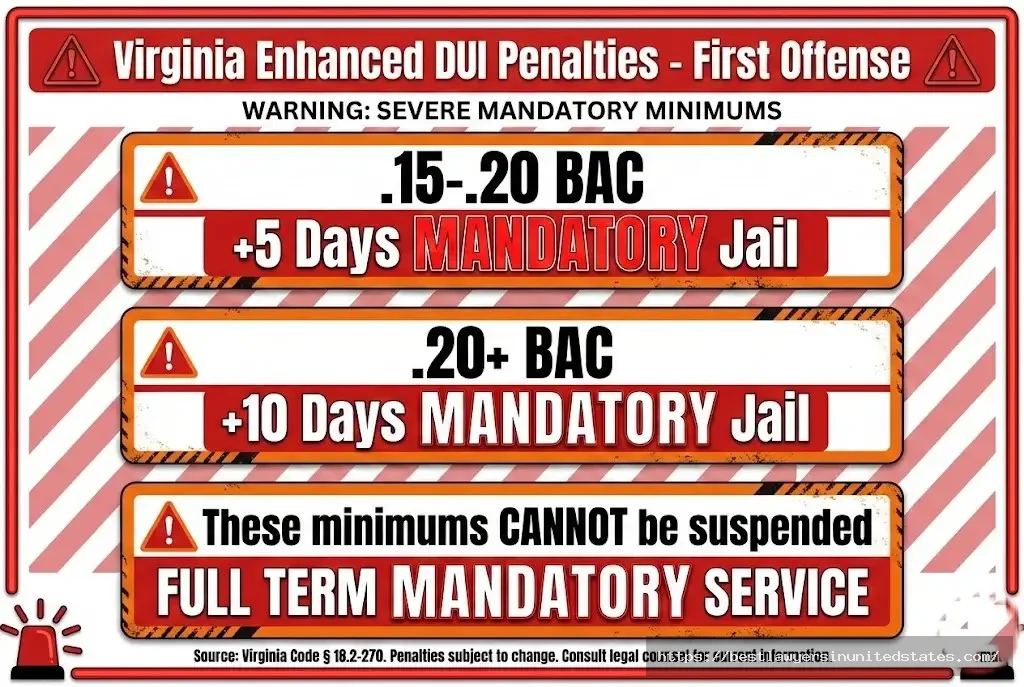
- .15-.20 BAC = Mandatory 5 days in jail
- .20+ BAC = Mandatory 10 days in jail
These minimum jail sentences cannot be suspended or reduced through plea negotiations. Judges must impose them regardless of circumstances.
How Likely Is Jail Time for First DUI?
Most first-time offenders with BAC below .15% avoid jail time in Virginia. Courts typically impose suspended sentences, meaning you won’t serve time unless you violate probation terms.
Factors increasing jail likelihood:
- BAC .15% or higher (mandatory minimum)
- Accident involvement
- Prior reckless driving convictions
- High speed combined with DUI
- Minor passenger in vehicle
Understanding the full financial impact of a first DUI helps you prepare for the total costs beyond just court fines.
Second DUI Within 5-10 Years
Timing matters significantly for second offenses in Virginia. The law treats offenses within 5 years much more harshly than those within 5-10 years.
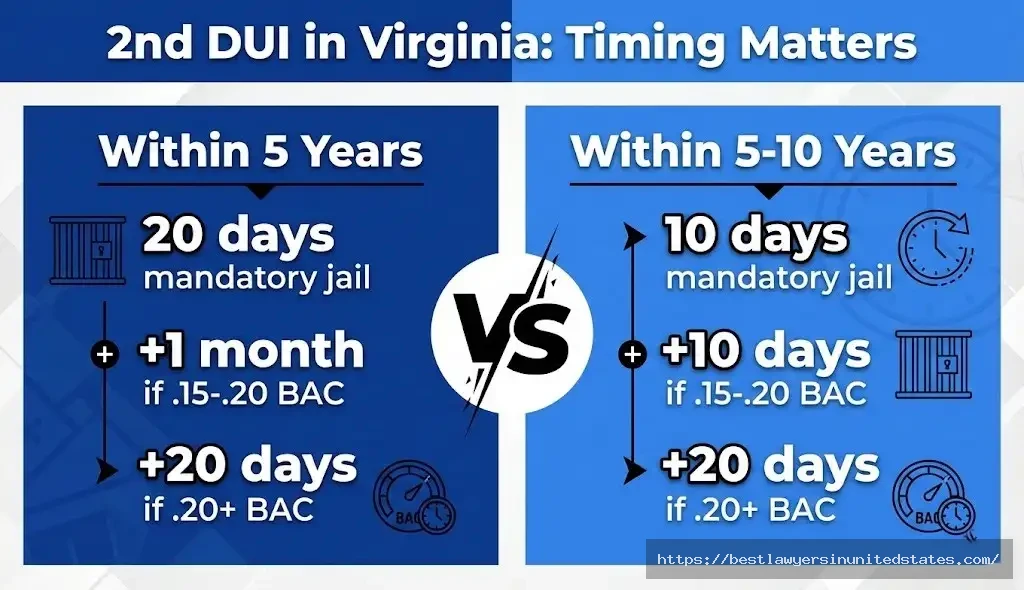
Second offense within 5 years:
| Penalty Category | Requirement |
|---|---|
| Classification | Class 1 misdemeanor |
| Fines | $500-$2,500 |
| Mandatory jail | 20 days minimum (1 month if BAC .15-.20, 20 days additional if .20+) |
| License suspension | 36 months |
| Ignition interlock | Required for restricted license |
Second offense within 5-10 years:
- Mandatory jail: 10 days minimum (10 days additional if BAC .15-.20, 20 days additional if .20+)
- All other penalties remain the same
- Cannot suspend mandatory jail time
Unlike states like Pennsylvania that use different lookback periods, Virginia counts all convictions within a 10-year window.
Third Offense: Automatic Felony
A third DUI within 10 years becomes a Class 6 felony in Virginia, carrying life-altering consequences.
Third offense penalties:
| Category | Within 5 Years | Within 10 Years |
|---|---|---|
| Classification | Class 6 felony | Class 6 felony |
| Mandatory minimum jail | 6 months | 90 days |
| Maximum jail | 5 years | 5 years |
| Fines | $1,000-$2,500 | $1,000-$2,500 |
| License suspension | Indefinite | Indefinite |
What “indefinite suspension” means:
- No automatic reinstatement eligibility
- Must petition for license restoration
- Minimum 3 years before applying
- Must prove rehabilitation and need
- Ignition interlock required if approved
Fourth and Subsequent Offenses
Fourth DUI offenses within 10 years remain Class 6 felonies but carry enhanced mandatory minimums:
- Mandatory 12 months in jail (no suspension possible)
- $1,000 minimum fine
- Permanent license revocation possible
- Vehicle forfeiture authorized under §18.2-270.1
Special DUI Circumstances in Virginia
DUI With a Minor in the Vehicle
Transporting anyone under 18 while impaired triggers mandatory additional penalties under §18.2-270(D):
- Extra 5 days mandatory jail (cannot be suspended)
- Additional $500-$1,000 fine
- Applies to any DUI offense (first through fourth)
- Penalties stack on top of base DUI penalties
Underage DUI (Under 21)
Virginia enforces zero tolerance for drivers under 21 through §18.2-266.1. A BAC of just .02% or higher violates the law—roughly equivalent to one drink.
Underage DUI penalties:
| Penalty Type | First Offense | Second Offense |
|---|---|---|
| License suspension | 12 months | 36 months |
| Minimum fine | $500 | $500 |
| Maximum fine | $1,000 | $1,000 |
| VASAP | Required | Required |
Key difference: Underage DUI cases go through regular adult court if the driver is 18 or older, not juvenile court.
Commercial Driver DUI
CDL holders face stricter standards and career-ending consequences. The BAC limit drops to .04% when operating a commercial vehicle, and any DUI conviction triggers:
- Minimum 12-month CDL disqualification
- Lifetime disqualification for second offense
- Disqualification even if you were driving your personal vehicle
- No restricted CDL available during suspension
Similar rules apply in neighboring states like Maryland, making any DUI charge particularly serious for professional drivers.
Administrative License Suspension Process
Virginia implements two separate suspension systems that run parallel to each other. Understanding both processes is critical for protecting your driving privileges.
The 7-Day Rule
Police confiscate your physical license at the time of arrest for DUI. Virginia DMV issues a temporary permit valid for 7 days from the arrest date.
What happens during those 7 days:
- Day 1-7: Temporary permit allows unrestricted driving
- Day 7: Permit expires, suspension begins automatically
- Exception: Filing for administrative hearing can extend the temporary permit
Requesting an Administrative Hearing
You have 7 days from arrest to request an administrative hearing to challenge the suspension. Missing this deadline means your suspension starts automatically.
How to request a hearing:
- File online through Virginia DMV website
- Mail written request to DMV
- Pay $50 administrative fee
- Hearing scheduled within 60 days
- Temporary driving privileges continue until hearing
What gets decided at the hearing:
- Whether officer had probable cause to stop you
- Whether officer properly advised you of implied consent
- Whether you refused testing or failed the test
- Whether testing procedures followed proper protocols
Two Suspensions Run Separately
Administrative suspension and criminal court suspension stack independently. Even if you win your criminal case, the administrative suspension remains unless successfully challenged.
| Suspension Type | Trigger | Duration (First) | Can You Challenge? |
|---|---|---|---|
| Administrative | Arrest/Refusal | 7 days to 12 months | Yes (within 7 days) |
| Criminal | Conviction | 12 months | Only through appeal |
VASAP: Virginia’s Mandatory Alcohol Program
Every person convicted of DUI in Virginia must complete the Virginia Alcohol Safety Action Program (VASAP) under §18.2-271.1. No exceptions exist—even first-time offenders with minimal BAC levels must enroll.
What VASAP Involves
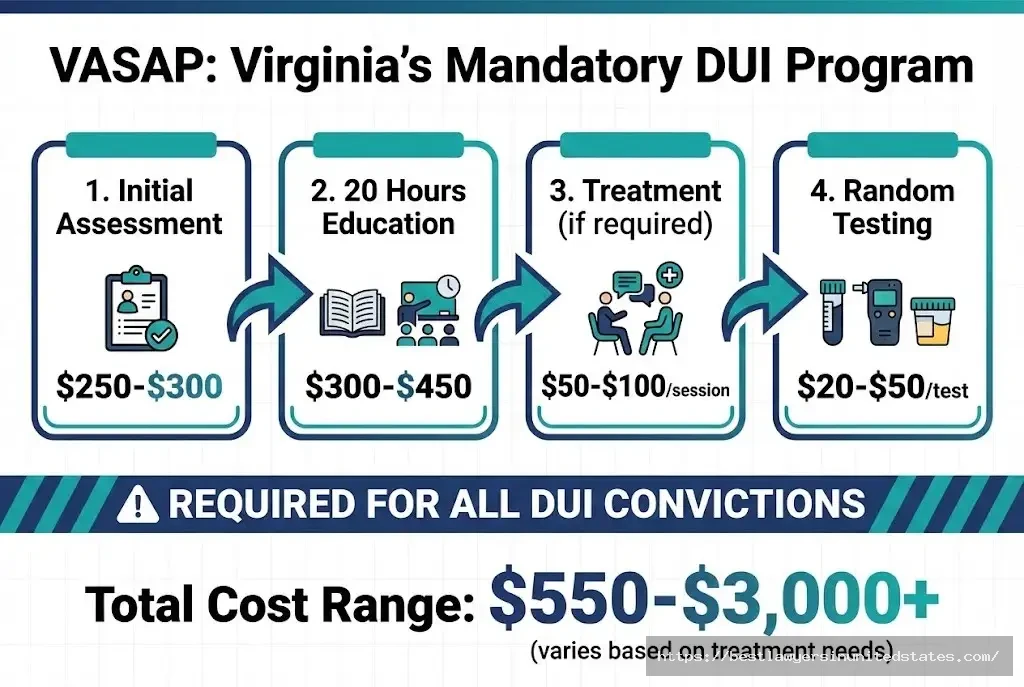
VASAP operates through 24 regional programs across Virginia. The program includes:
Initial assessment:
- Interview with VASAP case manager
- Alcohol/drug evaluation
- Risk level determination
- Treatment plan development
Education component (minimum requirement):
- 20 hours of group education classes
- Sessions cover alcohol effects, Virginia DUI laws, and consequences
- Must attend all sessions (no absences allowed)
- Usually meets weekly over 10 weeks
Treatment component (if required):
- Additional counseling sessions based on assessment
- Can require 50+ hours for high-risk cases
- Individual or group therapy options
- Random alcohol/drug testing
- Cost increases significantly for treatment clients
VASAP Costs
| Service | Average Cost |
|---|---|
| Initial enrollment fee | $250-$300 |
| Education program | $300-$450 |
| Treatment sessions (if required) | $50-$100 per session |
| Drug/alcohol testing | $20-$50 per test |
| Total (education only) | $550-$750 |
| Total (with treatment) | $1,500-$3,000+ |
Important: You must pay all VASAP costs yourself. No payment plans or waivers exist.
VASAP and Your Restricted License
You cannot get a restricted license in Virginia without VASAP enrollment proof. The program provides documentation to DMV showing your enrollment status.
Timeline for restricted license eligibility:
- Cannot apply until VASAP enrollment complete
- Must show ignition interlock device installation
- Earliest eligibility varies by offense (typically 30-90 days after conviction)
- Must maintain good standing in VASAP throughout restricted license period
Failure to complete VASAP prevents license reinstatement permanently until you finish the program.
Getting a Restricted License in Virginia
Virginia allows restricted licenses for work, medical, and educational needs during your suspension period. However, strict requirements apply that differ from states like Tennessee.
Restricted License Eligibility
First offense:
- Can apply after conviction
- No waiting period required
- Must show legitimate need (work, medical appointments, education, childcare)
- Ignition interlock device mandatory
Second offense:
- Must wait 4 months from conviction
- Can only drive to work, VASAP, ignition interlock service
- More limited scope than first offense
Third offense:
- No restricted license available during initial suspension period
- Must serve minimum time before eligibility
Mandatory Ignition Interlock Device
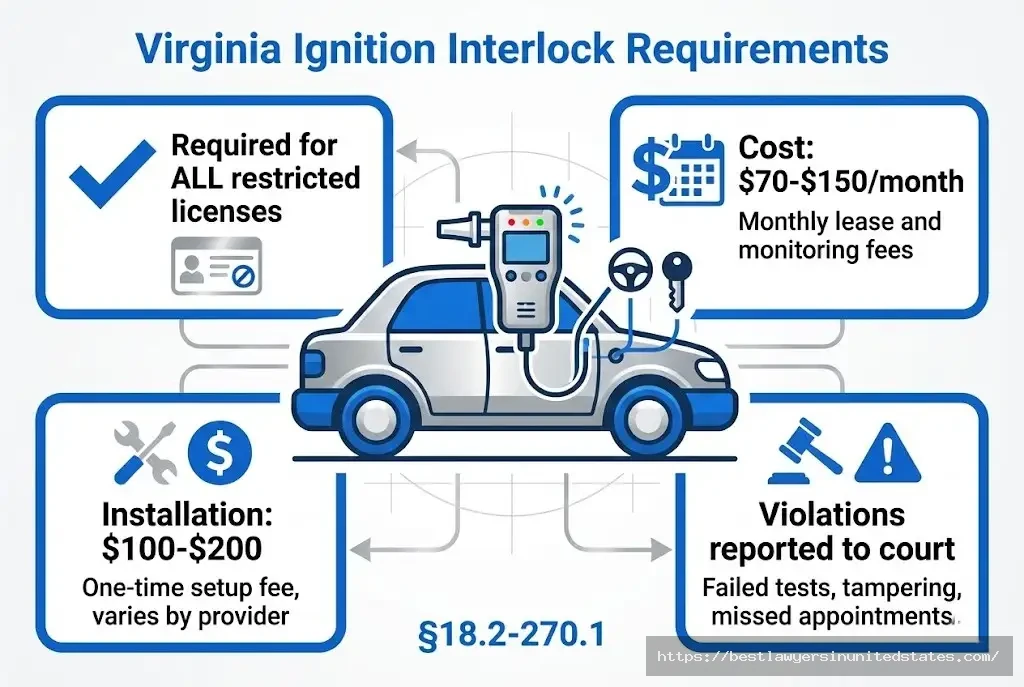
Every restricted license in Virginia requires an ignition interlock device (IID) under §18.2-270.1. No exceptions exist, even for first-time offenders.
IID requirements:
| Aspect | Details |
|---|---|
| Installation | State-certified provider only |
| Monthly cost | $70-$150 (rental + monitoring) |
| Installation fee | $100-$200 one-time |
| Calibration | Monthly appointments required |
| Violations | Recorded and reported to court |
| Removal | Only after completing full restricted period |
How IID works:
- You blow into device before starting car
- Device measures your BAC
- Car won’t start if BAC exceeds .02%
- Random rolling retests required while driving
- All attempts and results logged and reported
Applying for Restricted License
Submit application to Virginia DMV with these required documents:
- Petition for restricted license (form available at DMV)
- VASAP enrollment proof
- FR44 insurance certificate
- IID installation certificate
- Court order (for some offenses)
- $145 restricted license fee
FR44 Insurance Requirement
Virginia requires FR44 insurance for all DUI offenders—a high-risk insurance certification that costs significantly more than standard coverage.
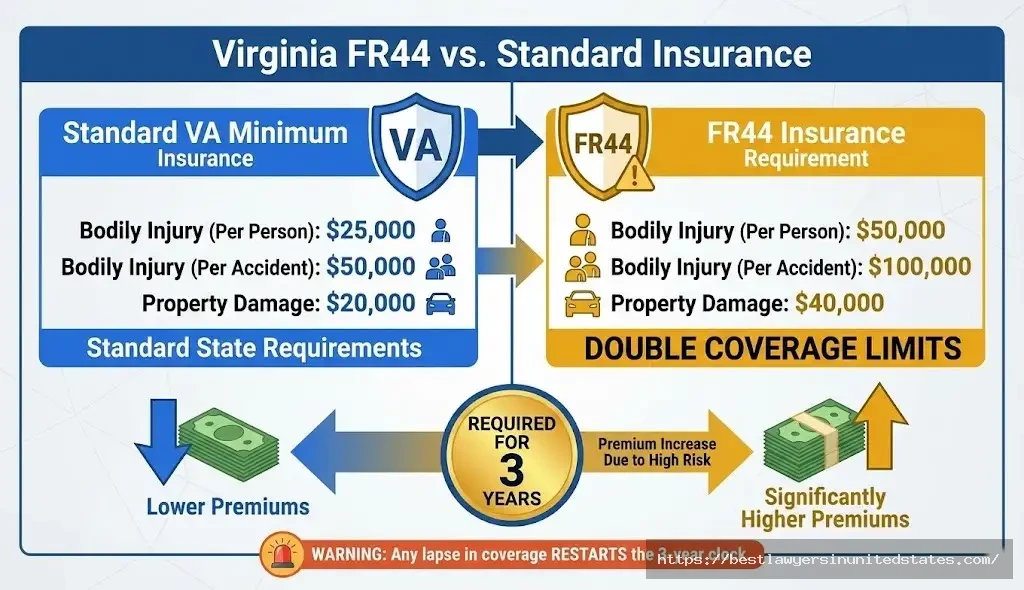
FR44 vs. SR-22 Insurance
Many people confuse FR44 with SR-22 insurance. Virginia uses FR44, which requires double the liability coverage of SR-22.
Coverage requirements:
| Insurance Type | Bodily Injury (per person) | Bodily Injury (per accident) | Property Damage |
|---|---|---|---|
| Virginia minimum | $25,000 | $50,000 | $20,000 |
| FR44 requirement | $50,000 | $100,000 | $40,000 |
How Much FR44 Increases Your Insurance
FR44 designation typically increases insurance premiums 50-200% depending on your driving history and insurance company.
Example cost increases:
- Previous premium: $1,200/year
- With FR44: $2,400-$3,600/year
- Additional cost over 3 years: $3,600-$7,200
How long you need FR44:
- Minimum 3 years from conviction date
- Must maintain continuous coverage
- Any lapse restarts the 3-year clock
- Insurance company files FR44 directly with Virginia DMV
Not all insurance companies offer FR44 policies. You may need to switch to a high-risk insurer, which costs even more.
Full Cost of a Virginia DUI
Direct fines represent only a fraction of total DUI costs in Virginia. Understanding the complete financial impact helps you prepare for what’s ahead.
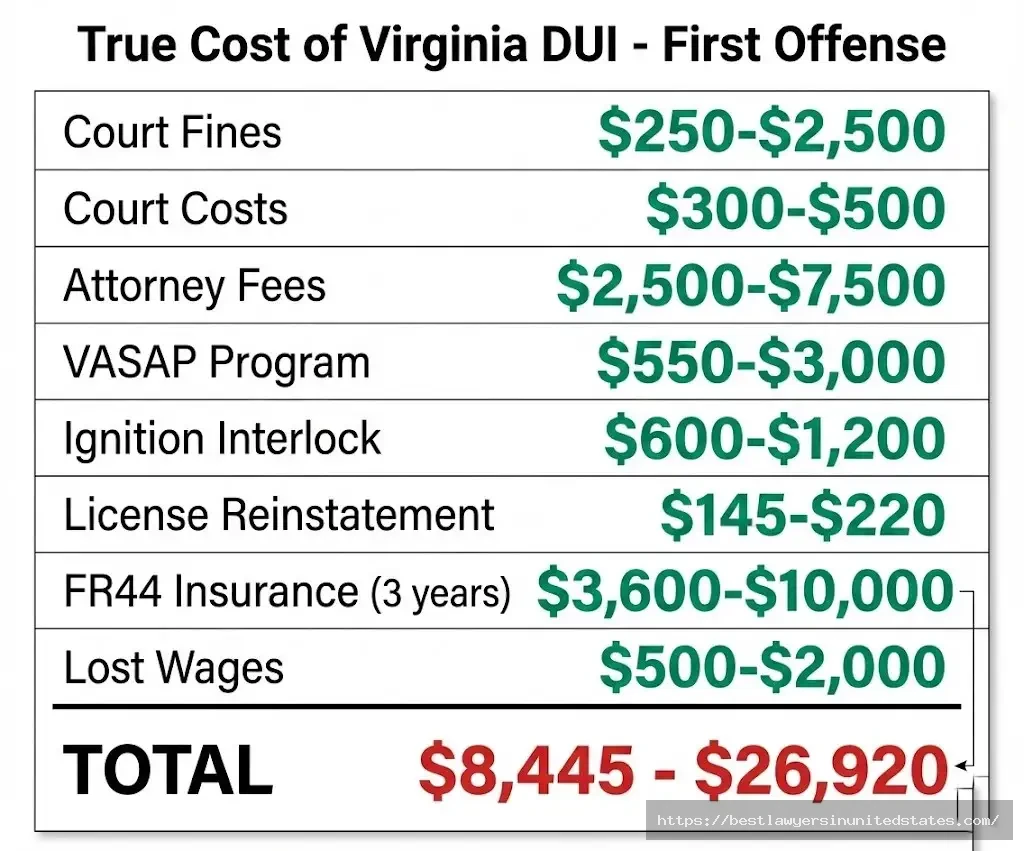
First Offense Cost Breakdown
| Expense Category | Low End | High End |
|---|---|---|
| Court fines | $250 | $2,500 |
| Court costs | $300 | $500 |
| Attorney fees | $2,500 | $7,500 |
| VASAP program | $550 | $3,000 |
| Ignition interlock (6 months) | $600 | $1,200 |
| License reinstatement | $145 | $220 |
| FR44 insurance increase (3 years) | $3,600 | $10,000 |
| Lost wages (court/jail) | $500 | $2,000 |
| Total first offense | $8,445 | $26,920 |
Use our DUI cost calculator to get a personalized estimate based on your specific situation.
DUI Cost Calculator
Estimate total DUI expenses by state and offense
Detailed Cost Breakdown
Payment Timeline
Bail bond, towing fees, car impound, attorney retainer
Initial court fines, DMV fees, DUI school enrollment, ignition interlock installation
Monthly probation fees, ignition interlock fees, DUI school payments, attorney balance
Insurance premium increases, license reinstatement, SR-22 filing fees
- Lost wages from missed work (court dates, jail time, DUI school) – $2,000-$10,000
- Job loss or difficulty finding employment – Varies
- Professional license suspension (doctors, lawyers, nurses, pilots) – Career ending
- Rideshare and transportation costs during suspension – $1,500-$5,000
- Travel restrictions and visa denials – Varies
- Security clearance loss – Career impact
- Child custody implications – Legal costs
- Rental car restrictions – Varies
- Personal relationships and mental health costs – Priceless
Hidden Costs Most People Forget
Employment impact:
- Job loss risk (especially for CDL holders, government employees, healthcare workers)
- Difficulty finding new employment with DUI on record
- Required disclosure on job applications
- Professional license suspensions (lawyers, nurses, teachers)
Transportation costs:
- Uber/Lyft to work during suspension: $200-$500/month
- Restricted license still limits when you can drive
- Increased car insurance for years after conviction
Background check consequences:
- Housing applications may be denied
- Security clearance revocations
- Immigration status complications
- Military service impacts
Second and Third Offense Costs
Costs escalate dramatically for repeat offenses:
Second offense:
- Add $2,000-$5,000 for mandatory jail time consequences
- Higher attorney fees ($5,000-$15,000)
- Longer FR44 requirement period
- Vehicle installation costs for extended IID period
- Total: $15,000-$40,000+
Third offense (felony):
- Felony defense attorney: $10,000-$25,000
- Bail bond costs: $1,000-$5,000
- Extended jail time impacts (lost wages, job loss)
- Permanent license revocation costs
- Total: $30,000-$60,000+
Virginia DUI Court Process Timeline
Understanding the criminal justice timeline helps you prepare for what’s ahead and meet critical deadlines.
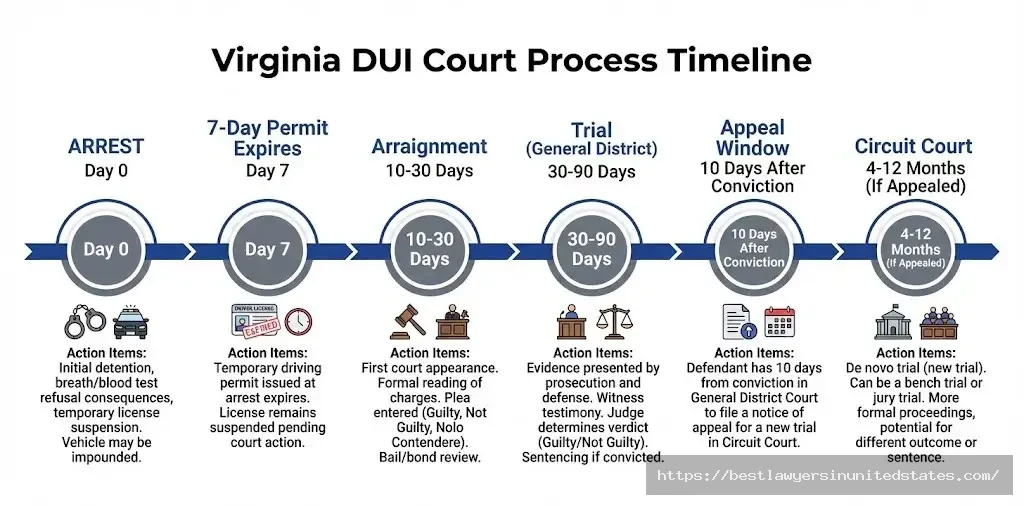
Arrest to Arraignment
Within 48 hours of arrest:
- Booking at local jail or police station
- Bail hearing (most released on personal recognizance)
- Arraignment scheduled in General District Court
- Temporary 7-day driving permit issued
At arraignment (10-30 days after arrest):
- Judge reads formal charges
- You enter initial plea (guilty, not guilty, no contest)
- Trial date set (usually 30-90 days out)
- Bond conditions reviewed or modified
General District Court Trial
First and second offense DUI cases begin in General District Court:
- No jury trials available (judge-only proceedings)
- Commonwealth’s Attorney prosecutes
- Police officer testimony required
- Breathalyzer/blood test results admitted
- Defense presents evidence and witnesses
- Judge issues verdict same day
Possible outcomes:
- Guilty verdict → Sentencing same day
- Not guilty verdict → Case dismissed, administrative suspension may remain
- Case continued → New trial date set
- Reduced charges → Reckless driving or other lesser offense
Appeals to Circuit Court
Losing in General District Court doesn’t end your options. Virginia allows de novo appeals to Circuit Court within 10 days of conviction.
Circuit Court differences:
- Jury trial available (6-person jury for misdemeanors)
- Fresh start (previous conviction erased)
- More formal proceedings
- Higher stakes (judge not bound by previous sentence)
- Can result in harsher penalty than original
Felony DUI Process
Third and subsequent DUI offenses go directly to Circuit Court:
- Grand jury indictment required
- Preliminary hearing in General District Court first
- 12-person jury for felony trials
- More extensive discovery process
- Longer timeline (4-12 months common)
What Makes a DUI Case Weak?
While every case is different, certain factors make DUI charges harder for prosecutors to prove beyond reasonable doubt.
Common Defense Angles in Virginia
Challenging the traffic stop:
- Did officer have reasonable suspicion to stop you?
- Was checkpoint properly established with required signage?
- Did officer extend stop beyond reasonable time?
Field sobriety test issues:
- Were tests administered according to NHTSA standards?
- Did medical conditions affect performance?
- Were environmental factors present (uneven pavement, poor lighting)?
- Did officer properly explain and demonstrate tests?
Chemical test problems:
- Was test administered within 3-hour window?
- Did officer follow 20-minute observation period requirements?
- Was breathalyzer properly calibrated and maintained?
- Were blood samples properly stored and tested?
- Did medical conditions (GERD, diabetes) affect results?
Implied consent violations:
- Did officer properly read implied consent warning?
- Was warning given before or after test request?
- Did officer answer your questions about consequences?
Rising BAC Defense
Virginia’s 3-hour rule creates opportunities for rising BAC defenses. Your BAC may have been below .08% while driving but rose above the limit by testing time.
When this defense works:
- Short time between drinking and driving
- Test administered 1-2 hours after stop
- No other impairment evidence present
- Expert testimony about absorption rates
How DUI Affects Your Life Long-Term
A Virginia DUI conviction creates a permanent criminal record that follows you indefinitely. Understanding these consequences helps you make informed decisions about fighting charges.
Criminal Record Consequences
Virginia does not allow expungement of DUI convictions under any circumstances. Unlike states like Ohio that permit sealing after certain periods, Virginia keeps DUI convictions on your record permanently.
What stays on your record:
- Criminal conviction (Class 1 misdemeanor or Class 6 felony)
- Arrest record
- Court proceedings
- Sentencing details
- All show up on background checks forever
The “7-year rule” doesn’t help: While DMV demerit points drop after 7 years, the criminal conviction remains. Employment background checks still find it 10, 20, or 30 years later.
Employment Impact
Jobs requiring clean records:
- Teaching positions (K-12, university)
- Healthcare roles (nurses, EMTs, physicians)
- Government employment (federal, state, local)
- Financial services (banking, accounting)
- Commercial driving (CDL positions)
- Security/law enforcement careers
Disclosure requirements:
- Most job applications ask about criminal convictions
- Professional licensing boards require disclosure
- Failing to disclose can result in termination for dishonesty
- Some employers automatically disqualify DUI convictions
Professional License Consequences
Virginia professional licensing boards take DUI convictions seriously:
Medical professionals:
- Board of Medicine reviews all DUI convictions
- May require substance abuse evaluation
- Possible license suspension or probation
- Must report to board within 30 days
Attorneys:
- Virginia State Bar disciplinary proceedings
- Public reprimand possible
- Law license suspension for repeat offenses
Teachers:
- Board of Education notification required
- Teaching license review
- May lose certification for felony DUI
CDL holders:
- Automatic 12-month disqualification
- Career-ending for most professional drivers
- No restricted CDL available
Immigration Consequences
DUI convictions can affect immigration status and applications:
- Green card renewal complications
- Naturalization application denials
- Visa revocation possibilities
- Deportation risk for felony DUI (rare but possible)
- Travel restrictions to certain countries
Regional Variations in Virginia
While Virginia law applies statewide, enforcement patterns and court practices vary significantly by region.
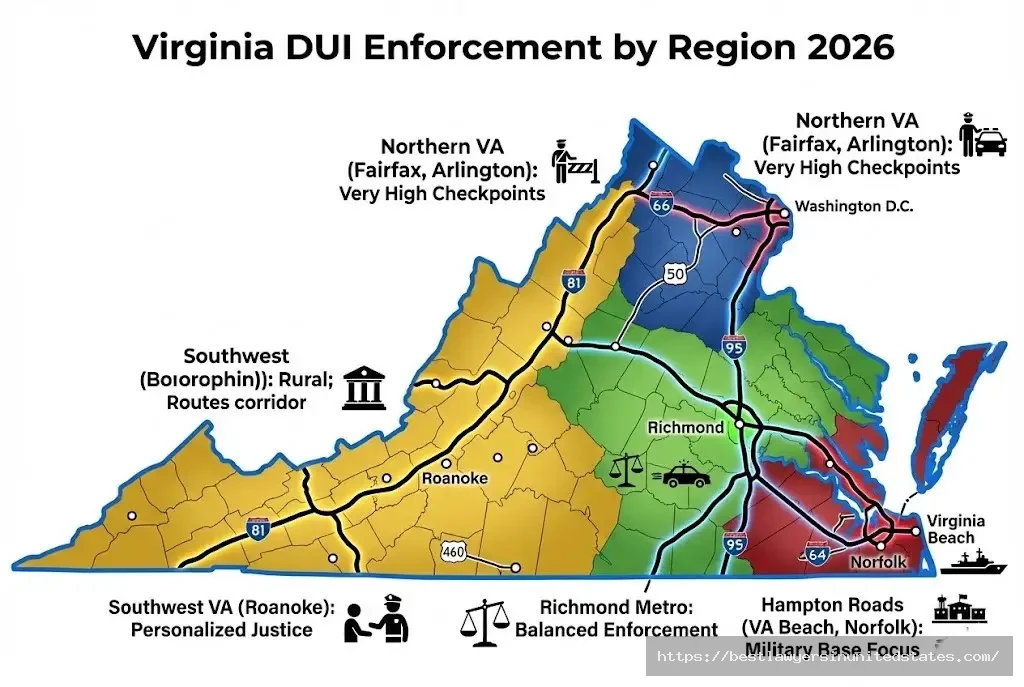
Northern Virginia (Fairfax, Arlington, Loudoun)
Northern Virginia courts handle high DUI volumes and tend toward consistent, by-the-book sentencing:
- Checkpoint frequency: Very high (especially holiday periods)
- Prosecution approach: Rarely dismiss cases or offer favorable pleas
- Jail time: First offenders with BAC under .15% rarely serve time
- Attorney necessity: Strongly recommended due to strict prosecution
High-enforcement areas:
- Route 50 corridor
- I-66 during rush hours
- Route 7 (Leesburg Pike)
- Route 29 (Lee Highway)
Hampton Roads (Virginia Beach, Norfolk, Newport News)
Coastal Virginia sees heavy DUI enforcement near military bases and entertainment districts:
- Military implications: Service members face additional UCMJ consequences
- Beach area enforcement: Town Center and Oceanfront heavily patrolled
- Navy base proximity: BAC testing often immediate
- Treatment programs: More diversion options available for first offenders
Richmond Metro Area
Virginia’s capital region balances strict prosecution with treatment-oriented approaches:
- VASAP variations: Richmond program typically thorough but fair
- Court attitudes: Some flexibility for first offenders showing responsibility
- Checkpoint locations: Interstate 95 and Route 288 common spots
- Attorney selection: Local experience matters significantly
Southwest Virginia (Roanoke, Blacksburg)
Rural courts may offer more personalized justice but still impose full penalties:
- Lower DUI volumes: Judges remember defendants
- Community impact: Small-town reputation damage significant
- Attorney availability: Fewer DUI specialists available
- VASAP access: Longer distances to program locations
Frequently Asked Questions
Can You Get a DUI Dismissed in Virginia?
Quick Answer: DUI dismissals are rare in Virginia but possible if prosecutors lack sufficient evidence or constitutional violations occurred during your arrest.
Complete dismissals typically require serious problems with the state’s case: illegal traffic stops, breathalyzer malfunctions, improper blood draws, or missing police officers at trial. Your attorney negotiates with the Commonwealth’s Attorney to identify weaknesses that might lead to dismissal or reduced charges like reckless driving.
Virginia prosecutors rarely offer favorable plea deals compared to other states. They know most defendants face mandatory minimums and limited defense options, reducing their incentive to negotiate.
How Long Does a DUI Stay on Your Record in Virginia?
Quick Answer: DUI convictions remain on your Virginia criminal record permanently with no expungement available.
Virginia law prohibits expungement of any DUI conviction under §19.2-392.2. The conviction appears on background checks indefinitely, affecting employment, housing, and professional licensing for life. Only dismissed or acquitted DUI charges can be expunged, not convictions.
The “7-year rule” applies only to DMV demerit points, not your criminal record. After 7 years, points drop from your driving record, but the conviction itself remains permanently accessible.
What Happens If You Refuse a Breathalyzer in Virginia?
Quick Answer: Refusing a breathalyzer in Virginia triggers an automatic 12-month license suspension for first refusal, plus a separate civil charge with up to $500 fine.
Refusal penalties run completely separately from any DUI criminal case under §18.2-268.3. Even if your DUI charge gets dismissed, the refusal suspension remains unless successfully challenged at an administrative hearing within 7 days of arrest.
Second refusals within 10 years result in 3-year suspensions. Officers increasingly obtain search warrants for forced blood draws when drivers refuse testing, especially in accident cases.
Is Jail Time Mandatory for Second DUI in Virginia?
Quick Answer: Yes, Virginia imposes mandatory minimum jail time for all second DUI offenses—20 days if within 5 years, 10 days if within 5-10 years.
Judges cannot suspend these mandatory minimums under §18.2-270. If your BAC was .15-.20%, add another month of mandatory jail. BAC above .20% adds 20 more mandatory days. These sentences stack and cannot be reduced through plea negotiations or good behavior.
Unlike neighboring West Virginia that offers some judicial discretion, Virginia courts must impose the full mandatory sentence.
Can You Drive After a DUI Before Your Court Date?
Quick Answer: You can drive on your 7-day temporary permit until it expires, then your license is suspended until you obtain a restricted license or complete your full suspension.
Police confiscate your physical license at arrest but issue a temporary permit valid for 7 days. During those 7 days, you drive legally with no restrictions. After day 7, your suspension begins automatically unless you requested an administrative hearing within that window.
Getting caught driving on a suspended license after DUI results in additional Class 1 misdemeanor charges, up to 12 months in jail, and extended suspension periods.
What Is the Penalty for First-Time DUI in Virginia?
Quick Answer: First-time DUI penalties range from $250-$2,500 fine, up to 12 months in jail (rarely imposed below .15% BAC), 12-month license suspension, mandatory VASAP enrollment, and potential ignition interlock requirement.
Most first offenders with BAC below .15% receive suspended jail sentences, probation, and VASAP requirements. Enhanced penalties kick in at .15% BAC (mandatory 5 days jail) and .20% BAC (mandatory 10 days). Total costs typically range from $8,000-$27,000 including fines, attorney fees, VASAP, insurance increases, and ignition interlock expenses.
Does Virginia DUI Show on Background Checks?
Quick Answer: Yes, Virginia DUI convictions appear on all criminal background checks permanently because Virginia prohibits expungement of DUI convictions.
Employers, landlords, professional licensing boards, and government agencies all see DUI convictions on standard background checks. The conviction never disappears or gets sealed regardless of how much time passes. This differs significantly from states like California that allow record sealing after 10 years.
Only dismissed or acquitted DUI charges can be expunged from Virginia records. Convictions remain permanently accessible.
Can You Beat a DUI Charge in Virginia?
Quick Answer: Successful DUI defenses typically challenge illegal traffic stops, breathalyzer accuracy, field sobriety test administration, or 3-hour rule violations through motions to suppress evidence.
Virginia DUI cases get dismissed or reduced when prosecutors cannot prove their case beyond reasonable doubt. Common successful defense strategies include proving the officer lacked reasonable suspicion for the stop, demonstrating breathalyzer calibration problems, showing blood test contamination, or proving BAC rose after driving ended (rising BAC defense).
Winning requires experienced legal representation familiar with Virginia’s specific DUI statutes and local court procedures.
Finding Legal Help in Virginia
DUI charges in Virginia carry serious consequences that benefit from experienced legal representation. While you have the right to represent yourself, the complexity of Virginia DUI law and mandatory minimum sentences make attorney representation highly valuable.
When choosing a DUI attorney, consider:
- Virginia DUI experience specifically (general criminal attorneys may lack specialized knowledge)
- Familiarity with your local court (judges, prosecutors, procedures)
- Track record with cases similar to yours
- Fee structure and payment plans
- Communication style and availability
Average Virginia DUI attorney fees:
- First offense (misdemeanor): $2,500-$7,500
- Second offense (misdemeanor): $5,000-$10,000
- Third offense (felony): $10,000-$25,000
Most attorneys offer free initial consultations to evaluate your case.
Need help with a Virginia DUI charge?
Contact experienced DUI attorneys in your area for a free case evaluation.
Email: [email protected]