
If you’ve been using Native shampoo or conditioner and started worrying whether the products live up to their “clean” promises, you are far from alone. The Native hair care lawsuit story is about allegations that some Native personal care products may contain PFAS — toxic synthetic chemicals known as “forever chemicals” because they never fully break down in the human body or the environment — while the brand markets itself as natural, simple, and safe.
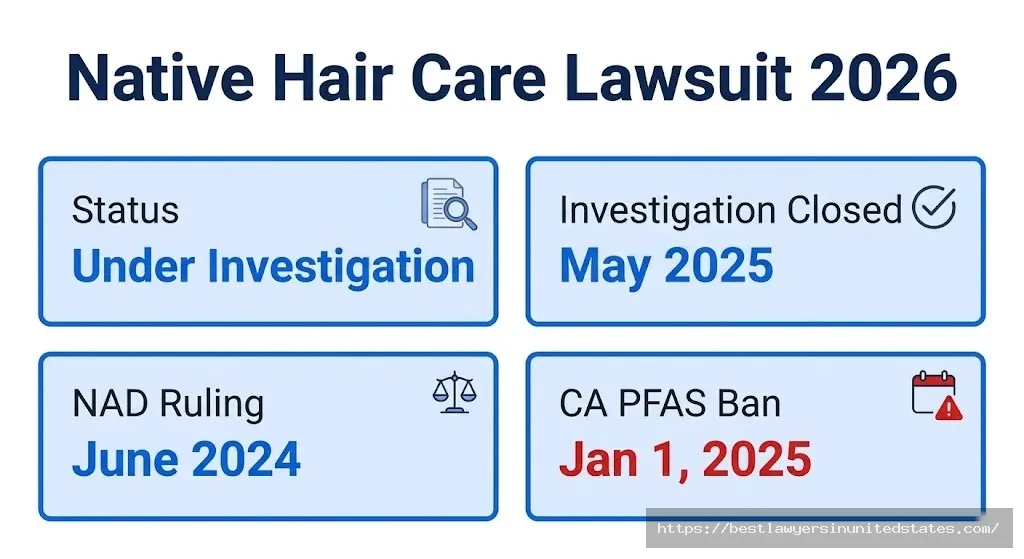
As of 2026, no formal class action lawsuit has been filed in court, and no settlement fund exists. What has happened is a serious, documented legal investigation, a regulatory advertising ruling against Native’s parent company Procter & Gamble, and a massive wave of hair loss and scalp irritation complaints that went viral. Understanding where things actually stand — not where misleading headlines imply they stand — is what this guide is for.
Quick Answer: The Native hair care lawsuit involves consumer complaints about hair loss, scalp damage, and PFAS chemical concerns in products sold as “natural” and “clean.” Attorneys formally investigated the matter from 2023 to May 2025. The National Advertising Division (NAD) challenged several of Native’s marketing claims in June 2024 and required the brand to update its messaging. No court case has been filed, no settlement deadline exists, and no compensation fund has been opened as of early 2026. However, consumers who suffered documented harm may still have individual legal options. Lugano Diamonds Lawsuit
What Is the Native Hair Care Lawsuit About?
Background of the Brand and the Controversy
Native is a personal care brand founded in 2015 in San Francisco. It was built around the promise of clean, simple, naturally derived ingredients — starting with aluminum-free deodorant and expanding into shampoo, conditioner, body wash, and sunscreen. The brand was acquired by Procter & Gamble for a reported $100 million in November 2017, making it part of one of the world’s largest consumer goods companies.
Despite that corporate backing, Native kept its indie, eco-conscious identity. Its minimalist packaging, short ingredient lists, and bold claims of being “sulfate-free,” “paraben-free,” and made with “simple, naturally derived ingredients” attracted millions of shoppers who wanted to avoid the harsh chemicals found in mainstream products. For a long time, it worked beautifully as a brand story.
Then the complaints started coming in.
Starting around 2023 and accelerating sharply through 2024 and into early 2025, thousands of consumers began reporting that Native shampoo and conditioner had caused unexpected hair loss, thinning, scalp irritation, dryness, and breakage. The volume and consistency of these reports — across Reddit, TikTok, beauty forums, and consumer complaint boards — caught the attention of consumer rights attorneys. That is when the legal conversation began.
The Two Core Allegations
The Native hair care controversy breaks down into two distinct but related issues.
First: Hair loss and scalp damage. Consumers reported that after switching to Native shampoo and conditioner, they experienced noticeable hair shedding, thinning, scalp dryness, itching, and in some cases significant hair loss that they directly attributed to the products. These were people who had specifically chosen Native because they believed it would be gentler on their hair than conventional brands — making the reported damage feel like a particular betrayal.
Second: PFAS contamination and false advertising. Consumer rights attorneys and watchdog organizations raised concerns that some Native products may contain PFAS (per- and polyfluoroalkyl substances) — a class of synthetic chemicals that have been linked to cancer, reproductive harm, immune system disruption, and hormone problems. If Native products contained PFAS while being marketed as “clean” and “naturally derived,” that would represent a serious false advertising problem under U.S. consumer protection law.
Key Events Timeline
| Date | Event | Details |
|---|---|---|
| 2015 | Native founded | San Francisco; natural deodorant brand |
| November 2017 | P&G acquisition | Bought for reported $100 million |
| 2021–2022 | PFAS lawsuits surge industry-wide | Dozens of class actions filed against beauty brands |
| 2023 | Consumer complaints spike | Hair loss and scalp reports flood Reddit, TikTok |
| 2023 | ClassAction.org investigation opens | Attorneys begin collecting consumer reports on Native PFAS concerns |
| April 26, 2024 | Investigation widely reported | News outlets report on potential lawsuit; public awareness surges |
| June–July 2024 | NAD advertising review | National Advertising Division challenges Native’s marketing claims |
| July 2024 | NAD ruling issued | Native/P&G required to modify several advertising claims |
| January 1, 2025 | California PFAS ban takes effect | All intentionally added PFAS banned from cosmetics sold in California |
| Early 2025 | Hair loss complaints go viral | TikTok users share hair loss videos; renewed public scrutiny |
| May 2025 | ClassAction.org investigation closed | Attorneys close investigation without filing a court case |
| October 2025 | No active lawsuit confirmed | Legal researchers confirm no filed class action as of this date |
| 2026 | Regulatory landscape tightens | FDA PFAS cosmetics report published; broader industry scrutiny continues |
Who Is Behind the Complaints and Investigation?
The legal push came from consumer rights attorneys working with ClassAction.org, a platform that connects affected consumers with law firms exploring class action possibilities. The investigation focused on Native’s shampoo, conditioner, and body wash lines — specifically products like the Cucumber & Mint Shampoo and Conditioner, the Powder & Cotton Body Wash, and the Citrus & Herbal Musk Deodorant line.
No single named plaintiff led a formally filed case. The investigation was a pre-litigation data-gathering process — attorneys collecting reports, reviewing ingredients, and deciding whether the evidence supported filing an actual court complaint. Ultimately, in May 2025, they closed the investigation without proceeding to a lawsuit.
On the advertising front, the NAD review was triggered by a competitor challenge to Native’s marketing language, not by a consumer lawsuit. That review led to real, documented consequences for how Native can describe its products.
What Are the Core Allegations?
The claims against Native and its parent company, Procter & Gamble, center on several overlapping concerns:
- False advertising: Native promoted products as made with “simple,” “safe,” and “naturally derived” ingredients while the products may have contained PFAS chemicals that contradict that branding
- PFAS contamination: Third-party testing raised questions about the presence of fluorinated compounds in certain Native products, even though PFAS are not listed on ingredient labels
- Hair loss and scalp harm: Consumers reported significant hair thinning, excessive shedding, scalp irritation, burning sensations, and breakage after using Native shampoo and conditioner
- Inadequate warnings: Plaintiffs argued Native failed to warn consumers about potential side effects, particularly for people with sensitive scalps or pre-existing hair conditions
- Greenwashing: The brand’s entire marketing identity — built on natural, clean, and safe messaging — was called into question when consumers discovered potential chemical concerns
What Are PFAS and Why Do They Matter?
Understanding “Forever Chemicals”
PFAS stands for per- and polyfluoroalkyl substances — a group of more than 10,000 synthetic chemicals that have been manufactured and used in consumer products since the 1940s. They are called “forever chemicals” because the carbon-fluorine bonds that make them so useful are also essentially indestructible. These chemicals do not break down in the environment, and they accumulate in the human body over time.
PFAS have been widely used in cosmetics and personal care products because they make formulas easier to apply, more water-resistant, and smoother in texture. The problem is that exposure to PFAS has been linked by scientific and regulatory agencies to a serious list of health consequences.
Documented Health Risks of PFAS Exposure
| Health Concern | Associated PFAS Exposure |
|---|---|
| Certain cancers | Kidney cancer, testicular cancer, thyroid cancer |
| Hormone disruption | Interference with thyroid and reproductive hormones |
| Immune system damage | Reduced ability to fight infections; decreased vaccine effectiveness |
| Liver disease | Elevated liver enzymes; liver damage |
| Reproductive harm | Decreased fertility; developmental effects on fetuses |
| High cholesterol | Elevated LDL cholesterol levels |
| High blood pressure | Particularly in pregnant women |
| Thyroid disease | Disruption of normal thyroid function |
The fact that PFAS can be passed from mothers to children — both in utero and through breastmilk — makes the presence of these chemicals in personal care products especially concerning to parents and health advocates.
Why PFAS in Shampoo Is a Special Problem
PFAS may appear in hair care products in two ways: intentionally added for performance benefits like shine, texture, or water resistance, or unintentionally present due to contamination in raw materials, manufacturing equipment, or packaging. Either way, they don’t show up on ingredient labels because U.S. cosmetic labeling law only requires disclosure of intentionally added ingredients.
This creates a serious transparency gap. You could be reading a label that lists only familiar, clean-sounding ingredients while the actual product contains trace fluorinated chemicals that the brand itself may not be fully aware of — or may be choosing not to test for.
That gap is exactly what makes the Native case both legally and ethically significant. Defective Product Lawsuit
The Hair Loss Complaints: What Consumers Reported
Scale and Pattern of Reports
The consumer complaints against Native were not a handful of isolated bad reactions. They built into a documented pattern that played out across multiple platforms over months.
On TikTok, users posted videos showing before-and-after hair thinning that they linked to Native products. One widely shared example came from a user who reported visible hair thinning after switching to Native’s curly hair shampoo. The video attracted widespread engagement, with thousands of comments from people sharing similar experiences. Once that content started circulating, a flood of similar accounts followed.
Reddit threads filled with complaints ranging from mild scalp dryness to severe hair fall. Users on beauty forums described clumps of hair in shower drains, breakage, loss of hair texture, and scalp sensitivity. Many of these people had made the switch to Native specifically to protect their hair — which made the reported damage feel worse.
Most Commonly Reported Symptoms
| Complaint | Description |
|---|---|
| Hair thinning | Gradual or rapid reduction in hair volume after starting Native use |
| Excessive shedding | More hair than normal coming out during washing or brushing |
| Scalp dryness | Dry, tight, flaky scalp after repeated use |
| Breakage | Hair snapping mid-shaft; rough, brittle texture |
| Scalp irritation | Itching, burning, or sensitivity |
| Hair loss clumps | Large amounts of hair falling out at once |
Important Caveat
Hair loss has many possible causes — stress, hormonal changes, nutritional deficiencies, thyroid conditions, styling practices, and sensitivity to any number of ingredients. The fact that many consumers reported hair loss after using Native does not automatically prove that Native caused it. Courts would require medical documentation, lab testing, and proof of causation before any claim could succeed. The volume of reports is worth taking seriously, but correlation is not the same as legal causation.
The NAD Advertising Ruling: What Actually Happened in 2024
What the NAD Is and Why It Matters
The National Advertising Division (NAD) is the advertising industry’s self-regulatory body, operated by BBB National Programs. It reviews marketing claims and issues rulings on whether those claims are substantiated. NAD rulings are not court judgments — they don’t award damages or force product recalls — but they carry real weight because companies that ignore them risk being referred to the Federal Trade Commission.
What the NAD Found About Native
In June and July 2024, the NAD reviewed Native’s marketing claims after a competitor challenge. The review focused specifically on language used in Native’s advertising — phrases like “simple ingredients,” “safe ingredients,” “naturally derived,” and “Born in the USA.”
The outcome was significant. The NAD found that several of Native’s claims were not adequately substantiated and recommended that Native and P&G modify their advertising.
| Claim Reviewed | NAD Outcome |
|---|---|
| “Simple ingredients” | Required clarification; claim was potentially misleading |
| “Safe ingredients” | Must be backed by evidence; not standalone sufficient |
| “Born in the USA” | Required clarification about what this actually means |
| “Simple. Effective. Safe.” tagline | Permitted as puffery; no specific action required |
| “Naturally derived” claims | Scrutinized for accuracy and precision |
Native and P&G updated their marketing messaging following the ruling. This is a documented, real consequence — one that most articles covering this topic have not reported clearly.
Critically, the NAD did not rule on PFAS or product safety. The review was about advertising language, not about whether the products contain harmful chemicals. But the ruling validates the broader concern: Native was making claims its marketing could not fully support.
The ClassAction.org Investigation: What Happened and Why It Closed
How the Investigation Worked
ClassAction.org opened a formal investigation into Native products in 2023. The site invited consumers to submit reports about their experiences and asked specifically whether people had experienced hair loss, scalp irritation, or other reactions they attributed to Native shampoo, conditioner, body wash, or deodorant products.
The products under investigation included:
| Product Category | Specific Items Investigated |
|---|---|
| Shampoo & Conditioner | Cucumber & Mint line; Curly Hair formula |
| Body Wash | Powder & Cotton; other scent lines |
| Deodorant | Citrus & Herbal Musk; other varieties |
| General personal care | All products marketed with “naturally derived” claims |
Why the Investigation Closed Without a Lawsuit
In May 2025, ClassAction.org updated the Native investigation page to mark it “Investigation Closed” — meaning the attorneys decided not to proceed with filing a court case.
Legal teams looking at cases like this typically screen for several things before filing:
- Documented injuries: Medical records confirming hair loss or scalp damage tied to product use
- Lab data: Confirmed PFAS presence at meaningful levels, not just trace fluorine that could come from packaging or environmental contamination
- Causation proof: Evidence linking the specific product to the specific harm
- Viable legal theory: A claim that can win under applicable consumer protection or product liability law
The investigation closing does not mean Native’s products are safe. It does not mean consumers weren’t harmed. It means the attorneys who reviewed the available evidence determined there was not yet a strong enough legal case to file in court and win — at least not under the standards they were working with.
What This Means for Consumers
If you experienced hair loss or scalp damage after using Native products, the closing of this investigation does not end your options. Individual product liability or personal injury claims operate differently from class actions. You may still be able to pursue a claim with the help of an attorney who reviews your specific situation.
What Native and P&G Have Said
Native has not issued a comprehensive public statement directly addressing the hair loss complaints or the PFAS investigation. Procter & Gamble, as the parent company, has maintained that Native products meet all applicable safety standards and undergo regular testing. The brand updated its advertising claims following the 2024 NAD ruling but has not acknowledged or denied that its products have caused consumer harm.
That silence — particularly in the face of widespread consumer reports — has itself become a point of criticism. In the clean beauty space, where brands build loyalty on trust and transparency, staying quiet when customers are reporting hair loss is a brand-damaging choice regardless of what the legal outcome eventually shows.
The Regulatory Picture in 2026: How Laws Are Changing
California’s PFAS Cosmetics Ban
One of the most significant developments in this entire story is a regulatory shift that happened on January 1, 2025: California’s comprehensive PFAS ban for cosmetics took effect. Under California Assembly Bill 2771 — the PFAS-Free Cosmetics Act — no person or company may manufacture, sell, or distribute any cosmetic product containing intentionally added PFAS in California as of that date.
This is a major shift. California is the largest consumer market in the United States, and brands that sell nationally typically reformulate their products to meet California standards rather than maintain separate product lines.
| Law | Effective Date | What It Bans |
|---|---|---|
| California AB 2762 (Toxic-Free Cosmetics Act) | January 1, 2025 | 13 specific high-priority PFAS compounds |
| California AB 2771 (PFAS-Free Cosmetics Act) | January 1, 2025 | All intentionally added PFAS in cosmetics |
| California AB 496 | January 1, 2027 | 26 additional toxic substances in cosmetics |
| Federal MoCRA PFAS report | December 2025 | FDA required to publish PFAS safety assessment |
What This Means for the Native Case Specifically
The California ban means that for products sold in California after January 1, 2025, intentionally added PFAS are simply illegal. Any Native product sold in California after that date must be PFAS-free — or the company faces regulatory liability independent of any private lawsuit.
The FDA’s MoCRA (Modernization of Cosmetics Regulation Act) requirements also now mandate that cosmetics companies document safety claims and report serious adverse events. This means hair loss reports submitted to Native must now be formally tracked and reported to the FDA if they meet the definition of a “serious adverse event.” That creates a new paper trail — one that could matter significantly in future litigation.
Similar Cases in the Beauty Industry: Context and Comparison
The Native situation does not exist in a vacuum. The broader beauty industry has seen a wave of PFAS-related litigation and investigations.
| Case | Issue | Outcome |
|---|---|---|
| Dry shampoo benzene lawsuits (2021–2023) | Benzene contamination in aerosol dry shampoos | Multiple brands recalled; class actions filed; settlements reached |
| Wen hair care lawsuit | Hair loss from cleansing conditioner | Settlement of approximately $26 million reached |
| OGX shampoo DMDM hydantoin complaints | Alleged formaldehyde-releasing preservative causing hair loss | Class action filed; ongoing |
| Garnier Fructis lawsuits | Various formulation complaints | Mixed outcomes |
| Broad PFAS cosmetics lawsuits (2022–present) | PFAS presence in makeup, skincare, haircare | Dozens of cases filed; many ongoing |
The dry shampoo benzene cases are the clearest parallel. In those cases, contamination was confirmed by independent lab testing, which gave plaintiffs the concrete evidence they needed to move forward. The Native case has not yet produced that kind of confirmed, court-ready lab evidence — which is why the investigation closed without a filing.
The Wen hair care case is also instructive. Wen was sued specifically over hair loss claims — the same complaint at the heart of the Native controversy. That case eventually settled for roughly $26 million after years of litigation and extensive documentation of consumer harm.
Do You Need a Lawyer? Your Options Right Now
Quick Answer: You do not need a lawyer to document your experience or submit a complaint. However, if you suffered significant hair loss or scalp damage you believe was caused by Native products, consulting a consumer products attorney is worth doing — especially since individual claims can sometimes proceed even when a class action does not. Pet Screening Lawsuit
What You Can Do Without a Lawyer
- Document your experience in detail: dates you started using Native, which products, what symptoms you noticed, and when
- Take photographs of hair loss, scalp irritation, or damaged hair
- Keep any receipts, packaging, or product bottles
- Report your experience to the FDA through their MedWatch program
- Submit a complaint to the Federal Trade Commission regarding advertising concerns
- Contact the Consumer Product Safety Commission if you believe the product caused physical harm
What to Look for in Legal Help
If you are considering pursuing a claim, look for attorneys who handle:
- Consumer products liability
- False advertising class actions
- Personal injury claims involving cosmetic products
- PFAS litigation specifically
Many consumer protection attorneys offer free initial consultations and work on contingency — meaning you pay nothing unless they win your case.
How to Protect Yourself Going Forward
Whether or not you ever had a reaction to Native products, this situation is a useful reminder of how to approach “clean beauty” claims in general.
Steps to Take Right Now
| Action | Why It Matters |
|---|---|
| Check ingredient lists carefully | Marketing claims are not legally regulated; ingredient lists are |
| Research unfamiliar ingredients | Many ingredients sound natural but have complex chemistry |
| Do a patch test with new products | Apply a small amount behind the ear for 24–48 hours before full use |
| Monitor your scalp and hair | Take note of changes after switching any hair care product |
| Photograph baseline hair condition | A before photo is useful evidence if problems develop |
| Keep receipts and packaging | Documentation matters if you need to make a claim later |
| Report adverse reactions | Tell your dermatologist and report to the FDA if serious |
| Consult a dermatologist | Rule out other causes of hair loss before attributing it to a product |
What “Natural” and “Clean” Actually Mean Legally
Here is something every shopper should know: terms like “natural,” “clean,” “non-toxic,” and “eco-friendly” have no legal definition under U.S. law when applied to cosmetics. Brands can use these words freely with no regulatory definition to meet. The only labeling that has teeth is the ingredient list itself.
This is the core of the Native case. The brand built an entire identity on the promise of being cleaner and safer than competitors — but that promise was marketing language, not a legal commitment backed by third-party testing or regulatory verification.
2026 Status Update: Where Things Stand Right Now
As of early 2026, here is the honest picture:
| Status Item | Current Position |
|---|---|
| Filed class action lawsuit | None confirmed |
| Settlement fund | Does not exist |
| Claim deadline | None — no case to claim in |
| ClassAction.org investigation | Closed May 2025 without filing |
| NAD advertising ruling | Issued June–July 2024; Native updated marketing |
| California PFAS cosmetics ban | In effect since January 1, 2025 |
| FDA PFAS report (MoCRA) | Published December 2025 |
| Individual consumer claims | Still possible for documented harm cases |
| New lawsuit possibility | Cannot be ruled out if new evidence emerges |
The picture may change. PFAS litigation across the beauty industry continues to grow. If independent lab testing confirms PFAS presence at meaningful levels in Native products, that would change the legal calculation significantly. Consumer reports continue to accumulate. Regulatory scrutiny is intensifying. A new lawsuit filing is possible.
This page will be updated if a court case is filed, a settlement is announced, or new significant developments occur.
Frequently Asked Questions
What is the Native hair care lawsuit?
The Native hair care lawsuit is an umbrella term for consumer complaints and legal investigations involving Native shampoo, conditioner, and personal care products. The core issues are claims that Native products contain PFAS chemicals despite being marketed as clean and natural, and widespread reports of hair loss and scalp damage from users. As of 2026, no formal lawsuit has been filed in court.
Has a class action lawsuit been filed against Native?
No. As of early 2026, no class action lawsuit has been filed against Native in any U.S. court. A legal investigation was conducted from 2023 to May 2025 and closed without resulting in a court filing.
Is there a settlement I can claim money from?
No. Because no lawsuit has been filed, there is no settlement fund and no claim deadline. If a lawsuit is eventually filed and settled, affected consumers would need to file claims at that time. There is nothing to claim right now.
What exactly is in Native shampoo that people are concerned about?
The main concern is PFAS — per- and polyfluoroalkyl substances — which are synthetic chemicals linked to cancer, hormone disruption, and immune damage. These chemicals would not appear on ingredient labels even if present, because they could exist as trace contaminants rather than intentionally added ingredients. Additionally, some consumers believe that even the listed ingredients in certain Native formulas caused scalp and hair reactions.
Does Native shampoo actually cause hair loss?
There is no confirmed scientific proof that Native shampoo directly causes hair loss. The complaints are real and substantial in number, but hair loss has many possible causes. The legal and medical standard for proving causation requires documented injuries, lab data, and evidence linking the specific product to the specific harm — evidence that has not yet been established at the level needed for a court case.
Who owns Native, and does that matter?
Native is owned by Procter & Gamble, which acquired the brand in 2017 for a reported $100 million. This matters because P&G is a major multinational company with substantial regulatory oversight and legal resources. It also means that any future lawsuit would effectively be against one of the world’s largest consumer goods companies.
What did the NAD ruling say about Native’s marketing?
The National Advertising Division reviewed Native’s advertising in June and July 2024 and found that several claims — including “simple ingredients” and “safe ingredients” — were not adequately substantiated. Native was required to modify or clarify those claims. The ruling did not address PFAS or product safety specifically, but it validated the concern that Native’s marketing overpromised what the products could deliver.
Are PFAS now banned in cosmetics?
In California, yes. As of January 1, 2025, all intentionally added PFAS are banned from cosmetics sold in the state under the PFAS-Free Cosmetics Act. Other states have varying levels of regulation. At the federal level, the FDA was required to publish a PFAS safety report for cosmetics in December 2025 under the MoCRA framework, but no federal ban is currently in effect.
What should I do if I experienced hair loss from Native products?
First, see a dermatologist to rule out other causes. Document your experience thoroughly: dates, products used, symptoms observed, and photographs. Keep any product packaging and receipts. Report your experience to the FDA via their adverse event reporting system. If your hair loss was significant, consult a consumer products or personal injury attorney — many offer free initial consultations — to understand whether you have an individual claim.
What products were specifically under investigation?
The products most frequently named in consumer complaints and the ClassAction.org investigation include the Cucumber & Mint Shampoo and Conditioner, the Curly Hair Shampoo formula, the Powder & Cotton Body Wash, and the Citrus & Herbal Musk Deodorant. However, complaints covered the broader Native shampoo and conditioner line generally.
Why did the attorneys close the investigation without filing a lawsuit?
Attorneys typically close investigations when they determine that the available evidence does not yet meet the legal threshold needed to win in court. This usually means insufficient lab evidence confirming harmful chemical levels, lack of enough documented medical injuries, difficulty proving causation, or a combination of these factors. The investigation closing does not mean the products are safe — it means the legal standard for filing was not met at that time.
Can I still pursue a claim individually even though the class action investigation closed?
Potentially, yes. Individual product liability and personal injury claims operate under different standards than class actions. If you have documented medical evidence of harm — a dermatologist’s records confirming hair loss, for example — and a clear connection to Native product use, an attorney may still be able to pursue your individual case. Consult a consumer products attorney for a free evaluation.
What has Native said publicly about these complaints?
Native has not issued a detailed public response to the hair loss complaints or the PFAS investigation. Procter & Gamble has maintained that Native products meet all applicable safety standards. The company updated its advertising language following the 2024 NAD ruling but has not directly acknowledged consumer hair loss reports or addressed PFAS testing publicly.
Will a lawsuit eventually be filed?
It is possible. The regulatory environment is shifting rapidly — California’s PFAS ban, the FDA’s MoCRA requirements, and growing consumer litigation across the beauty industry all increase pressure on brands. If independent lab testing confirms PFAS at meaningful levels in Native products, or if new consumer injury documentation is gathered, attorneys could revisit the case. Whether that happens depends on evidence that is not yet publicly available.
How does this compare to other hair care lawsuits?
The Wen hair care lawsuit — which also centered on hair loss claims — is the closest comparison. That case eventually settled for approximately $26 million after years of litigation. The difference is that Wen plaintiffs were able to document causation more directly. The dry shampoo benzene cases are another comparison: in those cases, independent lab testing confirmed contamination, which gave the lawsuits their foundation. The Native case is still waiting for that kind of confirmed, court-ready evidence.
Is Native shampoo still safe to use?
No regulator has declared Native shampoo unsafe. The NAD ruling addressed marketing language, not product safety. The ClassAction.org investigation closed without findings of confirmed harm. That said, if you experienced hair loss, scalp irritation, or other adverse effects while using Native products, you should stop using them and consult a dermatologist. Personal reactions vary significantly, and what works without issue for one person may cause problems for another.
What is greenwashing, and does it apply here?
Greenwashing is when a company uses environmental or health-conscious marketing language to make products seem cleaner, safer, or more natural than they actually are. Critics argue that Native’s marketing — built on phrases like “simple,” “clean,” and “naturally derived” — amounted to greenwashing if the products contained synthetic chemicals that contradicted those claims. The NAD ruling partially supported this concern by requiring Native to modify certain claims.
How do I report a bad reaction to a cosmetic product?
You can report adverse reactions to the FDA through their MedWatch safety reporting system. You can also report to the Consumer Product Safety Commission and the Federal Trade Commission. Keeping records of your complaint submission is useful if you later pursue legal action.
What will happen to Native as a brand if a lawsuit is eventually filed?
If a formal lawsuit is filed and succeeds, Native could face financial penalties, required product reformulation, changes to its labeling and marketing, and reputational damage. As part of a major company like Procter & Gamble, it would likely survive financially — but the brand identity, which is entirely built on trust in clean ingredients, would take a serious hit. Similar outcomes in other “clean beauty” lawsuits have forced significant industry-wide changes in how brands make and substantiate natural claims.
The Bigger Picture: What This Means for Clean Beauty
The Native hair care lawsuit story is not just about one brand. It is about a fundamental gap in how “natural” and “clean” beauty products are regulated and marketed in the United States.
The terms that drive billions of dollars in purchasing decisions — “natural,” “clean,” “non-toxic,” “simple,” “safe” — have no legal definition. Brands use them freely. Consumers interpret them to mean something specific and meaningful. That mismatch is the environment in which problems like the Native situation develop.
The combination of new state laws like California’s PFAS ban, the FDA’s expanded oversight under MoCRA, and a growing wave of consumer litigation is slowly changing that dynamic. Brands are being forced to test more rigorously, document safety claims more thoroughly, and market more honestly.
Whether or not a Native lawsuit is ever filed, this controversy has already made the brand update its marketing, pushed P&G to face public scrutiny about what “natural” means under their ownership, and contributed to a broader industry reckoning about clean beauty credibility. For the millions of people who chose Native because they trusted that promise, that accountability matters — regardless of what any court eventually decides.
If you used Native hair care products and experienced problems, document everything, see a dermatologist, and consult a consumer protection attorney if your harm was significant. The legal situation may still develop in ways that create compensation opportunities — and being prepared will put you in the best possible position when it does.
