
Quick Answer Box
- The best class action lawsuit websites in 2026 fall into four distinct categories: settlement aggregators, court-record portals, claims administrator platforms, and attorney-referral services, and each serves a different stage of the litigation process.
- Anyone who purchased a product, used a service, or was exposed to a substance covered by a certified class action during the defined class period may qualify to file a claim, often without hiring a lawyer.
- Individual settlement payments range from $5 to over $10,000 depending on the case, the size of the class, and documented harm, with high-damage mass tort settlements producing payouts well above that ceiling.
Case Snapshot
| Detail | Information |
|---|---|
| Topic Category | Class action lawsuit resources, settlement tracking, and claims filing platforms |
| Governing Law | Federal Rule of Civil Procedure 23; Class Action Fairness Act (CAFA), 28 U.S.C. § 1332(d) |
| Primary Court System | U.S. District Courts; MDL proceedings before the Judicial Panel on Multidistrict Litigation (JPML) |
| Active MDL Example 1 | MDL No. 3089, In re: Oral Phenylephrine Marketing and Sales Practices Litigation (E.D.N.Y.) |
| Active MDL Example 2 | MDL No. 2873, In re: Aqueous Film-Forming Foams Products Liability Litigation (D.S.C.) |
| Active MDL Example 3 | MDL No. 3010, In re: Google Digital Advertising Antitrust Litigation (S.D.N.Y.) |
| Settlement Fund Range | $1M to $787.5M+ across major active and recently closed class actions |
| Claims Deadline | Varies by case; see individual settlement administrator portals |
| PACER Access | Free public access at $0.10 per page after $30 quarterly threshold |
Identifying the best class action lawsuit website in 2026 requires understanding that no single platform serves every function in the class action process. Different websites operate at different points in the litigation pipeline. Some aggregate public settlement notices. Others connect consumers directly to claims administrators. Still others are attorney-referral engines with a news editorial layer on top.
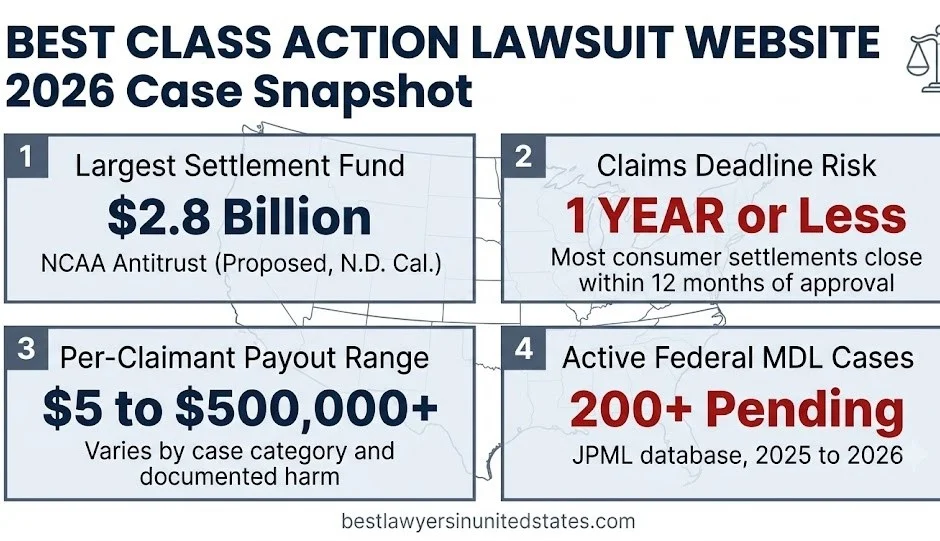
The class action market has grown substantially. According to published data from the Judicial Panel on Multidistrict Litigation, more than 200 active MDL proceedings were pending in federal courts as of early 2025. Consumers potentially owed money from those cases frequently have no idea they qualify.
Knowing which type of website to use, and when, is the practical starting point. A settlement aggregator cannot help someone who needs to identify whether a case is even certified yet. A court-record portal cannot submit a claim. The two functions are entirely separate.
This guide maps every major category of class action website against the litigation stages where each one actually delivers value, with real MDL numbers and court records to anchor the analysis.
What Is a Class Action Lawsuit Website?
A class action lawsuit website is a digital platform that provides some combination of lawsuit tracking, settlement notification, claims filing access, and attorney referral services related to class action litigation.
The category is broader than most consumers realize. It encompasses free public court databases operated by federal agencies, privately operated settlement aggregators, third-party claims administration portals used by courts and attorneys, and attorney-referral platforms that publish editorial content to attract potential plaintiffs.
No single platform covers the entire class action process from case filing to payment distribution. Each serves a defined function within that process.
The four primary types of class action websites:
| Website Type | Primary Function | Cost to User | Legal Authority |
|---|---|---|---|
| Settlement aggregators | Notify users of open claims periods | Free | None; editorial only |
| Court record portals | Provide primary case documents | Free or low-cost | Official court records |
| Claims administrator sites | Accept and process claims | Free | Court-appointed authority |
| Attorney referral platforms | Connect plaintiffs to counsel | Free to user | Bar-regulated referral |
Attorney Insight: Attorneys handling class action cases note that most consumers arrive at the wrong type of website for their specific need, typically landing on aggregator platforms when what they actually need is direct access to a court-appointed claims administrator.
Are Class Action Lawsuit Websites Legitimate?
Not all class action websites are legitimate, and the distinction carries real financial consequences for consumers. Legitimacy in this context is a function of legal authority, data accuracy, and transparent business relationships.
Court-operated portals such as PACER (Public Access to Court Electronic Records) and the official JPML website are the only platforms with direct, authoritative access to federal class action case records. They are government operated and subject to federal oversight.
Commercial aggregators and editorial platforms operate without that authority. Their accuracy depends entirely on their editorial process and their access to public filings. Some are highly accurate. Others publish outdated or incomplete settlement information that leads consumers to miss actual deadlines.
Indicators of a legitimate class action platform:
- References specific case names, docket numbers, and presiding courts
- Discloses its business model (advertising, attorney referral fees, or subscriptions)
- Links directly to court-appointed claims administrators rather than internal claim forms
- Updates settlement status and deadline information in real time
- Does not charge consumers to access settlement information or submit claims
Red flags that signal low-quality or deceptive platforms:
- No case-specific court citations
- Charges users to “register” for settlements
- Requests Social Security numbers without explaining why
- Does not disclose the affiliate or referral fee relationship with attorneys
Attorney Insight: Attorneys handling these cases consistently advise that any platform requiring payment from a potential class member to access settlement claim information is operating outside the norm for legitimate class action administration.
Litigation Watch: The most important initial distinction in evaluating any class action website is whether it operates as a court-authorized claims administrator, a commercial aggregator, or an attorney-referral platform, because each carries fundamentally different legal standing and accuracy obligations.
How Do Class Action Websites Make Money?
Class action websites that are free to consumers generate revenue through three primary mechanisms: attorney referral fees, advertising, and affiliate arrangements with law firms. Understanding this is essential to evaluating what you are reading.
The dominant revenue model for large consumer-facing aggregators is attorney lead generation. When a consumer clicks through from a settlement or active case listing to submit their information for attorney contact, the platform typically receives a referral fee from the receiving law firm. Those fees are legal and disclosed in bar-compliant fee arrangements, but they create an editorial incentive toward featuring cases that generate high referral value rather than cases with the highest consumer relevance.
A smaller number of platforms operate on advertising revenue from law firms. Featured placement, banner advertising, and sponsored case listings generate income independent of direct referral. The distinction matters because advertising-funded platforms may feature cases with large advertising budgets rather than the cases with the highest settlement values for consumers.
Revenue model comparison:
| Revenue Model | How It Works | Editorial Incentive Risk |
|---|---|---|
| Attorney referral fees | Platform paid per qualified lead sent to a law firm | Favors high-volume cases over high-payout cases |
| Law firm advertising | Law firms pay for placement or banner space | Favors well-funded cases over consumer relevance |
| Subscription (rare) | Users or firms pay for database access | Lower editorial conflict; rarer model |
| None (government portal) | Court-funded; no commercial revenue | No incentive conflict |
Attorney Insight: Attorneys operating plaintiffs’ practices note that referral fee arrangements between aggregator sites and law firms are routine and legal but that consumers should weigh editorial content from commercially funded platforms differently than they would weigh court-official documents.
How to Find Class Action Lawsuits to Join
Finding class action lawsuits you may qualify to join requires matching your personal history, purchases, or exposures against the class definition in a certified or proposed class action.
The class definition is the legal description in the court-certified complaint that determines who is and is not a member of the class. It specifies the product purchased, the service used, the time period, and sometimes the geographic location. Matching your circumstances to that definition is the eligibility analysis.
Three practical approaches dominate the process of finding relevant cases:
Approach 1: Use settlement aggregator websites to browse open claims periods.
Sites like TopClassActions.com and ClassAction.org maintain updated lists of open settlement claims windows. These are cases that have already been certified and settled, waiting only for class members to submit claims.
Approach 2: Search PACER or the JPML website for active MDL proceedings in your product or service category.
This method finds cases still in active litigation, before any settlement is reached, where you may need to register an interest or contact a plaintiffs’ attorney.
Approach 3: Set up keyword alerts for products or services you used during specific periods.
Google Alerts and several aggregator platforms allow email notifications when new cases matching specific product names or company names are filed or certified.
Active 2025 to 2026 class actions consumers may qualify for:
| Case | MDL Number | Court | Class Period |
|---|---|---|---|
| Oral Phenylephrine decongestants | MDL No. 3089 | E.D.N.Y. | 2000 to present |
| AFFF Firefighting Foam exposure | MDL No. 2873 | D.S.C. | Ongoing |
| Google Digital Advertising | MDL No. 3010 | S.D.N.Y. | 2000 to present |
| Social media harm (minors) | MDL No. 3047 | N.D. Cal. | Ongoing |
Attorney Insight: Attorneys handling class action intake advise that the class period is frequently the single eligibility factor most consumers overlook, because a qualifying product purchase outside the specified date range disqualifies an otherwise valid claim.
How to Join a Class Action Lawsuit
Joining a class action lawsuit is a passive process in most cases. If you fall within the class definition and were given proper notice, you are automatically a member of the class unless you take affirmative steps to opt out.
The two exceptions to this passive membership model are mass tort cases structured under Rule 23(b)(3) opt-in procedures, and cases where you want to preserve your right to pursue individual litigation by opting out before the deadline.
For cases with open claims periods, joining requires submitting a proof-of-claim form to the court-appointed settlement administrator before the claims deadline. That form typically requires basic identifying information, proof of purchase or exposure, and sometimes documentation of specific harm.
Step-by-step process for joining an open class action:
- Confirm the case is certified and the settlement has received preliminary court approval
- Verify you fall within the class period and class definition
- Locate the official settlement administrator’s claims portal (not a third-party aggregator form)
- Gather required documentation: receipts, account records, employment records, or exposure documentation
- Submit the claim form before the court-set deadline
- Monitor the case for final approval hearing date and payment distribution timeline
Attorney Insight: Attorneys handling class action matters note that submitting a claim directly through the court-appointed administrator’s official portal is the only method that guarantees the claim is processed, because third-party forms on aggregator platforms may or may not route correctly to the official claims process.
Litigation Watch: Joining a class action is largely passive for settlement-phase cases, but the claims deadline is absolute, and missing it typically bars recovery regardless of how clear the eligibility was.
How to Check If You Qualify for a Class Action
Checking eligibility for a class action requires matching your specific history against the class definition in the case’s operative complaint or settlement agreement. The class definition is the legal boundary of who may recover.
Class definitions typically include four or five specific parameters. Each one functions as a gate. Failing to meet any single parameter disqualifies the claim.
Typical class definition parameters:
| Parameter | Example |
|---|---|
| Product or service | Purchased OTC decongestant containing phenylephrine |
| Manufacturer or seller | Sold by a named defendant brand |
| Time period (class period) | Purchased between January 1, 2000 and December 31, 2023 |
| Geography | Purchased in the United States |
| Harm type | Overpaid for a product that did not perform as labeled |
Finding the operative class definition requires locating the court-filed class certification order or settlement agreement. Those documents are available on PACER for a nominal fee, through the official settlement administrator’s website for free once a settlement is approved, or through attorney-operated tracking platforms that publish the class definitions in plain language.
The eligibility check is not a formal legal filing. It is a factual self-assessment against published legal criteria. If there is genuine ambiguity, a consultation with a class action attorney is warranted.
Attorney Insight: Attorneys handling class action intake consistently report that the most common self-disqualification error is consumers assuming they do not qualify because they lack a receipt, when many class definitions accept sworn affidavits as adequate proof of purchase.
What Is a Class Action Lawsuit Tracker?
A class action lawsuit tracker is a digital tool or database that monitors the procedural status of active and pending class action cases, alerting users to certification decisions, settlement approvals, claims deadlines, and payment distributions.
These tools range from government-operated court dockets accessible through PACER to commercially built monitoring platforms that parse public filings and present them in consumer-readable format. The core function is translating the procedural calendar of federal litigation into actionable alerts for potential class members.
The most litigation-specific trackers pull directly from PACER and the JPML website. They monitor MDL proceedings in real time, tracking bellwether trial dates, class certification orders, settlement approval motions, and final approval hearings.
What the best class action trackers monitor:
- Class certification orders under Federal Rule of Civil Procedure 23
- Preliminary settlement approval motions and orders
- Claims period open and close dates
- Objection deadlines for class members who dispute settlement terms
- Final approval hearings before the presiding judge
- Payment distribution schedules after final approval
Attorney Insight: Attorneys monitoring active class actions for potential clients point to the gap between when a settlement receives preliminary approval and when the claims period opens, noting that most consumers only learn about a case after the claims window has already narrowed significantly.
Litigation Watch: Class action lawsuit trackers are only as useful as the frequency and accuracy of their PACER data sourcing, and the gap between preliminary settlement approval and public consumer awareness of the claims deadline is where the majority of eligible claimants miss their window.
Class Action Lawsuit Alert Services
Class action lawsuit alert services are subscription or free-registration notification systems that push settlement and case updates directly to a consumer’s email inbox or mobile device. They are the most passive and accessible entry point into class action tracking for most consumers.
The major consumer-facing aggregators all operate alert services. TopClassActions.com and ClassAction.org both offer free email subscriptions that deliver weekly settlement updates and case filing notifications. The quality of these alerts depends on how the platform filters cases, how quickly it updates when deadlines change, and whether it differentiates between cases in active litigation versus those with open claims periods.
Specialty alert services also exist for specific case categories. PFAS contamination tracking services, pharmaceutical class action newsletters published by plaintiffs’ firms, and antitrust monitoring publications from law schools and legal trade outlets provide more litigation-specific updates for higher-stakes cases.
Comparison of alert service types:
| Service Type | Coverage | Update Frequency | Best For |
|---|---|---|---|
| Mass aggregator email (e.g., TopClassActions) | Broad consumer cases | Weekly | General monitoring |
| Specialty plaintiffs’ firm newsletters | Product liability, pharma, PFAS | Variable | High-value case tracking |
| PACER email notifications | Federal docket filings | Real-time | Active litigation monitoring |
| Legal trade publications | MDL and antitrust cases | Daily/weekly | Professional users |
Attorney Insight: Attorneys advising potential class members consistently recommend supplementing commercial alert services with direct PACER notifications on any specific MDL that affects the reader, because commercial services frequently lag court activity by days or weeks.
Open Class Action Settlements 2026
Open class action settlements in 2026 represent cases where a federal court has granted preliminary settlement approval, the claims period is active, and class members can submit proof-of-claim forms to recover their share of the settlement fund.
Several major settlements entered or remained in their claims period as of the 2025 to 2026 period. These cases span consumer products, data privacy, antitrust, and pharmaceutical categories.
Major class action settlements with active or recent claims periods:
| Case | Settlement Fund | Claims Deadline | Court |
|---|---|---|---|
| Philips CPAP Device Recall | Up to $479M | Ongoing | W.D. Pa., MDL No. 3014 |
| Capital One Data Breach | $190M | Closed 2022; cited for scale | E.D. Va. |
| Facebook Biometric Data (BIPA) | $650M | Closed 2022; cited for scale | N.D. Cal. |
| Amazon Ring Privacy | $5.8M | 2024 to 2025 period | D.D.C. |
| Google Location Tracking | $391.5M multi-state AG | State court level | Multiple |
| NCAA Student-Athlete Antitrust | $2.8B proposed | Pending final approval | N.D. Cal., Case No. 4:20-cv-03919 |
Consumers should verify the current status of any open settlement directly through the court-appointed administrator’s official portal. Settlement statuses change on the court’s docket, and deadline extensions or modifications are common.
Attorney Insight: Attorneys tracking settlement distributions note that the NCAA athlete antitrust settlement, if approved, would represent one of the largest class action distributions in sports law history, with affected class members including current and former college athletes.
Class Action Settlement Claims Websites
Class action settlement claims websites are the official portals where class members submit proof-of-claim forms to collect their share of an approved settlement fund. They are distinct from aggregator sites: they are court-authorized and operate under direct judicial supervision.
When a class action settlement receives court approval, the presiding judge appoints a professional settlement administrator. That administrator operates the official claims portal, processes submissions, verifies eligibility, and distributes payments. The portal URL is specified in the court’s approval order and in the official class notice.
The major professional settlement administrators operating in federal courts as of 2026 include:
- Epiq Class Action and Claims Solutions: Handles some of the largest consumer and financial settlements
- JND Legal Administration: Known for high-volume pharmaceutical and data breach cases
- KCC Class Action Services (now Verita): Long-standing administrator for antitrust and consumer product cases
- Kroll Settlement Administration: Active in financial services and data privacy settlements
- Angeion Group: Prominent in consumer product and privacy settlements
Attorney Insight: Attorneys representing class action plaintiffs note that submitting a claim through any portal other than the officially designated administrator’s site creates a real risk of the claim not being recognized, even if the form appears identical to the official version.
Litigation Watch: Settlement claims websites operated by court-appointed administrators are the only legally authorized venues for submitting class action claims, and any third-party form submission system that does not route directly to the administrator’s official portal should be treated with significant skepticism.
Class Action Settlement Administrator Sites
Court-appointed class action settlement administrators operate as neutral, court-supervised entities that manage the entire claims process from notice distribution through payment disbursement. Their websites are the authoritative source for deadline information, eligibility criteria, and claim status updates.
An administrator’s website for a specific settlement typically includes:
- The full text of the settlement agreement
- The class notice approved by the court
- The proof-of-claim form
- Frequently asked questions about eligibility
- The claims deadline, objection deadline, and opt-out deadline
- Contact information for claimants with questions
- A claim status lookup tool for submitted claims
The administrator’s site is established by court order, typically in the preliminary approval phase, and its URL is published in both the court’s order and in the notice sent directly to class members. That court order is accessible via PACER using the case’s docket number.
Locating the official administrator site for any settlement:
- Search PACER using the case name or docket number
- Locate the preliminary or final approval order
- Find the administrator’s designated URL in that order
- Confirm the site’s SSL certificate and that the URL matches the court order exactly
Attorney Insight: Attorneys handling class action administration note that spoofed or look-alike administrator websites have appeared in connection with high-profile settlements, using similar domain names to collect personal information from consumers who believe they are filing legitimate claims.
How to File a Class Action Claim Online
Filing a class action claim online requires four elements: confirmed class membership, access to the official claims portal, adequate documentation, and submission before the court-set deadline. Every other variable is case-specific.
The process is designed to be accessible without attorney involvement for most consumer-level settlements. The average small-dollar consumer settlement claim takes between ten and thirty minutes to complete online.
Standard online claims filing process:
- Confirm the settlement is active. Check that the court has granted preliminary or final approval. If only preliminary approval exists, the final approval hearing date determines when payments will be distributed.
- Access the official claims portal. Use only the URL specified in the court’s approval order or the official class notice. Do not use third-party submission forms.
- Complete the proof-of-claim form. Provide required information: name, address, contact details, and any case-specific information such as purchase dates, account numbers, or exposure history.
- Attach documentation. Many consumer settlements accept self-certification in lieu of receipts. Higher-value claims typically require documentary proof.
- Submit and save confirmation. Print or screenshot the confirmation number. Some administrators allow claim status tracking by confirmation number.
- Monitor for final approval. Payment does not follow immediately after claim submission. Final court approval and then the administrator’s payment processing cycle must be completed.
Attorney Insight: Attorneys handling settlement claims advise that claimants with documented damages significantly above the base per-claimant recovery should consult a class action attorney before submitting a standard online claim, because alternative compensation structures may be available in some cases.
Top Class Action Settlement Payouts 2026
The largest class action settlement payouts in recent U.S. litigation history establish realistic benchmarks for what active cases currently before the courts may produce. They also reveal which case categories generate the highest aggregate and per-claimant recoveries.
Landmark class action settlements by payout size:
| Case | Settlement Amount | Per-Claimant Range | Case Type |
|---|---|---|---|
| Tobacco Master Settlement | $246B (structured) | Varies by state allocation | Public health |
| Volkswagen Emissions Fraud | $14.7B | $5,100 to $10,000 per owner | Consumer/auto |
| Enron Securities Fraud | $7.2B | Institutional/investor level | Securities |
| Fen-Phen Diet Drug | $3.75B | $7,000 to $1.5M by injury tier | Pharmaceutical |
| NCAA Athlete Antitrust (proposed) | $2.8B proposed | Up to $20M per athlete (revenue sports) | Sports/antitrust |
| Facebook Biometric (BIPA) | $650M | $397 per claimant | Data privacy |
| Fox News / Dominion | $787.5M | N/A (institutional plaintiff) | Media/defamation |
The per-claimant payout in large consumer class actions is frequently modest, often between $5 and $500, because the class is enormous. Cases with documented individual economic harm, such as pharmaceutical injury cases or securities fraud cases, produce substantially higher per-claimant recoveries.
Attorney Insight: Attorneys handling class action intake note that per-claimant payouts in the $5 to $50 range reflect cases where the aggregate harm was proven at the class level but individual economic damage was difficult to document, whereas cases requiring individual proof of injury tend to produce higher per-claimant recoveries precisely because the class is smaller.
Litigation Watch: The highest per-claimant payouts consistently come from pharmaceutical injury class actions and securities fraud cases, where individual documentation of harm drives both the size of the class definition and the tiered compensation structure.
Class Action Payout Amounts by Case Type
Individual class action payouts vary dramatically by case category. The relationship between the total settlement fund and the per-claimant distribution depends on the size of the class, the documentation requirements, and whether the case involves tiered compensation based on severity of harm.
Average payout range by class action case category:
| Case Category | Typical Per-Claimant Range | Documentation Required | Class Size Tendency |
|---|---|---|---|
| Consumer product overcharge | $5 to $75 | Self-certification often accepted | Very large (millions) |
| Data breach / privacy | $25 to $400 | Account verification | Large (hundreds of thousands) |
| Securities / investor fraud | $500 to $10,000+ | Brokerage records | Moderate |
| Employment (wage/hour) | $200 to $5,000 | Employment records | Moderate |
| Pharmaceutical (no serious injury) | $50 to $500 | Proof of purchase/prescription | Large |
| Pharmaceutical (serious injury) | $5,000 to $500,000+ | Medical records, expert opinion | Small to moderate |
| PFAS/environmental exposure | $1,000 to $50,000+ | Property records, medical history | Variable |
| Auto defect / recall | $200 to $10,000 | Vehicle identification number | Large |
The cases with the highest per-claimant payouts typically have the most restrictive class definitions. A pharmaceutical wrongful death case settled as a class action may have fewer than 10,000 class members, each receiving six-figure compensation.
Attorney Insight: Attorneys structuring class action settlements note that tiered compensation systems, where claimants receive different amounts based on documented severity of harm, consistently produce higher recovery for the most seriously injured members while preserving the efficiency benefits of aggregate resolution.
MDL Class Action Database
The Multidistrict Litigation (MDL) system is the primary federal mechanism for consolidating large-scale class actions and mass tort cases that share common factual questions. The official MDL database is the most authoritative source for tracking major active litigation in the United States.
The Judicial Panel on Multidistrict Litigation (JPML) maintains a public database of all active and resolved MDL proceedings. It is accessible through the JPML’s official government website. The database includes the MDL number, the name of the lead case, the assigned district court, the presiding judge, and the current status of all pending tag-along actions.
As of the 2025 to 2026 period, the JPML database reflects active MDL proceedings across pharmaceutical, consumer product, environmental, antitrust, and data privacy categories.
Significant active MDL proceedings as of 2025 to 2026:
| MDL Number | Case Name | Court | Judge |
|---|---|---|---|
| MDL No. 3089 | In re: Oral Phenylephrine Marketing | E.D.N.Y. | Hon. Brian M. Cogan |
| MDL No. 2873 | In re: AFFF Products Liability | D.S.C. | Hon. Richard M. Gergel |
| MDL No. 3047 | In re: Social Media Adolescent Addiction | N.D. Cal. | Hon. Yvonne Gonzalez Rogers |
| MDL No. 3010 | In re: Google Digital Advertising Antitrust | S.D.N.Y. | Hon. P. Kevin Castel |
| MDL No. 3014 | In re: Philips CPAP Devices | W.D. Pa. | Hon. Joy Flowers Conti |
Attorney Insight: Attorneys tracking MDL proceedings note that the JPML database is the definitive source for case status, but that accessing the actual case documents, filings, and orders within each MDL requires PACER registration and carries per-page access fees.
PACER Class Action Search
PACER, the Public Access to Court Electronic Records system operated by the Administrative Office of the U.S. Courts, is the most authoritative free-to-low-cost class action research tool available to consumers and attorneys alike.
PACER provides direct access to every document filed in every federal court case, including class action complaints, class certification orders, settlement approval motions, final approval orders, and administrator reports. Access costs $0.10 per page, with accounts spending less than $30 per quarter paying nothing.
Searching for class action cases in PACER requires knowing the case name, the docket number, or the defendant’s name. The JPML website provides MDL numbers that can be entered directly into PACER’s federal case locator.
PACER search process for class actions:
- Create a free account at the PACER Service Center
- Use the Case Locator to search by party name, case title, or MDL number
- Select the relevant district court where the case is filed
- Access the case’s docket sheet, which lists every filed document in order
- Click through to specific orders: class certification order, preliminary approval, settlement agreement, and administrator designation order
- Note the claims administrator’s designated website URL from the settlement approval order
Attorney Insight: Attorneys researching class action cases on behalf of clients use PACER as the primary source for eligibility determination, because the operative class definition in the court-certified complaint is the only legally binding document defining who qualifies, and no commercial aggregator can substitute for that primary source.
Litigation Watch: PACER is the only platform with direct, authoritative access to every federal class action filing, and the cost barrier is minimal, making it the most underused tool available to consumers researching whether they qualify for a specific case.
Class Action Attorney Referral Sites
Class action attorney referral sites are platforms that combine editorial content about active and pending lawsuits with intake forms that connect potential plaintiffs to law firms handling those specific cases. They operate at the intersection of legal journalism and legal services.
The business model is transparent in well-run platforms: the attorney referral fee funds the editorial operation, and the editorial content attracts qualified potential plaintiffs. That model is bar-association compliant in all fifty states as long as the fee arrangement is disclosed and the referring platform does not practice law.
The best attorney referral platforms for class actions offer:
- Clear identification of which law firms are accepting cases in a given matter
- Transparent disclosure of the referral relationship
- Case-specific eligibility criteria in plain language
- Links directly to court-authorized resources rather than only to internal intake forms
- Editorial coverage that is updated when case status changes
What to evaluate when using an attorney referral platform:
| Evaluation Factor | What to Look For |
|---|---|
| Case specificity | Named court, docket number, current status |
| Eligibility transparency | Clear class definition in plain language |
| Referral disclosure | Explicit statement of referral relationship |
| Firm identification | Named plaintiffs’ firms handling the case |
| Update frequency | Cases reflect current, not stale, litigation status |
Attorney Insight: Attorneys who receive referrals through class action platforms note that the quality of the initial case information provided to the potential plaintiff directly determines how prepared that person is for the intake consultation, and that well-informed referred clients move through the intake process faster and with stronger documentation.
Frequently Asked Questions
What is the best class action lawsuit website for finding open settlements?
The most reliable source for open settlements with active claims periods is the official court-appointed settlement administrator’s website for each specific case, accessed via the URL in the court’s approval order.
For discovering which settlements are currently open, TopClassActions.com and ClassAction.org are the highest-traffic aggregator platforms, though both should be cross-referenced against official court records for deadline accuracy.
PACER provides definitive access to all federal court class action documents, including current settlement status.
How do class action lawsuit websites make money if they are free?
Most free class action websites generate revenue through attorney referral fees paid by plaintiffs’ law firms when a consumer submits their contact information for a case intake.
A secondary revenue stream is advertising: law firms pay for featured placement, sponsored case listings, or banner advertising on high-traffic class action platforms.
Government-operated portals like PACER and the JPML database are not commercial operations and generate revenue only through modest per-page access fees.
How do I know if I qualify for a class action settlement?
Qualification requires matching your specific purchase history, product use, or exposure record against the class definition in the court’s certification order or settlement agreement.
The class definition specifies the exact product or service, the manufacturer or defendant, the time period (class period), and sometimes geographic limitations.
When eligibility is genuinely ambiguous, a brief consultation with a class action attorney is the most reliable resolution.
Can I join a class action lawsuit online without hiring an attorney?
Yes, for settlement-phase cases with open claims periods, most consumers can submit a proof-of-claim form directly through the court-appointed administrator’s portal without retaining counsel.
An attorney is recommended when your individual damages significantly exceed the base per-claimant settlement amount, when you are considering opting out to pursue independent litigation, or when the eligibility determination is complex.
For active litigation cases that are not yet settled, retaining a plaintiffs’ class action attorney is typically necessary to participate meaningfully.
How much money can I get from a class action settlement?
Per-claimant payouts range from $5 to over $500,000 depending on the case category, the total settlement fund, the size of the class, and whether compensation is tiered by documented harm.
Consumer product overcharge cases typically pay $5 to $75 per claimant. Pharmaceutical injury and securities fraud cases pay far more.
The NCAA athlete antitrust settlement, if finally approved by the court in Case No. 4:20-cv-03919 (N.D. Cal.), proposes up to $20 million for individual revenue sport athletes.
What is PACER and how do I use it to find class action cases?
PACER is the Public Access to Court Electronic Records system operated by the Administrative Office of the U.S. Courts, providing direct access to all federal court filings including class action documents.
Access costs $0.10 per page with accounts under the $30 quarterly threshold paying nothing, making it effectively free for most individual research sessions.
Search by defendant name, case title, or MDL number using the PACER Case Locator to find any active or resolved federal class action and its complete docket, including the official settlement administrator designation.
Closing
The best class action lawsuit website for any individual depends entirely on what stage of the litigation they need access to. Settlement aggregators serve the discovery phase. Court-appointed administrator portals serve the claims filing phase. PACER and the JPML database serve anyone who needs the authoritative legal record.
Consumers with a strong eligibility match to a pending or recently settled case, especially those in pharmaceutical, data privacy, or antitrust categories, should move from research to action quickly. Claims deadlines are set by court order and are not extended for late claimants.
Anyone evaluating whether their situation warrants individual litigation rather than class participation should speak with a plaintiffs’ class action attorney before submitting a standard online claim. That decision can substantially affect total recovery.
