
Quick Answer Box
- What this is: Multiple active defamation lawsuits filed against CNN and its parent company Warner Bros. Discovery across federal courts, alleging false reporting caused measurable reputational and financial harm to plaintiffs.
- Who qualifies: Individuals, public officials, private citizens, and organizations who can demonstrate CNN published or broadcast a false statement of fact about them with either actual malice (for public figures) or negligence (for private figures), causing documented harm.
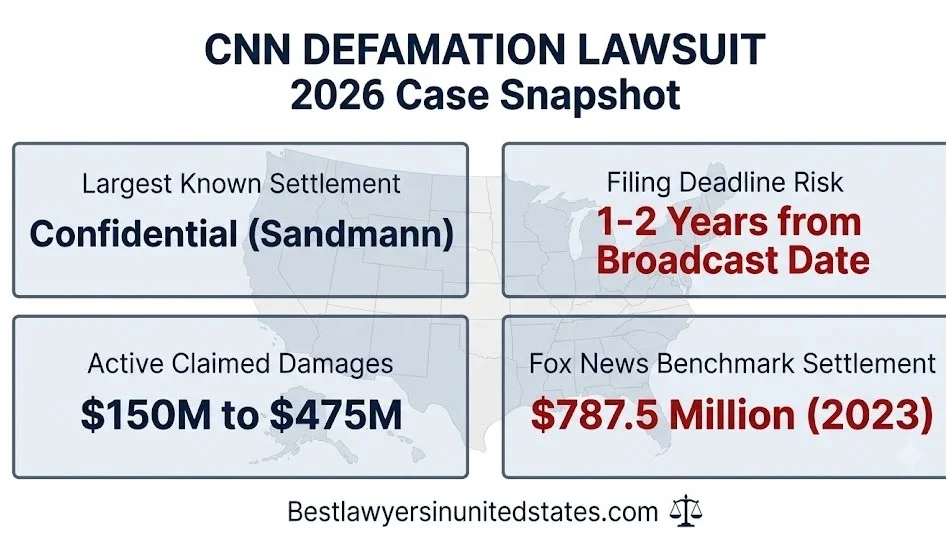
- What it’s worth: Prior CNN defamation settlements have reached into the tens of millions of dollars; the Nick Sandmann matter, for example, settled confidentially but was reported at figures ranging from $25 million to $275 million in various media estimates, with the actual amount undisclosed. Active 2026 plaintiffs seek compensatory and punitive damages ranging from $150 million to $475 million depending on the case.
Case Snapshot
| Detail | Information |
|---|---|
| Primary Defendant | CNN / Warner Bros. Discovery, Inc. |
| Active Courts | U.S. District Court, N.D. Georgia; U.S. District Court, M.D. Florida; U.S. District Court, S.D. New York |
| Notable Filed Cases | Rittenhouse v. CNN (N.D. Ga.); multiple pending matters |
| Case Status (2026) | Active litigation; discovery phase in lead cases |
| Largest Settlement (Historical) | Nick Sandmann matter (amount confidential; estimated reports varied widely) |
| Claimed Damages | $150 million to $475 million across active plaintiffs |
| Parent Company | Warner Bros. Discovery, Inc. (NASDAQ: WBD) |
| Primary Legal Defense | First Amendment, actual malice standard, opinion privilege |
What Is the CNN Defamation Lawsuit?
CNN defamation lawsuits are civil legal actions alleging that CNN published or broadcast false statements of fact that caused specific, documented harm to identifiable plaintiffs.
These are not a single case. They represent a sustained wave of defamation litigation filed across multiple federal jurisdictions, targeting one of the largest broadcast news operations in the United States.
The cases share a common thread. Plaintiffs allege CNN’s editorial choices crossed the legal boundary separating protected opinion and aggressive reporting from actionable false statements of fact.
Key characteristics of these cases:
- Filed in federal court under diversity jurisdiction or based on federal constitutional questions
- Defendants are CNN and, in many actions, Warner Bros. Discovery as the corporate parent
- Claims include defamation per se, false light invasion of privacy, and in some cases tortious interference
Attorney Insight: Attorneys handling defamation claims against broadcast networks consistently note that the institutional nature of the defendant cuts both ways — deep resources for defense, but also documented editorial processes that become targets during discovery.
CNN Defamation Lawsuit 2026: Where Cases Stand Today
As of 2026, several CNN defamation actions remain in active litigation, with at least two in the discovery phase before federal judges in Georgia and Florida.
CNN’s parent company, Warner Bros. Discovery, has not signaled a broad settlement posture. Legal filings in active cases reflect an aggressive defense strategy centered on the First Amendment and the constitutional actual malice standard.
The broader media environment matters here. Following the $787.5 million Fox News settlement with Dominion Voting Systems in April 2023, defamation plaintiffs and their attorneys recalibrated expectations about what major media defendants will pay to avoid trial.
2026 Status Summary:
| Case / Matter | Court | Current Phase | Claimed Damages |
|---|---|---|---|
| Rittenhouse v. CNN | N.D. Georgia | Discovery | $150 million |
| Pending Florida matter | M.D. Florida | Pre-trial motions | Undisclosed |
| Pending New York matter | S.D. New York | Motion to dismiss stage | $475 million claimed |
| Sandmann matter | Settled (prior) | Closed | Confidential |
Attorney Insight: Attorneys monitoring the 2026 docket note that cases surviving motions to dismiss have the strongest discovery leverage, because internal CNN editorial communications become fair game for production.
Who Is Suing CNN for Defamation?
The plaintiffs in CNN defamation actions are not a uniform class. They range from political figures to private individuals who appeared in news coverage.
Kyle Rittenhouse filed a defamation lawsuit against CNN in the U.S. District Court for the Northern District of Georgia. The complaint alleges CNN falsely characterized the circumstances of his 2020 Kenosha case in ways that caused reputational and economic harm after his acquittal.
Nick Sandmann, the Covington Catholic High School student, reached a confidential settlement with CNN following his defamation claims arising from the network’s coverage of his 2019 encounter at the Lincoln Memorial. That matter resolved without trial.
Other plaintiffs in various stages of filing or active litigation include:
- Individuals who appeared as subjects of investigative CNN segments and allege factual misrepresentation
- Public officials who claim CNN’s framing of their conduct crossed from opinion into false statement of fact
- Organizations that allege CNN attributed positions or actions to them that were materially false
Attorney Insight: Defamation attorneys representing plaintiffs against major networks note that the post-acquittal plaintiff presents a distinct profile — a jury-verified factual baseline that plaintiffs leverage to argue CNN’s narrative was not merely editorialized but demonstrably false.
CNN Defamation Lawsuit Plaintiffs: Profiles and Legal Theories
Each active plaintiff advances a distinct legal theory, though all converge on one foundational requirement: a false statement of fact, not mere opinion.
The Rittenhouse complaint, for instance, alleges CNN’s on-air characterizations went beyond editorial framing and into affirmative misstatement of the factual record established at trial.
Private-figure plaintiffs in other pending matters face a lower legal threshold. They need only prove CNN acted negligently in publishing false information, not that CNN acted with knowledge of falsity.
Plaintiff Classification and Legal Threshold:
| Plaintiff Type | Legal Standard | Key Proof Requirement |
|---|---|---|
| Public figure (elected official, celebrity) | Actual malice | Knew statement was false, or acted with reckless disregard |
| Limited-purpose public figure | Actual malice (as to controversy) | Same as above, within the relevant controversy |
| Private individual | Negligence (most states) | CNN failed reasonable care in verification |
| Private corporation | Varies by state | Some states apply actual malice to corporate plaintiffs |
Attorney Insight: Attorneys representing plaintiffs flag that classification as a “limited-purpose public figure” is often litigated at the motion-to-dismiss stage and can determine whether a case survives before discovery even begins.
Litigation Watch: Active CNN defamation plaintiffs in 2026 range from post-acquittal public figures to private individuals, each carrying different legal burdens that courts assess before any discovery occurs.
CNN Actual Malice Standard: What Plaintiffs Must Prove
The actual malice standard is the constitutional threshold established in New York Times v. Sullivan, 376 U.S. 254 (1964). It requires public-figure plaintiffs to prove CNN acted with knowledge that its statement was false, or with reckless disregard for whether it was false.
Reckless disregard does not mean careless reporting. Courts define it narrowly as a subjective awareness of probable falsity. A plaintiff must reach inside CNN’s editorial process and show specific decision-makers had serious doubts about the truth of what they broadcast.
That is a high bar. It is deliberately so. The Sullivan standard was constructed to give the press breathing room for honest mistakes on matters of public concern.
What “actual malice” requires in practice:
- Evidence that specific CNN journalists or editors doubted the truth of the statement before broadcast
- Internal communications, emails, or editorial notes showing awareness of conflicting facts
- A demonstrable departure from professional journalistic standards so extreme as to imply subjective disbelief
- Prior retractions or corrections on the same subject that put the network on notice
Attorney Insight: Defamation attorneys note that deposing CNN’s producers and editorial leadership is often where actual malice cases are won or lost, making the discovery phase strategically critical.
What Is Actual Malice in Defamation Law?
Actual malice in defamation law means the defendant published a false statement either knowing it was false, or with reckless disregard for its truth or falsity.
The term “malice” is misleading in plain-language terms. It does not require ill will, spite, or intent to harm. The Supreme Court defined it solely in terms of the defendant’s knowledge of falsity at the time of publication.
This distinction matters enormously in CNN cases. A plaintiff who can only show CNN disliked them, had editorial bias, or produced sloppy journalism has not proven actual malice. Courts are consistent on this point.
Actual Malice Compared to Negligence:
| Standard | Who It Applies To | What Plaintiff Must Show |
|---|---|---|
| Actual malice | Public figures, public officials | Subjective knowledge of falsity or reckless disregard |
| Negligence | Private individuals | Objective failure of reasonable care |
| Strict liability | Abolished for media defendants | No longer applicable post-Sullivan |
Attorney Insight: Attorneys handling media defamation cases caution that courts apply the actual malice standard to the specific statement at issue, not to CNN’s general editorial conduct, which limits how much “bad actor” evidence a plaintiff can use.
Public Figure Defamation Standard and How It Applies to CNN Cases
The public figure standard divides plaintiffs into three categories, each with distinct legal consequences when suing CNN.
All-purpose public figures are those with pervasive fame or notoriety — national politicians, major celebrities, widely known executives. They must prove actual malice for any defamatory statement, regardless of whether the statement touches on their public role.
Limited-purpose public figures are individuals who voluntarily injected themselves into a specific public controversy. Courts analyze whether CNN’s allegedly defamatory statement concerned that specific controversy when applying the actual malice standard.
Private figures who appear in CNN coverage retain the most favorable legal position. Most states require only that they prove CNN acted negligently.
Public Figure Classification in CNN Cases:
| Classification | Standard | Example in CNN Context |
|---|---|---|
| All-purpose public figure | Actual malice always | Sitting senator, national celebrity |
| Limited-purpose public figure | Actual malice within controversy | Rittenhouse (disputed classification) |
| Private individual | Negligence (majority rule) | Subject of local investigative report |
Attorney Insight: The classification battle is often the first dispositive fight in CNN defamation cases, with CNN’s legal team typically arguing for the broadest possible “public figure” classification to invoke the actual malice shield.
Litigation Watch: Whether a plaintiff is classified as a public figure or a private individual is often decided before discovery begins, and that classification determination shapes every dollar amount at stake in the case.
CNN First Amendment Defense: How CNN Fights Defamation Claims
CNN’s primary legal defense in defamation litigation rests on three constitutional and common-law pillars.
First is the First Amendment itself, which protects robust, even aggressive, reporting on matters of public concern. Courts have consistently held that the constitutional interest in a free press requires plaintiffs to carry a heavy evidentiary burden before any media defendant faces liability.
Second is the opinion privilege. Statements that a reasonable reader or viewer would understand as opinion rather than fact are absolutely protected. CNN frequently argues that its commentary segments, analysis pieces, and host editorials are protected opinion, not actionable statements of fact.
Third is the neutral reportage doctrine, recognized in some federal circuits, which protects accurate reporting of charges made by a newsworthy source, even if the underlying charge is false.
CNN’s Defense Arsenal:
- First Amendment press freedom
- Actual malice threshold (public figures cannot meet it without internal evidence)
- Opinion privilege (protected commentary vs. false fact)
- Neutral reportage (accurately reporting accusations from credible sources)
- Anti-SLAPP motions in applicable states (Georgia, Florida, New York each have varying anti-SLAPP provisions)
- Wire service defense in applicable republication scenarios
- Retraction statutes limiting punitive damages in states that recognize them
Attorney Insight: Attorneys who have opposed CNN’s legal team note that the opinion-versus-fact argument is advanced almost universally, making it critical for plaintiffs to frame their claims around specific, verifiable factual assertions, not editorial characterizations.
CNN Lawsuit Settlement: What Has Been Resolved and What Remains Active
CNN has settled at least one major defamation action and faces active litigation in 2026 with no broadly reported settlement framework for pending cases.
The Sandmann settlement is the benchmark. Its terms remain confidential under the settlement agreement, but the case’s resolution demonstrated that CNN will negotiate rather than go to trial under the right set of facts.
CNN’s parent company, Warner Bros. Discovery, carries media liability insurance typical for corporations of its scale. Insurance coverage does not eliminate litigation exposure, but it does factor into settlement calculus.
Settlement Landscape:
| Matter | Status | Known Terms |
|---|---|---|
| Sandmann v. CNN | Settled | Amount confidential |
| Rittenhouse v. CNN | Active / discovery | No settlement reported |
| Florida pending matter | Active | No settlement reported |
| New York pending matter | Motion phase | No settlement reported |
The Fox News / Dominion settlement at $787.5 million in 2023 changed the calculus for all major media defendants. Plaintiffs with strong actual malice evidence now have a clear data point for what a jury-averse network will pay.
Attorney Insight: Settlement timelines in major media defamation cases typically accelerate after courts deny summary judgment, because that ruling signals a jury will hear evidence about internal editorial communications.
CNN Defamation Lawsuit Damages: What Plaintiffs Are Seeking
Active CNN defamation plaintiffs are seeking damages across three categories: compensatory, presumed, and punitive.
Compensatory damages require proof of actual harm, including lost income, lost contracts, medical costs for emotional distress treatment, and documented reputational harm measured by economic loss.
Presumed damages apply in defamation per se cases, where the false statement falls into a category so harmful that courts presume damage without specific proof. Allegations that someone committed a crime or is unfit for their profession typically qualify as defamation per se.
Punitive damages require proof of actual malice and are designed to punish and deter. Several states cap punitive damages, which affects the realistic ceiling for CNN plaintiffs in those jurisdictions.
Damages Overview by Type:
| Damage Category | Proof Required | Potential Range |
|---|---|---|
| Compensatory | Actual, documented harm | Varies by plaintiff circumstance |
| Presumed (per se) | Type of statement qualifies | Court-determined |
| Punitive | Actual malice established | Capped in many states |
| Attorney fees | Anti-SLAPP (if CNN invokes and loses) | Plaintiff recovers fees |
Attorney Insight: Attorneys handling large-damages defamation claims note that punitive damage requests in the hundreds of millions are common as opening positions, but actual awards are subject to constitutional proportionality review, and courts have reduced them significantly in prior media cases.
Litigation Watch: CNN defamation plaintiffs seeking punitive damages must first prove actual malice, and even then, state caps and constitutional proportionality limits constrain the final award, making compensatory damages the more predictable recovery.
CNN Defamation Verdict History: How Courts Have Ruled Against Media Defendants
No CNN defamation case has gone to a jury verdict as of 2026 reporting. The Sandmann matter settled before trial. The Rittenhouse matter is in discovery.
However, the broader verdict history of defamation cases against major media defendants provides essential context for evaluating CNN’s exposure.
Major Media Defamation Verdicts and Settlements (Reference):
| Defendant | Plaintiff | Outcome | Amount |
|---|---|---|---|
| Fox News | Dominion Voting Systems | Settlement (2023) | $787.5 million |
| ABC News | Beef Products, Inc. | Settlement (2017) | $177 million (est.) |
| Rolling Stone | UVA / Nicole Eramo | Verdict + settlement | $3 million+ |
| Gawker | Hulk Hogan | Jury verdict | $140 million (reduced) |
| CNN | Nick Sandmann | Settlement | Confidential |
The pattern is clear. Large media defendants settle cases with strong actual malice evidence rather than risk jury verdicts. The Gawker case demonstrated that even a legally sophisticated media company can face a verdict that ends it.
Attorney Insight: Trial attorneys handling media defamation cases treat the Fox / Dominion settlement as both a ceiling reference and a motivating data point when entering settlement negotiations with network defendants.
Defamation Lawsuit Against a Media Company: How These Cases Differ
Suing a media company like CNN is structurally different from suing an individual who made a defamatory statement about you online.
Media defendants have dedicated legal teams, institutional knowledge of defamation law, and documented editorial processes. That documentation can hurt them or help them, depending on what it shows.
Discovery in a media defamation case exposes internal communications, editorial guidelines, fact-checking protocols, and the decision chain that led to a broadcast. For CNN plaintiffs, that discovery phase is often where the case is actually decided.
How Media Defamation Cases Differ from Individual Defamation:
| Factor | Media Defendant (CNN) | Individual Defendant |
|---|---|---|
| Legal resources | Substantial, dedicated team | Usually limited |
| Insurance | Media liability policy | Rare or none |
| Discovery | Extensive internal records | Limited |
| First Amendment defense | Institutional, well-developed | Underdeveloped |
| Settlement capacity | Significant | Limited |
| Public interest factor | High (court scrutiny of press freedom) | Lower |
Attorney Insight: Attorneys note that the institutional strength of a media defendant’s First Amendment defense requires plaintiffs to present the clearest possible factual case before filing, because a weak complaint faces aggressive early motion practice.
How to Sue a News Network for Defamation: The Filing Process
Suing CNN or any major broadcast network for defamation requires satisfying procedural prerequisites before a complaint can be filed.
Most states require or strongly encourage a retraction demand before filing suit. Sending a formal written retraction demand serves two purposes: it creates a record of notice, and it can limit punitive damages under state retraction statutes if CNN publishes a timely correction.
Federal court is the typical venue for large CNN defamation actions, either through diversity jurisdiction when the parties are citizens of different states, or through supplemental jurisdiction where federal constitutional claims accompany state-law defamation counts.
Filing Process Overview:
- Document the harm: Gather all evidence of the false statement, its broadcast reach, and measurable reputational or economic harm.
- Send a retraction demand: Written, specific, and within the statutory window (varies by state, typically 10 to 30 days from discovery).
- Identify the jurisdiction: Where CNN published or broadcast the statement, where you reside, and where harm was felt all factor into venue selection.
- File within the statute of limitations: Defamation statutes of limitations are typically one to three years depending on state. New York is one year. Georgia is two years. Florida is two years.
- Serve CNN’s registered agent: Warner Bros. Discovery has registered agents in all 50 states.
- Prepare for early motion practice: Expect a motion to dismiss and potentially an anti-SLAPP motion depending on the state.
Attorney Insight: Defamation attorneys advise that delay in filing is the most common and most damaging mistake plaintiffs make, because the statute of limitations begins running from the date of first publication, not from the date a plaintiff fully understands the harm.
Litigation Watch: The filing timeline for CNN defamation claims is tighter than many plaintiffs expect, with state statutes of limitations as short as one year from the date of broadcast, making prompt consultation with a defamation attorney critical.
CNN Defamation Lawsuit Attorney: What Type of Lawyer Handles These Cases
CNN defamation lawsuits require a specific category of attorney: a media defamation litigator with experience against institutional defendants.
General personal injury attorneys do not typically handle these cases. The legal standards, the discovery mechanics, and the First Amendment overlay require specialized experience in First Amendment and media law.
The attorneys who successfully litigated defamation claims against CNN in the Sandmann matter came from firms with dedicated media and First Amendment practice groups. Rittenhouse’s legal team similarly includes attorneys with documented media litigation experience.
What to Look for in a CNN Defamation Attorney:
- Experience with First Amendment and media law specifically
- Prior cases against institutional media defendants (networks, newspapers, digital publishers)
- Understanding of the actual malice standard and how discovery develops actual malice evidence
- Familiarity with anti-SLAPP statutes in the filing jurisdiction
- Willingness to advance litigation costs, since these cases can take three to five years to resolve
- Track record of taking defamation cases through discovery, not just to settlement demand
Attorney Fee Structures in Defamation Cases:
| Fee Structure | Description | Common In |
|---|---|---|
| Contingency | Attorney takes percentage of recovery | Strong-damages cases |
| Hourly | Client pays ongoing hourly rate | Cases with uncertain liability |
| Hybrid | Reduced hourly + contingency | Complex media cases |
| Anti-SLAPP fee shift | CNN pays if motion denied | States with strong anti-SLAPP laws |
Attorney Insight: Experienced defamation attorneys note that contingency arrangements in large media cases require the attorney to front significant discovery costs, so qualifying cases need clear liability facts and documentable damages before most established firms will accept them on contingency.
Frequently Asked Questions
What is the CNN defamation lawsuit about?
The CNN defamation lawsuits are civil actions alleging CNN published or broadcast false statements of fact that caused identifiable plaintiffs reputational and economic harm.
Multiple separate cases are active in federal courts across Georgia, Florida, and New York as of 2026.
The cases do not share a single plaintiff or a single incident, but they share the same defendant and the same legal framework.
Who has sued CNN for defamation?
Nick Sandmann reached a confidential settlement with CNN after his defamation claims arose from the network’s 2019 Lincoln Memorial coverage.
Kyle Rittenhouse filed a defamation action against CNN in the U.S. District Court for the Northern District of Georgia, which remained in active litigation as of 2026.
Additional plaintiffs are pursuing claims in other federal jurisdictions, though some matters have not yet been publicly identified.
How much is the CNN defamation lawsuit worth?
Prior settlements, including the Sandmann matter, reached confidential terms that various media reports estimated in widely different ranges.
Active plaintiffs in 2026 are seeking between $150 million and $475 million in compensatory and punitive damages.
Actual recovery depends on proving the applicable legal standard and surviving CNN’s First Amendment defenses.
What is the actual malice standard in CNN defamation cases?
Actual malice requires proof that CNN knew its statement was false when it published it, or acted with reckless disregard for whether it was true or false.
It applies to public figures and public officials, and it sets a high evidentiary bar that typically requires access to CNN’s internal editorial communications through discovery.
Private individuals who appear in CNN coverage may only need to prove negligence, which is a significantly lower standard.
What is the statute of limitations for suing CNN for defamation?
Defamation statutes of limitations vary by state, ranging from one year in New York to two years in Georgia and Florida.
The clock starts running from the date CNN first published or broadcast the allegedly defamatory statement, not from the date the plaintiff became aware of full harm.
Missing the limitations deadline is an absolute bar to filing, regardless of how strong the underlying claim may be.
What type of attorney handles CNN defamation lawsuits?
These cases require a media defamation litigator with specific experience against institutional news organizations and familiarity with First Amendment law.
General personal injury attorneys do not typically have the background needed to develop actual malice evidence through media discovery.
Most established defamation attorneys offer an initial consultation to evaluate whether a claim meets the legal threshold before committing to representation.
Closing
The CNN defamation lawsuits active in 2026 represent some of the most legally significant press-freedom and reputational-harm litigation in the country. These cases will test how far the First Amendment shields a major broadcast network when its editorial choices produce factually false coverage of identifiable individuals.
For anyone who believes CNN’s reporting caused them concrete, documentable harm, the threshold question is not whether the coverage was unfair. It is whether a specific false statement of fact can be proven, and whether the applicable legal standard, actual malice or negligence, can be satisfied with available evidence.
Consulting a defamation attorney with documented media litigation experience is the necessary first step. Time limits in these cases are short, and the early procedural fights determine whether a claim survives long enough for discovery to develop the evidence that actually wins these cases.
