
Quick Answer
- What is this case? Buc-ee’s Ltd. has filed multiple federal lawsuits against competing travel center operators, alleging trade dress infringement, trademark infringement, and unfair competition under the Lanham Act.
- Who is affected? Competing travel center businesses that operate mascot-based branding, large-format fueling stations, or roadside convenience concepts with visual similarities to Buc-ee’s registered trade dress.
- What is it worth? Buc-ee’s has sought injunctive relief, disgorgement of profits, and Lanham Act attorney’s fees; in at least one documented case, the defendant faced a permanent injunction requiring rebrand or closure of competing operations.
Case Snapshot
| Detail | Info |
|---|---|
| Primary Plaintiff | Buc-ee’s Ltd. (Lake Jackson, Texas) |
| Primary Defendant (Notable Case) | Choke Canyon, L.L.C. |
| Court (Primary Case) | U.S. District Court, Southern District of Texas, Houston Division |
| Case Number (Buc-ee’s v. Choke Canyon) | 4:13-cv-02128 (filed 2013; subsequent proceedings through 2017 and appealed to Fifth Circuit) |
| Fifth Circuit Docket | No. 16-20494 |
| Legal Basis | Lanham Act, 15 U.S.C. §§ 1114, 1125(a); Texas common law unfair competition |
| Status (2026) | Buc-ee’s ongoing enforcement posture; active USPTO registrations; new competitor entrants subject to cease-and-desist pipeline |
| Relief Sought | Permanent injunction, disgorgement, attorney’s fees, statutory damages |
| Settlement Fund | Not applicable (injunctive and damages litigation, not class action) |
Introduction
Buc-ee’s Ltd. has built one of the most aggressive intellectual property enforcement programs in the American roadside retail industry. The company’s federal lawsuits against competitors are not isolated disputes. They form a documented, multi-case litigation strategy that has played out in Texas federal courts and the Fifth Circuit Court of Appeals over more than a decade.
The most extensively litigated matter remains Buc-ee’s Ltd. v. Choke Canyon, L.L.C., filed in 2013 in the Southern District of Texas. That case established the legal template Buc-ee’s now applies to new entrants.
Any business operating in the large-format travel center space should understand what Buc-ee’s has argued in court, what courts have actually decided, and what the enforcement pattern looks like in 2026. The stakes for defendants are not abstract. Permanent injunctions, mandatory rebrands, and Lanham Act fee-shifting have all appeared in these proceedings.
The legal theories at work here are neither obscure nor narrow. They sit at the intersection of trade dress law, trademark registration, and unfair competition doctrine under federal statute.
What Is the Buc-ee’s Lawsuit Against a Competitor?
The Buc-ee’s lawsuit competitor matter refers to a series of federal intellectual property enforcement actions brought by Buc-ee’s Ltd. against travel center operators whose branding, mascot imagery, or store format the company contends is confusingly similar to its own protected marks.
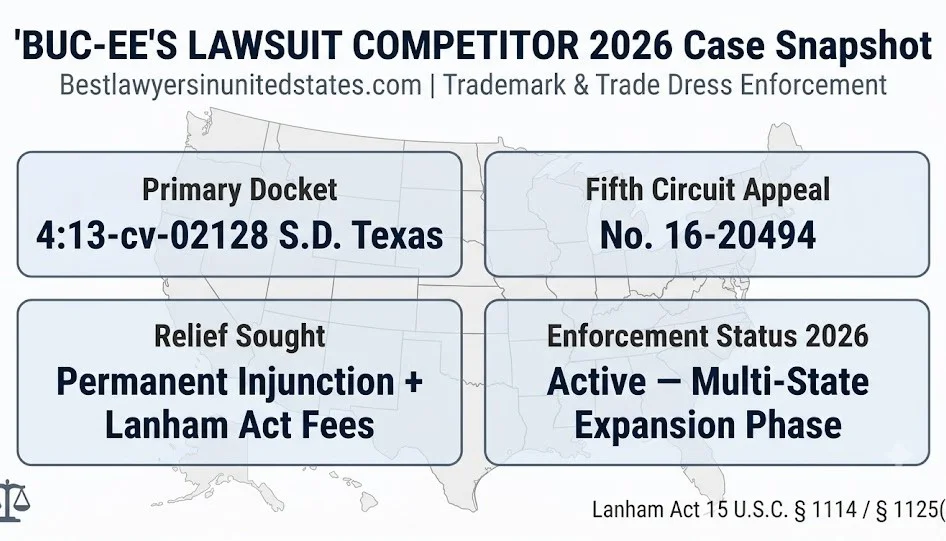
The core legal vehicle is the Lanham Act, specifically 15 U.S.C. § 1114 (registered mark infringement) and § 1125(a) (trade dress and false designation of origin).
These are not state-level consumer protection suits. They are federal claims adjudicated in U.S. District Courts, with appellate review available through the Fifth Circuit.
Key facts about this litigation category:
- Buc-ee’s holds multiple USPTO-registered trademarks, including registrations for its beaver mascot design, the “Buc-ee’s” word mark, and specific color and design combinations
- The company has sent documented cease-and-desist letters to competitors before filing suit
- Federal court filings in at least two Texas districts show Buc-ee’s actively monitoring competitor branding
Attorney Insight: Attorneys handling trade dress enforcement for retail chains note that the combination of a distinctive mascot, proprietary color scheme, and store-format elements can create a protectable “total image” under Lanham Act doctrine, provided those elements are non-functional and have acquired secondary meaning.
Buc-ee’s Competitor Legal Dispute 2026: Where Does the Case Stand?
As of 2026, Buc-ee’s enforcement posture has not softened. The company continues to expand into new states, including the Southeast, Mid-Atlantic, and Midwest, bringing its registered trademarks into new geographic markets where competitors may not have previously encountered its IP claims.
New market entry by Buc-ee’s has historically preceded or accompanied legal scrutiny of regional travel center chains whose visual branding resembles Buc-ee’s registered marks.
The 2026 legal landscape for competitors reflects these realities:
| Factor | 2026 Status |
|---|---|
| Active USPTO Registrations | Multiple live registrations for beaver design and word marks |
| Geographic Expansion | Active entry into non-Texas markets (Midwest, Southeast) |
| Enforcement Pipeline | Cease-and-desist activity documented in new expansion states |
| Fifth Circuit Precedent | Favorable to Buc-ee’s on trade dress distinctiveness (per prior proceedings) |
| New Competitor Risk Window | Highest for operators opening within Buc-ee’s announced expansion corridor |
Attorney Insight: IP litigators advising regional travel center operators recommend a trademark clearance audit before any rebrand or new location opens in a state where Buc-ee’s has announced or opened a location.
Who Is Buc-ee’s Suing?
Buc-ee’s has directed its litigation most prominently at Choke Canyon, L.L.C., a Texas-based travel center chain that also used a distinctive animal mascot, green color branding, and a roadside convenience format with significant visual overlap with Buc-ee’s brand identity.
The Choke Canyon matter is the most fully litigated and publicly documented of Buc-ee’s competitor lawsuits. Beyond that case, Buc-ee’s has pursued or threatened action against:
- Regional travel plaza operators whose mascot animals bore visual similarity to the Buc-ee beaver
- Operators whose store-format layouts, signage color palettes, or fuel canopy designs Buc-ee’s asserts create consumer confusion
- Businesses that adopted large-footprint highway convenience retail concepts in Buc-ee’s established or announced markets
What makes a business a litigation target:
- Use of an animal mascot in travel center retail branding
- Green, tan, or yellow color combinations in fueling station signage
- Large-format highway rest stop concepts in Buc-ee’s operational territory
- Any use of “Buc” or phonetically similar naming in roadside retail
Attorney Insight: Trademark counsel representing potential defendants note that geographic proximity to an existing Buc-ee’s location is not required for a Lanham Act claim if the plaintiff holds a nationally registered mark.
Buc-ee’s vs. Choke Canyon Lawsuit: The Foundational Case
Buc-ee’s Ltd. v. Choke Canyon, L.L.C., Case No. 4:13-cv-02128, filed in the U.S. District Court for the Southern District of Texas, Houston Division, is the anchor litigation in Buc-ee’s competitor enforcement history.
Buc-ee’s filed the complaint in July 2013, alleging trademark infringement and trade dress infringement under the Lanham Act, plus Texas common law unfair competition. The Fifth Circuit later addressed aspects of the case under Docket No. 16-20494.
Timeline of the Choke Canyon matter:
| Date | Event |
|---|---|
| July 2013 | Complaint filed, S.D. Texas, Houston Division |
| 2013-2016 | District court proceedings, motions practice, discovery |
| 2016 | Appeal filed to the Fifth Circuit (No. 16-20494) |
| 2017 | Fifth Circuit issues opinion addressing trade dress and trademark claims |
| Post-2017 | Choke Canyon rebranding and compliance proceedings |
The court’s analysis examined whether Choke Canyon’s animal mascot branding and travel center trade dress created a likelihood of consumer confusion with Buc-ee’s marks.
Attorney Insight: IP litigators who have monitored this case note that the Fifth Circuit’s analysis in the Choke Canyon appeal has become a reference point for assessing trade dress distinctiveness claims in roadside retail contexts throughout the circuit.
Buc-ee’s Trade Dress Lawsuit: What Does “Trade Dress” Actually Mean Here?
Trade dress refers to the total visual and commercial image of a product or business, and it is fully protectable under federal law when it is distinctive and non-functional.
For Buc-ee’s, the protectable trade dress at issue in its competitor lawsuits includes the combination of its beaver character, specific color schemes (particularly the yellow and black palette), distinctive signage architecture, and the overall “look and feel” of its travel centers as a unified commercial identity.
Elements courts examine in trade dress cases like this:
- Is the trade dress inherently distinctive, or has it acquired secondary meaning through use?
- Are the elements non-functional (meaning, not required for a competing business to operate competitively)?
- Does the defendant’s trade dress create a likelihood of confusion in the relevant consumer market?
Buc-ee’s has argued, and courts have credited the argument, that its commercial image has acquired secondary meaning in the Texas market and beyond. That means consumers associate the Buc-ee’s visual presentation with a single source.
Attorney Insight: Trade dress claims are often stronger than standalone trademark claims because they capture the entire brand experience rather than a single word or logo, making them harder for defendants to design around.
Litigation Watch: The Choke Canyon case, Buc-ee’s trade dress doctrine, and the company’s 2026 expansion plans form a connected enforcement framework that any travel center competitor must assess before entering Buc-ee’s market footprint.
Buc-ee’s Lanham Act Claims: The Federal Law Behind the Lawsuits
The Lanham Act is the primary federal statute governing trademark and trade dress protection in the United States. Buc-ee’s suits against competitors invoke two core provisions.
15 U.S.C. § 1114 protects registered trademarks. Because Buc-ee’s holds USPTO registrations for its beaver design and word marks, any competitor’s use of a confusingly similar mark triggers this section.
15 U.S.C. § 1125(a) covers unregistered trade dress and false designation of origin. This provision allows Buc-ee’s to protect the overall visual identity of its travel centers even beyond what is formally registered.
| Lanham Act Provision | What It Protects | What Buc-ee’s Must Prove |
|---|---|---|
| § 1114 | Registered trademarks | Defendant used a confusingly similar mark in commerce |
| § 1125(a) | Trade dress, unregistered marks | Distinctiveness, non-functionality, likelihood of confusion |
| § 1117 | Attorney’s fees | Exceptional case standard (willful infringement often required) |
The fee-shifting provision under § 1117 is particularly significant. In cases where a court finds the defendant’s conduct willful, Buc-ee’s can recover its full attorney’s fees. This dramatically increases litigation risk for smaller competitor defendants.
Attorney Insight: Defense counsel in Lanham Act cases often focus early on negating the “likelihood of confusion” prong, since defeating that element resolves both the § 1114 and § 1125(a) claims simultaneously.
Buc-ee’s Trademark Infringement Case: What Must Be Proven in Court?
In any trademark infringement case, the plaintiff must satisfy a multi-factor likelihood of confusion analysis. In the Fifth Circuit, courts apply the factors established in Digits and refined in subsequent cases, commonly referred to as the Digits factors.
The key factors relevant to Buc-ee’s competitor cases include:
- Strength of the mark: Buc-ee’s marks have been used continuously since at least the 1980s and have acquired substantial marketplace recognition
- Similarity of the marks: Courts compare appearance, sound, and commercial impression
- Similarity of the products or services: Both parties operate in the same roadside travel center market
- Potential purchaser care: Highway travelers making quick fueling and snack decisions are typically found to exercise low levels of care
- Evidence of actual confusion: Documented instances of consumer confusion carry significant weight
The low purchaser care factor is particularly consequential for defendants in this industry. Courts have consistently found that highway travelers act quickly and are susceptible to source confusion. That finding favors Buc-ee’s in likelihood-of-confusion analysis.
Attorney Insight: Defendants in these cases often commission consumer survey evidence to rebut the likelihood of confusion prong, as survey data showing that a statistically significant portion of consumers can distinguish the brands is among the strongest available defenses.
Buc-ee’s Trade Dress Beaver Logo Lawsuit: Why the Mascot Is the Center of the Case
The beaver mascot is the most immediately recognizable element of Buc-ee’s trade dress and the focal point of its competitor infringement claims. The “Buc-ee” beaver character, depicted with buck teeth and a baseball cap, is registered with the USPTO and has been in continuous commercial use for decades.
When Choke Canyon adopted a similarly styled animal character as a mascot for its travel center chain, Buc-ee’s argued that consumers encountering both brands on Texas highways would likely confuse their source.
Why the beaver registration matters legally:
- A federally registered mark carries a legal presumption of validity and of the registrant’s exclusive right to use it nationwide in commerce
- Registration can become incontestable after five years of continuous use, eliminating certain challenges to its validity
- Incontestable status narrows the defenses available to a competitor claiming the mark is weak or descriptive
The mascot comparison in the Choke Canyon litigation required the court to assess whether the two animal characters were sufficiently similar in appearance and commercial impression to confuse ordinary consumers.
Attorney Insight: Courts in the Fifth Circuit assess visual similarity holistically, considering the overall impression rather than cataloging individual features, which means a defendant who changes minor design details without altering the animal-mascot concept may not escape liability.
Litigation Watch: The beaver mascot’s incontestable registration status, the low-purchaser-care finding in travel center markets, and Fifth Circuit precedent from the Choke Canyon appeal collectively create a high litigation risk for any competitor mascot branding strategy.
Buc-ee’s Federal Court Filing Details: Courts, Dockets, and Judges
Buc-ee’s has filed its intellectual property enforcement actions primarily in federal court in Texas. Federal jurisdiction is appropriate because the Lanham Act is a federal statute, and federal courts have exclusive jurisdiction over registered trademark claims.
Primary court: U.S. District Court, Southern District of Texas, Houston Division
Identified dockets:
- Buc-ee’s Ltd. v. Choke Canyon, L.L.C.: Case No. 4:13-cv-02128, S.D. Texas
- Fifth Circuit appeal: No. 16-20494, U.S. Court of Appeals for the Fifth Circuit
The Fifth Circuit’s 2017 opinion addressed the district court’s findings on trade dress distinctiveness and the likelihood of confusion analysis. That opinion is publicly available through PACER and the Fifth Circuit’s official opinions database.
Court hierarchy for these claims:
| Court Level | Role in Buc-ee’s IP Cases |
|---|---|
| U.S. District Court (S.D. or W.D. Texas) | Trial court; initial motions, discovery, trial or summary judgment |
| U.S. Court of Appeals, Fifth Circuit | Appellate review of district court decisions |
| U.S. Supreme Court | Certiorari; no Buc-ee’s IP case has reached this level |
Attorney Insight: Practitioners note that filing in the Southern District of Texas, Houston Division, places these cases before a bench with extensive experience in complex commercial and IP litigation, which generally favors well-prepared plaintiffs with documented trademark portfolios.
Buc-ee’s Sued Another Travel Center: Are There Cases Beyond Choke Canyon?
Buc-ee’s enforcement activity is not limited to the Choke Canyon matter. The company has pursued or threatened litigation against multiple operators, and its expansion into new states has opened new enforcement fronts.
While the Choke Canyon case is the most extensively documented federal proceeding, Buc-ee’s broader enforcement activity includes:
- Documented cease-and-desist correspondence to regional travel plaza operators in Texas and neighboring states
- Opposition proceedings before the USPTO Trademark Trial and Appeal Board (TTAB) challenging competitor trademark applications
- State court actions under Texas common law unfair competition theories in matters that did not reach federal district courts
Why TTAB proceedings matter:
| Proceeding Type | Forum | Outcome Available |
|---|---|---|
| Trademark infringement lawsuit | Federal District Court | Injunction, damages, fees |
| Opposition proceeding | USPTO TTAB | Block competitor’s trademark registration |
| Cancellation proceeding | USPTO TTAB | Cancel competitor’s existing registration |
TTAB oppositions allow Buc-ee’s to block a competitor’s mark before that competitor ever opens a location. This is a lower-cost enforcement tool that precedes or substitutes for full federal litigation.
Attorney Insight: Attorneys handling competitor-side defense in these matters advise that a TTAB opposition proceeding can be as commercially damaging as a district court injunction, since it prevents the competitor from obtaining the legal protections that come with federal registration.
Buc-ee’s Injunction Against a Competitor: What Relief Can Courts Grant?
A permanent injunction is the most operationally consequential remedy available in Buc-ee’s competitor lawsuits. It is also the remedy the company has most consistently prioritized in its court filings.
In the Choke Canyon matter, the litigation’s practical resolution required the defendant to address its branding in ways that eliminated the confusing similarity with Buc-ee’s marks. An injunction in this context can require:
- Complete removal of the infringing mascot from all signage, digital media, packaging, and merchandise
- Cessation of use of the infringing trade dress in any new or existing location
- Mandatory destruction of infringing materials
- Ongoing court supervision of compliance
Preliminary vs. permanent injunctions:
| Injunction Type | When Granted | Standard |
|---|---|---|
| Temporary Restraining Order | Emergency, ex parte | Immediate irreparable harm |
| Preliminary Injunction | Early in case, after hearing | Likelihood of success on merits, irreparable harm, balance of harms, public interest |
| Permanent Injunction | After final judgment | Plaintiff prevailed; ongoing harm likely without it |
Buc-ee’s has sought preliminary injunctions in some proceedings, which, if granted, force a competitor to rebrand before the case even goes to trial.
Attorney Insight: The preliminary injunction stage is often the decisive moment in these cases because a mandatory rebrand at that stage effectively resolves the dispute before discovery concludes, given the cost burden on smaller competitor defendants.
Litigation Watch: TTAB oppositions, preliminary injunctions, and permanent injunctions give Buc-ee’s a three-tier enforcement toolkit that can stop a competitor’s branding at the application stage, during litigation, or after a final judgment.
Buc-ee’s Trademark Enforcement History: A Pattern Across the Years
Buc-ee’s trademark enforcement program predates its national expansion. The company has operated a consistent brand protection posture since at least the early 2000s, when it first obtained federal trademark registrations.
Documented milestones in Buc-ee’s enforcement history:
| Year | Event |
|---|---|
| 2003 | Early USPTO filings for beaver design and word marks |
| 2013 | Federal complaint filed against Choke Canyon (4:13-cv-02128) |
| 2016 | Fifth Circuit appeal briefed (No. 16-20494) |
| 2017 | Fifth Circuit opinion issued; trade dress analysis applied |
| 2018-2022 | Expansion into Alabama, Georgia, Tennessee; enforcement pipeline extends geographically |
| 2023-2024 | New state openings in Kentucky, Missouri, Colorado; increased TTAB opposition activity |
| 2025-2026 | Continued expansion into Mid-Atlantic and Midwest; new cease-and-desist activity documented in expansion corridors |
The pattern is clear: Buc-ee’s enforcement activity intensifies in parallel with its geographic expansion. Each new state Buc-ee’s enters becomes a new market in which its registered marks gain commercial significance and where infringing activity by local competitors becomes actionable.
Attorney Insight: IP counsel tracking Buc-ee’s expansion note that the company’s announcement of a new state entry is effectively a signal to regional travel center operators to conduct an immediate trademark clearance review.
Buc-ee’s Intellectual Property Litigation: The Full Legal Portfolio
Buc-ee’s intellectual property litigation strategy extends beyond individual lawsuit filings. The company maintains a layered IP portfolio designed to provide maximum protection across multiple legal theories.
Components of Buc-ee’s IP enforcement framework:
- Federal trademark registrations: Multiple USPTO registrations for word marks, design marks, and combined marks covering the beaver character, the “Buc-ee’s” name, and associated branding elements
- Trade dress protection: Unregistered trade dress claims covering the overall visual presentation of its travel centers
- Common law rights: State-level trademark and unfair competition rights that extend to geographic markets where Buc-ee’s operates even without federal registration
- TTAB proceedings: Active opposition and cancellation proceedings against competitor trademark applications
- Federal litigation: District court Lanham Act cases as the enforcement mechanism of last resort
This layered approach means a competitor can face a cease-and-desist letter backed by multiple independent legal theories, not a single registered mark claim.
Attorney Insight: Practitioners who represent defendants in these matters describe the layered portfolio as creating a “compound liability” problem, where even if a defendant successfully defeats one claim, the remaining theories may independently support an injunction.
Buc-ee’s Lawsuit: What Businesses Are Affected?
Any business operating in the large-format travel center or roadside convenience retail category that uses an animal mascot, a distinctive color scheme in its fueling station architecture, or a store concept that resembles Buc-ee’s total commercial image faces potential exposure.
Categories of potentially affected businesses:
- Regional travel center chains entering states where Buc-ee’s holds active registrations
- Independent travel plaza operators who have historically used animal mascot branding
- Franchise concepts built around roadside convenience retail with visual overlap to Buc-ee’s trade dress
- Businesses that adopted branding before Buc-ee’s expanded into their state but now find themselves in direct market overlap
Risk assessment framework for operators:
| Risk Factor | Level of Concern |
|---|---|
| Animal mascot in travel center branding | High |
| Yellow/black or green/white color scheme in signage | Moderate to High |
| Large-format highway convenience concept | Moderate |
| Location in Buc-ee’s announced expansion state | High |
| Existing USPTO registration for competing mark | Moderate (reduces but does not eliminate risk) |
Attorney Insight: Defense-side trademark attorneys emphasize that a prior state registration or common law use in a specific geographic market can support a defense of senior local rights, but only within that market, and only if the use genuinely predates Buc-ee’s entry into that region.
Litigation Watch: The business impact of Buc-ee’s litigation extends well beyond the named defendants in its federal cases. Regional operators across a widening geographic footprint face proactive enforcement risk that increases with each Buc-ee’s state entry.
Buc-ee’s Lawsuit Outcome and Settlement: What Has Actually Happened?
Buc-ee’s competitor litigation has not followed the class action settlement model that generates consumer-facing settlement funds. These are business-to-business IP enforcement cases with different outcome structures.
Documented outcomes:
The Choke Canyon matter resolved after the Fifth Circuit proceedings through a combination of judicial findings and practical business compliance. Choke Canyon’s operations contracted significantly in the years following the litigation. The case did not produce a public monetary settlement agreement, but the operational consequences for the defendant were substantial.
Typical outcome spectrum in cases like these:
| Outcome Type | Description | Frequency in IP Enforcement |
|---|---|---|
| Consent Decree / Agreed Injunction | Defendant agrees to rebrand under court supervision | Common in pre-trial settlements |
| Summary Judgment for Plaintiff | Court rules for Buc-ee’s without trial | Occurs when evidence is one-sided |
| Trial Verdict | Jury or bench trial resolves liability | Less common; most settle before trial |
| Voluntary Rebrand | Defendant rebrands without formal court order | Common after cease-and-desist |
| TTAB Settlement | Parties agree on registration terms | Common in opposition proceedings |
Monetary damages in Lanham Act cases are calculated based on the defendant’s profits from infringing activity and the plaintiff’s actual damages. In cases involving willful infringement, courts may treble the damages award.
Attorney Insight: In IP enforcement matters where the defendant is a smaller regional chain, the practical cost of litigation often drives settlement through voluntary rebrand agreements rather than contested trials, which means many outcomes never appear in public court records.
What Type of Lawyer Handles the Buc-ee’s Competitor Lawsuit?
The legal professionals who handle cases of this type on both sides of the dispute are intellectual property attorneys with specific experience in trademark and trade dress litigation under the Lanham Act.
On the plaintiff side (Buc-ee’s): Large Texas-based IP litigation firms with federal court experience in the Southern and Western Districts of Texas handle enforcement actions.
On the defendant side (competitors): Businesses targeted by Buc-ee’s need IP defense attorneys who understand:
- Trade dress non-functionality arguments
- Consumer survey methodology for likelihood-of-confusion rebuttal
- TTAB opposition practice
- Preliminary injunction defense strategy in the Fifth Circuit
If your business has received a cease-and-desist from Buc-ee’s:
- Retain IP litigation counsel immediately, before responding
- Do not modify your branding unilaterally without legal guidance
- Preserve all documents related to your mark’s adoption and use history
- Commission a trademark clearance opinion from qualified counsel
Types of attorneys involved:
| Attorney Type | Role |
|---|---|
| IP Litigation Partner | Leads federal court defense or prosecution |
| Trademark Prosecution Counsel | Manages USPTO filings and TTAB proceedings |
| Commercial Litigator | Handles damages phase and trial if necessary |
| General Business Counsel | Coordinates rebrand compliance if settlement occurs |
Attorney Insight: IP defense attorneys in Lanham Act cases involving large, well-funded plaintiffs like Buc-ee’s consistently advise that early intervention, before any public response to a cease-and-desist letter, is the single most important step a defendant business can take.
Frequently Asked Questions
Has Buc-ee’s won its lawsuits against competitors?
Buc-ee’s has achieved favorable outcomes in its primary documented federal litigation.
The Choke Canyon case produced results consistent with Buc-ee’s enforcement objectives, including Fifth Circuit proceedings that addressed trade dress distinctiveness in Buc-ee’s favor.
What is trade dress and why does it matter in the Buc-ee’s lawsuit?
Trade dress is the total visual and commercial image of a business, protectable under the Lanham Act when it is distinctive and non-functional.
In Buc-ee’s competitor cases, the trade dress at issue includes the beaver mascot, color scheme, signage architecture, and the overall brand presentation of its travel centers.
Can a small travel center chain defend against a Buc-ee’s lawsuit?
Yes, defenses are available, but they require experienced IP litigation counsel and often significant resources for consumer survey evidence and expert witnesses.
The most viable defenses include arguing senior local use rights, challenging likelihood of confusion through survey data, and demonstrating that specific trade dress elements are functional.
What court handles Buc-ee’s trademark and trade dress cases?
Buc-ee’s has filed its primary federal IP enforcement actions in the U.S. District Court for the Southern District of Texas, Houston Division.
Appeals are heard by the U.S. Court of Appeals for the Fifth Circuit.
What happens if a competitor ignores a Buc-ee’s cease-and-desist letter?
Ignoring a cease-and-desist from Buc-ee’s is likely to result in a federal lawsuit in Texas within a relatively short period.
That lawsuit can include a motion for a preliminary injunction, which, if granted, forces an immediate rebrand while litigation proceeds.
What should a business do if it receives a cease-and-desist letter from Buc-ee’s?
The immediate priority is retaining qualified IP litigation counsel before making any response or public statement.
An attorney can assess the strength of Buc-ee’s claims, evaluate available defenses, and negotiate terms that may avoid full federal litigation.
Closing
Buc-ee’s litigation against competitors is a documented, multi-case federal enforcement program with real outcomes for real businesses. The Choke Canyon matter established the legal framework. The company’s ongoing geographic expansion makes that framework relevant to a widening range of operators in 2026.
Any business in the travel center or large-format roadside retail space that has received a cease-and-desist letter, faces a TTAB opposition, or operates in a state where Buc-ee’s has opened or announced a location should consult a trademark and IP litigation attorney. The window between receiving initial enforcement correspondence and a federal filing can be short.
An attorney who handles Lanham Act trade dress and trademark infringement cases is the right specialist for this situation.