
Quick Answer
- The Walgreens lawsuit landscape in 2026 spans several separate cases: a closed $100 million pricing settlement, a $300 million federal opioid settlement, and emerging product claims still in litigation.
- Customers who used insurance to fill prescriptions between 2007 and 2024 were eligible for the pricing settlement, but that claim window has closed.
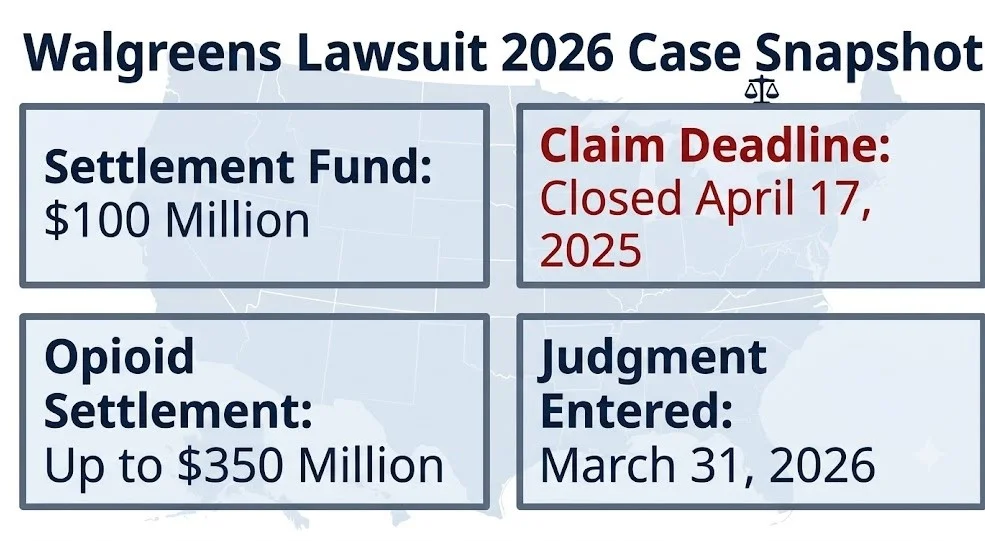
- The pricing settlement fund is worth $100 million, while the separate federal opioid resolution reaches up to $350 million, paid over six years.
| Detail | Info |
|---|---|
| Court | U.S. District Court for the Northern District of Illinois |
| Case / Docket Number | 1:17-cv-02246 (Russo et al. v. Walgreen Co.) |
| Presiding Judge | Edmond E. Chang |
| Filing Date | Originally filed March 2017; judgment entered March 31, 2026 |
| Status | Approved, claims being processed, payments pending |
| Settlement Fund | $100 million (Savings Club case); separately, up to $350 million (federal opioid settlement) |
The Walgreens lawsuit story in 2026 is not one case. It is several, moving on different tracks with different deadlines. Missing that distinction is the most common mistake readers make searching this topic right now.
The headline case just cleared its biggest hurdle. On March 31, 2026, a federal judge in Chicago entered judgment approving a $100 million settlement over pharmacy pricing.
Separately, Walgreens closed out a federal opioid dispensing case worth up to $350 million, on top of a 2022 multistate opioid deal worth $5.52 billion over 15 years. Newer claims involving lidocaine patches and PFAS-treated bandages remain unresolved.
This piece walks through each track, what already closed, and what is still worth watching.
Walgreens Lawsuit
A Walgreens lawsuit refers to any of several distinct legal actions against the pharmacy chain, spanning pricing, opioids, product claims, and employment disputes. There is no single unified case covering all of it.
The most financially significant consumer case is Russo et al. v. Walgreen Co., a pricing class action originally filed in March 2017 in federal court in Chicago.
Separately, Walgreens has resolved major federal and state opioid litigation, and it faces newer, still-developing claims tied to specific products sold in its stores.
Quick Facts
- Lead consumer case: Russo v. Walgreen Co., N.D. Illinois
- Separate track: federal and multistate opioid settlements
- Emerging track: lidocaine and PFAS product claims, unresolved
Attorneys handling these claims describe Walgreens’ 2026 legal exposure as unusually layered, with active, closed, and emerging cases all running simultaneously.
Lawsuit Walgreens
A lawsuit against Walgreens can originate from a customer, a state attorney general, the federal government, or a former employee, depending on the underlying claim. The legal theory changes significantly across these categories.
Consumer pricing claims proceed as civil class actions under state consumer protection statutes. Opioid claims combine federal Controlled Substances Act violations with False Claims Act allegations over billing.
Employment claims, like the Walgreen Pharmacy Services Settlement, proceed under wage and hour law rather than consumer protection or drug enforcement statutes.
| Claim Type | Legal Theory |
|---|---|
| Pricing overcharge | State consumer protection law |
| Opioid dispensing | Controlled Substances Act, False Claims Act |
| Employee wage dispute | Wage and hour law |
Attorneys handling these claims note that the legal theory behind each Walgreens case determines which court, and often which government agency, gets involved.
Walgreens Lawsuit 2026
The Walgreens lawsuit picture in 2026 is defined by one closed claim window and several still-moving cases. Understanding which category applies matters more than the word “lawsuit” itself.
On March 31, 2026, Judge Edmond E. Chang of the Northern District of Illinois entered judgment approving the $100 million Savings Club settlement. Claims are now being processed, though no payments have gone out yet.
At the same time, newer product-related claims involving lidocaine patches and PFAS-treated bandages remain in active litigation, with no settlement or claim form yet available.
| 2026 Case Status | Detail |
|---|---|
| Savings Club settlement | Approved March 31, 2026; claims processing |
| Federal opioid settlement | Resolved, up to $350 million |
| Lidocaine and PFAS claims | Active litigation, no settlement yet |
Attorneys handling these claims caution readers that “Walgreens lawsuit 2026” news often mixes a closed case with active ones in the same article.
Walgreens Lawsuit Claim Form
A Walgreens lawsuit claim form was required to participate in the Savings Club pricing settlement, and that filing window has already closed. Most class members needed to submit by April 17, 2025.
A small subset of claimants who sought additional prescription detail had a later deadline of June 16, 2025, but no new claim forms are being accepted for this settlement.
For the emerging lidocaine and PFAS product claims, no claim form currently exists, since neither case has reached a settlement or claims administration stage.
- Savings Club claim form: deadline passed, closed to new submissions
- Federal opioid settlement: no individual consumer claim form, funds go to states
- Lidocaine and PFAS claims: no claim form yet available
Attorneys handling these claims warn that any site currently advertising a live Savings Club claim form should be treated with real skepticism.
Litigation Watch: The $100 million Walgreens pricing settlement is approved and processing claims, but its filing window closed in 2025, while newer lidocaine and PFAS product claims remain unresolved with no claim form yet.
Who Qualifies for Walgreens Lawsuit
Qualification depends entirely on which specific Walgreens case a reader means, since eligibility criteria differ sharply across the pricing, opioid, and product tracks. There is no universal qualifying standard.
For the now-closed Savings Club settlement, qualification covered individuals and third-party payors who paid for prescriptions using insurance between January 1, 2007 and November 18, 2024.
For the newer lidocaine and PFAS claims, qualification will likely depend on documented product purchases and, in PFAS cases, evidence of exposure, once a class is formally defined.
| Case | Who Qualified or May Qualify |
|---|---|
| Savings Club settlement | Insured customers and third-party payors, 2007 to 2024 (claim window closed) |
| Federal opioid settlement | State and local governments, not individual consumers |
| Lidocaine or PFAS claims | To be defined by future class certification |
Attorneys handling these claims note that “who qualifies” changes case by case, and readers should confirm which specific Walgreens matter applies to their situation.
Walgreens Lawsuit Eligibility
Eligibility for any Walgreens legal claim requires matching the exact class period, product, or employment window defined in that specific case. Broad assumptions about eligibility are the most common source of confusion.
For the pricing settlement, eligibility already closed with the passed claim deadline, meaning new eligibility determinations are no longer being made for that case.
For former employees, eligibility under the Walgreen Pharmacy Services Settlement covered those terminated between April 6, 2018, and April 6, 2021, a narrow and specific window.
- Pricing settlement: eligibility window closed, no new claims accepted
- Employee settlement: narrow termination date window, already defined
- Emerging product claims: eligibility not yet formally established
Attorneys handling these claims recommend confirming exact dates and product details before assuming eligibility for any Walgreens matter.
Walgreens Prescription Savings Club Lawsuit
The Walgreens Prescription Savings Club lawsuit alleged the company inflated prescription prices by not using its own discount club pricing as the “usual and customary” price for insurance billing. This was the core legal theory behind the $100 million settlement.
According to court records, the case, filed as Russo et al. v. Walgreen Co., accused Walgreens of overcharging insured customers and third-party payors compared to cash-paying Savings Club members.
The settlement fund of $100 million will cover attorneys’ fees, expenses, and payments to class members, split into distribution pools after those costs are deducted.
Bold callout: The Walgreens Savings Club settlement is six times larger than a comparable prior pharmacy pricing case, reflecting a longer class period and larger nationwide footprint.
Attorneys handling these claims point to the “usual and customary” pricing definition as the central legal issue in the entire case.
Walgreens Opioid Lawsuit
The Walgreens opioid lawsuit refers to two separate resolved matters: a multistate settlement with state and local governments, and a federal settlement with the Department of Justice. Both are now closed.
In 2022, Walgreens agreed to pay up to $5.52 billion over 15 years to resolve thousands of lawsuits brought by state and local governments over its role in the opioid crisis.
Separately, in 2025, Walgreens agreed to pay $300 million, potentially rising to $350 million, to resolve a Department of Justice complaint alleging it filled millions of unlawful controlled substance prescriptions between August 2012 and March 2023.
| Opioid Settlement | Amount | Paid To |
|---|---|---|
| Multistate government settlement (2022) | Up to $5.52 billion over 15 years | State and local governments |
| Federal DOJ settlement (2025) | $300 million, up to $350 million | U.S. government |
Attorneys handling these claims note that neither opioid settlement creates a direct individual consumer payout, since the funds are structured for government and public health use.
Litigation Watch: Walgreens has now closed out its major opioid litigation through a combined multistate and federal resolution worth billions, while its pricing settlement separately moved to final court approval in 2026.
Walgreens Lawsuit Settlement Amount
The total dollar figure across Walgreens’ major settlements now exceeds $5.9 billion, spanning pricing, opioid, and employment matters. No single number captures the full scope, since each case has its own fund.
The pricing settlement totals $100 million, approved by the court on March 31, 2026, and currently in the claims processing stage.
The combined opioid resolutions, covering both the 2022 multistate deal and the 2025 federal settlement, account for the overwhelming majority of Walgreens’ total settlement exposure.
| Settlement | Amount |
|---|---|
| Savings Club pricing settlement | $100 million |
| Multistate opioid settlement | Up to $5.52 billion |
| Federal DOJ opioid settlement | Up to $350 million |
| Employee wage settlement | $2.5 million |
Attorneys handling these claims caution against adding these figures together as one “payout pool,” since each fund serves a legally distinct group of claimants.
Walgreens Class Action Lawsuit
A Walgreens class action lawsuit is a case where multiple plaintiffs with similar claims proceed together under one certified class, rather than filing individually. Several such actions exist against Walgreens right now, in different stages.
The Savings Club pricing case reached full class certification and final court approval, making it the most advanced class action against the company.
The lidocaine and PFAS product cases remain in earlier stages, with plaintiffs still pursuing discovery and class certification as of early 2026.
| Case | Class Action Stage |
|---|---|
| Savings Club pricing case | Certified, approved, in claims processing |
| Lidocaine patch claims | Pre-certification, active discovery |
| PFAS bandage claims | Pre-certification, active discovery |
Attorneys handling these claims stress that certification status directly affects whether a claim form currently exists for a given case.
Walgreens Lawsuit Payout
Payout timing and structure differ sharply depending on which Walgreens case a reader is asking about. The pricing settlement is the closest to an actual consumer payout right now.
For the Savings Club settlement, no payments have been issued as of this writing, even though the court entered judgment on March 31, 2026. The settlement administrator is still processing claims and resolving deficiencies.
For the opioid settlements, funds flow to state and local governments and treatment programs, not directly to individual consumers who purchased opioid prescriptions.
- Savings Club settlement: payments pending, no checks issued yet
- Opioid settlements: funds go to governments and treatment programs, not individuals
- Employee wage settlement: payments handled separately under its own claims process
Attorneys handling these claims recommend patience with the Savings Club timeline, since appeals could delay payment further if filed.
Walgreens Lidocaine Lawsuit
The Walgreens lidocaine lawsuit alleges the company’s store-brand lidocaine patches, marketed as maximum strength, did not perform as advertised or caused economic loss to purchasers. This case remains in active litigation with no settlement yet.
Plaintiffs are pursuing claims tied to specific SKUs sold as maximum strength pain relief patches, focusing on both product performance and pricing premium allegations.
As of early 2026, there is no formalized Walgreens lidocaine settlement or claim form, since the case has not reached class certification or a negotiated resolution.
- No settlement fund exists yet for lidocaine claims
- Plaintiffs are focused on specific maximum strength SKUs
- Claims will likely require proof of purchase and documented economic loss or adverse reaction
Attorneys handling these claims caution that any lidocaine claim form circulating online right now is premature, since no court has certified this case.
Walgreens PFAS Lawsuit
The Walgreens PFAS lawsuit alleges certain store-brand products, including bandages, contained forever chemicals not disclosed to consumers. This case is tied to broader PFAS multidistrict litigation still working through causation and exposure issues.
As of early 2026, there is no global Walgreens PFAS settlement or claim voucher program, since the underlying MDL rulings on causation and damages remain pending.
Plaintiffs are continuing discovery and pursuing class certification, with outcomes in the broader PFAS MDL expected to shape how any future Walgreens-specific settlement would be structured.
Bold callout: No PFAS settlement or claim form exists yet for Walgreens products, despite active discovery in the underlying litigation.
Attorneys handling these claims note that PFAS causation rulings from the broader multidistrict litigation will likely determine how strong any Walgreens-specific claim becomes.
Walgreens Employee Lawsuit
A Walgreens employee lawsuit refers to wage and hour claims brought by current or former staff, separate from the consumer and opioid cases. The most notable recent example already reached settlement.
The Walgreen Pharmacy Services Settlement resolved claims from employees terminated between April 6, 2018, and April 6, 2021, for $2.5 million.
Walgreens denied the underlying allegations but agreed to settle to avoid the cost and uncertainty of continued litigation and a possible trial.
| Employee Settlement Fact | Detail |
|---|---|
| Settlement amount | $2.5 million |
| Eligible period | April 6, 2018 to April 6, 2021 |
| Claim basis | Final paycheck and wage-related allegations |
Attorneys handling these claims note that employment settlements like this one typically move faster than large consumer class actions, given smaller claimant pools.
How to File a Walgreens Lawsuit Claim
Filing a Walgreens lawsuit claim depends entirely on which case is currently accepting claims, since several Walgreens matters have already closed their filing windows. Confirming an open claim period is the essential first step.
For the Savings Club settlement, the filing window closed in 2025, and no new claims are being accepted regardless of eligibility.
For emerging claims like lidocaine or PFAS products, there is currently no formal claim process, so the realistic next step is documenting purchases and consulting an attorney about a potential individual or future class claim.
| Step | Applies To |
|---|---|
| Check settlement website for current claim status | Savings Club settlement (closed) |
| Document product purchases and receipts | Lidocaine and PFAS claims |
| Consult an attorney about individual claims | Any case without an active claim form |
Attorneys handling these claims recommend keeping receipts and pharmacy records now, even without an open claim form, since documentation becomes harder to obtain later.
Walgreens Lawsuit Attorney
A Walgreens lawsuit attorney is typically a consumer class action or product liability attorney, depending on which case applies. The right specialty differs across pricing, product, and employment claims.
For the closed pricing settlement, most class members did not need individual counsel, since the class action structure already represented their interests collectively.
For emerging lidocaine or PFAS claims, an attorney experienced in product liability and multidistrict litigation is generally the better fit, given the ongoing causation and class certification questions.
- Ask whether the attorney is tracking the specific Walgreens case relevant to your situation
- Ask whether a claim form currently exists or is still pending
- Ask how documentation requirements differ between product claims and wage claims
Attorneys handling these claims recommend confirming a firm’s specific experience with the exact Walgreens matter, since general consumer complaint attorneys may not handle product liability causation issues.
Walgreens Lawsuit Deadline
The deadline that matters most right now is the one that already passed: the Savings Club claim form deadline of April 17, 2025, with a limited extension to June 16, 2025 for certain claimants. No new claims are being accepted.
For emerging lidocaine and PFAS claims, no formal claim deadline exists yet, since neither case has reached a settlement structure requiring one.
Readers considering an individual claim outside these settlements should confirm applicable statutes of limitations with an attorney, since those vary significantly by state and claim type.
- Savings Club claim deadline: passed, April 17, 2025 (extended to June 16, 2025 for some claimants)
- Opioid settlements: no individual consumer deadline, funds already allocated to governments
- Lidocaine and PFAS claims: no deadline yet, case still in litigation
Attorneys handling these claims stress that a passed deadline for one Walgreens case does not affect eligibility for a separate, still-open matter.
Walgreens Lawsuit by State
Walgreens lawsuits touch nearly every state, but specific cases are concentrated in particular courts depending on the legal theory involved. The pricing settlement and opioid resolutions illustrate this difference clearly.
The Savings Club pricing case was filed and resolved in the U.S. District Court for the Northern District of Illinois, covering class members nationwide regardless of their home state.
The 2022 multistate opioid settlement, by contrast, allocated funds directly to state and local governments, with amounts and timing varying based on each state’s specific settlement agreement.
| Case | Court or Structure | State Variation |
|---|---|---|
| Savings Club settlement | N.D. Illinois, nationwide class | No state-by-state variation for eligibility |
| Multistate opioid settlement | State-specific allocation agreements | Amounts and timing vary by state |
| Employee wage settlement | Federal wage law | Applies to eligible former employees nationwide |
Attorneys handling these claims note that opioid settlement funds are the clearest example of state-by-state variation among Walgreens’ major cases.
Frequently Asked Questions
Is there an active Walgreens lawsuit in 2026?
Yes, several Walgreens legal matters remain active in 2026, though at different stages.
The Savings Club pricing settlement is approved and processing claims, while lidocaine and PFAS product claims remain in active litigation.
Who qualifies for the Walgreens Savings Club settlement?
Insured customers and third-party payors who paid for prescriptions between January 1, 2007, and November 18, 2024, qualified.
The claim filing window for this settlement has already closed, so new eligibility determinations are no longer being made.
How much is the Walgreens lawsuit settlement worth?
The Savings Club pricing settlement is worth $100 million, approved by the court on March 31, 2026.
Separately, Walgreens’ opioid settlements total up to $5.87 billion combined across the multistate and federal resolutions.
Can I still file a Walgreens lawsuit claim form?
No new claim forms are being accepted for the Savings Club settlement, since that deadline passed in 2025.
Emerging lidocaine and PFAS claims have no formal claim form yet, since neither case has reached settlement.
Is Walgreens facing a class action lawsuit right now?
Yes, Walgreens faces multiple class actions at different stages of litigation.
The pricing case reached certification and approval, while lidocaine and PFAS claims remain in earlier, pre-certification phases.
What is the deadline to join a Walgreens lawsuit?
The Savings Club claim deadline already passed on April 17, 2025, with a limited extension to June 16, 2025 for some claimants.
No deadline currently exists for the newer lidocaine or PFAS claims, since those cases have not reached a settlement structure.
Walgreens’ legal picture in 2026 is really several separate stories moving at once. The pricing settlement closed its claim window and is now processing payments, while opioid litigation is resolved and newer product claims are still forming.
Anyone with documented lidocaine or PFAS product purchases should preserve receipts now and speak with a product liability attorney before any future claim window opens.
