Quick Answer Box
- What this case is: Civil lawsuits and regulatory scrutiny targeting QC Kinetix for allegedly misrepresenting the efficacy of its regenerative medicine treatments, including platelet-rich plasma (PRP) injections and purported stem cell therapies, to patients paying out-of-pocket costs often exceeding $10,000.
- Who qualifies: Patients who paid for QC Kinetix treatments between approximately 2019 and the present, experienced inadequate results, and can show they relied on the company’s marketing claims when deciding to purchase treatment.
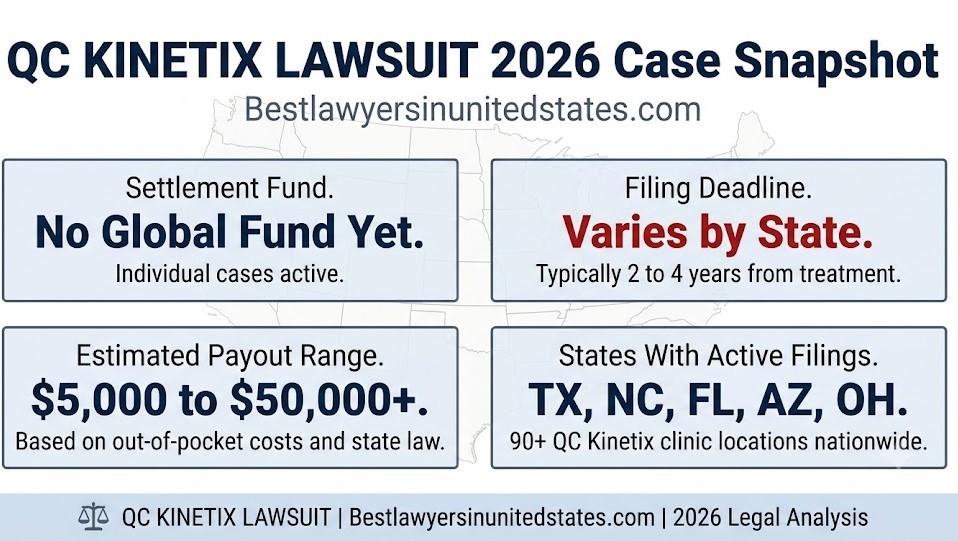
- What it’s worth: Individual claim values in comparable regenerative medicine fraud cases have ranged from $5,000 to $50,000+ depending on total out-of-pocket expenditure, documented harm, and the specific legal theories pursued.
Case Snapshot
| Detail | Information |
|---|---|
| Company | QC Kinetix (corporate parent entity, franchised network) |
| Headquarters | Charlotte, North Carolina |
| Court(s) | U.S. District Courts in multiple jurisdictions; state courts in NC, TX, FL, and others |
| Case / MDL Number | No federal MDL consolidated as of publication; individual and coordinated state filings active |
| Earliest Known Filing Activity | 2021 (state-level consumer protection complaints) |
| Status as of 2026 | Active litigation; no global class settlement reached |
| Regulatory Activity | FTC oversight of regenerative medicine marketing; state AG inquiries in multiple states |
| Primary Legal Theories | Fraud, deceptive trade practices, negligent misrepresentation, breach of contract, battery (in some filings) |
Introduction
The QC Kinetix lawsuit represents one of the more closely watched legal disputes in the regenerative medicine industry heading into 2026. At its center is a straightforward allegation: that QC Kinetix sold expensive, unproven treatments to patients in pain, backed by marketing claims the science does not support.
Patients across more than 90 clinic locations paid between $5,000 and $15,000 or more per treatment series. Many report they received little or no relief. Several report they were never told the treatments were experimental or not FDA-approved for their specific conditions.
The legal landscape around QC Kinetix is not a single lawsuit. It is a collection of individual claims, coordinated filings, and regulatory investigations that together form a serious legal challenge for the company and its franchise network. That distinction matters enormously for claimants deciding how to proceed.
This analysis draws on court filings, regulatory enforcement history, consumer complaint records, and the legal framework governing regenerative medicine advertising to give readers an accurate picture of where this litigation stands in 2026.
What Is the QC Kinetix Lawsuit?
The QC Kinetix lawsuit refers to civil legal actions filed by former patients alleging the company misrepresented the nature, efficacy, and scientific support behind its regenerative medicine treatments.
QC Kinetix operates a franchise network of clinics across the United States. The company markets itself as offering non-surgical alternatives for joint pain, arthritis, and sports injuries. Treatments center on platelet-rich plasma (PRP) injections and substances the company has marketed as stem cell therapies.
The core legal dispute is whether QC Kinetix made factual representations about these treatments that were false or misleading, and whether patients paid substantial sums based on those representations without being adequately informed of the treatments’ limitations.
Key allegations at a glance:
- Misrepresentation of stem cell therapy efficacy
- Failure to disclose experimental status of treatments
- High-pressure sales practices at consultations
- Misleading before-and-after testimonials
- Inadequate informed consent documentation
Attorney Insight: Attorneys handling these claims point to the gap between QC Kinetix’s marketing language and the current FDA posture on regenerative medicine products as the foundational vulnerability in the company’s legal defense.
QC Kinetix Lawsuit 2026: Where Does the Case Stand?
As of 2026, the QC Kinetix lawsuit landscape is active but not yet resolved through any global settlement. Individual claims are being prosecuted in state and federal courts across multiple jurisdictions.
No federal Multidistrict Litigation (MDL) panel has consolidated QC Kinetix cases into a single federal proceeding as of this writing. That means claimants are not operating under a single federal case number or master complaint. Each claim proceeds under the laws of the state where the patient was treated.
This is a significant structural fact. In cases without MDL consolidation, early filers often have strategic advantages, and the absence of coordination means settlement timelines can vary dramatically by jurisdiction.
| Status Category | Current Position (2026) |
|---|---|
| Federal MDL | Not yet consolidated |
| State Court Filings | Active in NC, TX, FL, AZ, OH, and others |
| Regulatory Investigation | FTC monitoring active; state AG inquiries ongoing |
| Global Settlement | None reached as of publication |
| Class Certification | Sought in at least one jurisdiction; not yet granted |
Attorney Insight: Attorneys handling these claims point to the lack of MDL consolidation as a reason claimants should act independently rather than waiting for a coordinated resolution that may not materialize on a predictable timeline.
What Fraud Allegations Are Central to the QC Kinetix Lawsuit?
The fraud allegations against QC Kinetix center on the company’s representations about the nature and clinical support behind its treatments. These are not peripheral complaints. They form the substantive core of the litigation.
Plaintiffs allege QC Kinetix told prospective patients that its treatments could repair damaged cartilage, reverse arthritis, and eliminate the need for surgery. These representations, plaintiffs argue, were made without adequate scientific basis and in direct conflict with the FDA’s regulatory position on these products.
Fraud claims in these cases generally require proving four things: a false statement of material fact, knowledge of falsity or reckless disregard for truth, reliance by the plaintiff, and resulting damages. The out-of-pocket cost documentation and the company’s own marketing materials are central to meeting this burden.
Primary fraud theories in active filings:
- Common law fraud (intentional misrepresentation)
- Fraudulent inducement to contract
- Negligent misrepresentation
- Violations of state Deceptive Trade Practices Acts (DTPAs)
- In select filings: civil battery (treatment administered without valid informed consent)
Attorney Insight: Attorneys handling these claims point to QC Kinetix’s written consultation materials and recorded sales presentations as potentially strong evidence that the misrepresentations were systematic and not isolated to individual sales staff.
Litigation Watch: The fraud allegations, deceptive advertising claims, and patient complaint record together establish a pattern that courts will scrutinize carefully, and that pattern is precisely what gives these cases their litigation strength.
QC Kinetix Patient Complaints: What the Records Show
Patient complaints against QC Kinetix have accumulated across the Better Business Bureau, state consumer protection agencies, and federal regulatory databases. The volume and consistency of these complaints is legally significant.
As of 2025 and into 2026, QC Kinetix held an “F” rating with the Better Business Bureau based on complaint patterns and the company’s failure to resolve disputes. Hundreds of individual complaints describe nearly identical experiences: aggressive sales consultations, high out-of-pocket costs, no measurable benefit, and difficulty obtaining refunds.
Consumer complaint records are not direct legal evidence, but they serve two functions in litigation. They corroborate the plaintiff’s account and support an argument that the conduct was not an isolated incident but a repeating business practice. Courts weigh systematic conduct more seriously than one-off mistakes.
Common complaint themes from patient records:
- Promised results not delivered
- Sales staff overstated clinical evidence
- Refund requests denied despite stated satisfaction guarantees
- No follow-up care after treatment series concluded
- Difficulty accessing medical records post-treatment
Attorney Insight: Attorneys handling these claims point to the BBB complaint record as a pattern-of-conduct document that supports punitive damages arguments in states where that remedy is available for consumer fraud.
How Regenerative Medicine Fraud Became QC Kinetix’s Legal Problem
Regenerative medicine fraud is the broader legal and regulatory category within which QC Kinetix’s legal exposure sits. Understanding this context is essential to understanding why these cases are viable.
The FDA has taken an increasingly firm position since 2019 that most regenerative medicine products, including many stem cell preparations used by clinics like QC Kinetix, require pre-market approval before they can be marketed for specific conditions. The FDA’s enforcement discretion period ended in May 2021, after which unapproved products sold without proper regulatory clearance face direct enforcement exposure.
QC Kinetix operates in a gray zone between wellness services and medical treatment. Plaintiffs argue the company exploited that ambiguity to make medical-sounding claims while avoiding the regulatory accountability that formal medical providers face. Courts in several states have shown willingness to apply consumer protection statutes to this type of hybrid medical marketing.
FDA regulatory framework relevant to QC Kinetix claims:
| Product Category | FDA Status | Relevance to Litigation |
|---|---|---|
| Platelet-Rich Plasma (PRP) | Generally considered minimally manipulated; some uses cleared | Plaintiffs argue efficacy claims exceeded cleared indications |
| Allogenic Stem Cell Products | Require BLA or IND; most clinic products lack approval | Central to fraud and misbranding allegations |
| Exosome Products | FDA has issued warnings; not cleared for therapeutic use | Some QC Kinetix locations marketed these |
| Amniotic Products | Mixed regulatory status; some warnings issued | Marketed by some franchisees without adequate disclosure |
Attorney Insight: Attorneys handling these claims point to the FDA’s 2021 enforcement posture as a baseline they use to frame the “knew or should have known” element of negligent misrepresentation claims.
The Deceptive Advertising Claims at the Core of This Lawsuit
The deceptive advertising claims in the QC Kinetix lawsuit target the company’s marketing infrastructure directly. This is distinct from a general fraud claim and involves specific legal standards under both federal and state law.
Under the FTC Act and parallel state deceptive trade practices statutes, advertising a health-related product or service requires that efficacy claims be substantiated by competent and reliable scientific evidence. Plaintiffs allege QC Kinetix’s advertising did not meet this standard, particularly for claims tied to arthritis reversal, cartilage regeneration, and avoidance of surgical procedures.
QC Kinetix ran advertising across television, radio, digital platforms, and in-clinic presentation materials. Several specific advertising campaigns used language that plaintiffs’ attorneys argue crossed from promotional puffery into actionable false representation. The distinction between puffery and actionable misrepresentation is one courts decide on a case-by-case basis.
Advertising claims cited in patient filings:
- “Avoid surgery permanently”
- “Regenerate your own cartilage”
- “FDA-compliant treatments” (cited as misleading regarding actual approval status)
- Patient testimonials presented without required scientific substantiation
- Before-and-after imaging used without adequate clinical context
Attorney Insight: Attorneys handling these claims point to the distinction between FTC-defined “puffery” and actionable false advertising as a key contested issue, one that depends heavily on the specific wording QC Kinetix used in each market.
Litigation Watch: The deceptive advertising claims, the regenerative medicine regulatory framework, and the FDA’s 2021 enforcement posture together give plaintiffs a credible basis for arguing that QC Kinetix’s marketing practices crossed from aggressive promotion into legally actionable misrepresentation.
The Stem Cell Therapy Angle: Why These Claims Are Especially Serious
The stem cell therapy component of the QC Kinetix lawsuit carries particular legal weight because it involves the most specific regulatory prohibitions.
QC Kinetix and its franchisees marketed products that patients understood to be stem cell therapies. In reality, many of these products were amniotic-derived or exosome preparations sold by third-party biologics companies and administered under stem cell branding. This product characterization is itself legally significant.
The FDA has specifically warned that marketing a product as stem cell therapy when it does not meet the legal definition of an approved stem cell product can constitute misbranding under the Federal Food, Drug, and Cosmetic Act. Several QC Kinetix patients were told they received “stem cells.” Court filings allege this representation was false or materially misleading.
What the stem cell claims mean for litigation:
- Patients who paid premium prices specifically for “stem cell” treatment have a stronger misrepresentation argument than those who received only PRP
- Misbranding under federal law can support state consumer protection claims even without proving intent to defraud
- Franchise locations that sourced non-approved biologics from unlicensed suppliers face additional exposure
Attorney Insight: Attorneys handling these claims point to the product sourcing chain, specifically which biologics supplier provided the materials marketed as stem cells, as one of the most consequential discovery targets in active cases.
FTC Investigation Into QC Kinetix: What Federal Regulators Are Watching
The FTC’s role in the QC Kinetix legal picture is separate from but parallel to private civil litigation. Federal regulatory scrutiny adds a layer of legal pressure that private lawsuits alone cannot replicate.
The FTC has broad authority under Section 5 of the FTC Act to take action against deceptive acts or practices in commerce. The agency has been actively scrutinizing the regenerative medicine clinic industry since at least 2019, issuing warning letters to clinics making unsupported therapeutic claims. While QC Kinetix has not been the subject of a publicly announced FTC enforcement action as of this publication, the company operates in an industry the FTC has explicitly identified as a priority enforcement area.
State attorneys general in states including Texas, North Carolina, Florida, and Arizona have consumer protection divisions that review complaints about medical marketing fraud. Some of these offices have opened inquiries involving regenerative medicine clinic networks.
FTC regulatory tools relevant to this case:
| Tool | Authority | Effect on Civil Claims |
|---|---|---|
| Section 5 FTC Act enforcement | Prohibits deceptive acts in commerce | FTC findings create persuasive precedent for civil plaintiffs |
| Civil investigative demands | Compel document production | Can surface internal communications useful to private litigants |
| Consent orders | Require corrective advertising | Admissions in consent orders can be used in civil proceedings |
| Cease and desist | Stop specific advertising claims | Signals FTC’s view that claims were unsupported |
Attorney Insight: Attorneys handling these claims point to FTC warning letters issued to the regenerative medicine industry as establishing an industry-wide “knew or should have known” standard that strengthens individual plaintiff negligence claims.
Franchise Liability in the QC Kinetix Lawsuit: Who Is Actually Responsible?
The franchise structure of QC Kinetix is one of the most legally complex and practically significant aspects of this litigation. It determines who a claimant can actually sue, and in which court.
QC Kinetix operates through a franchise model. Individual clinic locations are typically owned by franchisees who license the QC Kinetix brand, protocols, and marketing system from the corporate franchisor. This structure creates a potential liability split that every claimant needs to understand.
The franchisor may argue that franchisees are independent contractors responsible for their own sales practices. Franchisees may argue they simply followed the system the franchisor required them to follow. Courts have handled this tension differently, but where a franchisor exercises substantial control over marketing language, training scripts, and treatment protocols, courts have found grounds to hold the franchisor liable alongside or instead of the franchisee.
Franchise liability factors courts examine:
- Did the franchisor write the sales scripts used at franchise locations?
- Did the franchisor provide the advertising materials that contained alleged misrepresentations?
- Did the franchisor’s training program instruct franchisees on how to discuss stem cell efficacy?
- Did the franchise agreement require use of specific marketing language?
- Did the franchisor review and approve individual location advertising?
Attorney Insight: Attorneys handling these claims point to the franchise disclosure document (FDD) and the franchise operations manual as critical discovery targets, because these documents often reveal how much control the corporate parent exercised over the representations made to patients.
Litigation Watch: The franchise liability question, the FTC’s regulatory posture, and the stem cell product sourcing chain are three discovery fronts that will define the scope of corporate accountability in this litigation.
Who Qualifies for the QC Kinetix Lawsuit?
Qualification for the QC Kinetix lawsuit is not automatic for everyone who received treatment. There are specific factual criteria that define a legally viable claim.
The strongest claims come from patients who can show they paid for treatment after being presented with specific marketing claims about efficacy, received inadequate results or no results, and would not have paid for treatment had they known the accurate clinical picture.
The financial threshold matters practically. Patients who paid small amounts may find that the cost of litigation or even contingency-fee case management does not justify the effort relative to potential recovery. The cases most likely to attract attorney representation are those involving total out-of-pocket expenditures of $5,000 or more.
General qualification indicators:
- Received treatment at any QC Kinetix location between 2019 and present
- Paid out-of-pocket (insurance typically does not cover these treatments)
- Were told the treatment could regenerate cartilage, reverse arthritis, or avoid surgery
- Did not receive the promised outcome
- Have documentation of payment (receipts, bank statements, credit card records)
- Retained any written materials from the consultation or treatment
Attorney Insight: Attorneys handling these claims point to the consultation intake paperwork as frequently containing misleading representations in writing, which makes the evidentiary burden meaningfully easier than verbal-only misrepresentation cases.
QC Kinetix Lawsuit Eligibility: Specific Criteria Claimants Must Meet
Eligibility for the QC Kinetix lawsuit turns on specific legal elements, not just dissatisfaction with treatment results. Attorneys screen claimants against these criteria before accepting representation.
The first criterion is reliance. The claimant must show they reasonably relied on QC Kinetix’s representations when deciding to purchase treatment. This is typically shown through the consultation timeline, the specific claims made by staff, and the patient’s own pre-treatment understanding of the treatment’s limitations.
The second criterion is documented damages. Courts require that financial harm be quantifiable. Patients need payment records, contracts, or treatment agreements that specify what they paid and what they were promised.
The third criterion is causation in cases involving physical harm. If a patient claims they suffered physical injury from a treatment, they must show the treatment, not a pre-existing condition, caused that harm.
Eligibility screening criteria summary:
| Criterion | What You Need to Show | Common Documentation |
|---|---|---|
| Treatment at QC Kinetix | Confirmed attendance at a QC Kinetix location | Appointment records, text confirmations |
| Reliance on marketing claims | You believed the efficacy representations | Consultation notes, brochures, recorded calls |
| Out-of-pocket payment | You paid directly, not through insurance | Credit card statements, financing agreements |
| Inadequate outcome | Results did not match representations | Medical records, post-treatment documentation |
| Damages threshold | Typically $5,000+ to attract representation | Total payment receipts |
Attorney Insight: Attorneys handling these claims point to financing agreements signed at QC Kinetix consultations as particularly useful documents, because they often contain the specific treatment promises that form the basis for breach of contract claims.
Which States Are Most Active in QC Kinetix Legal Actions?
QC Kinetix operates clinics in more than 90 locations across the United States, and legal activity is not uniformly distributed. Certain states have generated the most significant litigation activity based on clinic density, consumer protection law strength, and state AG posture.
Texas is the most active state for QC Kinetix-related complaints and litigation. The Texas Deceptive Trade Practices Act is one of the strongest consumer protection statutes in the country. It allows for recovery of economic damages plus up to three times that amount for intentional violations, plus attorney fees. North Carolina, as QC Kinetix’s home state, is also a significant litigation venue.
Florida and Arizona each have substantial QC Kinetix clinic networks and active consumer protection enforcement environments. Ohio, Georgia, and South Carolina have also seen complaint and filing activity.
State legal environment comparison:
| State | DTPA Strength | Punitive/Treble Damages | AG Activity Level | Clinic Presence |
|---|---|---|---|---|
| Texas | Very Strong | Yes (3x) | High | High |
| North Carolina | Strong | Yes (limited) | Moderate | High (HQ state) |
| Florida | Strong | Yes | High | High |
| Arizona | Moderate | Yes | Moderate | High |
| Ohio | Moderate | Yes | Moderate | Moderate |
| Georgia | Moderate | Yes | Moderate | Moderate |
Attorney Insight: Attorneys handling these claims point to Texas as the preferred jurisdiction for individual claims where a claimant has a choice, given the DTPA’s favorable fee-shifting provisions that make smaller individual cases economically viable for plaintiff-side attorneys.
Litigation Watch: Texas’s DTPA, the multi-state clinic footprint, and the class action certification efforts in at least one jurisdiction represent the three most consequential structural developments for claimants evaluating their options.
Is There a QC Kinetix Class Action Lawsuit?
A QC Kinetix class action lawsuit has been sought but class certification has not been granted as of this writing in 2026. Understanding the distinction between an attempted class action and a certified one is critical for claimants.
Class certification requires the court to find, among other things, that the claims of individual class members share enough common questions of law and fact that resolving them together makes sense. In cases involving individualized sales presentations, courts sometimes find that the specific representations made to each patient differ too much to support a single class.
This is QC Kinetix’s likely defense to class certification. The company’s attorneys will argue that what each patient was told varies by location, franchisee, and sales staff member, making individual issues predominate over common ones.
Plaintiffs counter that the company’s standardized training materials, national advertising campaigns, and franchise-required sales protocols make the core misrepresentations uniform enough to support class treatment.
Class action vs. individual claim comparison:
| Factor | Class Action | Individual Claim |
|---|---|---|
| Timeline | Longer; depends on certification ruling | Can move more quickly |
| Control | Class counsel makes key decisions | Client retains more control |
| Payout potential | Distributed among class members | Full individual recovery possible |
| Attorney costs | Spread across class | Contingency on individual claim |
| Admission to participate | Automatic or opt-in depending on structure | Requires individual filing |
Attorney Insight: Attorneys handling these claims point to the class certification hearing as the pivotal event in 2026, because a denial does not end the litigation but shifts strategy toward coordinated individual filings rather than class resolution.
QC Kinetix Settlement: Has One Been Reached?
No global QC Kinetix settlement has been reached as of this publication. The litigation is in active discovery and pre-trial stages across multiple jurisdictions.
This is an important fact for claimants to understand. Unlike some mass torts where a settlement fund has been established and claimants simply submit proof of eligibility, the QC Kinetix litigation currently requires active legal representation and case-by-case pursuit.
Some individual cases may have resolved privately, through confidential settlements between individual plaintiffs and QC Kinetix, without public disclosure. This is common in franchise-network litigation, where the corporate parent prefers resolving cases quietly to avoid creating precedent that encourages additional filings.
What “no global settlement” means for claimants:
- No claims administrator accepting submissions
- No established settlement fund to draw from
- Individual representation is required, not optional
- Early resolution through direct negotiation remains possible on a case-by-case basis
- Statute of limitations continues to run; delay carries legal risk
Attorney Insight: Attorneys handling these claims point to the absence of a global settlement as an indication that QC Kinetix has not yet reached the volume of litigation pressure that typically forces a global resolution in franchise-network consumer fraud cases.
QC Kinetix Settlement Amount: What the Numbers Could Look Like
No verified QC Kinetix settlement amount is publicly available because no global settlement has been reached. Any figure presented as a confirmed settlement number by a competitor source should be treated with significant skepticism.
What is available is a basis for projecting settlement value by reference to comparable regenerative medicine fraud and deceptive medical marketing cases. Courts and mediators in these cases use out-of-pocket expenditure as the baseline and multiply from there based on harm severity and applicable statutory multipliers.
In Texas DTPA cases involving intentional violations, treble damages (three times economic loss) are available. For a patient who paid $12,000 for a treatment series, treble damages would put the gross recovery figure at $36,000 before attorney fees. In states without statutory multipliers, economic damages alone drive the number.
Projected individual claim value ranges:
| Out-of-Pocket Cost | State with Treble Damages | State Without Multiplier | Physical Harm Added |
|---|---|---|---|
| $5,000 | Up to $15,000 | $5,000 to $8,000 | Additional recovery possible |
| $10,000 | Up to $30,000 | $10,000 to $16,000 | Additional recovery possible |
| $15,000 | Up to $45,000 | $15,000 to $25,000 | Additional recovery possible |
| $20,000+ | Up to $60,000+ | $20,000 to $35,000 | Substantial addition possible |
Attorney Insight: Attorneys handling these claims point to punitive damages availability as a function not just of state law but of the specific conduct evidence gathered in discovery, meaning cases where internal company emails show knowledge of false claims carry substantially higher settlement leverage.
Litigation Watch: Settlement value projections, class certification outcomes, and the absence of a global resolution fund all point toward 2026 as a year of intensified individual case activity rather than a year of mass-settlement payouts.
QC Kinetix Lawsuit Payout: What Individual Claimants Might Receive
Individual QC Kinetix lawsuit payout figures depend on factors specific to each claimant’s situation. There is no flat payment schedule and no established fund from which standard amounts are distributed.
The primary driver of individual payout is total out-of-pocket expenditure. Secondary drivers include whether the claimant suffered physical harm requiring additional medical treatment, which state’s law applies, whether the franchisee or corporate parent is the named defendant, and the quality of documentary evidence the claimant can produce.
Attorney fees in these cases are typically handled on a contingency basis. A standard contingency fee in consumer protection and personal injury cases ranges from 33% to 40% of the gross recovery. Some attorneys handling QC Kinetix claims may adjust this range based on case complexity.
Payout factor breakdown:
- Base recovery: Total amount paid for treatment
- Statutory multiplier: Treble damages where available (Texas, some other states)
- Consequential damages: Additional medical costs incurred to treat worsened condition
- Pain and suffering: Available in physical harm cases; not applicable to pure economic loss claims
- Attorney fees: Typically 33% to 40% contingency; sometimes fee-shifted to defendant under state DTPA
- Net to client: Gross recovery minus attorney fees and case costs
Attorney Insight: Attorneys handling these claims point to fee-shifting provisions in state consumer protection statutes, particularly Texas DTPA, as making smaller cases viable that would otherwise be uneconomical for plaintiff-side representation.
How to Join the QC Kinetix Lawsuit
Joining the QC Kinetix lawsuit is not a matter of submitting a form to a claims administrator. Because no class settlement exists, the process requires individual legal action or individual representation within a coordinated attorney network.
The starting point is gathering documentation. Before contacting an attorney, claimants should locate every document related to their QC Kinetix experience: payment records, financing agreements, consultation brochures, text messages, emails, and any written treatment plans or outcome guarantees.
The next step is contacting an attorney who handles consumer protection, personal injury, or medical fraud cases and who has reviewed QC Kinetix claims specifically. Initial consultations are typically free. The attorney evaluates whether the claim meets viability thresholds before agreeing to representation.
Steps to initiate a QC Kinetix claim:
- Document collection: Payment records, contracts, financing agreements, consultation materials
- Medical record request: Obtain your QC Kinetix treatment records directly (you have a legal right to these)
- Personal account: Write a timeline of what you were told, by whom, and when
- Attorney consultation: Contact a consumer protection or personal injury attorney with experience in medical fraud claims
- Statute of limitations check: Confirm the deadline in your state before taking any other steps
- Representation agreement: If the attorney accepts your case, sign a contingency representation agreement
- Case filing: Your attorney files in the appropriate court (state or federal depending on claim type and damages)
Attorney Insight: Attorneys handling these claims point to the statute of limitations as the single most time-sensitive issue, because many states impose a two-to-three-year window from the date of the alleged fraud or the date the claimant reasonably discovered it, and that window can expire without warning.
What Type of Attorney Handles the QC Kinetix Lawsuit?
The QC Kinetix lawsuit sits at the intersection of three attorney practice areas, and understanding which type is right for a given claim directly affects case strategy, fee structure, and likely outcome.
Consumer protection attorneys handle the deceptive trade practices and false advertising claims. These attorneys are most effective when the claim involves primarily economic loss, meaning the patient paid and received nothing of value. Consumer protection attorneys often work under state DTPA statutes that provide fee-shifting, making representation viable for smaller economic damage claims.
Personal injury attorneys handle claims where the patient suffered physical harm as a result of the treatment or the delay in seeking appropriate medical care. If a patient’s condition worsened because they relied on QC Kinetix treatment instead of pursuing effective conventional care, a personal injury framing may capture additional damages including medical expenses and pain and suffering.
Medical malpractice attorneys apply where the treatment itself was administered negligently and physical injury resulted. This is the narrowest category and requires expert medical testimony about the standard of care. Most QC Kinetix claims do not rise to malpractice level, but some involving improper injection techniques or contaminated products might.
Attorney type selection guide:
| Primary Harm | Best Attorney Type | Key Statute / Theory | Fee Structure |
|---|---|---|---|
| Economic loss only | Consumer protection attorney | State DTPA | Contingency; possible fee-shift |
| Physical injury added | Personal injury attorney | Negligence + DTPA | Contingency (33% to 40%) |
| Negligent treatment | Medical malpractice attorney | Negligence + standard of care | Contingency; higher case costs |
| All three present | Firm handling all theories | Combined pleading | Contingency; negotiated |
Attorney Insight: Attorneys handling these claims point to the combination of consumer protection and personal injury theories as the strongest approach for most QC Kinetix claimants, because it maximizes both the available damages and the statutory fee-shifting leverage.
Frequently Asked Questions
What is the QC Kinetix lawsuit about?
The QC Kinetix lawsuit involves allegations that the company misrepresented the safety, efficacy, and scientific support behind its regenerative medicine treatments, including platelet-rich plasma and stem cell therapies.
Patients who paid out-of-pocket costs ranging from $5,000 to $15,000 or more allege they were told the treatments could reverse arthritis, regenerate cartilage, and eliminate the need for surgery, representations they argue were not supported by the clinical evidence.
Active legal theories include fraud, deceptive trade practices, negligent misrepresentation, breach of contract, and in some cases, battery.
Who qualifies to file a QC Kinetix lawsuit claim?
Patients who received treatment at any QC Kinetix location between approximately 2019 and the present and paid out-of-pocket may qualify if they can show they relied on the company’s marketing claims and suffered economic or physical harm as a result.
The strongest claims involve documented out-of-pocket expenditures of $5,000 or more, written materials containing the alleged misrepresentations, and clear records of payment.
Patients who experienced worsened physical conditions as a result of delayed conventional care may have additional damages beyond economic loss.
Has QC Kinetix settled any lawsuits?
No global QC Kinetix settlement has been publicly announced or confirmed as of 2026.
Individual cases may have resolved through confidential private agreements, but no publicly disclosed settlement fund exists and no claims administrator is accepting submissions.
Claimants should not wait for a global settlement before consulting an attorney, because statutes of limitations continue to run regardless of litigation status.
How much could a QC Kinetix lawsuit payout be?
Individual payout depends on the total amount paid for treatment, the state where treatment occurred, whether physical harm occurred, and the strength of the documentary evidence.
In states with treble damages provisions like Texas, a claimant who paid $10,000 could see gross recovery reach $30,000 or more before attorney fees.
Cases without statutory multipliers typically recover economic damages only, which is the total out-of-pocket amount, plus consequential damages where applicable.
What is the filing deadline for a QC Kinetix lawsuit claim?
The filing deadline depends on the statute of limitations in the state where the patient received treatment, which typically ranges from two to four years from the date of the alleged fraud or the date the patient discovered or should have discovered the harm.
Some states apply a “discovery rule” that starts the clock when the patient reasonably discovered the misrepresentation, which may extend the window for patients who only recently learned the treatment lacked the promised scientific support.
Consulting an attorney as soon as possible is the only way to confirm the specific deadline applicable to an individual claim.
What type of attorney should I contact about a QC Kinetix claim?
Most QC Kinetix claimants should start with a consumer protection attorney or a personal injury attorney who has experience with medical fraud or deceptive trade practices cases.
Consumer protection attorneys are well-suited for claims involving primarily economic loss, while personal injury attorneys add value where physical harm or worsened medical conditions are part of the claim.
Attorneys who handle mass tort or class action cases may also be appropriate if coordinated litigation in the claimant’s state is ongoing.
Closing
The QC Kinetix lawsuit is active, unresolved, and moving. No global settlement exists, no MDL has been formed, and the statute of limitations is running in every state where patients received treatment.
The single most important step for anyone who paid for QC Kinetix treatment and believes they were misled is to consult a consumer protection or personal injury attorney before the filing deadline in their state expires. Documentation gathered now, including payment records, consultation materials, and medical records, forms the foundation of any viable claim.
Attorneys handling these cases work on contingency. The financial barrier to getting legal advice is low. The barrier imposed by a missed filing deadline is absolute.