
If you’ve experienced serious health problems after getting the Kyleena IUD, you’re not alone — and you may have legal options worth exploring. This guide covers what Kyleena is, what the reported risks and side effects are, what legal claims women have pursued over similar hormonal IUDs, and how to find out if your situation warrants a consultation with a personal injury attorney. crepe erase lawsuit
Important notice: As of February 2026, there is no approved class action settlement specific to Kyleena that you can file a claim with. If you see websites claiming there is one with a deadline and payout, those claims are not accurate. What does exist are opportunities to pursue individual personal injury lawsuits if you were harmed. This guide explains exactly what that means.
What Is the Kyleena IUD?
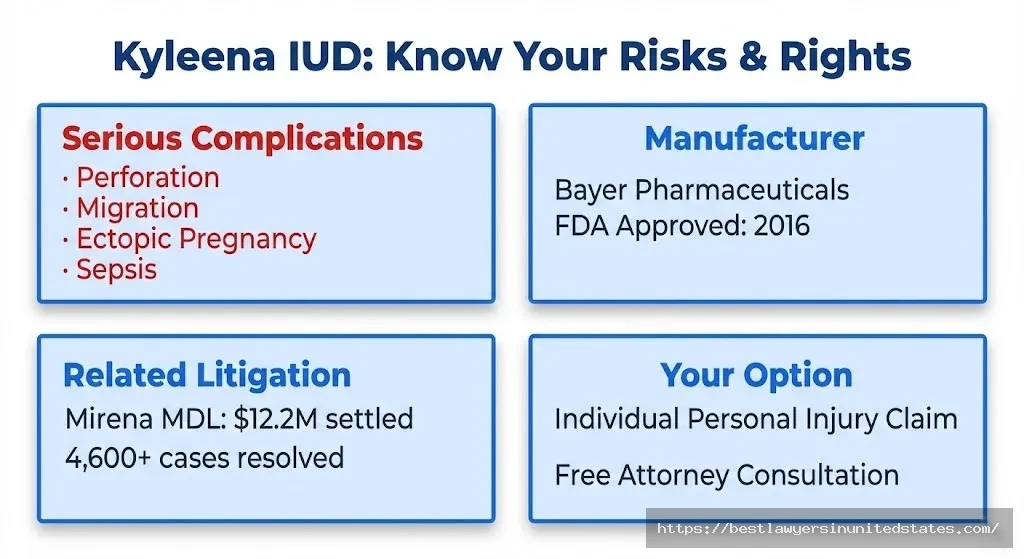
Kyleena is a small, T-shaped hormonal intrauterine device (IUD) manufactured by Bayer Pharmaceuticals. It was FDA-approved in 2016 and releases a low daily dose of levonorgestrel — a synthetic progestin — into the uterus to prevent pregnancy for up to five years.
Bayer also makes two other levonorgestrel-releasing IUDs: Mirena (higher hormone dose, approved for 8 years) and Skyla (lower dose, approved for 3 years). Kyleena was specifically tested in women who had never given birth, though its labeling says it can be used regardless of pregnancy history.
Like all IUDs, Kyleena carries disclosed risks. The question that has driven lawsuits against Bayer — for Mirena and, increasingly, for its related devices — is whether the company adequately warned patients and doctors about the full scope of those risks. Sister Wives Lawsuit Settlement Amounts
Reported Kyleena Side Effects and Complications
Common Side Effects (Disclosed by Bayer)
These are side effects Bayer acknowledges in Kyleena’s labeling and product information:
- Irregular or absent periods, especially in the first few months
- Spotting or bleeding between periods
- Cramping or pelvic pain during and after insertion
- Acne, headaches, or mood changes
- Ovarian cysts (usually resolve on their own)
- Nausea
Most of these effects are considered manageable and often decrease over time.
Serious Complications That Have Led to Legal Action
These are the complications that have prompted women to consult attorneys and, in the case of Mirena, file lawsuits against Bayer:
Uterine Perforation. During or after insertion, the IUD can puncture the uterine wall. This can happen without causing immediate pain, meaning the injury goes undetected for months or years. Perforation can lead to organ damage, infections, and surgery. The FDA has estimated that perforation occurs in roughly 1 in 1,000 insertions across IUD types. Bayer has acknowledged this risk in labeling, but lawsuits have alleged the company downplayed how often it happens and how serious the consequences can be.
IUD Migration. If the device shifts from its original position, it can travel outside the uterus and into the abdominal cavity. Women have reported IUDs found near the bladder, bowel, and other organs — often requiring surgery to remove. Some cases have resulted in multiple operations and lasting damage.
Expulsion. The IUD can partially or fully come out of the uterus, sometimes without the user knowing. This can both cause injury and leave a woman unprotected from pregnancy.
Ectopic Pregnancy. If pregnancy occurs while the IUD is in place, there is a higher-than-normal risk of it being ectopic (implanting outside the uterus). Ectopic pregnancy is a medical emergency that can be life-threatening.
Sepsis and Pelvic Inflammatory Disease (PID). IUD insertion can introduce bacteria into the uterus, and in rare cases this leads to serious infection. Women with sexually transmitted infections at the time of insertion face elevated risk.
Possible Link to Breast Cancer. Multiple studies — including a large Danish study published in JAMA in 2024 — have found that levonorgestrel-releasing IUDs like Mirena and Kyleena may be associated with an approximately 30% increased risk of breast cancer compared to non-hormonal contraceptive users. A class action lawsuit based on this breast cancer link was filed against Bayer in 2022, survived an initial motion to dismiss, but was ultimately dismissed by stipulation in May 2024. The science is still developing, and researchers continue to call for more studies.
Pseudotumor Cerebri (Idiopathic Intracranial Hypertension). Thousands of Mirena lawsuits alleged that levonorgestrel caused an abnormal build-up of cerebrospinal fluid in the skull, mimicking a brain tumor. Most of these cases were dismissed after a federal judge ruled that plaintiffs’ expert causation testimony didn’t meet the required scientific standard.
The Legal History: What Happened With Mirena Lawsuits
To understand where Kyleena litigation stands, you need to understand what happened with Mirena — because the two devices share the same active hormone and are made by the same company.
The Mirena MDL: Uterine Perforation and Migration
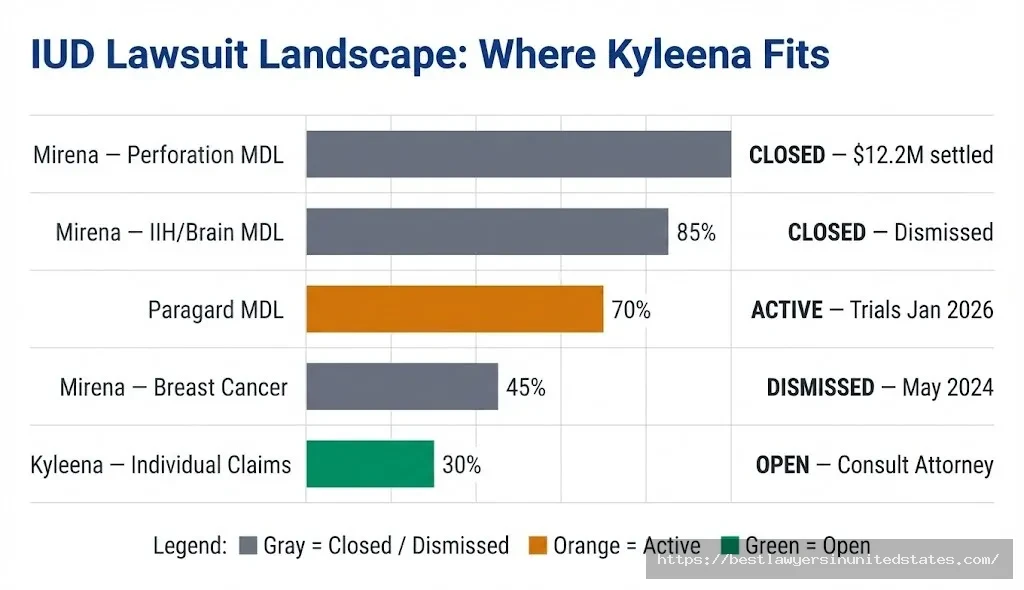
Beginning around 2011, women who suffered serious injuries from Mirena — particularly uterine perforation and device migration — began filing lawsuits against Bayer. These cases were eventually consolidated into a Multi-District Litigation (MDL 2434) in federal court.
The central allegation: Bayer knew the Mirena could perforate organs or migrate outside the uterus, but did not adequately warn doctors or patients about these risks.
By 2018, Bayer offered $12.2 million to settle approximately 4,600 perforation and migration cases. That works out to roughly $2,500 to $50,000 per case depending on injury severity, though most cases were dismissed rather than settled.
The Mirena perforation MDL is now closed.
The Pseudotumor Cerebri (IIH) Cases
A second wave of Mirena lawsuits involved claims that levonorgestrel caused pseudotumor cerebri (PTC), also called idiopathic intracranial hypertension (IIH). These cases were consolidated in a separate federal MDL.
In 2018, the judge presiding over these cases excluded the plaintiffs’ expert witnesses on causation, ruling that the science wasn’t sufficient to prove levonorgestrel caused PTC. Without causation experts, the cases couldn’t proceed. Most were dismissed.
The Breast Cancer Class Action
In March 2022, a class action was filed against Bayer alleging that Mirena (and by implication similar levonorgestrel IUDs) increased the risk of breast cancer, and that Bayer knew of this risk but concealed it. The case survived Bayer’s motion to dismiss in October 2023, but the parties filed a voluntary dismissal in May 2024.
Where Things Stand for Kyleena Specifically
Kyleena was only FDA-approved in 2016 — years after most Mirena lawsuits were already underway. Because it’s a newer product, there is less litigation history specific to Kyleena. However:
- Kyleena releases the same hormone (levonorgestrel) as Mirena
- It carries the same FDA-acknowledged risks of perforation, migration, and expulsion
- It is manufactured by the same company (Bayer) under the same alleged failure-to-warn framework
- The breast cancer research applies to levonorgestrel IUDs as a category, which includes Kyleena
This means that if you experienced a serious complication from Kyleena — perforation, migration, ectopic pregnancy, sepsis, or another qualifying injury — you may have the basis for an individual personal injury claim against Bayer, even though no class action settlement currently exists.
Your Legal Options If You Were Harmed by Kyleena
Individual Personal Injury Lawsuit (Not a Class Action)
Because there is no Kyleena class action settlement, your path to compensation — if you have a valid claim — is an individual personal injury lawsuit. This is actually common and appropriate for medical device injury cases: class actions work well for cases where everyone suffered the same modest harm (e.g., a company overcharged everyone $20), but medical device injuries are individual. Each woman’s injuries are different, which typically makes individual suits more appropriate and potentially more valuable.
In an individual lawsuit, you would typically allege:
- Product liability (design defect): The IUD was unreasonably dangerous by design
- Failure to warn: Bayer didn’t adequately disclose known risks to doctors and patients
- Manufacturing defect: If your specific device was defective (less common)
- Negligence: Bayer acted carelessly in how it designed, manufactured, or marketed the device
You don’t pay out of pocket. Personal injury attorneys in these cases work on contingency — meaning they only get paid (typically 33–40% of any recovery) if you win or settle.
What You Need to Have a Viable Claim
Not every bad experience with Kyleena translates to a lawsuit. Attorneys generally look for the following before taking a case:
| Factor | Why It Matters |
|---|---|
| A serious, documented injury | Perforation, migration, ectopic pregnancy, sepsis, surgical intervention |
| Medical records confirming the injury | Attorneys need to link the IUD to your specific harm |
| Causation | Your injury must be attributable to the device, not a pre-existing condition or other cause |
| Statute of limitations | You only have a limited window (varies by state, typically 2–4 years from when you knew or should have known of the injury) to file |
The statute of limitations issue is critical. If you experienced a Kyleena-related injury, don’t wait to consult an attorney. The clock may already be running. 100 Day Dream Home Lawsuit
Statute of Limitations: Don’t Miss Your Window

Every state has a deadline — called the statute of limitations — for filing a personal injury lawsuit. For medical device cases:
| State | Typical Deadline | Notes |
|---|---|---|
| California | 2 years | From date of injury or discovery |
| Texas | 2 years | From date of injury |
| New York | 2.5–3 years | Varies by claim type |
| Florida | 2 years | Changed from 4 years in 2023 |
| Illinois | 2 years | From date of discovery |
The “discovery rule” in most states means the clock starts when you knew — or reasonably should have known — that your injury was caused by the IUD. So if your Kyleena perforated your uterus but you didn’t find out until a CT scan years later, your deadline may start from that discovery date, not the insertion date.
Still, this is complex and varies by state and circumstance. The only way to know exactly where you stand is to talk to an attorney.
What to Expect When You Consult an Attorney
If you think you have a Kyleena-related claim, here’s what a free initial consultation typically involves:
Step 1: You share your story. The attorney or their intake team will ask about your Kyleena insertion date, your symptoms, your diagnosis, and any surgeries or treatments you received.
Step 2: They review your medical records. You’ll likely be asked to sign a HIPAA release so the firm can pull your records from your OB-GYN, emergency room, or hospital. This is standard.
Step 3: They assess viability. Not every case is worth pursuing. The firm will honestly tell you whether they think your case is strong enough to take on contingency. If they say no, ask why — it may point you to another firm or give you useful information.
Step 4: If they take your case. You’ll sign a contingency fee agreement. The firm advances all litigation costs and only gets paid if you recover money.
You don’t owe anything for the consultation. Reputable firms do not charge for initial case evaluations.
Key Questions to Ask an Attorney
When you speak with a personal injury attorney about a potential Kyleena claim, ask:
- Have you handled IUD injury cases or other Bayer medical device cases?
- What is your contingency fee percentage?
- What are my realistic chances of recovery given my specific injuries?
- Am I within the statute of limitations in my state?
- How long do cases like mine typically take?
- Will my case be filed individually or consolidated with others?
Comparison: Kyleena vs. Other IUD Lawsuits
| IUD | Manufacturer | Key Lawsuits | Current Status |
|---|---|---|---|
| Mirena | Bayer | Perforation/migration MDL; IIH MDL; Breast cancer class action | Mostly closed; individual suits still possible |
| Kyleena | Bayer | No MDL or class action yet; individual suits possible | Active investigation by plaintiffs’ firms |
| Skyla | Bayer | Same risks as Mirena/Kyleena; less litigation history | Individual suits possible |
| Paragard | CooperSurgical | Breakage during removal; MDL in N.D. Georgia with 2,000+ cases | Ongoing; bellwether trials began January 2026 |
| Liletta | Allergan/Bayer | Similar levonorgestrel risks; limited litigation | Under watch |
Injuries Most Likely to Support a Kyleena Claim
Based on prior IUD litigation patterns, these are the injury types that attorneys are most likely to evaluate seriously:
Higher Viability:
- Uterine perforation confirmed by imaging or surgery
- IUD migration outside the uterus requiring surgical removal
- Ectopic pregnancy while the IUD was in place
- Sepsis or serious pelvic infection tied to insertion or the device
- Multiple surgeries caused by IUD complications
- Permanent fertility damage
Lower (But Still Worth Evaluating):
- Severe, prolonged pain not responsive to standard treatment
- Unexplained hormonal disruption with documented health consequences
- Breast cancer diagnosis (developing legal theory — worth discussing with an attorney)
Less Likely to Sustain a Claim Alone:
- Spotting, irregular periods, mood changes (common, disclosed side effects)
- Mild cramping
- Pregnancy while the IUD was in place (failure is a disclosed risk)
How to Document Your Experience
Whether or not you decide to pursue legal action, preserving evidence is important. Here’s what to gather:
| Document | Where to Get It |
|---|---|
| Kyleena insertion records | Your OB-GYN or women’s health clinic |
| Any imaging (ultrasound, CT, X-ray) showing device location | Radiology department of hospital or clinic |
| Emergency room or hospital records | Hospital medical records department |
| Surgical records (if you had removal surgery) | Hospital or surgical center |
| Prescription or pharmacy records showing Kyleena purchase | Pharmacy or insurance records |
| Written notes about symptoms and dates | Keep a journal starting today |
Even if records are old, most providers are required to keep them for at least 7–10 years.
Frequently Asked Questions
Is there a Kyleena class action lawsuit I can join right now?
No. As of February 2026, there is no active, court-approved Kyleena class action settlement. Any website claiming you can file a claim and receive a payout by a specific deadline for a Kyleena class action is providing inaccurate information. Your option is an individual personal injury claim, which requires working with an attorney.
Can I still sue if it’s been several years since my injury?
Maybe. The statute of limitations varies by state and depends on when you knew or discovered your injury was caused by the IUD. Don’t assume you’ve missed your window — talk to an attorney to find out. Motorcycle Crash Lawsuit
Does Bayer deny that Kyleena causes these injuries?
Bayer acknowledges certain risks (perforation, migration, expulsion, ectopic pregnancy) in Kyleena’s labeling. The legal debate is not whether these risks exist, but whether Bayer adequately warned doctors and patients about how frequently they occur and how serious the consequences can be.
How much could I receive in a personal injury settlement?
This varies enormously based on the nature of your injury, your medical bills, lost income, pain and suffering, and other factors. In prior Mirena litigation, individual settlements ranged from a few thousand dollars to significantly more for women who suffered serious, permanent harm. There’s no formula — your attorney can give you a realistic assessment after reviewing your records.
Do I need to have kept the IUD to file a claim?
No. You need medical records documenting that you had the Kyleena IUD and that you suffered an injury. The device itself is not typically required as evidence in these cases.
What if my doctor inserted it incorrectly — is that a malpractice case instead?
It could be both. If your injury was caused by a physician’s error during insertion, you might have a medical malpractice claim against the doctor in addition to, or instead of, a product liability claim against Bayer. An attorney can help sort out who is responsible.
I don’t have health insurance and can’t afford a lawyer. What do I do?
Personal injury attorneys in device liability cases work on contingency — you pay nothing upfront and nothing unless you win. You don’t need money to get a free consultation or to have a firm take your case.
What happens if I was also using other medications or had pre-existing conditions?
This can complicate causation arguments but doesn’t automatically disqualify you. Attorneys and their medical experts handle these nuances. Be upfront about your full medical history during your consultation.
Is the Kyleena still on the market?
Yes. The FDA has not recalled Kyleena. It remains an approved contraceptive. The existence of lawsuits and adverse events does not itself constitute a finding that the device is defective — that’s what courts determine.
Can I opt out of any future class action if one is certified?
If a Kyleena class action is certified in the future, you would typically receive notice and have the option to opt out and pursue your own claim independently. If you opt in, you’d be bound by whatever the class action settles for. An attorney can advise you on which path makes sense for your specific situation.
Finding a Qualified Attorney
Look for attorneys who:
- Have experience in medical device product liability or pharmaceutical mass torts
- Have previously handled IUD cases, Bayer litigation, or similar device defect claims
- Offer a free initial consultation with no obligation
- Work on a contingency fee basis (you pay nothing unless you win)
- Are licensed in your state or have co-counsel arrangements in your state
Many national firms specialize in exactly this type of litigation and can handle cases in any state. A good starting point is to search for attorneys who have handled Mirena or Paragard IUD lawsuits — that experience translates directly to Kyleena.
Summary: Key Takeaways
- Kyleena is a Bayer hormonal IUD with serious known risks including uterine perforation, migration, and ectopic pregnancy.
- There is no Kyleena class action settlement to file a claim with as of 2026.
- If you suffered serious harm, you may have an individual personal injury claim — and it costs nothing to find out.
- The statute of limitations is real. If you were injured, don’t delay.
- Gather your medical records now, regardless of whether you decide to pursue legal action.
- Work with an attorney experienced in medical device liability, not a general practice firm.
