
Getting a divorce in Maine costs anywhere from $500 to over $30,000, depending on whether you and your spouse agree on the major issues. If you’re reading this, you’re probably worried about the financial impact—and you should have clear answers before making any decisions.
The minimum you’ll pay is $120 for the Maine District Court filing fee, but that’s just the starting point. Most people end up spending between $1,500 and $15,000 when you factor in attorney fees, service costs, and other expenses that add up quickly.
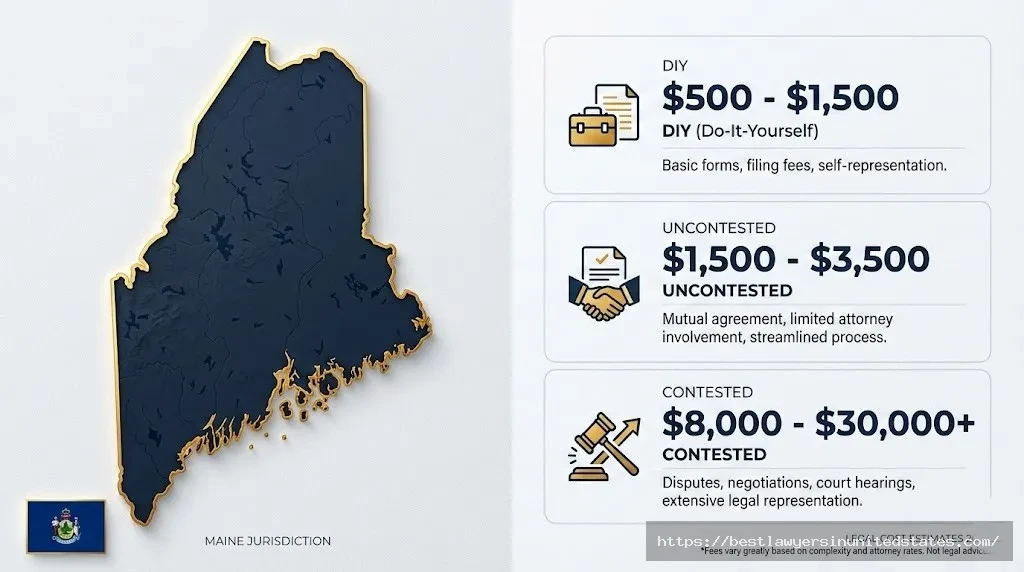
This guide breaks down every cost you’ll face in a Maine divorce, including the hidden fees most attorneys don’t mention upfront. You’ll get specific dollar amounts, money-saving strategies, and real-world examples so you can budget accordingly.
Quick Answer: What Does a Divorce Cost in Maine?
Here’s what you need to know right now:
| Divorce Type | Total Cost Range | Timeline |
|---|---|---|
| DIY Divorce (no lawyer) | $120-$500 | 2-4 months |
| Uncontested (with lawyer) | $1,500-$3,500 | 2-6 months |
| Contested (moderate conflict) | $8,000-$15,000 | 6-18 months |
| High-Conflict Contested | $15,000-$30,000+ | 12-24+ months |
The biggest factor? Whether you and your spouse can agree on property division, child custody, and support. An uncontested divorce where both parties cooperate costs about 80% less than a contested case that goes to trial.
Divorce Cost Calculator
Get an estimated cost for your divorce based on your specific situation
Your Estimated Divorce Cost
Cost Breakdown
📧 Get a Personalized Consultation
Have questions about your specific situation? Contact our legal experts for guidance tailored to your needs.
Contact Us via EmailWant an instant estimate based on your situation? Use our divorce cost calculator to get a personalized breakdown in under 2 minutes. Just answer a few questions about your assets, children, and whether your spouse will cooperate.
What Are the Filing Fees for Divorce in Maine?
Maine’s court filing fees are relatively straightforward compared to other states. The Maine Judicial Branch sets these rates, and they apply statewide regardless of which county you file in.
District Court Filing Fee
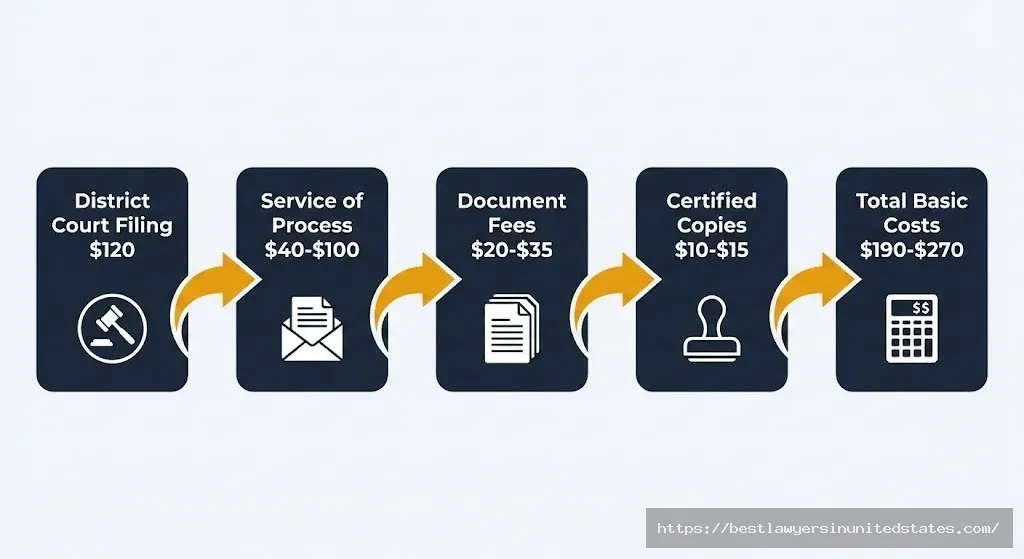
The standard filing fee to start a divorce case in Maine is $120. This covers your Complaint for Divorce and gets your case on the court docket. You’ll pay this when you file your initial paperwork at the District Court clerk’s office.
Unlike states such as California or New York, Maine doesn’t charge separate fees for response documents or final decree processing.
Service of Process Costs
After filing, you must officially notify your spouse by “serving” them with divorce papers. You have three options:
- Sheriff’s service: $40-$60 (varies by county)
- Private process server: $50-$100
- Certified mail with return receipt: $8-$15 (only if spouse cooperates)
Most people use the sheriff because it’s affordable and creates an official record that holds up in court.
Additional Court Document Fees
You might encounter these additional costs:
- Motion filing fees: $20-$35 per motion
- Subpoena fees: $25-$40 each
- Document copying: $0.50-$1.00 per page
- Certified copies of decree: $10-$15
How to Apply for a Fee Waiver in Maine
Can’t afford the $120 filing fee? Maine allows you to request a fee waiver by filing an Affidavit of Indigency (Form FM-096). You’ll qualify if your household income is at or below 125% of the federal poverty level.
For 2026, that means:
- Single person: Annual income under $17,655
- Family of 2: Annual income under $23,885
- Family of 4: Annual income under $36,345
The court clerk reviews your affidavit and supporting documents (pay stubs, tax returns, benefit letters) and typically approves or denies within 5-7 business days. If approved, you won’t pay filing fees or service costs.
How Much Do Divorce Lawyers Cost in Maine?
Attorney fees represent the largest expense in most Maine divorces. Understanding how lawyers charge helps you budget and compare options.
Average Hourly Rates by Region
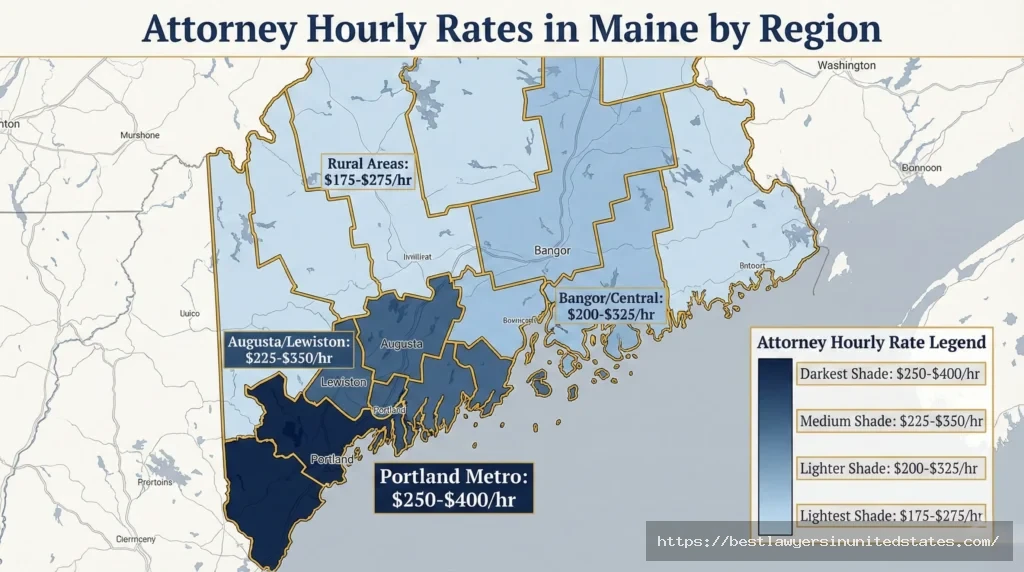
Maine divorce attorney rates vary by location and experience:
| Region | Hourly Rate Range | Average |
|---|---|---|
| Portland Metro | $250-$400/hour | $325/hour |
| Augusta/Lewiston | $225-$350/hour | $275/hour |
| Bangor/Central Maine | $200-$325/hour | $250/hour |
| Rural Areas | $175-$275/hour | $225/hour |
Attorneys in Portland and Southern Maine charge premium rates due to higher overhead and demand. If you live near the coast but don’t have complex issues, consider hiring an attorney from Augusta or Bangor who can handle your case remotely.
Experienced family law specialists (15+ years) typically charge $50-$75 more per hour than newer attorneys, but they often resolve cases faster, potentially saving you money overall.
Retainer Fee Expectations
Most Maine divorce attorneys require an upfront retainer—a deposit against future work. Your lawyer bills hourly against this retainer, and you replenish it when the balance gets low.
Typical retainer amounts:
- Simple uncontested: $1,500-$2,500
- Moderate complexity: $3,000-$5,000
- Contested with trial: $7,500-$15,000
The retainer isn’t the total cost—it’s just the starting deposit. If your case resolves quickly, you’ll get unused funds back. If it drags on, you’ll need to add more.
Flat Fee Divorce Services
Some attorneys offer flat-fee packages for straightforward uncontested divorces. You pay one set price for everything from filing to final decree.
Flat fee ranges in Maine:
- No kids, no property: $1,200-$1,800
- With kids OR property: $1,800-$2,800
- With kids AND property: $2,500-$3,800
Flat fees only work when both spouses cooperate. If your case becomes contested, the attorney switches to hourly billing.
Limited Scope Representation Costs
Can’t afford full representation but need legal help? Limited scope (also called “unbundled”) services let you hire an attorney for specific tasks only.
Common limited scope services:
- Document review: $300-$600
- Court appearance coaching: $400-$800
- Negotiation assistance: $800-$1,500
- Single court appearance: $500-$1,200
This middle-ground option works well if you’re comfortable handling most tasks yourself but want professional guidance on complicated issues like property division or parental rights.
What’s the Difference Between Contested and Uncontested Divorce Costs?
The single biggest factor affecting your total cost is whether your divorce is contested or uncontested. Understanding this distinction helps you predict expenses and maybe avoid unnecessary costs.
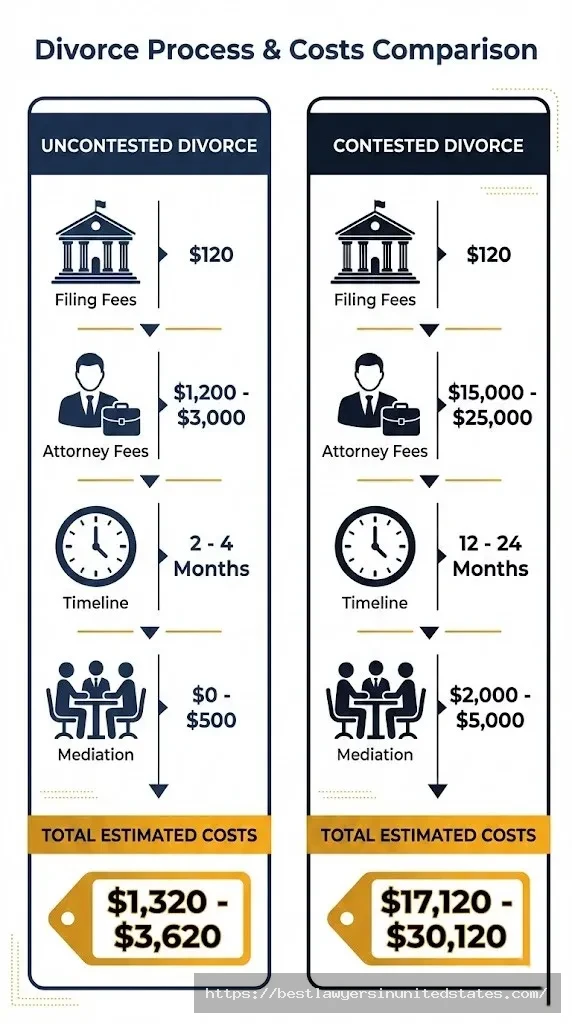
What Makes a Divorce “Contested”?
A contested divorce means you and your spouse disagree on one or more major issues:
- Property division and debt allocation
- Parental rights and responsibilities (custody)
- Parenting time schedules
- Child support amounts
- Spousal support (alimony)
- Business valuations
- Retirement account divisions
Even one disputed issue makes your divorce contested. The more you disagree about, the more expensive and lengthy the process becomes.
An uncontested divorce means you’ve already agreed on everything before filing. You might negotiate these agreements yourselves or through mediation, but by the time you file with the court, there’s nothing left to fight about.
Cost Comparison: Contested vs. Uncontested
Here’s how the numbers break down:
| Cost Category | Uncontested | Contested (Moderate) | Contested (High-Conflict) |
|---|---|---|---|
| Court filing fees | $120 | $120 | $120 |
| Service costs | $50 | $60 | $60 |
| Attorney fees | $1,200-$3,000 | $7,000-$12,000 | $15,000-$25,000+ |
| Mediation | $0-$500 | $1,000-$2,500 | $2,000-$5,000 |
| Discovery costs | $0 | $1,000-$3,000 | $3,000-$8,000 |
| Expert witnesses | $0 | $0-$2,000 | $2,000-$10,000 |
| Trial preparation | $0 | $2,000-$5,000 | $5,000-$15,000 |
| TOTAL | $1,370-$3,670 | $11,180-$24,680 | $27,180-$63,180+ |
The attorney fee difference explains the massive gap. In an uncontested case, your lawyer files paperwork and ensures everything meets Maine Revised Statutes Title 19-A requirements. Total attorney time: 8-15 hours.
In a contested case, your lawyer handles document requests, depositions, negotiations, court motions, trial prep, and potentially multiple court appearances. Total attorney time: 40-150+ hours.
How Long Each Type Takes (Time = Money)
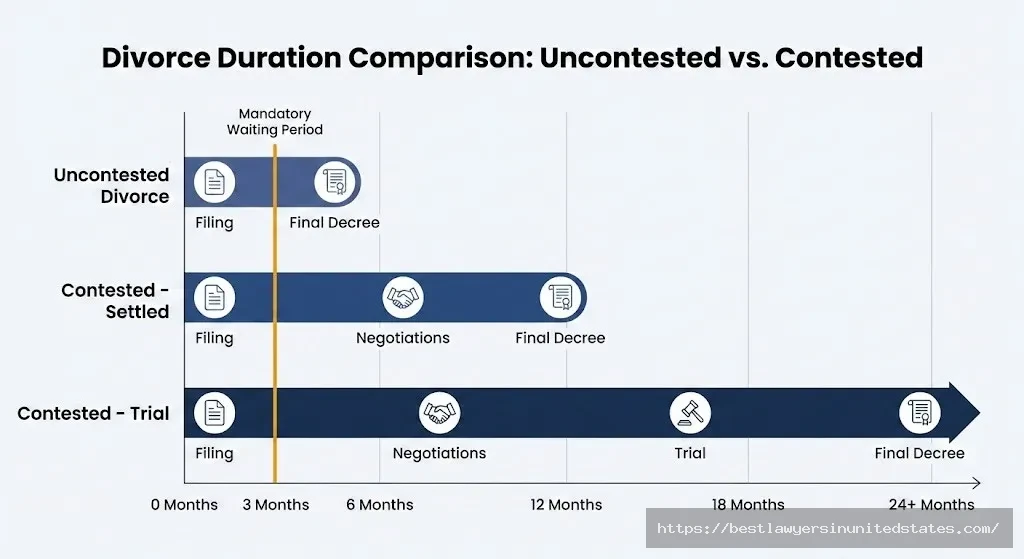
Timeline matters because longer cases mean more attorney hours:
Uncontested divorce timeline:
- Preparation: 2-4 weeks
- After filing: 60-day minimum waiting period
- Total: 2-4 months
- Attorney hours: 8-15
Contested divorce timeline:
- Initial filing and response: 1-2 months
- Discovery and disclosure: 3-6 months
- Mediation attempts: 1-3 months
- Trial preparation: 2-4 months
- Trial and final decree: 1-2 months
- Total: 8-18 months (sometimes 24+ months)
- Attorney hours: 40-150+
Maine law requires a 60-day waiting period from the date your spouse is served before the court can grant a final divorce decree. This applies to both contested and uncontested cases, though contested cases usually take much longer due to negotiation and court scheduling.
The Hidden Costs of Divorce in Maine Nobody Warns You About
Most people budget for lawyer fees and filing costs but get blindsided by additional expenses that add thousands to the final bill. Here’s what attorneys rarely mention upfront.
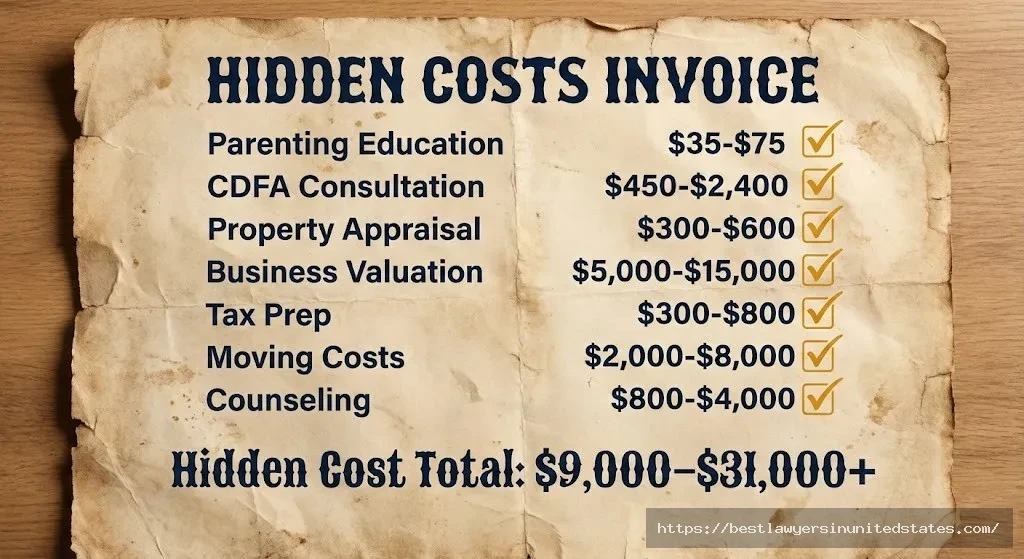
Parenting education course: Maine requires parents going through divorce to complete a court-approved parenting education program. Cost: $35-$75 per person. You must submit proof of completion before the court will finalize your divorce.
Financial expert consultation: Complex asset divisions benefit from a Certified Divorce Financial Analyst (CDFA). These professionals help you understand the long-term tax implications of settlement proposals. Cost: $150-$300 per hour, typically 3-8 hours.
Property appraisals: If you own real estate and can’t agree on its value, you’ll need a professional appraisal. Cost: $300-$600 for a residential appraisal, $1,000-$2,500 for commercial property.
Business valuations: Own a business or professional practice? You’ll need a forensic accountant to determine its value for property division purposes. Cost: $5,000-$15,000 depending on business complexity.
Tax preparation fees: Divorce complicates your taxes, especially in the year you separate. Expect to pay $300-$800 more for professional tax prep to handle issues like filing status changes, dependent claims, and property transfer reporting.
Credit report monitoring: Protect yourself from identity theft and ensure your spouse doesn’t open accounts in your name during the process. Cost: $10-$30 monthly, usually for 12-24 months.
Individual counseling: Divorce takes an emotional toll. Many people find therapy essential during this transition. Cost: $100-$200 per session, typically 8-20 sessions. Some insurance covers this.
Moving and housing transition: Whether you’re moving out of the marital home or helping your ex move out, budget for moving trucks, deposits on new housing, furniture, utilities setup, and duplicate household items. Cost: $2,000-$8,000 depending on circumstances.
Name change fees (if desired): If you want to legally change your name back after divorce, there’s a separate court filing fee. Cost: $75-$150 plus the cost of updating driver’s license, passport, and other documents.
Document copying and notarization: You’ll make dozens of copies of financial documents, deeds, titles, and agreements. Notary services cost $2-$10 per signature. Total: $50-$200 throughout the process.
These hidden costs add up. Budget an extra $1,000-$3,000 beyond your attorney fees and filing costs to avoid financial surprises.
How Much Does Divorce Cost in Maine With Kids?
Children add complexity and cost to Maine divorces. You’ll deal with additional legal requirements and potentially contentious decisions about parental rights and responsibilities.
The court requires a detailed Parenting Plan outlining custody arrangements, decision-making authority, and parenting time schedules. Creating this plan takes time—either through negotiation, mediation, or court proceedings.
Additional costs specific to divorces with children:
- Parenting plan mediation: $200-$400 per session (typically 2-4 sessions needed)
- Guardian ad litem (if court-appointed): $1,500-$5,000
- Custody evaluations: $2,500-$7,500 if disputes require professional assessment
- Child support worksheet preparation: Usually included in attorney fees, or $200-$400 if done separately
Maine follows specific Child Support Guidelines based on both parents’ incomes and the parenting time arrangement. The court calculates support using a formula, so there’s less to fight about unless income is disputed or there are special circumstances.
Do kids make divorce more expensive? Yes, but not always dramatically. If parents agree on custody and support, costs only increase by $500-$1,500 for the additional paperwork and parenting plan development.
If parents fight over custody, costs skyrocket. A contested custody battle can add $5,000-$20,000 to your total divorce costs due to evaluations, expert witnesses, and extended attorney hours.
What Are the Grounds for Divorce in Maine?
Maine is a “no-fault” divorce state, meaning you don’t need to prove your spouse did something wrong. The legal ground used in nearly all Maine divorces is “irreconcilable differences”—basically, you’ve grown apart and can’t make the marriage work.
You can also file based on specific fault grounds if you prefer:
- Adultery
- Impotence
- Extreme cruelty
- Desertion for three consecutive years
- Gross and confirmed habits of intoxication
- Non-support
Does citing fault increase costs? Potentially, yes. Fault-based divorces often become more contentious because you’re essentially accusing your spouse of misconduct. This can lead to:
- Longer discovery processes to prove allegations
- More court motions and hearings
- Increased attorney hours for litigation
- Higher emotional tension that makes settlement harder
Most Maine attorneys recommend irreconcilable differences unless there’s a specific strategic reason to cite fault (like it might affect property division or spousal support in your favor).
Does Adultery Affect Divorce Costs in Maine?
Adultery doesn’t automatically increase costs, but it often does indirectly. Maine courts can consider adultery when dividing property or awarding spousal support, which gives the wronged spouse some negotiating leverage.
If you cite adultery as grounds, you’ll need evidence—text messages, photos, witness testimony, private investigator reports. Gathering this evidence adds costs:
- Private investigator: $50-$150 per hour, typically 10-40 hours = $500-$6,000
- Digital forensics expert: $150-$300 per hour to recover deleted messages or emails
- Additional attorney time: Preparing evidence for court adds 5-15 hours
The betrayed spouse might feel morally justified spending money to prove adultery, but financially it rarely makes sense. Unless the adultery involved spending significant marital assets on the affair partner, you’re better off pursuing a no-fault divorce and saving your money for your post-divorce life.
How to File for Divorce in Maine Without a Lawyer
Filing for divorce without an attorney (called “pro se” representation) is the cheapest option if your situation is straightforward. Many people successfully handle their own uncontested divorces in Maine.
You’re a good candidate for DIY divorce if:
✓ Your spouse agrees to the divorce ✓ You have no children under 18, or you’ve agreed on all custody/support issues ✓ You have minimal marital property (under $50,000 in assets) ✓ Neither spouse has retirement accounts or pensions ✓ You’ve been married less than 10 years ✓ Neither spouse is seeking alimony ✓ You can communicate civilly with your spouse
Step-by-step DIY divorce process:
1. Get the forms: Download free divorce forms from the Maine Judicial Branch website. You’ll need:
- Complaint for Divorce (FM-001)
- Vital Statistics Form (FM-032)
- Child Support Affidavit (if applicable)
- Financial Affidavit
2. Complete the paperwork: Fill out forms carefully and completely. Mistakes cause delays. Many Maine courts offer free form-filling assistance at the courthouse.
3. File with the District Court: Bring your completed forms and $120 filing fee to your county’s District Court clerk’s office. The clerk reviews for completeness but doesn’t give legal advice.
4. Serve your spouse: Have the sheriff or process server deliver copies to your spouse. You can’t hand-deliver yourself.
5. Wait 60 days: Maine’s mandatory waiting period starts when your spouse is served.
6. Finalize the divorce: If everything’s uncontested, the court reviews your paperwork and issues a Final Divorce Decree without requiring a court appearance.
Total DIY divorce cost: $120-$500 depending on service method and whether you need to make court copies or certified documents.
Can You File for Divorce Online in Maine?
Yes and no. Maine courts don’t offer a fully online divorce filing system, but you can use online document preparation services to help with paperwork.
Online divorce services like those featured in our DIY divorce guide cost $150-$500 and provide:
- State-specific forms customized to your situation
- Step-by-step questionnaire to gather information
- Completed, court-ready documents
- Filing instructions for your county
- Customer support via chat or phone
What online services DON’T do:
- File documents with the court for you (you still do this in person)
- Provide legal advice
- Represent you if complications arise
- Handle contested issues or negotiations
Online services work best for simple, uncontested divorces where both spouses cooperate. They’re essentially a cheaper alternative to hiring a lawyer for paperwork, costing about 80-90% less than attorney representation.
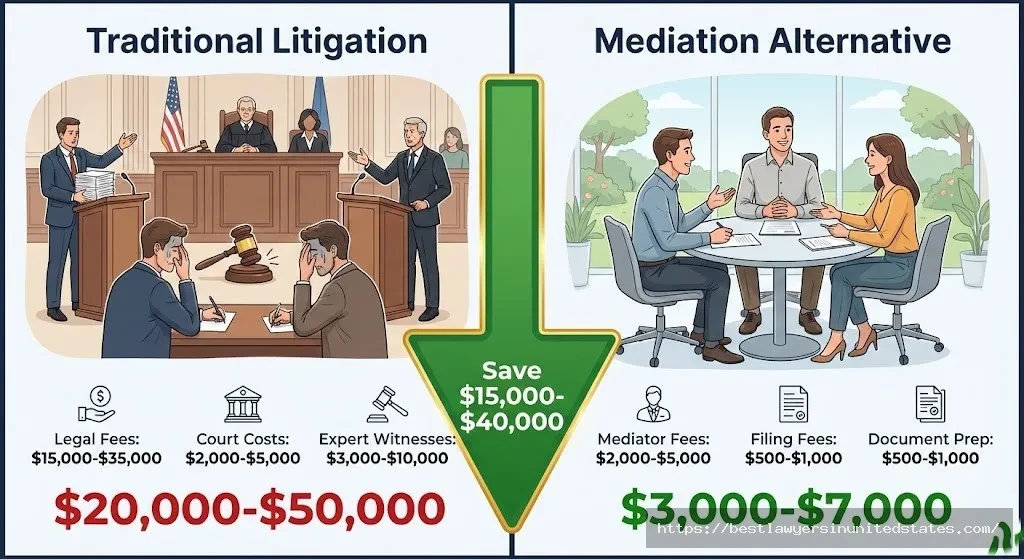
How Much Does Divorce Mediation Cost in Maine?
Mediation helps divorcing couples reach agreements without going to court. A neutral third party (the mediator) facilitates negotiations on property division, custody, and support issues.
Maine divorce mediator rates:
- Attorney-mediators: $200-$350 per hour
- Professional mediators (non-attorney): $150-$250 per hour
- Court-connected mediation: Sometimes free or low-cost ($50-$100)
How many sessions will you need? Most Maine couples complete mediation in 4-8 sessions, each lasting 1.5-2 hours. Total mediation time: 6-16 hours.
Total mediation costs:
- Simple cases: $900-$2,000
- Moderate complexity: $2,000-$4,000
- Complex cases: $4,000-$7,000
Split between two people, that’s $450-$3,500 per spouse—still significantly cheaper than contested litigation.
Mediation savings comparison:
| Divorce Method | Per Spouse Cost | Timeline |
|---|---|---|
| Mediation to agreement | $2,000-$5,000 | 2-6 months |
| Contested litigation | $8,000-$25,000+ | 8-24 months |
| Savings with mediation | $6,000-$20,000+ | 6-18 months faster |
Maine courts often require mediation in contested custody cases. Some counties provide court-connected mediation services at reduced rates for families who qualify based on income.
When Hiring an Expensive Divorce Lawyer Actually Saves You Money
Spending more on legal representation seems counterintuitive when you’re trying to minimize divorce costs. But in certain situations, hiring experienced counsel prevents financial mistakes that cost far more than attorney fees.
You should invest in quality legal representation when:
Complex asset portfolios: If your marital estate includes multiple properties, business interests, stock options, or investments exceeding $500,000, the right attorney pays for themselves. A skilled lawyer ensures proper valuation and division, potentially saving you $50,000-$200,000 in assets you might otherwise lose through negotiation mistakes.
Business ownership: Own a business or professional practice? Improper valuation or division can destroy years of work. Business-focused family law attorneys know how to protect your company while meeting divorce settlement obligations. Cost: $300-$450/hour, but potentially saves your business worth $250,000+.
Suspected hidden assets: Think your spouse is hiding money, undervaluing assets, or failing to disclose accounts? Attorneys with forensic accounting connections can uncover hidden assets. The discovery process costs $5,000-$15,000 but might recover $50,000-$200,000 in concealed marital property.
Domestic violence situations: Your safety is priceless. Attorneys experienced in domestic violence cases understand how to obtain protective orders, handle court proceedings safely, and protect your interests when the other party is dangerous or unstable.
Mental health custody concerns: If your spouse has addiction issues, untreated mental illness, or poses safety risks to your children, you need an attorney who knows how to present evidence properly and work with court evaluators. Custody mistakes made to save money could affect your children for years.
Out-of-state property or military divorces: Jurisdiction issues and specialized laws (like the Servicemembers Civil Relief Act) require attorneys familiar with interstate divorce complications. DIY mistakes in these cases cause years of legal problems.
High-income disparity cases: When one spouse earns significantly more than the other, spousal support calculations and property division become complex. An experienced attorney ensures you don’t agree to unfair terms that affect you for decades.
The pattern? When your financial future, children’s safety, or complex legal issues are at stake, experienced representation isn’t an expense—it’s an investment that prevents catastrophic mistakes.
How Can You Pay for Your Maine Divorce?
Divorce costs create immediate financial pressure, especially if you’re not the primary breadwinner or don’t have savings. Here are your realistic options for financing a Maine divorce.
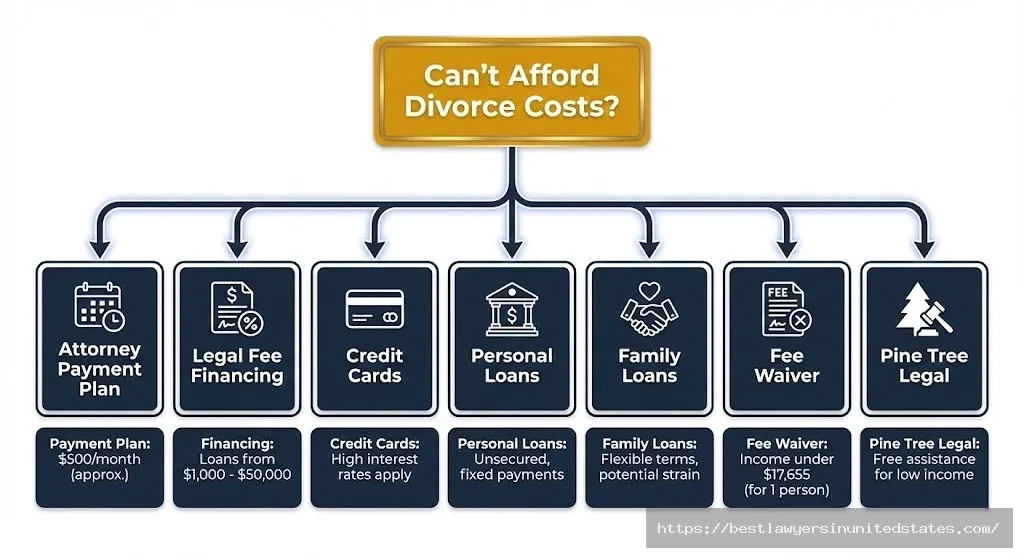
Attorney Payment Plans
Most Maine family law attorneys offer payment arrangements for clients who can’t afford the full retainer upfront. Common structures:
- Monthly installments: Pay $500-$1,000 monthly while case progresses
- Milestone payments: Pay at key stages (filing, discovery, settlement, trial)
- Percentage upfront, rest financed: Pay 30-50% initially, remainder monthly
Not all attorneys offer payment plans, and those who do typically require a credit check or minimum initial payment. Ask about this during your consultation.
Legal Fee Financing Companies
Specialized lenders provide loans specifically for legal fees. They work directly with law firms and fund your retainer.
Terms to expect:
- Loan amounts: $2,500-$40,000
- Interest rates: 9-18% APR (varies by credit)
- Repayment terms: 12-60 months
- Approval time: 24-48 hours
Companies like Upsolve and LegalShield offer financing options, though rates are higher than traditional loans due to the unsecured nature.
Credit Cards
Using credit for divorce costs is common but expensive. If you go this route:
Pros:
- Immediate access to funds
- Might earn rewards points
- 0% intro APR cards give you 12-18 months interest-free
Cons:
- High interest (18-28%) after intro period
- Damages credit score if you max out cards
- Requires available credit limit
Only use credit cards if you have a realistic plan to pay off the balance within 12-18 months.
Personal Loans
Traditional unsecured personal loans from banks or credit unions offer better rates than credit cards or legal financing.
What to expect:
- Rates: 6-15% APR for good credit
- Amounts: $5,000-$50,000
- Terms: 24-72 months
- Requirements: Steady income and decent credit (650+)
Credit unions often offer better rates than banks, especially for existing members.
Borrowing from Retirement Accounts
You can withdraw from 401(k) or IRA accounts to pay divorce costs, but penalties apply:
- 10% early withdrawal penalty (if under 59½)
- Income taxes on withdrawn amount (could be 20-30%)
- Lost future growth on withdrawn funds
A $10,000 withdrawal might net you only $6,000-$7,000 after penalties and taxes. This should be a last resort.
Family Loans
Borrowing from parents or family members avoids interest but can complicate relationships. If you go this route:
- Put terms in writing (amount, repayment schedule, interest if any)
- Treat it professionally to maintain the relationship
- Consider it a formal loan, not a gift
Pine Tree Legal Assistance and Fee Waivers
Pine Tree Legal Assistance provides free legal representation to low-income Mainers. Eligibility requires household income at or below 125% of federal poverty level:
- Single person: Under $17,655 annually
- Family of 4: Under $36,345 annually
Pine Tree handles many family law matters including divorce, custody, and domestic violence cases. Wait times can be long due to high demand.
The Affidavit of Indigency (Form FM-096) waives court filing fees and service costs if you meet income requirements—saving you $150-$200 in immediate costs.
Maine Volunteer Lawyers Project
This program connects low-income individuals with volunteer attorneys who provide limited free services. You might qualify if your income is below 200% of federal poverty level and have a simple legal issue.
Services are limited scope, meaning the attorney might help with specific tasks rather than full representation, but it’s valuable assistance if you can’t afford a full retainer.
How Long Does It Take to Get a Divorce in Maine?
Maine requires a 60-day minimum waiting period from the date your spouse is served with divorce papers. This cooling-off period applies to all divorces, even when both parties agree on everything.
Realistic timelines by divorce type:
Uncontested divorce: 2-4 months total
- Preparation: 2-3 weeks
- Filing and service: 1-2 weeks
- 60-day waiting period: mandatory
- Court processing: 2-4 weeks
Contested (settled before trial): 6-12 months
- Initial filing and response: 1-2 months
- Discovery: 2-4 months
- Negotiation/mediation: 2-4 months
- Settlement paperwork and court approval: 1-2 months
Contested (going to trial): 12-24+ months
- Pre-trial proceedings: 6-10 months
- Trial scheduling wait: 2-6 months
- Trial and decision: 1-2 months
- Appeals (if any): Add 6-12 months
Court backlogs in Cumberland County (Portland area) typically add 2-4 months to contested cases due to higher caseloads. Rural counties often schedule hearings faster.
Who Gets the House in a Divorce in Maine?
Maine follows equitable distribution rather than community property rules. The court divides marital property fairly but not necessarily equally (unlike 50/50 community property states like California).
Factors Maine courts consider:
- Each spouse’s contribution to acquiring marital property
- Value of non-marital property each spouse owns
- Economic circumstances of each spouse at division
- Length of the marriage
- Age and health of each party
- Occupation and employability
- Liabilities and needs of each spouse
- Whether the property division is in lieu of or in addition to spousal support
The house specifically: Courts often award the marital home to the spouse with primary custody of minor children, allowing them to maintain stability. The other spouse typically receives offsetting assets (retirement accounts, other property, or a larger percentage of other marital assets).
If neither can afford to keep the house or buy out the other’s equity, the court orders it sold and proceeds divided.
Mortgage considerations: Just because the divorce decree awards you the house doesn’t mean the mortgage lender must remove your ex-spouse from the loan. You’ll likely need to refinance in your own name—which requires income to qualify and equity to avoid PMI.
What Money Can’t Be Touched in a Divorce?
Not everything you own is subject to division. Maine law protects certain property as “non-marital” or “separate property.”
Protected assets include:
Inheritance received by one spouse (even during marriage): If you inherited $100,000 from your grandmother, it remains yours as long as you kept it separate. If you deposited it in a joint account or used it to buy marital assets, it likely becomes marital property.
Gifts given specifically to one spouse: Your parents gave you a car—that’s yours. They gave the couple wedding gifts—those are marital property.
Property owned before marriage: The house you bought before getting married remains yours, though any appreciation in value during the marriage might be marital property subject to division.
Personal injury settlements (with exceptions): If you received a settlement for your injuries, the portion covering medical expenses and pain/suffering is yours. The portion covering lost wages during marriage might be marital property.
Property designated as separate in a prenuptial agreement: Valid prenups can designate property as separate even if it would otherwise be marital.
The key to keeping property separate: Don’t commingle it. Keep inheritances and gifts in separate accounts. Don’t use separate property to improve marital property. Don’t add your spouse’s name to solely-owned property titles.
Once you mix separate and marital property (called “transmutation”), the entire amount might become marital property subject to division.
Property Division Rules in Maine (Not Community Property)
Maine is not a community property state. Instead, it follows equitable distribution, which means “fair” but not necessarily equal division.
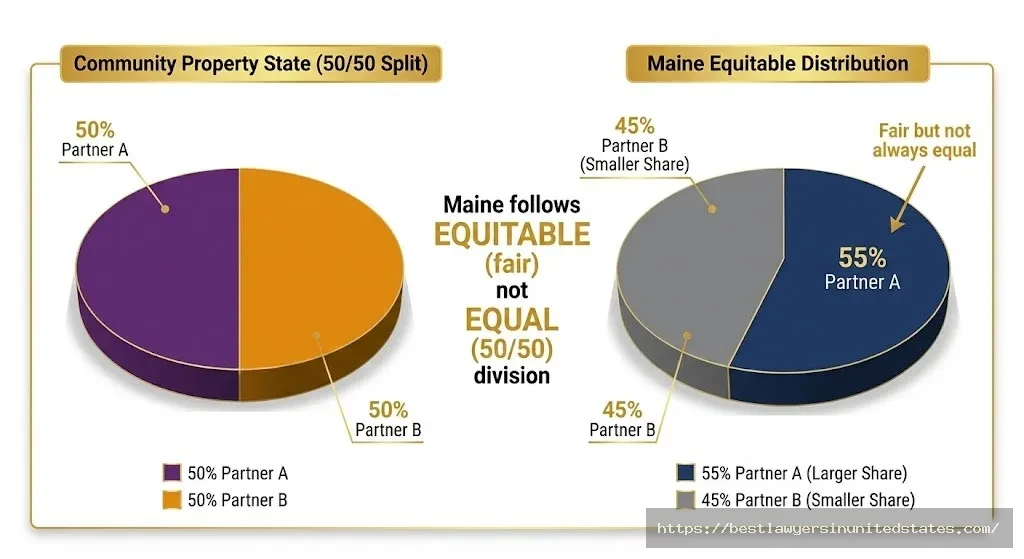
The court starts with the presumption of 50/50 division but adjusts based on fairness factors. In practice, many Maine divorces end with approximately 50/50 splits when both spouses contributed similarly to the marriage, but variations are common:
- 65/35 splits: When one spouse sacrificed career for childrearing
- 70/30 splits: In longer marriages where one spouse has significantly better earning potential
- 80/20 or more unbalanced splits: Rare, but possible when one spouse made disproportionate financial contributions or has special needs
Unlike community property states where the 50/50 division is nearly automatic, Maine’s system gives judges discretion to craft fair outcomes based on each couple’s unique circumstances.
How Does Alimony Work in Maine?
Maine calls spousal support “general support” or “transitional support” rather than alimony, but it serves the same purpose—providing financial assistance to a lower-earning spouse.
Types of spousal support in Maine:
General support: Long-term or permanent support for spouses who can’t become self-supporting due to age, disability, or other factors. Typically awarded after long marriages (15+ years).
Transitional support: Temporary support for a specific period (usually 1-5 years) allowing the recipient to get education, training, or work experience to become self-sufficient.
Factors courts consider for support:
- Length of marriage
- Each spouse’s ability to earn income
- Age and health
- Job skills and employability
- Division of property
- Standard of living during marriage
- Contributions as homemaker
- Economic misconduct (wasting marital assets)
No automatic formulas: Unlike child support, Maine has no mathematical formula for calculating spousal support. Judges have broad discretion based on the factors above.
Tax treatment: Under federal law changes from 2019, spousal support paid under divorces finalized after December 31, 2018 is NOT tax-deductible for the payer and NOT taxable income for the recipient. This changed the math for many negotiations.
What Disqualifies You from Alimony in Maine?
Several factors can reduce or eliminate spousal support awards:
Short marriage duration: Marriages under 5-7 years rarely result in spousal support unless there are exceptional circumstances (like a spouse giving up a career to support the other’s education).
Similar earning capacity: If both spouses can earn roughly equal incomes, support is unlikely. The purpose is to address income disparities, not subsidize a similar-earning ex-spouse.
Cohabitation with a new partner: If the support-receiving spouse moves in with a romantic partner in a marriage-like relationship, support often gets modified or terminated.
Remarriage: Spousal support typically ends automatically when the recipient remarries.
Economic misconduct: If you wasted marital assets on affairs, gambling, or other misconduct, the court might reduce or deny support.
Refusal to work or become self-supporting: Courts expect recipients to make reasonable efforts toward self-sufficiency. If you have the ability and opportunity to work but refuse, the court might impute income to you and reduce or deny support.
Maine judges emphasize self-sufficiency, especially in shorter marriages. The trend is toward time-limited transitional support rather than permanent general support, except in long marriages where one spouse has limited earning capacity.
Do I Need a Lawyer for Divorce in Maine?
Not legally, but it depends on your circumstances. Maine law allows you to represent yourself (pro se), and thousands of people successfully file their own divorces annually.
You probably DON’T need a lawyer if:
✓ You and your spouse agree on all issues ✓ You have no children, or agree on all custody/support matters ✓ Your marital property is worth less than $75,000 ✓ You’ve been married less than 10 years ✓ Neither spouse wants alimony ✓ You can follow detailed instructions ✓ You’re both emotionally stable enough to communicate
You probably DO need a lawyer if:
✗ Your spouse hired an attorney ✗ You disagree on custody, property, or support ✗ You have complex assets (business, real estate, investments over $100,000) ✗ Your spouse is hiding assets or being financially dishonest ✗ There’s domestic violence or safety concerns ✗ You feel intimidated or confused by the legal process ✗ Your spouse is pressuring you to sign agreements you don’t understand
The danger of DIY with complications: Many people start DIY divorces thinking they’re simple, only to realize too late they agreed to unfair terms. Fixing mistakes after signing a settlement agreement is difficult or impossible.
Middle-ground options: Consider limited scope representation or consulting with an attorney for a few hours to review documents even if you handle most of the process yourself.
Are There Free Divorce Resources in Maine?
Yes. If you can’t afford an attorney, several organizations provide free or low-cost help:

Pine Tree Legal Assistance
Who qualifies: Households earning below 125% of federal poverty level
- Single: Under $17,655/year
- Family of 2: Under $23,885/year
- Family of 4: Under $36,345/year
What they provide: Full legal representation in family law matters including divorce, custody, domestic violence, and support.
How to apply: Call 1-877-594-5500 or visit ptla.org. Intake process takes 1-2 weeks, then additional wait time for attorney assignment based on demand.
Maine Volunteer Lawyers Project
Who qualifies: Income below 200% of federal poverty level What they provide: Limited scope assistance—might help with specific tasks like document review or court preparation rather than full representation How to apply: Apply through Pine Tree Legal, which screens for both programs
Maine Judicial Branch Self-Help Centers
Located in most county courthouses, these centers provide:
- Free blank divorce forms
- Basic instructions on completing forms
- Information about court procedures
- Referrals to other resources
What they CAN’T do: Provide legal advice, tell you what to write on forms, or predict how your case will turn out.
Legal Services for the Elderly
Who qualifies: Age 60+ with low to moderate income What they provide: Free legal help with family law, housing, benefits, and other civil matters Contact: 1-800-750-5353
Court Form Assistance
Many Maine courts offer free “form filling” help where trained volunteers assist you in completing divorce forms. They can’t give legal advice but can ensure you’re filling out forms correctly. Check with your county’s District Court clerk for availability.
Frequently Asked Questions
How much does a divorce lawyer cost in Maine?
Maine divorce attorneys charge $175-$400 per hour depending on location and experience. Portland-area lawyers average $325/hour, while rural attorneys charge $200-$250/hour. Most require a $1,500-$7,500 retainer upfront, which is billed against as they work on your case.
Does Maine require a separation period before divorce?
No. Maine has no legal separation requirement before filing for divorce. However, there is a mandatory 60-day waiting period after your spouse is served with divorce papers before the court can finalize the divorce decree.
Can I get a divorce in Maine if I’m pregnant?
Yes. Maine courts will grant divorces to pregnant women. However, the court typically won’t finalize the divorce until after the child is born so that custody, support, and paternity issues can be properly addressed in the final decree.
Who pays the divorce lawyer fees if I didn’t want the divorce?
Each spouse typically pays their own attorney fees. However, Maine courts can order one spouse to contribute to the other’s legal fees if there’s a significant income disparity and one party can’t afford representation. You must file a motion requesting this.
What is the 10 10 10 rule for divorce?
The 10/10/10 rule applies to military divorces. If you were married at least 10 years, your spouse served at least 10 years of creditable military service during the marriage, and those periods overlap for at least 10 years, you can receive direct retirement payments from DFAS (Defense Finance and Accounting Service).
How much does a CDFA cost in Maine and do I need one?
Certified Divorce Financial Analysts in Maine charge $150-$300 per hour. You need one if you have complex assets (business ownership, multiple properties, significant retirement accounts), complex tax situations, or want to understand long-term financial impacts of settlement proposals. Simple divorces don’t require a CDFA.
Will my divorce cost more if my spouse contests it?
Yes, significantly. An uncontested divorce costs $1,500-$3,500 with an attorney. A contested divorce costs $8,000-$30,000+ depending on complexity and conflict level. Each issue you fight about adds attorney hours, court appearances, and potentially expert witness costs.
Can I recover attorney fees from my spouse in Maine?
Sometimes. Maine courts can order one spouse to pay some or all of the other spouse’s attorney fees if there’s a significant income or asset disparity and one party can’t afford representation. The requesting party must file a motion showing financial need and the other party’s ability to pay.
What’s the difference between legal separation and divorce costs in Maine?
Maine doesn’t have formal “legal separation” like some states. Couples can live separately and create separation agreements addressing finances and custody, but there’s no court filing for legal separation. A separation agreement costs $500-$2,000 with attorney help. Many couples who separate eventually divorce, meaning you’d pay for both.
How much does divorce mediation cost in Maine vs. traditional divorce?
Mediation costs $1,000-$4,000 total (split between spouses) for most cases—about $500-$2,000 per person. Traditional contested divorce costs $8,000-$25,000+ per person. Mediation saves $6,000-$20,000 per spouse when successful and reduces timeline by 6-18 months.
Do online divorce services work for Maine residents?
Yes, for simple uncontested divorces. Online document preparation services cost $150-$500 and provide Maine-specific forms completed based on your information. You still file papers yourself at the courthouse. These services work when both spouses agree on everything but don’t provide legal advice or representation.
How long do you have to be married to get alimony in Maine?
There’s no minimum marriage length for spousal support eligibility, but it’s rare in marriages under 5-7 years. Longer marriages (10+ years) have higher likelihood of support awards, especially if one spouse sacrificed career for family or has limited earning capacity.
Next Steps: Getting Started with Your Maine Divorce
Now that you understand Maine divorce costs, here’s your action plan:

1. Use the cost calculator: Get your personalized estimate using our divorce cost calculator to budget accurately.
2. Assess your situation: Are you a good candidate for DIY divorce, or do you need attorney representation? Review the guidance above honestly.
3. Gather financial documents: Start collecting tax returns, bank statements, property deeds, retirement account statements, and debt information. You’ll need these regardless of whether you hire an attorney.
4. Consider mediation first: If you’re not in immediate danger and your spouse might cooperate, explore mediation before jumping to litigation.
5. Consult attorneys: Most Maine family law attorneys offer free or low-cost initial consultations. Meet with 2-3 to compare approaches and costs.
6. Check eligibility for free help: If you meet income requirements, apply for Pine Tree Legal Assistance before spending money on private attorneys.
7. Download Maine divorce forms: Get the official forms from the Maine Judicial Branch website to see what information you’ll need to provide.
Divorce is expensive and emotionally draining, but going in with clear cost expectations and a solid plan helps you make informed decisions during a difficult time.
For specific cost comparisons with other states, check our complete guides on how much divorce costs nationally and in neighboring states like New Hampshire or Massachusetts.
