
Quick Answer: New Hampshire uses “DWI” (Driving While Intoxicated) instead of “DUI.” First-time offenders face $500-$1,200 in fines, up to one year in jail (often suspended), and 9-24 months license suspension under NH RSA 265-A:2.
New Hampshire takes drunk driving seriously. The state’s DWI laws include mandatory education programs, possible ignition interlock devices, and strict BAC limits. A 2025 law now adds enhanced penalties for wrong-way driving while intoxicated.
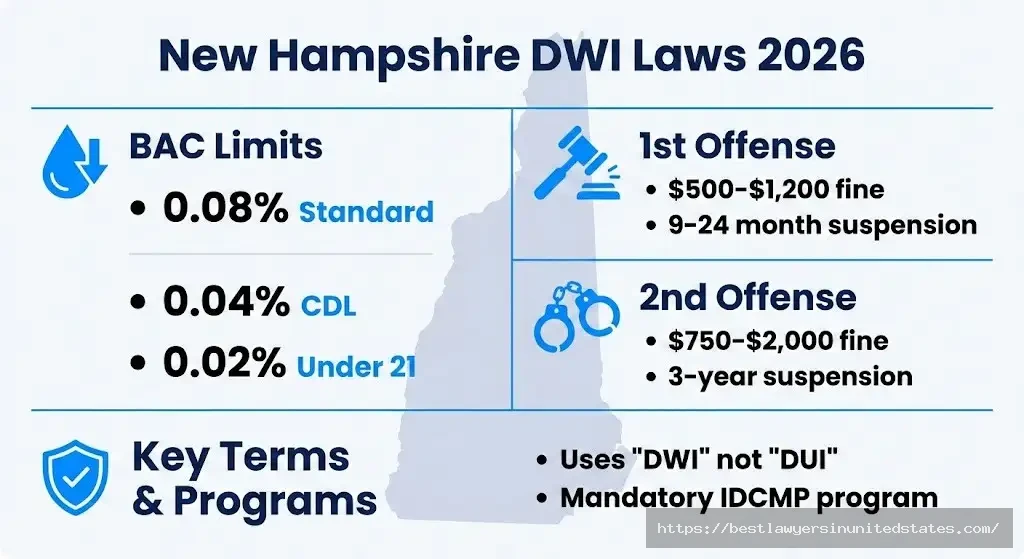
This guide covers everything you need to know about New Hampshire’s DWI laws, from arrest to license reinstatement.
What Qualifies as DWI in New Hampshire?
Quick Answer: You commit DWI in New Hampshire when you operate a vehicle with a BAC of .08% or higher, or while impaired by alcohol or drugs under NH RSA 265-A:2.
New Hampshire law defines three ways to commit DWI. You can be arrested if you drive with a BAC at or above the legal limit. You can also face charges if any amount of alcohol or drugs impairs your ability to drive safely, regardless of your BAC.
DWI vs DUI: Why the Different Name?
New Hampshire officially uses “DWI” (Driving While Intoxicated) in its statutes. Most states use “DUI” (Driving Under the Influence). The terms mean the same thing legally, but knowing New Hampshire’s preferred terminology helps when reading court documents or statute citations.
The Granite State adopted “DWI” decades ago and kept the terminology even as other states switched to “DUI.”
New Hampshire BAC Limits
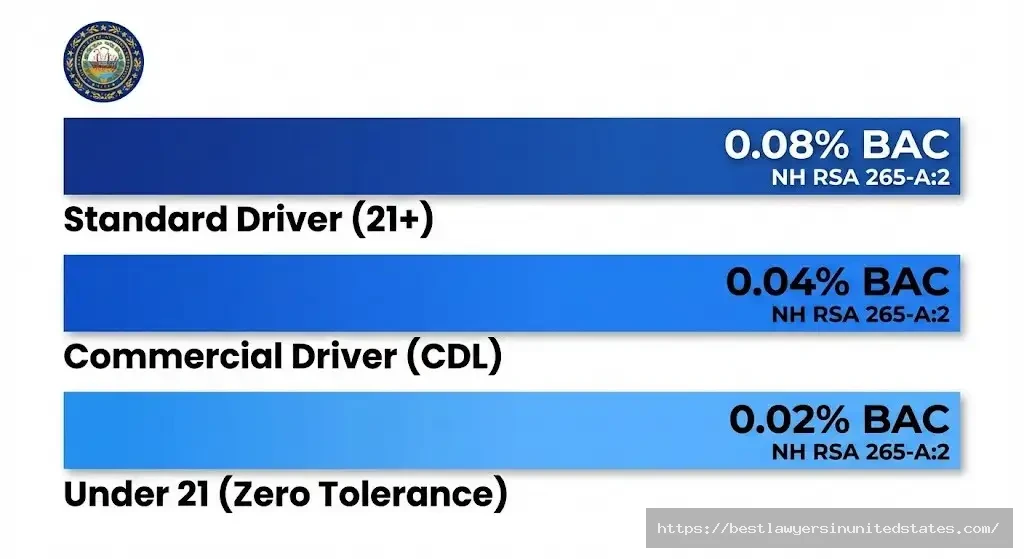
Different drivers face different blood alcohol limits in New Hampshire:
| Driver Type | BAC Limit | Statute |
|---|---|---|
| Standard (21+) | 0.08% | RSA 265-A:2 |
| Commercial (CDL) | 0.04% | RSA 265-A:2 |
| Under 21 | 0.02% | RSA 265-A:2 |
The standard .08% limit applies to most drivers. Commercial drivers holding a CDL face a stricter .04% limit. Drivers under 21 fall under New Hampshire’s zero-tolerance law with just a .02% limit.
Not sure where you stand? Use our BAC calculator to estimate your blood alcohol level based on drinks consumed, body weight, and time elapsed.
BAC Calculator
Estimate your Blood Alcohol Content
• Commercial Driver (CDL): 0.04% BAC
• Drivers Under 21: 0.00-0.02% BAC (Zero Tolerance)
• Enhanced Penalties: 0.15% BAC or higher in most states
What Counts as “Operating” a Vehicle?
You don’t need to be driving down the road to face DWI charges. New Hampshire law says you “operate” a vehicle when you exercise control over it. This includes sitting in the driver’s seat with the keys, even if the engine is off.
Courts have convicted drivers who were sleeping in parked cars with the keys in the ignition.
Impairment Beyond Alcohol
DWI charges aren’t limited to alcohol. New Hampshire law covers impairment from any substance, including marijuana, prescription medications, and illegal drugs. Officers can arrest you for DWI if any substance reduces your ability to drive safely.
Key point: Prescription drugs can trigger DWI charges even if you have a valid prescription.
What is Aggravated DWI in New Hampshire?
Quick Answer: Aggravated DWI under NH RSA 265-A:3 applies when your BAC exceeds .16%, you’re speeding 30+ mph over the limit, you refuse testing, you have a passenger under 16, you cause serious injury, or you’re driving the wrong way.
New Hampshire created a separate “Aggravated DWI” charge with harsher penalties than standard DWI. This enhanced charge carries mandatory jail time and longer license suspensions.
Aggravated DWI Triggers
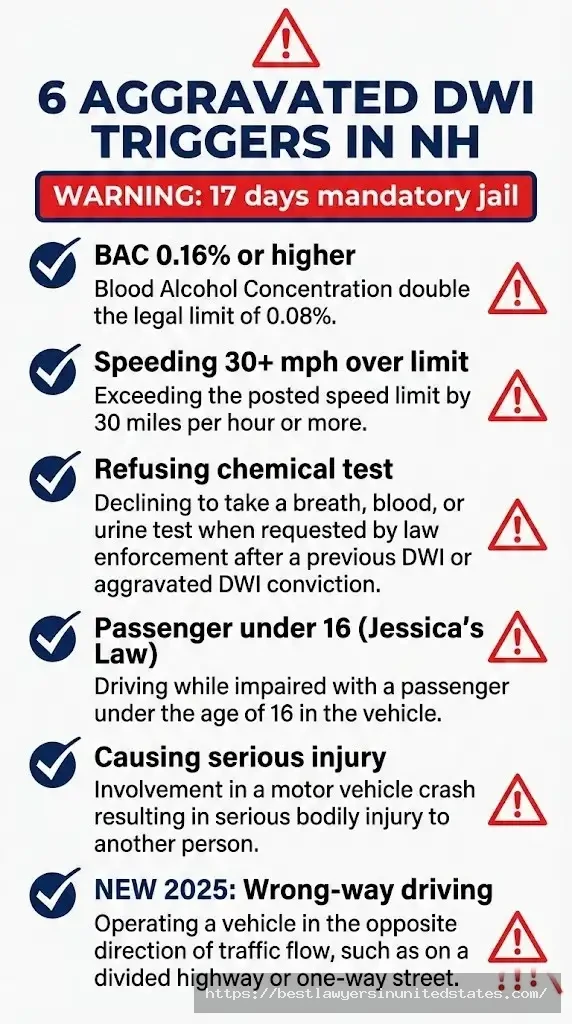
You face aggravated DWI charges when any of these factors apply:
- ⚖️ BAC of .16% or higher (twice the legal limit)
- 🚗 Driving 30+ mph over the posted speed limit
- ❌ Refusing chemical testing after arrest
- 👶 Having a passenger under age 16 (Jessica’s Law)
- 🏥 Causing serious bodily injury to another person
- ⚠️ NEW 2025: Driving the wrong way on a highway or limited-access road
The wrong-way driving enhancement became law in August 2025 after several fatal accidents on New Hampshire highways.
Aggravated DWI Penalties
Aggravated DWI penalties exceed standard DWI consequences:
| Penalty Type | Standard 1st DWI | Aggravated 1st DWI |
|---|---|---|
| Jail Time | Up to 1 year (often suspended) | Minimum 17 days mandatory |
| Fines | $500-$1,200 | $750-$1,200 |
| License Suspension | 9-24 months | 18-24 months |
| Ignition Interlock | May be required | Always required |
Critical deadline: Aggravated DWI carries 17 days mandatory minimum jail time that cannot be suspended.
Jessica’s Law: Child Passenger Enhancement
New Hampshire’s Jessica’s Law automatically elevates a standard DWI to aggravated DWI when you have a passenger under 16 years old. The law protects children from impaired drivers.
Parents caught driving drunk with their children face aggravated charges even if their BAC barely exceeds .08%.
New Hampshire DWI Penalties by Offense Level
Quick Answer: First offense DWI in New Hampshire brings $500-$1,200 fines, up to one year jail (usually suspended), 9-24 months license suspension, and mandatory IDCMP completion. Penalties increase sharply for repeat offenses.
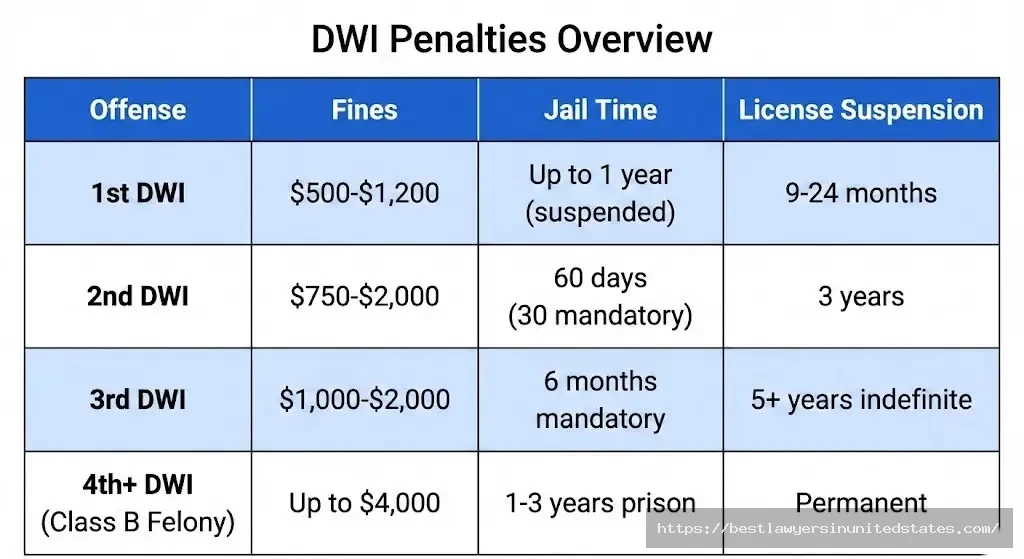
New Hampshire bases DWI penalties on how many prior convictions you have within the past 10 years. Looking back periods don’t reset—your fourth DWI 15 years later still counts as a fourth offense.
First Offense DWI Penalties
| Penalty Category | Amount/Duration |
|---|---|
| Fines | $500-$1,200 |
| Court Costs | $240-$300 |
| Jail Time | Up to 1 year (often suspended) |
| License Suspension | 9-24 months |
| IDCMP Program | Mandatory |
| Ignition Interlock | May be required |
Most first-time offenders receive suspended jail sentences if they complete the Impaired Driver Care Management Program (IDCMP) and stay out of trouble during probation.
Exception: Aggravated DWI requires 17 days mandatory jail time even on a first offense.
Second Offense DWI Penalties
Second offenses within 10 years bring mandatory jail time:
| Penalty Category | Amount/Duration |
|---|---|
| Fines | $750-$2,000 |
| Court Costs | $240-$300 |
| Jail Time | 60 days minimum (30 can be suspended) |
| License Suspension | 3 years minimum |
| IDCMP Program | Mandatory |
| Ignition Interlock | Mandatory (12+ months) |
You must serve at least 30 days of the jail sentence. The remaining 30 days can be suspended if you comply with probation terms.
Similar to Massachusetts DUI laws, New Hampshire requires ignition interlock devices for all second-time offenders.
Third Offense DWI Penalties
Quick Answer: Third DWI is a Class A misdemeanor in New Hampshire with 6 months mandatory jail time, $1,000-$2,000 fines, and indefinite license suspension (minimum 5 years).
| Penalty Category | Amount/Duration |
|---|---|
| Criminal Classification | Class A Misdemeanor |
| Fines | $1,000-$2,000 |
| Court Costs | $240-$300 |
| Jail Time | 6 months mandatory minimum |
| License Suspension | Indefinite (5-year minimum) |
| IDCMP Program | Mandatory |
| Ignition Interlock | Mandatory indefinitely |
None of the 6-month jail sentence can be suspended. You serve the full term.
Fourth and Subsequent Offense Penalties
Quick Answer: Fourth DWI becomes a Class B felony in New Hampshire with 1-3 years prison time, up to $4,000 in fines, and permanent license revocation.
Fourth DWI charges represent New Hampshire’s harshest drunk driving penalties:
| Penalty Category | Amount/Duration |
|---|---|
| Criminal Classification | Class B Felony |
| Fines | Up to $4,000 |
| Prison Time | 1-3 years minimum |
| License Suspension | Permanent revocation |
| IDCMP Program | Mandatory |
| Ignition Interlock | Mandatory if ever relicensed |
This felony conviction affects voting rights, gun ownership, and employment opportunities permanently.
DWI Causing Serious Bodily Injury
Causing serious bodily injury while driving drunk elevates charges to a felony under NH RSA 265-A:3. Penalties include up to 7 years in state prison and fines up to $4,000.
The law defines “serious bodily injury” as physical harm creating a substantial risk of death or causing serious permanent disfigurement.
DWI Negligent Homicide
Quick Answer: DWI resulting in someone’s death is a Class A felony in New Hampshire under RSA 630:3, carrying 7.5-15 years in state prison.
If your drunk driving kills another person, you face negligent homicide charges in addition to DWI. This Class A felony represents New Hampshire’s most serious drunk driving offense.
Prosecutors don’t need to prove you intended to kill anyone—just that you drove drunk and someone died as a result.
Under 21 DWI (Zero Tolerance)
Drivers under 21 face New Hampshire’s zero-tolerance law. A BAC of just .02% triggers DWI charges and penalties.
Under-21 first offense consequences:
- 📋 60-day license suspension minimum
- 💰 $300-$600 fines
- 📚 Mandatory alcohol education
- ⚖️ Delayed full licensure
Courts can also require community service and alcohol counseling for underage offenders.
Total Cost of a New Hampshire DWI
Quick Answer: A first-time DWI in New Hampshire costs $7,000-$15,000 total when you include fines, attorney fees, increased insurance, IDCMP, ignition interlock, and license reinstatement.
The court fine represents only a fraction of your total DWI costs. Hidden expenses add up quickly.
First Offense DWI Cost Breakdown
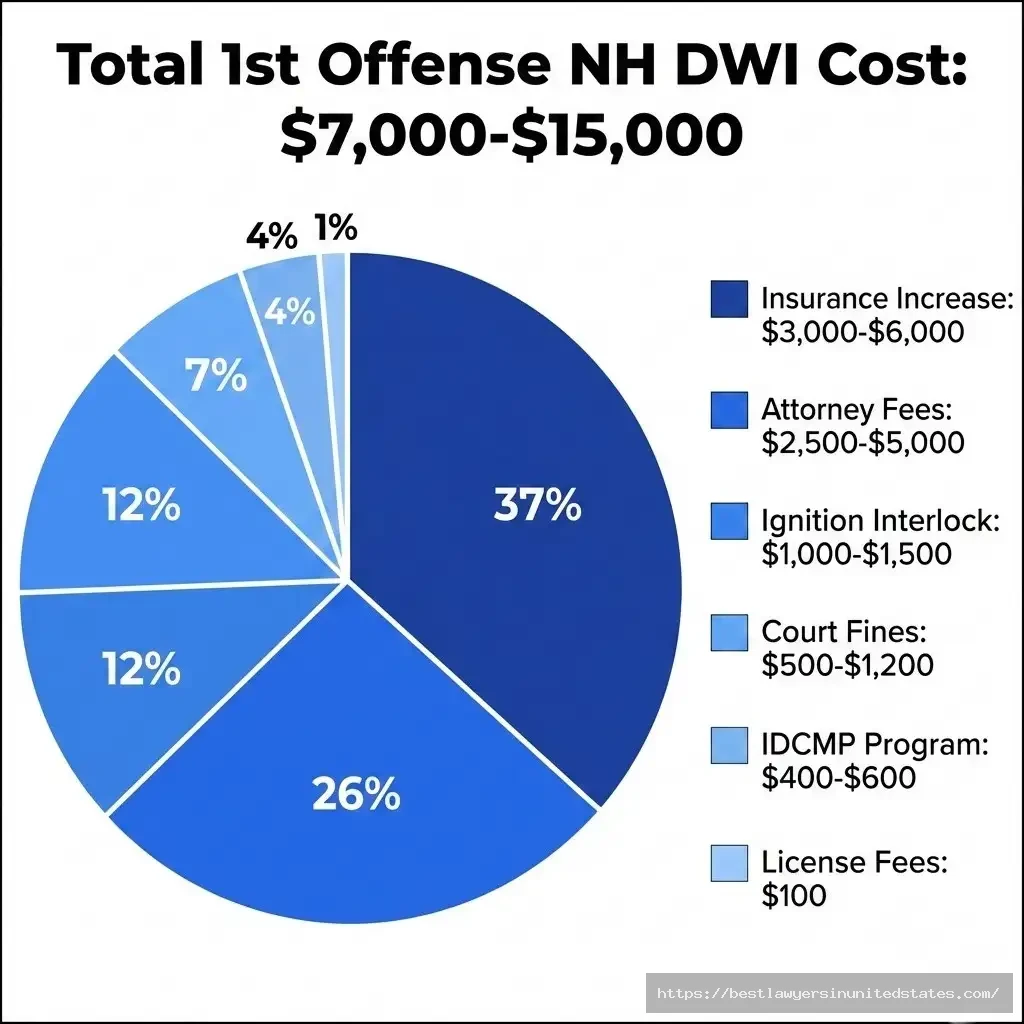
| Cost Category | Amount |
|---|---|
| Court Fines | $500-$1,200 |
| Court Costs | $240-$300 |
| Attorney Fees | $2,500-$5,000 |
| IDCMP Program | $400-$600 |
| Ignition Interlock (if required) | $1,000-$1,500/year |
| License Reinstatement | $100 |
| SR-22 Insurance Filing | $25-$50 |
| Insurance Increase (3 years) | $3,000-$6,000 |
| TOTAL FIRST OFFENSE | $7,765-$15,150 |
Second Offense DWI Cost Breakdown
| Cost Category | Amount |
|---|---|
| Court Fines | $750-$2,000 |
| Court Costs | $240-$300 |
| Attorney Fees | $3,500-$7,500 |
| IDCMP Program | $600-$800 |
| Mandatory Ignition Interlock (12 months) | $1,500-$2,000 |
| License Reinstatement | $100 |
| SR-22 Insurance Filing | $25-$50 |
| Insurance Increase (5 years) | $6,000-$12,000 |
| Lost Wages (30 days jail) | $3,000-$8,000 |
| TOTAL SECOND OFFENSE | $15,715-$32,650 |
Third Offense DWI Cost Breakdown
| Cost Category | Amount |
|---|---|
| Court Fines | $1,000-$2,000 |
| Court Costs | $240-$300 |
| Attorney Fees | $5,000-$10,000 |
| IDCMP Program | $800-$1,000 |
| Mandatory Ignition Interlock (indefinite) | $2,000-$3,000+ |
| License Reinstatement (after 5+ years) | $100 |
| SR-22 Insurance Filing | $25-$50 |
| Insurance Increase (10+ years) | $12,000-$25,000 |
| Lost Wages (6 months jail) | $15,000-$30,000 |
| TOTAL THIRD OFFENSE | $36,165-$71,450 |
Want to calculate your specific costs? Use our DUI cost calculator to estimate expenses based on your situation.
DUI Cost Calculator
Estimate total DUI expenses by state and offense
Detailed Cost Breakdown
Payment Timeline
Bail bond, towing fees, car impound, attorney retainer
Initial court fines, DMV fees, DUI school enrollment, ignition interlock installation
Monthly probation fees, ignition interlock fees, DUI school payments, attorney balance
Insurance premium increases, license reinstatement, SR-22 filing fees
- Lost wages from missed work (court dates, jail time, DUI school) – $2,000-$10,000
- Job loss or difficulty finding employment – Varies
- Professional license suspension (doctors, lawyers, nurses, pilots) – Career ending
- Rideshare and transportation costs during suspension – $1,500-$5,000
- Travel restrictions and visa denials – Varies
- Security clearance loss – Career impact
- Child custody implications – Legal costs
- Rental car restrictions – Varies
- Personal relationships and mental health costs – Priceless
Insurance Impact
Your insurance rates increase 60-100% after a DWI conviction in New Hampshire. The high-risk designation lasts 3-5 years minimum. Some carriers drop DWI offenders entirely, forcing you into expensive SR-22 high-risk policies.
Average insurance increase: $1,000-$2,000 per year for 3-5 years.
The New Hampshire DWI Arrest Process
Quick Answer: After a New Hampshire DWI arrest, you’re booked within 72 hours, face immediate administrative license suspension, must request an ALS hearing within 30 days, and attend arraignment in district court within 60 days.
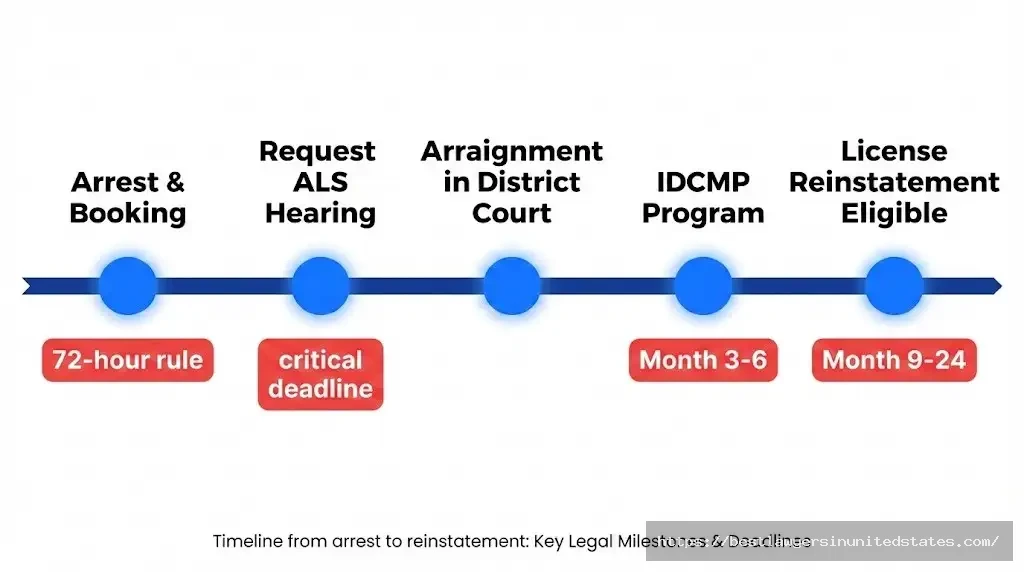
Understanding each step helps you protect your rights and meet critical deadlines.
Traffic Stop and Initial Contact
Officers need reasonable suspicion to pull you over. Common triggers include weaving, speeding, running red lights, or driving without headlights at night.
During the stop, officers look for signs of impairment:
- 👃 Odor of alcohol
- 👀 Bloodshot or glassy eyes
- 🗣️ Slurred speech
- 📄 Fumbling with license and registration
Field Sobriety Tests
Officers typically ask you to perform three standardized field sobriety tests:
- Horizontal Gaze Nystagmus (HGN): Officer watches your eyes track a moving object
- Walk-and-Turn: Walk nine steps heel-to-toe, turn, walk back
- One-Leg Stand: Balance on one foot while counting
Critical point: You can refuse field sobriety tests in New Hampshire without automatic penalties. Only chemical tests trigger implied consent violations.
Recording Police in New Hampshire
New Hampshire law allows you to record police interactions, including DWI stops. Courts have upheld this First Amendment right repeatedly.
How to record safely:
- 📱 Inform the officer you’re recording
- ⚖️ Don’t interfere with the investigation
- 💾 Keep your phone visible and accessible
- ✅ Save the recording immediately
Your recording can provide evidence if officers make procedural mistakes or misrepresent what happened.
Preliminary Breath Test (PBT)
Officers may ask you to blow into a portable breathalyzer at the roadside. This preliminary breath test (PBT) helps establish probable cause for arrest.
Key difference: The roadside PBT is not the official chemical test. You can refuse the PBT without triggering implied consent violations, but refusal often leads to arrest anyway.
Arrest and Booking
Once arrested, officers transport you to the police station for booking. New Hampshire’s 72-hour rule requires booking and initial appearance within 72 hours of arrest (excluding weekends and holidays).
What happens during booking:
- 📸 Photographing and fingerprinting
- 📋 Recording personal information
- 🔍 Property inventory
- 💼 Bail determination
Chemical Testing and Implied Consent
Quick Answer: New Hampshire’s implied consent law (RSA 265:4) requires you to submit to chemical testing after a DWI arrest. Refusal triggers automatic license suspension of 180 days (first offense) to 2 years (subsequent offenses).
Every licensed driver in New Hampshire automatically consents to chemical testing when accepting their license. This “implied consent” kicks in after a lawful DWI arrest.
How Implied Consent Works
Officers must read you the implied consent warning before requesting a breath, blood, or urine test. The warning explains refusal consequences.
The official test happens at the station, not at the roadside. This test’s results can be used as evidence in court.
Should You Refuse the Breathalyzer?
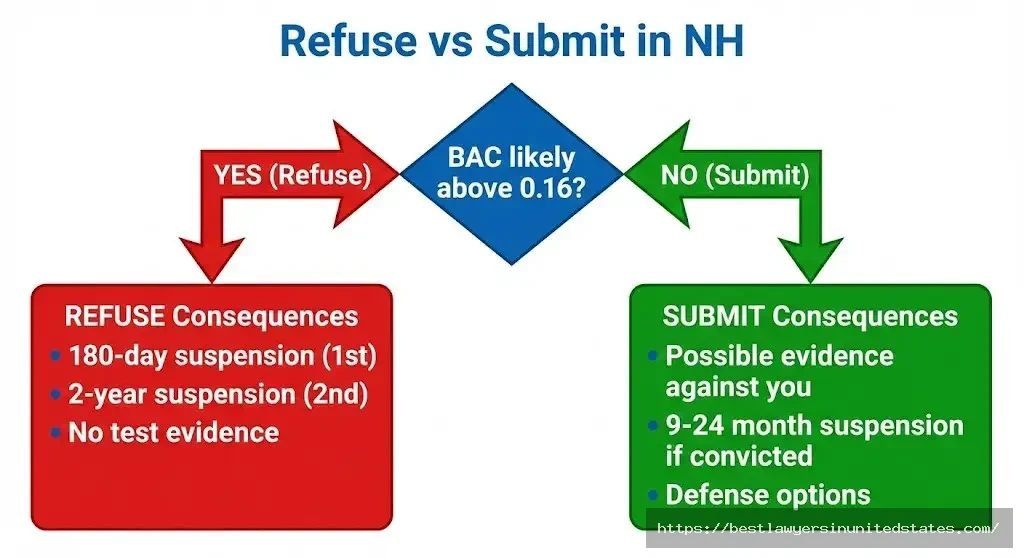
Quick Answer: Refusal brings certain license suspension, while taking the test might help your defense. Most attorneys advise submission unless your BAC is extremely high.
| Scenario | Refusal Penalty | Test Failure Penalty |
|---|---|---|
| 1st offense | 180-day suspension | 9-24 month suspension (if convicted) |
| 2nd offense | 2-year suspension | 3-year suspension (if convicted) |
| 3rd+ offense | 2-year suspension | 5+ year suspension (if convicted) |
Factors favoring refusal:
- ✅ Your BAC is likely .16+ (aggravated level)
- ✅ You have prior DWI convictions
- ✅ You caused an accident with injuries
Factors favoring submission:
- ✅ Your BAC might be below .08%
- ✅ This is your first offense
- ✅ You’re a commercial driver (CDL consequences are severe)
States like Maine impose similar implied consent penalties, though suspension periods vary.
Right to Independent Testing
New Hampshire law allows you to request independent chemical testing at your own expense after completing the official test. You must make this request promptly.
Some defendants use independent lab results to challenge the state’s evidence if the results differ significantly.
Can Police Force You to Take a Test?
Officers cannot physically force you to provide a breath or blood sample without a warrant. However, police increasingly obtain warrants for blood draws in cases involving serious accidents or injuries.
Exception: Unconscious drivers can be tested without consent in medical emergencies.
Administrative License Suspension (ALS) Hearing
Quick Answer: New Hampshire suspends your license administratively under RSA 265:79 before any criminal conviction. You have 30 days to request an ALS hearing to challenge the suspension.
Administrative license suspension (ALS) runs separately from criminal court proceedings. Even if you win your criminal case, the administrative suspension can remain in effect.
Two Separate Processes
Understanding the dual track:
| Process | Purpose | Outcome |
|---|---|---|
| Administrative (DMV) | License suspension only | Determined at ALS hearing |
| Criminal (Court) | Guilt/innocence, penalties | Determined at trial or plea |
You fight these battles independently. Winning one doesn’t guarantee winning the other.
ALS Hearing Timeline
Critical deadlines after arrest:
- Day 1-30: Request ALS hearing with NH DMV
- Day 30: Temporary license expires if you don’t request hearing
- Day 30-60: DMV schedules hearing
- Day 60-90: Hearing typically occurs
Critical deadline: Request your hearing within 30 days or lose your right to challenge the suspension.
What Happens at the ALS Hearing
ALS hearings focus on narrow legal issues, not whether you were actually drunk. The hearing officer considers only:
- ⚖️ Did police have probable cause to arrest you?
- ⚖️ Were you properly advised of implied consent?
- ⚖️ Did you refuse testing or test over the legal limit?
If the hearing officer finds the police followed proper procedures, your suspension stands regardless of whether you’re eventually convicted.
Temporary Driving Permits
You receive a temporary license valid for 30 days after arrest. This expires unless you request an ALS hearing.
If you request a hearing, you can typically drive until the hearing decision.
Arraignment in New Hampshire District Court
Quick Answer: Arraignment happens in NH District or Circuit Court within 60 days of arrest. You enter a plea, learn the formal charges, and receive bail conditions.
Arraignment represents your first official court appearance. Courts handle DWI cases in different locations across New Hampshire.
New Hampshire DWI Court Locations
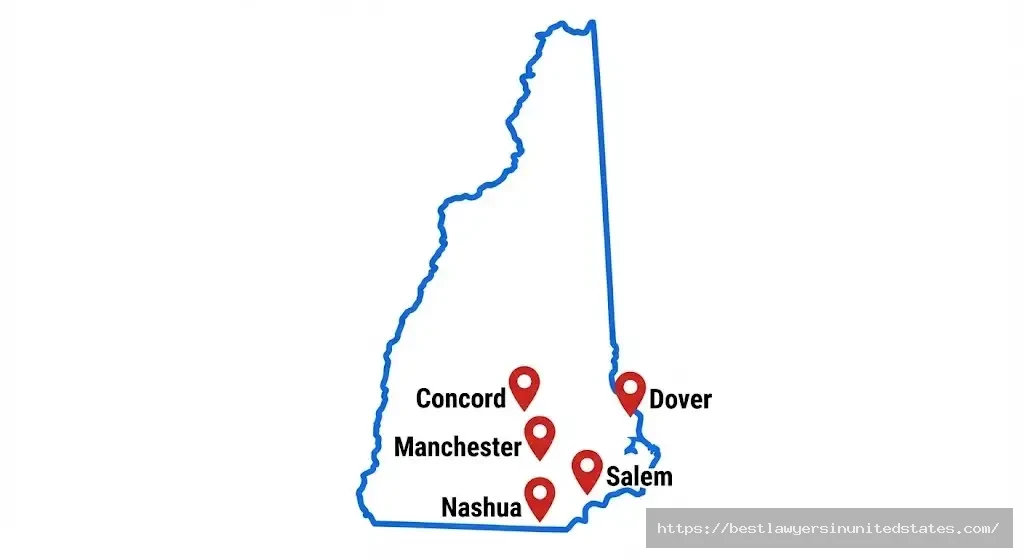
Major NH courts handling DWI cases:
| Court | Location | Counties Served |
|---|---|---|
| Manchester District Court | 35 Amherst St, Manchester | Hillsborough |
| Concord District Court | 32 Clinton St, Concord | Merrimack |
| Nashua District Court | 25 Walnut St, Nashua | Hillsborough |
| Salem District Court | 55 Geremonty Dr, Salem | Rockingham |
| Dover District Court | 25 St Thomas St, Dover | Strafford |
Pro tip: Arrive early, dress professionally, and bring all court paperwork.
What to Expect at Arraignment
The judge reads the charges against you and asks how you plead. You have three options:
- Guilty: You admit the charges (not recommended without attorney advice)
- Not Guilty: You contest the charges and proceed to trial
- Nolo Contendere: No contest plea (treated as guilty for sentencing but can’t be used against you in civil court)
Most defendants plead “not guilty” initially to preserve their options.
Bail and Release Conditions
First-time DWI offenders typically receive personal recognizance (PR) bail without posting money. The court may impose conditions:
- 🚫 No alcohol consumption
- 🚗 No driving without a valid license
- ✅ Attend all court dates
- 📋 Report to a probation officer
Violating bail conditions can result in arrest and detention until trial.
Impaired Driver Care Management Program (IDCMP)
Quick Answer: New Hampshire’s IDCMP is a mandatory education and treatment program required for all DWI offenders before license reinstatement. The program costs $400-$800 and takes 2-6 months to complete.
Every person convicted of DWI in New Hampshire must complete IDCMP. You cannot get your license back without completion certification.
What is IDCMP?
The Impaired Driver Care Management Program provides substance abuse education and, when needed, treatment for drunk drivers. The New Hampshire Department of Health and Human Services administers the program statewide.
IDCMP serves two purposes: educating offenders about drunk driving risks and identifying those with substance abuse problems needing treatment.
IDCMP Process Step-by-Step
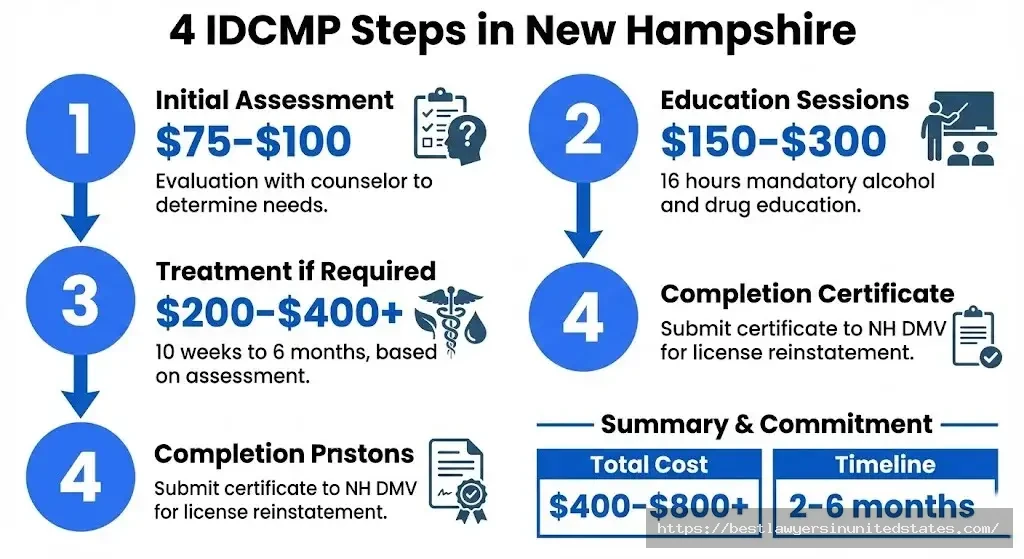
1. Initial Assessment ($75-$100)
You complete a comprehensive evaluation with an IDCMP counselor. The assessment examines your drinking patterns, DWI circumstances, and treatment needs.
2. Education Sessions ($150-$300)
All offenders attend 16 hours of alcohol education classes. Sessions cover drunk driving laws, BAC effects, and decision-making strategies.
3. Treatment (if required) ($200-$400+)
If your assessment reveals substance abuse issues, you must complete treatment before IDCMP certification. Treatment length varies from 10 weeks to 6 months.
4. Completion Certificate
After finishing all requirements, IDCMP issues a completion certificate. You submit this to the NH DMV as part of license reinstatement.
IDCMP Costs
| Program Component | Cost |
|---|---|
| Initial Assessment | $75-$100 |
| Education Classes | $150-$300 |
| Treatment (if required) | $200-$400+ |
| Completion Certificate | Included |
| Total Range | $400-$800+ |
Costs increase significantly if you need extended treatment.
IDCMP Timeline
Typical completion timeline:
- ⏱️ First offense, no treatment: 2-3 months
- ⏱️ First offense, with treatment: 4-6 months
- ⏱️ Repeat offense: 6-12 months
You cannot begin IDCMP until after conviction. This delays your license reinstatement timeline.
License Suspension and Reinstatement
Quick Answer: First-time DWI offenders in New Hampshire lose their license for 9-24 months. License reinstatement requires IDCMP completion, SR-22 insurance filing, paying $100 reinstatement fee, and installing an ignition interlock device (if required).
License suspension hits immediately and lasts months or years depending on your offense level and cooperation.
How Long Do You Lose Your License for DUI in NH?
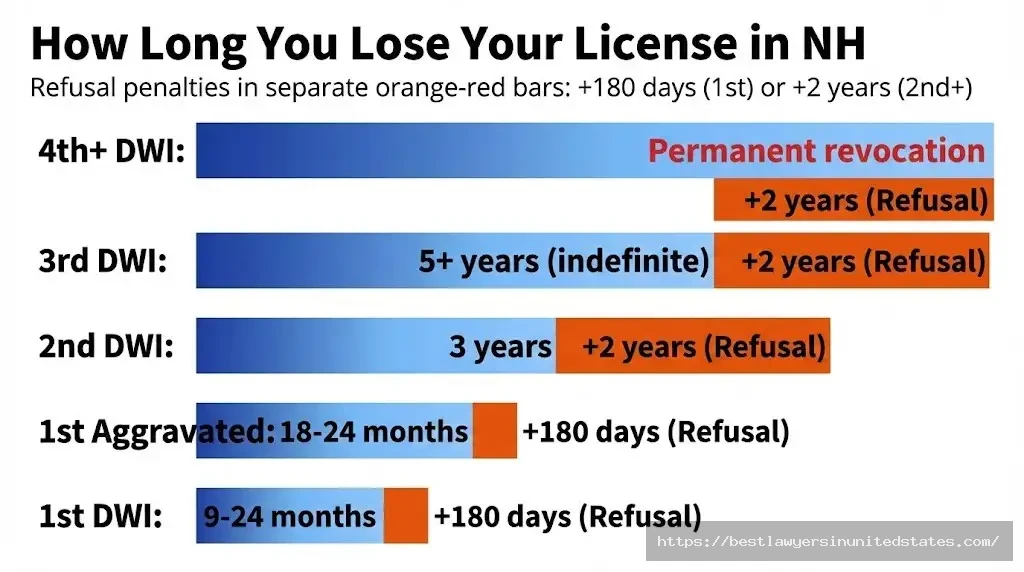
Suspension periods vary based on offense level and whether you refused testing:
| Offense Level | Standard Suspension | Aggravated Suspension | Refusal Suspension |
|---|---|---|---|
| 1st DWI | 9-24 months | 18-24 months | +180 days |
| 2nd DWI | 3 years | 3-5 years | +2 years |
| 3rd DWI | Indefinite (5-year minimum) | Indefinite (5-year minimum) | +2 years |
| 4th+ DWI | Permanent revocation | Permanent revocation | +2 years |
Critical point: Refusal suspensions stack on top of conviction suspensions.
Immediate Suspension After Arrest
Your license suspension begins immediately upon arrest or test failure. The administrative suspension runs parallel to any criminal suspension.
Officers confiscate your physical license at arrest and issue a temporary 30-day permit.
“Cinderella License” (Work Privileges)
Quick Answer: New Hampshire offers restricted “Cinderella licenses” allowing driving to work, school, or medical appointments during suspension. Eligibility and restrictions vary by case.
Cinderella licenses get their name from the fairytale character—you can drive during limited hours like Cinderella could go to the ball. The official term is “hardship license.”
Eligibility requirements:
- ✅ Employment verification
- ✅ No public transportation alternative
- ✅ Ignition interlock device installed
- ✅ SR-22 insurance filing
- ✅ Court approval
Restrictions:
- ⏰ Drive only to/from work during scheduled hours
- 🏥 Medical appointments (pre-approved)
- 📚 School/educational programs
- 🚫 No personal errands or social driving
Violating Cinderella license restrictions triggers immediate suspension and possible criminal charges.
License Reinstatement Process
Getting your license back requires completing several steps in order:
Step 1: Serve Full Suspension Period
You must complete your entire suspension before applying for reinstatement. Courts cannot reduce the minimum suspension period.
Step 2: Complete IDCMP
Submit your IDCMP completion certificate to the NH DMV. This certification proves you finished the mandatory education program.
Step 3: Obtain SR-22 Insurance
Contact an insurance provider who files SR-22 forms with New Hampshire. The SR-22 certifies you carry minimum liability coverage.
Step 4: Install Ignition Interlock (if required)
Second and subsequent offenders must install an ignition interlock device before reinstatement. Some first offenders with aggravated circumstances also need IID.
Step 5: Pay Reinstatement Fee
Submit $100 to the NH DMV along with all required documentation.
Step 6: Visit DMV
Schedule an appointment at a New Hampshire DMV office. Bring all certificates, proof of insurance, and payment.
Total timeline from arrest to full reinstatement: 12-36 months for first offense.
Ignition Interlock Device (IID) Requirements
Quick Answer: Ignition interlock devices prevent your car from starting if you’ve been drinking. New Hampshire requires IID for all second/subsequent offenders and many first-time aggravated DWI cases. Installation costs $100-$200, plus $60-$90 monthly monitoring.
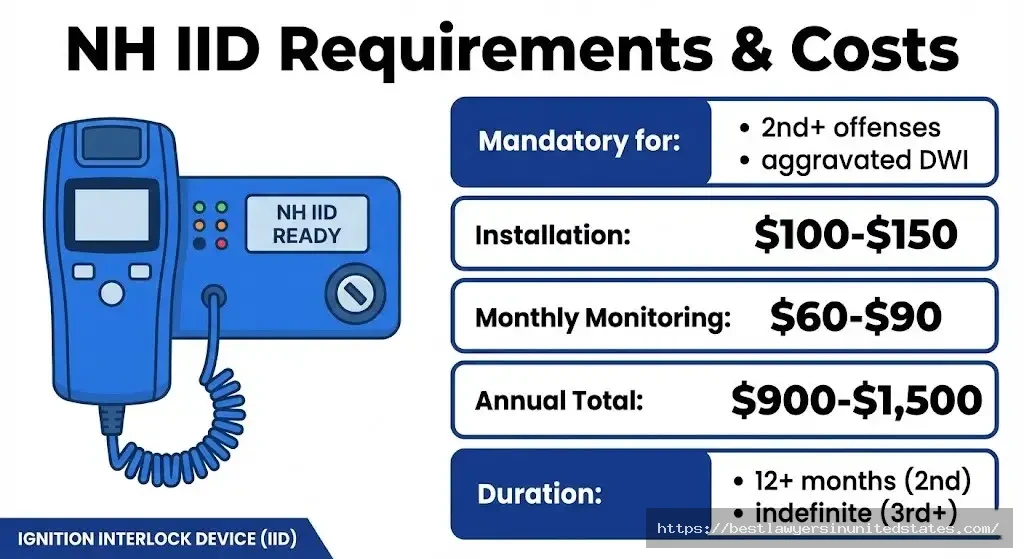
An ignition interlock device is a breathalyzer wired into your vehicle’s ignition system. You must blow into the device before starting the car. If your BAC registers above a preset limit (typically .02%), the car won’t start.
When is IID Mandatory?
| Offense Level | IID Requirement |
|---|---|
| 1st DWI (standard) | May be required by court |
| 1st Aggravated DWI | Always required (12+ months) |
| 2nd DWI | Always required (12+ months) |
| 3rd DWI | Always required (indefinite) |
| 4th+ DWI | Always required (indefinite if ever relicensed) |
Courts have discretion to order IID for first-time standard DWI offenders, particularly those with high BAC readings.
IID Costs
| Cost Category | Amount |
|---|---|
| Installation | $100-$200 |
| Monthly Monitoring | $60-$90 |
| Calibration (every 60 days) | $50-$75 |
| Removal | $50-$100 |
| Annual Total | $900-$1,500 |
You pay all IID costs out of pocket. New Hampshire offers no subsidies or payment plans.
How IID Works
Modern ignition interlock devices include anti-circumvention features:
- 🚗 Random rolling retests while driving (every 5-45 minutes)
- 📸 Camera photos during each breath sample
- 💾 Data logging of all tests and violations
- 🔐 Tamper detection alerts
The device records violations like failed tests, missed retests, or tampering attempts. These violations extend your IID requirement period.
Approved IID Vendors in New Hampshire
The NH DMV maintains a list of approved ignition interlock device providers. You must use an approved vendor for installation to count toward your requirement.
Major approved vendors:
- Smart Start
- Intoxalock
- LifeSafer
- Draeger
Call multiple providers to compare costs and installation wait times.
Collateral Consequences of New Hampshire DWI
Quick Answer: DWI convictions in New Hampshire create a permanent criminal record affecting employment, professional licenses, insurance rates, and background checks. The conviction never automatically disappears.
The court penalties represent just the beginning. DWI convictions create lasting consequences that affect your life for years.
Criminal Record Impact
New Hampshire DWI convictions create a permanent criminal record. The conviction appears on:
- 🔍 Employment background checks
- 🏫 College applications
- 🏠 Rental applications
- 💼 Professional licensing reviews
- 🔫 Firearm purchase checks
How long does a DWI stay on your record in NH? Permanently. New Hampshire doesn’t automatically expunge or erase DWI convictions after a set period.
Employment Consequences
Many employers run criminal background checks. A DWI conviction can affect:
Jobs requiring commercial driving:
- ❌ Truck drivers
- ❌ Delivery drivers
- ❌ Bus drivers
- ❌ Professional drivers
Jobs requiring professional licenses:
- ⚖️ Attorneys
- 🏥 Medical professionals
- 👨🏫 Teachers
- 💼 Financial advisors
Jobs with driving requirements:
- 📋 Sales representatives
- 🏗️ Contractors
- 🚑 Emergency responders
Some employers have blanket policies against hiring anyone with DWI convictions.
Commercial Driver’s License (CDL) Impact
Quick Answer: CDL holders face stricter .04% BAC limits and can lose their commercial license permanently after certain DWI offenses, even if the violation occurred in a personal vehicle.
Commercial drivers face career-ending consequences from DWI convictions:
| Violation | CDL Consequence |
|---|---|
| 1st DWI (.04+ BAC) | 1-year CDL suspension |
| 1st DWI with hazmat | 3-year CDL suspension |
| 2nd DWI | Lifetime CDL revocation |
| DWI causing death | Lifetime CDL revocation |
Critical point: You lose your CDL even if the DWI occurred while driving your personal car during off-duty hours.
New Hampshire follows federal commercial driver regulations. CDL holders convicted in other states face the same penalties as if convicted in New Hampshire.
Insurance Rate Increases
DWI convictions trigger “high-risk driver” classifications with insurance companies. Your rates increase 60-100% on average.
Typical insurance impact:
- 📈 60-100% rate increase for 3-5 years
- 📋 SR-22 filing requirement ($25-$50/year)
- ❌ Some carriers drop DWI offenders entirely
- 💰 Annual increase of $1,000-$2,000
High-risk status lasts 3-5 years minimum. You must maintain continuous SR-22 coverage throughout this period or face license suspension.
Professional Licensing Consequences
Professional licensing boards review DWI convictions. You must report convictions to most boards within 30 days.
Professions affected:
- Attorneys (NH Bar Association review)
- Medical professionals (Board of Medicine discipline)
- Nurses (Board of Nursing review)
- Teachers (Educator certification review)
- Financial advisors (Securities licensing issues)
- Real estate agents (Commission review)
Boards can impose sanctions ranging from reprimands to license revocation depending on circumstances and profession.
Out-of-State Drivers: Home License Impact
Quick Answer: If you’re licensed in another state, a New Hampshire DWI conviction reports to your home state through the Interstate Driver’s License Compact. Your home state will suspend your license according to their laws.
New Hampshire participates in the Interstate Driver’s License Compact with 44 other states. The compact requires member states to share DWI conviction information.
What happens:
- New Hampshire suspends your NH driving privileges
- NH reports the conviction to your home state
- Your home state suspends your home license
- You face penalties from both states
Wisconsin, Georgia, Massachusetts, Michigan, and Tennessee don’t fully participate in the compact, but may still receive conviction information through other channels.
Neighboring states like Vermont and Massachusetts honor New Hampshire DWI suspensions and impose their own additional penalties.
New Hampshire DWI Defense Strategies
Quick Answer: Common DWI defenses in New Hampshire include challenging the traffic stop legality, questioning breathalyzer accuracy and calibration, disputing field sobriety test administration, and presenting medical explanations for impairment symptoms.
Even strong DWI cases have potential defenses. An experienced attorney can identify weaknesses in the prosecution’s case.
Challenging the Traffic Stop
Quick Answer: Officers need reasonable suspicion of criminal activity to pull you over. If the stop was illegal, all evidence gets suppressed.
The Fourth Amendment protects against unreasonable searches and seizures. Officers can’t pull you over without specific, articulable facts suggesting criminal activity.
Invalid reasons for traffic stops:
- ❌ Stopping cars at random
- ❌ Pulling over based on driver’s appearance
- ❌ Stopping based on hunches without observable violations
- ❌ Following you hoping to see a violation
Valid reasons for traffic stops:
- ✅ Observing traffic violations (speeding, weaving, running lights)
- ✅ Equipment violations (broken taillight, expired registration)
- ✅ Sobriety checkpoint (if properly administered)
If your attorney proves the stop was illegal, the court excludes all evidence obtained after the illegal stop—including breathalyzer results.
Questioning Breathalyzer Accuracy
Breathalyzer devices require regular calibration and maintenance. Attorneys challenge breathalyzer results by examining:
Calibration records:
- When was the device last calibrated?
- Who performed the calibration?
- Do records show proper maintenance?
Operator certification:
- Is the officer certified to operate the device?
- When did certification expire?
- Did the officer follow proper testing protocols?
Environmental factors:
- Mouthwash or breath spray contamination
- Radio frequency interference
- Rising blood alcohol (you were under .08% while driving)
Medical conditions:
- GERD or acid reflux
- Diabetes (ketones mimic alcohol)
- Dental work trapping alcohol
Breathalyzer challenges work best when combined with independent blood test results showing lower BAC.
Field Sobriety Test Reliability
Field sobriety tests rely on subjective officer observations. Many factors affect performance besides alcohol:
Medical conditions:
- Inner ear problems affecting balance
- Leg or knee injuries
- Neurological conditions
- Age (tests designed for people under 65)
Environmental factors:
- Uneven pavement
- Poor lighting
- Bad weather
- Restrictive clothing (high heels, tight pants)
Test administration errors:
- Officer failed to properly demonstrate
- Officer failed to account for medical conditions
- Officer conducted non-standardized tests
- Officer misinterpreted natural nervousness
Video evidence from police dashcams or your recording can prove you performed better than the officer claimed.
Rising Blood Alcohol Defense
Your BAC continues rising for 30-90 minutes after your last drink. The “rising BAC defense” argues you were under .08% while driving but over the limit by testing time.
This defense works when:
- ✅ You were stopped shortly after leaving a bar
- ✅ Significant time passed between stop and testing
- ✅ You had your last drink within 30-60 minutes of driving
- ✅ Independent testing shows declining BAC
The defense requires expert testimony about alcohol absorption rates and timelines.
What Makes a DWI Case Weak?
Prosecutors drop or reduce charges in cases with significant problems:
Strong defense indicators:
- ⚖️ Illegal traffic stop without reasonable suspicion
- 🔧 Breathalyzer calibration issues or operator errors
- 📹 Video contradicting officer testimony
- 🏥 Medical explanations for impairment symptoms
- ❌ Missing or incomplete police reports
- 🔬 Independent blood test showing lower BAC
- ⏰ Long delay between stop and testing
Critical point: Never assume your case is unwinnable. Many DWI charges get reduced or dismissed based on procedural errors.
Your Rights During a New Hampshire DWI Stop
Quick Answer: You have the right to remain silent, refuse field sobriety tests without penalty, record the interaction, and request an attorney. You’re not required to show ID unless lawfully arrested—New Hampshire is not a stop-and-identify state.
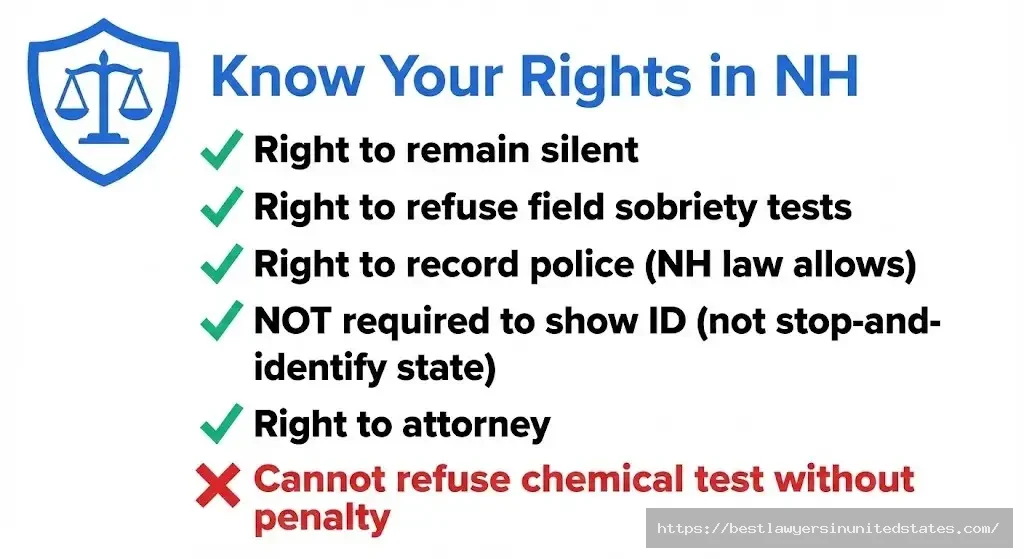
Knowing your rights prevents self-incrimination and strengthens your defense.
Right to Remain Silent
The Fifth Amendment protects against self-incrimination. You don’t have to answer incriminating questions.
Questions you can politely decline:
- “How much have you had to drink tonight?”
- “Where are you coming from?”
- “What were you doing tonight?”
- “Do you know why I pulled you over?”
Suggested response: “Officer, I prefer not to answer questions without my attorney present.”
Information you must provide:
- ✅ Driver’s license
- ✅ Registration
- ✅ Insurance
You can provide documents without answering interrogation questions.
Stop-and-Identify Laws in NH
Quick Answer: New Hampshire is NOT a stop-and-identify state. You don’t have to provide identification unless you’re lawfully arrested or driving a vehicle.
Many people believe you must show ID whenever police ask. This is false in New Hampshire.
When you must show ID:
- 🚗 You’re operating a motor vehicle (license required)
- ⚖️ You’re lawfully arrested
- ⚖️ You’re suspected of committing a crime
When you can refuse:
- 🚶 You’re walking down the street
- 🏪 You’re in a public place not suspected of crimes
- ❓ Officer asks “Can I see your ID?” without reasonable suspicion
Asking for ID and requiring ID are different. Officers often phrase it as a request, but in New Hampshire, pedestrians can politely decline unless the officer has reasonable suspicion of criminal activity.
Recording Police Interactions
New Hampshire law explicitly allows recording police officers during traffic stops and arrests. This First Amendment right has been upheld in multiple court cases.
How to record legally:
- Inform the officer: “I’m recording this interaction”
- Keep your phone visible: Don’t make furtive movements
- Don’t interfere: Stay out of the officer’s way
- Save immediately: Back up the recording to cloud storage
Officers may ask you to stop recording. You can politely refuse: “Officer, I have the right to record under New Hampshire law.”
What you can record:
- ✅ Traffic stop conversations
- ✅ Field sobriety test administration
- ✅ Arrest procedures
- ✅ Officer statements and behavior
Your recording provides evidence if officers make procedural mistakes or misrepresent facts later.
Right to Refuse Field Sobriety Tests
Quick Answer: You can refuse field sobriety tests in New Hampshire without triggering automatic license suspension. Only refusing chemical tests (breath, blood, urine) after arrest triggers penalties.
Field sobriety tests and chemical tests are different:
| Test Type | Can You Refuse? | Penalty for Refusal |
|---|---|---|
| Field Sobriety Tests (roadside) | YES | None (but may lead to arrest) |
| Preliminary Breath Test (roadside) | YES | None (but may lead to arrest) |
| Chemical Test (after arrest at station) | YES | Automatic license suspension |
Many attorneys advise refusing field sobriety tests because they’re designed for failure and provide evidence against you.
What to Say (and Not Say) to Police
During a DWI stop, NEVER say:
- ❌ “I only had two beers”
- ❌ “I’m not drunk”
- ❌ “I’m fine to drive”
- ❌ “I just left a party/bar”
Any admission helps the prosecutor’s case.
Safe responses:
- ✅ “I don’t wish to answer questions”
- ✅ “I want to speak with my attorney”
- ✅ “Am I free to leave?”
- ✅ “I do not consent to searches”
Be polite but firm. Arguing or being rude never helps your case.
New Hampshire-Specific DWI Topics
Jessica’s Law: Child Endangerment Enhancement
Quick Answer: Having a passenger under 16 years old while driving drunk automatically elevates your charge to aggravated DWI in New Hampshire, triggering mandatory minimum jail time of 17 days.
New Hampshire’s Jessica’s Law targets drunk drivers who endanger children. The law shows no mercy—even a BAC of .08% with a child passenger means aggravated DWI.
Jessica’s Law consequences:
- ⚖️ Automatic aggravated DWI classification
- 🔒 17 days mandatory jail (no suspension)
- 💰 Higher fines ($750-$1,200 vs $500-$1,200)
- 🚗 Longer license suspension (18-24 months vs 9-24 months)
- 🔐 Mandatory ignition interlock device
The law applies to any passenger under 16, not just your own children. Carpooling other kids triggers the same enhancement.
Open Container Laws in New Hampshire
Quick Answer: New Hampshire allows passengers (not drivers) to possess open alcohol containers in vehicles. Drivers cannot have open containers within reach, but passengers face no state law restrictions.
New Hampshire differs from most states on open containers. Passengers can legally drink in moving vehicles under state law.
New Hampshire open container rules:
- ✅ Passengers can possess open containers
- ✅ Passengers can drink alcohol while riding
- ❌ Drivers cannot possess open containers
- ❌ Open containers cannot be within driver’s reach
Exception: Some municipalities have local ordinances prohibiting open containers. Check local laws in your city.
Federal law: Highways receiving federal funding prohibit open containers. This creates confusion about enforcement.
2025 Wrong-Way Driving Law Update
Quick Answer: A new August 2025 New Hampshire law adds wrong-way driving on limited-access highways as an aggravated DWI trigger, carrying mandatory enhanced penalties.
Several fatal head-on collisions involving wrong-way drunk drivers prompted this legislation. The law targets impaired drivers who enter highway exit ramps or drive against traffic.
New enhancement triggers:
- 🚗 Driving wrong way on any limited-access highway
- 🚗 Entering exit ramps
- 🚗 Driving against traffic flow on divided highways
Wrong-way driving during a DWI now carries the same enhanced penalties as high BAC or refusing testing.
Additional penalties:
- 17 days mandatory jail time (first offense)
- Extended license suspension
- Mandatory ignition interlock
- Possible aggravated assault charges if you cause accidents
The law took effect August 7, 2025. Cases before this date don’t include the wrong-way enhancement.
New Hampshire’s 72-Hour Rule
Quick Answer: New Hampshire’s 72-hour rule requires police to bring arrested persons before a judge within 72 hours (excluding weekends and holidays) for arraignment or bail hearing.
This rule protects against indefinite detention without judicial review. If you’re arrested on Friday night, police have until Tuesday (skipping weekend) to arraign you.
The 72-hour clock:
- Hour 0: Arrest occurs
- Hours 1-72: Booking, processing, holding
- Hour 72: Must appear before judge (excluding weekends/holidays)
Violating the 72-hour rule can result in case dismissal or suppression of evidence.
Can You Get Your New Hampshire DWI Expunged?
Quick Answer: New Hampshire uses “annulment” instead of expungement. DWI convictions can be annulled after 10 years if you have no other convictions and complete all court requirements.
New Hampshire doesn’t “expunge” records—it “annuls” them. The distinction matters for legal proceedings.
Annulment vs Expungement in NH
Annulment means the conviction is hidden from public view but still exists for law enforcement and courts. Expungement completely erases the conviction as if it never happened.
New Hampshire law uses annulment, which provides limited relief:
| Record Type | Public Can See? | Police Can See? | Courts Can See? |
|---|---|---|---|
| Before Annulment | YES | YES | YES |
| After Annulment | NO | YES | YES |
Annulled records don’t appear on private background checks but remain visible to law enforcement and courts for sentencing purposes.
Eligibility for DWI Annulment
Requirements for first-offense DWI annulment:
- ✅ 10 years passed since conviction
- ✅ No other criminal convictions in 10 years
- ✅ Completed all sentencing requirements (fines, IDCMP, suspension)
- ✅ Not charged with any pending criminal offenses
DWI convictions that CANNOT be annulled:
- ❌ Second or subsequent DWI convictions
- ❌ DWI causing serious bodily injury (felony)
- ❌ DWI negligent homicide (felony)
- ❌ Fourth or subsequent DWI (Class B felony)
New Hampshire law prohibits annulment of second and subsequent DWI convictions permanently.
Annulment Application Process
Steps to annul a NH DWI conviction:
- Wait 10 years from conviction date
- Obtain criminal record from NH State Police
- File petition in the court that convicted you
- Pay filing fee ($100-$250 depending on court)
- Attend hearing (prosecutor may object)
- Judge decides based on rehabilitation evidence
Timeline: 3-6 months from filing to decision.
Impact of Annulment
Annulment provides limited benefits:
What gets sealed:
- ✅ Public court records
- ✅ Private background check results
- ✅ Employment screening (most cases)
What remains visible:
- ❌ Law enforcement databases
- ❌ Court use for sentencing repeat offenders
- ❌ Professional licensing board reviews (sometimes)
- ❌ CDL violation records
Critical limitation: A second DWI arrest treats your annulled conviction as a first offense for sentencing purposes. You face second-offense penalties.
Frequently Asked Questions
Is a DUI a felony in NH?
Quick Answer: Fourth and subsequent DWI offenses are Class B felonies in New Hampshire. DWI causing serious bodily injury or death are also felonies. First through third offenses are misdemeanors (Class A for third).
New Hampshire classifies DWI offenses by severity:
| Offense | Classification |
|---|---|
| 1st DWI | Misdemeanor |
| 2nd DWI | Misdemeanor |
| 3rd DWI | Class A Misdemeanor |
| 4th+ DWI | Class B Felony |
| DWI + Serious Injury | Felony |
| DWI Negligent Homicide | Class A Felony |
Felony DWI convictions carry prison time (not county jail) and create permanent consequences for voting, gun ownership, and employment.
How long does a DUI stay on your record in NH?
Quick Answer: DWI convictions remain on your New Hampshire criminal record permanently unless annulled after 10 years. First offenses can be annulled; second and subsequent offenses cannot.
Unlike some states that erase DWI convictions after 7-10 years automatically, New Hampshire keeps them forever without court-ordered annulment.
Timeline for record retention:
- Criminal record: Permanent (unless annulled)
- DMV/driver record: Permanent
- Insurance surcharge: 3-5 years
- Background checks: Permanent (unless annulled)
Courts and police can see annulled convictions for sentencing repeat offenders.
What is the penalty for DUI in New Hampshire?
Quick Answer: First offense DWI in New Hampshire carries $500-$1,200 fines, up to one year jail (usually suspended), 9-24 months license suspension, mandatory IDCMP completion, and possible ignition interlock requirement.
Penalties increase based on offense level and aggravating factors. Use our DUI cost calculator to estimate your total expenses including fines, attorney fees, IDCMP, insurance increases, and license reinstatement.
What happens when you get a DUI in New Hampshire?
Quick Answer: After a NH DWI arrest, you’re booked within 72 hours, receive a temporary license for 30 days, must request an administrative hearing within 30 days to avoid automatic suspension, attend arraignment within 60 days, complete IDCMP if convicted, and face license suspension of 9 months to permanent depending on offense level.
The process includes:
- Arrest and booking
- Administrative license suspension
- Criminal court arraignment
- Trial or plea negotiation
- Sentencing and IDCMP
- License reinstatement process
Most cases resolve in 3-12 months from arrest to final disposition.
Can you refuse a breathalyzer in NH?
Quick Answer: You can refuse chemical testing in New Hampshire, but refusal triggers automatic license suspension of 180 days (first offense) to 2 years (subsequent offenses) under implied consent law RSA 265:4.
Refusal consequences:
- 1st refusal: 180-day suspension
- 2nd refusal: 2-year suspension
- 3rd+ refusal: 2-year suspension
Refusal suspensions stack on top of any conviction-based suspensions. Most attorneys advise submission unless your BAC is extremely high or you have prior convictions.
Do you lose your license immediately after DUI in NH?
Quick Answer: Yes, New Hampshire suspends your license immediately upon DWI arrest or test failure. Officers confiscate your physical license and issue a temporary 30-day permit. The suspension continues unless you request an administrative hearing within 30 days.
The administrative suspension runs before any criminal conviction. You can challenge it at an ALS hearing, but the burden of proof favors the state.
How harsh are judges on first-time DUI in NH?
Quick Answer: New Hampshire judges typically suspend jail sentences for first-time non-aggravated DWI offenders who complete IDCMP and comply with probation. However, judges impose full penalties for aggravated DWI, accidents, or high BAC regardless of prior record.
Factors judges consider:
- BAC level (.08-.15 vs .16+)
- Accident or property damage
- Cooperation with police
- Prior criminal record (non-DWI)
- Employment and family situation
- Completion of alcohol treatment
First offenders who show remorse, complete treatment proactively, and hire attorneys often receive suspended sentences and shorter suspensions.
What makes a DUI aggravated in NH?
Quick Answer: DWI becomes aggravated in New Hampshire when your BAC exceeds .16%, you’re speeding 30+ mph over the limit, you refuse testing, you have a child passenger under 16, you cause serious injury, or you’re driving the wrong way (2025 law).
All aggravated DWI factors trigger mandatory minimum jail time of 17 days and extended license suspensions. See the aggravated DWI section above for complete penalty details.
New Hampshire DWI Resources
Official State Resources
New Hampshire Department of Motor Vehicles:
- Website: nh.gov/safety/divisions/dmv
- License reinstatement information
- SR-22 insurance filing
- Ignition interlock device requirements
New Hampshire Circuit Court:
- Website: courts.state.nh.us
- Court locations and contact information
- Case lookup and scheduling
- Self-help legal resources
New Hampshire Revised Statutes:
- RSA 265-A:2 (DWI statute): gencourt.state.nh.us
- RSA 265-A:3 (Aggravated DWI): gencourt.state.nh.us
- RSA 265:79 (Administrative License Suspension): gencourt.state.nh.us
- RSA 265:4 (Implied Consent): gencourt.state.nh.us
Impaired Driver Care Management Program (IDCMP):
- New Hampshire Department of Health and Human Services
- Program information and provider list
- Completion certification
Local Court Contact Information
Manchester District Court 35 Amherst Street, Manchester, NH 03101 Phone: (603) 624-6570 Serves: Hillsborough County
Concord District Court 32 Clinton Street, Concord, NH 03301 Phone: (603) 271-6400 Serves: Merrimack County
Nashua District Court 25 Walnut Street, Nashua, NH 03060 Phone: (603) 883-0321 Serves: Hillsborough County
Salem District Court 55 Geremonty Drive, Salem, NH 03079 Phone: (603) 893-1216 Serves: Rockingham County
Dover District Court 25 St. Thomas Street, Dover, NH 03820 Phone: (603) 742-7202 Serves: Strafford County
Legal Assistance
Find a New Hampshire DWI Attorney:
Contact us at [email protected] for referrals to experienced New Hampshire DWI defense attorneys offering free consultations.
Experienced DWI attorneys can:
- Challenge illegal traffic stops
- Question breathalyzer accuracy
- Negotiate reduced charges
- Fight administrative suspensions
- Minimize penalties and collateral consequences
Helpful Calculators and Tools
Blood Alcohol Calculator: Estimate your BAC based on drinks consumed, body weight, gender, and time. Calculate your BAC
DUI Cost Calculator: Estimate total DWI costs including fines, attorney fees, insurance increases, IDCMP, ignition interlock, and license reinstatement. Calculate DWI costs
Conclusion
New Hampshire’s DWI laws impose serious penalties that increase sharply with each offense. First-time offenders face $7,000-$15,000 in total costs, license suspension of 9-24 months, and mandatory IDCMP completion. Aggravated DWI charges add mandatory jail time even for first offenses.
The 2025 wrong-way driving law demonstrates New Hampshire’s commitment to stricter DWI enforcement. Understanding your rights during traffic stops, the administrative suspension process, and available defenses can significantly impact your case outcome.
Critical deadlines:
- 30 days to request ALS hearing
- 72 hours from arrest to arraignment
- 10 years before annulment eligibility (first offense only)
If you’re facing DWI charges in New Hampshire, contact an experienced attorney immediately. Early intervention can mean the difference between a conviction and case dismissal.
Compare NH penalties with neighboring states:
For personalized legal advice on your New Hampshire DWI case, email [email protected] today.
