
Getting divorced in Vermont typically costs between $300 and $30,000+ depending on your situation. A simple stipulated divorce without an attorney runs $300-$500, while a contested divorce with significant legal fees can exceed $30,000. Most Vermont divorces fall somewhere in between, with the average cost landing around $12,000-$15,000 when attorneys are involved.
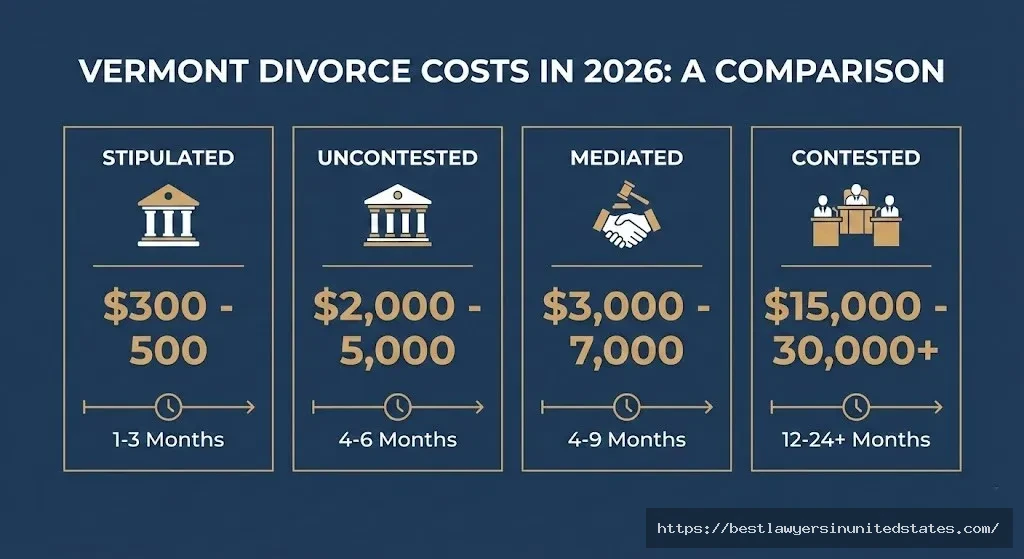
Quick Answer: Vermont Divorce Costs by Type
| Divorce Type | Total Cost Range | Timeline | Best For |
|---|---|---|---|
| Stipulated (DIY) | $300-$500 | 3-6 months | Couples agreeing on everything |
| Uncontested (with attorney) | $2,000-$5,000 | 4-8 months | Minimal conflict, simple assets |
| Mediated | $3,000-$7,000 | 4-9 months | Willing to negotiate, moderate assets |
| Contested | $15,000-$30,000+ | 12-24+ months | High conflict, complex property |
The actual amount you’ll pay depends on five key factors: whether you hire an attorney, how much you and your spouse disagree, the complexity of your assets and debts, whether you have children, and which Vermont county you file in.
Divorce Cost Calculator
Get an estimated cost for your divorce based on your specific situation
Your Estimated Divorce Cost
Cost Breakdown
📧 Get a Personalized Consultation
Have questions about your specific situation? Contact our legal experts for guidance tailored to your needs.
Contact Us via EmailWhat Are the Filing Fees for Divorce in Vermont?
Vermont Family Court charges $295 to file a divorce complaint in 2026. This is the base court fee you’ll pay regardless of your divorce type. If you’re the spouse responding to a divorce, filing an answer costs an additional $135.
Vermont Court Filing Fees
| Document | Cost |
|---|---|
| Divorce Complaint (initial filing) | $295 |
| Answer to Complaint | $135 |
| Certified Copy of Decree | $7-$15 |
| Fee Waiver Application | $0 |
These fees can be waived if you qualify based on income. Vermont Legal Aid reports that roughly 20% of divorce filers successfully obtain fee waivers. To qualify, your household income must fall below 185% of the federal poverty guidelines, which is $28,545 for a single person or $38,663 for a family of two in 2026.
The fee waiver doesn’t eliminate all costs—you’ll still need to pay for serving papers on your spouse (typically $50-$150 through a sheriff or process server) and the mandatory COPE parenting course if you have minor children ($50 per person).
Download Free Divorce Papers Wyoming pdf
How Much Does a Divorce Lawyer Cost in Vermont?
Vermont divorce attorneys charge between $250 and $450 per hour depending on their experience and location. Burlington-area attorneys typically charge $350-$450 hourly, while lawyers in rural Vermont counties often charge $250-$325 per hour.
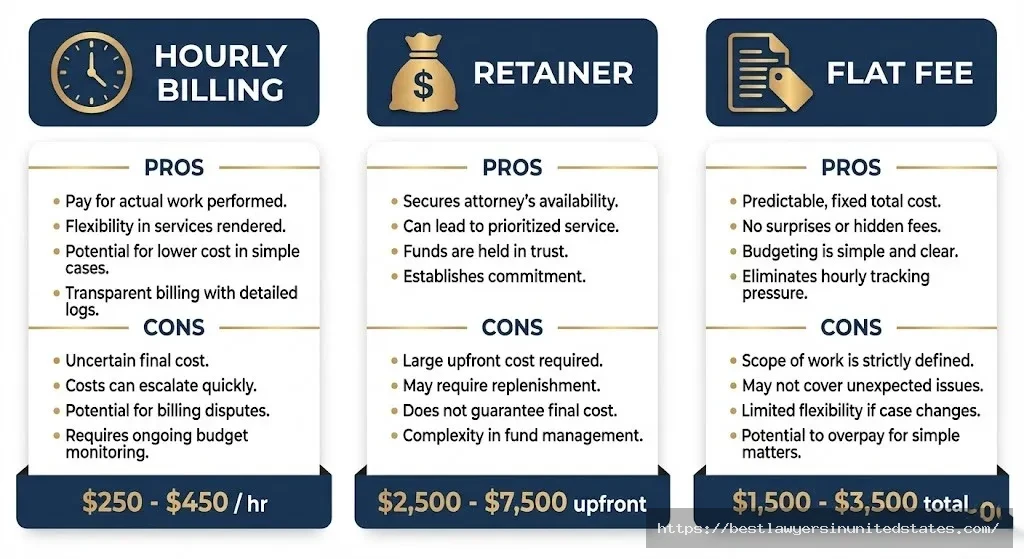
Vermont Attorney Fee Structure
| Fee Type | Typical Amount | What It Covers |
|---|---|---|
| Hourly Rate | $250-$450/hour | All legal work billed in 6-15 minute increments |
| Retainer (Initial Deposit) | $2,500-$7,500 | Upfront payment held in trust account |
| Uncontested Flat Fee | $1,500-$3,500 | Complete representation for simple divorce |
| Consultation Fee | $0-$350 | Initial meeting (many offer free consultations) |
Most Vermont family law attorneys require a retainer—an upfront deposit of $2,500 to $7,500 that sits in a trust account. They bill against this retainer at their hourly rate, and you’ll need to replenish it if your case takes longer than expected.
A straightforward uncontested divorce handled by an attorney typically requires 8-15 hours of work ($2,000-$6,750 in fees). A moderately contested case might need 40-80 hours ($10,000-$36,000), while high-conflict divorces involving custody battles or complex property can exceed 100 billable hours.
Some Vermont attorneys offer flat-fee packages for uncontested divorces, typically ranging from $1,500 to $3,500. This covers drafting documents, filing paperwork, and representing you at the final hearing—but only if both spouses cooperate and don’t require extensive negotiation.
What Is a Stipulated Divorce in Vermont and How Much Does It Cost?
A stipulated divorce means you and your spouse agree on all terms before filing—property division, debt allocation, child custody, and support. Vermont calls this a “divorce by stipulation,” and it’s the cheapest option at $300-$1,500 total.
Stipulated Divorce Cost Breakdown
| Expense Item | Cost |
|---|---|
| Court filing fee | $295 |
| Vermont divorce forms | $0-$150 (free online or paid service) |
| Service of process | $0 (if spouse accepts service) |
| COPE course (if children) | $50 per person |
| Document notarization | $0-$10 |
| Total | $295-$505+ |
The Vermont Judiciary provides all necessary divorce forms free on their website. You can download, complete, and file them yourself. Alternatively, online divorce document preparation services charge $150-$300 to help you fill out forms correctly, though they cannot provide legal advice.
For a stipulated divorce to work, you need full agreement on:
- How you’ll divide all marital property and debts
- Whether anyone will pay spousal maintenance (alimony) and how much
- Child custody arrangements and parenting time schedules (if applicable)
- Child support amounts following Vermont’s guidelines
If you disagree on even one issue, you cannot file a stipulated divorce and will need either mediation or attorney representation.
How Much Does an Uncontested Divorce Cost in Vermont?
An uncontested divorce means your spouse won’t fight the divorce, even if you haven’t agreed on every detail yet. This type costs $2,000-$5,000 when you hire an attorney to handle negotiations and paperwork.
The difference between stipulated and uncontested: In a stipulated divorce, you’ve already resolved everything before filing. In an uncontested case, you might need your attorney to negotiate a few issues, draft a settlement agreement, or handle minor disagreements—but your spouse isn’t actively contesting the divorce itself.
Typical Uncontested Divorce Costs
| Service | Cost |
|---|---|
| Attorney fees (8-15 hours) | $2,000-$6,750 |
| Filing fee | $295 |
| Process server | $50-$150 |
| COPE course | $50-$100 |
| Financial affidavit preparation | Included in attorney fees |
| Total | $2,395-$7,295 |
Vermont attorneys handling uncontested divorces typically spend 8-15 hours on your case: initial consultation, document drafting, filing with the Family Division, serving your spouse, negotiating any outstanding issues, and attending the final hearing. At $250-$450 per hour, this translates to $2,000-$6,750 in legal fees.
Many Vermont lawyers offer flat-fee packages for truly uncontested cases. If you and your spouse can agree on terms quickly, you might secure representation for $1,500-$3,500 total—significantly less than hourly billing.
What Does a Contested Divorce Cost in Vermont?
A contested divorce—where you and your spouse disagree on major issues like property division, custody, or alimony—costs $15,000-$30,000 or more in Vermont. These cases require extensive attorney time, court appearances, discovery, and potentially expert witnesses.
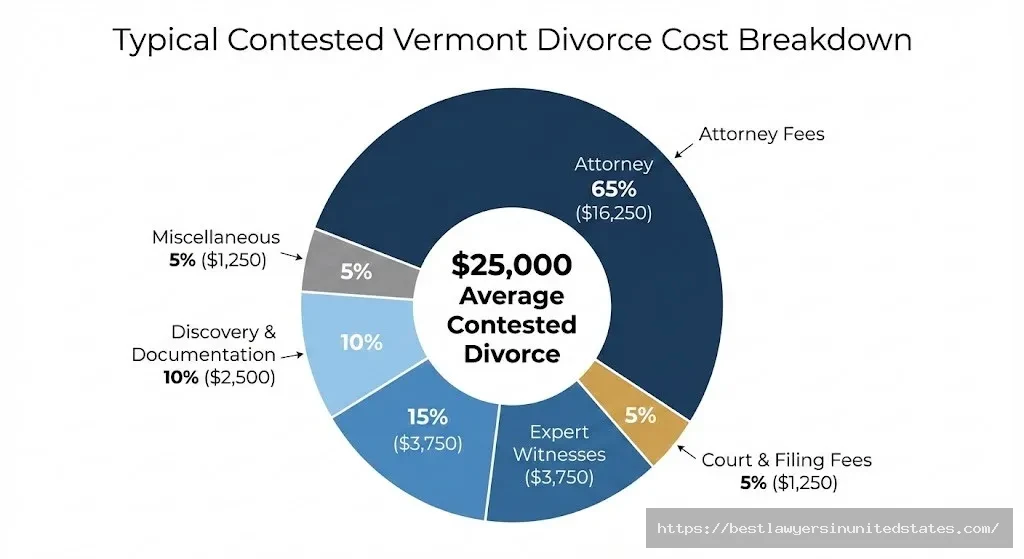
Contested Divorce Cost Components
| Expense Category | Cost Range |
|---|---|
| Attorney retainer | $5,000-$10,000 |
| Attorney hourly fees (60-150+ hours) | $15,000-$67,500 |
| Court filing fees | $295-$500 |
| Service and court costs | $200-$500 |
| COPE parenting course | $100 |
| Financial expert/appraiser | $2,000-$8,000 |
| Custody evaluator (if ordered) | $3,000-$10,000 |
| Trial preparation and testimony | $5,000-$15,000 |
| Total Potential Cost | $25,595-$111,600+ |
High-conflict Vermont divorces can drag on for 18-24 months or longer. Each contested issue adds billable hours: motions for temporary orders ($1,500-$3,000), discovery requests and depositions ($2,000-$8,000), pre-trial conferences, and ultimately a multi-day trial.
If your divorce involves substantial assets (homes, retirement accounts, businesses), you’ll likely need financial experts. A forensic accountant charges $250-$450 per hour to trace hidden income or value businesses. Real estate appraisers cost $400-$800 per property. Pension appraisers charge $500-$2,500 for QDRO preparation.
Child custody battles are particularly expensive in Vermont. If the court orders a custody evaluation, expect to pay $3,000-$10,000. The evaluator interviews both parents, observes interactions with children, reviews records, and submits a detailed recommendation to the Family Division.
How Much Does Divorce Mediation Cost in Vermont?
Divorce mediation costs $3,000-$7,000 in Vermont—significantly less than a contested divorce. You and your spouse meet with a neutral mediator who helps you negotiate all divorce terms. Most Vermont mediators charge $150-$300 per hour, and cases typically require 8-20 hours of mediation sessions.
Vermont Mediation Cost Breakdown
| Expense | Cost |
|---|---|
| Mediator hourly rate | $150-$300/hour |
| Total mediation hours | 8-20 hours |
| Mediation cost | $1,200-$6,000 |
| Court filing fee | $295 |
| Attorney review (optional) | $500-$1,500 |
| COPE course | $50-$100 |
| Total | $2,045-$7,895 |
Many Vermont couples use mediation even if they plan to hire attorneys. The mediator facilitates discussions about property division, custody arrangements, and support obligations. Once you reach agreement, the mediator drafts a memorandum of understanding. Your attorneys then review the terms and formalize them into court documents.
This hybrid approach—mediation plus limited attorney review—often costs $5,000-$10,000 total, still far less than full litigation. Vermont courts encourage mediation, and some Family Division judges require couples to attempt mediation before scheduling contested hearings.
Vermont Legal Aid offers free or reduced-cost mediation for qualifying low-income families. Contact them at (800) 889-2047 to determine eligibility.
What Hidden Costs Should You Expect in a Vermont Divorce?
Beyond attorney fees and filing costs, Vermont divorces often include hidden expenses that catch people off guard. These can add $500-$5,000+ to your total divorce bill.
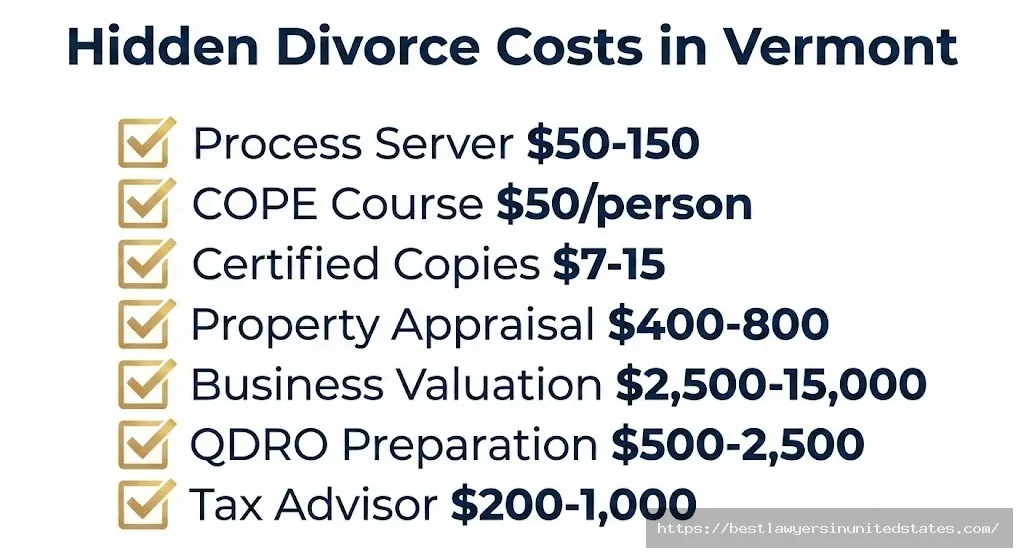
Hidden Vermont Divorce Costs
| Hidden Fee | Cost Range | When Required |
|---|---|---|
| Process server | $50-$150 | Serving papers if spouse won’t accept voluntarily |
| COPE parenting course | $50 per parent | Mandatory for all divorces with minor children |
| Case manager conference | $0 | Court-scheduled, but may require attorney time ($250-$450) |
| Certified divorce decree copies | $7-$15 each | Changing name, refinancing, benefits updates |
| Property appraisal | $400-$800 | Determining fair market value of home |
| Business valuation | $2,500-$15,000 | Valuing closely-held business interests |
| Retirement account appraisal (QDRO) | $500-$2,500 | Dividing 401(k), pension, or IRA |
| Tax advisor consultation | $200-$1,000 | Understanding divorce tax implications |
| Post-divorce modifications | $1,500-$5,000+ | Later changes to custody or support |
Vermont’s mandatory COPE program (Children of Parents in Education) requires both parents to complete a 2.5-hour course about helping children through divorce. The $50 fee is non-negotiable if you have kids under 18.
Process server fees range from $50-$150 depending on your county. Chittenden County typically charges more than rural counties. If your spouse is difficult to locate, special process service can cost $200-$500.
Every Vermont divorce with children includes a case manager conference within 30-60 days of filing. While the conference itself is free, your attorney will likely attend with you, adding 2-3 billable hours ($500-$1,350) to your tab.
Property appraisals are essential when you and your spouse can’t agree on asset values. Vermont follows equitable distribution law, not community property, so accurate valuations matter. A professional appraisal of your marital home costs $400-$800, while business valuations for a family-owned company run $2,500-$15,000.
If you’re dividing retirement accounts, you’ll need a Qualified Domestic Relations Order (QDRO) drafted by a specialist. These documents legally split 401(k)s, pensions, and IRAs without tax penalties. QDRO preparation costs $500-$2,500 depending on account complexity.
Don’t forget certified copies of your final divorce decree. You’ll need these to change your name on a driver’s license, update Social Security records, refinance property, or modify beneficiaries. Vermont courts charge $7-$15 per certified copy, and you’ll likely need 3-5 copies.
How Can You Reduce Your Vermont Divorce Costs?
Vermont divorces don’t have to break the bank. Seven proven strategies can cut your legal expenses by 40-70%, potentially saving $5,000-$20,000.
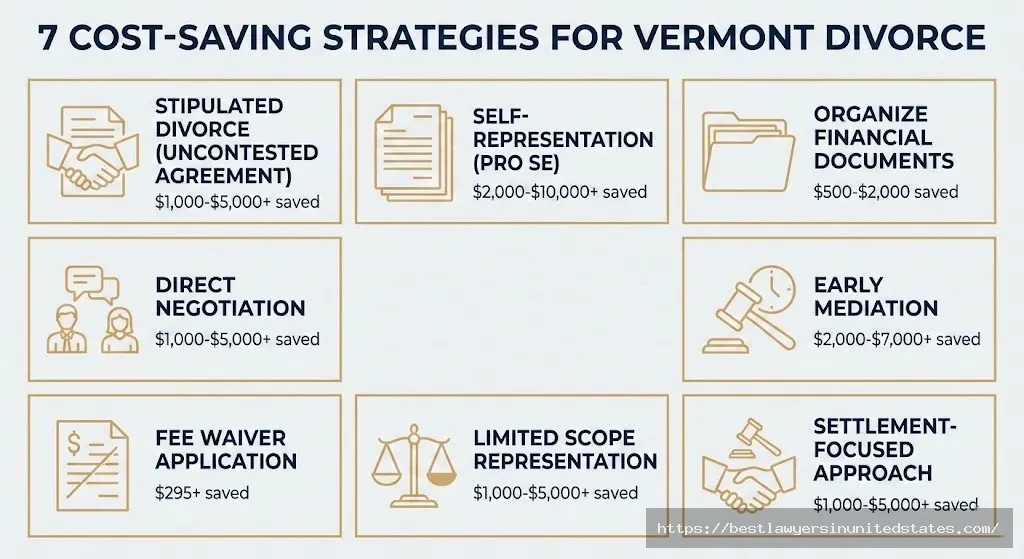
1. Try mediation before litigation. Mediation costs $3,000-$7,000 compared to $15,000-$30,000+ for contested litigation. Even if mediation only resolves some issues, you’ll reduce attorney billable hours significantly.
2. Do your own document preparation. Vermont’s judiciary website provides free divorce forms. Download them yourself rather than paying an attorney $300-$800 to fill out standardized paperwork. Save legal fees for negotiations and court appearances.
3. Organize financial records before meeting your attorney. Every minute your lawyer spends searching for bank statements or tax returns costs $250-$450. Compile all financial documents—bank statements, retirement account statements, mortgage papers, vehicle titles, credit card statements—before your first consultation. This preparation can save 5-10 billable hours ($1,250-$4,500).
4. Communicate directly with your spouse when possible. Attorney-mediated communication costs $250-$450 per hour. If you can email or text your spouse about scheduling or minor issues without attorney intervention, do it. Save your lawyer’s time for actual legal strategy.
5. Apply for a fee waiver if you qualify. If your household income is below 185% of federal poverty guidelines ($28,545 for one person in 2026), file an Application for Waiver of Filing Fee with the Vermont Family Court. This saves you $295-$430 in court costs.
6. Choose limited scope representation. Many Vermont attorneys offer “unbundled” services where they handle specific tasks—reviewing documents, appearing at hearings, giving legal advice—while you manage other parts yourself. This hybrid approach costs 50-70% less than full representation.
7. Settle quickly and avoid trial. Once your divorce reaches trial, costs skyrocket. Trial preparation requires 20-40 attorney hours ($5,000-$18,000), expert witnesses cost $2,000-$10,000, and the trial itself runs $3,000-$8,000+ for attorney time. Most Vermont family law attorneys will tell you: settle before trial whenever possible.
Does It Matter Which Vermont County You File in?
Filing fees are uniform across Vermont at $295 statewide, but attorney hourly rates and local court procedures vary significantly by county. Where you file can influence your total divorce cost by $2,000-$8,000.
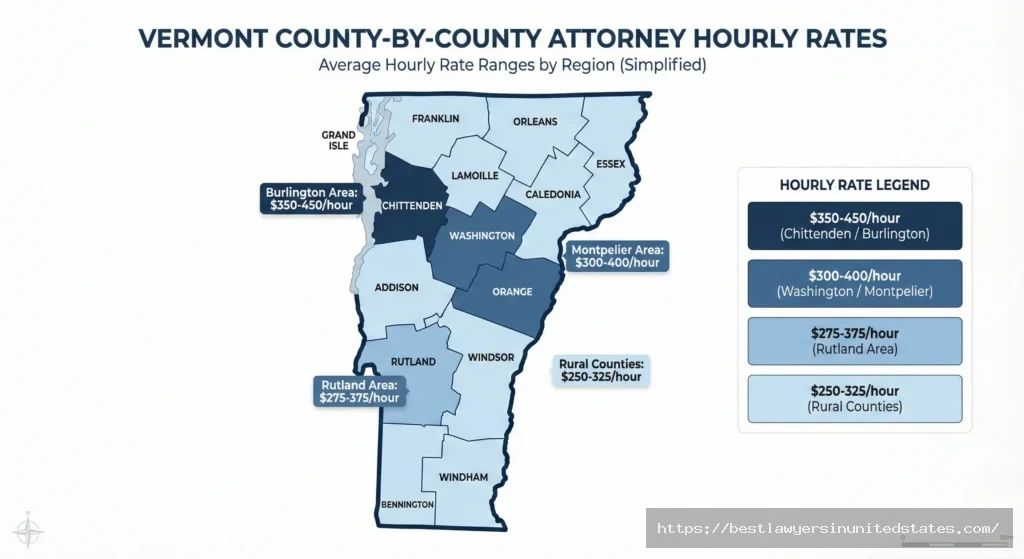
Vermont County Attorney Rate Comparison
| County | Average Attorney Hourly Rate | Typical Uncontested Cost | Population Served |
|---|---|---|---|
| Chittenden (Burlington) | $350-$450 | $3,500-$6,750 | Largest metro area |
| Washington (Montpelier) | $300-$400 | $3,000-$6,000 | State capital |
| Rutland | $275-$375 | $2,500-$5,625 | Second-largest city |
| Bennington | $250-$350 | $2,250-$5,250 | Southern Vermont |
| Windsor | $275-$375 | $2,500-$5,625 | Upper Valley region |
| Rural counties | $250-$325 | $2,000-$4,875 | Orange, Caledonia, Essex |
Chittenden County—home to Burlington, Vermont’s largest city—has the highest attorney rates at $350-$450 per hour. A typical uncontested divorce with attorney representation costs $3,500-$6,750 here compared to $2,000-$4,875 in rural counties like Orleans, Essex, or Caledonia.
Washington County (Montpelier) and Rutland County fall in the middle at $275-$400 per hour. The cost difference reflects local market rates, attorney experience levels, and cost of living variations across Vermont.
Case timelines also vary by county. Chittenden County Family Court handles the highest volume of cases in Vermont, which can mean longer wait times for hearings. Rural county courts often schedule final hearings faster—sometimes within 4-5 months for uncontested cases compared to 6-9 months in Burlington.
To file for divorce in Vermont, at least one spouse must have lived in the state for six months before filing. You file in the county where either spouse currently resides.
What Is a Wife Entitled to in a Vermont Divorce?
Vermont follows equitable distribution, not community property law. This means the court divides marital property fairly—not necessarily 50/50—based on factors like marriage length, each spouse’s contribution, and financial circumstances.
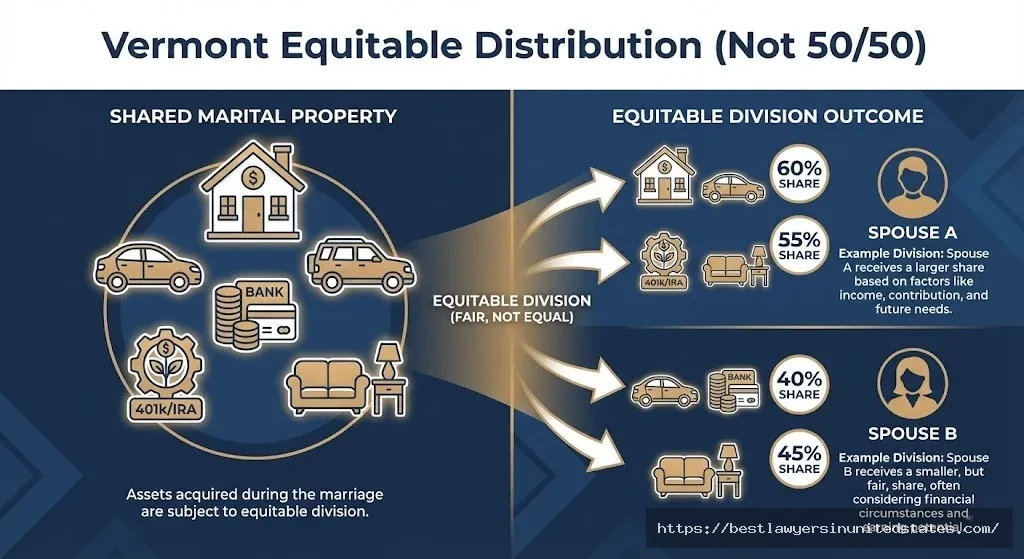
A wife (or any spouse) is entitled to:
Marital Property Division: All assets and debts acquired during marriage get divided equitably. This includes homes, vehicles, bank accounts, retirement accounts, businesses, and debts. Property owned before marriage or received as inheritance/gift typically remains separate property.
Vermont courts consider these factors when dividing property:
- Length of the marriage
- Each spouse’s contribution to acquiring marital property
- Each spouse’s contribution as homemaker
- Current value and earning potential of each spouse
- Each spouse’s health and age
- Liabilities and needs of each party
- Whether property division will serve as an alternative to spousal support
Spousal Maintenance (Alimony): Vermont courts may award temporary or permanent maintenance if one spouse lacks sufficient property or ability to meet reasonable needs. The court evaluates:
- Financial resources of the spouse seeking maintenance
- Time and training needed to acquire education or training for employment
- Standard of living during marriage
- Duration of the marriage
- Age and physical/emotional condition of both spouses
- Ability of the supporting spouse to pay while meeting their own needs
Retirement Account Division: Vermont treats retirement benefits earned during marriage as marital property subject to division. A wife whose husband contributed to a 401(k) or pension during marriage is entitled to a share, typically through a QDRO.
Real Examples of Vermont Property Division:
15-year marriage, one stay-at-home parent: Court awarded wife 60% of marital assets and temporary maintenance for three years to complete nursing degree. Husband kept his business but paid wife her share of its increased value during marriage.
7-year marriage, both working: Court divided assets 50/50 with no maintenance. Each spouse kept their own retirement accounts built before marriage and split only contributions made during marriage.
25-year marriage, significant income disparity: Wife received 55% of assets plus permanent maintenance of $2,000/month. Court recognized her contribution raising three children and managing the household while husband built his career.
Vermont is not a community property state. Unlike California or Texas where assets automatically split 50/50, Vermont judges have discretion to divide property based on what’s fair given your specific circumstances. This flexibility means having strong legal representation matters—an experienced Vermont family law attorney can argue for a more favorable distribution.
How Does Alimony Work in Vermont and What Does It Cost?
Vermont calls alimony “spousal maintenance,” and courts award it when one spouse lacks sufficient income or property to meet reasonable needs. The paying spouse can expect to pay 15-35% of their gross income in maintenance, depending on circumstances, though no strict formula exists.
Vermont Maintenance Factors
Vermont Statutes Title 15 § 752 lists factors courts consider:
- Financial resources of the spouse seeking maintenance
- Time needed to acquire education/training for employment
- Standard of living established during marriage
- Duration of the marriage
- Age and physical/emotional condition of both spouses
- Ability of the supporting spouse to pay while meeting their own needs
- Inflation
- Costs of childcare if custodial parent
- Contributions as homemaker
- Employment opportunities available to each spouse
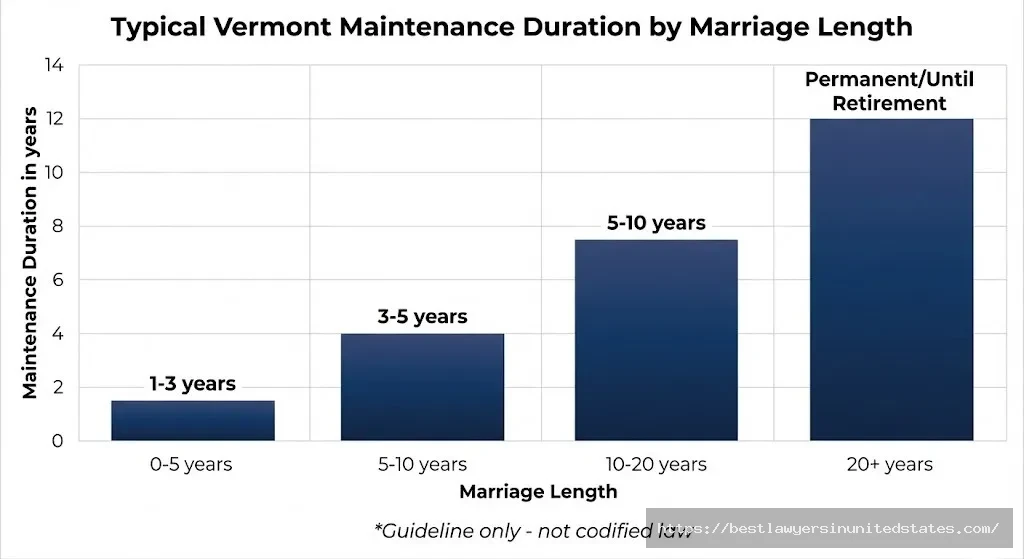
Maintenance Duration Guidelines
Vermont doesn’t follow rigid formulas, but general patterns emerge:
| Marriage Length | Typical Maintenance Duration | Monthly Amount Range |
|---|---|---|
| Under 5 years | 1-3 years (rehabilitative) | $500-$1,500 |
| 5-10 years | 3-5 years | $1,000-$2,500 |
| 10-20 years | 5-10 years | $1,500-$3,500 |
| 20+ years | Permanent or until retirement | $2,000-$5,000+ |
The “1-3-1-3-1-3 Rule” Explained
Some Vermont divorce attorneys reference a “1-3-1-3-1-3 rule” for maintenance duration, though this is not codified in Vermont law. The informal guideline suggests:
- Marriages lasting 1-3 years: No maintenance or very short-term
- Marriages lasting 3-10 years: Maintenance for 1/3 to 1/2 the marriage length
- Marriages lasting 10+ years: Maintenance for 1/2 to full marriage length, potentially permanent for 20+ year marriages
This is purely a rule of thumb some attorneys use to estimate outcomes. Vermont judges have full discretion to deviate based on case facts. Don’t rely on this formula—your specific financial situation, health, career prospects, and contributions matter far more.
Tax Implications of Vermont Alimony
Critical change in 2019: Alimony is no longer tax-deductible for the paying spouse or taxable income for the recipient for divorces finalized after December 31, 2018. This federal tax law change significantly impacts divorce negotiations.
For divorces finalized before 2019, the old rules apply—payers deduct maintenance payments and recipients report them as income. This difference affects settlement strategies substantially.
Modifying Maintenance
Vermont courts can modify maintenance if circumstances substantially change: job loss, disability, retirement, or remarriage of the recipient. Filing a modification motion costs $135 plus attorney fees of $1,500-$5,000 depending on complexity.
Real Vermont Maintenance Examples:
8-year marriage, stay-at-home mom with two young children: Court ordered husband to pay $2,200/month maintenance for 4 years while wife completed paralegal training. Wife also received 60% of marital assets and primary custody with child support.
18-year marriage, husband primary earner ($150,000/year), wife ($35,000/year): Court awarded wife $2,500/month permanent maintenance until she reaches retirement age, noting her reduced career advancement due to family responsibilities.
5-year marriage, both spouses worked: No maintenance awarded. Court found both had capacity to support themselves and marriage was relatively short with no children.
How Long Does a Vermont Divorce Take?
Vermont divorces take 3-24+ months from filing to finalization depending on complexity and cooperation level. The state has no mandatory separation period, but practical timelines vary significantly.
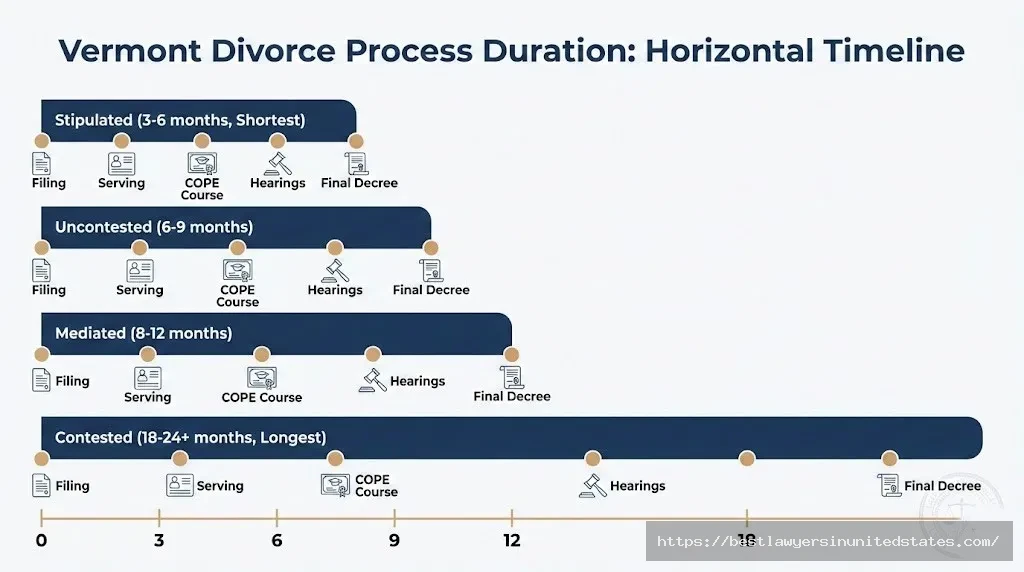
Vermont Divorce Timeline by Type
| Divorce Type | Minimum Timeline | Realistic Timeline | Key Milestones |
|---|---|---|---|
| Stipulated (agreed) | 3 months | 4-6 months | File → Serve → Wait 30 days → Final hearing |
| Uncontested | 4 months | 6-9 months | File → Serve → Answer → Negotiate → Hearing |
| Mediated | 5 months | 8-12 months | File → Mediation sessions → Agreement → Hearing |
| Contested | 12 months | 18-24+ months | File → Discovery → Motions → Trial → Decree |
Vermont Divorce Process Steps
Vermont law requires specific steps that add time to every divorce:
1. Filing (Day 1): One spouse files a Complaint for Divorce with Vermont Family Court. Filing fee: $295. If you have children under 18, the court automatically schedules a Case Manager Conference for 30-60 days out.
2. Service (Within 30 days): The non-filing spouse must be served with divorce papers. If they accept service voluntarily, this takes days. If you need a sheriff or process server, allow 2-4 weeks.
3. Response Period (30 days): The served spouse has 30 days to file an Answer. If they don’t respond, you can proceed with a default divorce after the deadline.
4. Case Manager Conference (30-60 days after filing): For divorces with children, both parties meet with a case manager to discuss custody, visitation, and support. This is mandatory and helps identify contested issues early.
5. COPE Course (For parents): Both parents must complete this 2.5-hour parenting course before finalizing divorce. The course teaches co-parenting skills and helps children adjust. Cost: $50 per person.
6. Financial Disclosures (Ongoing): Both spouses complete detailed financial affidavits listing all income, assets, debts, and expenses. Vermont requires full transparency. Hiding assets can result in sanctions.
7. Discovery (In contested cases): If spouses disagree on asset values or income, attorneys issue discovery requests: interrogatories, document requests, depositions. This process takes 3-6 months.
8. Mediation or Negotiation: Most Vermont divorces settle before trial. You’ll negotiate a final agreement covering property division, support, and (if applicable) custody. This can take 2-8 months depending on cooperation levels.
9. Final Hearing: Once you reach agreement or complete trial, the court schedules a final hearing. The judge reviews your settlement agreement or issues rulings on contested matters, then signs the divorce decree. In uncontested cases, this hearing lasts 15-30 minutes. Contested trials can span multiple days over several weeks.
10. Divorce Decree Issued: After the final hearing, the court issues your divorce decree. You’re officially divorced. Order certified copies ($7-$15 each) for name changes, refinancing, and benefits updates.
The fastest Vermont divorces—stipulated cases with no children and simple assets—can finalize in 3-4 months. The statutory minimum is simply the time needed to file, serve, wait 30 days, and get a hearing date.
Most Vermont divorces with children take 6-12 months due to mandatory COPE courses, case manager conferences, and more complex negotiations around custody and support.
High-conflict contested divorces easily stretch 18-24 months, sometimes longer if custody evaluations or business valuations are needed. Each motion filed, each discovery dispute, and each continued hearing adds 2-8 weeks to your timeline.
Which Vermont Divorce Option Is Right for You?
Choosing between DIY divorce, mediation, attorney representation, or litigation depends on four factors: your conflict level, asset complexity, whether you have children, and your budget.
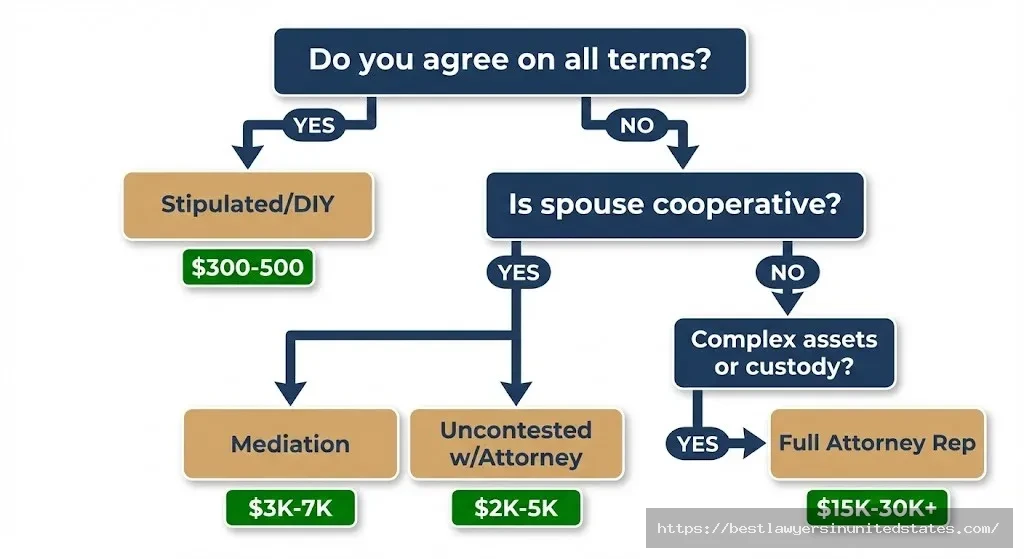
Vermont Divorce Decision Framework
Choose Stipulated/DIY Divorce ($300-$500) If:
- You and your spouse agree on all terms
- You have simple assets (no businesses, pensions, or complex investments)
- Combined marital assets under $100,000
- No contested child custody issues
- Both spouses are cooperative and honest about finances
- You’re comfortable completing legal forms yourself
Choose Uncontested with Attorney ($2,000-$5,000) If:
- You mostly agree but need help negotiating a few issues
- You have moderate assets including home, retirement accounts
- You want professional document preparation and representation
- Minor disagreements about property division or support
- You want legal advice but expect cooperation
Choose Mediation ($3,000-$7,000) If:
- You’re willing to compromise but need neutral facilitation
- Moderate to complex assets requiring fair division
- You want to maintain a co-parenting relationship
- You need help structuring custody and support agreements
- You want to avoid court while reaching fair outcomes
Choose Full Attorney Representation ($15,000-$30,000+) If:
- Significant disagreement on major issues (custody, property, support)
- One spouse is hiding assets or being dishonest
- History of domestic violence or abuse
- Complex business ownership or professional practices
- Substantial assets over $500,000
- High-conflict custody disputes requiring evaluation
- Your spouse already hired an attorney
Red Flags That Require An Attorney:
Don’t attempt DIY divorce if any of these apply:
- Your spouse hired an attorney and you haven’t
- History of domestic violence or controlling behavior
- Suspicion of hidden assets or undisclosed income
- Business ownership or professional practice to divide
- Complex retirement benefits (military pension, multiple 401(k)s)
- Your spouse pressuring you to sign documents quickly
- Disagreement about child custody or major parenting decisions
Vermont allows you to start with one approach and switch later. Many couples begin with mediation, then hire attorneys to review the mediated agreement. Others attempt DIY filing, realize it’s too complex, and retain counsel midway through.
What Are the Grounds for Divorce in Vermont?
Vermont is primarily a no-fault divorce state, meaning you don’t need to prove wrongdoing to get divorced. Most Vermont couples file under the no-fault ground that the marriage is “irretrievably broken” with no chance of reconciliation.
Vermont No-Fault Divorce Requirements
Under Vermont Statutes Title 15 § 551(7), you can file for divorce on grounds that “the marriage is irretrievably broken and the court finds that: (A) the parties have lived separate and apart for six consecutive months; or (B) irreconcilable differences have arisen which have resulted in the breakdown of the marriage and make it reasonably probable that the marriage cannot be preserved.”
Translation: You can get divorced in Vermont by either:
- Living separately for 6 months, then filing
- Claiming irreconcilable differences without separation
Most Vermont divorces use option 2—filing immediately based on irreconcilable differences without waiting 6 months. You don’t need your spouse’s consent or agreement that the marriage is broken.
Vermont Fault-Based Grounds
Vermont still allows fault-based divorce on these grounds, though they’re rarely used:
- Adultery
- Imprisonment
- Intolerable severity (cruelty)
- Willful desertion for seven years
- Incurable insanity
Does Adultery Affect Divorce in Vermont?
Vermont adultery laws exist but have minimal practical impact on divorce outcomes. While adultery is technically a crime in Vermont (V.S.A. Title 13 § 201), it’s never prosecuted, and filing for divorce based on adultery doesn’t give you advantages in property division or custody.
Vermont courts use equitable distribution regardless of fault. Adultery might influence property division only if the unfaithful spouse spent significant marital assets on an affair—hotels, gifts, trips—that depleted the marital estate. Even then, the impact is limited to reimbursing wasted marital funds, not punishing the affair itself.
Adultery doesn’t affect child custody unless the affair directly harmed the children or the parent’s judgment regarding the kids. Vermont custody decisions focus entirely on the children’s best interests, not parents’ relationship conduct.
Bottom line: Don’t bother filing a fault-based divorce in Vermont unless you have strategic reasons (rare). No-fault divorces are faster, cheaper, and reach the same outcomes.
Real Vermont Divorce Cost Examples
These anonymized examples show actual Vermont divorce costs based on different circumstances and approaches.
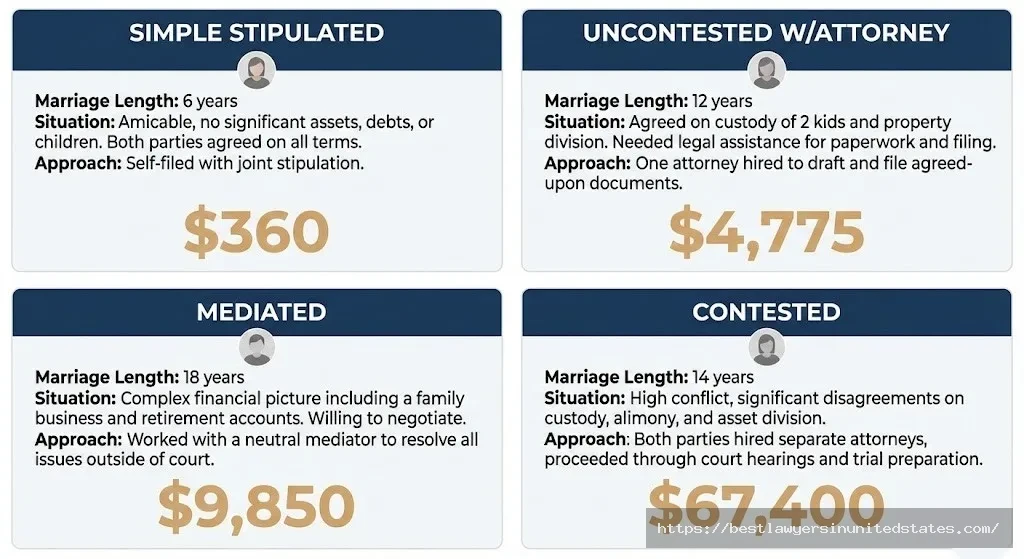
Example 1: Simple Stipulated Divorce – Burlington
Situation: 6-year marriage, no children, renting apartment, minimal assets ($15,000 savings, two cars worth $20,000 combined, $8,000 credit card debt).
Approach: Couple agreed on everything before filing. Downloaded forms from Vermont Judiciary website, completed them together, filed at Chittenden Family Court.
Total Cost: $360
- Filing fee: $295
- Notary for signatures: $10
- Process server (spouse’s work): $55
- Time to finalize: 4 months
Outcome: Each kept their own car, split savings 50/50, split debt 50/50. No spousal maintenance. Divorce finalized with one brief final hearing lasting 20 minutes.
Example 2: Uncontested Divorce with Attorney – Rutland
Situation: 12-year marriage, two children (ages 7 and 9), own home with $80,000 equity, husband’s 401(k) worth $95,000, wife’s smaller retirement account worth $25,000, some disagreement on custody schedule.
Approach: Wife hired attorney for $300/hour who negotiated settlement with husband (who represented himself initially but consulted an attorney for advice).
Total Cost: $4,775
- Attorney fees (12 hours): $3,600
- Filing fee: $295
- COPE course (both parents): $100
- Process server: $75
- Home appraisal: $500
- QDRO preparation: $1,200
- Certified copies: $5
- Time to finalize: 8 months
Outcome: Wife got primary physical custody with 60/40 parenting time. Husband pays $1,800/month child support. They split home equity 55/45 (wife received more due to less retirement savings). Each kept their vehicles. No maintenance awarded.
Example 3: Mediated Divorce – Bennington
Situation: 18-year marriage, one teenage child, own home worth $320,000 with $120,000 equity, husband’s business valued at $200,000, wife’s 403(b) worth $180,000, husband’s 401(k) worth $250,000.
Approach: Couple tried negotiating alone, made no progress. Hired mediator at $200/hour for 14 sessions over 5 months. Each spouse also retained attorney for limited advice.
Total Cost: $9,850
- Mediation (14 two-hour sessions): $5,600
- Wife’s attorney (limited scope): $2,100
- Husband’s attorney (limited scope): $1,800
- Business valuation: $3,500
- QDRO preparation: $1,500
- Filing fee: $295
- COPE course: $50
- Process server: $60
- Certified copies: $15
- Time to finalize: 11 months
Outcome: Husband kept business but paid wife $100,000 over 5 years for her share. Wife kept house with full equity. They split retirement accounts roughly 60/40 in wife’s favor to balance business value. Joint custody with equal parenting time. Husband pays $800/month child support until daughter turns 18 (two more years). Wife receives $1,500/month maintenance for 7 years.
Example 4: Contested Divorce – Chittenden County
Situation: 14-year marriage, three children (ages 4, 8, 12), highly contentious, allegations of hidden income, custody dispute, own home worth $425,000 with $200,000 equity, husband’s medical practice, wife stay-at-home mom for 10 years.
Approach: Full litigation with extensive discovery, custody evaluation, business valuation, multiple motions, temporary hearings, and 3-day trial.
Total Cost: $67,400 combined
- Wife’s attorney fees (95 hours at $375/hour): $35,625
- Husband’s attorney fees (88 hours at $400/hour): $35,200
- Filing fees and court costs: $650
- Process server and service: $180
- COPE courses: $100
- Custody evaluator: $8,500
- Medical practice valuation: $12,000
- Forensic accountant: $6,200
- Real estate appraisal: $600
- QDRO preparation: $2,200
- Child therapist testimony: $1,500
- Guardian ad litem for children: $4,800
- Temporary order motions (4): $6,000
- Certified copies: $45
- Time to finalize: 23 months
Outcome: Wife received primary physical custody (70/30 split), husband has every other weekend and one weeknight. Husband pays $2,850/month child support. Wife received 62% of marital assets including house and $500,000 from practice value (paid over 7 years). Wife receives $3,200/month permanent maintenance until youngest child turns 18, then reduces to $2,400/month for 6 more years. Both parents ordered to attend co-parenting counseling.
These examples show Vermont divorce costs range dramatically based on cooperation level, asset complexity, and whether children are involved. The $67,400 contested case cost roughly 187 times more than the $360 stipulated divorce—yet both couples ended up legally divorced.
How Much Does a Divorce Cost in Vermont? Quick FAQs
How much does a divorce cost if both parties agree in Vermont?
If both spouses agree on all terms, a Vermont divorce costs $300-$500 total for a DIY stipulated divorce (just filing fees and minimal costs) or $2,000-$5,000 if you hire an attorney to handle paperwork. Add $50 per parent for the mandatory COPE course if you have children.
What is the cheapest way to get divorced in Vermont?
The cheapest Vermont divorce is a stipulated (agreed) divorce without an attorney, costing $300-$500. Download free forms from the Vermont Judiciary website, file them yourself at Family Court ($295 filing fee), and represent yourself at the brief final hearing. This only works if you and your spouse agree on everything.
Can I get a free divorce in Vermont?
Vermont doesn’t offer completely free divorces, but you can get the $295 filing fee waived if your income falls below 185% of federal poverty guidelines ($28,545 for one person in 2026). File an Application for Waiver of Filing Fee with the court. Vermont Legal Aid also provides free legal help to qualifying low-income residents. Call (800) 889-2047 to check eligibility.
Who pays the divorce fees in Vermont?
Usually each spouse pays their own attorney fees and splits court costs. However, Vermont judges can order one spouse to pay the other’s reasonable attorney fees if there’s significant income disparity or if one spouse has substantially more financial resources. This is called a “fee award” and requires a motion filed with the court.
How much does a divorce lawyer cost in Vermont?
Vermont divorce attorneys charge $250-$450 per hour depending on experience and location. Burlington-area lawyers typically charge $350-$450/hour, while rural Vermont attorneys charge $250-$325/hour. Most require an upfront retainer of $2,500-$7,500. Total legal fees range from $2,000 for simple uncontested cases to $30,000+ for contested divorces.
Does adultery affect divorce cost in Vermont?
Adultery rarely affects divorce cost in Vermont. While you can file for divorce based on adultery (a fault ground), it won’t change property division, custody, or support outcomes unless the affair financially depleted marital assets. Most Vermont couples file no-fault divorces claiming “irreconcilable differences”—it’s faster and just as effective. Filing fault-based divorce based on adultery might increase costs by requiring proof through witnesses or evidence.
How long do you have to be married to get alimony in Vermont?
Vermont has no minimum marriage length requirement for alimony (called “spousal maintenance”). Courts can award maintenance in short marriages if circumstances warrant it, though it’s uncommon. Generally, marriages under 5 years rarely result in maintenance unless one spouse sacrificed career opportunities for the marriage. Maintenance becomes more likely in marriages lasting 10+ years, with longer marriages more likely to result in longer-term or permanent support.
Is Vermont a 50/50 divorce state?
No. Vermont follows equitable distribution, not 50/50 community property division. Courts divide marital assets fairly based on factors like marriage length, each spouse’s contributions, earning capacity, and needs—not automatically 50/50. In practice, many Vermont divorces result in roughly 50/50 splits for shorter marriages with equal earners, but the court has discretion to award 60/40, 70/30, or other ratios based on circumstances.
What happens if I can’t afford a divorce in Vermont?
If you can’t afford Vermont’s $295 filing fee, file an Application for Waiver of Filing Fee based on your income. Contact Vermont Legal Aid at (800) 889-2047 for free legal representation if you qualify financially. Consider a DIY divorce using free court forms if your situation is simple and both spouses cooperate. Some Vermont attorneys offer payment plans or limited scope representation (helping with specific tasks only) to reduce upfront costs.
How much does it cost to modify a divorce decree in Vermont?
Filing a motion to modify custody, support, or maintenance costs $135 in Vermont Family Court. Attorney fees for modification range from $1,500-$5,000 depending on whether it’s contested. Simple agreed modifications cost less, while contested modifications requiring hearings or evidence cost more. You can only modify Vermont divorce decrees if circumstances have substantially changed since the original order.
Why is moving out the biggest mistake in a divorce?
Moving out of the marital home before divorce can weaken your negotiating position for property division and hurt your custody case if you have children. Vermont judges consider stability when awarding custody—moving out might be interpreted as abandoning your parental role. Financially, moving out means paying for two households before assets are divided, straining your budget during divorce. Before moving out, consult a Vermont family law attorney about strategic implications for your specific case. Sometimes staying is impossible (domestic violence), but voluntary moves should be carefully planned.
Do I have to support my wife after divorce in Vermont?
Maybe. Vermont courts can order spousal maintenance (alimony) if your spouse lacks sufficient property or income to meet reasonable needs and you have the ability to pay. Factors include marriage length, standard of living during marriage, each spouse’s earning capacity, age, health, and contributions to the marriage. Maintenance isn’t automatic—your spouse must request it, and the court must find it appropriate based on statutory factors. Maintenance can be temporary (rehabilitative) or permanent, depending on circumstances.
Can my wife take my house in a Vermont divorce?
Vermont doesn’t automatically give your house to either spouse. The court will divide all marital property—including the house—equitably (fairly). If the house was purchased during marriage, it’s marital property subject to division. Options include: selling the house and splitting proceeds, one spouse keeping it and buying out the other’s equity, or offsetting the house value against other assets (one keeps house, other gets retirement accounts). If you owned the house before marriage, the appreciation in value during marriage may be marital property while the original equity remains yours.
What money can’t be touched in a divorce in Vermont?
Separate property generally isn’t divided in Vermont divorce. This includes: property owned before marriage, inheritances received by one spouse, gifts given specifically to one spouse (not both), personal injury settlements for pain and suffering (not lost wages), and property specified as separate in a valid prenuptial agreement. However, if separate property was commingled with marital property—like depositing inheritance into a joint account—it may lose its separate character and become divisible.
How do I file for divorce in Vermont without a lawyer?
Download free divorce forms from the Vermont Judiciary website at www.vermontjudiciary.org/family/divorce. Choose forms based on whether you have children. Complete the Complaint for Divorce and supporting documents. File them at Vermont Family Court in your county (filing fee: $295). Serve copies on your spouse via sheriff or process server. If your spouse doesn’t contest, wait 30 days, then request a final hearing. Attend the hearing where the judge reviews your agreement and issues a divorce decree. For step-by-step guidance, see Vermont’s self-help resources or contact Vermont Legal Aid.
What assets are not included in a Vermont divorce?
Property acquired before marriage, inheritances, gifts given to one spouse individually, personal injury settlements (pain/suffering portion), and property designated as separate in a prenuptial agreement generally aren’t divided in Vermont divorce. However, the increase in value of separate property during marriage may be considered marital property. For example, if you owned a house worth $200,000 before marriage and it’s now worth $350,000, the $150,000 appreciation might be subject to division. Retirement account contributions made before marriage typically remain separate property while contributions during marriage are marital.
How much does mediation cost for divorce in Vermont?
Vermont divorce mediation costs $150-$300 per hour, with most cases requiring 8-20 hours of mediation sessions over several months. Total mediation costs range from $1,200-$6,000. Add the $295 court filing fee, $50-$100 for COPE courses (if you have children), and optionally $500-$1,500 for attorneys to review the mediated agreement. Total mediated divorce cost: $3,000-$7,000, significantly less than litigating a contested divorce.
What is a stipulated divorce in Vermont and how much does it cost?
A stipulated divorce means you and your spouse have already agreed on all terms before filing—property division, debt allocation, child custody, support, and alimony. You submit a written stipulation agreement to the court along with your divorce complaint. The judge reviews it for fairness, and if approved, issues a divorce decree without trial. Stipulated divorces cost $300-$1,500 total including filing fees, forms, and minimal service costs. This is Vermont’s fastest and cheapest divorce option, typically finalizing in 3-6 months.
How much does a contested divorce cost in Vermont?
A contested divorce in Vermont costs $15,000-$30,000+ per spouse when you disagree on major issues like property division, custody, or support. Costs include attorney fees ($250-$450/hour for 60-150+ hours), court filing fees, expert witnesses (appraisers, custody evaluators, financial experts), discovery costs, and trial preparation. High-conflict cases with substantial assets or complex custody disputes can exceed $50,000 per spouse. The more issues you contest and the longer the case drags on, the higher your costs climb.
Can I represent myself in a Vermont divorce?
Yes. Vermont allows self-representation in divorce (called “pro se”). Download free forms from the Vermont Judiciary, complete them, file with Family Court, serve your spouse, and represent yourself at hearings. This works best for simple cases where both spouses agree on everything. However, self-representation is risky if: your spouse hired an attorney, you have significant assets or debts, custody is contested, or complex financial issues exist. Consider at least consulting an attorney for limited scope advice even if you do most work yourself.
What is the COPE course in Vermont divorce?
COPE (Children Of Parents in Education) is a mandatory 2.5-hour parenting course required for all divorcing Vermont parents with children under 18. The course teaches co-parenting skills, helping children cope with divorce, and maintaining stability during family transitions. Both parents must complete COPE before the court will finalize your divorce. Cost: $50 per parent. Many counties offer the course in-person or online. Register through your local Vermont Family Court or check the Vermont Judiciary website for approved providers.
How does child support affect divorce cost in Vermont?
Child support itself is calculated using Vermont’s standard guidelines based on parents’ combined income and custody arrangement—this doesn’t add to divorce cost since it’s formulaic. However, if parents dispute income calculations (especially with self-employed parents or variable income), you might need a forensic accountant ($2,000-$8,000) to analyze finances. Contested custody battles dramatically increase divorce costs since custody determination affects child support amounts. If you agree on custody and accurately disclose income, child support adds minimal cost to your divorce beyond attorney time to prepare support orders.
Does the length of marriage affect divorce cost in Vermont?
Not directly, but longer marriages tend to cost more to divorce because they involve more complex assets (real estate, retirement accounts, businesses) and more likely alimony disputes. A 3-year marriage with minimal assets might cost $300-$2,000 to divorce, while a 20-year marriage with accumulated wealth, retirement accounts, and maintenance issues might cost $5,000-$30,000+. The complexity matters more than duration—a complicated 5-year marriage can cost more to divorce than a simple 15-year marriage where spouses agree on terms.
Next Steps: Getting Started with Your Vermont Divorce
Now that you understand Vermont divorce costs, take these action steps:
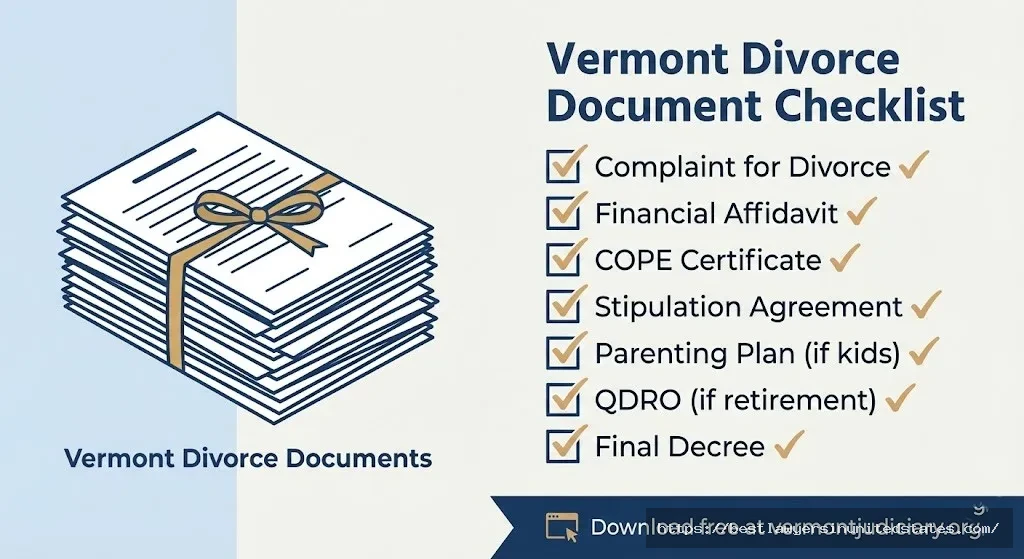
If you and your spouse agree on everything: Download Vermont’s free divorce forms, complete them together, and file at your county Family Court. Total DIY cost: $300-$500. Finalize in 3-6 months.
If you need help but want to minimize costs: Schedule consultations with 2-3 Vermont family law attorneys offering free initial meetings. Ask about flat-fee uncontested divorce packages ($1,500-$3,500) or limited scope representation where the attorney handles specific tasks while you do the rest.
If you can’t agree but want to avoid litigation: Contact a Vermont divorce mediator. Expect $150-$300 per hour for 8-20 hours of sessions ($3,000-$7,000 total). This is still far less expensive than contested litigation.
If you can’t afford the filing fee: File an Application for Waiver of Filing Fee with Vermont Family Court. If your income qualifies, the $295 fee is waived. Also contact Vermont Legal Aid at (800) 889-2047 for free legal assistance if you meet income guidelines.
If your case is complex or high-conflict: Don’t attempt DIY divorce. Hire an experienced Vermont family law attorney. The upfront cost ($2,500-$7,500 retainer) is worth it to protect your financial interests and parental rights. Compare this to divorce costs in neighboring states to understand regional variations.
Gather these documents before meeting with an attorney:
- Last 3 years of tax returns
- Recent pay stubs for both spouses
- Bank and investment account statements (last 6 months)
- Retirement account statements (401k, IRA, pension)
- Property deeds and mortgage statements
- Vehicle titles and loan information
- Credit card statements showing marital debts
- Life insurance policies
- Health insurance information
- Documentation of separate property (pre-marital assets, inheritances)
Coming prepared saves attorney billable hours, potentially reducing your costs by $1,000-$3,000.
Vermont divorce doesn’t have to bankrupt you. With the right approach—whether DIY stipulated divorce, mediation, or strategic attorney representation—you can dissolve your marriage at a cost that matches your situation and budget. The key is understanding your options, acting strategically, and getting help when you need it.
