
North Carolina uses “DWI” (Driving While Impaired), not “DUI.” A DWI conviction in NC follows a unique 6-level sentencing system under N.C.G.S. § 20-138.1. First-time offenders typically face Level 5 penalties with a minimum 24-hour jail sentence, though judges often substitute community service.
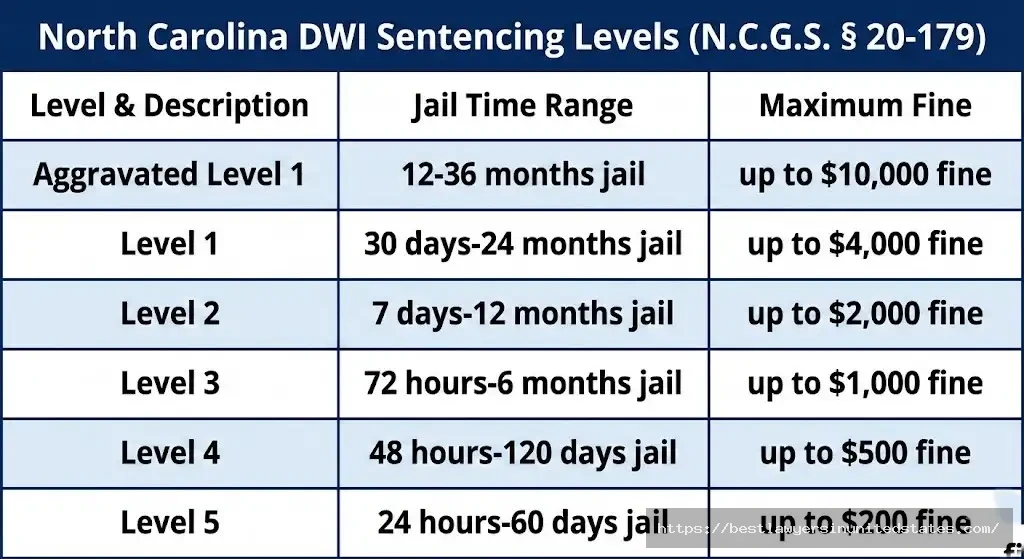
North Carolina’s DWI laws differ significantly from other states. The state employs a structured sentencing system based on aggravating and mitigating factors rather than simple first, second, or third offense categories. Understanding these distinctions can make a substantial difference in your case outcome.
Understanding North Carolina DWI Laws
What Constitutes DWI in North Carolina?
North Carolina defines DWI as operating a vehicle while “appreciably impaired” by alcohol or drugs. You violate N.C.G.S. § 20-138.1 if you drive with a blood alcohol concentration of 0.08% or higher, or if any amount of impairing substance affects your ability to drive safely.
Key point: NC law applies to any vehicle operation on any highway, street, or public vehicular area. Unlike some states, you can receive a DWI charge on private property if the area is open to public traffic.
North Carolina BAC Limits
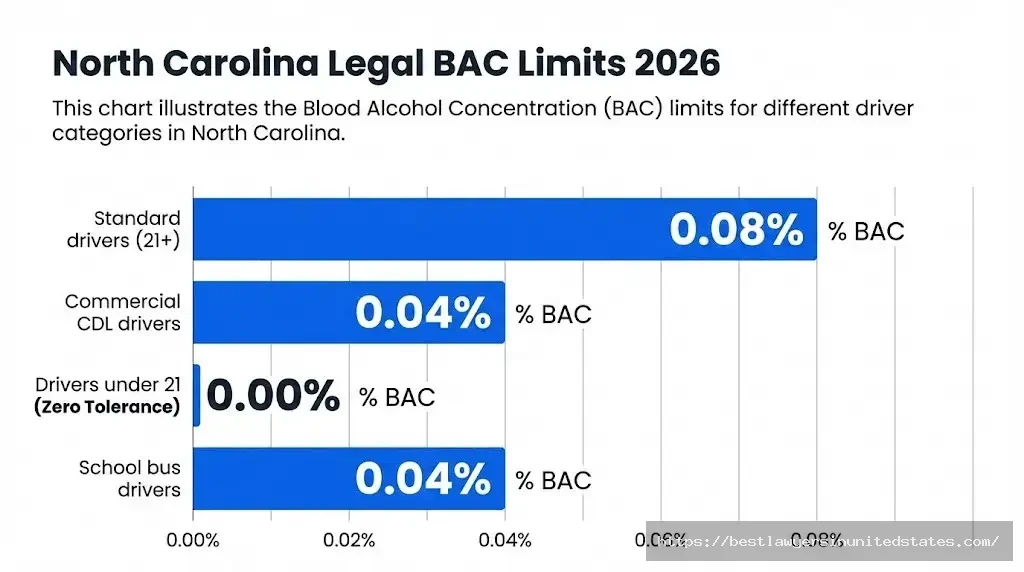
Different drivers face different legal limits in North Carolina:
| Driver Type | Legal BAC Limit |
|---|---|
| Standard drivers (21+) | 0.08% |
| Commercial drivers (CDL) | 0.04% |
| Drivers under 21 | 0.00% (zero tolerance) |
| School bus drivers | 0.04% |
Not sure where you stand? Calculate your potential BAC level using our interactive BAC calculator to understand how drinks affect your blood alcohol concentration.
BAC Calculator
Estimate your Blood Alcohol Content
• Commercial Driver (CDL): 0.04% BAC
• Drivers Under 21: 0.00-0.02% BAC (Zero Tolerance)
• Enhanced Penalties: 0.15% BAC or higher in most states
The Implied Consent Law
When you receive a North Carolina driver’s license, you automatically agree to chemical testing if arrested for DWI. This “implied consent” law under N.C.G.S. § 20-16.2 gives officers authority to request breath, blood, or urine tests.
Critical deadline: Refusing the test triggers immediate consequences separate from your criminal case.
Can You Get a DWI on Private Property in NC?
Yes. North Carolina law covers any “public vehicular area,” which includes shopping center parking lots, apartment complex driveways, and other private areas open to public use. Courts have upheld DWI convictions for drivers arrested in grocery store parking lots and residential community streets.
NC DWI Sentencing: The 6-Level System Explained
How North Carolina Judges Determine Your Sentence
North Carolina abandoned simple first, second, third offense sentencing in favor of a factor-based system under N.C.G.S. § 20-179. Judges weigh three types of factors to determine your sentencing level:
- Grossly Aggravating Factors (most serious)
- Aggravating Factors (increase severity)
- Mitigating Factors (decrease severity)
The presence and number of these factors determines whether you receive Aggravated Level 1, Level 1, Level 2, Level 3, Level 4, or Level 5 sentencing.
Grossly Aggravating Factors
These factors carry the most weight and automatically elevate your sentencing level:
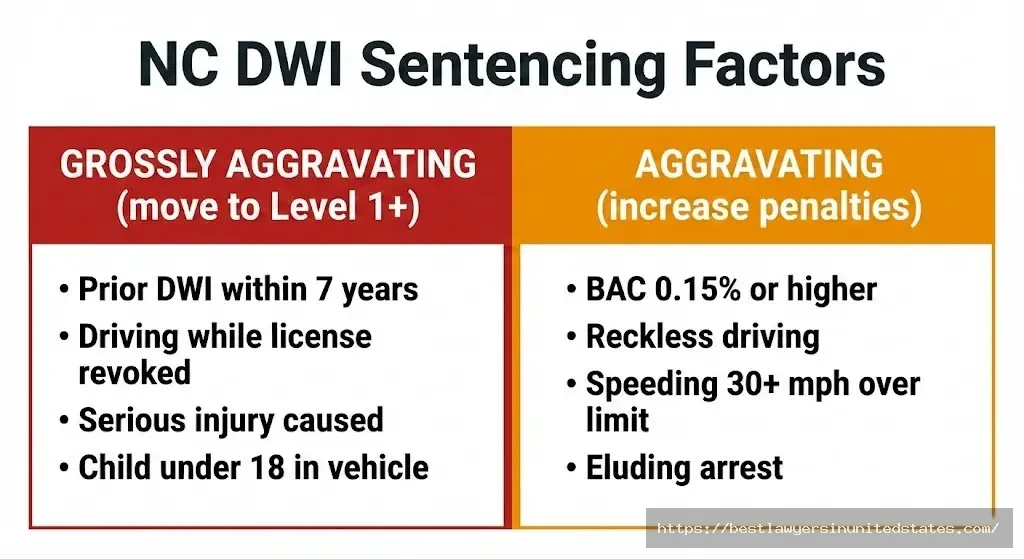
The four grossly aggravating factors:
- Prior DWI conviction within 7 years
- Driving while license revoked for prior DWI
- Serious injury to another person caused by DWI
- Child under 18 in the vehicle during offense
Impact: Just one grossly aggravating factor moves you to Level 1 or higher sentencing. Two or more factors result in Aggravated Level 1, the most severe punishment.
Aggravating Factors That Increase Penalties
Courts consider these circumstances when determining your sentence:
- Grossly reckless or dangerous driving
- BAC of 0.15% or higher
- Driving with revoked, suspended, or no license
- Passing a stopped school bus
- Speeding to elude arrest
- Reckless driving conviction arising from same incident
- Speeding more than 30 mph over limit
- Two or more moving violations within 5 years
- Prior DWI conviction more than 7 years ago
Mitigating Factors That Decrease Penalties
These factors can reduce your sentencing level:
- Slight impairment with BAC not exceeding 0.09%
- Safe, lawful driving except for impairment
- Safe driving record (4 years with no convictions)
- Impairment caused by lawfully prescribed medication
- Voluntary submission to substance abuse assessment
- Completion of substance abuse treatment
NC DWI Sentencing Chart
| Sentencing Level | Grossly Aggravating Factors | Jail Time | Fines | Community Service |
|---|---|---|---|---|
| Aggravated Level 1 | 3 or more | 12-36 months | Up to $10,000 | N/A |
| Level 1 | 1 or 2 | 30 days-24 months | Up to $4,000 | N/A |
| Level 2 | 0 (but aggravating > mitigating) | 7 days-12 months | Up to $2,000 | 24-60 hours |
| Level 3 | 0 (balanced factors) | 72 hours-6 months | Up to $1,000 | 24-72 hours |
| Level 4 | 0 (mitigating > aggravating) | 48 hours-120 days | Up to $500 | 24-48 hours |
| Level 5 | 0 (only mitigating factors) | 24 hours-60 days | Up to $200 | 24 hours |
Note: Judges may suspend jail time for Levels 3-5 and substitute community service. Levels 1 and Aggravated Level 1 require actual jail time with limited suspension options.
Will You Go to Jail for a First DWI in North Carolina?
Quick Answer: Most first-time DWI offenders in North Carolina receive Level 5 sentencing with a minimum 24-hour jail requirement, though judges typically allow community service substitution instead of actual jail time.
Level 5: The Most Common First Offense Outcome
Approximately 70% of first-time DWI offenders with no aggravating factors receive Level 5 sentencing. This includes:
- Minimum 24 hours in jail (usually suspended)
- Fine up to $200
- Court costs (typically $180-$200)
- 60-day license revocation
- Substance abuse assessment
Key benefit: Judges almost always suspend the 24-hour jail requirement in favor of 24 hours of community service for first-time offenders with clean records.
When First Offenders Face Harsher Sentences
You may receive Level 3 or Level 4 sentencing even as a first offender if:
- Your BAC measured 0.15% or higher
- You drove recklessly or dangerously
- You had a child in the vehicle
- You caused an accident
These aggravating factors can increase your jail time to 48-72 hours minimum, with judges less likely to substitute community service.
What Happens After Your DWI Arrest
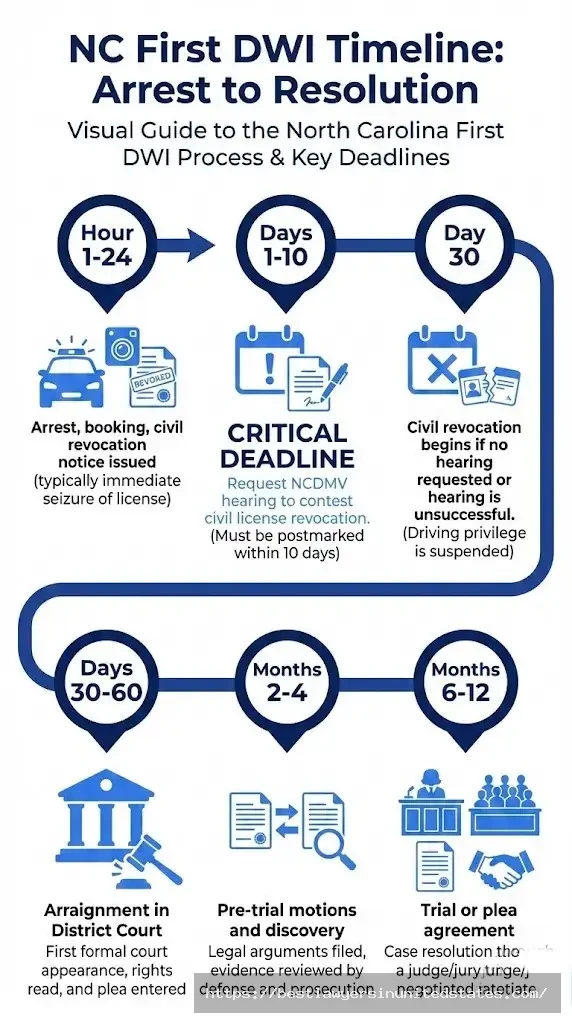
Timeline of events:
- Immediate: Police confiscate your license and issue a civil revocation notice
- Within 10 days: Request a civil revocation hearing with NCDMV
- Within 30 days: Arraignment on criminal charges
- 30 days: Civil license revocation begins unless you request and win a hearing
- 60-120 days: Pre-trial motions and hearings
- 6-12 months: Trial or plea agreement
Contact a DWI attorney immediately to protect your rights and minimize consequences. Email [email protected] for a free consultation with experienced North Carolina DWI lawyers.
Second and Third DWI Offenses in North Carolina
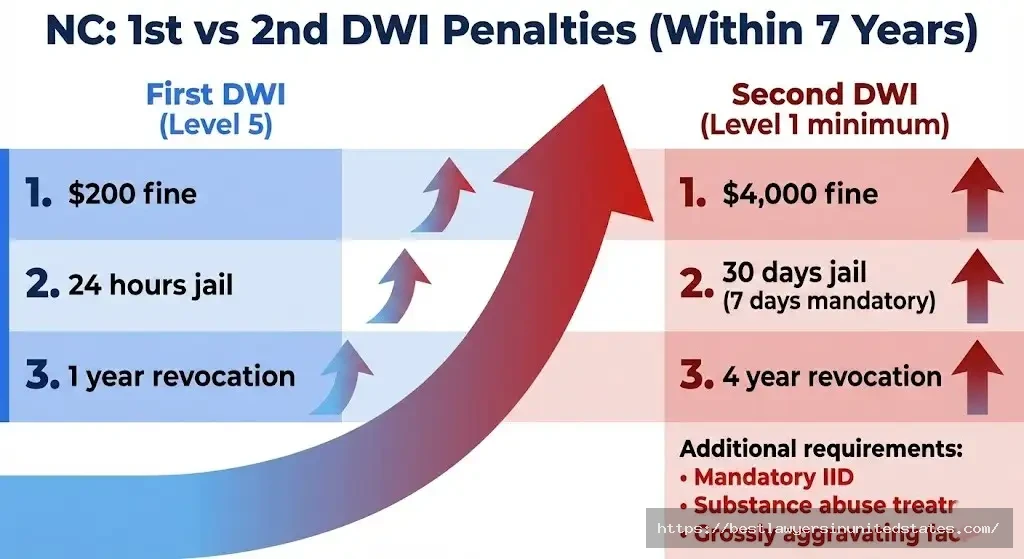
How Prior Convictions Affect Sentencing
A second DWI conviction within 7 years qualifies as a grossly aggravating factor under N.C.G.S. § 20-179. This automatically elevates you to Level 1 sentencing at minimum.
Second offense penalties (Level 1):
- Minimum 30 days in jail (no suspension allowed for first 7 days)
- Fine up to $4,000
- 4-year license revocation
- Mandatory ignition interlock device
- Substance abuse treatment (not just assessment)
The 7-Year Lookback Period
North Carolina counts prior DWI convictions within 7 years as grossly aggravating factors. A second DWI after more than 7 years may still face enhanced penalties through aggravating factors, but not grossly aggravating status.
Example: If you received a DWI in 2018 and another in 2026, the 2018 conviction counts as grossly aggravating. The same DWI in 2017 would only count as an aggravating factor.
Third Offense: Approaching Felony Territory
A third DWI conviction within 7 years results in at least two grossly aggravating factors, triggering Aggravated Level 1 sentencing:
- Minimum 12 months in jail
- Maximum 36 months in jail
- Fine up to $10,000
- Permanent license revocation (subject to limited driving privilege after 3 years)
- Mandatory ignition interlock for life
Critical point: Three DWI convictions within 10 years makes you eligible for habitual DWI charges, a Class F felony.
Habitual DWI: North Carolina’s Felony Charge
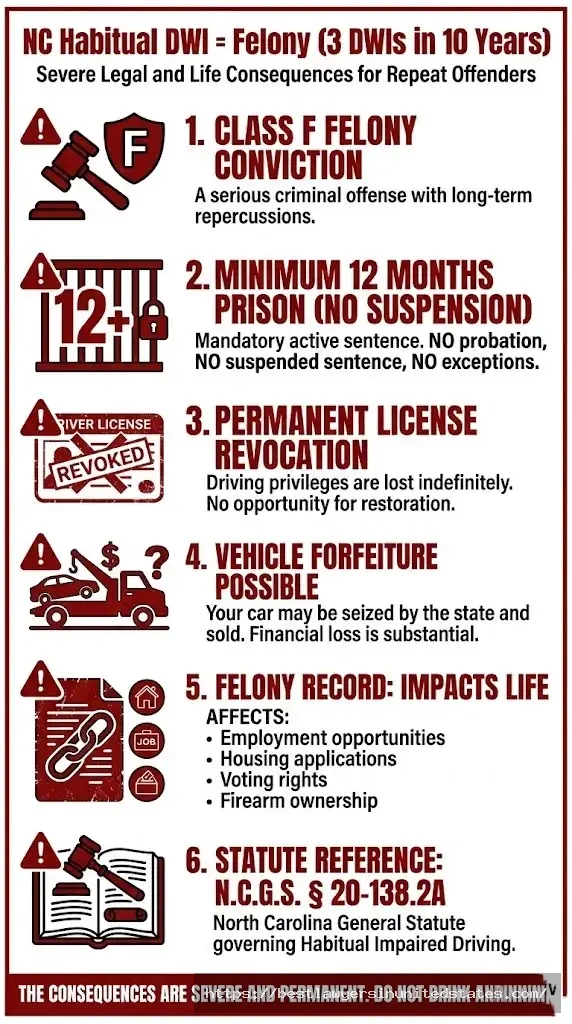
When DWI Becomes a Felony
North Carolina elevates DWI to felony status under N.C.G.S. § 20-138.2A when you receive three or more DWI convictions within 10 years. This “habitual impaired driving” charge carries substantially harsher penalties than misdemeanor DWI.
Habitual DWI penalties:
- Class F felony conviction
- Minimum 12 months in prison (no suspension or substitution)
- Permanent license revocation
- Vehicle forfeiture (state may seize your car)
- Felony record affecting employment, housing, voting rights
How the 10-Year Lookback Works
Prosecutors count all DWI convictions within 10 years from the date of the current offense. Unlike the 7-year grossly aggravating factor window, habitual DWI has a broader scope.
Example: DWI convictions in 2016, 2019, and 2024 would qualify for habitual DWI charges in 2026 because all three fall within 10 years of the current offense.
Fighting Habitual DWI Charges
An experienced attorney may challenge habitual DWI charges by:
- Questioning the validity of prior convictions
- Examining whether prior convictions fell outside the 10-year window
- Negotiating reduction to misdemeanor DWI
- Challenging the current DWI charges to avoid third conviction
The consequences of felony conviction warrant aggressive legal defense. Find qualified North Carolina criminal defense lawyers who handle habitual DWI cases.
License Suspension and Revocation in North Carolina
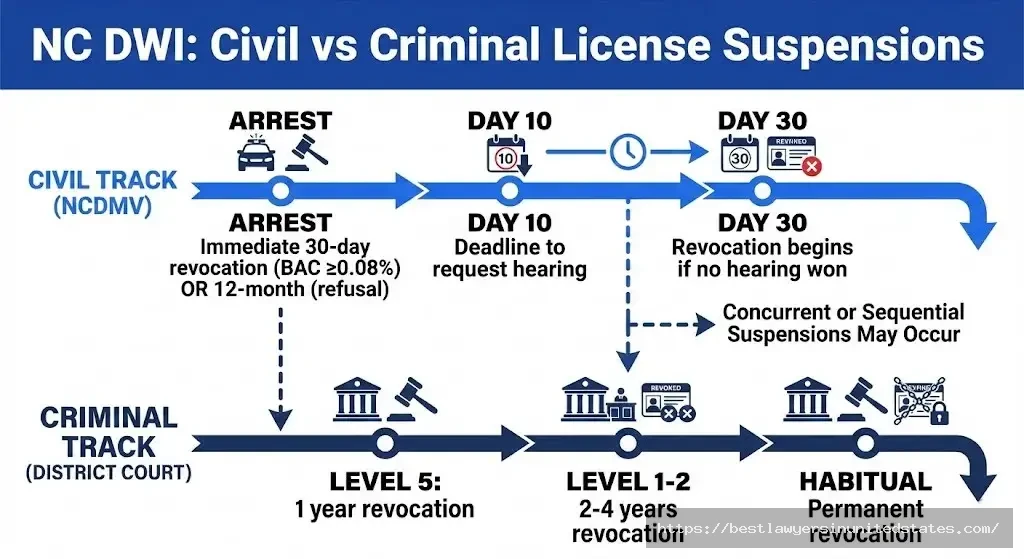
Immediate Civil Revocation at Arrest
North Carolina imposes two separate license suspensions: civil (administrative) and criminal. The civil revocation begins immediately upon arrest if you:
- Refuse chemical testing (12-month revocation)
- Submit to testing with BAC ≥0.08% (30-day revocation)
Critical deadline: You have exactly 10 days from your arrest date to request a civil revocation hearing. Missing this deadline means automatic suspension with no opportunity to contest it.
Criminal Court Suspension
A DWI conviction in criminal court triggers additional license revocation:
| Offense Level | Revocation Period |
|---|---|
| Level 5 (first offense, no aggravating factors) | 1 year |
| Level 4-3 | 1 year |
| Level 2-1 | 2-4 years |
| Aggravated Level 1 | Permanent (eligible for limited privilege after 3 years) |
| Habitual DWI | Permanent |
Suspension vs. Revocation: What’s the Difference?
Suspension: Temporary removal of driving privileges with automatic reinstatement after the period ends.
Revocation: Complete cancellation of your license requiring you to reapply, pay fees, and meet all requirements as a new driver.
North Carolina DWI convictions result in revocation, not suspension. You cannot simply wait out the period and automatically drive again.
How Suspensions Stack
Civil and criminal suspensions run concurrently (at the same time) in most cases. However, refusing the chemical test adds penalty time:
Example:
- Refuse test: 12-month civil revocation
- Level 5 conviction: 1-year criminal revocation
- Total: 12 months (concurrent), not 24 months
Getting Your License Back: Limited Driving Privilege in NC
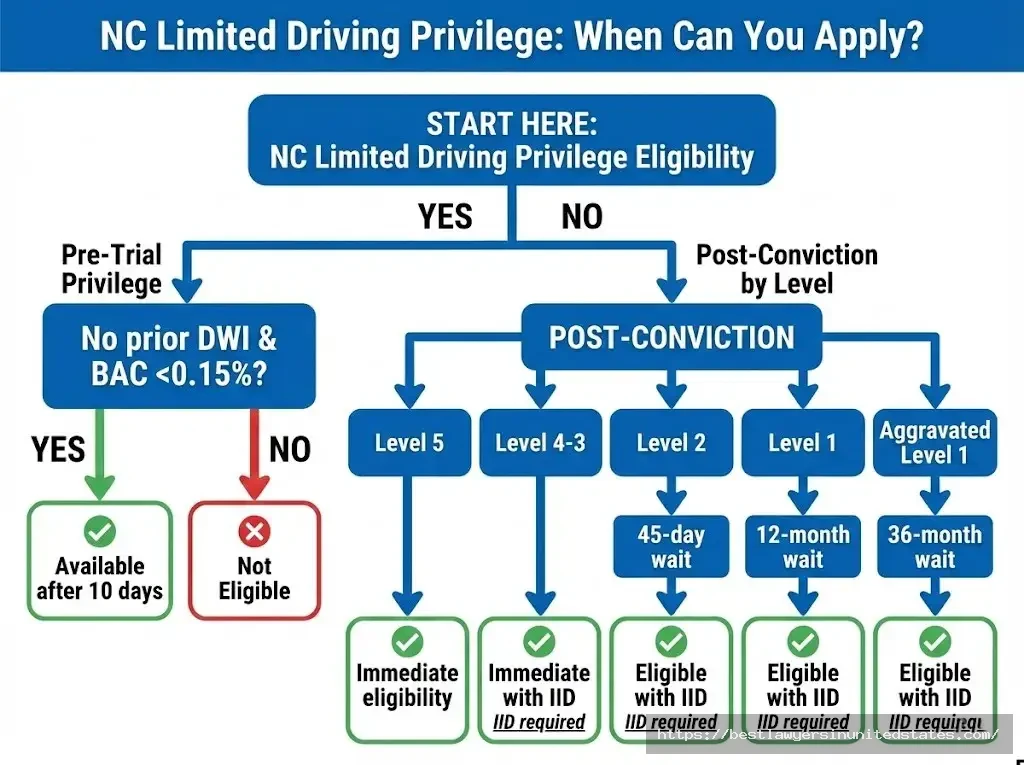
What Is a Limited Driving Privilege?
North Carolina uses the term “limited driving privilege,” not “restricted license” or “hardship license.” This court order allows you to drive for specific purposes during your revocation period under N.C.G.S. § 20-179.3.
Approved driving purposes:
- Travel to and from work
- Maintaining your household
- Educational purposes
- Court-ordered treatment programs
- Community service
- Emergency medical care
Pre-Trial Limited Driving Privilege
You may obtain driving privileges before your criminal trial in certain circumstances:
Eligibility requirements:
- No prior DWI convictions within 7 years
- BAC below 0.15% at time of arrest
- Valid driver’s license at time of offense
- Not charged with any grossly aggravating factors
- Completed substance abuse assessment
Waiting period: You can apply 10 days after your civil revocation begins.
Post-Conviction Limited Driving Privilege
After conviction, eligibility depends on your sentencing level:
| Sentencing Level | Waiting Period | Ignition Interlock Required? |
|---|---|---|
| Level 5 | Immediate | Sometimes |
| Level 4-3 | Immediate | Usually |
| Level 2 | 45 days | Yes |
| Level 1 | 12 months | Yes |
| Aggravated Level 1 | 36 months | Yes |
How to Apply for Limited Driving Privilege
Step-by-step process:
- Complete substance abuse assessment at NCDMV-approved facility
- Obtain SR-22 insurance from your insurance provider
- File petition with the court that handled your DWI case
- Pay filing fee ($100 court costs)
- Attend hearing (if court requires)
- Install ignition interlock (if required by court order)
Documents needed:
- Certified copy of your driving record
- Proof of SR-22 insurance
- Substance abuse assessment results
- Proof of enrollment in treatment (if required)
- Proof of employment or school enrollment
Ignition Interlock Device Requirements
Most post-conviction limited driving privileges require an ignition interlock device (IID). This breath-testing unit prevents your vehicle from starting if it detects alcohol.
IID costs:
- Installation: $75-$150
- Monthly monitoring: $70-$100
- Removal: $50-$75
- Total annual cost: $900-$1,350
North Carolina-approved IID providers include Smart Start, Intoxalock, and LifeSafer. Compare state DUI laws by checking our comprehensive guides for Georgia, Florida, and other states.
Refusing the Breathalyzer in North Carolina
Immediate Consequences of Refusal
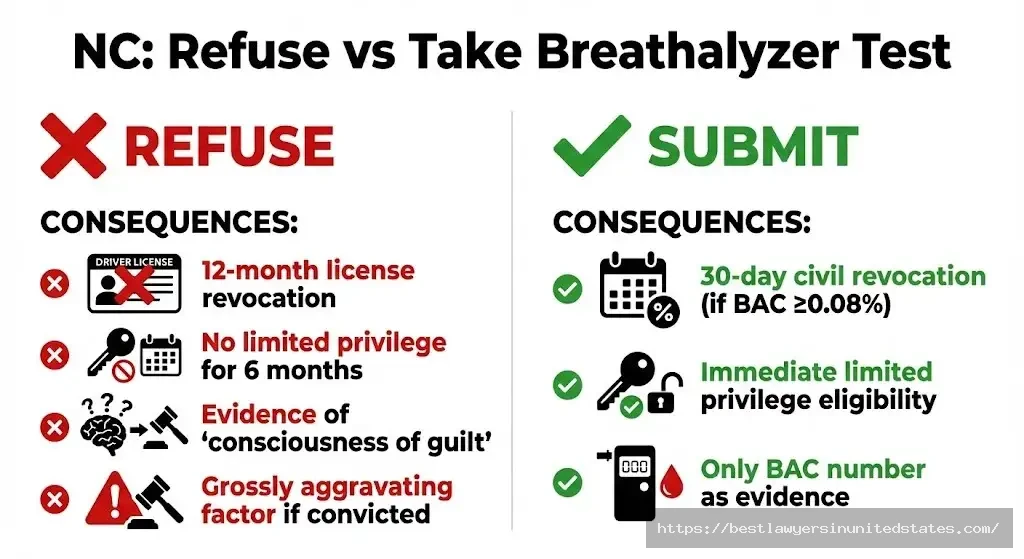
Refusing chemical testing triggers automatic consequences under North Carolina’s implied consent law:
Refusal penalties:
- Immediate 12-month license revocation (civil)
- No limited driving privilege for first 6 months
- Refusal becomes evidence against you in court
- Refusal may qualify as grossly aggravating factor if you’re convicted
Compare this to submitting to the test:
- 30-day civil revocation for BAC ≥0.08%
- Immediate limited driving privilege eligibility
- No additional evidence against you
Can Police Force You to Take a Test?
Officers cannot physically force you to provide a breath sample without a warrant. However, North Carolina law allows officers to obtain search warrants for blood draws in serious cases involving:
- Accidents with injuries or death
- Suspected drug impairment
- Refusal combined with other factors
Magistrates are available 24/7 to issue warrants, meaning officers can obtain authorization for forced blood draws within 1-2 hours in most counties.
How Refusal Affects Your Criminal Case
Prosecutors use test refusal as evidence of “consciousness of guilt.” They argue you refused because you knew you were impaired. Judges allow this evidence, and juries often view refusal negatively.
What prosecutors tell juries: “An innocent person with nothing to hide would take the test. The defendant refused because he knew he would fail.”
When Refusal Might Make Sense
Rare situations where refusal could be strategic:
- You consumed drugs that will show in blood test
- You have prior DWI convictions (already facing grossly aggravating factors)
- Medical conditions make field sobriety tests impossible
Critical point: Consult an attorney before making this decision if possible. Most DWI attorneys advise taking the test unless you face certain conviction anyway.
Zero Tolerance: DWI for Drivers Under 21
North Carolina’s 0.00% BAC Rule
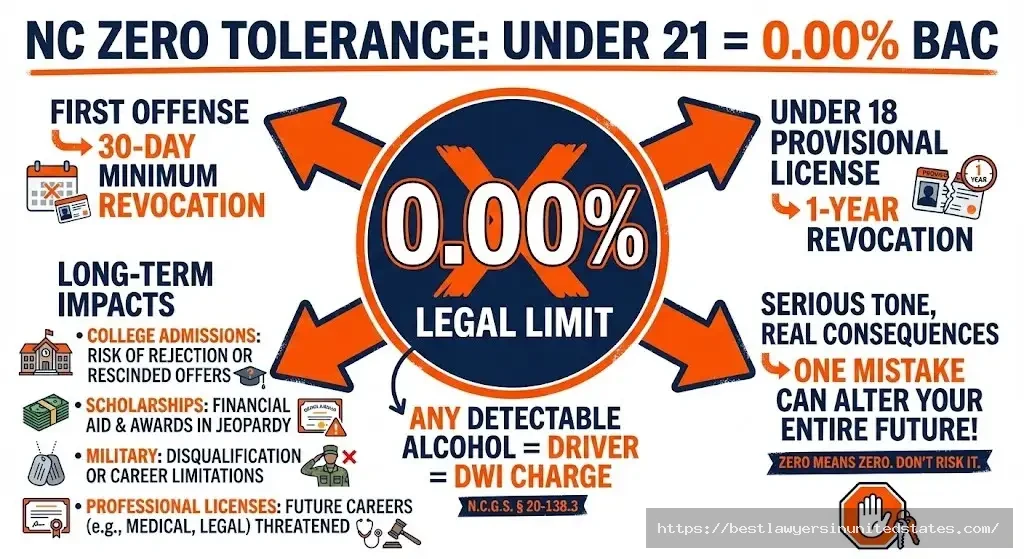
North Carolina enforces zero tolerance for drivers under 21 under N.C.G.S. § 20-138.3. Any detectable amount of alcohol results in DWI charges, even trace amounts from mouthwash or medication.
Underage DWI penalties (first offense):
- 30-day license revocation (minimum)
- $200 fine
- Community service
- Substance abuse assessment
- Possible additional charges if BAC ≥0.08%
Provisional License Consequences
Drivers under 18 with provisional licenses face additional restrictions:
- Revocation period extends to 1 year
- No limited driving privilege for first 6 months
- Must complete driver education again
- Must restart provisional license holding period
Impact on College and Future Employment
An underage DWI conviction creates long-term consequences:
- College admissions: Many universities ask about criminal convictions
- Scholarships: Athletic and academic scholarships often have conduct requirements
- Student housing: Some colleges prohibit students with alcohol convictions
- Future employment: Professional licenses (law, medicine, teaching) require disclosure
- Military service: DWI conviction may disqualify enlistment
Important: Underage DWI stays on your record permanently in North Carolina with very limited expungement options.
The True Cost of a DWI in North Carolina
Total Cost Breakdown by Sentencing Level
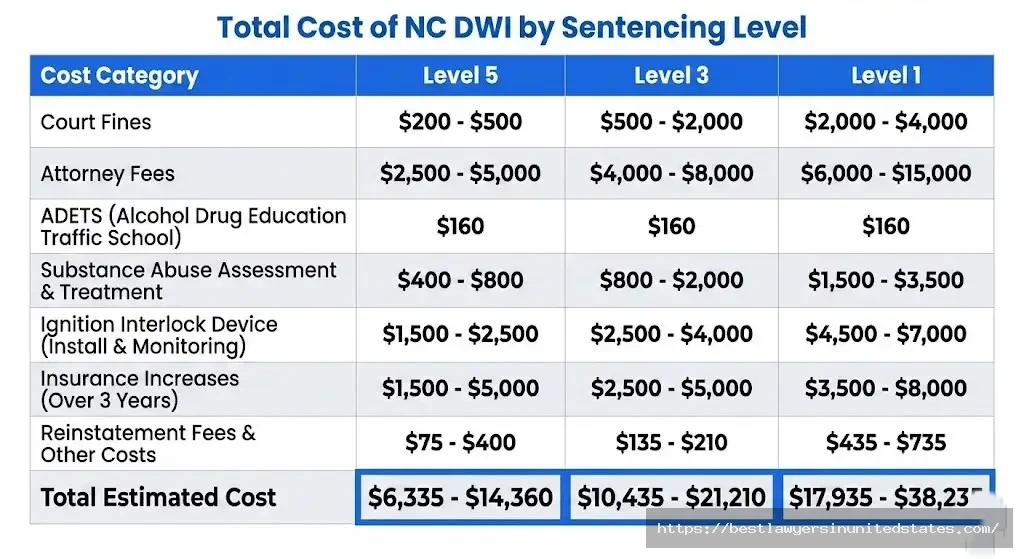
Understanding the full financial impact helps you prepare. Here’s what North Carolina DWI convictions actually cost:
| Cost Category | Level 5 | Level 3 | Level 1 |
|---|---|---|---|
| Court fines | $200 | $1,000 | $4,000 |
| Court costs | $180 | $180 | $180 |
| Attorney fees | $2,500-$5,000 | $3,500-$7,500 | $5,000-$15,000 |
| ADETS | $150 | $150 | $150 |
| Substance abuse assessment | $150-$400 | $150-$400 | $150-$400 |
| Substance abuse treatment | $0-$1,500 | $500-$2,500 | $1,500-$5,000 |
| Ignition interlock (1 year) | $0-$900 | $900-$1,350 | $900-$1,350 |
| License reinstatement | $130 | $130 | $130 |
| SR-22 filing | $25/year | $25/year | $25/year |
| Insurance increases (3 years) | $3,000-$6,000 | $4,000-$8,000 | $6,000-$12,000 |
| TOTAL ESTIMATED COST | $6,335-$14,360 | $10,435-$21,210 | $17,935-$38,235 |
Calculate your specific costs using our DUI cost calculator, which factors in your location, offense level, and insurance history.
DUI Cost Calculator
Estimate total DUI expenses by state and offense
Detailed Cost Breakdown
Payment Timeline
Bail bond, towing fees, car impound, attorney retainer
Initial court fines, DMV fees, DUI school enrollment, ignition interlock installation
Monthly probation fees, ignition interlock fees, DUI school payments, attorney balance
Insurance premium increases, license reinstatement, SR-22 filing fees
- Lost wages from missed work (court dates, jail time, DUI school) – $2,000-$10,000
- Job loss or difficulty finding employment – Varies
- Professional license suspension (doctors, lawyers, nurses, pilots) – Career ending
- Rideshare and transportation costs during suspension – $1,500-$5,000
- Travel restrictions and visa denials – Varies
- Security clearance loss – Career impact
- Child custody implications – Legal costs
- Rental car restrictions – Varies
- Personal relationships and mental health costs – Priceless
Hidden Costs You Might Miss
Lost wages:
- Court appearances: 2-5 days off work
- Jail time or community service: 1-7 days
- Treatment programs: 10-40 hours
- Total lost income: $1,000-$5,000 for average earners
Transportation costs without a license:
- Uber/Lyft to work: $30-$50/day × 30-365 days = $900-$18,250
- Family/friend assistance costs
- Lost job opportunities requiring driving
Professional consequences:
- CDL drivers: Permanent career loss
- Uber/Lyft drivers: Immediate termination
- Healthcare workers: License board investigation
- Teachers: Possible license suspension
- Lawyers: Bar association disciplinary action
How Insurance Rates Increase in North Carolina
DWI conviction labels you “high-risk” for 3 years in North Carolina. Insurance companies respond with:
Average premium increases:
- Current premium $1,200/year → New premium $2,500-$3,500/year
- Increase of $1,300-$2,300 annually
- Total 3-year impact: $3,900-$6,900
Some insurers cancel your policy entirely, forcing you to purchase high-risk insurance through assigned risk pools at even higher rates.
ADETS: Alcohol Drug Education Traffic School
Every DWI conviction requires completion of ADETS, North Carolina’s mandatory education program. The program costs $100-$200 depending on your county.
ADETS requirements:
- 16-20 hours of classroom instruction
- Assessment screening
- Attendance at all sessions (no absences)
- Final examination
NCDMV-approved providers:
- ACME Services
- Second Chance Center
- New Hope Counseling
- County health departments
Failure to complete ADETS prevents license reinstatement regardless of completing all other requirements.
DWI Checkpoints in North Carolina
Are Sobriety Checkpoints Legal in NC?
Yes. North Carolina courts have repeatedly upheld the constitutionality of DWI checkpoints under both state and federal law. Officers must follow specific guidelines, but checkpoints are common throughout the state.
Your Rights at a Checkpoint
You must:
- Stop when directed by officers
- Provide license and registration
- Answer basic questions (name, destination)
You do NOT have to:
- Answer questions about drinking
- Consent to vehicle search
- Perform field sobriety tests
- Take preliminary breath test (PBT) at roadside
What to say: “I don’t answer questions without my attorney present.”
Common Checkpoint Locations by County
Mecklenburg County (Charlotte):
- I-77 near Tyvola Road
- I-85 near Billy Graham Parkway
- Independence Boulevard
- Typically Friday-Saturday nights, 9 PM-2 AM
Wake County (Raleigh):
- Capital Boulevard (US-1)
- Western Boulevard
- Glenwood Avenue
- Peak times: Thursday-Saturday, 10 PM-3 AM
Guilford County (Greensboro):
- I-40 near Bryan Boulevard
- Wendover Avenue
- High Point Road
- Common during holiday weekends
What Happens if You Turn Around?
Turning around before a checkpoint is legal but draws attention. Officers often station patrol cars nearby to stop vehicles that avoid checkpoints. You will likely face a traffic stop for any minor violation (broken taillight, failure to signal, etc.).
NC DWI Court Process Timeline
What to Expect After Your Arrest
Hour 1-24: Booking and initial processing
- Fingerprinting and photographing
- Chemical testing (breath, blood, or urine)
- Civil revocation notice issued
- Bond hearing (typically released on written promise)
Days 1-10: Critical decision period
- Action required: Request civil revocation hearing with NCDMV
- Contact DWI attorney for consultation
- Gather evidence (witness names, video footage, receipts)
Days 30-60: Arraignment
- First court appearance
- Enter plea (usually “not guilty” to preserve options)
- Receive discovery (police reports, test results)
- Schedule pre-trial conferences
Months 2-4: Pre-trial motions
- Attorney files motions to suppress evidence
- Challenge checkpoint legality
- Question test accuracy
- Contest probable cause for stop
Months 4-12: Trial or plea agreement
- Negotiate with prosecutor
- Accept plea agreement, or
- Proceed to trial before judge or jury
The Two-Track System
Your DWI creates two separate legal proceedings:
Track 1: Civil license revocation (NCDMV)
- Administrative hearing
- Determined by hearing officer
- Focus: Was arrest lawful? Did you refuse or fail test?
- Timeline: 60-90 days
Track 2: Criminal DWI charges (District Court)
- Criminal court proceedings
- Determined by judge or jury
- Focus: Are you guilty beyond reasonable doubt?
- Timeline: 6-18 months
Critical point: Winning your civil hearing doesn’t prevent criminal conviction. Losing your criminal case doesn’t automatically reinstate your license. You must succeed in both to avoid all consequences.
NCDMV Hearing Process
Who decides: NCDMV hearing officer (not a judge)
What they determine:
- Did officer have reasonable grounds to stop you?
- Did officer have probable cause to arrest you?
- Did you refuse testing or test above legal limit?
Possible outcomes:
- Revocation sustained (you lose)
- Revocation rescinded (you win – license restored)
Attorney value: Legal representation significantly increases your chances of winning. Officers must prove their case, and technical errors in procedure often result in revocation being overturned.
County-Specific Information for North Carolina DWI Cases
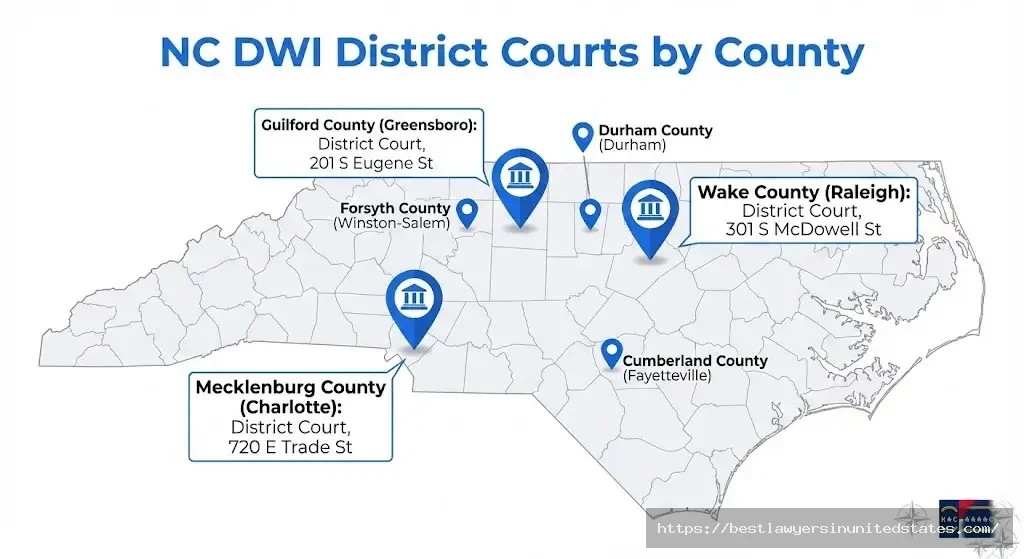
Mecklenburg County (Charlotte)
Courts handling DWI:
- Mecklenburg County District Court
- 720 E Trade Street, Charlotte, NC 28202
- Phone: (704) 686-0900
NCDMV Office:
- Charlotte License Plate Agency
- 3025 W Arrowood Road, Charlotte, NC 28273
- Phone: (704) 931-0061
Common prosecutors: Mecklenburg County District Attorney’s Office operates a specialized DWI unit with experienced prosecutors who rarely offer favorable plea deals.
Wake County (Raleigh)
Courts handling DWI:
- Wake County District Court
- 301 S McDowell Street, Raleigh, NC 27601
- Phone: (919) 792-4200
NCDMV Office:
- Raleigh Driver License Office
- 3105 Hammond Business Place, Raleigh, NC 27603
- Phone: (919) 715-7000
Local programs: Wake County offers DWI court (treatment court) for repeat offenders, combining supervision, treatment, and accountability.
Guilford County (Greensboro)
Courts handling DWI:
- Guilford County District Court (Greensboro Division)
- 201 S Eugene Street, Greensboro, NC 27401
- Phone: (336) 412-7600
NCDMV Office:
- Greensboro Driver License Office
- 3025 Wayne Road, Greensboro, NC 27407
- Phone: (336) 723-2330
Notable: Guilford County judges vary significantly in sentencing philosophy. Local attorney knowledge proves valuable.
Common North Carolina DWI Myths Debunked
Myth: “You Can Plead DWI Down to Reckless Driving”
FALSE. North Carolina law specifically prohibits reducing DWI charges to reckless driving or any lesser offense under N.C.G.S. § 20-138.4. This differs from many states that allow “wet reckless” plea bargains.
What you CAN negotiate:
- Lower sentencing level (Level 1 to Level 3)
- Dismissal if evidence is weak
- Reduction of additional charges (reckless driving arising from same transaction)
What you CANNOT do:
- Plead DWI down to reckless driving
- Plead DWI down to careless and imprudent
- Avoid DWI conviction while admitting impaired driving
Myth: “DWI Adds Points to Your License”
FALSE. North Carolina does not assign points for DWI convictions. The state uses an automatic revocation system instead of the point-based system applied to traffic violations.
How it actually works:
- DWI = Automatic license revocation (not points)
- Speeding = Points (3-5 depending on speed)
- Reckless driving = 4 points
- Running red light = 3 points
Why this matters: Insurance companies use their own point systems. A DWI conviction affects your insurance regardless of state points.
Myth: “Police Need to See You Driving”
FALSE. Officers can charge you with DWI even if they never witnessed you driving. North Carolina courts accept circumstantial evidence of operation.
Common scenarios:
- Found asleep in parked car with keys in ignition
- Admitted to driving when questioned
- Witnesses saw you driving before police arrived
- Crash scene evidence proves you were driving
Critical factor: “Operation” under NC law means exercising control over the vehicle, not necessarily movement.
Myth: “You Can’t Get DWI on Private Property”
FALSE in North Carolina. The state’s DWI law applies to “any highway, street, or public vehicular area.” Courts have defined “public vehicular area” broadly to include:
- Shopping center parking lots
- Apartment complex parking areas
- Private roads open to public access
- Hotel parking lots
- Restaurant parking areas
Only exception: Completely private property with restricted access (gated residence, farm roads, etc.)
Myth: “Field Sobriety Tests Are Required”
FALSE. You can legally refuse field sobriety tests in North Carolina with no penalty. These roadside tests (walk-and-turn, one-leg stand, horizontal gaze nystagmus) are voluntary.
Confusion arises from:
- Chemical test refusal (which has penalties)
- Officer pressure making tests seem mandatory
- Mixing up roadside tests vs. official chemical testing
Smart approach: Politely decline field sobriety tests. These subjective tests rarely help your case and always provide evidence against you.
Frequently Asked Questions
What is the NC DWI statute number?
Quick Answer: N.C.G.S. § 20-138.1 covers impaired driving in North Carolina, with sentencing provisions under N.C.G.S. § 20-179.
This statute defines DWI as driving while appreciably impaired or with BAC ≥0.08%. Related statutes cover implied consent (§ 20-16.2), habitual DWI (§ 20-138.2A), and limited driving privilege (§ 20-179.3).
What is the BAC limit in North Carolina?
Quick Answer: The legal BAC limit is 0.08% for standard drivers, 0.04% for commercial drivers, and 0.00% for drivers under 21.
North Carolina follows federal standards for most drivers but enforces zero tolerance for underage drivers. Any detectable alcohol in a driver under 21 violates N.C.G.S. § 20-138.3.
What is a Level 5 DWI in NC?
Quick Answer: Level 5 is the lowest DWI sentencing level in North Carolina, typically assigned to first-time offenders with no aggravating factors.
Level 5 penalties include minimum 24 hours in jail (often suspended for community service), fines up to $200, and 1-year license revocation. About 70% of first-time DWI offenders receive Level 5 sentencing.
How long does a DWI stay on your record in NC?
Quick Answer: DWI convictions remain on your North Carolina driving record permanently with very limited expungement options.
North Carolina does not automatically remove DWI convictions after any time period. Expungement is only available in rare circumstances such as wrongful conviction or pardon. For sentencing purposes, DWI convictions within 7 years count as grossly aggravating factors, and convictions within 10 years count toward habitual DWI charges.
Can I get my DWI expunged in North Carolina?
Quick Answer: North Carolina rarely allows DWI expungement, with exceptions only for dismissed charges or successful appeals.
You CAN expunge:
- DWI charges that were dismissed
- DWI charges where you were found not guilty
- Convictions later overturned on appeal
- Underage DWI (§ 20-138.3) convictions after age 20 in very limited circumstances
You CANNOT expunge:
- Standard DWI convictions
- Level 1 through Level 5 DWI
- Habitual DWI convictions
- DWI combined with serious injury
What can a DWI be reduced to in NC?
Quick Answer: North Carolina prohibits reducing DWI to lesser charges like reckless driving, but prosecutors may reduce your sentencing level from Level 1 to Level 3-5.
Unlike states that allow “wet reckless” pleas, NC law under § 20-138.4 prevents any plea bargain to non-DWI charges when evidence shows impaired driving. Your attorney can negotiate for:
- Lower sentencing level based on mitigating factors
- Dismissal of case if evidence is insufficient
- Concurrent sentencing for multiple charges
Will insurance drop me after a DWI in North Carolina?
Quick Answer: Many insurance companies cancel policies after DWI conviction, and all companies classify you as high-risk for 3 years with premium increases of 100-300%.
North Carolina requires SR-22 insurance filing for DWI offenders, proving you maintain minimum coverage. Expect annual premiums to increase from $1,200 to $2,500-$3,500. Some insurers refuse high-risk drivers entirely, forcing you into assigned risk pools with even higher rates.
How many drinks is 0.08 BAC?
Quick Answer: Most people reach 0.08% BAC after 3-4 drinks within 2 hours, but this varies dramatically by weight, gender, food consumption, and metabolism.
A 180-pound man typically reaches 0.08% after 4 standard drinks in 2 hours. A 130-pound woman reaches 0.08% after 2-3 drinks. Use our BAC calculator for personalized estimates based on your specific factors.
Standard drink definition:
- 12 oz beer (5% alcohol)
- 5 oz wine (12% alcohol)
- 1.5 oz spirits (40% alcohol)
Can I drive to work during my suspension?
Quick Answer: Not during the initial suspension period, but you can apply for a limited driving privilege after 10-45 days depending on your sentencing level.
North Carolina requires a waiting period before limited driving privilege eligibility:
- Level 5: Apply after 10 days
- Level 3-4: Apply after 10 days
- Level 2: Wait 45 days
- Level 1: Wait 12 months
You must install an ignition interlock device, maintain SR-22 insurance, and complete substance abuse assessment before receiving limited driving privilege.
Do I need a lawyer for a first-time DWI?
Quick Answer: Yes, hiring an experienced DWI attorney significantly improves your chances of reduced charges, lower sentencing level, and preserved driving privileges.
An attorney can:
- Challenge checkpoint legality and stop validity
- Suppress unreliable test results
- Negotiate with prosecutors for lower sentencing levels
- Secure limited driving privilege
- Navigate NCDMV civil hearings
- Identify mitigating factors judges may overlook
Attorney costs ($2,500-$5,000 for first offense) often save money by reducing fines, insurance increases, and lost wages. Contact experienced lawyers through our attorney directory or email [email protected].
Resources for North Carolina DWI Cases
NCDMV Contact Information
North Carolina Division of Motor Vehicles
- Website: ncdot.gov/dmv
- Phone: (919) 715-7000
- Hours: Monday-Friday, 8 AM-5 PM
License restoration inquiries:
- Phone: (919) 861-3912
- Submit forms: Mail to 3101 Mail Service Center, Raleigh, NC 27699-3101
North Carolina Court System
Administrative Office of the Courts
- Website: nccourts.gov
- Phone: (919) 890-1000
- Find your court: nccourts.gov/locations
District Court locations:
- Courts are organized by county
- Search by county name for specific courthouse addresses
- Most DWI cases are heard in District Court
ADETS Providers
Find approved providers:
- Search: NCDMV website → Driver Services → ADETS
- Call NCDMV: (919) 715-7000
- Costs vary by provider ($100-$200)
Major providers:
- ACME Services (statewide locations)
- Second Chance Center (multiple counties)
- County health departments (check local availability)
Ignition Interlock Device Installers
NC-approved IID providers:
- Smart Start: (800) 880-3394
- Intoxalock: (888) 283-5899
- LifeSafer: (800) 634-3077
Compare costs and locations before selecting a provider. Installation fees, monthly monitoring costs, and service quality vary.
Legal Assistance
North Carolina State Bar Lawyer Referral Service
- Phone: (800) 662-7660
- Website: ncbar.gov
- Monday-Friday, 9 AM-5 PM
Free consultation available: Contact [email protected] to connect with experienced North Carolina DWI attorneys offering free initial consultations.
Important: This guide provides general information about North Carolina DWI laws current as of 2026. Laws change frequently, and individual cases vary significantly. Consult a qualified North Carolina DWI attorney for advice specific to your situation.
North Carolina’s unique 6-level sentencing system, strict implied consent law, and prohibition on plea bargaining make professional legal representation essential for favorable outcomes. Understanding your rights, the court process, and available defenses can substantially reduce the impact of a DWI charge on your life, finances, and freedom.
