
Driving under the influence in South Dakota means operating a vehicle with a blood alcohol content of 0.08% or higher, or while impaired by alcohol, drugs, or other substances under SDCL § 32-23-1. First-time offenders face a Class 1 misdemeanor with minimum 30-day license suspension, potential jail time, and fines. South Dakota stands out for its Suspended Imposition of Sentence option and mandatory 24/7 Sobriety Program for repeat offenders.
This guide breaks down everything you need to know about South Dakota’s DUI laws in 2026, from arrest to sentencing.
What Counts as DUI in South Dakota?
South Dakota law prohibits driving or having actual physical control of any vehicle under five conditions outlined in § 32-23-1.
The Five Ways to Get a DUI in South Dakota
1. BAC of 0.08% or Higher Any driver with 0.08% blood alcohol content commits DUI, regardless of visible impairment. Law enforcement measures this through breath, blood, or urine testing.
2. Under the Influence of Alcohol or Marijuana You can face charges even below 0.08% if alcohol, marijuana, or illegal drugs impair your driving ability. Officers document erratic driving, failed field sobriety tests, and physical signs of intoxication.
3. Impaired by Prescription Drugs Taking valid prescription medications doesn’t create a defense. If drugs render you incapable of safely driving, you violate § 32-23-1(3).
4. Combined Influence Mixing alcohol with prescription drugs or other substances that impair safe driving triggers DUI charges under § 32-23-1(4).
5. Inhalants and Prohibited Substances Inhaling or ingesting substances under § 22-42-15 (like huffing chemicals) while driving violates South Dakota law.
Who Can Be Arrested?
“Actual physical control” extends beyond active driving. You can face DUI charges sitting in a parked car with keys in the ignition, even on private property.
Law enforcement can arrest you without a warrant after an accident if they have probable cause you violated DUI laws before or immediately after the crash (§ 32-23-1.1).
South Dakota BAC Limits by Driver Type
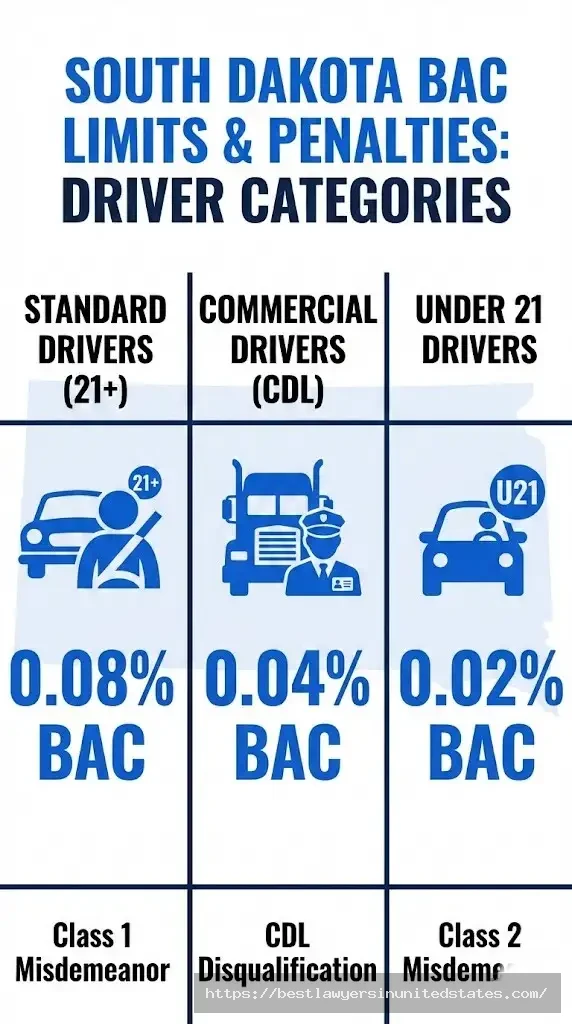
Different drivers face different legal limits in South Dakota.
| Driver Type | BAC Limit | Violation Level | First Offense Class |
|---|---|---|---|
| Standard (21+) | 0.08% | DUI (§ 32-23-1) | Class 1 Misdemeanor |
| Commercial (CDL) | 0.04% | CDL DUI | CDL disqualification |
| Under 21 | 0.02% | Underage DUI (§ 32-23-21) | Class 2 Misdemeanor |
Understanding BAC Measurement
South Dakota defines BAC as milligrams of alcohol per 1.0 cubic centimeter of whole blood or per 2,100 cubic centimeters of deep lung breath (§ 32-23-7).
Not sure where you stand after drinking? Our BAC calculator estimates your current blood alcohol level based on drinks consumed, body weight, and time elapsed.
BAC Calculator
Estimate your Blood Alcohol Content
• Commercial Driver (CDL): 0.04% BAC
• Drivers Under 21: 0.00-0.02% BAC (Zero Tolerance)
• Enhanced Penalties: 0.15% BAC or higher in most states
Critical for first offenders: A BAC of 0.17% or higher triggers mandatory chemical dependency evaluation, even on your first DUI.
First Offense DUI in South Dakota
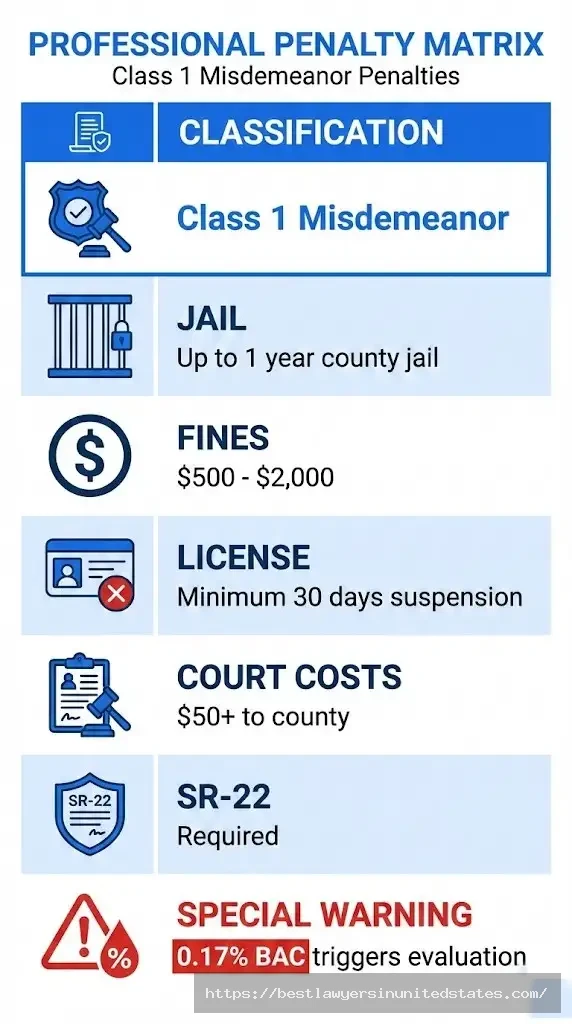
A first DUI conviction in South Dakota is a Class 1 misdemeanor under § 32-23-2.
First Offense Penalties
| Penalty Type | First Offense |
|---|---|
| Classification | Class 1 Misdemeanor |
| Jail Time | Up to 1 year county jail |
| Fines | Class 1 misdemeanor fines |
| License Suspension | Minimum 30 days |
| Court Costs | $50 to county (§ 32-23-4.10) |
| SR-22 Insurance | Required (§ 32-35-113) |
The 30-Day License Suspension
The court must revoke your license for at least 30 days. However, South Dakota allows you to apply for a limited driving privilege immediately.
Permitted uses for limited license:
- Employment
- 24/7 sobriety testing
- School attendance
- Child care delivery or pickup
- Health appointments
- Court or probation appointments
- Counseling programs, treatment, or aftercare
Requirements: You must provide proof of SR-22 financial responsibility insurance to qualify for limited driving privileges.
The 0.17% BAC Trigger
First-time offenders who blow 0.17% or higher face additional requirements under § 32-23-2.1.
You must complete:
- Court-ordered chemical dependency evaluation
- Evaluation by licensed addiction counselor or certified health professional
- Pay evaluation costs yourself
The evaluator’s recommendations go directly to the judge and can influence your sentence. Treatment program participation often becomes a probation condition.
Can You Avoid a Conviction?
Suspended Imposition of Sentence (SIS) gives South Dakota first-time offenders a unique opportunity. If granted, you complete probation conditions without a formal conviction appearing on your record.
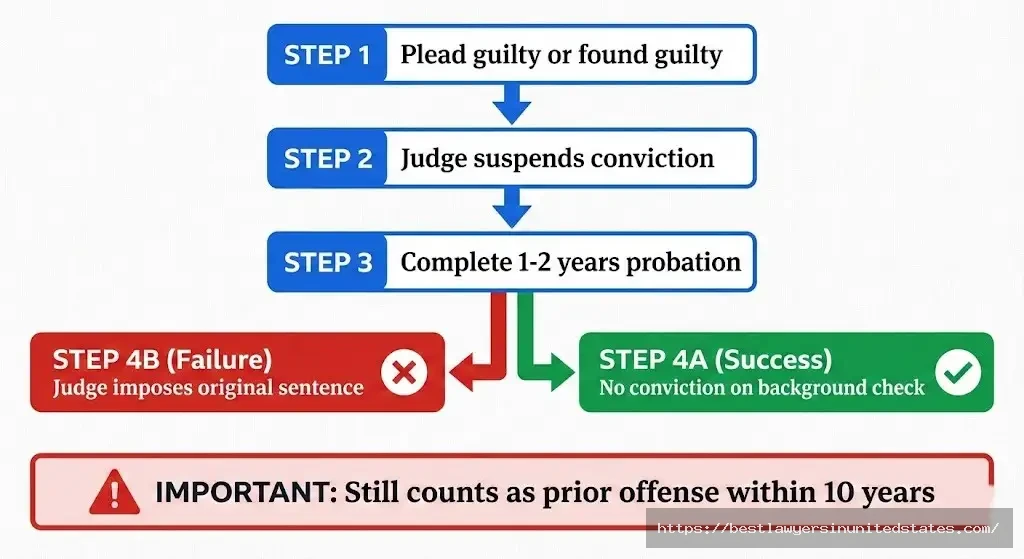
How SIS works:
- You plead guilty or are found guilty
- Judge suspends the conviction
- You complete probation (typically 1-2 years)
- If successful, no conviction appears on background checks
- If you violate probation, the judge can impose the original sentence
Critical limitation: SIS doesn’t prevent the DUI from counting as a prior offense if you get another DUI within 10 years.
Second Offense DUI Penalties
A second DUI within 10 years remains a Class 1 misdemeanor but carries harsher consequences under § 32-23-3.
Second Offense Penalties Table
| Penalty Type | Second Offense |
|---|---|
| Classification | Class 1 Misdemeanor |
| Jail Time | Up to 1 year county jail |
| License Revocation | Minimum 1 year |
| Limited License | After completing treatment program |
| SR-22 Insurance | Required |
| Special Condition | Chemical dependency program |
License Revocation Differences
Second offense revocation lasts minimum one year. You cannot get limited driving privileges until you successfully complete a court-approved chemical dependency program.
Important distinction: This is revocation, not suspension. You must reapply for your license after the period ends.
Driving During Revocation
If police catch you driving without a license during the revocation period, the court must sentence you to at least 3 days in county jail. The judge cannot suspend this sentence.
The 24/7 Sobriety Program Requirement
Second-time offenders must participate in South Dakota’s 24/7 Sobriety Program if convicted within 10 years of their first offense (§ 32-23-23).
Program requirements:
- Twice-daily breath testing (morning and evening)
- OR continuous alcohol monitoring bracelet
- Pay all testing costs
- Report to designated testing location
- Random drug testing possible
Testing locations: Available in all 66 South Dakota counties through law enforcement offices, court services, and dedicated testing centers.
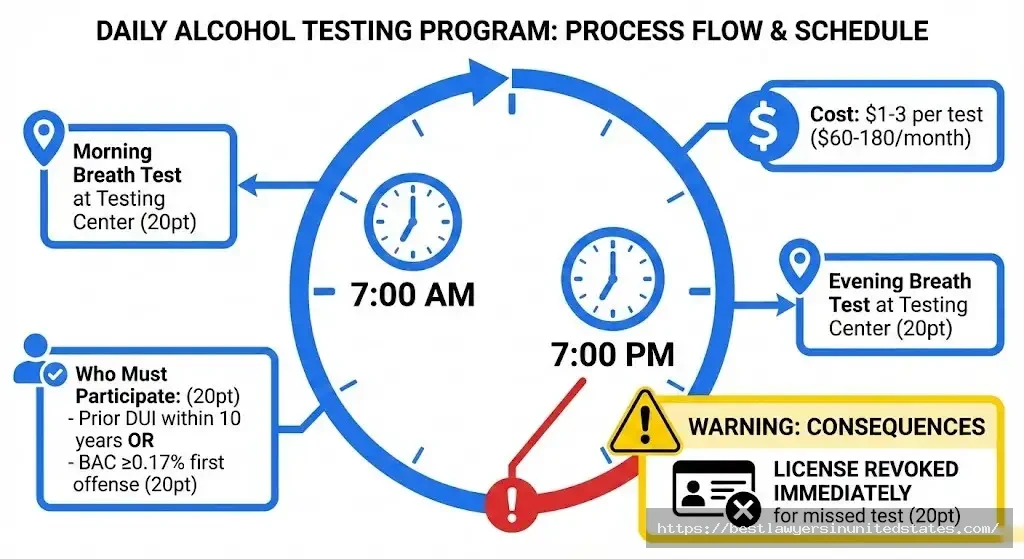
Costs: Typically $1-3 per test, totaling $60-180 monthly depending on county and testing method.
Third Offense: When DUI Becomes a Felony
Your third DUI within 10 years elevates to a Class 6 felony under § 32-23-4.
Third Offense Penalties
| Penalty Type | Third Offense (Felony) |
|---|---|
| Classification | Class 6 Felony |
| Prison Time | Up to 2 years state prison |
| License Revocation | Minimum 1 year from sentencing or release |
| Driving Without License | Mandatory 10 days jail |
| Limited License | After treatment completion |
| Parole | Available after serving minimum |
Felony Consequences Beyond Penalties
A felony conviction creates lifelong consequences:
Loss of rights:
- Voting rights (until completion of sentence)
- Firearm ownership rights
- Professional licenses in many fields
- Housing applications flagged
- Employment background checks show felony
How License Revocation Works
The court revokes your license for minimum one year from the date sentence is imposed OR one year from initial release from imprisonment, whichever is later.
Critical timing: If you violate probation and return to prison, the revocation period restarts. Time spent imprisoned doesn’t count toward fulfilling your revocation period.
Limited Driving Privileges
You can apply for limited driving after completing a court-approved chemical dependency program and providing SR-22 proof of financial responsibility.
The court retains jurisdiction to modify license conditions throughout your entire revocation period, even though § 23A-27-19 normally limits this power (§ 32-23-4).
Fourth, Fifth, and Sixth DUI Offenses
South Dakota imposes mandatory prison sentences for fourth and subsequent DUI convictions.
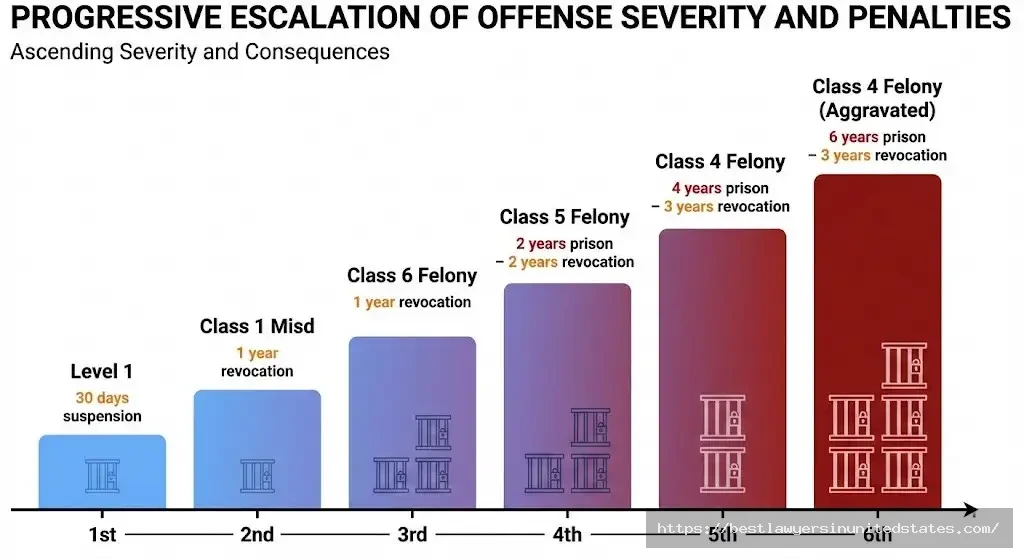
Escalating Felony Classifications
| Offense | Classification | Minimum Prison | Mandatory Parole | License Revocation | Driving Without License Penalty |
|---|---|---|---|---|---|
| 4th | Class 5 Felony | 2 years | 1 year | 2 years minimum | 20 days jail |
| 5th | Class 4 Felony | 4 years | 1 year | 3 years minimum | 20 days jail |
| 6th+ (Aggravated) | Class 4 Felony | 6 years | 1 year | 3 years minimum | 20 days jail |
Fourth Offense Requirements (§ 32-23-4.6)
The court must sentence you to at least two years in a South Dakota state correctional facility. One year must be served on parole unless you refuse parole under § 24-15A-15.
Parole must include at least one:
- 24/7 sobriety program enrollment
- Ignition interlock device
- Breath alcohol interlock
- Alcohol monitoring bracelet
- Other enhanced monitoring tool
Only one way to avoid prison: The judge can suspend your sentence if you enter and complete a drug court, DUI court, veterans treatment court, or mental health court program as a probation condition (§ 32-23-4.6).
Fifth Offense Requirements (§ 32-23-4.7)
Minimum four years in state prison. Same parole and monitoring requirements as fourth offense.
Sixth Offense: The “Aggravated” Category (§ 32-23-4.9)
Special provision triggers when:
- You have at least 6 total DUI convictions
- At least 5 occurred within 25 years of current charge (extended lookback)
- At least 2 occurred within 10 years of current charge
Minimum sentence: Six years in state prison if you have 6+ convictions within 15 years.
Mandatory supervision after release: Must include 24/7 sobriety, ignition interlock, alcohol bracelet, or enhanced monitoring.
The 24/7 Sobriety Program Explained
South Dakota’s 24/7 Sobriety Program became mandatory for certain DUI offenders in 2006 and has since been adopted by other states.
Who Must Participate?
You must participate if ANY of these apply (§ 32-23-23):
1. Previous DUI within 10 years Any prior DUI conviction within the last decade triggers automatic enrollment.
2. First offense with BAC ≥ 0.17% Even first-time offenders enter the program if their BAC was 0.17% or higher.
3. Court-ordered limited driving permit The program becomes a condition of receiving limited driving privileges during suspension.
How the Program Works
Standard testing schedule:
- Report to testing location twice daily (typically 7 AM and 7 PM)
- Provide breath sample each visit
- Testing times vary by county and testing site
- Random drug testing possible
Alternative monitoring:
- Continuous alcohol monitoring (CAM) bracelet
- Transdermal alcohol sensors
- GPS monitoring combined with home testing units
Testing Locations Across South Dakota
The program operates in all 66 counties through:
- County sheriff offices
- Municipal police departments
- Court services offices
- Dedicated testing centers in larger cities
Largest testing networks:
- Minnehaha County (Sioux Falls area)
- Pennington County (Rapid City area)
- Lincoln County
- Brown County (Aberdeen)
Program Costs
| Testing Method | Cost per Test | Monthly Cost |
|---|---|---|
| Twice-daily breath tests | $1-3 | $60-180 |
| CAM bracelet | Installation + daily fee | $300-450 |
| GPS + home testing | Device + monitoring | $200-350 |
Who pays: Participants pay all testing and monitoring costs.
What Happens If You Miss a Test or Fail?
Immediate consequences:
- Limited driving permit revoked immediately
- Judge notified within 24 hours
- Probation violation proceedings start
- Possible jail time under graduated sanctions
Graduated sanctions policy: The Unified Judicial System applies progressive penalties based on violation severity and frequency.
South Dakota Implied Consent Law
Operating a vehicle in South Dakota creates automatic consent to chemical testing under § 32-23-10.
What You Automatically Agree To
By driving in South Dakota, you consent to:
- Blood withdrawal
- Breath testing
- Urine testing
- Other bodily substance testing
When it applies: After lawful arrest for violating § 32-23-1 or § 32-23-21 (underage DUI).
Chemical Testing Requirements
Officers must request testing after arrest. The arresting officer can require you to submit to blood or bodily substance withdrawal as evidence (§ 32-23-10).
Who can withdraw blood (§ 32-23-14):
- Physicians
- Registered nurses
- Physician assistants
- Phlebotomists
- Licensed practical nurses
- Medical technicians
- Medical technologists
- Laboratory technicians
Protection for medical personnel: Healthcare providers acting on presumed consent face no liability if they use ordinary care. Hospitals and facilities employing them are also protected.
Can You Refuse Testing?
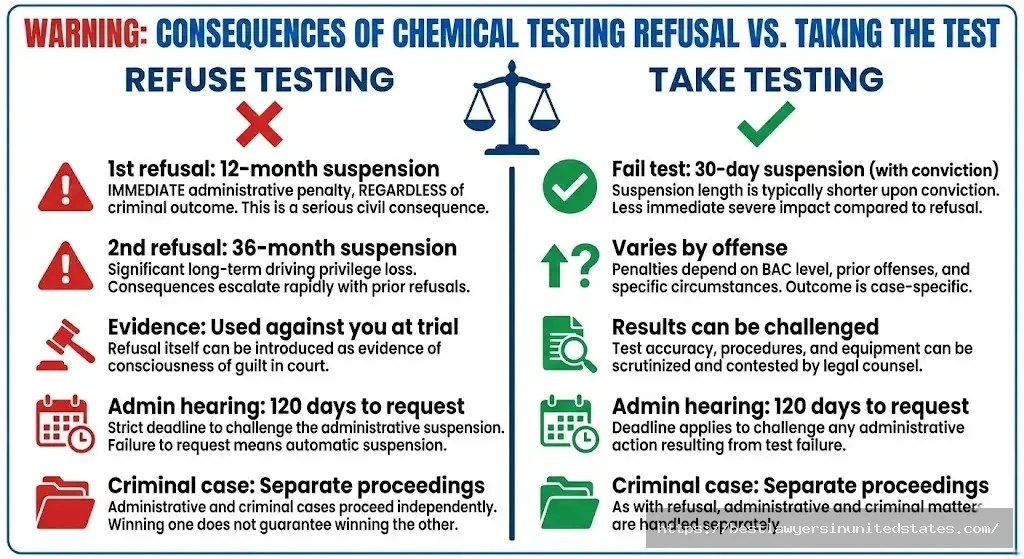
Yes, but refusal carries consequences.
| Action | First Refusal | Second Refusal |
|---|---|---|
| License revocation | 1 year | 3 years |
| Criminal case impact | Admissible as evidence | Admissible as evidence |
| Administrative hearing | Available within 120 days | Available within 120 days |
Refusal becomes evidence: Prosecutors can introduce your refusal at trial as “consciousness of guilt” under § 32-23-10.1.
The Administrative License Hearing
You have 120 days from arrest to request a hearing under § 32-23-11.
What the Secretary of Public Safety determines:
- Did the officer comply with the law?
- Did you actually refuse?
If both answers are yes, the Secretary revokes your license for one year.
Temporary license: When officers confiscate your South Dakota license, the notice of intent to revoke functions as a temporary 120-day license (§ 32-23-19).
Your Right to Additional Testing
You can request an independent chemical test by a physician, lab technician, registered nurse, physician assistant, or medical technologist of your choosing (§ 32-23-15).
You pay: All costs for independent testing fall on you.
Strategic use: Defense attorneys often use independent lab results to challenge the state’s evidence.
Underage DUI: Drivers Under 21
South Dakota enforces strict zero-tolerance laws for drivers under 21 through § 32-23-21.
What Triggers Underage DUI?
A Class 2 misdemeanor if you’re under 21 and:
1. Physical evidence of 0.02% or higher BAC Just 0.02% triggers charges—roughly one drink for most people.
2. Physical evidence of marijuana or controlled substances Any detectable amount of illegal drugs in your system violates the law, even days after consumption.
Underage DUI Penalties
| Offense | License Suspension | Court Consequences |
|---|---|---|
| 1st offense | 30 days | Class 2 misdemeanor |
| 2nd offense | 180 days | Class 2 misdemeanor |
| 3rd+ offense | 1 year | Class 2 misdemeanor |
Limited driving privileges available: The court can issue an order permitting driving for employment, school, or counseling after you provide proof of financial responsibility under § 32-35-43.1.
Underage vs. Standard DUI
Drivers under 21 can face both charges simultaneously:
If BAC is 0.02-0.079%: Underage DUI only (§ 32-23-21) If BAC is 0.08% or higher: Both underage DUI AND standard DUI (§ 32-23-1)
Case scenario: A 20-year-old with 0.10% BAC faces a Class 1 misdemeanor for standard DUI plus a Class 2 misdemeanor for underage consumption.
The Refusal Exception
Your license is not subject to revocation under § 32-23-18 if you plead guilty to violating § 32-23-21 before the revocation order issues (§ 32-23-11.1).
Strategic consideration: This creates an incentive for quick plea agreements on underage DUI charges.
Commercial Driver’s License (CDL) DUI
Commercial drivers face stricter standards and career-ending consequences.
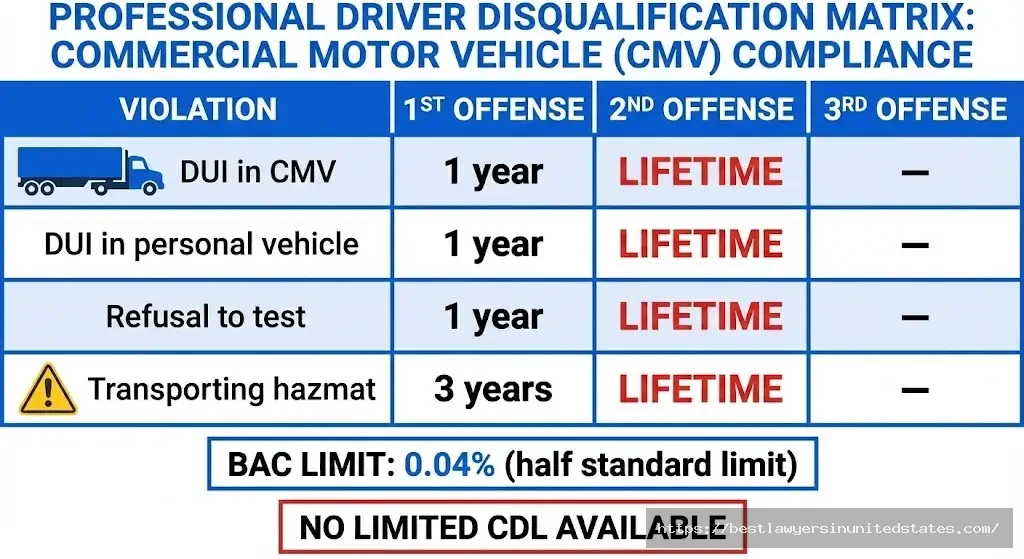
CDL BAC Limit: 0.04%
Commercial drivers violate federal and South Dakota law at 0.04% BAC—half the standard limit.
Applies when:
- Operating a commercial motor vehicle
- Driving any vehicle while holding a CDL
- On or off duty status doesn’t matter
CDL Disqualification Periods
| Violation | First Offense | Second Offense | Third Offense |
|---|---|---|---|
| DUI in CMV | 1 year | Lifetime | N/A |
| DUI in personal vehicle | 1 year | Lifetime | N/A |
| Refusal to test | 1 year | Lifetime | N/A |
| Transporting hazmat | 3 years | Lifetime | N/A |
No limited CDL: South Dakota provides no limited commercial driving privileges during disqualification.
The Separate Criminal Case
CDL disqualification runs separately from your criminal DUI case.
You face:
- Criminal DUI charges (Class 1 misdemeanor minimum)
- Administrative CDL disqualification
- Personal driver’s license suspension
- Federal Motor Carrier Safety regulations
Career impact: Most trucking companies won’t hire drivers with DUI history, making even first offenses career-ending.
Out-of-State DUI Convictions
South Dakota counts DUI convictions from other states when calculating your offense level.
How Out-of-State Convictions Count (§ 32-23-4.5)
Standard lookback (10 years): Any conviction in another state that would be a DUI under South Dakota law counts if it occurred within 10 years of your current charge.
Extended lookback (25 years for 6th+ offense): For aggravated sixth offenses under § 32-23-4.9, South Dakota looks back 25 years at out-of-state convictions.
What Counts as Equivalent?
State prosecutors must show the out-of-state offense would violate § 32-23-1 if committed in South Dakota.
Commonly counted violations:
- DWI (Driving While Intoxicated)
- OWI (Operating While Intoxicated)
- OUI (Operating Under the Influence)
- Impaired driving
- Wet reckless (sometimes)
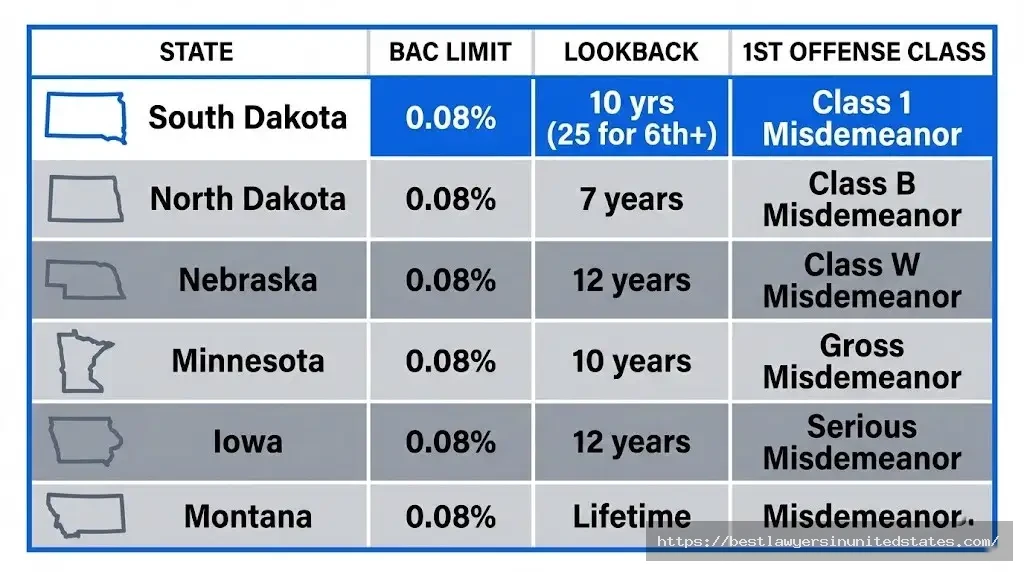
Comparison with Neighboring States
| State | Standard BAC | Lookback Period | First Offense Class |
|---|---|---|---|
| South Dakota | 0.08% | 10 years (25 for 6th+) | Class 1 Misdemeanor |
| North Dakota | 0.08% | 7 years | Class B Misdemeanor |
| Nebraska | 0.08% | 12 years | Class W Misdemeanor |
| Minnesota | 0.08% | 10 years | Gross Misdemeanor |
| Iowa | 0.08% | 12 years | Serious Misdemeanor |
| Montana | 0.08% | Lifetime | Misdemeanor |
Why this matters: Moving between states doesn’t reset your DUI count. A North Dakota DUI from 8 years ago counts as your first offense in South Dakota.
Vehicular Crimes Also Count
South Dakota includes vehicular homicide (§ 22-16-41) and vehicular battery (§ 22-18-36) convictions when calculating your offense number (§ 32-23-4.8).
Example: A vehicular homicide conviction in 2018 plus a DUI in 2026 = second DUI offense for sentencing purposes.
Specialized Treatment Courts
South Dakota offers alternative sentencing through specialized courts for certain DUI offenders.
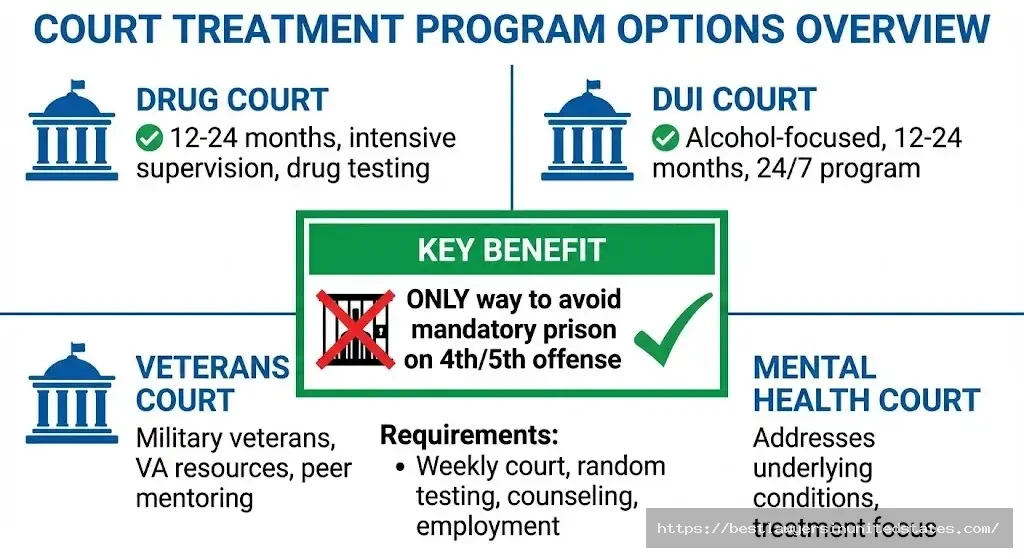
Four Treatment Court Options
1. Drug Court Program Intensive supervision with regular drug testing, counseling, and court appearances. Typically lasts 12-24 months.
2. DUI Court Program Focused specifically on alcohol-related offenses. Combines treatment, monitoring, and accountability.
3. Veterans Treatment Court Designed for military veterans with specialized VA resources and peer mentoring.
4. Mental Health Court Addresses underlying mental health conditions contributing to substance abuse.
Why Treatment Courts Matter
For fourth and fifth offenses: These programs offer the only way to avoid mandatory prison time (§§ 32-23-4.6, 32-23-4.7).
Standard sentence:
- 4th offense: 2 years prison minimum
- 5th offense: 4 years prison minimum
With treatment court: Judge can suspend the sentence if you complete the program as a probation condition.
Treatment Court Requirements
Typical program elements:
- Weekly court appearances
- Random drug/alcohol testing
- Group and individual counseling
- Employment or education requirement
- Community service
- Sober living environment
- 24/7 Sobriety Program participation
Duration: Most programs run 12-24 months with progressive phases.
Failure consequences: Violating program rules can result in immediate jail sanctions or termination, triggering the original prison sentence.
Eligibility Determination
Each judicial circuit determines eligibility based on:
- Criminal history
- Addiction severity
- Offense circumstances
- Available treatment resources
- Risk assessment scores
Application: Your attorney petitions the court for treatment court admission, usually before sentencing.
What a South Dakota DUI Really Costs
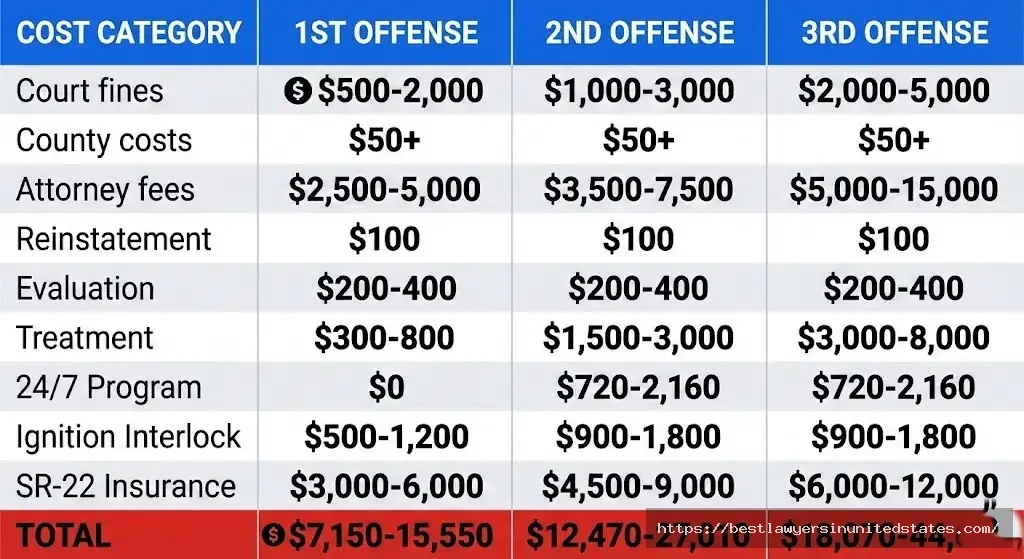
Financial consequences extend far beyond court fines.
Complete Cost Breakdown
| Cost Category | First Offense | Second Offense | Third Offense (Felony) |
|---|---|---|---|
| Court fines | $500-2,000 | $1,000-3,000 | $2,000-5,000 |
| County court costs | $50+ | $50+ | $50+ |
| Attorney fees | $2,500-5,000 | $3,500-7,500 | $5,000-15,000 |
| License reinstatement | $100 | $100 | $100 |
| Chemical dependency evaluation | $200-400 | $200-400 | $200-400 |
| DUI school/treatment | $300-800 | $1,500-3,000 | $3,000-8,000 |
| 24/7 Sobriety Program | $0 | $720-2,160/year | $720-2,160/year |
| Ignition interlock device | $500-1,200 | $900-1,800 | $900-1,800 |
| SR-22 insurance (3 years) | $3,000-6,000 | $4,500-9,000 | $6,000-12,000 |
| Total estimated cost | $7,150-15,550 | $12,470-27,010 | $18,070-44,610 |
County costs under § 32-23-4.10: Every conviction requires a $50 minimum payment to the county general fund. Failure to pay is punishable by contempt.
Want to estimate your specific costs? Our DUI cost calculator provides personalized estimates based on your situation.
DUI Cost Calculator
Estimate total DUI expenses by state and offense
Detailed Cost Breakdown
Payment Timeline
Bail bond, towing fees, car impound, attorney retainer
Initial court fines, DMV fees, DUI school enrollment, ignition interlock installation
Monthly probation fees, ignition interlock fees, DUI school payments, attorney balance
Insurance premium increases, license reinstatement, SR-22 filing fees
- Lost wages from missed work (court dates, jail time, DUI school) – $2,000-$10,000
- Job loss or difficulty finding employment – Varies
- Professional license suspension (doctors, lawyers, nurses, pilots) – Career ending
- Rideshare and transportation costs during suspension – $1,500-$5,000
- Travel restrictions and visa denials – Varies
- Security clearance loss – Career impact
- Child custody implications – Legal costs
- Rental car restrictions – Varies
- Personal relationships and mental health costs – Priceless
Hidden Costs
Lost wages from:
- Court appearances (minimum 3-6 days)
- Jail time (if sentenced)
- License suspension (transportation challenges)
- Treatment program attendance
Employment consequences:
- Job loss for CDL holders
- Professional license suspensions
- Background check failures
- Security clearance revocation
Personal costs:
- Increased car insurance premiums
- Alternative transportation (Uber, taxis)
- Childcare during court/treatment
- Mental health impacts
Insurance Rate Increases
South Dakota insurers typically increase rates 40-100% after a DUI conviction.
Average increases:
- First offense: $1,000-2,000/year for 3 years
- Second offense: $1,500-3,000/year for 3-5 years
- SR-22 filing fee: $25-50/year
Long-term impact: Rate increases often last 5-7 years even though SR-22 requirements end after 3 years.
The DUI Legal Process in South Dakota
Understanding the timeline helps you meet critical deadlines.
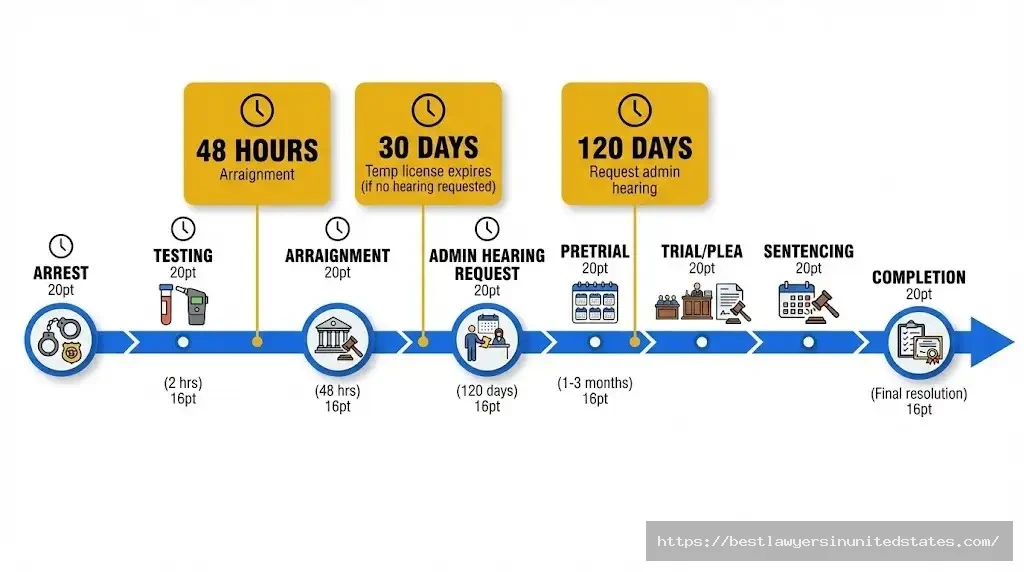
Step 1: Arrest and Booking
Immediate actions by law enforcement:
- Field sobriety tests administered
- Preliminary breath test (portable device)
- Arrest if probable cause exists
- Transport to jail for booking
- Request for official chemical test
Your Miranda rights: Officers must read these before custodial interrogation, but not before requesting field sobriety tests.
Step 2: Chemical Testing (Within 2 Hours of Arrest)
Implied consent warning: Officers must explain that refusing triggers automatic license suspension.
Testing options:
- Breath test (most common – Intoxilyzer or similar device)
- Blood draw (requires medical professional)
- Urine test (rare, usually for drugs)
Critical timing: Tests must occur within a reasonable time, though South Dakota law doesn’t specify an exact window.
Step 3: License Confiscation and Temporary Permit
If you refuse testing or fail:
- Officer confiscates your South Dakota driver’s license
- Notice of intent to revoke serves as temporary license
- Temporary license valid for 120 days
- Notice functions as your license during this period (§ 32-23-19)
Out-of-state licenses: Officers cannot confiscate these but will report the arrest to South Dakota Department of Public Safety.
Step 4: Arraignment (Within 48 Hours)
First court appearance requirements:
- Judge informs you of charges
- You enter initial plea (guilty, not guilty, no contest)
- Bond/bail determination
- Appointment of public defender if you qualify
Release options:
- Personal recognizance (PR bond)
- Cash or surety bond
- Own recognizance with conditions
Step 5: Request Administrative Hearing (120-Day Deadline)
Critical deadline: You have 120 days from arrest to request a hearing on license revocation under § 32-23-11.
What’s decided:
- Did the officer follow proper procedures?
- Was there probable cause for arrest?
- Did you actually refuse or fail testing?
Two separate battles: Administrative hearing results don’t affect your criminal case, and vice versa.
Step 6: Pretrial Proceedings (1-3 Months)
Discovery phase:
- Prosecutor provides evidence (police reports, test results, videos)
- Defense investigates and gathers evidence
- Motions to suppress evidence filed
- Plea negotiations occur
Common defense motions:
- Challenge traffic stop legality
- Suppress breath/blood test results
- Exclude field sobriety test evidence
- Dismiss for procedural errors
Step 7: Trial or Plea Agreement
Most cases resolve through plea agreements where you plead guilty to reduced charges or the original charge with sentencing recommendations.
Trial process if no plea:
- Jury selection (6-12 jurors)
- Opening statements
- Prosecution presents evidence
- Defense presents case
- Closing arguments
- Jury deliberation and verdict
Step 8: Sentencing
Factors judges consider:
- Prior criminal record
- BAC level
- Accident involvement
- Aggravating/mitigating circumstances
- Chemical dependency evaluation results
- Treatment program completion
Sentencing options:
- Suspended imposition of sentence
- Probation with conditions
- Jail or prison time
- Fines and court costs
- Treatment program participation
- 24/7 Sobriety Program enrollment
DUI Arrest: Know Your Rights
South Dakota law protects certain rights during DUI stops and arrests.
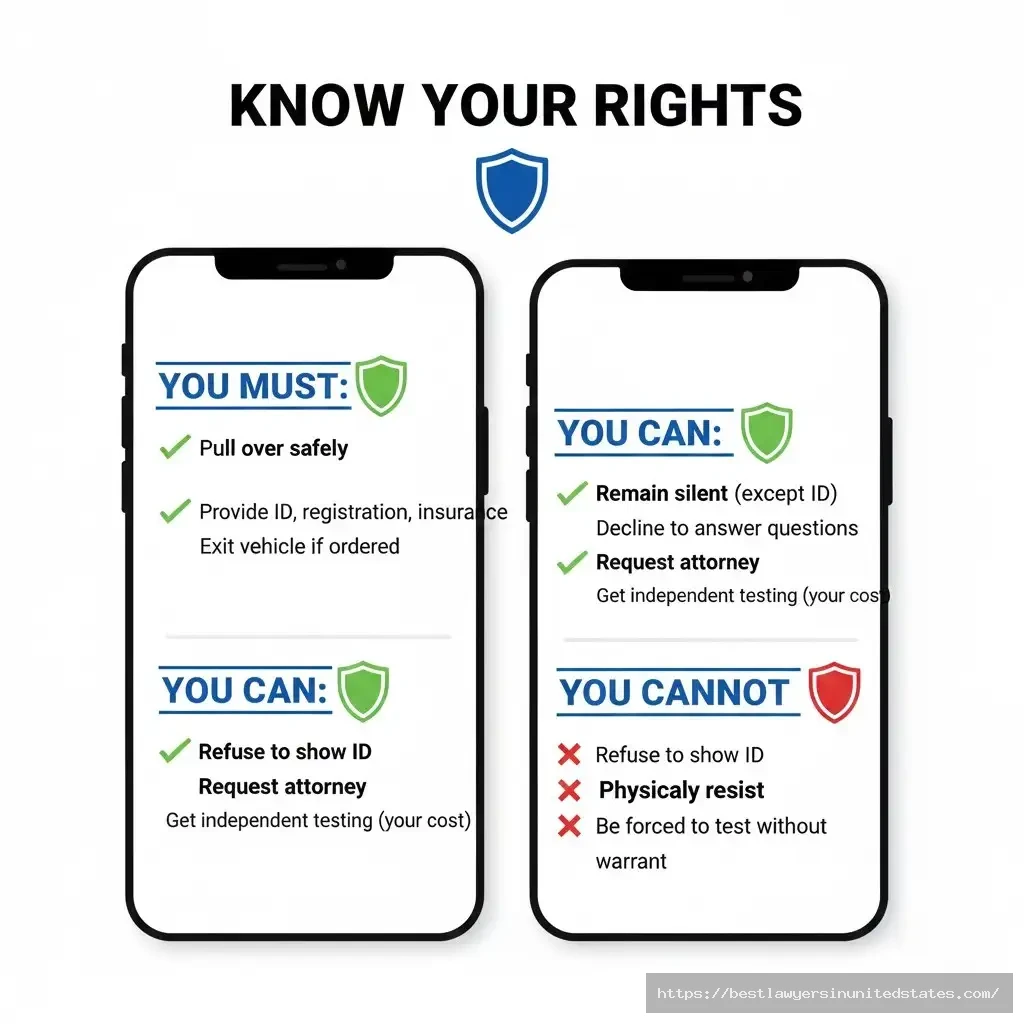
During the Traffic Stop
You must:
- Pull over safely when signaled
- Provide license, registration, and insurance
- Exit vehicle if ordered
- Submit to preliminary breath test if requested
You can:
- Remain silent except for providing identification
- Politely decline to answer questions (“I prefer not to answer questions”)
- Refuse field sobriety tests (though refusal can be used as evidence)
You cannot:
- Refuse to show identification
- Drive away from the stop
- Physically resist lawful orders
After Arrest
Miranda rights apply once you’re in custody and police begin interrogation.
You have the right to:
- Remain silent
- Speak with an attorney before answering questions
- Stop answering questions at any time
- Independent chemical testing at your expense (§ 32-23-15)
Officers must allow:
- Phone call to attorney (when reasonably possible)
- Access to test results upon request (§ 32-23-16)
Can You Refuse Field Sobriety Tests?
Yes, but: Officers can use refusal as evidence of impairment. South Dakota law doesn’t create penalties specifically for refusing field sobriety tests (only chemical tests after arrest).
Strategic consideration: Field sobriety tests provide subjective evidence. Some attorneys recommend politely declining, while others say cooperation appears less suspicious to juries.
Chemical Test Refusal Consequences
Immediate impact:
- 1-year license revocation (first refusal)
- 3-year revocation (second refusal)
- Refusal admissible at trial
No forced testing without warrant: Officers cannot physically force you to provide breath or blood samples without a search warrant (§ 32-23-14).
Exception: Officers increasingly obtain warrants for blood draws in serious cases involving accidents, injuries, or suspected drug impairment.
When to Hire a DUI Attorney
Legal representation significantly impacts case outcomes.
Critical Reasons to Hire an Attorney
Complex legal procedures:
- Two parallel cases (criminal and administrative)
- Strict filing deadlines (120 days for admin hearing)
- Technical evidence (breath test calibration, blood chain of custody)
- Statute interpretation
Potential defenses:
- Illegal traffic stop
- Improper field sobriety test administration
- Breath test machine malfunctions
- Blood sample contamination
- Rising BAC (alcohol still absorbing during arrest)
- Medical conditions affecting tests
Sentencing alternatives:
- Negotiating suspended imposition of sentence
- Treatment court admission
- Reduced charges (reckless driving, lesser offense)
- Limited driving privileges
What DUI Attorneys Cost in South Dakota
Fee structures:
- First offense: $2,500-5,000
- Second offense: $3,500-7,500
- Third offense (felony): $5,000-15,000
- Trial representation: $7,500-20,000+
Payment options:
- Flat fee for specific services
- Hourly rates ($200-400/hour)
- Payment plans available
- Public defender if you qualify financially
What’s included:
- Initial consultation
- Case investigation
- Court appearances
- Motion filing and argument
- Plea negotiations
- Trial representation
Finding a South Dakota DUI Attorney
Look for:
- Experience with South Dakota DUI law
- Familiarity with local courts and prosecutors
- Knowledge of breath/blood testing science
- Track record of favorable outcomes
Free consultation: Most DUI attorneys offer free initial consultations to evaluate your case.
Need help finding qualified representation? Our directory connects you with experienced DUI attorneys in South Dakota.
[Find DUI Lawyers in South Dakota – Free Consultation] Email: [email protected]
Frequently Asked Questions
How long does a DUI stay on your record in South Dakota?
Quick Answer: A DUI conviction remains on your criminal record permanently in South Dakota, but only counts as a prior offense for 10 years (25 years for sixth+ offenses).
The distinction matters because employers and background checks see the conviction forever, but prosecutors can only use it to enhance future DUI charges within the lookback period.
Exception: Successfully completing a suspended imposition of sentence prevents the conviction from appearing on most background checks, though law enforcement records still show the arrest and disposition.
Can you get a DUI on private property in South Dakota?
Quick Answer: Yes, South Dakota DUI laws apply anywhere you operate or have actual physical control of a vehicle, including private property.
Section 32-23-1 doesn’t limit enforcement to public roads. Cases have upheld DUI arrests in:
- Private parking lots
- Driveways
- Farm fields
- Private roads
- Parking structures
“Actual physical control” means sitting in a vehicle with keys accessible, even if the engine is off.
How much does a first DUI cost in South Dakota?
Quick Answer: Total costs range from $7,150 to $15,550 for a first offense, including fines, attorney fees, treatment, and insurance increases.
Major expenses include:
- Attorney fees: $2,500-5,000
- SR-22 insurance increases: $3,000-6,000 over 3 years
- Court fines and costs: $550-2,050
- Treatment and evaluation: $500-1,200
- Ignition interlock (if required): $500-1,200
Use our cost calculator for personalized estimates based on your BAC, county, and circumstances.
What happens if you refuse a breathalyzer in South Dakota?
Quick Answer: Your license gets suspended for 12 months on first refusal, compared to 30 days minimum for a failed test with conviction.
Additional consequences:
- Prosecutors can use refusal as evidence at trial
- No limited driving privileges until administrative hearing
- Second refusal triggers 3-year suspension
- Doesn’t prevent DUI charges based on other evidence
You have 120 days to request an administrative hearing to challenge the suspension.
Is jail time mandatory for first DUI in South Dakota?
Quick Answer: No, South Dakota law doesn’t mandate jail time for first-offense DUI. Judges can sentence up to one year but often impose probation instead.
Typical first-offense outcomes:
- Probation with conditions (most common)
- Suspended imposition of sentence
- Jail time only for aggravating factors (high BAC, accident, injury)
Second and subsequent offenses increase jail time likelihood, with fourth offenses requiring minimum 2-year prison sentences.
Can you get a suspended imposition of sentence for DUI in South Dakota?
Quick Answer: Yes, South Dakota judges can grant suspended imposition of sentence for first-offense DUIs, allowing you to avoid a conviction if you complete probation successfully.
How it works:
- Judge suspends the conviction after guilty plea or verdict
- You complete 1-2 years probation with conditions
- Success means no conviction appears on background checks
- Violation allows judge to impose original sentence
Important limitation: The DUI still counts as a prior offense if you get another DUI within 10 years.
How do you get limited driving privileges in South Dakota?
Quick Answer: Apply through the court after providing SR-22 insurance proof. First offenders can get limited licenses immediately; second offenders must complete chemical dependency treatment first.
Permitted uses under § 32-23-2:
- Employment
- 24/7 sobriety testing
- School attendance
- Child care pickup/delivery
- Health appointments
- Court/probation appointments
- Counseling or treatment programs
The court retains authority to modify conditions throughout your suspension period.
What is the 24/7 Sobriety Program in South Dakota?
Quick Answer: A monitoring program requiring twice-daily breath tests or continuous alcohol monitoring for offenders with prior DUIs within 10 years or first-offense BAC of 0.17% or higher.
Program details:
- Report to testing location morning and evening
- Provide breath sample each visit
- Pay $1-3 per test ($60-180 monthly)
- Alternative: continuous alcohol monitoring bracelet
- Available in all 66 South Dakota counties
Violations trigger immediate license revocation and probation violation proceedings.
Do out-of-state DUI convictions count in South Dakota?
Quick Answer: Yes, South Dakota counts DUI convictions from any state if they occurred within 10 years (or 25 years for aggravated sixth offenses).
Under § 32-23-4.5, prosecutors must prove the out-of-state offense would violate South Dakota DUI laws. Common equivalent offenses include DWI, OWI, OUI, and impaired driving.
Example: A Minnesota DUI from 2020 counts as your first offense for a 2026 South Dakota DUI, making it a second offense.
What BAC level requires chemical dependency evaluation in South Dakota?
Quick Answer: First-offense DUI with BAC of 0.17% or higher triggers mandatory chemical dependency evaluation under § 32-23-2.1.
Evaluation requirements:
- Licensed addiction counselor or certified health professional
- You pay all evaluation costs
- Recommendations provided to sentencing judge
- Often results in treatment program requirement
The 0.17% threshold is roughly double the legal limit of 0.08%.
Can you beat a DUI charge in South Dakota?
Quick Answer: Possible defenses include illegal traffic stop, improper testing procedures, medical conditions affecting results, and rising BAC, but success requires experienced legal representation.
Common defense strategies:
- Challenge probable cause for stop
- Question field sobriety test administration
- Attack breath test machine calibration
- Expose blood sample chain of custody issues
- Prove medical conditions (GERD, diabetes) affected results
Prosecutors must prove guilt beyond reasonable doubt. An attorney can identify weaknesses in their case.
How does a DUI affect CDL drivers in South Dakota?
Quick Answer: CDL holders face 1-year disqualification for first DUI (in any vehicle) and lifetime disqualification for second offense, with no limited commercial driving allowed.
CDL-specific consequences:
- 0.04% BAC limit (half the standard limit)
- Disqualification applies even for DUI in personal vehicle
- No work permits or limited CDL available
- Federal regulations prevent most employers from hiring drivers with DUI history
- 3-year disqualification if transporting hazardous materials
Most CDL drivers lose their careers after first DUI.
What happens at a DUI arraignment in South Dakota?
Quick Answer: The judge informs you of charges, you enter a plea, and the court determines bail conditions within 48 hours of arrest.
Arraignment process:
- Judge reads formal charges
- Explanation of maximum penalties
- You plead guilty, not guilty, or no contest
- Public defender appointment if you qualify
- Bond amount set or personal recognizance release
- Next court date scheduled
Most defendants plead not guilty at arraignment to preserve options for plea negotiations.
Is South Dakota a zero-tolerance state for DUI?
Quick Answer: No, South Dakota’s standard legal limit is 0.08% BAC for drivers 21 and older. However, drivers under 21 face zero-tolerance laws with a 0.02% limit.
BAC limits by category:
- Standard drivers (21+): 0.08%
- Commercial drivers: 0.04%
- Drivers under 21: 0.02%
The 0.02% under-21 limit allows for margin of error but still qualifies as zero-tolerance compared to some states’ absolute zero policies.
How long does the DUI court process take in South Dakota?
Quick Answer: Most DUI cases resolve within 3-6 months through plea agreements. Cases going to trial can take 6-12 months from arrest to final disposition.
Timeline factors:
- Complexity of evidence
- Attorney availability
- Court scheduling
- Plea negotiation progress
- Motion hearings needed
Critical deadlines:
- 120 days to request administrative hearing
- 48 hours for arraignment after arrest
- Typical pretrial conferences every 4-6 weeks
Take Action Now
A South Dakota DUI charge requires immediate action to protect your rights and driving privileges.
Critical next steps:
1. Contact an attorney within 24 hours Free consultations help you understand your options and begin building your defense.
2. Request administrative hearing within 120 days Miss this deadline and your license revocation becomes automatic with no appeal.
3. Document everything Write down arrest details, officer statements, and testing procedures while fresh in your memory.
4. Avoid discussing your case Don’t post on social media or discuss details with anyone except your attorney.
5. Prepare financially Review the cost breakdown and explore payment plan options with your attorney.
South Dakota’s DUI laws create serious consequences, but understanding the process and securing qualified legal representation gives you the best chance for favorable outcomes. Whether you’re facing first-offense charges or dealing with repeat DUI allegations, acting quickly preserves important rights and opportunities.
Need legal help? Connect with experienced South Dakota DUI attorneys who offer free consultations.
Email: [email protected]
