
Every year, millions of people search for divorce records. Some need proof for remarriage. Others want to update legal documents or research family history. Understanding how to access these records can save time, money, and frustration.
Divorce records are official documents that prove a marriage ended legally. They come in three main types: divorce decrees from courts, divorce certificates from state vital records offices, and complete court case files. Most divorce records are public, but access rules and costs vary by state.
This guide explains where to find divorce records, how much they cost, what information they contain, and how to get copies. You’ll learn the difference between decrees and certificates, discover which states offer online access, and find solutions to common problems people face when searching for these documents.
What Are Divorce Records?
Types of Divorce Documents
Divorce records refer to official documents that prove a marriage ended through legal divorce. Courts and state agencies create several types of records during and after the divorce process.
A divorce decree is the final court order that ends a marriage. The judge signs this document after the divorce is final. It includes all terms of the divorce like custody, support, and property division. Courts keep the original decree in the case file.
A divorce certificate is a vital record issued by state health departments. It contains basic information about the divorce but not the detailed court order. Think of it like a birth certificate – it proves something happened without showing all the details.
Complete court records include every document filed in the divorce case. This means the petition, responses, motions, agreements, financial disclosures, and the final decree. The court clerk’s office maintains these files.
Why People Need Divorce Records
You might need divorce records for several legal and personal reasons. Most states require proof of divorce before issuing a new marriage license. The county clerk will ask for a certified divorce decree or certificate when you apply to remarry.
Name changes require the divorce decree if it includes a provision restoring your maiden name. You’ll need certified copies to update your Social Security card, driver’s license, passport, and other official documents.
Property transfers also require divorce decrees. Title companies and county recorders need to see how the court divided property before processing deeds or mortgage releases.
Other common uses include updating wills and trusts, modifying custody or support orders, proving marital status for immigration applications, changing beneficiaries on insurance and retirement accounts, and researching family history for genealogy.
| Document Type | What It Is | Where to Get It | Typical Cost | Common Uses |
|---|---|---|---|---|
| Divorce Decree | Final court order ending marriage | Court clerk where divorce was filed | $10-40 | Legal proceedings, property transfers, custody matters |
| Divorce Certificate | Official vital record | State vital records office | $10-30 | Remarriage, name change, basic proof |
| Divorce Verification | Letter confirming divorce | State health department (some states) | $10-25 | Quick proof, informal verification |
| Complete Court Records | Entire case file | Court clerk’s office | $0.50/page or free viewing | Legal representation, detailed research |
Divorce Decree vs. Divorce Certificate: What’s the Difference?
Understanding Divorce Decrees
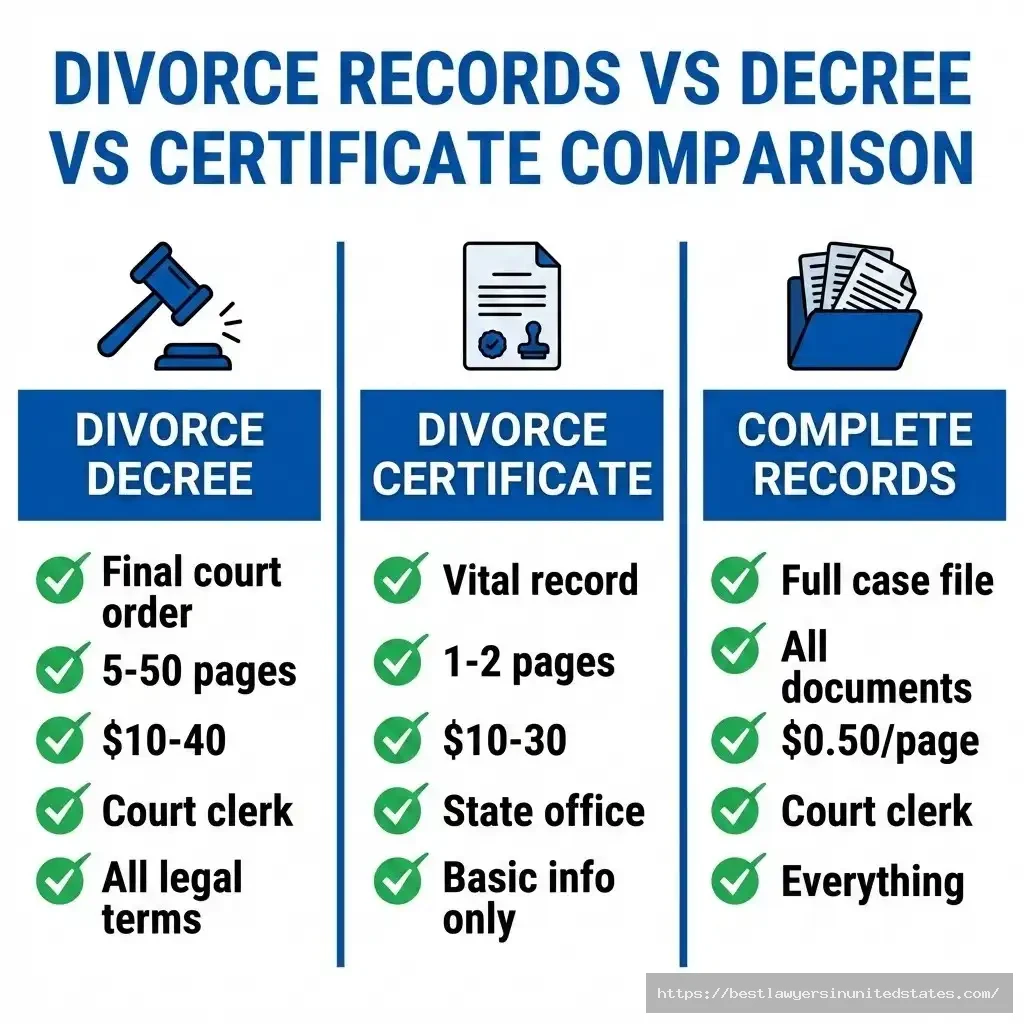
A divorce decree is the comprehensive legal document that officially ends your marriage. The judge signs this multi-page document after your divorce case concludes. It spells out every detail the court decided about your divorce.
The decree covers custody arrangements if you have children. It states who has legal and physical custody, visitation schedules, and decision-making authority. Child support amounts and payment terms appear in the decree.
Property division details show up in divorce decrees. The document lists which spouse gets which assets and debts. It may include the family home, vehicles, bank accounts, retirement funds, and credit card debts.
Spousal support terms are included when applicable. The decree states if alimony must be paid, how much, how long, and when payments begin. It may also explain what happens if circumstances change.
Divorce decrees typically run 5 to 50+ pages depending on case complexity. A simple uncontested divorce might produce a shorter decree. Complex cases with many assets, businesses, or custody disputes create longer decrees.
How Divorce Certificates Work
A divorce certificate contains only basic identifying information. State vital records offices issue these one or two-page documents. They look similar to birth or death certificates.
The certificate shows both spouses’ names, the date divorce was granted, the county and state where it occurred, and the case number. That’s about it. You won’t find custody terms, property division, or support amounts on a certificate.
Some states don’t issue divorce certificates at all. Texas, for example, provides verification letters instead of formal certificates. Other states like California and Florida do issue certificates through their vital records systems.
Most state vital records offices only maintain divorce certificates from the 1960s or 1970s forward. Divorces before those years exist only at the county level where they were filed. The state didn’t track divorces centrally before establishing modern vital statistics systems.
Which Document Do You Need?
For remarriage, most county clerks accept either a certified divorce decree or certificate. Check with your specific county clerk’s office about their requirements before ordering documents.
Name changes require the actual divorce decree with the name change provision. A certificate won’t work because it doesn’t show the court authorized your name restoration.
Legal proceedings need the full decree. Attorneys, courts, and title companies want to see the complete terms. A basic certificate lacks the detail they need.
Genealogy research works fine with certificates or index searches. You’re usually just confirming a divorce happened and when. You don’t need the full legal details.
Quick informal proof can use verification letters where available. These cost less than certified copies and work for basic confirmation purposes.
Are Divorce Records Public?
General Public Access Rules
Most divorce records are public documents under state sunshine laws. These laws promote government transparency by making court records accessible. Anyone can typically request and view basic divorce records without proving a relationship or showing cause.
Courts believe public access serves important purposes. It allows media oversight of the judicial system. It helps researchers study divorce trends. It enables background checks for legitimate purposes.
The default is public access unless specific exceptions apply. You don’t need to be a party to the divorce to access records. You don’t need your ex-spouse’s permission. You don’t need to explain why you want them.
However, courts can seal records in certain situations. They balance the public’s right to access against privacy concerns. Partial sealing is more common than completely sealing all records.
What Information Is Public vs. Sealed
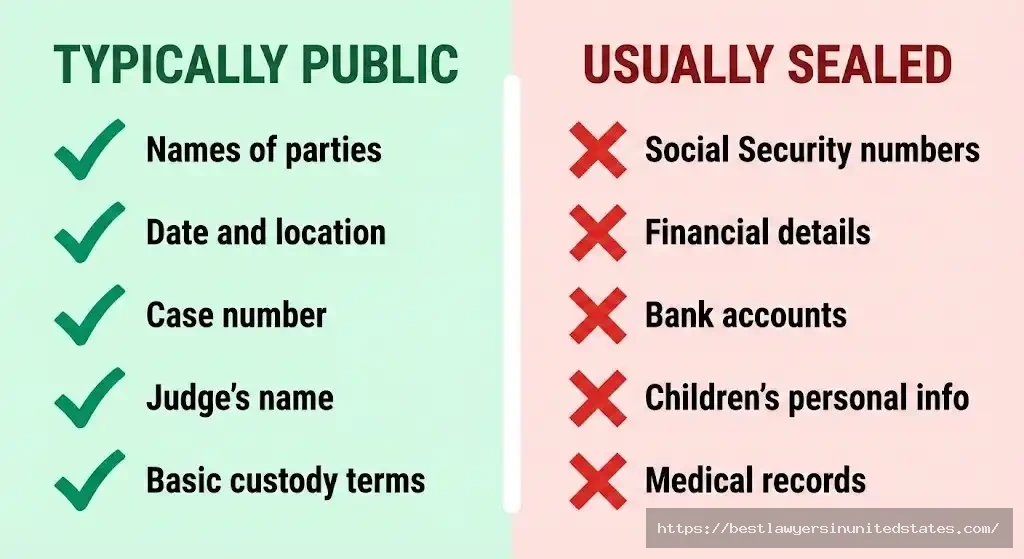
Typically public information includes:
- Full names of both parties
- Date and location of divorce
- Case or docket number
- Judge’s name
- Basic custody arrangements
- General property division terms
Often sealed or redacted information includes:
- Social Security numbers
- Detailed financial statements
- Bank account numbers
- Children’s specific personal details
- Abuse allegations (sometimes)
- Mental health or medical records
The goal is keeping identifying numbers and sensitive personal details private while maintaining transparency about the court proceeding itself. States approach this balance differently.
How Public Access Varies by State
States fall into three general categories for divorce record access. Understanding your state’s approach helps you know what to expect.
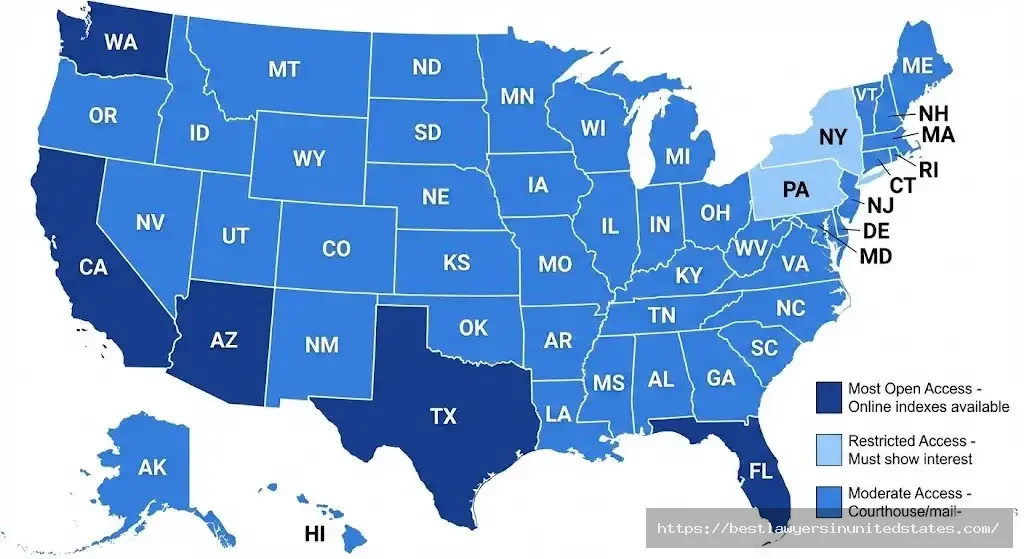
Most Open Access States:
Texas, California, and Florida make nearly all divorce records public. These states maintain online searchable indexes. Third parties can easily access records without restrictions.
California’s eAccess system lets anyone search court records online. Texas provides verification letters to anyone who requests them. Florida county clerk websites offer comprehensive online search and ordering.
Moderate Access States:
Many states treat divorce records as public but require courthouse visits or written requests. Online access may be limited. Some require you to state your relationship to the case or reason for requesting records.
These states haven’t fully digitized their records. You can access them, but you need to go through more formal channels than simply searching online.
Restricted Access States:
New York and Pennsylvania restrict access more than most states. You may need to show legitimate interest or explain your relationship to the parties. Online access is quite limited.
These states weigh privacy concerns more heavily. They make records available but create more hurdles to accessing them.
When Courts Seal Divorce Records
Courts seal records in specific circumstances when privacy interests outweigh public access principles. High-profile divorces involving celebrities or public figures often get sealed to prevent media scrutiny.
Cases involving domestic violence or abuse may be sealed to protect victims. Courts want to encourage abuse victims to come forward without fearing their stories will become public.
Divorces with minor children sometimes get partial sealing. Details about custody evaluations, children’s therapy records, or sensitive allegations about parenting might be sealed while basic case information remains public.
Business owners sometimes request sealing to protect trade secrets or confidential business information disclosed during divorce proceedings. If proprietary information appears in financial disclosures, courts may seal those specific documents.
Mental health records and medical information typically get sealed automatically. Courts recognize these details are highly personal and not relevant to public oversight of the judicial process.
| State | Public Access Level | Online Search | Notes |
|---|---|---|---|
| Texas | Most Open | Yes – state index | Verification letters available to anyone |
| California | Most Open | Yes – eAccess system | County-level online access common |
| Florida | Most Open | Yes – county sites | Strong public records tradition |
| New York | Restricted | Limited | Must show legitimate interest |
| Pennsylvania | Restricted | Limited | County-level only, limited online |
| Illinois | Moderate | Some counties | Varies significantly by county |
Where to Get Divorce Records
Court Clerk’s Office
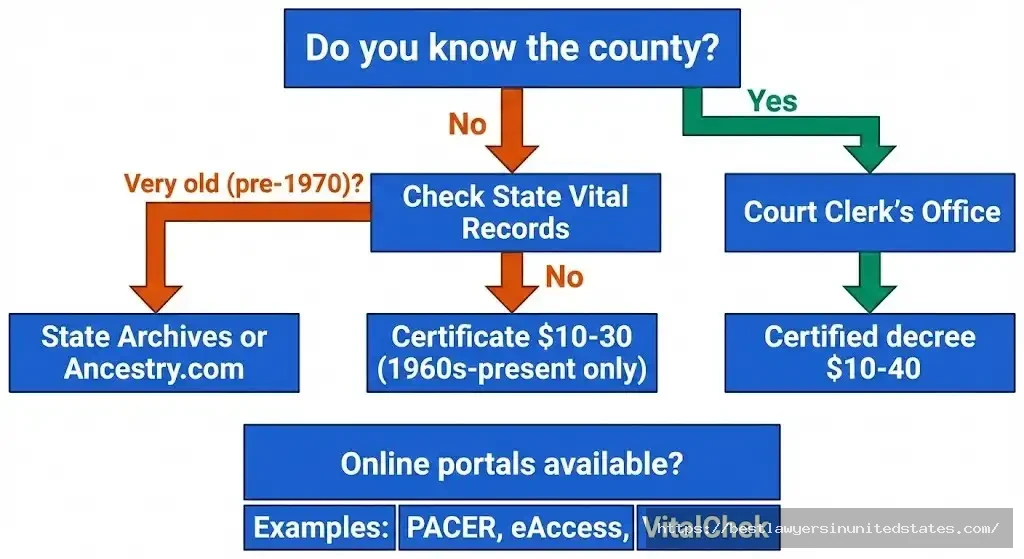
The court clerk in the county where your divorce was filed maintains the complete official record. This is always the primary source for divorce decrees and full case files.
You can access these records in person at the courthouse. Visit during business hours and ask to see the file. Bring identification and the case number if you have it. Most courthouses let you view records for free at public access computers.
Mail requests work if you can’t visit in person. Send a written request with the parties’ names, approximate divorce date, and payment for copies. Include your return address and contact information. Processing takes 2-6 weeks typically.
Some courts offer online access through eAccess systems. Search by name or case number and view documents electronically. You may pay per page to download files. Not all courts have digitized their records yet.
Pros of using court clerks:
- Most comprehensive records available
- Certified copies with official seals
- Complete case file access
- Always reliable and official
Cons of using court clerks:
- Must know correct county where filed
- May require in-person visit for older records
- Archived records take longer to retrieve
- Different procedures in each county
State Vital Records Office
State vital records offices or health departments issue divorce certificates in many states. These work like birth or death certificates – official vital records proving an event occurred.
Online ordering through state websites or VitalChek makes this convenient. Fill out an application, verify your identity, pay the fee, and receive the certificate by mail. Processing takes 1-3 weeks for most states.
Mail orders work if you prefer not to order online. Download the application from your state’s vital records website. Complete it, attach payment, and mail to the address shown. Expect 2-6 weeks for processing.
In-person visits to state vital records offices provide same-day service in many cases. Some states have regional offices in addition to the main state office. Call ahead to confirm hours and what documents to bring.
Pros of using vital records offices:
- Centralized state-level system
- Online ordering often available
- Standardized procedures
- No need to identify specific county
Cons of using vital records offices:
- Usually only have records from 1960s-1970s forward
- Limited information compared to court decrees
- Not all states issue certificates
- May not include recent divorces yet
Online Court Systems
PACER provides electronic access to federal court records. You’ll need this only for divorces handled in federal courts, which is rare. Most divorces happen in state courts, not federal.
Many states now offer online portals for searching court records. Search by name, case number, or date range. View dockets and sometimes download documents. Fees vary by state and court.
Examples include California’s eAccess system, which lets you search by name across multiple courts. Texas offers some county-level online access. Florida county clerk websites provide extensive online searching and ordering.
County clerk websites sometimes let you search directly on their site. This varies tremendously by county. Urban counties tend to have better online systems than rural counties.
Third-Party Services
VitalChek partners with over 450 government agencies to provide online ordering of vital records. They charge processing fees on top of state fees. This is convenient but more expensive than ordering directly from the state.
The service handles the ordering and shipping logistics. You fill out one standard application. VitalChek routes it to the correct state agency and follows up. Most orders arrive in 7-15 business days.
Ancestry.com and FamilySearch maintain historical divorce record collections for genealogy research. These work well for older divorces from the 1800s through 1980s. Many records are indexed and searchable.
Free and paid subscriptions provide different levels of access. FamilySearch is completely free. Ancestry requires a subscription for most records. Both let you search indexes and view record images when available.
Background check services aggregate public records including divorce records. These commercial services vary widely in accuracy and completeness. They charge monthly or per-search fees.
Cost to Obtain Divorce Records
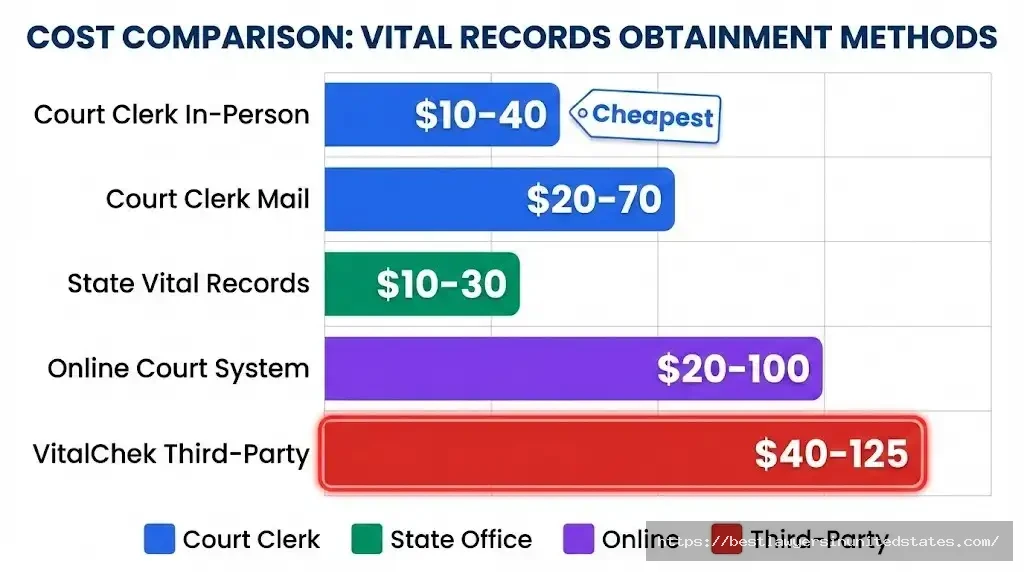
Fee Breakdown by Source
Costs vary significantly depending on where you request records and what type you need. Understanding the fee structure helps you find the most affordable option for your situation.
Court clerk fees typically include a search fee plus copy costs. Viewing records in person is usually free. Copies cost $0.50 to $2 per page. A full divorce decree might run 10-50 pages.
Certification fees add $10-40 to the base copy cost. This gets you a certified copy with the official court seal. Most official purposes require certification. Personal reference copies don’t need certification and cost less.
State vital records offices charge flat fees per certificate, usually $10-30. This includes the search and one certified copy. Additional copies ordered at the same time cost $5-15 each. Expedited processing adds $10-50.
Online court systems charge per page for document downloads, commonly $0.10 to $2 per page. You can view dockets free in most systems. Downloading and printing documents triggers the fees.
Third-party services like VitalChek charge processing and shipping fees on top of state fees. Total costs run $25-75 for one certificate. Expedited shipping adds another $15-75.
| Source | Search Cost | Document Cost | Certified Copy | Expedited Fee |
|---|---|---|---|---|
| Court Clerk (In-Person) | Free-$10 | $0.50/page | $10-40 | N/A |
| Court Clerk (Mail) | $5-25 | $0.50-1/page | $10-40 | $10-30 |
| State Vital Records | Free-$5 | N/A | $10-30/copy | $10-50 |
| Online Court System | Free-$50 | $0.10-2/page | Varies | N/A |
| VitalChek/Third-Party | Included | N/A | $25-75 | $15-75 |
State-Specific Cost Examples
Texas:
- Verification letter: $20 from state vital statistics
- Certified decree from court: $10-25 depending on county
- Online index searching: Free
- Same-day rush processing: Not available
California:
- Divorce certificate: $24 from state vital records
- Court certified decree: $15-40 depending on county
- eAccess document downloads: $0.50-1 per page
- Expedited processing: Additional $15
Florida:
- County-level certificates: $5-10
- Court certified decree: $1-2 per page
- Online access: Free to minimal fees
- Rush processing: $10-25 extra
New York:
- State divorce records: $30
- County clerk copies: $10-40
- Online access: Very limited
- Expedited service: Additional $30
Ways to Reduce Costs
Search online indexes before ordering anything. Many states and counties offer free searching. Confirm the record exists and note the case number. This prevents paying for unsuccessful searches.
Order directly from state or court websites instead of third-party services. You’ll avoid VitalChek’s processing fees. The state charges the same whether you order through them or a third party.
Request non-certified copies when acceptable. For personal reference, genealogy, or preliminary review, non-certified copies cost much less. You only need certification for official legal purposes.
Visit the courthouse in person when possible. This eliminates mail processing fees and expedited shipping charges. You can view records completely free at public terminals. Only pay for pages you actually need to copy.
Order multiple copies at once if you need them. Most places charge less for additional copies ordered simultaneously. The first copy might be $20, but copies 2-5 might only be $5 each.
Check if fee waivers apply to your situation. Many jurisdictions waive fees for indigent persons who can’t afford them. You’ll need to fill out a fee waiver application showing your income and expenses.
If you’re going through a divorce now, you can estimate your total costs including filing fees and legal expenses using our divorce cost calculator. This helps you budget for both the divorce itself and obtaining records later.
Divorce Cost Calculator
Get an estimated cost for your divorce based on your specific situation
Your Estimated Divorce Cost
Cost Breakdown
📧 Get a Personalized Consultation
Have questions about your specific situation? Contact our legal experts for guidance tailored to your needs.
Contact Us via EmailWhat Information Is Included in Divorce Records
Standard Information in All States
Every divorce record contains basic identifying information regardless of which state issued it. Both parties’ full legal names appear, including any maiden names. The date of marriage shows when the relationship began.
The divorce grant date indicates when the court finalized the divorce. This date determines when you’re legally single again and free to remarry. The county and state where the divorce was granted establish which court had jurisdiction.
Case or docket numbers provide the filing reference for the divorce case. You’ll need this number to request records or reference the case later. The presiding judge’s name appears on the final decree.
Additional Details That Vary by State
Some states include much more detail in public records while others keep information minimal. These differences reflect varying approaches to privacy and public access.
Information that may appear:
- Names and ages of minor children
- General custody arrangement type
- Property division summary
- Alimony or spousal support terms
- Grounds for divorce in fault states
- Attorney names for both parties
- Final hearing date
- Brief settlement terms description
Information usually sealed or excluded:
- Social Security numbers
- Detailed financial statements
- Bank account numbers
- Specific property addresses (sometimes)
- Abuse allegation details
- Mental health or medical records
- Children’s schools or specific information
Different types of divorce may produce different record lengths. An uncontested divorce often results in shorter, simpler records. A contested divorce with trials and extensive discovery creates much longer case files.
Divorce Decree vs. Certificate Content Comparison
Understanding what each document contains helps you request the right one for your needs.
Divorce decrees contain:
- Complete court order and judgments
- All terms and conditions
- Detailed custody and visitation schedules
- Child and spousal support amounts and terms
- Property division specifics
- Debt allocation
- Name change authorizations
- Attorney fee awards
- 5-50+ pages typical
Divorce certificates contain:
- Basic identifying information only
- Names of both parties
- Date and place of divorce
- Case number
- 1-2 page document
- Similar format to birth/death certificates
- No legal terms or conditions
When you need to show exactly how the court divided property or structured custody, only the decree works. When you simply need to prove a divorce occurred for remarriage, a certificate is usually sufficient.
When You Need Your Divorce Records
Legal Requirements for Remarriage
Most states require proof of divorce before issuing a new marriage license. The county clerk needs to verify you’re legally free to marry again. They can’t issue a license if you’re still married to someone else.
Bring a certified divorce decree or certificate to the clerk’s office when applying. The clerk reviews it to confirm your previous marriage ended. Requirements vary by state and county, so call ahead to ask what they accept.
Some clerks accept divorce certificates. Others require the actual decree showing the date divorce was final. A few accept either document. Don’t assume – confirm the specific requirements before your appointment.
The divorce must be final before you can remarry. If you’re still in a waiting period, you can’t get married yet even with a divorce decree. The decree shows the finalization date clearly.
Name Change Documentation
Restoring your maiden name or previous name requires the divorce decree with the name change provision. A certificate won’t work because it doesn’t include court orders about names.
The decree must specifically state that the court is restoring your previous name or authorizing you to use it again. Not all divorce decrees include this. You must request it during your divorce if you want it.
You’ll need certified copies for multiple agencies. Social Security requires one. The DMV requires one. Passport services require one. Some agencies keep the copy, so order several certified copies initially.
Present your certified decree plus your other identification documents at each agency. Each has specific procedures for processing name changes. Start with Social Security since many others require you to change it there first.
Property Transfers and Legal Matters
Divorce decrees are essential for transferring property ownership after divorce. The decree shows which spouse got which assets. Title companies and county recorders need to see this before processing deed changes.
Quitclaim deeds transfer property between ex-spouses. You’ll need the divorce decree showing you were awarded the property. The title company reviews the decree to confirm the transfer aligns with court orders.
Mortgage releases require decree copies. If one spouse keeps the house but both names are on the mortgage, you’ll need to refinance. The lender wants proof the divorce happened and terms for property division.
Retirement account divisions need divorce decrees with qualified domestic relations orders (QDROs). These special court orders tell retirement plan administrators how to split the account. The decree and QDRO work together.
Bank accounts, investment accounts, and insurance policies all require decree copies to remove an ex-spouse or change beneficiaries. The financial institution wants court documentation before making changes.
Personal and Administrative Uses
Update your will and trust after divorce. The decree proves your marital status changed. Your estate planning attorney needs it to draft new documents reflecting your current family situation.
Child custody or support modifications require the original decree. Courts need to see the existing orders before changing them. Bring certified copies to any modification hearings.
Immigration and visa applications often require divorce proof. U.S. Citizenship and Immigration Services wants to verify your marital status. They typically require certified copies of divorce decrees or certificates.
Military benefits changes need divorce documentation. If your spouse was in the military, various benefits may continue depending on marriage length. You’ll need the decree to make claims or update status.
Insurance beneficiary updates require proof. Life insurance, health insurance, and auto insurance companies all need divorce documentation before removing an ex-spouse or changing beneficiaries.
How to Search for Divorce Records
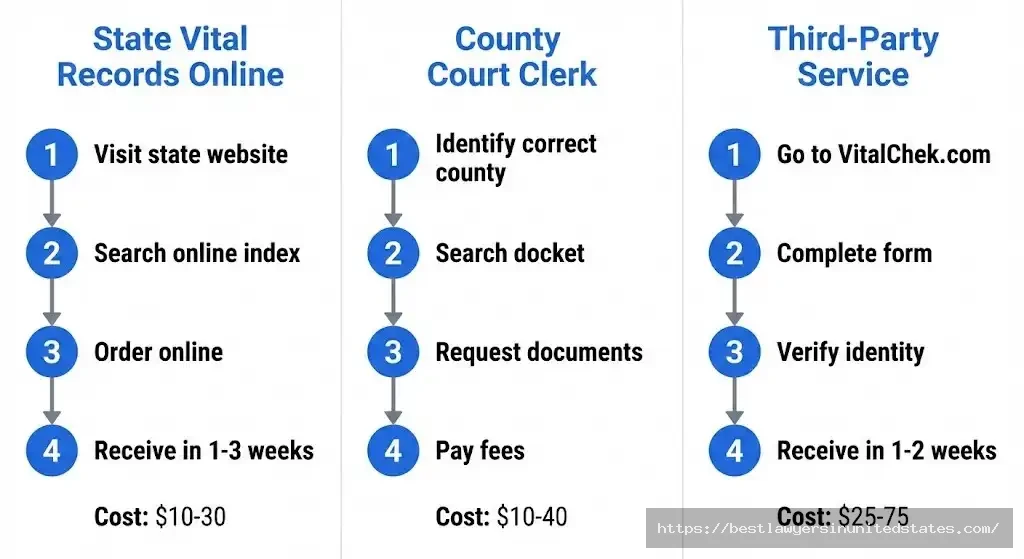
Method 1: State Vital Records Online Search
Start by visiting your state’s vital records or health department website. Most states maintain online presences where you can search for and order records. Look for the vital records section specifically.
Check if an online index exists. Many states let you search by name and date range before ordering. This confirms the record exists and helps you avoid paying for a search that won’t find anything.
Search parameters usually include both parties’ names, approximate divorce date, and sometimes the county. You might need only one person’s name. Try different combinations if your first search doesn’t work.
If the search finds your record, proceed to the online ordering form. Complete it with your contact information, payment details, and delivery preferences. Verify your identity through their electronic system.
Pay the state fee and any processing charges. Choose standard or expedited shipping. Most orders arrive in 5-15 business days. Track your order if the system provides tracking information.
Method 2: County Court Clerk Search
Identify the correct county where the divorce was filed. This is usually where one spouse lived at the time. It might not be where you live now or where you got married.
Check the county clerk’s website for online search tools. Many counties offer docket searches by name. Enter both parties’ names or the case number if you have it.
View the docket sheet to confirm you found the right case. The docket shows all filings, hearings, and the final decree date. This helps verify it’s your case before requesting copies.
Request documents either online, by mail, or in person depending on the county’s systems. Fill out request forms with the case number, parties’ names, and specific documents needed.
Pay required fees and wait for processing. In-person requests often provide same-day service. Mail requests take 2-6 weeks typically. Online orders through county portals vary.
Method 3: Third-Party Online Services
VitalChek streamlines ordering from multiple state agencies through one website. Go to VitalChek.com and select your state. Choose “Divorce Records” from the vital records options.
Complete the standard application form with both parties’ information. Provide the divorce date, location, and your contact details. The form is similar across all states.
Verify your identity through electronic verification or by uploading ID images. This security step prevents unauthorized access to records. Follow the prompts carefully.
Pay the combined processing fee and state fee. Add expedited shipping if needed. Review your order details before submitting. You’ll receive a confirmation email with tracking.
For historical or genealogy research, try Ancestry.com or FamilySearch.org. Create a free or paid account depending on the service. Search their divorce records collections by name, location, and date.
Filter results to narrow down to the specific person and time period. View index entries or record images when available. Save relevant records to your research files or family tree.
Tips for Successful Searches
If you can’t find the record:
- Try alternate spellings of names
- Expand the date range by several years
- Check adjacent counties if near county borders
- Search under maiden names or previous names
- Call the clerk’s office for search assistance
If the record appears sealed:
Contact the court clerk to verify it’s actually sealed versus just not online. Sealed records require special procedures to access. You may need to petition the court if you’re not a party.
For very old records (pre-1970):
Check state archives rather than current court files. Contact local historical societies for guidance. Search newspaper archives for public divorce announcements. Consider hiring a professional genealogist for difficult searches.
Many people searching for records are also dealing with divorce filing fees or trying to understand how to file for divorce. These related processes all create the public records you might search for later.
Accessing Historical Divorce Records (Pre-1970)
Why Historical Records Are Different
Most states didn’t centralize vital records until the 1960s or 1970s. Before then, only the county where the divorce was filed kept records. No state-level system existed to track all divorces.
Older records may not be digitized. You might need to review physical files, microfilm, or microfiche. This requires in-person visits or hiring someone local to search for you.
Courthouse fires, floods, and other disasters destroyed some historical records. Not every old divorce file still exists. Some counties have gaps in their records from lost or damaged files.
Documentation standards varied historically. Very old divorce records may contain less detail than modern ones. The information recorded and how it was organized changed over time.
Where to Find Historical Records
County clerk archives hold the originals. They’re your first stop for divorces before the state centralized records. Call or visit the courthouse in the county where the divorce occurred.
Some counties transferred old files to off-site storage or archives. You may need to request files in advance. Staff will retrieve them from storage for you to review during your visit.
Microfilm copies exist in many counties. Clerks converted old paper records to microfilm years ago to preserve them. You’ll use microfilm readers at the courthouse or library to view these.
State archives receive county records after 50-100 years in many states. Search their catalogs to see what they hold. Visit during research hours to review files. Some provide appointment-only access.
Archives organize records by county and year. They maintain finding aids to help you locate specific records. Staff can guide you through their systems and collections.
Genealogy websites offer indexed historical divorce collections. Ancestry.com maintains the largest collection of U.S. divorce records. Their indexes cover the 1800s through 1980s for many locations.
FamilySearch.org provides free access to many historical records. Volunteers index records making them searchable by name. You can view record images for confirmed matches.
MyHeritage and Findmypast also maintain divorce record collections. Subscription levels vary. Free accounts provide limited access while paid subscriptions unlock full collections.
Newspaper archives published legal notices including divorce announcements. Search historical newspaper databases for easier access than court records. Divorces often appeared in legal notices sections.
Newspapers.com provides searchable archives from papers nationwide. Chronicling America offers free Library of Congress newspaper collections. Local libraries often maintain local newspaper archives.
Research Tips for Historical Records
Be flexible with name spellings. Indexers made errors transcribing old handwritten records. Try multiple spelling variations. Search for first name only if the surname isn’t working.
Check multiple adjacent years. Divorce dates might be recorded inconsistently. Search a five-year window around your expected date. The filing date and finalization date may differ by a year or more.
Look for divorce announcements in newspapers first. These are often easier to find than court records. Once you confirm a divorce happened, you know where to search court files.
Contact local genealogical and historical societies. Members often have deep knowledge of local records and resources. They may have indexes or finding aids not available online.
Consider hiring a professional genealogist for difficult searches. They know local resources and have experience with old record systems. This can save you time and travel expenses for distant searches.
Sealed & Confidential Divorce Records
When Divorce Records Are Sealed
Some divorce records are sealed by court order to protect privacy. This means they’re not available to the public. Only the parties to the divorce and their attorneys can access sealed records.
Automatic sealing happens in some situations:
Courts may automatically seal cases involving domestic violence protective orders. Abuse allegations and related evidence often get sealed to protect victims. Some states automatically seal cases with minor children.
Mental health records disclosed during divorce get sealed. Medical records and psychological evaluations are confidential by default. Business trade secrets or proprietary information may be sealed.
Court-ordered sealing requires a motion. One or both parties must ask the court to seal records. They file a motion explaining why sealing is needed. The court holds a hearing and decides.
Common reasons for requesting sealing include public figure or celebrity divorces with media attention, embarrassing personal information that’s not legally relevant, protection from harassment or stalking, sensitive financial or business information, and highly contentious cases with inflammatory allegations.
Partial vs. Complete Sealing
Partial sealing is much more common. The court seals specific documents while keeping basic case information public. The docket sheet might show the case exists with parties’ names and dates, but specific documents are sealed.
Financial disclosures, custody evaluations, and settlement negotiations often get partially sealed. The final decree might be public while discovery documents are sealed. This balances transparency with privacy.
Complete sealing is rare and requires extraordinary circumstances. The entire case file becomes confidential. The docket itself may be sealed. Only parties and attorneys can confirm the case exists.
Courts resist complete sealing because it eliminates judicial oversight. The public can’t see what happened in the case. This undermines court transparency principles.
How to Seal Your Divorce Records
During your divorce:
File a motion to seal with your divorce petition or early in the case. Explain specifically what information needs protection and why. Attach supporting documentation like police reports for domestic violence cases.
Serve the motion on your spouse so they can respond. The court schedules a hearing. Present evidence supporting why sealing is necessary. The court weighs public interest against your privacy needs.
If approved, the court issues a sealing order. It specifies exactly what is sealed and who can access it. The clerk’s office marks the file appropriately.
After divorce is final:
File a post-judgment motion to seal records. Explain why sealing is needed now. You’ll have a higher burden of proof than during the case. Courts are reluctant to seal records after they’ve been public.
Notify your ex-spouse of the motion. They may oppose it. The court considers whether information is already public. If media or others already accessed records, sealing may not help.
The court considers several factors: privacy interests of parties and children, public’s right to access court proceedings, whether information is already public, alternative remedies like redacting specific items, and whether both parties consent to sealing.
Accessing Sealed Records
If you’re a party to the divorce:
You can always access your own sealed divorce records. Contact the court clerk’s office with your identification and case information. You may need to review files at the courthouse rather than getting copies.
If you’re not a party:
You generally cannot access sealed records. Limited exceptions exist for attorneys representing someone with legitimate need, people with court orders granting access, and cases where you can show compelling legal interest.
You would need to petition the court explaining why you need access. The court holds a hearing. You must prove your need outweighs the privacy interests that led to sealing.
Understanding sealed records becomes particularly important if you’re currently going through the divorce process and wondering whether your case might benefit from sealing certain documents.
Common Problems & Solutions
“I Can’t Find the Divorce Record”
Problem: You’ve searched state and county systems but found no record of the divorce.
Solutions to try:
First, verify the divorce actually finalized. Some couples separate or file for divorce but never complete the process. Ask your ex-spouse or check old mail for divorce paperwork.
Check if the divorce was filed in a different county than expected. Divorces are filed where one spouse lived, which might not be where you lived together. Try searching counties where each spouse might have lived.
Try alternate spellings of both names. Records might be indexed under different spelling variations. Search for first name only if surname searches aren’t working.
Expand your search dates significantly. Divorces take months or years to finalize. If you think it happened in 2015, search 2014-2017. The filing date and finalization date differ.
Call the clerk’s office directly for assistance. Explain what you’ve tried. They can search their systems differently and may find records you missed online.
“The Record Is Sealed or Restricted”
Problem: You found the case but can’t access the documents.
Solutions to try:
Contact the court clerk to verify the record is sealed versus just not digitized yet. Ask why it’s sealed. Some sealing is temporary or only covers specific documents.
If you’re a party to the divorce, show identification at the clerk’s office. They’ll let you view your own sealed records. You may not get copies, but you can see the file.
If you have a legitimate legal need, consider petitioning the court for access. Draft a motion explaining why you need access and what legal matter requires it. The judge will decide if your need outweighs the sealing reasons.
Consider whether summary information might work instead. Even sealed cases may have public docket sheets showing basic information. This might be enough for your purpose.
“I Don’t Know Where the Divorce Was Filed”
Problem: You’re unsure which county or state had jurisdiction.
Solutions to try:
Check the last known residence county for both spouses. Divorces are typically filed where the petitioner lived. Try the county where either spouse lived when the divorce happened.
Search multiple adjacent counties. If you lived near county borders, the divorce might be in any nearby county. Cast a wide net initially.
Contact state vital records offices. Many maintain state-level indexes even if they don’t have full records. They can tell you which county to search.
Ask family members who might remember. Someone may recall which courthouse or attorney was involved. Old mail or documents might provide clues.
Look for old tax returns showing filing status changes. The year your status changed from married to single narrows down when the divorce occurred.
“The Divorce Is Very Old (Before 1970)”
Problem: State vital records says they don’t have records that old.
Solutions to try:
Contact the county clerk directly in the county where you believe the divorce occurred. They have older records than the state system. Be prepared to visit in person.
Visit or contact state archives. Many states transferred old county records to central archives. Search their catalogs and finding aids.
Search Ancestry.com and FamilySearch.org for historical divorce records. Volunteers have indexed many old divorce records making them searchable by name.
Check newspaper archives for divorce announcements. Historical newspapers published legal notices including divorces. This can confirm a divorce happened and where.
Consider hiring a professional genealogist experienced in the area and time period. They know local resources and can efficiently search old records.
“Costs Are Too High”
Problem: You can’t afford certification and shipping fees for copies.
Solutions to try:
Visit the courthouse to view records for free. You don’t have to pay to look at public records. Take notes or photos of key information if allowed.
Request non-certified copies when acceptable. For personal reference or preliminary review, non-certified copies cost much less. You only need certification for official legal purposes.
Order directly from state or court offices. Skip third-party services like VitalChek. The state charges the same fee but third parties add processing charges.
Check if fee waivers apply to your situation. Many courts waive fees for indigent persons who complete fee waiver applications showing they can’t afford standard fees.
Get verification letters instead of certificates where available. Some states like Texas offer cheaper verification letters that work for many purposes.
Many people researching divorce costs find it helpful to estimate their total expenses including future record retrieval needs before proceeding.
Frequently Asked Questions
Are divorce records public?
Quick Answer: Generally yes, divorce records are public documents accessible to anyone under state sunshine laws, though some states restrict access and courts may seal records containing sensitive information.
Most states treat divorce records as public to promote government transparency. Anyone can request them without proving a relationship to the parties. However, New York and Pennsylvania restrict access more than other states. Courts can seal individual cases for privacy reasons like domestic violence or protection of children.
How much do divorce records cost?
Quick Answer: Typically $10-40 for a certified copy from courts or state vital records offices, with fees varying by state and document type.
Court clerks usually charge $10-40 for certified divorce decrees. State vital records offices charge $10-30 for divorce certificates. Non-certified copies cost less. Third-party services add processing fees of $10-50. Expedited processing adds $10-50 extra.
How long does it take to get divorce records?
Quick Answer: In-person at courthouse: same day to 1 week; mail from state: 2-6 weeks; online through VitalChek: 1-2 weeks; court online portal: instant to 24 hours.
Processing times vary by method and location. In-person courthouse visits often provide same-day service. Mail requests to state offices take 2-6 weeks. Online orders through third parties take 1-2 weeks. Counties with electronic systems may provide instant downloads.
Can I get divorce records online?
Quick Answer: Many states offer online ordering through vital records offices or VitalChek, and some courts have electronic access portals, but not all states and counties provide online access.
States like California, Texas, and Florida offer extensive online access. Others require mail or in-person requests. Check your specific state’s vital records website. County courts vary widely in online availability. PACER provides federal court access but most divorces occur in state courts.
Do I need a lawyer to get divorce records?
Quick Answer: No, anyone can request divorce records without an attorney since the process is administrative, not legal.
Requesting records is a simple administrative process. Fill out applications, pay fees, and receive documents. No legal representation is needed. However, interpreting complex divorce decrees or using them in legal proceedings might benefit from attorney advice.
What’s the difference between a divorce decree and a divorce certificate?
Quick Answer: A decree is the complete court order from the divorce case with all terms and conditions; a certificate is a shorter vital record from the state office proving divorce occurred.
Divorce decrees are comprehensive legal documents showing custody, support, property division, and all court decisions. They run 5-50+ pages from court clerks. Divorce certificates are 1-2 page vital records showing names, dates, and basic information from state offices. Think birth certificate versus medical records.
Do I need a certified copy?
Quick Answer: Yes for official legal purposes like remarriage, name changes, or property transfers; no for personal reference or genealogy research.
Certified copies include an official seal proving authenticity. Courts, government agencies, and financial institutions require them for legal matters. Non-certified copies work fine for personal use. They’re cheaper but lack official seals.
How do I get a copy of my divorce decree?
Quick Answer: Contact the clerk of court in the county where your divorce was filed, provide names and case number if known, pay $10-40, and receive a certified copy by mail or in person.
Call or visit the county courthouse where you got divorced. Request a certified copy of the decree. Provide both parties’ names and approximate date. The case number helps but isn’t required. Pay the fee and choose mail or in-person pickup.
How long are divorce records kept?
Quick Answer: Permanently in most jurisdictions, with older records transferred to state archives but not destroyed.
Courts keep divorce records indefinitely. They’re permanent legal documents. Very old records may transfer to state archives after 50-100 years. They remain accessible there. Records are not destroyed even after decades.
When do divorce records become public?
Quick Answer: Usually immediately upon filing and finalization, though some jurisdictions have brief waiting periods or redact sensitive information before public release.
Most divorce records become public as soon as they’re filed. The court docket shows filings immediately. The final decree is public when issued. Some courts redact Social Security numbers and children’s information before making files public. This may take a few days.
Can I get divorce records from 50+ years ago?
Quick Answer: Yes, but you’ll likely need to contact the county clerk or state archives since older records may not be online.
Historical records exist but accessing them takes more effort. County clerk’s offices maintain original files. State archives may have very old records transferred from counties. Genealogy websites like Ancestry.com and FamilySearch.org have indexed many historical divorces. Newspaper archives may show divorce announcements from the time period.
Can my ex-spouse seal our divorce records?
Quick Answer: They can petition the court to seal records, but both parties are typically notified and courts consider both parties’ interests and public access principles before sealing.
Your ex can file a motion to seal records. The court notifies you of the motion. You can oppose it at a hearing. The judge weighs privacy interests against public access. Both parties’ views matter. Courts don’t seal records just because someone requests it.
Can I get someone else’s divorce records?
Quick Answer: Yes if they’re public records, since you don’t need to be a party to access them, with exceptions for sealed records.
Public records are available to anyone for any lawful purpose. You don’t need permission or a relationship to the parties. You can search for and obtain copies. Sealed records are different – only parties or people with court orders can access those.
Do I need my ex’s permission to get our divorce records?
Quick Answer: No if records are public, since both parties have equal right to access their own divorce records.
You don’t need your ex-spouse’s permission for public records. You were a party to the divorce and have full rights to access the case file. Contact the court or vital records office directly. Your ex can’t block your access.
Where are divorce records kept?
Quick Answer: Court clerk’s office in the county where divorce was filed (complete records) and state vital records office (certificates only, usually from 1960s forward).
The county courthouse maintains complete case files with all documents. State health or vital records departments may have divorce certificates for recent divorces. Very old records may be at state archives. Only the county where you filed has the full record.
Conclusion
Divorce records serve many purposes from proving marital status for remarriage to researching family history. Understanding the different types of records and where to find them saves time and money.
Most divorce records are public and accessible through county clerks or state vital records offices. Costs typically range from $10-40 for certified copies. Online access varies widely by state, with some offering comprehensive systems and others requiring in-person or mail requests.
The key to successful record searches is knowing where the divorce was filed and what type of document you actually need. Divorce decrees provide complete court orders with all terms, while certificates offer basic proof. Choose the right document for your specific purpose.
Whether you need records for remarriage, name changes, property transfers, or genealogy, the resources outlined in this guide provide multiple paths to accessing them. Start with state online systems when available, contact county clerks directly when needed, and consider historical archives for older records.
Questions about your specific situation? Contact your local court clerk’s office for guidance on accessing records in your jurisdiction.
Need help with divorce costs or legal matters?
Email: [email protected]
Last updated: January 2026