
Getting a divorce involves filing a petition with your local family court, serving papers to your spouse, and either reaching a settlement agreement or going to trial. The process takes anywhere from 3 months to 2+ years depending on whether your divorce is contested or uncontested. Most divorces cost between $500 and $30,000+ based on complexity and attorney involvement.
This guide walks you through every step of the divorce process, from deciding if you’re ready to file through finalizing your divorce decree. You’ll learn about different divorce types, state-specific requirements, costs, timelines, and how to handle property division, child custody, and spousal support. Whether you’re just considering divorce or ready to file today, this guide gives you the information you need to move forward.
Before You File: What You Need to Know
Understanding the Divorce Process
Divorce legally ends your marriage and divides your marital property, debts, and parental responsibilities. Courts call this “dissolution of marriage” in most states. The process starts when one spouse files a divorce petition and ends when a judge signs your final divorce decree.
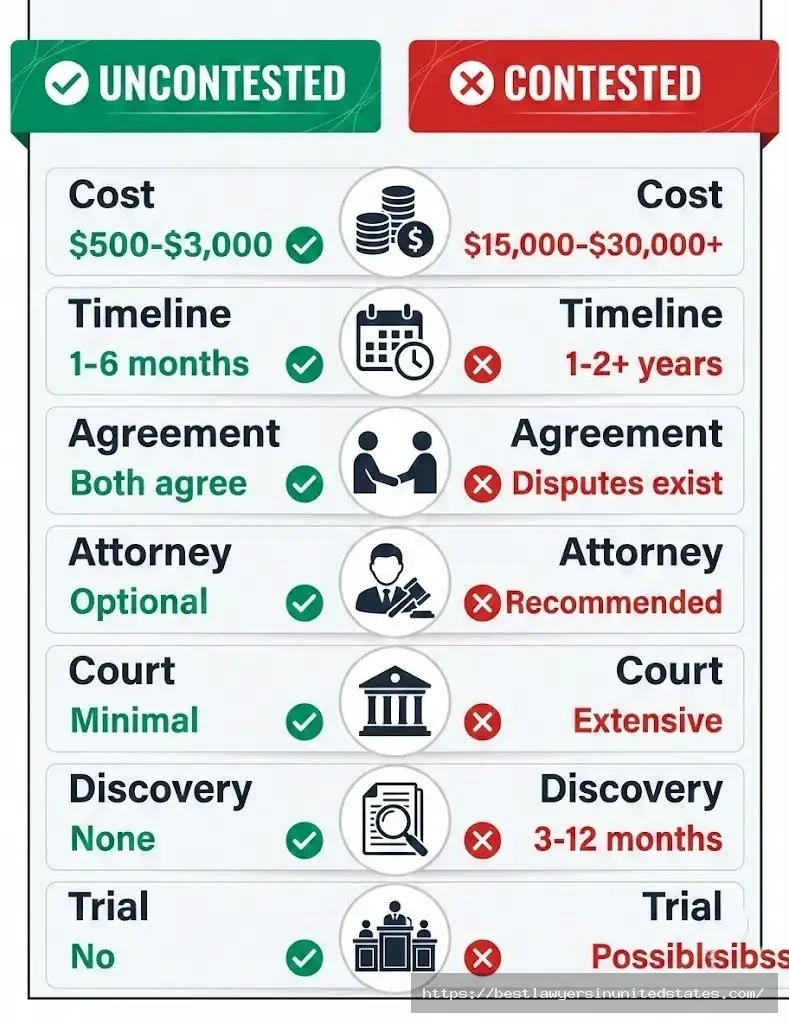
The timeline varies widely. An uncontested divorce where both spouses agree on everything takes 1 to 6 months in most states. A contested divorce with disputes over property, custody, or support can take 1 to 2+ years to resolve. State waiting periods, court backlogs, and the complexity of your case all affect how long your divorce takes.
Key Questions to Answer Before Filing
Are you emotionally and financially ready to divorce? This decision affects every aspect of your life. Many couples find that counseling or trial separation helps them decide whether divorce is the right choice. If you’re certain about divorcing, start preparing financially by understanding your household income, debts, and assets.
Do you meet your state’s residency requirements? Most states require you to live there for 6 months to 1 year before filing. Alaska has no residency requirement, while Nevada only requires 6 weeks. Check your state’s specific rules before filing.
What type of divorce fits your situation? An uncontested divorce works when both spouses agree on all terms. A contested divorce is necessary when you disagree on major issues. Mediation offers a middle ground where a neutral third party helps you negotiate. Understanding the costs of each divorce type helps you budget for the process ahead.
Residency Requirements by State
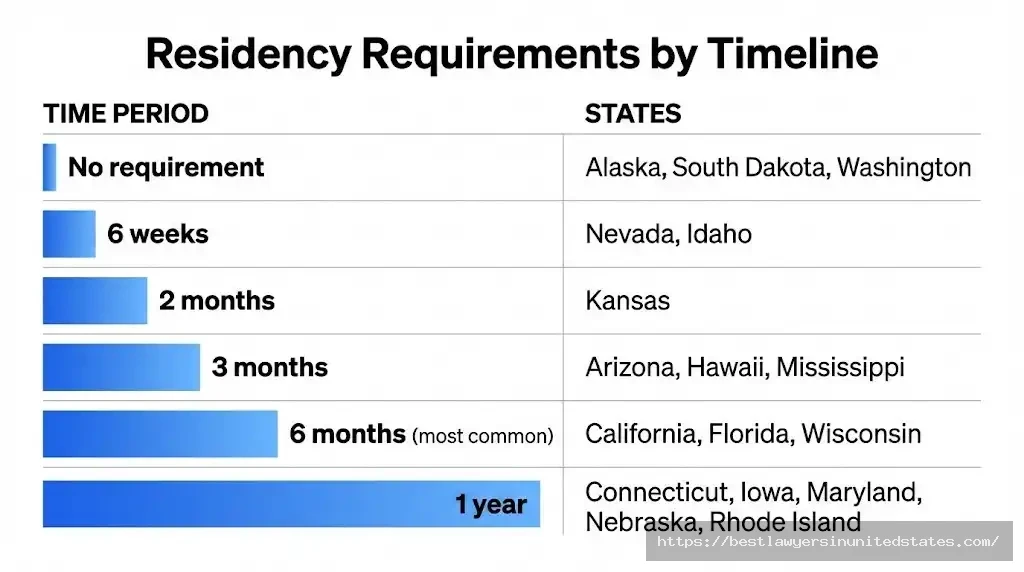
Every state has residency requirements before you can file for divorce. Here’s what you need to know:
Common residency periods:
- 6 months: Most states including California, Florida, and Wisconsin
- 1 year: Connecticut, Iowa, Maryland, Nebraska, and others
- 6 weeks: Nevada (shortest in the country)
- No requirement: Alaska, South Dakota, Washington
You typically file in the county where you or your spouse lives. If you recently moved to a new state, you may need to wait before filing. Military members can file in their state of legal residence, their current duty station state, or where their spouse lives.
Where to file: Contact the family court clerk in your county to confirm local filing requirements and fees.
Types of Divorce Explained
Uncontested Divorce
Both spouses agree on all terms including property division, child custody, support payments, and alimony. This is the fastest and cheapest divorce option available. You work together to complete paperwork and submit a settlement agreement to the court for approval.
Average cost: $500 to $3,000 total
Timeline: 1 to 6 months
Best for: Amicable separations, couples without complex assets, parents who agree on custody
An uncontested divorce costs significantly less than litigation because you avoid lengthy court battles and excessive attorney fees. Many couples complete uncontested divorces without attorneys using court-provided forms.
Contested Divorce
You disagree on one or more major issues and need a judge to decide. Common disputes include property division, child custody, spousal support, or child support amounts. The discovery process requires extensive financial documentation and can involve depositions, expert witnesses, and multiple court hearings.
Average cost: $15,000 to $30,000+
Timeline: 1 to 2+ years
When necessary: High-conflict situations, complex asset division, custody disputes
Contested divorce costs escalate quickly because of attorney hours, court fees, and expert witness expenses. Many contested divorces eventually settle before trial, but the threat of litigation drives up costs.
Divorce Mediation
A neutral mediator helps you and your spouse negotiate all divorce terms. The mediator can’t give legal advice or represent either party. You control the outcome instead of leaving decisions to a judge. Many couples use attorneys outside of mediation sessions for legal guidance.
Average cost: $3,000 to $7,000
Timeline: 2 to 6 months
Benefits: Less adversarial, more control, faster than litigation, private process
Divorce mediation costs less than litigation but more than DIY divorce. Mediators charge $100 to $300 per hour for their services. Most couples need 5 to 10 sessions to reach complete agreements.
Collaborative Divorce
Both spouses hire specially trained collaborative attorneys who work together toward settlement. The process includes financial advisors, child specialists, and other professionals as needed. If collaboration fails and you go to court, both attorneys must withdraw and you hire new lawyers.
Average cost: $5,000 to $15,000 per spouse
Timeline: 4 to 12 months
Best for: High-asset divorces, business owners, couples committed to avoiding court
Learn more about collaborative divorce costs and when this team approach makes financial sense.
DIY Divorce (Pro Se)
You file and complete your divorce without attorney representation. Courts provide forms and many states offer self-help resources. This option works best for simple situations with no children, few assets, and complete agreement.
When appropriate:
- Short marriage (under 5 years)
- No children together
- Limited assets and debts
- Both spouses agree on all terms
- No spousal support disputes
State-specific requirements: Every state has different forms and procedures. Our DIY divorce state-by-state guide provides direct links to court forms and filing instructions for all 50 states.
Summary Dissolution
Some states offer simplified divorce procedures for qualifying couples. Requirements typically include short marriage duration (under 5 years), no children, limited property, and agreement on all terms. Available in California, Oregon, Colorado, and several other states.
Requirements typically include:
- Married less than 5 years
- No children (born or adopted)
- No real estate ownership
- Limited personal property value
- Limited debt amounts
- Both spouses waive spousal support
Check if your state offers summary dissolution and whether you qualify for this expedited process.
Step-by-Step Divorce Process
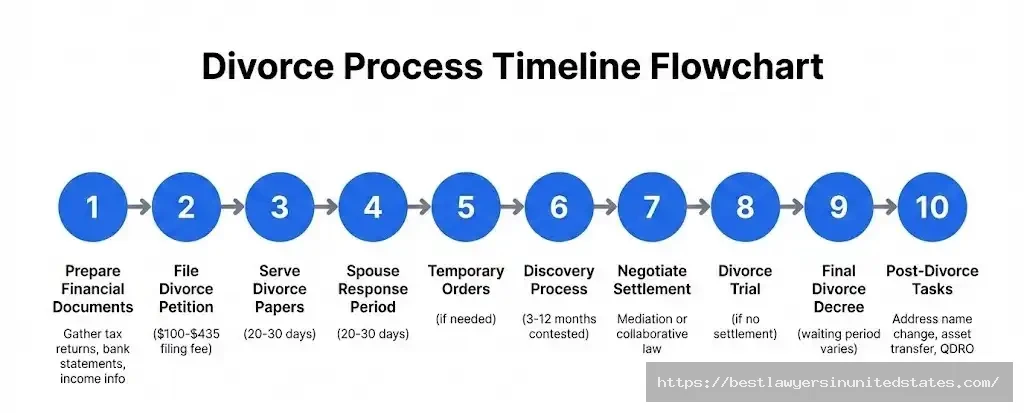
Step 1: Prepare Your Financial Documents
Gather complete financial documentation before filing. Courts require full financial disclosure from both spouses. Missing documents delay your case and can result in court penalties.
Required documents include:
- Last 3 years of tax returns
- Recent pay stubs (3-6 months)
- Bank account statements (all accounts)
- Credit card statements
- Retirement account statements (401k, IRA, pension)
- Investment account statements
- Property deeds and mortgage statements
- Vehicle titles and loan documents
- Business financial statements (if applicable)
- Life insurance policies
- Health insurance information
Organize documents by category. Make copies of everything. Many attorneys recommend photographing or scanning important documents in case your spouse tries to hide assets.
Step 2: File the Divorce Petition
The divorce petition starts your case. It tells the court you want to end your marriage and outlines what you’re requesting regarding property, custody, and support. The person filing is called the “petitioner” and the other spouse is the “respondent.”
Petition typically includes:
- Basic information about your marriage
- Grounds for divorce (no-fault or fault-based)
- Requests for property division
- Child custody and visitation requests
- Child support calculations
- Spousal support requests
File your petition with the family court clerk in your county. Filing fees range from $100 to $435+ depending on your state and county. Fee waivers are available for low-income filers who can’t afford court costs.
Where to file:
- County where you live
- County where your spouse lives
- County where you last lived together (in some states)
The clerk stamps your petition with a case number and returns copies to you. Some courts assign a hearing date at filing. Others schedule hearings later in the process.
Step 3: Serve Divorce Papers
You must legally notify your spouse about the divorce. This is called “service of process” and it’s required in every divorce case. Your spouse has the right to respond to your petition.
Service methods:
- Personal service: Sheriff, process server, or adult non-party delivers papers directly to spouse
- Certified mail: Spouse signs receipt showing they received papers (not allowed in all states)
- Service by publication: Legal notice in newspaper when spouse can’t be located (requires court approval)
You must file proof of service with the court showing your spouse received the papers. This document includes the date, time, location, and method of service. Without proof of service, your case can’t move forward.
What if you can’t find your spouse? Courts allow service by publication after you prove diligent efforts to locate them. You’ll need to publish a legal notice in newspapers where your spouse might see it.
Step 4: Spouse Response Period
Your spouse has 20 to 30 days (varies by state) to file a response after being served. The response states whether they agree or disagree with your petition requests.
Three possible outcomes:
Agreement: Spouse agrees with everything. You can proceed with an uncontested divorce and submit your settlement agreement to the court.
Disagreement: Spouse contests one or more issues. Your case becomes a contested divorce requiring negotiation, mediation, or trial.
No response: Spouse doesn’t file anything within the deadline. You can request a default divorce where the judge grants everything in your original petition.
Most spouses file a response even if they agree because it protects their rights. Consult an attorney if your spouse files a response disagreeing with major issues.
Step 5: Temporary Orders (If Needed)
Request temporary orders for urgent issues that can’t wait until your divorce finalizes. Courts issue temporary orders for child custody, child support, spousal support, bill payment, and exclusive use of property.
Common temporary order requests:
- Primary physical custody of children
- Temporary child support payments
- Temporary spousal support
- Who stays in the family home
- Who pays which bills during divorce
- Freezing bank accounts or investments
- Preventing sale of marital property
Temporary orders remain in effect until your divorce finalizes or the court modifies them. Some temporary arrangements become permanent in the final decree.
File a motion for temporary orders if you need immediate relief. Courts typically schedule hearings within 2 to 4 weeks for temporary order requests.
Step 6: Discovery Process (Contested Divorces)
Discovery is the formal exchange of financial information in contested cases. Both spouses must disclose all income, assets, debts, and expenses. This process can take 3 to 12 months depending on complexity and cooperation.
Discovery methods include:
Interrogatories: Written questions the other spouse must answer under oath
Requests for production: Demands for documents like bank statements, tax returns, and pay stubs
Depositions: In-person questioning under oath with a court reporter recording answers
Subpoenas: Court orders requiring third parties (banks, employers) to produce records
Financial affidavits: Sworn statements listing all income, assets, debts, and expenses
Hidden assets trigger discovery battles. Forensic accountants trace money and uncover concealed property. Lying during discovery can result in perjury charges and sanctions.
Step 7: Negotiate Settlement
Most divorces settle before trial. Settlement negotiations happen through attorneys, mediators, or direct discussion between spouses. You have more control over outcomes when you settle compared to letting a judge decide.
Settlement terms typically cover:
- Division of all marital property and debts
- Child custody schedule and decision-making authority
- Child support amounts and payment methods
- Spousal support amount and duration
- Tax considerations and deductions
- Insurance coverage and beneficiaries
Your settlement becomes a Marital Settlement Agreement (MSA) that’s submitted to the court. Judges review the agreement and usually approve it if terms seem fair and meet legal requirements.
Settlement saves time and money compared to trial. Court battles cost 2 to 3 times more than negotiated settlements and take much longer to resolve.
Step 8: Divorce Trial (If No Settlement)
Trial becomes necessary when you can’t reach agreement. A judge hears evidence, testimony from both spouses, and arguments from attorneys. The judge then decides all disputed issues and issues a final order.
Trial timeline: Getting to trial can take 1 to 2+ years from the initial filing date. Court backlogs and case complexity affect scheduling.
What happens at trial:
- Opening statements from both attorneys
- Presentation of evidence (financial documents, photos, messages)
- Witness testimony (spouses, experts, sometimes children)
- Cross-examination of witnesses
- Closing arguments
- Judge’s decision (issued immediately or weeks later)
Trials are public record unless sealed by the judge. Everything said in court becomes part of the permanent record. This lack of privacy motivates many couples to settle.
Step 9: Final Divorce Decree
The judge signs your final divorce decree ending your marriage. This legal document includes all terms of your divorce including property division, custody arrangements, and support obligations.
Decree includes:
- Division of all marital assets
- Allocation of marital debts
- Child custody and visitation schedule
- Child support amount and payment details
- Spousal support terms (if awarded)
- Name change authorization (if requested)
- Insurance requirements
- Tax implications
Some states have mandatory waiting periods between filing and finalization. California requires 6 months, Texas requires 60 days, and some states have no waiting period. Your divorce isn’t final until the judge signs the decree and the waiting period expires.
You’re legally single once the decree is entered. You can’t remarry until this happens even if you and your spouse have been separated for years.
Step 10: Post-Divorce Tasks
Finalize loose ends after your divorce becomes official. Failing to complete these tasks can cause problems later.
Important post-divorce actions:
Legal documents:
- Update your will and estate plan
- Change beneficiaries on life insurance
- Update retirement account beneficiaries
- Modify power of attorney documents
- Update healthcare directives
Financial accounts:
- Open individual bank accounts
- Remove ex-spouse from joint accounts
- Refinance or transfer property titles
- Transfer or divide retirement accounts
- Update credit card accounts
Government records:
- File name change paperwork (if changing)
- Update Social Security records
- Get new driver’s license
- Update passport
- Notify IRS of name or address changes
Implement orders:
- Set up child support payments
- Execute property transfers
- Divide retirement accounts with QDRO
- Establish custody exchange procedures
- Begin spousal support payments
Modify orders if circumstances change significantly. Courts can adjust child support, custody, and sometimes spousal support based on material changes in circumstances.
Divorce Costs: What to Expect
Calculate Your Divorce Costs
Planning a divorce? Use our free calculator to estimate your total costs based on your state’s filing fees, typical attorney rates, and whether your divorce is contested or uncontested.
Divorce Cost Calculator
Get an estimated cost for your divorce based on your specific situation
Your Estimated Divorce Cost
Cost Breakdown
📧 Get a Personalized Consultation
Have questions about your specific situation? Contact our legal experts for guidance tailored to your needs.
Contact Us via EmailCalculator features:
- State-specific filing fees
- Attorney cost estimates by complexity
- Contested vs uncontested comparison
- Total cost breakdown
- Money-saving tips based on your situation
Questions about your divorce or need legal help? Email: [email protected]
Average Divorce Costs by Type
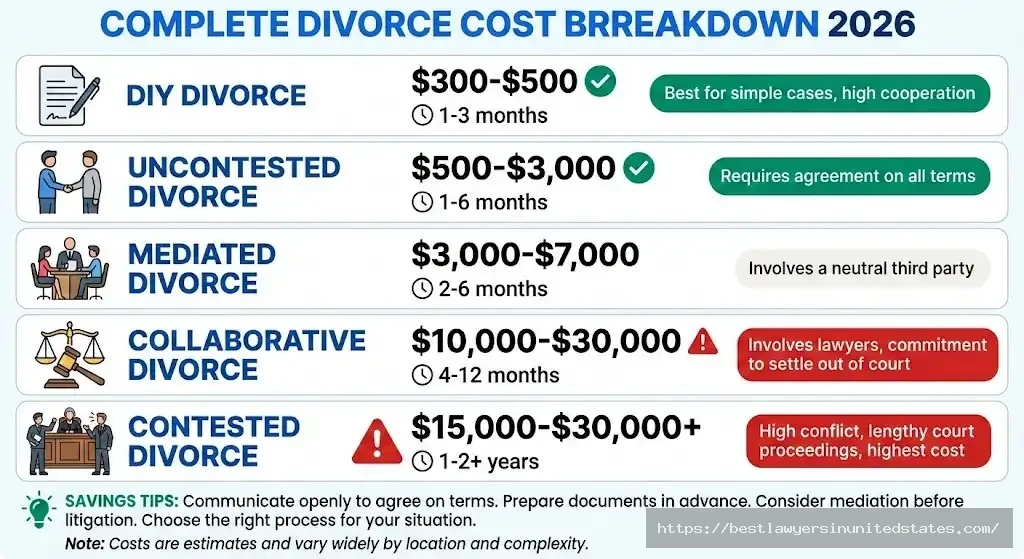
Divorce costs vary dramatically based on whether your case is contested or uncontested. Understanding different divorce types helps you budget appropriately.
| Divorce Type | Average Cost | Timeline | Best For |
|---|---|---|---|
| DIY/Pro Se | $300-$500 | 1-3 months | Simple cases, complete agreement |
| Uncontested | $500-$3,000 | 1-6 months | Amicable splits, few assets |
| Mediated | $3,000-$7,000 | 2-6 months | Willing to compromise |
| Collaborative | $10,000-$30,000 | 4-12 months | High assets, avoid court |
| Contested | $15,000-$30,000+ | 1-2+ years | Major disagreements |
Learn more about divorce costs and what factors affect your total expenses.
Divorce Cost Breakdown
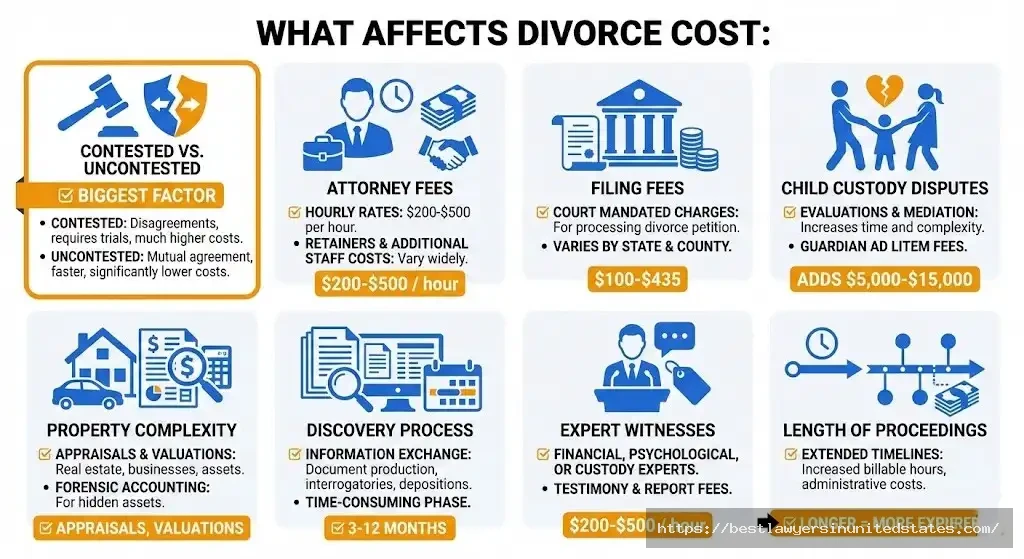
Understanding where your money goes helps you make informed decisions about your divorce strategy.
Filing fees: Courts charge $100 to $435+ to file divorce petitions. Fees vary by state and county. Some jurisdictions charge additional fees for responses, motions, and other filings. State-by-state filing fees show exactly what you’ll pay in your location.
Attorney fees: Most divorce attorneys charge $200 to $500 per hour depending on location and experience. Initial retainers range from $2,500 to $10,000. Contested cases often exceed the initial retainer requiring additional payments. Attorney fees represent the largest expense in most divorces.
Additional costs:
- Mediation: $100 to $300 per hour, typically 5-10 sessions needed
- Expert witnesses: $200 to $500+ per hour for accountants, appraisers, custody evaluators
- Court reporter fees: $200 to $500 per deposition
- Financial advisors: $150 to $300 per hour
- Process server: $50 to $150 per service attempt
- Copying and administrative fees: $100 to $500 total
State-Specific Divorce Costs
Divorce costs vary significantly by state because of differences in filing fees, average attorney rates, and state complexity.
| State | Filing Fee | Avg Uncontested | Avg Contested |
|---|---|---|---|
| California | $435-$450 | $1,500-$2,500 | $17,000-$30,000 |
| Texas | $250-$300 | $1,500-$2,000 | $15,000-$25,000 |
| Florida | $400-$410 | $1,200-$2,500 | $12,000-$28,000 |
| New York | $335-$350 | $2,000-$3,500 | $15,000-$35,000 |
Get detailed cost breakdowns for your state:
How to Reduce Divorce Costs
Smart strategies can cut your divorce costs dramatically without sacrificing important rights or protections.
Try uncontested divorce first: Work with your spouse to reach agreements before filing. Even couples who start contentiously often find common ground through honest discussion. Uncontested divorce costs a fraction of litigation.
Consider mediation: Mediators cost less than attorneys and help you avoid court battles. Most couples who mediate successfully spend $3,000 to $7,000 total compared to $30,000+ for litigation.
Use limited scope representation: Pay an attorney for specific services like reviewing documents or attending one hearing instead of full representation. This “unbundled” approach saves money while still providing legal guidance.
Do your own legwork: Gather financial documents, complete paperwork, and research issues yourself. Every task you complete saves attorney time and fees.
Settle disputes outside court: Each court appearance costs money. Settle as many issues as possible through negotiation before involving judges.
Know when to fight: Some issues matter more than others. Don’t spend $10,000 in legal fees fighting over a $3,000 asset. Pick battles that have real financial or emotional significance.
State-Specific Divorce Laws
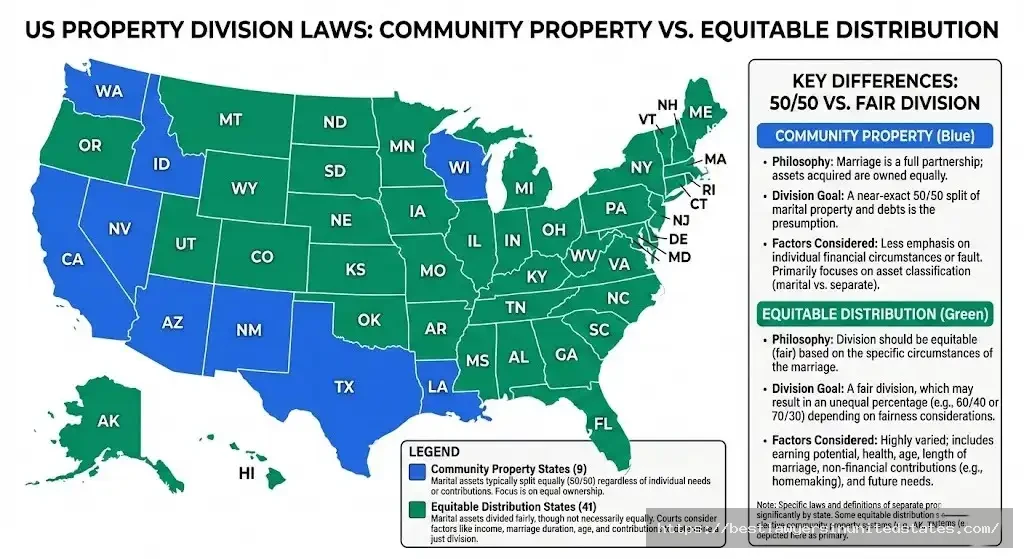
Community Property vs Equitable Distribution
Property division rules vary dramatically by state. Understanding your state’s approach affects how much you keep after divorce.
Community property states split marital assets 50/50 regardless of who earned more or whose name is on accounts. These nine states follow community property rules: California, Texas, Arizona, Nevada, Washington, Idaho, Louisiana, New Mexico, and Wisconsin.
Example: You earn $200,000 while your spouse earns $50,000. All income and assets acquired during marriage get split equally in a community property state.
Equitable distribution states divide property “fairly” but not necessarily equally. Judges consider multiple factors including income, earning capacity, contribution to the marriage, and future financial needs. The remaining 41 states follow equitable distribution.
Example: A judge might award 60% of assets to a lower-earning spouse with custody of young children and 40% to the higher-earning spouse.
What Gets Divided?
Marital property includes most assets acquired during marriage:
- Income from employment
- Bank account balances
- Real estate purchased during marriage
- Vehicles bought during marriage
- Retirement account contributions made during marriage
- Business value increases during marriage
- Investment gains during marriage
Separate property stays with the original owner:
- Assets owned before marriage
- Inheritances received by one spouse
- Gifts given specifically to one spouse
- Personal injury settlements (in most states)
Commingled assets create disputes when separate and marital property mix. Depositing inheritance money into a joint account or using separate funds for home renovations can convert separate property to marital property.
Grounds for Divorce by State
Every state now allows no-fault divorce. You don’t need to prove wrongdoing to end your marriage. Most couples file using “irreconcilable differences” or similar language.
No-fault grounds include:
- Irreconcilable differences
- Incompatibility
- Irretrievable breakdown of marriage
- Living separate and apart
Some states still allow fault-based grounds that can affect property division or alimony:
Common fault grounds:
- Adultery
- Abandonment
- Physical or emotional cruelty
- Substance abuse
- Imprisonment
- Insanity (in some states)
Fault grounds can influence outcomes in some states. Proving adultery might increase your alimony award or property share in states that consider marital misconduct. Most attorneys recommend no-fault divorces because fault-based cases cost more and take longer.
Waiting Periods by State
Many states require waiting periods between filing and finalization. These “cooling off” periods give couples time to reconsider and allow for settlement negotiations.
Common waiting periods:
| Waiting Period | States |
|---|---|
| No waiting period | Alaska, Nevada, Washington (several others) |
| 30 days | Delaware, Idaho, Wyoming |
| 60 days | Kansas, Kentucky, Maryland, Texas |
| 90 days | Michigan, New Jersey, Rhode Island |
| 6 months | California, Iowa, Utah |
| 1 year separation | North Carolina, South Carolina (before filing) |
Waiting periods start from different points. Some states count from filing date while others count from service date. A few states require couples to live separately for the entire waiting period.
State Residency Requirements
You must establish residency before filing. States don’t want to handle divorces for non-residents.
| Residency Period | States (Examples) |
|---|---|
| No requirement | Alaska, South Dakota, Washington |
| 6 weeks | Nevada, Idaho |
| 2 months | Kansas |
| 3 months | Arizona, Hawaii, Mississippi |
| 6 months | California, Florida, Wisconsin |
| 1 year | Connecticut, Iowa, Maryland, Nebraska, Rhode Island |
Military members can file in their home state, their duty station state, or where their spouse lives. This flexibility helps service members who move frequently.
Where to file if spouses live in different states: Generally the first person to file determines jurisdiction. Some states allow competing filings requiring jurisdictional hearings. Consult an attorney if you and your spouse live in different states.
Divorce With Children
Child Custody Basics
Courts decide custody based on the child’s best interests. Judges consider stability, parenting ability, child’s preferences (depending on age), and each parent’s involvement in daily care.
Physical custody determines where children live. Sole physical custody means children primarily live with one parent. Joint physical custody splits time between both parents’ homes with various schedules (50/50, 60/40, weekdays/weekends, etc.).
Legal custody covers major decisions about education, healthcare, religion, and extracurricular activities. Most states favor joint legal custody where parents share decision-making even if one parent has primary physical custody.
Courts create parenting plans detailing:
- Regular custody schedule
- Holiday and vacation time
- Transportation arrangements
- Communication between parents
- How to modify the schedule
- Dispute resolution procedures
Child Support
States use formulas to calculate child support based on parental incomes and custody time. The higher-earning parent typically pays support to help equalize household resources for the children.
Common calculation factors:
- Both parents’ gross income
- Number of children
- Custody time percentage
- Health insurance costs
- Childcare expenses
- Educational costs
Support typically continues until children turn 18 or graduate high school, whichever comes later. Some states extend support for disabled children or those attending college.
Wondering how much child support you might pay or receive? Our calculator estimates monthly obligations based on your state’s guidelines.
Calculator features:
- State-specific child support formulas
- Income shares model calculations
- Custody time adjustments
- Additional expense estimates
Questions about your divorce or need legal help? Email: [email protected]
Modifying Support Orders
Life changes after divorce. Courts modify child support when circumstances change significantly.
Common modification reasons:
- Job loss or major income decrease
- Substantial income increase
- Changes in custody time
- Increased healthcare or childcare costs
- Child’s changing needs
File a modification motion when changes happen. Support doesn’t automatically adjust. You’re still responsible for the original amount until a judge modifies the order.
Mandatory Parenting Classes
Many states require parents to complete parenting classes during divorce. These classes help parents manage divorce’s impact on children and develop cooperative parenting skills.
Class topics typically include:
- How divorce affects children at different ages
- Co-parenting communication strategies
- Managing conflict away from children
- Supporting children through transitions
- Creating effective parenting plans
Classes run 2 to 8 hours and cost $15 to $75 depending on location. Courts require certificates of completion before finalizing divorces with minor children.
Dividing Property and Debts
What Is Marital Property?
Marital property includes most assets acquired during marriage regardless of whose name is on the title. Both spouses own marital property and courts divide it during divorce.
Assets typically considered marital:
- Income earned during marriage
- Real estate purchased during marriage
- Bank accounts opened during marriage
- Retirement contributions made during marriage
- Vehicles bought during marriage
- Business interests acquired during marriage
- Stock and investment gains during marriage
Separate property exceptions:
- Assets owned before marriage
- Inheritances to one spouse only
- Gifts given specifically to one spouse
- Personal injury settlements (in most states)
- Property excluded by prenuptial agreement
Commingling happens when separate and marital property mix. Using inheritance money to pay the mortgage or depositing it in a joint account can convert separate property to marital property. Keep separate property completely separate to maintain its classification.
Property Division Process
Dividing property requires four main steps regardless of which state you’re in.
Step 1: Inventory everything List every asset and debt. Include houses, cars, bank accounts, retirement accounts, investments, furniture, jewelry, collections, and business interests. Don’t hide assets because discovery will likely uncover them.
Step 2: Classify as marital or separate Determine whether each item is marital or separate property. Provide documentation showing when and how you acquired assets. Separate property acquired before marriage or through inheritance stays with the original owner in most cases.
Step 3: Value everything Get accurate valuations for all marital property. Real estate needs appraisals. Retirement accounts need current statements. Businesses require professional valuations. Vehicles can be valued using Kelley Blue Book or similar resources.
Step 4: Divide property Negotiate who gets what or let a judge decide. Community property states divide marital assets 50/50. Equitable distribution states aim for fairness but not necessarily equality.
QDROs for Retirement Accounts
Retirement account division requires a Qualified Domestic Relations Order (QDRO). This court order tells retirement plan administrators to split accounts without tax penalties.
Common QDRO mistakes:
- Failing to get the QDRO prepared and approved
- Waiting too long to file the QDRO after divorce
- Using incorrect plan information
- Miscalculating division percentages
QDROs take 3 to 6 months to complete after divorce finalization. Hire an attorney or QDRO specialist to draft these orders correctly because mistakes can cost thousands in taxes and penalties.
Debt Division
Courts divide marital debts along with assets. Who’s responsible for which debts depends on state law and when the debt was incurred.
Marital debts typically include:
- Credit cards used for household expenses
- Mortgages on marital property
- Car loans for vehicles purchased during marriage
- Personal loans taken during marriage
- Medical bills incurred during marriage
- Tax obligations from joint returns
Protecting your credit: Your divorce decree assigns debt responsibility, but creditors aren’t bound by it. If your ex-spouse fails to pay a joint debt, creditors can still pursue you. Refinance loans to remove ex-spouses from accounts when possible. Monitor credit reports regularly to catch missed payments early.
Alimony and Spousal Support
Types of Alimony
Courts award different types of spousal support based on circumstances and needs.
Temporary alimony provides support during the divorce process before the final decree. These payments help a lower-earning spouse maintain basic living standards while the case is pending.
Rehabilitative alimony lasts for a specific period allowing a spouse to gain education, training, or work experience to become self-supporting. This is the most common type awarded in modern divorces.
Permanent alimony continues indefinitely or until remarriage or death. Courts rarely award permanent alimony anymore except in long marriages where one spouse can’t become self-supporting due to age, health, or lack of work history.
Reimbursement alimony repays a spouse who supported the other through education or career advancement. This compensates sacrifices made during the marriage.
Calculate Your Alimony
Wondering about spousal support? Our calculator estimates alimony payments based on your state’s guidelines, income difference, marriage length, and other factors.
Calculator features:
- State-specific alimony formulas
- Duration estimates
- Income-based calculations
- Modification factors
Questions about your divorce or need legal help? Email: [email protected]
How Alimony Is Calculated
Most states don’t have strict alimony formulas. Judges have discretion based on multiple factors.
Common factors judges consider:
- Income difference between spouses
- Length of marriage
- Standard of living during marriage
- Age and health of both spouses
- Earning capacity and education
- Contribution to spouse’s education or career
- Time out of workforce
- Child custody arrangements
- Marital misconduct (in some states)
State approaches vary widely:
Formula states: A few states like Massachusetts use formulas. Massachusetts awards 30-35% of income difference for marriages over 20 years.
Discretionary states: Most states give judges broad discretion with general guidelines but no formulas.
Limited alimony states: Texas and some other states rarely award alimony except in specific circumstances.
Alimony Duration
How long alimony lasts depends on marriage length and support type.
General guidelines:
- Short marriages (under 5 years): Little to no alimony in most states
- Medium marriages (5-20 years): Alimony for 1/3 to 1/2 the marriage length
- Long marriages (20+ years): Potentially permanent in some states, though increasingly rare
Termination triggers:
- Recipient spouse remarries
- Recipient spouse cohabitates with romantic partner (in many states)
- Either spouse dies
- Court-ordered end date reaches
- Recipient becomes self-supporting (for rehabilitative alimony)
Modifying alimony: Courts modify alimony when circumstances change substantially. Job loss, major health issues, or significant income changes can warrant modifications. File a modification motion when changes occur because alimony won’t adjust automatically.
Common Divorce Mistakes to Avoid
Mistake 1: Filing Without Financial Preparation
Many people file for divorce without understanding their household finances. This puts you at a disadvantage during property division negotiations.
Fix it: Spend several months before filing gathering financial documents. Copy tax returns, bank statements, credit card statements, investment statements, and loan documents. Photograph important documents if your spouse might hide them. Open your own bank account and credit card to establish independent credit.
Mistake 2: Moving Out Before Consulting an Attorney
Leaving the marital home can hurt your property rights and custody case. Courts sometimes view departure as abandonment or interpret it as conceding the house to your spouse.
Fix it: Talk to an attorney before moving out. If you must leave for safety reasons, document your reasons and maintain regular contact with children. Never leave children behind without a formal custody arrangement.
Mistake 3: Hiding Assets
Discovery finds hidden assets eventually. Attempting to hide property results in court sanctions, loss of credibility, and potential criminal charges for perjury or contempt.
Fix it: Disclose everything honestly. Courts punish spouses who hide assets by awarding the hidden property to the other spouse or assessing financial penalties. Full disclosure protects you legally and helps reach fair settlements.
Mistake 4: Using Kids as Pawns
Involving children in adult conflicts damages them emotionally and angers judges. Courts punish parents who bad-mouth the other parent or try to alienate children.
Fix it: Keep children completely separate from divorce disputes. Never speak negatively about your ex in front of kids. Don’t use children as messengers or spies. Courts favor parents who promote healthy relationships between children and both parents.
Mistake 5: Fighting Over Everything
Some couples litigate every fork and towel. Legal fees quickly exceed the disputed property value. Spending $5,000 fighting over $2,000 in household goods makes no financial sense.
Fix it: Pick battles carefully. Fight for things that matter financially or emotionally. Let small items go. Focus on major assets like the house, retirement accounts, and custody arrangements.
Mistake 6: Not Documenting Everything
Divorce requires extensive documentation. Missing records delay your case and weaken your negotiating position.
Fix it: Keep detailed records of all financial transactions during separation. Document custody time, child expenses, and communication with your spouse. Save emails, texts, and voicemails that might be relevant later. Take photos of valuable property.
Mistake 7: Social Media Oversharing
Posts can be used as evidence. Privacy settings don’t protect you in court proceedings. Photos showing expensive purchases, new relationships, or activities contradicting your court claims can damage your case.
Fix it: Stop posting on social media during divorce. Don’t post about your divorce, your ex, your finances, your dating life, or activities with the kids. Assume anything you post will be shown to a judge.
Frequently Asked Questions
How long does a divorce take?
Quick Answer: Uncontested divorces take 1 to 6 months while contested divorces take 1 to 2+ years depending on state laws, court backlogs, and case complexity.
The timeline depends on several factors. State waiting periods range from zero to 6 months before courts can finalize divorces. Complex property division or custody disputes extend the process. Court backlogs in busy jurisdictions add months to timelines.
Can I get a free divorce?
Quick Answer: Fee waivers let low-income filers divorce for free in most states, covering court filing fees but not attorney costs.
Apply for a fee waiver by filing paperwork with the court showing financial hardship. Courts typically waive fees if your income falls below poverty guidelines or you receive government assistance. Legal aid organizations provide free attorneys for qualifying individuals in some jurisdictions.
Do I need a lawyer for divorce?
Quick Answer: You don’t legally need an attorney for divorce, but lawyers help with complex assets, custody disputes, or contested issues.
DIY divorce works well when you have no children, few assets, short marriage duration, and complete agreement on all terms. Hire an attorney for business ownership, substantial assets, custody disputes, spousal support disagreements, or when your spouse has an attorney.
What if my spouse won’t sign divorce papers?
Quick Answer: Your spouse can’t prevent divorce indefinitely. Courts grant default divorces when spouses don’t respond within the deadline.
After properly serving divorce papers, your spouse has 20-30 days to respond. If they ignore the deadline, file for default divorce. The judge grants everything requested in your original petition. Your spouse loses the right to contest terms by failing to respond.
Can I stop a divorce after filing?
Quick Answer: Yes, both spouses can reconcile and dismiss the divorce case anytime before the judge signs the final decree.
File a dismissal motion with the court stating you and your spouse reconciled. Most courts allow dismissals without hearings if both parties agree. Some couples file and dismiss multiple times before finally divorcing.
What if my spouse filed for divorce in another state?
Quick Answer: The first person to file usually determines jurisdiction, though courts resolve competing filings based on residency and connection to each state.
Consult an attorney immediately if your spouse files in a different state. You might need to challenge jurisdiction or file your own competing case. Courts consider which state has stronger connections to the marriage, where children live, and where you’ve established residency.
How is property divided in divorce?
Quick Answer: Community property states split marital assets 50/50 while equitable distribution states divide property fairly but not necessarily equally.
Nine states follow community property rules splitting everything acquired during marriage evenly. The remaining states use equitable distribution considering income, earning capacity, contributions to the marriage, and future needs. Separate property owned before marriage or received as inheritance typically stays with the original owner.
Who gets the house in divorce?
Quick Answer: It depends on state law, who has custody, and financial circumstances. Options include selling, buyout, or continued co-ownership.
Courts consider who can afford the mortgage, which parent has custody, and whether selling makes more financial sense. One spouse might buy out the other’s equity share. Some couples keep the house jointly until children graduate. Selling and splitting proceeds is often the cleanest option.
What happens to retirement accounts in divorce?
Quick Answer: Retirement accounts get divided as marital property, requiring a QDRO to split funds without tax penalties.
Contributions made during marriage are marital property subject to division. You need a Qualified Domestic Relations Order telling the plan administrator how to split the account. QDROs prevent tax penalties and early withdrawal fees when executed properly.
Can I get alimony?
Quick Answer: Alimony depends on income disparity, marriage length, and state laws. It’s not automatic and requires either agreement or court order.
Courts consider income differences, earning capacities, marriage duration, age, health, and standard of living. Long marriages with significant income gaps are more likely to result in alimony awards. Short marriages rarely result in support unless special circumstances exist.
How much does divorce cost?
Quick Answer: DIY divorces cost $300-$500, uncontested divorces cost $500-$3,000, and contested divorces cost $15,000-$30,000+.
Costs depend primarily on whether your case is contested. Filing fees range from $100 to $435+ by state. Attorney fees range from $200 to $500 per hour. Complex cases with discovery, expert witnesses, and trials cost significantly more. Get detailed cost information for your situation.
What are grounds for divorce?
Quick Answer: All states allow no-fault divorce based on irreconcilable differences. Some states also allow fault-based grounds like adultery or cruelty.
No-fault divorce requires no proof of wrongdoing. Simply stating the marriage is broken beyond repair is enough. Fault grounds include adultery, abandonment, physical or emotional cruelty, substance abuse, and imprisonment. Most attorneys recommend no-fault divorces because they’re faster and less expensive.
How long do I have to live in a state to file for divorce?
Quick Answer: Most states require 6 months to 1 year of residency. Alaska has no requirement and Nevada requires just 6 weeks.
Residency requirements prevent forum shopping where people file in favorable states. You must prove residency through driver’s license, voter registration, or similar documentation. Military members can file in their home state, duty station state, or where their spouse lives.
Can I date during divorce?
Quick Answer: Legally yes in most states once separated, but dating can impact custody or alimony awards and generally complicates proceedings.
Wait until after your divorce finalizes to start dating publicly. Dating during divorce can be used against you in custody battles by suggesting you’re prioritizing romance over children. In fault-based states, dating might be considered adultery affecting property division or alimony. Focus on completing your divorce before starting new relationships.
How do I find divorce records?
Quick Answer: Contact the county clerk where the divorce was finalized or use your state’s vital records office for certified copies.
Divorce records are public documents accessible through the family court clerk in the county where the divorce was finalized. Some states maintain online databases searchable by name and date. You need identifying information like full names, approximate divorce date, and county. Fees for certified copies range from $10 to $30.
Disclaimer: This guide provides general information about the divorce process. Laws vary by state and individual circumstances differ. Consult a licensed attorney in your jurisdiction for advice about your specific situation. Nothing in this article creates an attorney-client relationship.