
What Is Child Support and How Much Will I Pay?
Child support is a court-ordered payment from one parent to another for a child’s living expenses. The amount depends on your state’s formula, both parents’ incomes, custody arrangement, and number of children.
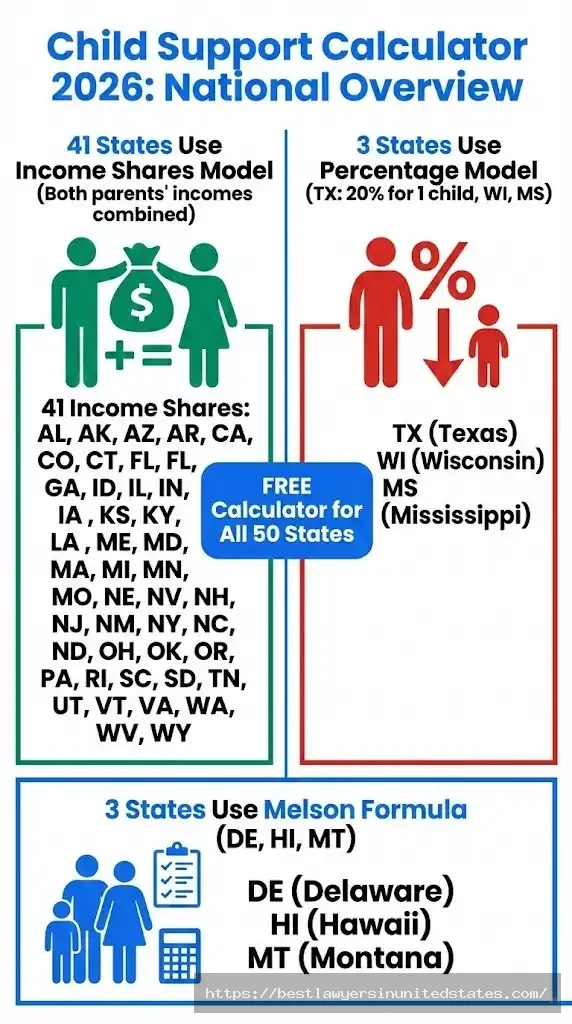
Most states use the Income Shares Model, which combines both parents’ incomes and splits costs proportionally. Texas, Wisconsin, and Mississippi use a simpler percentage model based only on the paying parent’s income. Delaware, Hawaii, and Montana use the Melson Formula, which ensures basic needs are met first.
Your actual payment can range from $200/month to $2,000+ depending on income levels and state guidelines. Use our calculator below to estimate your specific amount.
Calculate Your Child Support Payment
Planning for child support costs? Our free calculator estimates monthly payments based on your state’s specific guidelines, income levels, and custody arrangement.
Child Support Calculator
Calculate child support estimates based on your state’s guidelines. Get accurate payment amounts using income shares model calculations.
Enter Your Information
Provide income, custody, and children details
Estimated Monthly Child Support
📍 State Child Support Guidelines
Information about this state’s child support calculation method will appear here.
📊 Calculation Breakdown
| Component | Value |
|---|
Calculator features:
- All 50 state formulas included
- Custody time adjustments
- Income shares and percentage models
- Additional expense estimates
- Medical and childcare cost factors
Questions about child support or need legal help? Email: [email protected]
How Child Support Is Calculated in the United States
Understanding which calculation model your state uses helps explain why support amounts vary dramatically across state lines. When planning for divorce with children, knowing your state's method is the first step.
Income Shares Model (41 States)
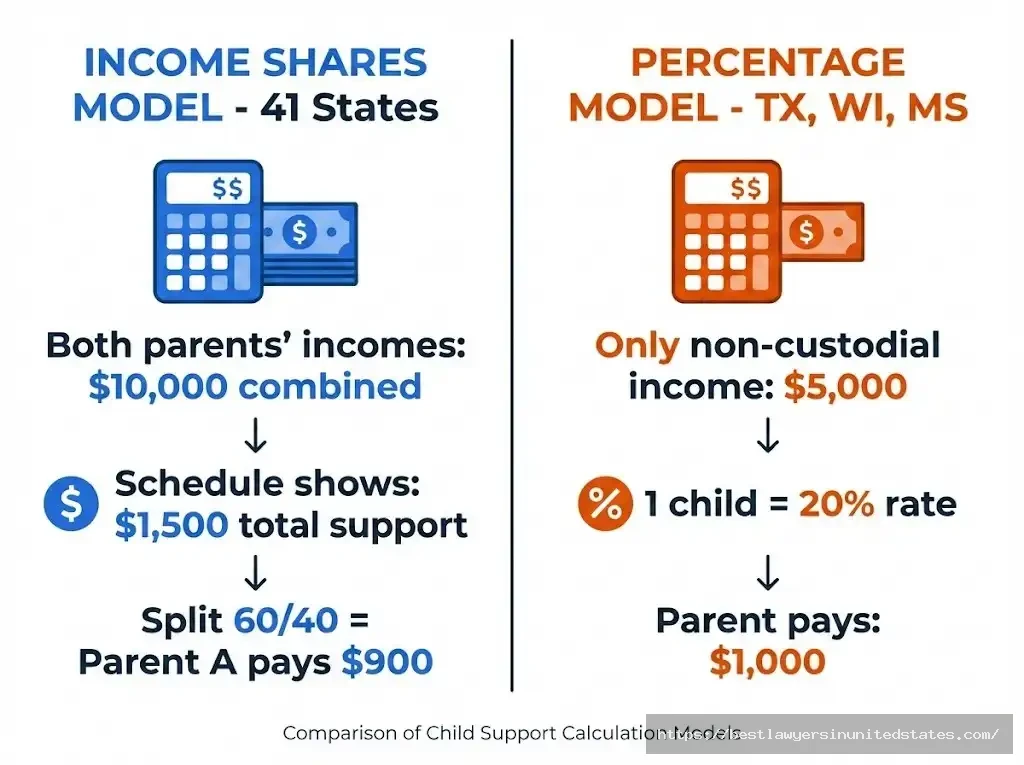
The Income Shares Model combines both parents' gross incomes and uses a state schedule to determine total support. That amount is then split between parents based on their income percentage.
How it works:
- Parent A earns $6,000/month (60% of combined income)
- Parent B earns $4,000/month (40% of combined income)
- Combined income: $10,000/month
- State schedule shows $1,500/month total support for 1 child
- Parent A pays 60% = $900/month
- Parent B pays 40% = $600/month
States using Income Shares Model: Alabama, Arizona, California, Colorado, Connecticut, Florida, Georgia, Idaho, Indiana, Iowa, Kansas, Kentucky, Louisiana, Maine, Maryland, Massachusetts, Michigan, Minnesota, Missouri, Nebraska, New Hampshire, New Jersey, New Mexico, New York, North Carolina, Ohio, Oklahoma, Oregon, Pennsylvania, Rhode Island, South Carolina, South Dakota, Tennessee, Utah, Vermont, Virginia, Washington, West Virginia, Wyoming, Alaska (hybrid), Arkansas.
Percentage of Income Model (3 States)
This simpler model uses only the non-custodial parent's income. The custodial parent's income doesn't affect the calculation.
Texas percentage model:
- 1 child = 20% of net income
- 2 children = 25% of net income
- 3 children = 30% of net income
- 4 children = 35% of net income
- 5+ children = 40% of net income
Example: Parent earning $5,000/month with 1 child pays 20% = $1,000/month.
States using percentage model: Texas, Wisconsin, Mississippi.
Melson Formula (3 States)
The most complex calculation ensures both parents and children meet basic needs first. Remaining income is then allocated proportionally.
Three-step calculation:
- Reserve minimum self-support amount for each parent
- Allocate child's basic needs from remaining income
- Split any excess income proportionally
States using Melson Formula: Delaware, Hawaii, Montana.
State-by-State Child Support Differences
Each state has unique formulas, income caps, and add-on expenses. Understanding your state's specific rules affects your final payment amount.

High-Cost States
Massachusetts:
- Income Shares Model
- Combined income cap: $400,000
- Above cap: Court discretion based on child's needs
New York:
- Income Shares Model
- Combined income cap: $163,000 (2026)
- Above cap: Pro rata continuation or discretionary
New Jersey:
- Income Shares Model
- Combined income cap: $187,200
- Extensive worksheet with multiple adjustments
California:
- Complex guideline formula
- No hard income cap
- Computer calculation required for accuracy
For detailed California divorce expenses including child support, see our California divorce cost guide.
Mid-Range States
Florida:
- Straightforward Income Shares schedule
- Medical and childcare added separately
- No complex adjustments needed
Florida's overall divorce costs include these support calculations.
Georgia:
- Income Shares Model
- Deviation factors for high earners
- Health insurance credit system
Pennsylvania:
- Three different worksheets based on custody type
- Worksheet A: Primary custody
- Worksheet B: Shared custody (40%+ time)
- Worksheet C: Split custody
State Income Cap Comparison
| State | Combined Income Cap | Treatment Above Cap |
|---|---|---|
| New York | $163,000 | Pro rata/discretionary |
| New Jersey | $187,200 | Discretionary |
| Massachusetts | $400,000 | Case-by-case |
| California | None | Guideline continues |
| Texas | None | Percentage continues |
| Florida | $10,000/month | Schedule stops |
Unique State Rules
Wisconsin: Shared placement adjustment applies at 25%+ parenting time.
Texas: Simple percentage increases with each child (20%, 25%, 30%, 35%, 40%).
Indiana: Parenting Time Credit Worksheet kicks in at 128+ overnights per year.
Utah: Separate worksheets for sole versus joint custody. Joint custody threshold starts at 111+ days.
How Custody Arrangements Affect Child Support
Parenting time significantly impacts support calculations. More time with the paying parent typically means lower payments, though specifics vary by state.
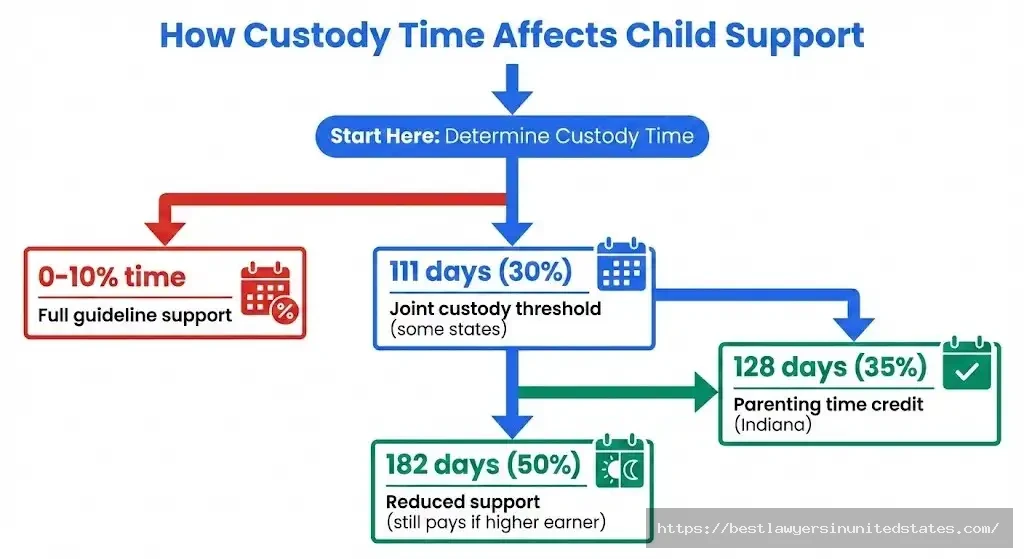
Sole Custody (0-10% Time with Non-Custodial Parent)
The non-custodial parent pays the full guideline amount with no reduction. Standard every-other-weekend visitation equals approximately 14% of parenting time, which doesn't trigger adjustments in most states.
Typical arrangement:
- Non-custodial parent: Every other weekend + one weeknight
- Total overnights: ~50 per year (14%)
- Support: Full guideline amount
Joint Physical Custody Thresholds
Different states define "shared custody" at different overnight percentages. Crossing these thresholds triggers reduced support calculations.
State threshold examples:
- 111 days (30%): Utah, some others
- 128 days (35%): Indiana (Parenting Time Credit begins)
- 146 days (40%): Various states
- 182 days (50%): Wisconsin, others
50/50 Custody Calculations
Even with equal parenting time, the higher-earning parent typically pays support. Children's expenses don't disappear just because time is split equally.
Three calculation methods states use:
Offset Method: Calculate what each parent would owe if they were non-custodial. Higher amount pays the difference.
Example:
- Parent A calculation: $1,200/month
- Parent B calculation: $800/month
- Parent A pays: $400/month ($1,200 - $800)
Multiplier Method: Apply a shared custody reduction multiplier to the base amount.
Example:
- Base support: $1,000/month
- 50/50 multiplier: 0.5
- Adjusted support: $500/month
Straight Calculation: Use standard formula with custody time factored into income percentage.
California 50/50 example:
- Parent A: $6,000/month (60% of combined income)
- Parent B: $4,000/month (40% of combined income)
- Result: Parent A pays $300-400/month
- Reason: Higher income despite equal custody time
Calculate Your Divorce Costs
Planning a divorce? Our calculator estimates total costs including filing fees, attorney rates, and child support obligations.
[EMBED: DIVORCE COST CALCULATOR] Link: https://bestlawyersinunitedstates.com/divorce-cost-calculator/
Calculator features:
- State-specific filing fees
- Attorney cost estimates by complexity
- Contested vs uncontested comparison
- Total cost breakdown
- Money-saving tips based on your situation
Need help finding an affordable divorce attorney? Email: [email protected]
What Income Counts for Child Support
Courts include nearly all income sources when calculating support. Understanding what counts helps you estimate your obligation accurately.
Included Income Sources
Employment income:
- Wages, salaries, tips
- Bonuses and commissions
- Overtime pay (often averaged)
- Self-employment income (gross receipts minus legitimate business expenses)
Investment and property income:
- Dividends and interest
- Rental property income
- Capital gains (some states)
Benefits and other income:
- Social Security retirement benefits
- Unemployment benefits
- Workers' compensation
- Disability payments (most states)
- Pension and retirement income
- Spousal support/alimony received
Military income:
- Base pay
- BAH (Basic Allowance for Housing) - varies by state
- BAS (Basic Allowance for Subsistence) - varies by state
- Special pay and bonuses
Excluded Income Sources
Need-based assistance:
- SSI (Supplemental Security Income)
- TANF (Temporary Assistance for Needy Families)
- SNAP (food stamps)
- Foster care payments
Other exclusions:
- Child support received for other children
- VA disability benefits (some states)
- Irregular gifts (unless substantial and regular)
Self-Employment Income Calculation
Courts examine business income carefully to prevent income manipulation. They look at gross receipts minus only legitimate business expenses.
What courts review:
- Tax returns (Schedule C, K-1 forms)
- Profit and loss statements
- Bank account records
- Depreciation schedules (may be added back)
- Cash versus accrual accounting
Red flags that trigger scrutiny:
- Sudden income drop after filing
- Personal expenses run through business
- Excessive depreciation write-offs
- Lifestyle inconsistent with reported income
Imputed Income
Courts may assign ("impute") income to parents who are voluntarily unemployed or underemployed. This prevents parents from avoiding support by working less.
When courts impute income:
- Voluntarily unemployed despite ability to work
- Takes lower-paying job to reduce support
- Has earning capacity based on education and experience
- Refuses to seek employment
Imputation methods:
- Recent work history and salary
- Minimum wage (some states)
- Median income for occupation (some states)
- Vocational expert testimony
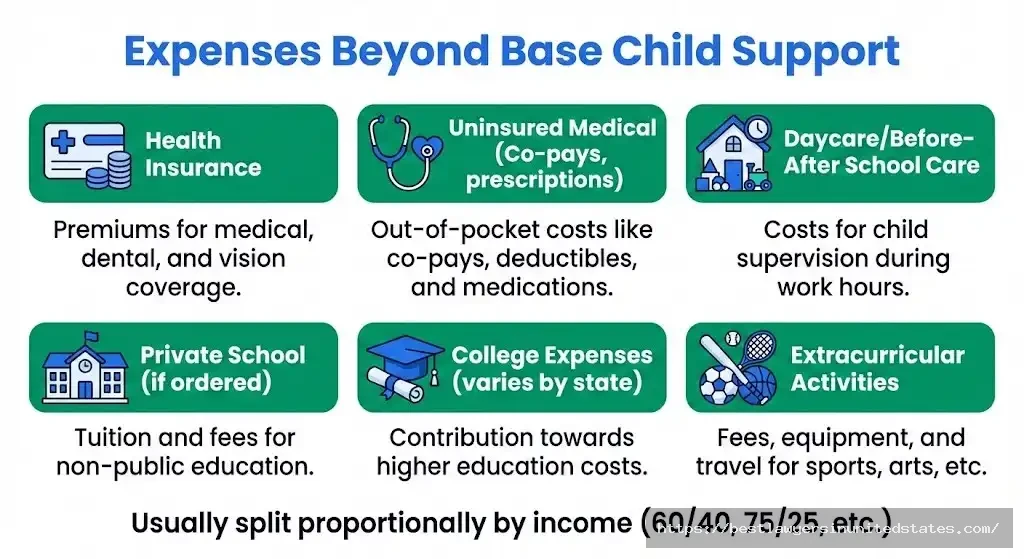
Additional Expenses Beyond Base Support
Base child support covers general living expenses like food, clothing, and shelter. Additional costs are typically split between parents separately.
Medical Support
Health insurance premiums: The parent providing health insurance gets credit for the premium cost. States handle this two ways: deduct from that parent's support obligation OR split the cost proportionally between both parents.
"Reasonable cost" is usually defined as less than 5% of gross income.
Uninsured medical expenses: Co-pays, deductibles, prescriptions, and other out-of-pocket costs are split proportionally based on income percentage.
Common split arrangements:
- 60/40 split if incomes are $6,000 and $4,000
- 75/25 split if incomes are $7,500 and $2,500
- 50/50 split if incomes are equal
Extraordinary medical expenses:
- Orthodontics
- Surgery
- Therapy and counseling
- Special medical equipment
Most states set threshold amounts (first $100-500/year) before cost-sharing begins.
Dental and vision: Some states include these in health insurance definition. Others treat them separately but split the same way as medical.
Childcare Costs
Work-related childcare: Courts add costs for childcare necessary for employment or education. This includes:
- Daycare for children under school age
- Before and after school care
- Summer programs while parent works
How it's calculated:
- Actual cost paid OR reasonable cost for the area
- Split proportionally by income percentage
- May be added to base support or paid directly
- Requires verification (receipts, provider information)
Example calculation:
- Daycare cost: $800/month
- Parent A income: 60%
- Parent B income: 40%
- Parent A pays: $480/month
- Parent B pays: $320/month
Educational Expenses
Private school: Private school is NOT automatically required. Courts may order it if:
- Child attended before divorce
- Both parents agree
- Parent can afford without hardship
- Child has special educational needs
If ordered, costs are split proportionally by income.
College expenses: College support varies dramatically by state. Some states can order support beyond age 18, while others cannot.
States that can order college support: New Jersey, Massachusetts, Connecticut, Indiana, Illinois, Oregon, Washington, Hawaii, South Carolina, Utah, Mississippi, Alabama, Iowa, Missouri, New Hampshire.
States that terminate at 18/graduation: California, Texas, Florida, Georgia, Arizona, Nevada.
College costs may include:
- Tuition and fees
- Room and board
- Books and supplies
- Transportation
Extracurricular Activities
What qualifies:
- Sports leagues and equipment
- Music lessons and instruments
- Dance classes
- Tutoring
- Academic clubs
Limits: Courts consider whether activities are "reasonable and appropriate" based on:
- Parents' income levels
- Child's historical participation
- Educational or developmental benefit
Cost handling:
- Some states include in deviation factors
- Others order separate proportional contribution
- May require mutual agreement for expensive activities
Calculate Alimony Payments
Wondering about spousal support? Our calculator estimates alimony payments based on state guidelines, income difference, and marriage length.
[EMBED: ALIMONY CALCULATOR] Link: https://bestlawyersinunitedstates.com/divorce-finances/alimony-calculator/
Calculator features:
- State-specific alimony formulas
- Duration estimates
- Income-based calculations
- Modification factors
Questions about alimony or need legal help? Email: [email protected]
Supporting Multiple Children in Different Households
Child support gets complicated when parents have children with multiple partners. Most states use a "first-in-time" priority system.
Multiple Children with Same Ex-Partner
This scenario is straightforward. Child support schedules account for increasing numbers of children, though not linearly.
Texas percentage example:
- 1 child = 20% of net income
- 2 children = 25% of net income (12.5% per child)
- 3 children = 30% of net income (10% per child)
Multiple Children with Different Partners
When managing divorce finances across multiple households, understanding obligation priority matters significantly.
First-in-Time Priority (Most States): Earlier child support orders take priority. Later orders are calculated AFTER deducting prior obligations.
Example calculation:
- Parent earns: $5,000/month
- Existing order #1: $1,000/month for 2 children (first marriage)
- New case: 1 child (second marriage)
- New calculation: Uses $4,000 remaining income, not $5,000
- New order: Approximately $600/month
Equal Treatment Approach (Rare): Some states try to treat all children fairly by adjusting orders. This is uncommon since it rewards having more children.
Subsequent Children Considerations
Children in current household: Some states allow deductions for children living with the obligor parent. This recognizes the support obligation to the current household.
How it works:
- Calculate theoretical support for current household children
- Reduce income by that amount
- Calculate support for other case using reduced income
Example:
- Gross income: $6,000/month
- 1 child in current household
- Theoretical support for current child: $800/month
- Adjusted income for other case: $5,200/month
Deviation requests: Parents can request deviations based on multiple support obligations. Courts have discretion but must show hardship. Deviations won't eliminate support but may reduce it.
High-Income and Low-Income Child Support
Income extremes require special consideration. States handle very high earners and very low earners differently.
High-Income Earners
Income caps by state:
| State | Combined Income Cap | Above Cap Treatment |
|---|---|---|
| New York | $163,000 | Pro rata or discretionary |
| New Jersey | $187,200 | Discretionary |
| Massachusetts | $400,000 | Case-by-case analysis |
| California | None | Guideline continues |
| Texas | None | Percentage continues |
| Florida | $10,000/month | Schedule stops |
Above the cap: Courts have discretion on income exceeding caps. They may:
- Apply guideline percentage to excess income
- Deviate based on child's actual needs
- Conduct lifestyle analysis
High-earner considerations: Children shouldn't be "enriched" beyond reasonable needs. However, they are entitled to benefit from a parent's wealth. Courts balance necessary expenses versus excessive luxury.
Factors courts examine:
- Private school costs
- Travel and vacations
- Extracurricular activities
- College savings
- Standard of living during marriage
Low-Income Earners
Minimum support amounts: Many states set minimum monthly support regardless of income:
- Common range: $50-100/month
- Recognizes some contribution better than none
- May be suspended if parent truly cannot pay
Low-income adjustments:
Self-support reserve: Some states won't order support if it pushes the paying parent below poverty level. This ensures the obligor can meet their own basic needs.
Federal Poverty Level (FPL) consideration: Courts may:
- Reduce support to keep obligor above FPL
- Suspend support temporarily during unemployment
- Order minimum amount with modification when circumstances improve
Deviation for poverty: Parents can request deviations showing they cannot afford guideline amounts. Evidence includes:
- Proof of job search efforts
- Medical expenses
- Disability preventing work
- Living expenses documentation
When and How to Modify Child Support
Support orders aren't permanent. You can request modification when circumstances change substantially.
Grounds for Modification
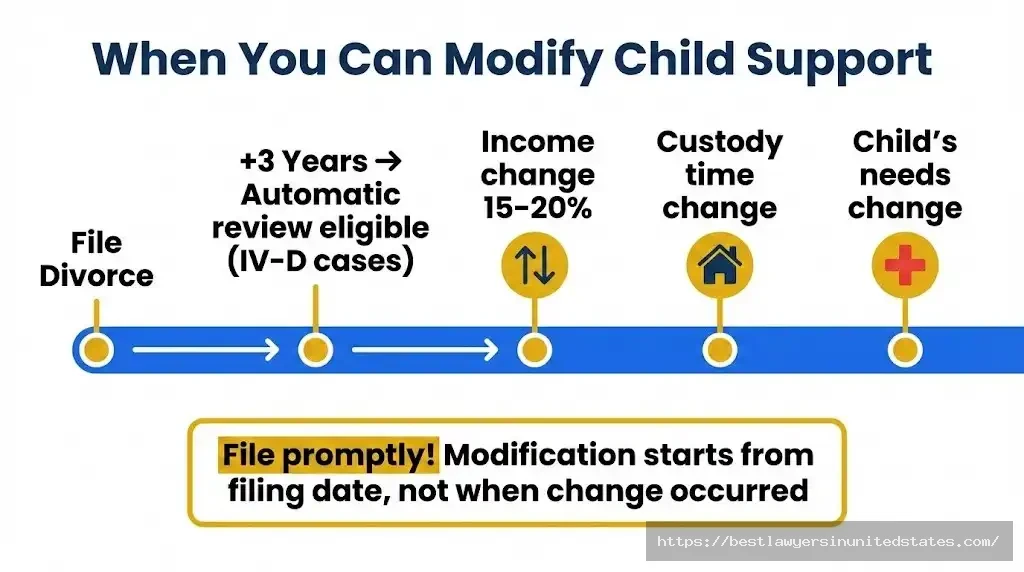
Substantial change in circumstances: Most states require 15-20% change in income or expenses to modify support.
Income changes:
- Job loss or reduction in hours
- Promotion or raise
- Disability preventing work
- Return to work after disability
- Change in overtime/bonus structure
Custody changes:
- Parenting time increases significantly
- Child changes primary residence
- Overnight percentage crosses state threshold
- Temporary custody arrangement becomes permanent
Child's needs change:
- Medical condition requiring extra care
- Special education needs develop
- Extraordinary expenses increase
- Child's activities become more expensive
Cost of living adjustments: Some states allow automatic COLA increases every few years.
Automatic Review Periods
IV-D cases (government agency involved): Either parent can request review every 3 years without showing change in circumstances.
Process:
- Request review from child support agency
- Agency reviews current incomes
- Recalculates support
- Issues modified order if change meets threshold
How to Request Modification
Court-ordered support:
- File motion for modification with family court
- Serve other parent with notice
- Provide evidence of changed circumstances
- Attend hearing
- Judge enters new order
Agency-ordered support:
- Request review from IV-D agency
- Submit income verification
- Agency recalculates
- New order issued if warranted
Critical timing rule: Modifications are effective from the date you file the motion or request, NOT from when circumstances changed. File promptly when changes occur.
Example:
- Income drops January 1
- File modification June 1
- New order effective June 1
- Still owe full amount for January through May
Temporary Versus Permanent Changes
Short-term changes:
- Temporary job loss: Court may suspend support temporarily
- Seasonal income variations: Often averaged over full year
- Short-term disability: May suspend with modification when recovered
Permanent changes:
- Long-term disability: Permanent modification
- Career change with lower pay: Permanent modification if not voluntary
- Retirement: May reduce or terminate support depending on state
Tax Implications of Child Support
Understanding tax treatment helps with financial planning. The rules are simpler than they used to be.
Key Tax Rules
Not taxable income (recipient): Child support is NOT taxable to the parent receiving it. Don't report it on your tax return.
Not tax deductible (payor): You cannot deduct child support payments. This is different from pre-2019 alimony under old tax law.
Dependency Exemption
Default rule: The custodial parent (parent with more than 50% custody time) gets to claim the child as a dependent.
Release to non-custodial parent: The custodial parent can release the exemption using IRS Form 8332. This is often negotiated as part of divorce settlement.
Value of exemption:
- Reduces taxable income
- Allows Child Tax Credit claim
- May qualify for other tax benefits
Child Tax Credit
2026 credit amount: $2,000 per child under 17
Phase-out thresholds: Credit begins phasing out at higher income levels ($200,000 single, $400,000 married filing jointly).
Important rule: Only the parent claiming the child as a dependent can claim the Child Tax Credit. Parents cannot split it.
Head of Household Status
Qualification: The custodial parent may qualify for Head of Household filing status if:
- Child lives with them more than 50% of the year
- They pay more than 50% of household costs
- They are unmarried
Benefits:
- More favorable tax brackets than "single" status
- Higher standard deduction
- Lower tax liability
Difference from Alimony
Under current tax law (divorces after 2018), alimony is also not deductible or taxable. For those navigating both alimony and child support, the tax treatment is identical now.
Pre-2019 divorces: Old alimony rules still apply (deductible to payor, taxable to recipient). Child support was never deductible or taxable.
Understanding the Divorce Process
Planning your divorce timeline and understanding each step helps manage expectations and costs.
Learn more about the complete divorce process including filing, custody, and financial settlements.
Common Divorce Timeline Stages
Initial filing: Submit petition to family court (1-2 weeks to prepare)
Service of process: Deliver papers to spouse (2-4 weeks)
Response period: Spouse has 20-30 days to respond (varies by state)
Discovery: Exchange financial information (2-6 months for contested cases)
Negotiation: Attempt settlement (1-3 months)
Trial: If no settlement (6-12 months wait time common)
Understanding how long divorce takes in your state helps plan for child support start dates.
Frequently Asked Questions About Child Support Calculator
How much child support will I pay if I make $1,000 a week?
Quick Answer: In Texas, you'd pay approximately $180-200/week for one child (20% of net income after taxes). In California, it depends on the other parent's income too.
Texas uses a percentage model based only on your income. California uses income shares, combining both parents' incomes. If the other parent makes $500/week and you have standard visitation, expect to pay approximately $250-300/week in California.
Does my state use gross or net income for child support?
Quick Answer: Most states use gross income (before taxes). Only a few states use net income.
Texas, Wisconsin, and Mississippi calculate support using net income after taxes. Income shares model states (41 states) use gross income, but tax calculations are built into their formulas. Check your state's specific calculator or worksheet to confirm.
How does 50/50 custody affect child support payments?
Quick Answer: Even with equal parenting time, the higher-earning parent typically pays reduced support because children's expenses continue.
The amount decreases from sole custody levels but rarely goes to zero. For example, if you earn 60% of combined income but have 50% custody time, you'll still pay support based on that income difference. The exact reduction formula varies by state.
What if I'm self-employed and my income varies?
Quick Answer: Courts look at gross business income minus legitimate business expenses using tax returns, profit/loss statements, and bank records.
Personal expenses run through your business will be added back. If reported income seems inconsistent with your lifestyle, courts may impute higher income. Most states average self-employment income over 2-3 years to handle variations.
Can parents agree to waive child support?
Quick Answer: No. Child support is a right of the child, not the parent, so courts must approve all support orders.
Courts won't approve waivers or below-guideline amounts without proper legal grounds. Even if parents agree privately, the court must enter an order meeting state guidelines or approve specific deviations with written findings.
When does child support end?
Quick Answer: Usually at age 18 or high school graduation, whichever is later. Some states extend to age 19-21 for college or disability.
Emancipation rules vary by state. Some states (New Jersey, Massachusetts) can order college support beyond age 18. Others (California, Texas) terminate at 18 or high school graduation. Check your state's specific emancipation age.
How is income imputed if I'm unemployed?
Quick Answer: Courts may assign income based on your earning capacity considering education, work history, skills, and local job market.
Some states impute minimum wage. Others use median income for your occupation or require vocational expert testimony. Courts examine whether unemployment is voluntary (to avoid support) or involuntary (legitimate job loss).
What if my ex hides income or works under the table?
Quick Answer: Courts can impute income based on lifestyle, spending patterns, and prior earning history using discovery tools to uncover hidden income.
Subpoenas to banks, businesses, and tax authorities can reveal undisclosed income. Parents face contempt sanctions for failing to disclose income. Lifestyle analysis helps courts determine if reported income matches actual spending.
How are bonuses and overtime counted in child support?
Quick Answer: Most states include them if they're regular and predictable. One-time bonuses might be excluded or averaged over several years.
Regular overtime is typically averaged over 12-24 months. Sporadic overtime may be excluded. Discretionary bonuses vary by state - some include them fully, others exclude them, and some average them over multiple years.
Does my new spouse's income count toward child support?
Quick Answer: No. Child support calculations use only biological or adoptive parents' incomes.
Exception: If you quit your job and your new spouse supports you, courts may impute income to you based on earning capacity. Your new spouse's income itself never factors into calculations, but it may affect deviation requests.
How do I modify an existing child support order?
Quick Answer: File a motion showing substantial change in circumstances (usually 15-20% income change) or wait 3 years for automatic review in IV-D cases.
Significant changes include job loss, promotion, custody time changes, or child's needs changes. File promptly because modifications are effective from filing date, not when circumstances changed.
What if I can't afford the calculated amount?
Quick Answer: Request a deviation hearing with evidence of extraordinary circumstances like medical expenses, prior support obligations, or poverty-level income.
Courts have discretion to deviate from guidelines but must enter written findings. Bring documentation of expenses, other obligations, and income limitations. Deviations reduce support but rarely eliminate it entirely.
Do I still pay child support if my ex denies me visitation?
Quick Answer: Yes. Child support and custody/visitation are separate legal issues. Denial of visitation doesn't excuse support obligation.
Seek court enforcement of visitation rights separately. Never withhold support as leverage for visitation - this can result in enforcement actions against you including wage garnishment and contempt charges.
What happens if I don't pay child support?
Quick Answer: Serious consequences including wage garnishment, tax refund intercept, license suspension, passport denial, and possible jail time for contempt.
Federal law requires passport denial at $2,500+ in arrears. States can suspend driver's licenses, professional licenses, and recreational licenses. Bank accounts can be levied. Arrears accrue interest and appear on credit reports.
How accurate is this child support calculator?
Quick Answer: Our calculator provides estimates based on state guidelines. For court filing, use your state's official calculator or worksheet.
Results are only as accurate as the information you enter. Actual court orders may differ based on additional factors, judicial discretion, and case-specific circumstances. Use estimates for planning, not as legal advice.
Resources and Next Steps
Related Calculators and Tools
Financial planning tools:
- Divorce Cost Calculator - Estimate total divorce expenses
- Alimony Calculator - Calculate spousal support
- State-specific divorce cost pages - See all 50 states
Comprehensive guides:
- Divorce with Children Guide - Custody, support, and parenting plans
- Divorce Process Overview - Step-by-step divorce timeline
- Divorce Finances Hub - All financial aspects of divorce
- Online Divorce Options - DIY divorce resources
Professional Legal Help
Finding attorneys:
- Find a Divorce Lawyer - Attorney directories by location
- Understanding Attorney Fees - What lawyers charge
- Legal aid societies - Income-based free legal help
- State bar associations - Attorney referral services
Official Government Resources
Federal resources:
- Office of Child Support Enforcement (federal): ACF.HHS.gov/css
- U.S. Department of Health and Human Services
- Federal Parent Locator Service
State resources:
- Your state's child support enforcement agency
- Local family court website
- State IV-D agency
- County clerk's office
Important Reminders
Calculator limitations: This calculator provides estimates only. Use your state's official calculator for court filings. Child support is a legal obligation - don't ignore orders.
Documentation: Keep detailed payment records. Pay through your state's disbursement unit when possible. Save all receipts and payment confirmations.
Modifications: Seek modification through proper legal channels if circumstances change. File promptly - modifications start from filing date, not when change occurred.
Compliance: Make payments on time every time. If you can't pay, file for modification immediately rather than letting arrears accumulate.
Conclusion
Child support calculations involve complex formulas that vary across all 50 states. Understanding whether your state uses the Income Shares Model, Percentage of Income Model, or Melson Formula helps explain payment amounts.
Key takeaways:
- Most states combine both parents' incomes using income shares
- Custody time significantly impacts support at state-specific thresholds
- Medical, childcare, and extraordinary expenses are typically additional
- High earners may exceed caps while low earners may qualify for minimums
- Modification requires substantial change (usually 15-20% income shift)
- Support is a legal obligation with serious enforcement consequences
Whether you're planning ahead before filing for divorce, negotiating a settlement, or seeking modification of an existing order, accurate child support calculations help you make informed financial decisions.
Use our calculator above for immediate estimates. For personalized guidance, consult a family law attorney in your state. For official calculations, use your state's court-approved calculator or worksheet.
Questions or need legal help? Contact your local family court or state child support enforcement agency for official calculations and legal advice. Email: [email protected]