
Finding the right divorce lawyer starts with understanding what type of case you have and what you can afford. Most people need a family law attorney who specializes in contested or uncontested divorce cases. Your choice depends on whether you and your spouse agree on terms like property division, child custody, and support payments.
The average person spends $7,000 to $15,000 on divorce lawyer fees, but costs vary widely based on case complexity. Simple uncontested divorces may cost $1,500 to $5,000, while high-conflict cases can exceed $30,000. Before hiring an attorney, you should know what type of representation you need and how much you can realistically spend.
This guide walks you through every step of finding, vetting, and hiring a divorce attorney in 2026. You’ll learn when you actually need a lawyer, how to verify credentials, what questions to ask during consultations, and how to spot red flags that signal a bad fit.
Do You Need a Divorce Lawyer?
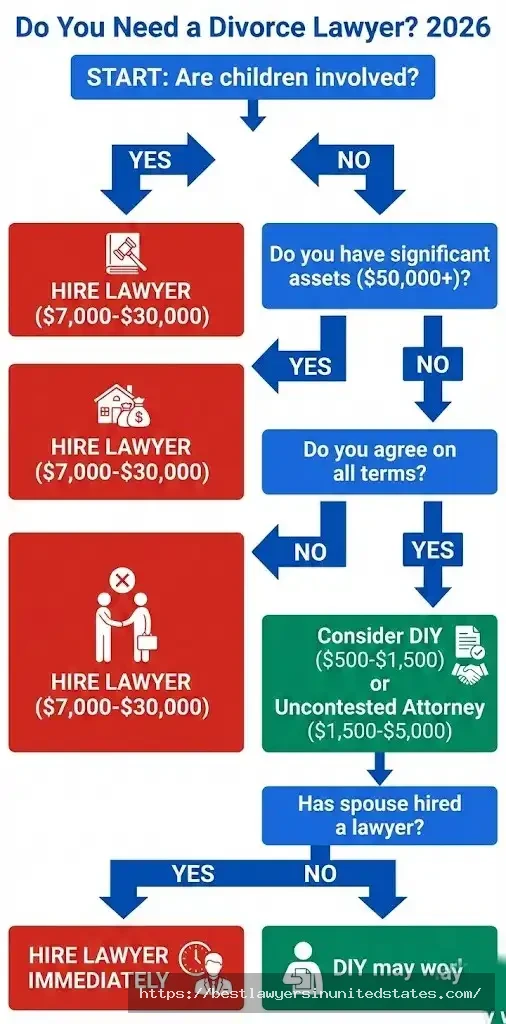
Not every divorce requires an attorney, but most people benefit from professional legal help. You can file for divorce without a lawyer if both spouses agree on all terms and have minimal assets. However, hiring an attorney protects your financial interests and parental rights when stakes are high.
When You Don’t Need a Lawyer
You may not need an attorney if your situation meets these criteria:
✅ Both spouses agree to divorce ✅ No children under 18 ✅ Minimal shared assets (under $50,000) ✅ No retirement accounts or real estate ✅ No spousal support disputes ✅ Marriage lasted less than 5 years ✅ Both partners can communicate respectfully
For simple cases, you can use an uncontested divorce process or online divorce service. These options cost $139 to $1,500 depending on whether you handle paperwork yourself or use a document preparation service.
When You Should Hire a Lawyer
Quick answer: Hire an attorney if children, significant assets, or disagreements are involved.
You need professional legal representation when:
✅ Your spouse hired a lawyer (never face an attorney alone) ✅ Children and custody are at stake ✅ Significant assets or debts must be divided ✅ One spouse owns a business ✅ Domestic violence or abuse occurred ✅ You don’t understand your state’s divorce laws ✅ Your spouse is hiding assets ✅ You can’t agree on major issues
The cost of hiring an attorney is worth protecting your financial future and relationship with your children. Mistakes made during divorce negotiations are difficult and expensive to fix later.
Decision Tool: Which Path Is Right for You?
| Your Situation | Best Option | Typical Cost |
|---|---|---|
| Both agree, no kids, minimal assets | DIY or online service | $139-$1,500 |
| Agree on most issues, need guidance | Limited scope attorney | $1,000-$3,000 |
| Some disagreements, willing to compromise | Mediation with attorneys | $3,000-$8,000 |
| Major disagreements, complex assets | Full representation | $7,000-$30,000+ |
| High conflict, abuse, hidden assets | Aggressive litigation attorney | $15,000-$50,000+ |
Use our divorce cost calculator to estimate your total expenses based on your specific situation.
Questions about your divorce or need legal help? Find divorce lawyers in your area for free consultation. Email: [email protected]
Types of Divorce Lawyers You Might Need
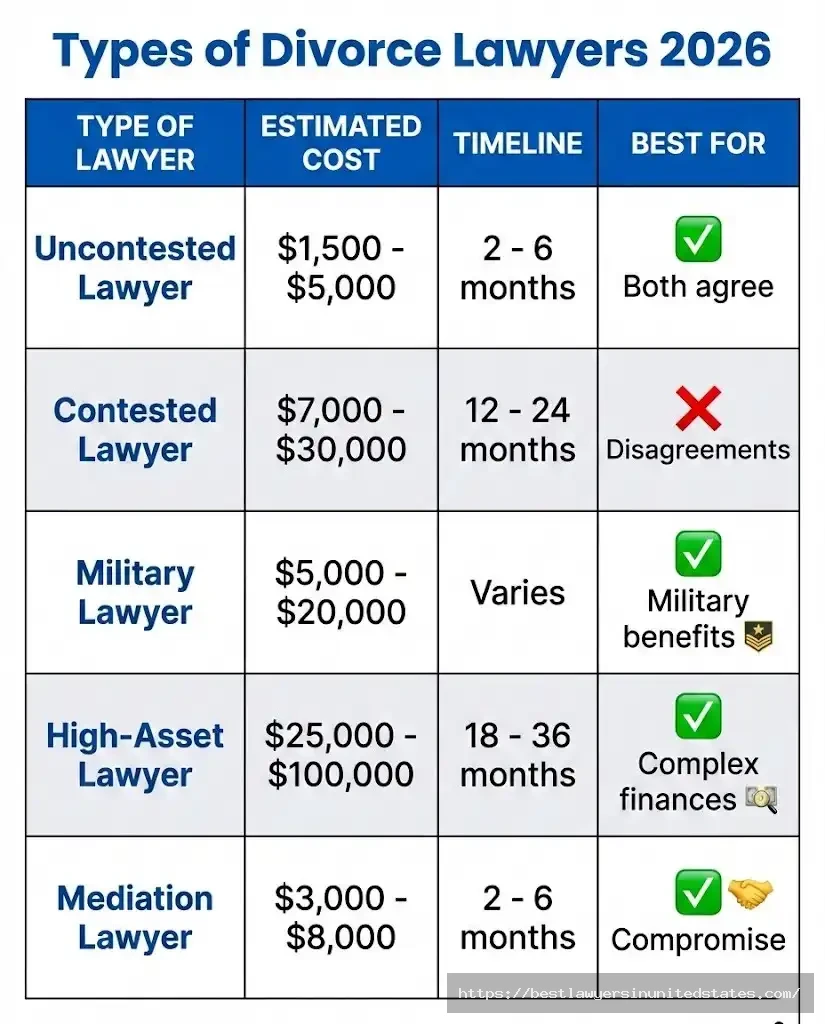
Different divorce situations require different types of attorneys. A lawyer who handles simple uncontested cases may not have experience with high-conflict litigation or military pension division. Understanding the specializations helps you find someone qualified for your specific needs.
Uncontested Divorce Lawyers
Uncontested divorce attorneys handle cases where both spouses agree on all major issues. These lawyers prepare paperwork, file documents with the court, and make sure your agreement follows state law. They charge flat fees of $1,500 to $3,000 for straightforward cases.
This type of attorney is right for you if both partners agree on property division, child custody, and support. The process moves faster and costs less than contested divorce cases.
Contested Divorce Lawyers
Contested divorce attorneys represent clients when spouses disagree on major issues. These lawyers handle negotiation, discovery, depositions, and trial preparation. They charge hourly rates of $200 to $500 depending on experience and location.
Key services contested divorce lawyers provide:
✅ Asset and debt investigation ✅ Expert witness coordination ✅ Aggressive negotiation tactics ✅ Trial representation ✅ Protection of financial interests ✅ Child custody advocacy
Expect to pay $15,000 to $30,000 or more for full representation in a contested case. Understanding divorce attorney fees helps you budget for this investment.
Military Divorce Lawyers
Military divorce attorneys understand complex federal laws that affect service members and their spouses. These specialists know how to handle pension division under the Uniformed Services Former Spouses’ Protection Act and jurisdictional issues when families move frequently.
Military-specific considerations include:
✅ Servicemembers Civil Relief Act protections ✅ 10/10 rule for military pension division ✅ Deployment impact on custody schedules ✅ State vs. military jurisdiction ✅ Base legal services coordination
If you or your spouse serves in the military, find an attorney with military divorce experience. Standard family law attorneys may miss critical protections and benefits.
High-Asset Divorce Lawyers
High-asset divorce attorneys handle cases involving significant wealth, business interests, or complex financial portfolios. These lawyers work with forensic accountants, business valuators, and tax specialists to protect your assets.
You need this specialization if your marital estate includes:
✅ Business ownership ✅ Investment portfolios over $500,000 ✅ Multiple properties ✅ Retirement accounts exceeding $1 million ✅ Stock options or executive compensation ✅ Intellectual property or royalties
High-asset cases require extensive discovery and expert witnesses. Legal fees often range from $25,000 to $100,000 or more depending on complexity.
Mediation and Collaborative Divorce Attorneys
Mediation attorneys help couples negotiate settlements outside of court. Collaborative divorce lawyers commit to resolving issues without litigation. Both approaches cost less than traditional contested divorce and give you more control over outcomes.
Mediation vs. Collaborative Divorce:
| Feature | Mediation | Collaborative |
|---|---|---|
| Attorney role | Advisory only | Full representation |
| Mediator | Neutral third party | Not used |
| Cost | $3,000-$8,000 | $5,000-$15,000 |
| Timeline | 2-6 months | 4-12 months |
| Court involvement | Minimal | None unless process fails |
Learn more about divorce mediation costs to see if this approach fits your budget and relationship dynamic.
How Much Does a Divorce Lawyer Cost?
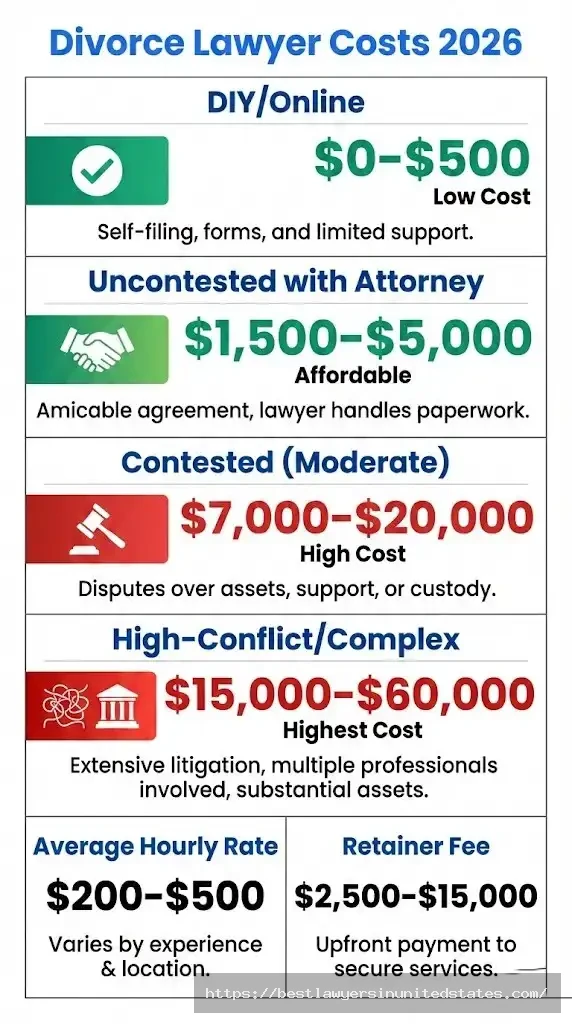
Divorce attorney costs depend on case complexity, location, and billing structure. Most lawyers charge either hourly rates or flat fees. Understanding these costs upfront helps you budget and avoid financial surprises during an already stressful time.
Average Divorce Lawyer Costs by Type
Quick answer: Uncontested divorce lawyers charge $1,500 to $5,000 flat fees, while contested divorce attorneys bill $7,000 to $30,000+ based on hourly work.
| Divorce Type | Attorney Cost | Total With Court Fees |
|---|---|---|
| DIY/Online | $0-$500 | $500-$1,500 |
| Uncontested with attorney | $1,500-$3,000 | $2,000-$5,000 |
| Mediation | $3,000-$8,000 | $4,000-$10,000 |
| Contested (moderate) | $7,000-$15,000 | $10,000-$20,000 |
| High-conflict/complex | $15,000-$50,000 | $20,000-$60,000 |
Visit how much does a divorce cost for detailed breakdowns by state and situation.
Understanding Retainer Fees
A retainer fee is an upfront payment you make to hire an attorney. This money goes into a trust account and the lawyer bills against it as work gets done. When the retainer runs low, you’ll need to replenish it to continue representation.
Typical Retainer Amounts:
| Case Type | Retainer Range |
|---|---|
| Uncontested divorce | $1,500-$3,000 |
| Standard contested | $5,000-$10,000 |
| High-conflict | $10,000-$25,000 |
| Complex/high-asset | $15,000-$50,000 |
The retainer doesn’t represent total cost. It covers initial work like document review, filing paperwork, and early negotiations. Complex cases often require multiple retainer replenishments.
Hourly Rate Breakdown
Most divorce attorneys charge hourly rates for contested cases. Rates vary significantly by location and attorney experience.

Average Hourly Rates by Location (2026):
✅ Rural areas: $150-$250/hour ✅ Suburban areas: $200-$350/hour ✅ Major cities: $300-$500/hour ✅ Top-tier metro areas: $400-$700/hour
Your case may require 20 to 100+ billable hours depending on complexity. A moderate contested divorce taking 40 hours at $300/hour costs $12,000 in attorney fees alone.
What Drives Up Attorney Costs
Several factors increase legal expenses during divorce:
✅ High conflict between spouses ✅ Child custody disputes ✅ Complex property division ✅ Business valuation needs ✅ Extensive discovery requests ✅ Multiple court hearings ✅ Expert witness fees ✅ Trial preparation and appearance
Understanding these cost drivers helps you control expenses. Cooperation and reasonable compromise significantly reduce legal fees.
Hidden Costs Most People Miss
Beyond attorney fees, divorce involves additional expenses:
| Cost Type | Typical Amount | When Required |
|---|---|---|
| Court filing fees | $200-$500 | Always |
| Service of process | $50-$300 | Always |
| Mediation | $100-$400/hour | Often required |
| Parenting classes | $50-$200 | When children involved |
| Property appraisals | $300-$600 each | Real estate division |
| Business valuation | $5,000-$25,000 | Business owners |
| Forensic accounting | $3,000-$15,000 | Hidden asset suspicion |
| Custody evaluator | $2,500-$10,000 | Disputed custody |
Check divorce filing fees for your state’s specific court costs.
Calculate Your Divorce Costs
Planning a divorce? Use our free calculator to estimate your total costs based on your state’s filing fees, typical attorney rates, and whether your divorce is contested or uncontested.
Divorce Cost Calculator
Get an estimated cost for your divorce based on your specific situation
Your Estimated Divorce Cost
Cost Breakdown
📧 Get a Personalized Consultation
Have questions about your specific situation? Contact our legal experts for guidance tailored to your needs.
Contact Us via EmailCalculator features: ✅ State-specific filing fees ✅ Attorney cost estimates by complexity ✅ Contested vs uncontested comparison ✅ Total cost breakdown ✅ Money-saving tips based on your situation
Questions about costs or need legal help? Find divorce lawyers for free consultation. Email: [email protected]
Where to Find Divorce Lawyers
Finding qualified divorce attorneys requires research beyond a simple Google search. The best lawyers for your case may not appear in paid advertisements. Use multiple sources to build a list of potential candidates before scheduling consultations.
State Bar Association Referrals
Every state bar association maintains a lawyer referral service. These directories list attorneys by practice area and location. Bar referrals often include initial consultations at reduced rates of $25 to $50.
Search “[Your State] Bar Association” to access official referral services. Lawyers listed through bar associations must maintain good standing and carry malpractice insurance.
Personal Referrals and Recommendations
Friends, family, and coworkers who went through divorce can recommend attorneys based on real experience. Ask specific questions about communication style, responsiveness, and cost management.
Questions to ask when getting referrals:
✅ Was your divorce contested or uncontested? ✅ How did the attorney communicate with you? ✅ Did costs stay within initial estimates? ✅ Would you hire them again? ✅ What could they have done better?
Remember that a good fit for someone else may not work for your situation. Use referrals as a starting point, not the final decision.
Online Lawyer Directories
Several reputable websites help you find and compare divorce attorneys:
Avvo.com – Rates lawyers based on experience, disciplinary record, and peer reviews Martindale-Hubbell – Long-established attorney rating service Super Lawyers – Recognition program for top-rated attorneys NOLO – Legal information site with attorney directory
These platforms show attorney credentials, client reviews, and areas of specialization. Read multiple reviews to identify patterns rather than focusing on single complaints or praises.
Local Family Court Observations
Visit your local family court to watch divorce proceedings and see attorneys in action. This gives insight into different representation styles and courtroom effectiveness.
You can observe:
✅ Attorney preparation and organization ✅ Communication with judges ✅ Client interaction and support ✅ Negotiation tactics ✅ Professional demeanor
Note attorney names who impress you and research their practices online. Many successful family law attorneys never heavily advertise but excel in the courtroom.
Legal Aid and Low-Cost Services
If you can’t afford private representation, legal aid organizations provide free or reduced-cost services based on income. Most states offer assistance to individuals earning below 125% of federal poverty guidelines.
Find free legal help:
✅ Legal Services Corporation (LSC.gov) ✅ LawHelp.org ✅ State and local bar associations ✅ Law school legal clinics ✅ Pro bono programs
These services typically handle straightforward cases. Complex divorces may not qualify for free representation but might receive limited scope assistance.
How to Verify and Vet Divorce Lawyers
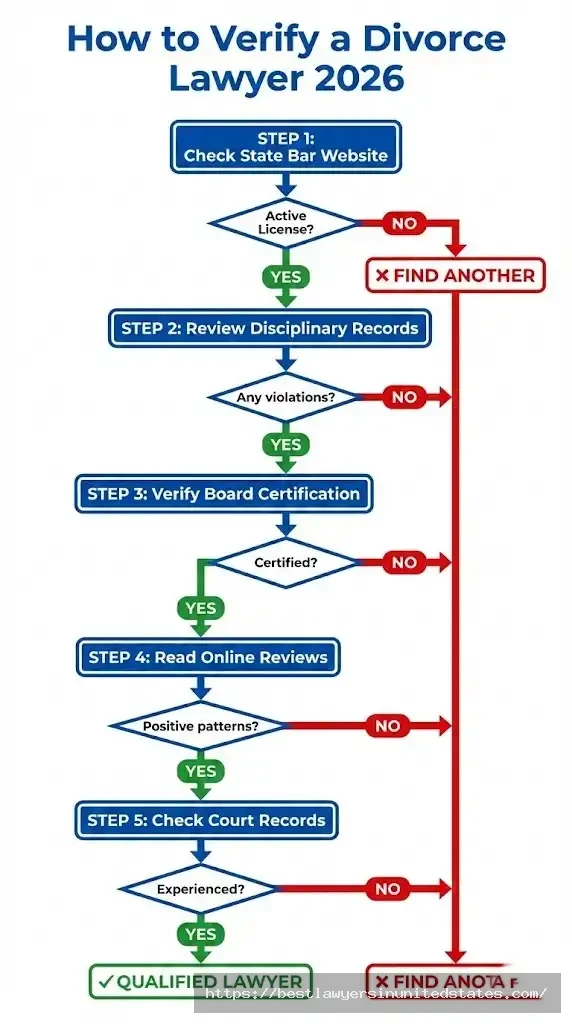
Never hire an attorney without verifying their credentials and checking for disciplinary issues. Even lawyers with impressive websites may have serious problems you can spot through basic research. Taking time to vet candidates protects you from costly mistakes.
Check State Bar Standing
Every attorney must maintain active bar membership in good standing to practice law. State bar websites let you verify licensing and view disciplinary history.
How to verify bar standing:
- Visit your state bar association website
- Find the “Attorney Search” or “Lawyer Lookup” tool
- Enter the attorney’s full name
- Review license status, admission date, and practice areas
- Check for disciplinary actions or complaints
Active status means the lawyer can currently practice. Any “suspended,” “disbarred,” or “inactive” status is an immediate red flag.
Review Disciplinary Records
Attorney discipline records reveal serious professional misconduct. While minor infractions may not disqualify a candidate, patterns of problems or major violations should concern you.
What to look for in discipline records:
✅ Nature of violation (ethical, financial, competence) ✅ Date and frequency of issues ✅ Sanctions imposed (reprimand, suspension, disbarment) ✅ Current status and resolution
Most disciplinary actions stem from billing disputes, missed deadlines, or communication failures. Violations involving theft of client funds or dishonesty are deal-breakers.
Verify Board Certifications
Some states offer board certification in family law or marital law. Certified attorneys have demonstrated expertise through experience, testing, and peer review. This credential matters more than marketing claims about being “top” or “best” lawyers.
Board certification requirements typically include:
✅ 5+ years of family law experience ✅ Handling significant percentage of family law cases ✅ Passing comprehensive written exam ✅ Receiving positive peer reviews ✅ Completing continuing education requirements
Fewer than 5% of family law attorneys earn board certification. This designation indicates genuine expertise rather than marketing skill.
Evaluate Online Reviews Carefully
Client reviews provide useful insights but require critical analysis. Look for patterns across multiple platforms rather than focusing on individual reviews.
Red flags in reviews:
❌ Multiple complaints about poor communication ❌ Billing surprises or unexplained charges ❌ Missed court deadlines ❌ Lack of preparation or attention ❌ Difficulty getting return calls ❌ Pressure tactics or overpromising
Positive signs in reviews:
✅ Consistent praise for responsiveness ✅ Clear communication and explanations ✅ Realistic expectations set from start ✅ Preparation and case knowledge ✅ Compassion during difficult process
Read reviews on multiple sites including Google, Avvo, and state bar websites. Single-source reviews may not represent the full picture.
Warning Signs to Avoid
Some red flags should immediately eliminate an attorney from consideration:
Run from lawyers who:
❌ Guarantee specific outcomes (“I’ll get you full custody”) ❌ Badmouth judges or opposing counsel ❌ Won’t provide written fee agreements ❌ Pressure immediate retainer payment ❌ Have multiple bar complaints ❌ Promise to “destroy” your spouse ❌ Seem unfamiliar with local courts ❌ Don’t return calls during consultation process
Trust your instincts. An attorney who feels wrong during initial contact probably isn’t right for your case.
Questions to Ask During Your Consultation
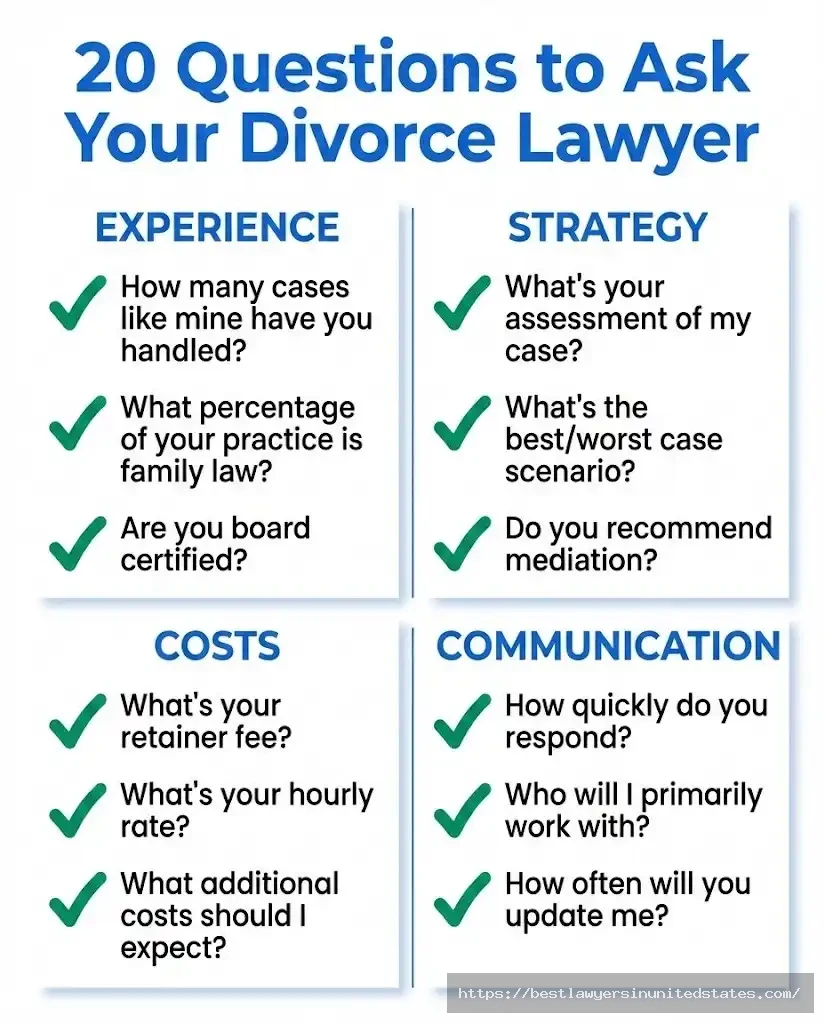
The initial consultation determines whether an attorney fits your needs. Come prepared with specific questions about experience, strategy, and costs. This meeting is your chance to evaluate the lawyer’s knowledge and approach before signing a retainer agreement.
Experience and Qualifications
Start with questions about the attorney’s background and expertise:
“How many divorce cases have you handled?” Look for someone with at least 50+ cases under their belt. More experience usually means better results.
“What percentage of your practice focuses on family law?” You want someone who dedicates 75% or more of their practice to divorce and family cases.
“Have you handled cases like mine before?” If you have children, business interests, or military service, the attorney should have specific experience with those issues.
“Are you board certified in family law?” While not required, board certification demonstrates advanced expertise and commitment to the field.
“Which courts do you regularly practice in?” Local court familiarity matters. Attorneys who regularly appear in your jurisdiction understand judges’ preferences and procedural nuances.
Case Strategy and Approach
Understanding how the attorney will handle your case matters as much as their credentials:
“What’s your initial assessment of my case?” A good lawyer will give you realistic expectations, not overpromise outcomes.
“What’s your approach to property division in cases like mine?” In community property states vs. equitable distribution states, strategies differ significantly. Check divorce laws by state to understand your state’s rules.
“How do you handle high-conflict situations?” Some attorneys prefer aggressive tactics while others focus on negotiation. Choose someone whose style matches your needs.
“Do you recommend mediation or collaborative divorce for my situation?” Open-mindedness about alternatives shows the attorney prioritizes your best interests over billable hours.
“What’s the best and worst case scenario for my situation?” Attorneys who only paint rosy pictures aren’t being honest. You need realistic expectations.
Communication and Availability
Poor communication ruins attorney-client relationships. Clarify expectations upfront:
“How quickly do you typically respond to emails and calls?” 24-48 hours is reasonable. Same day is excellent. Over a week is unacceptable.
“Who will I primarily communicate with?” Some attorneys delegate heavily to paralegals. Know who handles day-to-day communication.
“How often will you update me on case progress?” Proactive updates show the attorney values keeping you informed.
“What’s the best way to reach you?” Establish preferred communication methods (email, text, phone) from the start.
“Will you be the attorney appearing in court?” Some firms assign different attorneys for hearings. You should know who represents you in court.
Costs and Billing
Get complete clarity on financial expectations:
“What’s your retainer fee?” Initial retainer amounts vary from $1,500 to $25,000+ depending on case complexity.
“What’s your hourly rate?” Rates range from $150 to $500+ per hour based on location and experience.
“What tasks are billed at your rate vs. paralegal rates?” Good firms use lower-cost staff for routine work, saving you money.
“How often will I receive billing statements?” Monthly statements let you track costs and identify unexpected expenses early.
“What happens if the retainer runs out?” Know the replenishment process and minimum amounts required.
“Are there any flat fee options for my case?” Some uncontested cases qualify for flat fee billing of $1,500 to $3,000.
“What additional costs should I expect?” Filing fees, service costs, expert witnesses, and mediation add to total expenses.
Use our calculator to estimate total costs: divorce cost calculator
Timeline and Process
Understanding the divorce timeline helps you plan:
“How long do cases like mine typically take?” Uncontested divorces may finish in 2-6 months. Contested cases take 12-24+ months.
“What are the major steps in my case?” A good attorney will outline the entire divorce process from filing to final decree.
“What’s required of me during the process?” Know your responsibilities for document gathering, court appearances, and decision-making.
“What could delay my case?” Common delays include missing documents, uncooperative spouses, and court scheduling.
Red Flag Answers to Watch For
Some responses should concern you:
❌ “I guarantee we’ll win” – No ethical attorney guarantees outcomes ❌ Vague about fees or experience – Lack of transparency signals problems ❌ Dismissive of your concerns – You deserve to be heard ❌ Aggressive toward your spouse without cause – Unnecessary conflict increases costs ❌ Can’t explain strategy clearly – You should understand the approach
Trust attorneys who set realistic expectations, communicate clearly, and focus on your goals rather than their ego.
What to Bring to Your First Meeting
Arriving prepared for your initial consultation saves time and money. Lawyers charge $200 to $500+ per hour, so organizing documents beforehand maximizes the value of your meeting. You’ll also get better advice when the attorney has complete information.
Financial Documents Checklist
Bring copies of these financial records:
Income Documentation: ✅ Pay stubs (last 3-6 months) ✅ Tax returns (last 2-3 years) ✅ W-2s and 1099s ✅ Business profit/loss statements (if self-employed) ✅ Bonus or commission statements
Bank and Investment Accounts: ✅ Checking and savings statements (last 12 months) ✅ Investment account statements ✅ Retirement account statements (401k, IRA, pension) ✅ Stock options or equity compensation ✅ Cryptocurrency holdings
Debt and Liabilities: ✅ Credit card statements ✅ Mortgage statements ✅ Auto loan documents ✅ Student loan statements ✅ Personal loan agreements
Property and Assets: ✅ Real estate deeds and recent appraisals ✅ Vehicle titles and registration ✅ Business ownership documents ✅ Life insurance policies ✅ Valuable personal property (jewelry, art, collections)
Legal Documents to Include
If you have existing legal documents related to your marriage or children, bring them:
✅ Marriage certificate ✅ Prenuptial or postnuptial agreement ✅ Previous separation agreements ✅ Court orders (custody, support, restraining orders) ✅ Birth certificates of children ✅ Adoption papers ✅ Any legal correspondence from spouse’s attorney
Information About Your Spouse
The attorney needs to understand your spouse’s situation:
✅ Full legal name and contact information ✅ Employment and income details ✅ Known assets and debts ✅ Social Security number (if available) ✅ Attorney information (if spouse has hired one) ✅ Concerns about hidden assets or dishonesty
Timeline and Key Dates
Prepare a written timeline including:
✅ Date of marriage ✅ Date of separation (if applicable) ✅ How long you’ve lived in current state ✅ Ages and birth dates of children ✅ When you decided to divorce ✅ Any domestic violence incidents (dates)
Your Goals and Priorities
Write down your top priorities for the divorce:
✅ Child custody and visitation preferences ✅ Property division goals ✅ Spousal support concerns ✅ Specific assets you want to keep ✅ Timeline preferences ✅ Privacy considerations
Being clear about priorities helps the attorney develop an effective strategy. You may not get everything you want, but communicating goals from the start improves outcomes.
Questions and Concerns List
Before the meeting, write down:
✅ Specific questions about your case ✅ Concerns about the process ✅ Financial worries ✅ Child-related issues ✅ Anything keeping you up at night
This ensures you don’t forget important questions during the consultation.
What You Don’t Need to Bring
Don’t waste consultation time with:
❌ Original documents (bring copies) ❌ Excessive detail about marital problems ❌ Long written narratives ❌ Irrelevant personal items ❌ Dramatic stories about your spouse
Focus on facts and finances. The attorney needs information to assess your legal options, not therapy.
Questions about documentation or need legal help? Find divorce lawyers for free consultation. Email: [email protected]
Alternatives to Hiring a Traditional Lawyer
Full representation isn’t the only option for getting legal help during divorce. Several alternative approaches cost less than traditional attorney representation while still providing professional guidance. Understanding these options helps you choose the right level of assistance for your situation.
Divorce Mediation
Mediation uses a neutral third party to help spouses negotiate settlement terms. Both people can bring attorneys for advice, but the mediator doesn’t represent either side. This approach works well when couples can communicate respectfully despite their decision to divorce.
Mediation costs and timeline:
| Feature | Details |
|---|---|
| Mediator fees | $100-$400 per hour |
| Total cost | $3,000-$8,000 for complete mediation |
| Sessions needed | 4-10 sessions |
| Timeline | 2-6 months |
| When it works | Both willing to compromise |
Learn more about divorce mediation costs and how the process works.
Collaborative Divorce
Collaborative divorce involves each spouse hiring an attorney who commits to settling without litigation. If the process fails and court becomes necessary, both attorneys must withdraw. This creates strong incentives for everyone to reach agreement.
Collaborative divorce features:
✅ Each spouse has full legal representation ✅ Attorneys commit to settlement only ✅ Team approach includes financial experts ✅ Private negotiations without court ✅ More expensive than mediation but less than litigation
Typical costs range from $5,000 to $15,000 per person. The process takes 4-12 months depending on complexity.
Limited Scope Representation
Limited scope (unbundled) legal services let you hire an attorney for specific tasks rather than full representation. You handle some parts yourself while getting professional help for complex issues.
Common unbundled services:
✅ Document review and filing ✅ Court appearance coaching ✅ Settlement negotiation only ✅ Specific motion or hearing representation ✅ Legal advice and strategy consultation
Costs range from $1,000 to $5,000 depending on services needed. This works well if you’re comfortable handling routine tasks but want expert help for critical decisions.
Online Divorce Services
Online divorce platforms guide you through paperwork completion for uncontested divorces. These services cost $139 to $500 and work only when both spouses agree on all terms.
What online services provide:
✅ State-specific divorce forms ✅ Step-by-step filing instructions ✅ Document preparation assistance ✅ Filing guidance ✅ Customer support
What they don’t provide:
❌ Legal advice ❌ Negotiation help ❌ Court representation ❌ Customized strategy
Popular services include DivorceWriter, CompleteCase, and 3StepDivorce. These platforms save money but offer no legal protection if issues arise.
Pro Bono and Legal Aid
If you can’t afford an attorney, free legal services may be available based on income. Most programs serve individuals earning below 125% of federal poverty guidelines ($37,650 for family of 4 in 2026).
Where to find free legal help:
✅ Legal Services Corporation (LSC.gov) ✅ LawHelp.org ✅ State bar association pro bono programs ✅ Law school legal clinics ✅ Volunteer lawyer projects
These services typically handle straightforward cases involving children or domestic violence. Complex property division may not qualify for free representation.
Do-It-Yourself (DIY) Divorce
Handling divorce completely on your own is possible in simple uncontested cases. Most courts provide self-help resources and form packets for people without attorneys.
DIY divorce requirements:
✅ Both spouses agree on all terms ✅ No children under 18 ✅ Limited shared assets and debts ✅ Neither spouse owns a business ✅ No retirement accounts to divide ✅ No spousal support issues
Total costs range from $300 to $1,000 including filing fees and document preparation. This approach risks mistakes that could be expensive to fix later.
When Alternatives Don’t Work
Some situations require full attorney representation:
❌ Your spouse hired an attorney ❌ Domestic violence or abuse ❌ Complex asset division ❌ Business ownership ❌ Child custody disputes ❌ Hidden assets suspected ❌ Spouse won’t negotiate in good faith
Never try to save money on legal help when your financial future or parental rights are at stake. The cost of hiring an attorney is less than the cost of making irreversible mistakes.
Special Situation: Military Divorce
Military divorces involve unique federal and state laws that standard family law attorneys may not understand. Service members and their spouses need lawyers who know how military benefits, pension division, and deployment affect divorce proceedings.
Military-Specific Legal Protections
The Servicemembers Civil Relief Act (SCRA) protects active duty military from legal proceedings that could affect their service. This law can delay divorce proceedings if the service member can’t participate due to military duties.
SCRA protections include:
✅ Delaying court proceedings during active duty ✅ Protection from default judgments ✅ Extension of deadlines ✅ Stay of proceedings for 90+ days
Courts must honor SCRA protections when service members request them. An experienced military divorce attorney knows how to work within these constraints.
Military Pension Division
The Uniformed Services Former Spouses’ Protection Act (USFSPA) governs how military pensions are divided in divorce. Understanding the “10/10 rule” is essential for protecting retirement benefits.
10/10 Rule Requirements:
✅ Marriage lasted at least 10 years ✅ Service member performed 10+ years of creditable service during marriage ✅ Overlap between marriage and military service
If the 10/10 rule applies, the Defense Finance and Accounting Service (DFAS) pays the former spouse’s pension share directly. Otherwise, the service member must pay their ex-spouse after receiving retirement pay.
Jurisdiction and Where to File
Military families often move between states, creating confusion about where to file for divorce. Most states allow filing if:
✅ Either spouse is a legal resident ✅ Service member is stationed in the state ✅ Couple lived together in the state
Choose your filing location carefully. Each state has different property division laws, alimony rules, and filing fees. An attorney with military divorce experience helps you pick the best jurisdiction.
Base Legal Services
All military installations provide free legal assistance to service members. These attorneys can review documents, explain options, and provide limited guidance. However, base legal services cannot represent you in civilian court or handle contested divorces.
What base legal offers:
✅ Free initial consultation ✅ Document review ✅ Notary services ✅ Legal information ✅ Simple uncontested divorce assistance
What they cannot do:
❌ Represent you in civilian court ❌ Handle contested divorces ❌ Negotiate with opposing counsel ❌ Provide ongoing representation
Use base legal for information, but hire private counsel for contested cases or complex issues.
Special Situation: High-Asset Divorce
Divorces involving significant wealth require attorneys with specialized financial expertise. High-asset cases involve business valuation, complex property division, tax planning, and often prenuptial agreement enforcement. Standard divorce attorneys may lack the knowledge needed to protect your financial interests.
When You Need a High-Asset Attorney
Consider yourself high-asset if your marital estate includes:
✅ Net worth exceeding $1 million ✅ Business ownership or partnerships ✅ Multiple real estate properties ✅ Investment portfolios over $500,000 ✅ Stock options or restricted stock ✅ Intellectual property or royalties ✅ Offshore accounts or international assets ✅ Complex trust structures
These cases require attorneys who work with forensic accountants, business valuators, and tax specialists. Legal fees for high-asset divorce typically range from $25,000 to $100,000 or more.
Business Valuation Considerations
Dividing a business fairly requires accurate valuation. Three main approaches exist:
Asset-based valuation: What the business owns minus debts Income-based valuation: Future earning potential Market-based valuation: Comparable business sale prices
Professional business valuators charge $5,000 to $25,000 depending on complexity. Your attorney should know how to challenge inflated or deflated valuations that don’t reflect true business value.
Hidden Asset Investigation
High-net-worth individuals sometimes hide assets during divorce. Red flags include:
❌ Sudden drop in income ❌ Unexplained transfers to family members ❌ New business ventures ❌ Offshore accounts ❌ Cryptocurrency holdings ❌ Overpayment of taxes with expected refunds
Forensic accountants can trace hidden money and uncover financial deception. These investigations cost $3,000 to $15,000 but often discover assets worth much more.
Tax Implications of Asset Division
High-asset divorces create significant tax consequences. Your attorney should coordinate with tax professionals about:
✅ Capital gains on property sales ✅ Retirement account division tax treatment ✅ Alimony tax treatment changes (post-2018) ✅ Dependency exemptions for children ✅ Business sale or transfer taxation
Poor tax planning during divorce can cost hundreds of thousands in unnecessary taxes.
Special Situation: Domestic Violence
Domestic violence changes divorce priorities and procedures. Your safety and your children’s safety matter more than property division or financial concerns. Specialized attorneys understand how to handle high-conflict cases while protecting abuse victims.
Finding Domestic Violence Attorneys
Look for lawyers with specific domestic violence experience:
✅ Restraining order expertise ✅ Criminal court coordination ✅ Safe communication protocols ✅ Trauma-informed approach ✅ Connections to victim services
Many state and local bar associations maintain domestic violence attorney referral lists. Victims often qualify for free or reduced-cost legal services regardless of income.
Free Legal Services for Abuse Victims
Domestic violence organizations provide free legal help:
✅ National Domestic Violence Hotline: 1-800-799-7233 ✅ State domestic violence coalitions ✅ Local women’s shelters ✅ Legal aid domestic violence units ✅ Law school domestic violence clinics
These programs prioritize abuse cases even when other free services have waiting lists.
Restraining Orders and Protection
A protective order (restraining order) legally prohibits your abuser from contacting or approaching you. Your attorney can help you file for emergency protection before starting divorce proceedings.
Restraining order process:
- File petition with family court
- Judge reviews for immediate danger
- Temporary order issued within 24 hours
- Full hearing scheduled within 10-30 days
- Long-term protection order if granted
Violating a restraining order is a criminal offense. These orders protect you during divorce proceedings and can continue after divorce is final.
Safe Communication Methods
Attorneys handling domestic violence cases use extra precautions:
✅ Unlisted phone numbers ✅ P.O. Box addresses ✅ Secure email systems ✅ Virtual consultations ✅ Court accompaniment ✅ Safety planning
Never use your home computer or phone to research divorce options if your abuser monitors your technology. Use library computers or a trusted friend’s device.
Understanding State Law Differences
Divorce laws vary dramatically between states. Property division rules, waiting periods, and court procedures differ based on where you file. Hiring an attorney who practices in your state isn’t just convenient – it’s necessary for protecting your rights.
Community Property vs. Equitable Distribution
Nine states follow community property rules where marital assets are split 50/50 regardless of who earned more. The other 41 states use equitable distribution, dividing property fairly but not necessarily equally.
Community Property States: ✅ Arizona ✅ California ✅ Idaho ✅ Louisiana ✅ Nevada ✅ New Mexico ✅ Texas ✅ Washington ✅ Wisconsin
In community property states, all income and assets acquired during marriage belong equally to both spouses. Separate property (owned before marriage or inherited) remains with the original owner.
Equitable Distribution States: Judges consider multiple factors to divide property fairly:
✅ Length of marriage ✅ Income and earning potential ✅ Age and health ✅ Contributions to marriage ✅ Separate property value ✅ Economic circumstances after divorce
Understanding your state’s system helps you set realistic expectations. Check divorce laws by state for specific rules in your location.
Mandatory Waiting Periods
Most states require a waiting period between filing for divorce and finalizing it. This cooling-off period gives couples time to reconsider or resolve issues.
| State | Waiting Period | Starts From |
|---|---|---|
| California | 6 months | Service on spouse |
| Texas | 60 days | Filing date |
| New York | None | Can finalize immediately |
| Florida | 20 days | Filing date |
| Arizona | 60 days | Service on spouse |
| Georgia | 31 days | Filing date |
Your attorney should factor waiting periods into timeline expectations. Some states waive waiting periods in cases involving abuse or domestic violence.
Mandatory Mediation Requirements
Many states require mediation before allowing contested divorces to proceed to trial. This saves court resources and often helps couples reach agreements.
States with mandatory mediation:
✅ California (if children involved) ✅ Florida (most contested cases) ✅ North Carolina (custody disputes) ✅ Arizona (child-related issues) ✅ Maine (contested cases)
Even when not required, judges often order mediation before scheduling trials. Choose an attorney experienced in mediation if your state requires it.
Attorney Fee Shifting
Some states allow judges to order one spouse to pay the other’s attorney fees. This helps when one spouse has significantly more income or has caused unnecessary legal expenses through bad faith conduct.
When fee shifting may apply:
✅ Large income disparity between spouses ✅ One spouse hiding assets ✅ Frivolous motions or delays ✅ Abuse or intimidation tactics ✅ Refusal to participate in good faith
Ask potential attorneys about fee shifting options in your state. This could significantly reduce your out-of-pocket costs.
Working Successfully With Your Lawyer
Hiring an attorney is just the beginning. How you work together during your divorce affects both the outcome and the cost. Clear communication, reasonable expectations, and active participation in your case lead to better results.
Setting Communication Expectations
Establish communication protocols during your first meeting:
“How should I contact you?” Email works best for non-urgent matters. Phone for time-sensitive issues. Text if your attorney permits it.
“How quickly will you respond?” 24-48 hours is reasonable for non-emergency issues. Urgent matters should get same-day response.
“Who else might I communicate with?” Paralegals often handle routine matters. Know who to contact for different issues.
“Should I copy you on communications with my spouse?” Yes. Your attorney needs to see all divorce-related communication.
How to Keep Costs Down
Smart clients control legal expenses:
✅ Organize documents yourself instead of having attorneys do it ✅ Use email instead of phone calls when possible ✅ Prepare questions before consultations ✅ Avoid emotional venting (that’s what therapists are for) ✅ Be reasonable about demands and compromise ✅ Don’t call your attorney every time you’re upset ✅ Come to meetings prepared ✅ Make decisions promptly when asked
Every hour your attorney spends on your case increases your bill. Cooperation and organization save money.
Signs Your Lawyer Is Doing Good Work
You should see these indicators:
✅ Returns calls and emails within promised timeframe ✅ Explains legal concepts in terms you understand ✅ Prepares you thoroughly for hearings and depositions ✅ Anticipates opposing counsel’s moves ✅ Keeps you informed of case developments ✅ Manages expectations realistically ✅ Shows up on time and prepared
When to Consider Switching Lawyers
Sometimes attorney-client relationships don’t work out. Consider changing representation if:
❌ Consistent failure to return communications ❌ Missed court deadlines or hearings ❌ Billing irregularities or surprise charges ❌ Lack of case preparation ❌ Can’t explain strategy or next steps ❌ Ethical concerns about conduct ❌ Your case isn’t progressing
How to fire your lawyer:
- Review your retainer agreement for termination terms
- Find new attorney before firing current one
- Send written termination letter
- Request your complete file
- Pay any outstanding fees owed
Most retainers allow you to fire your attorney at any time. You’ll owe payment for work completed but can receive a refund for unused retainer funds.
When You Can’t Afford a Lawyer
Legal representation costs more than many people can afford. If you’re facing divorce without money for an attorney, several options provide free or reduced-cost legal help based on income. Don’t give up your rights because you can’t pay hourly rates.
Income-Based Legal Aid
Legal aid organizations provide free services to low-income individuals. Most programs serve people earning below 125% of federal poverty guidelines.
2026 Income Guidelines (125% of poverty level):
| Household Size | Annual Income |
|---|---|
| 1 person | $18,075 |
| 2 people | $24,363 |
| 3 people | $30,650 |
| 4 people | $37,650 |
| 5 people | $43,938 |
Find free legal help:
✅ Legal Services Corporation (LSC.gov) – National directory of legal aid providers ✅ LawHelp.org – State-by-state free legal services ✅ State bar associations – Pro bono program referrals ✅ Local domestic violence organizations – Free help for abuse victims
Legal aid programs prioritize cases involving children, domestic violence, or basic needs like housing. Complex property division may not qualify for free services.
Law School Legal Clinics
Many law schools operate free legal clinics where supervised law students handle cases. These clinics take divorce cases and provide quality representation at no cost.
Benefits of law school clinics:
✅ Completely free legal services ✅ Supervised by experienced professors ✅ Thorough case preparation ✅ Focus on teaching creates detailed work
Drawbacks:
❌ May take longer than private attorneys ❌ Students have less experience ❌ Not all schools handle complex cases ❌ Limited availability
Search “[Your State] law school legal clinic” to find programs near you.
Bar Association Reduced-Fee Programs
State and local bar associations maintain lawyer referral services offering reduced rates. Initial consultations typically cost $25 to $50, with participating attorneys offering lower hourly rates or payment plans.
Contact your state bar association’s lawyer referral service. These programs match you with experienced attorneys willing to work with limited budgets.
Payment Plans and Flexible Billing
Many private attorneys offer payment plans when you can’t afford a full retainer upfront. Options include:
✅ Monthly payment plans ✅ Reduced initial retainer ✅ Credit card acceptance ✅ Post-divorce payment from settlement proceeds
Ask potential attorneys about payment flexibility during consultations. Some lawyers work with clients who need financial accommodation.
Fee Shifting: Making Your Spouse Pay
In some states, judges can order your spouse to pay your attorney fees if:
✅ Significant income disparity exists ✅ Your spouse has engaged in bad faith conduct ✅ You can’t afford representation otherwise ✅ Your spouse caused unnecessary legal expenses
Your attorney can file a motion requesting fee shifting. While not guaranteed, this option reduces financial barriers to proper representation.
Limited Scope Representation
If you can’t afford full representation, hire an attorney for specific critical tasks:
✅ Reviewing settlement agreements ✅ Handling specific court hearings ✅ Advising on property division ✅ Negotiating child custody terms
Limited scope services cost $1,000 to $5,000 depending on complexity. This provides professional help for crucial decisions while keeping total costs manageable.
Red Flags and Attorney Misconduct
Not every attorney provides ethical, competent representation. Recognizing warning signs early protects you from costly mistakes and legal malpractice. Trust your instincts when something feels wrong about your lawyer’s conduct.
Guarantees and Overpromising
No honest attorney guarantees specific outcomes. Anyone who promises you’ll get the house, full custody, or a certain amount in property division is either lying or inexperienced.
Red flag statements:
❌ “I guarantee we’ll win custody” ❌ “You’ll definitely get the house” ❌ “I always win my cases” ❌ “Your spouse won’t get anything” ❌ “Judges always side with my clients”
Ethical attorneys explain likely outcomes based on facts and law. They set realistic expectations while working toward your goals.
Pressure Tactics
High-pressure sales tactics have no place in legal representation. Walk away from attorneys who:
❌ Demand immediate retainer payment ❌ Won’t let you consult other lawyers ❌ Create artificial urgency ❌ Pressure decisions before you’re ready ❌ Criticize other attorneys you’re considering
Take time to interview multiple attorneys and make informed decisions. Any lawyer unwilling to wait for your decision doesn’t respect you as a client.
Communication Failures
Poor communication is the most common complaint against divorce attorneys. Warning signs include:
❌ Taking more than a week to return calls ❌ Missing scheduled appointments ❌ Failing to inform you of court dates ❌ Not copying you on important documents ❌ Staff can never reach the attorney either
If communication problems start during the consultation process, they’ll only get worse after you hire the attorney.
Billing Problems
Unethical billing practices destroy attorney-client trust. Watch for:
❌ Vague fee agreements without written terms ❌ Charges for services never discussed ❌ Excessive billing for routine tasks ❌ Refusing to provide itemized statements ❌ Billing for time you know wasn’t spent
All fee arrangements should be in writing. Request itemized billing statements monthly. Question any charges that seem excessive or unfamiliar.
Lack of Preparation
Your attorney should know your case inside and out. Red flags include:
❌ Asking basic questions repeatedly ❌ Appearing unprepared at hearings ❌ Missing filing deadlines ❌ Not knowing case facts during meetings ❌ Confusing your case with other clients’
Preparation takes time. If your attorney seems to spend minimal time on your case, you’re not getting the representation you’re paying for.
How to Report Attorney Misconduct
If your lawyer engages in serious misconduct, file a complaint with your state bar association:
- Visit your state bar website
- Find “File a Complaint” or “Attorney Discipline”
- Complete the online complaint form
- Provide detailed description of misconduct
- Submit supporting documentation
The bar association investigates complaints and can discipline attorneys through reprimands, suspension, or disbarment. Filing a complaint doesn’t get you legal malpractice damages, but protects future clients from the same attorney.
Consider consulting a legal malpractice attorney if your lawyer’s misconduct caused financial harm. You may have grounds for a malpractice lawsuit seeking compensation for damages.
Frequently Asked Questions
How much does a divorce lawyer cost?
Quick Answer: Divorce lawyers charge $200 to $500 per hour, with total costs ranging from $2,000 for simple uncontested cases to $30,000+ for contested divorces.
Uncontested divorces with attorney assistance typically cost $1,500 to $5,000 including filing fees. Contested cases requiring extensive negotiation and possible trial cost $7,000 to $30,000 or more depending on complexity. Visit our divorce attorney fees page for detailed cost breakdowns by divorce type.
Do I really need a divorce lawyer?
Quick Answer: You need a lawyer if children are involved, significant assets must be divided, or you and your spouse disagree on any major issue.
Simple uncontested divorces with minimal assets and no children can be handled without an attorney using DIY methods or online services. However, hiring an attorney protects your rights when stakes are high. If your spouse hired a lawyer, you should never face legal representation alone.
How do I find a good divorce lawyer near me?
Quick Answer: Start with your state bar association’s lawyer referral service, then check attorney credentials, read reviews, and schedule consultations with 3-5 candidates.
Verify every attorney’s bar standing and disciplinary record before scheduling consultations. Ask specific questions about their experience with cases like yours. The right attorney for your friend may not fit your situation and personality.
What questions should I ask during a divorce lawyer consultation?
Quick Answer: Ask about experience with cases like yours, case strategy, communication practices, costs and billing, and expected timeline.
Essential questions include: “How many cases like mine have you handled?” “What’s your hourly rate and retainer fee?” “How quickly do you respond to calls and emails?” “What’s the best and worst case scenario?” Bring a written list so you don’t forget important questions.
How long does a divorce take with a lawyer?
Quick Answer: Uncontested divorces take 2-6 months, while contested divorces take 12-24 months or longer depending on complexity and court schedules.
Your state’s mandatory waiting period affects minimum timeline. California requires 6 months, Texas requires 60 days, while New York has no waiting period. Learn more about divorce process timelines in your state.
Can I get a free divorce lawyer?
Quick Answer: Free legal services are available through legal aid organizations if you earn below 125% of federal poverty guidelines (approximately $37,650 for a family of four in 2026).
Legal aid programs prioritize cases involving children or domestic violence. Search LSC.gov or LawHelp.org to find free services in your area. Law school legal clinics also provide free representation in some cases.
What’s the difference between a contested and uncontested divorce lawyer?
Quick Answer: Uncontested divorce lawyers handle paperwork when spouses agree on all terms ($1,500-$5,000), while contested divorce lawyers negotiate and litigate disputes ($7,000-$30,000+).
If you and your spouse agree on property division, custody, and support, an uncontested divorce lawyer prepares documents and files them with the court. Contested divorce lawyers handle negotiation, discovery, and potential trial when spouses disagree.
Do divorce lawyers charge for consultations?
Quick Answer: Many divorce attorneys offer free initial consultations, while others charge $50 to $200 for the first meeting.
Free consultations typically last 30-60 minutes. Some high-demand attorneys charge for all meetings including initial consultations. Always ask about consultation fees when scheduling your appointment.
How do I know if my divorce lawyer is doing a good job?
Quick Answer: Good lawyers return communications within 24-48 hours, keep you informed of case developments, explain options clearly, and manage expectations realistically.
Your attorney should proactively update you on case progress, prepare you thoroughly for hearings, and demonstrate detailed knowledge of your case. If your lawyer consistently fails to communicate or seems unprepared, consider finding new representation.
Can I fire my divorce lawyer and hire someone new?
Quick Answer: Yes, you can fire your divorce lawyer at any time, though you must pay for work already completed.
Send written termination to your attorney and request your complete file. Find new representation before firing your current lawyer to avoid delays in your case. Any unused retainer funds should be refunded within 30 days.
What if I can’t afford a divorce lawyer?
Quick Answer: Options include legal aid services, law school clinics, payment plans, limited scope representation, and requesting the judge to order your spouse to pay your attorney fees.
Legal aid organizations provide free services based on income. Many attorneys offer payment plans or unbundled services for specific tasks. In states allowing fee shifting, judges may order your spouse to pay your legal fees if significant income disparity exists.
What’s better: divorce lawyer or mediator?
Quick Answer: Hire a lawyer if you have disagreements or need representation; use a mediator if both spouses can compromise and want to avoid litigation.
Mediation costs $3,000 to $8,000 and works when couples can communicate respectfully. Divorce lawyers cost more but protect your interests when conflict exists or legal expertise is needed. Check divorce mediation costs to compare options.
Do I need a military divorce lawyer?
Quick Answer: Yes, if you or your spouse serves in the military, hire an attorney experienced with SCRA protections, military pension division, and jurisdictional issues unique to military families.
Military divorces involve federal laws like the Servicemembers Civil Relief Act and pension division under the Uniformed Services Former Spouses’ Protection Act. Standard divorce attorneys often lack experience with these complex military-specific issues. Learn more about military divorce requirements.
What documents do I need to bring to a divorce lawyer?
Quick Answer: Bring financial records (pay stubs, tax returns, bank statements), property documents, debt information, and any existing legal documents related to your marriage or children.
Your attorney needs complete financial information to advise you properly. Include 2-3 years of tax returns, recent account statements, property deeds, and details about retirement accounts. Organizing documents before consultation saves billable hours.
Can one lawyer represent both spouses in a divorce?
Quick Answer: No, the same attorney cannot represent both spouses in a divorce due to conflict of interest rules, even in uncontested cases.
Each spouse needs separate legal representation to protect individual interests. However, one spouse can hire an attorney while the other represents themselves in simple uncontested divorces.
Final Word: Finding the Right Divorce Lawyer
Choosing a divorce attorney affects your financial future and relationship with your children. Take time to research candidates, verify credentials, and schedule multiple consultations. The right lawyer for your case has relevant experience, communicates clearly, charges transparent fees, and understands your goals.
Use our free divorce cost calculator to estimate total expenses based on your situation. Understanding costs upfront helps you budget and make informed decisions about legal representation.
Questions about finding a divorce lawyer or need help with your case? Contact experienced family law attorneys for free consultation. Email: [email protected]