
Divorce laws vary dramatically across all 50 U.S. states, affecting everything from how much you’ll pay to how long the process takes. Some states divide property 50/50 while others use a fair distribution method. Waiting periods range from zero days to six months depending on where you live.
This guide compares divorce requirements, costs, and timelines for every state in 2026. You’ll learn which states have the fastest divorces, lowest costs, and most favorable laws for your situation. Whether you’re researching your options or ready to file, you’ll find state-specific data to make informed decisions about your divorce.
How Divorce Laws Vary by State
Every state sets its own divorce rules through state statutes and family codes. These laws differ significantly in five key areas: property division systems, residency requirements, waiting periods, grounds for divorce, and financial obligations.
Key Areas Where State Laws Differ
The most significant differences between states involve property division. Nine states use community property rules that traditionally split marital assets 50/50. The other 41 states use equitable distribution, which means fair but not necessarily equal division.
Residency requirements range from no minimum in some states to 12 months in others. If you just moved or have homes in multiple states, these rules determine where you can file. Understanding how to file for divorce starts with meeting your state’s residency requirements.
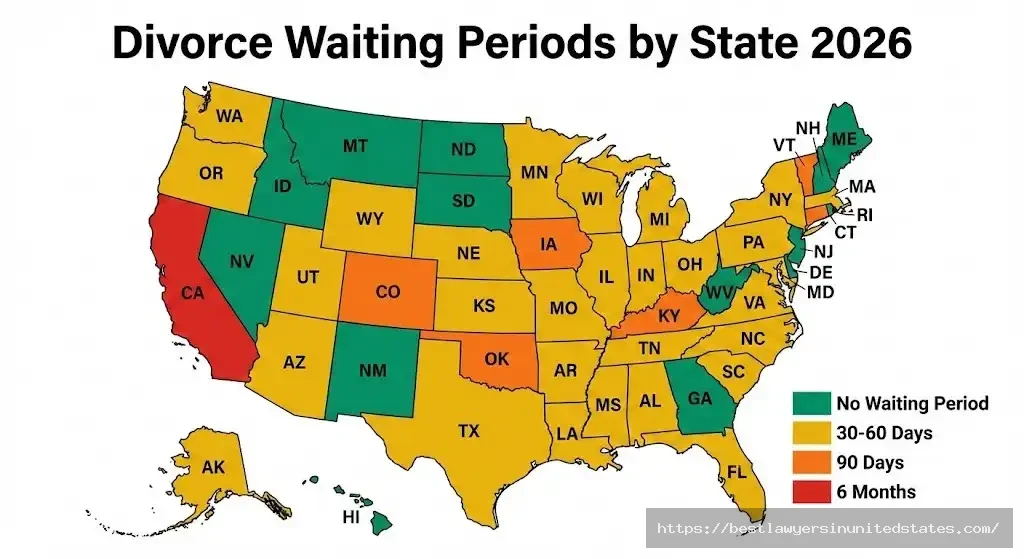
Waiting periods add mandatory delays after filing before your divorce becomes final. California requires six months while Nevada, New Jersey, and several other states have no waiting period. These delays can significantly impact how long your divorce takes to complete.
All States Now Allow No-Fault Divorce
Every state permits no-fault divorce as of 2010. You can file based on “irreconcilable differences” or “irretrievable breakdown” without proving your spouse did something wrong. Some states also allow fault-based grounds like adultery or cruelty, which may affect alimony or property division decisions.
Filing fees vary from $70 in Mississippi to $450 in California. Total divorce costs depend on whether your case is contested and if you hire an attorney. An uncontested divorce typically costs $500 to $3,000 while a contested divorce can exceed $15,000.
Property Division: Community Property vs Equitable Distribution
The property division system in your state determines how courts split assets and debts during divorce. This difference affects everything from your house and retirement accounts to credit card debt and business interests.
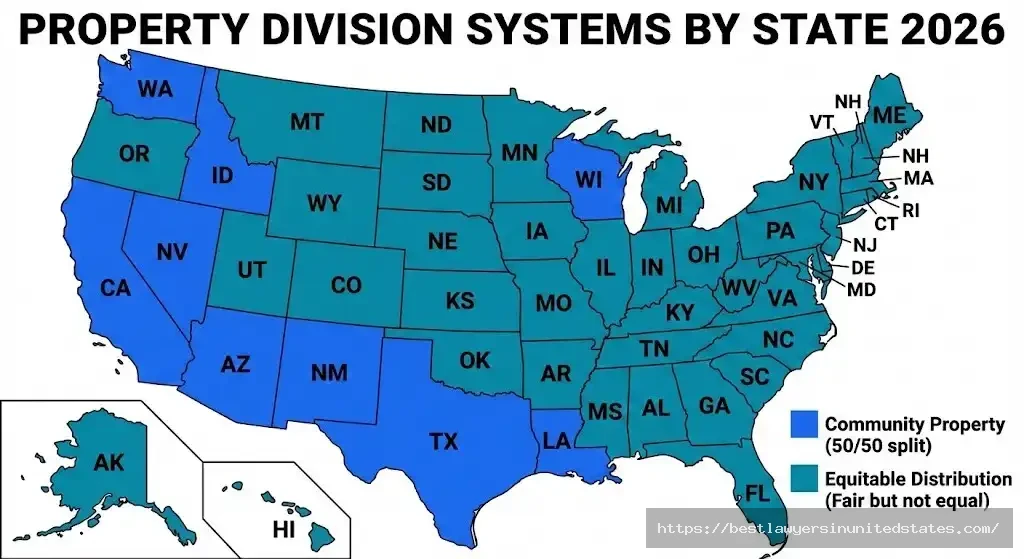
Community Property States (9 States)
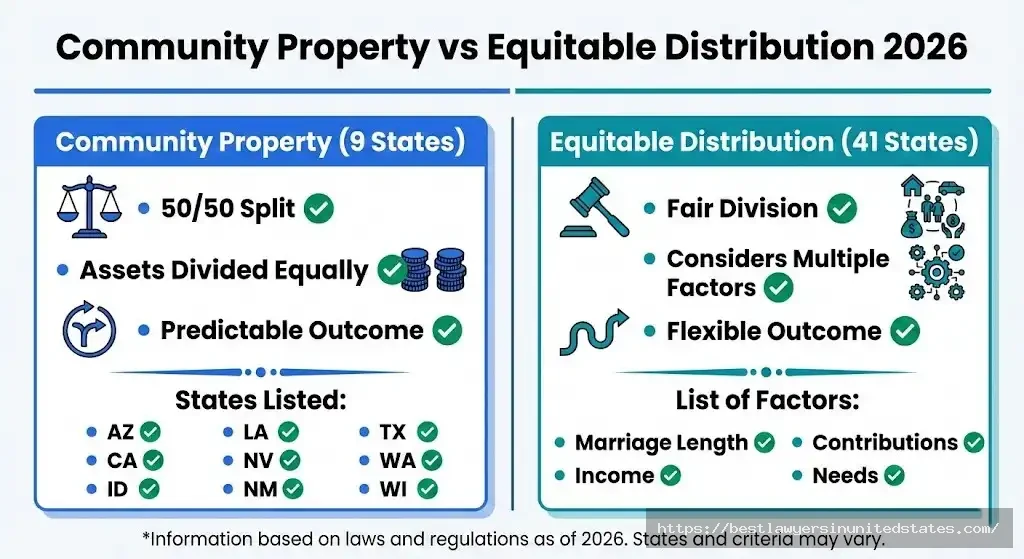
Nine states follow community property laws: Arizona, California, Idaho, Louisiana, Nevada, New Mexico, Texas, Washington, and Wisconsin. Under traditional community property rules, courts divide marital property 50/50 regardless of who earned more or whose name is on the title.
Community property includes all income, assets, and debts acquired during marriage. Your paychecks, house purchases, retirement contributions, and credit card charges become jointly owned. Separate property includes anything you owned before marriage, inheritances, and gifts received individually.
California applies the strictest 50/50 split with few exceptions. Washington allows judges more flexibility to divide property equitably when a 50/50 split seems unfair. Divorce costs in California often reflect the complexity of dividing community assets.
| State | Property System | Split Method | Flexibility |
|---|---|---|---|
| Arizona | Community Property | 50/50 | Limited |
| California | Community Property | 50/50 | Very Limited |
| Idaho | Community Property | 50/50 | Limited |
| Louisiana | Community Property | 50/50 | Limited |
| Nevada | Community Property | 50/50 | Moderate |
| New Mexico | Community Property | 50/50 | Limited |
| Texas | Community Property | 50/50 | Moderate |
| Washington | Community Property | Equitable | High |
| Wisconsin | Community Property | 50/50 | Moderate |
Equitable Distribution States (41 States)
The remaining 41 states use equitable distribution, which means fair division based on multiple factors. Courts consider marriage length, each spouse’s income and earning capacity, contributions to the marriage, and financial circumstances.
Equitable distribution doesn’t mean equal. One spouse might receive 60% of marital assets while the other gets 40% based on the court’s fairness analysis. Judges look at who sacrificed career advancement for childcare, who has greater future earning potential, and who needs more resources post-divorce.
New York divorce costs and Florida divorce costs reflect the equitable distribution states’ approach. Courts in these states have broader discretion in property division decisions.
Key Differences Between Systems
Community property states offer more predictability since the 50/50 split is predetermined. You know what to expect before going to court. Equitable distribution states give judges more flexibility to account for unique circumstances but create less certainty about outcomes.
Both systems treat separate property differently. Assets owned before marriage or received as gifts/inheritance typically remain separate. However, commingling separate and marital property can change this classification.
Divorce Residency Requirements by State
You must meet your state’s residency requirement before filing for divorce. Courts need jurisdiction over your case, which requires at least one spouse to be a legal resident of the state for a minimum time period.
Understanding Residency Rules
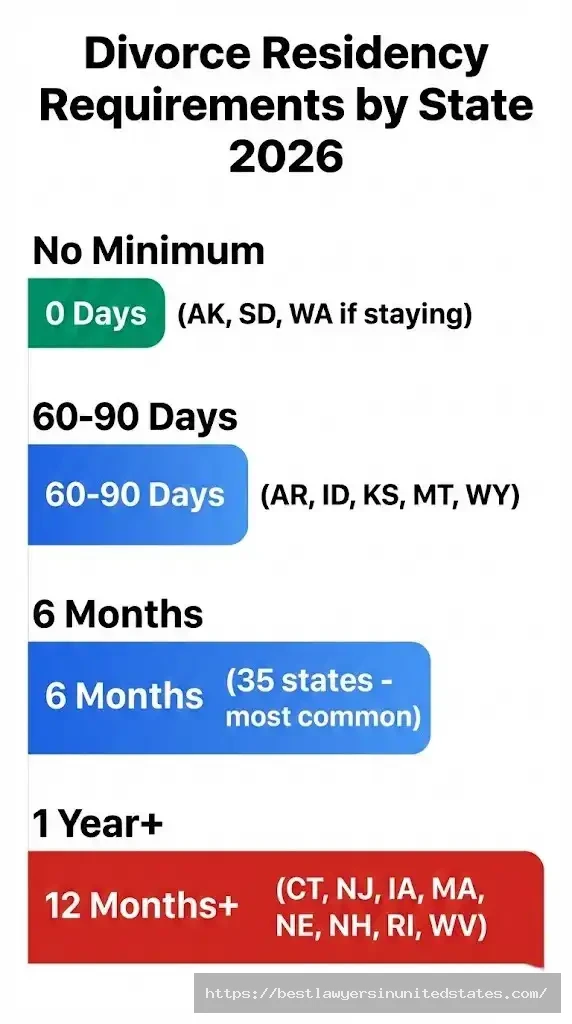
Most states require six months of residency before filing. Some states also require living in your specific county for a shorter period, typically three months. These requirements prevent forum shopping where people file in states with favorable laws.
Shortest residency requirements: Alaska, South Dakota, and Washington have no minimum if you plan to remain in the state. You can file immediately after moving if you intend to stay.
Longest residency requirements: Connecticut and New Jersey require 12 months of continuous state residency. New York varies from one to two years depending on where you married and where grounds for divorce occurred.
Most common requirement: Six months of state residency covers about 35 states. This gives you enough time to establish legal domicile while not creating excessive delays.
State-by-State Residency Requirements
| State | Residency Requirement | County Requirement |
|---|---|---|
| Alabama | 6 months | None |
| Alaska | None (if staying) | None |
| Arizona | 90 days | 90 days |
| Arkansas | 60 days | 60 days |
| California | 6 months | 3 months |
| Colorado | 91 days | 91 days |
| Connecticut | 12 months | None |
| Delaware | 6 months | None |
| Florida | 6 months | None |
| Georgia | 6 months | None |
| Hawaii | 3 months | None |
| Idaho | 6 weeks | 6 weeks |
| Illinois | 90 days | None |
| Indiana | 6 months | 3 months |
| Iowa | 1 year | None |
| Kansas | 60 days | None |
| Kentucky | 180 days | None |
| Louisiana | 6 months | None |
| Maine | 6 months | None |
| Maryland | 6 months | None |
| Massachusetts | 1 year | None |
| Michigan | 6 months | 10 days |
| Minnesota | 6 months | None |
| Mississippi | 6 months | None |
| Missouri | 90 days | None |
| Montana | 90 days | None |
| Nebraska | 1 year | None |
| Nevada | 6 weeks | None |
| New Hampshire | 1 year | None |
| New Jersey | 1 year | None |
| New Mexico | 6 months | None |
| New York | 1-2 years | Varies |
| North Carolina | 6 months | None |
| North Dakota | 6 months | None |
| Ohio | 6 months | 90 days |
| Oklahoma | 6 months | 30 days |
| Oregon | 6 months | None |
| Pennsylvania | 6 months | None |
| Rhode Island | 1 year | None |
| South Carolina | 3 months | None |
| South Dakota | None (if staying) | None |
| Tennessee | 6 months | None |
| Texas | 6 months | 90 days |
| Utah | 3 months | None |
| Vermont | 6 months | None |
| Virginia | 6 months | None |
| Washington | None (if staying) | None |
| West Virginia | 1 year | None |
| Wisconsin | 6 months | 30 days |
| Wyoming | 60 days | None |
Special Situations
Military members can file in their state of legal residence even if stationed elsewhere. The Servicemembers Civil Relief Act (SCRA) provides special protections. Learn more about military divorce rules and options.
Recent movers who don’t meet residency requirements must either wait or file in their previous state if they still qualify there. Check both states’ requirements to determine your best option.
Multiple residences give you a choice of where to file if you meet requirements in more than one state. Consider each state’s laws on property division, alimony, and child custody before deciding.
Divorce Waiting Periods & Cooling-Off Periods by State
A waiting period is the mandatory time between filing your divorce petition and the court finalizing your divorce. States impose these delays to allow reconciliation opportunities and prevent hasty decisions.
How Waiting Periods Work
The waiting period clock starts when you file your petition or when your spouse is served, depending on state law. During this time, you can work on settlement agreements, complete required classes, or attend mediation sessions.
California enforces the longest waiting period at six months. Your divorce cannot become final until at least six months and one day after service, regardless of how quickly you resolve other issues. Divorce timelines in California always include this mandatory delay.
Multiple states have no waiting period: Nevada, New Jersey, New Hampshire, New Mexico, Georgia, Montana, and North Dakota. Your divorce can become final as soon as all paperwork is complete and approved by a judge.
State Waiting Periods Table
| State | Waiting Period | Starts When | Notes |
|---|---|---|---|
| Alabama | 30 days | Filing | None |
| Alaska | 30 days | Filing | None |
| Arizona | 60 days | Service | None |
| Arkansas | 30 days | Filing | None |
| California | 6 months | Service | Longest in US |
| Colorado | 91 days | Filing | Same as residency |
| Connecticut | 90 days | Return date | None |
| Delaware | None | N/A | After hearing |
| Florida | 20 days | Service | None |
| Georgia | None | N/A | None |
| Hawaii | None | N/A | None |
| Idaho | 21 days | Service | 90 days with children |
| Illinois | None | N/A | None |
| Indiana | 60 days | Filing | None |
| Iowa | 90 days | Service | None |
| Kansas | 60 days | Filing | None |
| Kentucky | 60 days | Filing | None |
| Louisiana | 180 days | Filing | 365 with children |
| Maine | 60 days | Filing | None |
| Maryland | None | N/A | None |
| Massachusetts | 90-120 days | Filing | Varies by type |
| Michigan | 60 days | Filing | 180 with children |
| Minnesota | None | N/A | None |
| Mississippi | 60 days | Filing | None |
| Missouri | 30 days | Filing | None |
| Montana | None | N/A | None |
| Nebraska | 60 days | Filing | None |
| Nevada | None | N/A | None |
| New Hampshire | None | N/A | None |
| New Jersey | None | N/A | None |
| New Mexico | None | N/A | None |
| New York | None | N/A | None |
| North Carolina | 30 days | Filing | After 1 year separation |
| North Dakota | None | N/A | None |
| Ohio | 30 days | Filing | None |
| Oklahoma | 90 days | Filing | 10 with agreement |
| Oregon | None | N/A | None |
| Pennsylvania | 90 days | Service | None |
| Rhode Island | 90 days | Filing | None |
| South Carolina | 60 days | Filing | None |
| South Dakota | 60 days | Service | None |
| Tennessee | 60 days | Filing | None |
| Texas | 60 days | Filing | None |
| Utah | 30 days | Filing | None |
| Vermont | 90 days | Filing | None |
| Virginia | None | N/A | None |
| Washington | 90 days | Filing | None |
| West Virginia | 20 days | Service | None |
| Wisconsin | 120 days | Filing | None |
| Wyoming | 20 days | Service | None |
Waiting Period vs Total Timeline
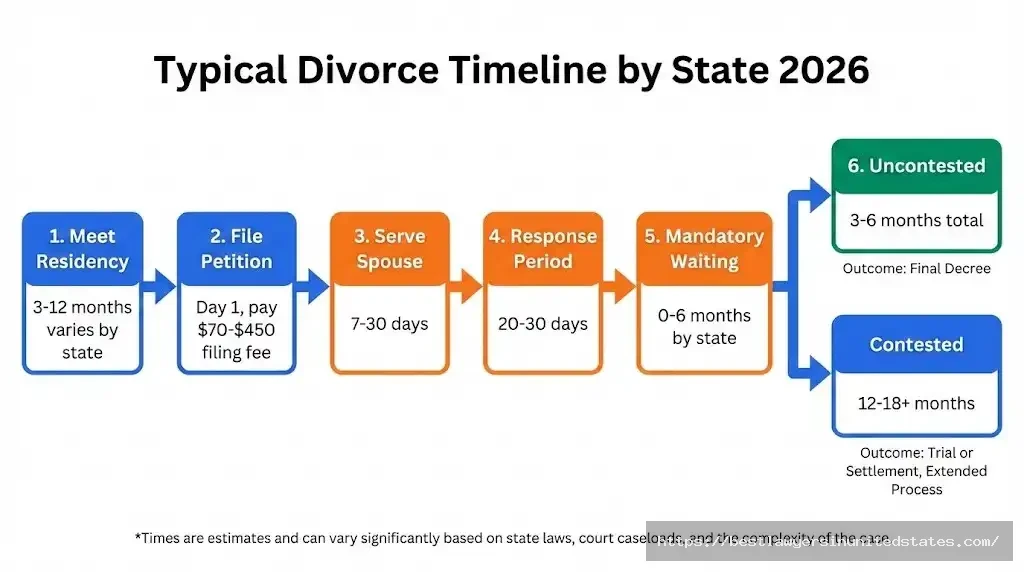
The waiting period is just one component of your total divorce timeline. Contested divorces typically take 12 to 18 months due to discovery, negotiations, and trial preparation. Uncontested divorces usually finalize within 3 to 6 months in most states.
States with no waiting period can still take several months to process paperwork and schedule court hearings. Court backlogs vary significantly by county and can add months to your timeline.
Divorce Filing Fees by State
Filing fees are your first divorce expense. You pay this fee when submitting your divorce petition to the court clerk. Fees vary significantly by state and sometimes by county within the same state.
Current 2026 Filing Fees
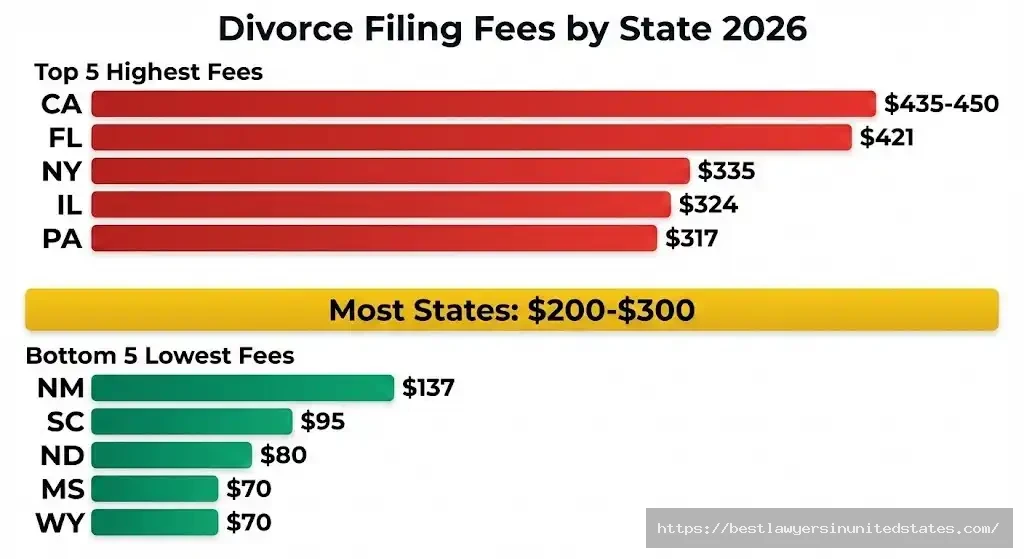
Highest filing fees: Florida charges $421, California charges $435-$450 depending on county, and New York charges $335. These states also tend to have higher overall divorce costs due to attorney rates and cost of living.
Lowest filing fees: Mississippi and Wyoming charge $70-$100 to file. Arkansas, West Virginia, and South Dakota also have filing fees under $150. Lower filing fees don’t always mean lower total costs if attorney rates are high.
Average filing fees: Most states charge $200-$300 to file for divorce. This represents the petition filing fee only and doesn’t include response fees, motion fees, or other court costs.
Filing Fees by State Table
| State | Filing Fee (2026) | Response Fee | Fee Waiver Available |
|---|---|---|---|
| Alabama | $290 | $150 | Yes |
| Alaska | $250 | $150 | Yes |
| Arizona | $349 | $176 | Yes |
| Arkansas | $165 | $100 | Yes |
| California | $435-$450 | $435-$450 | Yes |
| Colorado | $230 | $116 | Yes |
| Connecticut | $350 | $350 | Yes |
| Delaware | $155 | $155 | Yes |
| Florida | $421 | $409 | Yes |
| Georgia | $220 | $135 | Yes |
| Hawaii | $265 | $265 | Yes |
| Idaho | $221 | $221 | Yes |
| Illinois | $324 | $239 | Yes |
| Indiana | $157 | $157 | Yes |
| Iowa | $185 | $185 | Yes |
| Kansas | $198 | $198 | Yes |
| Kentucky | $148 | $148 | Yes |
| Louisiana | $300 | $150 | Yes |
| Maine | $120 | $120 | Yes |
| Maryland | $165 | $165 | Yes |
| Massachusetts | $215 | $215 | Yes |
| Michigan | $230 | $80 | Yes |
| Minnesota | $390 | $390 | Yes |
| Mississippi | $70 | $70 | Yes |
| Missouri | $163 | $163 | Yes |
| Montana | $200 | $100 | Yes |
| Nebraska | $158 | $158 | Yes |
| Nevada | $299 | $299 | Yes |
| New Hampshire | $250 | $250 | Yes |
| New Jersey | $300 | $200 | Yes |
| New Mexico | $137 | $137 | Yes |
| New York | $335 | $335 | Yes |
| North Carolina | $225 | $100 | Yes |
| North Dakota | $80 | $80 | Yes |
| Ohio | $200 | $200 | Yes |
| Oklahoma | $180 | $180 | Yes |
| Oregon | $301 | $301 | Yes |
| Pennsylvania | $317 | $317 | Yes |
| Rhode Island | $160 | $160 | Yes |
| South Carolina | $150 | $150 | Yes |
| South Dakota | $95 | $95 | Yes |
| Tennessee | $310 | $180 | Yes |
| Texas | $300 | $300 | Yes |
| Utah | $333 | $333 | Yes |
| Vermont | $295 | $295 | Yes |
| Virginia | $86 | $86 | Yes |
| Washington | $314 | $314 | Yes |
| West Virginia | $135 | $135 | Yes |
| Wisconsin | $184 | $184 | Yes |
| Wyoming | $70 | $70 | Yes |
Fee Waivers for Low-Income Filers
Every state offers fee waivers or deferrals for people who cannot afford filing fees. You must prove financial hardship by submitting income documentation, tax returns, and information about assets and expenses.
Qualification guidelines typically require income below 125-150% of federal poverty level. Some states use different calculations. Check with your county clerk or family court for specific waiver requirements and application forms.
Calculate Your Total Divorce Costs
Filing fees are just the beginning. Attorney fees, mediation costs, and other expenses add significantly to your total. Use our calculator to estimate your complete divorce costs.
Calculate Your Divorce Costs
Planning a divorce? Use our free calculator to estimate your total costs based on your state’s filing fees, typical attorney rates, and whether your divorce is contested or uncontested.
Divorce Cost Calculator
Get an estimated cost for your divorce based on your specific situation
Your Estimated Divorce Cost
Cost Breakdown
📧 Get a Personalized Consultation
Have questions about your specific situation? Contact our legal experts for guidance tailored to your needs.
Contact Us via EmailCalculator features:
- State-specific filing fees
- Attorney cost estimates by complexity
- Contested vs uncontested comparison
- Total cost breakdown
- Money-saving tips based on your situation
Questions about your divorce or need legal help? [Find Divorce Lawyers – Free Consultation]
Email: [email protected]
Grounds for Divorce by State
Grounds for divorce are the legal reasons you give the court for ending your marriage. All states now allow no-fault divorce, but some states also permit fault-based grounds that may affect property division or alimony.
No-Fault Divorce (All 50 States)
Every state permits no-fault divorce where you simply state the marriage has broken down irretrievably. Common terms include “irreconcilable differences,” “irretrievable breakdown,” or “incompatibility.” You don’t need to prove your spouse did anything wrong.
No-fault divorce became available nationwide after New York adopted it in 2010 as the last state. This option makes divorce more accessible and less adversarial. Most divorces file under no-fault grounds even in states that allow fault-based alternatives.
Fault-Based Divorce (Some States)
About half of all states still recognize fault-based grounds in addition to no-fault options. Common fault grounds include:
- Adultery: Sexual relationship outside marriage
- Cruelty: Physical or mental abuse
- Abandonment: One spouse leaves for extended period
- Incarceration: Imprisonment for specified time
- Addiction: Substance abuse problems
- Mental illness: Incurable insanity
Filing based on fault may affect alimony awards or property division in some states. Courts might award more assets or longer alimony to the “innocent” spouse. However, proving fault requires evidence and often lengthens proceedings.
No-Fault Only States
Fourteen states only allow no-fault divorce: California, Colorado, Florida, Indiana, Iowa, Kansas, Kentucky, Michigan, Minnesota, Missouri, Montana, Nebraska, Nevada, Oregon, Washington, and Wisconsin. You cannot file based on your spouse’s misconduct in these states.
When Fault Matters
Even in states allowing fault grounds, most divorces proceed no-fault because:
- Fault is difficult and expensive to prove
- Fault rarely significantly impacts outcomes
- No-fault divorces resolve faster
- Less conflict benefits children
Consider fault-based divorce only if you have clear evidence and your attorney believes it will meaningfully improve your financial outcome or custody position.
Process Serving Requirements by State
After filing your divorce petition, you must formally notify your spouse through a legal process called service of process. Each state has specific rules about who can serve papers and how service must occur.
Who Can Serve Divorce Papers
Most states allow any adult age 18 or older who is not party to the divorce to serve papers. This includes friends, relatives, professional process servers, or sheriff’s deputies. You cannot serve your own divorce papers in almost all contested cases.
States requiring licensed process servers: Alaska, Delaware, Michigan, Nevada, Oklahoma, and Texas require process servers to be licensed. New York requires licensing in New York City but not statewide.
Sheriff service: Every state allows sheriff’s deputies to serve divorce papers. Sheriff service typically costs $30-$75 and provides reliable proof of service.
Professional process servers: Private companies specialize in serving legal documents. They charge $50-$200 depending on location and difficulty. Professional service is faster than sheriff service in many counties.
Service Restrictions by State
Some states restrict when divorce papers can be served:
No Sunday service: Tennessee, Maine, Florida, Massachusetts, and New York prohibit serving divorce papers on Sundays. Servers must wait until Monday to deliver documents.
Religious holiday protection: New York also prohibits service on Saturdays if the recipient observes a religious holiday on that day. This accommodates Jewish Sabbath and other religious practices.
Holiday restrictions: Minnesota prohibits service on Sundays and legal holidays. Check your state’s specific rules about holiday service.
Alternative Service Methods
If your spouse cannot be located or refuses service, courts allow alternative methods:
- Service by publication: Running a legal notice in newspapers
- Service by posting: Posting notice at courthouse or last known address
- Service by mail: Certified or registered mail in some states
- Electronic service: Email or social media in limited circumstances
Alternative service requires court permission and proof that you attempted standard service first. These methods take longer and may affect whether your spouse can contest the divorce.
Alimony & Spousal Support Laws by State
Alimony (also called spousal support or maintenance) is money paid from one spouse to the other after divorce. Not every divorce includes alimony, and amounts vary significantly by state based on income differences and marriage length.
How States Calculate Alimony
Courts consider multiple factors when deciding alimony:
- Length of marriage
- Income and earning capacity of each spouse
- Standard of living during marriage
- Age and health of both spouses
- Contributions to the marriage (including homemaking)
- Education and job skills
- Child custody arrangements
No state uses a simple formula like child support calculations. Judges have significant discretion in awarding alimony amounts and duration. Some states provide guidelines while others rely entirely on case law.
Permanent Alimony States
Only six states still regularly award permanent alimony: Connecticut, New Jersey, North Carolina, Oregon, Vermont, and West Virginia. Permanent alimony continues until the recipient remarries or either spouse dies.
Courts in these states reserve permanent alimony for long marriages (typically 10+ years) where one spouse has significantly lower earning capacity. Even in these states, permanent awards are becoming less common.
Temporary and Rehabilitative Alimony
Most states now favor temporary alimony designed to help the lower-earning spouse become self-supporting:
Rehabilitative alimony: Lasts while the recipient completes education or job training. Common duration is 2-5 years.
Transitional alimony: Shorter-term support (6 months to 2 years) to help adjust to single life and find employment.
Reimbursement alimony: Compensates a spouse who supported the other through school or career advancement.
Alimony by State Variations
| State | Type | Duration Limits | Modification | Remarriage Effect |
|---|---|---|---|---|
| California | Various | Case by case | Yes | Terminates |
| Florida | Bridge-the-gap, Rehabilitative, Durational | Limited | Restricted | Terminates |
| Texas | Limited | Rare/short | Yes | Terminates |
| New York | Various | No specific limit | Yes | Terminates |
| Illinois | Various | Guideline formula | Yes | Terminates |
| Pennsylvania | Various | No limit | Yes | Terminates |
| Ohio | Various | No limit | Yes | Terminates |
| Massachusetts | General, Rehabilitative, Reimbursement, Transitional | Varies | Yes | Terminates |
| New Jersey | Open durational, Limited duration, Rehabilitative, Reimbursement | Varies | Yes | May terminate |
| Georgia | Various | No limit | Yes | Terminates |
Calculate Alimony Estimates
Calculate Alimony Estimates
Wondering about spousal support? Our calculator estimates alimony payments based on your state’s guidelines, income difference, marriage length, and other factors.
Calculator features:
- State-specific alimony formulas
- Duration estimates
- Income-based calculations
- Modification factors
Questions about your divorce or need legal help? [Find Divorce Lawyers – Free Consultation]
Email: [email protected]
Alimony Tax Changes
The Tax Cuts and Jobs Act eliminated the alimony tax deduction for divorces finalized after December 31, 2018. Recipients no longer pay income tax on alimony received, and payers cannot deduct alimony payments. This change significantly impacts alimony negotiations in all states.
Special Divorce Scenarios by State
Some divorce situations involve unique legal considerations that vary by state. Military divorces, same-sex divorces, and high-asset cases each have specific rules affecting jurisdiction, property division, and benefits.
Military Divorce
Active duty service members and their spouses face special rules under the Servicemembers Civil Relief Act (SCRA). Military divorces can be filed in:
- The state where the service member is stationed
- The service member’s state of legal residence
- The state where the non-military spouse resides
The 10/10 rule affects military retirement benefits. The Defense Finance and Accounting Service directly pays a portion of military retirement to the former spouse if:
- The marriage lasted 10 years or more
- The service member performed 10 years of creditable military service during the marriage
States cannot divide military retirement earned before marriage or after divorce. The Uniformed Services Former Spouses Protection Act limits how states divide military pensions. Military divorce requires specialized knowledge of federal and state laws.
Same-Sex Divorce
Same-sex married couples follow the same divorce rules as opposite-sex couples in all states since the Supreme Court’s 2015 Obergefell decision. States must recognize same-sex marriages performed in other states.
Complications can arise for couples who married before their state recognized same-sex marriage. Residency requirements may create confusion if the couple married in one state but lives in another. Courts generally count marriage length from the ceremony date regardless of state recognition timing.
High-Asset Divorce
Complex financial situations require extra attention to property division rules. Community property states offer more predictability for high-net-worth divorces since the 50/50 split applies regardless of asset complexity.
Equitable distribution states give judges broad discretion in dividing significant assets. Factors like separate property, inheritance, and business ownership become more important with substantial wealth.
High-asset divorces typically require:
- Business valuation experts
- Forensic accountants
- Tax specialists
- Real estate appraisers
- Pension valuation experts
States like California with community property rules provide clearer guidelines for dividing high-value assets. Texas and other community property states follow similar approaches.
Fastest and Most Affordable States for Divorce
If you have a choice about where to file, consider each state’s timeline and costs. Some states process divorces quickly with low fees while others impose long waits and expensive requirements.
Fastest Divorce States
Nevada earned its reputation for quick divorces with a six-week residency requirement and no waiting period. Uncontested divorces can finalize in 2-3 months if paperwork is complete.
Alaska and South Dakota allow immediate filing if you plan to remain a resident. No waiting periods mean divorces can complete within 60-90 days for uncontested cases.
States with no waiting period process divorces fastest: Nevada, New Jersey, New Hampshire, New Mexico, Georgia, Montana, and North Dakota. Court scheduling becomes the main timeline factor.
Slowest Divorce States
California requires six months before finalizing any divorce. Even uncontested cases with signed agreements must wait the full six-month period after service.
States requiring separation add time before you can even file. North Carolina requires one-year separation before filing. Virginia requires six-month or one-year separation depending on circumstances.
States with court backlogs face delays regardless of waiting period rules. Urban counties in New York, Florida, and Illinois sometimes schedule hearings 6-12 months after filing.
Lowest Cost Divorce States
Wyoming and Mississippi charge the lowest filing fees at $70. Combined with lower attorney rates in rural areas, total uncontested divorce costs can stay under $1,000.
Mountain and Plains states generally have lower divorce costs due to lower cost of living. Divorce costs in Montana, Idaho, and South Dakota average 30-40% less than coastal states.
DIY divorce options work well in states with simple forms and processes. Our DIY divorce guide covers which states make self-filing easiest.
Most Expensive Divorce States
California ranks highest for divorce costs with $435-$450 filing fees and attorney rates of $300-$500 per hour. Average contested divorce costs in California exceed $25,000.
New York and Massachusetts have expensive divorces due to high attorney rates ($350-$600/hour) and complex property division rules. New York divorce costs average $15,000-$30,000 for contested cases.
Florida charges the highest filing fee at $421 and has attorney rates of $250-$400/hour. Florida divorce costs run high despite no waiting period.
How to Choose Which State to File In
Most people file in the state where they currently live. But if you recently moved, own homes in multiple states, or are military, you might have options about where to file.
When You Have a Choice
You can choose your filing state if you meet residency requirements in more than one state. This situation commonly occurs when:
- You recently moved but still meet your old state’s residency rules
- You maintain homes in two states and live in both
- You’re in the military and can file in multiple locations
- You and your spouse live in different states
Consider these factors when choosing between states:
Property division system: Community property states split assets 50/50 while equitable distribution states allow flexible division. Choose the system most favorable to your situation.
Alimony laws: Some states award more generous alimony than others. Connecticut, New Jersey, and Oregon still allow permanent alimony while most states limit duration.
Waiting periods: States like California require six-month waits. If you need a faster divorce, choose a state with no waiting period.
Filing and attorney costs: Compare divorce costs between states. Filing fees vary from $70 to $450, and attorney rates differ significantly.
Child custody laws: Some states favor joint custody while others more readily award sole custody. Research your options if custody is contested.
When You Don’t Have a Choice
You must file where you (or your spouse) meet residency requirements. If only one state qualifies, that’s your only option regardless of other factors.
Moving to a different state just to file there rarely makes sense. The time required to establish residency often equals or exceeds any benefit from that state’s laws. Plus, moving during divorce proceedings raises complications about jurisdiction and which state’s laws apply.
Determining Jurisdiction
The first state where you file and properly serve your spouse typically keeps jurisdiction. Once one spouse files in State A, the other spouse cannot file in State B and have both proceedings run simultaneously.
Courts apply their own state’s laws even if you married elsewhere. Where you got married doesn’t determine which state’s divorce laws apply. Current residency controls jurisdiction.
Comprehensive FAQ
Do divorce laws vary by state?
Quick Answer: Yes, divorce laws vary significantly across all 50 states in areas like property division, residency requirements, waiting periods, filing fees, and alimony rules.
Each state sets its own divorce statutes through state legislatures. The most significant difference is between community property states (9 states) and equitable distribution states (41 states). Understanding different types of divorce helps you recognize how your state’s approach affects your case.
Which states have no-fault divorce?
Quick Answer: All 50 states allow no-fault divorce as of 2010 when New York became the last state to adopt it.
You can file for divorce based on “irreconcilable differences” or “irretrievable breakdown” without proving fault in every state. Some states also allow fault-based grounds like adultery or cruelty, but no-fault is always an option.
What’s the difference between community property and equitable distribution?
Quick Answer: Community property states divide marital assets 50/50 while equitable distribution states divide assets fairly based on multiple factors, which may not be equal.
Nine states use community property: Arizona, California, Idaho, Louisiana, Nevada, New Mexico, Texas, Washington, and Wisconsin. The other 41 states use equitable distribution where judges consider marriage length, income, contributions, and other factors to divide property fairly.
Can I choose which state to file for divorce in?
Quick Answer: You can choose only if you meet residency requirements in multiple states, which typically requires living in each state for the required time period.
Military members have more flexibility since they can file where stationed, where they maintain legal residence, or where their spouse lives. Most civilians must file in the state where they currently live after meeting the residency requirement.
Which states have the fastest divorces?
Quick Answer: Nevada, Alaska, South Dakota, New Jersey, and New Hampshire offer the fastest divorces with short or no residency requirements and no waiting periods.
Nevada’s six-week residency requirement and zero waiting period made it famous for quick divorces. States with no waiting period can finalize uncontested divorces in 60-90 days. Understanding how long divorce takes helps you plan realistic timelines.
Which states have the longest waiting periods?
Quick Answer: California has the longest waiting period at six months mandatory from service of papers to finalization of divorce.
California’s six-month rule applies to all divorces, even uncontested cases with signed agreements. Idaho requires 90 days when children are involved. Most states require 30-90 days or no waiting period at all.
Which states have the lowest filing fees?
Quick Answer: Wyoming and Mississippi have the lowest filing fees at approximately $70, while Florida ($421), California ($435-$450), and New York ($335) charge the most.
Filing fees represent just one component of total divorce costs. Compare divorce filing fees across states to understand this initial expense, but remember attorney fees typically cost much more than filing fees.
What if I just moved to a new state?
Quick Answer: You must meet your new state’s residency requirement before filing, which typically ranges from 60 days to 12 months depending on the state.
You might still qualify to file in your previous state if you meet their residency rules and haven’t been gone too long. Check requirements in both states to determine your options and timing.
Do I need to meet residency requirements if my spouse lives in the state?
Quick Answer: Yes, at least one spouse must meet the state’s residency requirement before filing regardless of where the other spouse lives.
If you move out of state during separation, you still need to meet your new state’s residency requirement before filing there. Alternatively, your spouse can file in the state where they remained if they meet residency requirements.
Can I get divorced in a different state than where I was married?
Quick Answer: Yes, you file for divorce where you currently live after meeting residency requirements, not where you married.
The state where you married has no relevance to divorce jurisdiction. Current residency determines which state’s courts handle your divorce and which state’s laws apply to property division and other issues.
Which states still allow fault-based divorce?
Quick Answer: About half of all states allow fault-based divorce in addition to no-fault options, but 14 states including California, Florida, and Washington only permit no-fault divorce.
No-fault only states are: California, Colorado, Florida, Indiana, Iowa, Kansas, Kentucky, Michigan, Minnesota, Missouri, Montana, Nebraska, Nevada, Oregon, Washington, and Wisconsin. Other states allow both no-fault and fault-based grounds.
What states offer permanent alimony?
Quick Answer: Only six states regularly award permanent alimony: Connecticut, New Jersey, North Carolina, Oregon, Vermont, and West Virginia.
Most states now limit alimony to rehabilitative or transitional support lasting 2-5 years. Even in states allowing permanent alimony, courts reserve it for long marriages (10+ years) with significant income disparities.
How do military divorces work across states?
Quick Answer: Military members can file where they’re stationed, where they maintain legal residence, or where their spouse lives under the Servicemembers Civil Relief Act (SCRA).
Military divorces involve special rules about jurisdiction, pension division, and benefit protection. The 10/10 rule affects direct payment of retirement benefits when the marriage lasted 10+ years overlapping with 10+ years of service.
What’s the most expensive state to get divorced in?
Quick Answer: California has the highest divorce costs with $435-$450 filing fees and attorney rates of $300-$500/hour, followed closely by New York and Massachusetts.
Contested divorces in California average $15,000-$30,000 or more. New York and Massachusetts have similar costs due to high attorney rates and complex proceedings.
Which states require separation before divorce?
Quick Answer: North Carolina requires one year of separation before filing, while Virginia requires six months to one year depending on whether you have children and a signed agreement.
Most states don’t require formal separation before filing. You can file for divorce in most states as soon as you decide to end the marriage and meet residency requirements.
How do I calculate my divorce costs?
Quick Answer: Use our divorce cost calculator to estimate your total based on your state’s filing fees, typical attorney rates, and whether your divorce is contested or uncontested.
Attorney fees typically represent the largest expense, ranging from $1,500-$3,000 for simple uncontested divorces to $15,000-$30,000+ for contested cases. Filing fees, mediation, experts, and court costs add to the total.
Conclusion
Divorce laws differ significantly across all 50 states in property division, residency requirements, waiting periods, filing fees, and financial obligations. Community property states split assets 50/50 while equitable distribution states divide property fairly based on multiple factors. Residency requirements range from no minimum to 12 months, and waiting periods vary from zero to six months.
Understanding your state’s specific divorce laws helps you make informed decisions about timing, costs, and strategy. Use our divorce cost calculator to estimate expenses based on your situation. Research your state’s requirements before filing to avoid delays and complications.
For detailed information about divorce in your specific state, visit our state-specific guides covering costs, timelines, and procedures for all 50 states.
Questions about your divorce or need legal help?
Find Divorce Lawyers – Free Consultation
Email: [email protected]