
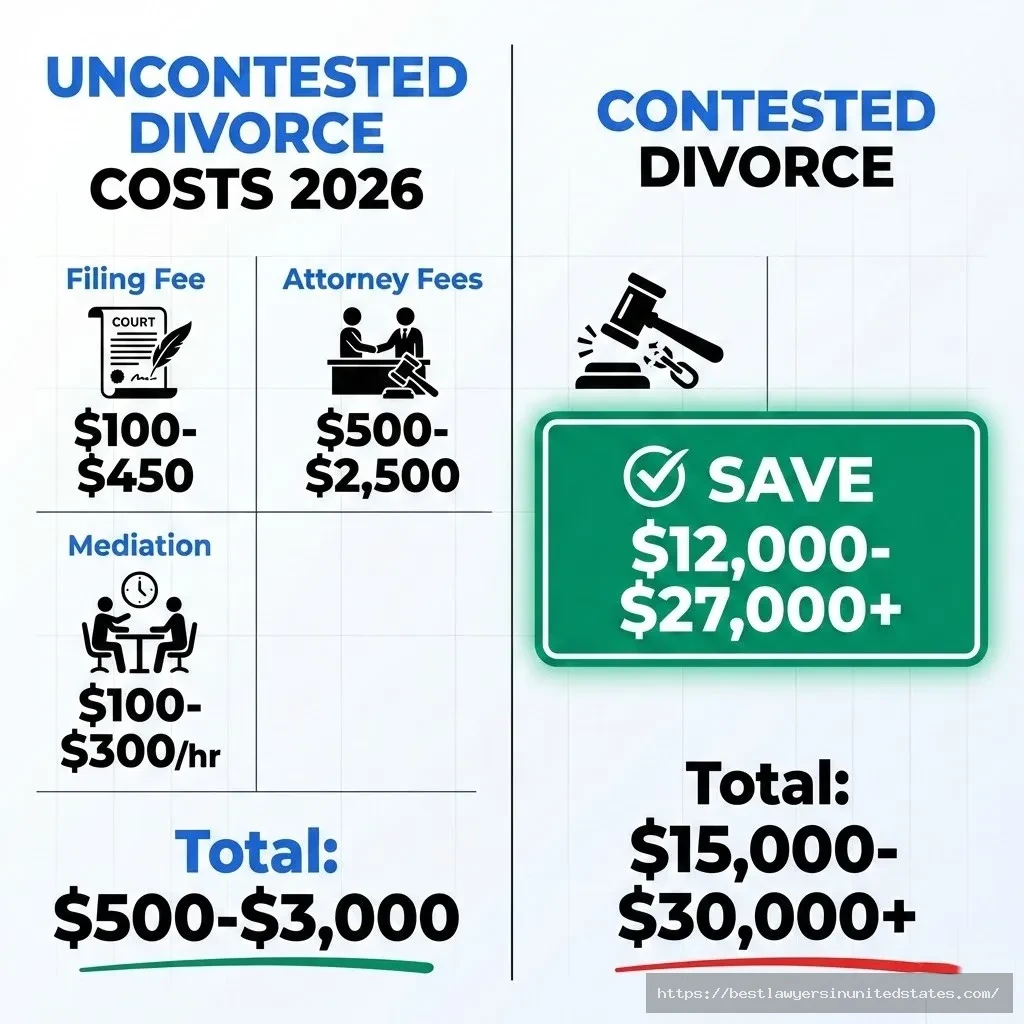
An uncontested divorce is when both spouses agree on all terms of the divorce, including property division, child custody, and support. This type of divorce is faster, cheaper, and less stressful than a contested divorce. Most uncontested divorces cost $500 to $3,000 and take 2 to 6 months to finalize.
If you and your spouse can agree on how to split assets, who gets custody of the children, and whether anyone pays alimony, you qualify for an uncontested divorce. This saves thousands of dollars in attorney fees and months of court battles.
What Is an Uncontested Divorce?
An uncontested divorce happens when both spouses agree on every aspect of ending their marriage. Neither spouse fights over property, money, or children. You both sign a settlement agreement that becomes your divorce decree.
The key is mutual agreement. If you disagree on even one issue, your divorce becomes contested. That means more time in court, higher legal bills, and added stress.
Key Features of Uncontested Divorce
What makes a divorce uncontested:
✅ Both spouses agree to divorce ✅ No disputes over property division ✅ Child custody and support are settled ✅ Alimony terms are agreed upon (if applicable) ✅ Both parties sign all paperwork willingly ✅ No trial or lengthy court hearings needed
Quick Answer: An uncontested divorce requires complete agreement between spouses on all terms. If you disagree on anything, it becomes a contested divorce.
Legal Requirements
Courts still review your agreement even though you both agree. A judge must approve your settlement to make sure it follows state law. This protects both parties from unfair agreements.
Most states require:
- Residency requirements (usually 6 months to 1 year)
- Waiting period after filing (30 to 180 days depending on state)
- Complete financial disclosure
- Signed settlement agreement
- Attendance at final hearing (in some states)
Contested vs Uncontested Divorce: What’s the Difference?
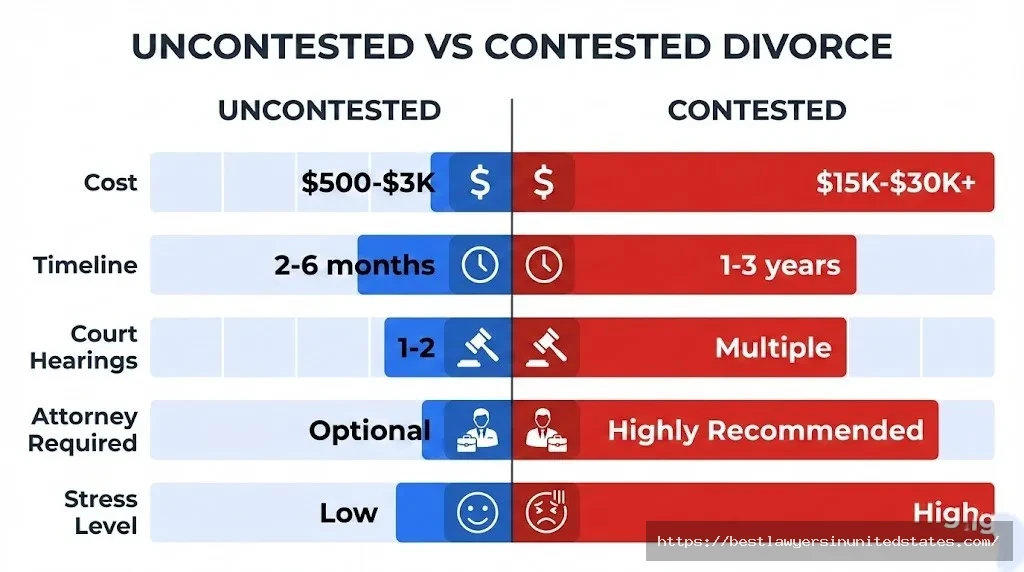
The main difference between contested and uncontested divorce is whether spouses agree on divorce terms. Uncontested means full agreement. Contested means you’re fighting over at least one issue.
Side-by-Side Comparison
| Feature | Uncontested Divorce | Contested Divorce |
|---|---|---|
| Agreement Level | Complete agreement | Disputes exist |
| Average Cost | $500 – $3,000 | $15,000 – $30,000+ |
| Timeline | 2-6 months | 1-3 years |
| Court Hearings | Minimal (1-2) | Multiple hearings |
| Attorney Needed | Optional | Highly recommended |
| Stress Level | Low | High |
| Discovery Process | Not required | Extensive |
| Trial | No | Possible |
When Divorce Becomes Contested
Your uncontested divorce can turn contested if:
- One spouse changes their mind about terms
- Hidden assets are discovered
- Someone refuses to sign papers
- New disputes arise about children or property
- One party feels pressured into agreement
This shift adds months to the process and thousands in legal costs. That’s why having a solid settlement agreement matters from the start.
Cost Impact
The difference in cost is substantial. Contested divorce costs include attorney retainers of $5,000 to $10,000, hourly rates of $250 to $500, expert witness fees, and court costs. Many contested divorces end up costing $20,000 to $50,000 or more.
Uncontested divorces avoid most of these expenses. You might spend only $500 to $3,000 total, including filing fees and attorney review.
How Much Does an Uncontested Divorce Cost?
The average uncontested divorce costs between $500 and $3,000 depending on your state and whether you hire a lawyer. Most people pay around $1,500 total. This includes court filing fees, document preparation, and legal review.
Cost Breakdown
Typical expenses for an uncontested divorce:
| Cost Type | Price Range | Notes |
|---|---|---|
| Filing Fee | $100 – $450 | Varies by state and county |
| Attorney Fees (flat rate) | $500 – $2,500 | Optional but recommended |
| Mediation | $100 – $300/hour | If needed for agreement |
| Document Prep Services | $200 – $500 | Online services or paralegals |
| Service of Process | $30 – $100 | Delivering papers to spouse |
| Total DIY | $200 – $600 | If you handle everything yourself |
| Total with Attorney | $1,000 – $3,000 | Includes legal review and filing |
Calculate Your Divorce Costs
Planning a divorce? Use our free calculator to estimate your total costs based on your state’s filing fees, typical attorney rates, and whether your divorce is contested or uncontested.
Divorce Cost Calculator
Get an estimated cost for your divorce based on your specific situation
Your Estimated Divorce Cost
Cost Breakdown
📧 Get a Personalized Consultation
Have questions about your specific situation? Contact our legal experts for guidance tailored to your needs.
Contact Us via EmailCalculator features:
- State-specific filing fees
- Attorney cost estimates by complexity
- Contested vs uncontested comparison
- Total cost breakdown
- Money-saving tips based on your situation
Questions about your divorce or need legal help? Find Divorce Lawyers – Free Consultation Email: [email protected]
Ways to Reduce Costs
Save money on your uncontested divorce:
✅ Handle paperwork yourself if comfortable with forms ✅ Use online divorce services ($200-$500) instead of full attorney representation ✅ Agree on everything before filing to avoid modifications ✅ File fee waiver request if you can’t afford filing fees ✅ Skip mediation if you already agree on terms ✅ Use flat-fee attorneys instead of hourly billing
Most states allow fee waivers for low-income filers. You submit a financial affidavit showing you can’t afford the filing fee. Courts waive or reduce fees in hardship cases.
Uncontested Divorce Process: Step-by-Step
The process of filing for divorce in an uncontested case follows six basic steps. Most people complete the process in 2 to 6 months. Each state has specific requirements, but the general process remains similar.
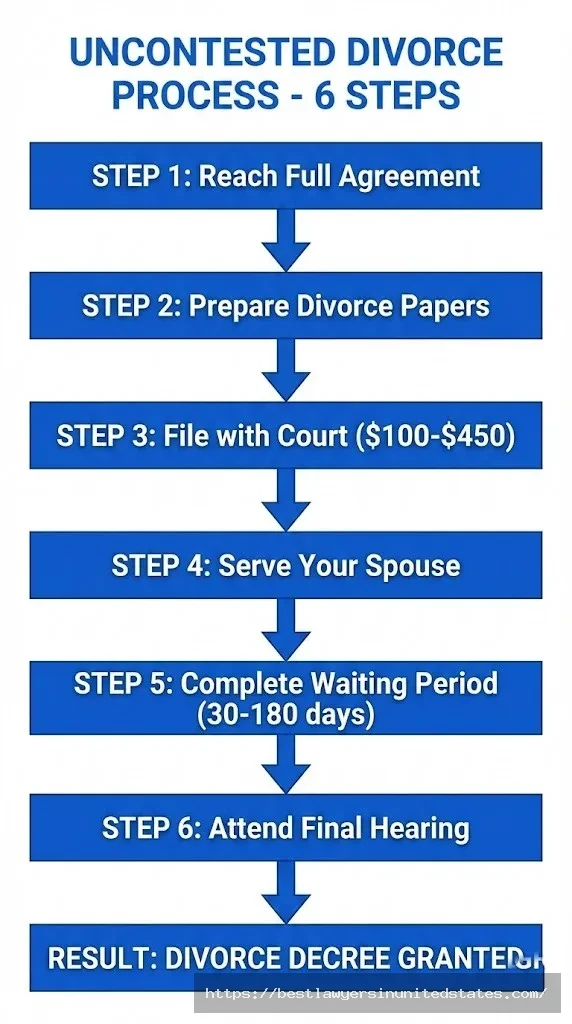
Step 1: Reach Full Agreement
Before filing, you must agree on all terms:
- How to divide property and debts
- Child custody and visitation schedule
- Child support amounts
- Whether anyone pays alimony
- Who keeps the house, cars, and other assets
Write everything down in a settlement agreement. This document becomes legally binding once the court approves it.
Step 2: Prepare Divorce Papers
You need several forms to start your divorce:
Required documents:
- Divorce petition or complaint
- Summons
- Marital settlement agreement
- Financial affidavits from both spouses
- Child custody and support agreement (if applicable)
- Property division agreement
Many courts provide free forms on their websites. You can also use online divorce services or hire an attorney to prepare documents.
Step 3: File with the Court
Take your completed forms to the county clerk’s office where you or your spouse lives. Pay the filing fee, which ranges from $100 to $450 depending on your state.
The clerk stamps your papers and gives you case numbers. Keep copies of everything for your records.
Step 4: Serve Your Spouse
Even in uncontested cases, you must legally “serve” divorce papers on your spouse. This means officially delivering the documents to them.
Service options:
- Sheriff or process server ($30-$100)
- Certified mail in some states
- Waiver of service (spouse signs acknowledging receipt)
Your spouse then has a set time to respond, usually 20 to 30 days. In uncontested cases, they typically sign an acknowledgment or waiver instead of filing a formal response.
Step 5: Complete Waiting Period
Most states require a mandatory waiting period before finalizing your divorce. This gives both parties time to reconsider and prevents hasty decisions.
Common waiting periods:
- 30 days: Arizona, Arkansas, Nevada
- 60 days: Texas, Utah, Nebraska
- 90 days: Louisiana, Michigan, Rhode Island
- 6 months: California
- No waiting period: Alaska, South Dakota, Washington
You cannot finalize your divorce before this period ends, even if you both agree.
Step 6: Attend Final Hearing (If Required)
Some states require a brief court appearance to finalize your divorce. Others let you submit paperwork without appearing.
The hearing lasts 5 to 15 minutes. The judge asks basic questions to confirm:
- Both parties agree to the divorce
- The settlement is fair
- You understand the agreement terms
- Neither party was pressured or coerced
If the judge approves, they sign your divorce decree. This makes your divorce official.
How Long Does an Uncontested Divorce Take?
Most uncontested divorces take 2 to 6 months from filing to finalization. The exact timeline depends on your state’s waiting period, court backlog, and how quickly you complete paperwork.
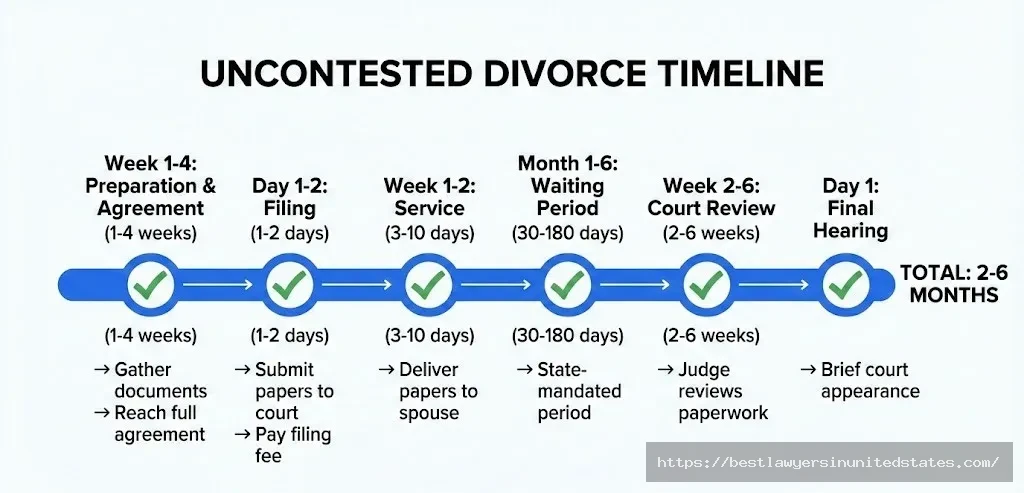
Timeline Breakdown
Typical uncontested divorce timeline:
| Phase | Duration | What Happens |
|---|---|---|
| Preparation | 1-4 weeks | Gather documents, reach agreement |
| Filing | 1-2 days | Submit papers to court |
| Service | 3-10 days | Deliver papers to spouse |
| Waiting Period | 30-180 days | State-mandated cooling off period |
| Court Review | 2-6 weeks | Judge reviews paperwork |
| Final Hearing | 1 day | Brief court appearance (if required) |
| Total Time | 2-6 months | From filing to final decree |
Fastest States for Divorce
States with the shortest divorce timelines:
Under 60 days possible:
- Nevada (2-3 weeks with no waiting period)
- Alaska (30 days minimum)
- South Dakota (60 days)
- Wyoming (60 days)
6+ months required:
- California (6 months mandatory)
- Vermont (6 months if uncontested)
- Rhode Island (3 months minimum)
Factors That Speed Things Up
Finish your divorce faster by:
✅ Having all paperwork completed accurately before filing ✅ Both spouses signing everything promptly ✅ Submitting all required financial documents ✅ Meeting residency requirements before filing ✅ Responding to court requests immediately ✅ Hiring an attorney to handle administrative tasks
Delays to Avoid
Common issues that slow down uncontested divorces:
- Incomplete or incorrect paperwork
- Missing required documents
- Spouse can’t be located for service
- Court backlog in your county
- Disagreements that arise after filing
- Judge requests additional information
Courts often reject incomplete filings. This sends you back to square one and adds weeks to your timeline.
Requirements for an Uncontested Divorce
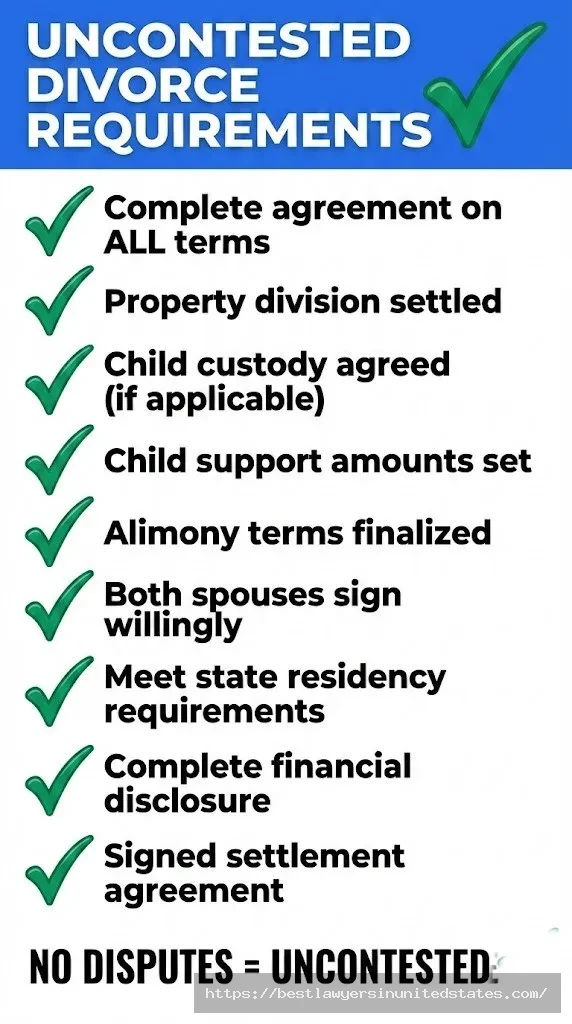
You must meet several requirements to qualify for an uncontested divorce. Courts enforce these rules to protect both parties. Missing even one requirement can delay your case or force you into a contested process.
Universal Requirements
Every state requires:
Complete agreement on all issues:
- Property and debt division
- Child custody and visitation
- Child support amounts
- Alimony or spousal support
- Division of retirement accounts
- Health insurance arrangements
Legal grounds for divorce:
- Irreconcilable differences (no-fault)
- Irretrievable breakdown of marriage
- Incompatibility
- Living separate and apart (in some states)
Residency requirements:
- At least one spouse must live in the state
- Duration varies: 6 months to 1 year typically
- Some states require county residency too
Financial Disclosure
Both spouses must provide complete financial information. This includes:
✅ Income statements and tax returns ✅ Bank account statements ✅ Investment and retirement accounts ✅ Property deeds and mortgage documents ✅ Vehicle titles and loan information ✅ Credit card and debt statements ✅ Business ownership documents
Hiding assets is illegal and can result in:
- Divorce being overturned
- Criminal charges for fraud
- Forfeiture of hidden assets
- Payment of opposing party’s legal fees
When Children Are Involved
Additional requirements apply if you have minor children:
Required documents:
- Parenting plan with custody schedule
- Child support calculation worksheet
- Health insurance plan for children
- Decision-making authority agreement
Court considerations:
- Child’s best interests must be primary
- Support amounts must meet state guidelines
- Custody arrangement must be reasonable
- Neither parent can waive child support rights
Some states require parenting classes before granting divorce with children. These courses cost $20 to $50 and take 2 to 4 hours online or in person.
Special Circumstances
Certain situations require extra steps:
Military divorces:
- Servicemember’s Civil Relief Act protections
- Military pension division rules
- Special jurisdiction requirements
Domestic violence cases:
- May need protective orders in place
- Special service requirements
- Court may question if agreement was coerced
High-value estates:
- Complex property division
- Business valuation required
- Tax implications reviewed
Can You Have an Uncontested Divorce with Children?
Yes, you can have an uncontested divorce with children if both parents agree on custody, visitation, and child support. Having kids doesn’t automatically make your divorce contested. The key is reaching a complete parenting agreement before filing.
Custody Arrangements
You must decide on two types of custody:
Legal custody (decision-making authority):
- Joint legal custody: Both parents make major decisions together
- Sole legal custody: One parent makes all major decisions
Physical custody (where children live):
- Joint physical custody: Children split time between homes
- Primary physical custody: Children live mainly with one parent
- Visitation schedule for non-custodial parent
Most courts prefer joint legal custody unless one parent is unfit. Physical custody arrangements vary based on what works best for your family.
Creating a Parenting Plan
Your parenting plan must cover:
Daily schedule:
- Regular weekly schedule
- Holiday and vacation rotation
- School break arrangements
- Transportation responsibilities
Decision-making:
- Medical care and emergencies
- Education and school choice
- Religious upbringing
- Extracurricular activities
Communication:
- How parents will communicate
- How to handle schedule changes
- Method for resolving disputes
Be as specific as possible. Vague language leads to future conflicts. Instead of “reasonable visitation,” specify exact days and times.
Child Support Obligations
Every state has child support guidelines based on income. Both parents must follow these formulas. You cannot waive or reduce child support below guideline amounts without court approval.
Factors in child support calculations:
- Both parents’ gross income
- Number of children
- Custody time percentage
- Healthcare and childcare costs
- Special needs expenses
Most states use an income shares model. This calculates what you would spend on children if married, then divides that proportionally based on each parent’s income.
Common Custody Agreements
Popular arrangements for uncontested divorces with children:
2-2-3 schedule:
- Children with Parent A: Monday-Tuesday
- Children with Parent B: Wednesday-Thursday
- Alternate weekends
Week on, week off:
- Children alternate full weeks with each parent
- Exchange happens at school or agreed location
Primary custody with visitation:
- Children live primarily with one parent
- Other parent gets alternating weekends plus one weeknight
Choose what fits your work schedules and children’s ages. Young children often do better with more frequent transitions.
Do You Need a Lawyer for an Uncontested Divorce?
You don’t legally need a lawyer for an uncontested divorce, but having one review your agreement protects your rights. Many people handle simple uncontested cases themselves. More complex situations benefit from legal advice.
DIY Divorce: When It Works
You can likely handle your own divorce if:
✅ Marriage lasted less than 5 years ✅ No children or children are adults ✅ Limited assets and debts (under $50,000) ✅ No retirement accounts or pensions ✅ No real estate or businesses ✅ Both spouses have similar incomes ✅ You’re comfortable with legal forms
DIY divorce guides and online services cost $200 to $500. This includes all necessary forms and filing instructions.
When You Need Legal Help
Get an attorney if your situation involves:
Complex property:
- Multiple real estate properties
- Business ownership
- Significant investments or stock options
- Retirement accounts requiring QDRO division
Financial complexity:
- Large income difference between spouses
- Concerns about hidden assets
- Significant debt division
- Tax implications of settlement
Children and support:
- Disputed custody time
- Special needs children
- Child support above or below guidelines
- Relocation plans
Attorney Options and Costs
Different levels of legal help available:
| Service Type | Cost | What You Get |
|---|---|---|
| Full representation | $1,500-$3,000 | Attorney handles everything |
| Limited scope | $500-$1,500 | Attorney reviews specific documents |
| Flat-fee service | $500-$2,000 | Paperwork prep and filing |
| Document review | $200-$500 | Attorney checks your agreement |
| Consultation only | $100-$300 | Legal advice, you handle filing |
Many divorce attorneys offer free consultations. Use this time to understand your rights and evaluate whether you need full representation.
Online Divorce Services
Legitimate online divorce services provide:
- State-specific forms
- Step-by-step instructions
- Document preparation help
- Filing guidance
- Customer support
These services work well for simple, truly uncontested cases. They cost less than hiring an attorney but more than DIY filing.
Popular services charge:
- $200-$300 for basic document preparation
- $400-$500 for document prep plus filing
- Additional fees for expedited service or attorney review
One Lawyer Cannot Represent Both Spouses
Some people ask if they can hire one attorney together. This creates a conflict of interest. An attorney cannot ethically represent both parties in a divorce.
You have three options:
- Each spouse hires their own attorney
- One spouse hires an attorney, the other reviews agreement independently
- Neither spouse uses an attorney for simple cases
If one spouse has an attorney, the other should at least consult with a lawyer to understand the agreement.
Benefits of Choosing an Uncontested Divorce
Uncontested divorce offers significant advantages over contested proceedings. Most couples save $15,000 to $25,000 in legal fees. You also preserve relationships and reduce emotional trauma.
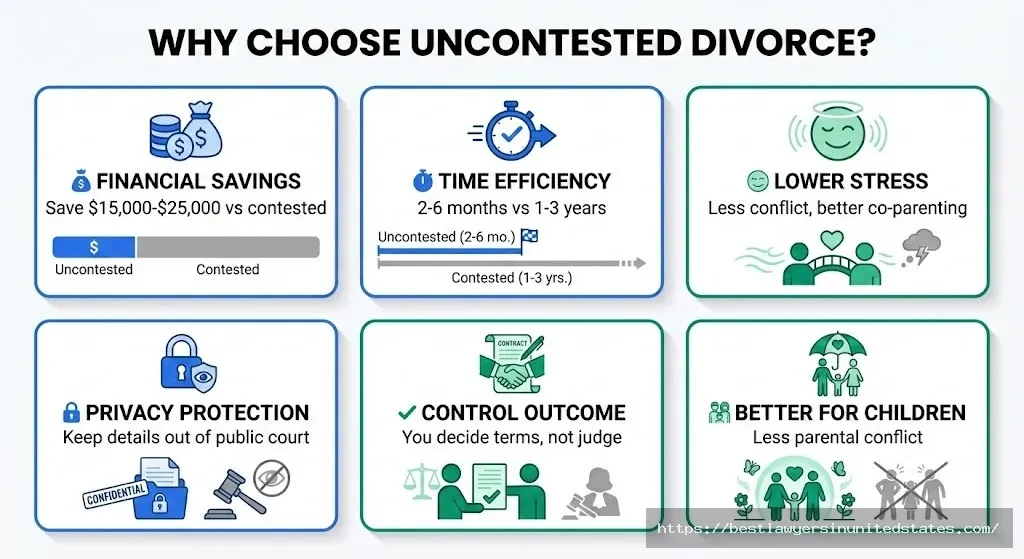
Financial Savings
The cost difference is dramatic:
| Divorce Type | Average Cost | Duration |
|---|---|---|
| Uncontested | $500-$3,000 | 2-6 months |
| Contested | $15,000-$30,000+ | 1-3 years |
| Mediated | $3,000-$8,000 | 3-9 months |
Uncontested divorces avoid:
- Extended attorney billing at $250-$500 per hour
- Discovery costs and depositions
- Expert witness fees
- Multiple court hearings
- Trial preparation expenses
Time Efficiency
Contested divorces drag on for 12 to 36 months. Uncontested cases finish in 2 to 6 months. This matters when:
- You want to remarry
- You need to relocate for work
- Business decisions depend on marital status
- Tax filing status affects your finances
Emotional Benefits
Less confrontational process means:
✅ Lower stress and anxiety ✅ Better co-parenting relationship preserved ✅ Children experience less conflict ✅ Faster emotional healing ✅ More control over outcomes ✅ Privacy maintained (less court involvement)
Studies show children fare better when parents cooperate during divorce. Contentious court battles harm kids more than the divorce itself.
Privacy Protection
Uncontested divorces keep your business private:
- Less information enters public court records
- No airing of personal disputes in court
- Settlement terms remain confidential
- No testimony about private matters
Contested divorces expose financial details, relationship issues, and family problems in public hearings. Anyone can access court transcripts.
Control Over Outcome
When you negotiate your own settlement, you control what happens. Judges in contested cases make decisions for you. They may award less than you wanted or order terms you dislike.
Your settlement can include creative solutions courts wouldn’t order:
- Flexible visitation arrangements
- Unique property division methods
- Gradual alimony phase-outs
- Special provisions for specific situations
When Uncontested Divorce Won’t Work
Some situations make uncontested divorce impossible or inappropriate. Pushing for an uncontested process when it doesn’t fit can lead to unfair agreements or legal problems later.
Red Flags That Require Contested Process
Proceed with caution if:
Domestic violence or abuse:
- Physical, emotional, or financial abuse exists
- One spouse controls or intimidates the other
- Fear prevents honest negotiation
- Power imbalance makes fair agreement impossible
Victims should never feel pressured to agree to unfair terms. Courts provide protections through contested proceedings.
Hidden assets suspected:
- Spouse won’t disclose complete finances
- Business income seems underreported
- Assets transferred before filing
- Significant spending unaccounted for
Discovery in contested cases forces full financial disclosure. Forensic accountants can trace hidden money.
Complex property requires valuation:
- Business ownership
- Professional practices
- Real estate portfolios
- Stock options and restricted stock
- Intellectual property
Expert appraisals often reveal assets are worth more or less than you think. Agreeing without valuations can cost you significantly.
Situations Requiring Extra Caution
Be careful if:
Large income disparity exists:
- One spouse earns significantly more
- One spouse gave up career for family
- Special needs dependents need support
- Standard of living will drastically change
Ensure alimony and property division truly compensate the lower-earning spouse. Don’t agree to less than you need.
Retirement accounts involved:
- 401(k), pension, or IRA division required
- QDRO (Qualified Domestic Relations Order) needed
- Social Security credits at stake
- Military pensions involved
Mistakes in retirement division can cost hundreds of thousands of dollars. Get expert help with these assets.
One spouse is self-employed:
- Income is variable
- Tax returns may not show true earnings
- Business assets complicate property division
- Child support calculations are complex
Self-employment income requires careful analysis. W-2 employees have straightforward income verification. Business owners do not.
Warning Signs of Coercion
An uncontested divorce isn’t fair if one spouse:
- Pressures the other to sign quickly
- Won’t allow time for attorney review
- Threatens consequences if terms aren’t accepted
- Uses children as leverage
- Controls access to financial information
Courts can void agreements signed under duress. If you feel pressured, seek legal help before signing anything.
When to Convert to Contested
Your uncontested case should become contested if:
- New information reveals unfair terms
- Spouse won’t follow agreed temporary orders
- Hidden assets are discovered
- One party changes their mind about major terms
- Agreement violates state law
Converting to contested adds time and cost, but protects you from bad agreements.
Uncontested Divorce by State: Key Differences
Divorce laws vary significantly by state. Filing fees, waiting periods, and property division rules differ. Understanding your state’s requirements helps you plan accurately.
State Comparison Table
| State | Filing Fee Range | Waiting Period | Property Division |
|---|---|---|---|
| California | $435-$450 | 6 months | Community property |
| Texas | $250-$350 | 60 days | Community property |
| Florida | $400-$450 | 20 days | Equitable distribution |
| New York | $335-$350 | None | Equitable distribution |
| Illinois | $250-$400 | None | Equitable distribution |
| Pennsylvania | $300-$350 | None | Equitable distribution |
| Georgia | $200-$400 | 31 days | Equitable distribution |
| North Carolina | $225-$250 | 30 days (after 1-year separation) | Equitable distribution |
| Arizona | $300-$350 | 60 days | Community property |
| Nevada | $300-$400 | None | Community property |
Community Property vs Equitable Distribution
Nine states follow community property laws:
- Arizona
- California
- Idaho
- Louisiana
- Nevada
- New Mexico
- Texas
- Washington
- Wisconsin
Community property states:
- Assets acquired during marriage split 50/50
- Separate property (owned before marriage) stays separate
- Equal division regardless of who earned more
Equitable distribution states:
- All other states use this system
- Courts divide property “fairly,” not necessarily equally
- Consider factors like income, earning capacity, length of marriage
Residency Requirements by State
How long you must live in the state before filing:
No residency requirement:
- Alaska
- South Dakota
- Washington
6 months:
- Arizona, California, Delaware, Florida, Georgia, Hawaii, Illinois, Indiana, Iowa, Kentucky, Louisiana, Massachusetts, Michigan, Minnesota, Mississippi, Missouri, Montana, Nebraska, New Hampshire, New Jersey, New Mexico, North Dakota, Ohio, Oklahoma, Oregon, Pennsylvania, South Carolina, Tennessee, Utah, Vermont, Virginia, West Virginia, Wisconsin
1 year:
- Connecticut, Maryland, Nebraska (if not state resident), Nevada, New York, Rhode Island, West Virginia (if grounds occurred outside state)
2 years:
- Rhode Island (if grounds occurred outside state)
Filing Fee Waivers
All states allow fee waivers for low-income filers. You file a financial affidavit showing you cannot afford the fee. Courts grant waivers if you:
- Receive public assistance
- Earn below poverty line (typically 125% of federal poverty guidelines)
- Cannot pay fee without hardship to yourself or dependents
Approval is not guaranteed but is common for qualifying individuals.
Online Filing Options
Many states now allow electronic filing:
States with e-filing for divorce:
- California, Florida, Illinois, New York, Texas, and 30+ others
Requirements vary:
- Some require attorney to e-file
- Others allow self-represented filers
- Fees may apply for e-filing service
- Technical requirements differ by court
Check your local court website for e-filing availability and instructions.
Common Mistakes in Uncontested Divorce
Small errors can delay your divorce or create unfair agreements. These mistakes happen in uncontested cases more often than people realize. Many are easily avoidable with proper planning.
Documentation Errors
Frequent paperwork mistakes:
Incomplete financial disclosure:
- Missing bank statements
- Unreported retirement accounts
- Forgotten assets like timeshares or storage units
- Debts not listed
Courts require complete financial honesty. Leaving items off your disclosure, even accidentally, can lead to your divorce being overturned later.
Incorrect forms:
- Using outdated forms
- Skipping required schedules
- Not notarizing when required
- Missing signatures or dates
Download current forms from your court’s website. Forms change periodically. Using an old version gets your case rejected.
Vague language in agreement:
- “Reasonable visitation” without specific schedule
- “Fair value” of house without stating dollar amount
- “Shared expenses” without defining percentages
Specificity prevents future disputes. State exact amounts, dates, and terms.
Agreement Mistakes
Common settlement errors:
Forgetting to divide:
- Tax refunds
- Security deposits
- Frequent flyer miles
- Storage unit contents
- Safety deposit box items
Not considering taxes:
- Capital gains on house sale
- Tax filing status implications
- Dependency exemptions for children
- Retirement account withdrawal penalties
Unfair alimony terms:
- Duration too short or too long
- Amount doesn’t reflect actual needs
- No modification clause for changed circumstances
Consult a tax professional before finalizing property division. Some assets have significant tax consequences.
Process Mistakes
Procedural errors that delay cases:
Improper service:
- Using wrong service method
- Not getting proof of service
- Serving papers yourself (not allowed in most states)
Missing deadlines:
- Not responding within required timeframe
- Filing documents late
- Letting case go dormant
Skipping required steps:
- Not attending parenting class when mandated
- Forgetting financial disclosure
- Missing final hearing without requesting waiver
Read your court’s local rules. Requirements vary even within the same state. Check your specific county court’s website.
Financial Mistakes
Money errors that cost you later:
Not getting house appraised:
- Agreeing to keep house without knowing true value
- One spouse assumes house worth more than reality
- Refinancing later reveals over-valuation
Ignoring debt:
- Assuming spouse will pay joint debt
- Not removing your name from accounts
- No protection if spouse files bankruptcy
If your name is on a debt, you remain liable even if your divorce agreement says your spouse pays it. Creditors aren’t bound by your divorce decree.
Undervaluing retirement:
- Not counting employer match
- Forgetting spouse’s pension
- No QDRO obtained for division
Retirement accounts need special handling. A QDRO (Qualified Domestic Relations Order) is required to split 401(k)s and pensions without tax penalties.
Avoiding These Mistakes
Protect yourself by:
✅ Having an attorney review your agreement before signing ✅ Using checklists to ensure all assets and debts are listed ✅ Getting professional appraisals for significant assets ✅ Consulting a tax advisor about property division ✅ Reading and following all court instructions ✅ Keeping copies of everything you file ✅ Following up to ensure case progresses
Frequently Asked Questions
What is an uncontested divorce?
Quick Answer: An uncontested divorce is when both spouses agree on all terms of ending their marriage, including property division, child custody, and support, without going to trial.
Both parties sign a settlement agreement that becomes part of the final divorce decree. Courts still review the agreement to ensure it’s fair and follows state law.
How much does an uncontested divorce cost?
Quick Answer: The average uncontested divorce costs $500 to $3,000, including filing fees ($100-$450) and attorney fees if you hire one ($500-$2,500).
You can reduce costs by handling paperwork yourself or using online divorce services. Use our divorce cost calculator to estimate your specific costs.
How long does an uncontested divorce take?
Quick Answer: Most uncontested divorces take 2 to 6 months from filing to finalization, depending on your state’s mandatory waiting period and court processing time.
States like Nevada can finalize divorces in weeks. California requires 6 months minimum. Check state-specific divorce timelines for accurate estimates.
Can I get an uncontested divorce if we have children?
Quick Answer: Yes, you can get an uncontested divorce with children if both parents agree on custody, visitation, and child support amounts.
You must submit a parenting plan and child support calculation worksheet. The court reviews these documents to ensure they serve the children’s best interests.
Do I need a lawyer for an uncontested divorce?
Quick Answer: You don’t legally need a lawyer for an uncontested divorce, but having one review your settlement agreement protects your rights, especially with complex assets or children involved.
Simple cases with limited assets and no children can often be handled DIY. Consider at least a consultation to understand your rights.
What’s the difference between contested and uncontested divorce?
Quick Answer: An uncontested divorce means both spouses agree on all terms. A contested divorce involves disputes over property, custody, or support that require court intervention.
Contested divorces cost $15,000 to $30,000+ and take 1 to 3 years. Uncontested divorces cost $500 to $3,000 and take 2 to 6 months.
Can an uncontested divorce become contested?
Quick Answer: Yes, an uncontested divorce can become contested if spouses stop agreeing on terms after filing, new disputes arise, or hidden assets are discovered.
This conversion adds significant time and cost to your case. Having a solid, fair agreement from the start prevents this problem.
What forms do I need for an uncontested divorce?
Quick Answer: Required forms typically include a divorce petition, summons, marital settlement agreement, financial affidavits, and child custody agreements if applicable.
Forms vary by state. Download current forms from your county court’s website or use online divorce services that provide state-specific paperwork.
How do I file for an uncontested divorce?
Quick Answer: To file for uncontested divorce, prepare required forms, file them with your county clerk’s office, pay the filing fee, serve papers on your spouse, and wait for the mandatory period before finalization.
Follow our step-by-step guide to filing for detailed instructions specific to your state.
Do I have to go to court for an uncontested divorce?
Quick Answer: Many states require at least one brief court hearing to finalize an uncontested divorce, but some allow paperwork-only divorce without appearing in court.
The final hearing typically lasts 5 to 15 minutes. The judge confirms you both agree and signs your divorce decree.
Can I get a free uncontested divorce?
Quick Answer: You cannot get a completely free divorce, but you can file a fee waiver request if you cannot afford filing fees, reducing costs to near zero if you handle paperwork yourself.
Most states grant waivers for low-income filers. You still need to pay for service of process ($30-$100) unless waived.
What if my spouse won’t sign divorce papers?
Quick Answer: If your spouse won’t sign in an uncontested case, your divorce becomes contested. You can still proceed by having your spouse properly served and obtaining a default judgment if they don’t respond.
Service proves they received the papers. If they don’t respond within 20 to 30 days, you can request a default divorce.
Is uncontested divorce the same as no-fault divorce?
Quick Answer: No, uncontested divorce means you agree on terms, while no-fault divorce means you’re not blaming anyone for the marriage ending. You can have a no-fault contested divorce or a fault-based uncontested divorce.
Most uncontested divorces are also no-fault. All states now allow no-fault grounds like “irreconcilable differences” or “irretrievable breakdown.”
Can I change my mind after filing for uncontested divorce?
Quick Answer: Yes, either spouse can change their mind before the judge signs the final decree. After finalization, you can only modify certain terms like custody and support, not property division.
If you’re having doubts, speak up before the final hearing. It’s much easier to stop the process than to overturn a completed divorce.
How do I calculate child support in an uncontested divorce?
Quick Answer: Child support is calculated using your state’s guidelines, which typically consider both parents’ incomes, custody time percentage, and additional expenses like healthcare and childcare.
Most state court websites provide child support calculators. The amount must meet state minimums even in uncontested cases.
Last Updated: January 2026
Need Help with Your Divorce? Contact divorce attorneys in your state for free consultations. Email: [email protected]