
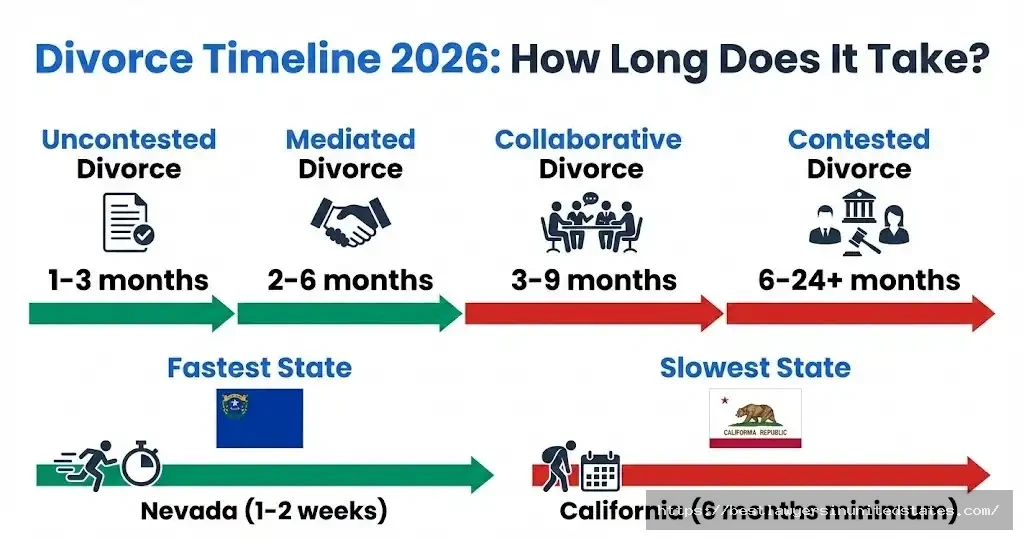
Divorce can take anywhere from one month to three years depending on your state, divorce type, and level of cooperation. The average U.S. divorce takes 3 to 12 months from filing to finalization. An uncontested divorce where both spouses agree on all terms typically takes 1 to 3 months, while a contested divorce with ongoing disputes can stretch to 24 months or longer.
Your timeline depends on five key factors: your state’s mandatory waiting period, whether your divorce is contested or uncontested, the complexity of property division, child custody arrangements, and court scheduling. States like Nevada allow divorces in as little as one to two weeks, while California requires a six-month minimum waiting period regardless of agreement. Understanding your divorce process timeline helps you plan financially and emotionally for the road ahead.
This guide breaks down divorce timelines by state, type, and situation. We’ll show you what to expect at each stage, how to speed up the process, and what factors cause delays. Use our timeline estimates to plan your next steps and understand how much your divorce might cost based on its duration.
Quick Answer: Divorce Timeline Overview
The timeline for your divorce depends primarily on whether it’s contested or uncontested. Uncontested divorces where both spouses agree take 1 to 3 months in most states. Contested divorces involving disagreements over custody, property, or support take 6 to 24 months or longer.
Divorce Timeline by Type
| Divorce Type | Typical Timeline | Best For | Average Cost |
|---|---|---|---|
| Uncontested | 1-3 months | Couples who agree on all terms | $500-$5,000 |
| Mediated | 2-6 months | Couples willing to negotiate | $3,000-$10,000 |
| Collaborative | 3-9 months | Couples with complex assets | $10,000-$30,000 |
| Contested | 6-24+ months | High-conflict divorces | $15,000-$100,000+ |
| DIY/Online | 1-6 months | Simple cases, no attorney | $300-$2,000 |
Key Timeline Factors
Your divorce timeline is affected by:
- State waiting periods: Range from zero days to six months
- Level of agreement: Uncontested divorces finish in weeks, contested take months
- Children involved: Add 2 to 6 months for custody arrangements
- Property complexity: Business valuations add 3 to 6 months
- Court availability: Trial dates can be 6 to 12 months out
The fastest divorces happen when both spouses agree before filing, complete paperwork accurately, and file in states without waiting periods. The longest divorces involve custody battles, complex property division, and multiple court appearances.
How Long Does Divorce Take by State? (50-State Comparison)
Divorce timelines vary dramatically by state due to different waiting periods, court processing times, and residency requirements. Some states allow divorces in weeks, while others mandate months of waiting regardless of agreement.
How Long Does Divorce Take by State? (50-State Comparison)
Divorce timelines vary dramatically by state due to different waiting periods, court processing times, and residency requirements. Some states allow divorces in weeks, while others mandate months of waiting regardless of agreement.
State Divorce Timeline Comparison
| State | Mandatory Waiting Period | Uncontested Average | Contested Average | Notes |
|---|---|---|---|---|
| Alabama | 30 days | 6-10 weeks | 12-18 months | No wait if no children |
| Alaska | 30 days | 1-3 months | 6-12 months | Fast processing |
| Arizona | 60 days | 90-120 days | 18-24 months | Covenant marriage longer |
| Arkansas | 30 days | 2-3 months | 12-18 months | – |
| California | 6 months | 6-8 months | 12-24+ months | Longest wait in U.S. |
| Colorado | 91 days | 3-4 months | 12-18 months | – |
| Connecticut | 90 days | 3-4 months | 12-18 months | – |
| Delaware | None | 2-4 months | 9-15 months | – |
| Florida | 20 days | 4-6 weeks | 6-12 months | One of fastest |
| Georgia | 31 days | 30-45 days | 6-12 months | Fast track available |
| Hawaii | None | 2-3 months | 8-12 months | – |
| Idaho | None | 6-8 weeks | 6-12 months | – |
| Illinois | None | 2-4 months | 12-24 months | Varies by county |
| Indiana | None | 2-3 months | 9-15 months | – |
| Iowa | 90 days | 3-4 months | 12-18 months | – |
| Kansas | 60 days | 2-3 months | 12-18 months | – |
| Kentucky | 60 days | 2-3 months | 12-18 months | – |
| Louisiana | 180 days | 6-8 months | 18-24 months | Longest separation |
| Maine | 60 days | 2-3 months | 9-15 months | – |
| Maryland | None | 2-4 months | 12-18 months | – |
| Massachusetts | 120 days | 4-6 months | 12-24 months | – |
| Michigan | 60 days (no kids) | 2-4 months | 9-15 months | 6 months with kids |
| Minnesota | None | 2-3 months | 9-15 months | – |
| Mississippi | None | 2-3 months | 12-18 months | – |
| Missouri | 30 days | 2-3 months | 12-18 months | – |
| Montana | None | 6-8 weeks | 9-12 months | – |
| Nebraska | 60 days | 2-3 months | 9-15 months | – |
| Nevada | None | 1-2 weeks | 6-12 months | Fastest in U.S. |
| New Hampshire | None | 2-4 months | 9-15 months | – |
| New Jersey | None | 3-4 months | 12-24 months | – |
| New Mexico | 30 days | 6-8 weeks | 9-15 months | – |
| New York | None | 3-6 months | 12-18 months | No-fault available |
| North Carolina | 1 year separation | 12-18 months | 18-24+ months | Longest separation |
| North Dakota | None | 2-3 months | 9-12 months | – |
| Ohio | None | 6-8 weeks | 9-15 months | – |
| Oklahoma | 10 days | 2-3 months | 12-18 months | Fast processing |
| Oregon | None | 2-3 months | 9-15 months | – |
| Pennsylvania | None | 3-4 months | 12-18 months | – |
| Rhode Island | None | 2-4 months | 12-24 months | Can be slow |
| South Carolina | 90 days | 3-4 months | 12-18 months | 1 year fault divorce |
| South Dakota | None | 60 days | 6-12 months | – |
| Tennessee | 60 days | 2-4 months | 12-18 months | – |
| Texas | 60 days | 60-90 days | 6-18 months | Can waive for violence |
| Utah | None | 30 days | 6-12 months | Fast processing |
| Vermont | 6 months | 6-8 months | 12-18 months | Long wait |
| Virginia | 6-12 months separation | 8-12 months | 18-24 months | Separation required |
| Washington | None | 90 days | 9-15 months | – |
| West Virginia | None | 2-3 months | 9-15 months | – |
| Wisconsin | 120 days | 4-6 months | 12-18 months | – |
| Wyoming | None | 2-4 months | 9-18 months | – |
Key State Timeline Highlights
Fastest states for uncontested divorce:
- Nevada: 1 to 2 weeks possible
- Alaska: 30 days minimum
- Oklahoma: 10 days minimum
- Florida: 3 to 4 weeks typical
Slowest states with mandatory waiting periods:
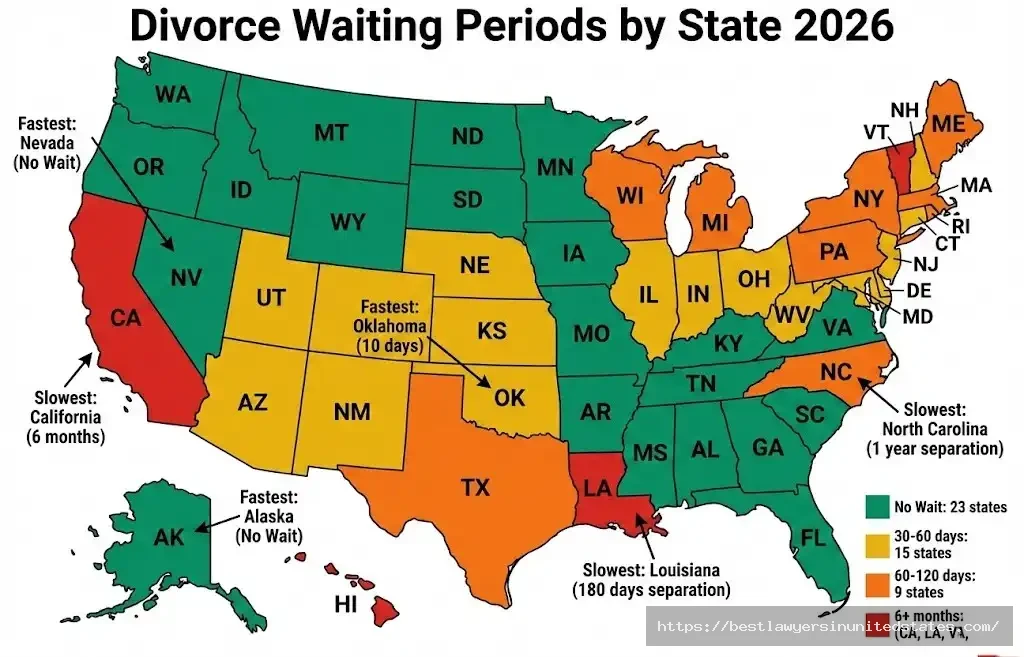
- California: 6 months mandatory
- Louisiana: 180 days separation
- Vermont: 6 months
- North Carolina: 1 year separation required
States with no waiting period: Alaska, Delaware, Hawaii, Idaho, Illinois, Indiana, Maryland, Minnesota, Mississippi, Montana, Nevada, New Hampshire, New Jersey, North Dakota, Ohio, Oregon, Pennsylvania, Rhode Island, South Dakota, Utah, Washington, West Virginia, and Wyoming.
Critical deadline: Your state’s waiting period starts either from the filing date or the date your spouse is served. California’s six-month wait begins when your spouse receives the papers, not when you file.
Divorce Timeline by Type: How Long Each Takes
Uncontested Divorce Timeline (1-3 Months)
An uncontested divorce takes 1 to 3 months when both spouses agree on property division, child custody, and support. This is the fastest type of divorce because it skips lengthy negotiations, discovery, and trial. Most states allow uncontested divorces to proceed on an expedited timeline once mandatory waiting periods pass.
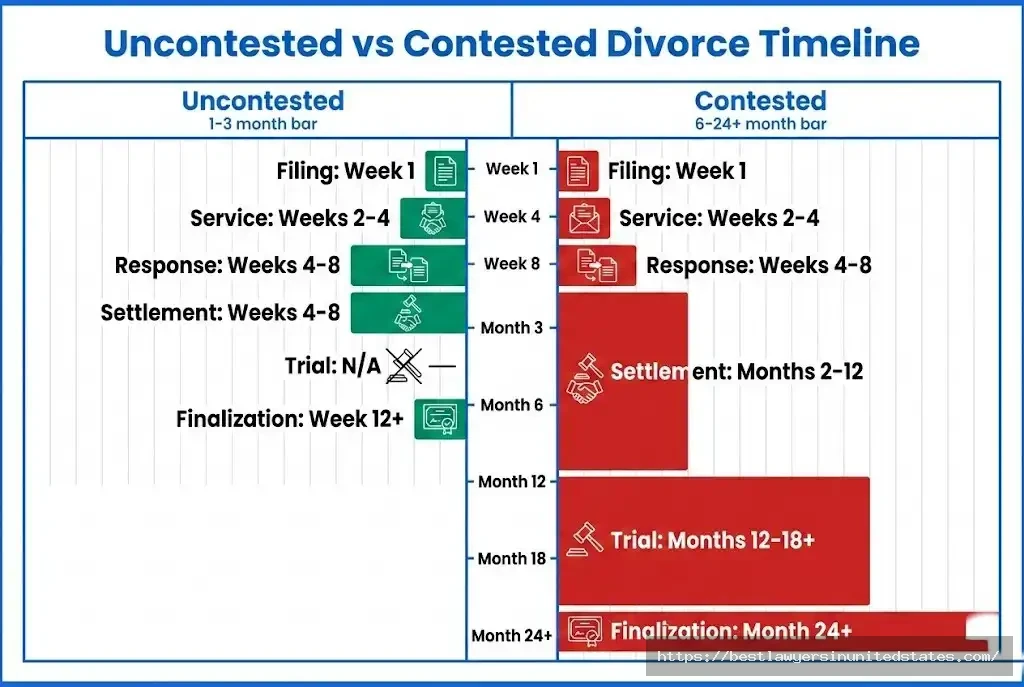
Week-by-Week Uncontested Divorce Timeline
- Week 1: File divorce petition with court clerk ($100-$500 filing fee)
- Weeks 2-4: Serve spouse with papers, spouse signs acknowledgment
- Weeks 4-8: Finalize marital settlement agreement, submit to court
- Weeks 8-12: Court reviews documents, schedules brief hearing
- Week 12+: Judge signs decree after state waiting period expires
Factors That Speed Up Uncontested Divorce
Uncontested divorces finish fastest when you:
- Pre-agree on all terms before filing
- Have no children or simple custody arrangement
- Own minimal property to divide
- Complete accurate paperwork the first time
- Both parties attend required hearings
- Use DIY divorce services or flat-fee attorneys
Uncontested Timeline by State
- California: 6+ months (mandatory six-month wait)
- Texas: 60 to 90 days (60-day minimum)
- Florida: 4 to 6 weeks (20-day minimum)
- New York: 3 to 6 months (no mandatory wait)
The main factor affecting uncontested divorce timeline is your state’s mandatory waiting period. States without waiting periods can finalize divorces in 4 to 8 weeks. States like California add six months regardless of agreement.
Contested Divorce Timeline (6-24+ Months)
A contested divorce takes 6 to 24 months or longer when spouses disagree on custody, property division, or spousal support. Contested divorces require formal discovery, multiple court appearances, and potentially a trial. Each point of disagreement adds weeks or months to your timeline.
Month-by-Month Contested Divorce Timeline
- Month 1: File petition, serve papers, spouse has 20 to 60 days to respond
- Months 1-2: Spouse files answer and counter-petition listing demands
- Months 2-6: Discovery phase (financial disclosures, depositions, interrogatories)
- Months 6-12: Settlement negotiations, court-ordered mediation attempts
- Months 12-18: Pre-trial motions, conferences, expert witnesses retained
- Months 18-24+: Trial preparation, court hearings (1 to 5 days typical)
- Post-trial: Judge issues ruling immediately or within 2 to 8 weeks
What Causes Extended Timelines in Contested Divorces
Contested divorces take longer because of:
- Complex property division: Business valuations take 3 to 6 months
- Child custody disputes: Evaluations require 2 to 4 months
- Spousal support disagreements: Forensic accountants need months for analysis
- Hidden assets: Discovery and investigation add 6 to 12 months
- Court backlogs: Trial dates scheduled 6 to 12 months out
- Attorney delays: Continuances and scheduling conflicts add months
- Multiple motions: Each temporary order hearing adds 4 to 8 weeks
High-conflict divorces involving abuse allegations, business ownership, or international custody can take 2 to 3 years. Each expert witness hired, deposition scheduled, and motion filed extends your timeline by weeks.
The discovery phase alone can stretch 6 to 12 months for complex estates. During discovery, you exchange financial documents, answer written questions, and attend depositions where attorneys question you under oath. This phase ends only when both sides agree they have sufficient information.
Divorce Mediation Timeline (2-6 Months)
Divorce mediation takes 2 to 6 months when a neutral third-party mediator helps spouses reach agreement without litigation. Mediation is faster than contested divorce because you control the schedule and avoid court delays. Most mediations require 2 to 6 sessions before reaching a final settlement.
Mediation Timeline Breakdown
- Weeks 1-2: Initial mediation session (2-3 hours), exchange financial information
- Weeks 2-8: Additional mediation sessions scheduled every 2 to 3 weeks
- Weeks 8-16: Draft comprehensive settlement agreement covering all issues
- Weeks 16-24: File agreement with court, attend brief final hearing
Benefits for Timeline
Mediation shortens your divorce timeline because:
- You schedule sessions at your convenience, not court’s
- Most issues resolve in 3 to 4 months
- Less expensive than litigation, saving money on attorney fees
- Avoids 6 to 12 month wait for trial dates
- Reduces emotional conflict that causes delays
Mediation works best when both spouses want to avoid court, can communicate civilly, and genuinely want to reach agreement. It fails when one spouse hides assets, refuses to negotiate, or has a history of domestic violence.
Collaborative Divorce Timeline (3-9 Months)
Collaborative divorce takes 3 to 9 months using a team approach where both spouses hire collaborative attorneys, financial advisors, and divorce coaches. This structured process works well for complex estates but takes longer than simple uncontested divorce. The team meets regularly to negotiate all issues outside of court.
Collaborative Divorce Timeline
- Month 1: Assemble collaborative team (attorneys, financial neutral, coaches)
- Months 2-4: Hold 3 to 6 team meetings addressing specific issues
- Months 4-6: Complete financial analysis, property valuations, custody plan
- Months 6-9: Finalize comprehensive agreement, file with court
Collaborative divorce takes longer than mediation but less time than litigation. It works best for high-net-worth couples, business owners, or families needing specialized expertise. The process ends if either spouse threatens litigation, requiring you to start over with new attorneys.
DIY/Online Divorce Timeline (1-6 Months)
DIY or online divorce takes 1 to 6 months for uncontested cases without attorneys. Your timeline depends mainly on your state’s waiting period and how quickly you complete paperwork. DIY divorce works only when both spouses agree on all terms and have no complex property or custody issues.
DIY Divorce Timeline
- Week 1: Complete online forms or download state-specific forms
- Week 2: File forms with court clerk, pay filing fees ($100-$500)
- Weeks 2-4: Serve spouse via certified mail or process server
- Weeks 4-6: Spouse files acknowledgment (if required by state)
- Weeks 6-12: Court processes paperwork, reviews for errors
- Week 12+: Attend brief final hearing, receive signed decree
DIY Timeline by State
- California: 6+ months minimum (six-month waiting period applies)
- Texas: 60+ days minimum (60-day waiting period)
- Nevada: As fast as 1 to 2 weeks (no waiting period)
- Florida: 3 to 4 weeks possible (20-day minimum)
DIY divorce is fastest and cheapest for simple cases. Your main risks are making errors in paperwork (causing rejections and delays) and missing important legal issues like property rights or tax implications. Most people hire attorneys for review even when filing DIY.
Factors That Affect How Long Your Divorce Takes
1. Divorce Type (Contested vs. Uncontested)
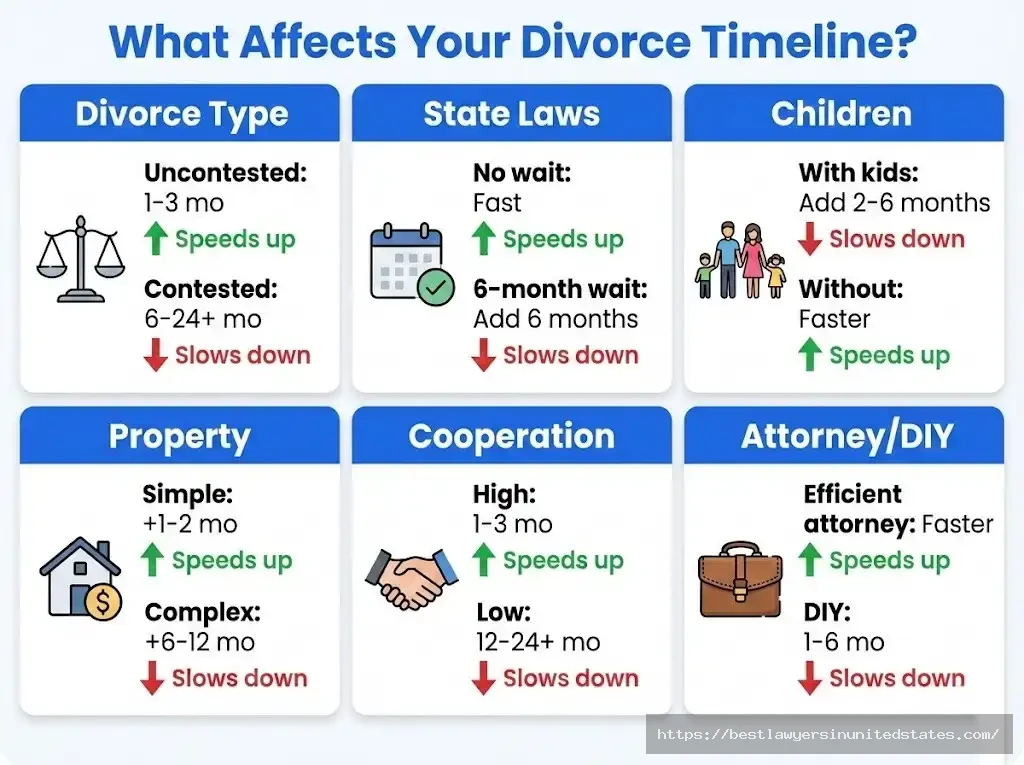
The single biggest factor affecting your divorce timeline is whether it’s contested or uncontested. Uncontested divorces where both spouses agree finish in 1 to 3 months. Contested divorces with ongoing disagreements take 6 to 24 months or longer.
Timeline Comparison
| Agreement Level | Timeline | What It Means |
|---|---|---|
| Full agreement | 1-3 months | Both sign settlement before filing |
| Minor disputes | 3-6 months | Resolve 1-2 issues through negotiation |
| Major disputes | 6-12 months | Disagree on custody or property |
| High conflict | 12-24+ months | Refuse all compromise, go to trial |
Every issue you disagree on adds weeks or months. Agreeing on property but fighting over custody takes less time than fighting over both. The fastest divorces happen when you negotiate all terms before filing your petition.
2. State Laws & Waiting Periods
Your state’s mandatory waiting period directly impacts how fast your divorce can finalize. Waiting periods range from zero days in 23 states to six months in California. These waiting periods apply even when both spouses agree and want the divorce finalized immediately.
States by Waiting Period
No waiting period (23 states): Alaska, Delaware, Hawaii, Idaho, Illinois, Indiana, Maryland, Minnesota, Mississippi, Montana, Nevada, New Hampshire, New Jersey, North Dakota, Ohio, Oregon, Pennsylvania, Rhode Island, South Dakota, Utah, Washington, West Virginia, Wyoming
Short waiting periods (under 60 days): Alabama (30 days), Oklahoma (10 days), Florida (20 days), Arkansas (30 days)
Moderate waiting periods (60-120 days): Texas (60 days), Michigan (60 days, 180 with kids), Kansas (60 days), Connecticut (90 days), Wisconsin (120 days)
Long waiting periods (6+ months): California (6 months), Louisiana (180 days separation), Vermont (6 months)
Residency requirements also affect timeline. Most states require 3 to 12 months of residency before you can file. You can’t file for divorce the day you move to a new state.
Court processing times vary dramatically by jurisdiction. Large urban counties have 6 to 12 month backlogs for trial dates. Small rural counties schedule hearings within 2 to 4 months. COVID-19 created massive backlogs in 2020 to 2023 that many courts still face in 2026.
3. Children and Custody Issues
Having children typically adds 2 to 6 months to your divorce timeline. Courts prioritize children’s best interests, requiring detailed parenting plans, potential custody evaluations, and more court oversight. The complexity of custody arrangements directly impacts how long your divorce takes.
Timeline Impact of Children
With children involved:
- Add 2 to 6 months for custody negotiations
- Custody evaluations take 2 to 4 months
- Parenting plan approval requires court review
- Child support calculations need income verification
- May require home studies or interviews
Without children:
- Faster process overall (1 to 2 months less)
- Skip custody hearings entirely
- No parenting class requirements
- Focus only on property and support
- Simpler agreements to review
Courts order custody evaluations when parents can’t agree on arrangements. A court-appointed evaluator interviews both parents, visits homes, speaks with children, and reviews documents. This process takes 2 to 4 months minimum and costs $2,000 to $10,000. The evaluator’s recommendation heavily influences the judge’s decision.
Parenting plans must specify custody schedules, holiday arrangements, decision-making authority, and child support. Detailed plans take weeks to negotiate. Courts review every provision to ensure children’s best interests are met.
4. Property and Asset Complexity
Property division complexity significantly impacts your divorce timeline. Simple estates with one home and bank accounts finalize quickly. Complex estates with businesses, multiple properties, retirement accounts, and investments take 6 to 12 additional months to value and divide.
Property Complexity Timeline
Simple estates (add 1-2 months):
- One family home
- Joint bank accounts
- Few personal assets
- No businesses
- Clear ownership
Moderate complexity (add 3-6 months):
- Multiple properties
- Retirement accounts (need QDROs)
- Investment portfolios
- Vehicles, collections
- Some debt
High complexity (add 6-12+ months):
- Business ownership requiring valuation (3-6 months)
- Real estate holdings in multiple states
- Stock options or restricted stock
- Hidden assets requiring forensic accounting
- International assets or offshore accounts
- Professional practices (medical, legal, dental)
Business valuations alone take 3 to 6 months. Forensic accountants review financial records, analyze cash flow, assess market conditions, and determine fair market value. Business owners often fight over valuation methods, requiring expert witnesses and extending trial time.
Retirement account division requires Qualified Domestic Relations Orders (QDROs) that attorneys draft separately from divorce decrees. QDROs take 2 to 4 months to prepare, get approved by plan administrators, and finalize. Many divorces technically finish but wait months for retirement account division.
5. Level of Cooperation
How well you and your spouse cooperate dramatically impacts timeline. High cooperation means agreeing quickly and finishing in 1 to 3 months. Low cooperation means fighting every issue and taking 12 to 24 months.
Cooperation Timeline Impact
High cooperation:
- Respond promptly to document requests
- Attend scheduled meetings and hearings
- Negotiate in good faith
- Agree to reasonable compromises
- Timeline: 1 to 3 months
Medium cooperation:
- Some disagreements but willing to negotiate
- Occasional delays or missed deadlines
- Agree on major issues, fight minor ones
- Timeline: 3 to 6 months
Low cooperation:
- Refuse to communicate directly
- Miss deadlines intentionally
- Fight every single issue
- Require court intervention frequently
- Timeline: 12 to 24+ months
Spouses who use divorce to punish each other create the longest timelines. Filing frivolous motions, refusing to produce documents, and skipping hearings add months to the process. Courts can impose sanctions for bad faith behavior, but delays still happen.
6. Attorney vs. DIY
Whether you hire an attorney affects your timeline in both directions. Experienced attorneys often speed things up by handling paperwork correctly and negotiating efficiently. Inefficient attorneys slow things down with scheduling conflicts and aggressive tactics. DIY divorce can be fastest for simple cases or slowest if you make errors.
Attorney Impact on Timeline
Attorneys speed up divorce when they:
- Know local court procedures and judges
- Complete accurate paperwork the first time
- Negotiate settlements efficiently
- Anticipate issues before they cause delays
- Have good working relationships with opposing counsel
Attorneys slow down divorce when they:
- Use aggressive litigation tactics unnecessarily
- Over-lawyer simple cases
- Have scheduling conflicts causing continuances
- Run up billable hours without progress
- Fight over minor issues
DIY divorce timeline:
- Fastest for simple, uncontested cases (1-3 months)
- Requires you to understand forms and procedures
- Risk of errors causing rejections and delays
- Must attend all hearings personally
- Saves months of attorney back-and-forth
Most people find middle ground by using flat-fee attorney services for document preparation while handling court appearances themselves. This saves money and time compared to full representation.
7. Court Backlog and Availability
Court scheduling significantly impacts contested divorce timelines. Large counties have 6 to 12 month waits for trial dates. Small counties schedule hearings within 2 to 4 months. Your divorce timeline depends partly on factors outside your control.
Court Backlog by Jurisdiction
Large urban counties:
- Trial dates: 6 to 12 months out
- Motions hearings: 4 to 8 weeks wait
- Judges handle 200+ cases simultaneously
- Examples: Los Angeles, Cook County, Harris County
Mid-size counties:
- Trial dates: 3 to 6 months out
- Motions hearings: 2 to 4 weeks wait
- Judges handle 100 to 200 cases
- Moderate processing speed
Small rural counties:
- Trial dates: 2 to 4 months out
- Motions hearings: 1 to 2 weeks wait
- Judges handle fewer than 100 cases
- Often faster processing
COVID-19 created massive backlogs in 2020 to 2023. Courts closed for months, jury trials stopped, and cases piled up. Many jurisdictions still face these backlogs in 2026, though most have implemented video hearings to speed processing.
Judge availability also matters. Some judges retire mid-case, requiring reassignment and starting over. Others take medical leave or vacation, causing continuances. You can’t control these factors, but they significantly impact your timeline.
Divorce Process Timeline: What to Expect After Filing
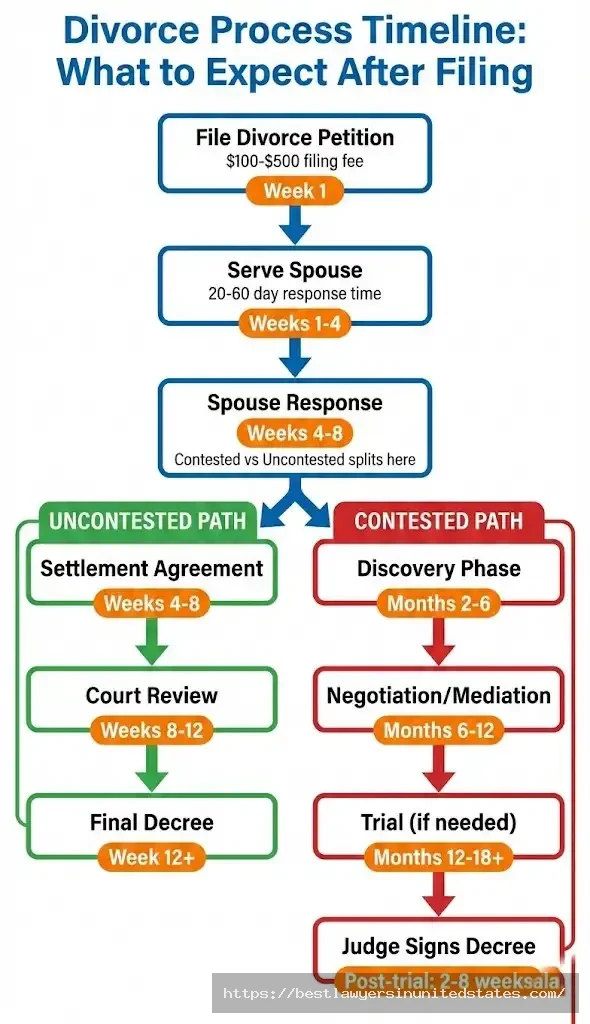
Week 1: Filing the Divorce Petition
Your divorce officially starts when you file a petition for dissolution of marriage with the county court clerk. This document states you want a divorce, lists grounds (usually irreconcilable differences), and proposes terms for property division, custody, and support. Filing takes 1 to 2 hours and costs $100 to $500 depending on your state.
What happens during filing:
- Complete divorce petition form (15-30 pages typical)
- Gather required documents (marriage certificate, financial disclosures)
- File with county court clerk in person or electronically
- Pay filing fee ($100-$500 varies by state and county)
- Receive case number and file-stamped copies
Some states require additional forms at filing: financial affidavits, parenting plans if you have children, and proposed settlement agreements. Missing required forms delays your case by weeks while you gather documents.
Learn how to file for divorce step-by-step in your state.
Weeks 1-4: Serving Your Spouse
After filing, you must formally serve your spouse with divorce papers within a specific timeframe (usually 30 to 120 days). Service means delivering copies of your petition so your spouse knows about the divorce and has opportunity to respond. Proper service is legally required before your divorce can proceed.
Service methods:
- Sheriff’s deputy serves papers in person ($30-$75 typical)
- Private process server delivers papers ($50-$150 typical)
- Certified mail with return receipt ($8-$15)
- Service by publication (if spouse missing, last resort)
Your spouse has 20 to 60 days to respond after being served (varies by state). This response deadline is critical. If your spouse doesn’t respond, you can request a default judgment and proceed without their input.
Weeks 4-8: Spouse’s Response
Once served, your spouse must file a response (also called an answer) within 20 to 60 days. Their response determines whether your divorce is contested or uncontested.
If spouse agrees (uncontested):
- Signs acknowledgment or waiver of service
- Signs proposed settlement agreement
- Case moves quickly to final hearing (weeks)
- No discovery or trial needed
If spouse disagrees (contested):
- Files formal answer and counter-petition
- Lists their demands and disagreements
- Discovery phase begins
- Case enters months-long negotiation process
Many spouses initially disagree but settle before trial. Only 5 to 10 percent of divorces actually go to trial. Most resolve through negotiation, mediation, or settlement conferences.
Months 2-6: Discovery Phase (Contested Only)
Discovery is the formal process of exchanging information and evidence in contested divorces. Both sides must disclose all financial information, answer written questions, and potentially attend depositions. This phase takes 2 to 12 months depending on asset complexity.
Discovery tools:
- Interrogatories: Written questions requiring written answers under oath
- Requests for production: Demands for documents, bank statements, tax returns
- Depositions: In-person questioning by opposing attorney (recorded under oath)
- Subpoenas: Court orders for third parties to provide records
- Requests for admission: Asks opposing party to admit or deny specific facts
Discovery often uncovers hidden assets, undisclosed income, or spending problems. Forensic accountants trace money through complex transactions. Discovery is expensive, costing $5,000 to $30,000 for complex cases, but necessary to ensure fair division.
This phase extends 6 to 12 months for complex estates involving businesses, multiple properties, or international assets. Simple cases complete discovery in 2 to 4 months.
Months 6-12: Negotiation and Settlement
Most divorces settle during negotiation phase after discovery reveals all financial information. Both sides exchange settlement proposals, counter-offers, and eventually reach agreement. Courts encourage settlement through mandatory mediation or settlement conferences.
Settlement process:
- Attorneys exchange settlement proposals
- Multiple rounds of negotiation (2-6 rounds typical)
- Court-ordered mediation (required in many states)
- Settlement conference with judge
- Finalize marital settlement agreement
If settlement is reached:
- Draft comprehensive agreement covering all issues
- Both parties sign before notary
- Submit to court for approval
- Move to final hearing (brief, uncontested)
If no settlement:
- Proceed to trial preparation
- Retain expert witnesses
- File pre-trial motions
- Wait for trial date (6-12 months typical)
Settling before trial saves 12 to 18 months and $15,000 to $50,000 in attorney fees. Judges encourage settlement and often pressure parties to compromise rather than go to trial.
Months 12-18+: Trial (If Needed)
Only 5 to 10 percent of divorces go to trial. Trials happen when spouses can’t agree after months of negotiation. Divorce trials typically last 1 to 5 days spread over weeks or months. The judge hears evidence, witness testimony, and expert opinions before issuing a ruling.
Trial timeline:
- Pre-trial conferences: 2 to 4 meetings
- Final trial: 1 to 5 days (rarely consecutive)
- Evidence presentation: Documents, witnesses, experts
- Both sides present their case
- Judge issues ruling immediately or within weeks
Trials are expensive, costing $10,000 to $50,000+ in attorney fees alone. Expert witness fees add $2,000 to $10,000 per expert. Trials are also unpredictable since judges have broad discretion in property division and custody decisions.
After trial, the judge issues a ruling either verbally in court or in a written judgment delivered 2 to 8 weeks later. Complex cases require written judgments explaining the judge’s reasoning.
Final Stage: Judge Signs Divorce Decree
Your divorce becomes official when the judge signs the final decree. The timing varies by state, case complexity, and how the judge received your agreement (settlement vs. trial).
How long for judge to sign?
Uncontested divorces:
- 1 to 2 weeks after final hearing (most states)
- Same-day signing in some jurisdictions
- Electronic filing states process faster
- Minimal review required for agreed cases
Contested divorces after trial:
- 2 to 8 weeks for written judgment
- Complex cases: up to 12 weeks
- Judge needs time to review evidence and law
- Draft lengthy orders with detailed findings
When is divorce final?
- Some states: Immediately upon signing
- Others: 30 to 60 day appeal period
- California: 6 months from filing (minimum)
- Check your state’s specific finalization rules
The court clerk files the signed decree with county records. You receive a certified copy by mail or can pick it up at the courthouse. This certified copy is your official proof of divorce required for name changes, remarriage, or benefit claims.
How Long Does Divorce Take If Both Parties Agree?
Divorce takes 1 to 3 months when both parties agree on all terms, excluding mandatory waiting periods. The fastest uncontested divorces happen in states without waiting periods where you can finalize in 4 to 8 weeks. States with mandatory waiting periods add weeks or months regardless of agreement.
Fastest Possible Timeline When Both Agree
- Week 1: File divorce petition with complete settlement agreement
- Week 2: Serve spouse, spouse signs acknowledgment immediately
- Week 3: Submit signed agreement to court for review
- Weeks 4-6: Court reviews documents, schedules brief final hearing
- Weeks 6-8: Attend 10-minute hearing, judge signs decree
- Week 8-12: Receive final divorce decree (after any waiting period)
State-Specific Timeline When Both Agree
- Nevada: 1 to 2 weeks (fastest in U.S., no waiting period)
- Alaska: 30 days minimum (30-day waiting period)
- Texas: 60 to 90 days (60-day mandatory waiting period)
- California: 6+ months (six-month mandatory waiting period)
- Florida: 3 to 4 weeks (20-day minimum, if no waiting period issues)
What You Need for Fast Uncontested Divorce
Complete these before filing to minimize delays:
- Marital settlement agreement: Covers all property, debts, custody, support
- Financial disclosures: List all assets, debts, income, expenses
- Parenting plan (if children): Detailed custody and visitation schedule
- Both signatures: On all documents, notarized
- Accurate forms: State-specific forms completed correctly
Cost Correlation
Faster timeline equals lower cost. Uncontested divorces with both parties in agreement cost $500 to $3,000 total (including filing fees and basic attorney review). This compares to $15,000 to $50,000+ for contested divorces taking 12 to 24 months.
Use our divorce cost calculator to estimate your timeline and costs based on your specific situation.
Divorce Cost Calculator
Get an estimated cost for your divorce based on your specific situation
Your Estimated Divorce Cost
Cost Breakdown
📧 Get a Personalized Consultation
Have questions about your specific situation? Contact our legal experts for guidance tailored to your needs.
Contact Us via EmailThe key to fast divorce is pre-negotiating everything before you file. Couples who spend 2 to 4 weeks agreeing on terms privately can file a complete agreement and finalize within weeks. Couples who file first and negotiate later add months to the divorce process.
State-Specific Divorce Timelines
How Long Does Divorce Take in California?
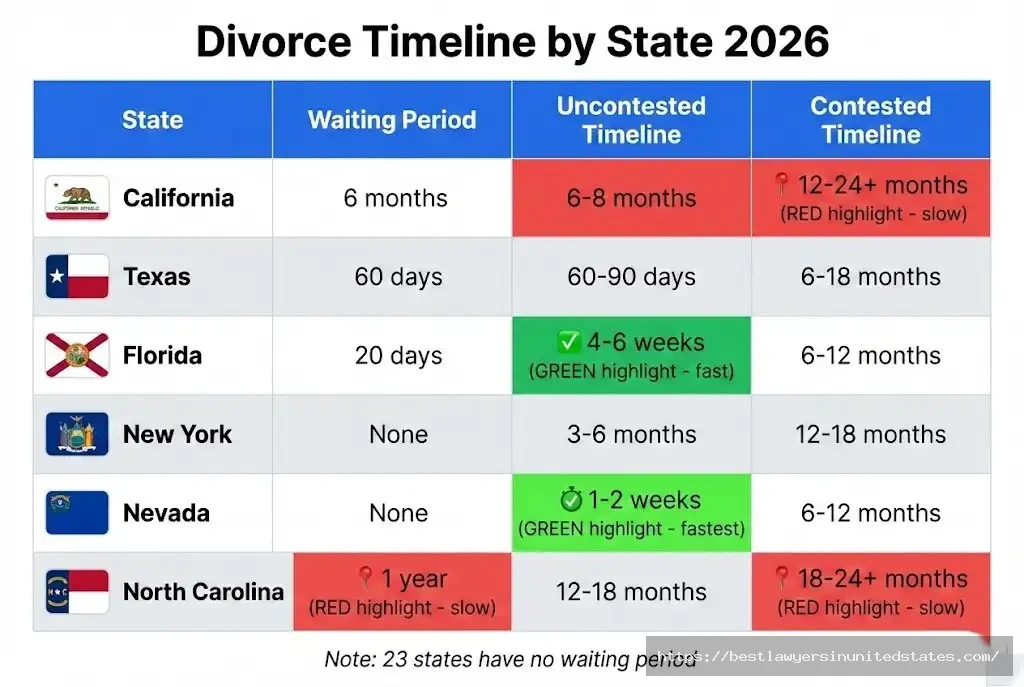
Divorce in California takes a minimum of 6 months due to mandatory waiting period, making it the longest required wait in the United States. Uncontested divorces typically take 6 to 8 months, while contested divorces take 12 to 24 months or longer.
The six-month waiting period starts from the date your spouse is served with papers, not from your filing date. This means even if both parties agree immediately and want to finalize faster, you must wait six months.
California divorce timeline:
- Minimum: 6 months (mandatory waiting period)
- Uncontested: 6 to 8 months
- Contested: 12 to 24+ months
- Key factor: Wait time applies from service date, not filing
Learn more about divorce costs in California.
How Long Does Divorce Take in Texas?
Divorce in Texas takes a minimum of 60 days due to mandatory waiting period. Uncontested divorces typically finalize in 60 to 90 days, while contested divorces take 6 to 18 months.
Texas allows judges to waive the 60-day waiting period in cases involving family violence. Otherwise, you must wait at least 60 days from filing to finalization.
Texas divorce timeline:
- Minimum: 60 days (mandatory waiting period)
- Uncontested: 60 to 90 days
- Contested: 6 to 18 months
- Key factor: Can waive 60-day wait in family violence cases
Learn more about divorce costs in Texas.
How Long Does Divorce Take in Florida?
Divorce in Florida takes a minimum of 20 days for uncontested cases, making it one of the fastest states. Uncontested divorces typically finalize in 4 to 6 weeks, while contested divorces take 6 to 12 months.
Florida’s 20-day minimum applies only to simplified dissolutions. Regular divorces have no mandatory waiting period but take longer due to court processing time.
Florida divorce timeline:
- Minimum: 20 days (simplified dissolution)
- Uncontested: 4 to 6 weeks
- Contested: 6 to 12 months
- Key factor: One of the fastest states for simple divorces
Learn more about divorce costs in Florida.
How Long Does Divorce Take in New York?
Divorce in New York takes 3 to 6 months for uncontested cases with no mandatory waiting period. Contested divorces take 12 to 18 months or longer depending on complexity.
New York implemented no-fault divorce in 2010, allowing divorces based solely on “irretrievable breakdown” of marriage for six months. This eliminated the need to prove grounds and speeds the process.
New York divorce timeline:
- Minimum: 3 to 6 months (uncontested)
- Uncontested: 3 to 6 months
- Contested: 12 to 18+ months
- Key factor: No mandatory waiting period for no-fault divorce
Learn more about divorce costs in New York.
How to Speed Up Your Divorce Timeline
1. Choose Uncontested Divorce
Choosing uncontested divorce is the single most effective way to speed your timeline. Agreeing on all terms before filing saves 6 to 18 months compared to contested divorce. Pre-negotiate property division, custody, and support privately before involving the court.
2. Complete Financial Disclosure Early
Gather all financial documents before filing to prevent discovery delays. Courts require complete financial disclosure regardless of agreement. Having documents ready speeds processing by weeks or months.
Essential documents to gather:
- Last 3 years tax returns
- Bank statements (6-12 months)
- Retirement account statements
- Property deeds and mortgage statements
- Credit card and loan statements
- Pay stubs (last 3 months)
- Business financial statements (if applicable)
3. Use Mediation Instead of Litigation
Mediation saves 6 to 12 months on average compared to contested litigation. You schedule sessions at your convenience instead of waiting months for trial dates. Most mediations resolve in 3 to 4 months with 2 to 6 sessions.
4. Hire an Efficient Attorney (or Go DIY)
Experienced attorneys streamline the process by handling paperwork correctly the first time and negotiating efficiently. DIY divorce works for simple cases and can be fastest option. The key is avoiding errors that cause delays and rejections.
Research attorney fees in your area and choose wisely.
5. Settle Outside of Court
Avoiding trial saves 12 to 18 months. Courts schedule trial dates 6 to 12 months out in most jurisdictions. Settling before trial lets you finalize on your timeline, not the court’s.
6. File in States with No Waiting Period
If you meet residency requirements in multiple states, file in one without mandatory waiting period. Nevada, Wyoming, and Washington allow divorces to finalize in weeks rather than months.
7. Respond Quickly to All Requests
Don’t delay paperwork, miss deadlines, or skip hearings. Every missed deadline adds weeks of delay. Attend all scheduled hearings on time. Cooperate fully with discovery requests.
Real Divorce Timeline Examples (Case Studies)
Example 1: Sarah in Texas – Uncontested, No Kids
Timeline: 75 days
Cost: $3,500
Type: Uncontested
Sarah and her spouse agreed on property division before filing. They used DIY divorce with attorney review. Filed in Dallas, both signed agreement, attended brief final hearing in week 10. Texas’s 60-day waiting period was the only delay.
Learn more about divorce costs in Texas.
Example 2: John in California – Contested with Kids
Timeline: 18 months
Cost: $45,000
Type: Contested
John faced high-conflict custody battle requiring forensic accountant and custody evaluator. Trial lasted 3 days. California’s six-month mandatory wait plus 12 months of litigation resulted in 18-month total timeline.
Learn more about divorce costs in California.
Example 3: Maria in Florida – Online DIY Divorce
Timeline: 28 days
Cost: $500
Type: Uncontested
Maria used online divorce service for simple case with no children and minimal property. Florida’s 20-day minimum plus one week processing resulted in 28-day total timeline.
Learn more about divorce costs in Florida.
Example 4: David in New York – Mediated Divorce
Timeline: 4 months
Cost: $8,000
Type: Mediated
David and spouse completed 5 mediation sessions over 3 months. One child required detailed parenting plan. Agreed on custody and property division. No trial needed.
Divorce Timeline FAQs
What is the quickest divorce you can get?
Quick Answer: The quickest divorce takes 1 to 2 weeks in Nevada for uncontested cases with no children and minimal property.
Nevada requires only 6 weeks of residency before filing. Once filed, uncontested divorces with complete agreements can finalize in 1 to 2 weeks since Nevada has no mandatory waiting period. Both parties must agree on all terms.
Other fast states include Alaska (30 days minimum), Wyoming (no waiting period), and Florida (3 to 4 weeks possible for simple cases).
How long does it take for a judge to sign a divorce decree?
Quick Answer: Judges sign divorce decrees in 1 to 8 weeks depending on case type and state.
For uncontested divorces, judges typically sign within 1 to 2 weeks after the final hearing. Some states allow same-day signing. Electronic filing states process faster than paper systems.
For contested divorces after trial, judges need 2 to 8 weeks to review evidence and issue written judgments. Complex cases requiring detailed rulings can take up to 12 weeks.
What affects signing time:
- Court backlog and judge’s caseload
- Case complexity and number of issues decided
- Whether ruling is verbal (same-day) or written (weeks)
- State-specific court procedures and timelines
How long does divorce take after filing papers?
Quick Answer: Divorce takes 1 to 3 months after filing for uncontested cases, 6 to 24+ months for contested cases, plus any mandatory state waiting period.
Uncontested timeline after filing:
- Texas: 60 to 90 days after filing
- California: 6+ months after filing (mandatory wait)
- Florida: 3 to 4 weeks after filing
- Most states: 1 to 3 months after filing
Contested timeline after filing:
- 6 to 24+ months depending on issues
- Discovery phase: 2 to 6 months
- Negotiation: 3 to 9 months
- Trial wait: 6 to 12 months
Week-by-week breakdown after filing:
- Weeks 1-4: Serve spouse, wait for response
- Weeks 4-8: Spouse responds, determines contested/uncontested
- Months 2-6: Discovery and negotiation (if contested)
- Months 6+: Settlement or trial preparation
What happens during the waiting period in a divorce?
Quick Answer: The waiting period is a mandatory “cooling-off” period required by some states between filing and finalization, giving couples time to reconsider divorce.
The waiting period applies even when both parties want immediate finalization. You cannot speed up or waive this period except in specific circumstances like family violence.
Purpose of waiting periods:
- Give couples time to reconsider divorce decision
- Prevent impulsive divorces filed during temporary conflict
- Allow time for settlement negotiations
- Meet state legal requirements
What you can do during waiting period:
- Continue settlement negotiations
- Attend court-ordered mediation
- Gather financial documents for final disclosure
- Make temporary living arrangements
- Discuss and draft custody arrangements
- Attend parenting classes (if required)
States with waiting periods:
- California: 6 months
- Texas: 60 days
- Florida: 20 days (simplified dissolution)
- Wisconsin: 120 days
- 23 states: No waiting period
How long does divorce take with kids vs. without kids?
Quick Answer: Divorce with children adds 2 to 6 months to the timeline compared to divorces without children.
With children:
- Add 2 to 6 months for custody arrangements
- Parenting plan must be detailed and court-approved
- May require custody evaluation (2 to 4 months)
- Mandatory parenting classes in most states
- Child support calculations and verification
Without children:
- Faster process overall (1 to 2 months less)
- Skip custody hearings and evaluations
- No parenting plan required
- Focus only on property and spousal support
- Simpler final agreements
Timeline comparison:
- Uncontested without kids: 1 to 3 months
- Uncontested with kids: 3 to 6 months
- Contested without kids: 6 to 12 months
- Contested with kids: 12 to 24+ months
Courts prioritize children’s best interests, requiring more oversight, documentation, and review time for divorces involving minors.
Can you speed up a divorce if both parties agree?
Quick Answer: Yes, uncontested divorces where both parties agree are the fastest option, typically finalizing in 1 to 3 months depending on state waiting periods.
How to speed up agreed divorce:
- Pre-agree on all terms before filing paperwork
- Complete all documents accurately the first time
- Use online divorce services for simple cases
- Hire efficient attorney for document review only
- File in state with no waiting period (if eligible)
- Attend all hearings promptly without delays
- Submit complete financial disclosure immediately
Fastest possible timelines when both agree:
- Nevada: 1 to 2 weeks (no waiting period)
- Florida: 3 to 4 weeks (simplified dissolution)
- Texas: 60 days (mandatory minimum)
- Most states: 1 to 3 months for uncontested divorce
You cannot speed up mandatory waiting periods, but you can minimize delays in all other aspects by being organized and cooperative.
How long does a contested divorce take?
Quick Answer: Contested divorce takes 6 to 24+ months depending on the complexity of disagreements and court schedules.
Average contested timeline:
- Simple contested: 6 to 12 months
- Moderate complexity: 12 to 18 months
- High complexity: 18 to 36+ months
What causes extended timelines:
- Property disputes requiring business valuations (3 to 6 months)
- Custody battles requiring evaluations (2 to 4 months)
- Hidden assets requiring forensic accounting (6 to 12 months)
- Court backlogs delaying trial dates (6 to 12 months)
- Multiple temporary order hearings (weeks each)
- Appeals after trial (6 to 18 additional months)
High-conflict divorces involving abuse allegations, international custody issues, or complex business ownership can take 2 to 3 years. Learn more about contested divorce costs.
How long does divorce take in [State]?
Quick Answer: See our comprehensive 50-state timeline table above for specific information about your state’s waiting periods and average timelines.
General ranges by state type:
- Fastest states (no waiting period): 1 to 3 months uncontested
- Moderate states (30-90 day wait): 2 to 4 months uncontested
- Slowest states (6+ month wait): 6 to 12 months uncontested
- Contested divorces: Add 6 to 18 months to any state’s timeline
Check your specific state in the detailed table provided earlier in this article.
Does hiring a lawyer speed up or slow down divorce?
Quick Answer: It depends on the attorney and case complexity. Experienced attorneys often speed things up, while aggressive litigators can slow them down.
Lawyers speed up divorce when they:
- Know local court procedures and judges’ preferences
- Complete accurate paperwork the first time
- Negotiate settlements efficiently without drama
- Anticipate potential issues before they cause delays
- Maintain good working relationships with opposing counsel
Lawyers slow down divorce when they:
- Use overly aggressive litigation tactics
- Over-lawyer simple cases with unnecessary motions
- Have scheduling conflicts causing continuances
- Run up billable hours without meaningful progress
- Fight over minor issues instead of focusing on resolution
DIY divorce can be faster:
- For simple, uncontested cases with agreement
- If you’re organized and detail-oriented
- Saves weeks of attorney back-and-forth scheduling
- No attorney calendar conflicts
- Learn about DIY divorce options
Most people benefit from attorney review even when filing DIY to avoid errors that cause delays and legal issues. Learn more about attorney fees.
Divorce Timeline vs. Cost: What to Expect
The length of your divorce directly impacts total cost. Longer timelines mean more attorney hours, additional court costs, and higher overall expenses. Understanding this relationship helps you budget and make strategic decisions about settlement versus litigation.
Cost Accumulation Over Time
| Timeline Phase | Cost Range | What You’re Paying For |
|---|---|---|
| Months 1-3 | $2,000-$5,000 | Initial attorney fees, filing fees, service costs |
| Months 3-6 | $5,000-$10,000 | Discovery costs, depositions, document review |
| Months 6-12 | $10,000-$25,000 | Continued litigation, expert witnesses, mediation |
| Months 12-24+ | $25,000-$50,000+ | Trial preparation, trial days, appeals |
Timeline and Cost by Divorce Type
- Timeline: 1 to 3 months
- Cost: $500 to $5,000
- Minimal attorney involvement
- Low court costs
- Timeline: 12 to 24+ months
- Cost: $15,000 to $100,000+
- Extensive attorney time
- Expert witnesses and evaluations
Key insight: Every additional month of litigation adds $1,000 to $5,000 in attorney fees depending on your attorney’s hourly rate and case activity. Settling three months earlier saves $3,000 to $15,000.
Use our divorce cost calculator to estimate both timeline and costs based on your specific situation.
Timeline-Cost Factors
Costs increase with longer timelines due to:
- Attorney hourly billing: $200 to $500 per hour adds up fast
- Expert witnesses: $2,000 to $10,000 per expert (business valuators, custody evaluators)
- Court costs: Multiple hearings at $100 to $300 each
- Discovery expenses: Depositions cost $500 to $2,000 each
- Trial costs: 3-day trial costs $10,000 to $30,000 in attorney time
The fastest way to reduce both timeline and cost is settling early. Every issue you agree on saves weeks of negotiation and thousands in attorney fees.
Learn more about how much divorce costs in our comprehensive guide.
Conclusion: Planning Your Divorce Timeline
Divorce timelines vary significantly based on your state’s laws, divorce type, level of cooperation, and case complexity. The average divorce takes 3 to 12 months from filing to finalization. Uncontested divorces where both parties agree finish fastest at 1 to 3 months. Contested divorces with ongoing disputes take 6 to 24 months or longer.
Key takeaways for planning your timeline:
- Check your state’s waiting period first since this creates a minimum timeline regardless of agreement
- Choose uncontested divorce when possible to save 6 to 18 months compared to contested litigation
- Gather financial documents early to prevent discovery delays of 2 to 6 months
- Consider mediation as a faster alternative that saves 6 to 12 months compared to trial
- Cooperate fully since fighting every issue extends your timeline by months
- Use our calculator to estimate your specific timeline and costs
Action steps to take now:
- Determine your divorce type based on level of agreement
- Research your state’s specific waiting period and requirements
- Collect all financial documents, tax returns, and property records
- Decide between mediation, attorney representation, or DIY
- Calculate estimated costs using our divorce cost calculator
Understanding your divorce timeline helps you plan emotionally and financially for the months ahead. Whether your divorce takes 6 weeks or 18 months, knowing what to expect at each stage reduces anxiety and helps you make informed decisions.
The divorce process varies by state, but the fundamental factors affecting timeline remain constant: cooperation, complexity, and court scheduling. Focus on what you can control and work strategically toward settlement to minimize both time and cost.
Related Articles: