
A divorce in Delaware costs between $1,500 and $3,000 for uncontested cases where both parties agree on terms. Contested divorces involving disputes over property, custody, or alimony typically range from $10,000 to $50,000 or more. The base filing fee with Delaware Family Court is $150, but additional ancillary matters like property division, alimony, child support, custody, and visitation each add $50 to your court costs.
Divorce Cost Calculator
Get an estimated cost for your divorce based on your specific situation
Your Estimated Divorce Cost
Cost Breakdown
📧 Get a Personalized Consultation
Have questions about your specific situation? Contact our legal experts for guidance tailored to your needs.
Contact Us via EmailUnderstanding the full financial picture before filing helps you budget appropriately and explore cost-saving options. This guide breaks down every expense you’ll encounter during a Delaware divorce, from court filing fees to attorney costs, and provides practical strategies to minimize your total expenditure.

Quick Summary: Delaware Divorce Costs at a Glance
| Divorce Type | Total Cost Range | Timeline | Best For |
|---|---|---|---|
| Uncontested (DIY) | $150 – $500 | 3-4 months | Couples agreeing on all terms, minimal assets |
| Uncontested (with lawyer) | $1,500 – $3,000 | 3-6 months | Couples agreeing but wanting legal guidance |
| Contested (moderate complexity) | $10,000 – $25,000 | 9-18 months | Disputes over 1-2 major issues |
| Contested (high conflict) | $25,000 – $50,000+ | 18-24+ months | Multiple disputes, significant assets, custody battles |
| Mediation | $3,000 – $7,000 | 3-6 months | Couples willing to compromise with neutral mediator |
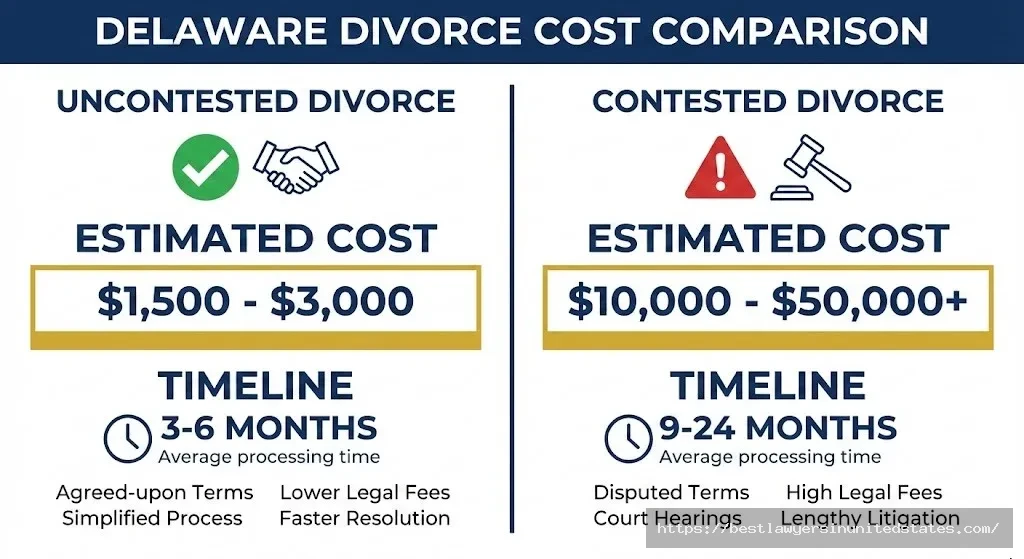
The type of divorce you pursue directly impacts both cost and duration. While uncontested divorces represent the most affordable option, they require both spouses to reach agreement on property division, spousal support, and any child-related matters before filing.
What Are Delaware Family Court Filing Fees?
Delaware Family Court charges specific fees for divorce petitions and each additional matter you’re asking the court to resolve. These are mandatory costs paid directly to the court when filing your paperwork.

Base Divorce Petition Fee
The initial petition for divorce costs $150 to file. This covers the basic request to dissolve your marriage but doesn’t include any requests for the court to decide ancillary matters like property division or custody.
Ancillary Matter Filing Fees
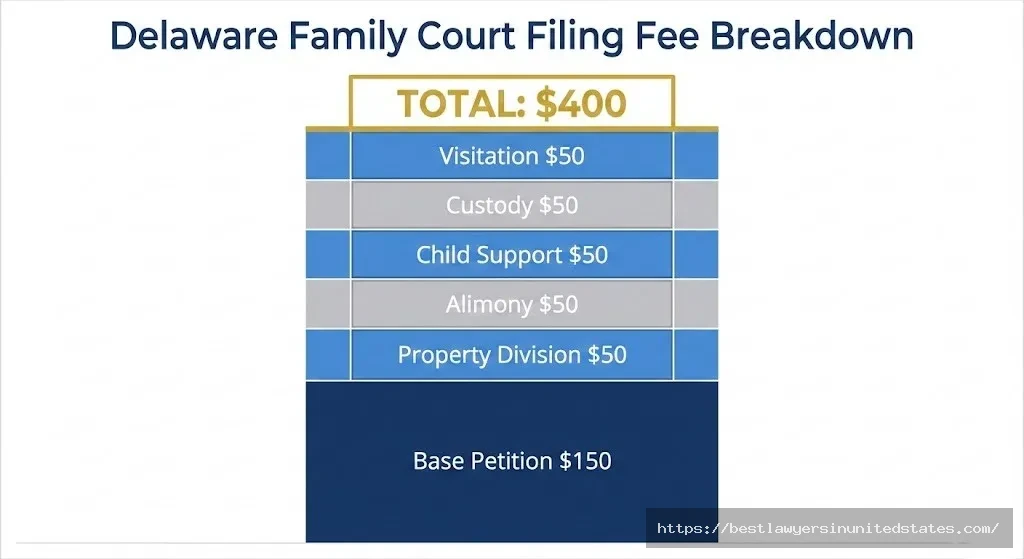
Each additional issue you ask the court to address adds $50 to your filing costs:
| Ancillary Matter | Filing Fee |
|---|---|
| Property Division | $50 |
| Alimony/Spousal Support | $50 |
| Child Support | $50 |
| Child Custody | $50 |
| Visitation Rights | $50 |
Example: If you file for divorce requesting property division, alimony, and child custody, your total filing fee would be $150 (base) + $50 + $50 + $50 = $300.
Service of Process Costs
After filing, you must legally serve your spouse with divorce papers. Service costs vary by county and method:
- Sheriff Service in New Castle County: $75-$100
- Sheriff Service in Kent County: $65-$85
- Sheriff Service in Sussex County: $65-$85
- Private Process Server: $50-$150
- Certified Mail (if spouse agrees): $8-$15
Additional Court Costs
Beyond initial filing, you may encounter these expenses:
- Certified copies of divorce decree: $10-$25 per copy
- Document filing for motions: $25-$50 each
- Modification petitions (post-divorce): $50-$100
- Appeal filing fees: $150-$200
Similar to divorce filing fees in neighboring states, Delaware’s court costs remain relatively moderate compared to states like California or New York, where filing fees can exceed $400.
How Much Does a Divorce Lawyer Cost in Delaware?
Attorney fees represent the largest expense in most Delaware divorces. Costs vary significantly based on case complexity, attorney experience, and whether your divorce is contested or uncontested.
Average Hourly Rates
Delaware divorce attorneys typically charge between $200 and $450 per hour, with rates varying by experience level and location:
- New attorneys (1-3 years experience): $200-$275/hour
- Mid-level attorneys (4-10 years): $275-$350/hour
- Senior attorneys (10+ years): $350-$450/hour
- Wilmington area attorneys: Generally 10-15% higher than Kent or Sussex County
Retainer Fees
Most divorce lawyers require an upfront retainer deposit before beginning work. In Delaware, typical retainers range from $2,500 to $10,000 depending on case complexity:
- Simple uncontested divorce: $1,500-$2,500
- Moderate complexity (some disputes): $3,500-$6,000
- High-conflict contested divorce: $7,500-$15,000+
The attorney bills their hourly rate against this retainer. If the retainer depletes before your case concludes, you’ll need to replenish it. Any unused portion should be refunded after case completion.
Flat Fee Uncontested Divorce
Many Delaware attorneys offer flat-fee packages for uncontested divorces where both parties agree on all terms. These typically cost $1,500 to $2,500 and include:
- Initial consultation
- Preparation of all divorce documents
- Filing with Delaware Family Court
- One court appearance (if required)
- Finalization of divorce decree
Flat fees don’t typically cover contested issues. If disagreements arise during the process, the attorney may convert to hourly billing.
What Factors Affect Attorney Costs?
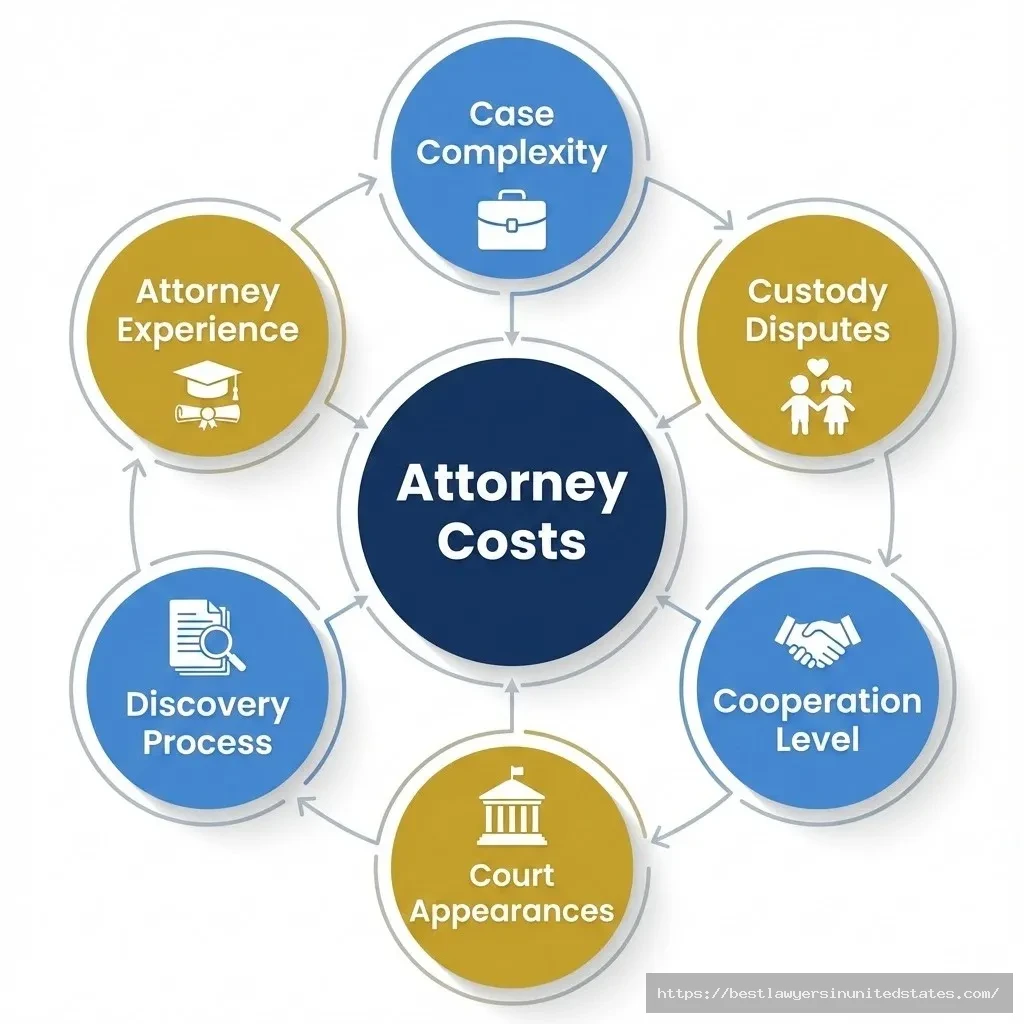
Several variables influence your total divorce attorney fees:
Case Complexity: High-asset divorces involving business valuations, retirement accounts, or multiple properties require more attorney time. Expect to pay 2-3 times more than average for complex financial situations.
Custody Disputes: Child custody battles significantly increase costs. Expert witnesses, psychological evaluations, and Guardian ad Litem appointments can add $5,000-$15,000 to your total.
Cooperation Level: An uncooperative spouse who contests every issue or refuses to provide financial documentation dramatically increases attorney hours and costs.
Court Appearances: Each Family Court hearing typically requires 3-5 hours of attorney time (preparation, travel, and appearance). At $300/hour, a single hearing costs $900-$1,500 in legal fees.
Discovery Process: Formal discovery (interrogatories, depositions, subpoenas) in contested cases adds $3,000-$10,000 to your bill.
Do Delaware Divorce Lawyers Offer Payment Plans?
Many Delaware divorce attorneys understand the financial strain of divorce and offer flexible payment arrangements:
- Monthly payment plans: Spread retainer payments over 3-6 months
- Credit card acceptance: Some firms accept credit cards (though interest rates apply)
- Limited scope representation: Hire an attorney for specific tasks only (document preparation, court appearances) rather than full representation
- Contingency for spousal support: Some attorneys accept cases where they’re paid from the awarded alimony (not common in Delaware)
Always discuss payment options during your initial consultation. Some attorneys offer free or reduced-fee first consultations to discuss your case and financial situation.
Uncontested vs. Contested Divorce Costs in Delaware
The single biggest factor determining your divorce cost is whether you and your spouse agree on major issues or need the court to decide disputed matters.
Uncontested Divorce Costs
An uncontested divorce occurs when both spouses agree on property division, spousal support, child custody, child support, and all other divorce terms. Total costs typically include:
| Cost Component | Amount |
|---|---|
| Court filing fees | $150-$300 |
| Service of process | $50-$100 |
| Attorney fees (if used) | $1,500-$2,500 flat fee |
| Document preparation (DIY) | $0-$300 for forms/guidance |
| Total Cost Range | $1,500-$3,000 |
Timeline: 3-6 months from filing to final decree
Uncontested divorces move quickly through Delaware Family Court. After filing, you must wait a minimum separation period, but you won’t face multiple court hearings or lengthy discovery processes. Many couples with straightforward financial situations and no children successfully complete uncontested divorces with minimal or no attorney involvement.
Contested Divorce Costs
A contested divorce involves disagreements requiring court intervention. Common disputed issues include:
- Property and asset division
- Spousal support amount and duration
- Child custody arrangements
- Child support calculations
- Business valuations
- Retirement account divisions
Contested divorce costs escalate quickly:
| Cost Component | Amount |
|---|---|
| Court filing fees | $200-$400 |
| Attorney retainer | $5,000-$15,000 |
| Total attorney fees | $10,000-$50,000+ |
| Expert witnesses | $2,000-$8,000 |
| Forensic accountant | $3,000-$10,000 |
| Property appraisals | $400-$800 per property |
| Business valuation | $5,000-$25,000 |
| Custody evaluation | $2,500-$5,000 |
| Guardian ad Litem | $3,000-$8,000 |
| Mediation attempts | $1,500-$4,000 |
| Total Cost Range | $10,000-$50,000+ |
Timeline: 9-24+ months from filing to trial/settlement
The cost difference between contested and uncontested divorces in Delaware often exceeds $30,000. Each court hearing, each discovery request, and each month of litigation adds to your attorney’s billable hours. High-conflict divorces involving significant assets or contentious custody disputes can easily exceed $75,000 per spouse.
Hidden Costs of Divorce in Delaware Most People Miss
Beyond obvious court and attorney fees, Delaware divorces involve numerous unexpected expenses that can add thousands to your total cost.
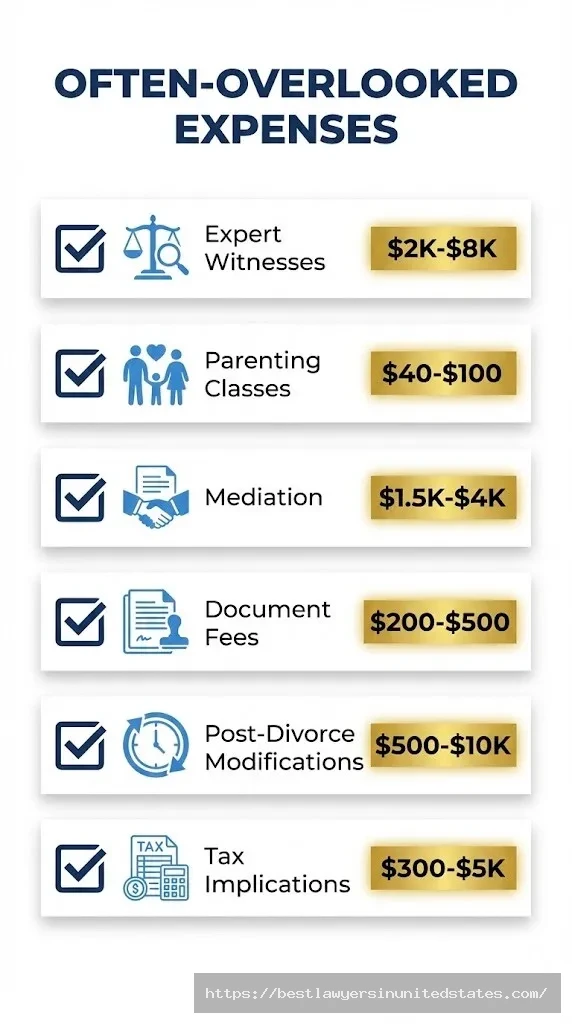
Expert Witness Fees
Complex divorces often require expert testimony:
Real Estate Appraisers: If you own property, the court may require professional appraisals to establish fair market value for division purposes. Expect $400-$800 per property appraisal.
Forensic Accountants: High-asset divorces or cases involving business interests require forensic accountants to trace assets, value businesses, and identify hidden income. These experts charge $250-$500 per hour, with total costs ranging from $3,000 to $15,000 depending on financial complexity.
Vocational Experts: In alimony disputes, vocational experts assess a spouse’s earning capacity and employability. Fees typically run $2,000-$5,000 for evaluation and testimony.
Child Custody Evaluators: When parents dispute custody arrangements, Delaware Family Court may order a comprehensive custody evaluation by a mental health professional. These evaluations cost $2,500-$5,000 and include interviews, home visits, and psychological testing.
Parenting Education Classes
Delaware Family Court requires parents in contested custody cases to complete approved parenting education classes. These programs cost $40-$100 per person and must be completed before the court finalizes custody arrangements.
Mediation Costs
Even in contested cases, Delaware Family Court often requires mediation before trial. Court-ordered mediation through the Family Court system may be free or low-cost, but private mediation costs $150-$300 per hour. Most cases require 4-8 hours of mediation sessions, totaling $1,200-$2,400.
While divorce mediation adds upfront costs, it typically saves money compared to full litigation. Successful mediation can reduce overall divorce costs by 40-60% compared to taking every issue to trial.
Document Preparation and Certified Copies
Throughout your divorce, you’ll need various documents:
- Certified divorce decree copies: $10-$25 each (you’ll need multiple for changing names on accounts, driver’s license, etc.)
- Court transcripts: $3-$5 per page (for appeals or review)
- Financial documentation copying: $0.25-$1.00 per page
- Document notarization: $5-$10 per document
Post-Divorce Modification Costs
After your divorce finalizes, life circumstances change. Modification petitions for alimony, child support, or custody cost $50-$100 to file, plus attorney fees if representation is needed. Simple modifications handled by agreement cost $500-$1,500 in attorney fees. Contested modifications essentially restart the legal process, costing $3,000-$10,000+.
Tax Implications
Divorce creates significant tax consequences often overlooked until April 15th arrives:
- Tax preparation fees increase: Expect to pay $200-$500 more for tax preparation during your divorce year due to complexity
- Capital gains taxes: Transferring appreciated assets triggers potential capital gains tax liability
- Retirement account division penalties: Improper handling of 401(k) or IRA divisions results in 10% early withdrawal penalties plus income tax
- Dependency exemption disputes: If your divorce decree doesn’t clearly specify who claims children as dependents, conflicts arise
Consider consulting a tax professional early in your divorce process. The $300-$500 consultation fee can save you thousands in avoided tax mistakes.
Divorce Costs by Delaware County
Delaware’s three counties have some cost variations, particularly for service of process and local attorney rates.
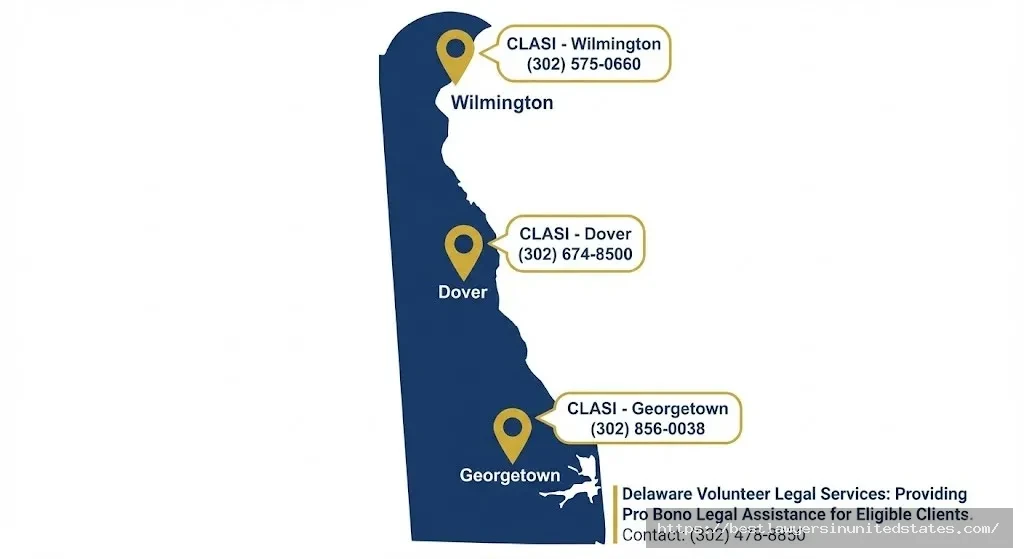
New Castle County Divorce Costs
New Castle County, home to Wilmington and containing approximately 60% of Delaware’s population, generally has the highest divorce costs statewide.
Court Location: New Castle County Family Court, 500 N. King Street, Wilmington, DE 19801
Average Attorney Rates: $275-$450/hour (10-15% higher than other counties)
Sheriff Service Fees: $75-$100
Local Considerations: Wilmington-area attorneys charge premium rates due to higher overhead costs. However, the larger attorney pool provides more options for specialized expertise in high-asset divorces or complex custody cases.
Legal Aid Resources:
- Community Legal Aid Society, Inc. (CLASI) – Wilmington Office: (302) 575-0660
- Delaware Volunteer Legal Services: (302) 478-8850
Kent County Divorce Costs
Kent County, centered around Dover, offers moderate divorce costs compared to New Castle County.
Court Location: Kent County Family Court, 400 Court Street, Dover, DE 19901
Average Attorney Rates: $225-$350/hour
Sheriff Service Fees: $65-$85
Local Considerations: Dover-area attorneys typically charge 10-20% less than Wilmington rates while maintaining comparable experience levels. Kent County’s smaller legal community means attorneys often work together more cooperatively, potentially reducing conflict and costs.
Legal Aid Resources:
- Community Legal Aid Society, Inc. (CLASI) – Dover Office: (302) 674-8500
Sussex County Divorce Costs
Sussex County, covering Delaware’s southern coastal region, generally has the lowest divorce costs in the state.
Court Location: Sussex County Family Court, 38 The Circle, Georgetown, DE 19947
Average Attorney Rates: $200-$325/hour
Sheriff Service Fees: $65-$85
Local Considerations: Sussex County’s more rural nature and lower cost of living translates to reduced attorney fees. However, fewer attorneys practice family law in Sussex County, so complex cases might still require hiring Wilmington-based specialists.
Legal Aid Resources:
- Community Legal Aid Society, Inc. (CLASI) – Georgetown Office: (302) 856-0038
How Can You Reduce Divorce Costs in Delaware?
Divorce inevitably involves expenses, but strategic choices can significantly reduce your total costs without sacrificing fair outcomes.
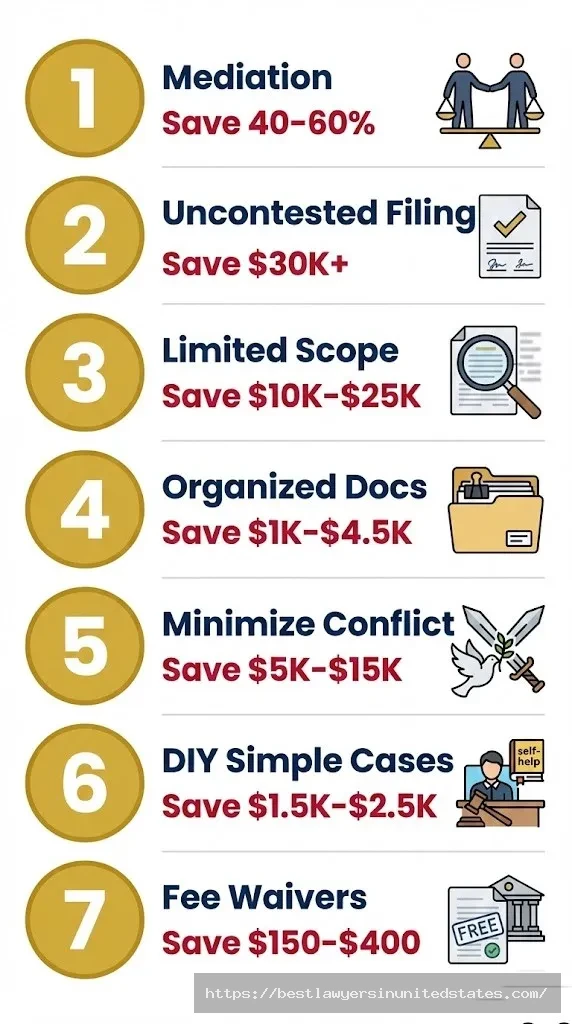
1. Choose Mediation Over Litigation
Mediation involves working with a neutral third party to reach agreements on disputed issues. Successful mediation reduces divorce costs by 40-60% compared to contested litigation. Even if mediation doesn’t resolve every issue, settling some matters through mediation reduces the issues requiring court intervention.
Delaware offers both court-sponsored mediation (often free or low-cost) and private mediation ($150-$300/hour). The total mediation cost of $1,500-$4,000 remains far less than the $15,000-$50,000 spent on contested litigation.
2. File for Uncontested Divorce When Possible
If you and your spouse can reach agreement on all major issues before filing, an uncontested divorce saves tens of thousands in legal fees. Consider negotiating terms with your spouse directly or through a single mediator, then hiring an attorney solely to prepare and file agreed-upon documents.
Many Delaware attorneys offer flat-fee uncontested divorce packages for $1,500-$2,500—a fraction of contested divorce costs.
3. Use Limited Scope Representation
Rather than hiring an attorney for full representation, consider “unbundled” or “limited scope” legal services. You handle some aspects of your divorce yourself while hiring an attorney for specific complex tasks:
- Document review and preparation: $500-$1,500
- Court appearance representation: $1,000-$2,500 per hearing
- Legal advice and coaching: $200-$450 per consultation
Limited scope representation works best when you’re comfortable handling routine tasks but need professional guidance for critical decisions or court appearances.
4. Prepare Organized Financial Documentation
Attorney time spent tracking down financial records costs you $200-$450 per hour. Reduce this expense by organizing all financial documentation before meeting your attorney:
- Three years of tax returns
- Recent pay stubs
- Bank and investment account statements
- Credit card statements
- Mortgage documents and property deeds
- Vehicle titles and loan documents
- Retirement account statements
- Business financial statements (if applicable)
Coming to your first attorney meeting with organized documentation can save 5-10 hours of attorney time—$1,000-$4,500 in fees.
5. Minimize Conflict and Communication
Every email or phone call from your attorney costs money. Batch your questions together rather than calling whenever something occurs to you. Communicate directly with your spouse about routine matters (child schedule adjustments, household bill payments) rather than through attorneys.
High-conflict couples who argue about minor issues through their attorneys can add $5,000-$15,000 to their divorce costs compared to couples who communicate reasonably.
6. Consider DIY Divorce for Simple Cases
Delaware offers resources for self-represented litigants through the Family Court Self-Help Center. If your divorce involves:
- No minor children
- Limited marital assets (under $50,000)
- No real property
- Short marriage duration (under 5 years)
- Agreement on major terms
You might complete your divorce without attorney representation. The Family Court provides form packets and instructions. Total DIY divorce costs remain under $500 (filing fees and service costs only).
Caution: DIY divorce risks costly mistakes in complex situations. If your case involves significant assets, retirement accounts, businesses, or children, attorney consultation is worth the investment.
7. Apply for Fee Waivers If You Qualify
Delaware allows low-income individuals to request court fee waivers. If you receive public assistance (SNAP, Medicaid, SSI) or your income falls below 125% of federal poverty guidelines, you may qualify for waived filing fees.
File a “Petition to Proceed In Forma Pauperis” along with your divorce petition. Include documentation of income and expenses. Approved waivers eliminate the $150-$400 in court filing costs.
What Is a Spouse Entitled to in a Delaware Divorce?
Understanding Delaware’s property division and spousal support rules helps you anticipate costs and negotiate fairly.
How Does Delaware Divide Property?
Delaware follows “equitable distribution” principles, meaning property division should be fair but not necessarily equal. Courts consider multiple factors when dividing marital assets:
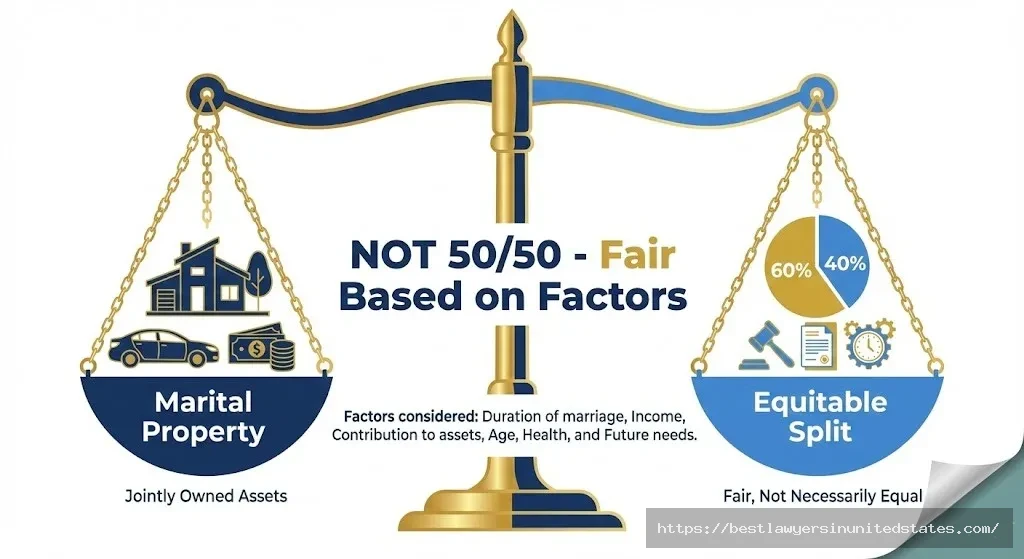
- Length of marriage
- Each spouse’s contribution to marital property acquisition
- Economic circumstances of each spouse
- Age and health of each spouse
- Whether either spouse has custody of minor children
- Tax consequences of property division
- Each spouse’s employability and earning capacity
Marital vs. Separate Property: Only marital property gets divided in divorce. Marital property includes assets acquired during marriage, regardless of whose name appears on the title. Separate property (owned before marriage, inherited, or received as gifts specifically to one spouse) typically remains with the original owner.
Delaware is NOT a 50/50 community property state. Courts have discretion to divide marital property in any proportion deemed fair under the circumstances. A 60/40 or 70/30 split is common when one spouse has significantly greater earning capacity or when marriages are short-term.
How Does Alimony Work in Delaware?
Delaware courts may award alimony (spousal support) when one spouse needs financial assistance and the other can afford to pay. Alimony isn’t automatic—courts exercise discretion based on statutory factors:

- Financial resources of each party
- Earning capacity and employability
- Time needed for education or training
- Standard of living during marriage
- Length of marriage
- Age and physical/mental condition
- Contributions as homemaker
- Tax consequences
- Whether either spouse has custody of children
Alimony Duration: Delaware courts typically award permanent alimony only in long-term marriages (20+ years) where one spouse has limited earning capacity. For shorter marriages, rehabilitative alimony lasting 1-5 years is more common, designed to allow the receiving spouse time to become self-supporting.
Alimony Amount: No formula dictates alimony amounts in Delaware. Courts consider all relevant factors to determine an amount that allows both parties to maintain reasonably comparable standards of living post-divorce.
Modification and Termination: Alimony orders can be modified if circumstances substantially change (job loss, illness, remarriage). Alimony typically terminates automatically upon the receiving spouse’s remarriage or death of either party.
How Is Child Support Calculated?
Delaware uses statutory guidelines to calculate child support. The Delaware Family Court provides an online child support calculator that considers:
- Each parent’s gross income
- Number of children
- Cost of health insurance for children
- Childcare expenses
- Each parent’s percentage of overnight custody
Unlike alimony, child support follows a mathematical formula, making it more predictable. The parent with less custody time typically pays support to the primary custodial parent.
Duration: Child support continues until the child reaches age 18 (or 19 if still in high school), becomes emancipated, marries, or joins the military.
Modification: Either parent can petition to modify child support when circumstances substantially change (income changes, custody arrangement changes, child’s needs change).
How to Get a Divorce If You Can’t Afford One in Delaware
Financial constraints shouldn’t trap you in an unhealthy marriage. Delaware provides several options for low-income individuals seeking divorce.
Fee Waiver Eligibility
Delaware Family Court waives filing fees for individuals who demonstrate financial hardship. You qualify for a fee waiver if you:
- Receive public assistance (TANF, SSI, SNAP, Medicaid, or General Assistance)
- Have income at or below 125% of federal poverty guidelines ($15,000 for individuals; $20,000 for families of two in 2026)
To request a fee waiver, file a “Petition to Proceed In Forma Pauperis” with your divorce petition. Attach proof of income (pay stubs, benefit statements, tax returns) and monthly expenses. The court reviews your petition and either grants or denies the waiver.
Approved waivers eliminate court filing fees but don’t cover attorney fees, service costs, or other divorce-related expenses.
Legal Aid Organizations
Delaware offers free legal services to low-income residents through nonprofit organizations:
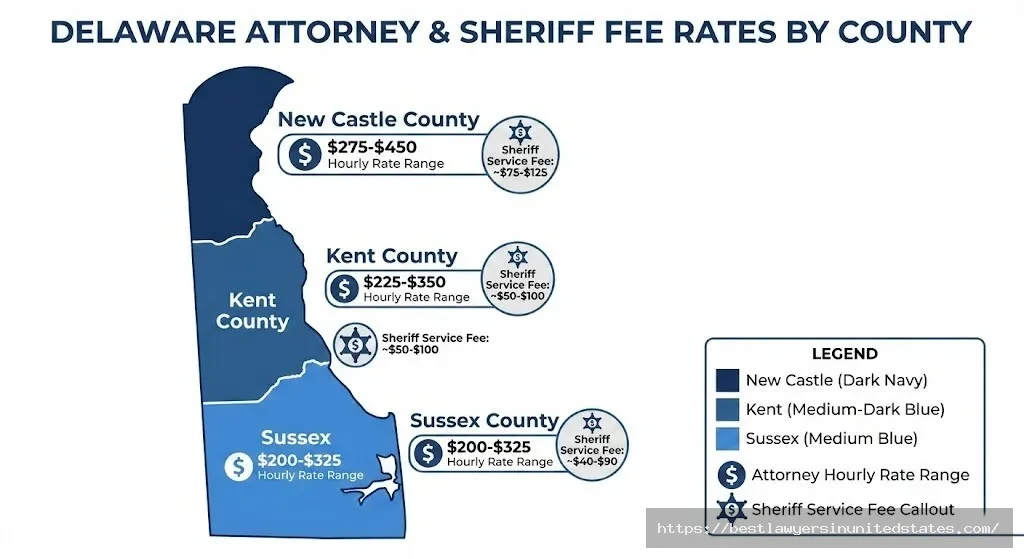
Community Legal Aid Society, Inc. (CLASI)
- Wilmington: (302) 575-0660
- Dover: (302) 674-8500
- Georgetown: (302) 856-0038
- Income eligibility: Generally 125% of federal poverty level
- Services: Free representation in divorce cases involving domestic violence, cases with children, or complex issues
Delaware Volunteer Legal Services (DVLS)
- Phone: (302) 478-8850
- Services: Pro bono attorney matching for eligible clients
- Income eligibility: Generally 200% of federal poverty level
These organizations prioritize cases involving domestic violence, children, or vulnerable parties. Waiting lists can extend several months, so apply early.
Family Court Self-Help Center
The Delaware Family Court Self-Help Center provides free resources for self-represented litigants:
- Form packets with instructions for uncontested divorce
- One-on-one assistance completing court forms
- Educational programs on divorce procedures
- Referrals to legal aid and community resources
Locations:
- New Castle County: (302) 255-0300
- Kent County: (302) 672-4266
- Sussex County: (302) 856-5697
The Self-Help Center cannot provide legal advice or represent you in court, but staff can explain procedures and help you complete required forms correctly.
Limited Scope Representation
Some Delaware attorneys offer reduced-fee services for clients handling most of their divorce independently but needing assistance with specific tasks. You might pay an attorney $500-$1,500 to:
- Review documents before filing
- Draft complex provisions (property division, retirement account division)
- Appear for critical court hearings
- Coach you on court procedures and strategy
Limited scope representation costs significantly less than full representation while ensuring critical decisions receive professional guidance.
Payment Plans Through Attorneys
Many Delaware divorce attorneys understand the financial burden of divorce and offer flexible payment arrangements:
- Monthly installment plans spreading retainer payments over 3-6 months
- Reduced retainers with higher monthly payments
- Sliding scale fees based on income (some attorneys)
- Deferred payment until asset distribution or spousal support begins
Always discuss payment concerns honestly with potential attorneys during initial consultations. Many lawyers prefer working with clients on payment plans rather than having clients navigate divorce without representation.
Who Pays the Costs in a Delaware Divorce?
Generally, each spouse pays their own attorney fees and shares court costs equally in Delaware divorces. However, exceptions exist.
Standard Rule: Each Party Pays Own Fees
Delaware courts typically order each spouse responsible for their own legal fees and require equal division of court filing costs. This remains true even when significant income disparity exists between spouses.
Exceptions: Court-Ordered Attorney Fee Awards
Delaware Family Court can order one spouse to contribute to the other’s attorney fees when:
Income Disparity: When one spouse earns significantly more or controls marital assets while the other lacks financial resources to retain adequate representation, courts may order the higher-earning spouse to contribute to the other’s legal fees. This ensures both parties have reasonably equal access to legal representation.
Bad Faith or Misconduct: If one spouse engages in unreasonable conduct that increases litigation costs (hiding assets, refusing reasonable settlement offers, making frivolous motions), courts may order that spouse to pay the other’s attorney fees as a sanction.
Complex Asset Division: In high-asset cases where extensive discovery and expert witnesses are necessary, courts sometimes require the spouse with greater financial resources to contribute to costs benefiting both parties (business valuations, forensic accountants).
Attorney fee awards are discretionary—courts consider all circumstances, including each party’s financial resources, conduct during litigation, and reasonableness of positions taken.
Requesting Attorney Fee Contributions
To request attorney fee contributions, file a motion with Family Court supported by:
- Detailed accounting of your attorney fees incurred
- Affidavit of your attorney describing work performed and reasonableness of fees
- Financial affidavit showing your income, assets, and inability to pay
- Evidence of spouse’s greater financial resources
Courts review these motions carefully and order contribution only when circumstances clearly warrant it. Don’t assume you’ll receive fee contributions—budget as if you’ll pay your own fees.
How Long Does a Divorce Take in Delaware (And What That Costs)?
Divorce timeline directly impacts total costs. The longer your divorce takes, the more attorney fees accumulate.
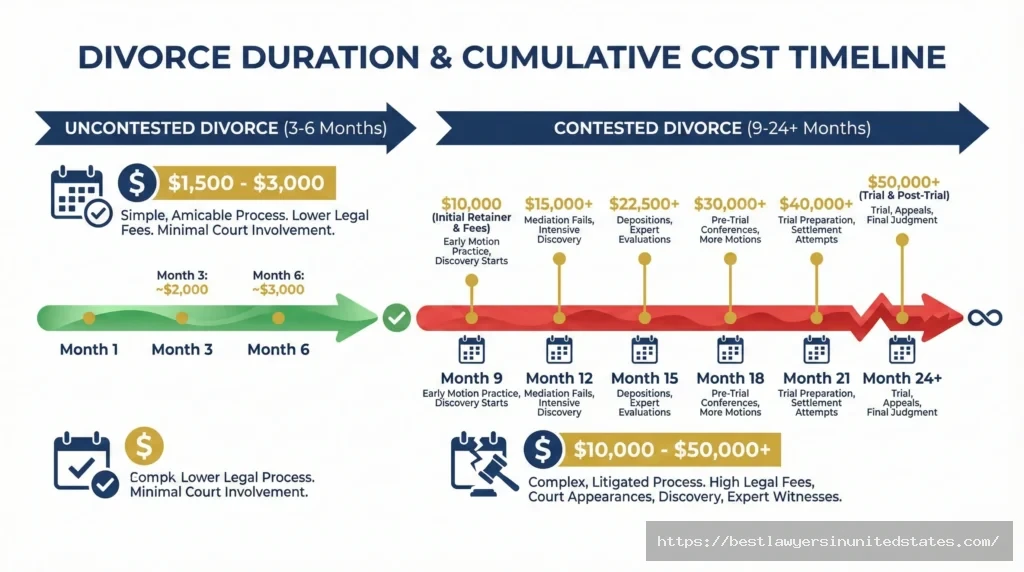
Uncontested Divorce Timeline: 3-6 Months
Delaware requires couples to be separated for six months before filing for no-fault divorce based on separation, though couples can file immediately on fault grounds or if both parties agree the marriage is irretrievably broken.
Typical Uncontested Timeline:
- Months 1-2: Negotiate settlement terms, prepare documents
- Month 3: File petition with Family Court, serve spouse
- Months 4-5: Waiting period for response (if needed), minor revisions
- Month 6: Final hearing (if required) and decree entry
Cost Implications: Short timelines mean minimal attorney fees. Most uncontested divorces conclude with 10-20 hours of attorney time, totaling $2,000-$8,000 in legal fees when attorney representation is used.
Contested Divorce Timeline: 9-24+ Months
Contested divorces proceed through multiple stages, each adding time and expense:
Months 1-3: Initial Filing and Discovery
- File petition, serve spouse, await response
- Exchange initial financial disclosures
- Begin informal discovery and settlement discussions
- Cost Impact: $2,500-$7,500 in attorney fees
Months 4-8: Formal Discovery
- Serve interrogatories, requests for production
- Conduct depositions of parties and witnesses
- Hire expert witnesses (appraisers, forensic accountants)
- Cost Impact: $5,000-$15,000 in attorney fees, $3,000-$10,000 in expert costs
Months 9-15: Motion Practice and Mediation
- File motions regarding temporary support, custody, asset freezes
- Attend multiple court hearings
- Participate in court-ordered mediation
- Cost Impact: $4,000-$12,000 in attorney fees, $1,500-$4,000 in mediation costs
Months 16-24: Trial Preparation and Trial
- Prepare trial exhibits and witness lists
- Conduct trial (typically 1-5 days)
- Post-trial motions and final decree entry
- Cost Impact: $8,000-$25,000+ in attorney fees
Total Contested Divorce Cost Range: $22,500-$73,500+
Every month of litigation adds approximately $1,000-$3,000 in attorney fees. High-conflict divorces extending beyond two years can easily exceed $100,000 in combined attorney fees and costs for both parties.
How to Reduce Timeline and Costs
Respond Promptly: Delays in responding to discovery requests or attorney communications extend timelines and increase costs. Each continuance or extension adds 1-3 months and $1,000-$3,000 in fees.
Settle What You Can: Even if you can’t reach agreement on all issues, settling some matters (uncontested property items, basic custody schedule) reduces the issues requiring trial and cuts costs by 30-50%.
Choose Mediation Early: The earlier you attempt mediation, the less you’ve spent on litigation costs. Mediating at month 6 rather than month 18 can save $15,000-$30,000 in attorney fees.
Be Realistic: Unreasonable positions force more litigation. If your attorney advises that your position is unlikely to prevail, seriously consider compromise. The cost of fighting for an extra $10,000 in property might cost $15,000 in additional legal fees.
Frequently Asked Questions
How much does a divorce cost in Delaware?
Delaware divorces cost $1,500-$3,000 for uncontested cases where both parties agree on all terms. Contested divorces involving property disputes, custody battles, or alimony disagreements typically cost $10,000-$50,000 or more per person. The base Family Court filing fee is $150, with additional $50 fees for each ancillary matter like property division, alimony, child support, custody, or visitation.
What is the cheapest way to get a divorce in Delaware?
The cheapest divorce option is an uncontested DIY divorce when both spouses agree on all terms, the marriage is short, there are no children, and assets are minimal. Total costs remain under $500 (court filing fees and service of process only). For slightly more complex situations, a flat-fee uncontested divorce through an attorney costs $1,500-$2,500. If you qualify based on income, apply for a court fee waiver to eliminate the $150-$400 filing costs.
How much does it cost to file for divorce in Delaware?
The base petition for divorce costs $150 to file with Delaware Family Court. Each additional ancillary matter adds $50: property division ($50), alimony ($50), child support ($50), custody ($50), and visitation ($50). A divorce petition requesting multiple ancillary matters can reach $350-$400 in filing fees. You must also pay for service of process, which costs $50-$100 depending on your county and service method chosen.
How much does a divorce lawyer cost in Delaware?
Delaware divorce attorneys charge $200-$450 per hour depending on experience level and location. Wilmington-area attorneys typically charge $275-$450/hour, while Kent and Sussex County attorneys charge $200-$350/hour. Most attorneys require a retainer deposit of $2,500-$10,000 upfront. Flat-fee uncontested divorce packages cost $1,500-$2,500. A contested divorce typically generates $10,000-$50,000+ in total attorney fees per person.
Who pays the costs in a divorce?
Each spouse typically pays their own attorney fees in Delaware divorces. Court filing fees are usually split equally between parties. However, Delaware Family Court can order one spouse to contribute to the other’s attorney fees when significant income disparity exists, when one spouse engages in bad faith conduct that increases costs, or when necessary to ensure both parties have adequate legal representation. Attorney fee awards are discretionary and based on each case’s specific circumstances.
What is a wife entitled to in a divorce in Delaware?
Delaware follows equitable distribution, dividing marital property fairly (not necessarily equally) based on factors including marriage length, each spouse’s contributions, economic circumstances, and future earning capacity. Spouses are entitled to a fair share of marital assets acquired during marriage, potential alimony if they need financial support and the other spouse can pay, and appropriate child custody and support arrangements. Delaware is not a 50/50 community property state—property division varies based on circumstances, with splits often ranging from 40/60 to 60/40.
How can I get a divorce if I can’t afford one?
Delaware offers several options for low-income individuals: (1) Apply for a court fee waiver by filing a Petition to Proceed In Forma Pauperis if your income is at or below 125% of federal poverty guidelines; (2) Contact Community Legal Aid Society, Inc. (CLASI) at (302) 575-0660 for free legal representation if you qualify; (3) Use the Delaware Family Court Self-Help Center for free form packets and assistance completing divorce paperwork; (4) Request limited scope representation for specific tasks rather than full legal representation; (5) Ask potential attorneys about payment plans spreading costs over 3-6 months.
Do Delaware divorce lawyers offer payment plans?
Many Delaware divorce attorneys offer flexible payment arrangements to help clients afford representation. Common options include monthly installment plans spreading retainer payments over 3-6 months, reduced initial retainers with higher monthly payments as the case progresses, sliding scale fees based on income, and deferred payment until asset distribution occurs. Some attorneys accept credit cards. Always discuss payment concerns during your initial consultation—most lawyers prefer working with clients on payment plans rather than having them proceed without representation.
What are the filing fees for ancillary matters in Delaware?
Delaware Family Court charges $50 for each ancillary matter beyond the base $150 divorce petition fee. Ancillary matters include property division ($50), alimony/spousal support ($50), child support ($50), child custody ($50), and visitation rights ($50). If you file for divorce requesting all five ancillary matters, your total filing fee would be $150 + $250 = $400. You must pay these fees when initially filing your divorce petition, not when the court eventually decides these issues.
How long does a divorce take in Delaware?
Uncontested Delaware divorces typically take 3-6 months from filing to final decree when both spouses agree on all terms. Contested divorces involving disputed issues take 9-24+ months depending on complexity and conflict level. Delaware requires six months’ separation before granting a no-fault divorce based on separation, though you can file immediately if using fault grounds or if both parties agree the marriage is irretrievably broken. Each additional month of litigation adds approximately $1,000-$3,000 in attorney fees.
How much does an uncontested divorce cost in Delaware?
An uncontested divorce in Delaware costs $1,500-$3,000 when using an attorney for flat-fee representation. This includes court filing fees ($150-$300), service of process ($50-$100), and attorney fees for document preparation and filing ($1,500-$2,500). If you handle the divorce yourself without an attorney, costs remain under $500 (filing fees and service only). Uncontested divorces require both spouses to agree on property division, spousal support, child custody, child support, and all other divorce terms before filing.
Can I get a free divorce in Delaware?
While no divorce is entirely free, Delaware allows low-income individuals to eliminate court filing costs through fee waivers. File a Petition to Proceed In Forma Pauperis if you receive public assistance or earn less than 125% of federal poverty guidelines ($15,000 for individuals in 2026). Approved petitions waive the $150-$400 in filing fees. For complete free divorce representation, contact Community Legal Aid Society, Inc. (CLASI) if you meet income guidelines and your case involves domestic violence, children, or other prioritized factors. Even with fee waivers and free representation, you may still incur costs for service of process and certified copies.
What money can’t be touched in a divorce?
Separate property generally cannot be divided in Delaware divorces. This includes assets owned before marriage, inheritances received by one spouse, gifts specifically given to one spouse (not both), and personal injury settlements compensating for individual pain and suffering. However, separate property can lose its protected status if commingled with marital assets—for example, depositing inherited money into a joint bank account. Property acquired during marriage is presumed marital and subject to equitable distribution regardless of whose name appears on the title. Certain retirement benefits earned before marriage may also be partially protected.
How do you split assets in a divorce in Delaware?
Delaware uses equitable distribution to divide marital assets fairly based on multiple factors rather than automatically splitting everything 50/50. Courts consider marriage duration, each spouse’s financial and non-financial contributions to asset acquisition, economic circumstances and future earning capacity of each party, age and health, whether either has custody of children, and tax consequences of proposed divisions. Common splits range from 40/60 to 60/40 depending on circumstances. Only marital property (acquired during marriage) gets divided—separate property owned before marriage or inherited stays with the original owner unless commingled with marital assets.
How many years do you have to be married to get alimony in Delaware?
Delaware has no specific minimum marriage length requirement for alimony eligibility. Courts consider marriage duration as one factor when deciding whether to award alimony and determining amount and duration. Short marriages (under 5 years) rarely result in alimony unless extreme circumstances exist. Moderate-length marriages (5-15 years) may justify rehabilitative alimony for 1-5 years. Long-term marriages (15+ years) are more likely to result in substantial alimony awards, with marriages exceeding 20 years sometimes justifying permanent alimony when the requesting spouse has limited earning capacity.
What are the grounds for divorce in Delaware?
Delaware recognizes both no-fault and fault-based grounds. No-fault grounds include living separate and apart for six consecutive months without cohabitation, or mutual agreement that the marriage is irretrievably broken. Fault-based grounds include adultery, willful desertion for one year, extreme cruelty making cohabitation unsafe or improper, habitual drunkenness, conviction of crime with imprisonment preventing cohabitation, mental illness requiring institutionalization for 18+ months, and incompatibility. Most Delaware divorces use no-fault grounds based on separation or irretrievable breakdown as these are easiest to prove and least contentious.
Can I file for divorce online in Delaware?
Delaware does not offer completely online divorce filing through the court system. However, you can access Delaware Family Court divorce forms online at the court’s website, complete them electronically, print them, and file them in person at the appropriate county Family Court location. Several third-party services provide online divorce document preparation for Delaware divorces—these services interview you online, prepare customized forms, and provide filing instructions, but you must still submit documents to court in person or by mail. Physical filing with proper service of process on your spouse remains required for all Delaware divorces.
Why is moving out the biggest mistake in a divorce from a financial perspective?
Moving out before finalizing financial agreements can negatively impact property division and support determinations. When you move out, you establish a new living arrangement at separate expense, potentially demonstrating you can afford to maintain separate households without spousal support. This weakens alimony claims. You may lose leverage in negotiating who keeps the marital home. If children remain in the marital home with your spouse, this establishes a custody status quo favoring your spouse. Moving out doesn’t affect your property rights to the home, but it creates practical disadvantages. If you must leave for safety reasons, document domestic violence and consult an attorney immediately.
What is the first thing I should do if I want a divorce?
Before taking any action, schedule consultations with 2-3 Delaware divorce attorneys to understand your rights, obligations, and options. Many attorneys offer free or reduced-fee initial consultations. Simultaneously, begin organizing your financial documentation: gather tax returns, bank statements, investment accounts, retirement account statements, credit card statements, mortgage documents, vehicle titles, and business records. Open individual bank accounts in your name only if you don’t already have them. Make copies of important documents and store them securely outside your home. Avoid making major financial decisions, moving money between accounts, or confronting your spouse before consulting an attorney. If domestic violence is present, contact law enforcement and seek a Protection From Abuse order immediately.
Ready to Move Forward With Your Delaware Divorce?
Understanding divorce costs helps you budget appropriately and make informed decisions about how to proceed. While financial concerns are valid, don’t let cost alone prevent you from pursuing a divorce if your marriage is truly irretrievable.
The total cost of your Delaware divorce depends largely on choices you and your spouse make. Choosing cooperation over conflict, mediation over litigation, and settlement over trial can reduce costs by 60-80% compared to contested litigation taken to trial.
If you’re ready to begin your divorce, consult with experienced Delaware family law attorneys to discuss your specific situation. Most offer free or low-cost initial consultations where you can get personalized cost estimates based on your circumstances. For those with limited income, explore fee waivers and free legal aid options through Community Legal Aid Society, Inc.
Every divorce is unique. The cost ranges provided in this guide represent typical Delaware cases, but your specific costs will depend on your assets, income, children, level of conflict, and choices made throughout the process. An initial consultation with a qualified attorney provides the most accurate cost estimate for your situation.
Comparing Delaware’s costs with neighboring states can provide helpful context—divorce costs in Maryland, Pennsylvania, and New Jersey often run higher due to increased filing fees and attorney rates in major metropolitan areas.
Taking the first step toward divorce is difficult, but understanding the financial realities helps you move forward with confidence. Whether you need full representation for a contested case or simple guidance for an uncontested filing, Delaware offers resources to help you navigate this challenging transition.