
If you’re researching divorce costs in Indiana, you’re probably feeling overwhelmed by conflicting information and vague price ranges. Here’s the truth: divorce costs in Indiana vary wildly depending on your situation, but understanding the real numbers helps you plan and avoid financial surprises.
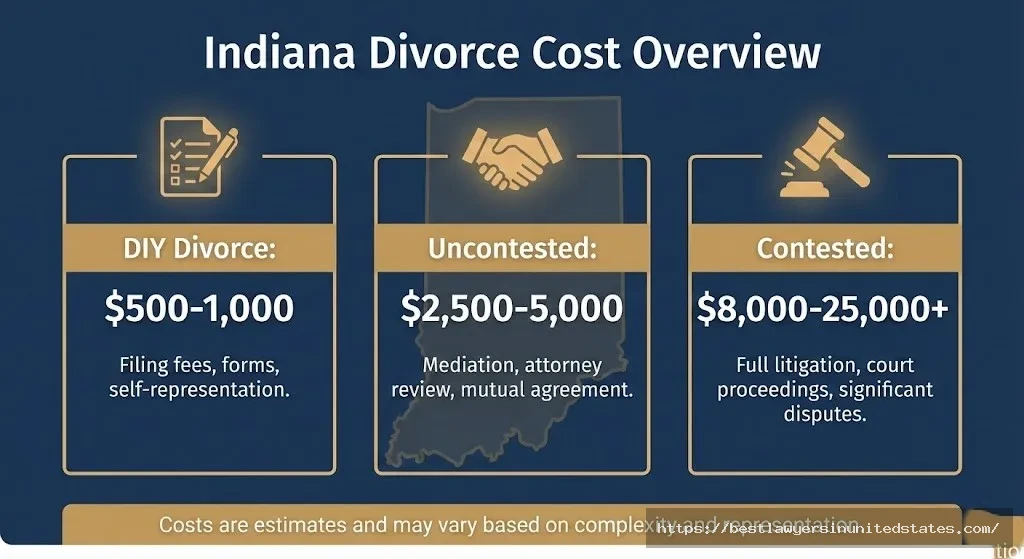
Quick Answer: Indiana divorce costs typically range from $2,500 to $5,000 for an uncontested divorce, and $8,000 to $25,000+ for a contested divorce. The filing fee alone is $157-$177 depending on your county. If you and your spouse agree on all terms, you might spend as little as $500-$1,000 doing it yourself.
This guide breaks down every cost you’ll face—from court fees to attorney retainers to hidden expenses most people don’t expect. Whether you’re trying to keep costs low or preparing for a complex case, you’ll find real numbers and practical advice here.
What Does an Indiana Divorce Actually Cost?
The average Indiana divorce costs between $3,500 and $15,000, but that number depends entirely on whether you’re fighting or cooperating. Here’s what you need to know upfront.

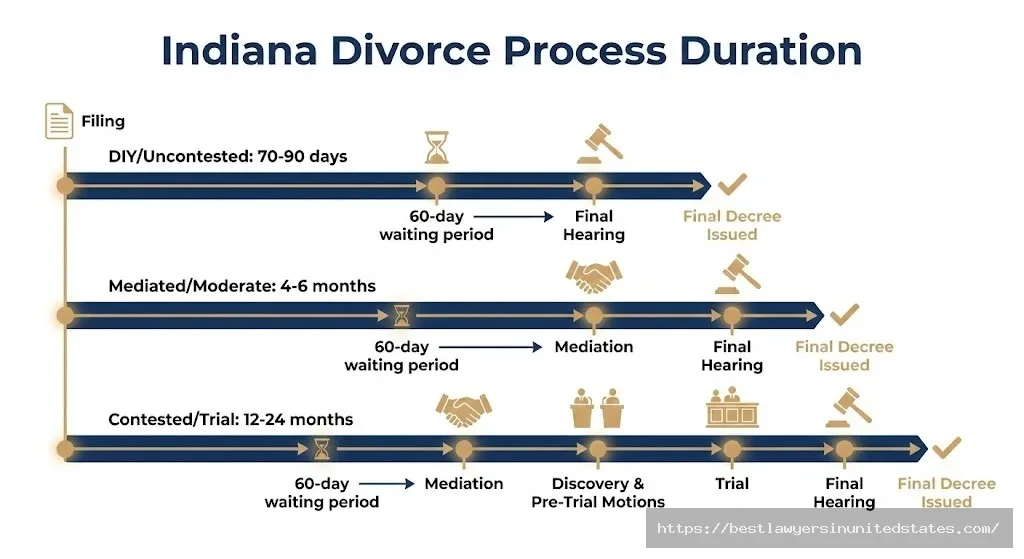
Uncontested Divorce: $2,500-$5,000 total when both spouses agree on everything—property, custody, support. Most cases settle within 60-90 days after the mandatory 60-day waiting period.
Contested Divorce: $8,000-$25,000+ when you disagree on major issues. Complex custody battles or high-asset cases can exceed $50,000 if they go to trial.
DIY Divorce: $200-$1,000 if you qualify for a simple divorce with no children, minimal property, and complete agreement. You’ll pay filing fees and possibly document preparation services, but skip attorney fees entirely.
The biggest cost driver? Conflict. Every disagreement that requires court intervention adds billable hours. Understanding uncontested divorce costs versus contested divorce costs helps you make informed decisions about which battles are worth fighting.
Indiana Divorce Filing Fees by County (2026)
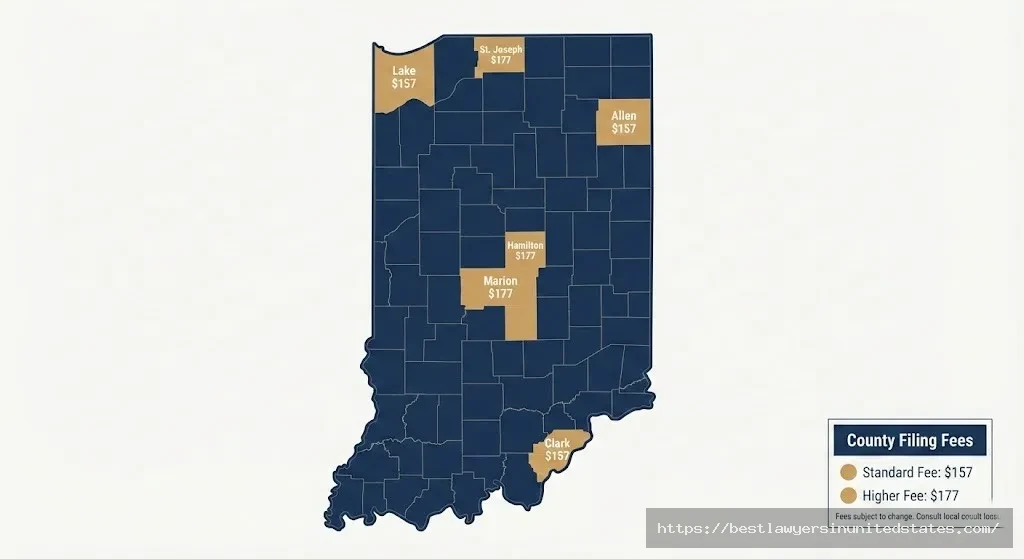
Filing fees vary slightly by county in Indiana. Here’s what you’ll actually pay at the courthouse:
| County | Filing Fee | Additional Fees | Contact |
|---|---|---|---|
| Marion County | $157 | Service fee: $16-$20 | Indianapolis: (317) 327-4740 |
| Clark County | $177 | Service fee: $18 | Jeffersonville: (812) 285-6244 |
| Lake County | $157 | Service fee varies | Crown Point: (219) 755-3600 |
| Allen County | $157 | Service fee: $15 | Fort Wayne: (260) 449-7245 |
| Hamilton County | $157 | Service fee: $16 | Noblesville: (317) 776-9629 |
| St. Joseph County | $157 | Service fee varies | South Bend: (574) 235-9635 |
Can’t afford the filing fee? Indiana courts offer fee waivers for low-income filers. More on that later in this guide.
These are just the initial filing fees. You’ll also pay for serving divorce papers to your spouse ($40-$125 through the sheriff or private process server), certified copies of your final decree ($1-$5 per page), and potentially other court costs if your case requires multiple hearings.
Divorce Cost Calculator
Get an estimated cost for your divorce based on your specific situation
Your Estimated Divorce Cost
Cost Breakdown
📧 Get a Personalized Consultation
Have questions about your specific situation? Contact our legal experts for guidance tailored to your needs.
Contact Us via EmailHow Much Do Divorce Attorneys Cost in Indiana?
Attorney fees represent the biggest variable in divorce costs. Indiana divorce lawyers typically charge $200-$400 per hour, though rates vary by location, experience, and case complexity.
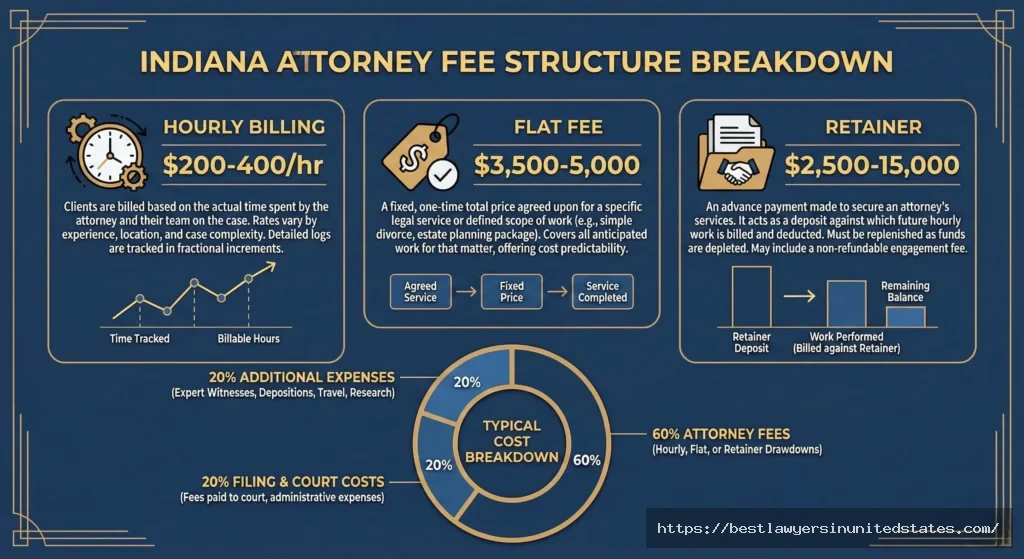
Hourly Billing: Most divorce attorneys bill by the hour, tracking every phone call, email, document review, and court appearance in 6-minute or 15-minute increments. Expect rates of:
- Junior associates: $175-$250/hour
- Experienced attorneys: $250-$350/hour
- Senior partners: $350-$450/hour
A straightforward uncontested divorce might require 10-15 billable hours ($2,000-$5,000). A contested case with custody disputes could easily consume 40-100+ hours ($8,000-$40,000).
Flat Fee Arrangements: Some attorneys offer flat fees for uncontested divorces, typically $3,500-$5,000. This covers filing the petition, drafting the settlement agreement, and attending one final hearing. Additional work (contested issues, extra court appearances, modifications) costs extra.
Retainer Fees: Attorneys require an upfront retainer—essentially a deposit against future work. Common retainer amounts in Indiana:
- Uncontested divorce: $2,500-$5,000
- Contested divorce: $5,000-$15,000+
- High-conflict cases: $15,000-$30,000+
The attorney bills against your retainer as work progresses. When depleted, you’ll need to replenish it. Unused retainer funds are refunded when your case concludes.
Understanding divorce attorney fees helps you budget realistically and ask the right questions during consultations.
What is the 6% Rule in Indiana Divorce?
The “6% rule” confuses many people going through Indiana divorces. Here’s what it actually means.

Indiana law allows courts to order one spouse to pay the other spouse’s attorney fees in certain situations. The 6% rule refers to Indiana Code § 31-15-10-1, which lets courts consider each party’s financial resources when dividing responsibility for legal fees.
How it works in practice: If one spouse earns significantly more than the other, the court may order the higher-earning spouse to contribute toward (or fully pay) the other spouse’s attorney fees. This prevents financial imbalance from creating an unfair advantage in divorce proceedings.
Example: Sarah earns $120,000 annually while her husband Tom earns $35,000. Sarah can afford a $15,000 retainer; Tom can barely cover rent. The court might order Sarah to pay a portion of Tom’s legal fees so he can afford adequate representation.
The rule doesn’t automatically apply—you must request it. Courts evaluate:
- Income disparity between spouses
- Available liquid assets
- Who initiated the divorce
- Whether either party is being unreasonable or causing unnecessary legal costs
The “6%” terminology is somewhat misleading; it doesn’t mean 6% of anything specific. Rather, it references the statute number. What matters is the principle: Indiana courts can level the financial playing field when one spouse would otherwise be unable to afford proper legal representation.
Hidden Divorce Costs Most People Don’t Expect
Beyond attorney fees and filing costs, these expenses catch people off guard:
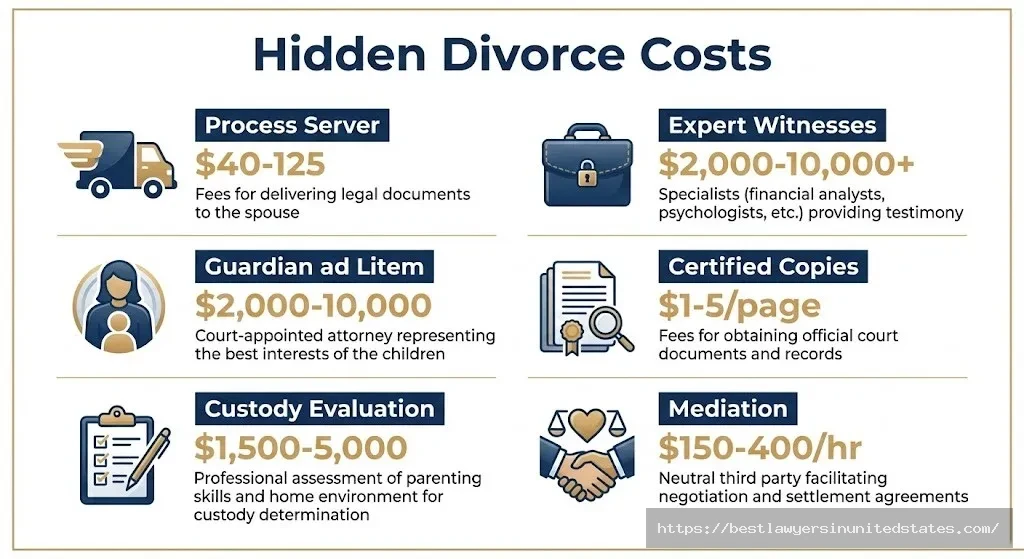
Process Server Fees: $40-$125 to serve divorce papers to your spouse. Sheriff’s department service costs $40-$60; private process servers charge $75-$125 but offer faster, more reliable service. If your spouse actively avoids service, costs increase for multiple attempts.
Certified Copies: $1-$5 per page for certified copies of your divorce decree. You’ll need several for changing your name on bank accounts, driver’s license, social security records, and other documents.
Guardian ad Litem (GAL): $2,000-$10,000+ when appointed to represent children’s interests in custody disputes. Both parents typically split this cost equally.
Custody Evaluations: $1,500-$5,000 for psychological evaluations when custody is contested. Court-appointed evaluators assess each parent’s fitness and recommend custody arrangements.
Expert Witnesses: $2,000-$10,000+ for experts like forensic accountants (complex asset division), real estate appraisers (valuing marital property), or vocational experts (calculating earning capacity for spousal support).
Mediation Fees: $150-$400 per hour for private mediators, typically split between spouses. Most divorces require 3-8 hours of mediation. Learn more about divorce mediation costs.
Document Preparation: $300-$800 if using legal document services instead of an attorney for uncontested divorces.
Temporary Orders Hearings: $1,500-$3,000 in attorney fees if you need emergency orders for child custody, support, or exclusive home possession before your divorce finalizes.
Post-Divorce Modifications: $1,500-$5,000+ if you need to modify custody, support, or other terms after your divorce concludes. These require new petitions and potentially new hearings.
What Factors Increase Divorce Costs in Indiana?
Understanding cost drivers helps you make strategic decisions about which issues warrant legal intervention.
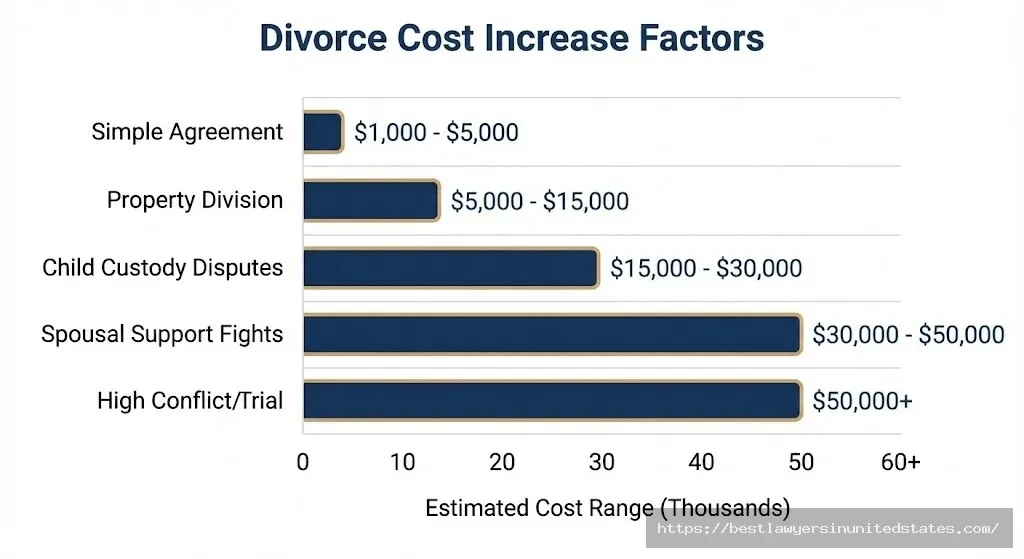
Child Custody Disputes: Fighting over custody is the single biggest cost escalator. Simple custody agreements might add $1,000-$2,000 to your legal fees. Contested custody trials can add $10,000-$30,000 or more, especially if you need a guardian ad litem or custody evaluation.
Complex Property Division: Dividing substantial assets—businesses, investment portfolios, multiple properties, retirement accounts—requires forensic accounting and expert valuations. Expect to add $3,000-$15,000 for professional appraisals and asset tracing.
Spousal Support Disagreements: Calculating appropriate alimony requires analyzing earning capacity, standard of living, and future financial needs. Contested spousal support claims add $2,000-$8,000 in legal fees, plus potential vocational expert costs.
Length of Marriage: Longer marriages typically involve more intertwined finances and property, increasing complexity and cost. A 25-year marriage with joint businesses, investments, and real estate will cost substantially more to untangle than a 3-year marriage with separate bank accounts.
Level of Conflict: High-conflict divorces with constant emergency motions, protective orders, and communication through attorneys can easily double or triple costs. Every angry email that requires your attorney’s response costs $50-$150.
Discovery Disputes: When one spouse hides assets or refuses to provide financial information, formal discovery (interrogatories, depositions, subpoenas) adds $3,000-$10,000+ to legal fees.
Geographic Location: Indianapolis and other urban areas have higher attorney rates than rural counties. Expect to pay 20-40% more for equivalent representation in major cities.
How to Reduce Your Indiana Divorce Costs
Smart strategies can cut your divorce costs significantly without sacrificing your interests.
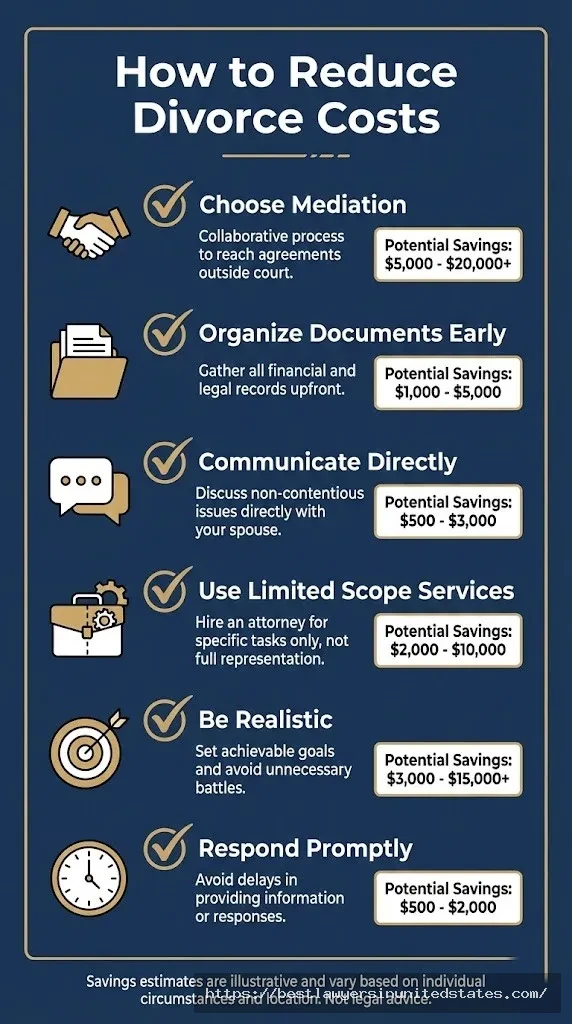
Choose Mediation Over Litigation: Mediation costs $150-$400 per hour split between spouses—far less than two attorneys billing $250-$400 each. Most couples resolve issues in 3-8 hours of mediation ($450-$3,200 total) versus $10,000-$30,000+ for contested litigation.
Organize Financial Documents Early: Your attorney bills $250-$400/hour to review documents. Spend your own time (free) organizing bank statements, tax returns, property deeds, retirement account statements, and debt records before meeting your attorney. You’ll save 5-10 billable hours.
Communicate Directly When Possible: Every email your attorney sends to your spouse’s attorney costs $50-$150. When you can discuss minor issues directly with your spouse—pickup times, minor schedule changes—you save money. Save attorney communication for significant legal issues.
Consider Unbundled Legal Services: Instead of full-service representation, hire an attorney for specific tasks (reviewing your settlement agreement, attending one critical hearing) while handling other aspects yourself. This “limited scope representation” can cut costs by 40-60%.
Be Realistic About Outcomes: Fighting over items with minimal value costs more in attorney fees than the items are worth. That $500 dresser your spouse wants? It’ll cost $1,000+ in billable hours to fight about. Pick your battles strategically.
Respond Promptly to Attorney Requests: When your attorney requests information or documents, delays cost money. Every time they follow up, you’re billed. Respond immediately to keep your case moving efficiently.
Consider Collaborative Divorce: Collaborative divorce uses specially trained attorneys and neutral professionals to reach settlement outside court. While not free, it typically costs 30-50% less than traditional litigation.
Free and Low-Cost Divorce Options in Indiana
If money is extremely tight, you have options beyond expensive attorneys.

Can You Get a Court Fee Waiver in Indiana?
Yes. Indiana offers fee waivers for people who can’t afford filing fees. Here’s exactly how to qualify and apply.
Eligibility Requirements:
- Your household income is at or below 125% of federal poverty guidelines
- You receive public assistance (TANF, SNAP, SSI, Medicaid)
- You can demonstrate inability to pay without hardship to you or your dependents
How to Apply:
- Complete the “Petition to Waive Court Fees” (available at your county clerk’s office or online)
- Provide proof of income (pay stubs, tax returns, benefit statements)
- Submit a financial affidavit detailing your income, expenses, assets, and debts
- File these forms with your divorce petition
Approval Timeline: Most counties approve or deny fee waivers within 7-14 days. If approved, you won’t pay filing fees, service fees, or other court costs.
If Denied: You can request a hearing to explain your circumstances to a judge. Bring documentation proving financial hardship—medical bills, rent receipts, utility shutoff notices, etc.
Legal Aid and Free Services in Indiana
Legal Aid of Indiana: Provides free legal services to low-income residents in civil cases, including divorce. Eligibility is generally limited to households earning less than 125% of federal poverty guidelines.
- Statewide hotline: 1-800-869-0212
- Website: www.indianalegalservices.org
- Services: Full representation in some cases, limited advice and document preparation in others
Indiana Legal Services: Similar to Legal Aid, serving specific counties and populations. Priority given to cases involving domestic violence, children, or vulnerable adults.
Pro Bono Programs: Many county bar associations offer free legal clinics where attorneys volunteer time to help low-income individuals. Contact your local bar association for scheduled clinic dates.
Law School Clinics: Indiana University and Notre Dame law schools operate legal clinics where law students (supervised by licensed attorneys) provide free representation in family law cases.
Indiana Lawyer Referral Service: While not free, this state bar program connects you with attorneys offering 30-minute consultations for $25-$50, helping you understand your options before committing to representation.
Should You Represent Yourself (Pro Se)?
Representing yourself—called “pro se” representation—can work for simple, uncontested divorces. Here’s when it makes sense and when it’s risky.
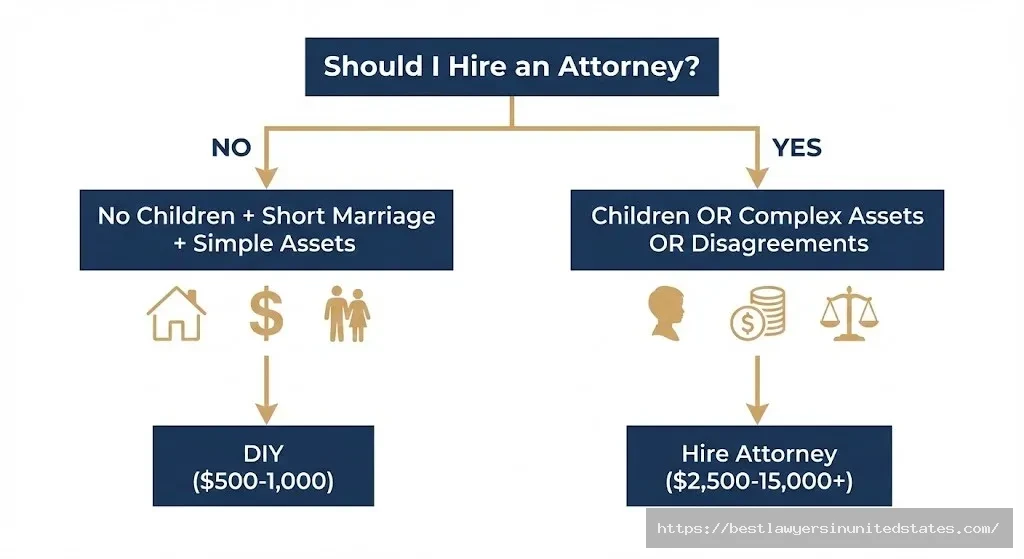
When DIY Works:
- No minor children
- Married less than 5 years
- Minimal property and debt to divide
- Both spouses agree on all terms
- No domestic violence concerns
- Neither spouse has retirement accounts, businesses, or complex assets
Free Resources for Pro Se Filers:
Indiana courts provide free divorce forms at www.in.gov/courts/selfservice. You’ll need:
- Petition for Dissolution of Marriage
- Summons
- Settlement Agreement
- Decree of Dissolution
Many counties offer self-help centers at the courthouse where staff (not attorneys) can explain forms and procedures—though they can’t give legal advice.
When DIY is Too Risky:
- Children involved (custody, support, parenting time)
- Significant assets to divide
- Business ownership
- Retirement accounts (401k, pension, IRA)
- Real estate beyond a single home
- One spouse hiding assets or being uncooperative
- Domestic violence history
The cost of mistakes often exceeds the cost of hiring an attorney. Poorly drafted custody agreements lead to years of expensive modification proceedings. Incorrectly divided retirement accounts trigger tax penalties. Overlooked marital assets mean losing what’s rightfully yours.
Consider at least consulting an attorney for a few hours to review your situation and proposed settlement. This limited consultation typically costs $250-$500 but can prevent $5,000-$20,000 in future problems.
For more guidance on handling your own divorce, review our DIY divorce state-by-state guide.
How Can You Finance Your Indiana Divorce?
If you need an attorney but can’t pay $5,000-$15,000 upfront, these financing options help.

Attorney Payment Plans: Many divorce attorneys offer payment plans, especially for middle-income clients. You might pay:
- $2,500 initial retainer
- $500-$1,000 monthly installments until case concludes
- Flexible arrangements based on your budget
Ask during initial consultations. Attorneys want to help; they’d rather set up a realistic payment plan than lose clients who need representation.
Legal Financing Companies: Companies like LegalShield, Upsolve, and similar services offer loans specifically for legal fees. Interest rates vary (8-36% APR), so compare options carefully. Typical terms:
- $5,000-$25,000 loan amounts
- 12-60 month repayment periods
- Approval based on credit score and income
Credit Cards: Using credit cards for legal fees isn’t ideal due to high interest rates (18-24% typically), but it’s an option if you can pay off balances quickly. Some attorneys offer discounted rates for credit card payments to ensure prompt payment.
Borrowing from Retirement Accounts: You can borrow from your 401(k) (up to $50,000 or 50% of vested balance) or withdraw from an IRA. Proceed cautiously:
Pros:
- Access to funds without credit check
- Lower interest rates than credit cards
- You’re paying interest to yourself (401k loans)
Cons:
- 401k loans must be repaid within 5 years or become taxable
- IRA early withdrawals trigger 10% penalty plus income tax
- Reduces retirement security
- If you lose your job, 401k loan becomes due immediately
Family Loans: Borrowing from family can work if handled formally. Create a written promissory note detailing repayment terms to avoid misunderstandings and potential tax implications. Keep emotions separate from finances.
Home Equity Loans or Lines of Credit: If you own significant equity in marital property, you might access it through a HELOC or home equity loan. However, this is complicated during divorce since both spouses must typically consent, and it affects property division.
Compare total costs carefully. A $10,000 legal fee financed at 20% interest over 3 years costs $13,200 total. Sometimes it’s worth settling for less favorable terms to avoid that interest burden.
Real Examples: What Indiana Divorces Actually Cost
Abstract numbers don’t help you budget. Here’s what real divorces cost and why.
Case Study 1: Simple Uncontested Divorce (Sarah & Tom, Indianapolis)
Situation: Married 4 years, no children, renting apartment, two paid-off cars, minimal debt, complete agreement on everything.
Process: Used online document service ($400) to prepare forms, filed themselves, attended one final hearing.
Total Cost Breakdown:
- Online document preparation: $400
- Marion County filing fee: $157
- Sheriff’s service: $45
- Certified copies (3): $15
- Total: $617
Timeline: 70 days (including mandatory 60-day waiting period)
Key Lesson: Simple cases with total agreement need minimal legal intervention. Sarah and Tom saved $4,000-$6,000 by handling it themselves.
Case Study 2: Moderate Complexity with Children (Mike & Jennifer, Fort Wayne)
Situation: Married 11 years, 2 children (ages 7 and 9), owned home with mortgage, two financed cars, combined $85,000 income, minor disagreements on parenting time and property division.
Process: Each hired attorneys, completed 6 hours of mediation, reached settlement without trial.
Total Cost Breakdown (Combined):
- Mike’s attorney fees: $4,500 (18 hours at $250/hour)
- Jennifer’s attorney fees: $3,800 (15 hours at $250/hour)
- Mediation fees: $2,100 (6 hours at $350/hour, split equally)
- Filing fees and service: $202
- Home appraisal: $450
- Guardian ad litem (limited involvement): $1,200 (split equally)
- Total: $12,252 ($6,126 each)
Timeline: 5 months from filing to final decree
Key Lesson: Mediation saved this couple $15,000-$30,000 compared to going to trial. Their attorneys guided them through negotiations but limited courtroom appearances.
Case Study 3: High-Conflict Contested Divorce (David & Rachel, Indianapolis)
Situation: Married 16 years, 3 children (ages 5, 10, 14), owned business together worth $800,000, multiple investment properties, allegations of hidden assets, contested custody.
Process: 18-month battle involving extensive discovery, forensic accounting, custody evaluation, guardian ad litem, 3-day trial.
Total Cost Breakdown (Combined):
- David’s attorney fees: $48,000 (160 hours at $300/hour)
- Rachel’s attorney fees: $42,000 (140 hours at $300/hour)
- Guardian ad litem: $8,500
- Custody evaluation: $4,500
- Forensic accountant: $12,000
- Business valuation expert: $8,000
- Real estate appraisals: $2,400
- Court reporter for depositions: $3,200
- Filing fees and court costs: $1,800
- Total: $130,400 (David paid $73,200, Rachel paid $57,200)
Timeline: 18 months from filing to final trial
Key Lesson: High-conflict divorces with complex assets and custody battles cost as much as a house down payment. Neither party “won”—both spent enormous sums fighting. Early mediation or settlement could have saved $80,000-$100,000.
These examples show the dramatic cost differences based on cooperation, complexity, and conflict level.
The True Cost of NOT Hiring an Attorney
Saving money on legal fees sounds appealing until mistakes cost you tens of thousands later.
Retirement Account Division Errors: Dividing 401(k)s and pensions requires a Qualified Domestic Relations Order (QDRO). File it wrong and you’ll trigger:
- Immediate income tax on transferred amounts (potentially $20,000-$50,000+)
- 10% early withdrawal penalty (another $5,000-$15,000+)
- Loss of retirement growth (hundreds of thousands over decades)
Attorneys charge $500-$2,000 to prepare proper QDROs. DIY mistakes cost $25,000-$65,000+.
Custody Agreement Gaps: Vague custody agreements create endless conflicts requiring expensive modifications. Common gaps:
- Who claims children on taxes?
- How are holidays divided?
- Who pays for extracurricular activities?
- What happens if one parent wants to relocate?
- How are major decisions (medical, education, religion) made?
Unclear agreements lead to contempt proceedings ($2,500-$5,000 per motion) and modification petitions ($3,000-$10,000). A $3,500 attorney fee upfront prevents $15,000-$30,000 in future litigation.
Overlooked Marital Assets: Without proper legal guidance, you might miss:
- Unvested stock options or restricted stock
- Accrued vacation or sick pay
- Business goodwill value
- Pending tax refunds
- Contingent assets (inheritance, lawsuit settlements)
- Military or government benefits
Missing a $50,000 asset because you didn’t know to look for it costs far more than the $3,000-$8,000 attorney fee to discover it.
Unfavorable Spousal Support Terms: Indiana spousal maintenance isn’t automatic. You must know when to request it and how to calculate appropriate amounts. DIY filers often waive spousal support rights permanently—rights that could have provided $500-$2,000 monthly for years.
Enforcement Problems: Court orders without proper enforcement provisions are difficult to enforce later. Attorneys build in mechanisms (income withholding orders, security interests, contempt provisions) that ensure compliance without additional litigation.
Consider limited scope representation as a middle ground: hire an attorney to review your proposed settlement agreement ($500-$1,000) or handle specific complex issues (QDRO preparation, business valuation) while you manage simpler tasks yourself.
Understanding general divorce costs nationwide helps you evaluate whether Indiana’s costs are reasonable for your situation.
Frequently Asked Questions About Indiana Divorce Costs
What is the cheapest way to get a divorce in Indiana?
The absolute cheapest option is an uncontested DIY divorce with no children and minimal property. You’ll pay $157-$177 in filing fees plus $40-$60 for service—total $200-$240. Use free court forms from www.in.gov/courts/selfservice. This only works if you and your spouse agree completely on all terms and your situation is straightforward. Add $300-$500 for document preparation services if you want professional help with forms but can’t afford an attorney.
Who pays attorney fees in an Indiana divorce?
Typically each spouse pays their own attorney fees. However, Indiana courts can order one spouse to contribute to or fully pay the other spouse’s attorney fees if there’s a significant income disparity. This ensures both parties can afford adequate representation. Courts consider each spouse’s income, assets, and financial resources when deciding fee allocation. You must specifically request this relief—it’s not automatic.
Can I get a divorce without going to court in Indiana?
Not entirely. Indiana requires at least one court appearance for your final hearing, even in uncontested cases. However, you can minimize court time through mediation and settlement. Uncontested divorces typically require just one 15-20 minute hearing where the judge reviews your agreement and issues the decree. Contested cases require multiple hearings, potentially including temporary orders hearings, settlement conferences, and trial.
How long does an uncontested divorce take in Indiana?
Minimum 60 days due to Indiana’s mandatory waiting period. Most uncontested divorces finalize 70-90 days after filing—the 60-day waiting period plus time for paperwork processing and scheduling your final hearing. Contested divorces take 6-18 months depending on complexity and court schedules. High-conflict cases with trial can exceed 18-24 months.
Is Indiana a 50/50 divorce state?
No. Indiana is an “equitable distribution” state, not a community property (50/50) state. Courts divide marital property fairly, considering factors like:
- Each spouse’s contribution to acquiring assets
- Economic circumstances of each spouse
- Conduct of parties during marriage (though fault rarely affects division)
- Earning capacity and employability
“Fair” doesn’t always mean equal. In practice, many judges divide assets roughly 50/50 in straightforward cases, but complex situations can result in 60/40 or 70/30 divisions. Property division is separate from spousal maintenance.
What happens if I can’t afford filing fees in Indiana?
File a fee waiver petition with your divorce paperwork. If your income is at or below 125% of federal poverty guidelines or you receive public assistance, courts typically waive filing fees. You’ll need to provide proof of income and complete a financial affidavit. Courts decide waiver requests within 7-14 days. If denied, you can request a hearing to present evidence of financial hardship.
Do I need a lawyer for an uncontested divorce in Indiana?
Not legally required, but often wise even for “simple” divorces. Consider hiring an attorney if you have:
- Minor children (custody, support, parenting time)
- Real estate or retirement accounts
- Debts exceeding $10,000
- Any assets you’re unsure how to value or divide
- Concerns about your spouse hiding assets
Even if you handle most of the process yourself, pay $500-$1,000 for an attorney to review your settlement agreement before signing. This ensures you’re not unknowingly waiving important rights or making costly mistakes.
How much does divorce mediation cost in Indiana?
Private mediators charge $150-$400 per hour, typically split between spouses. Most couples need 3-8 hours total, so expect $225-$3,200 per person. Court-ordered mediation through county programs often costs less ($50-$150 per person) but may have longer wait times. Mediation almost always costs less than litigation—even one contested hearing can exceed total mediation costs. Check our detailed divorce mediation cost guide for more information.
Can my spouse be forced to pay my attorney fees?
Possibly. Indiana courts can order fee-sharing when there’s significant income disparity between spouses. You must file a motion requesting attorney fees contribution and demonstrate:
- Your spouse earns substantially more than you
- You lack sufficient liquid assets to pay legal fees
- You need representation to protect your interests fairly
Courts evaluate financial circumstances of both parties. Even if ordered, your spouse typically won’t pay 100% of your fees—courts often order partial contributions like 40-60% of your legal costs.
What’s included in a divorce attorney’s flat fee?
Flat fees for uncontested divorces typically include:
- Initial consultation
- Preparation and filing of divorce petition
- Drafting marital settlement agreement
- Preparing final decree
- One appearance at final hearing
Flat fees generally DON’T include:
- Contested issues requiring additional hearings
- Discovery (subpoenas, depositions, interrogatories)
- Court reporter fees
- Expert witness costs
- Appeals
- Post-divorce modifications
Always get written clarification of what’s included before paying a flat fee. Some attorneys add charges for excessive revisions or unexpected complications even in supposedly “flat fee” cases.
For comparison with other states’ costs, see our guides on divorce costs in California, Texas divorce costs, and Florida divorce costs.
Take Control of Your Divorce Costs Today
Divorce costs feel overwhelming, but understanding the numbers helps you make informed decisions and avoid financial surprises. Whether you’re facing a straightforward uncontested divorce or a complex contested case, knowing what to expect financially allows you to plan strategically.
Key Takeaways:
- Indiana divorce costs range from $500 (simple DIY) to $50,000+ (contested with trial)
- Filing fees are $157-$177 depending on your county
- Attorney fees typically run $200-$400/hour with $2,500-$15,000+ retainers
- Mediation costs significantly less than litigation
- Fee waivers are available for low-income filers
- Hidden costs (GAL, custody evaluations, expert witnesses) add thousands to contested cases
- DIY only works for simple, completely agreed-upon divorces
The best way to control divorce costs is reducing conflict wherever possible. Every issue you can resolve through direct communication or mediation—rather than attorney negotiation or court intervention—saves hundreds to thousands of dollars.
If you’re ready to discuss your specific situation and get accurate cost estimates based on your circumstances, we offer free initial consultations. During your consultation, we’ll review your case details, explain your options, and provide transparent cost estimates with no obligation.
What to bring to your consultation:
- List of marital assets and debts
- Recent tax returns (if available)
- Information about children (ages, current custody arrangement)
- Your spouse’s income information (if known)
- Any relevant court documents (if already filed)
You don’t have to navigate divorce costs alone. Let us help you understand your options and create a cost-effective strategy for moving forward.
