Divorce in Arizona can cost anywhere from $349 for a simple DIY filing to over $50,000 for a contested case. The final amount depends on whether you and your spouse agree, whether children are involved, and how you choose to navigate the legal process.
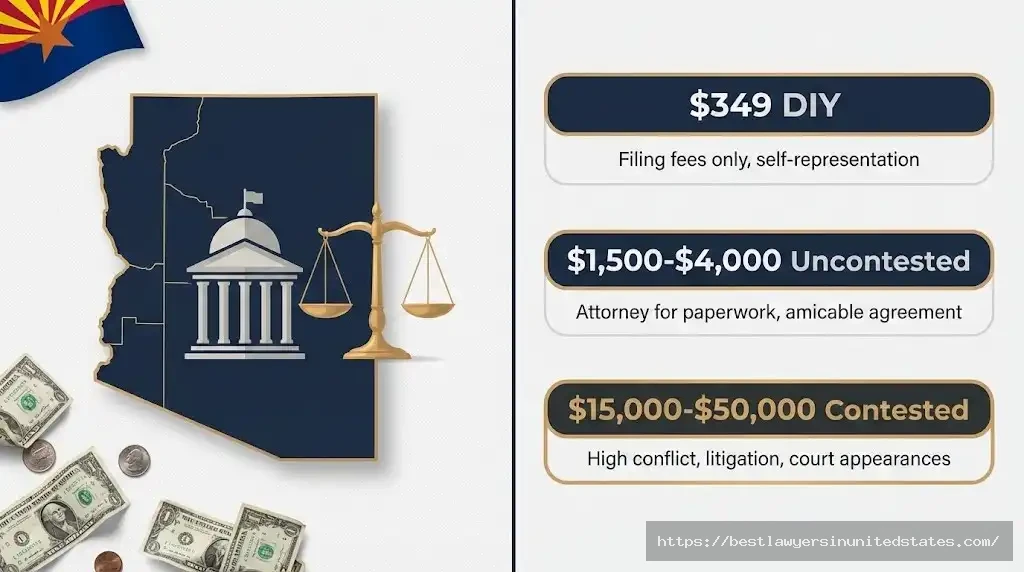
Most couples in Arizona spend between $1,500 and $15,000 on their divorce, with uncontested divorces being significantly cheaper than contested ones.
Arizona Divorce Costs at a Glance (2026)
| Divorce Type | Total Cost Range | Timeline |
|---|---|---|
| DIY Uncontested (no attorney) | $349 – $800 | 60-90 days |
| Uncontested with Attorney | $1,500 – $4,000 | 60-120 days |
| Mediation | $3,000 – $8,000 | 3-6 months |
| Collaborative Divorce | $5,000 – $15,000 | 4-9 months |
| Contested Divorce | $15,000 – $50,000+ | 12-24+ months |
Divorce Cost Calculator
Get an estimated cost for your divorce based on your specific situation
Your Estimated Divorce Cost
Cost Breakdown
📧 Get a Personalized Consultation
Have questions about your specific situation? Contact our legal experts for guidance tailored to your needs.
Contact Us via EmailWhat are the filing fees to start a divorce in Arizona?
The Maricopa County Superior Court charges $349 to file a Petition for Dissolution of Marriage in 2026. If you’re the responding spouse, the filing fee is $274.
Arizona Court Filing Fees by County (2026)
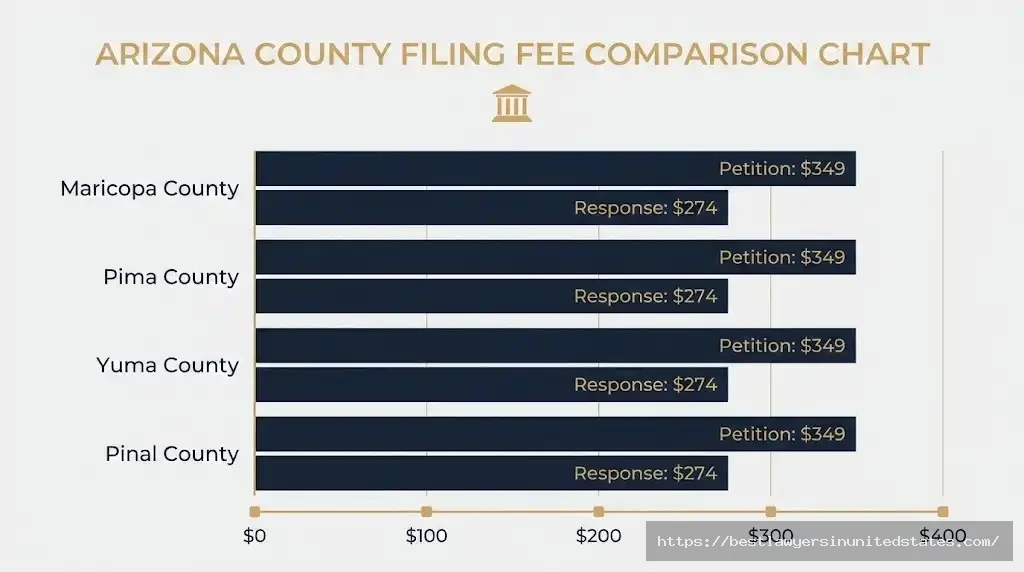
| County | Petition Filing Fee | Response Fee |
|---|---|---|
| Maricopa County | $349 | $274 |
| Pima County (Tucson) | $349 | $274 |
| Yuma County | $349 | $274 |
| Pinal County | $349 | $274 |
| Coconino County | $349 | $274 |
All Arizona counties follow the same fee structure set by the Arizona Revised Statutes. You’ll pay these fees directly to the Clerk of Superior Court when you submit your divorce papers.
Can I get the filing fee waived if I can’t afford it?
Yes. Arizona law (A.R.S. 25-324) allows you to request a fee deferral or waiver if you meet income requirements. You’ll need to complete an Application for Deferral or Waiver of Court Fees and provide proof of income.
You may qualify if:
- You receive public assistance (SNAP, TANF, Medicaid)
- Your household income is at or below 150% of the federal poverty line
- You can demonstrate genuine financial hardship
The court reviews each application individually. If approved, you can have divorce filing fees waived entirely or set up a payment plan.
How much does an uncontested divorce cost in Arizona?
An uncontested divorce in Arizona costs between $349 and $4,000 depending on whether you hire an attorney.
DIY (Pro Se) Uncontested Divorce: $349-$800
- Court filing fee: $349
- Service of process: $50-$150
- Document preparation (optional): $200-$300
- Total: $599-$800
Uncontested with Attorney: $1,500-$4,000
- Court filing fee: $349
- Flat-fee attorney services: $1,200-$3,500
- Service of process: included
- Total: $1,549-$3,849
An uncontested divorce means you and your spouse agree on all major issues: property division, child custody, spousal maintenance, and debt allocation. This is the fastest and cheapest option because it avoids court battles and extensive attorney time.
When can I file for divorce without a lawyer in Arizona?
You can handle your own divorce (called pro se representation) when:
- Both spouses agree on all terms
- You have no minor children, or you’ve agreed on a parenting plan
- Your marital assets are straightforward (no businesses, complicated retirement accounts, or extensive property)
- Neither spouse is seeking spousal maintenance, or you’ve agreed on terms
- No domestic violence or power imbalance exists
The Arizona Supreme Court website provides free divorce forms and instructions. Many people successfully complete their own uncontested divorce by following the step-by-step guides available from the Maricopa County Superior Court.
However, even in uncontested cases, consider consulting an attorney if you own real estate, have retirement accounts, or need to establish child support calculations.
How much does a contested divorce cost in Arizona?
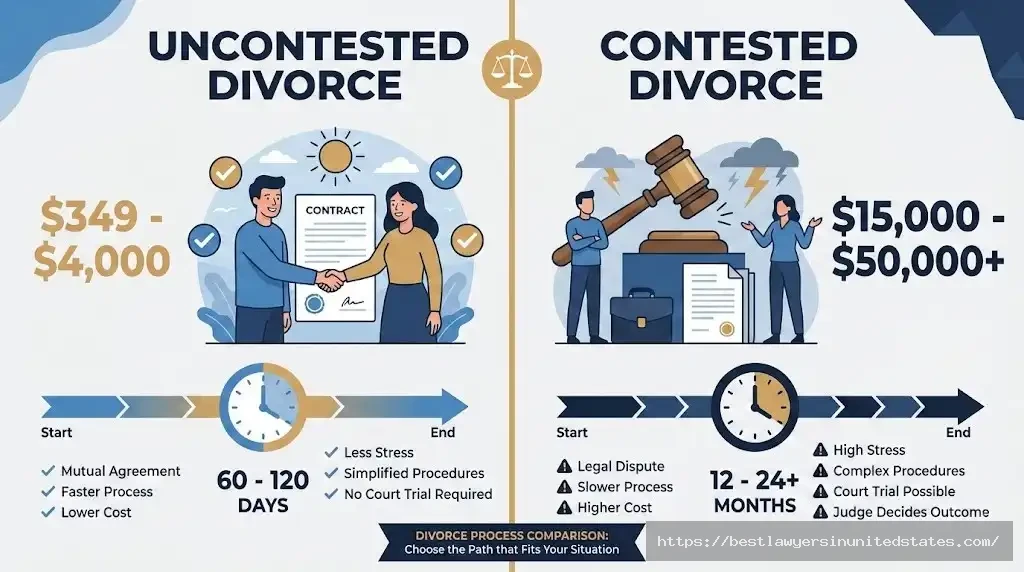
A contested divorce in Arizona typically costs $15,000 to $50,000 or more. High-conflict cases involving custody disputes, complex assets, or business valuations can exceed $100,000.
Contested Divorce Cost Breakdown
| Expense Category | Typical Cost |
|---|---|
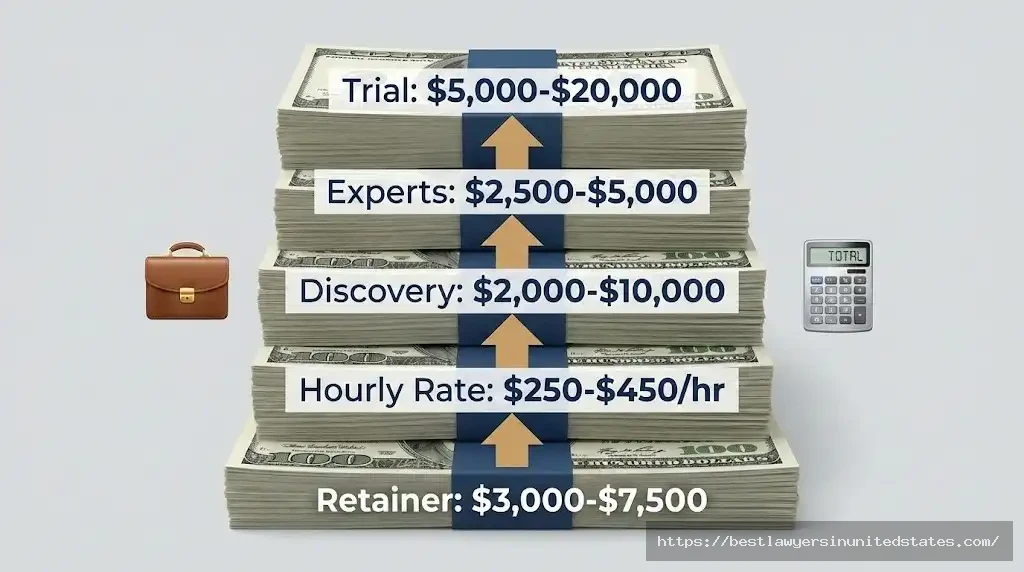
| Attorney retainer fee | $3,000 – $7,500 |
| Hourly attorney rate | $250 – $450/hour |
| Filing fees | $349 – $623 |
| Service of process | $50 – $150 |
| Discovery costs | $2,000 – $10,000 |
| Expert witnesses | $2,500 – $5,000 each |
| Court reporter/depositions | $300 – $800 per deposition |
| Parenting evaluations | $3,000 – $8,000 |
| Property appraisals | $400 – $600 |
| Business valuations | $5,000 – $25,000 |
| Trial preparation | $5,000 – $20,000 |
Most Arizona divorce attorneys charge between $250 and $450 per hour. You’ll typically pay a retainer upfront (usually $3,000-$7,500), which the attorney draws from as they work on your case.
What makes a contested divorce so expensive?
Contested divorces cost more because they require extensive legal work:
Discovery: Each side requests documents, financial records, emails, and other evidence. This process alone can cost $2,000-$10,000.
Depositions: Attorneys interview witnesses under oath, with court reporters documenting everything. Each deposition costs $300-$800.
Expert witnesses: You may need forensic accountants, real estate appraisers, child custody evaluators, or vocational experts. Each charges $2,500-$5,000 or more.
Court appearances: Every motion hearing, temporary orders hearing, and pretrial conference adds billable hours to your attorney’s time.
Trial preparation: If your case goes to trial, expect significant attorney time preparing exhibits, witness lists, and legal arguments.
How much does divorce mediation cost in Arizona?
Divorce mediation in Arizona costs between $3,000 and $8,000 for most cases. This includes multiple mediation sessions with a neutral third-party mediator who helps you and your spouse reach agreements.
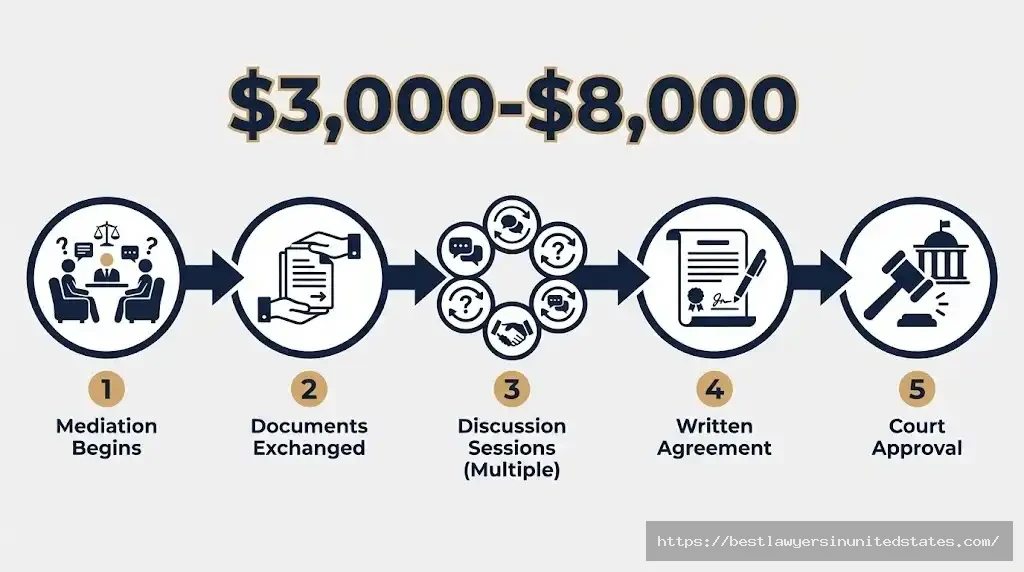
Typical Mediation Fee Structure:
- Initial session (2-3 hours): $400-$600
- Follow-up sessions: $200-$400 per hour
- Total sessions needed: 4-8 sessions
- Attorney review of mediated agreement: $500-$1,500
Mediation is significantly cheaper than litigation because you’re avoiding courtroom battles. Both spouses split the mediator’s fees, and many couples complete mediation in 3-6 months.
Is mediation required in Arizona divorces?
Maricopa County and most Arizona counties require mediation for contested issues involving children. The court may order you to attend conciliation court (a free mediation service) before proceeding to trial.
For other contested issues like property division, mediation is voluntary but highly encouraged. It’s almost always cheaper than going to trial.
What does collaborative divorce cost in Arizona?
Collaborative divorce in Arizona typically costs $5,000 to $15,000 per spouse. Both parties hire specially-trained collaborative attorneys and work together with neutral experts to reach settlement without going to court.
Collaborative Divorce Team Costs:
- Collaborative attorney fees: $250-$400/hour per attorney
- Financial neutral (accountant): $2,000-$5,000
- Child specialist: $2,000-$4,000
- Divorce coach: $150-$250/hour
- Total estimated cost: $10,000-$30,000 (combined for both spouses)
Collaborative divorce works best when both parties are committed to settling fairly and want to avoid the courtroom. If the process fails and you end up in litigation, you must hire new attorneys, which makes this option risky if your spouse isn’t fully committed.
How much do divorce attorneys charge in Arizona?
Arizona divorce attorneys charge between $250 and $450 per hour depending on their experience, location, and case complexity. You’ll also pay a retainer fee upfront.
Arizona Attorney Fee Structure
| Attorney Experience | Hourly Rate | Typical Retainer |
|---|---|---|
| New attorneys (1-3 years) | $200 – $275/hour | $2,500 – $4,000 |
| Mid-level (4-10 years) | $275 – $375/hour | $3,500 – $6,000 |
| Senior attorneys (10+ years) | $350 – $450/hour | $5,000 – $10,000 |
| Family law specialists | $400 – $500+/hour | $7,500 – $15,000 |
Flat-fee arrangements are common for uncontested divorces, typically ranging from $1,500 to $4,000 for complete representation.
What’s included in Arizona divorce attorney fees?
When you pay divorce attorney fees, you’re paying for:
- Initial consultations and case evaluation
- Document preparation (petitions, responses, motions)
- Court filings and deadline management
- Discovery (gathering evidence and financial documents)
- Negotiations with opposing counsel
- Court appearances and hearings
- Settlement discussions
- Legal advice throughout your case
Most attorneys bill in 6-minute or 15-minute increments. Even a brief phone call or email exchange gets added to your bill.
Can the court make my spouse pay my attorney fees?
Yes, under certain circumstances. Arizona courts can order one spouse to pay the other’s attorney fees if there’s a significant income disparity or if one spouse acted in bad faith.
Under Arizona Revised Statutes § 25-324, the court considers:
- Each spouse’s financial resources
- The reasonableness of positions taken during the divorce
- Whether one spouse unnecessarily increased litigation costs
- The ability of each party to pay their own fees
This happens most often when one spouse significantly out-earns the other or when one spouse uses litigation tactics to drain the other’s resources.
What are the hidden costs of divorce in Arizona?
Beyond attorney and filing fees, Arizona divorces come with additional expenses most people don’t anticipate.
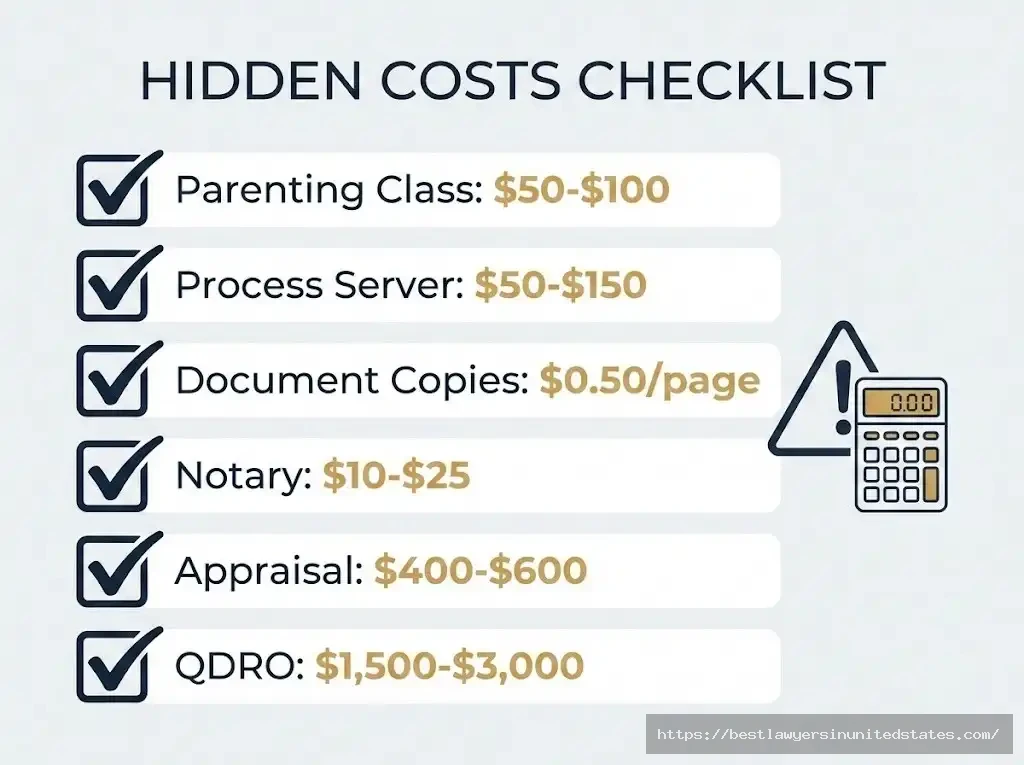
Mandatory Costs You Must Budget For
Parenting Classes (if you have children): $50-$100 Arizona law requires both parents to complete a parent education class before finalizing divorce. The course teaches co-parenting skills and takes about 3-4 hours.
Service of Process Fees: $50-$150 You must have your spouse officially served with divorce papers. A process server or sheriff’s deputy handles this.
Copies and Certified Documents: $0.50-$1.00 per page You’ll need certified copies of your divorce decree, parenting orders, and other documents for banks, schools, and government agencies.
Notary Services: $10-$25 per document Many divorce documents require notarization.
Optional But Common Costs
Real Estate Appraisal: $400-$600 If you own a home, you may need a professional appraisal to determine its value for property division.
Retirement Account Valuation: $1,500-$3,000 Dividing 401(k)s, pensions, or other retirement accounts often requires a Qualified Domestic Relations Order (QDRO), prepared by a specialized attorney.
Business Valuation: $5,000-$25,000 If either spouse owns a business, you’ll need a forensic accountant to determine its value.
Mental Health Counseling: $100-$200 per session Divorce is emotionally challenging. Many people benefit from therapy during and after the process.
Credit Report Monitoring: $0-$30/month After divorce, monitor your credit to ensure your ex-spouse isn’t opening accounts in your name.
Name Change Costs: $0-$400 If you want to return to your maiden name, Arizona allows this as part of your divorce decree at no extra cost. If you change your name later, you’ll need a separate court petition that costs around $300-$400 plus filing fees.
How much does divorce cost in Phoenix (Maricopa County)?
Divorce costs in Phoenix and Maricopa County range from $349 for DIY uncontested divorces to $50,000+ for complex contested cases.
Maricopa County-Specific Costs:
- Filing fee (petition): $349
- Filing fee (response): $274
- Process server in Phoenix: $75-$125
- Average attorney hourly rate: $275-$400
- Typical uncontested divorce with attorney: $1,800-$3,500
Maricopa County handles more divorce cases than any other Arizona county, which means the court system is well-organized with extensive self-help resources available at the Maricopa County Superior Court Self-Service Center.

How much does divorce cost in Tucson (Pima County)?
Divorce costs in Tucson and Pima County are nearly identical to Phoenix, ranging from $349 to $50,000+ depending on case complexity.
Pima County-Specific Costs:
- Filing fee (petition): $349
- Filing fee (response): $274
- Process server in Tucson: $60-$100
- Average attorney hourly rate: $250-$375
- Typical uncontested divorce with attorney: $1,500-$3,200
Attorney rates in Tucson tend to be slightly lower than Phoenix, but the difference is minimal. The Pima County Superior Court offers similar self-help resources for people representing themselves.
What’s the cheapest way to get divorced in Arizona?
The cheapest way to divorce in Arizona is a DIY uncontested divorce, which costs as little as $349 (just the filing fee).
Step-by-Step DIY Divorce Process
Step 1: Confirm You Qualify
- You and your spouse agree on all issues
- You’ve lived in Arizona for at least 90 days
- Your marriage is “irretrievably broken”
Step 2: Get the Forms Download free divorce forms from the Arizona Judicial Branch website or your local Superior Court’s self-service center.
Step 3: Complete the Paperwork You’ll need:
- Petition for Dissolution of Marriage
- Summons
- Preliminary Injunction
- Affidavit of Service
- Consent Decree (if uncontested)
- Parenting Plan (if you have children)
Step 4: File with the Court Take your completed forms to the Clerk of Superior Court in your county. Pay the $349 filing fee.
Step 5: Serve Your Spouse Have your spouse officially served with divorce papers, or have them sign an Acceptance of Service form.
Step 6: Wait 60 Days Arizona has a mandatory 60-day waiting period from the date of service before your divorce can be finalized.
Step 7: File Your Consent Decree If everything remains uncontested, submit your signed Consent Decree to the court for judge approval.
For detailed guidance on the DIY process, check out our state-by-state DIY divorce guide.
How can I reduce my divorce costs in Arizona?
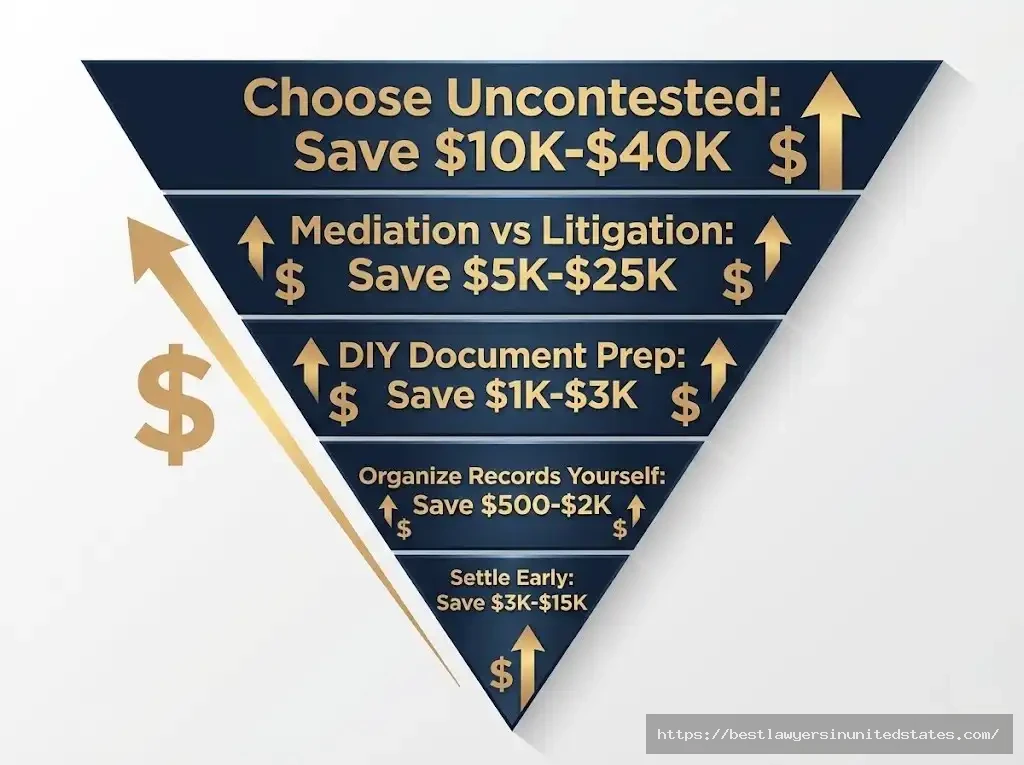
You can significantly reduce divorce costs by taking these steps:
Choose uncontested divorce when possible. This single decision can save you $10,000-$40,000. Work with your spouse to reach agreements before filing.
Use mediation instead of litigation. Even if you disagree on some issues, mediation costs $3,000-$8,000 compared to $15,000-$50,000+ for contested court battles.
Do your own document gathering. Instead of paying your attorney $300/hour to collect financial documents, organize everything yourself. Create spreadsheets of assets, debts, and income.
Communicate clearly with your attorney. Keep emails concise and save multiple questions for one phone call instead of calling repeatedly. Every interaction is billable time.
Consider unbundled legal services. Some attorneys offer “limited scope representation” where they handle specific tasks (like document review or a single court appearance) while you handle the rest. This costs less than full representation.
Settle early. The longer your divorce drags on, the more it costs. Every additional month means more attorney fees, more discovery, and more stress.
Be reasonable. Fighting over a $500 piece of furniture that will cost $2,000 in attorney fees makes no financial sense. Pick your battles carefully.
Use free resources. Take advantage of the court’s self-service centers, free legal clinics, and online resources before paying an attorney for basic information.
Real Arizona Divorce Cost Examples
These anonymized examples show what different divorce scenarios actually cost in Arizona.
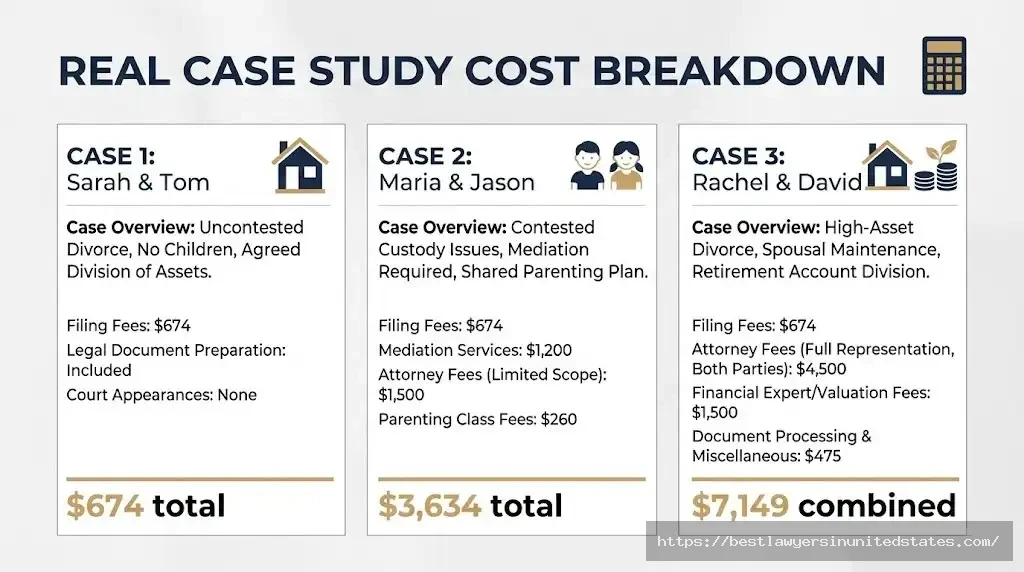
Case Study 1: Simple Uncontested Divorce – No Children
Sarah and Tom – Married 3 years, no children, minimal assets
Both agreed to separate amicably and divide their apartment furniture and small savings account on their own.
Costs:
- Court filing fee: $349
- Process server: $75
- One mediation session to finalize terms: $250
- Total: $674
Timeline: 75 days from filing to final decree
Tom handled all the paperwork himself using free court forms. Sarah signed everything voluntarily, avoiding contested hearings. They split the filing fee.
Case Study 2: Uncontested with Attorney – Young Children
Maria and Jason – Married 7 years, 2 young children
They agreed on property division and wanted joint custody, but needed help creating a proper parenting plan and child support calculation.
Costs:
- Court filing fee: $349
- Flat-fee attorney (Maria): $2,500
- Consulting attorney (Jason, 2 hours): $600
- Parenting class (both): $100
- Process server: $85
- Total: $3,634
Timeline: 90 days
Maria hired an attorney for flat-fee representation to draft all documents, calculate child support, and create a detailed parenting plan. Jason reviewed everything with his own attorney before signing. Both attended required parenting classes.
Case Study 3: Mediated Divorce – Property Disputes
Rachel and David – Married 12 years, 1 teenager, house and retirement accounts
They disagreed on how to divide their home equity and David’s 401(k), but both wanted to avoid court.
Costs (combined):
- Court filing fee: $349
- Mediation sessions (6 sessions @ $350/hour, split): $2,100 each
- Attorney review of mediated agreement (each): $1,200 each
- QDRO preparation (retirement division): $1,800
- Real estate appraisal: $500
- Parenting class (both): $100
- Total: $7,149 (combined)
Timeline: 5 months
After six mediation sessions over three months, they reached agreement on all issues. Each hired an attorney to review the final settlement before signing. They sold the house and split proceeds, then used a QDRO to divide David’s retirement account.
Case Study 4: Contested Divorce – Custody Battle
Jennifer and Mark – Married 15 years, 2 children, significant assets
Mark wanted primary custody and disputed Jennifer’s claims about his work schedule. They also disagreed on spousal maintenance and business valuation.
Jennifer’s costs:
- Retainer fee: $7,500
- Additional attorney fees: $18,500 (62 hours @ $325/hour)
- Filing fees and court costs: $500
- Custody evaluator: $4,500
- Expert witness (vocational evaluator): $3,500
- Business valuation expert: $8,000
- Deposition costs: $1,200
- Parenting class: $50
- Total: $43,750
Mark’s costs were similar: approximately $40,000
Combined total: ~$83,750
Timeline: 18 months
This case involved extensive discovery, multiple temporary orders hearings, a custody evaluation, business valuation, and two days of trial. The judge awarded joint custody with a detailed parenting time schedule, divided marital assets, and ordered Mark to pay spousal maintenance for 4 years.
Case Study 5: High-Conflict Divorce – All Issues Contested
Patricia and Robert – Married 22 years, 3 children, multiple properties and businesses
They disputed everything: custody, spousal support, property division, business valuations, and debt allocation. Robert attempted to hide assets, requiring forensic accounting.
Patricia’s costs:
- Initial retainer: $15,000
- Additional attorney fees: $67,000
- Filing fees and court costs: $1,200
- Forensic accountant: $18,000
- Custody evaluator: $6,500
- Real estate appraisals (3 properties): $1,500
- Business valuation expert: $22,000
- Vocational expert: $4,000
- Depositions (5): $3,500
- Trial preparation and trial (4 days): included in attorney fees
- Parenting class: $50
- Total: $138,750
Robert’s costs exceeded $120,000
Combined total: Over $258,000
Timeline: 2.5 years
This case involved motions for contempt, allegations of hidden assets, extensive discovery disputes, multiple expert witnesses, and four days of trial. The forensic accountant uncovered undisclosed business income, which significantly impacted the final settlement.
How long does a divorce take in Arizona?
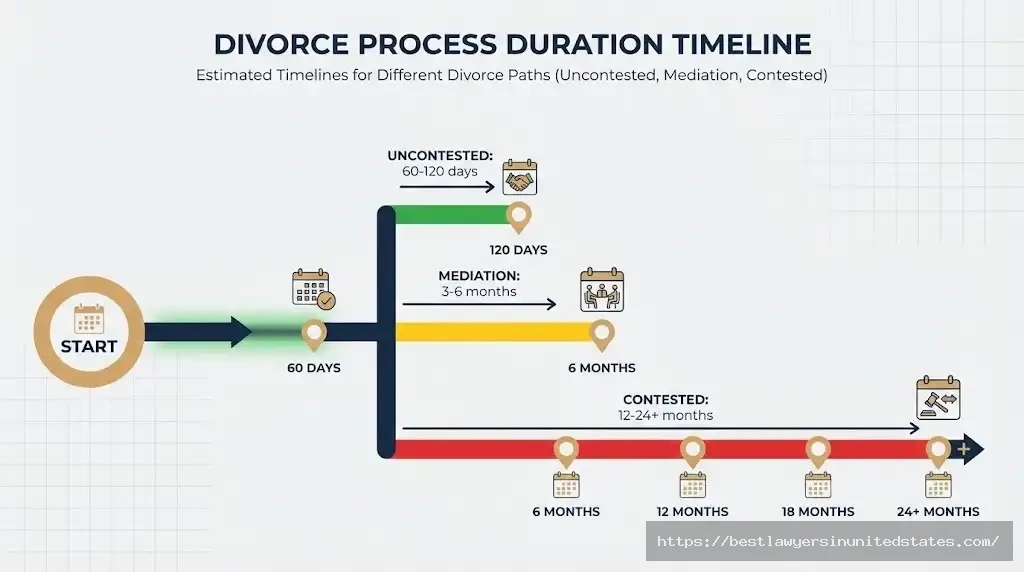
Arizona divorces take a minimum of 60 days due to the mandatory waiting period, but most take 3-18 months depending on complexity.
Typical Timeline by Divorce Type:
| Divorce Type | Average Timeline |
|---|---|
| Uncontested (no attorney) | 60-90 days |
| Uncontested (with attorney) | 60-120 days |
| Mediated divorce | 3-6 months |
| Collaborative divorce | 4-9 months |
| Contested (settled before trial) | 6-12 months |
| Contested (going to trial) | 12-24+ months |
The 60-day waiting period starts when your spouse is served with divorce papers. Even if you file together and agree on everything, you cannot finalize your divorce until this period expires.
Who pays for the divorce in Arizona?
In Arizona, each spouse typically pays their own attorney fees and costs, but the court can order one spouse to contribute to the other’s legal expenses in certain situations.
Under Arizona Revised Statutes § 25-324, judges consider:
- The financial resources of both parties
- Whether one spouse can afford legal representation while the other cannot
- Whether one party took unreasonable positions that increased costs
- The reasonableness of the attorneys’ fees charged
Courts most commonly order fee contributions when:
- One spouse earns significantly more than the other
- One spouse has greater access to marital assets
- One spouse engaged in bad faith litigation tactics
- One spouse refused reasonable settlement offers
Filing fees are paid by whoever files the paperwork. The petitioner (person filing for divorce) pays $349, while the respondent pays $274 to file a response.
What is a wife entitled to in a divorce in Arizona?
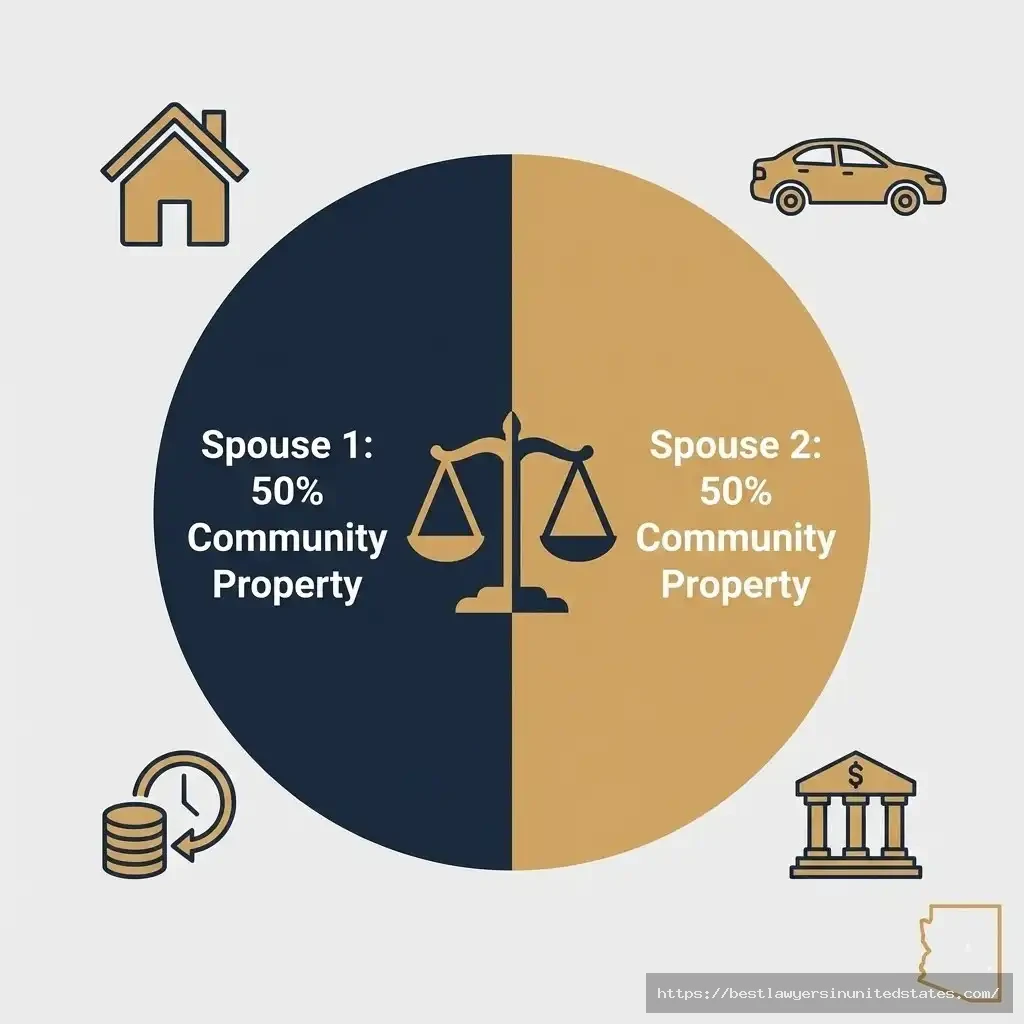
Arizona is a community property state, which means all property and debts acquired during the marriage are owned equally (50/50) by both spouses, regardless of whose name is on the title or who earned more money.
Community property includes:
- Income earned during marriage (both spouses)
- Real estate purchased during marriage
- Vehicles, furniture, and personal property bought during marriage
- Retirement accounts and pensions accrued during marriage
- Business interests created or grown during marriage
- Debt incurred during marriage
Separate property includes:
- Property owned before marriage
- Gifts or inheritances received by one spouse (even during marriage)
- Property acquired after service of divorce papers
- Property designated as separate by prenuptial agreement
The court divides community property equitably (fairly), which usually means 50/50 but can vary based on factors like:
- Length of marriage
- Each spouse’s economic circumstances
- Whether one spouse wasted marital assets
- Tax consequences of the division
Neither gender receives preferential treatment. Arizona law doesn’t favor wives over husbands or vice versa.
Is everything split 50/50 in a divorce in Arizona?
Generally yes, but not always. Arizona law presumes a 50/50 split of all community property, but judges can deviate from this if circumstances warrant.
Courts may order an unequal division when:
- One spouse wasted marital assets (gambling, affairs, reckless spending)
- One spouse hid or destroyed property
- One spouse has significantly greater earning capacity
- The marriage was very short
- One spouse committed domestic violence
- One spouse has excessive separate property
Even when the overall division isn’t exactly 50/50, it’s typically close. A 60/40 or 55/45 split is more common than a 70/30 division.
Debt is also divided equally. If you have $50,000 in credit card debt accumulated during marriage, you’re each responsible for $25,000, even if only one person’s name is on the cards.
What is the Rule of 65 in Arizona divorce?
The Rule of 65 refers to spousal maintenance (alimony) eligibility in Arizona. When one spouse’s age plus years of marriage equals or exceeds 65, the court presumes that spouse should receive spousal maintenance until retirement age or death.
Example: A 45-year-old spouse married for 20 years meets the Rule of 65 (45 + 20 = 65) and may be entitled to longer-term spousal maintenance.
This isn’t an automatic guarantee of spousal support, but it creates a presumption that the court will consider. Other factors matter too:
- Each spouse’s earning capacity
- Standard of living during marriage
- Age and health of both spouses
- Duration of the marriage
- Financial resources and separate property
- Contribution to the other spouse’s earning ability
Arizona courts can award temporary, transitional, or permanent spousal maintenance depending on the circumstances.
Frequently Asked Questions About Arizona Divorce Costs
How much does a divorce cost in Arizona if both parties agree?
An uncontested divorce where both parties agree costs $349 to $4,000 in Arizona. The court filing fee is $349, and if you hire an attorney for flat-fee representation, expect to pay $1,500-$4,000 total. Many couples handle uncontested divorces themselves for under $800 including all filing and service fees.
What is the cheapest way to get a divorce in Arizona?
The cheapest divorce option is filing yourself (pro se) for an uncontested case. This costs only $349 for the court filing fee. You’ll need to complete divorce forms yourself, serve your spouse, and finalize everything without an attorney. This works best when both parties agree on all terms and have no children or complex assets.
Can I get a free divorce in Arizona?
While no divorce is completely free, you can get close if you qualify for a fee waiver under A.R.S. 25-324. If you receive public assistance or meet income requirements (usually at or below 150% of federal poverty level), the court may waive filing fees entirely. You’ll still need to pay for service of process unless you can have your spouse sign an Acceptance of Service.
How long do you have to be married to get alimony in Arizona?
Arizona has no minimum marriage length for spousal maintenance eligibility, but longer marriages are more likely to result in alimony awards. Courts consider marriage duration as one factor among many. Short marriages (under 5 years) rarely result in long-term spousal maintenance unless there are exceptional circumstances.
Do you have to be separated for a year to get a divorce in Arizona?
No. Arizona has no separation requirement. You can file for divorce immediately if you’ve lived in Arizona for at least 90 days and your marriage is “irretrievably broken.” However, Arizona does have a mandatory 60-day waiting period from the date of service before your divorce can be finalized.
Can you date while separated in Arizona?
Technically yes, since Arizona doesn’t require legal separation before divorce. However, dating during divorce proceedings can complicate your case. It may affect custody decisions if you’re introducing new partners to your children, and it can create conflict that makes settlement more difficult. Many divorce attorneys advise waiting until your divorce is final.
How much does it cost to file for divorce in Maricopa County?
Filing for divorce in Maricopa County costs $349 for the petitioner (person filing) and $274 for the respondent (person responding). These fees are paid to the Maricopa County Superior Court Clerk’s office. You may qualify for fee deferral or waiver if you meet income requirements.
Can I use an online divorce service in Arizona?
Yes, several online divorce services operate in Arizona, typically charging $150-$500 to prepare your divorce paperwork. These services work best for simple, uncontested cases. However, online services don’t provide legal advice and can’t represent you in court. They’re essentially document preparation services. For complex cases or contested issues, hire a licensed Arizona attorney instead.
Do I need an attorney for an uncontested divorce in Arizona?
No, you don’t legally need an attorney for an uncontested divorce. Many couples successfully complete the process themselves using free court forms and self-help resources. However, consider consulting an attorney if you have:
- Children (need proper parenting plan and child support calculation)
- Real estate or significant assets
- Retirement accounts to divide
- A business or complex finances
- Any concerns about fairness of the agreement
Even a brief attorney consultation (1-2 hours at $250-$400/hour) can ensure you’re not missing important issues.
How much does a QDRO cost in Arizona?
A Qualified Domestic Relations Order (QDRO) to divide retirement accounts in Arizona costs $1,500 to $3,000. This specialized legal document is prepared by an attorney familiar with retirement plan rules and must be approved by both the court and the plan administrator. Some attorneys include QDRO preparation in their divorce representation, while others charge separately.
What happens if I can’t afford to pay for a divorce?
If you can’t afford divorce costs, you have several options:
Apply for a fee waiver under A.R.S. 25-324 to eliminate court filing fees.
Use free legal resources like the Maricopa County Superior Court Self-Service Center or Pima County Law Library.
Contact Legal Aid organizations like Community Legal Services or DNA – People’s Legal Services for free representation if you qualify based on income.
Request attorney fee contribution from your spouse. If your spouse earns significantly more or has greater access to marital funds, the court may order them to pay part of your attorney fees.
Consider unbundled services where an attorney handles only specific tasks you can’t do yourself, reducing overall costs.
Can my spouse refuse to sign divorce papers in Arizona?
Your spouse cannot prevent you from getting divorced in Arizona. If they refuse to sign or participate, you can proceed with a default divorce. After serving your spouse properly and waiting 60 days, you can request a default judgment if they never respond. The court will grant your divorce even without their cooperation.
How is child support calculated in Arizona?
Arizona uses specific child support guidelines based on both parents’ gross income, the number of children, and the parenting time schedule. The state provides an online Arizona Child Support Calculator that factors in:
- Both parents’ gross monthly income
- Number of children
- Number of days each parent has physical custody
- Cost of health insurance
- Childcare expenses
- Other child support obligations
The calculation is complex but relatively standardized. Most attorneys and the court use the same calculator to determine support amounts.
What disqualifies you from alimony in Arizona?
While no specific factors automatically disqualify you from spousal maintenance, these circumstances make it unlikely:
- Very short marriage (under 3-5 years)
- Sufficient separate property or income to support yourself
- Ability to become self-supporting through employment
- Spouse’s inability to pay (no income or assets)
- Marriage ended due to your domestic violence or adultery (judge discretion)
Arizona courts look at the totality of circumstances. Even if some factors weigh against spousal maintenance, others might support it.
Can you get a divorce without going to court in Arizona?
Yes, in most uncontested cases. If you and your spouse agree on all terms and file a Consent Decree, you typically don’t need to appear before a judge. The judge reviews your paperwork and signs the decree without a hearing. However, some counties require brief appearances even for uncontested cases, and any contested issues will require court hearings.
How much does it cost to change your name after divorce in Arizona?
If you include name change in your divorce decree, it’s free. The divorce petition asks if you want to restore your former name, and if you request it, the final decree includes this change at no additional cost.
If you decide to change your name after your divorce is finalized, you’ll need to file a separate Petition for Change of Name, which costs approximately $300-$400 in filing fees plus additional costs for publication (required in most Arizona counties) of around $100-$150.
Does Arizona recognize legal separation?
Yes. Arizona offers legal separation as an alternative to divorce. The process and costs are nearly identical to divorce (same $349 filing fee), but you remain legally married. Legal separation divides property, establishes custody, and addresses support issues just like divorce, but doesn’t terminate the marriage.
Couples choose legal separation for religious reasons, to maintain health insurance benefits, or when they’re unsure about divorce. You can convert a legal separation to divorce later by filing a simple motion.
Who keeps the house in a divorce in Arizona?
Since Arizona is a community property state, the house is typically considered jointly owned if purchased during the marriage. Several outcomes are possible:
Sell the house and split proceeds 50/50 – Most common when neither can afford it alone or both want fresh starts.
One spouse buys out the other’s share – The keeping spouse refinances and pays the other spouse half the equity.
Continue co-owning temporarily – Sometimes couples keep the house until children graduate, then sell.
Award to one spouse with offsetting assets – One keeps the house, the other gets retirement accounts or other property of equal value.
The court considers factors like who has primary custody of children, who can afford the mortgage, and each spouse’s attachment to the home.
What is the 60-day waiting period in Arizona?
Arizona law requires a mandatory 60-day waiting period from the date your spouse is served with divorce papers until the court can finalize your divorce. This cooling-off period gives couples time to reconsider and ensures decisions aren’t made hastily.
The 60 days starts when:
- Your spouse is personally served by a process server, OR
- Your spouse signs an Acceptance of Service
Even if you both agree on everything and file jointly, you must wait the full 60 days. No exceptions exist, even for emergency situations.
Can I represent myself in a contested divorce?
Yes, you have the right to represent yourself (pro se) even in contested cases, but it’s generally not advisable. Contested divorces involve complex legal procedures, rules of evidence, and courtroom protocols that most people don’t understand.
Risks of self-representation in contested cases:
- Missing critical deadlines that could cost you rights or assets
- Failing to properly present evidence
- Not knowing how to cross-examine witnesses
- Accepting unfair settlement terms
- Making procedural mistakes that weaken your case
If you absolutely cannot afford an attorney, contact Legal Aid organizations, seek unbundled legal services for critical tasks, and use all available court self-help resources.
How much does a divorce cost with a child in Arizona?
Divorces involving children cost $500 to $50,000+ depending on whether custody is contested. An uncontested divorce with agreed parenting plan costs $500-$4,000. Contested custody battles can exceed $50,000 per parent.
Additional child-related costs include:
- Parenting classes: $50-$100 (mandatory for both parents)
- Custody evaluation: $3,000-$8,000
- Child therapist testimony: $2,000-$4,000
- Guardian ad litem: $2,500-$10,000
- Parenting coordinator: $150-$300/hour
Child custody disputes are often the most expensive part of divorce because emotions run high and parents are less willing to compromise.
What is the average cost of a divorce lawyer in Arizona?
The average Arizona divorce lawyer charges $250-$400 per hour with typical retainers of $3,000-$7,500. Total costs vary enormously:
- Simple uncontested (flat fee): $1,500-$4,000
- Moderate complexity: $5,000-$15,000
- Highly contested: $15,000-$50,000+
Phoenix and Scottsdale attorneys generally charge more than those in smaller Arizona cities. Attorney experience and specialization also affect rates significantly.
Can I get spousal support if I cheated in Arizona?
Arizona is a no-fault divorce state, which means adultery doesn’t automatically disqualify you from spousal maintenance. However, judges have discretion and may consider marital misconduct when determining spousal support amounts and duration.
If you spent significant marital assets on an affair (gifts, travel, apartments for a paramour), the court may consider this “waste” of community property and adjust property division accordingly. But adultery alone doesn’t bar spousal maintenance if you otherwise qualify based on income, earning capacity, and marriage length.
How do I start the divorce process in Arizona?
Step 1: Meet residency requirements – You or your spouse must have lived in Arizona for at least 90 days.
Step 2: Gather financial documents – Collect tax returns, pay stubs, bank statements, retirement account statements, mortgage documents, credit card statements, and vehicle titles.
Step 3: Complete divorce forms – Download forms from the Arizona Courts website or your county’s Superior Court self-service center. Key forms include Petition for Dissolution of Marriage, Summons, and Preliminary Injunction.
Step 4: File with the court – Take your completed forms to the Clerk of Superior Court in your county and pay the $349 filing fee.
Step 5: Serve your spouse – Have your spouse officially served with copies of all filed documents within 120 days of filing. Use a process server or sheriff’s deputy (costs $50-$150).
Step 6: Wait for response – Your spouse has 20 days to respond if served in Arizona, 30 days if served out of state.
Step 7: Negotiate settlement or proceed to court – Try to reach agreement on all issues. If unsuccessful, proceed through temporary orders, discovery, and eventually trial.
For detailed guidance specific to your situation, consider consulting with an Arizona family law attorney for at least an initial consultation.
Understanding Arizona Community Property Division
Arizona follows community property law, treating all marital assets and debts as equally owned by both spouses. This differs from equitable distribution states where courts divide property based on fairness rather than ownership percentages.
What counts as community property?
All income earned during marriage becomes community property the moment it’s received. This includes:
- Wages, salaries, bonuses, and commissions
- Business income from companies started or grown during marriage
- Investment income from community assets
- Pension and retirement benefits accrued during marriage
- Stock options and deferred compensation earned during marriage
All property purchased with community funds is community property regardless of whose name appears on the title:
- Real estate (homes, rental properties, land)
- Vehicles, boats, recreational vehicles
- Furniture, jewelry, art, collectibles
- Bank accounts, investment accounts, cryptocurrency
- Business interests and professional practices
What remains separate property?
Property owned before marriage stays separate if kept separate throughout the marriage. A house you owned before marrying remains yours if you never added your spouse to the deed or refinanced during marriage.
Gifts and inheritances remain separate property even if received during marriage, as long as you keep them separate and don’t commingle them with marital funds.
Personal injury awards for your pain and suffering (but not lost wages) are separate property.
The commingling problem
The biggest challenge in Arizona divorces is commingling – when separate property gets mixed with community property. Common examples:
Depositing inheritance into a joint bank account converts it to community property in most cases.
Using marital income to pay the mortgage on a separate property home may create a community interest in the home’s appreciation.
Adding your spouse to the title of your separate property vehicle makes it community property.
Once commingling occurs, proving separate property ownership becomes difficult and expensive, often requiring forensic accountants to trace funds.
Arizona Spousal Maintenance Explained
Spousal maintenance (called alimony in some states) isn’t automatic in Arizona. The requesting spouse must prove:
- Lack of sufficient property to provide for their reasonable needs
- Inability to be self-sufficient through appropriate employment, OR
- Contribution to the other spouse’s education that enhanced earning capacity, OR
- Long marriage where age makes employment difficult, OR
- Significantly reduced income due to custody of a child
Types of spousal maintenance in Arizona
Temporary maintenance – Support ordered during divorce proceedings, ending when the divorce finalizes.
Transitional maintenance – Short-term support to help the receiving spouse become self-sufficient. Common after medium-length marriages (8-15 years).
Long-term maintenance – Ongoing support lasting years or until retirement. More common after long marriages (15+ years) or when the receiving spouse cannot become self-supporting due to age or disability.
Permanent maintenance – Rare, typically reserved for very long marriages where the receiving spouse is elderly or disabled.
How much is spousal maintenance in Arizona?
Unlike child support, Arizona has no formula for calculating spousal maintenance. Courts consider:
- Standard of living during marriage
- Duration of marriage
- Age and health of both spouses
- Earning capacity of both spouses
- Income sources (including property awarded in divorce)
- Financial resources of both parties
- Contribution of each spouse to earning capacity of the other
- Ability of the paying spouse to pay while meeting their own needs
Typical spousal maintenance ranges from $500 to $3,000 per month depending on these factors. High-income earners may pay significantly more.
Can spousal maintenance be modified?
Yes, either party can request modification if there’s been a substantial and continuing change in circumstances. Common reasons for modification:
- Paying spouse loses job or has significant income reduction
- Receiving spouse remarries or cohabitates with a romantic partner
- Receiving spouse’s income substantially increases
- Paying spouse retires at reasonable retirement age
Changes must be significant and permanent, not temporary fluctuations.
Protecting Your Financial Interests During Divorce
Going through divorce requires strategic financial planning to protect your interests and avoid costly mistakes.
Immediate financial steps to take
Document everything before filing – Copy all financial records including:
- Three years of tax returns
- Recent pay stubs and W-2s
- Bank statements (all accounts, last 12 months)
- Investment and retirement account statements
- Credit card statements
- Mortgage documents and home appraisal
- Vehicle titles and loan documents
- Business financial records
- Insurance policies
Open individual bank account – Open an account in your name only (at a different bank) and redirect your paycheck. You can use community funds as needed, but maintain transparency.
Check your credit report – Get free reports from all three bureaus (Equifax, Experian, TransUnion) to identify all debts and ensure your spouse hasn’t opened accounts in your name.
Close joint credit cards – Contact credit card companies to close joint accounts or convert them to individual accounts. This prevents your spouse from running up debt you’re partially responsible for.
Change passwords – Update passwords on all financial accounts, email, social media, and cloud storage. Use unique, strong passwords for each account.
Inventory household contents – Photograph or video record all personal property, furniture, artwork, jewelry, and valuables. Note approximate values and purchase dates.
Understanding the automatic preliminary injunction
When you file for divorce in Arizona, an Automatic Preliminary Injunction takes effect, prohibiting both spouses from:
- Transferring, hiding, or disposing of community property (except in the usual course of business)
- Withdrawing unusual amounts from accounts or taking excessive cash advances
- Canceling or changing beneficiaries on insurance policies
- Changing or terminating utility services to the family home
- Disturbing the peace of the other party or children
Violating these orders can result in serious consequences including contempt of court charges and attorney fee sanctions.
The discovery process
Discovery is the legal process where each spouse requests financial information from the other. Arizona allows several discovery methods:
Interrogatories – Written questions the other party must answer under oath. Typical questions ask about employment, income sources, assets, debts, and spending.
Requests for Production – Formal demands for documents like tax returns, bank statements, pay stubs, retirement account statements, and business records.
Requests for Admission – Statements you ask the other party to admit or deny, used to establish basic facts without lengthy proof.
Depositions – In-person testimony under oath where attorneys question you, your spouse, or witnesses. Court reporters document everything.
Subpoenas – Court orders demanding documents or testimony from third parties like banks, employers, or financial advisors.
Discovery is expensive ($2,000-$10,000+ in complex cases) but essential in contested divorces where one spouse suspects hidden assets or dishonesty about income.
When to Hire a Divorce Attorney in Arizona
Not every divorce requires an attorney, but certain situations demand professional legal representation.
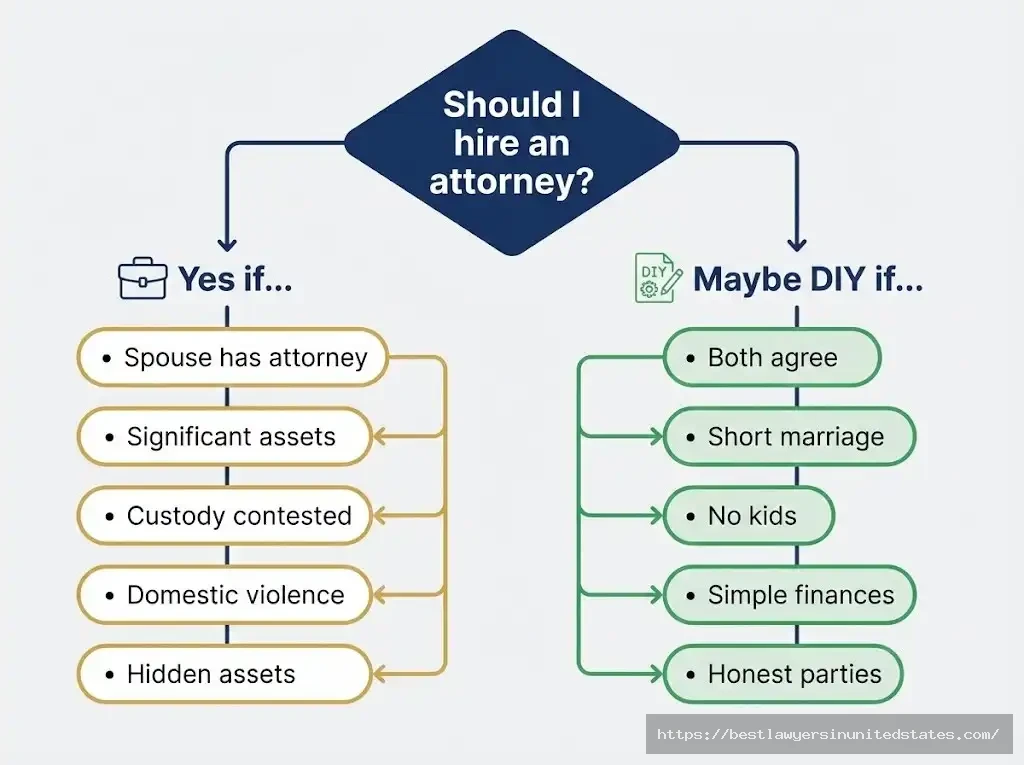
Hire an attorney when:
Your spouse has an attorney – Facing a represented opponent while unrepresented puts you at significant disadvantage.
Significant assets are involved – If you own real estate, businesses, extensive retirement accounts, or substantial investments, attorney guidance prevents costly mistakes.
Custody is contested – Fighting for custody or defending against custody challenges requires legal expertise. Mistakes can cost you time with your children.
Domestic violence is present – If you’ve experienced domestic abuse, an attorney can help obtain protective orders and ensure your safety throughout proceedings.
Your spouse is hiding assets – Suspicions of hidden income, undisclosed accounts, or transferred property require attorney investigation and discovery.
Complex income situations exist – Self-employment, business ownership, irregular income, or cryptocurrency holdings complicate financial disclosures.
You don’t understand the process – If court procedures, legal terminology, and paperwork overwhelm you, attorney guidance prevents critical errors.
Significant property disputes exist – Disagreements about what’s community vs. separate property, valuation disputes, or debt allocation conflicts need legal resolution.
When DIY might work:
Both parties agree on everything – True uncontested divorces with full agreement on all issues can be handled without attorneys.
Short marriage with minimal assets – Marriages under 5 years with no real estate, no children, and simple finances are good DIY candidates.
Both parties are honest and cooperative – If you trust your spouse to fully disclose finances and negotiate fairly, DIY becomes viable.
No children involved – Eliminating custody and child support complexity makes DIY more manageable.
You’re comfortable with paperwork – If you follow instructions well and don’t mind detailed forms, self-representation is possible.
Even in DIY-appropriate situations, consider paying for a one-hour legal consultation ($250-$400) to review your agreement before filing.
Arizona Divorce Timeline and Process
Understanding the divorce process helps you plan realistically and budget appropriately.
Uncontested divorce timeline
Weeks 1-2: Preparation and filing
- Gather financial documents
- Complete divorce forms
- File petition with court ($349)
- Serve spouse with papers
Week 3: Spouse’s response
- Spouse has 20 days to respond (if served in Arizona)
- If already in agreement, spouse signs Acceptance of Service
- Both parties complete financial disclosures
Weeks 4-8: Negotiation and paperwork
- Finalize parenting plan (if applicable)
- Complete property division worksheet
- Draft Consent Decree
- Calculate child support (if applicable)
Week 9: Submit final documents
- File signed Consent Decree with court
- Wait for 60-day period to expire
- Submit Decree of Dissolution for judge’s signature
Week 10+: Final decree
- Judge reviews and signs decree
- File copies with court
- Obtain certified copies
- Total time: 60-90 days minimum
Contested divorce timeline
Months 1-2: Initial filings
- File Petition for Dissolution
- Serve spouse
- Spouse files Response
- Exchange preliminary financial disclosures
- Attend Preliminary Pretrial Conference
Months 2-4: Temporary orders
- File motions for temporary orders (custody, support, exclusive use of home)
- Attend temporary orders hearings
- Receive temporary orders establishing status quo during divorce
Months 3-8: Discovery
- Serve interrogatories and document requests
- Respond to spouse’s discovery
- Conduct depositions
- Hire experts (appraisers, accountants, custody evaluators)
- Subpoena third-party records
Months 6-10: Mediation attempts
- Attend court-ordered mediation
- Attempt settlement negotiations
- Exchange settlement proposals
Months 10-15: Trial preparation
- Complete all discovery
- Identify witnesses
- Prepare exhibits
- Attend final pretrial conference
- File trial memorandums
Months 12-18+: Trial
- Attend trial (typically 1-4 days)
- Present evidence and witnesses
- Closing arguments
- Await judge’s decision (can take weeks)
- Receive final decree
Total time: 12-24+ months for contested divorces
Cost Comparison: Arizona vs. Other States
How do Arizona divorce costs compare nationally?
| State | Average Uncontested Cost | Average Contested Cost | Filing Fee |
|---|---|---|---|
| Arizona | $1,500 – $4,000 | $15,000 – $50,000 | $349 |
| California | $1,700 – $5,000 | $17,000 – $30,000 | $435 |
| Texas | $1,200 – $3,500 | $15,000 – $23,000 | $300 |
| Florida | $1,500 – $4,500 | $12,000 – $28,000 | $409 |
| New York | $2,000 – $5,500 | $17,000 – $35,000 | $335 |
Arizona’s divorce costs fall in the middle range nationally. Community property states like California and Texas have similar cost structures, while equitable distribution states vary more widely.
The main cost drivers in Arizona are:
- Attorney hourly rates ($250-$450)
- Discovery expenses in contested cases
- Expert witness fees
- Court-required evaluations and classes
Taking the Next Step
If you’re considering divorce in Arizona, start by assessing your situation honestly:
Can you and your spouse reach agreement? If yes, you’ll save $10,000-$40,000 by pursuing an uncontested divorce or mediation.
Do you have complex finances or assets? If yes, invest in attorney guidance even if you’re amicable. The cost of mistakes often exceeds attorney fees.
Are children involved? If yes, prioritize getting the parenting plan and child support calculations right. These affect your children for years.
Can you afford representation? If no, explore fee waivers, legal aid organizations, and unbundled legal services.
Use our free divorce cost calculator to estimate your specific situation. The calculator considers your county, case complexity, and representation choices to provide a personalized cost range.
For more guidance on reducing expenses, read our comprehensive guide on how to lower divorce costs nationwide.
Remember: the cheapest divorce isn’t always the best divorce. Protecting your financial future, ensuring fair asset division, and establishing appropriate custody arrangements often justifies the investment in qualified legal help.