
Quick Answer: A divorce in Utah typically costs between $2,500 and $25,000+. An uncontested divorce averages $3,000–$5,000, while a contested divorce ranges from $15,000–$30,000 or more depending on complexity and attorney involvement.
Divorce Cost Calculator
Get an estimated cost for your divorce based on your specific situation
Your Estimated Divorce Cost
Cost Breakdown
📧 Get a Personalized Consultation
Have questions about your specific situation? Contact our legal experts for guidance tailored to your needs.
Contact Us via EmailGetting divorced in Utah doesn’t have to drain your savings, but costs vary dramatically based on whether you and your spouse can agree. The biggest factor? Whether your divorce is contested or uncontested. Utah’s court filing fees start at $318, but that’s just the beginning. Attorney fees, mediation costs, parenting classes, and hidden expenses can quickly multiply your total spend.

This guide breaks down every cost you’ll face in a Utah divorce—from Salt Lake County filing fees to what you’ll actually pay an attorney per hour. We’ll also show you legitimate ways to reduce costs without sacrificing your legal rights.
What Does a Utah Divorce Actually Cost?
Here’s what you’ll pay based on your divorce type:
| Divorce Type | Total Cost Range | What’s Included |
|---|---|---|
| DIY Uncontested (No Attorney) | $318–$600 | Court filing fees, service costs, parenting class |
| Uncontested with Attorney | $2,500–$5,000 | Filing fees, flat-fee attorney, document prep |
| Uncontested with Children | $3,500–$6,500 | Above + parenting plan, child support calculations |
| Contested (Moderate) | $15,000–$25,000 | Retainer, hourly fees, mediation, court appearances |
| High-Conflict/High-Asset | $30,000–$100,000+ | Extended litigation, expert witnesses, custody evaluations |
The average Utah divorce costs around $13,200 according to recent state data, but that includes both simple and complex cases. Your actual cost depends on five key factors we’ll cover next.
Utah Divorce Filing Fees by County

Utah Code §78A-2-301 sets standard court filing fees, but some counties charge additional processing costs:
| County | Petition Filing Fee | Response Filing Fee |
|---|---|---|
| Salt Lake County | $318 | $0 (if responding only) |
| Utah County | $318 | $0 |
| Davis County | $318 | $0 |
| Weber County | $318 | $0 |
| Washington County | $318 | $0 |
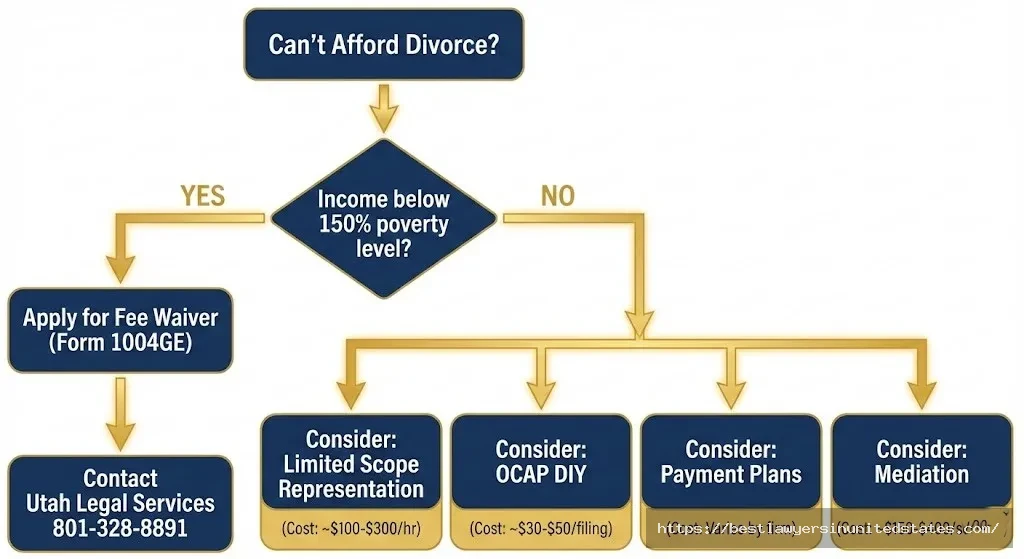
Fee Waiver Option: If your income is below 150% of the federal poverty level, you can request a fee waiver using Form 1004GE. The court will waive filing fees if you qualify based on income, public assistance, or financial hardship.
Additional court costs you’ll encounter:
- Service of process: $75–$150 (sheriff or private process server)
- Decree certification: $25–$35 per certified copy
- Motion filing fees: $30–$50 per motion (if filing requests after initial petition)
How Much Does a Divorce Lawyer Cost in Utah?
Divorce attorney fees in Utah vary by experience, location, and case complexity.

Hourly Rate Breakdown:
- Entry-level attorneys (1–5 years): $200–$275/hour
- Mid-level attorneys (6–15 years): $275–$375/hour
- Senior/specialized attorneys (15+ years): $375–$500/hour
- Rural areas (outside Wasatch Front): $175–$300/hour
Retainer Fees: Most Utah divorce attorneys require an upfront retainer—a deposit against future work:
- Uncontested divorce retainer: $2,000–$3,500 (often flat fee)
- Contested divorce retainer: $5,000–$15,000
- High-conflict divorce retainer: $15,000–$25,000+
Your attorney bills against this retainer hourly. If your case settles quickly, you may get a partial refund. Complex cases that exceed the retainer require additional payments.
Flat Fee Options: Some Utah attorneys offer flat-fee uncontested divorces:
- No children, no property: $1,500–$2,500
- With children or property division: $2,500–$4,000
- Includes: Document preparation, filing, court appearance (if required)
Uncontested vs. Contested Divorce: The Cost Difference
The single biggest factor affecting your Utah divorce cost is whether it’s contested or uncontested.

Uncontested Divorce Costs
An uncontested divorce means you and your spouse agree on all major issues: property division, debt allocation, child custody (if applicable), child support, and alimony. These divorces typically cost $2,500–$5,000 total with an attorney, or as little as $318–$600 if you handle it yourself using Utah’s OCAP system.
What you’ll pay:
- Court filing fee: $318
- Attorney flat fee: $1,500–$4,000 (optional)
- Service costs: $75–$150
- Parenting class (if children): $40–$60 per parent
- Mediation (if needed to finalize agreement): $200–$400/hour
Timeline: 30–90 days after filing (Utah requires a 30-day waiting period minimum)
Contested Divorce Costs
A contested divorce means you disagree on custody, property, support, or other issues. These require court intervention, attorney negotiation, and potentially a trial. Costs escalate quickly.
What you’ll pay:
- Initial retainer: $5,000–$15,000
- Ongoing attorney fees: $200–$500/hour
- Divorce mediation: $200–$400/hour (2–6 sessions typical)
- Discovery costs: $1,000–$5,000 (depositions, document requests)
- Expert witnesses: $3,000–$10,000+ (custody evaluators, appraisers, forensic accountants)
- Trial preparation: $5,000–$15,000
- Court time: $400–$500/hour for attorney appearance
Timeline: 6–18+ months
Real scenario: A contested divorce with moderate assets and custody dispute in Salt Lake County averages $18,000–$22,000 per party. If both spouses hire aggressive attorneys and refuse mediation, costs can exceed $40,000 each.
Hidden Costs No One Tells You About
These expenses catch people off guard:

During the Divorce:
- Parenting education class: $40–$60 per parent (mandatory under Utah Code §30-3-11.3 if you have minor children)
- Temporary orders filing: $30–$50 if you need emergency custody or support orders
- Domestic violence protective order: No fee if needed for safety
- Document copying/notarization: $50–$200 (financial disclosures, asset documentation)
- Property appraisals: $300–$600 for home, $150–$300 for vehicles
- Retirement account valuations: $500–$2,000 for QDRO preparation
- Business valuations: $5,000–$25,000+ if you own a business
- Custody evaluation: $3,000–$8,000 (court-ordered psychological assessment)
After the Divorce:
- Decree modifications: $1,500–$5,000 when life circumstances change
- Contempt proceedings: $2,000–$7,000 to enforce court orders
- Appeals: $10,000–$30,000+ if you disagree with the judge’s ruling
- Name change processing: $25–$50 (separate from divorce decree)
- Refinancing costs: $2,000–$4,000 to remove spouse from mortgage
- Estate planning updates: $500–$1,500 (new will, beneficiary changes)
How Can I Get a Divorce When I Can’t Afford One?
You have several options if money is tight:
1. Fee Waivers
Utah courts waive filing fees for qualifying low-income filers. You’ll complete Form 1004GE (Affidavit of Impecuniosity) and demonstrate financial hardship through:
- Income below 150% of federal poverty level
- Receipt of public assistance (SNAP, Medicaid, SSI)
- Financial hardship documentation
Income thresholds for 2026:
- Individual: Below $22,590/year
- Family of 2: Below $30,660/year
- Family of 4: Below $46,800/year
If approved, the court waives the $318 filing fee and other court costs.
2. Legal Aid Services
Utah Legal Services provides free representation to qualifying low-income residents:
- Income limit: Generally 125% of poverty level
- Services: Full divorce representation for domestic violence victims, limited help for others
- Contact: 801-328-8891 or utahlegalservices.org
Legal Aid Society of Salt Lake offers similar services in Salt Lake County.
3. Pro Bono Programs
The Utah State Bar’s Pro Bono Initiative connects low-income individuals with volunteer attorneys. Availability is limited, but you may qualify for free representation if you meet income guidelines and have a compelling case.
4. Limited Scope Representation
Also called “unbundled services,” this lets you hire an attorney for specific tasks only:
- Document review: $300–$800 (attorney reviews your paperwork)
- Court appearance only: $800–$1,500 (attorney represents you for one hearing)
- Coaching/consultation: $200–$400/hour (attorney advises, you do the work)
This approach cuts costs significantly versus full representation.
5. OCAP (Online Court Assistance Program)
Utah’s free OCAP system at utcourts.gov guides you through DIY divorce paperwork. It’s designed for uncontested divorces and generates court-ready documents based on your answers to questions.

OCAP works best when:
- Both spouses agree on everything
- No complex assets or debts
- Simple custody arrangement (if children involved)
- No domestic violence or power imbalances
OCAP limitations:
- Doesn’t provide legal advice
- Requires computer literacy
- Won’t help if spouse contests anything
- No attorney review of your documents
6. Payment Plans
Many Utah divorce attorneys offer payment plans:
- Monthly installments: Pay retainer over 3–6 months
- Reduced retainer + higher hourly: Start with $2,500, pay as you go
- Milestone billing: Pay when certain case stages complete
Always get payment terms in writing before hiring an attorney.
7. Mediation Instead of Litigation
Divorce mediation costs $200–$400/hour but can save you $10,000+ compared to litigation. A neutral mediator helps you and your spouse reach agreements on custody, property, and support.
Mediation costs for full case: $2,000–$4,000 total (split between spouses)
Litigation costs for same case: $15,000–$25,000+ per person
Some Utah courts require mediation before trial for contested divorces.
What Is the Cheapest Way to Get a Divorce in Utah?
The absolute cheapest route is a DIY uncontested divorce using OCAP:
Total cost: $318–$600
- Filing fee: $318
- Service of process: $75–$150
- Parenting class (if children): $40–$60 per parent
- Notary/copying: $10–$50
This only works if:
- You and your spouse agree on absolutely everything
- You have no complex property (no houses, businesses, retirement accounts to divide)
- You’re comfortable navigating court procedures alone
- There’s no domestic violence or power imbalance
Warning: DIY divorces become expensive mistakes when you miss legal requirements. One example: failing to properly divide retirement accounts can cost you tens of thousands in penalties and taxes. An attorney consultation ($200–$400) can identify these risks before you file.
When DIY Becomes Dangerous: Do You Really Need an Attorney?
Not every divorce needs an attorney, but some absolutely do. Here’s when DIY is risky:

✅ Safe to DIY:
- Married less than 5 years
- No children
- Minimal assets (less than $50,000 combined)
- No real estate, retirement accounts, or businesses
- Both spouses employed and self-sufficient
- Complete agreement on all terms
- No domestic violence or power dynamics
⚠️ Attorney Recommended:
- Children involved (custody and support calculations are complex)
- Real estate ownership (mortgage, equity division)
- Retirement accounts (401(k), IRA, pensions require QDROs)
- Significant debt to divide
- Disagreement on any issue
- Self-employment or business ownership
- Alimony considerations
🚨 Attorney Mandatory:
- Domestic violence or abuse
- Hidden assets or financial dishonesty
- High-conflict custody disputes
- Complex property (multiple properties, investments)
- Business valuations needed
- Large income disparity
- Substance abuse issues affecting custody
- Mental health concerns
Real cost of DIY mistakes:
- Improper retirement division: $20,000–$100,000+ in lost benefits
- Inadequate child support: $300–$800/month underpayment over years
- Unfair property split: $50,000+ in lost equity or assets
- Unenforceable custody orders: $5,000–$15,000 to fix later
Compare this to spending $2,500–$5,000 for professional help upfront.
6 Ways to Cut Your Divorce Costs Without Sacrificing Protection
You can reduce expenses significantly with strategic choices:

1. Get Organized Before Meeting Your Attorney
Every hour your attorney spends organizing your finances is billable time at $200–$500/hour. Do this yourself:
- Gather financial documents: Tax returns (3 years), bank statements (6 months), credit card statements, mortgage documents, retirement account statements
- List all assets and debts: Make a spreadsheet with current values, account numbers, balances
- Document income: Pay stubs, W-2s, 1099s, business income records
- Track expenses: Monthly budget showing living costs, child-related expenses
Time saved: 3–8 attorney hours
Money saved: $600–$4,000
2. Use Email, Not Phone Calls
Most attorneys bill in 6-minute or 15-minute increments. A quick phone call gets rounded up to 15 minutes ($50–$125 charge). Email lets your attorney respond efficiently and creates a written record.
Phone call: “I have a question about the parenting plan” = 15-minute minimum charge
Email: Same question answered in attorney’s time, billed accurately
Money saved: $500–$2,000 over a case
3. Prioritize What Matters
Fighting over every household item costs more in attorney fees than the items are worth. Focus on:
- High-value assets: Home, retirement accounts, vehicles
- Long-term impacts: Custody, child support, alimony
- Legal rights: Fair property division per Utah law
Let go of:
- Furniture worth less than $500
- Small personal items
- “Winning” on principle
Example: Spending $1,500 in attorney time to get a $800 couch is poor financial strategy.
4. Try Mediation Before Litigation
Mediation costs $200–$400/hour split between spouses ($100–$200 each). Most cases settle in 4–8 hours of mediation.
Mediation cost: $800–$3,200 total (split)
Litigation cost: $15,000–$25,000+ per person
Even if mediation doesn’t resolve everything, settling 80% of issues cuts litigation costs dramatically.
5. Consider Limited Scope Representation
Hire an attorney for specific tasks only:
- Document review: $500–$800 (attorney reviews your OCAP paperwork)
- Strategy session: $400–$600 (2-hour consultation on negotiation approach)
- Court appearance: $1,200–$2,000 (attorney represents you at one hearing)
Full representation cost: $5,000–$15,000
Limited scope cost: $1,500–$4,000
6. Respond Promptly to Attorney Requests
Delays cost money. When your attorney requests documents or information, provide them immediately. Every follow-up email or call adds to your bill.
Example: Attorney requests financial documents. You delay 3 weeks. Attorney sends 4 reminder emails, makes 2 phone calls. Cost: $300–$600 in unnecessary fees.
What Affects Your Divorce Cost in Utah?
Five main factors determine your final bill:
1. Children
Divorces involving minor children cost 40–60% more than childless divorces due to:
- Custody arrangements (legal and physical custody decisions)
- Parenting plan creation (detailed schedules, decision-making authority)
- Child support calculations (Utah uses income shares model)
- Mandatory parenting education class ($40–$60 per parent)
- Potential custody evaluations ($3,000–$8,000)
The more you disagree on custody, the higher your costs escalate.
2. Assets and Debts
Complex marital estates require more attorney time:
Simple estate (adds $500–$2,000):
- Joint bank account
- One vehicle per spouse
- Rental apartment
- Credit card debt under $10,000
Moderate estate (adds $3,000–$8,000):
- Primary residence with mortgage
- Two vehicles
- Retirement accounts (401(k), IRA)
- Debt $10,000–$50,000
Complex estate (adds $10,000–$50,000+):
- Multiple properties
- Business ownership
- Significant investments (stocks, bonds, real estate)
- Pensions or military retirement
- Debt over $100,000
- Inheritances or trusts
3. Cooperation Level
Your spouse’s willingness to negotiate directly impacts costs:
High cooperation: Both spouses exchange financial information promptly, negotiate reasonably, attend mediation in good faith
Cost impact: Lower end of ranges ($3,000–$8,000 total)
Low cooperation: One spouse hides assets, refuses mediation, files excessive motions, drags out discovery
Cost impact: Upper end or beyond ($20,000–$50,000+ each)
4. Attorney Choice
Attorney rates vary by experience and location:
- Wasatch Front (Salt Lake, Provo, Ogden): $250–$500/hour
- Rural counties: $175–$300/hour
- Specialized family law firms: $350–$500/hour
- General practice attorneys: $200–$300/hour
Higher rates don’t always mean better outcomes, but experienced family law specialists often resolve cases more efficiently than general practitioners, potentially saving money overall.
5. Court Jurisdiction
While filing fees are consistent statewide, some district courts have different processes:
- Third District (Salt Lake, Summit, Tooele): Larger docket, potentially longer wait times
- Fourth District (Utah County, Wasatch): Mandatory mediation for contested cases
- Rural districts: Smaller dockets, faster court dates, but fewer attorney options
Utah-Specific Cost Factors You Need to Know
Utah has unique requirements that affect divorce costs:
OCAP (Online Court Assistance Program)
Utah’s free self-help system generates divorce paperwork through guided questions. Accessible at utcourts.gov, OCAP covers:
- Uncontested divorces
- Temporary separation orders
- Custody modifications (post-divorce)
Cost savings: $1,500–$3,000 in attorney document preparation fees
Limitations:
- No legal advice provided
- Doesn’t help with negotiation
- Spouse must cooperate
- Not suitable for complex cases
Mandatory 30-Day Waiting Period
Utah law requires a 30-day waiting period from service of divorce papers until the divorce finalizes. If you have minor children, it’s 90 days. This means even uncontested divorces take at least 1–3 months.
Cost impact: Minimal for uncontested cases, but extended timelines in contested cases mean more attorney hours billed.
Domestic Relations Injunction
When you file for divorce in Utah, a Domestic Relations Injunction automatically takes effect per Utah Code §78B-7-801. This prevents both spouses from:
- Hiding or disposing of property
- Changing insurance beneficiaries
- Removing children from Utah without consent
- Harassing or threatening the other spouse
Violations can result in contempt charges, attorney fees to remedy, and penalties.
Cost impact: If your spouse violates the injunction, you’ll pay $1,500–$5,000 in attorney fees to file contempt motions and enforce compliance.
Parenting Education Requirement
If you have minor children, Utah Code §30-3-11.3 requires both parents to complete a divorce education course before the decree is entered. Approved providers charge $40–$60 per parent (online or in-person options).
Failure to complete: Court won’t finalize your divorce until you provide completion certificates.
Utah’s Alimony Calculation
Utah doesn’t use a strict formula for alimony (called “spousal support”), but courts consider:
- Length of marriage
- Each spouse’s earning capacity
- Financial need vs. ability to pay
- Standard of living during marriage
- Fault (though Utah is a no-fault state, adultery can affect alimony)
Common question: What is the 10-10-10 rule? This isn’t an official Utah law, but many attorneys reference a guideline that alimony is unlikely if you were married less than 10 years, probable if married 10–20 years, and expected if married 20+ years. Courts have discretion regardless of marriage length.
Cost impact: Alimony disputes add $3,000–$8,000 in attorney fees for analysis, financial affidavits, and court arguments.
Is Utah a 50/50 Divorce State?
No. Utah follows “equitable distribution,” not community property. This means courts divide marital property fairly, not necessarily equally. Factors include:
- Each spouse’s financial situation
- Contributions to marital property (including homemaking)
- Length of marriage
- Child custody arrangements
In practice, many Utah divorces result in close-to-equal splits, but it’s not guaranteed. High-earning spouses or those who brought significant premarital assets may keep more.
Cost impact: Arguing for unequal distribution requires attorney time to document contributions and justify division. Expect $2,000–$5,000 in additional legal fees if property division is contested.
How Much Does It REALLY Cost to Go to Trial?
Most divorces settle before trial, but if yours proceeds to court:

Pre-trial costs:
- Trial preparation: $5,000–$10,000 (witness prep, exhibit organization, legal research)
- Expert witnesses: $3,000–$10,000 (custody evaluators, appraisers, vocational experts)
- Depositions: $1,000–$3,000 (court reporter, attorney time)
- Subpoenas/discovery: $500–$2,000
Trial costs:
- Attorney court time: $3,000–$8,000 for 1–2 day trial ($400–$500/hour × 6–16 hours)
- Court reporter: $500–$1,000 per day
- Expert witness testimony: $2,000–$5,000 (if experts testify in person)
Post-trial:
- Decree drafting: $500–$1,500
- Appeals (if you lose): $10,000–$30,000+
Total trial cost: $15,000–$40,000 per party
Settlement alternative: Most cases settle during mediation or pre-trial conferences for $5,000–$15,000 total. The difference? $10,000–$25,000 in savings.
Post-Divorce Costs You Should Plan For
Your expenses don’t end when the judge signs the decree:

Modification Costs: Life circumstances change—job loss, relocation, remarriage. Modifying custody or support orders costs:
- Agreed modification: $1,000–$2,500 (both parties consent)
- Contested modification: $5,000–$15,000 (court hearing required)
Enforcement Costs: If your ex-spouse doesn’t comply with court orders (unpaid child support, denied visitation), enforcement costs:
- Contempt filing: $1,500–$4,000
- Wage garnishment setup: $300–$800
- Attorney for enforcement hearing: $2,000–$5,000
Appeal Costs: Disagree with the judge’s ruling? Appeals to the Utah Court of Appeals cost:
- Attorney fees: $10,000–$30,000
- Court costs: $500–$1,500
- Success rate: Less than 20% of divorce appeals overturn trial court decisions
Name Change Processing: Returning to a maiden name costs $25–$50 for certified copies of your decree to update:
- Driver’s license
- Social Security card
- Passport
- Bank accounts
- Credit cards
- Employer records
Estate Planning Updates: Post-divorce, update your:
- Will ($300–$800)
- Power of attorney ($150–$400)
- Healthcare directive ($100–$300)
- Beneficiary designations (free, but critical)
Tax Implications: Consult a CPA ($200–$500) about:
- Filing status changes
- Child tax credits
- Dependency exemptions
- Alimony tax treatment (if divorced before 2019, alimony is still deductible/taxable)
Frequently Asked Questions About Utah Divorce Costs
What is the cheapest way to get a divorce in Utah?
A DIY uncontested divorce using Utah’s free OCAP system costs $318–$600 total. This only works if you and your spouse agree on all terms, have no complex assets, and can navigate court procedures independently. Add an attorney for document review ($500–$800) to avoid costly mistakes.
How can I get a divorce if I can’t afford one?
Request a fee waiver if your income is below 150% of the poverty level. Contact Utah Legal Services (801-328-8891) for free representation if you qualify. Consider limited scope representation ($1,500–$4,000) instead of full attorney fees, or use mediation to settle before litigation starts.
How long does a Utah divorce take?
Uncontested divorces take 30–90 days minimum due to Utah’s mandatory waiting period (30 days for childless couples, 90 days with children). Contested divorces average 6–18 months depending on complexity and court availability.
What is the 10-10-10 rule for divorce in Utah?
This informal guideline suggests alimony is unlikely for marriages under 10 years, probable for 10–20 years, and expected for 20+ years. Utah courts have discretion—there’s no official “10-10-10” statute. Alimony depends on need, ability to pay, and other factors under Utah Code §30-3-5.
Is Utah a 50/50 divorce state?
No. Utah uses equitable distribution, meaning property is divided fairly, not necessarily equally. Courts consider each spouse’s financial situation, contributions to the marriage, and other factors. While many divorces result in close-to-equal splits, it’s not guaranteed by law.
Why is moving out the biggest mistake in a divorce?
Leaving the marital home before filing can hurt your case in several ways: you may lose leverage in property negotiations, create an impression of abandoning children (affecting custody), and incur duplicate housing costs. Consult an attorney before moving out, especially if custody is at issue.
How many years married to get alimony in Utah?
There’s no minimum marriage length for alimony in Utah. Courts award spousal support based on financial need and ability to pay, though longer marriages make alimony more likely. Marriages under 3 years rarely result in alimony unless there’s significant financial disparity or health issues.
Does adultery affect alimony in Utah?
Potentially. Utah is a no-fault divorce state, meaning you don’t need to prove wrongdoing to divorce. However, Utah Code §30-3-5 allows courts to consider fault when determining alimony. If adultery caused the marriage breakdown and created financial impact, it may reduce the cheating spouse’s alimony award.
What is a wife entitled to in a divorce in Utah?
Both spouses are entitled to equitable distribution of marital property (not necessarily 50/50), potential alimony based on need and earning capacity, child support if awarded primary custody, and half of retirement benefits earned during marriage. Utah law is gender-neutral—rights depend on financial circumstances, not gender.
What is a husband entitled to in a divorce in Utah?
Exactly the same as a wife: equitable property division, potential alimony if he earns less, child support if awarded primary custody, and retirement division. Utah courts don’t favor mothers or fathers in custody—decisions are based on the child’s best interests.
Who loses more financially in a divorce?
Statistically, both spouses experience financial decline after divorce, but women often face larger drops due to wage gaps and custody arrangements. However, every case is different. The spouse who earns less or has fewer separate assets typically faces greater financial adjustment, regardless of gender.
Do I have to be separated before filing for divorce in Utah?
No. Utah doesn’t require separation before filing for divorce. You can file while still living together, though most couples separate during the divorce process. Some choose “legal separation” instead of divorce for religious or financial reasons, but it’s not required before divorce.
What is OCAP and should I use it?
OCAP (Online Court Assistance Program) is Utah’s free system that generates divorce paperwork through guided questions. It’s ideal for simple, uncontested divorces with no children or complex assets. Don’t use OCAP if you disagree on anything, have significant property, or face domestic violence—consult an attorney instead.
How much does divorce mediation cost in Utah?
Mediation costs $200–$400 per hour in Utah, typically split between spouses. Most divorces require 4–8 hours of mediation to resolve issues, totaling $800–$3,200 split between you. This is significantly cheaper than litigation ($15,000+ per person).
Can I modify child support or custody after divorce?
Yes. Utah allows modifications when circumstances substantially change (income changes, relocation, child’s needs). Agreed modifications cost $1,000–$2,500. Contested modifications cost $5,000–$15,000. You’ll file a petition to modify with your local district court.
What happens if my spouse refuses to respond to divorce papers?
After 21 days of no response, you can request a default divorce. The court will grant your requested terms since your spouse didn’t contest. Default divorces cost slightly less ($2,000–$3,500 with attorney) but still require proper service proof and court appearances.
Do I need a lawyer for an uncontested divorce in Utah?
Not legally required, but recommended. An attorney consultation ($200–$400) can identify issues you haven’t considered—retirement division, tax implications, future modification rights. For truly simple cases (short marriage, no assets, no kids), OCAP may be sufficient. For anything more complex, invest $2,500–$4,000 in professional help.
How do I divide retirement accounts in a Utah divorce?
Retirement accounts earned during marriage are marital property. Division requires a Qualified Domestic Relations Order (QDRO) for 401(k)s and most pensions, prepared by an attorney or specialist ($500–$2,000). IRAs can be transferred through divorce decree. Improper division triggers tax penalties—always consult an attorney.
What are parenting education classes and are they required?
Utah Code §30-3-11.3 requires all divorcing parents with minor children to complete a divorce education course. Classes cost $40–$60 per parent and cover co-parenting, children’s adjustment to divorce, and communication strategies. Both parents must provide completion certificates before the court finalizes the divorce.
Can the court make my spouse pay my attorney fees?
Sometimes. Utah courts can order one spouse to contribute to the other’s attorney fees if there’s significant income disparity and the requesting spouse demonstrates financial need. Typically awarded in high-income-gap cases or when one spouse unnecessarily increases litigation costs. Not guaranteed.
Get a Free Utah Divorce Cost Assessment
Every divorce is different. Your actual costs depend on your specific circumstances—assets, children, cooperation level, and case complexity.
Next steps:
- Gather financial information: Bank statements, mortgage documents, retirement accounts, debt statements
- List your goals: Custody preferences, property priorities, support needs
- Consult an attorney: Most offer free initial consultations to assess your case and provide cost estimates
For more guidance, explore our comprehensive resources:
- Divorce Cost Calculator – Estimate your total divorce costs
- Divorce Filing Fees by State – Compare costs across states
- DIY Divorce Guide – State-by-state self-filing instructions
Understanding your costs upfront helps you make informed decisions about your divorce strategy. Whether you choose mediation, litigation, or a hybrid approach, knowing what to expect financially reduces stress during an already difficult transition.
Remember: The cheapest divorce isn’t always the best divorce. Spending $3,000 on professional guidance can save you $50,000 in future financial mistakes. Consult an experienced Utah family law attorney to protect your rights and secure your financial future.
